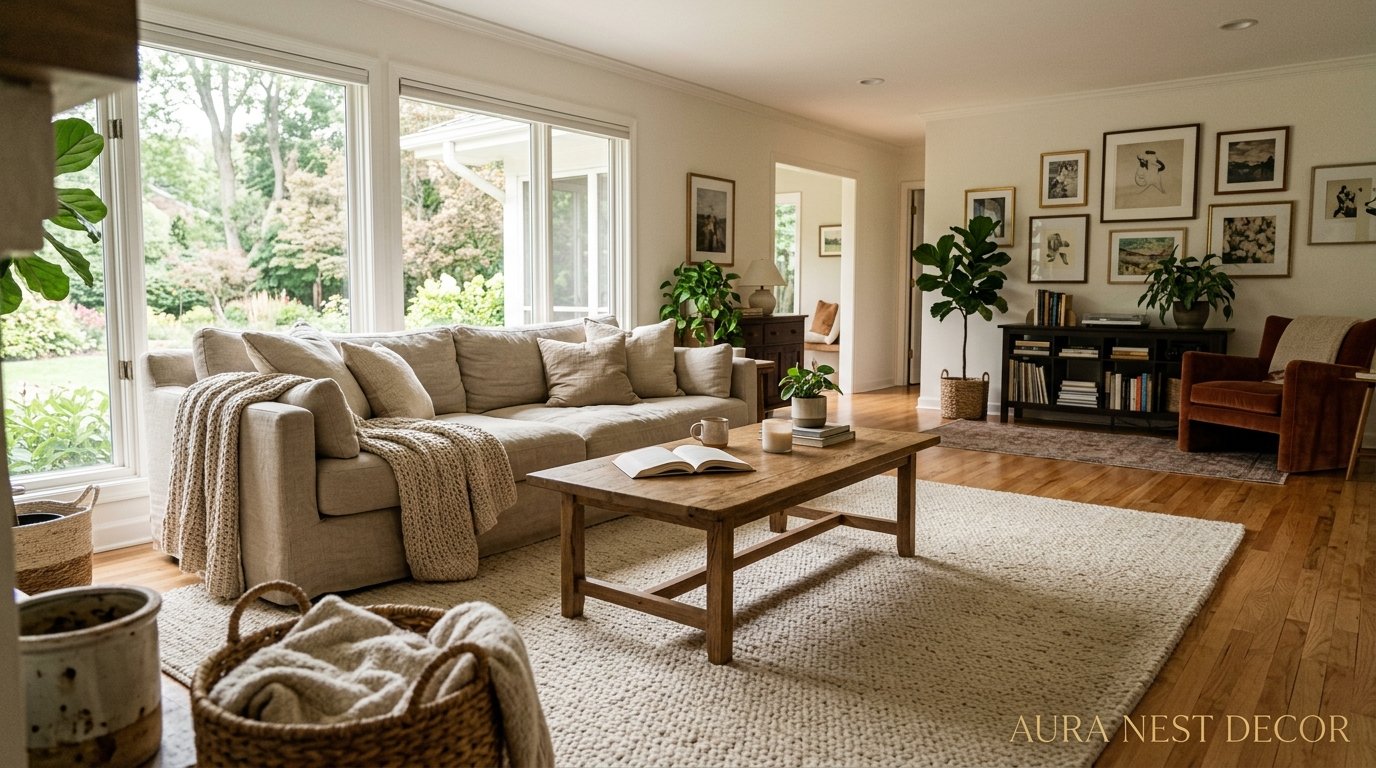
The Rug That Changed My Entire Living Room (And Why I Almost Didn’t Buy It)
I walked past it three times. Too big, I thought. Too much pattern. And then I stood in my living room six months later, staring at the exact empty floor I’d been trying to fix, and I went back for it.
Rugs do something to a room that furniture simply can’t. And yet most of us get them wrong — or worse, we skip them entirely and wonder why the space feels cold.
—
1. Why Your Living Room Feels “Off” (And It’s Probably the Floor)
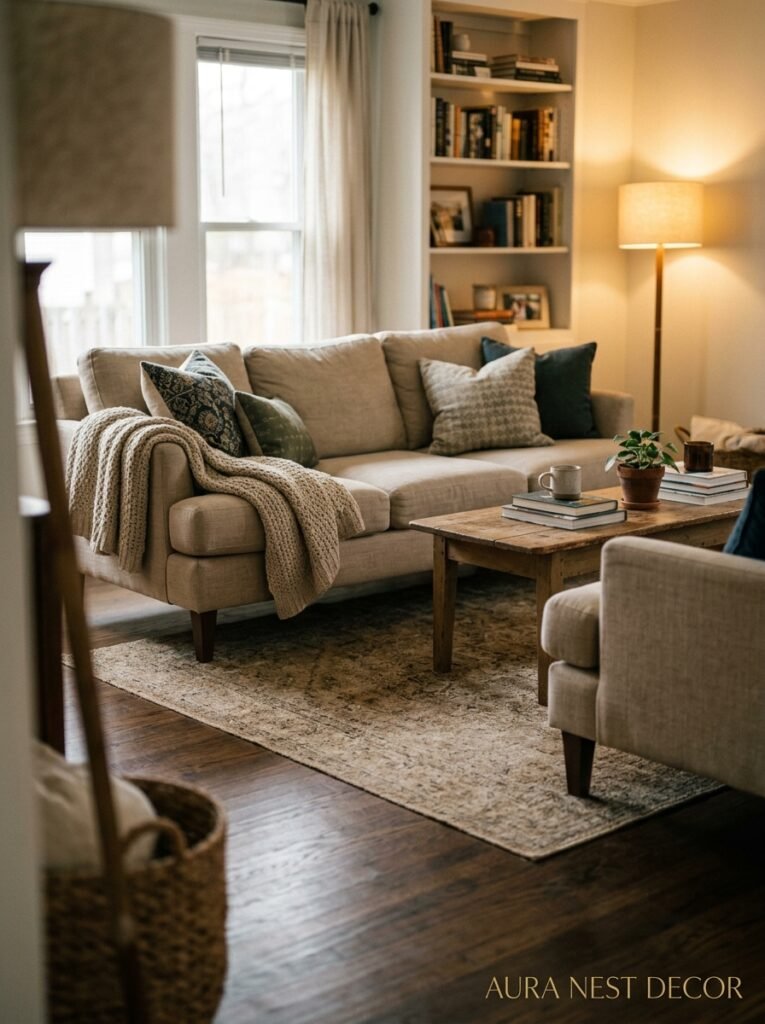
Here’s the thing nobody tells you when you’re decorating: furniture floats. Put a sofa, a coffee table, two chairs in a room, and they’re technically there — but if nothing is anchoring them to the ground, your eye doesn’t know where to settle. The room feels like a waiting room. A hotel lobby. Somewhere you’re passing through, not staying.
A rug fixes that. Not metaphorically — literally. The moment you slide a rug underneath the front legs of your sofa, something clicks. The seating area becomes a zone. It becomes yours.
But this isn’t really about rugs being useful. It’s about the fact that a good rug is the most underestimated design decision in any living room, and most people treat it like an afterthought. They buy the sofa first, the coffee table second, the curtains, the cushions, the throw blanket — and then they go looking for “a rug to go with everything.” That’s backwards. Or maybe it isn’t, maybe that’s just how most of us actually shop, and the real problem is just not knowing what to do when you get there.
Start here instead.
—
2. The Size Rule Everyone Gets Wrong (Go Bigger Than You Think)
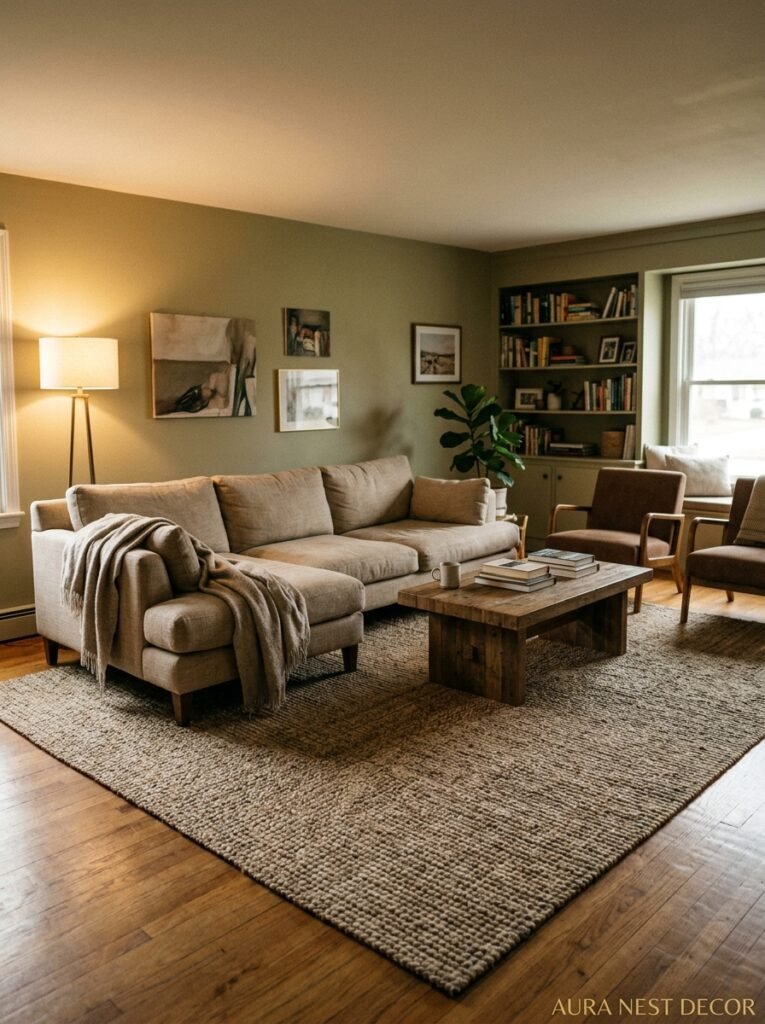
Okay. If there’s one thing I would shout from a rooftop about rugs, it’s this: the rug you’re considering? Get the next size up.
The most common mistake — and I’ve made it myself, twice — is buying a rug that’s too small. A 5×8 in a standard living room looks like a postage stamp. Your furniture surrounds it awkwardly, none of the legs are on it, and the whole effect is kind of sad. You end up with a rug that looks like it got lost on the way to the nursery.
For most living rooms in US homes, you want at least an 8×10. A 9×12 is even better if your space can hold it. In UK homes where rooms tend to run a bit narrower, you might work with a 200x290cm — but the principle is the same. Go bigger than feels right in the shop. Because on your actual floor, surrounded by your actual furniture, it’ll look exactly right.
The classic guidance is this: in a properly-sized rug arrangement, the front legs of all your main seating should rest ON the rug. Not beside it. Not almost on it. On it. That’s what creates the unified, intentional look that makes a room feel designed rather than assembled.
“A rug that’s too small doesn’t just look wrong — it makes everything around it look wrong too.”
—
3. The Color That Keeps Showing Up in Every Beautiful Living Room Right Now
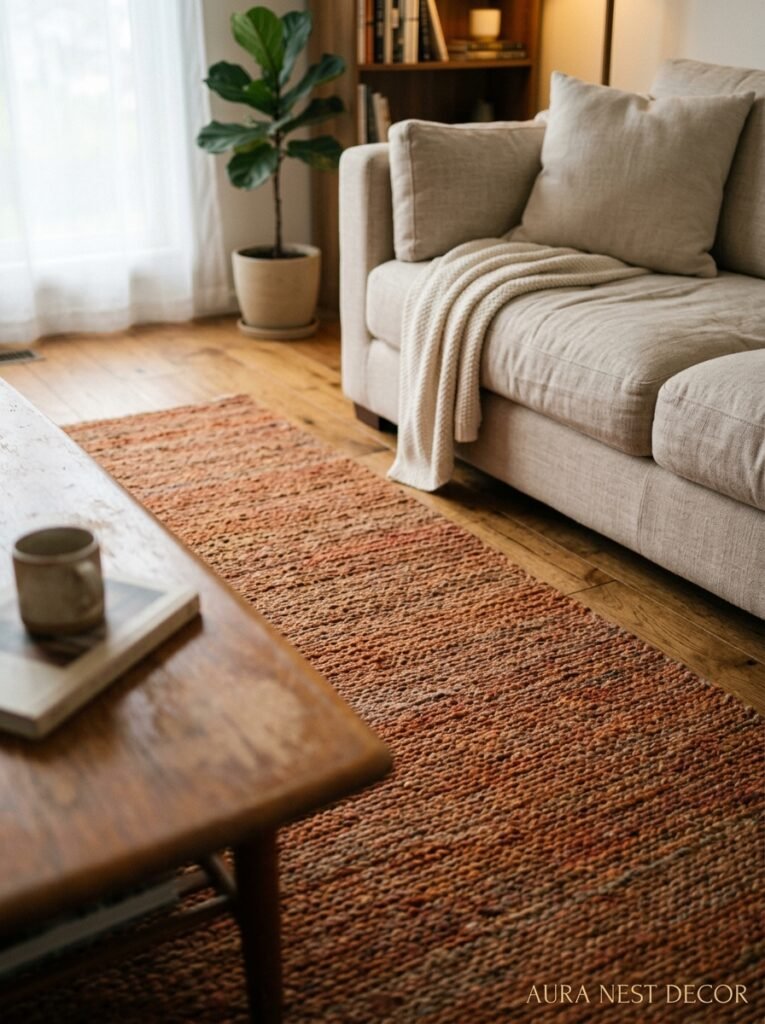
Not beige. Not grey. Those are fine — genuinely, no shade — but the color that’s everywhere right now in every saved pin I keep coming back to is warm terracotta. Dusty clay. That sort of faded burnt orange that sits somewhere between rust and blush.
It works with linen sofas. It works with dark green walls. It looks INCREDIBLE next to warm wood floors and does something almost magical with brass hardware. And unlike grey, which kind of neutralizes everything around it, terracotta brings the warmth up. It makes rooms feel lived in and glowing, even in winter when the light is flat and terrible.
That said — if terracotta isn’t your thing, the other shade I’d point to is a warm cream with natural texture variation. Something that looks slightly imperfect and handmade, not stark white. Bleached Moroccan-style wool. Jute-blend flatweaves in oat and sand. Anything that feels organic and a little worn-in, rather than brand new.
What I’d mostly steer people away from right now is cool grey. Not because it’s ugly, but because it’s been so dominant for so long that rooms with cool grey rugs are starting to feel dated in a way that’s hard to pinpoint. The space just feels like 2017.
—
4. Low Pile, High Pile, Flatweave: Actually What Should You Choose
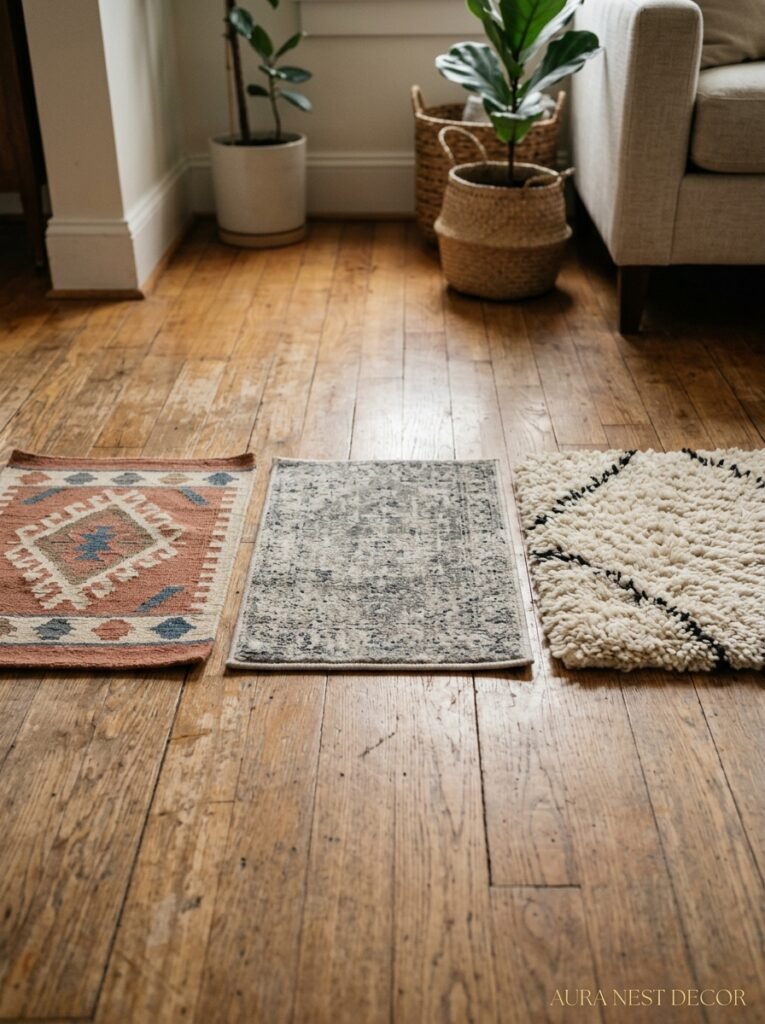
This genuinely depends on your life. Not your aspirational life. Your actual one.
Do you have kids or a dog? Do you eat snacks on the sofa constantly (no judgment)? Is vacuuming something that happens once a week or once it becomes impossible to ignore? Be honest. Because a long, plush, high-pile shag rug is absolutely stunning and also the most impractical thing you can put in a room with a golden retriever or a toddler with crackers.
High pile rugs — those thick, fluffy, almost cloud-like ones — are incredible for softness underfoot. They photograph beautifully. They feel like a hug when you’re sitting on the floor. But they flatten in traffic paths, they trap pet hair at a cellular level, and they’re genuinely awkward to vacuum properly. If you’ve got a quieter household, go for it. They’re worth it.
Flatweaves — think kilim, dhurrie, woven cotton or jute blends — are the opposite. Easy to clean, hold their look under heavy use, don’t flatten. Side note — flatweaves also tend to be cheaper, which matters when you’re going up to an 8×10 or larger. The downside is they offer basically no cushioning, which you’ll notice if you’re someone who sits on the floor a lot.
Low-to-medium pile is the sweet spot for most households. Substantial enough to feel luxurious, practical enough to actually live on.
“Choose the rug for the life you actually live, not the life you imagine you’ll start living once the house is tidy.”
—
5. The Case for Pattern (Even If You Think You’re a Neutrals Person)
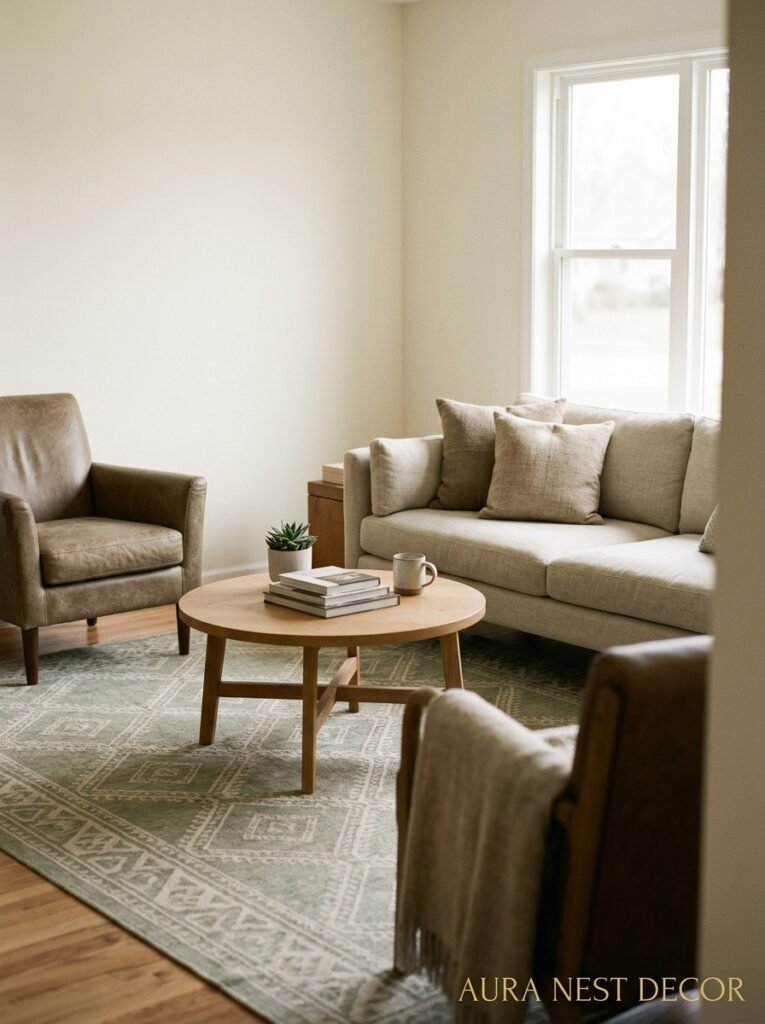
I thought I was a neutrals person for years. I have a cream sofa, light wood floors, white walls. Very calm, very restrained. And then I put down a patterned rug — this geometric Moroccan thing with charcoal lines on a warm white ground — and the whole room finally had a personality.
Pattern doesn’t mean busy. It doesn’t mean your room looks like a catalog from 1994. A single graphic pattern on a rug actually makes it easier to design around, not harder, because it gives you something to pull from. That rug pulled in charcoal (which I used for the throw and the frame on the wall), and it pulled in that warm off-white (which matched literally everything else already in the room). Done.
The patterns that feel most current right now: abstract geometrics, hand-knotted-style diamonds and medallions, painterly abstract designs that look almost like watercolor from a distance. All of these work across a lot of different room styles — they don’t lock you into one aesthetic the way, say, a very traditional floral or a very specific vintage map rug does.
One word of warning: if you have a patterned sofa, a patterned rug in a competing scale is going to fight. Go bigger, bolder, or just quieter with one of them.
—
6. What Nobody Mentions About Layering Rugs
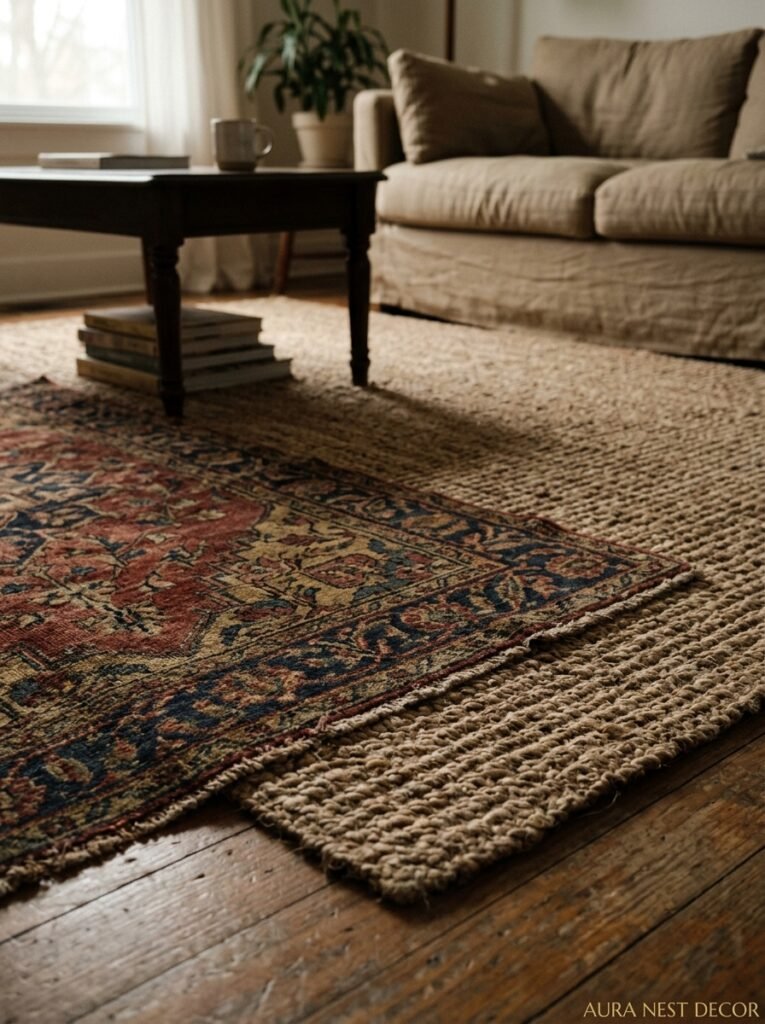
Layered rugs — you know the look, a flatweave or jute underneath, a smaller statement rug on top — are one of those trends that genuinely looks as good in real life as it does on Pinterest, but there are a few things nobody really explains before you try it.
First: the base rug needs to be flat. Like, genuinely, properly flat to the floor. If your bottom layer has any pile to it, the top rug will slide. Not gradually. Actively. You will come downstairs one morning and the top rug will be three feet from where it started and somehow tucked under the coffee table leg. Get a flatweave for the base.
Second: rug pads. Two of them. One under the base rug, one between layers. Yes, this is more effort than it sounds. It’s worth it.
Third — and this is the part I love — you can layer a smaller, more expensive, more special rug over an inexpensive jute base and get a high-end look without spending high-end money on a huge surface area. A beautiful 4×6 Beni Ourain-style wool rug layered over a $90 jute? Looks like you spent three times as much. I’m not gonna lie, I’ve done this, and guests genuinely think the whole setup is some curated vintage find.
—
7. The One Rule That Makes Any Rug Look More Expensive
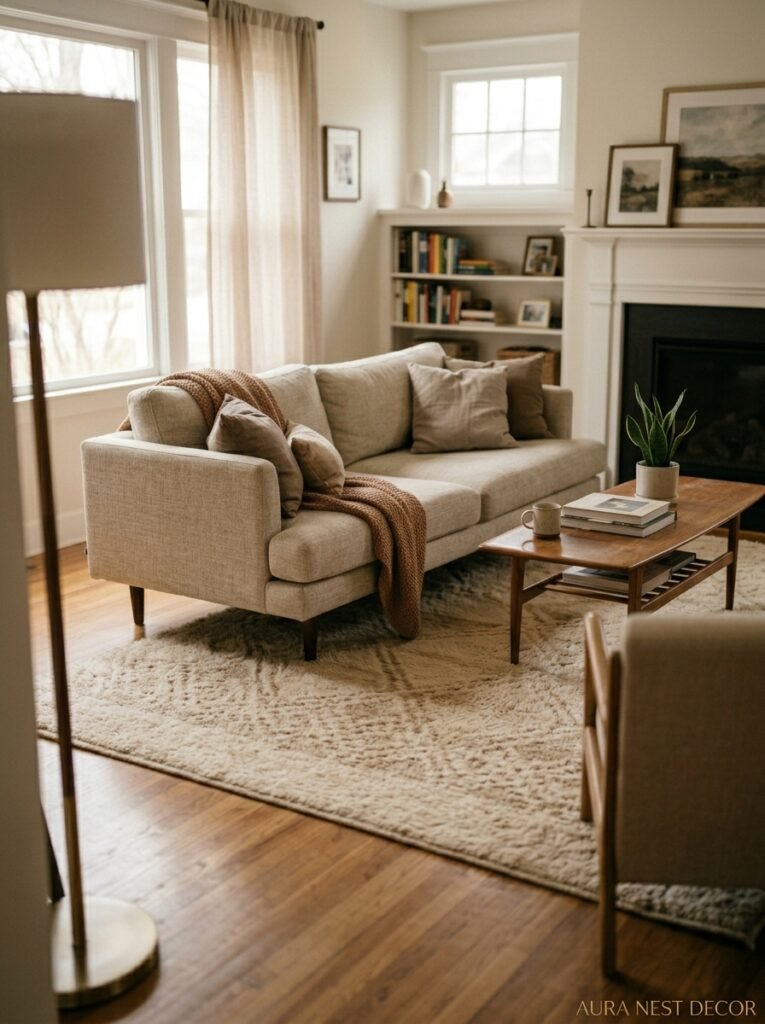
Leave a consistent border of floor showing around the edges of the rug.
That’s it. That’s the rule.
When a rug goes wall-to-wall or nearly wall-to-wall, it reads like carpet. When it’s floating in the middle of a room with no furniture anchoring it, it reads like a bath mat someone put in the wrong room. But when you can see 12 to 18 inches of floor on every side? It frames the rug. It makes the rug look chosen, placed, intentional.
This is also why I’d argue that an 8×10 in a slightly smaller room often looks better than a room-filling rug — because that border of hardwood or tile becomes part of the visual composition. The floor isn’t something you’re hiding. It’s something you’re framing.
“The floor showing around the rug isn’t wasted space. It’s what makes the rug look deliberate.”
—
8. Vintage and Overdyed Rugs: Why They’re Worth the Hunt

Not everyone wants a new rug. And honestly, I think some of the most beautiful living room rugs I’ve ever seen were vintage finds — faded Persian rugs from an estate sale, old Turkish kilims from an Etsy shop, overdyed pieces where the original pattern is almost hidden under a wash of deep teal or ochre.
There’s something about a worn rug that a brand new one just can’t replicate. The way the pile is slightly compressed in the traffic paths. The slight irregularities in the pattern that remind you a person made this. The colors that have softened and bled together over decades into something richer and more complex than anything you can buy off a shelf.
Vintage rugs also tend to be incredibly well-made. A fifty-year-old hand-knotted wool rug has survived fifty years — it’ll survive your family just fine.
For UK buyers, searching local auction houses and online markets like Vinterior or BCAR can turn up incredible pieces, sometimes for less than a mid-range new rug. In the US, Chairish, eBay, and Etsy’s vintage section are all worth a serious look. Budget a bit of time. These things reward patience.
—
9. The Underrated Power of a Round Rug in a Square Room
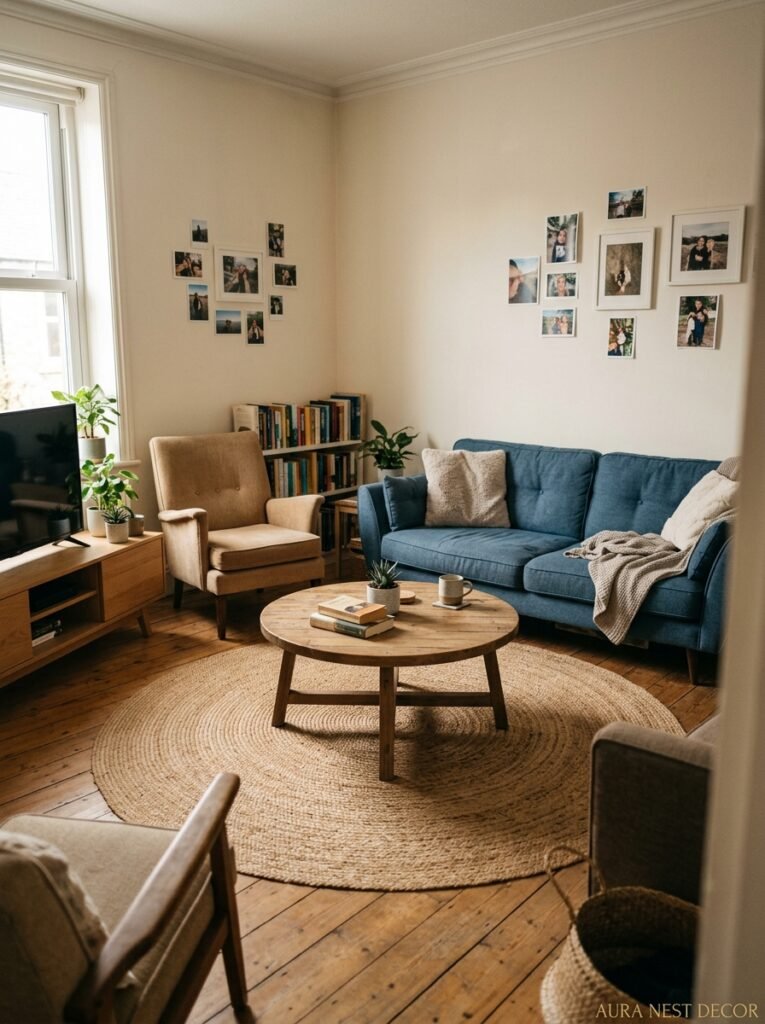
Everyone defaults to rectangular. But a round rug in a living room does something really specific and interesting — it softens the hard geometry of the room, and it creates a natural gathering point that rectangular rugs don’t quite manage in the same way.
Round rugs work particularly well around a single armchair or reading nook. They work beautifully in rooms where you want the seating to feel circular and conversational rather than aligned along a wall. And they’re GREAT in rooms where nothing is quite square — older UK homes especially, where walls aren’t always parallel and corners aren’t always ninety degrees.
The trick with round rugs is that they need to be big enough to anchor the furniture around them. A small round rug in the center of a large room reads as decorative, which is fine in some contexts and awkward in others. Go for at least 8 feet in diameter for a proper seating area.
—
10. How to Stop Your Rug From Sliding Around (For Good)
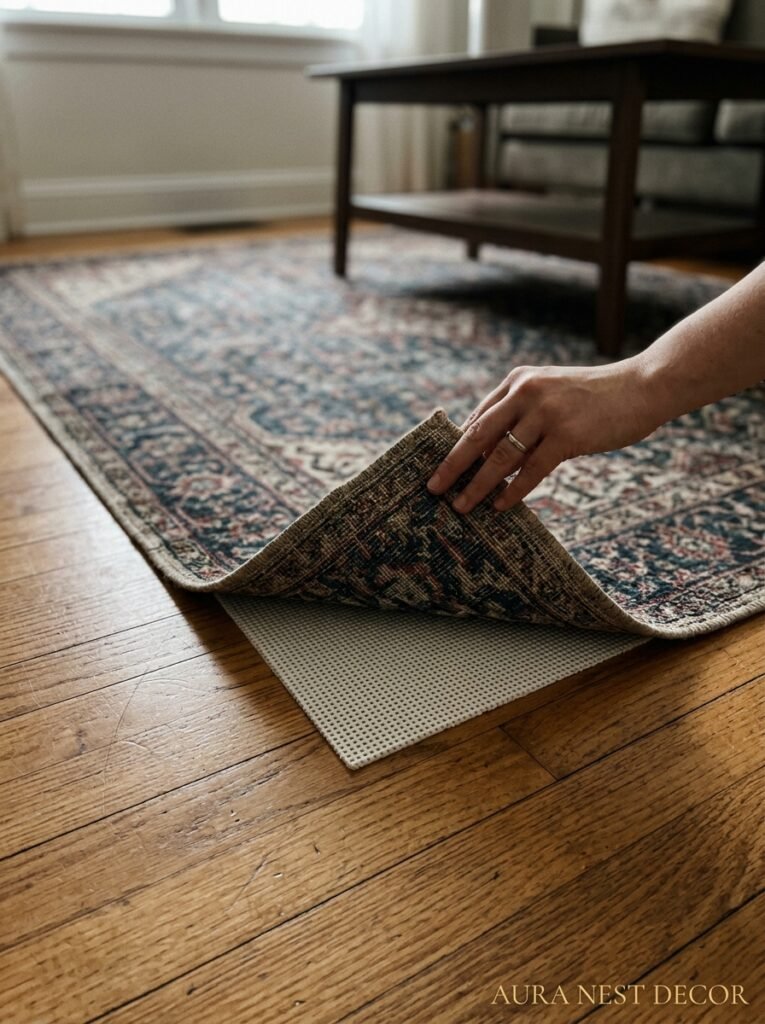
A rug pad. I can’t stress this enough. Not the thin, cheap foam ones that disintegrate after three months. A proper rug pad — thick felt and rubber combined, cut slightly smaller than your rug on all sides so it doesn’t show.
Rug pads protect your floor from dye transfer (real issue, especially with dark or vintage rugs on light hardwood), they protect the back of your rug from friction, they add cushioning underfoot, and they keep the rug from skiing across the room every time someone walks on it.
They add cost. A good 8×10 rug pad runs $50-80 in the US, £40-60 in the UK. It’s worth it. Categorically.
—
11. Dark Rugs in Light Rooms: The Combination That Shouldn’t Work But Does
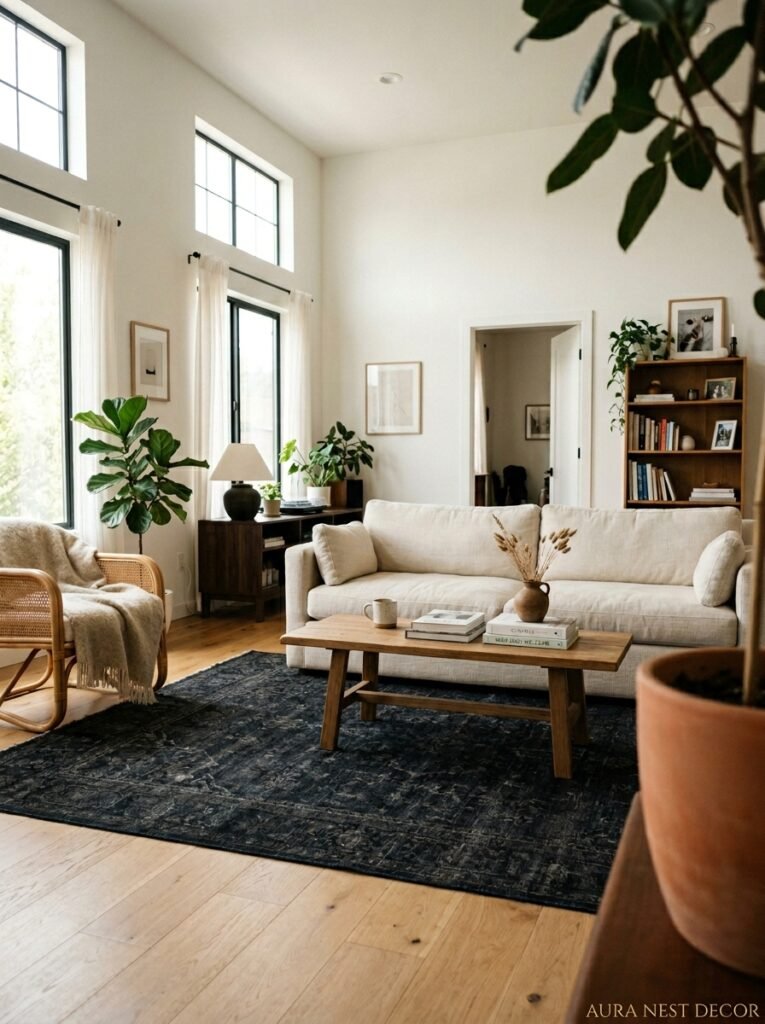
There’s a version of this that looks terrible — a random dark rug plopped into a light room with no visual connection to anything else in the space. But when it’s done right? A deep, near-black charcoal rug, or a rich navy, or an almost-black forest green in a light, airy room? Stunning.
The key is repetition. Pick up the rug color somewhere else in the room — a dark throw pillow, a lamp base, a picture frame. Just once is enough. It tells your eye this was a decision, not an accident.
Dark rugs also hide an enormous amount of everyday mess, which, honestly, is a completely valid design consideration and nobody should be embarrassed about it.
—
12. The Budget Reality: Where to Spend and Where to Save
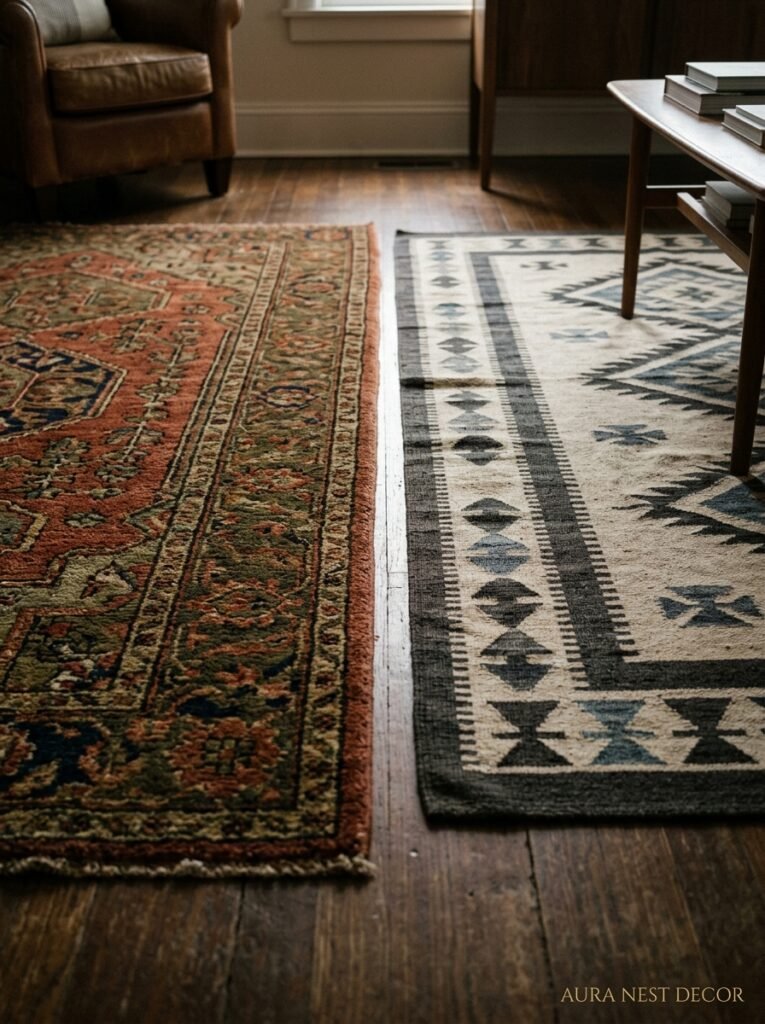
Real talk. A good rug is expensive. A GREAT rug — wool, hand-knotted, the kind that looks better after five years — can be very expensive. And it’s genuinely worth saving up for if you can, because a quality rug lasts decades and a cheap one does not.
But if your budget is tight right now, here’s where I’d focus: spend more on the rug pad and less on the rug itself if needed. A mid-range rug on a good pad looks and feels better than a high-end rug without one. Also, flatweave rugs in the $200-400 range can look absolutely beautiful — it’s not all about thick pile.
And look at sales. Wayfair, IKEA’s STOCKHOLM range, Ruggable (especially for households that need washable), and companies like Loloi through various US retailers all have genuine quality at different price points. In the UK, John Lewis, Habitat, and The Rug Company’s outlet are worth watching. You don’t have to spend a fortune to get something you’ll love.
—
❓ FAQ
Q: How do I know what size rug I need for my living room? A: The easiest rule: measure your seating area and size up from there. You want the front legs of your sofa and chairs resting on the rug, not beside it. For most living rooms, an 8×10 is the starting point — go to 9×12 if your room is large. When in doubt, cut kraft paper or tape the floor to visualize the size before you buy.
Q: Can I put a rug over carpet? A: You can, and it actually works better than people expect — especially in rental homes where you can’t change the carpet. A flatweave or low-pile rug over carpet creates that zone effect and adds visual interest. Use a rug gripper or furniture to hold it in place, since a normal rug pad won’t grip carpet the way it grips hard floors.
Q: How often should I clean my living room rug? A: Vacuum weekly for pile rugs (monthly for flatweaves held up by furniture weight), rotate it 180 degrees every six months to even out wear and sun fading, and get it professionally cleaned every two to three years if it’s a quality wool piece. For everyday spills, blot immediately — never rub — and tackle stains with cold water and a tiny bit of dish soap before anything else.
—
💭 Final Thoughts
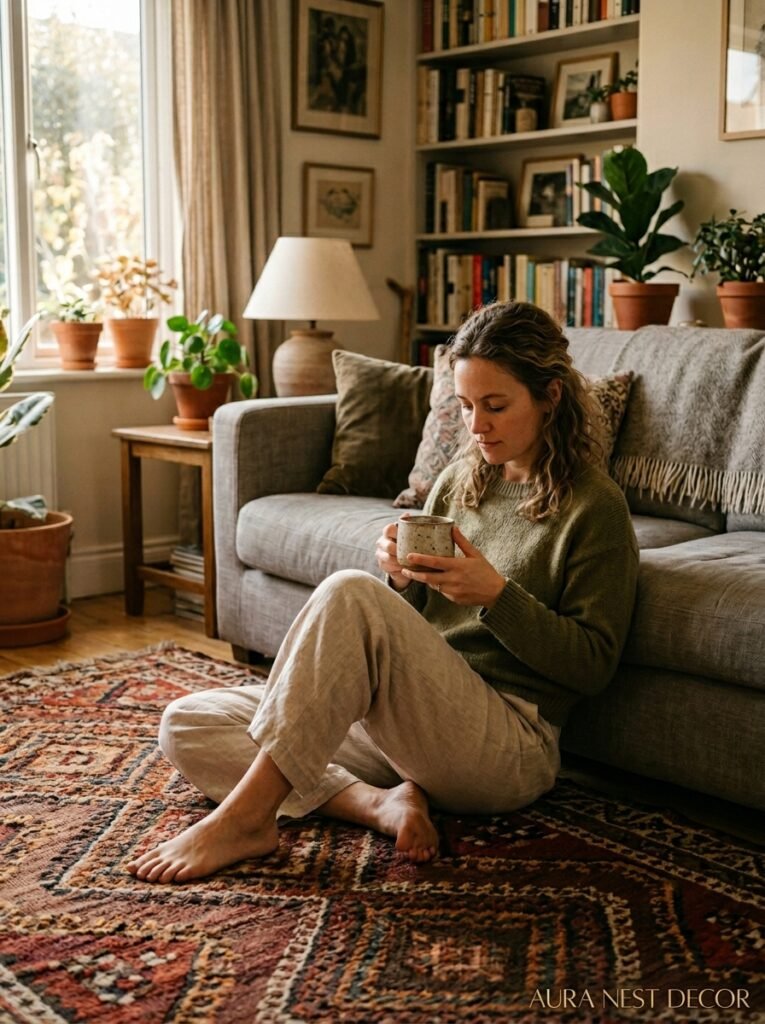
A rug isn’t just a floor covering. It’s the thing that tells a room it’s a room — that this is a place to stay, not just pass through. Get the size right, trust yourself with a bit more pattern or color than feels safe, and don’t buy without a rug pad.
What’s the rug situation in your living room right now — is it working, or is your floor still trying to tell you something?