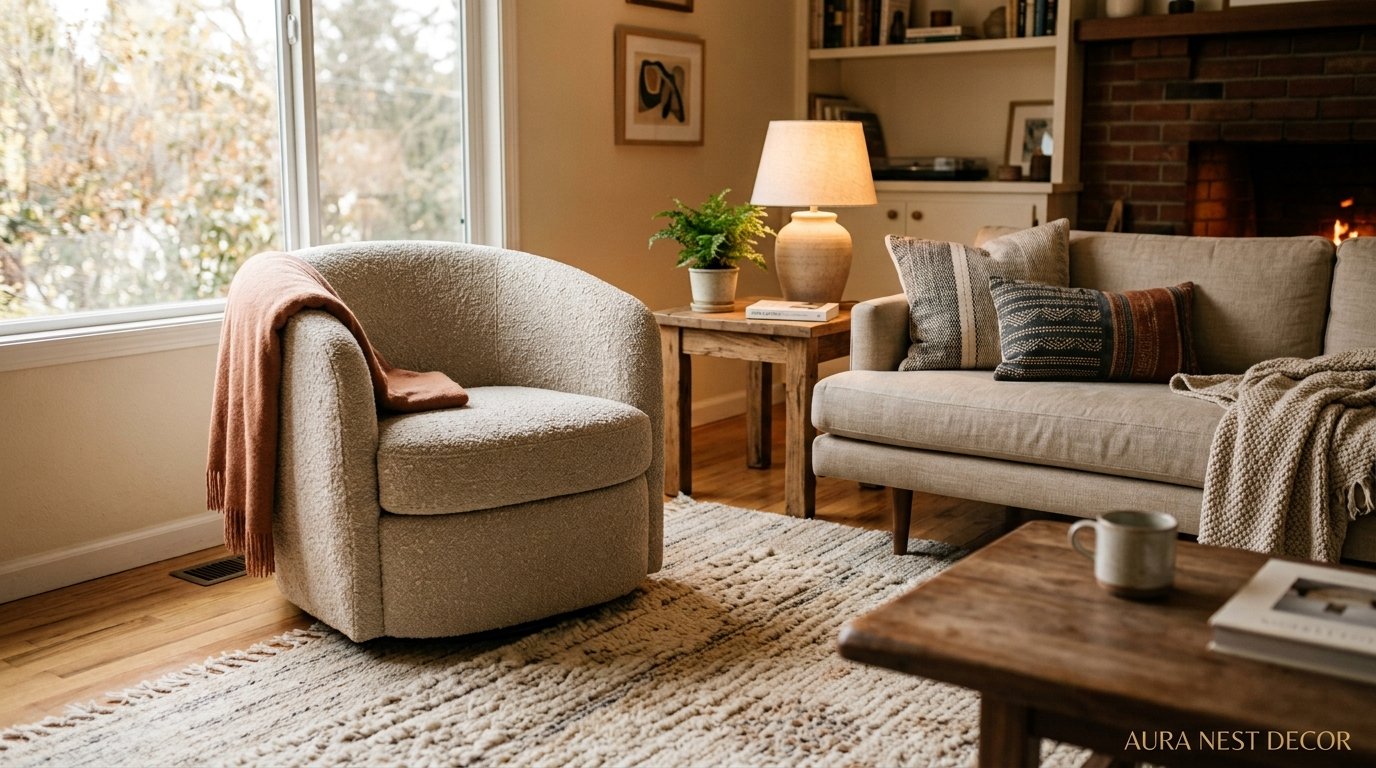
The Swivel Chair Is Having Its Moment — And Honestly, It’s Been Earning This
You’ve seen it on every Pinterest board that stops your scroll. That one chair. The one that sits slightly apart from the sofa, angled just enough to feel intentional, and somehow makes the whole room look pulled together in a way you can’t immediately explain. It swivels. And yes, that matters more than you think.
—
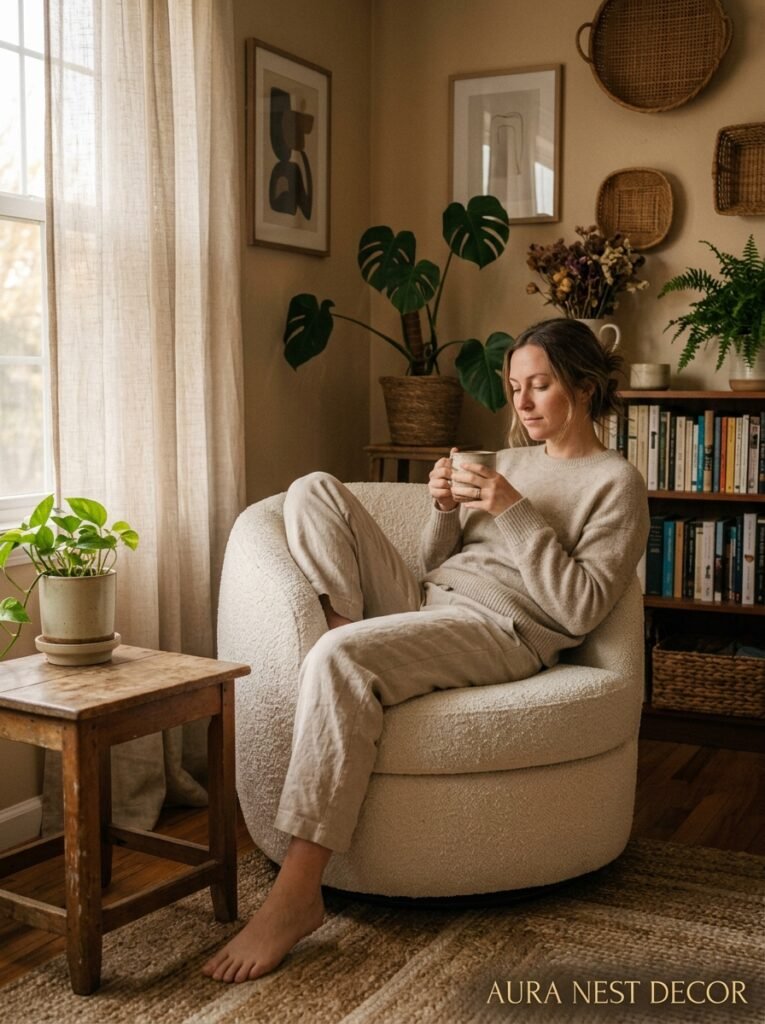
1. Why Everyone Who Has One Says They Can’t Imagine Going Back
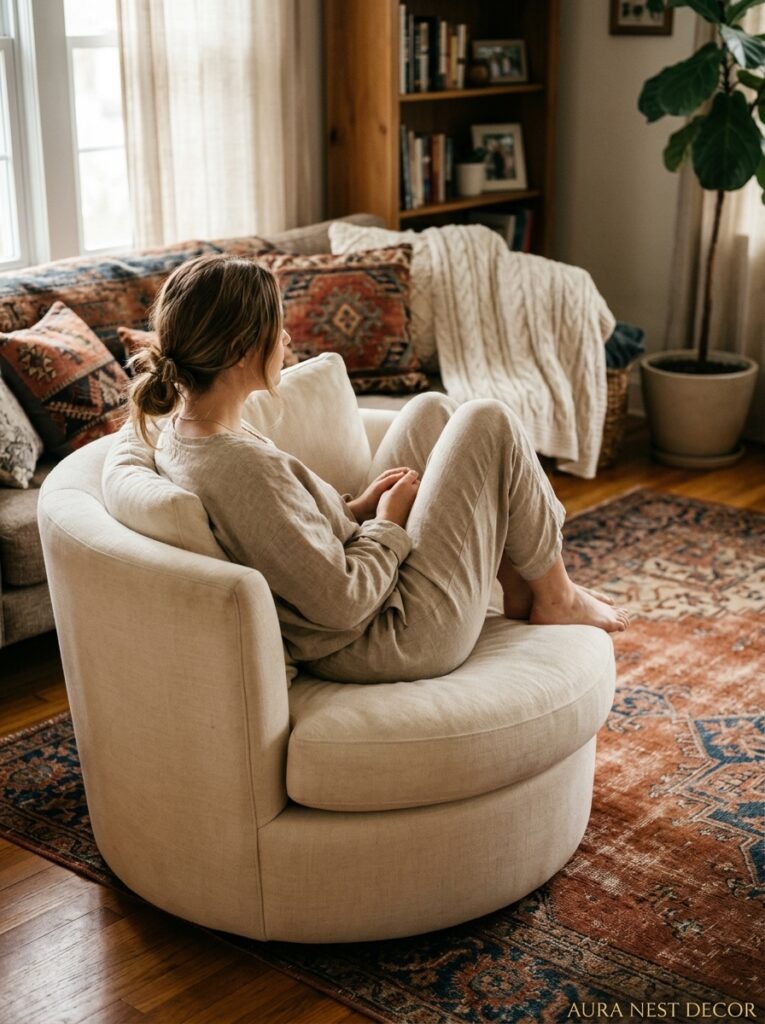
Ask anyone who owns a swivel chair in their living room and watch their face. There’s this little light that comes on. Because a swivel chair doesn’t just sit there — it participates. You turn toward the TV, then toward the conversation, then toward the window when the afternoon light comes in right. You’re not locked in. You’re not planted. There’s something genuinely freeing about furniture that moves with you instead of requiring you to contort around it.
I didn’t fully get this until I spent a weekend at my friend’s place in Edinburgh. She had this low, rounded barrel chair in a deep sage velvet, and it sat on a solid brass swivel base near the bay window. I sat in it maybe four times that weekend. Each time I ended up just… staying. Swiveling slightly toward whoever was talking. Looking out at the street. Turning back. It felt less like sitting in a chair and more like being at the center of the room without making it weird.
That’s the magic. A swivel chair is secretly social furniture. It makes you accessible in a way a fixed armchair just doesn’t. And because it usually sits at a slight remove from the main sofa arrangement, it gives you the option to be part of the group or slightly your own person. Which, honestly, is all any of us want.
“A swivel chair doesn’t anchor you to one view of the room — it gives you all of them.”
—
2. The Silhouette That’s Showing Up in Every Room That Feels Actually Cozy (Not Just Pretty)
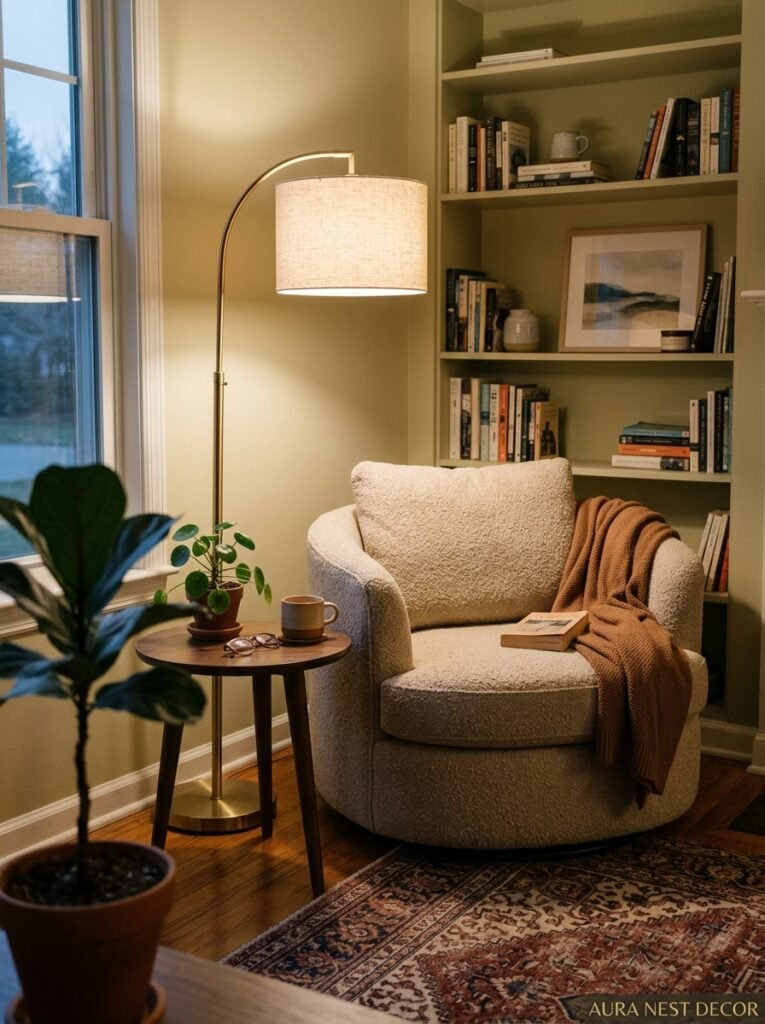
Right now the shape that’s everywhere is the round barrel swivel — curved back, low arms or no arms, upholstered fully so there’s no visible leg until you get to the base. It reads modern but it doesn’t feel cold. And that’s a hard line to walk. So many “contemporary” pieces end up feeling like a showroom you’re scared to touch. The barrel swivel feels like something you’d actually sink into at 9pm with a book.
But the classic tub-style swivel is having a moment too, especially in the UK where that silhouette has a kind of mid-century heritage that fits so well into Victorian terrace conversions and open-plan kitchen-diners. Wide seat, curved arms, the whole thing slightly overscaled in a way that feels intentional rather than accidental.
The version I can’t stop pinning lately is the scoop-back swivel — it’s more minimal, almost Japanese in its restraint, but with a swivel base it becomes dynamic. Still. You’d never guess it from a photo.
What they all have in common is that the base carries the whole look. Get the base right and you can get away with almost any silhouette. Wrong base and even a beautiful chair looks like it rolled in from a waiting room.
—
3. The Color That Keeps Showing Up in Every Living Room That Actually Looks Considered
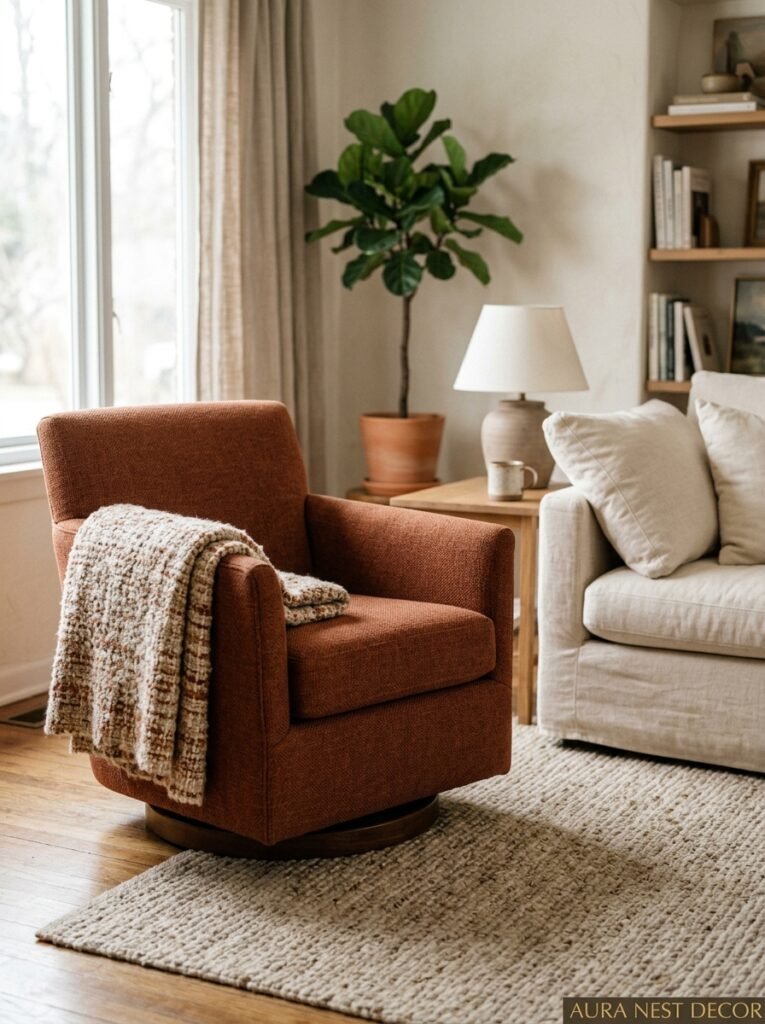
Boucle in oat or cream. Velvet in deep forest green. Leather in a cognac that photographs like a sunset. These are the three colorways that absolutely DOMINATE swivel chair content right now, and there’s a reason. Each one anchors a different mood.
The boucle cream says: this is a calm house. A slow Saturday house. A house where the throw pillows get rearranged for fun.
The deep green velvet says: we make real cocktails here and the bookshelves are actually read.
The cognac leather says: I bought one good thing instead of four mediocre things and I was right.
But honestly? The most interesting rooms aren’t the ones following those color scripts. I’ve been seeing dusty rose velvet swivel chairs popping up in rooms that should be too cool for them — minimalist, almost brutalist spaces where that one blush chair is doing something nobody expected. And it WORKS. The contrast is everything.
Don’t overthink the color. Pick the one that makes you pause for a second longer than the others and trust that. Your room will adjust.
—
4. How to Position It So It Doesn’t Look Like It Got Lost on Its Way to an Office
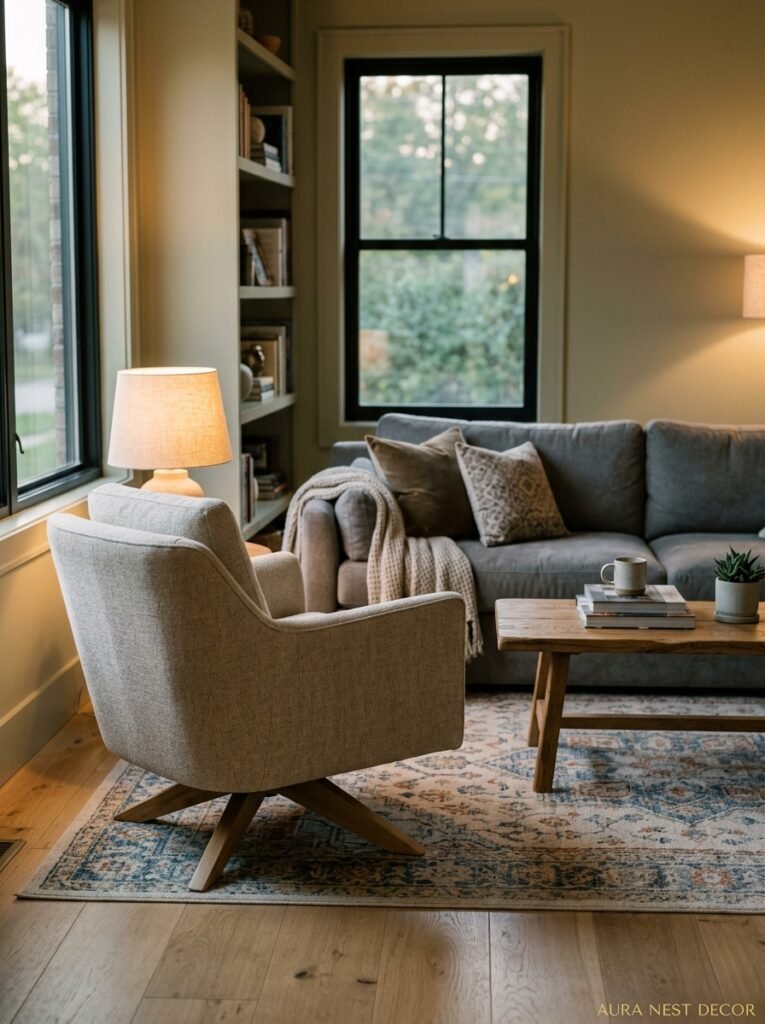
This is the thing people get wrong most often. They buy the chair, they love it, they put it in the corner parallel to the sofa, and then something feels off. The room looks like a waiting area. Or a hotel lobby. Not a home.
The secret is the angle. A swivel chair almost never looks right at 90 degrees to anything. You want it angled in — maybe 30-45 degrees toward the center of the room, or toward wherever conversation happens. It signals that the chair is leaning in, which is exactly what you want.
Then there’s distance. People pull swivel chairs too close to the sofa. Give it room to breathe. A gap of three to four feet between the chair and your main seating creates what designers call a “dialogue” between pieces — it’s close enough to be part of the room but far enough that it’s its own thing.
Side table or no side table? Side table. Always. Even a small one. A drink, a book, a lamp. Without it the chair looks unmoored, like it arrived and hasn’t quite settled. The right little table tethers it to the space without fixing it in place.
“Angle the chair toward the conversation. It changes everything about how the room reads.”
—
5. The Rug Situation — Because This Is Where People Either Nail It or Lose the Plot
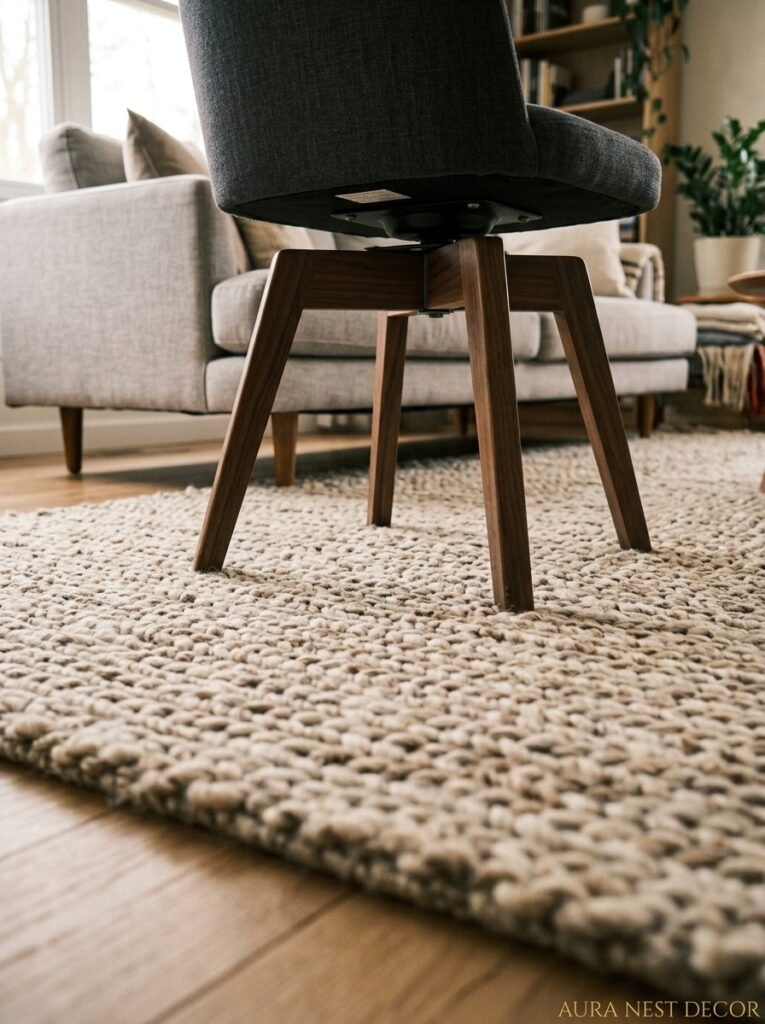
Here’s where I’ll be direct with you: the swivel chair needs to be ON the rug. Partially, at least. I know some people go back and forth on this, I know there are arguments for floating furniture off rugs in certain configurations, but for a swivel chair specifically? If it’s sitting entirely off the rug, it looks like an afterthought. Like you ran out of rug and just put the chair wherever.
Even having the front two “feet” of the base on the rug is enough. It pulls the chair into the room’s anchored zone. It says: this belongs here.
Size matters a lot in this equation. If your rug is already a bit small for the main sofa situation, a swivel chair can actually help — position it at the edge and let it define the perimeter. But if the rug is a good size and the chair sits completely off it, you’ve got a visual orphan and that’s a harder fix.
Pattern-wise, the swivel chair actually gives you permission to go bolder with the rug than you might otherwise. Because the chair is a natural focal point that can “hold” some visual complexity, a patterned rug doesn’t overwhelm the space the way it might in a more rigid, static arrangement.
—
6. What the Base Material Is Actually Telling Your Room
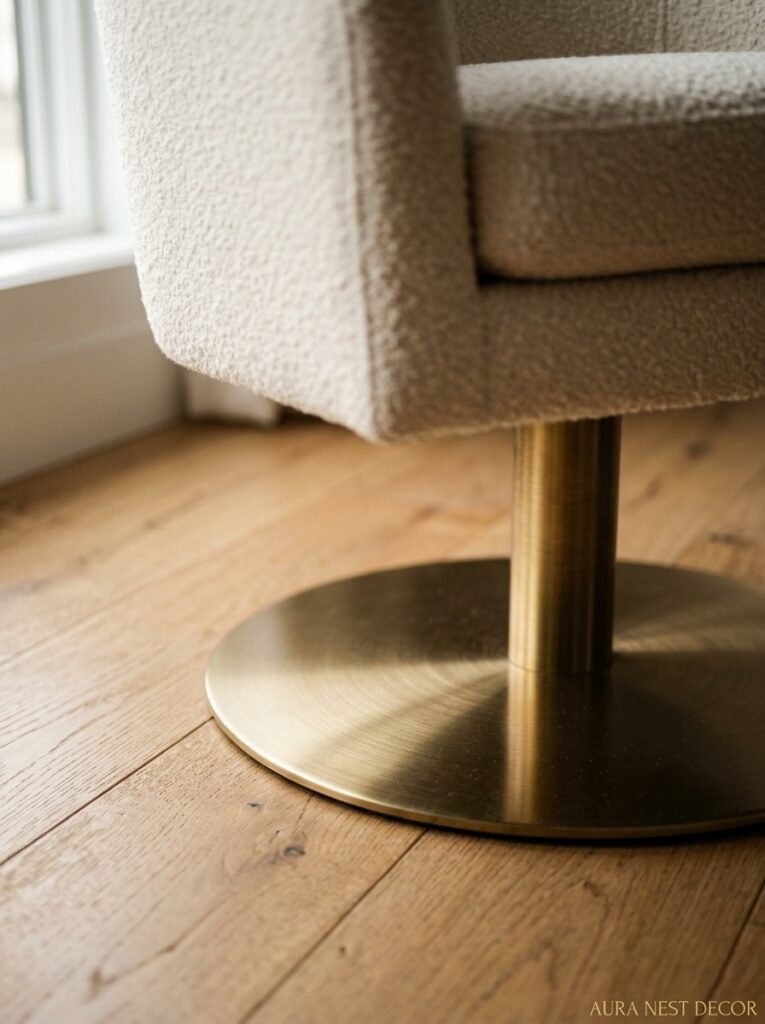
Nobody talks about this enough. The base isn’t decorative. Or — it IS decorative, but it’s also sending a very specific message to everyone who walks into the room. And you should know what that message is before you buy.
Brass base: warm, considered, slightly maximalist even in a minimal room. It whispers “this is intentional.” Goes with warm wood floors, plaster walls, any room that leans earthy.
Chrome or polished steel: cooler, crisper, much harder to pull off in a cozy context. It can work beautifully in the right space — a room with concrete, with dark walls, with really strong graphic art. But in a beige-and-linen room, chrome reads cheap even when it isn’t.
Matte black: safe in the best way. It’s the base that argues with nothing. Works across color palettes, works with timber floors, works with dark and light rooms equally. If you’re unsure, matte black.
Walnut or wood swivel base: oh, this one’s having a moment. Especially in the UK where there’s such a love of mid-century Scandinavian references. A wooden swivel base on a fabric chair gives you something that feels hand-crafted and considered without trying hard.
—
7. The Small Living Room Reality Check Nobody on Pinterest Gives You
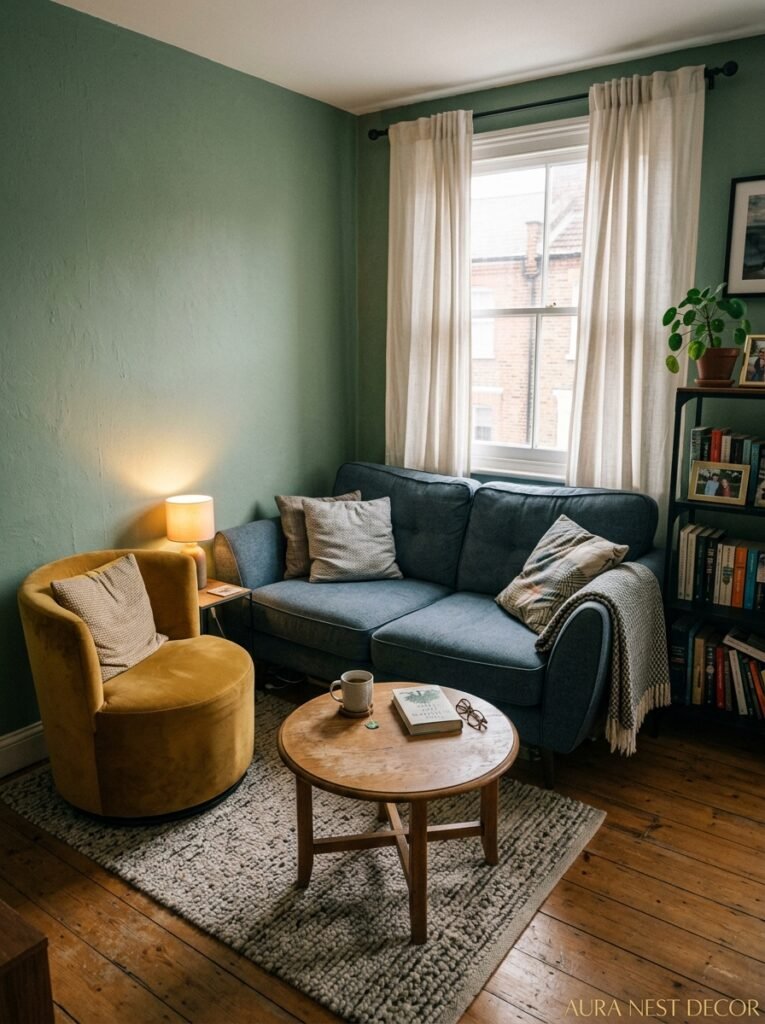
Small room? Still a swivel chair person? Good. But let’s be real about what’s going to work.
Scale is everything. A big barrel swivel in a small living room doesn’t say “bold choice,” it says “mistake.” You want a chair with a smaller footprint — slim profile, minimal or no arms, a lower swivel base so it doesn’t add unnecessary visual height. The chair should feel like it chose that room. Not like it’s squeezing in.
The other thing: color becomes more important in a small space. A swivel chair in a small room is going to be seen. All of it. From multiple angles. So you want something that works from every direction, which means fabrics with interesting texture rather than bold print, and colors that hold up under all your room’s different light conditions.
And weirdly, a small room with a swivel chair can actually feel MORE dynamic than a small room without one. Because the eye lands on it and then moves — the implied motion of a swivel chair does something to perception that a static piece doesn’t. The room feels less static. Less like a box.
“The right small swivel chair doesn’t shrink the room. It tricks your eye into forgetting the room is small.”
—
8. Pairing It With Your Sofa Without Making the Whole Thing Look Matchy-Matchy
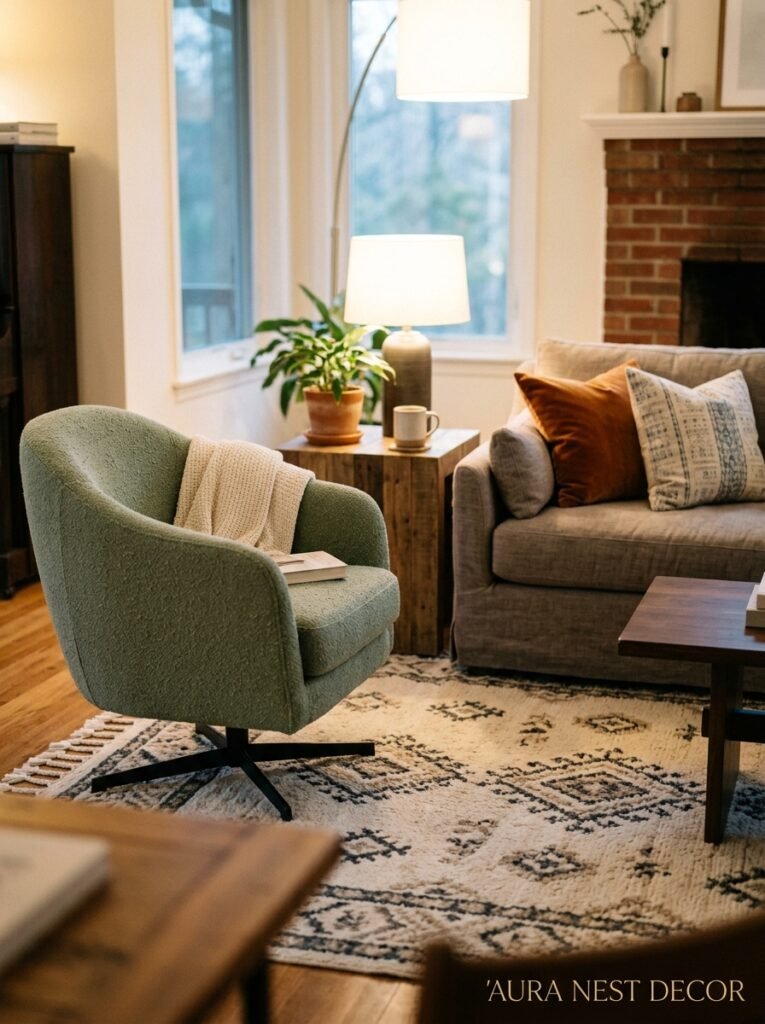
The instinct is to match. And I get it. But please don’t buy the swivel chair in the same fabric as your sofa. That’s not a set, that’s a suite, and suites went out of fashion when Friends went off air.
What works instead is tonal — same color family, different texture. Cream linen sofa with an oat boucle swivel. Charcoal velvet sofa with a slate-blue wool swivel. The tones talk to each other without copying each other.
Or contrast deliberately. Deep navy sofa, cognac leather swivel chair. That’s a pairing that has been circulating on Pinterest interior boards for two years now and it absolutely holds up. The contrast between the cool and warm tones creates a kind of tension that makes the room feel designed rather than just assembled.
What doesn’t work: different colors with similar textures and similar saturation levels. Two equally bright colors in different hues just compete. The chair and sofa need some kind of relationship — even if it’s the relationship of opposites.
And throw pillows help. A pillow on the sofa in the same color as the chair, a pillow on the chair in a fabric that echoes the sofa. It’s the oldest trick but it still works because it creates visual connective tissue across the room.
—
9. The Living Room “Flow” Question — Does a Swivel Chair Block Traffic?
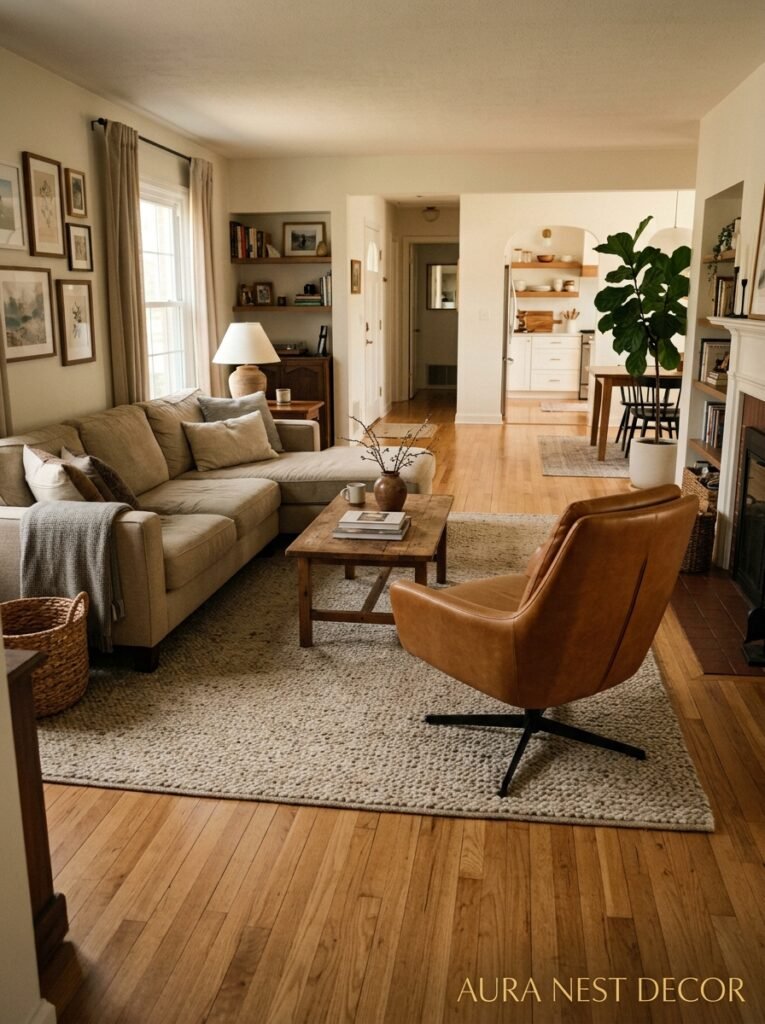
Short answer: only if you place it wrong. Longer answer: a swivel chair, because it moves, is actually one of the more traffic-friendly pieces you can put in a room. Need to squeeze past it? Someone can just rotate it slightly. No legs to trip over. No static arm blocking a path.
But placement still matters. Don’t put it in a natural walkway between the door and the sofa. Don’t put it so close to a coffee table that the swivel motion is immediately blocked on one side. Give it clearance — roughly 18 inches from anything it might rotate into, minimum.
In open-plan spaces, which are basically standard in any new build on either side of the Atlantic now, a swivel chair becomes a natural zone-divider. Position it at the edge of your seating area facing slightly inward, and it creates a soft boundary between the living zone and the dining zone without the heaviness of a room divider or console.
—
10. Vintage vs. New — Because the Old Ones Are Often Better and Everyone’s Sleeping on This
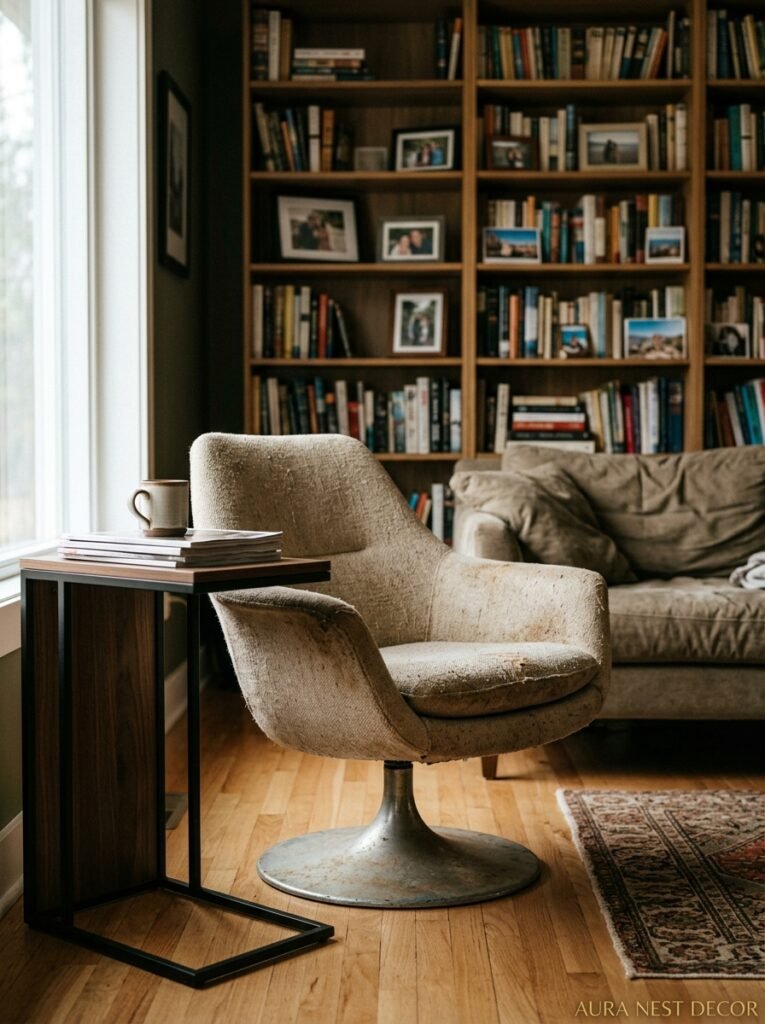
I want to make a case for vintage swivel chairs because the internet isn’t making it loudly enough. The ones made in the 1960s and 70s — particularly the Danish teak base styles, or the Italian chrome-and-leather numbers — were built with a weight and precision that a lot of contemporary versions just don’t match. The swivel mechanism on a well-made vintage chair is SMOOTH. Like, genuinely satisfying. Not the slightly-grindy-after-six-months version you get from some fast-furniture brands.
UK readers have a genuine advantage here. The car boot sales, the charity shops, the Facebook Marketplace finds in places like Bristol and Leeds and Manchester — there are still beautiful vintage swivel chairs out there at prices that would make American thrift store people weep. A Pieff-style chrome base tub chair. A G-Plan barrel swivel. A skinny-legged 70s bucket seat. These are out there.
American readers: estate sales and mid-century consignment shops are your friends. The 70s produced a LOT of swivel chairs because everyone wanted to feel like a Bond villain in their living room, and that legacy is paying off for us now.
Reupholstering is always an option. A tired vintage frame with new fabric is often better than a brand-new budget chair. Not always. But often.
—
11. The Lighting Rule That Makes Your Swivel Chair Setup Look Intentional
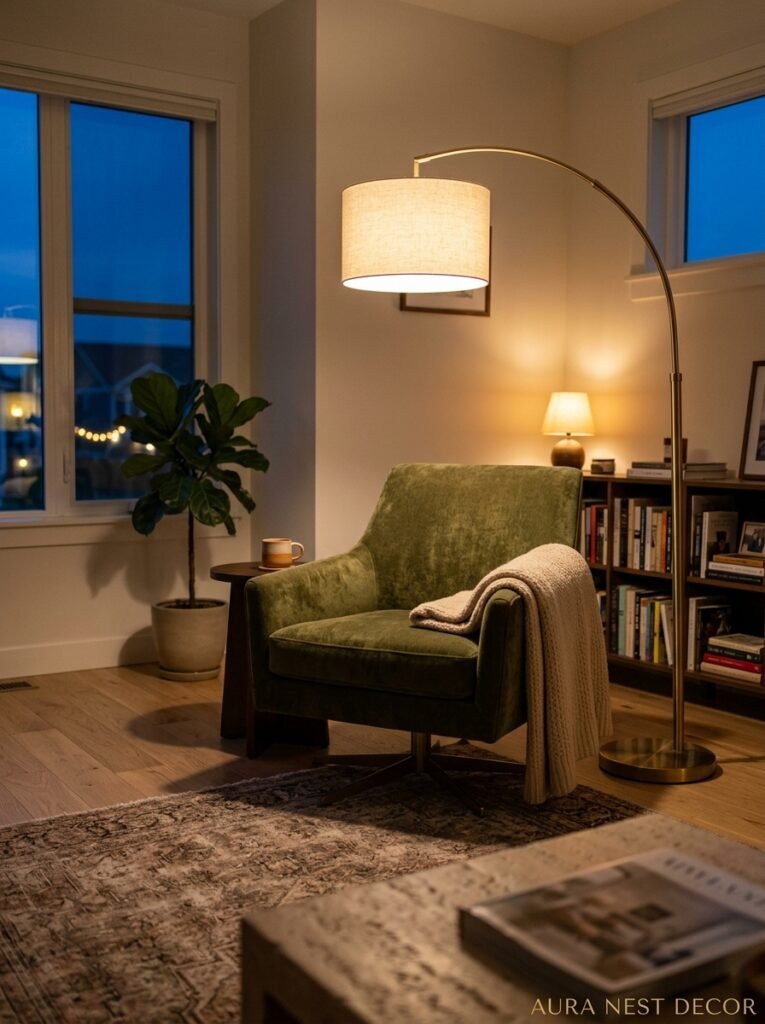
A swivel chair without a lamp next to it is a chair. A swivel chair with a floor lamp or arc lamp nearby is a moment.
The amber glow of a warm-toned floor lamp at 7pm does something to a velvet swivel chair that no amount of natural light can replicate. It creates a reading corner. An island. A place that looks curated and feels safe and somehow makes the whole living room look more considered than it actually is.
Arc lamps work especially well because you can position the base behind or beside the chair and let the arc swing over — it doesn’t crowd the space and it gives you that overhead warmth without requiring a ceiling fitting.
Color temperature matters hugely here. You want 2700K maximum. Anything cooler and the warm mood of the chair evaporates. The lamp is doing half the work the chair is doing, emotionally. Don’t underestimate it.
—
12. The Swivel Chair Detail That Nobody Mentions Until You Notice It On Your Own
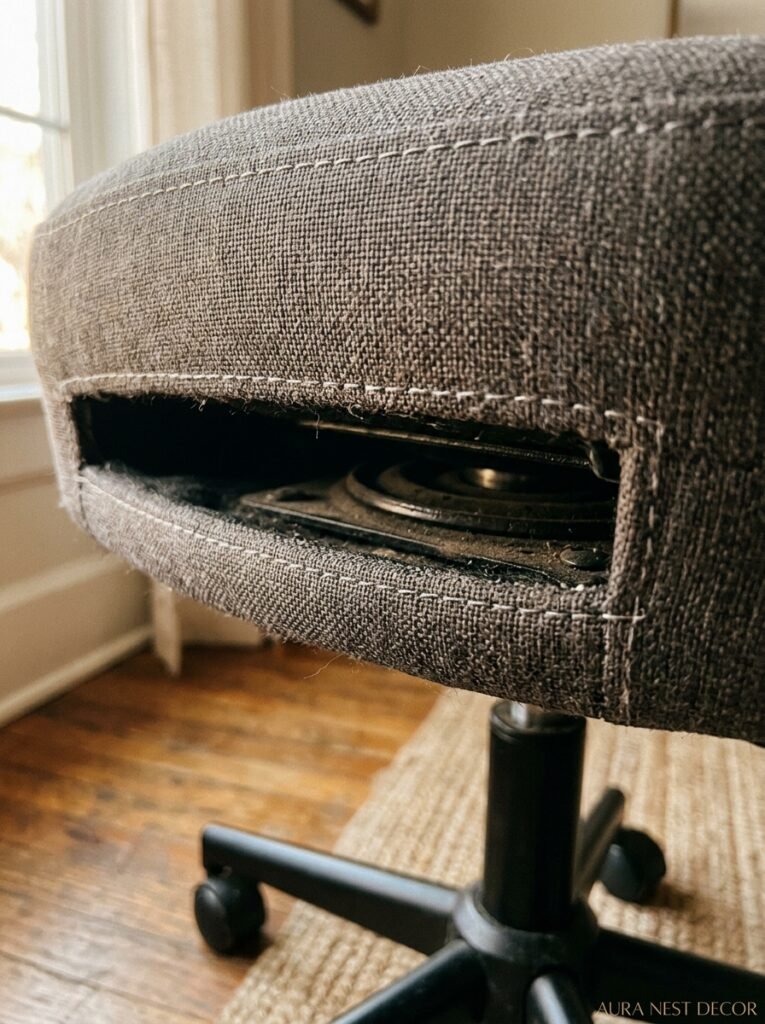
The weight of the chair — how heavy it is to swivel, how it returns to center or doesn’t — is something you can ONLY judge in person. And I say this as someone who has bought furniture online approximately one hundred times and sometimes regrets it: for a swivel chair specifically, try to sit in it if you can.
Because here’s the thing. A swivel chair that’s too easy to rotate will drift every time you shift your weight. You’ll spend the whole evening subconsciously correcting it. A chair that’s too stiff to rotate smoothly loses the whole point. You want that just-right resistance — effortless when you want it, stable when you don’t.
If you’re buying online, read the reviews specifically for swivel mechanism quality. Not general comfort. Not fabric feel. The mechanism. That’s what separates the good ones from the frustrating ones, and it’s almost never what the product description emphasizes because it’s almost never what the marketing team tests.
The best swivel chairs feel like they’re helping you. Not fighting you. Not drifting out from under you. Just there, ready, turning with intention when you need them to.
—
❓ FAQ
Q: Can a swivel chair replace an accent chair in a living room? A: Completely. In a lot of rooms, a swivel chair is actually a better accent chair because the movement and the base add visual interest that a static chair can’t. Just treat it the same way you’d treat an accent chair in terms of styling — side table, lamp, placement at an angle. It’ll do the job and then some.
Q: What’s the best fabric for a swivel chair if you have pets? A: Performance velvet or a tightly-woven boucle. Both resist claw damage better than you’d expect, and performance velvet in particular cleans up well. Avoid open-weave textiles or anything with a loose loop construction — cats find those irresistible, and not in a good way.
Q: Do swivel chairs work in a living room with young kids? A: They’re actually surprisingly fine. The swivel base is usually more stable than it looks, and kids love it (which is either a feature or a bug depending on your perspective). Look for chairs with a weight-return mechanism so it doesn’t spin freely — those tend to be safer and more practical in a family space.
—
💭 Final Thoughts
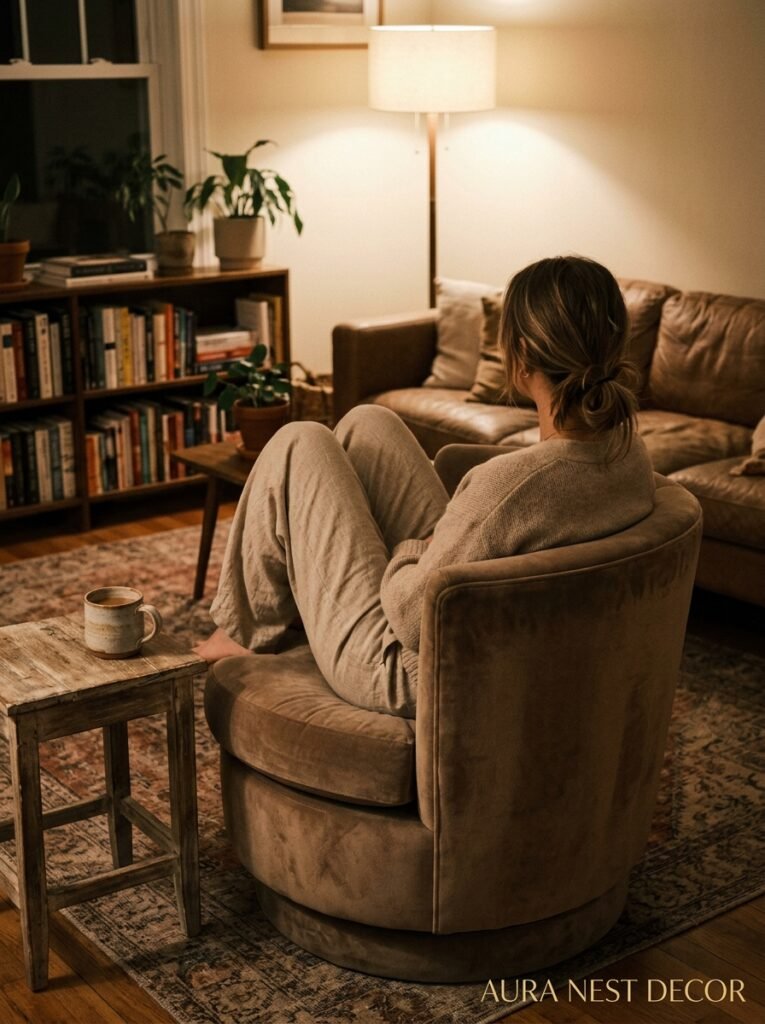
There’s something a little underrated about furniture that moves. We spend so much time in living rooms trying to get everything perfectly fixed and permanent, when sometimes what a room actually needs is one piece that responds to you. The swivel chair does that. It meets you where you are.
If you’ve been eyeing one and talking yourself out of it, stop talking yourself out of it. Get the base right, give it room to breathe, put a lamp next to it, and then just sit in it at the end of a long day and turn toward whatever you feel like facing.
What would your living room feel like with one piece in it that actually moves with you?