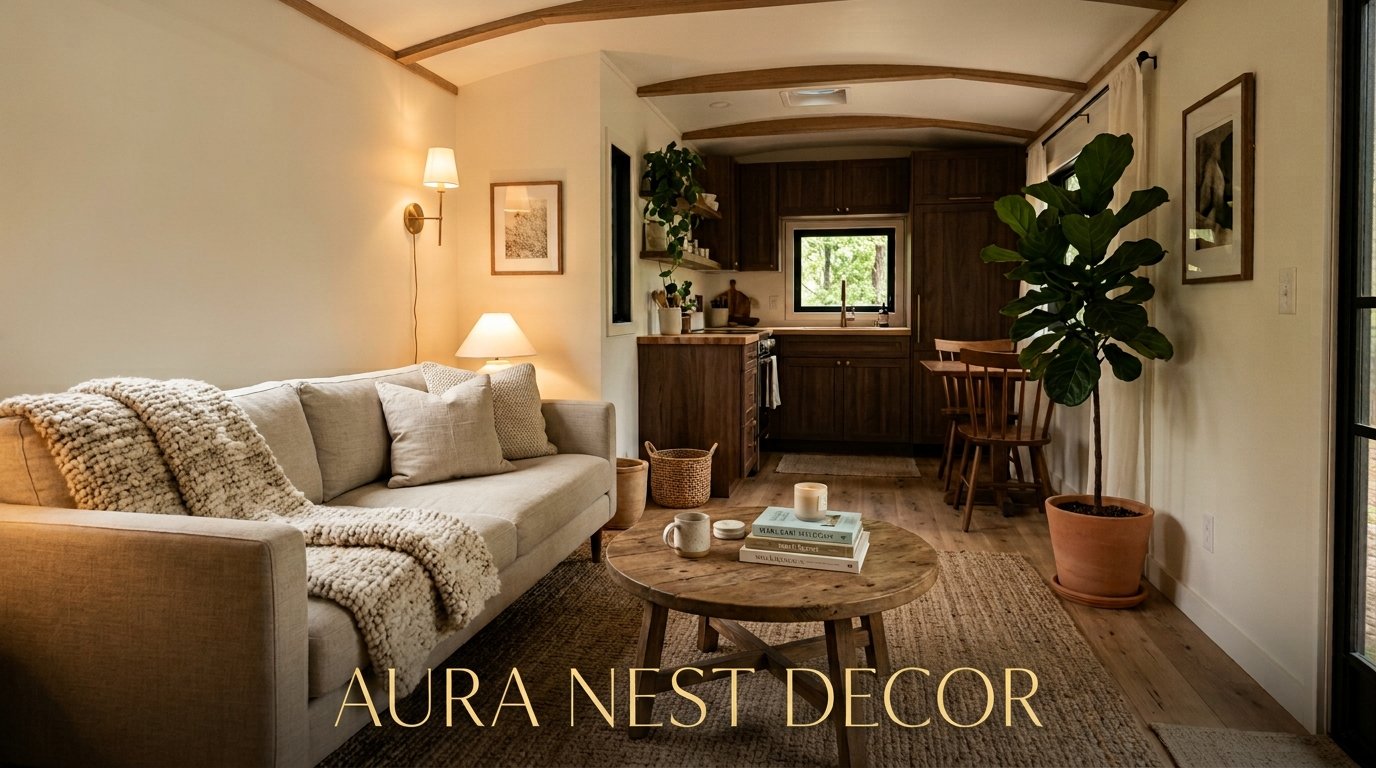
Trailer House Living Rooms That Look Like They Cost Three Times More Than They Did
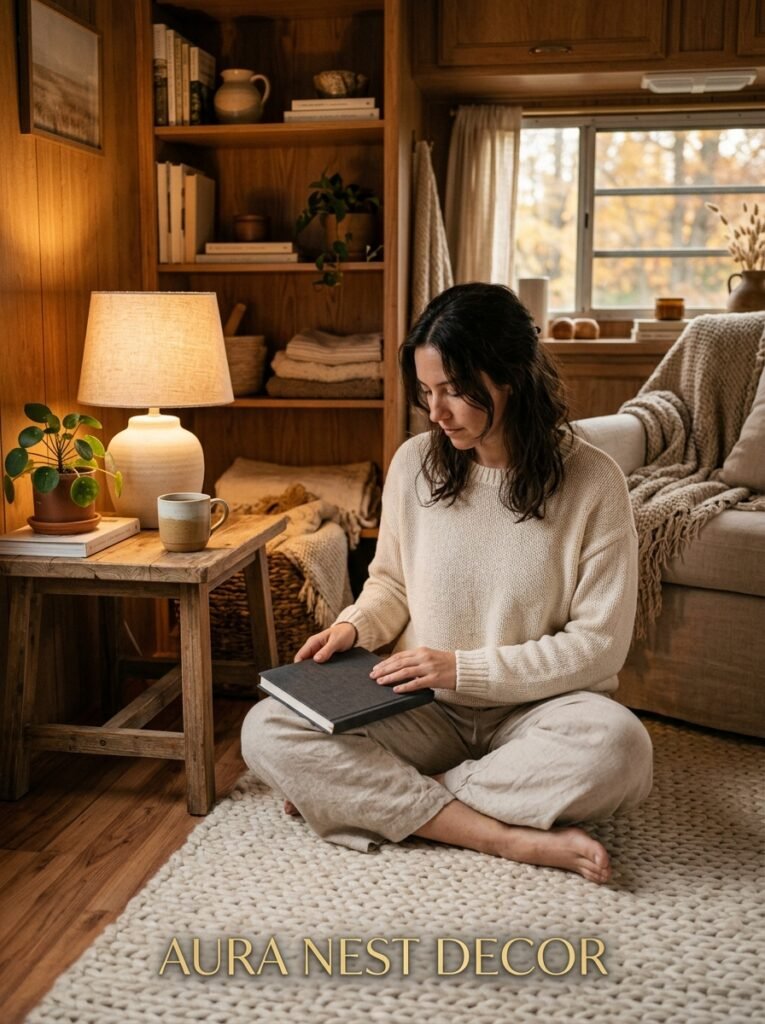
My neighbor Lisa walked into my trailer last spring and stopped dead in the doorway. “Wait,” she said, “this is the same place?” It was. Same bones. Totally different life.
—
1. The Lie You’ve Been Told About Mobile Home Living Rooms
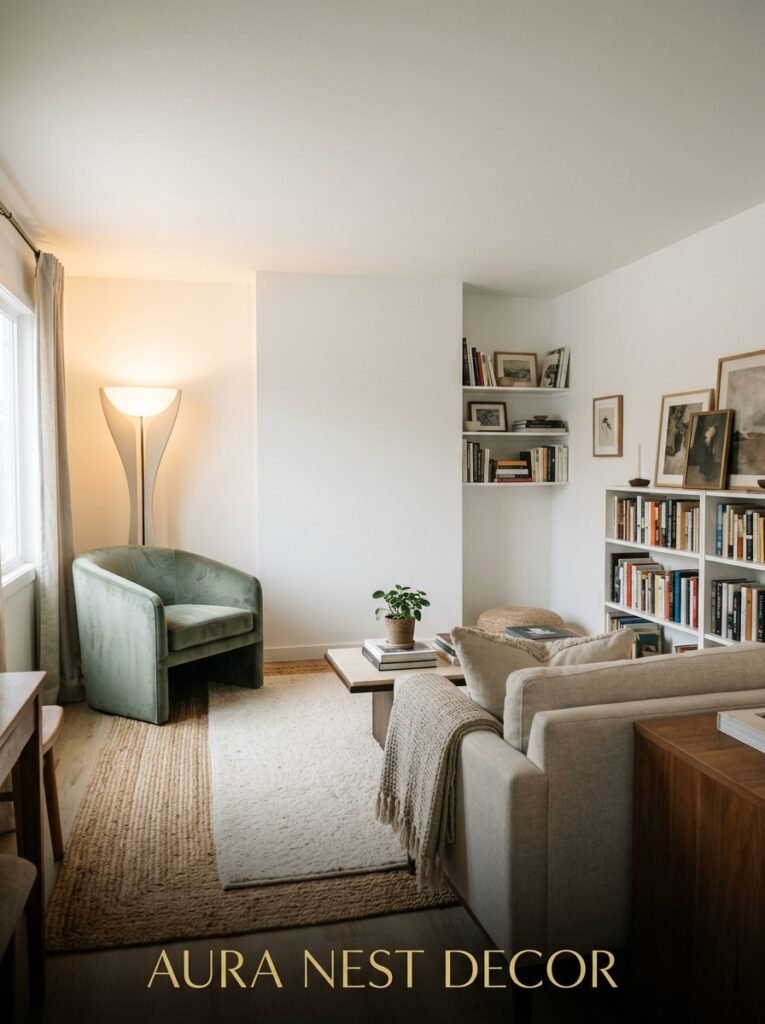
Let me just say it: most of the advice online for trailer living rooms is condescending. It’s all “make it look bigger!” and “don’t overwhelm the space!” as if the only goal is to apologize for living there. That’s not what we’re doing here.
A trailer living room can be BOLD. It can have personality. It can feel like the most intentional room in the neighborhood, because honestly? Constraints force creativity in a way that a big suburban open plan just doesn’t.
The rooms I’ve seen that stop people cold — they didn’t follow the rules. They ignored them, mostly. The owner chose one thing they loved, one real statement, and built outward from there instead of decorating by committee and ending up with a beige room that says nothing.
So before anything else: pick your one thing. A color. A material. A single piece of furniture. That’s your anchor, and everything else serves it.
2. The Color That’s Making Trailer Living Rooms Look Intentionally Designer Right Now
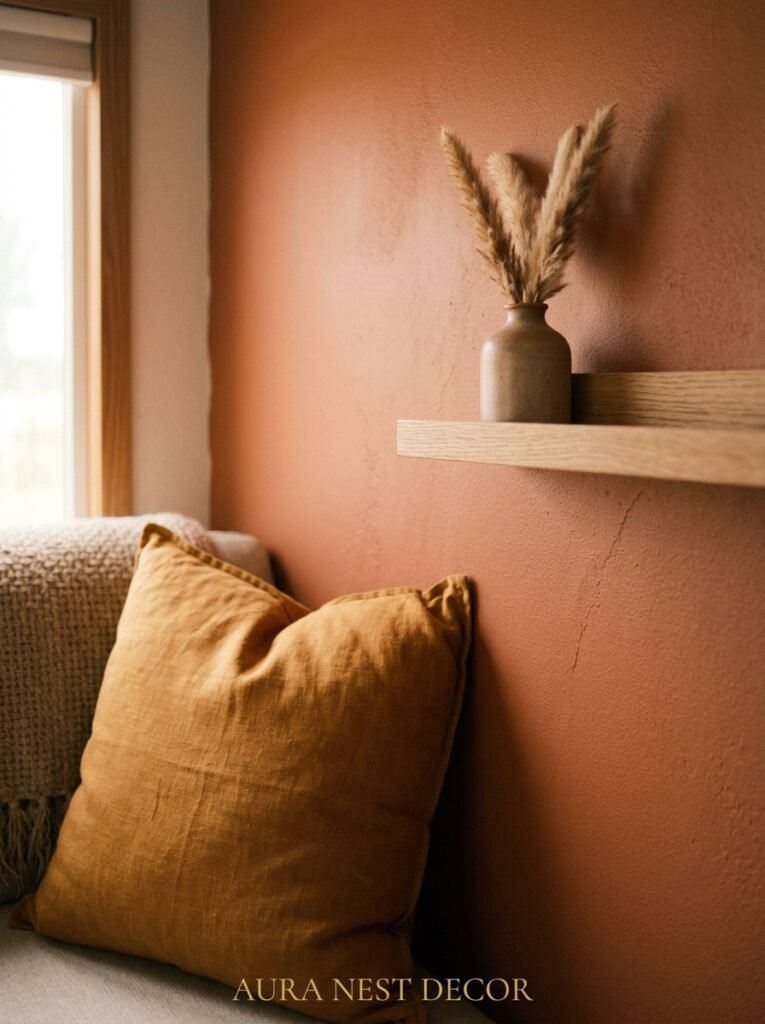
Warm terracotta. I know, I know — you’ve seen it everywhere. But there’s a reason it keeps showing up, and it’s not just Pinterest. It genuinely does something that cooler colors can’t: it makes a smaller space feel COZY instead of cramped.
In a trailer, the ratio of wall to window is different than in a stick-built home. The light bounces differently. Cool grays and blues can feel harsh in that context, almost clinical. But terracotta — or any of its dusty, earthy cousins like adobe, sienna, warm clay — those colors absorb light in a way that makes the room feel finished, even before you add furniture.
You don’t have to paint everything. One accent wall does it. Or terracotta-toned throw pillows against a neutral sofa. Even a rust-colored rug on a pale floor changes the whole temperature of the room.
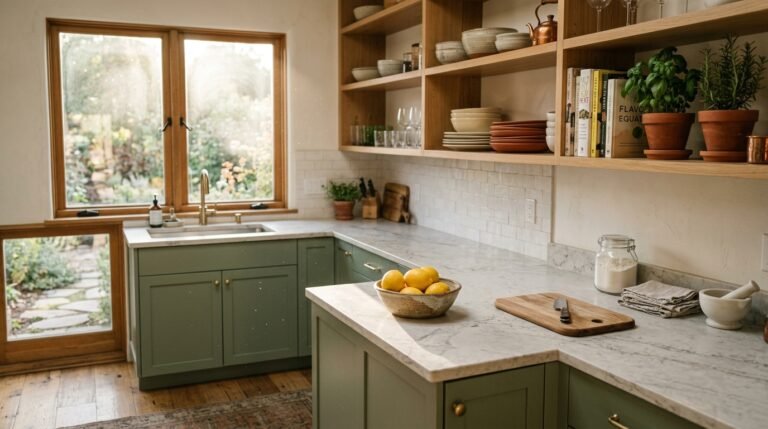
Side note — if terracotta isn’t your thing, deep sage green is doing the exact same job in a lot of the most beautiful mobile home interiors I’ve bookmarked. Earthy, unpretentious, grounding. Works especially well if you’ve got natural wood tones in the room already.
“The goal isn’t to make it look bigger. The goal is to make it look like YOU — and that changes everything.”
3. Why Your Sofa Choice Matters More Here Than It Would Anywhere Else
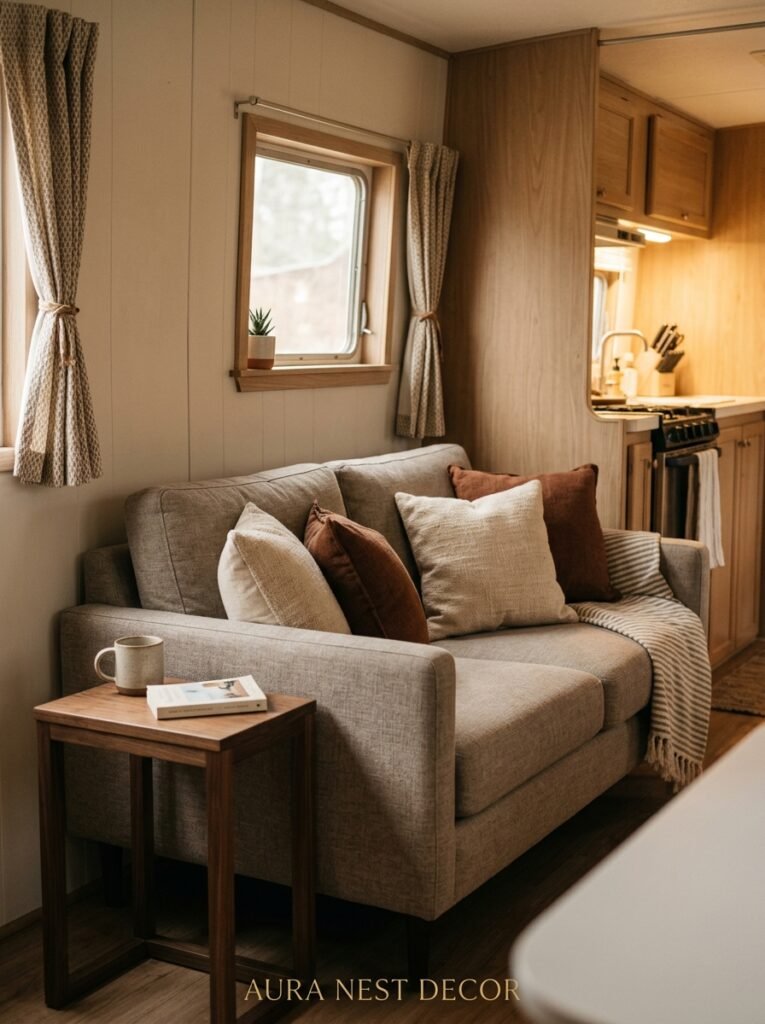
In a larger home, you can sort of get away with a mediocre sofa. The room carries it. In a trailer living room, the sofa is the room, and whatever you pick becomes the whole vibe whether you meant it to or not.
I’d argue: don’t go neutral. Or at least don’t go neutral by default, out of fear. A deep navy velvet sofa in a trailer living room reads rich. A cognac leather one reads intentional. Even a mustard linen one reads like someone actually made a choice here.
What you want to avoid is the big beige sectional — not because it’s wrong exactly, but because it tends to eat the entire visual weight of the room and then just sit there. Heavy. Beige. Nothing left to work with.
If budget is an issue (and honestly it usually is, that’s just real life), look at apartment-sized sofas first. The proportions tend to work better in mobile home rooms without you having to do much math. Facebook Marketplace is genuinely incredible for this — I found a barely-used sage green sofa in near-perfect condition for $180, and it’s the piece people comment on most.
4. The Floor Trick Nobody Talks About Enough
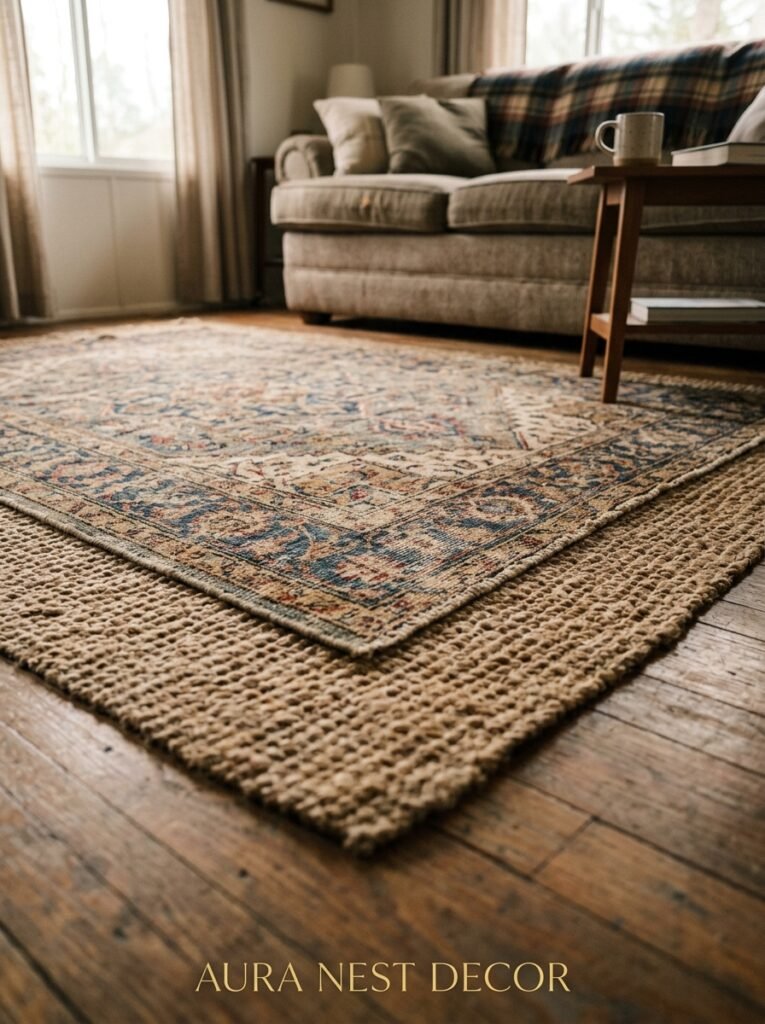
Here’s one of those things that sounds too simple and then you do it and suddenly the room makes sense.
Run your rug at an angle. Not wall-to-wall parallel. Slightly diagonal.
I know that sounds chaotic. It isn’t. What it does is trick the eye into reading the room as larger than it is, because the diagonal pulls the gaze past the actual corners of the space. It also adds a layer of visual interest that makes the room feel styled rather than just furnished.
In a trailer living room where the layout can feel a little rigid — rectangular, predictable — that single diagonal creates movement. And movement makes a room feel alive.
The rug should be bigger than you think. Too-small rugs are one of the most common mistakes in any living room, but in a mobile home it’s especially easy to play it safe and go small. Don’t. A 5×8 that fits “within” the seating area usually looks like a sad postage stamp. Go 8×10 if the room can hold it, and let it anchor everything.
5. Lighting That Will Literally Transform How the Room Feels After 5pm
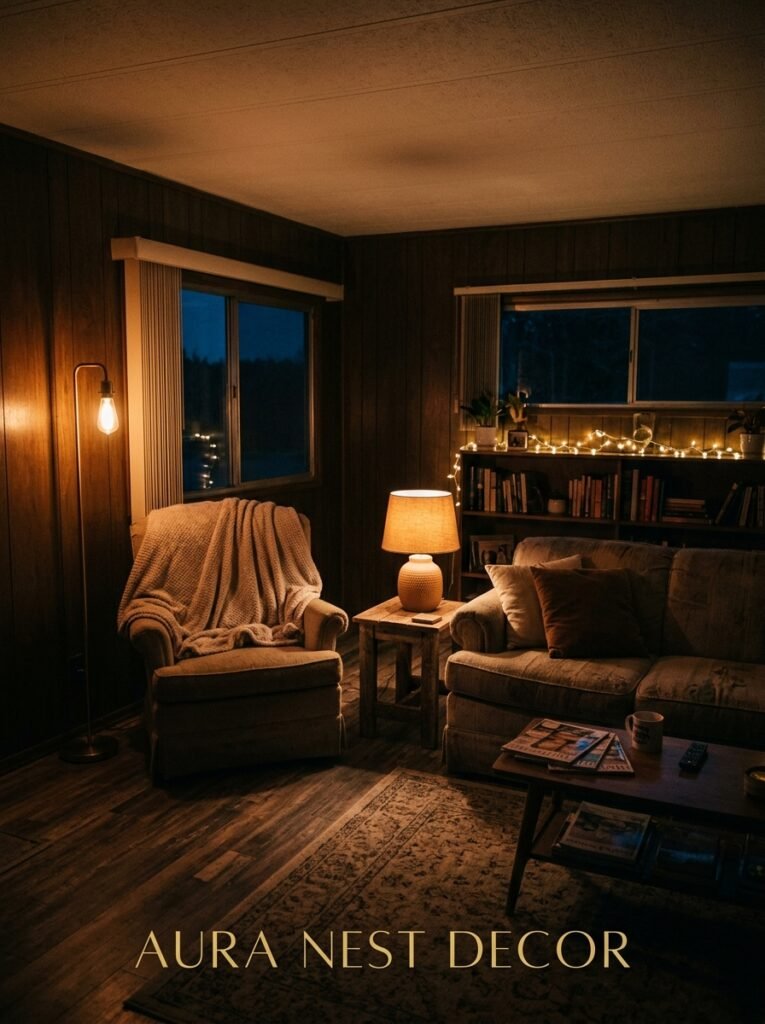
Overhead lighting in trailers is, not gonna lie, almost always terrible. It’s too bright, too flat, and positioned in a way that flattens everything in the room into a dentist’s waiting room.
Turn it off. Or at least supplement it aggressively.
Two or three plug-in floor lamps, placed in corners, doing the ambient work — that’s the move. Add a table lamp on whatever surface you have beside the sofa. If you can swing it, a small buffet lamp on a console table or shelf adds that layered glow that makes the whole room feel like somewhere you actually want to sit down.
“Overhead light is where you work. Lamplight is where you live.”
The warmth of the bulb matters more than people realize. Go 2700K for that amber, golden evening feel — not 3000K, which has a slightly blue-white tinge that I find really cold in the evenings. A lot of bulbs don’t list this clearly, so look for “soft white” specifically.
Candles count too, if you’re not over them. The smell of something warm — cedar, amber, vanilla — plus actual flickering light, in a small room with good rugs and the right sofa? That room is a place you want to be. No amount of money required.
6. The One Rule That Makes Even a Tiny Trailer Living Room Feel Intentional
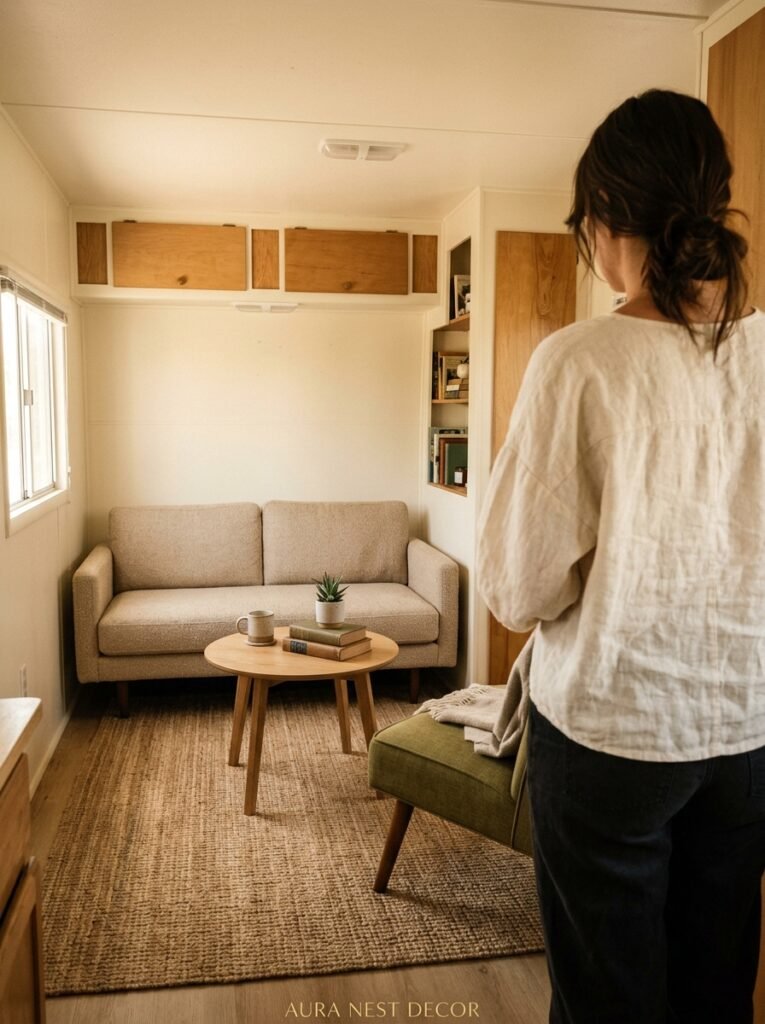
Edit harder than you think you need to.
People fill small spaces because it feels wrong to leave things “empty.” But in a trailer living room, empty space isn’t failure — it’s breath. Every unnecessary item makes the room fight itself.
A coffee table with three well-chosen objects on it reads styled. The same table with nine objects reads cluttered. Both might have an equal amount of “stuff” you love — the difference is curation, which is just the fancy word for making hard choices.
My personal rule: if I can’t immediately explain why something is in the room, it’s probably not earning its spot. That sounds brutal, and it sort of is. But the rooms that feel genuinely beautiful — in any size house — have that edited quality. Like someone actually thought about it. Because they did.
7. Vertical Lines Are Your Best Structural Trick
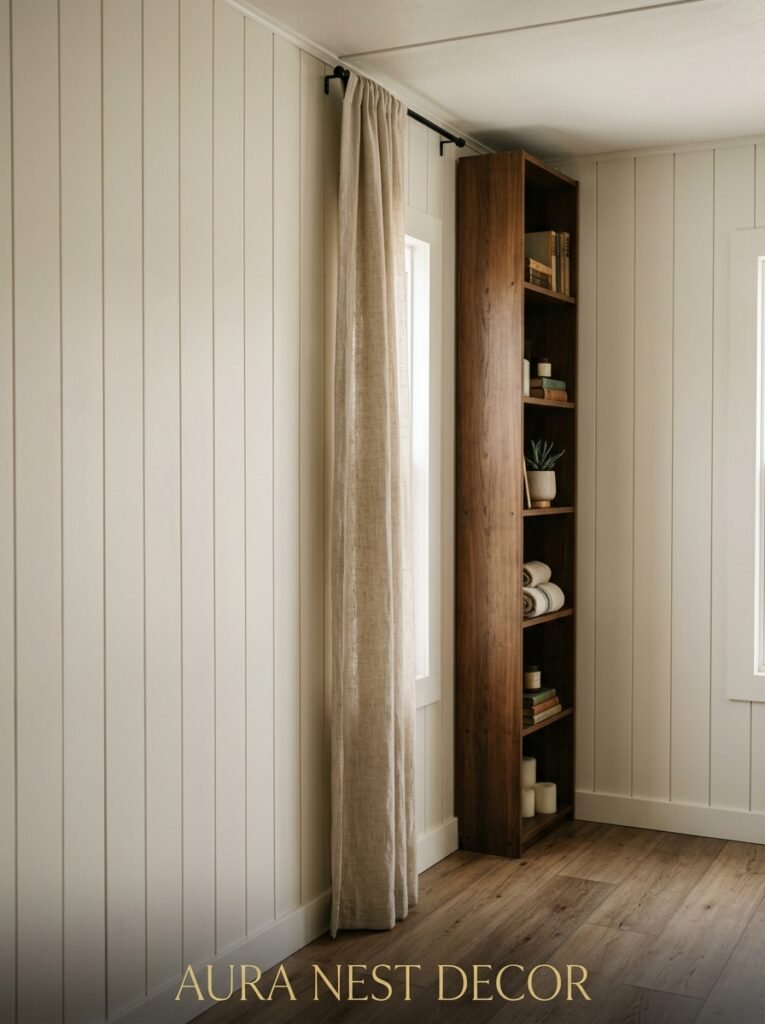
Trailers often have lower ceilings than stick-built homes. Not always, but often. And the instinct is to try to “hide” that somehow, which usually doesn’t work and just makes the room feel confused.
Instead: lean into vertical. Tall curtains hung as high as possible, pooling slightly at the floor. A narrow bookshelf that goes floor to ceiling. Artwork hung slightly higher than feels natural.
When the eye travels UP, the room feels taller. Simple as that, but it’s one of those things you have to see to really believe.
Curtains especially. This is the single change I’d make first if I were starting from scratch in a trailer living room. Hang your rod at the ceiling — not at the top of the window — and get curtains that are 96 or 108 inches long. In a room where the walls are maybe 8 feet high, that length of fabric does something almost architectural. The windows look bigger. The room looks taller. The whole thing feels more substantial.
It costs less than a new sofa and it’s probably the most dramatic single change you can make.
8. Gallery Walls Done Differently (Not the Grid, Please, Not the Grid)
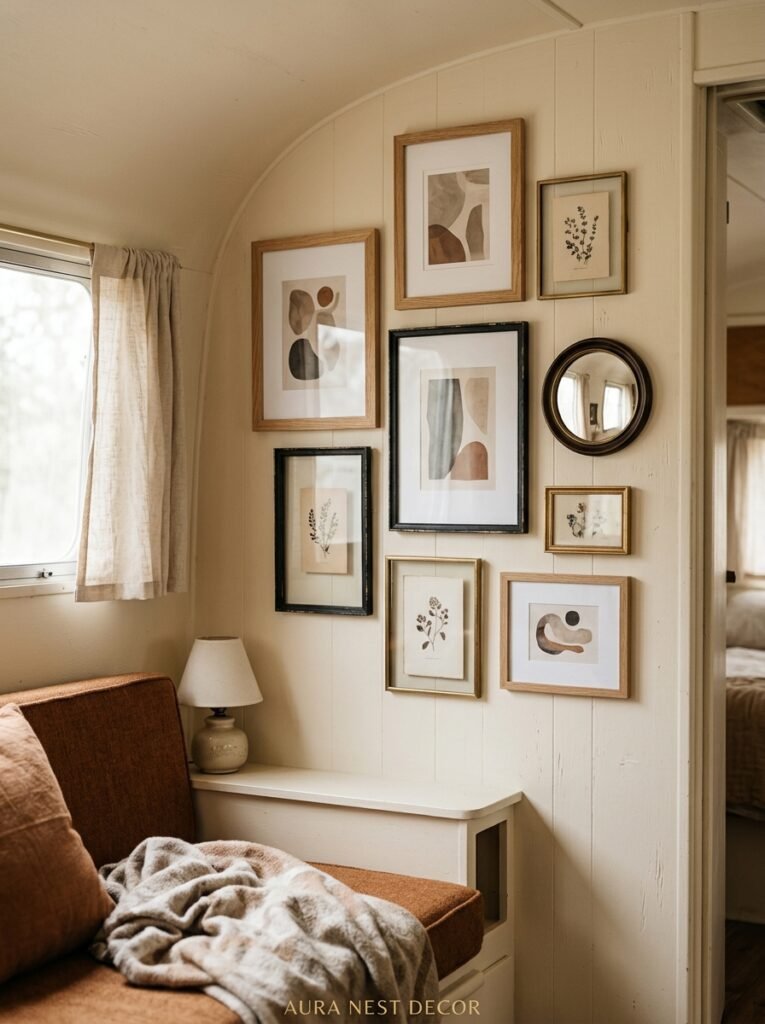
The uniform grid gallery wall had its moment. That moment has mostly passed. In a trailer living room specifically, it can feel a little corporate — like the waiting room of a hotel you’re not sure about.
What’s working better now is the collected look. Mismatched frames in a similar tone (all wood, or all black, or all gold — not a mix of everything). Pieces at different heights that relate to each other but don’t line up perfectly. The occasional non-framed piece — a woven wall hanging, a small mounted shelf, something that has texture instead of just image.
It’s supposed to look like you acquired things over time because you actually loved them. Not like you bought a set.
And here’s something that works especially well in mobile homes: go low with your gallery wall. Eye level or even slightly lower than you’d normally hang things. It brings the whole wall treatment closer to the human scale of the room, which makes it feel more intimate rather than trying to overwhelm the space.
“In a small room, an overcrowded gallery wall is just visual noise. Spread out, breathe, let each piece land.”
9. The Furniture Layout Mistake That’s Making Your Room Feel Wrong
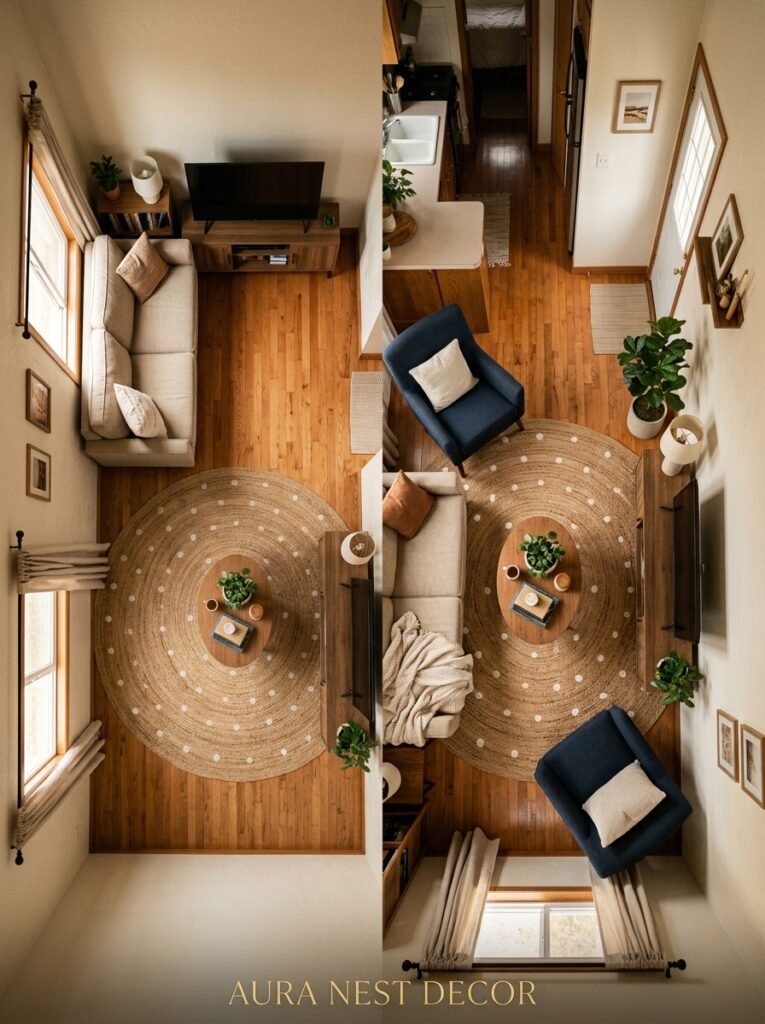
Pushing everything against the walls. I know why people do it — the logic is “more floor space in the middle = room feels bigger.” But it almost never works that way. It actually makes the room feel like it’s waiting for something to happen in it.
Float your sofa even just a few inches from the wall. Pull the chairs in closer together. Make the seating area feel like a deliberate little world within the room, not a perimeter you’re patrolling.
When furniture is pulled together, it creates intimacy. Conversation works. The room feels used in the best possible way — warm, inhabited, purposeful. And a room that feels purposeful feels designed, which is what we’re going for.
In a trailer specifically, I’d also suggest making peace with the idea that your layout might not be symmetrical. It’s fine. Most good rooms aren’t symmetrical when you look closely — they’re balanced, which is different. A heavy sofa on one side can be balanced by a floor lamp plus a tall plant on the other side. It doesn’t have to match. It just has to work.
10. Plants That Actually Do Something for the Room
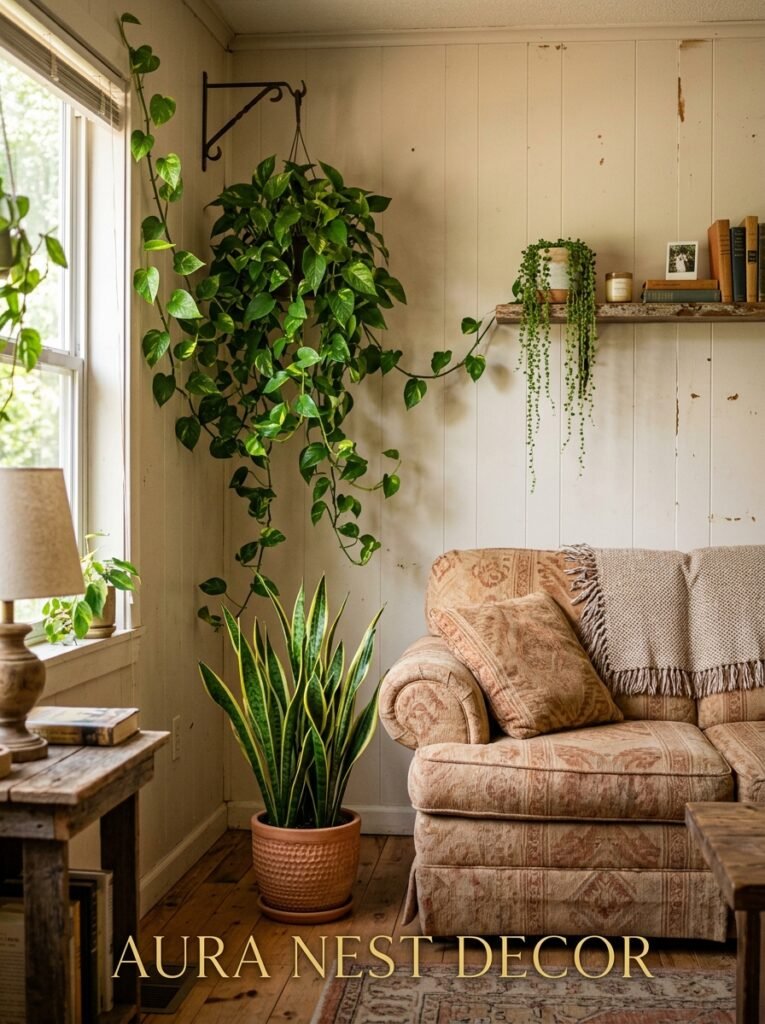
Not a lecture about houseplants, I promise. But a few specific things.
A large plant in a trailer living room — like a fiddle leaf fig or a big trailing pothos in a high-up spot — does disproportionate visual work for its cost. It brings in scale. It brings life. It makes the whole room feel less constructed and more like somewhere a real person hangs out.
Avoid: too many small plants in a row on a single shelf. It can look like a plant graveyard, or worse, like you’re trying very hard. One or two statements beat ten little gestures every time.
If you kill plants reliably (no judgment, same), high-quality faux ones in ceramic pots genuinely don’t read fake from across a room anymore. The key is the pot — a beautiful ceramic planter makes even a fake plant look like a considered choice. The cheap plastic pot is what gives it away, not the plant.
11. Textures That Do the Heavy Lifting
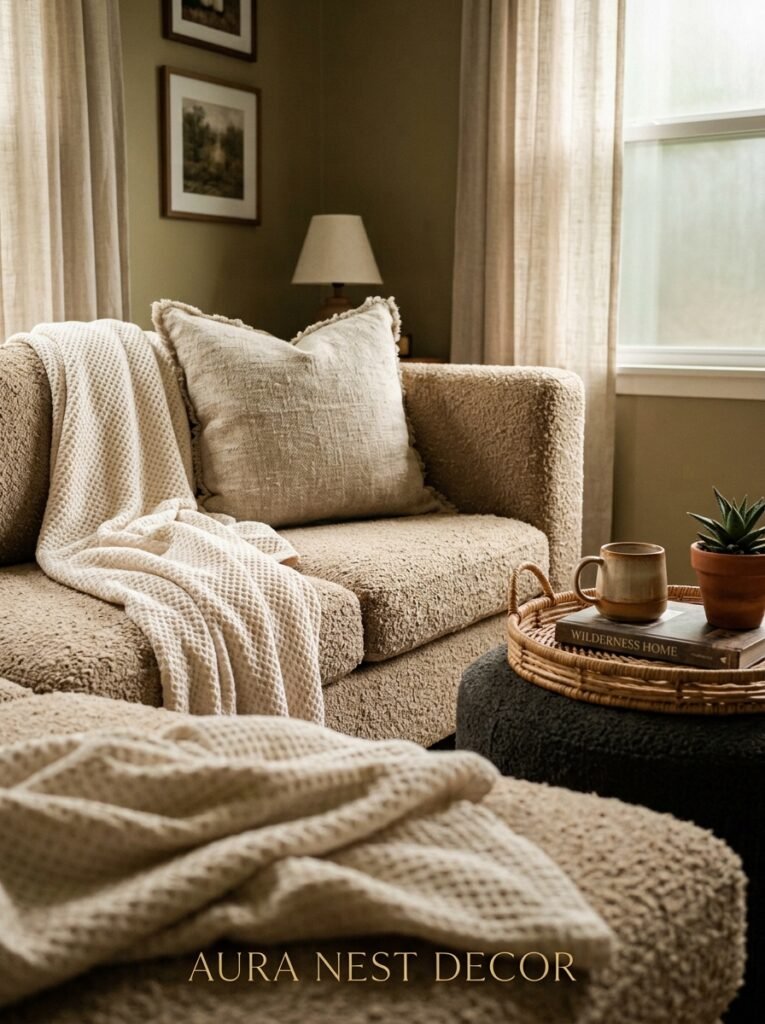
Paint and furniture get all the attention, but texture is what separates a room that looks good in photos from one that feels good in person.
In a trailer living room, layering texture is especially valuable because it adds dimension to a space that might not have a lot of architectural detail. Smooth walls, low ceilings, a practical floor — you’ve got to bring the richness in yourself.
Chunky knit throw. Nubby linen cushion cover. A jute rug under a softer rug. A wooden tray on a painted surface. A glazed ceramic lamp base. None of these are expensive individually, but together they create that “layered” quality that makes a room feel finished.
The combination of smooth and rough is what you’re going for, basically. Glass next to wicker. Metal next to fabric. Those contrasts register subconsciously as complexity — which the brain reads as care, and care reads as beautiful.
12. The One Piece Worth Spending Actual Money On
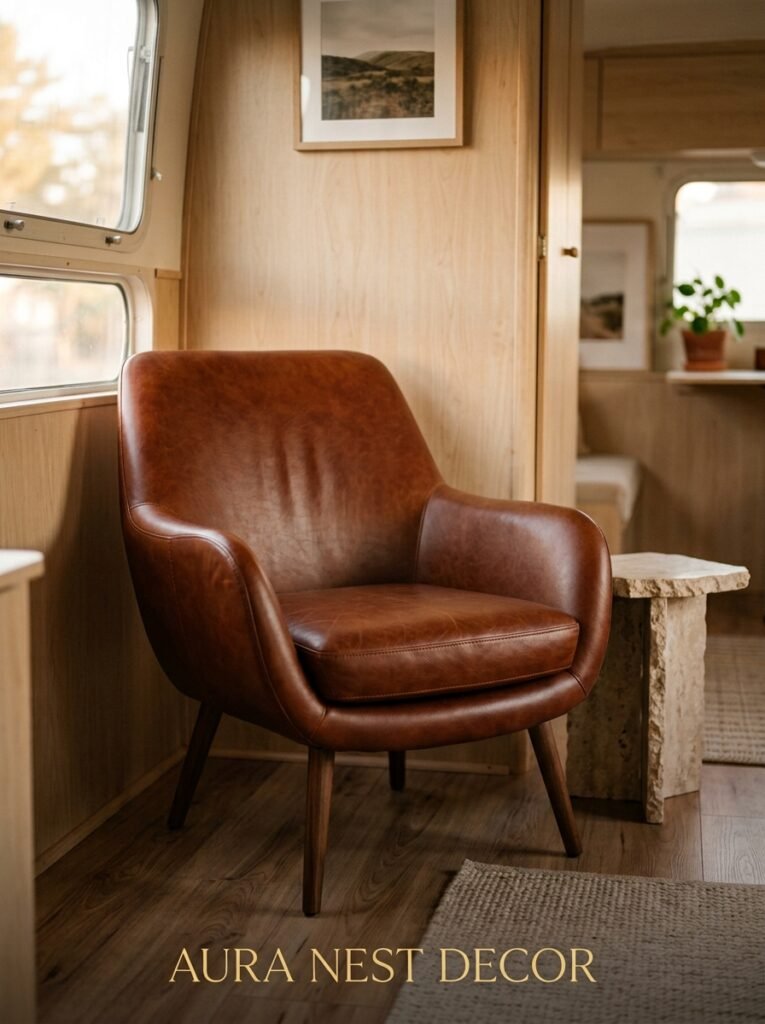
If you’ve got a limited budget — and in a trailer living room, you probably do, and that’s just the reality — be really selective about where you spend.
The one category I’d say is worth putting real money into is lighting. Specifically, one pendant lamp or a genuinely beautiful floor lamp. A sculptural, interesting light fixture in a trailer living room does more for the aesthetic of the space than almost anything else, because it’s unexpected. People walk in expecting a certain level of interior design and then there’s this striking, intentional piece of lighting and it recalibrates everything they assumed.
You don’t have to spend thousands. Etsy has some genuinely beautiful handmade lamp options in the $100-200 range that would look at home in any interior design magazine. Thrift stores occasionally have lighting you can rewire or spray paint into something spectacular for $15.
The rest — the rugs, the pillows, the plants, the curtains — you can often pull off beautifully on a tight budget if you’re patient and strategic. But give yourself one GOOD light. You’ll feel it every evening.
—
❓ FAQ
Q: How do I make a trailer living room look more permanent and less temporary? A: The main things that signal “temporary” are bare windows, uncovered floors, and walls with nothing on them. Curtains that go floor to ceiling, a substantial rug, and at least some wall decor (doesn’t have to be a full gallery — even one or two pieces helps) close most of that gap fast. Layered lighting instead of just overhead also makes a huge difference.
Q: What furniture size actually works in a mobile home living room? A: Apartment-sized sofas and chairs are your friends — they’re designed for smaller footprints without looking proportionally wrong. For coffee tables, something lower and slightly smaller than you’d pick for a bigger room keeps it from feeling like an obstacle course. The rug, however, should be bigger than instinct suggests — that’s one place where going up a size genuinely makes the room feel better.
Q: Can I do an accent wall in a trailer without it looking overwhelming? A: Absolutely, and honestly it’s one of the best moves in a small space because it gives the room a focal point. Stick to one wall — ideally the one behind where your sofa sits or faces. Warm, earthy tones tend to work better than very dark or very cool colors in mobile home proportions. If you’re not ready for paint, a large piece of textile wall art or even a significant gallery arrangement on that wall does the same job.
—
💭 Final Thoughts
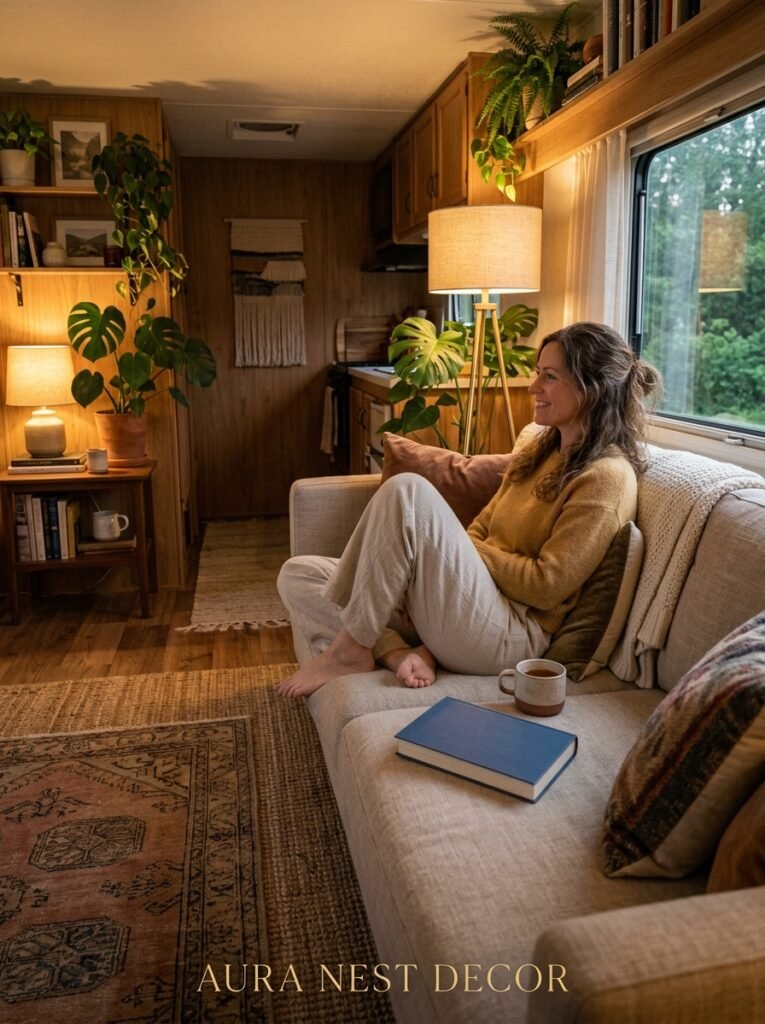
Here’s the thing about decorating a trailer living room that took me too long to figure out: the constraints aren’t the enemy. The budget limit, the smaller footprint, the lower ceiling — those things push you toward specificity, and specificity is what makes a room feel like it belongs to someone instead of just existing.
The most beautiful rooms I’ve ever been in weren’t the biggest ones. They were the ones where you could feel that someone made real choices, on purpose, for themselves.
What would your one anchor piece be?