
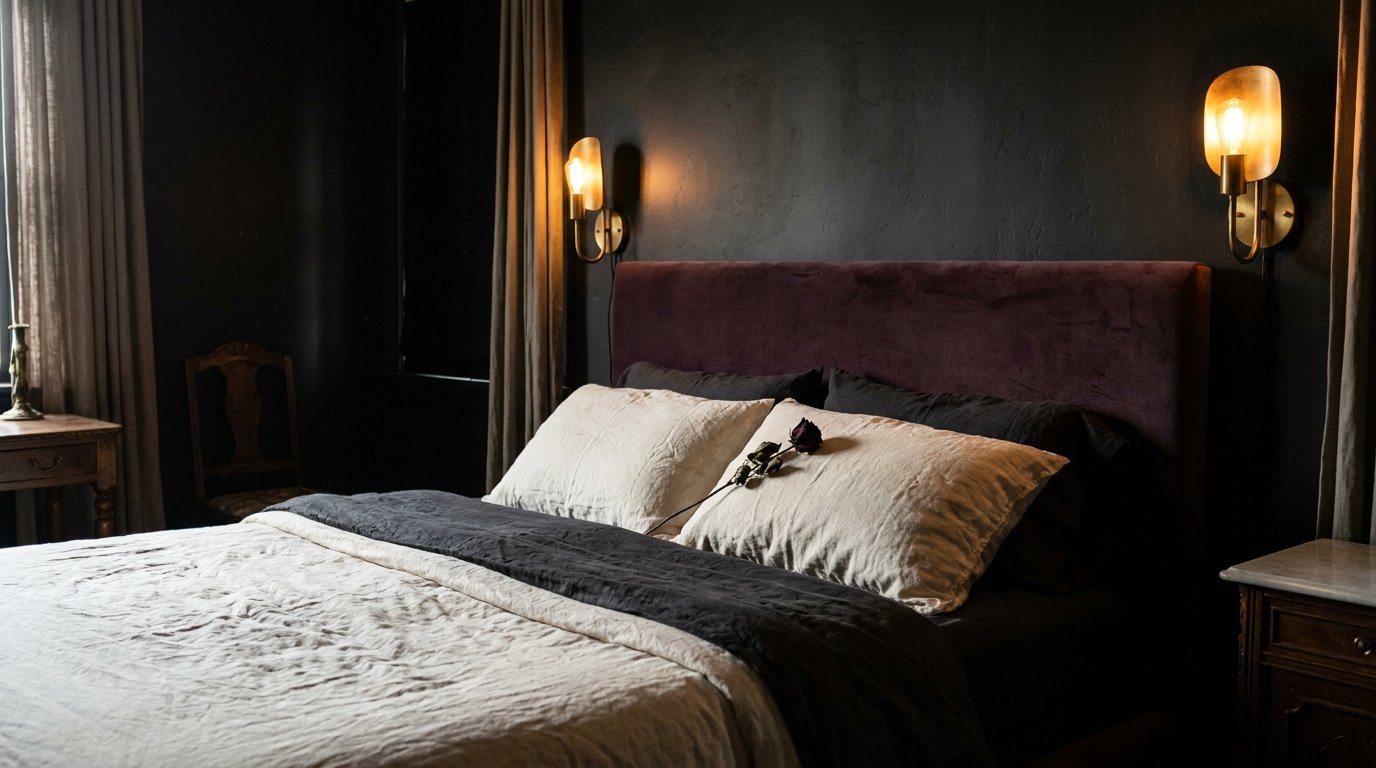
Why the Dark Feminine Bedroom Aesthetic Is the Most Misunderstood Look on Pinterest (And How to Actually Do It Right)
My friend looked at my bedroom last spring and said, “This looks like a vampire lives here.” She meant it as a criticism. I took it as a compliment.
And honestly, that moment kind of captures the whole divide around the dark feminine aesthetic — people either get it immediately, or they assume you’ve gone full gothic dungeon and are about to hang bats from your ceiling. Neither extreme is really right.
—
1. What “Dark Feminine” Actually Means (Because It’s Not What Most People Think)
Here’s the thing. “Dark” doesn’t mean black-everything. It doesn’t mean moody in a depressing way, and it definitely doesn’t mean no personality. The dark feminine bedroom aesthetic is really about depth. Richness. That quality where you walk into a room and feel like it has something to say.
Think about that feeling you get standing in an old library — the way the mahogany shelves and low amber light make the whole space feel both intimate and significant. Or walking into a hotel room in Marrakech with jewel-toned tiles and heavy curtains that almost shut out the daylight entirely. That pull. That weight.
That’s what this aesthetic is chasing.
It’s the opposite of a bright minimalist bedroom with white walls and blond wood and nothing on the nightstand. Which is lovely. But it’s a very different emotion.
The dark feminine version says: I have opinions. I have history. I wanted this room to feel like something.
—
2. The Color That Keeps Coming Back in Every Dark Feminine Room I’ve Saved
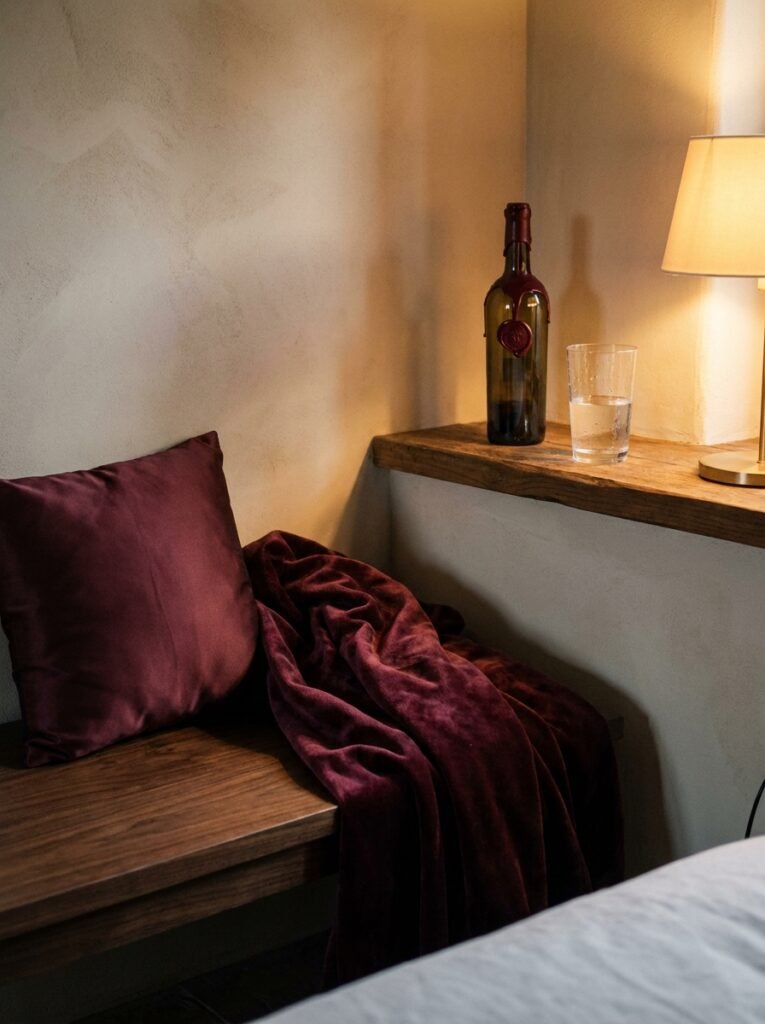
I’ve pinned probably three hundred of these rooms over the last two years and there’s one color that shows up constantly. Not black. Not charcoal. Plum. That dusty, almost-grey kind of plum that reads differently depending on the light — warmer at night, cooler and more muted in the morning. Sometimes it’s on the walls, sometimes just in the bedding, sometimes it’s the velvet on a chair in the corner that you barely notice until it suddenly becomes the thing your eye goes to every single time.
Plum is doing a lot of heavy lifting in this aesthetic and I think it’s because it sits right at the intersection of feminine and dramatic. It’s not trying too hard.
But other colors work too — forest green with a slightly grey undertone, deep burgundy, a nearly-black navy that still feels warm somehow. The key thing isn’t the specific color, it’s the undertone. You want colors that feel like they’ve absorbed something. Saturated. Maybe a little dusty.
“You want colors that feel like they’ve absorbed something. Saturated. Maybe a little dusty. Not fresh paint — aged.”
Avoid anything too bright or too cool. A cold purple reads completely different from a warm plum, and one of them looks like a child’s bedroom in a different era, not like this.
—
3. The Lighting Rule That Changes Everything About How Dark Rooms Feel
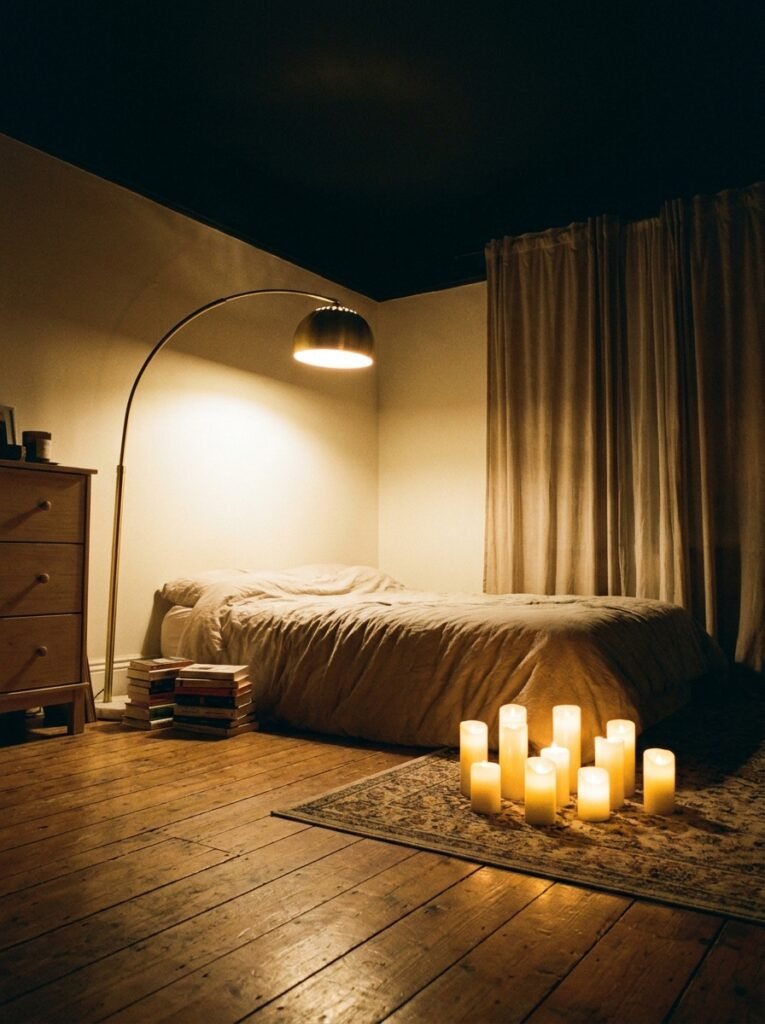
Can we talk about lighting for a second because I feel like this is where most people get it wrong.
They go dark on the walls and then put in a harsh overhead light and the whole thing flatlines. Overhead lighting is almost always the enemy in a dark feminine bedroom. Almost always. What you want instead is layers — low light, warm light, multiple sources, nothing too bright.
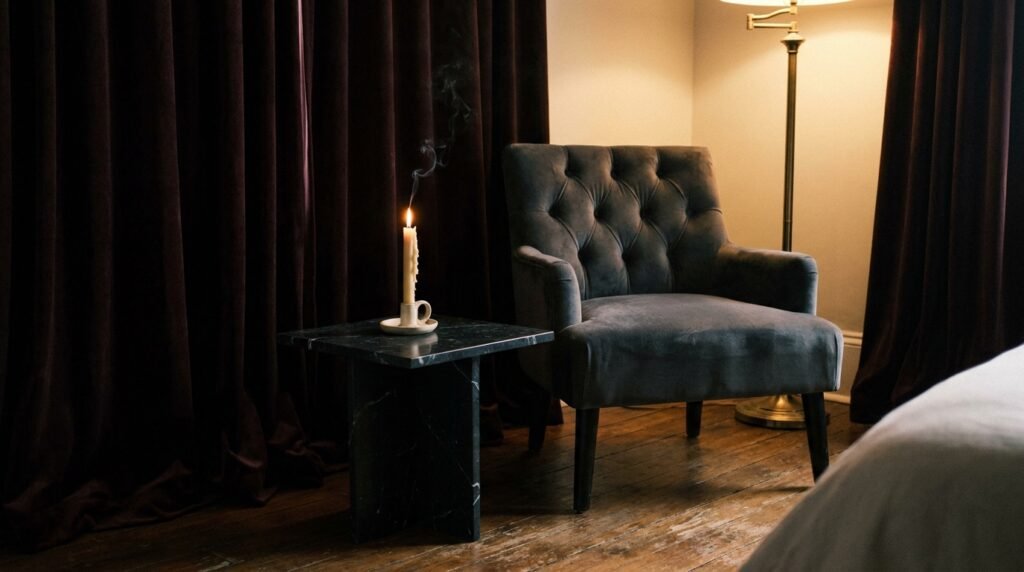
An Edison bulb on a bedside lamp at 7pm creates a completely different room than a cold LED strip running along the ceiling. Same walls, same furniture, completely different atmosphere. The amber glow from a low-wattage bulb bounces off dark paint in a way that makes the color look intentional rather than oppressive.
Candles, obviously. But also consider: a small lamp tucked behind a plant so the light comes through leaves, a lantern-style fixture that casts broken light patterns, fairy lights not in a cute-teen-bedroom way but looped along a dark shelf or draped behind a sheer curtain so the light is diffused to almost nothing.
The goal is warm and low. Multiple sources. Nothing that announces itself too loudly.
—
4. The Textiles That Separate “Actually Beautiful” From “A Bit Try-Hard”
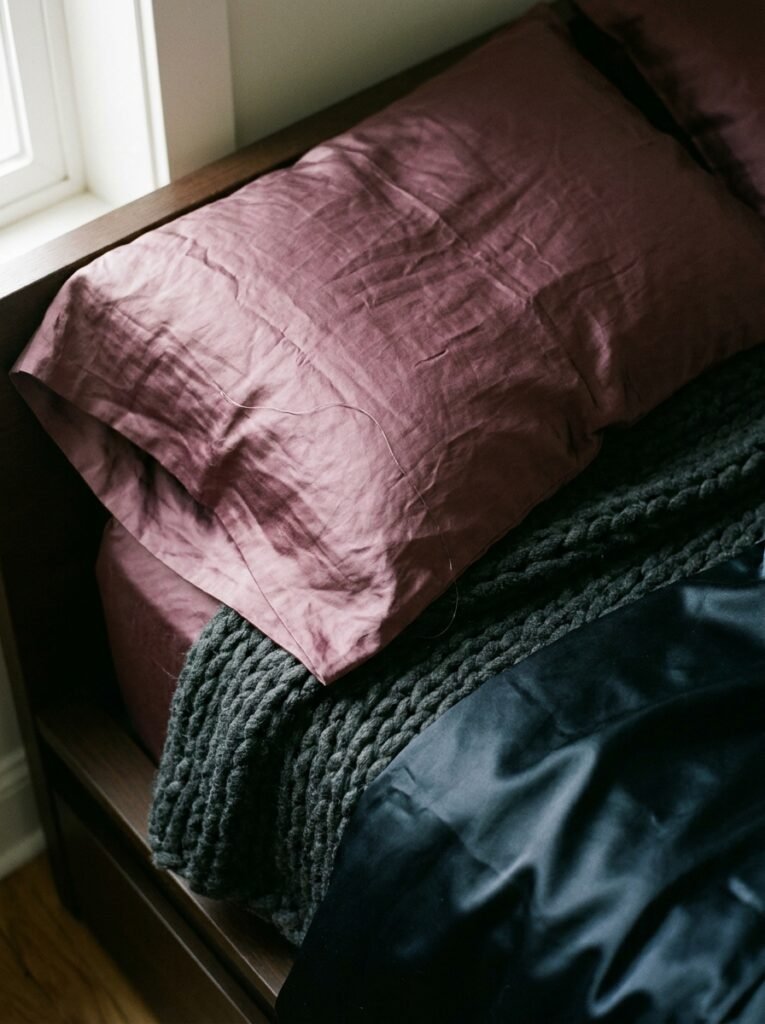
This is where the aesthetic either lands or completely falls apart, and I think it’s because people reach for the obvious.
Black satin sheets. Dramatic canopy with black fabric. Every decorative pillow in the same deep shade. It ends up looking like a set — not a room someone actually sleeps in and loves.
The real magic is in mixing textures so different from each other that the richness comes from contrast, not just color. Velvet against linen. A chunky knit throw next to a smooth silk-ish pillowcase. A woven jute rug under your feet that’s almost rough, grounding all that richness above it.
And here’s something that surprises people: cream and ivory belong in the dark feminine bedroom. Not as the dominant color obviously, but as relief. One off-white pillow in a sea of burgundy and forest green doesn’t lighten the mood — it makes everything around it look MORE saturated by contrast. Same principle as how a tiny bit of light makes a room feel darker, not less dark.
The bedding doesn’t have to all match. In fact, it probably shouldn’t.
—
5. The Specific Furniture Shapes That Fit This Mood (and the Ones That Kill It)
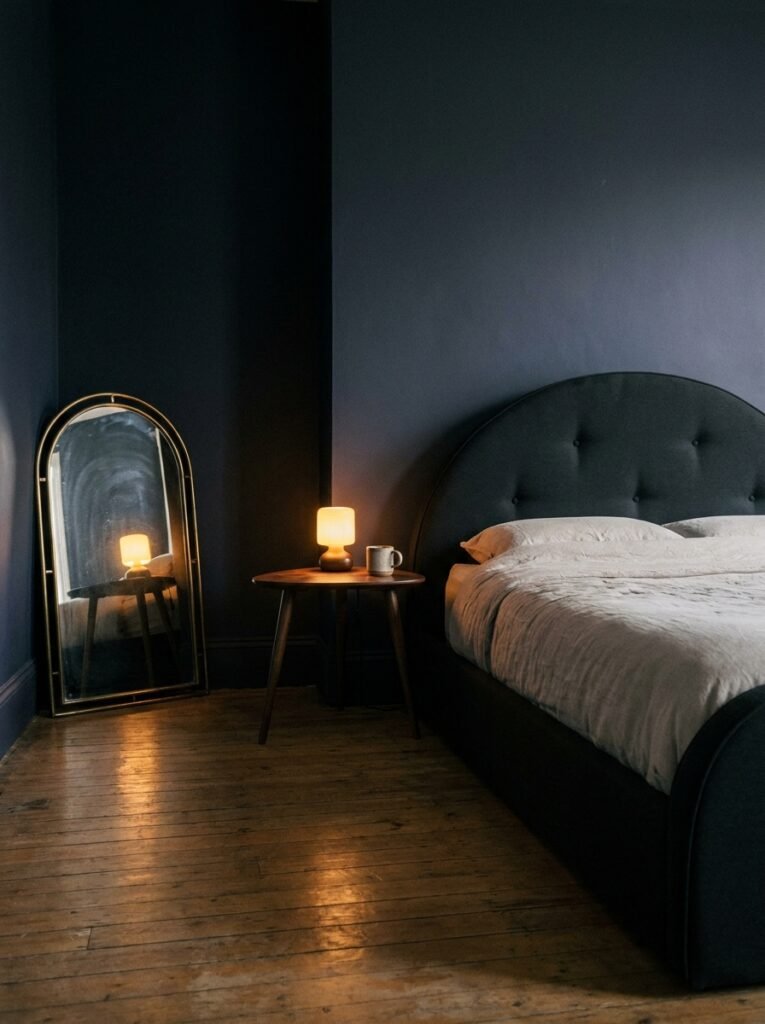
Sharp edges and very modern, angular furniture don’t belong here. I’ll just say that plainly.
The dark feminine aesthetic wants curves. Soft headboards with a slight lean to them, rounded dressers with aged metal hardware, a chair that looks like someone sank into it decades ago. That swooping Art Nouveau feeling isn’t accidental — there’s something about organic lines that reads as feminine without being fussy.
Four-poster beds come up constantly in this aesthetic and for good reason. Even without heavy canopy fabric, the frame alone creates a kind of architectural intention around where you sleep. It turns the bed into a room within a room. Which is exactly the feeling you’re going for.
Footboards are back, by the way. I’ve noticed this. A substantial footboard on a bed makes the whole thing feel more enclosed and private, more like a sanctuary — and in a dark feminine bedroom, that’s the entire point.
—
6. How Gallery Walls Work Differently Here Than in Any Other Aesthetic
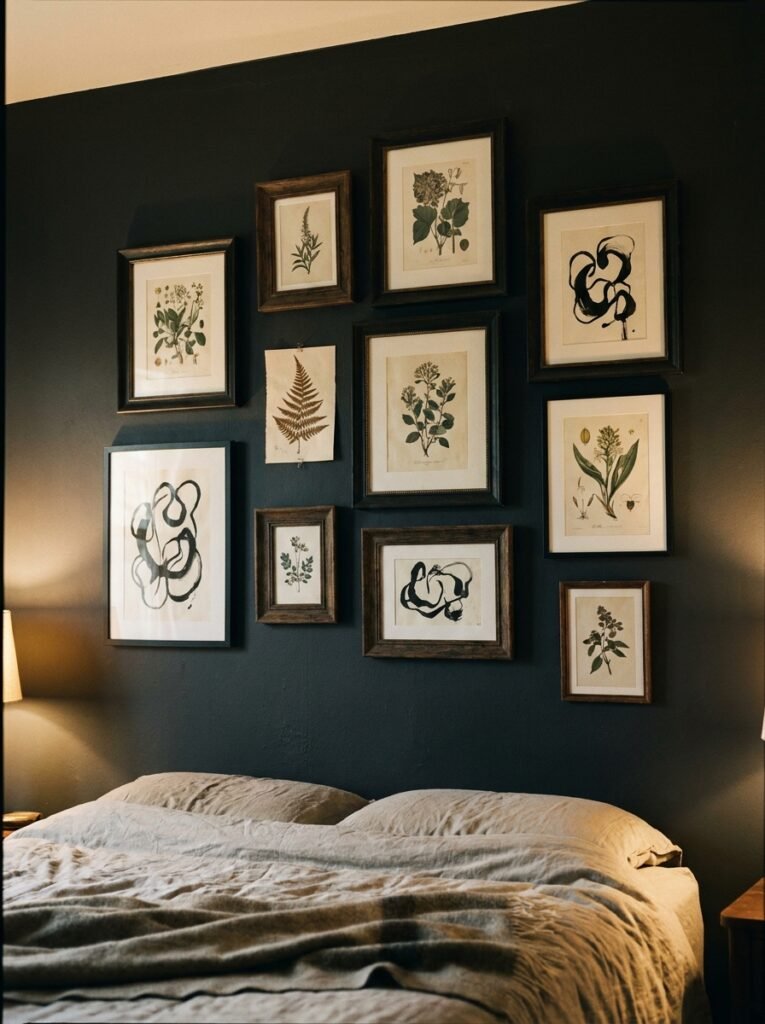
Gallery walls in a bright, white-walled bedroom are usually about personality — a collection of things you love, colourful, eclectic, a little chaotic.
Gallery walls in a dark feminine bedroom are about mood. That’s a completely different brief.
Stick to a tight palette. Black and gold frames, or all the same vintage-looking weathered frames, or no frames at all — prints matted and mounted straight on dark walls so the negative space around each piece becomes part of the composition. Go for art that earns its place. Botanical illustrations. An antique map. A portrait with a direct, slightly confrontational gaze. A piece of calligraphy in a language you find beautiful to look at.
Nothing too cheerful, nothing too ironic. And not too many things. This isn’t a room that’s trying to show everything at once.
“Nothing too cheerful, nothing too ironic. A dark feminine gallery wall isn’t a mood board — it’s a statement.”
—
7. The Scent Layer That Nobody Talks About But Everybody Notices
I’m going slightly off-topic here but stay with me because this is genuinely important.
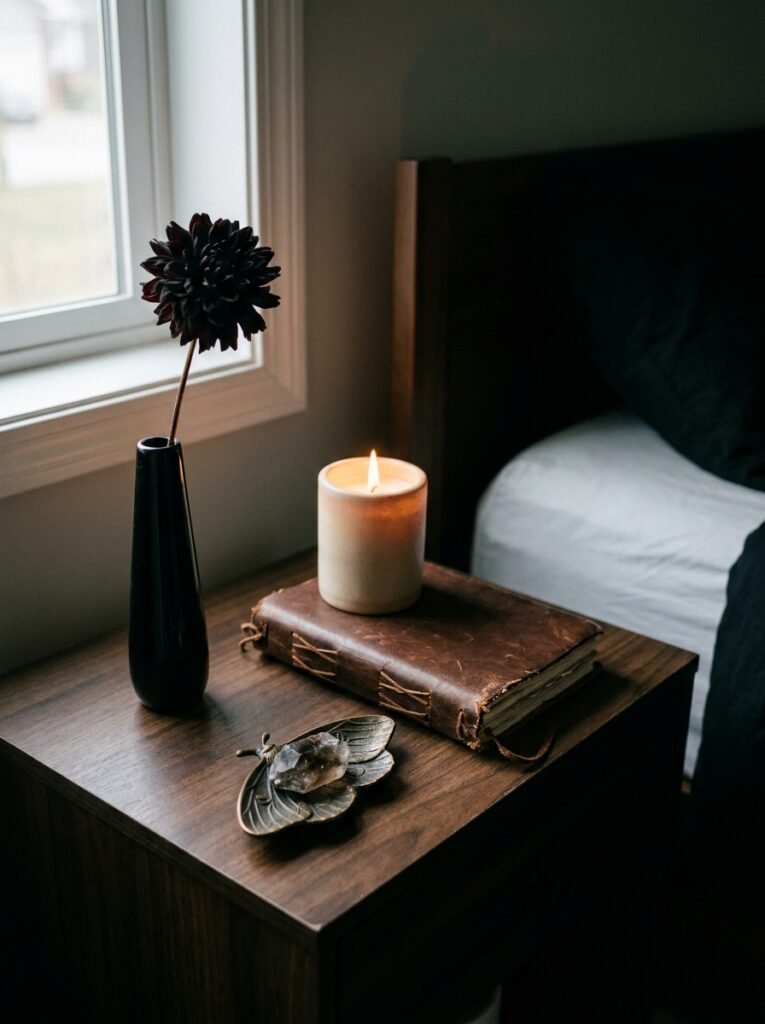
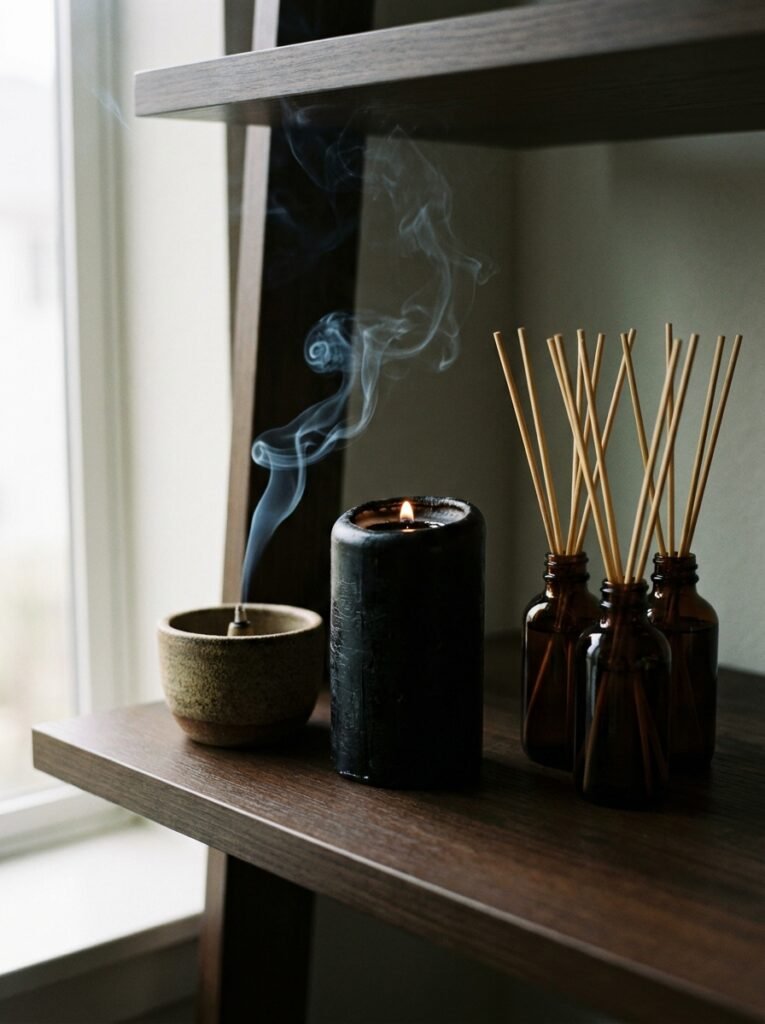
A dark feminine bedroom has a smell. It has to. Not perfumed in an aggressive way — just that quality you notice when you walk into a room and your body relaxes a half-second before your brain catches up. Oud. Black amber. Sandalwood. Dried botanicals that have been sitting in a decorative bowl long enough to lose their sharp edges and become something softer.
Candles in black or dark glass vessels just look right in this kind of room — and the scent should match the aesthetic the same way you’d choose art to match the feeling. Not fresh linen. Not clean cotton. Something that has weight to it.
A bundle of dried pampas grass or eucalyptus in a dark ceramic vase counts as scent décor too. Understated. Long-lasting. Earns its place visually AND in the air.
Anyway. Back to the visual stuff.
—
8. The One Thing Small Bedrooms Get Wrong When Trying This Aesthetic
Small room owners hear “dark bedroom” and immediately panic. They’ve been told their whole lives that small rooms need light colors or they’ll feel like a cave.
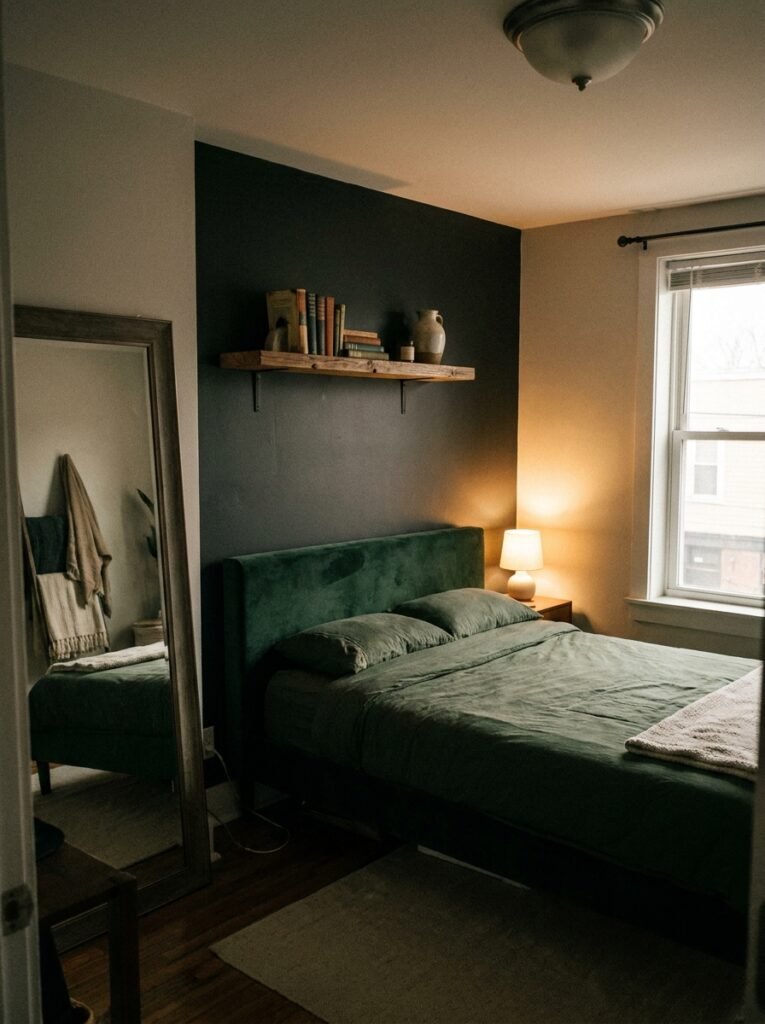
But here’s what actually happens in a small, well-executed dark feminine bedroom: the lack of visible boundaries makes the room feel endless. When the walls disappear into darkness, you stop being aware of where they are. That’s the opposite of feeling cramped.
The trick is scale. In a small room, you can’t have heavy, chunky furniture and dark walls — one or the other. Go dark on the walls and choose furniture that’s lower to the ground, a little more delicate, a little more spare. Let the architecture carry the drama. Keep surfaces cleaner than you think you need to. A few intentional objects, not a crowded collection.
One large mirror with a dark or black frame will do more for a small dark bedroom than almost anything else. Not to “make it feel bigger” in the cliché sense — but because reflected candlelight in a dark room does something almost theatrical. In the best way.
—
9. Plants That Belong in This Room (Specifically)
Not all plants read the same way in the same space, and this is one of those things that sounds obvious when you hear it but genuinely changes things when you apply it.
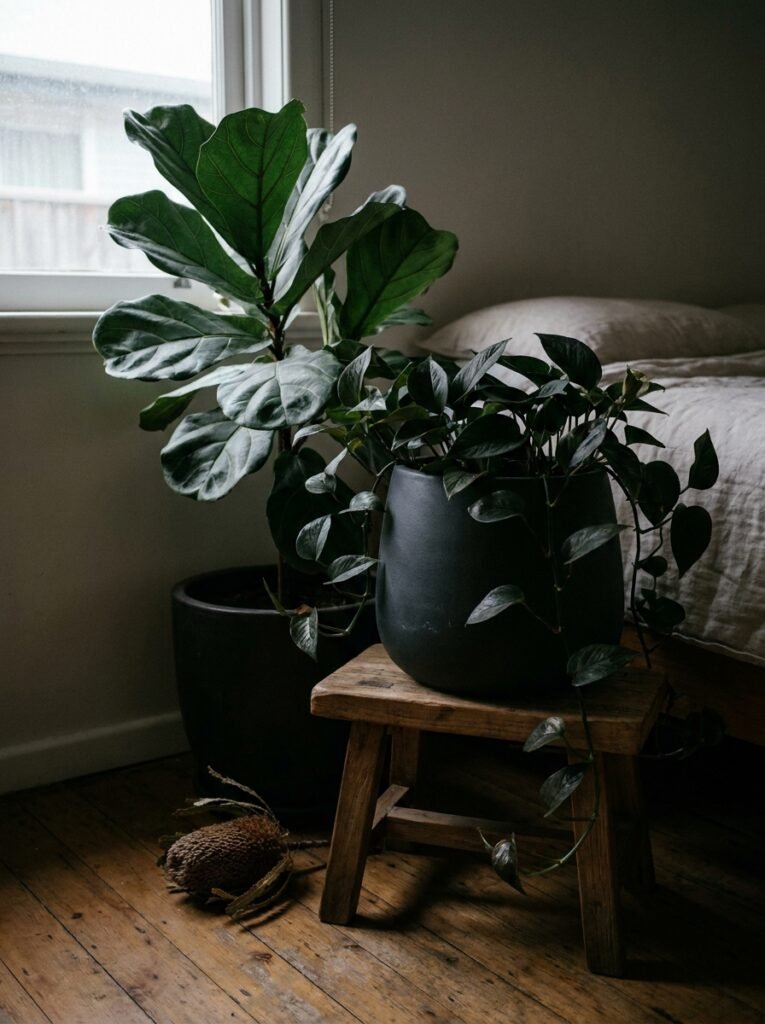
Lush, trailing, bright green plants look slightly wrong in a dark feminine bedroom. They’re fighting the mood. What you want instead are plants with structure. Dark leaf coloring. A certain drama in their silhouette.
A black-leafed elephant ear plant in a matte dark ceramic pot is stunning. Deep burgundy rex begonias. Snake plants — yes, the classic, but for a reason, because that rigid upward shape against a dark wall is almost architectural. A large dramatic monstera can work if the pot is right and the leaves have had time to develop those characteristic cuts and holes.
Dried arrangements are fully legitimate here and I’d argue they suit the mood better than living plants in some cases. A tangle of dried black-dyed cotton stems, a few preserved roses in a tone-on-tone dark vase. Things that feel like they’ve been here a while.
—
10. The Color That Keeps Showing Up on Dark Feminine Ceilings
Gold.
Not brass, not chrome, not sparkly ceiling fan gold. That proper, slightly matte, antique kind of gold that shows up in old European churches and looks like it’s been there for a century.
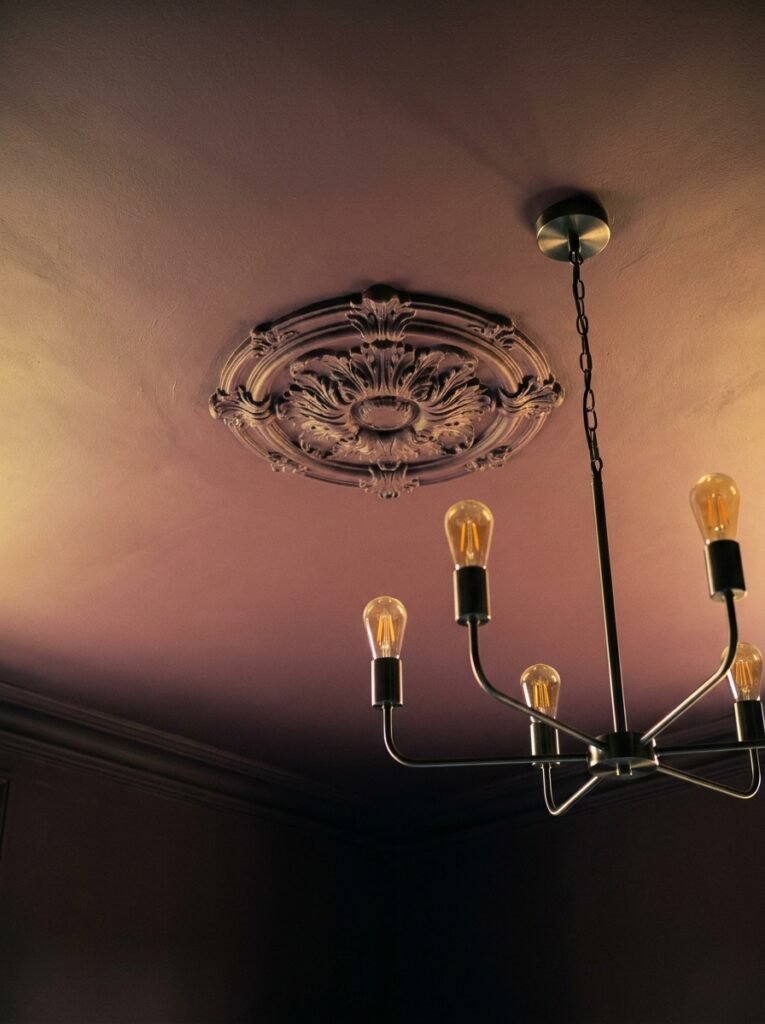
Dark walls with a ceiling that has any hint of gold — whether it’s a gold-painted medallion around a light fixture, a gold geometric stencil, or even just a very warm-toned cream ceiling that catches the lamplight right — creates this enclosing, enveloping feeling that makes the whole room feel deliberate. Like someone built this space with intention.
Even a single antique gold chandelier against dark walls does this. It doesn’t have to be elaborate.
“A single antique gold light fixture can do what a hundred other decorating decisions can’t: make a dark room feel opulent instead of oppressive.”
This is the difference between a room that feels unfinished and a room that feels done.
—
11. What to Do If You’re Renting and Can’t Paint the Walls
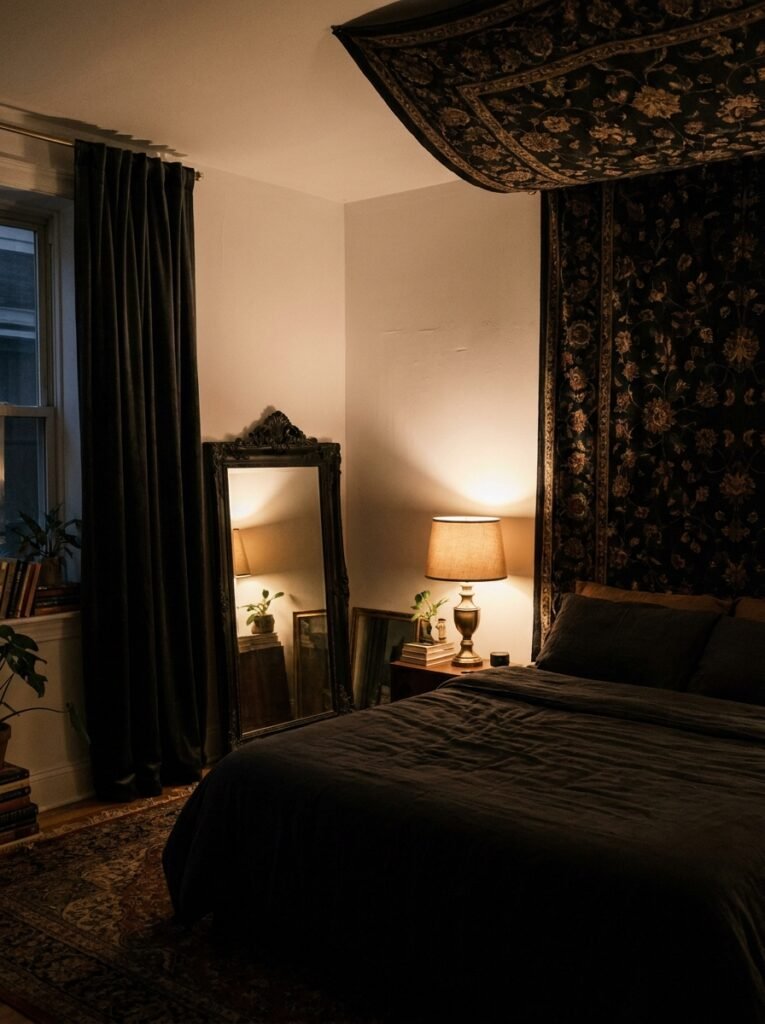
I hear this so often and I get it, because most rental agreements don’t exactly encourage you to paint your walls deep plum and call it a day.
But the walls are actually not where this aesthetic lives — or at least, they’re not the only place. You can build almost the entire feeling through textiles, lighting, and objects alone, leaving the walls completely untouched. Deeply saturated, heavy curtains that pool slightly on the floor will anchor the entire room’s palette. Dark, richly textured bedding. Low lighting everywhere. One or two substantial pieces of dark furniture if you can manage it.
Some people hang large dark-toned tapestries or fabric panels on the walls — not in a cheap dorm-room way, but as intentional textile art in dark colors that effectively replace the painted wall. You’d be surprised how completely it transforms a beige rental room.
The vibe lives in the objects and the light. You don’t need to own the walls.
—
12. The Part of the Room Everyone Forgets About Until They See Someone Who Got It Right
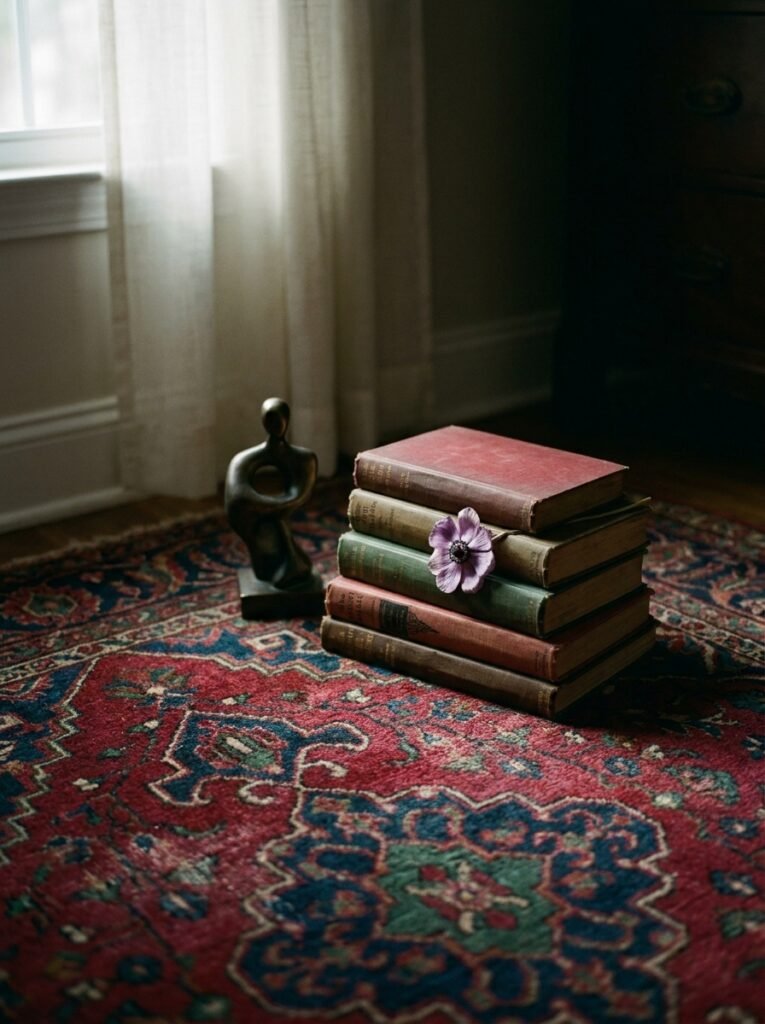
The ceiling, yes, we covered that — but I mean the floor.
People put so much energy into walls and bedding and then put a light grey carpet or a cheap pale rug on the floor and the whole thing loses its footing. Literally.
A deep, rich floor covering grounds everything above it. A dark Persian-style rug — those complex patterns in burgundy and navy and forest green that have been woven in one form or another for centuries — suits this aesthetic almost perfectly. If you’ve got dark hardwood floors, you’re already ahead. Let them breathe with minimal furniture legs interrupting them.
Or a very large, simple rug in a deep solid color, something with enough texture that it doesn’t look flat, with fringe or a low pile that photographs beautifully from above — which matters if you’re putting this on Pinterest, let’s be real.
The floor is the foundation. Get it wrong and the room floats. Get it right and suddenly everything above it looks considered and complete.
—
❓ FAQ
Q: Can dark bedroom walls make a room feel depressing rather than dramatic? A: They can, but it’s almost always a lighting problem. Dark walls with warm, layered, low lighting feel enveloping and intentional. Dark walls with harsh or cold overhead lighting feel heavy and flat. Swap your bulbs first — aim for warm white, around 2700K — and add at least two or three separate light sources before you decide the color isn’t working.
Q: Is the dark feminine aesthetic only for single people or young women, or can it work for a shared couple’s bedroom? A: Honestly, this comes up a lot, and the answer is that the aesthetic isn’t inherently gendered — the “feminine” in “dark feminine” refers to a quality of softness and depth rather than a demographic. Plenty of couples pull it off beautifully. It usually works best when both people lean into the luxury side of the look — rich textures, good lighting, quality bedding — rather than treating it as a specifically “her” space that one person reluctantly tolerates.
Q: What’s the difference between dark feminine and gothic bedroom aesthetics? A: Gothic leans into drama for drama’s sake — skulls, candelabras, very deliberate dark-romance symbolism, statement pieces that are explicitly morbid or medieval. Dark feminine is quieter and more grounded in luxury. It borrows some of the same color palette but the mood is intimate and sensory rather than theatrical. Think a gothic bedroom says “look at this”; a dark feminine bedroom just… makes you want to stay.
—
💭 Final Thoughts
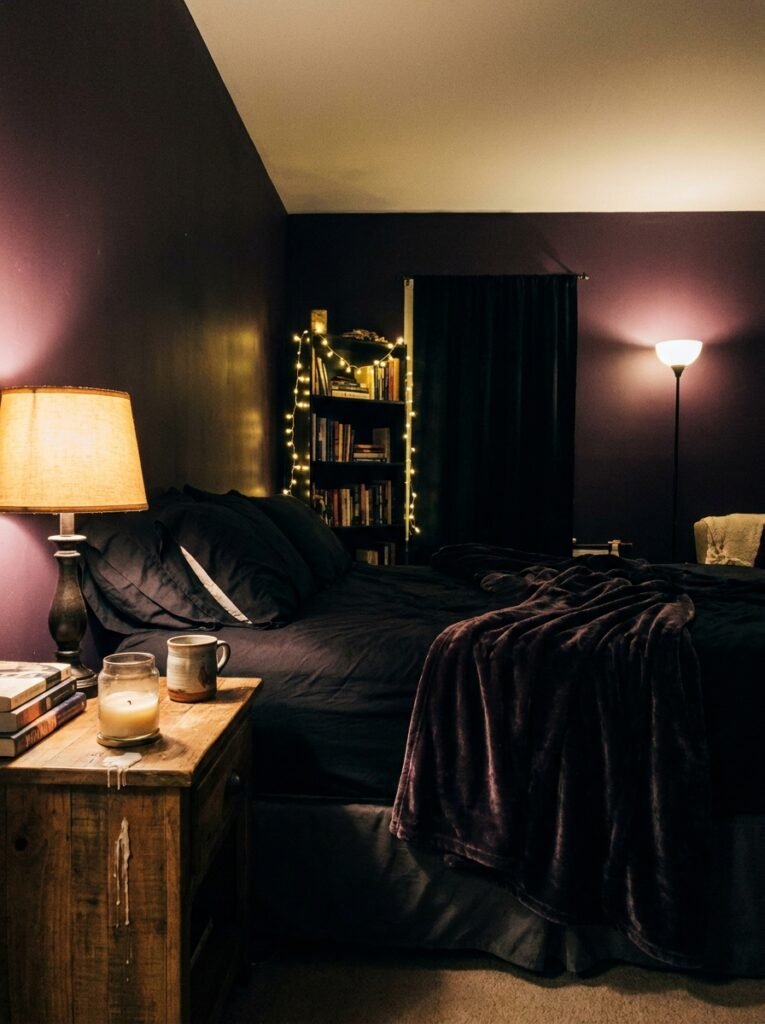
There’s something genuinely restful about a bedroom that isn’t trying to be bright and cheerful and aspirationally minimal. The dark feminine aesthetic is really just permission to make your room feel like it belongs to you — heavy and warm and a little secretive. Like there’s no reason for anyone else to rush through it.
If you’ve been saving these rooms on Pinterest and thinking I could never actually do that — start with the lighting and the bedding. The rest follows.
What would be the first thing you’d change to move your bedroom in this direction?