
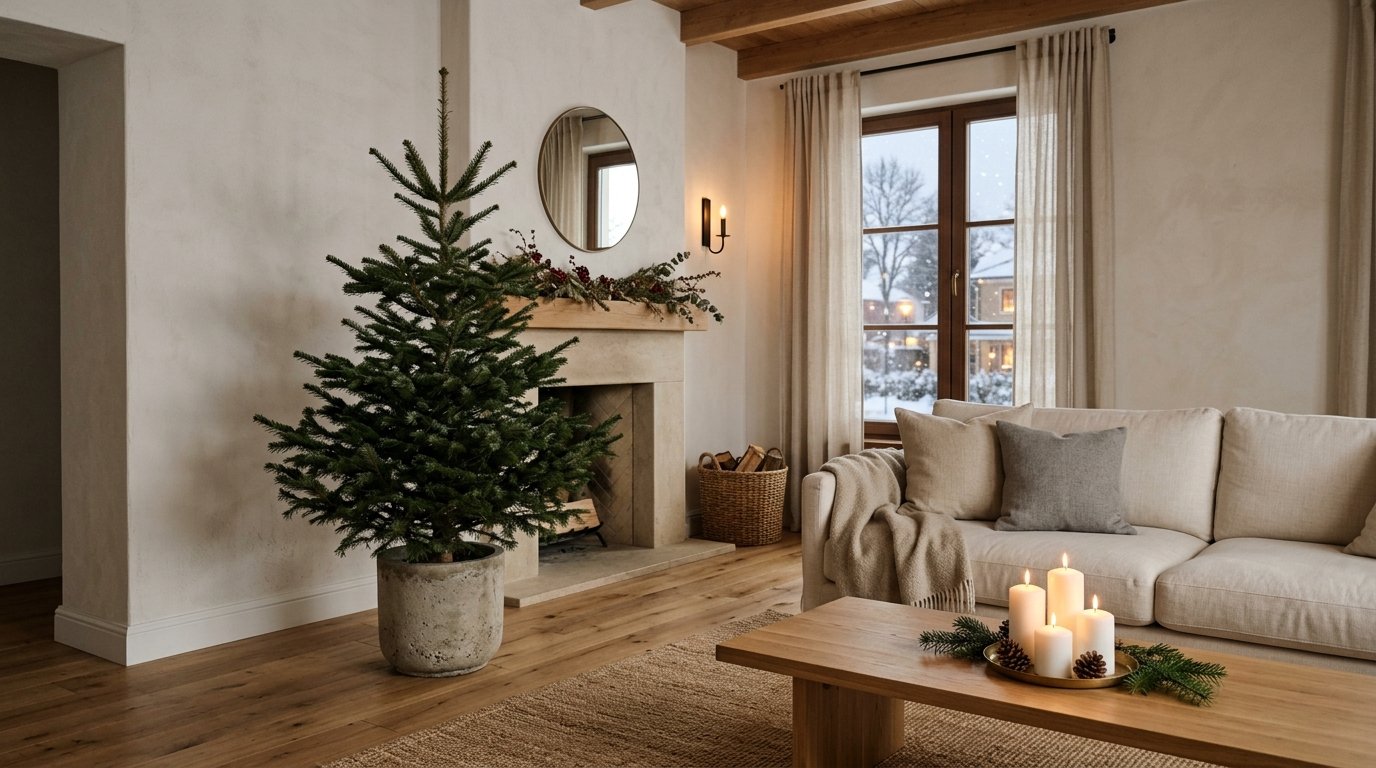
Why the Most Beautiful Christmas Living Rooms This Year Have Almost Nothing in Them
My neighbor knocked on my door last December and said, “I walked past your window and thought your tree wasn’t up yet — then I realized it WAS and I just… loved it.” That’s the moment I knew I’d finally gotten it right.
—
1. The Myth That More Tinsel Equals More Christmas Spirit
I spent years overdecorating. Every surface had something on it. Garlands on the mantel, garlands on the banister, garlands on the garlands. By the 15th of December I was already tired of looking at my own living room, and that felt wrong.
Minimalist Christmas decor isn’t about being cold or anti-festive. It’s not about pretending you don’t care. It’s about editing down to the things that actually give you that feeling — the warm chest, the quiet joy, the “oh, it’s Christmas” that hits when you walk in — without the visual noise that cancels it all out.
The secret is that restraint requires more intention than abundance does. Anyone can pile things on. Choosing three things and making them count? That’s harder. And the results are so much better.
“Restraint requires more intention than abundance does. Anyone can pile things on.”
—
2. The Specific Shade of Green That’s Doing All the Work Right Now

Not just any green. We’re talking deep, almost-blue-green — think fresh Douglas fir up close, or the inside of a wreath that hasn’t dried out yet. That specific dark, resinous green is the backbone of the most beautiful minimalist Christmas rooms I’ve seen this year, both in the US and the UK.
And here’s the thing: you don’t need a massive tree to get it. A single large branch in a clear vase. A wreath hung inside (not on the door — inside, above the fireplace or leaning against a wall). A few stems of eucalyptus mixed with actual pine. The color does the heavy lifting if you let it.
The contrast against white walls or cream linen is almost unreasonably good. It reads as “Christmas” without you needing to add a single ornament. Which means you CAN add one or two and they land with real weight.
—
3. What to Actually Do With a Christmas Tree When You Want It to Look Sculptural
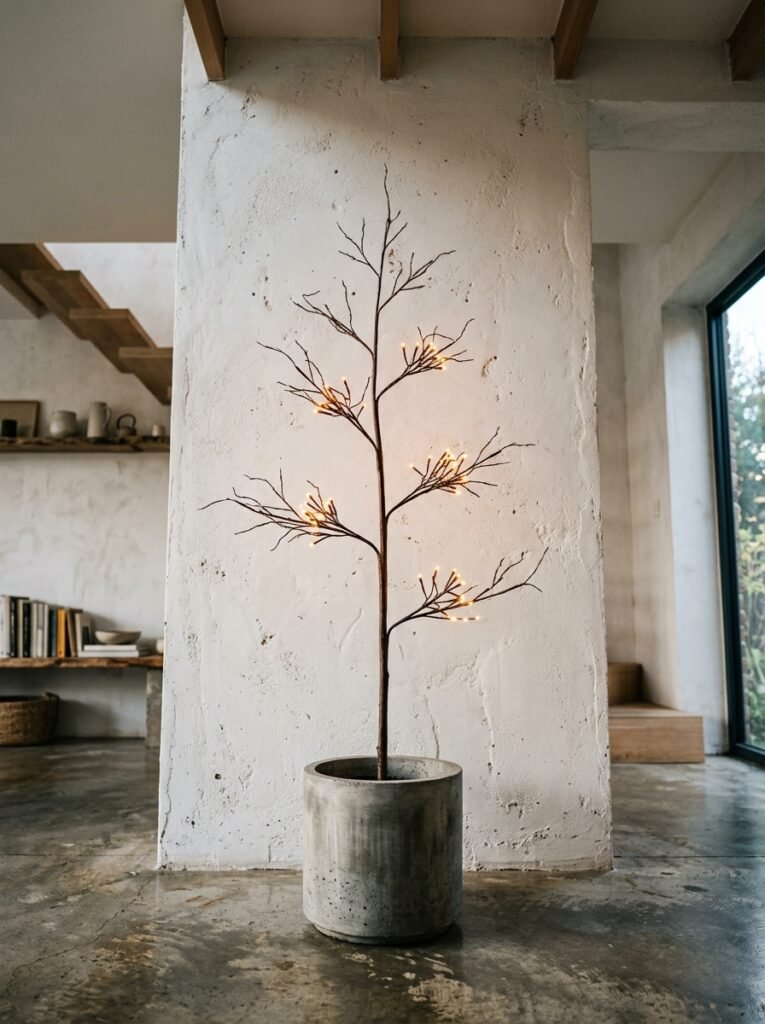
Leave gaps. That’s it, honestly. That’s the whole trick.
Most people stuff trees from the outside in. Minimalist styling works from the inside out — you look at the SHAPE of the tree first, the negative space between branches, the shadow it throws on the wall behind it. The ornaments should feel like they’re floating inside it, not hanging off the surface.
For a really clean look, stick to one type of ornament. Not one color — one TYPE. All glass spheres. All wooden shapes. All dried orange slices. Repetition reads as intentional. Mix-and-match reads as busy, no matter how “curated” it is on paper.
Keep the lights warm white or dim gold. Cool white LEDs are technically brighter but they flatten the whole thing. You want the amber glow of the lights at 9pm when everything else in the room is off — that specific moment is what minimalist Christmas decor is DESIGNED for.
—
4. The Mantelpiece Formula That Never Looks Overdone
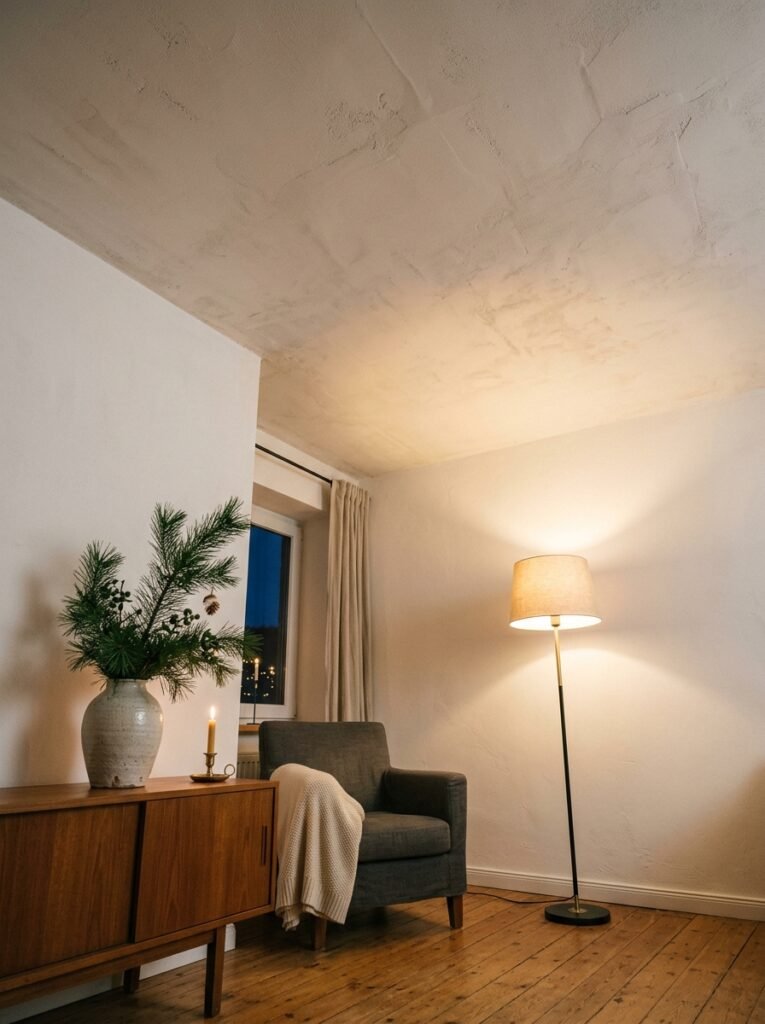
Three things. That’s the rule I came back to after years of experimentation.
Not three identical things — three things that create a visual conversation. Something tall. Something with texture. Something with a little warmth or light. The exact items vary, but the formula holds.
Maybe that’s a single tall candle in a concrete holder, a loose bundle of dried white cotton stems, and one small lantern. Maybe it’s a branch of eucalyptus laid horizontally across the shelf, a stack of two or three books with neutral spines, and a simple white pillar candle. The details change, but the scale relationship stays the same: height, texture, glow.
What you’re NOT putting on the mantelpiece: multiple stockings hung in a row if it crowds the visual (hang them lower if you must), an entire nativity set spread across the whole surface, fairy lights draped over everything. Those aren’t wrong, they’re just not this look.
—
5. The Forgotten Power of Doing Absolutely Nothing to the Ceiling
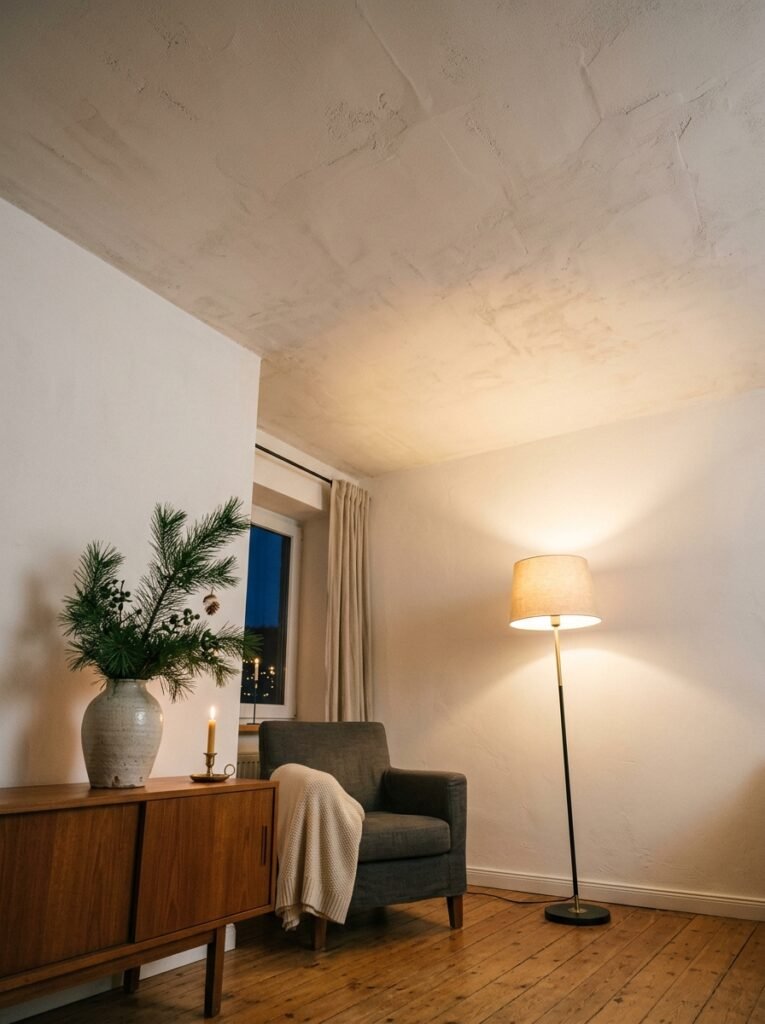
I know. Everyone’s doing pampas grass ceiling installations and dried flower chandeliers and it’s BEAUTIFUL but — in a minimalist living room at Christmas, the ceiling being completely, deliberately bare makes everything underneath it feel more considered.
Here’s why this actually works: negative space up high draws your eye DOWN to the things you’ve carefully placed. A low arrangement of candles on a coffee table. A floor lamp casting a warm circle. The tree in the corner. Your eye rests at a human height instead of bouncing around.
The only exception I’d make is a single sprig of mistletoe. One. From a ribbon. Just hanging there like it’s been there forever. That’s charming. That’s still minimal.
—
6. Textures That Say “December” Without Screaming It

This is where minimalist Christmas decor earns its warmth. Because if you strip out the clutter but you don’t add texture, you’re just… cold. Literally and figuratively.
What works:
- A chunky knitted throw folded over the arm of a sofa (not draped messily — folded once, intentionally)
- Linen cushion covers in oatmeal, cream, or very deep navy
- A woven jute rug that’s already there year-round but suddenly looks INCREDIBLY festive when everything else is stripped back
- Velvet. Something velvet. A cushion, a small pouffe, even a velvet ribbon around a candle jar
The goal is that when someone sits down in your living room it feels warm and considered and like the whole room is in on the secret of what month it is — without a single snowflake graphic in sight.
“When someone sits down in your living room it should feel like the whole room is in on the secret of what month it is.”
—
7. The Case for Candles as Your Only Christmas Decoration
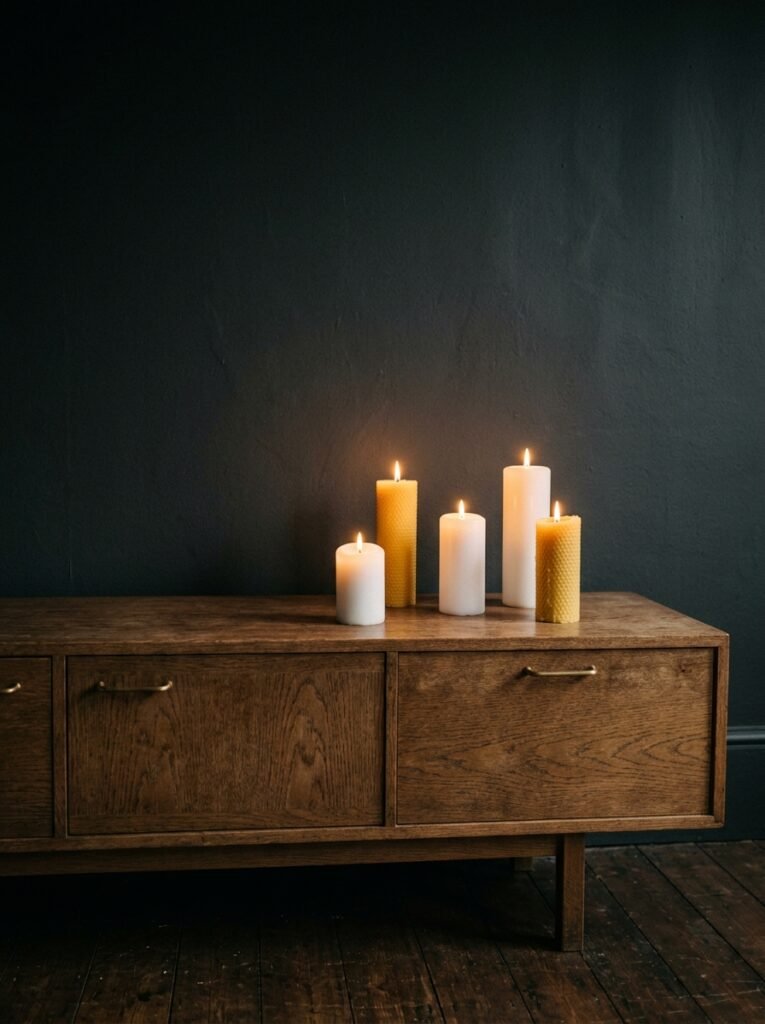
Some years, just do candles. That’s a complete sentence and a complete design philosophy.
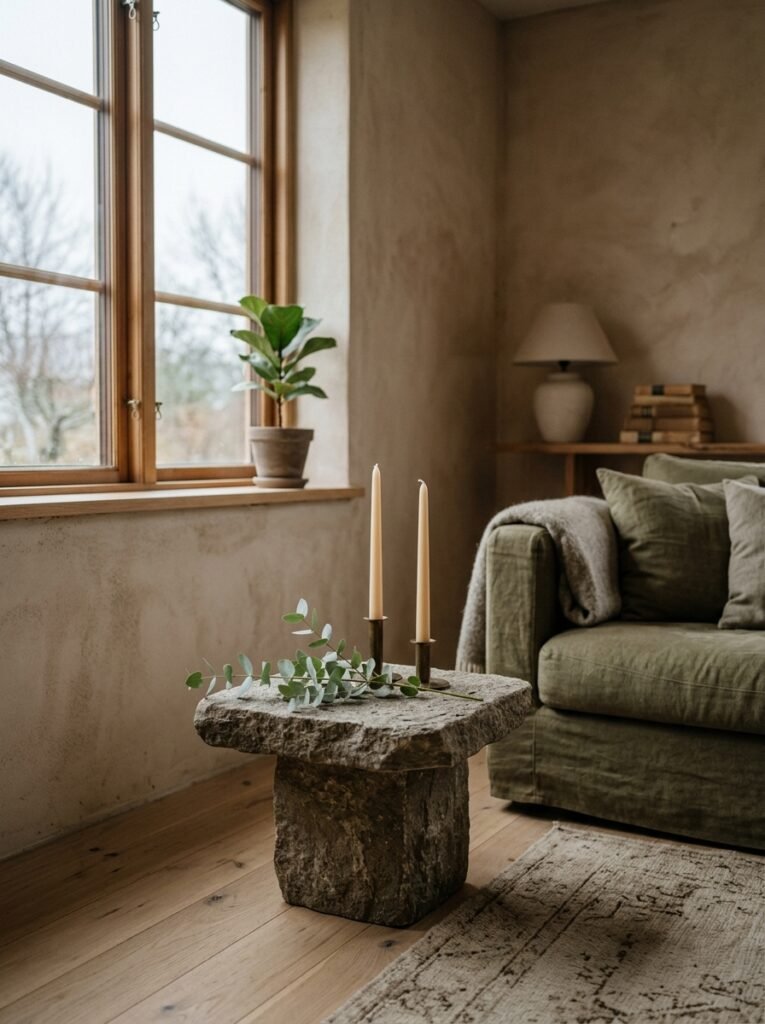
I’m not joking. If you get the candle situation right, you genuinely might not need anything else. A cluster of pillar candles at varying heights on a wooden board or a slate slab. Tea lights inside small glass holders on every surface — windowsill, coffee table, bookshelf edge. One big church candle in a heavy holder on the floor by the fireplace.
Light them at 4pm on a grey December afternoon and watch what happens to your room. It becomes COMPLETELY different. The shadows, the flicker, the specific quality of candlelight against cream or white walls — it does something to a room that no fairy light fully replicates.
This works especially well in the UK where, let’s be honest, it gets dark by half three in December and you’re going to need those candles whether you call it decor or not.
—
8. One Rule for the Windowsill That Changes Everything
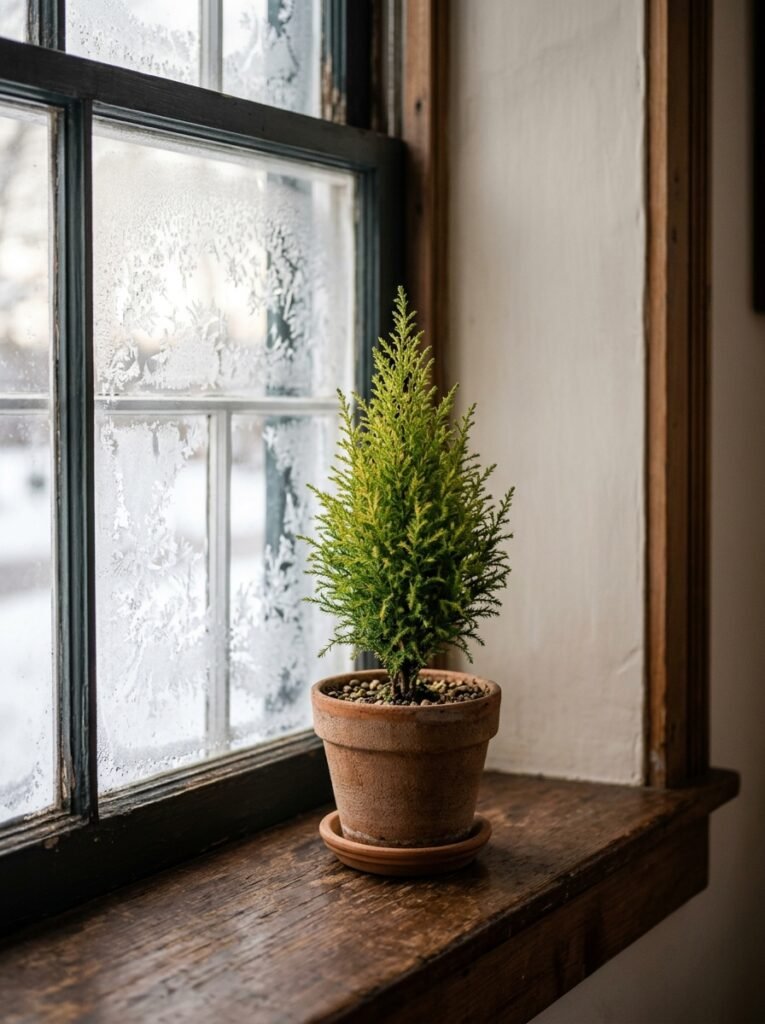
One candle per window. Centered. That’s it.
Not a collection of little things. Not a row of LED tea lights and a tiny wreath and some pine cones and a red bow. ONE candle. Centered. White or cream. No embellishment.
From outside, it looks impossibly elegant. From inside, it frames the winter view — bare branches, frost, grey sky — like you’ve put it there on purpose. Which you have.
This is one of those things that looks like you’ve thought about it deeply when actually it’s the least amount of thinking. The simplicity IS the thought.
—
9. The Color Palette That Travels Beautifully From November to January
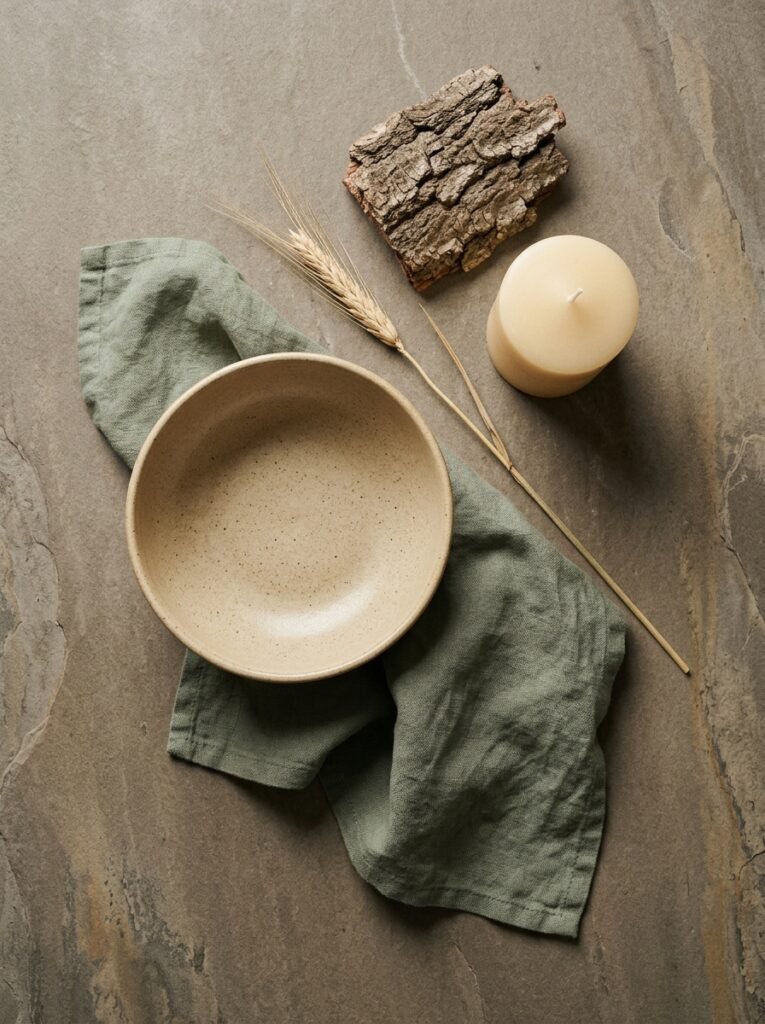
Here’s something I’ve landed on after too many years of buying stuff in red and gold and then feeling like I need to burn it all on December 26th: the real longevity move is a palette of deep green, warm white, natural wood, and one soft metallic.
Brass, not gold. There’s a difference — gold is festive, brass is just beautiful. A single brass candlestick. A brass picture frame that lives there all year. The distinction matters.
Deep green and warm white reads as winter, not specifically Christmas. So if you decorate in mid-November (no judgment), you’re not stuck with Christmas vibes for seven weeks. And after the tree comes down, the remaining greenery and candles just look like… a beautiful January room. Which, frankly, January desperately needs.
—
10. How to Style a Corner That Isn’t a Tree and Isn’t Nothing
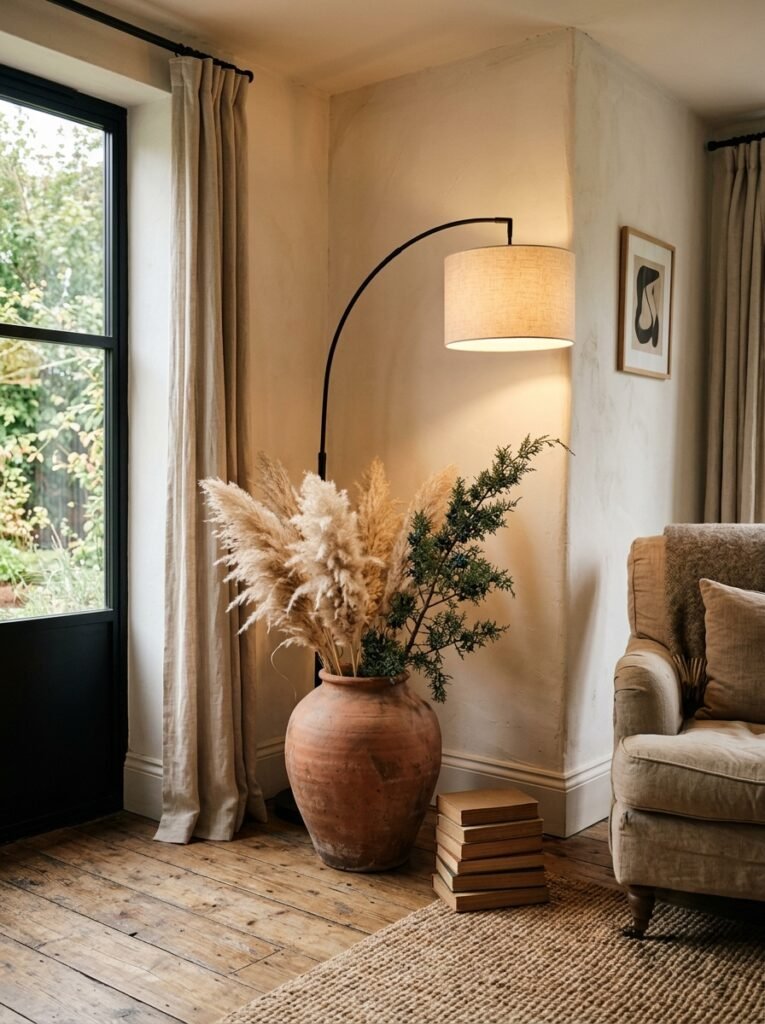
Not everyone has space for a full tree. Not everyone wants one. And a bare corner in a living room is a MISSED opportunity at Christmas because corners are where the eye rests.
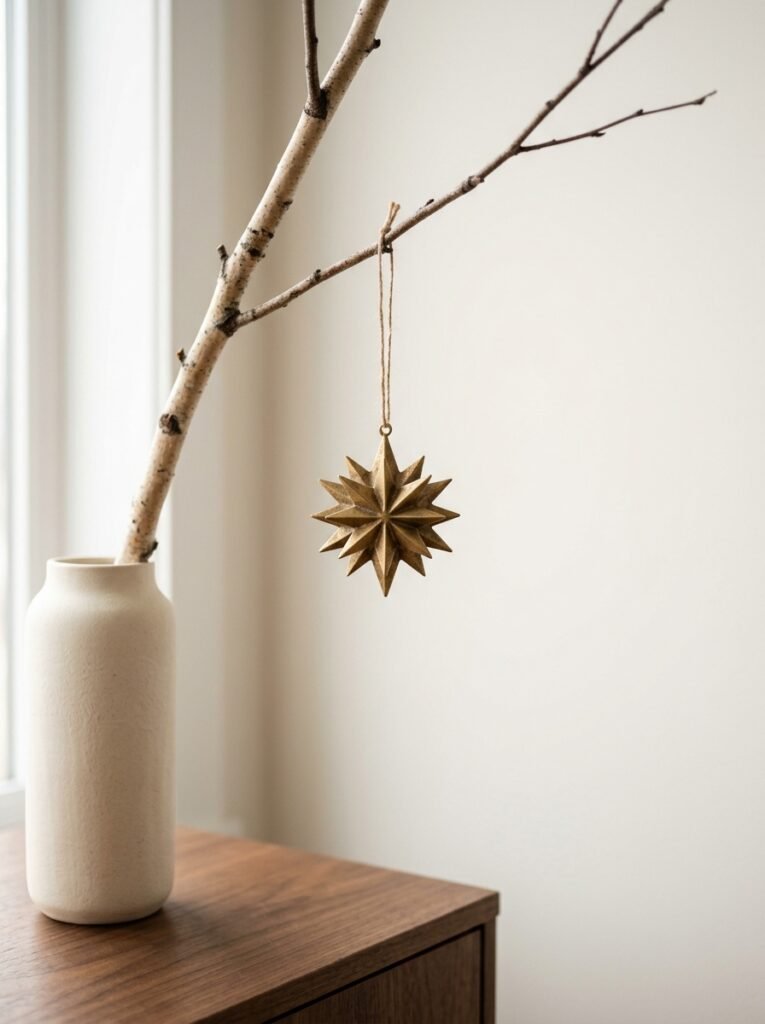
A tall arrangement of bare branches in a large floor vase — spray-painted white or just left natural — fills a corner with a kind of sculptural elegance that a tree sometimes can’t. You can hang a few glass ornaments from the branches if you want, or not. Either way it works.
Alternatively: a stack of wrapped gifts if you’re someone who actually has them done early (I respect you), topped with a simple sprig of pine. The stack itself becomes the decor.
Or a single large lantern on the floor, oversized, with a chunky pillar candle inside. Disproportionately large objects in corners look intentional and considered, not accidental.
“Disproportionately large objects in corners look intentional and considered, not accidental.”
—
11. The One Thing Most Minimalist Christmas Rooms Get Wrong
They forget scent. And scent is — arguably — the whole thing.
You walk into a room that smells like cloves and orange peel and pine and something warm and woody and your brain goes to Christmas faster than any decoration can take it. Scent bypasses critical thinking. It just WORKS.
A bowl of simmering water with cinnamon sticks and a sliced orange on the hob nearby. Real pine — from actual branches, not artificial. Candles with notes of cedarwood or frankincense (both of which smell expensive and seasonal without smelling like a novelty gift shop).
This is the layer that most Pinterest boards can’t show you, which means most people forget it. Don’t.
—
12. The Last Thing to Add, and the First Thing to Put Away

Whatever your version of “the one festive thing” is — the thing that’s a little extra, a little not-minimalist, a little purely sentimental — keep it. One thing.
Maybe it’s a slightly ridiculous advent calendar your kids love. Maybe it’s a string of fairy lights you’ve had for ten years that have three broken bulbs. Maybe it’s a ceramic Santa that was your grandmother’s and that you’d never actually choose to buy but that you’d never give up.
Put THAT out. Give it its own space. Let it exist without irony.
Because the whole point of minimalism isn’t to create a showroom — it’s to create room for the things that actually matter. And sometimes the thing that actually matters is a slightly chipped ceramic Santa standing alone on a windowsill.
That’s not a failure of minimalism. That’s exactly what it’s for.
—
❓ FAQ
Q: How do I make minimalist Christmas decor feel warm and not cold or sterile? A: Texture and candlelight are the two things that separate “minimal and warm” from “minimal and clinical.” Add something chunky to touch — a knitted throw, a woven cushion — and use candles or very warm-toned lights rather than cool white LEDs. The light temperature alone changes the whole feeling of a room.
Q: Can minimalist Christmas decor work if I have kids or pets who’ll mess with things? A: Yes — keep the lower half of the room simple and durable (a throw, some cushions, nothing breakable at floor level) and do your more delicate styling up high: the mantelpiece, windowsills, a shelf. It also means less to tidy when something inevitably gets knocked over.
Q: When should I put up minimalist Christmas decor? A: Whenever you want, honestly. One of the advantages of this style is that it’s not aggressively “Christmassy,” so it doesn’t feel out of place in mid-November. The green, white, and natural wood palette especially blends into late autumn beautifully and doesn’t start looking ridiculous the moment the calendar flips to December 1st.
—
💭 Final Thoughts
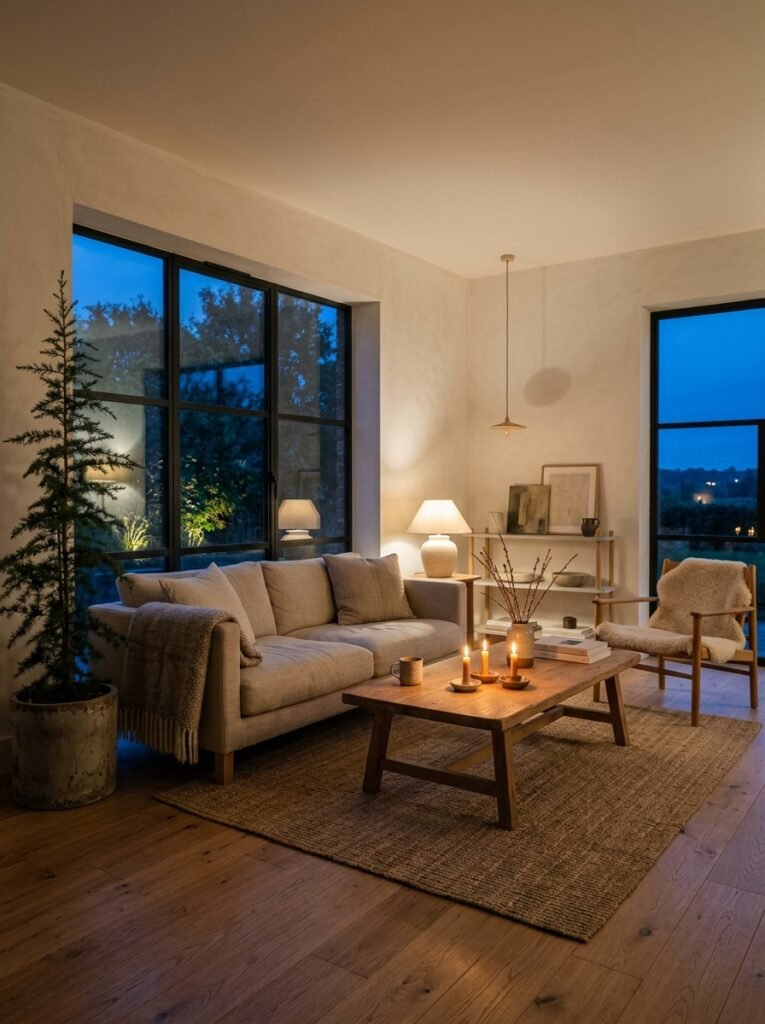
There’s something genuinely restful about walking into a room that’s celebrating quietly. Not performing Christmas — just acknowledging it. A candle, a branch, a smell, one thing you love.
That’s the version of December your living room can be. And honestly, after the year most of us have had, doesn’t quiet sound really, really good?