The Orange Sofa Is Having Its Moment — And Here’s How to Actually Pull It Off
You walked past it in the store and stopped. Maybe you even took a photo. There’s something about an orange sofa that makes your heart do a thing. And now you’re here, wondering if you’re brave enough.
—
1. Why Orange Sofas Look Terrible in Some Rooms and Incredible in Others
Let’s get the honest part out of the way first. An orange sofa can look absolutely stunning or genuinely chaotic, and the difference almost always comes down to one thing: undertone. Not the color of your walls. Not the size of the room. The undertone of the orange itself.
Because “orange” isn’t one color. There’s the terracotta-burnt sienna kind of orange that leans warm and earthy and honestly looks ancient in the best way. Then there’s the bright pumpkin orange — more saturated, almost 70s, very specific energy. And then there’s the rust-orange that sits somewhere between red and brown and copper, which is honestly my favorite version and the one that plays best with the most room styles.
The rooms where orange sofas fall apart? Usually it’s a very bright, cool-toned room — stark white walls, grey floors, lots of chrome. The orange just floats there looking confused, like it wandered in from a different house.
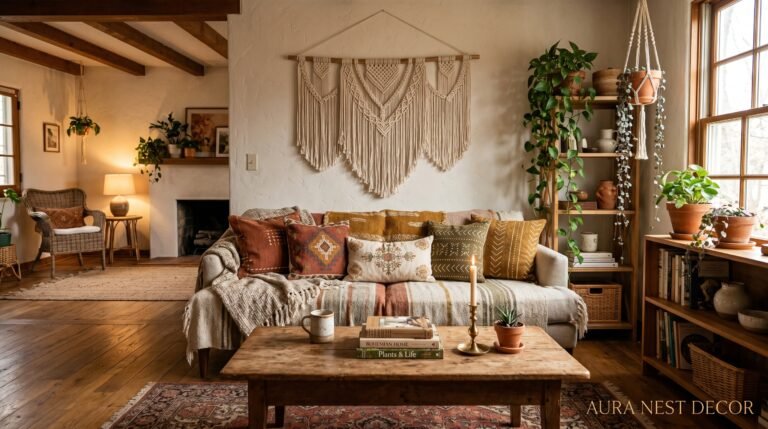
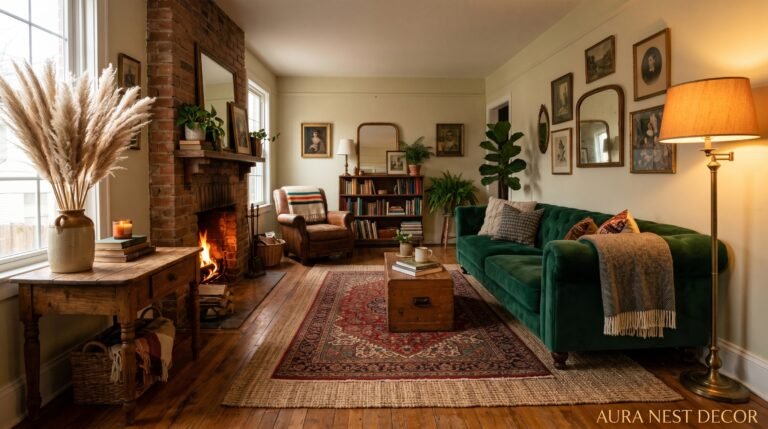
The rooms where orange sofas absolutely sing? Warm-toned spaces. Think plaster walls, wooden floors, lots of texture. The sofa doesn’t have to fight for attention there because everything around it is already on the same team.
So before you buy, pull the sofa up on your phone and hold it next to your actual wall. In your actual light. That step alone saves so many people from expensive regret.
“The orange sofa doesn’t need to match your room — it needs to belong there.”
—
2. The Wall Color That Makes an Orange Sofa Look Like It Was Always There
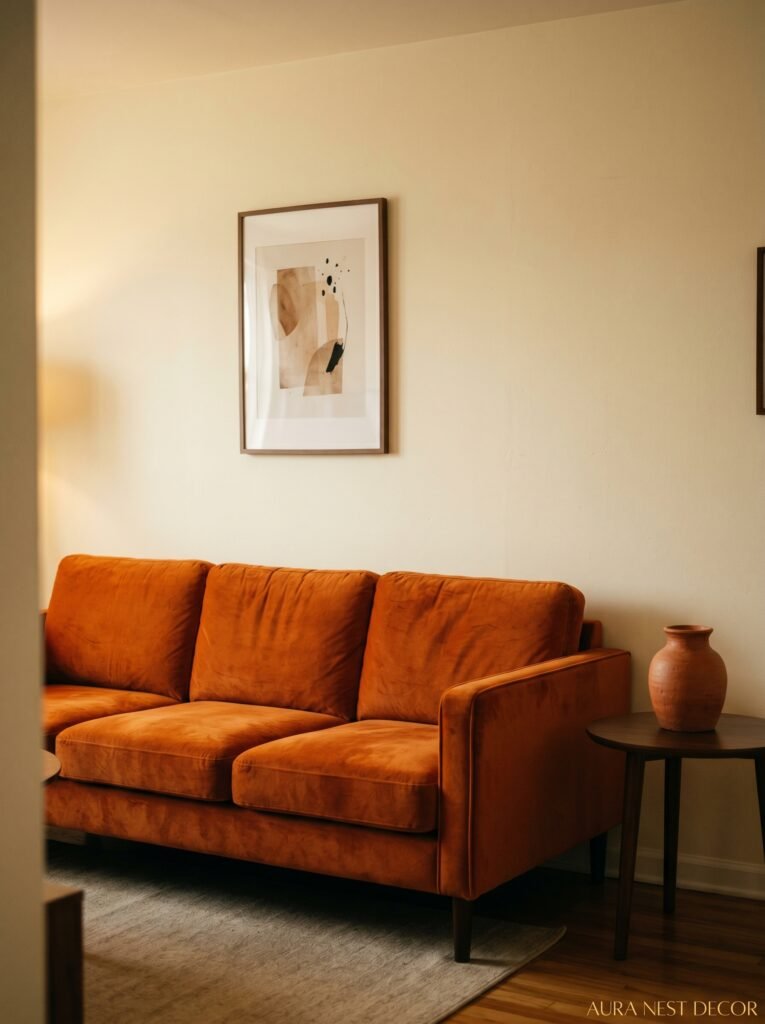
Deep green. I’m not even going to bury the lede on this one.
A forest green or hunter green wall behind an orange sofa is one of those pairings that makes complete sense once you see it and then you cannot unsee it. They sit opposite each other on the color wheel, which sounds like a design school answer, but the REAL reason it works is that both colors feel like they come from the same place. Outside. Autumn. Something old and unhurried.
Warm whites also work really well — not bright white, not cool grey-white, but the creamy, barely-there kind that feels more like plaster than paint. Benjamin Moore White Dove, Farrow & Ball Pointing, anything in that family. These let the sofa do its job without competition.
Terracotta walls with a rust orange sofa is a look that requires confidence, but when it works it genuinely looks like something out of an Amalfi coast villa and less like a mistake. The key is texture — rough plaster, woven baskets, linen throws. Without texture, it reads as flat and a bit much.
What doesn’t work: grey. Cool mid-tone grey walls make orange sofas look garish. I’ve seen it tried so many times and it just doesn’t. The grey reads cold and the orange reads hot and there’s no middle ground. Step away from the grey.
—
3. The Rug Underneath It All (This Part People Get Wrong)
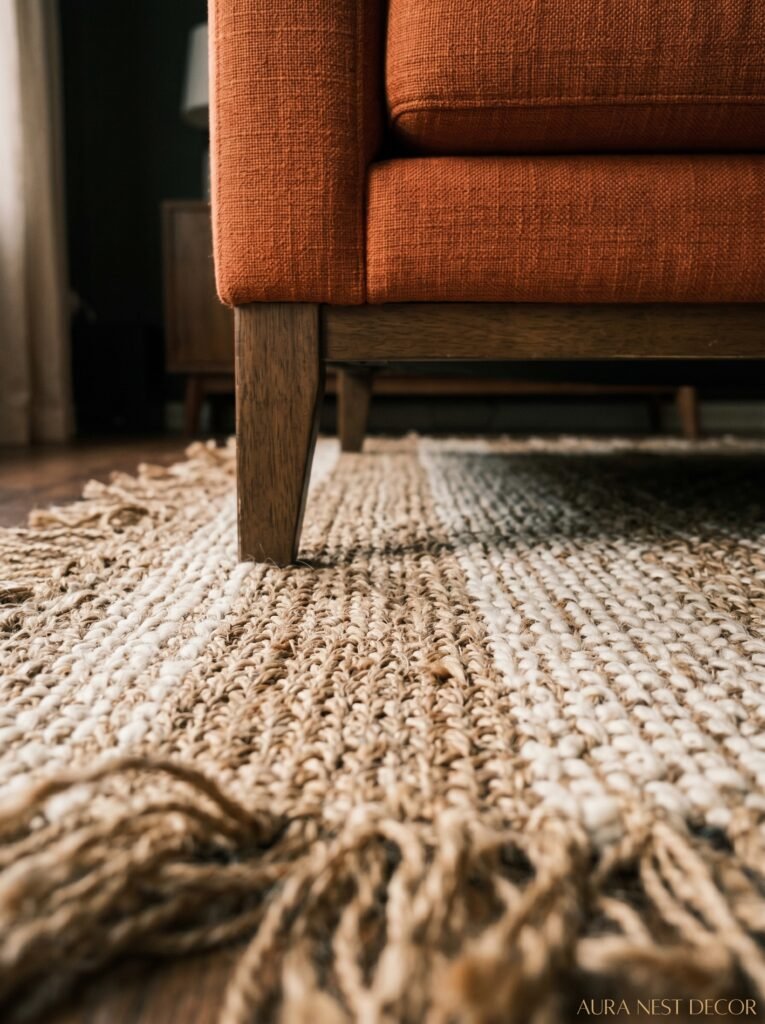
People often treat the rug as an afterthought with a statement sofa. Big mistake. Huge. The rug is actually what tells the room whether the orange sofa is “intentional design choice” or “bold accident.”
Natural fiber rugs — jute, sisal, seagrass — are almost foolproof with orange sofas. The earthy, undyed texture grounds the sofa’s warmth without competing. They’re also very forgiving, which, when you’re already committed to an orange sofa, you want your rug to be forgiving.
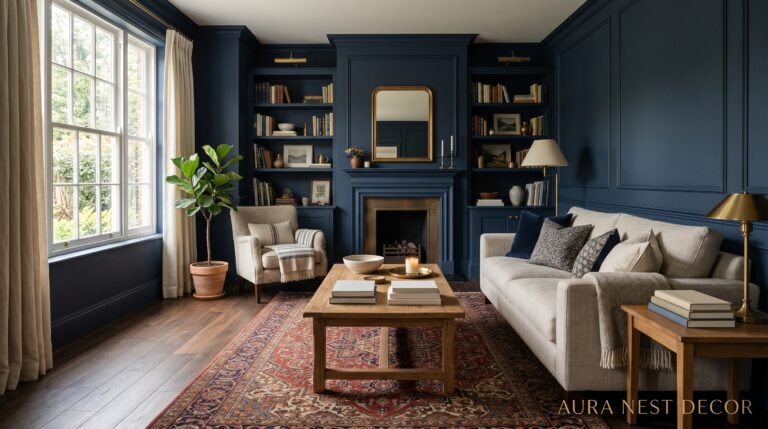
A vintage Persian or Turkish rug with warm tones in red, navy, and gold is actually extraordinary under an orange sofa. The multicolor pattern acts as a bridge between the sofa and the rest of the room, and somehow it makes the whole thing feel curated rather than chaotic.
What I’d avoid: plain grey rugs (see: the grey problem above), anything with a lot of cool blue or purple in it, and stark white shag because that’s just asking for stress.
Side note — if you’re going jute, go big. An undersized rug in any room is the number one thing that makes a space look unfinished, and with a statement piece like an orange sofa, you really want that rug to anchor the whole seating area properly.
—
4. Cushions That Don’t Try Too Hard (and a Few That Should)
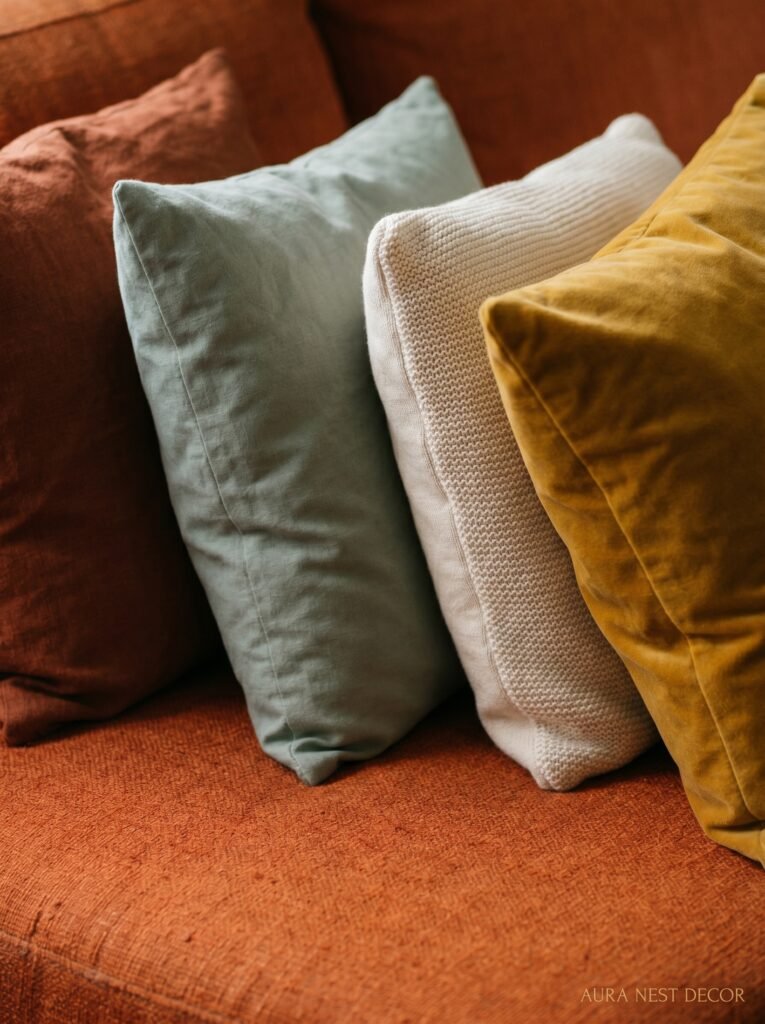
Okay so here’s where a lot of people panic. The sofa is orange. What cushions go on an orange sofa without making the whole thing look like a craft project?
First option: cream and white. Super simple, very clean, lets the sofa breathe. Works especially well if the rest of your room already has texture and warmth, because the cushions don’t need to do much heavy lifting.
Second option: deep navy or indigo. This is unexpected in the best way. Navy against orange is classic — think autumn, think old Dutch paintings, think that specific feeling of dusk in October. A couple of navy linen cushions and maybe one printed one that picks up both colors? So good.
Third option: the pattern play. A botanical print or a graphic geometric that includes orange alongside other colors pulls the sofa into the room’s story instead of letting it sit apart from everything else. Just don’t overload — two or three cushions max, or it starts looking like you couldn’t make a decision.
What to avoid: matching orange cushions. Please. The sofa is orange. It doesn’t need orange cushions to match. That’s like wearing a hat that matches your hat.
“Two cushions in the right colors do more work than eight cushions in the wrong ones.”
—
5. The Orange Sofa in a Small Living Room — Yes, You Can
There’s this idea that bold colors make small rooms feel smaller. And honestly? It’s not really true. What makes small rooms feel smaller is clutter, heavy furniture with no legs, and windows that are blocked or underlit.
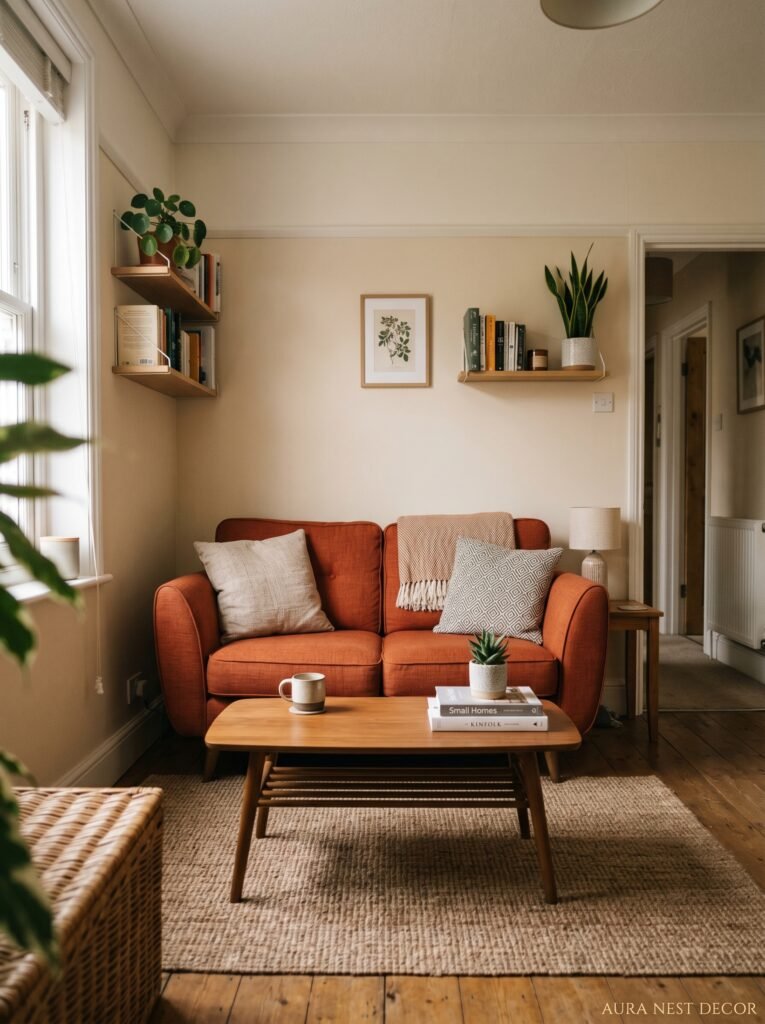
An orange sofa in a small room actually works really well when you choose the right one. Low profile. Clean lines. Ideally raised on legs, even slightly, because that bit of floor showing underneath makes the whole thing feel lighter.
Pair it with a wall color that’s warm but not dark — that creamy white we talked about, or a soft limewash. Keep the rest of the furniture relatively neutral. A wooden coffee table rather than a big upholstered ottoman. A couple of plants. Not a lot of extra stuff competing.
The goal in a small room is to make the orange sofa feel deliberate rather than cramped. One bold thing done confidently reads as maximalist-chic. Three bold things in a small space just reads as a lot.
—
6. The Specific Lighting That Makes Orange Absolutely Glow
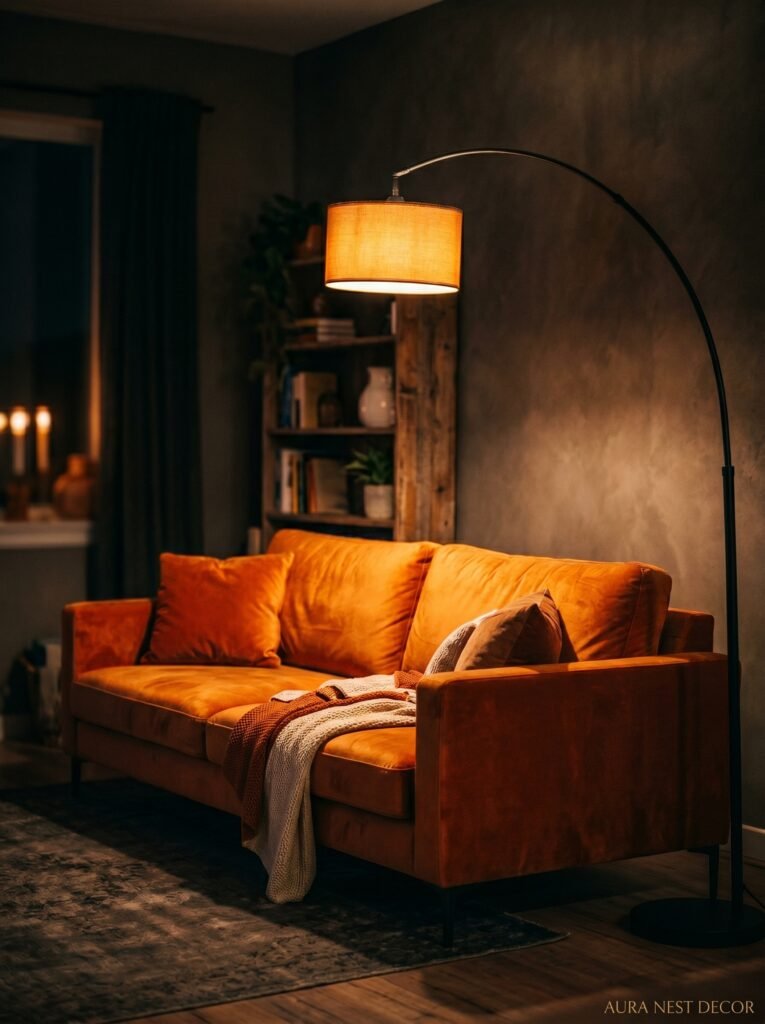
This is my favorite part of the whole orange sofa conversation because nobody talks about it enough.
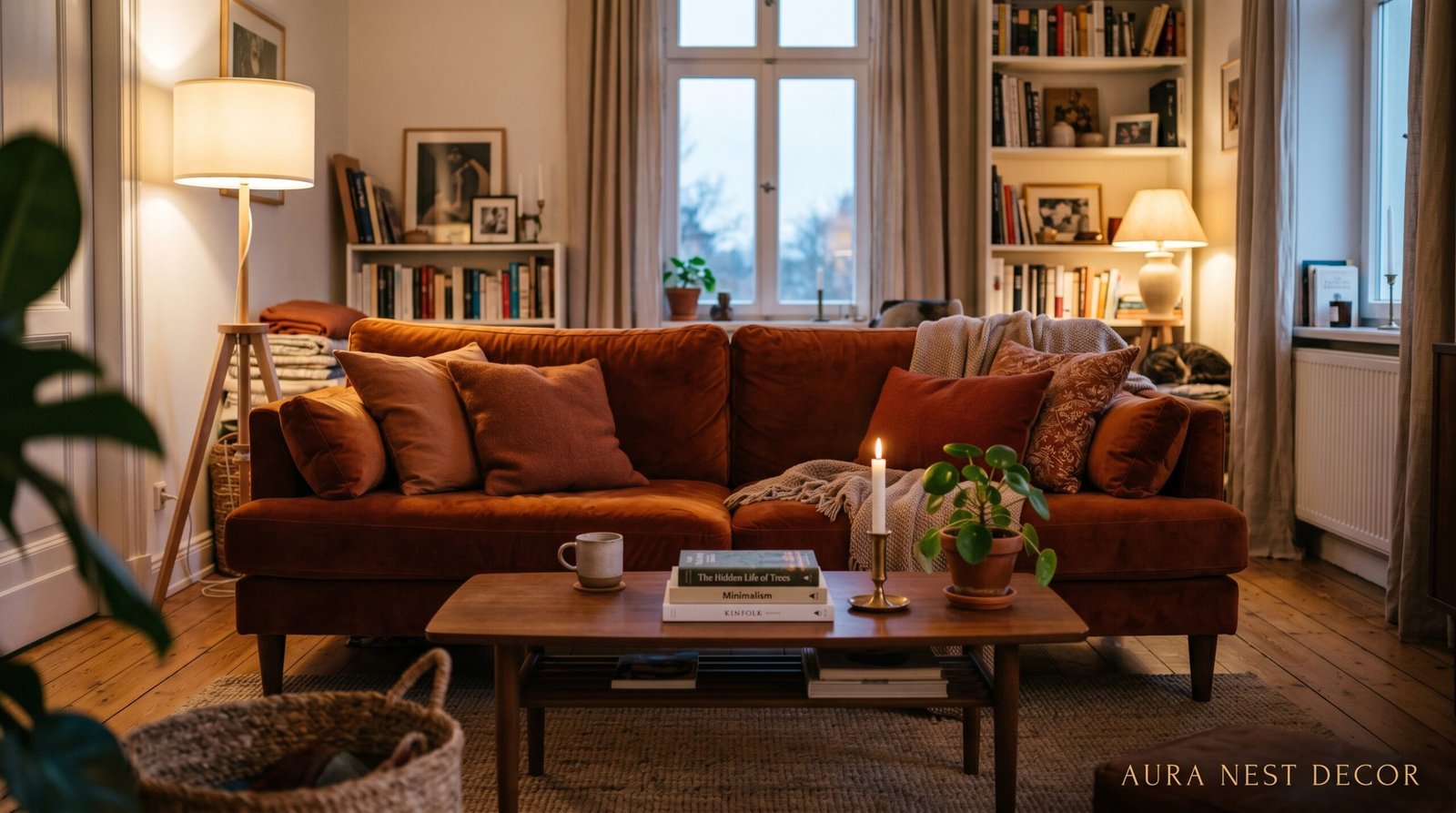
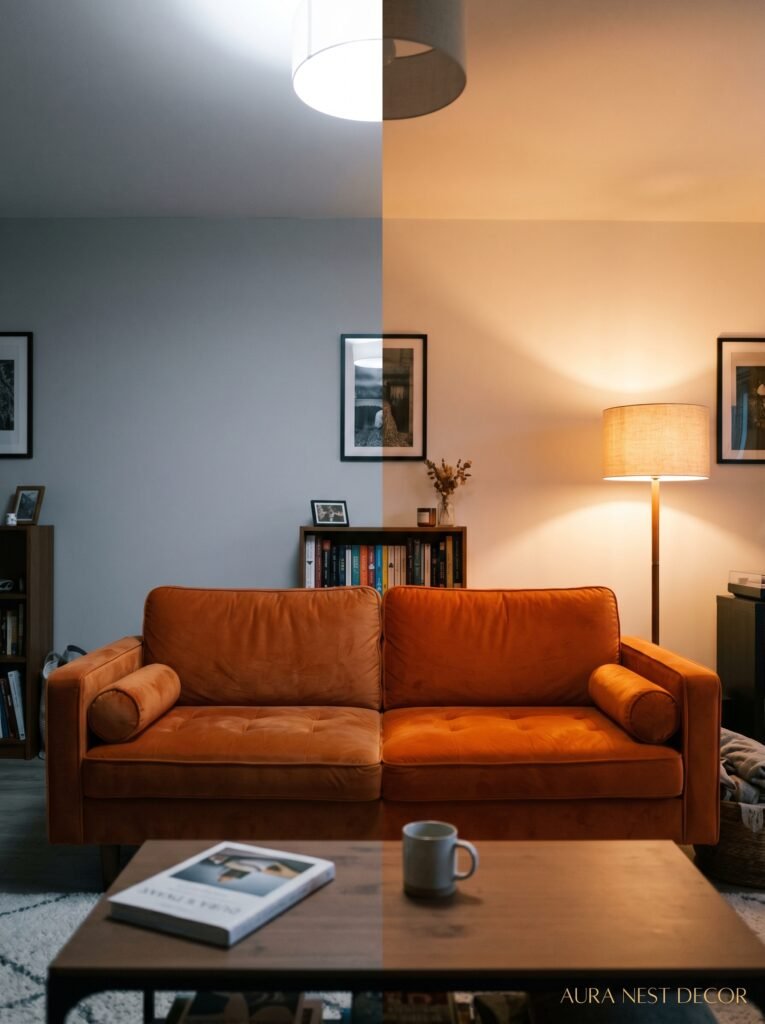
An orange sofa under harsh overhead lighting looks flat. Kind of disappointing, honestly. But the same sofa under warm ambient lighting — the amber glow of an Edison bulb at 7pm, a standing lamp with a linen shade off to one side, candles on the coffee table — looks rich and layered and genuinely beautiful.
Orange responds to warm light the way no other sofa color does. It deepens. The rust orange becomes almost bronze. The burnt sienna reads more like clay or leather. The whole room takes on this golden hour quality that you didn’t entirely plan but you’re absolutely taking credit for.
So if you’ve got an orange sofa and you’re wondering why it’s not looking as good as the Pinterest photos: check your lighting. Swap out any cool daylight bulbs for warm ones (around 2700K is the sweet spot). Add a floor lamp or a table lamp. Layer the light sources. That alone might be the transformation you’re looking for.
—
7. Making It Work With Wooden Floors vs. Grey Tile — Two Completely Different Approaches
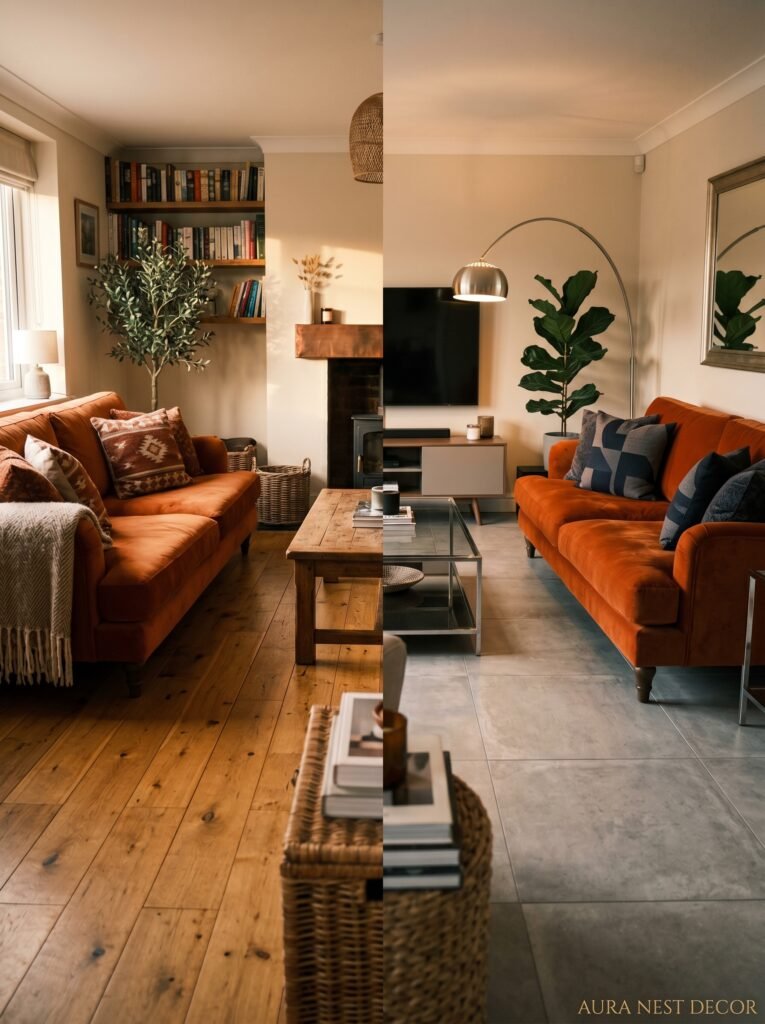
Orange sofas have different conversations with different floors, and it’s worth thinking about this specifically.
Wooden floors — especially warm, medium-toned wood like oak or walnut — are basically in the same color family as most orange sofas. They’re already having the same conversation. The result feels cohesive and warm and honestly quite Scandinavian-but-cozy when done well. Here you can let the rug be lighter and more textural, because the floor is already doing the grounding work.
Grey tile or grey-toned LVP flooring is a harder situation. Not impossible, but harder. The cool floor and the warm sofa are temperamentally opposed, and the rug becomes really important as a buffer. A jute or wool rug in warm beige or mustard tones acts as a translator between the cold floor and the warm sofa. Without it, the room reads as conflicted.
Light grey floors sometimes work better than dark grey because they read as more neutral rather than cool. But my real advice? If you’re on grey floors and you LOVE the orange sofa, commit to it, buy a beautiful warm-toned rug, and don’t second-guess yourself.
“The floor you have is the floor you work with — the rug is the cheat code.”
—
8. The Art and Décor That Belongs Around an Orange Sofa
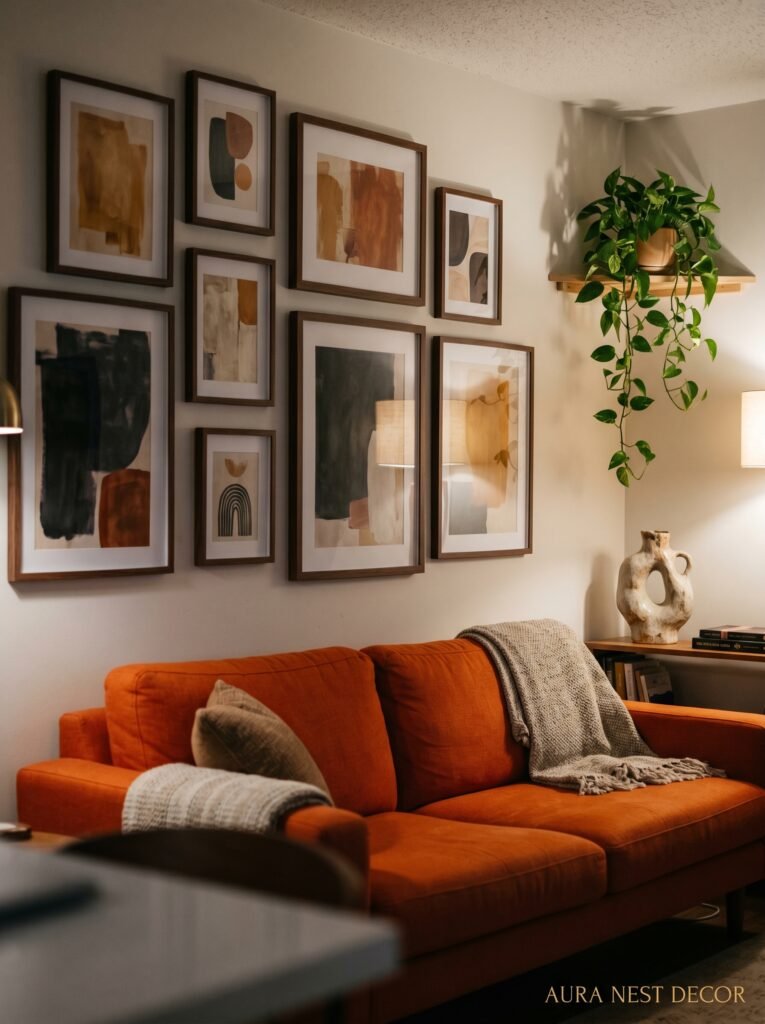
Gallery walls with an orange sofa can go either way. Black and white prints are the easy answer — they’re neutral, they don’t compete, they let the sofa hold the room’s color moment. But I actually love warm-toned art here. Think abstract pieces with ochre and clay and deep terracotta. Oil paintings with golden light. Vintage botanical prints in warm greens.
Objects on the coffee table: candles, a ceramic bowl, a stack of books with interesting spines. Warm metals — brass and copper — look genuinely gorgeous around an orange sofa. Chrome and steel less so.
Plants are a yes, obviously. But specifically, plants with broad green leaves (pothos, monstera, a rubber plant) work better than spindly ones because the big leaves create this nice contrast against the rounded softness of a sofa.
One thing I’d gently suggest avoiding: anything in very bright, saturated colors near the sofa. A cobalt blue vase right next to an orange sofa creates a visual vibration that’s technically interesting but in practice kind of exhausting to live with.
—
9. The Styling Trick That Interior Designers Actually Use Here
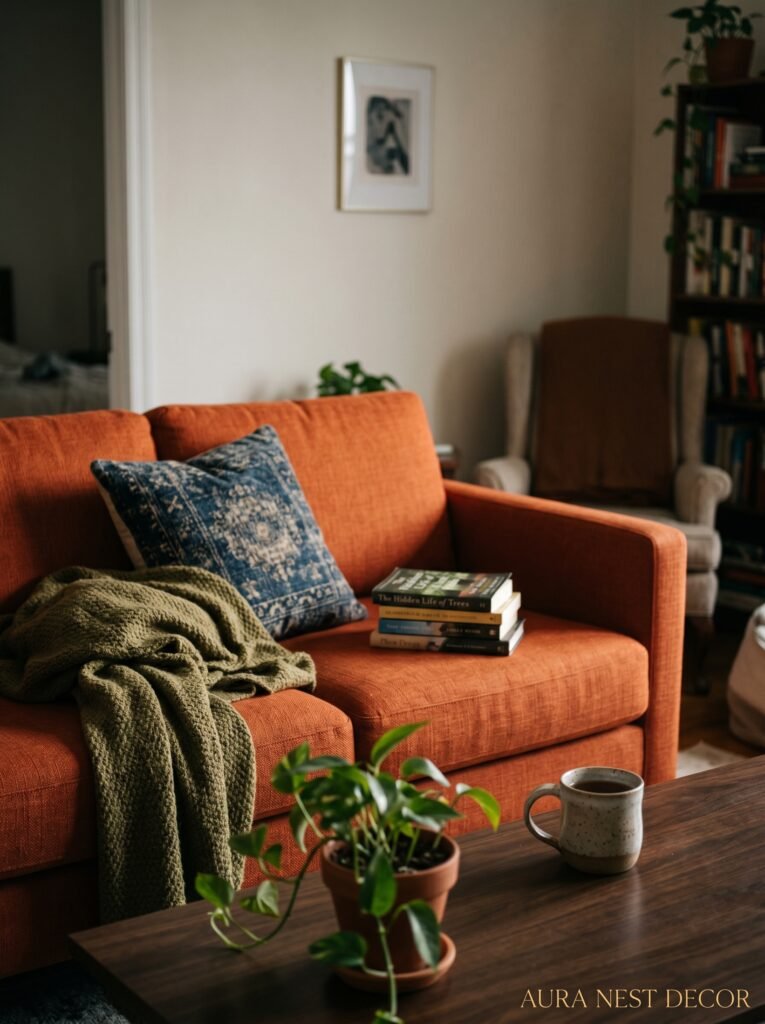
This is something I noticed after looking at genuinely beautiful rooms with orange sofas for a long time: the best-looking ones always have something that REPEATS the orange somewhere else in the room. Subtly.
Not another orange sofa. Not orange curtains, please. But a terracotta pot in the corner. A painting with orange tones in it. A candle in amber glass. An orange book spine in a shelf arrangement. A rust-colored throw draped over a chair on the other side of the room.
When the orange is only in the sofa, the eye doesn’t know what to do with it — it just stares at it, isolated. But when there are small echoes of that warmth dotted around the room, the sofa suddenly looks like it belongs to the space rather than sitting in judgment of it.
This is also why orange sofas in fully styled rooms always photograph better. The stylist has strategically placed hints of orange around the room and your eye reads it as intentional and beautiful, even if you can’t quite identify what they did.
—
10. The Orange Sofa Style That Works in a Very Traditional British Living Room
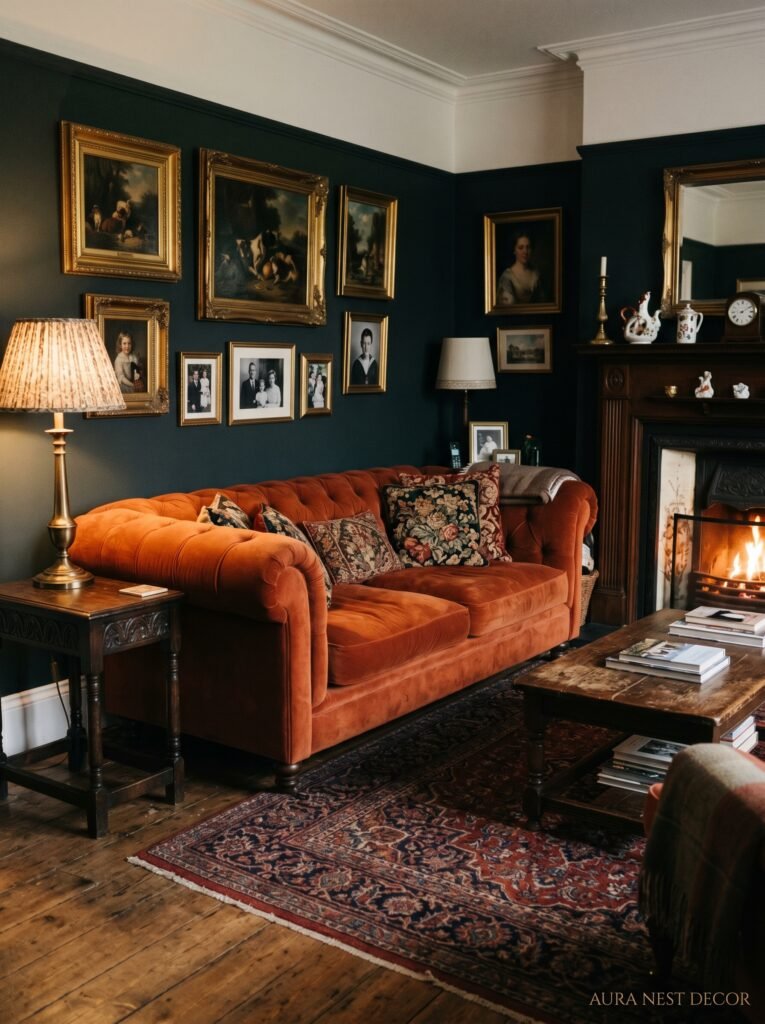
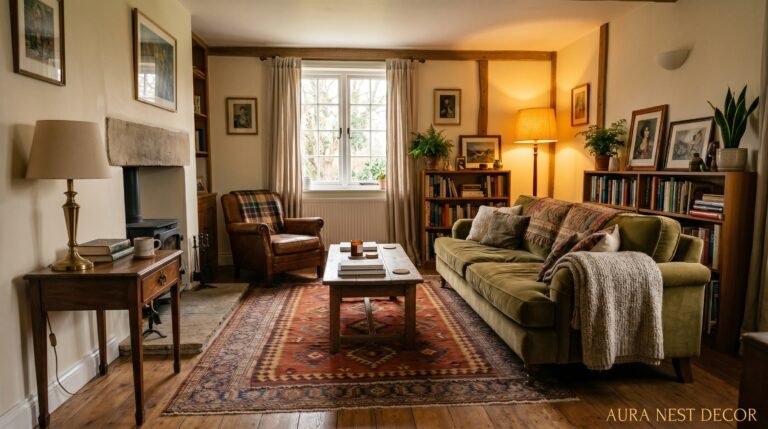
Right, so for UK readers specifically — because I know the traditional British living room is a real consideration here — the orange sofa that tends to work best in a period property with coving, bay windows, and an original fireplace is the deep rust or cognac version. Not the bright orange. The more whisky-colored one.
These sofas have been around in various forms for centuries — think old Chesterfields and wingbacks in cognac leather, Victorian parlors with rich warm upholstery. A rust-orange velvet sofa in that context doesn’t read as modern or bold; it reads as traditional with personality. Especially with the right navy cushions, a Persian rug, and a lot of books.
Pair it with Farrow & Ball tones — Mole’s Breath, Elephant’s Breath, Hague Blue, or the very warm Dead Salmon — and the sofa looks completely at home in a proper British period interior. Which is genuinely satisfying when it comes together.
—
11. The Modern Minimalist Room Where Orange Works Differently Than You’d Expect
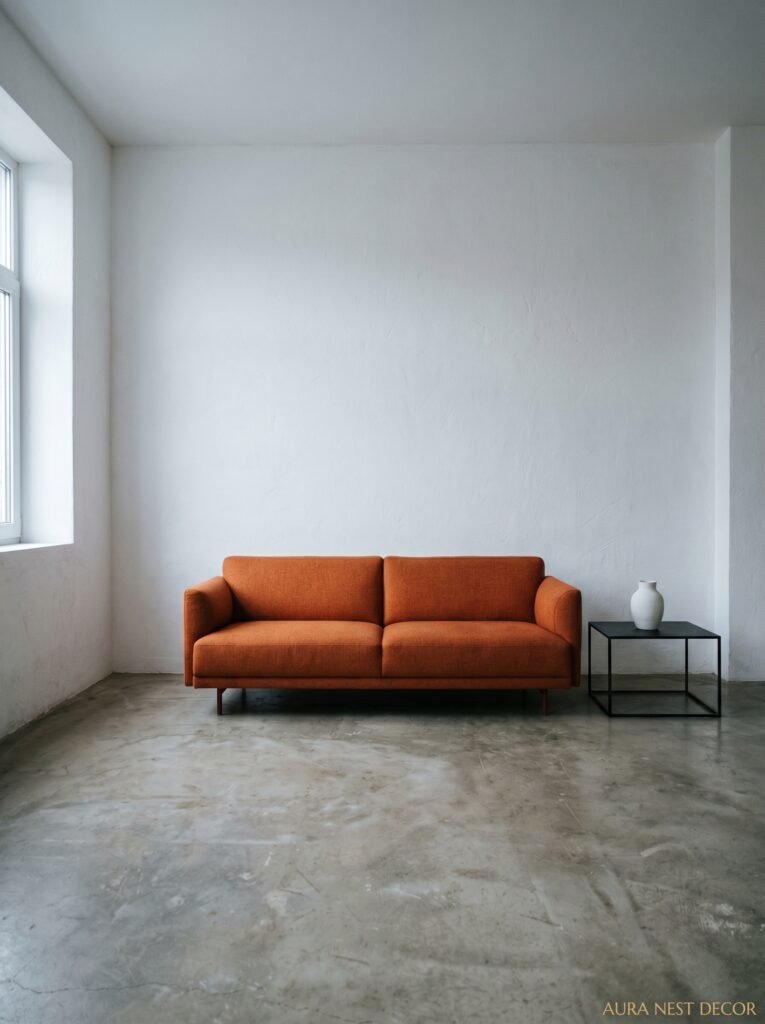
This is the counterintuitive one. An orange sofa in a clean, very minimal room — barely any furniture, lots of white or plaster walls, simple concrete or pale oak floors — can actually look extraordinary. But it works for a completely different reason than any of the cozy-warm rooms.
In a minimal space, the orange sofa becomes sculpture. There’s nothing competing with it, so it gets to be the whole point of the room. It’s almost like art installation energy. Very intentional. Very considered.
The key with this approach: every OTHER piece of furniture has to be super simple and neutral. A thin metal coffee table. One plant. Clean lines everywhere. Because if you bring in warmth in the other furniture as well, it stops looking minimal and starts looking eclectic, which is a different style entirely.
Not gonna lie, this approach requires more commitment and more confidence than the cozy warm approach. But when it works? The photos are stunning.
—
12. The Question Nobody Asks: Will You Still Love It in Five Years?
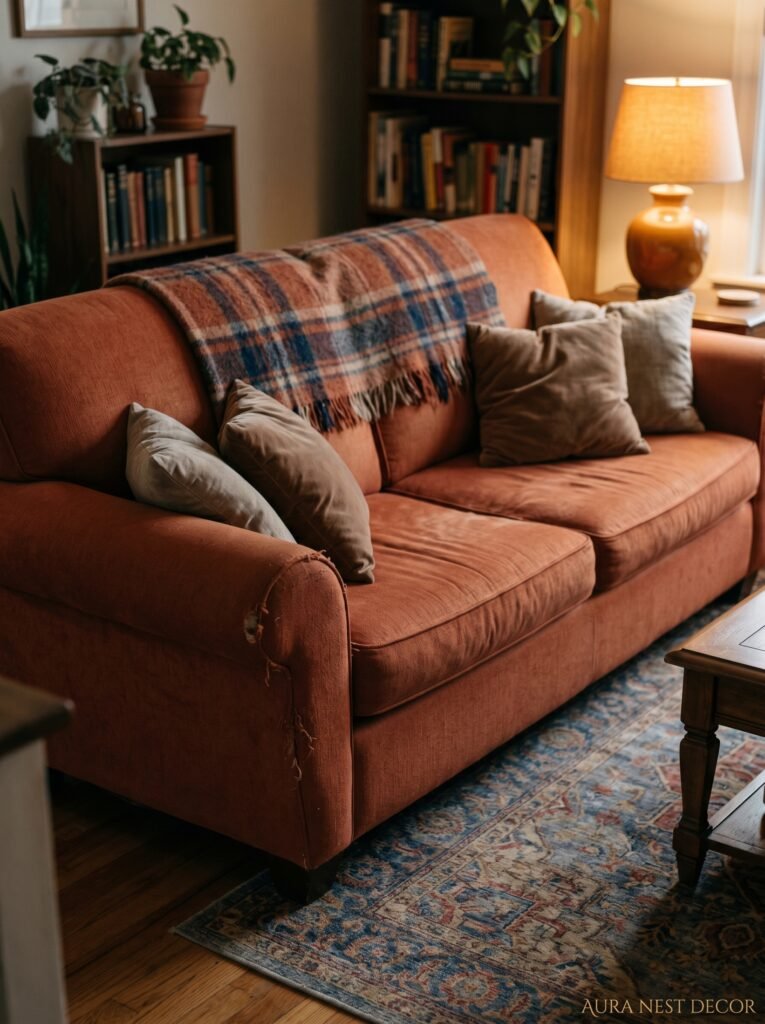
Here’s my slightly controversial opinion: I think orange sofas are more timeless than people give them credit for.
The burnt orange sofa trend has actually been through multiple decades and it keeps coming back. The 70s, obviously. The early 2000s briefly. And now. But terracotta and rust and warm earthy orange are colors that have been in human homes — in ceramics, in textiles, in natural dyes — for thousands of years. They’re not actually a trend. They just periodically get acknowledged.
What goes out of style is the very specific styling around a trend — the too-perfect, algorithm-uniform version of the orange sofa moment we’re in right now. But the sofa itself? A well-made, genuinely good rust velvet sofa styled thoughtfully? That’ll look great for a decade.
The thing I’d be more worried about is quality. Buy the best sofa you can afford. The cheap orange sofas look cheap quickly, and then the color becomes the thing you’re stuck with rather than the thing you love. Invest in the frame and fabric, and the color will take care of itself.
—
❓ FAQ
Q: What colors go well with an orange sofa? A: Deep green, navy blue, warm cream, and mustard yellow all work really well. Warm wood tones and natural textures like jute and linen are your best friends. The one color I’d steer clear of is cool grey — it tends to create a really uncomfortable contrast rather than a complementary one.
Q: Is an orange sofa too bold for a small living room? A: Not at all, as long as you choose a sofa with a light footprint — clean lines, raised legs — and keep the rest of the room fairly neutral. One confident color choice reads as intentional in a small space. The issues come when you stack multiple bold choices in a tight room and it starts feeling overwhelming.
Q: What’s the difference between a terracotta sofa and an orange sofa? A: Mainly undertone. Terracotta leans more towards earthy brown-red, like actual terracotta clay pots. Orange sofas tend to be brighter and more saturated. In practice, the styling advice overlaps a lot — both love warm rooms, wooden floors, green plants, and brass accents — but terracotta is generally a slightly easier color to live with because it reads as more neutral.
—
💭 Final Thoughts
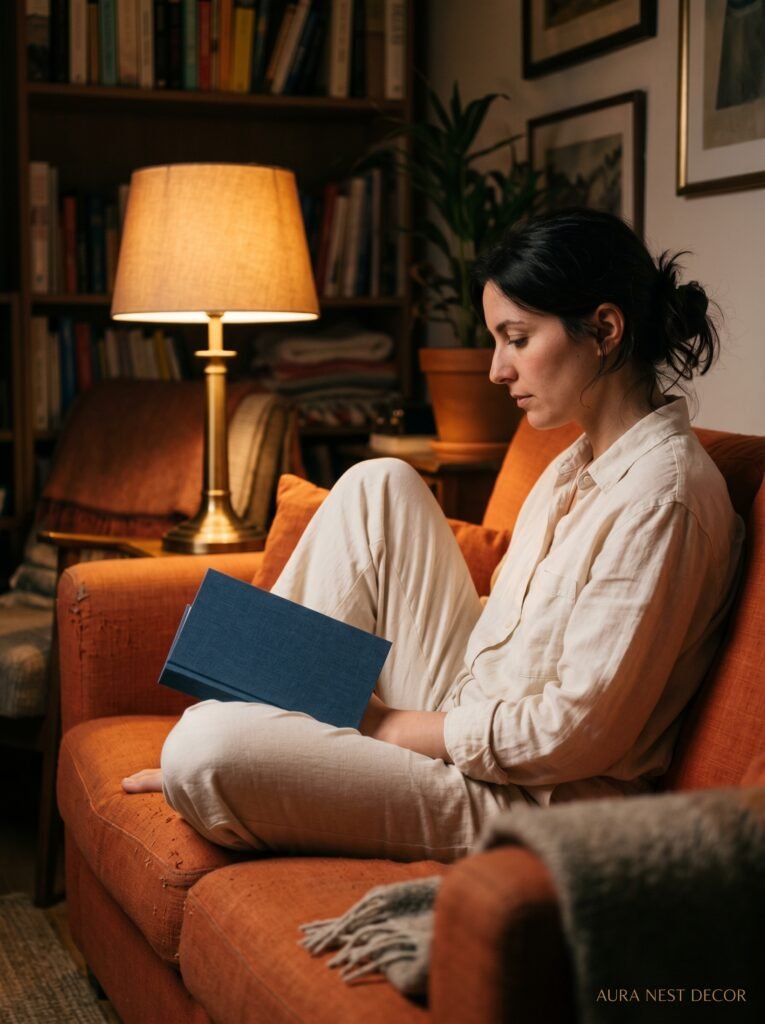
An orange sofa isn’t a casual decision, but it doesn’t have to be a scary one either. The right room, the right undertone, the right rug and light and a few well-placed echoes of warmth — and it all clicks into place in a way that feels completely inevitable. Like the room was always waiting for it.
The rooms that make people stop scrolling on Pinterest aren’t the safe ones. They’re the ones where someone made a choice and committed to it.
So — are you ready to commit?