The Grey Living Room That Actually Feels Warm (And Not Like a Waiting Room)
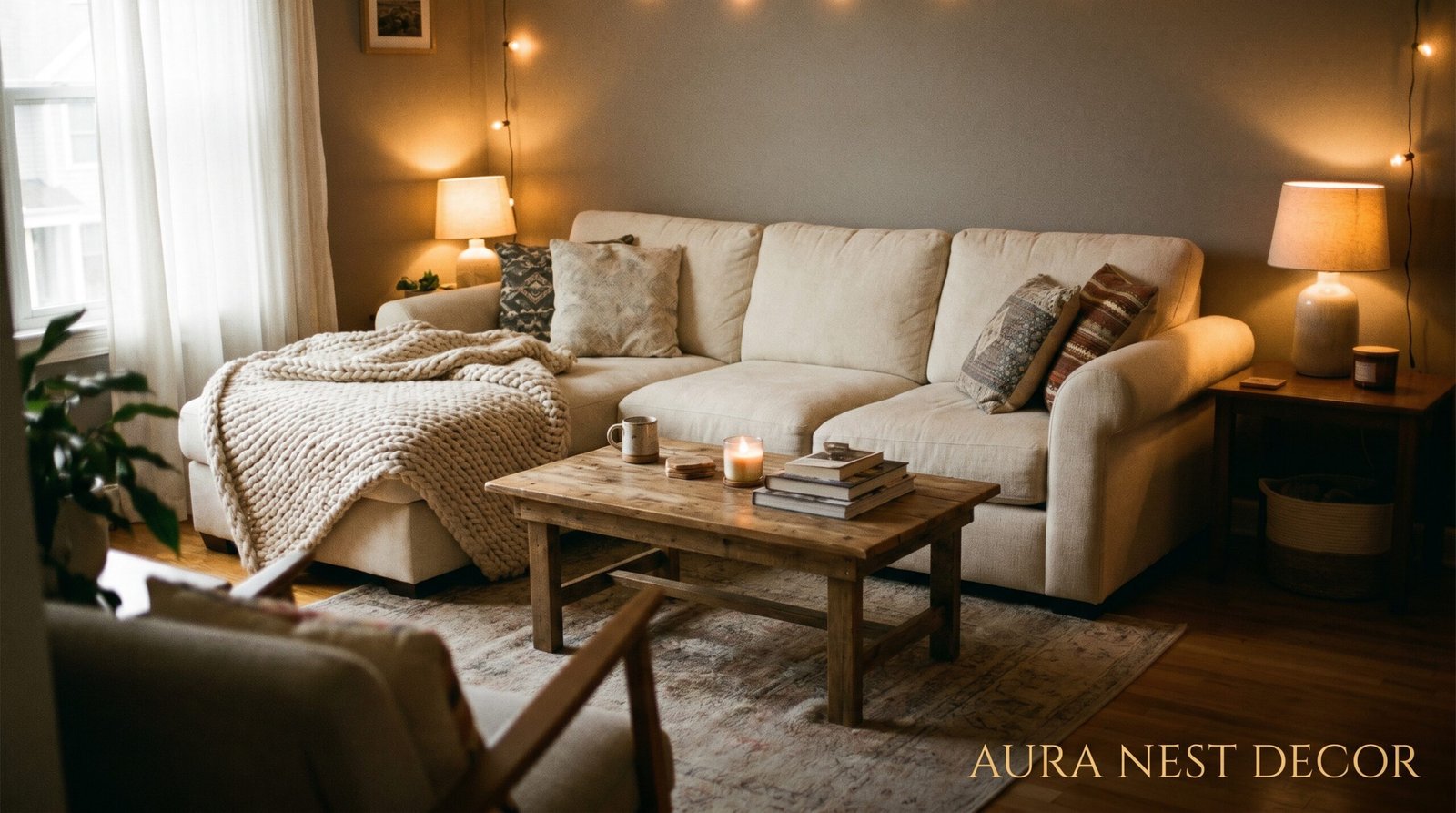
You know that grey living room you saved on Pinterest six months ago? The one that felt cozy and layered and somehow golden even though there wasn’t a single warm color in it? I’ve been chasing that exact feeling for years, and I think I’ve finally figured out what makes it work.

—
1. Why Most Grey Rooms Feel Cold (And What’s Actually Going Wrong)
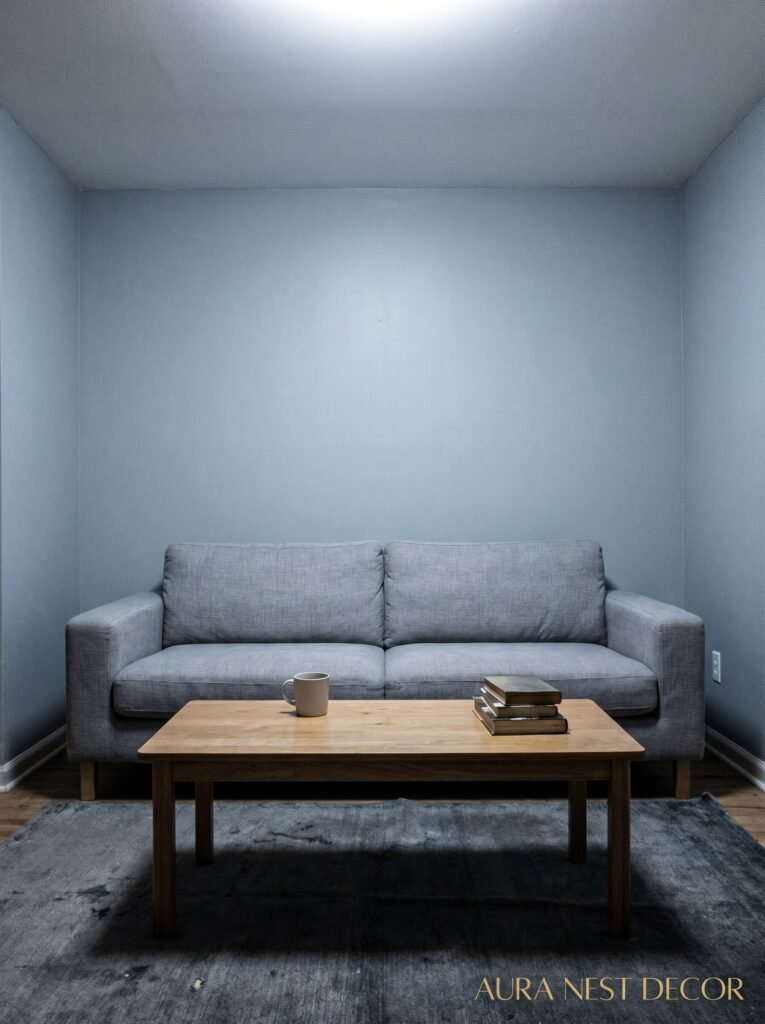
Here’s the thing nobody tells you upfront: grey is not a neutral. I know, I know — it looks neutral on a paint chip. But in a real room, grey has undertones that are doing a LOT of work, and if you ignore them, you end up with a living room that feels like the inside of a dentist’s office.
Blue-grey walls read cold the moment natural light drops, which in the UK is basically November through March. The whole room shifts. What looked like a sophisticated slate at noon becomes this kind of clinical, flat grey by 4pm and it’s honestly depressing to sit in.
So the very first thing — before throws, before candles, before any of that — is getting the undertone right. Look for greys with warm undertones. Greige (grey-beige) territory. Think Farrow & Ball’s Elephant’s Breath, or Sherwin-Williams’ Accessible Beige if you want to lean warmer. Dulux Warm Pewter. Benjamin Moore’s Revere Pewter.
These aren’t “boring” greys. They’re the greys that look expensive without screaming for attention. And they warm up instead of cooling down when the sun sets and you switch on the lamps.
This is the whole foundation. Get this wrong and no number of cozy blankets will fix it.
“The right grey doesn’t just sit on your walls — it changes everything that comes after it.”
2. The Lamp Situation Is More Important Than You Think
Let me be honest. I spent years getting lamps wrong. I’d buy whatever looked pretty and then wonder why my living room felt harsh in the evenings.
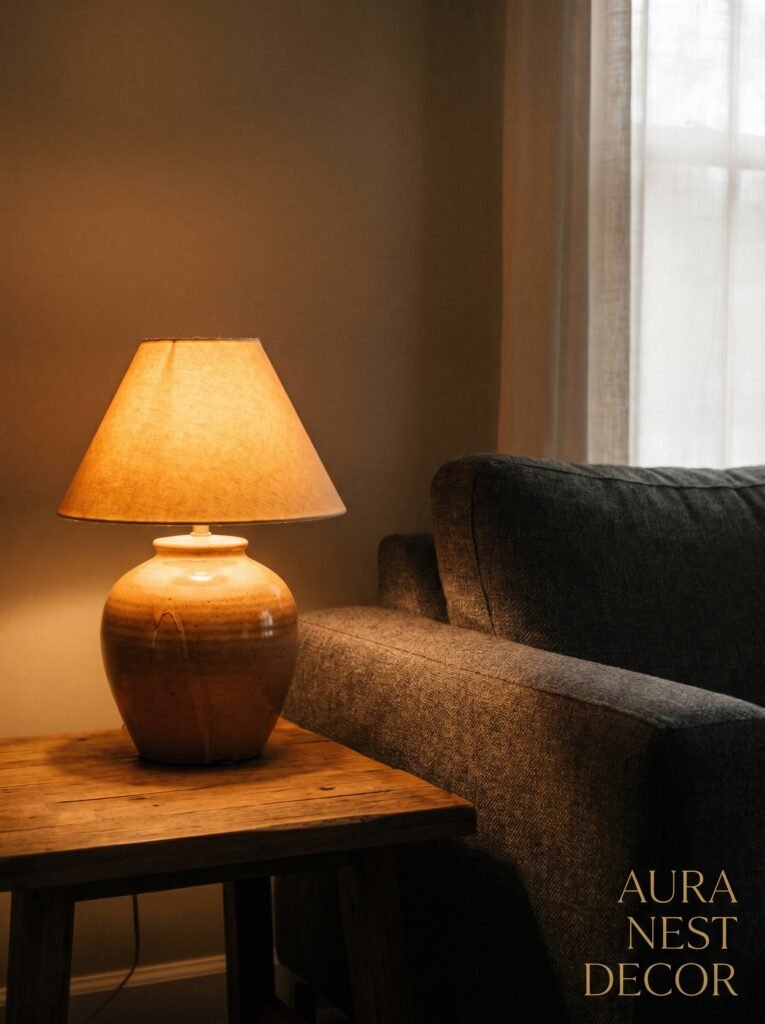
The secret is color temperature. You want bulbs around 2700K — that’s the warm amber range. Not 3000K, definitely not 4000K (which is basically daylight and will make your grey walls look like concrete). Just 2700K. Write it on your hand if you have to.
And then the placement. A lot of people have one overhead light and call it done. That’s the enemy of cozy. Overhead light casts downward shadows, it makes everything look flat, and it gives the room this kind of interrogation-room energy even when the light itself is warm. What you want instead is light at multiple heights — a floor lamp in the corner, a table lamp on a side table, maybe something on a shelf.
Multiple light sources at different heights create depth. The grey walls catch that amber glow from the side and suddenly they look rich and layered rather than flat. There’s a reason those Pinterest photos look the way they do — it’s not a filter, it’s lamp placement.
Side note — if you can put at least one lamp on a dimmer, do it. That ability to dial things down at 9pm is genuinely life-changing for a cozy grey room.
3. The Colour That Keeps Showing Up in Every Beautiful Grey Living Room Right Now
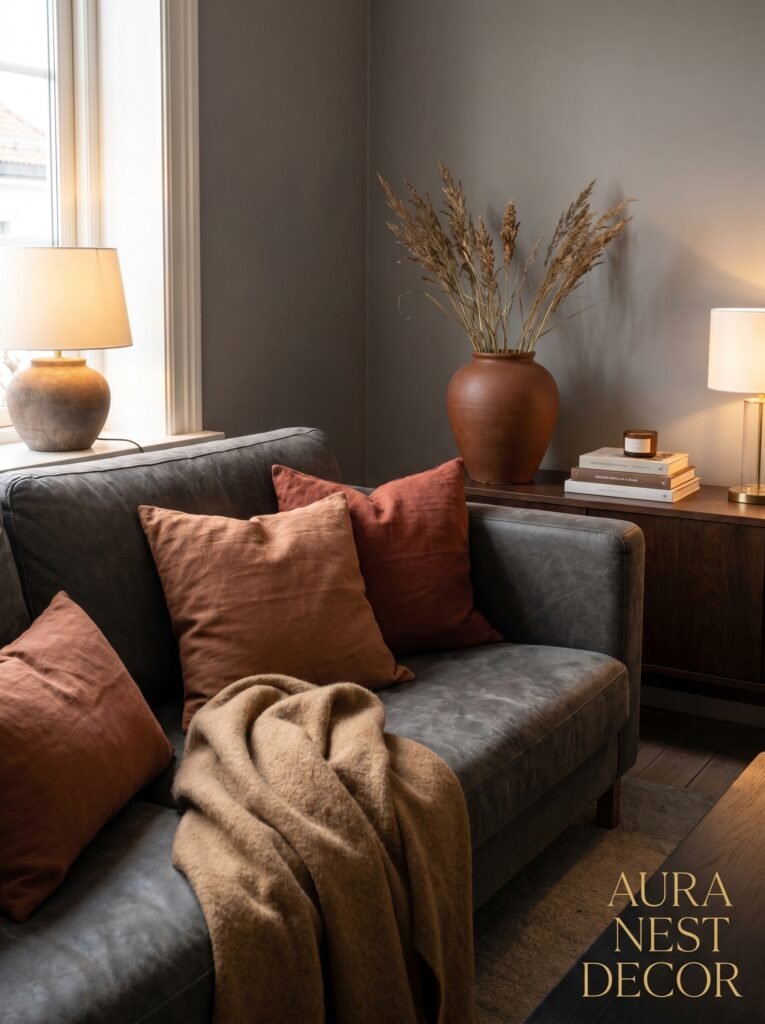
Rust. Terracotta. That warm, slightly dusty burnt orange-red. Call it what you want but it’s EVERYWHERE and honestly? I’m not mad about it.
Here’s why it works so well against grey: it’s the exact opposite of cold. Grey pulls cool, rust pulls warm, and the contrast between them creates this visual tension that just feels alive and interesting in a way that all-grey or all-neutral rooms don’t.
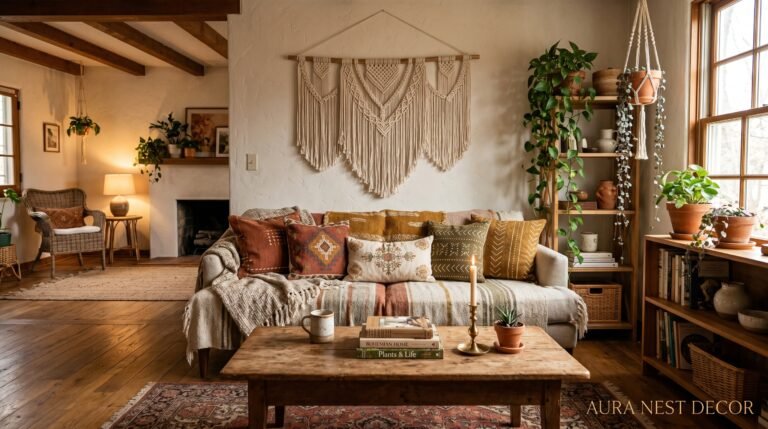
But you don’t want a lot of it. One terracotta throw. A rust-coloured cushion or two. Maybe a small pot in that family of colour on a shelf. That’s genuinely it — you’re not painting an accent wall (unless you are, in which case, respect). You’re just adding touches of warmth that tell the grey to relax.
I’ve also seen baked clay tones work beautifully — that pinky-brown that looks almost edible. Thrown against a soft warm grey, a stack of clay-toned cushions on a grey sofa looks like something you’d see in a House Beautiful shoot. And it costs basically nothing if you shop at H&M Home or Walmart.
The other colour that keeps coming up is deep forest green. But that’s a whole separate section because it deserves it.
4. What the Sofa Colour Actually Does to a Grey Room
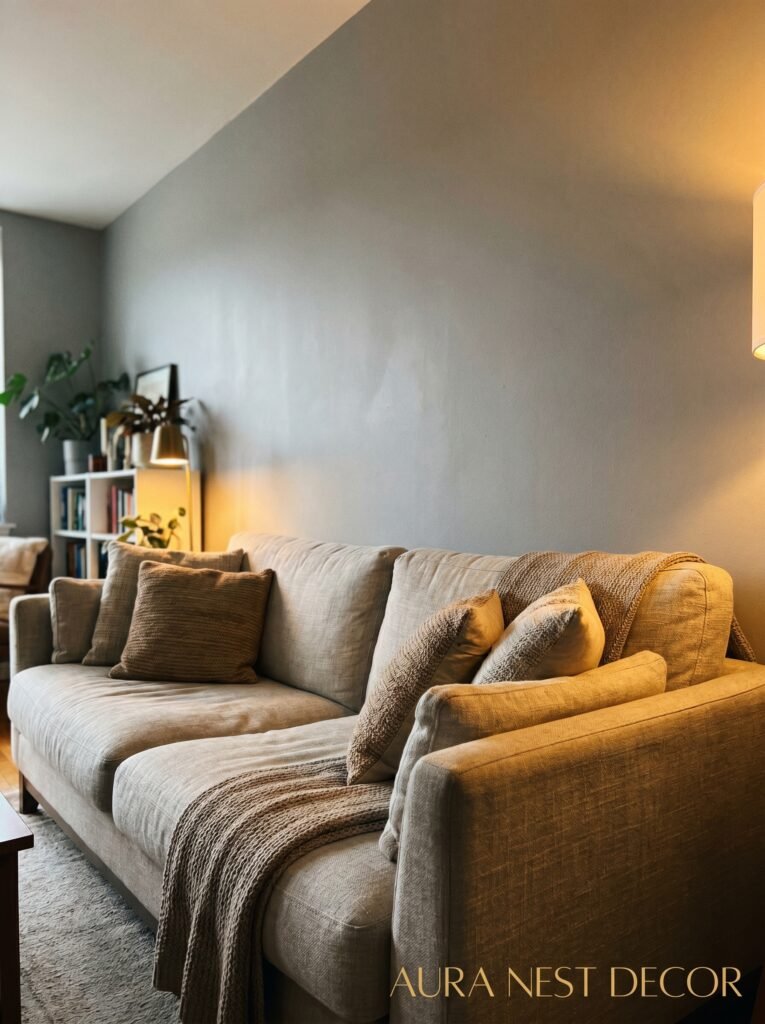
This is the decision people stress over the most and I think that’s partly because there genuinely isn’t one right answer. But there are wrong ones, and it helps to know what they are.
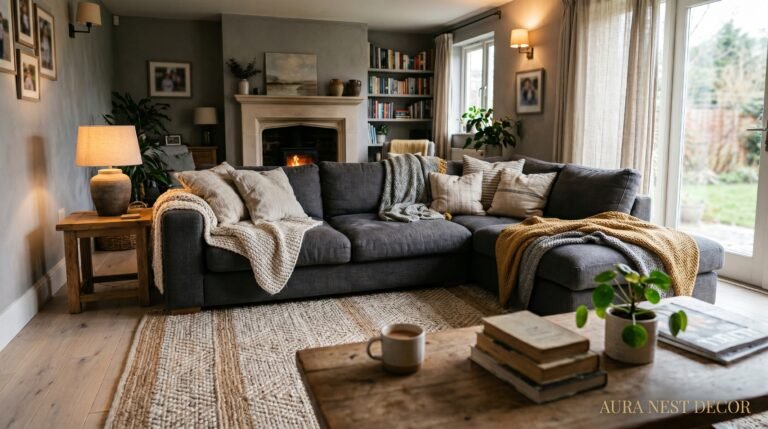
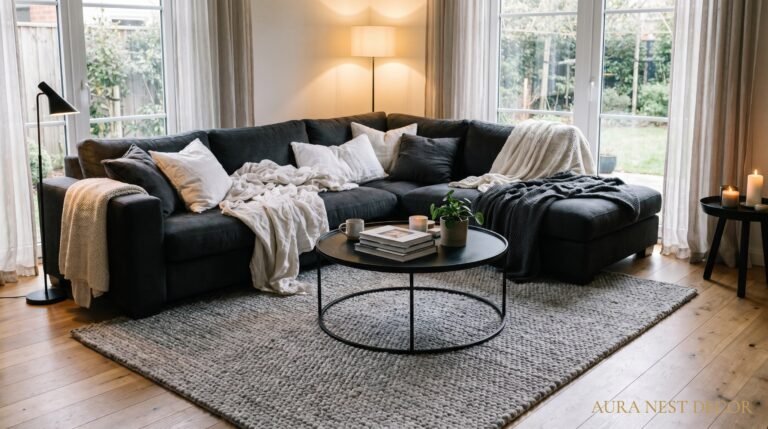
Grey sofa on grey walls: not inherently bad, but you MUST vary the tones and textures or everything blurs together into a fog. A dark charcoal sofa against mid-tone grey walls with cream and rust cushions? Stunning. A medium grey sofa against medium grey walls? Somehow the room just disappears.
Cream or off-white sofa on grey walls: this is the classic and it works. Every time. The light sofa bounces light around the room, the grey walls ground it, and the whole thing looks clean and expensive. The downside — and I’ll be real — is that cream sofas require actual effort to keep nice, especially if you’ve got kids or a dog.
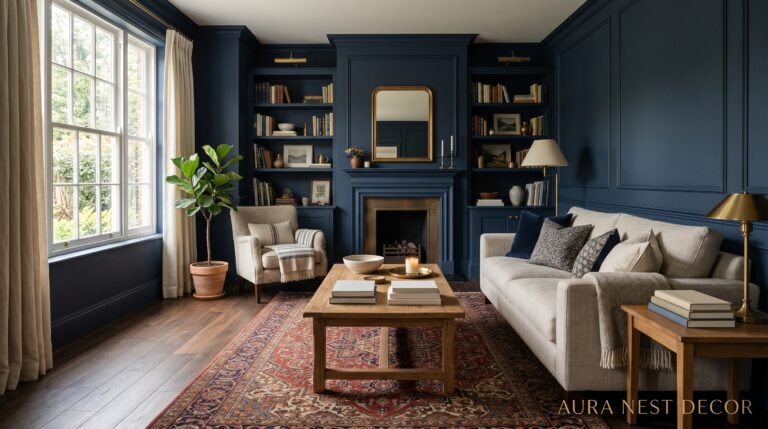
Navy on grey: underrated. Dark navy velvet sofa, warm grey walls, brass side tables — that’s a combination that feels like it belongs in a Georgian townhouse and I mean that as a complete compliment. It’s dramatic without being aggressive.
Natural linen: kind of the safest bet for a cozy look. Linen sofas have this inherently relaxed energy, they photograph beautifully, and they pair with grey walls without competing for attention.
“Your sofa and your walls aren’t supposed to match — they’re supposed to have a conversation.”
5. Texture Is the Thing That Makes a Grey Room Feel Like a Hug
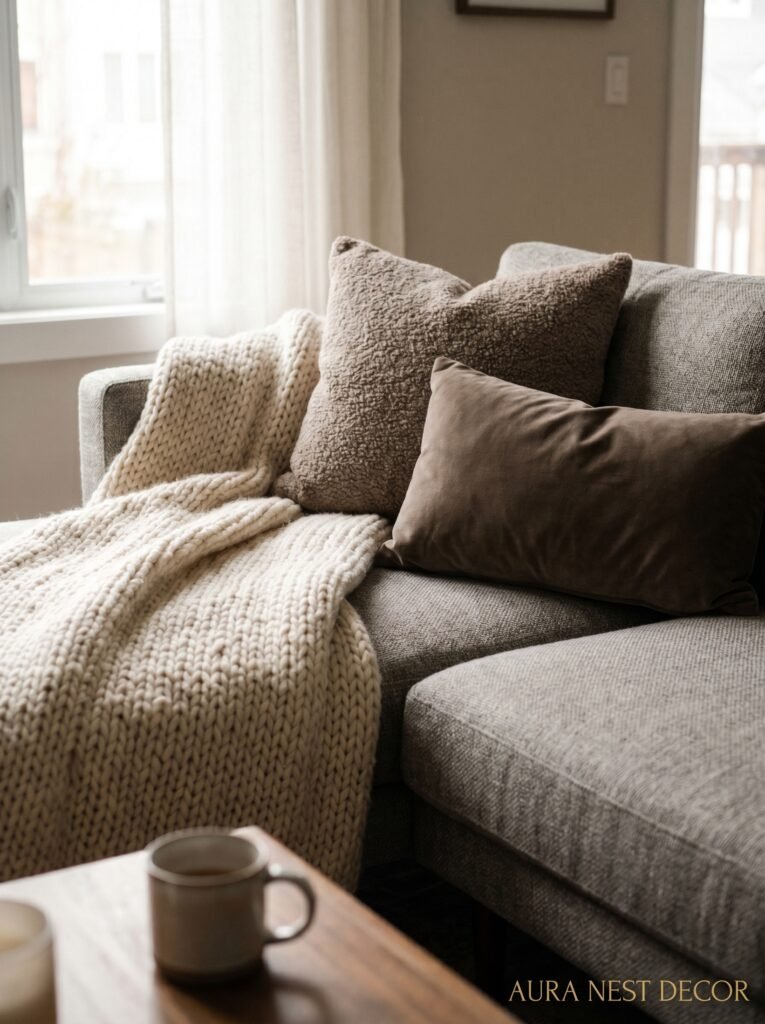
A smooth, flat grey room is cold. A textured grey room is cozy. That’s the whole rule, honestly.
Texture comes from so many different places. A chunky knit throw draped over the arm of the sofa — not folded neatly, just casually draped like someone actually used it. A jute or wool rug underfoot that has some visual weight to it. Linen cushion covers. A woven basket. A lamp with a pleated fabric shade. Curtains that have enough weight to pool slightly at the floor.
None of these things individually costs a fortune, but together they do something remarkable to a grey room. They make it look lived-in in the best possible way. They catch light differently at different times of day. They give your eye something to move across instead of just landing on the wall and stopping.
This is what I notice most in grey rooms that feel beautiful versus grey rooms that feel soulless: it’s almost always texture. The cold rooms are all hard surfaces and flat fabrics. The warm ones have layers, weight, variation.
If your budget is limited, start with the rug and the throw. Those two things alone will change the energy of your living room faster than anything else.
6. The One Plant That Belongs in a Cozy Grey Living Room
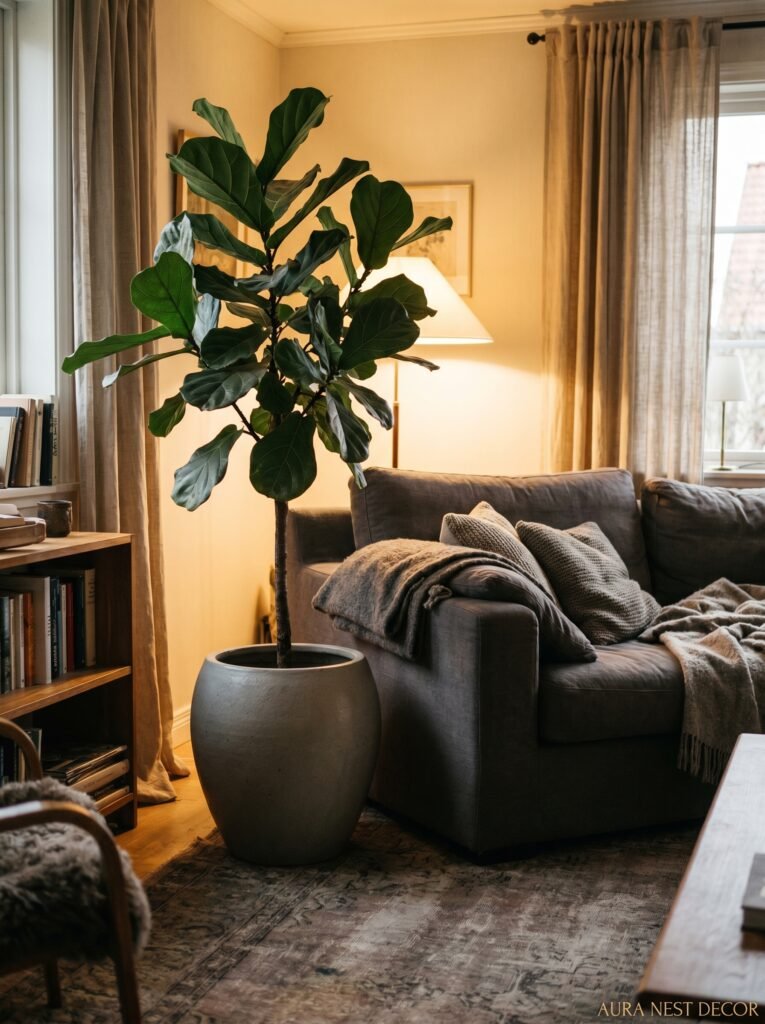
Not a cactus. Not a string of pearls hanging in a macramé pot (I mean, it can be, but hear me out first).
The plants that work best in a cozy grey room tend to have rounded, lush leaves — something that reads as full and slightly wild rather than architectural and spiky. A big monstera in the corner. A trailing pothos on a shelf. A fiddle leaf fig if you’ve got decent light and the patience for its drama.
Here’s what a plant does that nothing else can: it introduces a colour that grey walls can’t compete with. Deep, living green against warm grey is one of those combinations that just photographs beautifully — there’s a reason every cozy home account on Instagram has a big leafy plant in the corner of the living room shot.
It also adds height variation, which matters a lot in a cozy room. When everything is at eye level, the room feels flat. A tall plant takes the eye upward and makes the room feel bigger and more intentional.
And look — there’s something about a living thing in a grey room that makes the whole space feel less minimal and more human. I can’t fully explain why. But walk into a beautifully styled grey living room with no plants and then imagine one large, thriving plant in the corner. The room completely changes.
7. The Gallery Wall Rule That Nobody Talks About Enough
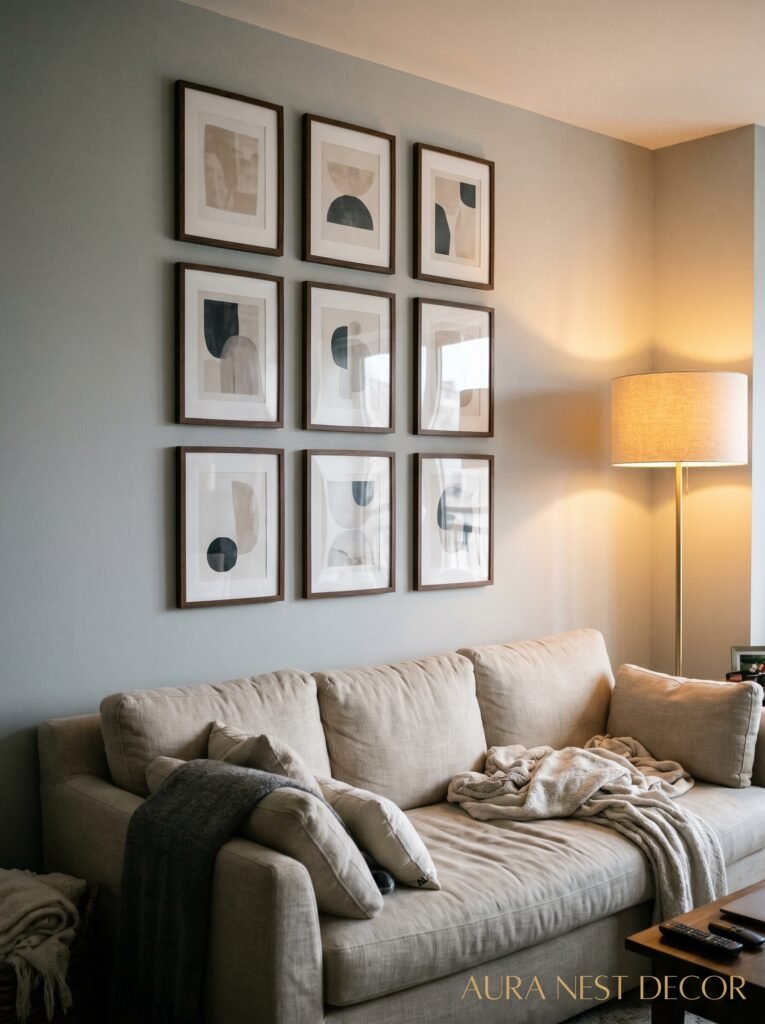
You don’t need to print a bunch of black-and-white photos and call it a gallery wall. (Although — you can, and it looks nice. But it’s also everywhere.)
What actually makes a gallery wall work in a grey living room is mixing the FRAMES, not just the art. Different sizes, yes. But also different finishes. Some wood frames — natural oak, walnut, something with grain. Some metal frames in brass or black. Maybe one ornate thrifted frame that has no business being next to a modern print but somehow works anyway.
The variation in frame material creates warmth that a wall of matching black frames just doesn’t have. And it looks like you’ve accumulated things over time rather than ordered a set from Amazon on a Tuesday.
For art content, I’d steer away from anything too cold or graphic in a cozy grey room. Warm botanical prints, abstract art with ochre or rust or deep green, soft landscape photography. Things that feel organic. Things that have some emotional weight to them.
“A gallery wall that looks collected over years costs the same as one that looks bought in an afternoon — it just takes more patience.”
8. The Deep Green Moment That Makes Grey Living Rooms Look Expensive
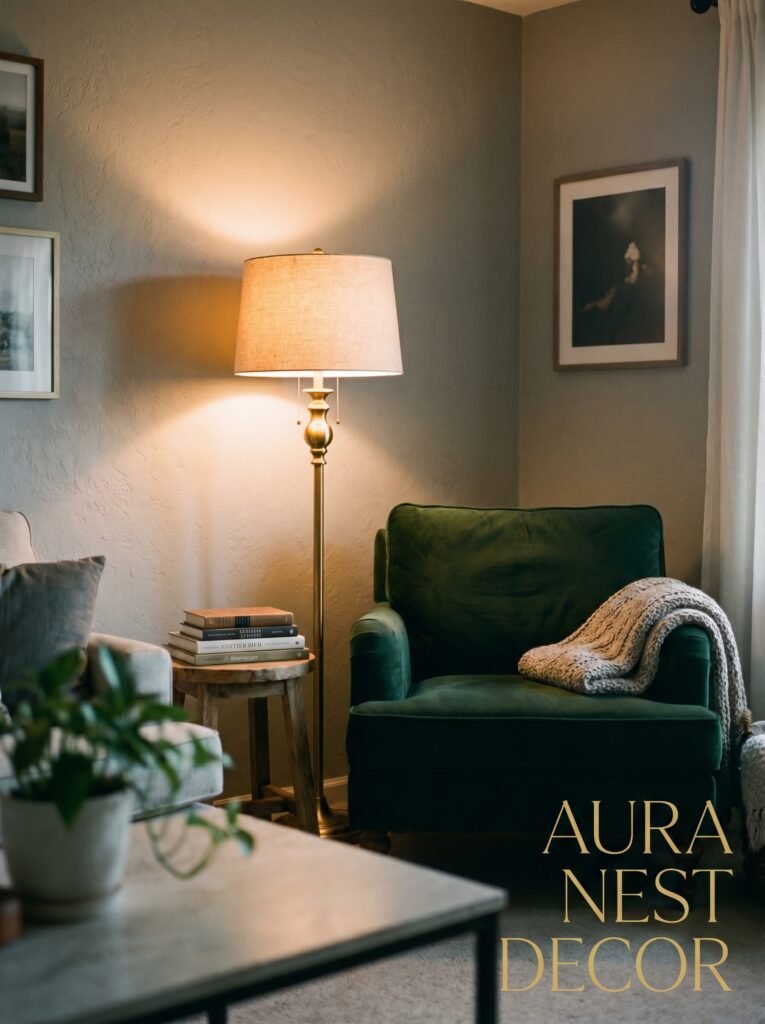
I kept this one separate because it really does deserve its own section. Deep hunter green — sage’s much more sophisticated older sibling — does something almost magical alongside warm grey.
It’s showing up everywhere right now: dark green velvet cushions, a deep green armchair as an accent piece, botanical prints with rich emerald tones, even green lampshades. And it works because green and grey are genuinely one of the most naturally harmonious colour combinations there is. Think of a grey morning sky over dark pine trees. There’s a reason that scene feels calming — the colours belong together.
In a living room, you don’t need a lot. A deep green velvet cushion on a grey sofa instantly makes the whole thing look like it was styled on purpose. Add a trailing plant with dark leaves and a brass lamp and you’ve basically nailed the look that Interior designers charge thousands of dollars/pounds to create.
It works in UK terraced houses. It works in open-plan American ranch homes. It doesn’t matter how much natural light you have — in bright rooms it looks fresh, in darker rooms it looks moody and cosy. Either way, it’s gorgeous.
9. What to Put on the Coffee Table (This Is More Specific Than You’d Think)
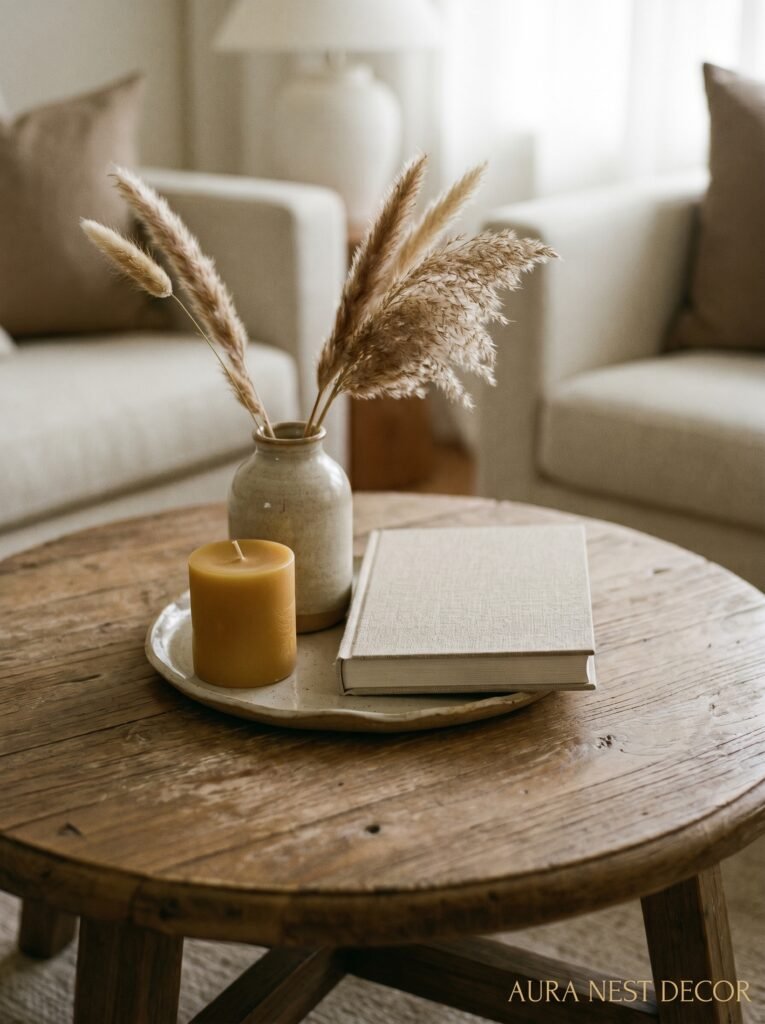
A coffee table in a cozy grey room is not just a surface. It’s a focal point. And most people style it the same way: a tray, a candle, a vase. Fine. But there’s a reason some coffee table setups stop your scroll and some don’t.
The ones that work usually have height variation. Something tall (a vase with dried pampas or eucalyptus — I know pampas is everywhere but it’s everywhere because it WORKS). Something medium. Something low, like a stack of two or three books with a small object on top.
The tray thing is genuinely useful for a grey room specifically, because a tray gives the eye a defined space to land on rather than things scattered across a wide surface. It creates order without looking sterile.
Materials matter here too. Bring in something organic — wood, stone, ceramic. A chunky stone candle holder. A wooden bowl. A ceramic vase in a matte glaze. These warm up the grey backdrop in a way that glass or plastic simply doesn’t.
And honestly? Leave some empty space on the table. The instinct is to fill everything, but a slightly sparse coffee table in a textured, layered grey room looks intentional and calm rather than empty.
10. The Curtain Mistake That Makes Grey Rooms Feel Smaller and Colder
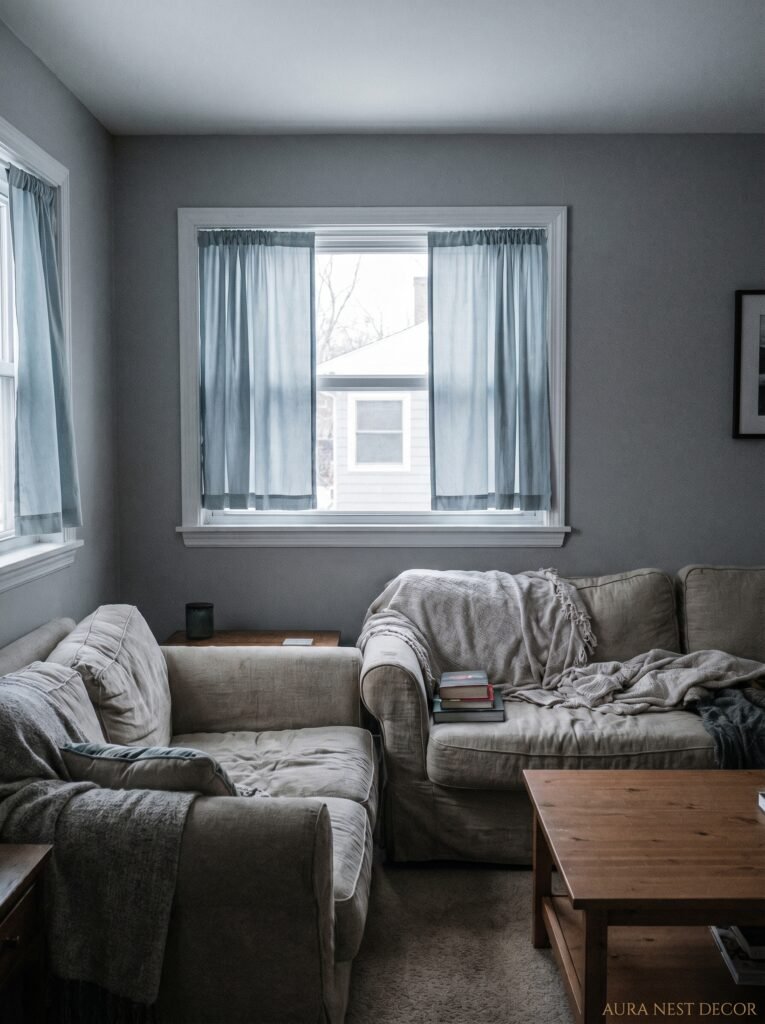
Hanging curtains at window height. That’s the mistake. Just that.
When curtains hang right at the window frame, they make the window — and therefore the ceiling — look lower. And lower ceilings make a room feel tighter and somehow colder. It’s a subtle thing but once you see it, you can’t unsee it.
Hang your curtains as close to the ceiling as possible. Then let them be long enough to just touch or very slightly puddle on the floor. This simple change makes any room feel taller and more generous, and in a grey living room it completely changes the sense of space.
For colour, in a cozy grey scheme, I’d go either warm cream/linen tones (which brighten and soften) or deep tones that match the darker elements in your room — forest green, charcoal, deep terracotta. What I wouldn’t do is hang curtains the exact same shade as your walls. Again — that fog thing. Nothing stands out, nothing has definition.
11. Why Wood Belongs in Every Single Grey Living Room
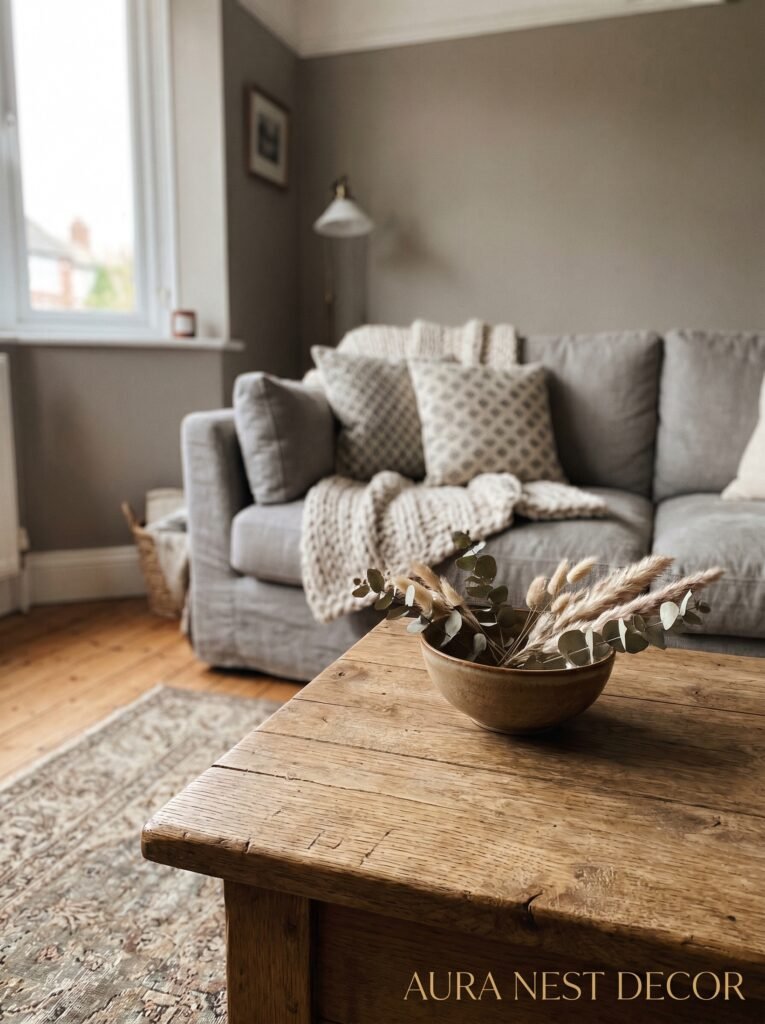
I’m not budging on this one. Wood — real wood or good faux wood — is non-negotiable in a cozy grey scheme.
A grey room with zero wood reads cold and contemporary in a way that most people actually don’t want in their living rooms. Wood introduces warmth at the literal material level: grain, colour variation, imperfection. The imperfection is actually important. Perfect surfaces are cold. Imperfect surfaces are warm.
It can come from anywhere: a wooden coffee table, wood-framed art, wooden shelving, a reclaimed wood side table, even wooden decorative objects. Darker woods like walnut read moody and rich. Lighter woods like oak or ash read fresh and Scandinavian. Both work beautifully against grey walls, just in different directions.
If your living room is currently all grey and metal and glass with no wood anywhere, that’s probably a significant part of why it doesn’t feel as cozy as you want it to. Add even one wooden element and watch the room shift.
12. The Candle Strategy for a Grey Room That Feels Warm at Night
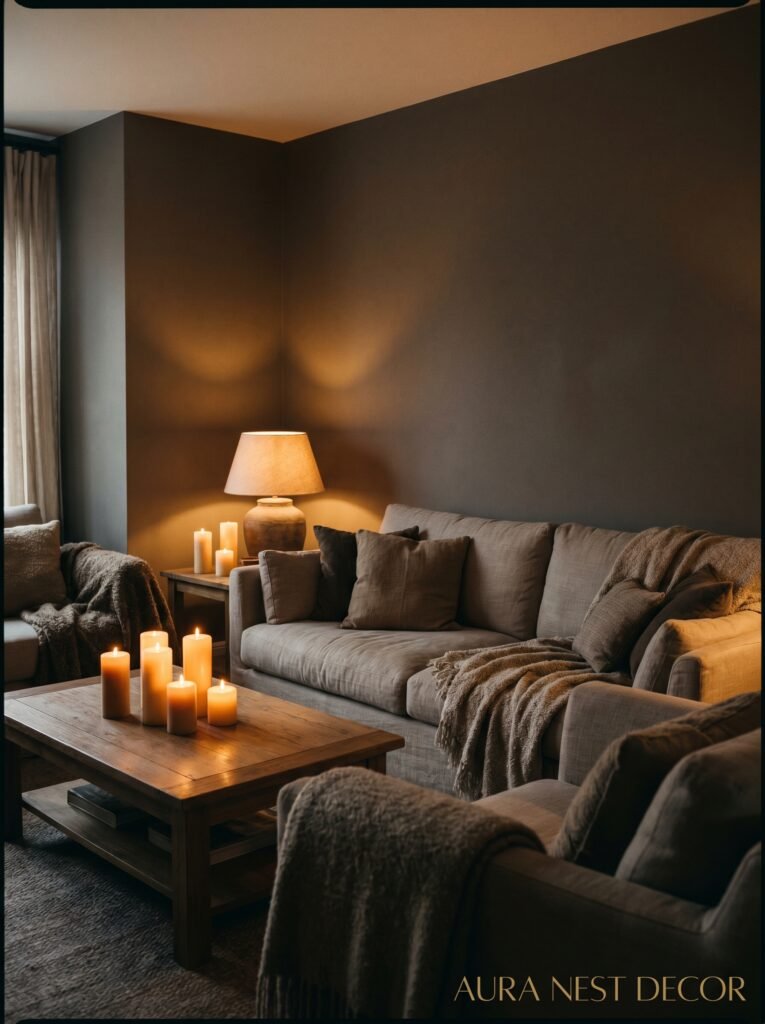
Not one big candle on the mantle. That’s fine but it’s not a strategy.
What actually creates ambiance in a grey living room at night is multiple small candle sources — a few tea lights in holders at different heights, a couple of pillar candles on a tray, a scented candle on the coffee table. The combined effect of several small flames distributed around a room creates a flicker and warmth that changes the entire atmosphere.
Warm wax tones (cream, ivory, white) look beautiful against grey walls. Avoid stark white if you can — it reads a bit clinical. And for scent, if you want that fully cozy feeling, go for something that suggests warmth: amber, sandalwood, cedar, vanilla, woodsmoke. Something that makes the room feel like it has a fire even when it doesn’t.
This is genuinely one of the cheapest ways to make a grey living room feel completely different at night. A £3 set of tea lights and a couple of simple holders from a charity shop. That’s it. The effect is disproportionate to the cost and I think that’s one of the most satisfying things about it.
—
❓ FAQ
Q: What’s the best grey paint for a living room that needs to feel warm? A: Look for greys with beige or brown undertones rather than blue or purple ones. Farrow & Ball Elephant’s Breath, Dulux Warm Pewter, and Sherwin-Williams Agreeable Gray are all consistently warm-reading across different lighting conditions. Always test a large swatch on your actual wall before committing — paint chips lie.
Q: Can grey work in a dark living room with very little natural light? A: Yes, but you need to choose carefully. Go lighter than you think you need to, stay firmly in the warm undertone territory, and invest seriously in lamp placement. A warm-toned greige in a north-facing UK living room can actually feel cozy and intentional with the right lighting — but a cool dark grey in the same room will feel like a cave.
Q: How do I make a grey sofa look less boring? A: Texture and contrast. Layer cushions in different fabrics — velvet, linen, boucle — and don’t match them perfectly. Add a chunky throw in a warm tone (rust, cream, deep green). Put a wooden coffee table in front of it. A grey sofa on its own can look flat; a grey sofa with layers looks deliberate and pulled-together.
—
💭 Final Thoughts
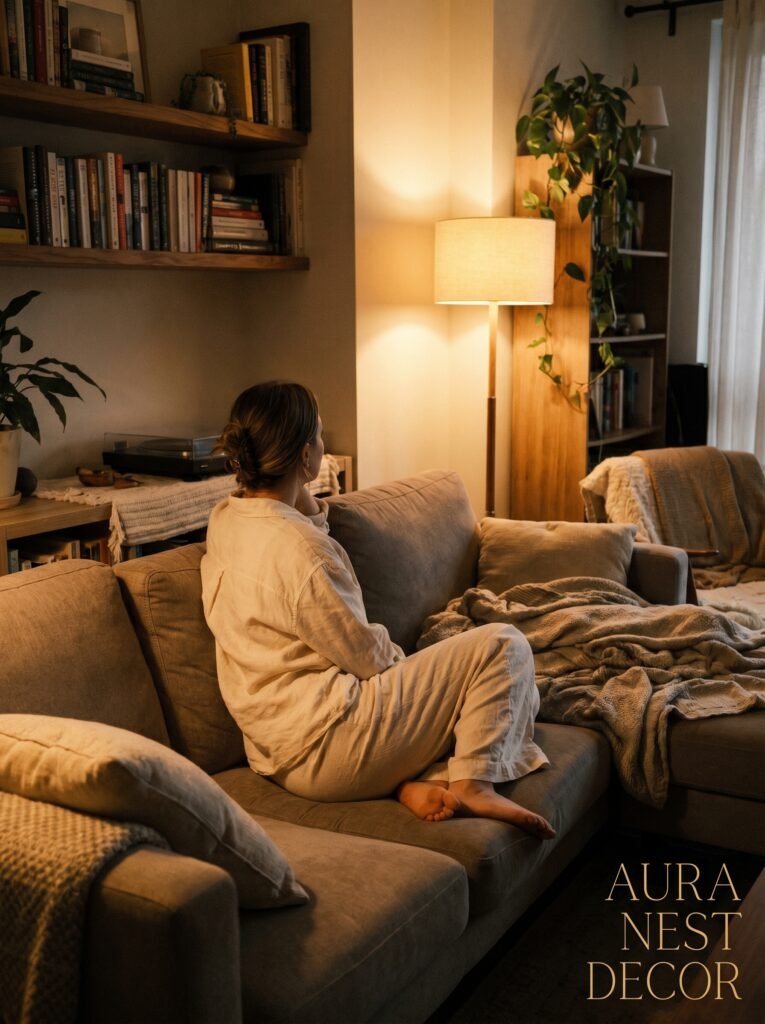
A grey living room done right doesn’t look grey. It looks warm, it looks collected, it looks like someone actually lives there and loves it. The colour itself isn’t the challenge — it’s understanding that grey is just the canvas, and everything you layer on top of it is what creates the feeling you’re chasing.
So — what’s the one thing in your living room right now that’s working against the cozy? Sometimes it’s just one thing. Fix that first.