The Rustic Living Room Bar That Made Me Forget Bar Carts Even Existed
You know that feeling when you walk into someone’s house and there’s a corner — just one corner — that stops you cold? That’s what a well-done rustic bar does. It doesn’t announce itself. It just sits there, all warm wood and soft amber light, and suddenly your whole evening feels different.
—
1. Why a Reclaimed Wood Shelf Hits Different Than Any Bar Cart You’ll Ever Buy
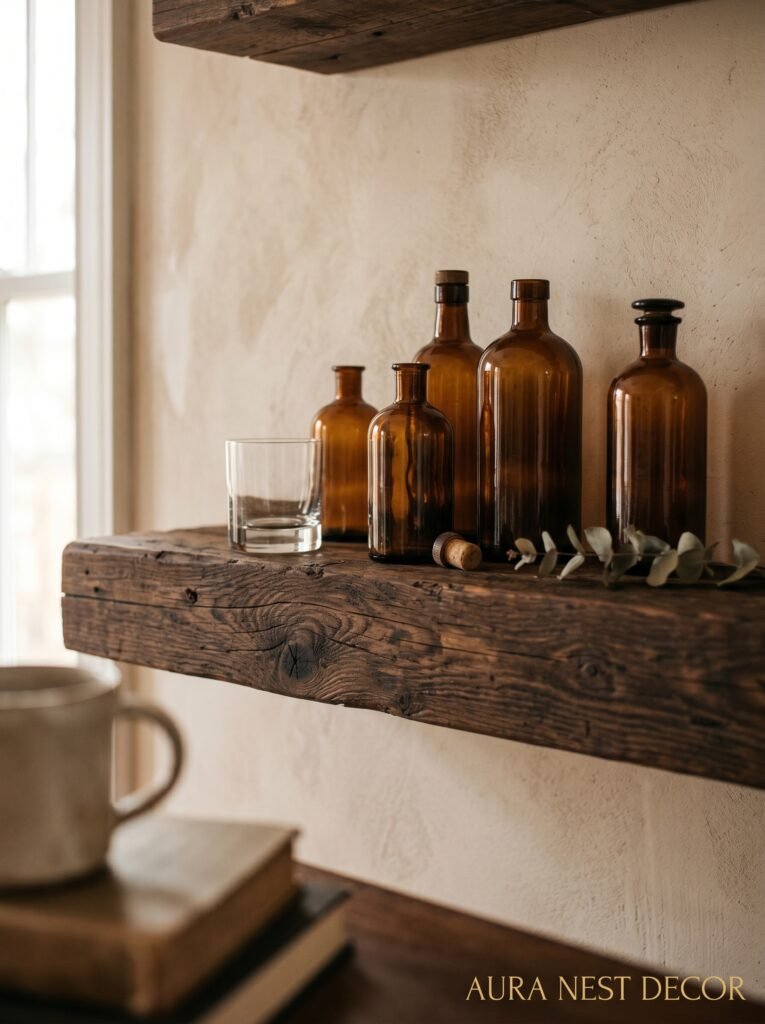
I’ve had three bar carts. THREE. And every single one of them ended up looking like I’d just wheeled in a hospital trolley with better taste in bottles. They move around, they wobble, they never feel placed.
A reclaimed wood shelf — the kind with visible grain, maybe a knot or two, edges that weren’t sanded down into oblivion — that stays put. It becomes part of the room. And the thing nobody tells you is that old wood has a color range that’s almost impossible to fake. It’s not brown. It’s gray-brown and amber and sometimes this deep reddish tone that only shows up when the light hits it sideways at 6pm on a winter evening. You can’t buy that at IKEA. You just can’t.
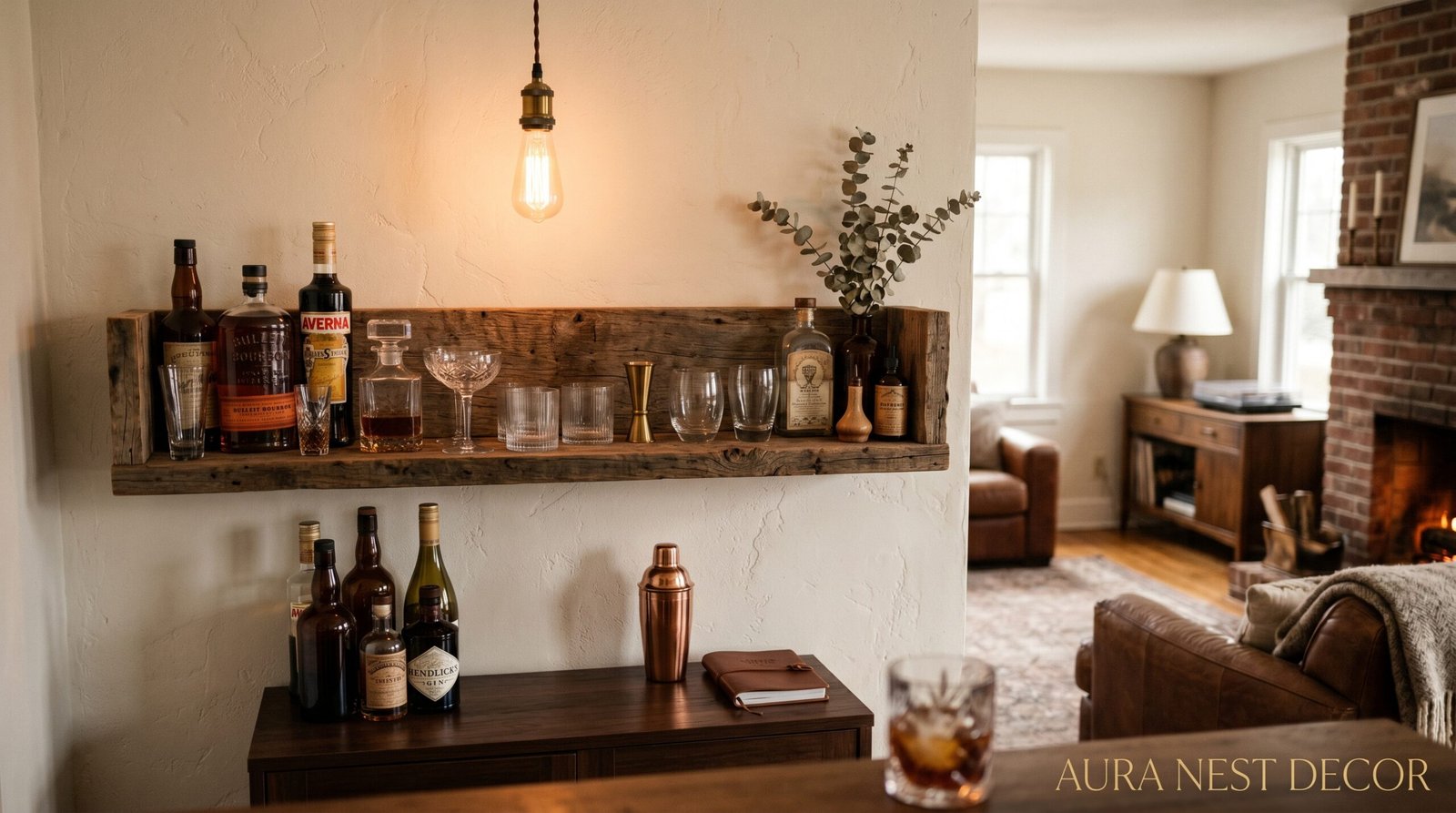
For a rustic bar setup, this is your starting point. One solid reclaimed shelf — or two, staggered at different heights — mounted on raw iron brackets. That’s the whole skeleton. Everything else gets layered in after. The bottles become art. The glasses become sculpture. And somehow, the room looks like it’s always been this way.
“Old wood doesn’t just hold your whiskey collection. It holds the whole mood of the room.”
—
2. The Lighting Trick That Makes Even Cheap Bottles Look Like They’re from a Speakeasy
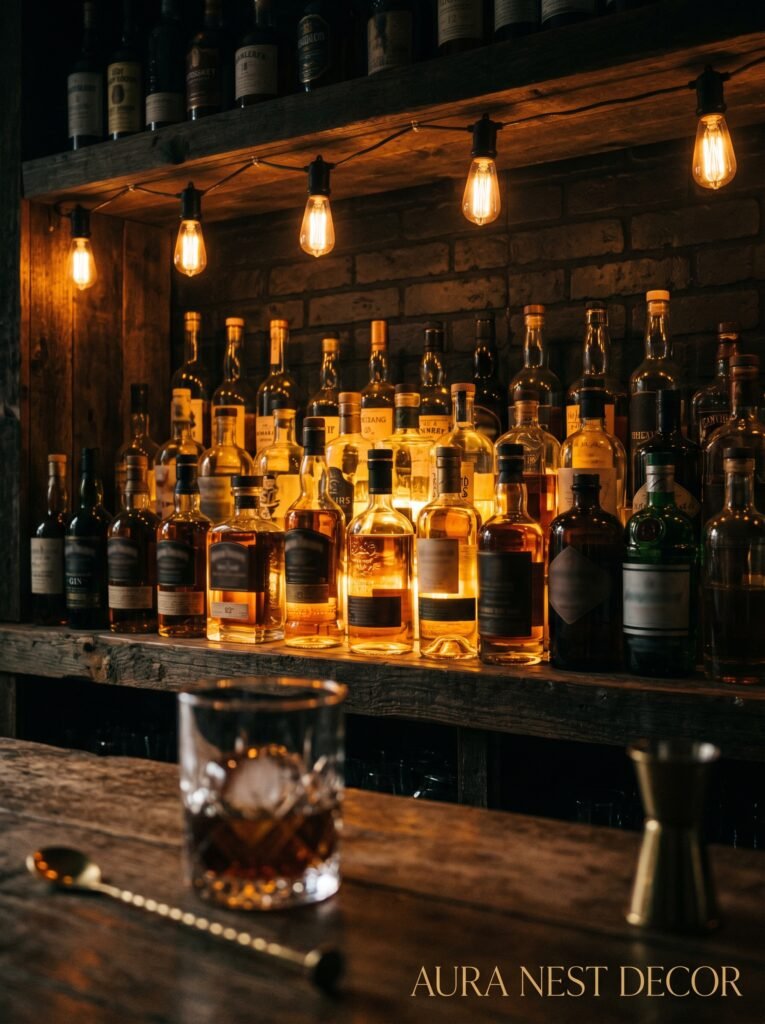
Okay, so here’s the thing about lighting a home bar. Most people don’t think about it at all. They’ve got the overhead light on, the bottles are just… sitting there, lit from above like they’re in a supermarket. And that’s fine! But it’s not this.
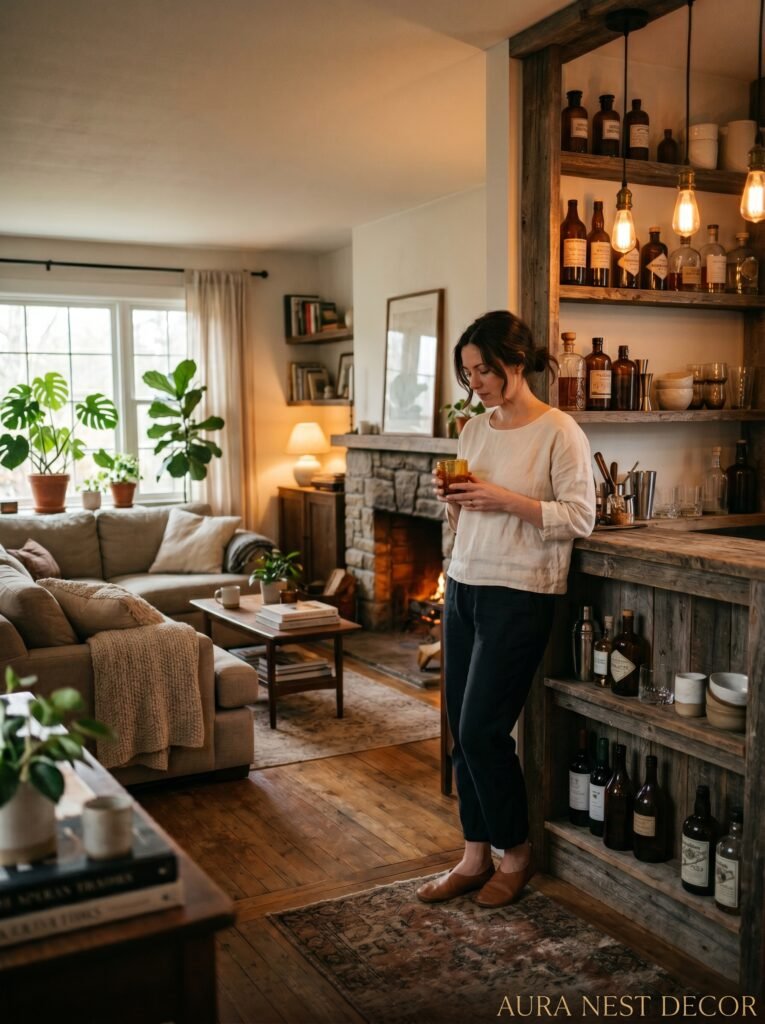
What you want is Edison bulbs. Specifically, the kind with the long visible filament — not the fake ones that just have a printed pattern inside. Real vintage-style filament bulbs, warm white, ideally on a dimmer. You hang them low if you can, or you put them in small wall sconces positioned at about head height. The amber glow they throw is genuinely different from any other light source. It makes the caramel tones in bourbon look like they’re lit from within. It makes your copper mugs glow. It turns a Tuesday into something that feels considered.
Side note — if you’re in the UK and you’re struggling to find vintage Edison bulbs in the right wattage, Nud Collection and Dowsing & Reynolds both do brilliant ones. In the US, check Schoolhouse Electric. You’re welcome.
The other trick? A small strip of warm LED lighting tucked BEHIND your bottles on the shelf — not under, behind. It creates a backlit glow that looks like it belongs in a boutique hotel in Nashville or a converted farmhouse in the Cotswolds. Takes about twenty minutes to install and costs almost nothing.
—
3. The Color That Keeps Showing Up in Every Beautiful Rustic Bar Right Now (And It’s Not What You Think)
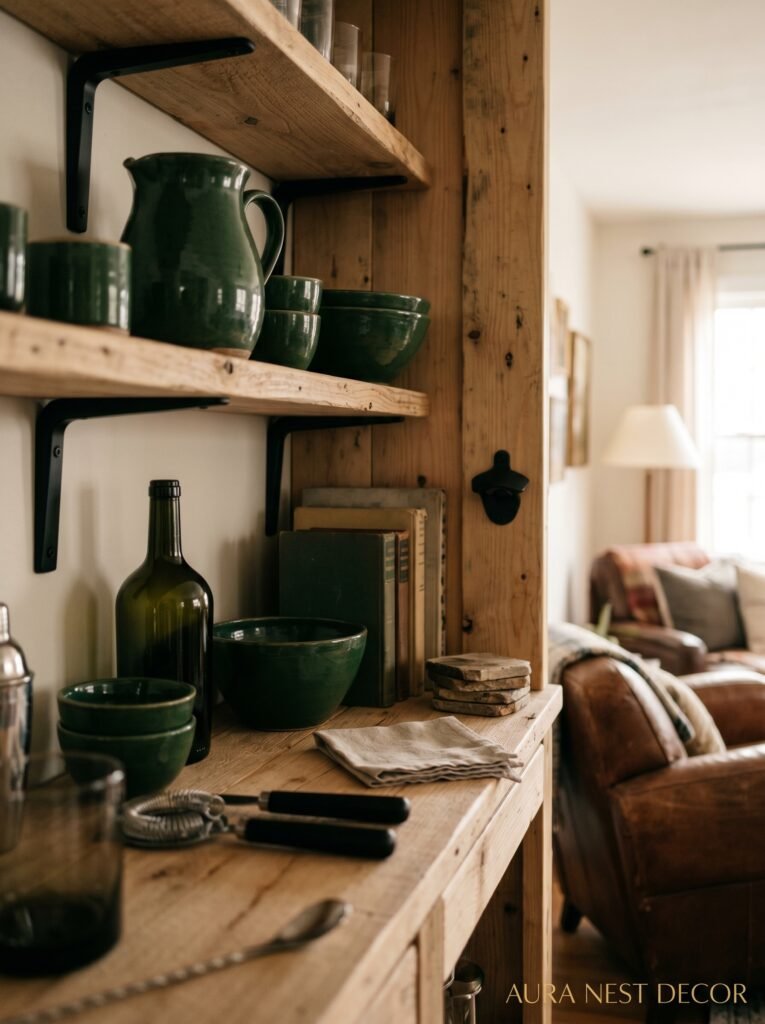
It’s not dark green. I know, I know — everyone’s doing dark green right now and it’s gorgeous. But for a rustic bar specifically? The color that keeps pulling me in is this sort of deep, dusty terracotta. Almost brick, but muted. Not earthy in a muddy way — earthy in a sunset-in-October way.
It works because it picks up the warm undertones in wood without fighting them. A dusty green wall competes a little with warm oak. Terracotta doesn’t compete — it agrees. And against the dark iron hardware and the amber of glass bottles, it creates this palette that feels like it evolved naturally rather than being chosen from a mood board.
If you’re painting, Farrow & Ball’s ‘Red Earth’ or Benjamin Moore’s ‘Clay Beige’ are both in this territory. Not exactly terracotta but in that warm, slightly faded family. In the UK I’d also look at Little Greene’s ‘Bombazine’ — it’s sort of a burnt clay tone that I’ve seen in about four different rooms now and it hasn’t missed once.
That said. If you’re renting or you just don’t want to commit to painting a whole wall — wallpaper. A small section of wallpaper in a textured or botanical print behind the shelves does exactly the same job with way less anxiety.
—
4. Mixing Your Glassware the Right Way (Because Matched Sets Are Kind of Boring Now)
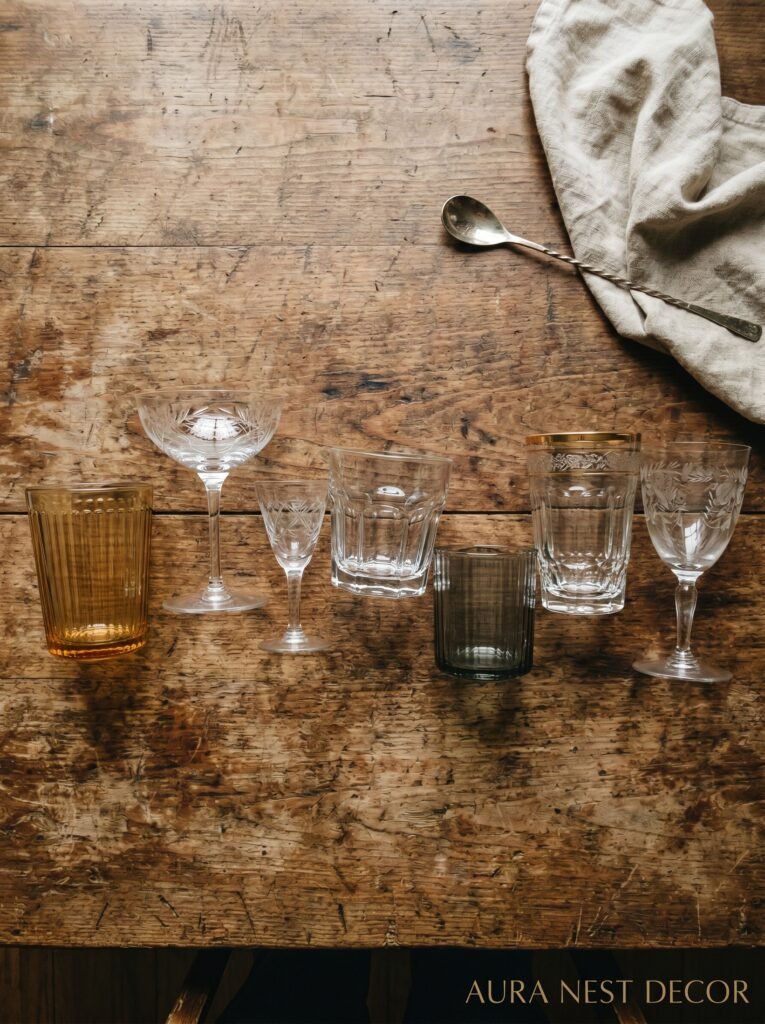
Nobody wants a matching set of eight identical lowball glasses anymore. Or maybe they do, I’m not here to tell anyone what to do with their glassware. But for a rustic bar aesthetic specifically, mismatched vintage glassware is EVERYTHING.
What you’re looking for: cut crystal tumblers from charity shops or estate sales, amber-tinted wine glasses (these are having an absolute moment), small coupe glasses in smoky glass, maybe one or two handblown pieces with visible bubbles in the glass itself. Etsy is brilliant for this. So are antique fairs — in the UK especially, you can walk away from a car boot sale with six genuinely beautiful pieces for under a tenner.
The key is keeping a visual thread. You don’t want truly random — you want curated random. So maybe everything’s in the amber-to-brown-to-smoky range. Or maybe everything has a cut or faceted quality to it. Or height varies wildly but all the pieces have that same heavy, quality feel. It should look like it was collected over time, not assembled in one panicked online order.
“The best home bar glassware tells a story. Matched sets don’t tell anything.”
—
5. The Unexpected Surface That Works Better Than a Dedicated Bar Cabinet
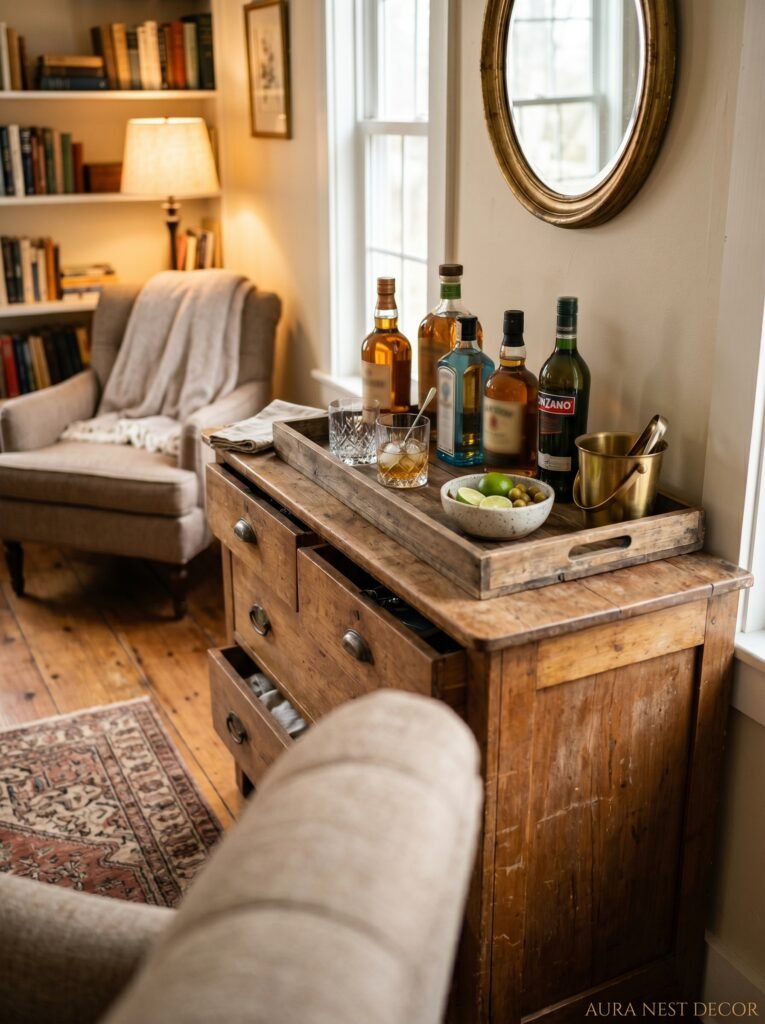
I’ve seen people convert all kinds of things. An old baker’s rack. A solid wood dresser with the drawers removed from the top half. A door on iron pipe legs mounted to the wall as a floating surface. My personal favorite I’ve ever seen in real life? A section of thick butcher block — the kind you’d use as a kitchen island — mounted at bar height in an alcove, with shelves above it and a row of simple hooks below for hanging bar tools.
It doesn’t scream “bar.” It whispers it. And there’s something about butcher block in a living room that feels slightly unexpected, which is exactly the energy rustic decor does best. It’s familiar material in an unfamiliar context and your eye sort of loves that.
For UK homes especially, where living rooms tend to be smaller and every piece of furniture has to justify its square footage — this built-in approach is SO much smarter than a freestanding cabinet. You’re not losing floor space. You’re using wall space that was probably just sitting there doing nothing.
—
6. The One Hardware Choice That Ties Every Rustic Bar Detail Together
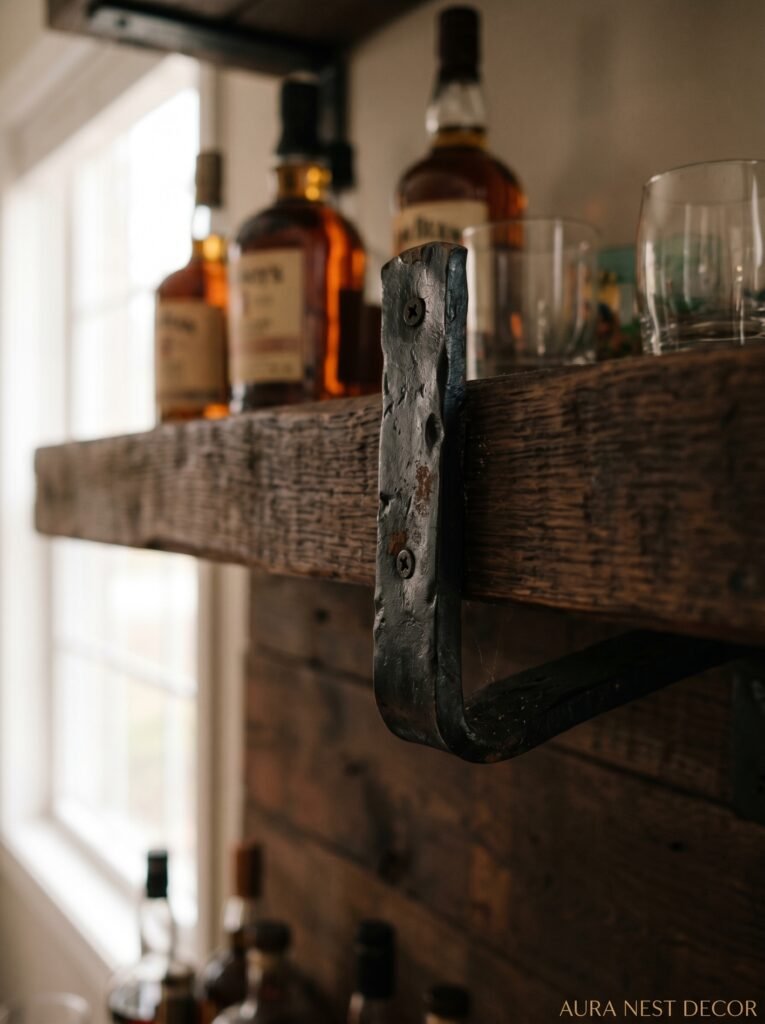
Iron. Raw, matte, dark iron. Not brushed nickel, not brass (though brass is beautiful in a different context), not chrome. For rustic specifically — iron.
Iron shelf brackets. Iron bottle openers. Iron hooks for bar towels. An iron rail along the front edge of the shelf for hanging wine glasses. Even the screws, if they’re visible, should ideally be dark rather than silver. It sounds like a small thing but it absolutely isn’t. Bright silver hardware on a reclaimed wood shelf looks like a mistake. Dark iron hardware looks like an intention.
The reason this works so well is that iron has this quality of looking both old and permanent at the same time. It doesn’t read as trendy. It reads as structural, as chosen, as something that would’ve been in a barn or a pub or a Victorian kitchen a hundred and fifty years ago. And that’s exactly the feeling a rustic bar needs to create — not that you installed it last spring, but that it’s always been here and it’ll still be here long after you’ve moved on.
—
7. Plants That Actually Work in a Bar Vignette Without Looking Like You’re Trying Too Hard
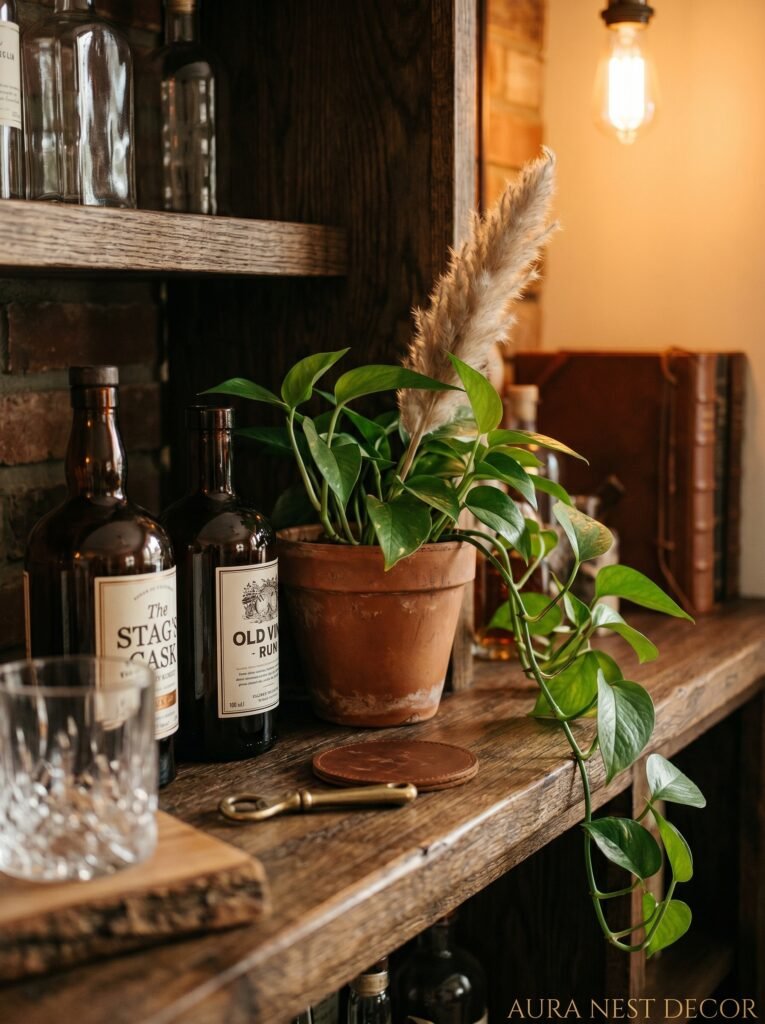
Not all plants work near a bar setup. Big tropical leaves? Too loud, too competing. Succulents? Too clinical, too on-trend in the wrong way. What works in a rustic bar context is more… considered. Trailing. Small. A little wild.
Trailing pothos in a small terracotta pot tucked at the end of a shelf. A single stem of dried eucalyptus in a narrow clay vase — no water, no fuss. A small rosemary plant if there’s any decent light source nearby, because honestly is there a better scent to have in a room where you’re drinking gin. One tiny jam jar of wildflowers, dried, on the corner.
The key is keeping it minimal and slightly imperfect. One pot too many and it starts looking like a garden center. One dried stem that’s slightly asymmetrical and it looks intentional and lived-in. The goal isn’t “botanical bar.” The goal is “this corner has been loved.”
“One small plant in the right spot does more for a room than six plants in the wrong one.”
—
8. How to Style the Actual Bottles Without It Looking Like a Liquor Store
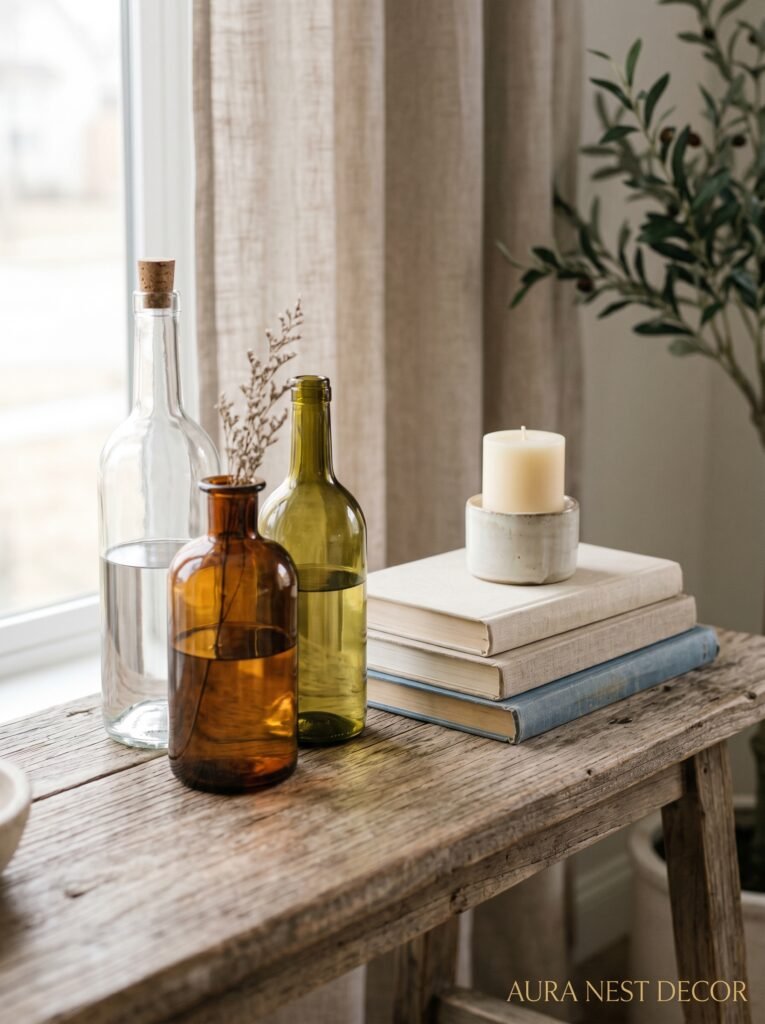
Here’s where people get it wrong most often — and I include my former self in this. You line all the bottles up by height, labels facing out, and it looks like a supermarket aisle. Or worse, you group them by spirit type like you’re organizing inventory.
What looks good? Varying heights, yes, but done in a more organic way. Put a taller bottle at the back, a shorter one in front and slightly to the left. A decanter beside them — a good cut glass decanter makes any mid-range whiskey look like something a fictional billionaire drinks. A small wooden board leaning against the wall behind the bottles (like a tiny charcuterie board) adds another layer and a different texture.
And don’t feel like you need to display every bottle. A few beautiful ones, the ones with interesting shapes or labels, work harder than twenty bottles that just look like the off-license shelf. The rest can live in a cupboard. Rotating display. Only your best stuff earns shelf space.
—
9. The Forgotten Detail That Makes a Rustic Bar Feel Genuinely Welcoming
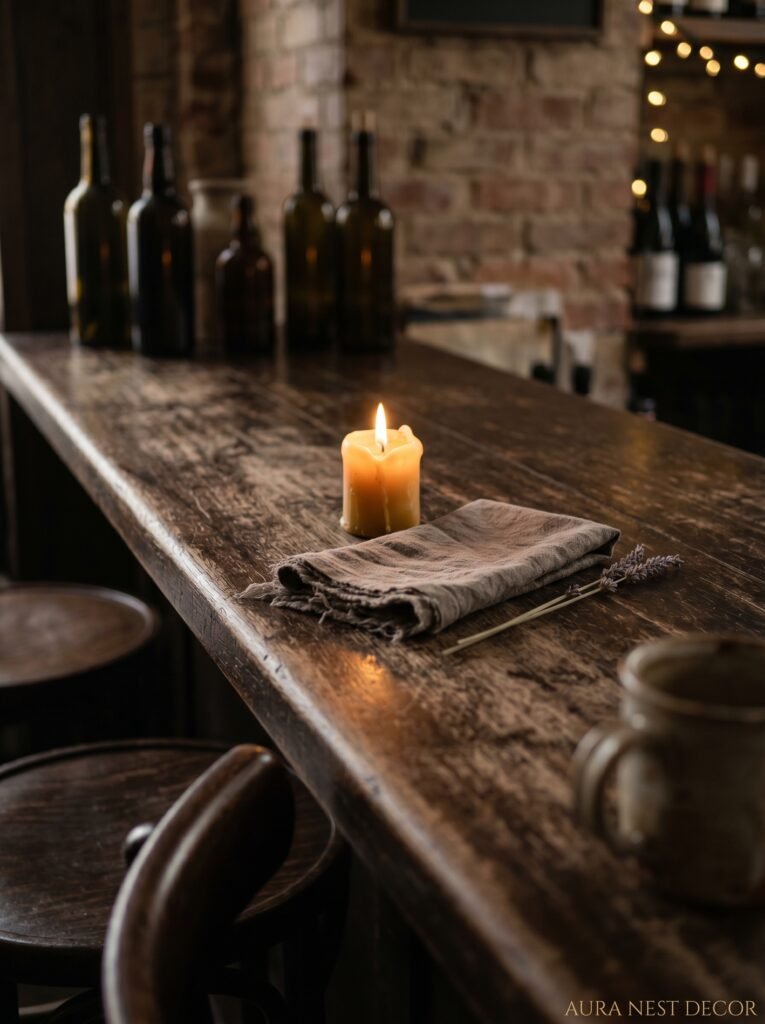
A bar towel. No, really. Hear me out.
Not the printed “live, laugh, lager” kind. A proper linen bar towel — slightly worn, slightly wrinkled, either plain white or in a thin stripe — draped casually over the front edge of the shelf or hanging from one of those iron hooks. It costs nothing. But what it does is signal that this space is used. Not staged. Used.
It’s the same reason a stack of a few cookbooks in a kitchen feels warmer than a bare counter. Or why a rumpled throw on a sofa looks cozier than one that’s been neatly folded. These little human traces — the towel, a forgotten book of cocktail recipes, a single coaster sitting out — make a space feel inhabited. And inhabited is what you’re going for. Not a showroom. Not a Pinterest board brought painfully to life. A place where someone actually pours a drink and sits down and exhales.
—
10. Making a Small Alcove or Awkward Corner Into the Best Part of Your Room
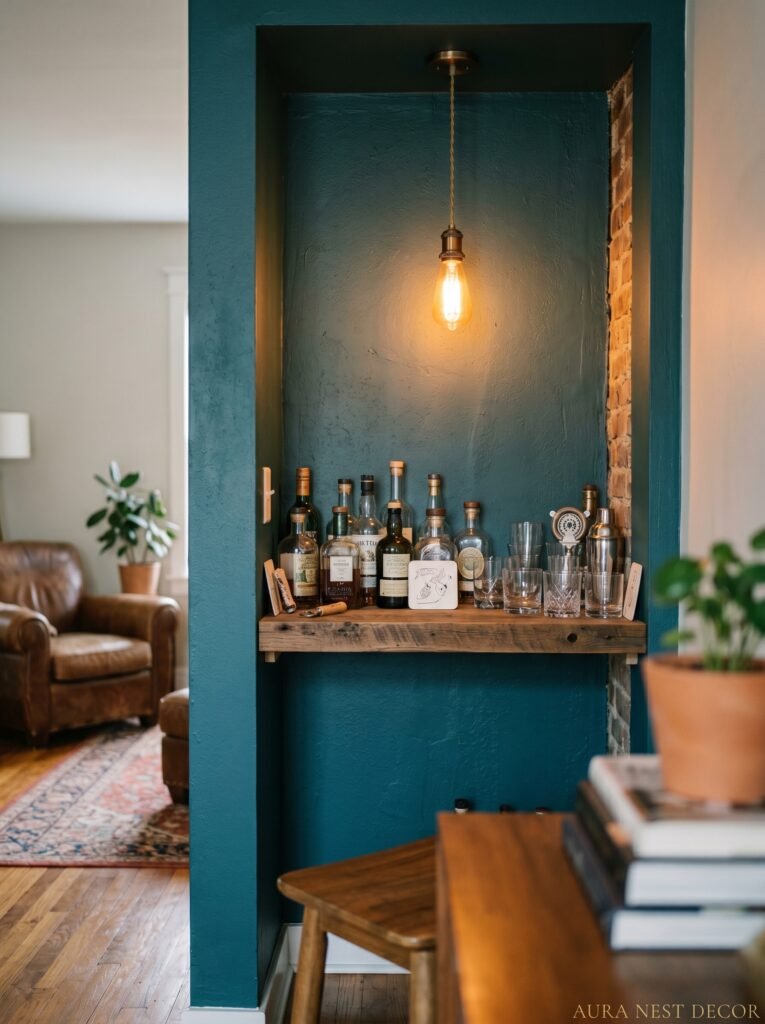
Alcoves in British homes. Those weird corners in American living rooms where you don’t know what to put. These are actually the BEST spots for a rustic bar setup and I’ll die on this hill.
Why? Because a bar works better when it’s slightly set apart. When you walk to it, rather than it being in the middle of the room. An alcove gives you built-in enclosure — you’ve already got one or two walls working for you. You float your shelves, you drop the Edison bulb, you paint the inside of the alcove that terracotta tone even if the rest of the room stays neutral, and suddenly you’ve got a nook with an identity.
Awkward corners in open-plan American homes work similarly. Corner shelving, angled slightly, with a small surface below. Or simply two walls of shelving meeting at the corner, with the bar tools and bottles and glassware creating a wraparound display that turns the awkward geometry into a feature.
—
11. The One Rule for Rustic Bar Decor That Basically Every Beautiful One Follows
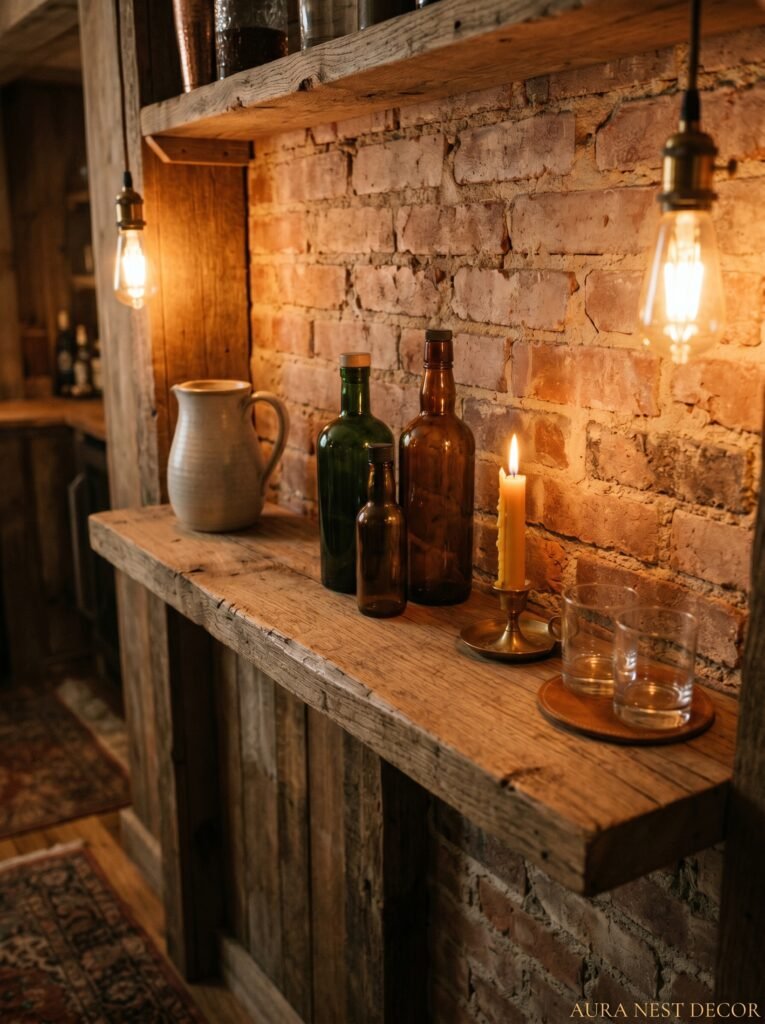
Don’t match everything. More specifically — don’t coordinate. Coordination is for hotel rooms. A rustic bar should look like it came together over time, with pieces from different places and different eras that somehow ended up in conversation with each other.
That means your vintage crystal glass can sit next to a very modern minimal coaster. Your reclaimed wood shelf can have brass-handled small drawers beside iron hooks. Your dried wildflowers can share a shelf with a sleek modern bottle of mezcal. The rustic frame — the wood, the iron, the warm tones — is strong enough to hold all of it together without everything needing to be “rustic.”
In fact, the contrast is kind of the whole point. The old wood looks older next to something modern. The iron looks more structural next to something delicate. The mix is what makes it feel collected and personal rather than curated from a single catalog.
—
12. The Finishing Touch Nobody Thinks to Add Until They See It Somewhere Else
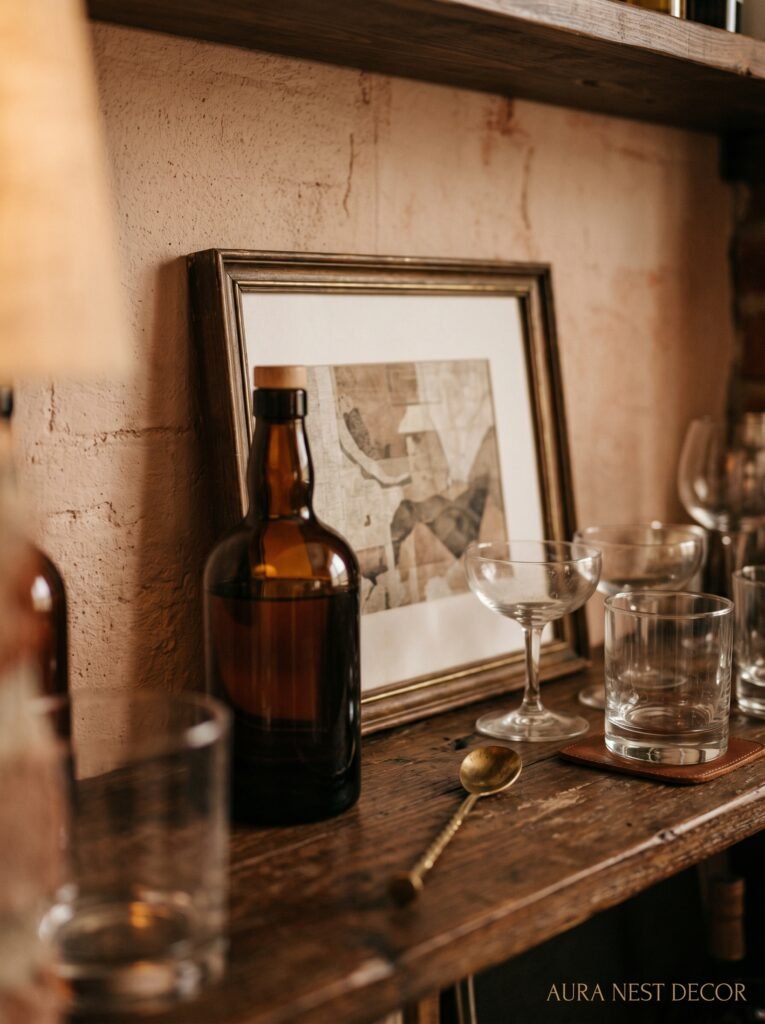
A small, framed piece of art. Or even just a framed vintage map, a pressed botanical print, an old illustration from a book about wine or whiskey. Something slightly worn looking — a thin wooden or dark metal frame, nothing pristine.
Hung above the bar shelves or propped against the wall behind the bottles, it does this quiet thing where it anchors the whole vignette. It says: this corner has a story. It gives your eye a landing place that isn’t a bottle label. And it’s SO easy to get wrong — too big and it overwhelms, too colorful and it fights with the bottles — so: small, slightly faded, tones that echo what’s already there.
A vintage whiskey advertisement from the 1930s. A botanical illustration of juniper berries. A hand-drawn map of Scotland or Kentucky, depending on what you’re pouring. These things exist everywhere — at charity shops, on Etsy, folded up in junk shops — and they cost almost nothing and they finish a bar vignette in a way that nothing else quite does.
—
❓ FAQ
Q: How do I make a rustic bar look good in a modern or contemporary living room? A: Keep the rustic elements restrained — one reclaimed wood shelf and dark iron hardware is usually enough. Let the rest of the styling be cleaner and more minimal, and the contrast actually works in your favor. The wood reads as a warm accent rather than a style clash.
Q: What’s the best way to start a home bar on a small budget? A: Honestly, one good reclaimed shelf, a single Edison bulb, and a mix of glassware sourced from charity shops or car boot sales is all you need. The bottles come over time. Start with the structure and the lighting — those two things do more heavy lifting than anything else.
Q: Do I need a lot of wall space for a rustic living room bar? A: Not at all. Some of the best setups I’ve seen occupy less than three feet of wall. A single floating shelf with a small surface below — even a narrow console table — is enough. An alcove is ideal but absolutely not required. Vertical space matters more than horizontal.
—
💭 Final Thoughts
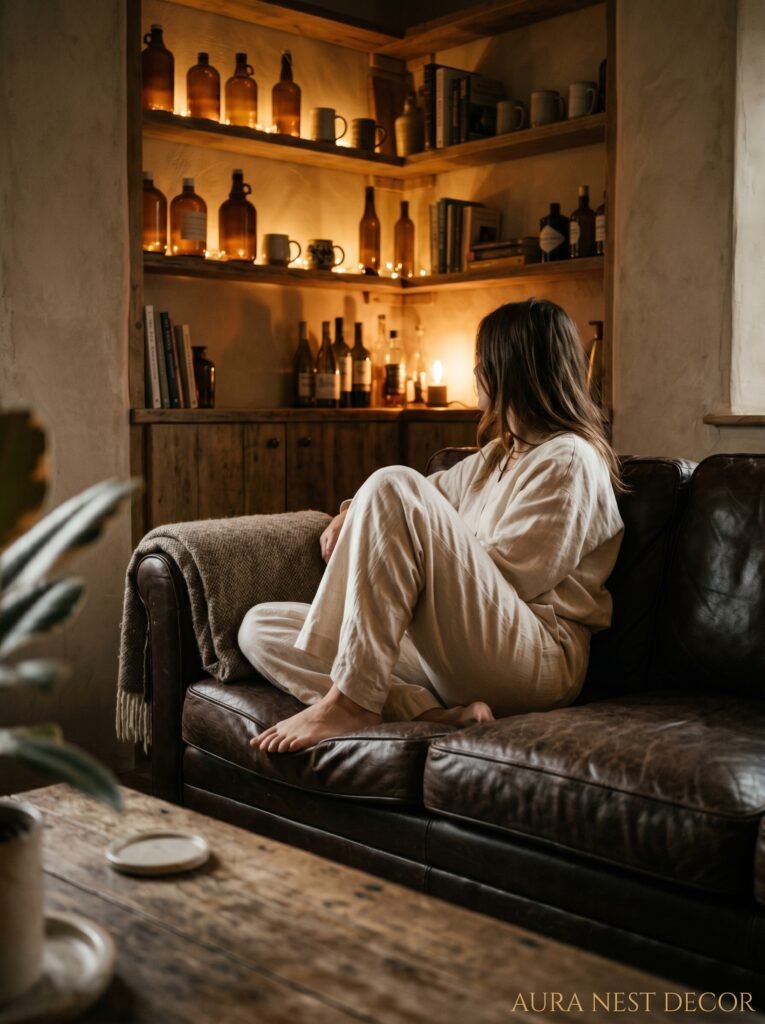
There’s a particular kind of evening that a good home bar makes possible — the one where nobody wants to leave because the corner of your room has this warmth to it that nobody can quite explain. That’s what rustic decor, done right, actually creates. Not a showpiece. Not an aesthetic statement. Just a place that feels genuinely good to be near.
Start with one shelf and one good light source. See where it goes from there. What would your corner look like?