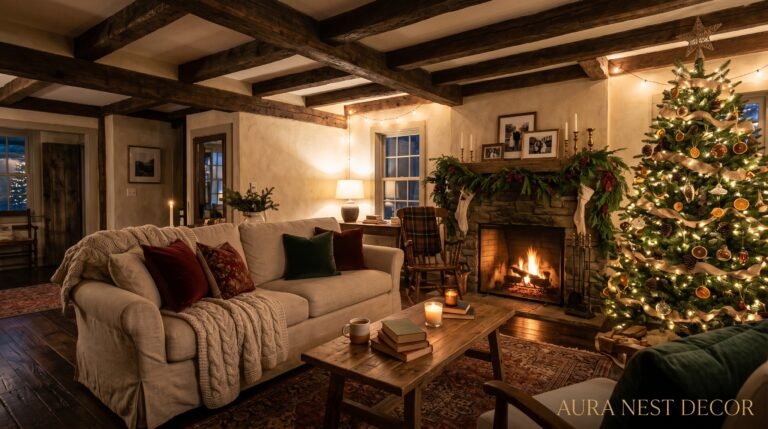
The Farmhouse Christmas Living Room That Makes You Want to Stay Inside All December
There’s a specific kind of evening that happens in December — the kind where it’s dark by four, the heating kicks on, and you look around your living room and think this needs to feel like somewhere. Not a showroom. Not a holiday card. Just… deeply, properly cozy in a way that makes you reluctant to leave even for bed.
That’s what rustic farmhouse Christmas does better than any other decorating style. And it’s more achievable than you think.
—
1. Why Aged Wood and December Light Are Basically in Love
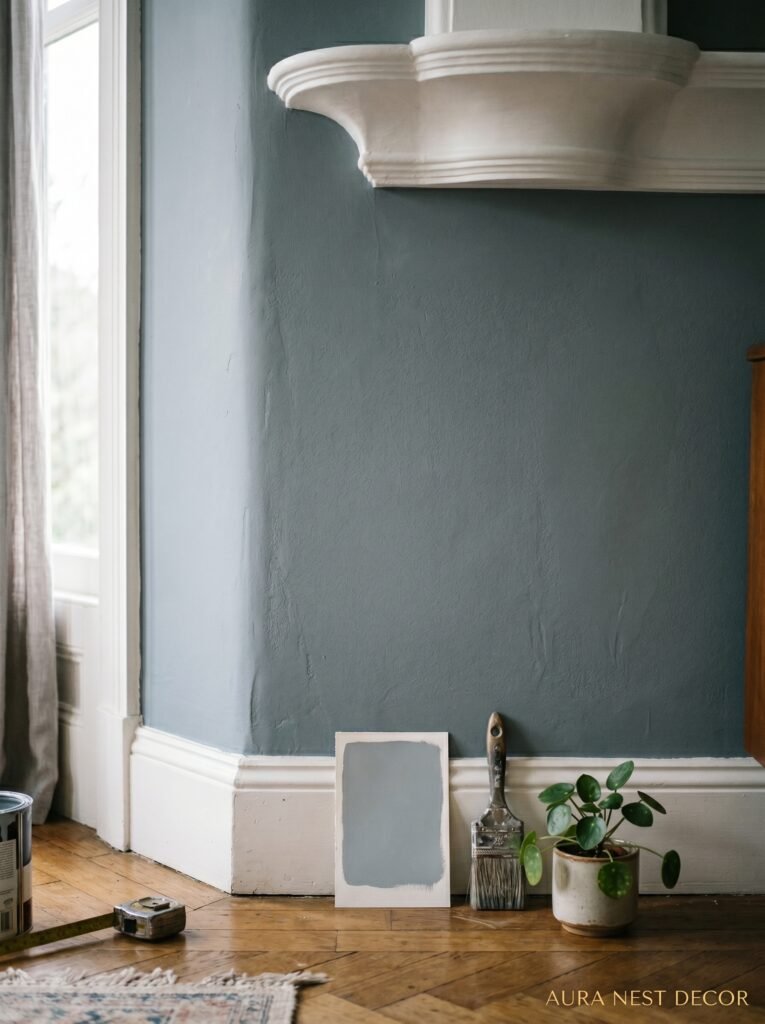
You don’t need to understand color theory to know that warm wood and candlelight belong together. You just feel it the second you walk into a room where both are present.
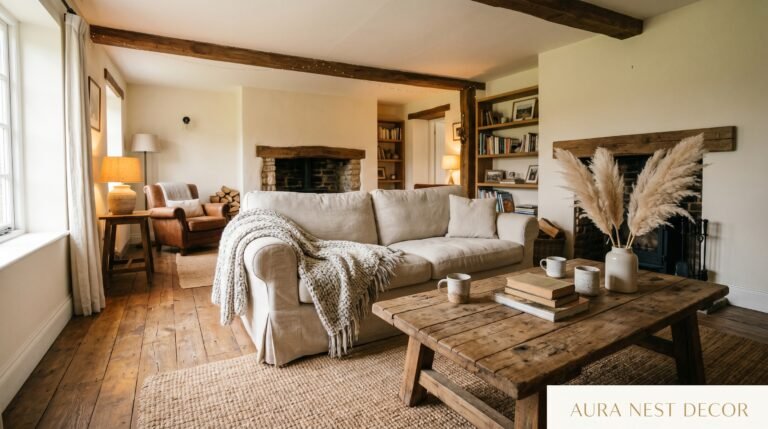
Reclaimed wood — whether that’s a salvaged mantel, a chunky coffee table, or even just a few cut log slices scattered on a shelf — catches the amber light in a way that painted surfaces simply don’t. There’s depth to it. Grain lines, small imperfections, a little darkness in the knots. In December, with a candle going and the overhead lights dimmed, aged wood practically glows. Not in a dramatic way. In a warm, quiet, yes kind of way.
If you don’t have reclaimed wood furniture, don’t panic. A single wooden tray, a stack of vintage books with worn spines, a small footstool with visible grain — any of these can anchor the look. The goal isn’t to build a log cabin. It’s to get one or two pieces of warm, imperfect wood into your sightline, because everything you layer around them will look ten times cozier for it.
And if you’re working with a white or light-grey living room — honestly? Lucky you. Pale walls make warm wood pop in the most satisfying way. It’s the contrast that does the heavy lifting.
“Warm wood in December light isn’t a design choice — it’s practically a biological need.”
—
2. The Mantel Arrangement That Looks Effortless But Isn’t Accidental

Everyone wants their mantel to look like they just threw a few things up there. Nobody wants it to look like they spent forty minutes rearranging things. The secret — and it’s genuinely not complicated — is odd numbers and height variation.
Three candles, not four. A small lantern, a medium pine branch, a tall brass candlestick. The eye moves between them without landing on symmetry, which is what makes a mantel look styled versus staged.
For farmhouse Christmas specifically, you want textures that feel collected rather than purchased as a set. A hand-thrown pottery piece next to a sprig of dried eucalyptus. A weathered wooden star propped against the mirror. A small collection of vintage ornaments you genuinely like sitting in a shallow bowl. The “set” look — where everything matches, everything is the same finish, everything is clearly from the same shop — is the opposite of rustic farmhouse. It doesn’t need to match. It needs to feel like it belongs together, which is a totally different thing.
One more thing: greenery is non-negotiable on a farmhouse mantel. Real or faux. Eucalyptus, fir, holly, pine. Even a single branch propped in a mason jar changes everything. Green softens, breathes, makes the whole arrangement feel alive. Don’t skip it.
—
3. The Throw Blanket Situation Deserves More Thought Than You’re Giving It
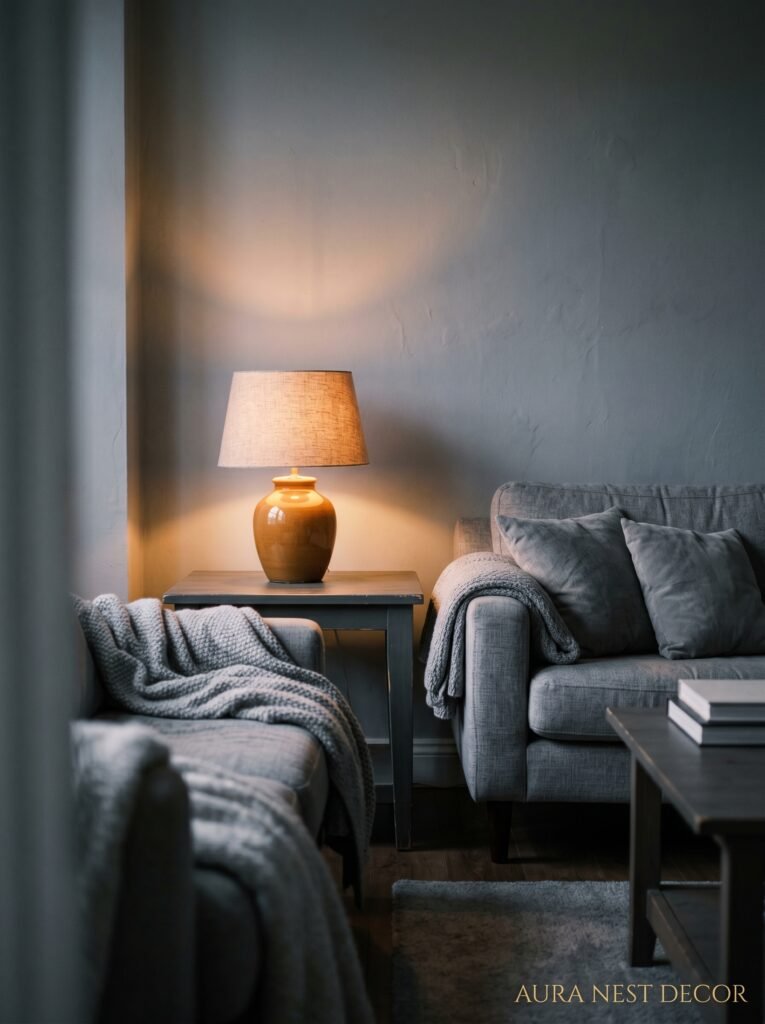
I know. Throw blankets feel like a small detail. They’re not.
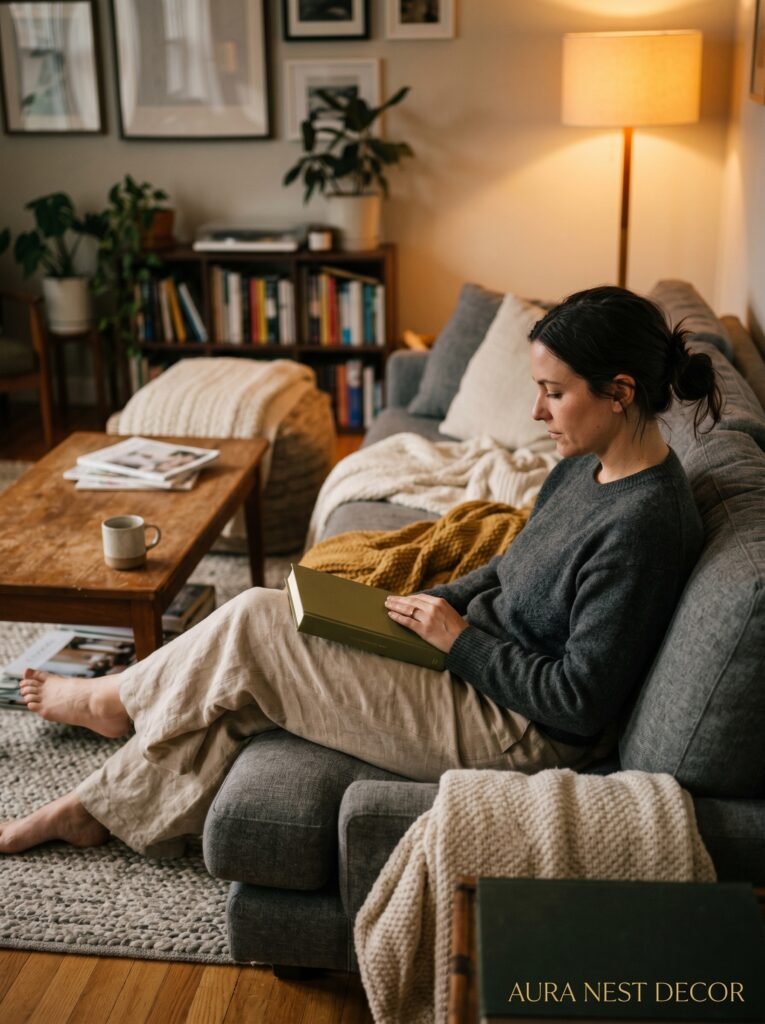
In a farmhouse Christmas living room, the throw blanket is doing serious emotional work. It’s saying you can sit here, you can get warm, you don’t have to be anywhere. That’s the whole vibe — and a thin, too-shiny, polyester throw will undercut everything else you’ve done. Not trying to be harsh. It just will.
What you’re looking for: chunky knit, waffle weave, or a proper wool blend in a neutral or natural color. Cream. Oatmeal. A soft grey-green. Deep red if you want a bit of Christmas drama. The texture matters more than the color, honestly. A beautifully textured cream throw in the corner of your sofa transforms the whole corner. It says this room is lived in and loved, which is the farmhouse Christmas goal in a single sentence.
Drape it casually, not folded. One corner hanging over the sofa arm, the rest kind of pooled. Not too neat. Real people use these things.
And get more than one if you can, because the moment a guest arrives and you can pull a spare out from a basket? Very satisfying. Very farmhouse.
—
4. Candles Are Doing More Than You Realize
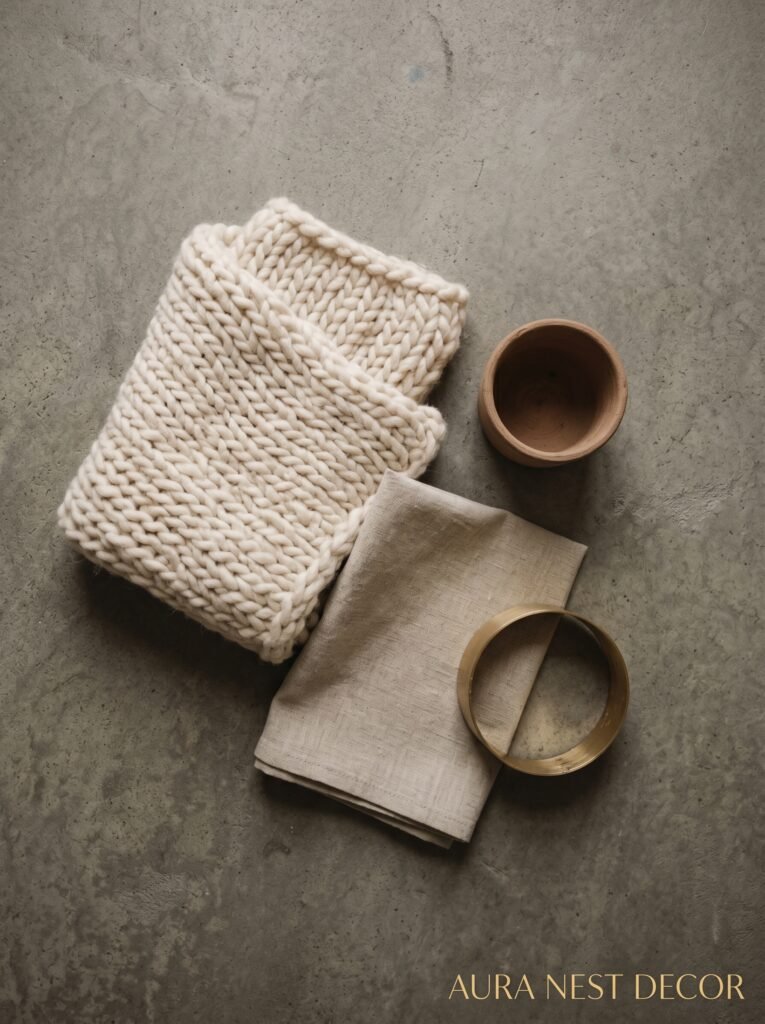
Overhead lighting is the enemy of cozy. I’ll die on this hill.
The single fastest thing you can do to make your living room feel like a rustic farmhouse Christmas dreamscape is to turn off the main lights and switch entirely to candles and lamps. The difference is genuinely shocking — not subtle at all. Same room. Completely different feeling.
For farmhouse Christmas, pillar candles in varying heights are your best friend. Group them on a wooden board or a slate slab. Three or five, different heights, let the wax drip a little if you can stand it (the dripped wax adds character and feels very European Christmas in the best way). Add a small hurricane lantern with a candle inside if you’re worried about drafts.
Scent matters too, though I’d keep it restrained. One scented candle, max — something like balsam fir, clove, or cedar. The rest can be unscented. You don’t want competing fragrances fighting each other across the room. One good scent, building slowly, is infinitely better than three strong ones that make your nose confused.
“Turn off the overhead lights and suddenly every room has potential.”
—
5. The Surprising Case for Dried Oranges and Why They’re Everywhere Right Now
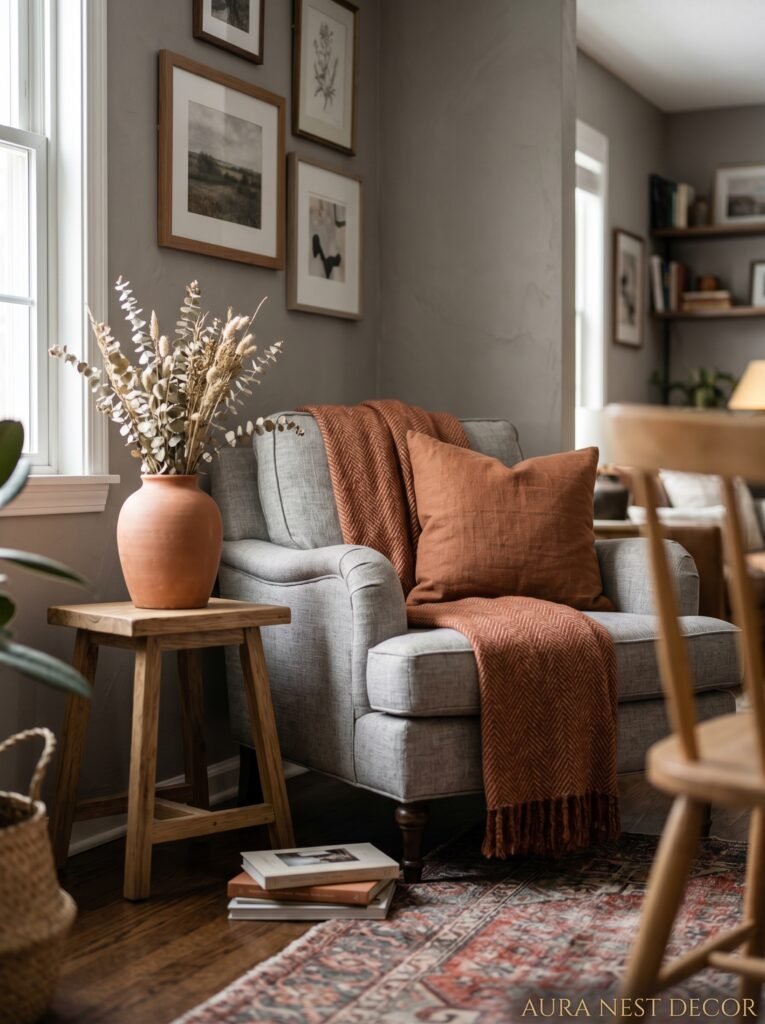
Dried orange slices are having a moment. And look, I know that sounds very “craft project from 2019” — but hear me out, because when they’re styled correctly, they look genuinely beautiful and they smell like Christmas.
The key is using them as part of a natural, textural display rather than hanging them all over everything. A few slices tucked into a garland. A string of them above the mantel, mixed with cinnamon sticks and dried rosehips. A small bowl of them on the coffee table next to a candle. That’s it. That’s the brief.
They dry really easily in a low oven — around 200°F / 95°C for two to three hours, flipped halfway. Or you can buy them pre-dried. Either way, they add a color (that deep amber-orange, warm and rich) and a scent (sweet, spiced, very festive) that feels completely farmhouse. They look handmade, even if you bought them, and that’s the whole point. Farmhouse Christmas should look like someone made things, cared about things, put time into this space.
Side note — rosehips, dried seed pods, and dried cotton stems all work in the same way. They’re cheap, they last, and they bring that textural rawness that makes farmhouse decor feel authentic instead of themed.
—
6. Plaid: How Much Is Too Much (And the Answer Might Surprise You)
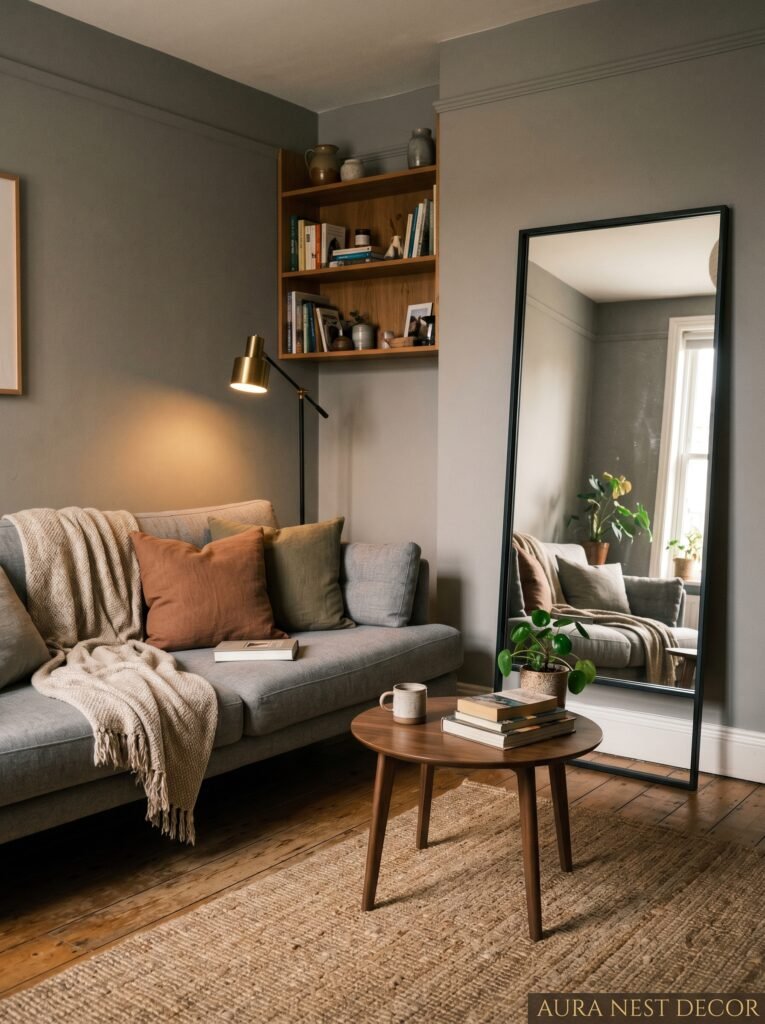
A lot of people are scared of plaid. They think it’ll look too country, too matchy-matchy, too… tartan-Christmas-catalogue. That fear is valid but also? Plaid is one of the most effective tools in the farmhouse Christmas toolkit when you use it with restraint.
One plaid element in a room is never too much. Two can work brilliantly. Three starts to tip into overwhelming.
The best plaid for farmhouse Christmas is muted — not the bright red-and-green Christmas plaid, but the kind with a lot of grey or dark green or navy in it, where the red is present but not shouting. A Buffalo check (the classic large-scale two-color check) in black and white or red and black is probably the most farmhouse-specific pattern you can use. One Buffalo check pillow or a folded throw in Buffalo check is genuinely transformational. It reads as Christmas without reading as “I bought a Christmas décor set from a big box store.”
In the UK especially, a tartan in a muted forest-green or Hunting plaid can feel equally right — it’s got that same rustic, wintry quality without being American-farmhouse-specific.
—
7. The Coffee Table You Keep Rearranging (And How to Finally Get It Right)
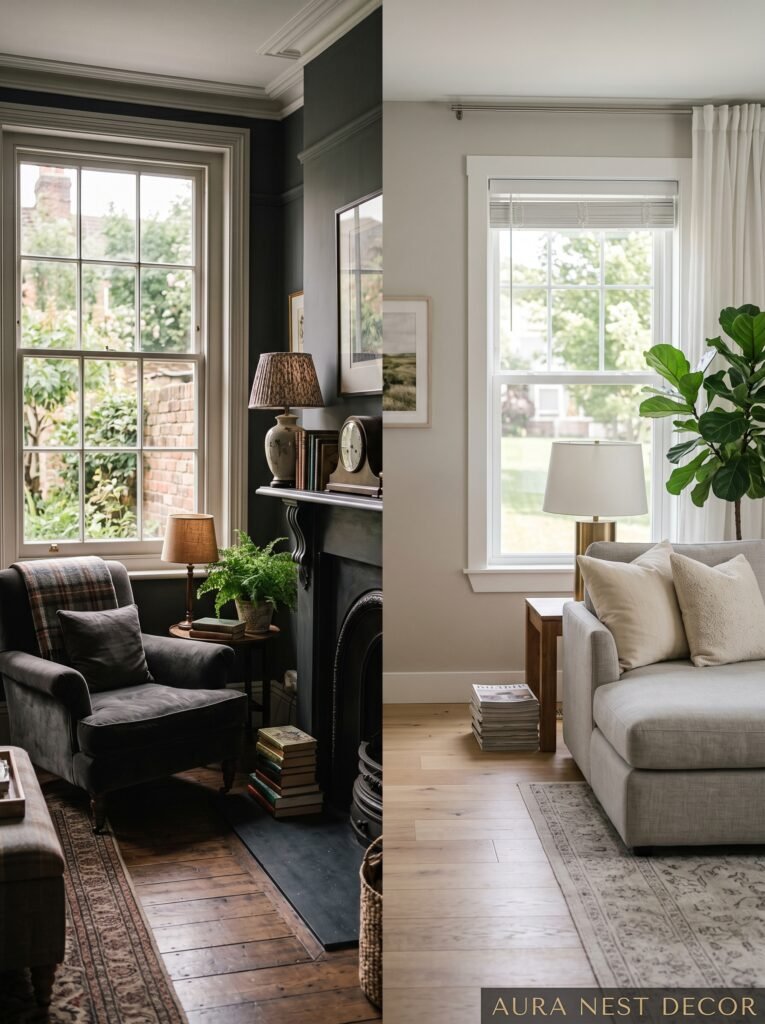
The coffee table is the hardest surface in the living room to style. Too much and it looks cluttered. Too little and it looks forgotten. For farmhouse Christmas, there’s a formula that actually works and I’m not even embarrassed to say it’s a formula because it genuinely works.
A tray. Something tall. Something round. Greenery.
The tray (wooden, woven, or slate) gives the arrangement a boundary, which is what stops it from looking scattered. Something tall — a candle, a small tree, a lantern — gives the eye somewhere to go. Something round — a pinecone bowl, a small globe ornament, a ball of twine — softens the arrangement. And greenery, even just a stem of fir, pulls it into the Christmas season without requiring anything specifically “Christmas-themed.”
Vary the heights. Don’t centre everything. Let one element hang slightly off the edge of the tray. This is the detail that makes it look unstudied.
“A tray isn’t containment — it’s permission for the arrangement to feel complete.”
—
8. What Farmhouse Christmas in a Small Living Room Actually Looks Like
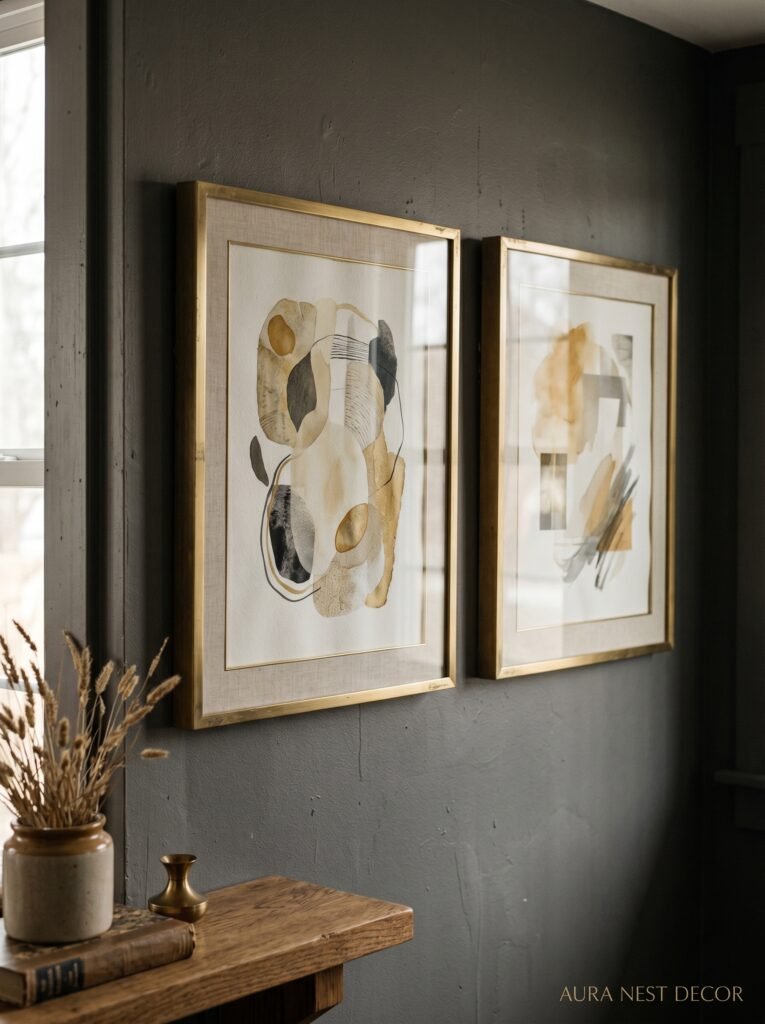
Small rooms can do farmhouse Christmas BEAUTIFULLY. I want to say this clearly because I think a lot of people assume the style requires a big open-plan space with barn doors and a cathedral ceiling. It doesn’t.
In a small living room, the key is going vertical and going cozy rather than going big. A tall, narrow tree with simple lights. Garland draped over a small window or a doorframe. A single wreath. Candles in clusters. You’re creating points of warmth and visual interest, not trying to fill space.
What to avoid in a small farmhouse Christmas room: too many figurines, too many competing collections, anything that requires floor space you don’t have. Edit hard. Three excellent things are worth more than twelve mediocre ones.
The advantage small rooms have is that the cozy feeling comes naturally — there’s less air to fill, less space to warm up. Lean into that. A small sofa with a beautiful throw, one candle going, the tree lit up in the corner — that’s an incredibly powerful image. A lot of the most beloved farmhouse Christmas photos on Pinterest are from small rooms. You’re not working against the space, you’re working with it.
—
9. The Case for a Real Christmas Tree (And What to Do If You Won’t Go There)

Real trees smell like December. There’s genuinely no getting around this fact. The moment a fresh tree comes into a house, the whole place smells like a forest, and for farmhouse Christmas in particular, that naturalness is EVERYTHING.
But. I get that real trees aren’t always practical — you’ve got cats, you’ve got a small space, you do the same tree every year and that’s your tradition and it works for you. Fine. Completely fine.
If you’re going faux, the trick for making it look farmhouse is to a) get a slightly imperfect-looking tree — not the super full, super symmetrical ones but the slightly irregular ones that look like they might have actually grown somewhere, and b) decorate it with things that have warmth and texture. Wooden ornaments. Dried orange slices. Woven straw stars. Simple kraft paper tags. Strings of warm white lights only — no multicolour, no cool white. And leave some gaps. Real trees have gaps. Perfection is the enemy of farmhouse.
Also: the three-foot potted Christmas tree that you can actually keep alive? Incredibly charming. Don’t underestimate it.
—
10. Brass, Copper, and the Rule About Shiny Things
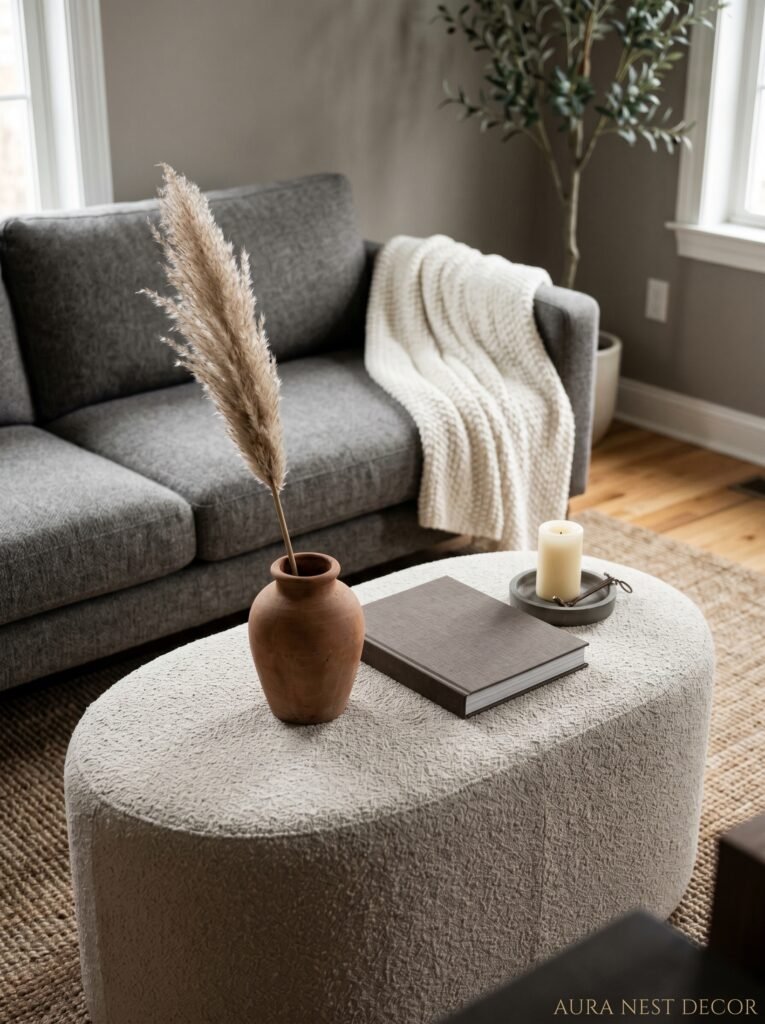
The metals you choose will make or break a farmhouse Christmas room. And I say this as someone who spent years thinking metal finishes were a detail I didn’t need to care about.
Chrome and silver are cold. They read modern. In a farmhouse Christmas living room, they feel wrong — slightly clinical, slightly out of place. Swap them for brass (ideally slightly tarnished, not mirror-polished) or copper. Both have warmth. Both catch candlelight. Both read as aged, collected, and real — which is the whole farmhouse aesthetic in a nutshell.
You don’t need to replace anything. A few brass taper candleholders, a copper mug holding pencils or dried flowers on the coffee table, a brass star on the tree. Accents. That’s all. They’ll warm up the whole room in a way that’s hard to pinpoint but immediately noticeable.
—
11. Greenery That Does the Heavy Lifting Without a Budget to Match

Real greenery — pine, fir, eucalyptus, holly — is cheap. Genuinely cheap. And it does more work than any purchased decoration in the farmhouse Christmas toolkit.
A simple garland of fresh pine draped along the mantel (secured with a bit of wire or just balanced on the mantel clips you can get for about four dollars) immediately makes the whole fireplace wall feel dressed and seasonal. A few stems of eucalyptus in a simple glass bottle on a bookshelf. A wreath of fresh fir on the door, tied with a natural linen ribbon instead of a plastic bow.
The key farmhouse principle with greenery is: use what looks like it came from outside. Not the ultra-perfect, ultra-dense, flock-sprayed stuff. The slightly irregular, slightly imperfect, clearly-from-nature stuff. If it has a few berries on it, great. If it has a pine cone naturally attached, even better. The more it looks like you cut it from somewhere real, the more it works.
In the UK, this is also the moment to absolutely use whatever holly and ivy is growing in your garden if you have it. Free, gorgeous, and perfectly farmhouse.
—
12. The Edit: What to Remove Before You Add Anything
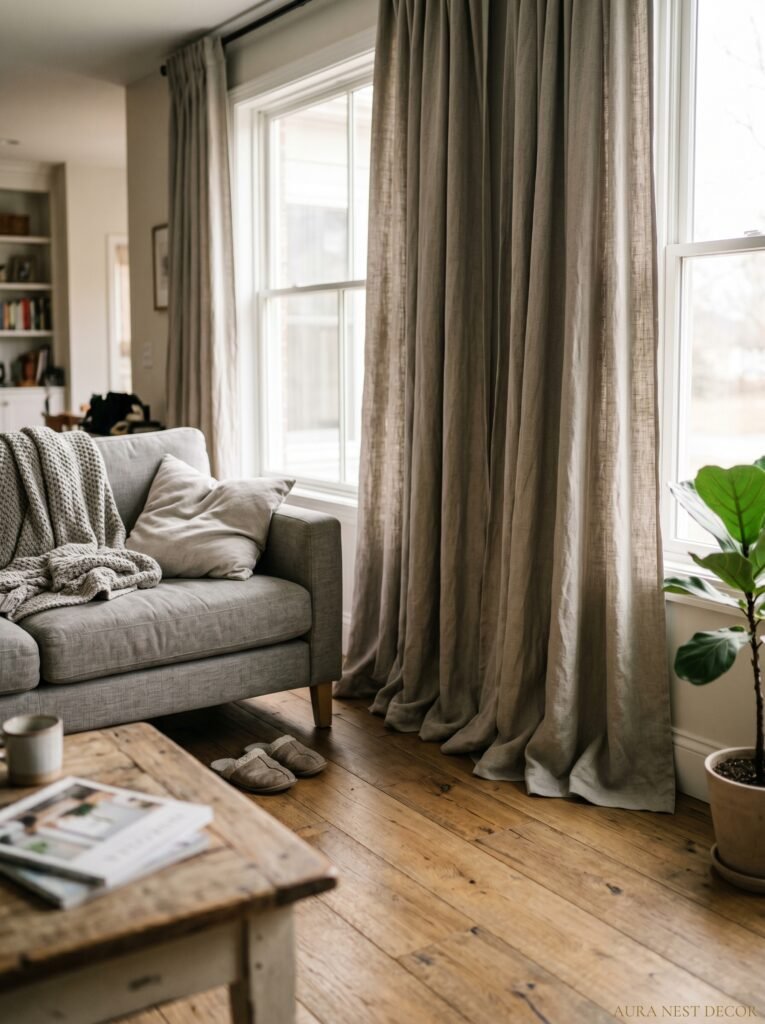
Here’s the thing nobody talks about in farmhouse Christmas décor articles: the removing matters as much as the adding.
Your everyday living room accessories — the abstract art, the chrome lamp, the neon yellow throw pillow you love in July — might need to come out for December. Not permanently. Just temporarily, to make space for the seasonal layer you’re adding.
Before you put a single Christmas thing up, do a clear-eye audit. What in this room is competing with the warm, natural, slightly rough aesthetic you’re going for? What’s too modern, too cold, too shiny? Box it up for the month. You’ll be amazed how much more cohesive the farmhouse Christmas layer looks when it’s not fighting with things that don’t belong.
This is the most underrated step. And it’s free.
—
❓ FAQ
Q: How do I make my living room look farmhouse-cozy for Christmas if I rent and can’t change anything permanent? A: Textiles, candles, and greenery are your best friends — none of them require drilling or painting. A great throw, some pillar candles in grouped clusters, a simple garland draped over a doorframe or bookshelf, and a fresh wreath hung with a command hook can completely transform a rental space. You’re layering mood, not renovating.
Q: Is farmhouse Christmas decor expensive to pull off? A: It really doesn’t have to be. The whole ethos of the style is “collected over time, found, foraged, imperfect” — which basically means charity shops, craft supply stores, and your own garden or local florist are your best sources. Fresh greenery is almost always cheap. Wooden ornaments are inexpensive. The candles you already own probably work. Spend money on one or two quality textiles if you want to — a genuinely good throw blanket is worth the investment — but the rest can absolutely be budget-friendly.
Q: Does farmhouse Christmas decor work in a very modern living room? A: Yes, and often surprisingly well. The contrast between a clean modern space and warm, textural farmhouse elements can look really intentional and interesting — it stops either style from feeling overdone. Keep the farmhouse elements restrained: one or two statement pieces, natural greenery, warm lighting. Don’t try to fully transform the room. Let the two styles have a conversation.
—
💭 Final Thoughts
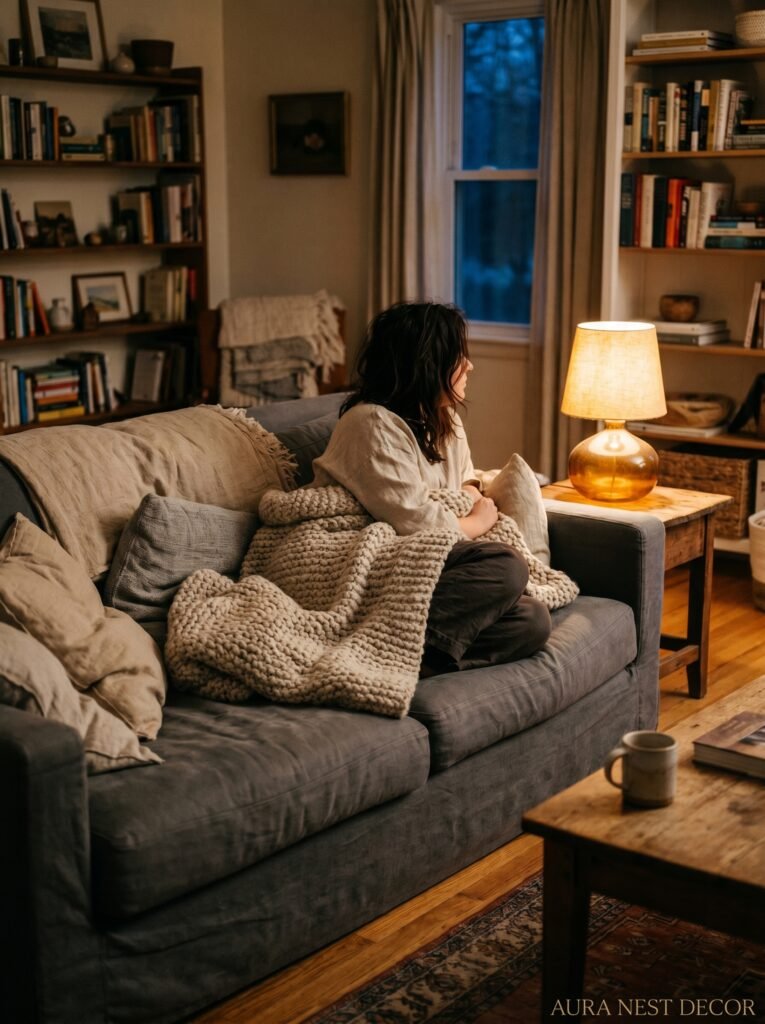
December’s short, and your living room can either be a place you pass through or a place you actually live in — candles going, something warm to drink, the tree lit up in the corner. Farmhouse Christmas doesn’t ask you to spend a lot or start over. It asks you to pay attention to warmth, texture, and the kind of details that make a room feel like it was loved into being.
So what’s the one corner of your living room that could use just a single farmhouse Christmas touch to change the whole feel of the space?