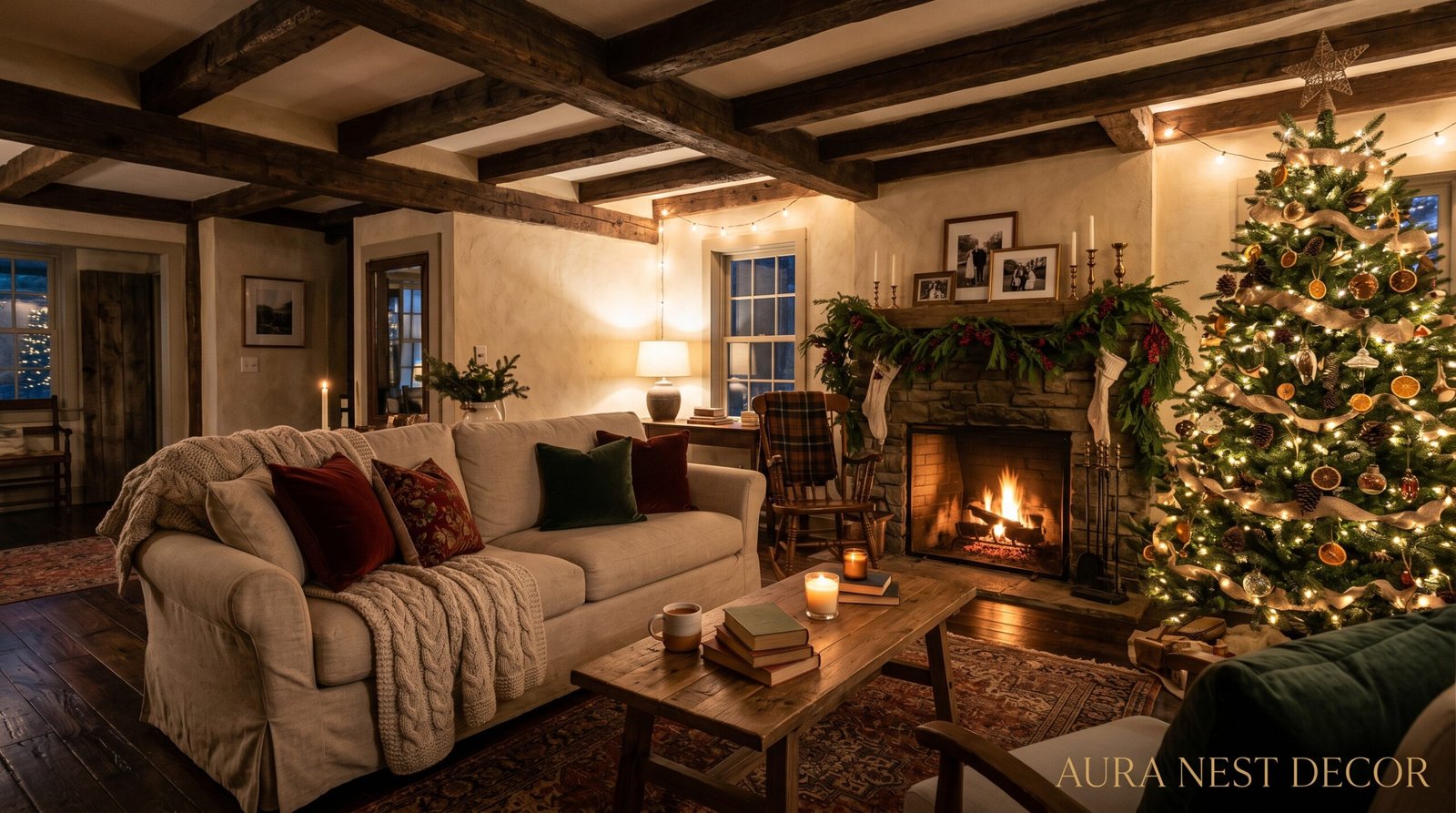
The Cozy Rustic Christmas Living Room You’ll Never Want to Take Down
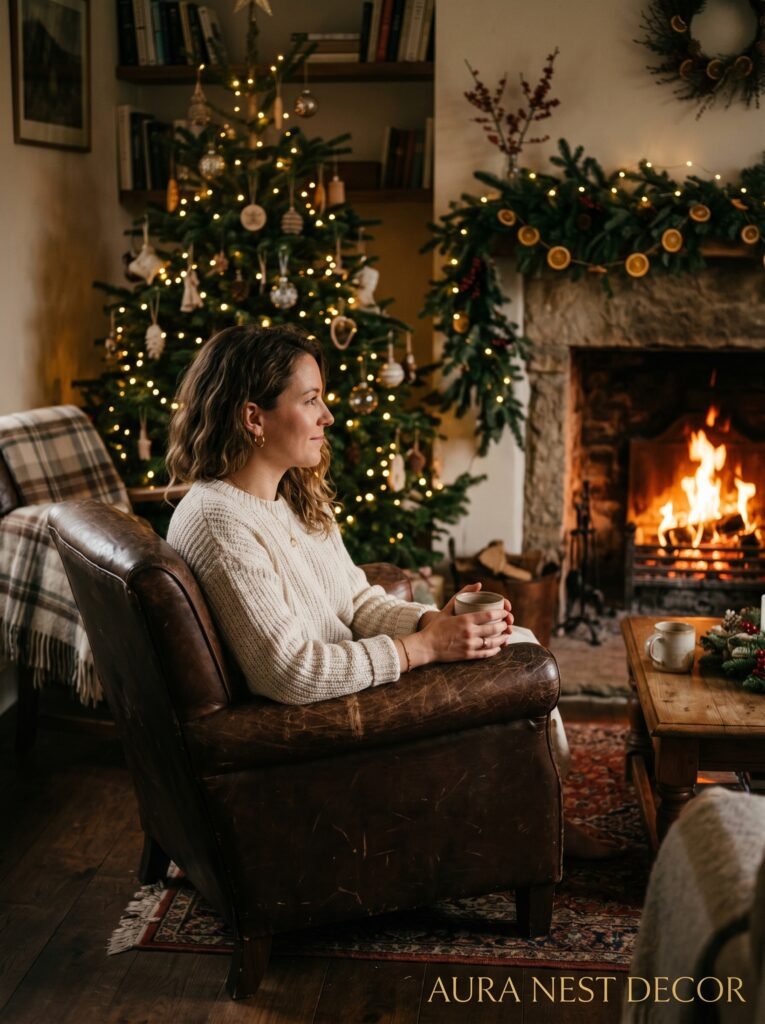
There’s a specific kind of magic that happens when you walk into a living room in December and it smells like pine and woodsmoke and something warm is burning low in the corner. You know the feeling. That’s what we’re chasing here — not a showroom, not a Pinterest grid that looks expensive and cold, but a room that feels like a hug.
—
1. Why “Rustic” Doesn’t Mean What You Think It Does Anymore
Okay, so when people say rustic Christmas, they sometimes picture antlers and plaid overload and that vaguely hunting-lodge thing that’s really not for everyone. But that’s not it. Not anymore.
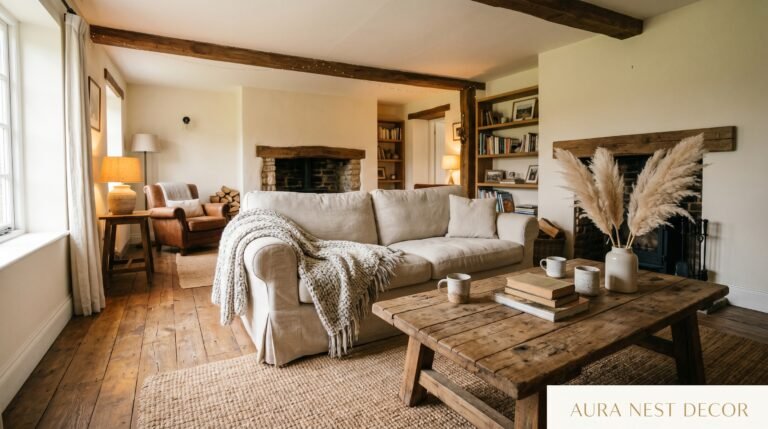
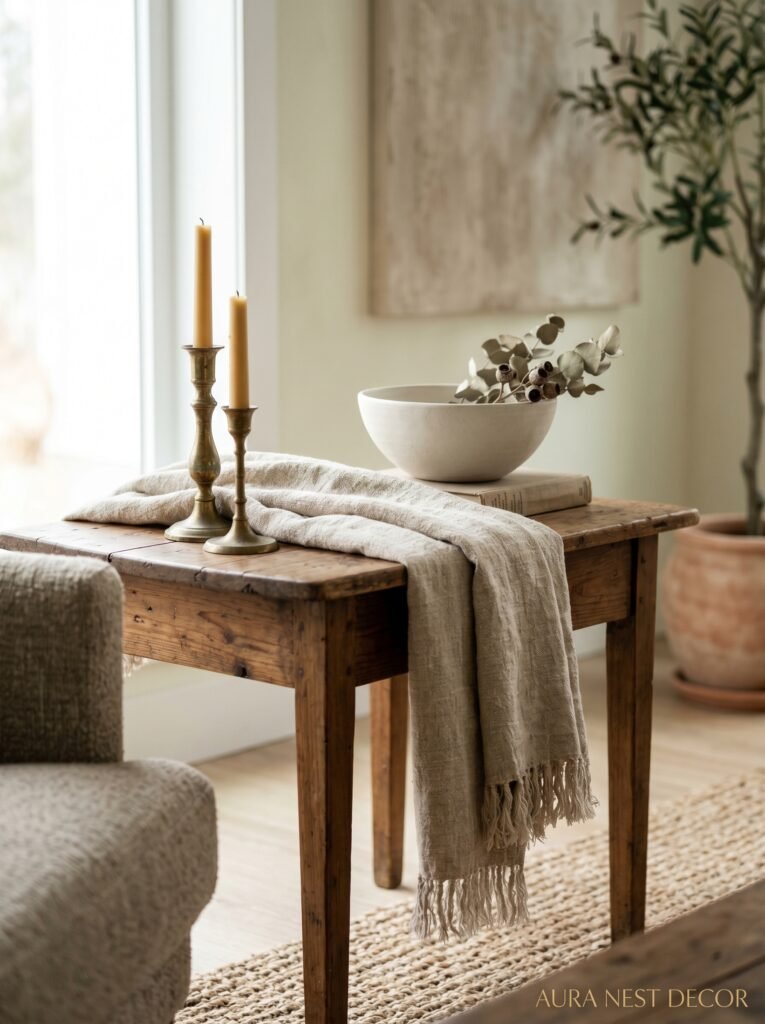
Modern cozy rustic is something softer. It’s the texture of a rough linen stocking hanging from a mantle. It’s a wooden bowl filled with clementines and cinnamon sticks sitting on a coffee table that wasn’t bought as a “statement piece” — it just ended up there and it works. It’s imperfect and warm and it doesn’t try too hard.
The whole vibe is built around materials that feel real. Raw wood. Chunky knit. Dried botanicals. Terracotta. Natural beeswax candles that drip just a little bit. Nothing shiny in a plastic way, nothing that looks like it arrived in a shrink-wrapped box from a department store.
The key shift — and this changed how I style everything, honestly — is moving away from decorating AS a performance and toward decorating for how it actually feels to sit in the room at 8pm with a candle going and a blanket over your legs. That version of your living room is the goal. Everything else is secondary.
And rustic doesn’t mean shabby or messy. It means intentionally imperfect. There’s a difference. A big one.
—
2. The Mantle Setup That Earns Its Own Instagram Post (Without Trying)
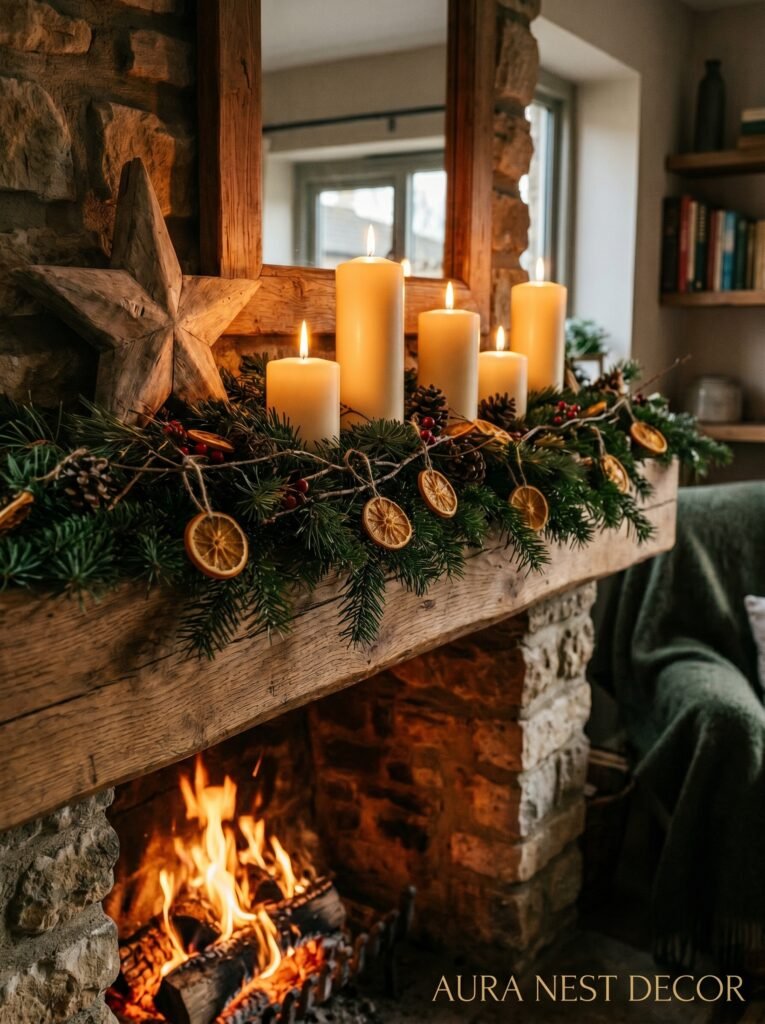
Here’s the thing about mantles. They can go wrong SO fast. You either overload them until nothing reads, or you leave them too sparse and they feel forgotten. The sweet spot for rustic Christmas is what I’d call “collected over time.”
Start with greenery but make it mixed. Not a matching garland from one box. Eucalyptus, pine boughs, maybe a few sprigs of holly or dried orange slices tucked in. The key is that it doesn’t look purchased as a set. Even if it sort of was, it shouldn’t look like it.
Add candles at different heights. This matters more than people realize. Three white pillar candles that are all the same height look fine. Three pillar candles at different heights, slightly different widths, one slightly off-center — that looks like a real person lives here.
Stockings should feel heavy and handmade. Chunky knit, thick velvet, or even a rough hessian works beautifully against painted or brick mantles. In the UK especially, I’ve noticed people hang stockings in a more casual way, sometimes overlapping slightly, and I love that.
“A mantle that looks like it was styled in five minutes usually took an hour. But the ones that look like they took an hour? Those were done in five.”
One last thing — don’t feel pressured to make it symmetrical. Asymmetry is part of the rustic soul.
—
3. The Color Palette That Actually Reads as Warm (Not Just “Christmas”)
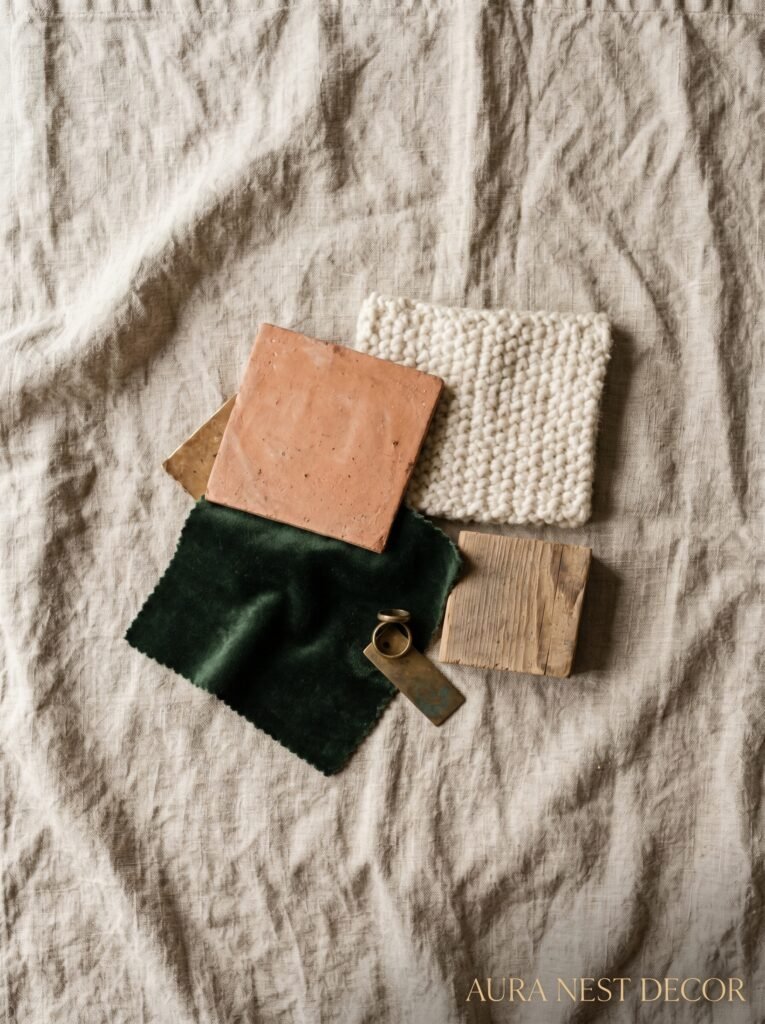
Red and green is not the move if you’re going rustic cozy. Or, okay, it CAN be the move, but not in a bold, saturated way. Think deeper.
The palette that’s showing up absolutely everywhere right now in homes I admire: deep forest green, warm cream, terracotta, cognac brown, and that particular dusty red that’s almost burgundy but not quite. Add in the natural tones of wood and dried botanicals and you have something that feels cohesive without being matchy-matchy.
Cream is doing a lot of heavy lifting here. Cream candles, cream knit throws, cream ceramic ornaments — it softens everything and keeps the room from feeling heavy or dark. Because the mistake people make with rustic rooms is going too brown, too dark, too much, and suddenly it feels like a cave instead of a cabin.
Gold is fine. But not polished gold — brushed, matte, slightly aged. Think old brass candlesticks, not shiny baubles. There’s a warmth to antique gold that polished gold doesn’t have. They’re genuinely not the same.
In the US, I notice a tendency to go bolder with the reds and greens. In the UK, people tend toward a more muted palette naturally — those stone walls and period features just call for something quieter. Both approaches work, but know your room.
—
4. Lighting That Does the Actual Work of Making Everything Beautiful
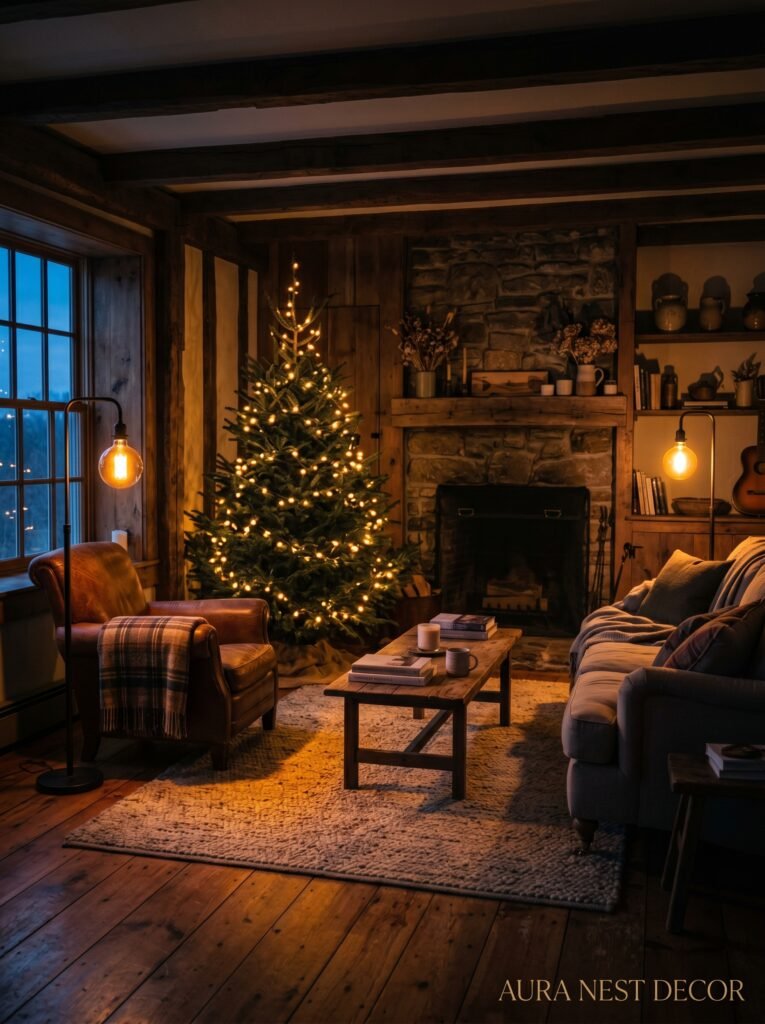
I want to say this clearly: you cannot out-decorate bad lighting. Cannot. I’ve seen stunning rooms that felt completely cold because the overhead light was just… overhead and bright and wrong.
For a cozy rustic Christmas living room, you want multiple light sources, all warm, all low. Turn off the main overhead light completely if you can. Use lamps, candles, and fairy lights only. The amber glow of an Edison bulb at 7pm does more for Christmas atmosphere than any decoration you’ll ever buy.
Fairy lights in a rustic context should be warm white — never cool white or multicolor. Wrap them loosely around a garland on the mantle, drape them inside a large glass jar with some pine cones, or run them along a bookshelf behind some scattered greenery. The effect is that soft, slightly blurry warm glow that photographs BEAUTIFULLY for Pinterest but also just, you know, makes people feel cozy when they sit in your living room. Which is the actual point.
“Warm lighting isn’t a mood — it’s the entire room.”
Candles deserve a special mention. Not just for atmosphere but for smell. Beeswax candles have a natural honey scent that genuinely adds to the feeling. Pair that with a soy candle in a cedar or fir scent and your living room smells like Christmas even before you’ve done a single thing.
—
5. The One Throw Blanket Rule That Changes How Your Whole Room Feels
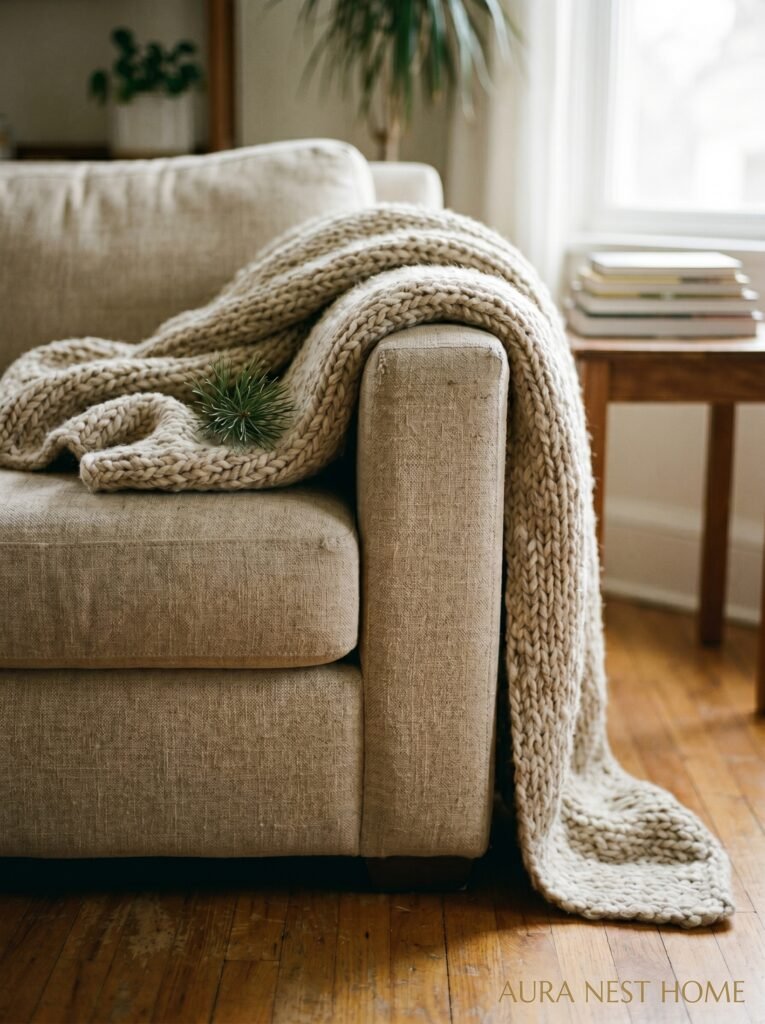
There’s a rule I keep coming back to. One blanket on the sofa — properly placed, not folded into a neat rectangle — does more for the cozy factor of a room than almost anything else.
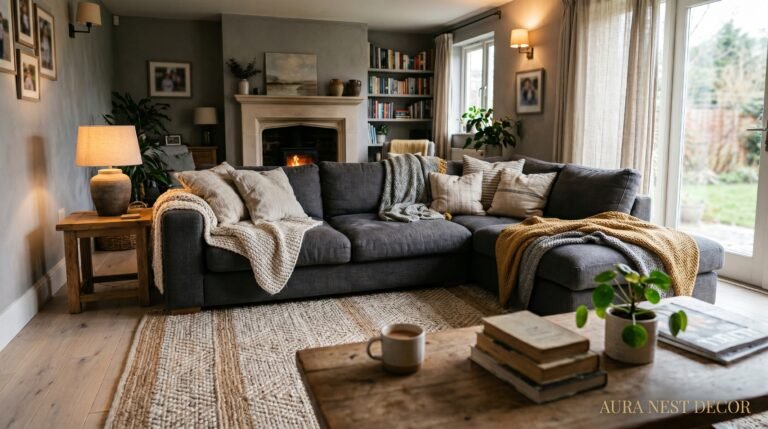
But it has to be the right blanket. For rustic Christmas, you want chunky knit, waffle weave, or a heavy wool throw in cream, oatmeal, or a deep forest green. Drape it casually over one arm of the sofa so it falls slightly toward the floor. Or fold it loosely — messily, honestly — over one corner cushion. The messiness is intentional. It says someone actually uses this room, actually sits here, actually gets cold and reaches for a blanket.
Don’t have five blankets draped artfully everywhere. That’s where it tips from cozy into staged. One or two, placed naturally, is enough.
Cushions are the same. Mix textures: a velvet cushion next to a linen one next to something with a bit of cable-knit texture. And mix the sizes — a larger square cushion behind a smaller rectangular one looks effortless in a way that matching sets never quite manage.
—
6. What to Do With a Fireplace (Even If It Doesn’t Actually Work)
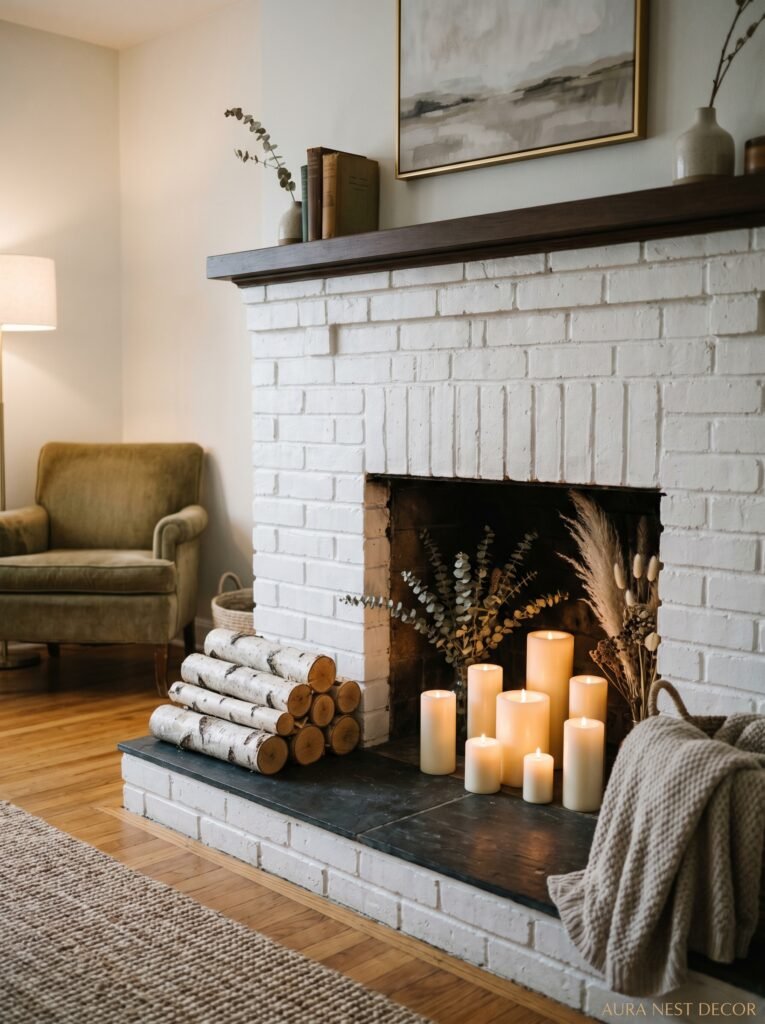
If you have a working fireplace — first of all, I’m genuinely jealous. Light it. That’s your decoration. Everything else is just the supporting cast.
But SO many homes, especially in the UK and in urban US apartments, have original fireplaces that are either gas or completely blocked up and decorative. And that’s fine. Actually, that’s an opportunity.
Fill the firebox with candles. Different heights, different sizes, all in warm tones — white, cream, ivory. In winter, when it gets dark at 4pm (which, if you’re in the UK, you know is basically forever), lighting a collection of candles inside a fireplace creates this incredible reflected glow that bounces off the brick or tile surround. It genuinely looks like a fire from across the room.
Alternatively, fill it with stacked logs and some pinecones. You’re not burning them — they’re just there. They smell good, they look real, and they bring in that natural texture that’s so central to the rustic aesthetic. Add a few pillar candles at the front and you’re done.
—
7. The Christmas Tree Style That Fits a Rustic Room Without Screaming “I Bought a Kit”
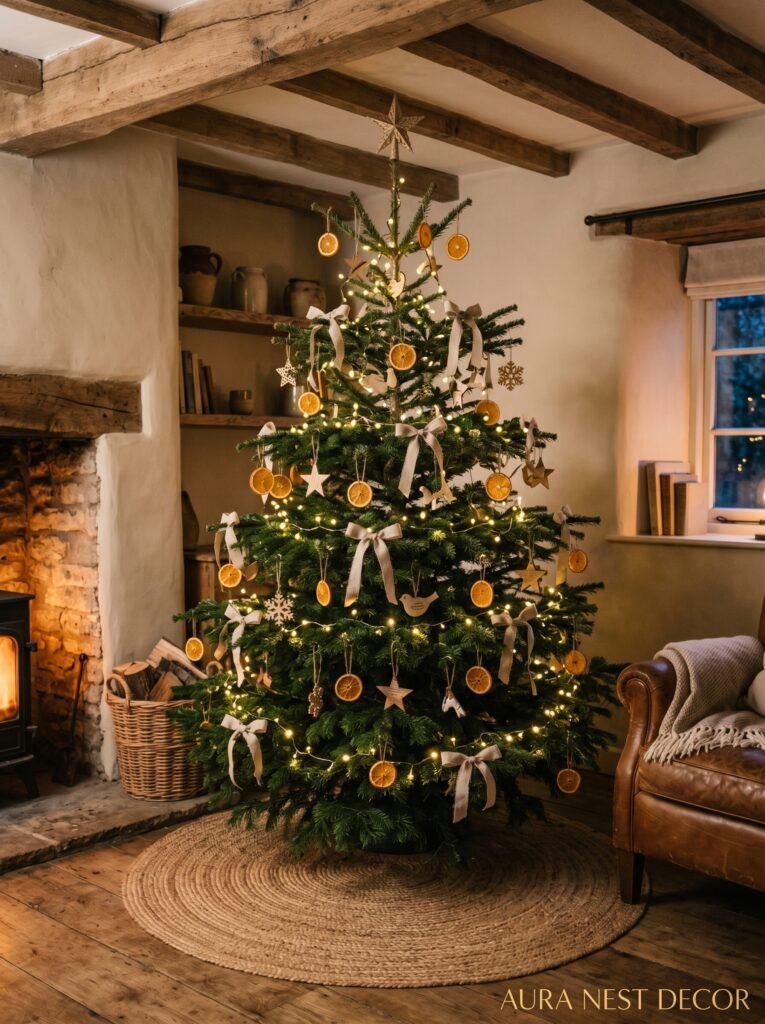
Themed trees done WELL are beautiful. But a rustic Christmas tree shouldn’t look themed. It should look like ornaments accumulated over years, the same way real trees in real houses look.
Go for a mix: wooden ornaments, handmade-looking clay or salt-dough shapes, dried orange slices, small bundles of cinnamon sticks tied with twine, some simple glass baubles in muted tones, and maybe a few special ones — a ceramic mushroom, a little brass star — that feel found rather than bought as a set.
The tree topper matters more than people think. A star in brushed gold or wood, a simple linen bow, or even just a few long pine sprigs clustered at the top — all better than a plastic glittery star that doesn’t match anything else on the tree.
Lights: warm white, always. And honestly, slightly fewer than you think you need. Let the ornaments and the tree itself show.
“The most beautiful trees I’ve ever seen didn’t have a theme. They had a story.”
Don’t fuss too much about filling every gap. A tree that’s slightly uneven, slightly imperfect, slightly full of sentimental junk you’ve kept for years — that’s the one people actually want to stand in front of with a glass of mulled wine.
—
8. That Unexpected Spot in the Living Room You’re Not Decorating (But Should Be)
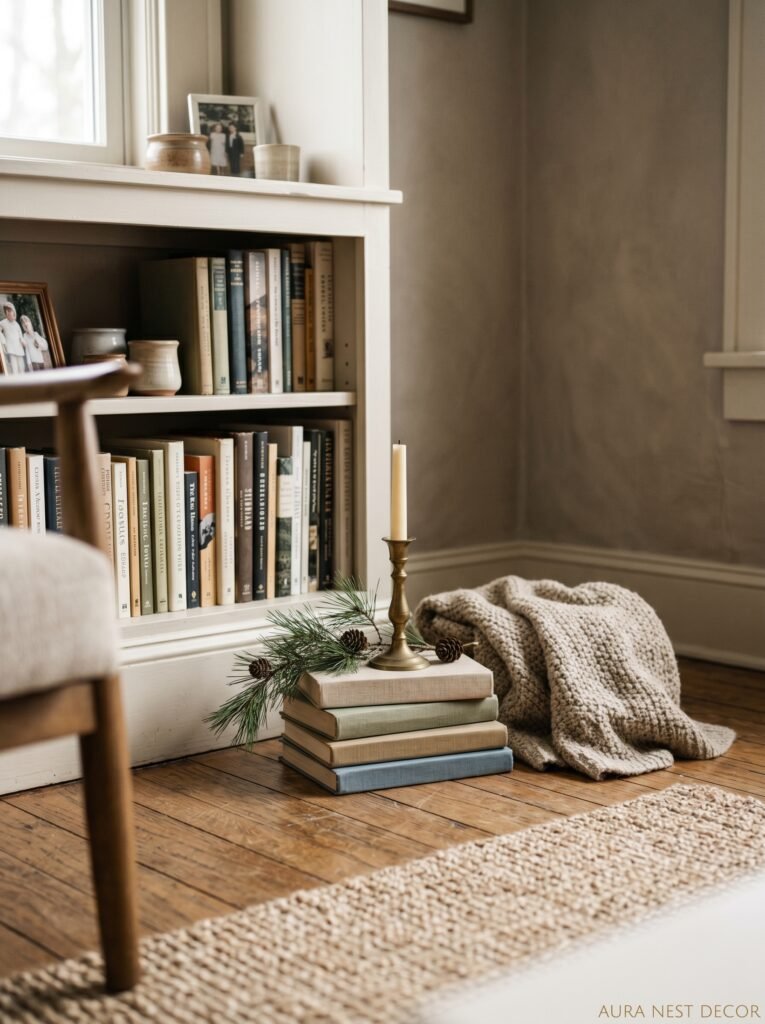
The windowsill. I’m serious — the windowsill is one of the most underused surfaces in Christmas decorating and it’s also one of the most visible, especially from outside the house at night.
A simple row of white or cream pillar candles on a windowsill, slightly staggered in height, looks incredible from the street. Inside, it creates this beautiful framing effect when you’re sitting in the room — the candlelight against the dark winter window.
For a rustic look, add a few sprigs of holly or eucalyptus flat against the windowsill between the candles. Or a single pine cone every few inches. It doesn’t need to be elaborate. The window already does the dramatic work for you.
Side note — bookshelves are the other neglected surface. You don’t need to do a full “Christmas bookshelf” situation. Just tuck a few sprigs of greenery behind some books, add one small candle, swap out a vase for something seasonal. It integrates the Christmas feel into the whole room instead of concentrating all the decoration in one or two obvious spots.
—
9. The Smell of the Room Is Half the Decoration
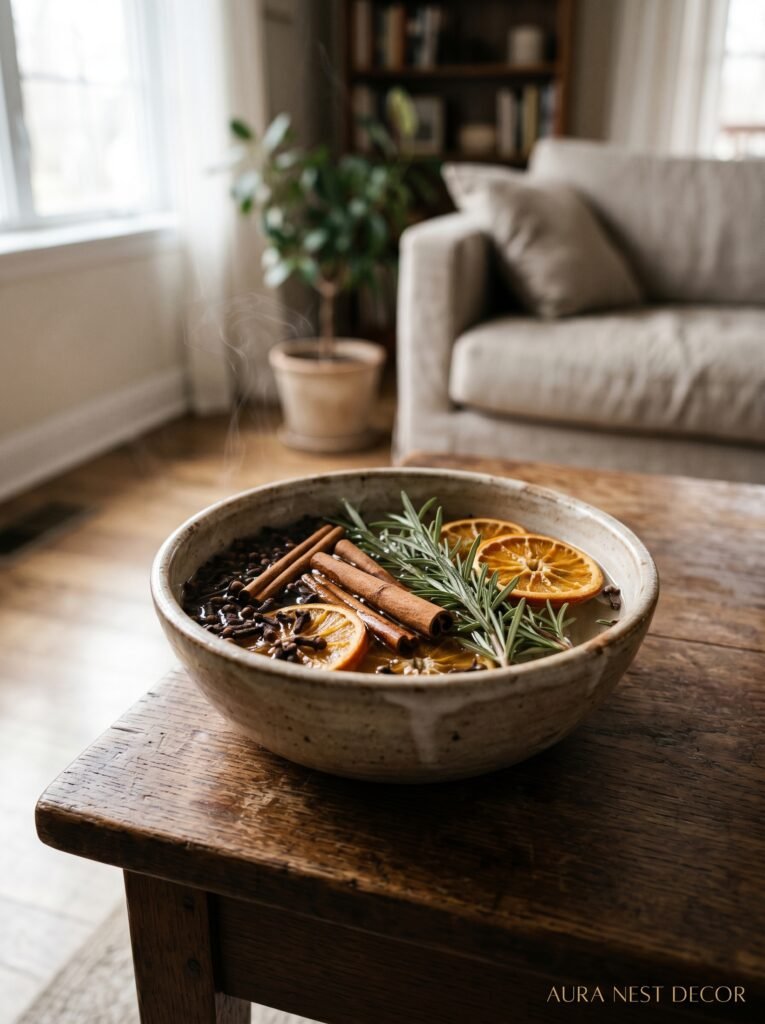
I’ve said this before and I’ll keep saying it. The olfactory side of Christmas decorating is genuinely as powerful as the visual side, maybe more so. Walk into a room that smells like pine, warm spice, and woodsmoke and you FEEL Christmas before you’ve looked at anything.
For a rustic living room, layer the scent sources. Real greenery does some of the work naturally — pine, eucalyptus, and holly all have their own scents. Add a soy or beeswax candle in cedar, fir, or clove. A small bowl of potpourri with dried oranges, cinnamon sticks, and cloves on a coffee table or side table. A reed diffuser in a complementary scent for the background note.
Don’t go overboard. If every single source is competing at full blast, the room smells overwhelming rather than atmospheric. One dominant scent note — say, warm spice — with a quieter woody base works perfectly.
Mulled wine or cider simmering in a slow cooker in the kitchen also absolutely counts. The steam carries through the whole house. It’s technically cooking, but honestly it’s also decorating.
—
10. A Coffee Table Setup That Actually Makes Sense for Real Life
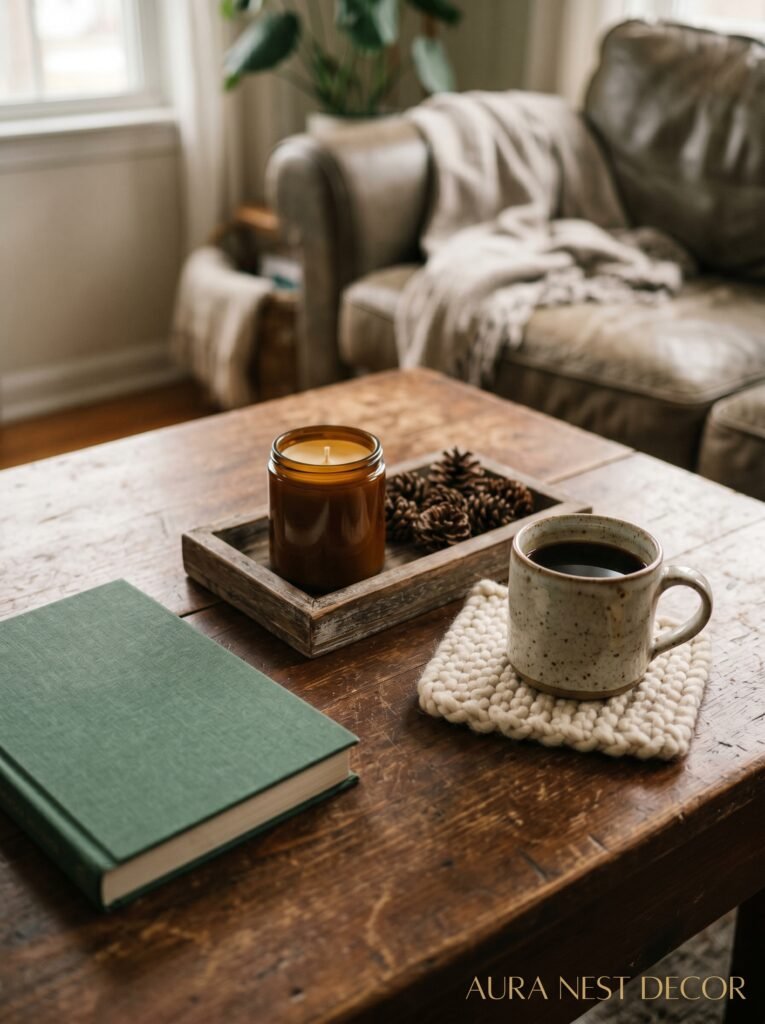
The coffee table is where rustic Christmas styling can go very Instagram and very non-functional, very fast. I’ve seen beautiful coffee tables that you clearly couldn’t put a mug down on. And that’s not the vibe.
For a real, liveable cozy Christmas coffee table: a large wooden tray in the center anchors everything. Inside the tray, a short pillar candle, a small dish with a few clementines, maybe a sprig of rosemary or pine. Around the tray, you have room for your actual life — a remote, a coaster, a book you’re currently reading.
The tray is the key. It contains the decoration without making the whole table feel precious. You can move the tray if you need the space. It doesn’t take itself too seriously.
A stack of coffee table books with Christmas or nature themes can work if you have them — but don’t buy books just for styling. It always reads fake, if only to you.
—
11. DIY Touches That Look Expensive and Take About 20 Minutes
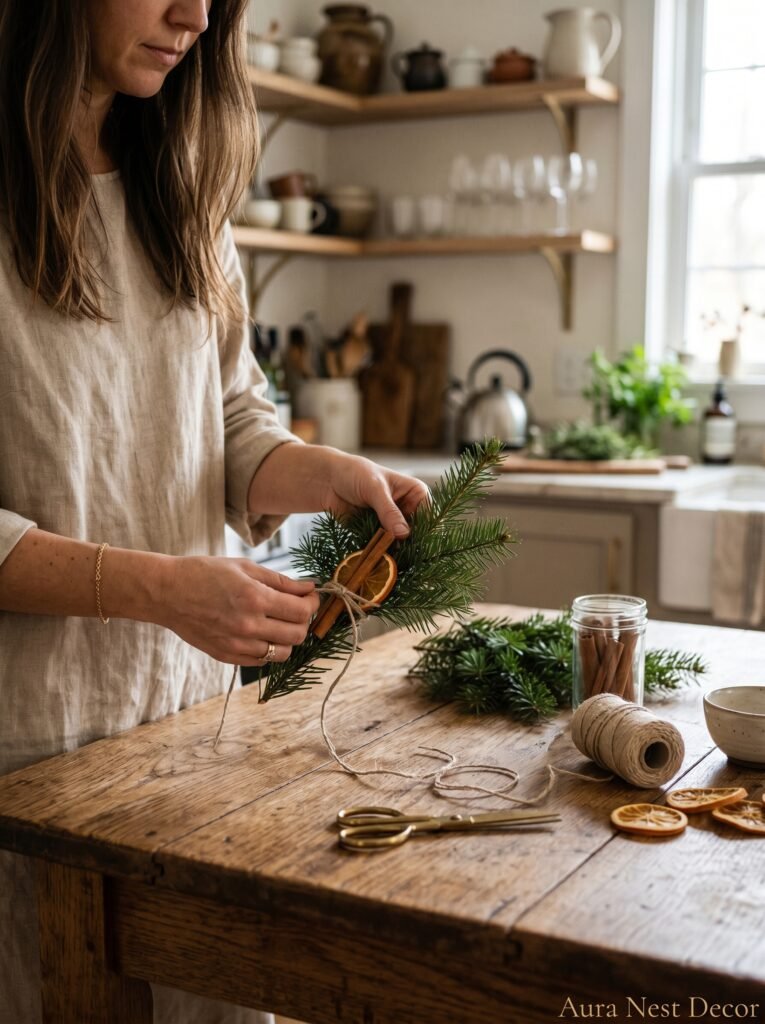
Not gonna lie, some of the most beautiful rustic Christmas touches I’ve ever seen cost basically nothing. It’s the handmade quality that makes them.
Dried orange slices are the big one. Slice oranges thin, bake at 200°F (about 95°C) for several hours until fully dried, and you have ornaments, garland additions, potpourri components — all for a couple of dollars. They smell incredible while they’re drying too, which is sort of a bonus room decoration.
Cinnamon stick bundles tied with rough twine. You can hang these on the tree, tuck them into garlands, or lay them flat in a decorative bowl. Done in two minutes.
A simple wreath made from pine or eucalyptus clippings gathered together and shaped — it doesn’t need a form or a base. Rough, slightly asymmetrical, tied at the back with wire or twine. Hang it over the mantle or on a door inside the room. The imperfection is the whole point.
—
12. The Edit That Separates a Cozy Room From a Cluttered One
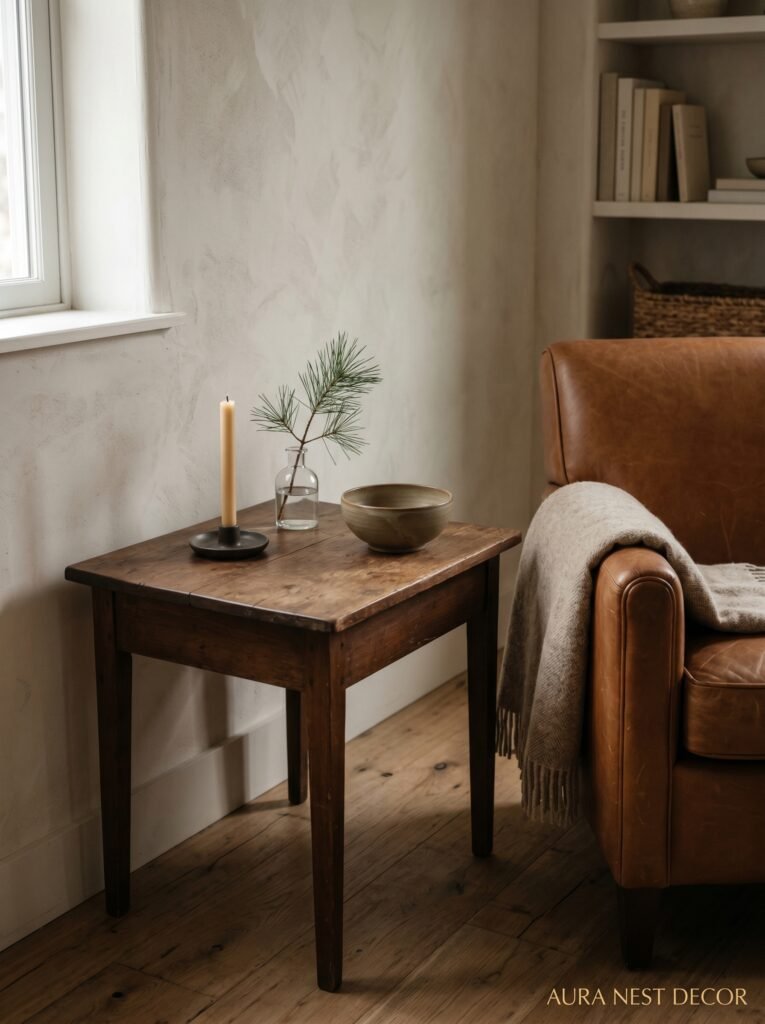
More is not more. I know Pinterest makes it look like more is more, but more is usually more. More is usually too much, actually.
The edit is the last step and it’s the most important one. Once you’ve placed everything, step back and remove one thing from every surface. Just one. It’s uncomfortable the first time you do it, but the room always looks better afterward.
Rustic cozy lives in the breathing room between things. The gap between two candles. The empty stretch of mantle between the garland and the stocking. The floor space visible between the tree and the sofa. Without those gaps, the room loses the relaxed quality that makes it feel genuinely cozy instead of just busy.
And finally — sit in the room at night with everything lit and look at it for five minutes. That’s your actual decoration. Not the daylight version, not the photo. The room you sit in at night in December. That’s the one worth getting right.
—
❓ FAQ
Q: How do I get a rustic Christmas look without spending a lot of money? A: Honestly, the best rustic elements are cheap or free. Dried oranges, pine cones from the garden, eucalyptus from a grocery store, clementines in a wooden bowl, candles from the pound shop or dollar store in cream and white — the whole aesthetic favors natural, simple, imperfect things over anything pricey. The texture comes from layering, not from cost.
Q: What’s the difference between rustic Christmas and farmhouse Christmas decor? A: They overlap a lot, but rustic tends to be warmer and less structured — it’s about raw materials, natural textures, and an organic feel. Farmhouse leans slightly more graphic, with more black and white contrast and a cleaner line. Rustic is the messier, cozier cousin. Both are lovely, but they do create different atmospheres in a room.
Q: Can I do cozy rustic Christmas in a modern apartment without a fireplace or exposed beams? A: Completely. The fireplace and beams are nice but they’re not the point. Warm lighting, natural textures, dried botanicals, and the right candles create the same feeling in a flat white-walled apartment. The atmosphere is about materials and light, not architecture. A chunky throw, some warm Edison bulbs, and real greenery on a mantle shelf will do the same job.
—
💭 Final Thoughts
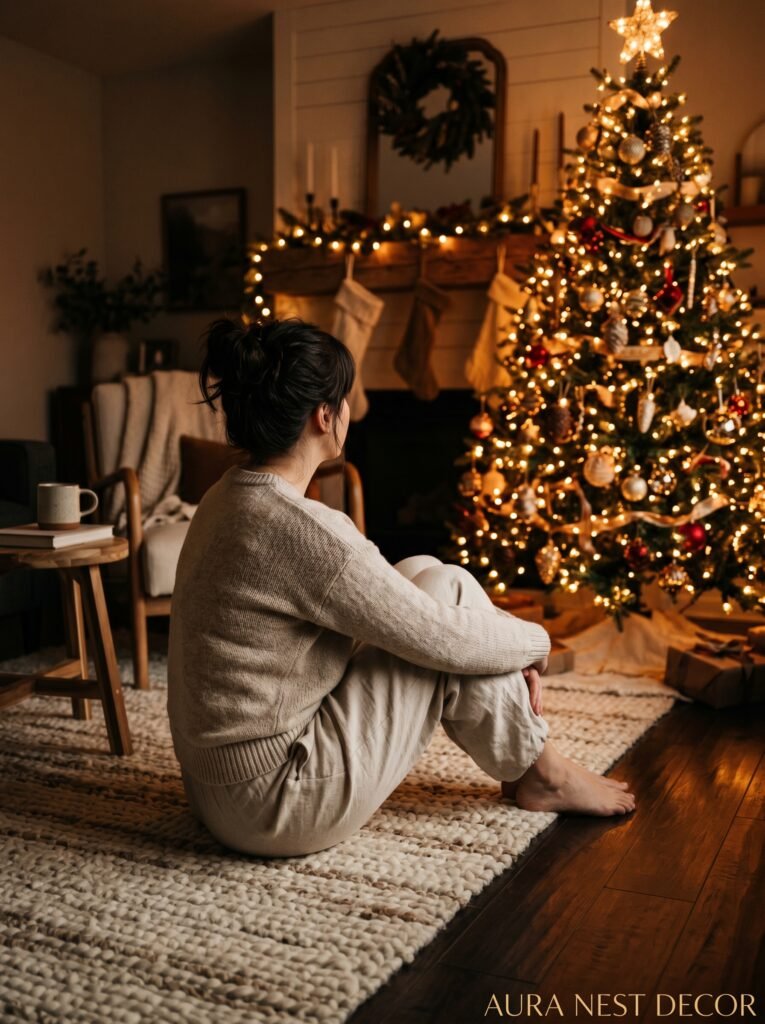
The Christmas living room you’ll remember isn’t the one that looked perfect in photos. It’s the one that smelled like pine and candlewax and something spiced, where the lights were low and everything felt a little soft around the edges. Rustic cozy gets that right almost by definition — because the whole aesthetic is built around imperfection and warmth and things that feel real.
Don’t chase the perfect version. Chase the version your people want to sit in.
What’s the one thing in your living room right now that you’d want to build the whole Christmas feeling around?