
How to Decorate Your Living Room with Plants (And Actually Make It Look Like a Magazine)
There’s a moment — maybe you’ve had it too — when you walk into someone’s living room and something about it just stops you. The light is soft, the shelves feel considered, and somehow the whole space feels alive. Nine times out of ten, there are plants involved. Not in a cluttered, overgrown way, but in that perfectly imperfect way that makes a room feel like a home rather than a showroom.
—
1. Why Plants Transform a Living Room in Ways Furniture Simply Cannot
You can buy the most beautiful sofa. You can hang gallery walls and layer rugs and spend three weekends hunting the perfect coffee table. But nothing — nothing — breathes life into a room the way a plant does. Quite literally.
Plants introduce organic shapes that no piece of furniture can replicate. They soften hard angles, add vertical interest, and create a sense of layered depth that makes even a modest living room feel more intentional and more alive. There’s a reason every interior designer worth their salt reaches for greenery before they call a project finished.
In the US, the houseplant industry has grown exponentially since 2020 — what began as a pandemic-era coping mechanism became a full-blown lifestyle movement. In the UK, the same story unfolded in Victorian terraces and new-build flats alike. People discovered what their grandmothers always knew: plants make a house feel like someone actually lives there.
“A living room without plants is a room still waiting to feel like home.”
2. The Art of Choosing the Right Plant for Your Living Room Style
Before you rush to your nearest garden centre or scroll through Amazon for a trailing pothos, it’s worth pausing to think about your existing interior style. Not every plant suits every room — and this is where most people go wrong.
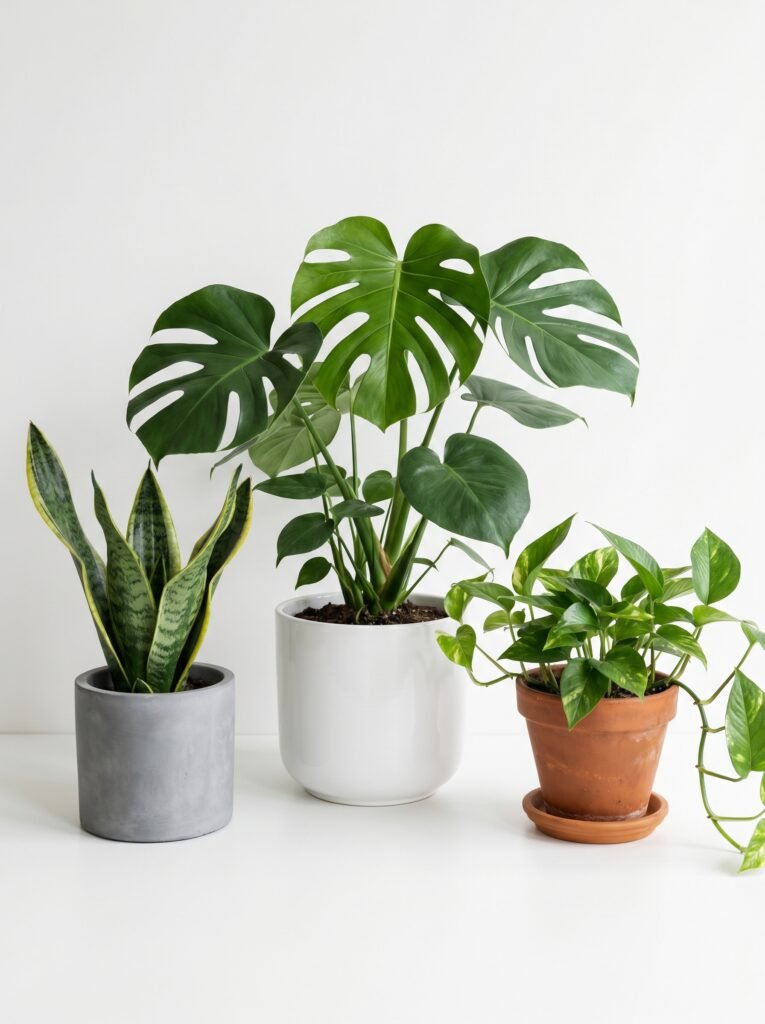
If your living room leans toward a modern minimalist aesthetic — think clean lines, neutral palettes, perhaps a Scandi influence — then architectural plants are your allies. A sculptural snake plant (Sansevieria trifasciata) in a matte concrete pot. A single, dramatic monstera in a corner with a simple white ceramic planter. One well-chosen plant speaks louder than a dozen competing ones.
For maximalist or eclectic spaces, the kind that lean into colour, pattern, and personality — which is enormously popular in British Victorian and Edwardian homes — you have far more licence to layer. Trailing plants from high shelves, hanging plants near bay windows, clusters of different heights and textures on console tables.
If your space is farmhouse or cottage-style, popular across rural England and throughout the American South and Midwest, lean into soft trailing plants like English ivy, herbs in terracotta pots on windowsills, and fiddle-leaf figs that feel warm rather than clinical.
3. The Size Rule Nobody Talks About (But Every Stylist Uses)
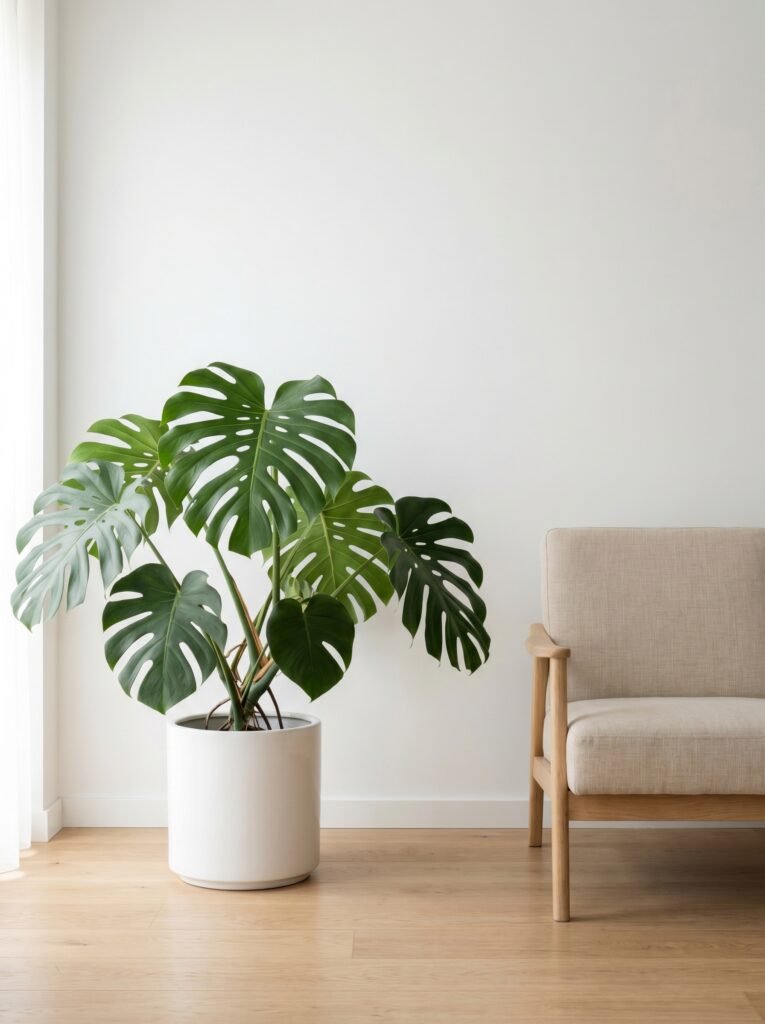
Here’s a secret most interior stylists use but rarely explain out loud: plant scale relative to furniture is everything. A tiny succulent on a vast sideboard looks lost and lonely. A ceiling-grazing fiddle-leaf fig next to a low-slung armchair creates drama and draws the eye upward, making your ceiling feel higher.
As a general rule, think in thirds. A plant that reaches roughly a third of the height of your ceiling creates proportion without overwhelming the space. In standard UK homes with eight-foot ceilings, that means plants in the 2.5–3 foot range are your working height for floor plants. In American homes with nine or ten-foot ceilings, you have a little more room to play.
For shelves and surfaces, cluster plants in odd numbers — threes and fives feel naturally balanced to the human eye in a way that even numbers simply don’t. One plant alone, three plants together, five plants across a shelf: these groupings feel effortless rather than arranged.
4. Where to Actually Put Plants for Maximum Impact
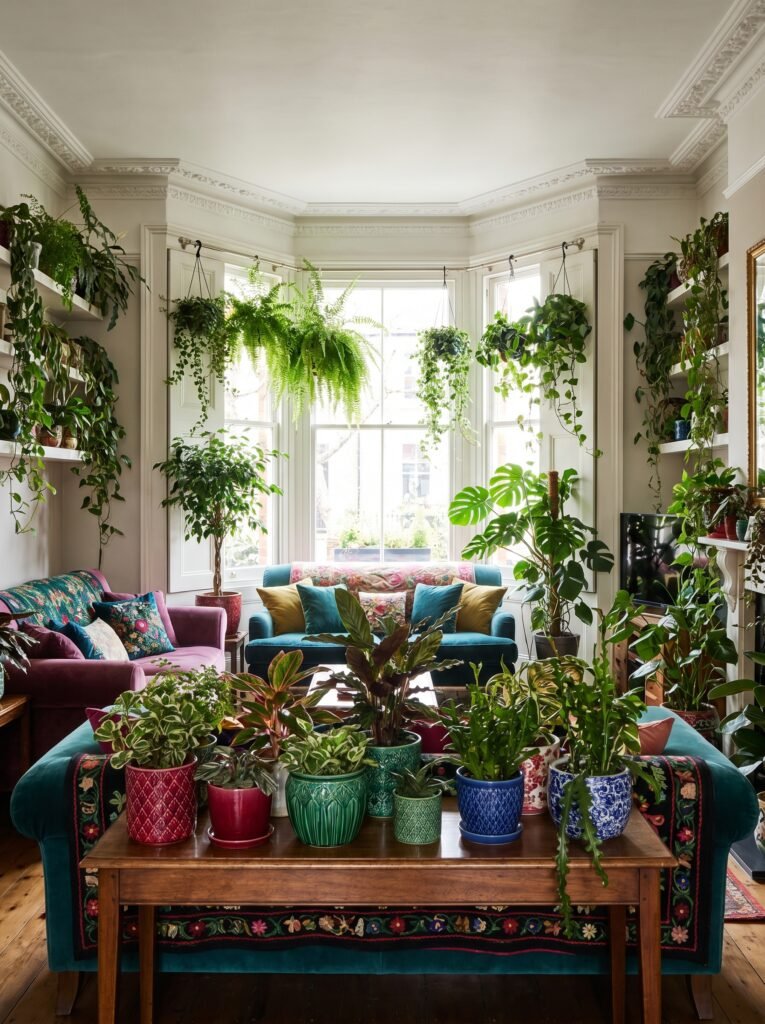
The question isn’t just which plants — it’s where. Placement is what separates a room that looks decorated from a room that looks designed.
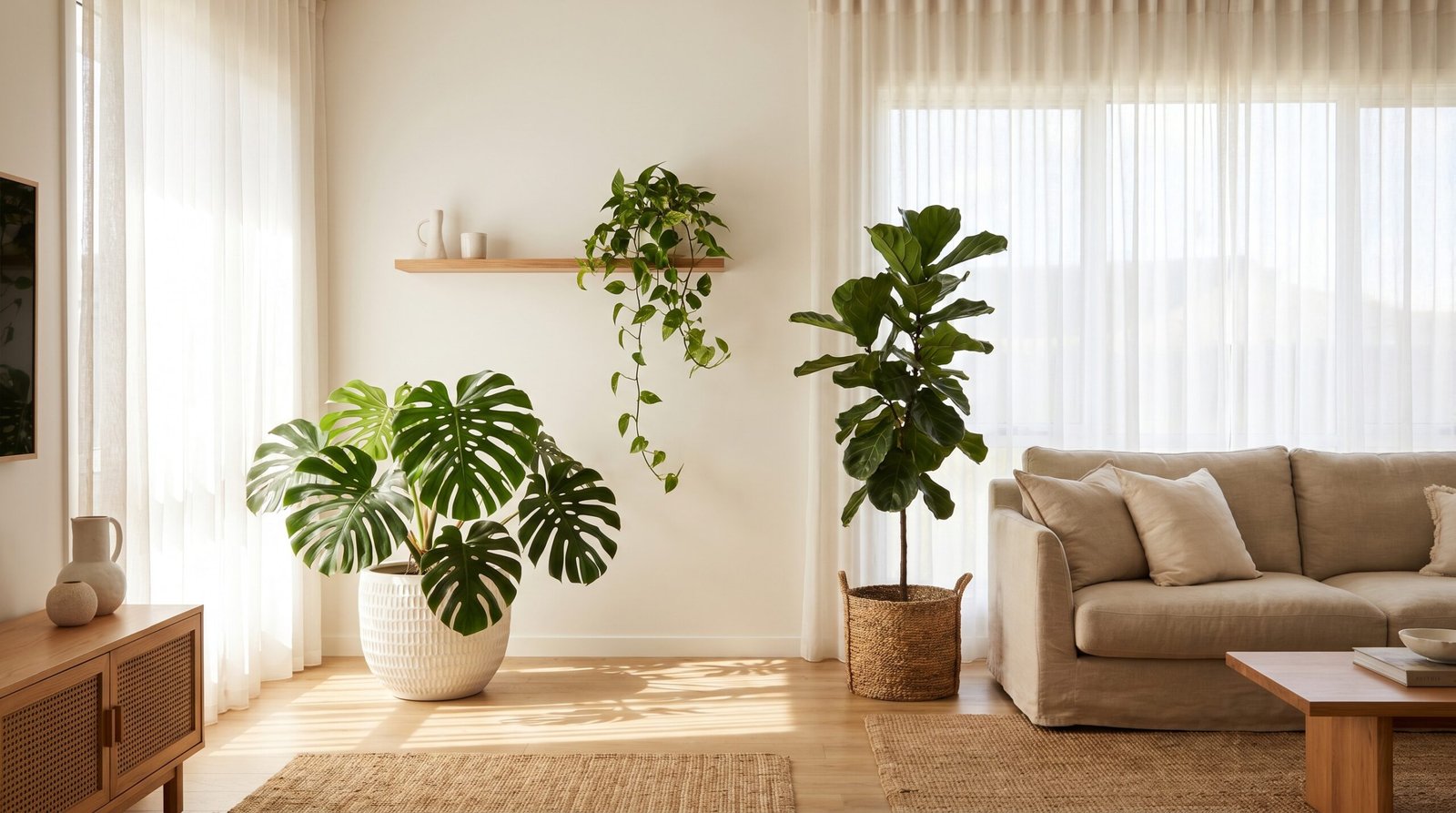
Corners are chronically underutilised in most living rooms. A floor plant in a corner — a tall fiddle-leaf fig, a palm, or a bold bird of paradise — immediately adds warmth and draws the eye around the room rather than straight to the TV. It also solves that universal design dilemma of not knowing what to do with dead corner space.
Windowsills in UK homes, especially those gorgeous wide sills found in older properties, are natural plant shelves. Trailing plants that spill downward — string of pearls, heartleaf philodendron, or scindapsus — create a soft waterfall effect that looks deliberate and beautiful.
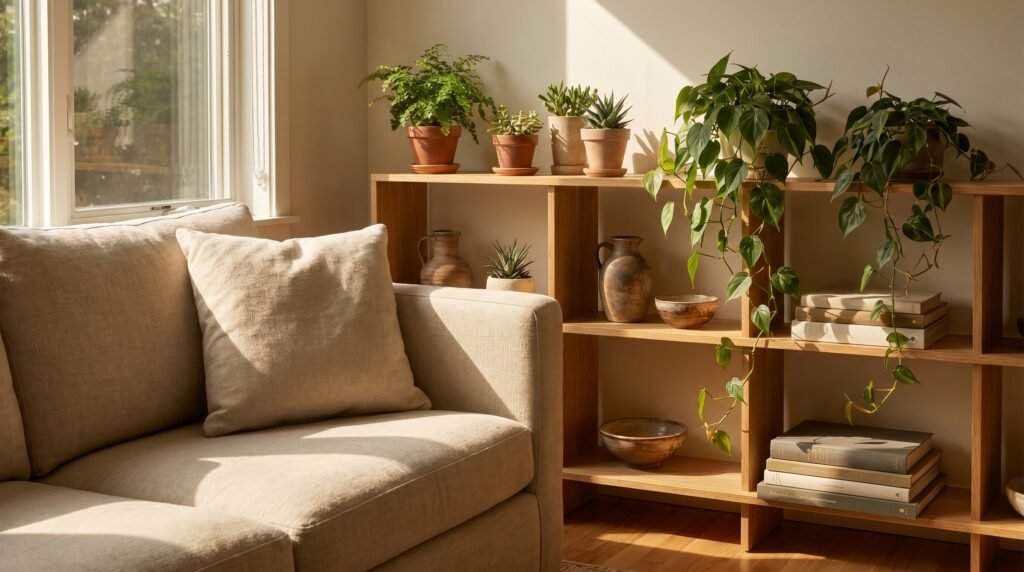
Bookshelves become 30% more interesting the moment a trailing plant is introduced. Tuck a small pothos or wandering jew (Tradescantia) behind books on the top shelf and let it trail downward over the spines. It works in maximalist spaces and surprisingly, in more minimal ones too.
Coffee tables benefit from a single small plant rather than a vase of cut flowers — it lasts longer, requires no weekly replacement, and adds texture without overwhelming the surface.
5. The Best Low-Maintenance Plants for Living Rooms (UK and US Climate Considered)
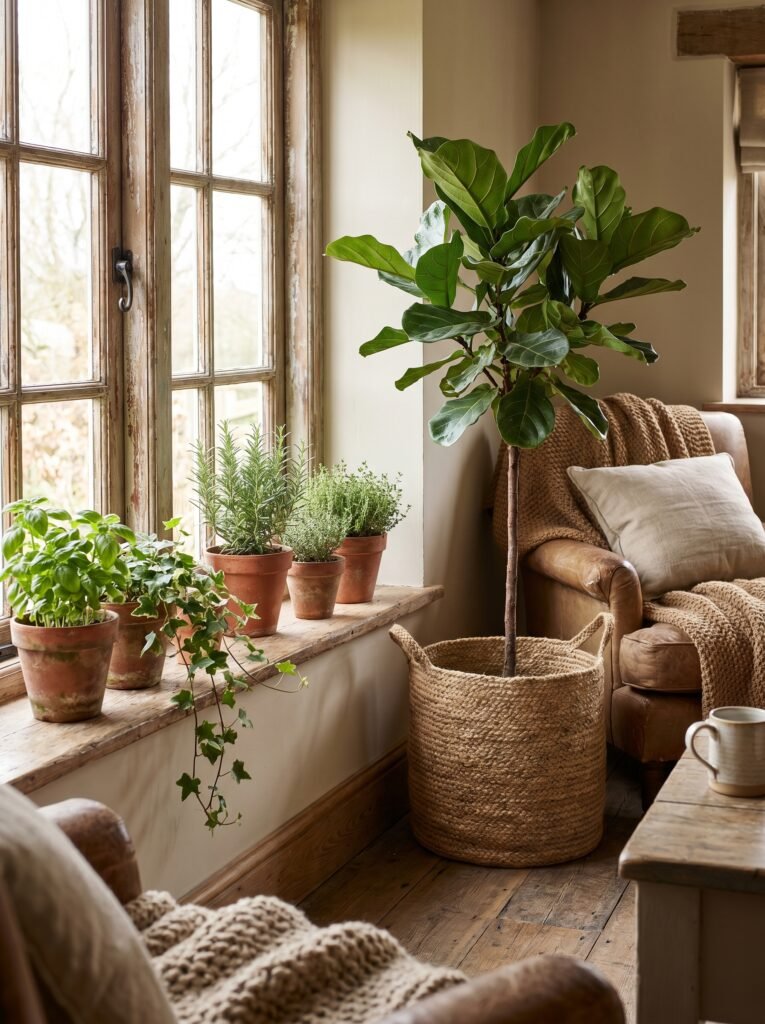
Let’s be honest about something: not everyone is a natural plant parent. And that’s perfectly fine. The beauty of today’s houseplant market is that there are genuinely gorgeous options that thrive on relative neglect.
Pothos (Epipremnum aureum) is perhaps the most forgiving plant you’ll ever own. It tolerates low light, irregular watering, and central heating — the bane of British houseplants in winter. It trails beautifully and grows quickly, making it incredibly satisfying to watch.
ZZ Plant (Zamioculcas zamiifolia) is almost impossible to kill. It stores water in its roots, tolerates low light, and its waxy, deep green leaves look genuinely expensive. Perfect for north-facing rooms — common in both UK terraced houses and apartment living rooms across American cities.
Snake Plant remains the evergreen choice of interior designers because it looks architectural in virtually any pot, tolerates drought, and filters air. It does well in the dry heat of American-style central air conditioning and the equally dry central heating of UK homes.
Peace Lily blooms with minimal fuss, tolerates lower light, and has a softness that suits British cottage interiors beautifully. Just keep it away from pets and small children.
“The right plant in the wrong spot is still the wrong choice — context is everything in design.”
6. How to Style Plants with Different Pot Materials and Textures
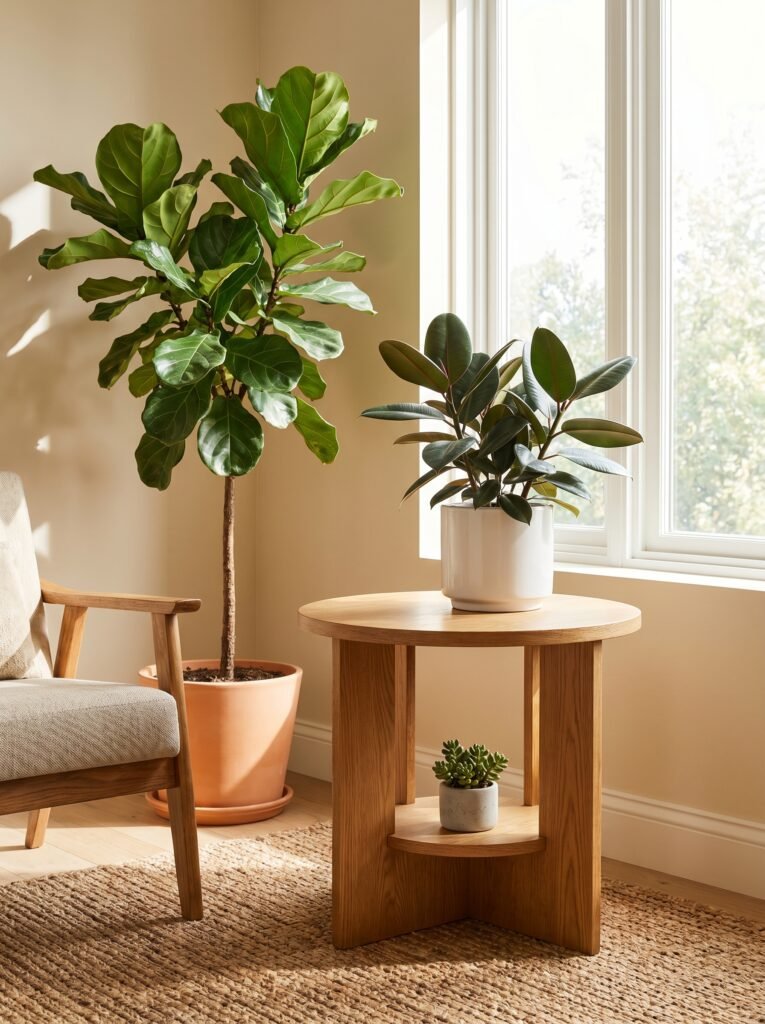
The pot is not an afterthought — it’s half the design decision. The wrong pot can make even a gorgeous plant look generic. The right pot can make a £10 plant from the supermarket look like it belongs in an Anthropologie catalogue.
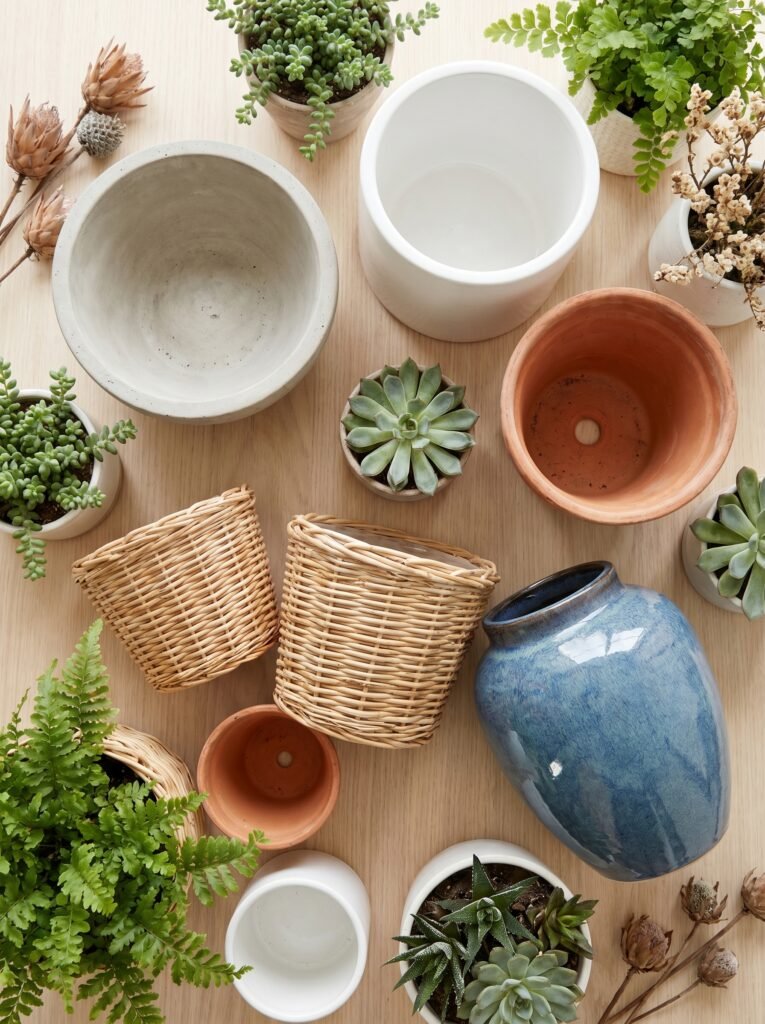
Terracotta is having an enormous moment on both sides of the Atlantic. It brings warmth, ages beautifully, and works across almost every interior style from rustic farmhouse to modern boho. The slight orange-red tone adds colour to neutral rooms without demanding attention.
Woven seagrass or rattan baskets as plant covers (rather than true pots — you keep the plastic nursery pot inside) are wildly popular and for good reason. They add texture, warmth, and a casual, lived-in quality that makes a room feel instantly more relaxed. These are particularly popular in American bohemian and California-casual interiors.
Matte ceramic and stone-effect planters suit minimalist and Scandi-influenced spaces beautifully. Brands like IKEA (enormously popular in both the US and UK) offer affordable options, while British brands like Burgon & Ball and American ceramicists on Etsy offer more unique pieces.
Dark or black planters — either matte or glazed — have a surprisingly sophisticated effect. They make the green of the plant pop dramatically and work wonderfully in moody, dark-walled rooms.
7. The Magic of Mixing Heights, Shapes, and Textures
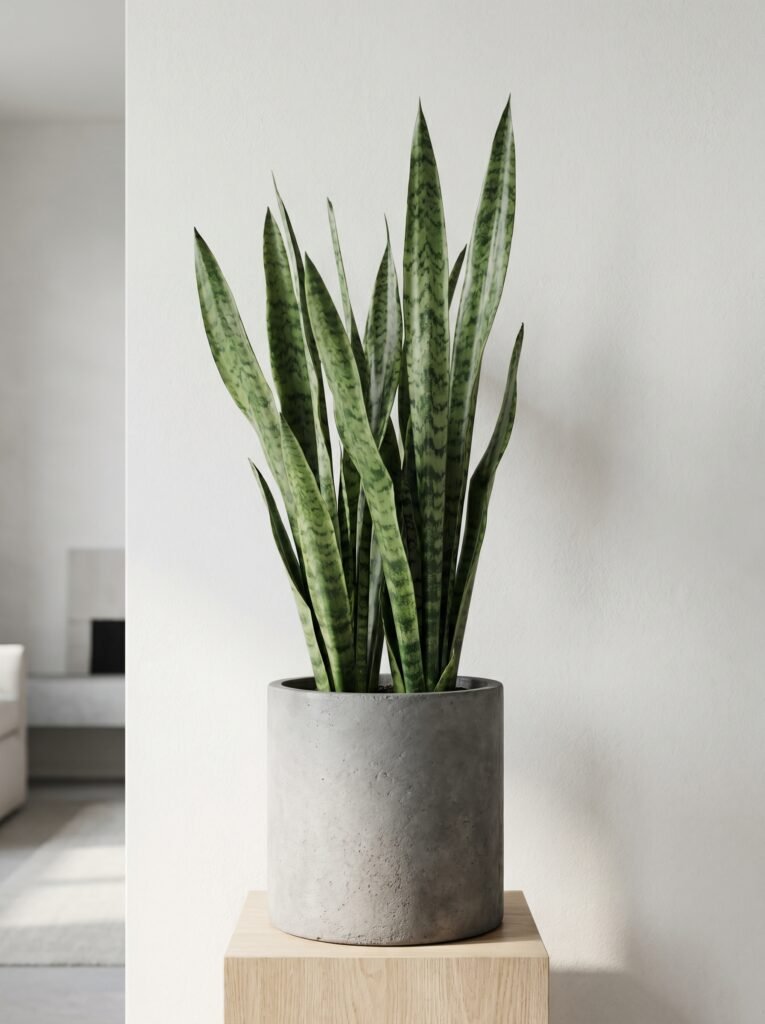
Walk through any well-designed living room and notice what the plants are doing. They’re almost never all the same height. There’s usually something tall, something trailing, something compact and textural. That contrast is intentional.
Think of plant styling the way a florist thinks about flower arranging: you need height, filler, and flow. Your tall floor plant is your height. Your mid-level plant on a side table or plant stand is your filler. Your trailing plant on a shelf or hanging from a hook is your flow.
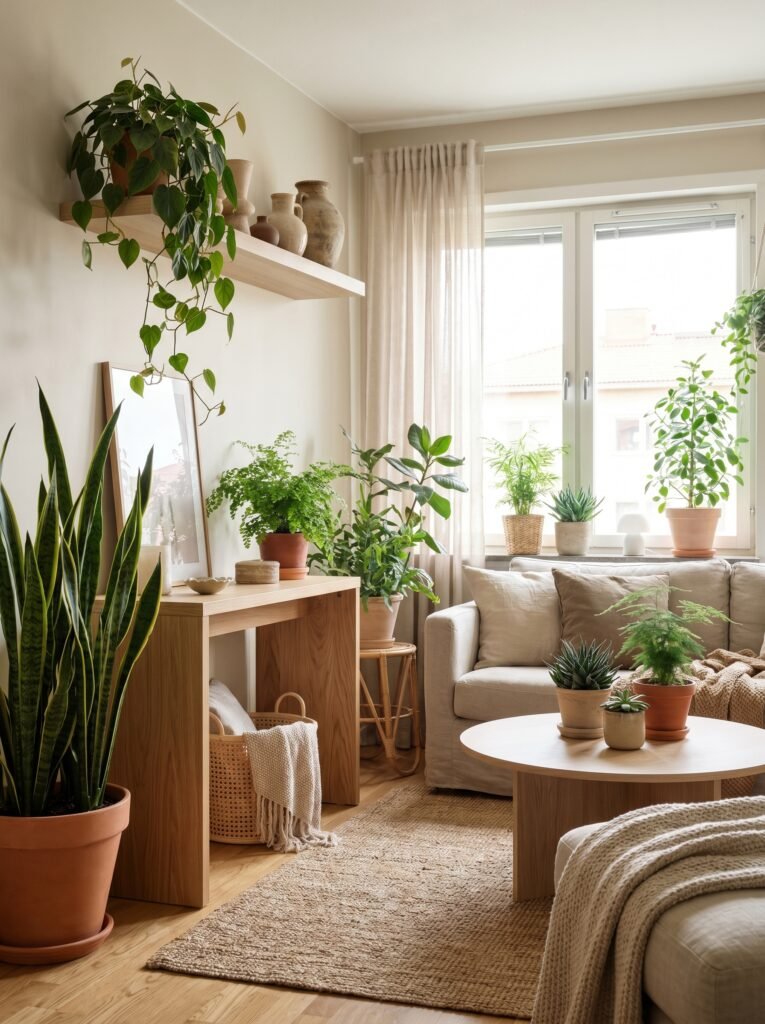
Mixing leaf textures creates similar contrast. Pair the large, dramatic leaves of a monstera with the feathery softness of a maidenhair fern. Contrast the thick, sculptural leaves of a rubber plant with the delicate trailing tendrils of a string of hearts. These pairings are what make a living room plant display look considered rather than collected.
8. Hanging Plants and the Vertical Dimension Most People Forget
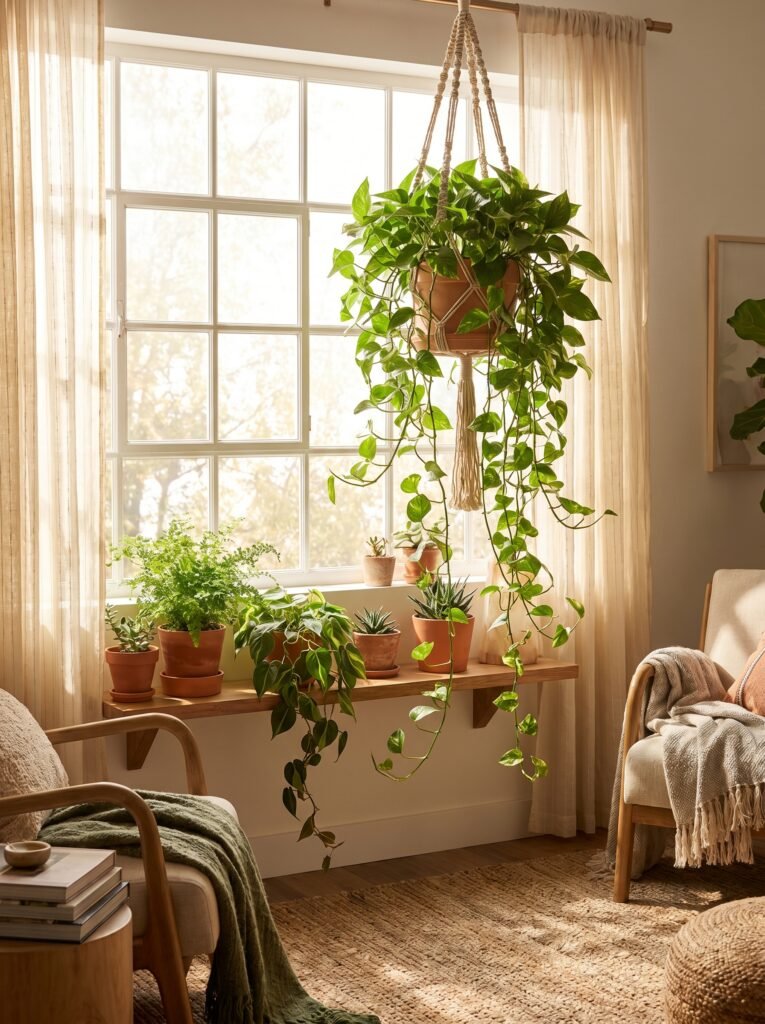
Most people decorate living rooms only on horizontal surfaces — shelves, tables, floors. But the vertical dimension — the wall space above eye level — is one of the most impactful and underused areas in any room.
Hanging planters, whether macramé (still enormously on trend), simple hook-and-pot setups, or wall-mounted geometric frames, lift the eye upward and create a sense of lush abundance without taking up any floor space. For small living rooms — the reality for many apartment dwellers in London, Manchester, New York, or Chicago — this is genuinely transformative.
Ceiling hooks can be installed into joists for heavier plants. Wall brackets are available in countless styles. Even a simple tension rod across a window with small hanging pots creates a curtain of greenery that filters light beautifully.
9. Seasonal Plant Styling: How to Keep Your Living Room Fresh Year-Round
One of the most exciting aspects of decorating with plants is that they change with the seasons — and you can lean into that rather than fighting it.
In spring and summer, bring in lighter, brighter energy. Fresh herbs in terracotta pots on a console table. Trailing plants moved closer to windows to take advantage of longer light hours. Add a flowering plant — a peace lily, an orchid, or for American readers, a stunning bird of paradise if your space allows.
In autumn and winter, lean into warmth and richness. Deep-toned pots — burgundy, forest green, aged bronze. The dramatic contrast of a dark rubber plant against a warm, candlelit room. Add eucalyptus stems (dried or fresh) to your plant display for that cosy, hygge-adjacent feeling that’s enormously popular in both British and Scandinavian-influenced American homes.
“Decorating with plants isn’t a one-time decision — it’s a living, evolving practice.”
10. Budget-Friendly Ways to Build a Plant Collection Without Breaking the Bank
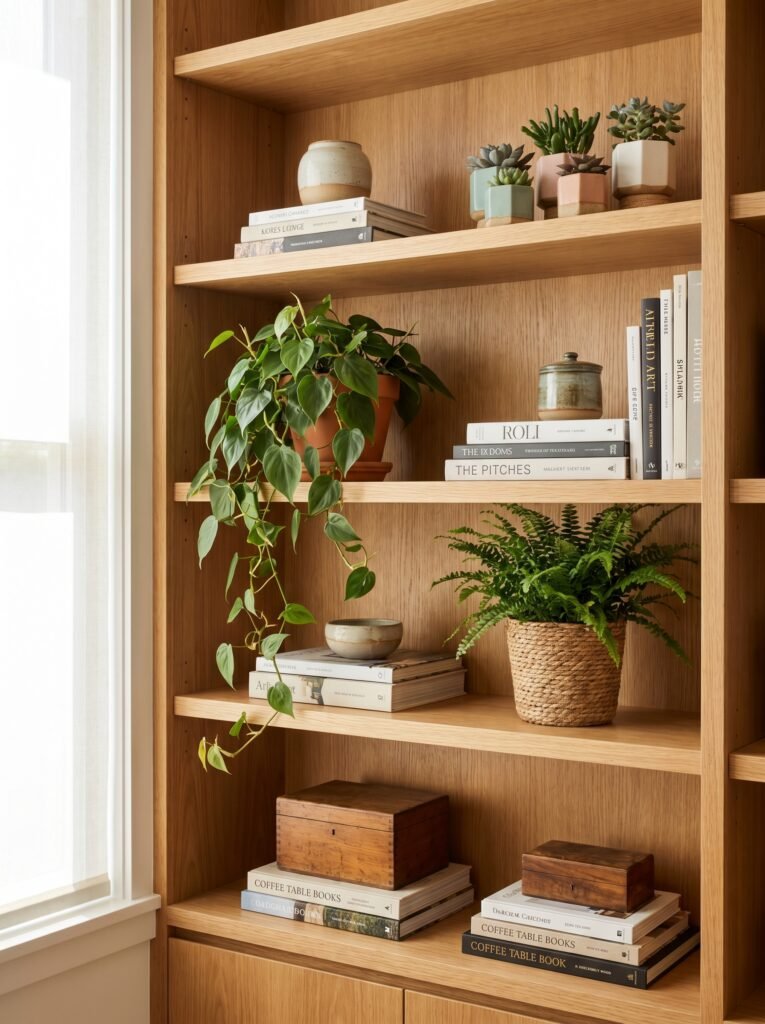
Building a beautiful, layered plant display doesn’t require a florist’s budget. Some of the most beautiful living room plant collections are built gradually, thoughtfully, and economically.
Propagation is the interior designer’s secret weapon. One trailing pothos, bought for £5 at a garden centre or $8 at a Home Depot, can become ten plants within a year through simple water propagation. Cut a stem below a node, place it in water, watch roots appear in two weeks, pot it up. Repeat. Your shelves will be full within a season.
Supermarkets on both sides of the Atlantic have dramatically improved their plant offerings. Lidl and Aldi in the UK regularly stock beautiful, healthy plants at extraordinary prices. In the US, Trader Joe’s, Costco, and IKEA all offer remarkably good value on houseplants.
Plant swaps — community events increasingly popular in American cities and British towns alike — are a wonderful way to diversify your collection for free. One healthy mother plant can yield multiple cuttings to trade.
11. Common Plant Styling Mistakes That Make a Room Look Cluttered
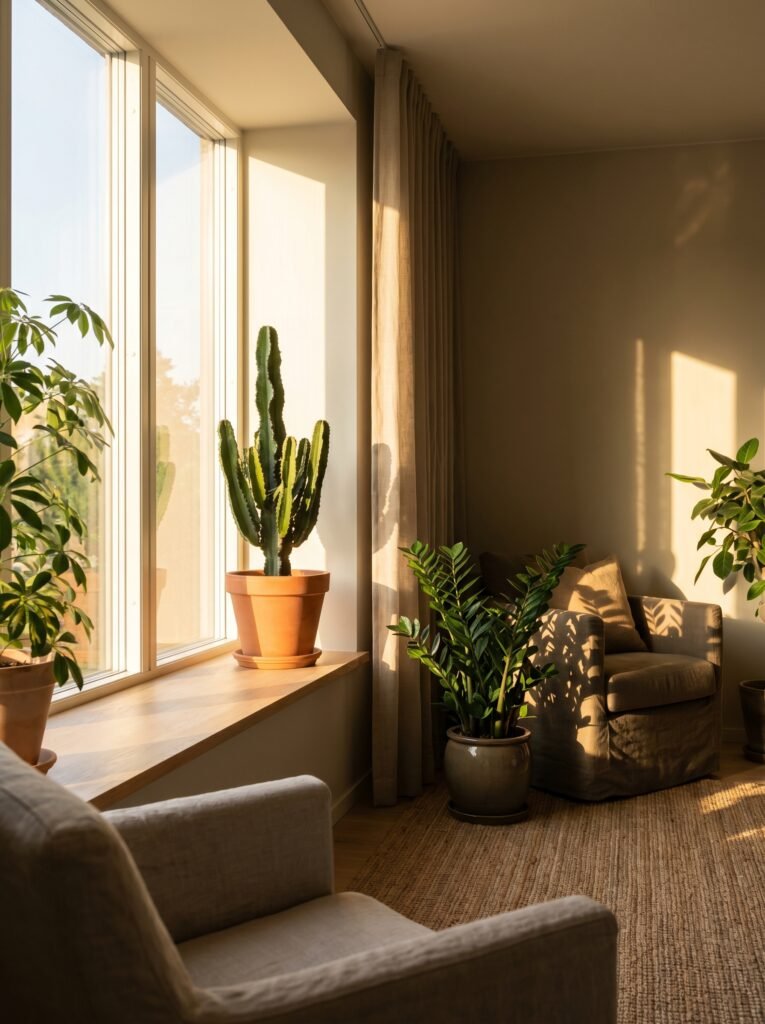
There’s a fine line between lush and chaotic, and it’s worth knowing where it is.
The most common mistake is uniformity — buying all the same type of pot, all the same size plant, all lined up in a row. It looks like a garden centre display, not a home.
The second most common mistake is ignoring the light. Placing a sun-loving plant in a dark corner will result in a struggling, sad-looking plant that drains the energy from a room rather than adding to it. Always research the light needs of your plant before deciding where it lives.
Overcrowding surfaces is the third pitfall. When every single surface in a room has a plant on it, the effect becomes overwhelming and difficult to clean. Edit ruthlessly. A few well-placed plants make a stronger statement than twenty plants competing for attention.
12. Creating a “Plant Moment” — The Designer Trick That Pulls Everything Together
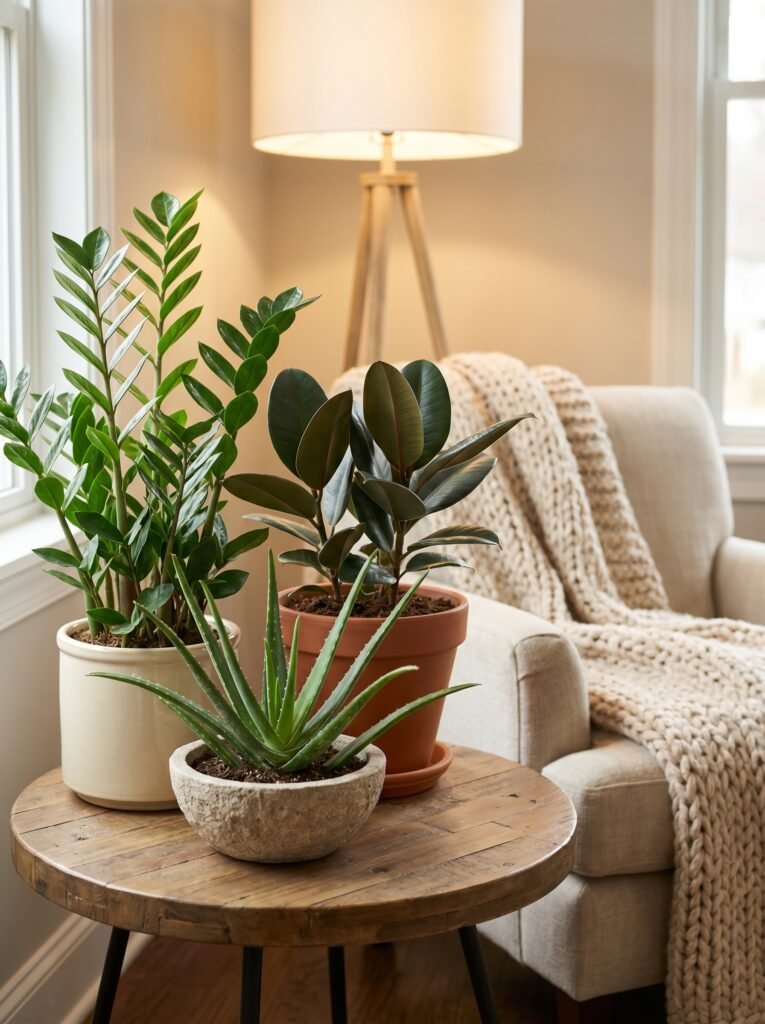
The best living rooms with plants don’t just have plants scattered around — they have what designers call a “plant moment.” One deliberate, styled corner or vignette that draws the eye and makes people stop to look.
Imagine a corner of your living room: a tall, graceful fiddle-leaf fig in a woven rattan basket. Beside it, a smaller textured pot with a trailing scindapsus. On the floor beside them, a stack of coffee table books with a small sculptural object or candle on top. This grouping, this moment, anchors the room and makes it feel deeply considered.
Creating your plant moment costs far less than you’d think. It requires intention more than investment. Look at your room and ask yourself: where does the eye naturally travel when you walk in? That’s where your plant moment belongs.
—
🌿 How to Take Care of Your Living Room Plants
Even the most beautiful arrangement falls apart if the plants aren’t thriving. Here’s what actually works.
Water according to the plant, not a schedule. Most houseplants fail from overwatering, not underwatering. Stick your finger two inches into the soil — if it’s still damp, wait. This single habit saves more plants than any other advice.
In winter, central heating in both UK and US homes dramatically dries the air. Group plants together to create a microclimate of humidity, or place pots on a tray of pebbles filled with water — evaporation does the rest.
Feed your plants from spring through summer with a balanced liquid fertiliser — once a month is usually sufficient for most houseplants. Nothing will make your plants look healthier faster than a seasonal feed.
Wipe large leaves with a damp cloth every few weeks. Dust accumulates on broad-leafed plants like monsteras and rubber plants, dulling their colour and blocking photosynthesis. A quick wipe keeps them glossy and thriving.
Finally, rotate your pots a quarter turn every few weeks so all sides receive even light. Plants grow toward light — without rotation, they’ll lean dramatically and lose their shape over time.
—
❓ FAQ
Q: What are the best plants for a living room with low natural light? A: Snake plants, ZZ plants, and pothos are the three most reliable choices for low-light living rooms. All three tolerate the north-facing rooms common in UK terraced houses and basement apartments in American cities. They remain visually striking even in dim conditions and require minimal watering.
Q: How many plants is too many for a living room? A: There’s no universal number, but the principle of restraint usually produces the best results. A good starting point is one floor plant, two to three mid-level plants on shelves or tables, and one hanging or trailing plant. As you become more confident with plant care and styling, you can layer in more — but always step back and edit if a room starts to feel cluttered rather than lush.
Q: Are there any living room plants that are safe for pets and children? A: Yes — this is important to consider. Spider plants, Boston ferns, peperomia, and calathea are all considered non-toxic to cats, dogs, and children. Always verify with the ASPCA toxic plant list (US) or your veterinarian, as individual sensitivities vary. Many popular plants — including pothos, philodendrons, and peace lilies — are toxic if ingested, so placement matters enormously in homes with curious pets or toddlers.
—
💭 Final Thought
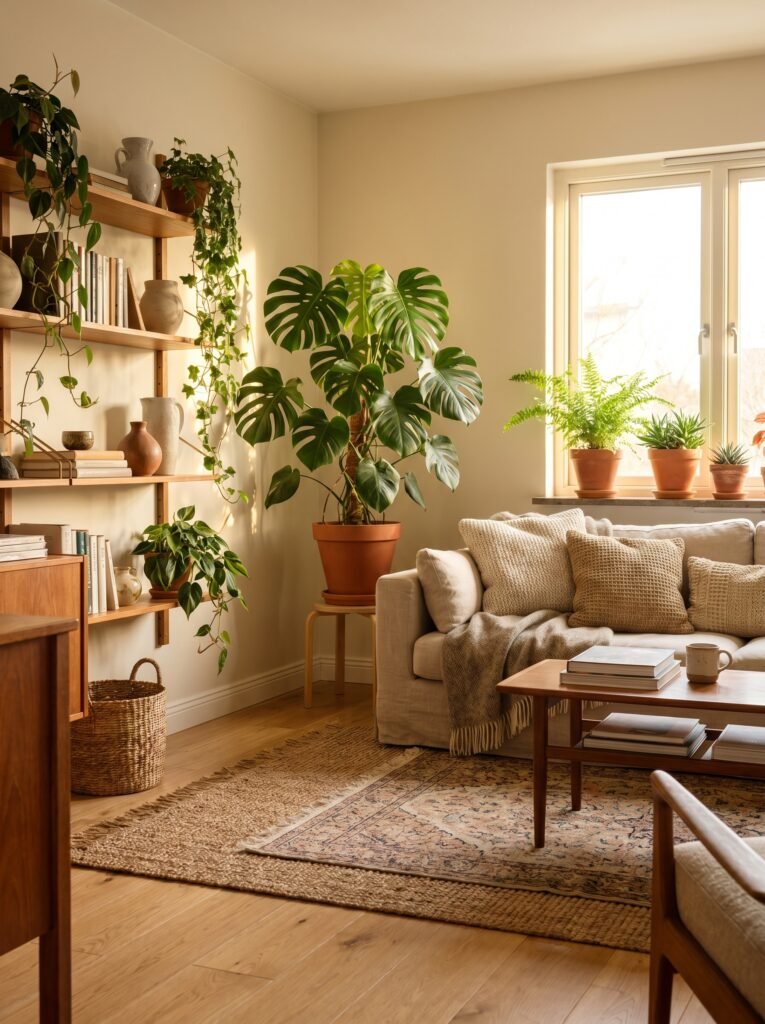
A living room decorated with plants isn’t just a design choice — it’s a daily reminder that you’ve created a space where living things thrive, including yourself. There’s something quietly profound about tending to a plant, watching it grow, and seeing how it transforms the corner of a room you once didn’t know what to do with. It costs very little and gives back more than you expect.
So here’s the question worth sitting with: if your living room could feel more alive, more layered, more genuinely you — what’s stopping you from making it that way?