How to Make a Tiny Living Room Feel Like the Coziest Place You’ve Ever Been
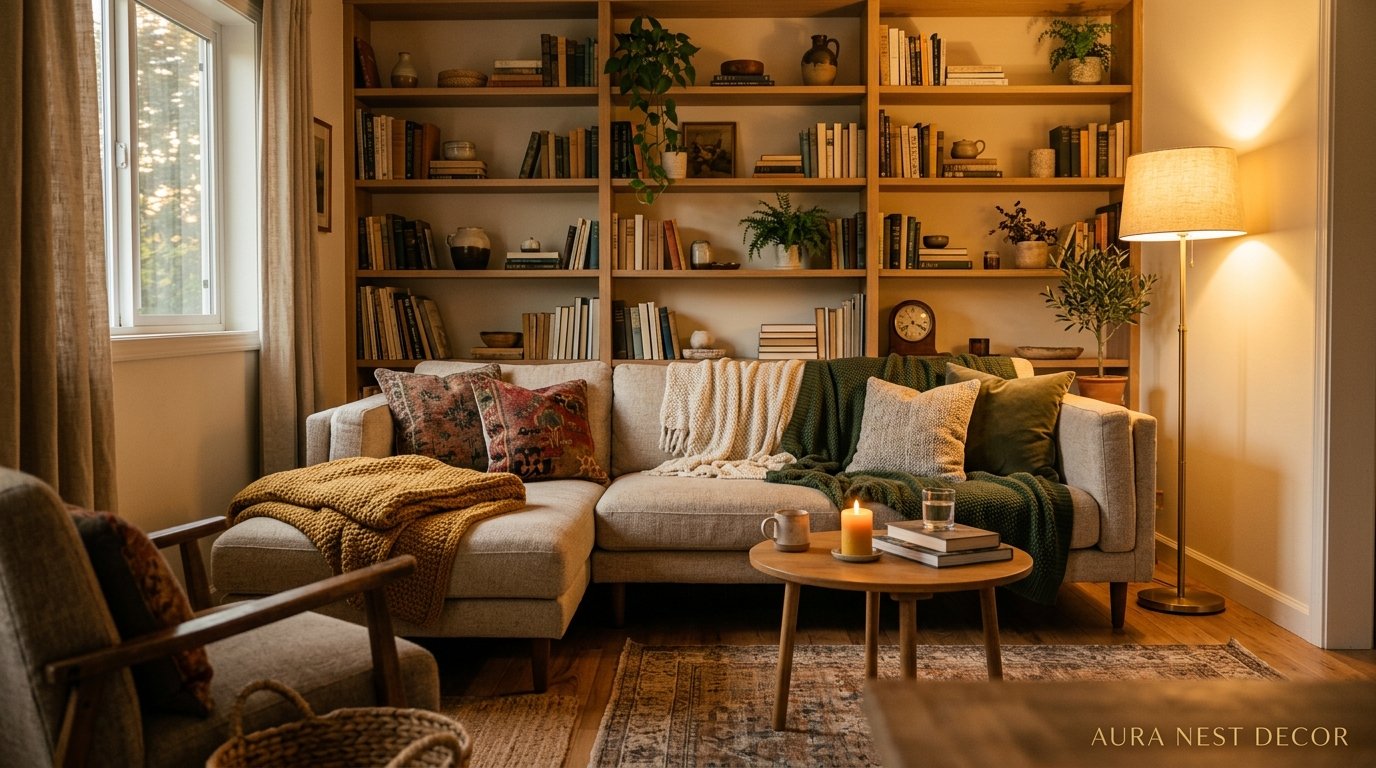
You walk in and just… exhale. That’s the thing about a small living room done right — it doesn’t feel cramped. It feels held. Like the room itself is giving you a hug.
—
1. The Ceiling Trick Nobody Talks About (But Every Cozy Room Uses)
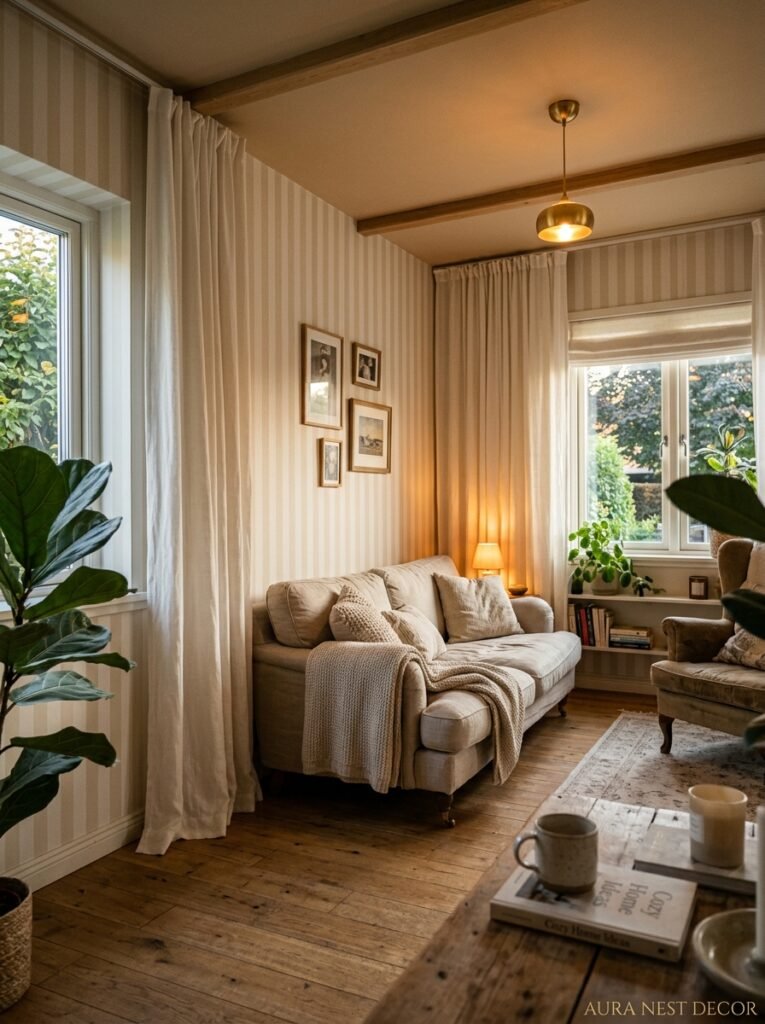
Look up. No, seriously — when did you last actually look at your ceiling in a small room? Because here’s the thing most people miss: in a tiny living room, your ceiling is doing one of two things. It’s either shrinking your space or secretly making it feel enormous. And the difference comes down to color.
Painting your ceiling the same shade as your walls — or just one or two tones lighter — is genuinely one of those changes that hits different. It wraps the whole room in one continuous color, and suddenly the edges of the space feel less obvious. Less “box.” More “cocoon.” I’ve seen this work in London terraced houses where the front room is basically the width of a sofa, and I’ve seen it work in American craftsman cottages where the living room doubles as everything else. Same principle both ways.
Dark ceilings work too. I know that sounds terrifying in a small room, but a deep navy or charcoal ceiling in a tiny living room pulls the eye UP instead of out. It draws you in. There’s something about a dark ceiling that makes candlelight and lamp glow look unbelievably rich, like you’re sitting inside something intentional instead of just existing in whatever square footage you’ve got.
And if you’re renting and can’t paint at all? String lights or a paper lantern hung from the ceiling does surprisingly similar work. It creates a “visual ceiling” that makes the whole room feel lower, warmer, more curated. Don’t sleep on this.
“Your ceiling is the one design element most people ignore — and the one that changes EVERYTHING in a small space.”
2. The Exact Sofa Size That Actually Works (Not the One You Think You Need)
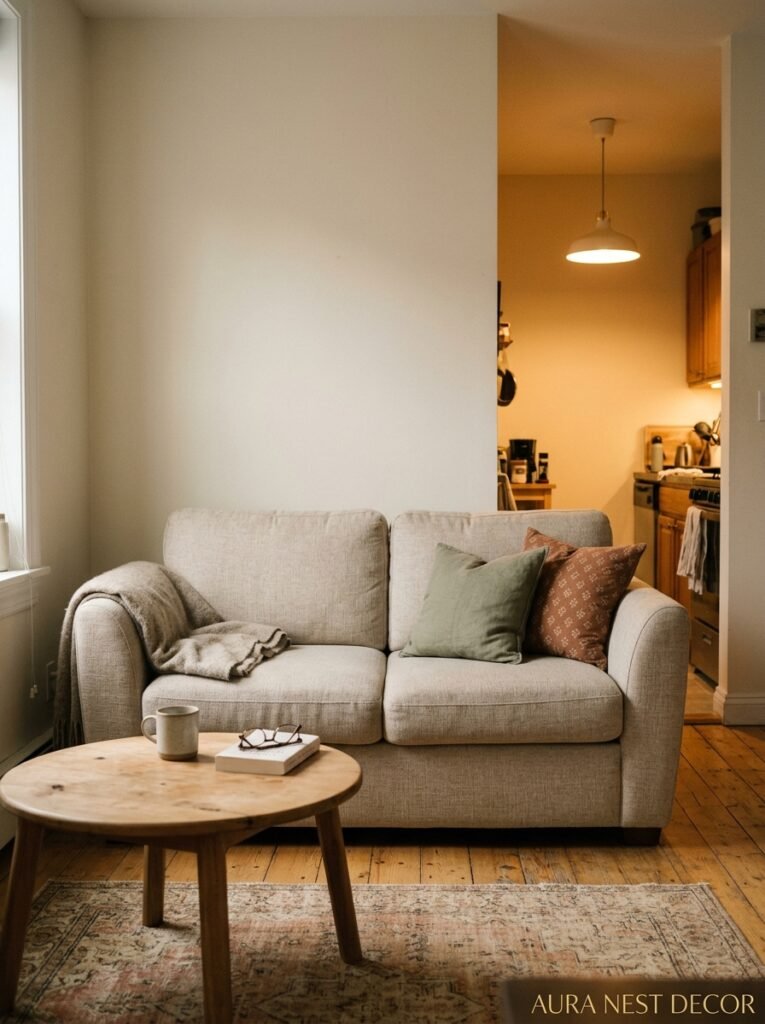
Can we talk about sofas? Because this is where most people go wrong in small living rooms, and I say that with genuine love.
Everyone thinks they need a big sofa. And then they squeeze a massive three-seater into a tiny room and spend the next three years doing a strange shuffle sideways every time they walk in. The sofa dominates. The room disappears. It’s not cozy — it’s just full.
A two-seater or a loveseat, done well, can feel MORE generous than a three-seater that’s fighting with the walls. Especially when you pair it with one really good armchair. That combination — a compact sofa plus one chair — creates a conversation area, which is what cozy actually means. Cozy isn’t about how much seating you have. It’s about the relationship between the pieces.
In the UK, where period terraced houses and ex-council flats often have front rooms that clock in under 150 square feet, this is basically survival knowledge. In the US, even in newer builds with “open concept” layouts, the living room section often isn’t that big. So size down your sofa and invest the rest of your budget into something that’s really good quality — better fabric, better legs, something with character. A small sofa that looks like it belongs somewhere beautiful beats a huge sofa that looks like it belongs in a waiting room.
And honestly? The floor space you get back feels like breathing room. Which is the whole point.
3. Why Every Pinterest-Worthy Small Living Room Has at Least One Embarrassingly Large Lamp
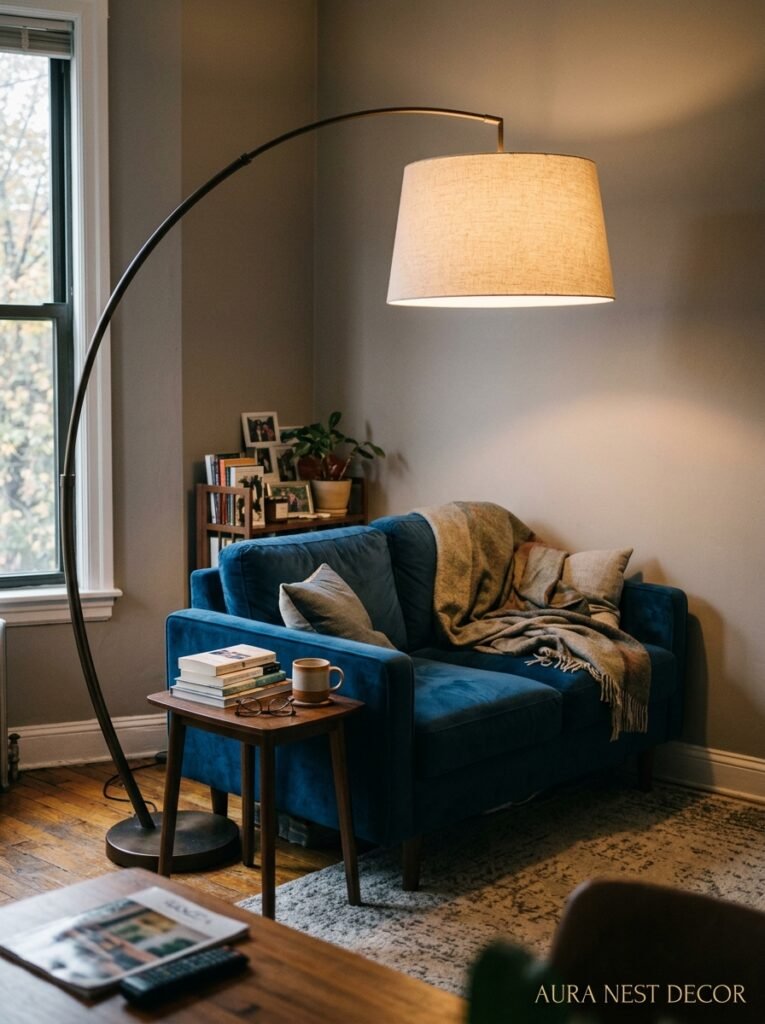
I can’t explain exactly why this works. But it does. Walk through any small living room that looks incredible on Pinterest and I promise you, there’s at least one lamp that’s almost too big for the room. A proper floor lamp with an oversized shade, or a ceramic table lamp that takes up a third of a side table, something that commands a little attention.
Oversized lamps in small rooms do two things. They anchor the space — give it a sense of scale and intention, like the room was designed rather than assembled. And they throw light in a way that small lamps just don’t. Proper warm light that pools on the floor and glows on the walls instead of just illuminating a small circle around itself.
The light temperature matters more than almost anything else in a small living room. I’m talking 2700K bulbs — that’s the warm amber end of things. Under 3000K if you can help it. The kind of light that looks great at 8pm on a Tuesday in November when you’ve had a long day and you just want to sit with a blanket and something hot to drink. That’s the target. That specific feeling. Cool blue-white light makes small rooms feel clinical and a bit sad, even with the nicest furniture in the world.
Side note — if you can, layer your light sources. Floor lamp plus table lamp plus maybe some candles or a small string of warm LEDs tucked onto a shelf. Multiple light sources at different heights make the room feel textured. Rich. Like you meant it.
4. The Color That Keeps Showing Up in Every Beautiful Small Living Room Right Now
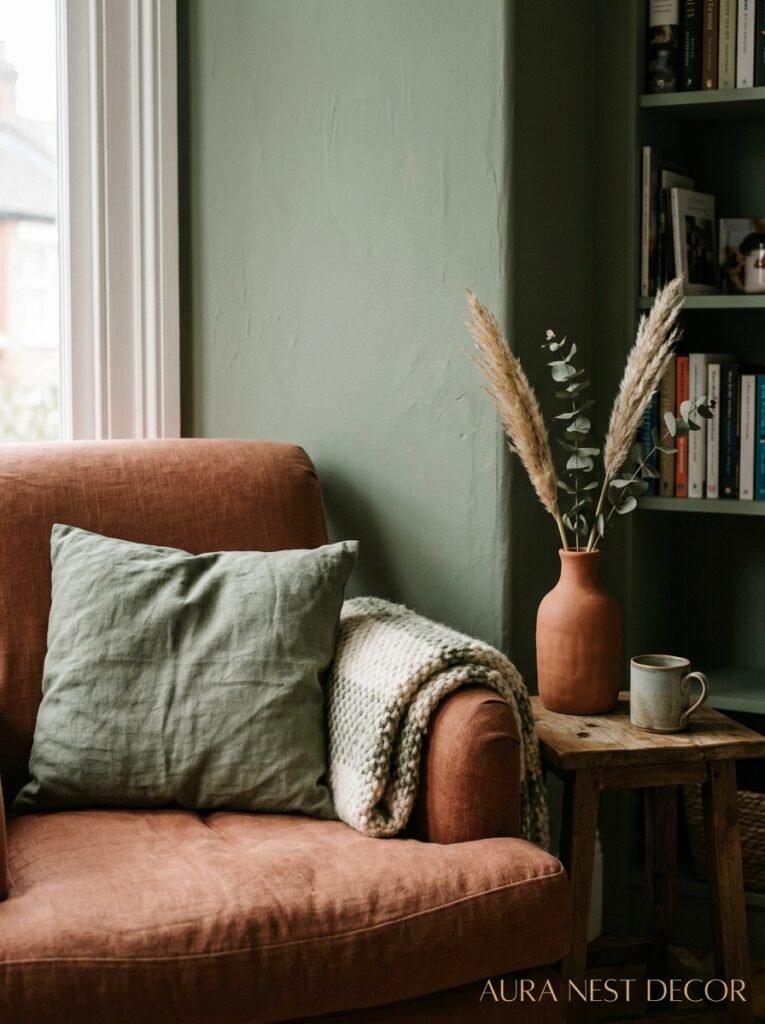
Okay, I’m going to say it: warm terracotta is having a moment that refuses to end, and I’m not even slightly sorry about it. Not the bright orange-red terracotta that felt very 2019 — I mean the dusty, almost muted version. The one that looks like sun-faded tiles in southern Portugal, or old brick in a Victorian building that’s been softened by decades of weather.
This color does something specific in small spaces. It makes them feel warm without feeling heavy. It reads completely differently depending on the light — almost pinkish in morning light, more orange-brown by lamplight at night, kind of bronze on a grey winter afternoon. Which means your small living room is constantly doing something different visually, and that variation is what keeps it from feeling monotonous or static.
If painting a whole room feels like a commitment you can’t make right now, one wall is enough. One terracotta wall behind your sofa or your shelving unit changes the whole mood. Or a terracotta-colored rug. Or a few terracotta pots on a shelf. The color just… works with wood, with cream, with linen, with black iron. It’s friendly to almost every style. And in both US and UK homes, it sits beautifully alongside whatever’s already there.
Other colors doing similar things right now: aged sage green, warm mushroom (which is basically a sophisticated greige), and very deep forest tones for people who want to go dramatic. But terracotta is the one I keep coming back to. It’s reliable in the best way.
5. The One Rule That Makes Any Tiny Room Feel Intentional (Not Just Small)
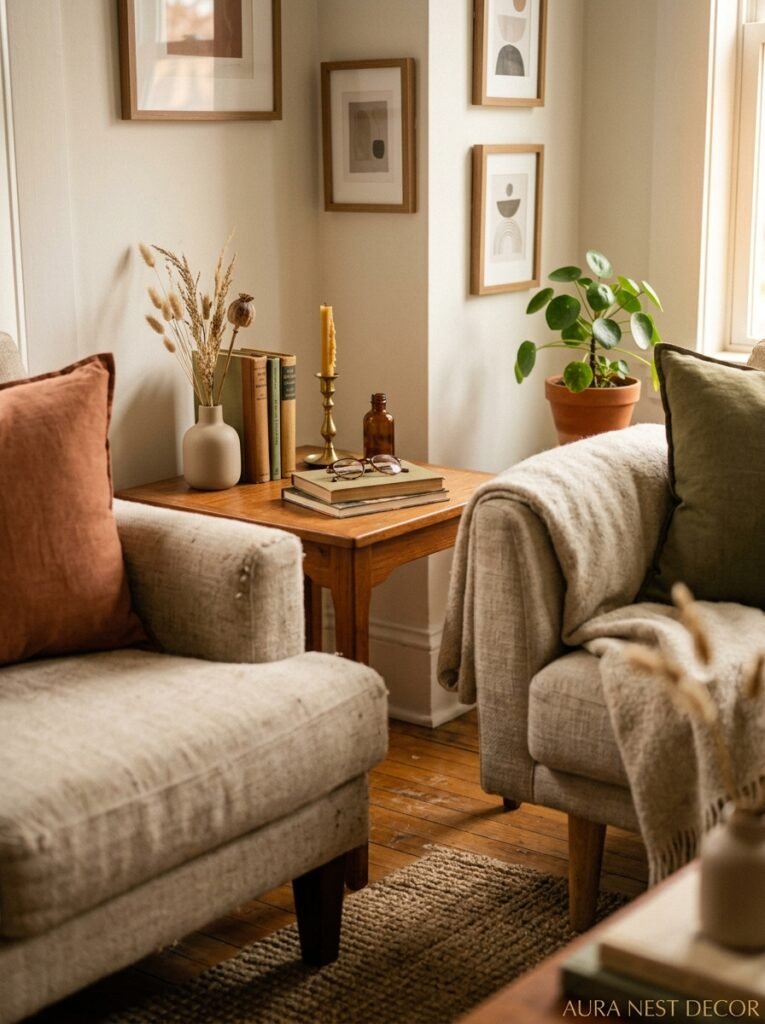
Everything in the room should have a reason to be there. And I know that sounds obvious, but stay with me.
Most small living rooms feel chaotic not because they’re small but because they’ve accumulated things without a framework. The inherited coffee table that doesn’t quite go. The old speaker on the floor that was supposed to be temporary four years ago. The throw blanket in the wrong color, draped on the armrest because there’s nowhere else to put it.
Here’s the rule that changes things: pick ONE material to repeat. Just one. Could be rattan. Could be dark wood. Could be brushed brass or matte black or a specific woven textile. And then make sure that material shows up at least three times in the room. Not in a matchy-matchy way — just as a thread. A through-line. When the eye can trace a material through a space, the room feels designed even if you didn’t spend much. It feels like you made decisions. And in a tiny room, intentionality is what creates the feeling of quality.
In practice this might look like: rattan lampshade, rattan mirror frame, one small rattan basket. That’s it. The rest of the room can be totally different. But that one repeating material pulls it all together in a way that reads as calm and considered rather than accumulated and chaotic.
“The difference between a cramped room and a cozy room is almost always intention, not square footage.”
6. Shelves That Go All the Way to the Ceiling (And Why This Is Non-Negotiable)
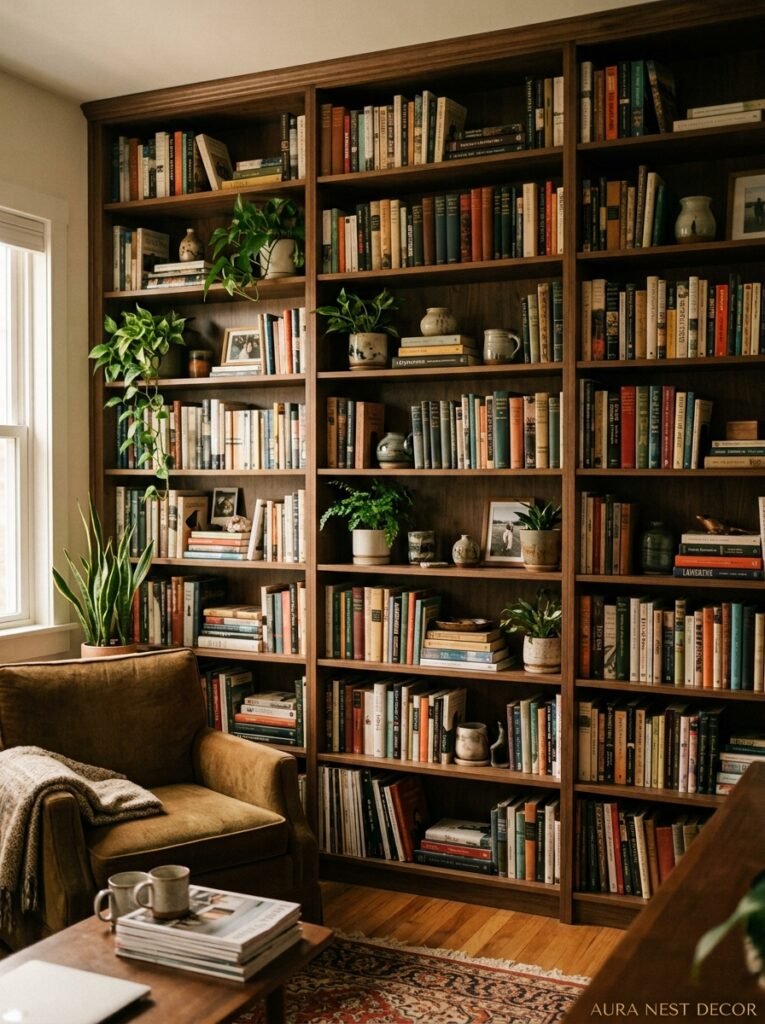
Floor-to-ceiling shelving in a small living room is not a compromise. It’s a power move.
Most people in small spaces think about storage horizontally — they want furniture with drawers, ottomans with lids, baskets on the floor. And those things are useful. But vertical storage is where the real magic is, because it does two things simultaneously: gives you more storage AND makes the room feel taller, bigger, more significant somehow.
Built-in shelves are the dream. But if you’re renting or just don’t want that level of commitment, you can get the same effect with two tall standalone shelving units pushed right up against the same wall, or a single very tall unit that hits close to the ceiling. Paint it the same color as the wall it’s sitting against, and it’ll look almost built-in. I’ve seen people do this in rented flats in Manchester and Brooklyn and the results are genuinely indistinguishable from custom joinery in photos.
The styling matters too. Not too precious, not too sparse. Books mixed in with objects, some things grouped, some things with space around them. A real lived-in look that’s been slightly edited. That’s the sweet spot.
7. The “Wrong” Coffee Table That’s Actually Right for Small Living Rooms
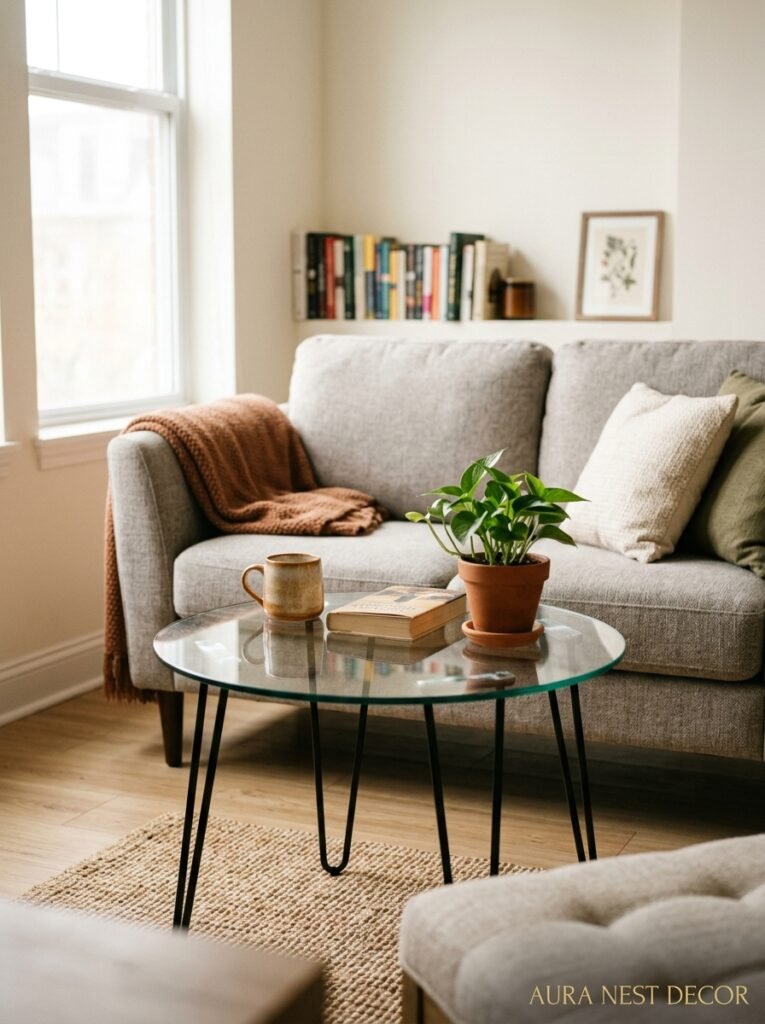
Solid coffee tables are the enemy of small spaces. I said it.
A big, solid, wood-top coffee table takes up the same visual real estate as a piece of furniture twice its actual size, because it blocks the floor. And in a tiny room, the floor is a design element. You want to SEE as much floor as possible. It makes the space feel bigger.
Glass top coffee tables — the ones everyone dismissed as very ’90s — are genuinely one of the best choices for small living rooms. Especially with simple metal legs. The top is barely visible, you can see straight through to the floor and whatever’s under it, and the whole room breathes differently because of that openness. Side note: they’re also easier to clean than you’d think.
Alternatively? Two or three small round nesting tables instead of one big coffee table. You can spread them apart or cluster them, move them when you need floor space, and the rounded edges are kinder to small rooms than corners everywhere. There’s also something slightly playful about nesting tables that adds character to a room that might otherwise feel too serious or too careful.
A low stool with a tray on top. A concrete or stone drum table. A big flat woven basket. All of these work better in a small living room than the standard coffee table because they’re either visually light or they earn their footprint by doing something interesting.
“Glass tops aren’t dated. They’re just right for small spaces — the transparency is the whole point.”
8. What British Maximalism Gets Right That American Minimalism Often Misses
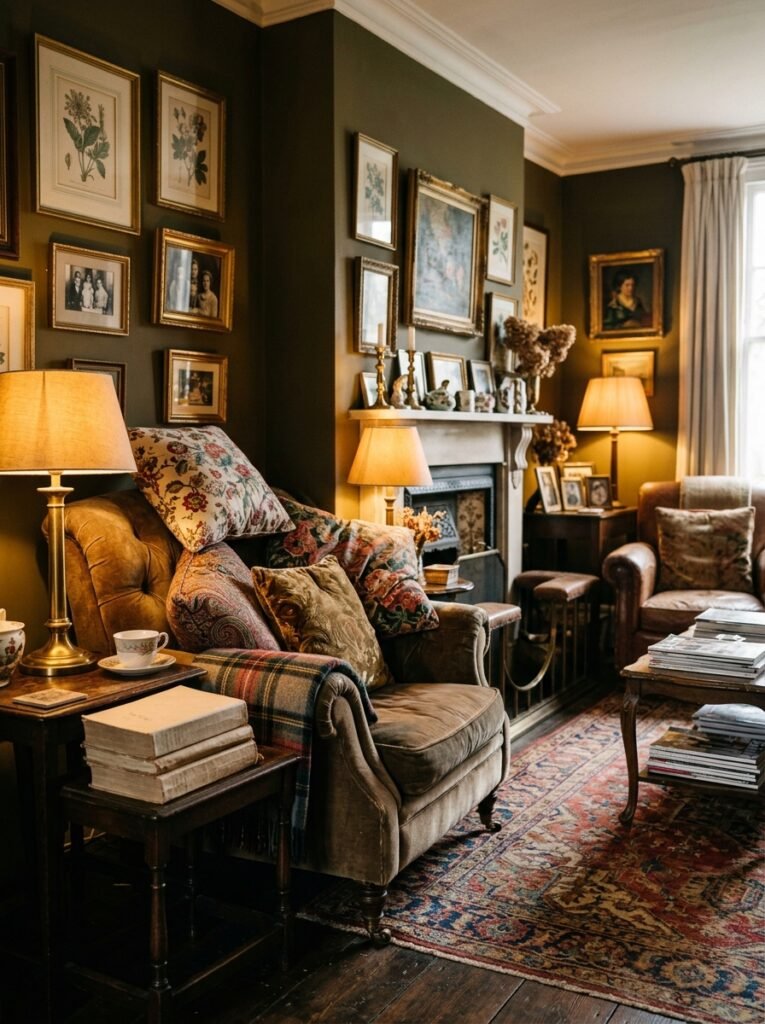
Okay, I want to get into something that I think about a lot. There’s a certain kind of British living room — the kind you see in old terraced houses, in cottages, in Victorian conversions — that should, technically, feel cluttered. There’s a lot going on. Mix of patterns, layered rugs, shelves full of actual stuff, a collection of something weird and personal on the mantelpiece. But it doesn’t feel cluttered. It feels like a place where someone actually LIVES.
And I think American minimalism, at its most rigid, sometimes throws out what makes a small room feel alive in its attempt to make it feel clean. Bare surfaces can feel cold. A room with one carefully chosen object on each surface can feel more like a showroom than a home. That’s not cozy, that’s just empty.
The British instinct to layer, to collect, to put personal and imperfect things on display — that’s actually a design strength. Especially in small spaces. When every inch of a room reflects the person living in it, the smallness stops being a problem. You’re not noticing the size. You’re noticing the story.
The balance is: thoughtful maximalism versus chaotic accumulation. Curate your collections. Frame the chaos just a little. But don’t purge the personality out of your room in the name of looking “clean.”
9. The Rug Size Mistake That Makes Small Living Rooms Look Smaller
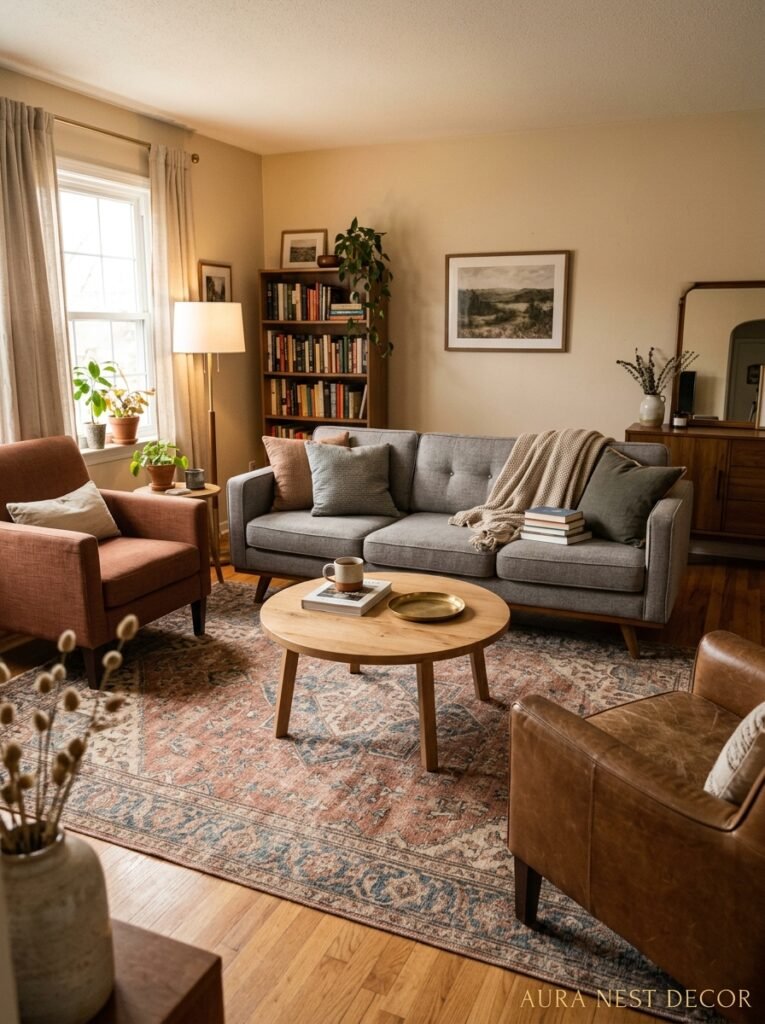
Too small. Everyone goes too small.
It feels counterintuitive — in a small room, shouldn’t a smaller rug feel more proportionate? No. Actually no. A rug that’s too small for the seating area floats in the middle of the room like a postage stamp, and instead of unifying the space it just makes everything feel disconnected and, weirdly, smaller.
The rug should go under the front legs of the sofa at minimum. Ideally, it should be large enough that all the seating furniture has at least its front legs on it. That’s what “anchors” a living room — the furniture and the rug forming one unified zone rather than individual pieces scattered on bare floor.
In a very small room, you might think this means the rug goes edge to edge and that’s fine. I’d rather see a rug that almost fills the room than one that leaves too much bare floor around a tiny seating island. The visual confidence of a properly sized rug is worth it every time.
10. The Weird Window Treatment That’s Actually Perfect for Tiny Houses
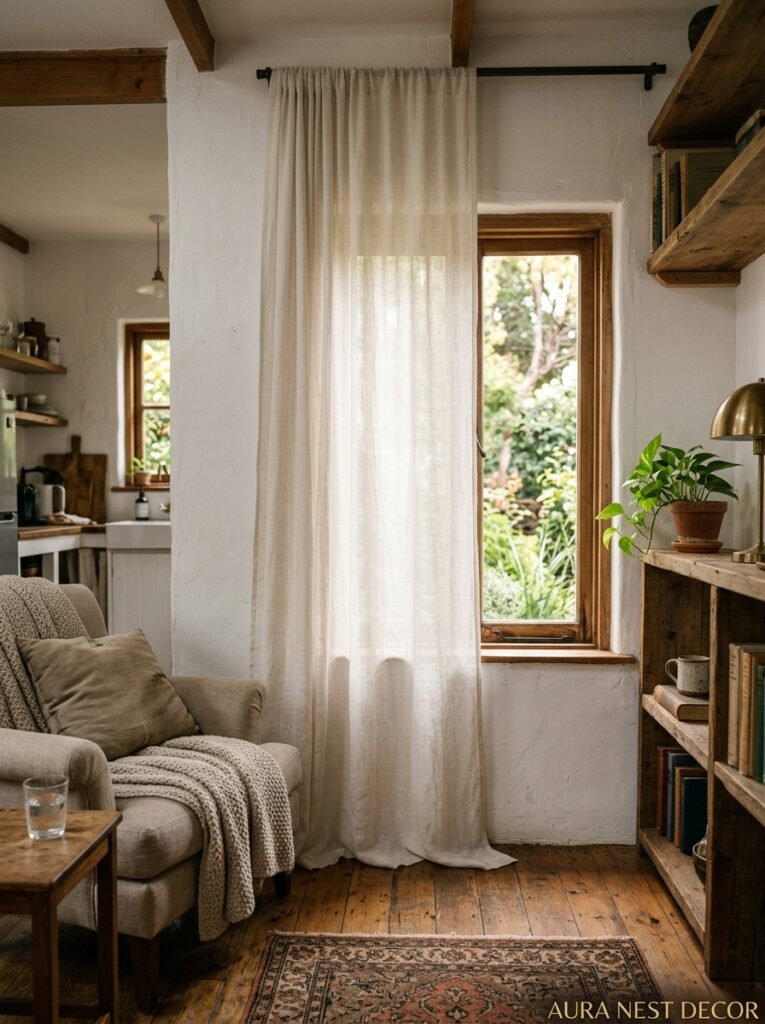
Floor length curtains. Even if your windows are small. ESPECIALLY if your windows are small.
This is one of those counterintuitive styling tricks that works 100% of the time and always looks a bit shocking when you first explain it. Hanging curtains close to the ceiling (as high as possible, like 2-3 inches from the ceiling or crown molding) and letting them pool slightly on the floor makes windows look dramatically taller and the room feel dramatically larger. The eye reads “height” and interprets it as spaciousness.
In British homes especially, where Victorian and Edwardian houses have tall ceilings but often smallish, awkwardly proportioned windows, this technique is basically essential. The curtains create the illusion of a grander window than actually exists. In American homes — ranch houses, bungalows, newer builds — the same trick adds architectural interest where the bones of the house might not naturally have much.
Fabric: go light where you can. Linen, cotton, anything that lets some light through even when closed. In a small space, natural light is your most valuable resource and you don’t want to block it unless you have to.
11. How to Make a Tiny Living Room Work for Both Lounging and Living (Without It Feeling Like a Hotel Room)
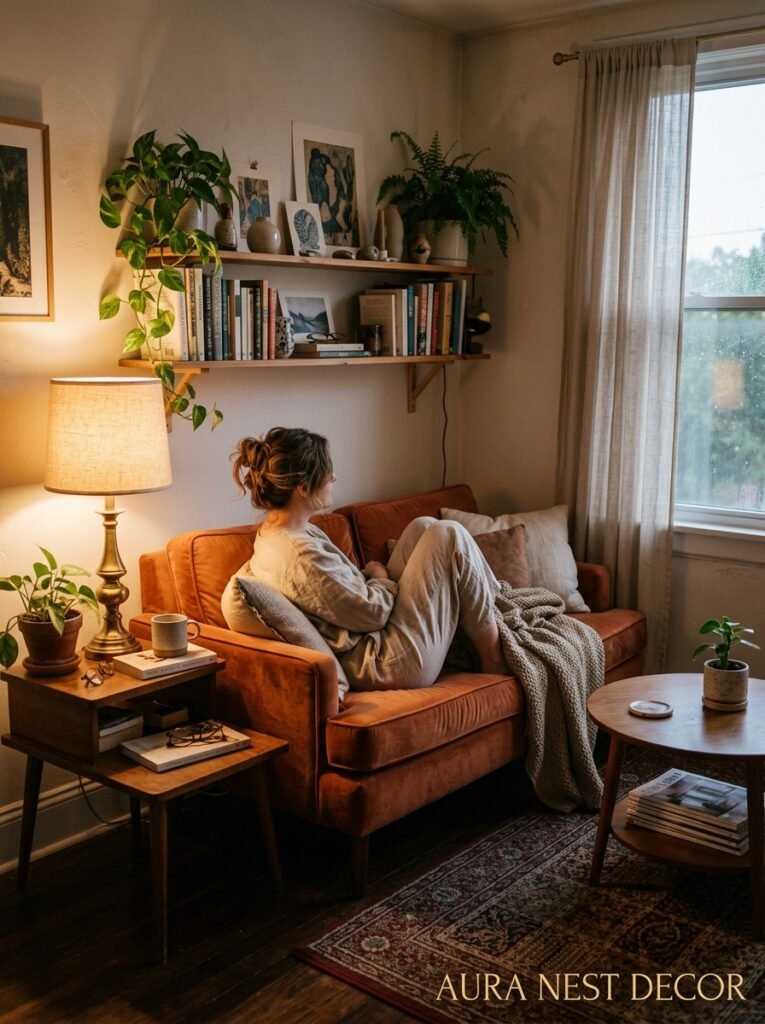
The challenge in a small living room — especially in tiny houses or small flats — is making it feel like it serves real life without looking overly functional. Too much storage furniture makes a room feel utilitarian. Too little and it’s unusable.
The solution is hiding function in nice objects. A beautiful large basket instead of a plastic storage bin. A vintage trunk as a side table that also holds blankets. A pretty tray on the coffee table that corrals the remotes and chargers so they look almost intentional. A fabric ottoman with a removable lid that stores stuff inside.
None of this has to be expensive. It has to be considered. The goal is that when someone walks in, they see a lived-in, comfortable room — not the organizational system that’s holding it together underneath.
12. The Last Thing to Add (That Most People Add First and Regret)
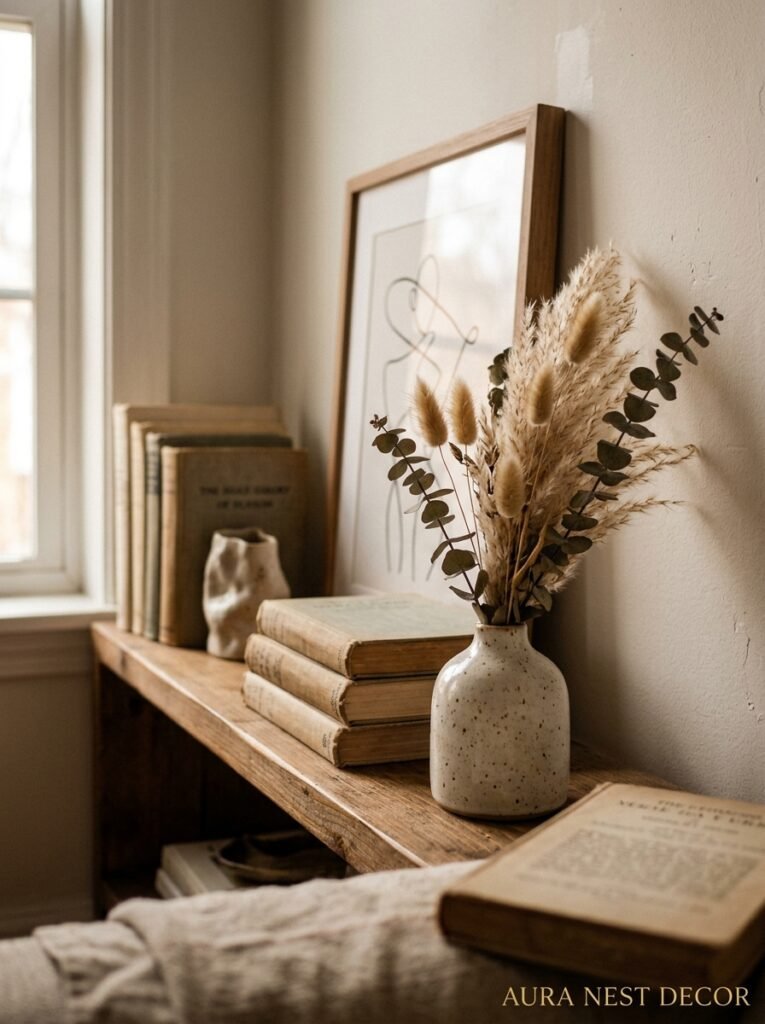
Accent cushions. Pillows. Throw blankets.
I know. They’re everywhere on Pinterest and they are genuinely wonderful. But they’re the last layer, not the first. And in a small living room, the number matters more than you’d think.
Too many cushions and the sofa disappears into a pile of soft things. Too few and the room feels bare. In a small space, something like four cushions on a two-seater (two matching, two different but coordinated) and one throw blanket folded over the arm is usually the sweet spot. Maybe one more cushion on the armchair. That’s enough. The cushions should enhance the sofa, not bury it.
And please — not every cushion needs to be a different texture and pattern. Two matching cushions in a good fabric make a small sofa look more expensive than six cushions in six different patterns. Restraint in the soft furnishings is where a lot of small living rooms finally tip from “trying too hard” to “effortlessly cozy.”
—
❓ FAQ
Q: What’s the best sofa color for a small living room? A: Honestly, a mid-toned neutral — warm cream, soft camel, a dusty mushroom — works best because it doesn’t fight for attention against the walls. Very dark sofas can work well in small rooms too, especially if the walls are light. What tends to struggle is a bright or saturated sofa color in a room that doesn’t have the space to “absorb” it.
Q: Should I use mirrors in a small living room? A: Yes, but thoughtfully. A large mirror placed on a wall that reflects a window or a lamp does the most work — it bounces light and creates visual depth. A gallery wall of small mirrors doesn’t really do much. Go big, go strategic, and don’t lean it on the floor unless the rest of the room is very intentional, because leaning mirrors can look unfinished.
Q: Can an open-plan tiny house living room ever feel cozy, or does open-plan mean it always feels cold? A: Open-plan can absolutely feel cozy — but you have to define the living room zone clearly. A rug, a lighting setup, and the furniture arrangement all have to work together to say “this is the living area” even without walls. A pendant light or floor lamp cluster directly above or around the seating area does a lot of that work. The coziness comes from the zone feeling contained even in an open space.
—
💭 Final Thoughts
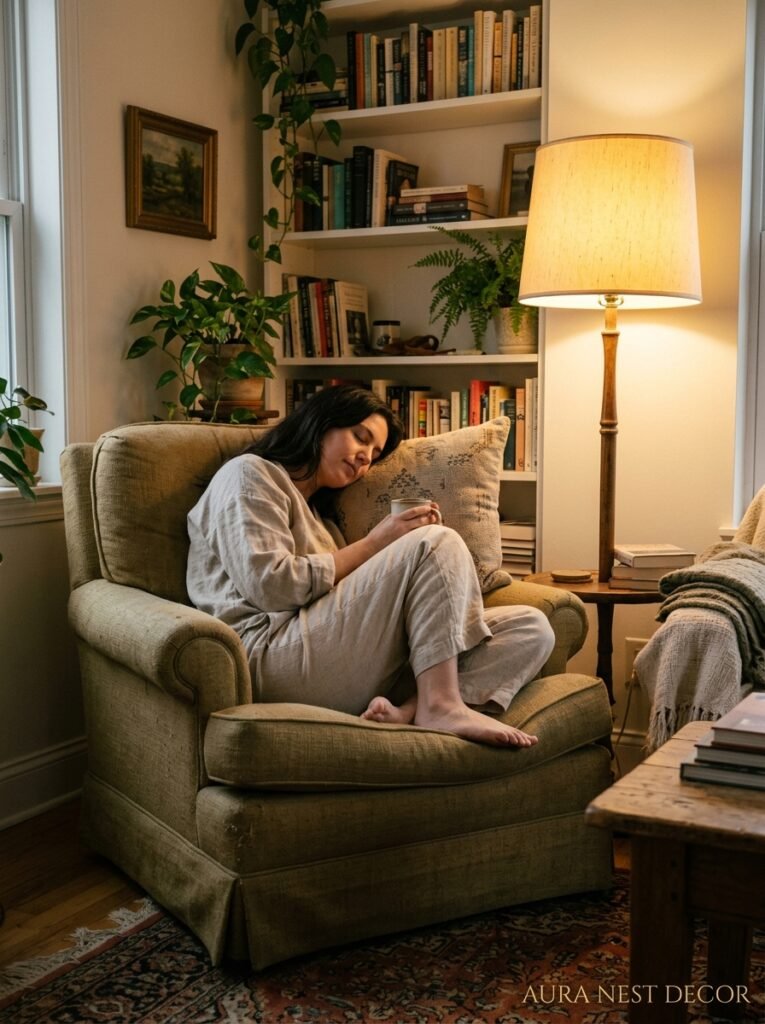
A small living room isn’t a problem to solve. It’s a constraint that, if you work with it instead of against it, produces something genuinely lovely — a room that feels gathered and intentional rather than sprawling and indifferent. The best small living rooms I’ve ever been in had almost nothing to do with their square footage. They had everything to do with the choices made inside it. What would your room feel like if you changed just one thing this week?