
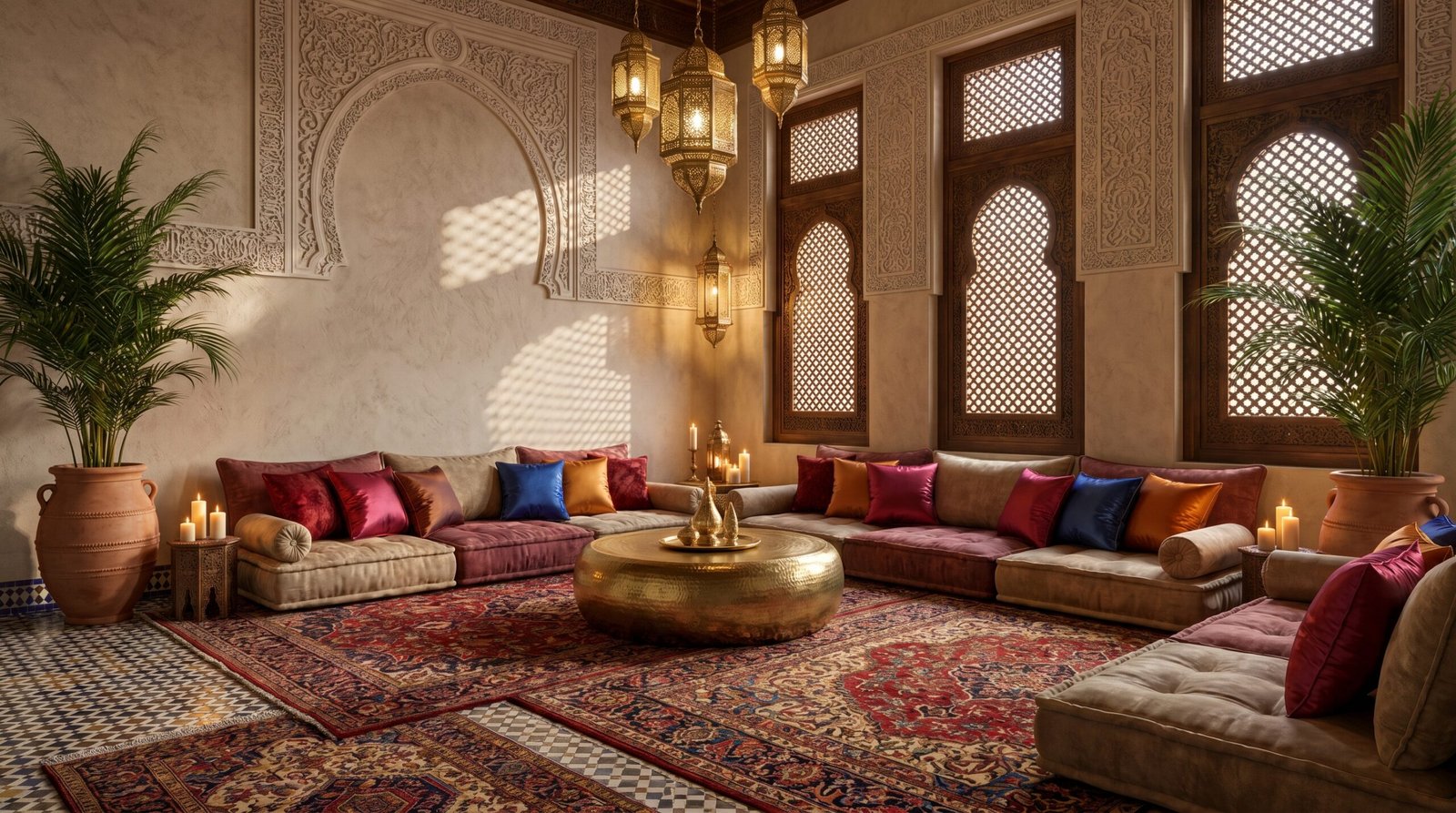
The Arabic Style Living Room: How Ancient Beauty Can Transform Your Home Into a Soul-Stirring Sanctuary
There’s something quietly extraordinary about stepping into an Arabic style living room — a feeling that the room itself has a heartbeat, that its walls hold centuries of stories, that sitting down inside it is less like taking a seat and more like being welcomed home. If you’ve ever scrolled past one of those richly layered, lantern-lit spaces and felt an ache in your chest — a longing you couldn’t quite name — this article is for you.
—
1. What Exactly Is Arabic Style Interior Design — and Why Does It Feel So Different?
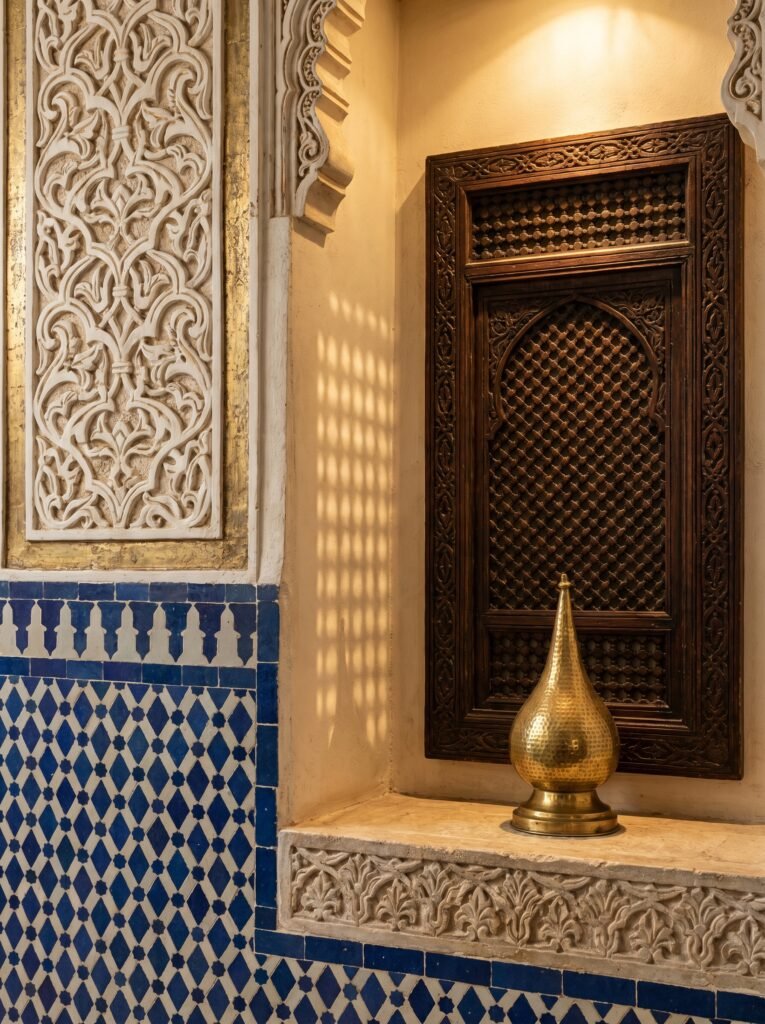
Arabic style interior design draws from a deep well of cultural history spanning the Arabian Peninsula, North Africa, Persia, and the broader Islamic world. It is not a single aesthetic frozen in time — it is a living tradition shaped by centuries of craftsmanship, trade routes, spiritual philosophy, and a profound respect for beauty as something sacred rather than superficial.
What makes an Arabic style living room feel different from any other design style is its intentionality. Every pattern, every color, every curve on a carved wooden screen was placed there with meaning. The geometry in the tilework reflects mathematical harmony. The arabesque vines that climb across textiles and plasterwork symbolize the infinite. Even the low seating arrangement — cushioned divans called majlis — was designed not for aesthetics alone but to create a particular quality of human connection: everyone at the same level, no head of the table, no hierarchy in the gathering.
“An Arabic style living room doesn’t just look beautiful — it creates a feeling, a philosophy, an invitation to slow down and be present.”
This is why Arabic interiors resonate so deeply with so many people across the globe, regardless of their background. They speak to something universal: the desire to live inside a space that feels meaningful, layered, and alive.
—
2. The Majlis — Understanding the Heart of the Arabic Living Room
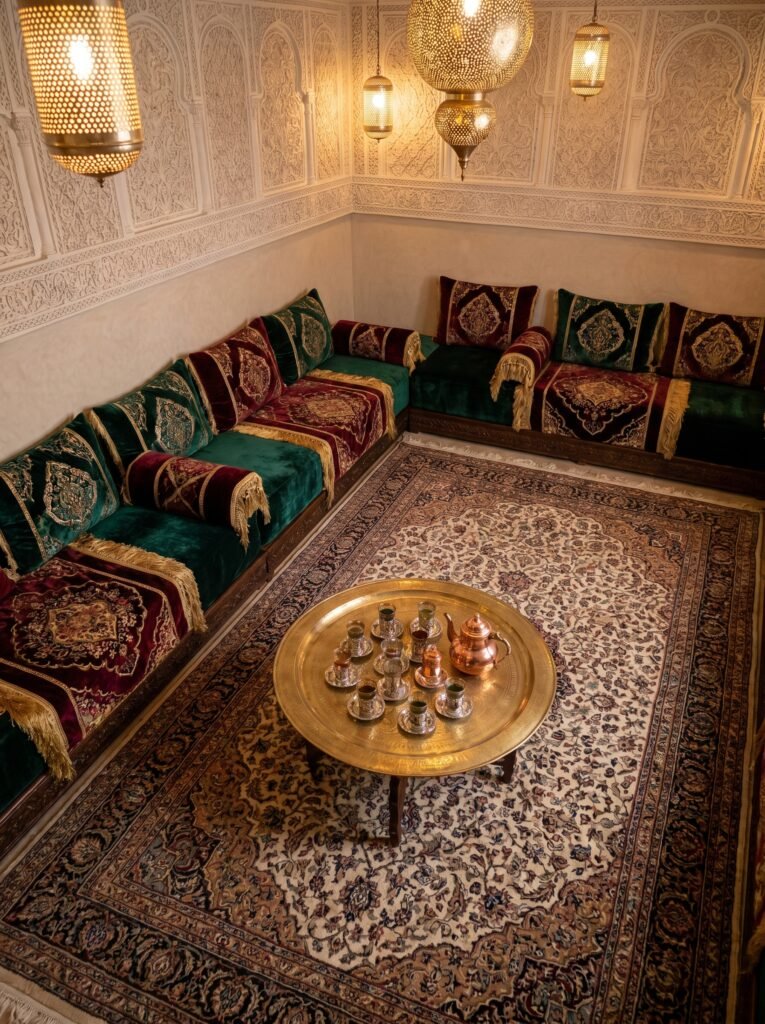
Before you pick a single color or buy a single cushion, you need to understand the majlis. The word itself comes from the Arabic root meaning “a place of sitting,” and for centuries, it has been the social and spiritual center of Arab domestic life — the room where guests are honored, conversations stretch late into the night, and tea is poured with ceremony.
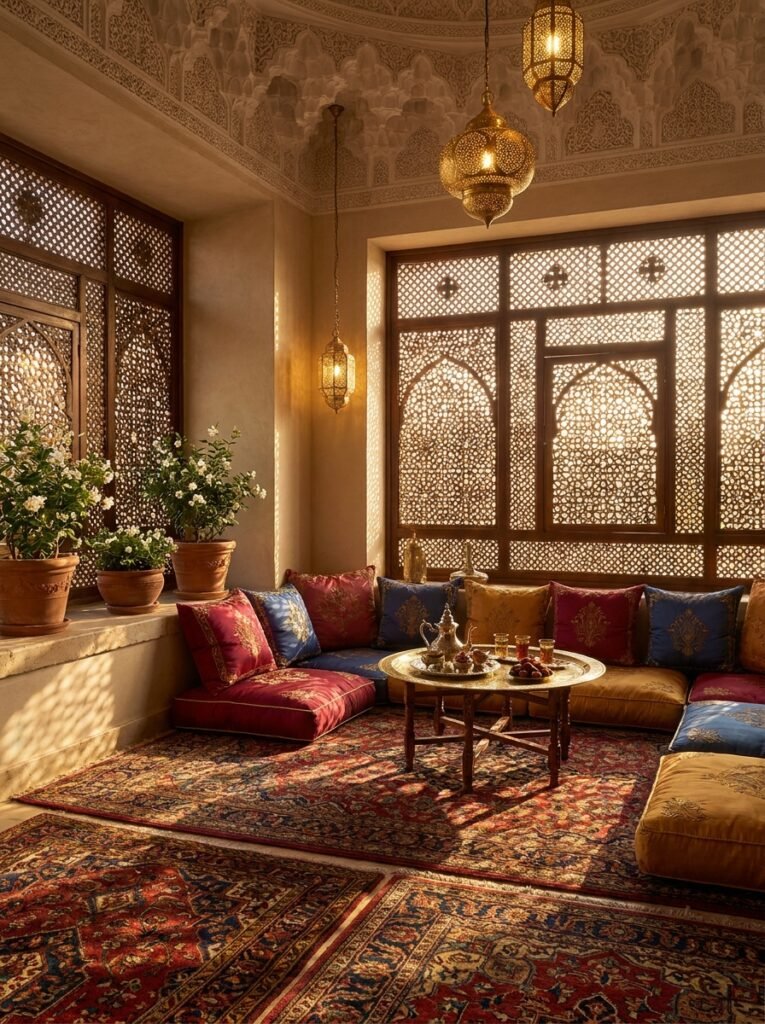
The traditional majlis is built around perimeter seating: long, low divans or banquette cushions lining the walls, often covered in rich fabrics, with layers of pillows in varying sizes. A central coffee table — perhaps carved wood or hammered brass — anchors the space. There is no television as the focal point, no single dominant sofa pushing everything to the periphery. The room is designed for conversation, for gathering, for lingering.
When you bring this philosophy into a modern home, something remarkable happens. The room begins to feel generous — spacious even in a small space — because the energy flows inward rather than toward a screen. Guests feel welcomed in a way that’s hard to articulate but immediately felt.
—
3. The Color Palette That Makes Your Eyes Feel Like They’re Resting

Arabic style living rooms have a color palette that walks a very specific tightrope — rich without being overwhelming, warm without being heavy. Think deep jewel tones grounded by earthy neutrals: burnt saffron, dusty rose, deep teal, ochre gold, and terracotta, softened by ivory, sand, and warm white.
These are not the bright, saturated colors of a maximalist fever dream. They are colors that have been warmed by sun, aged by time, and deepened by dust — colors that feel like they’ve been somewhere, that carry a story. Walls in warm white or pale sand create the perfect backdrop, allowing the richness of textiles and metalwork to sing without competing.
Deep emerald green, borrowed from the tiles of ancient mosques, works beautifully as an accent — on a velvet cushion, a painted side table, or a single statement wall. Burgundy and navy bring depth. And threading through it all, gold — not brash metallic gold, but burnished, hammered, warm gold — ties the entire palette together like a thread of poetry.
—
4. Geometric Patterns and Arabesque Details — The Language of the Walls
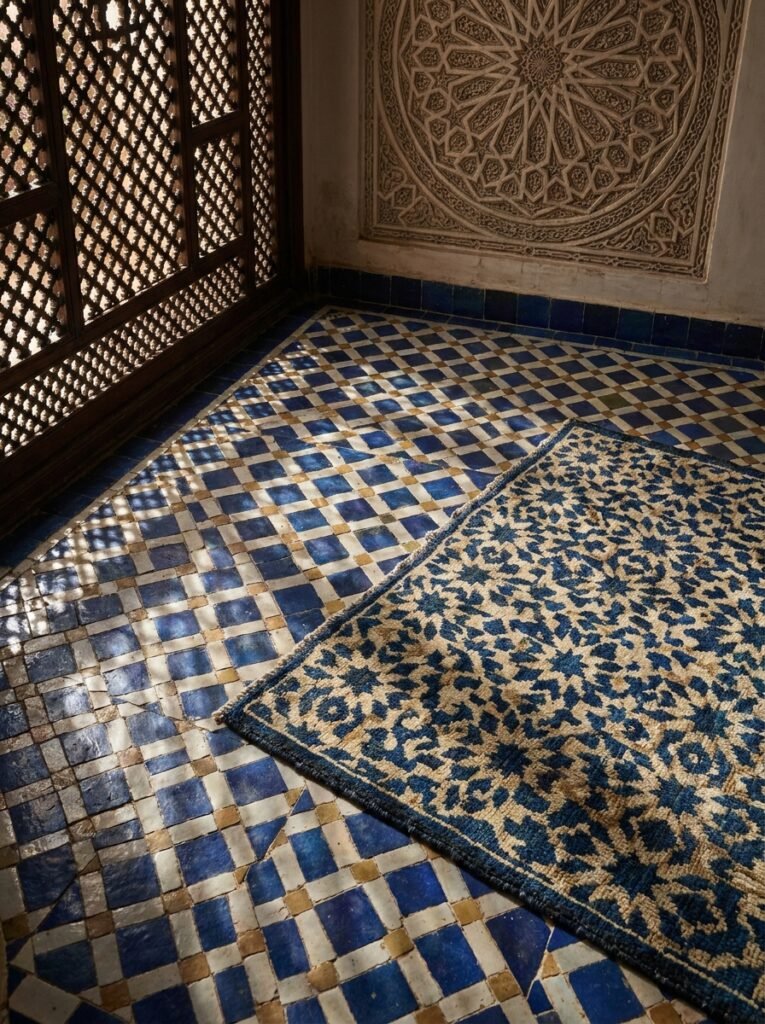
If color is the emotion of an Arabic living room, then pattern is its language. Geometric patterns — intricate tessellations of stars, hexagons, and interlocking lines — appear everywhere in authentic Arabic design, from hand-painted zellige tiles to carved plaster screens to inlaid wooden furniture. And they’re not decorative noise. They are, genuinely, one of the most sophisticated mathematical traditions in human history.
The eight-pointed star, for instance, appears in Islamic architecture across twelve centuries and three continents. When you see it on a tile panel or printed on a cushion cover, you’re looking at something that connects your living room to the walls of the Alhambra in Granada and the courtyards of Marrakech.
Arabesque patterns — flowing, organic vines and scrollwork that curve and intertwine across surfaces — complement geometric forms with their sense of organic movement. Together, the two create a visual rhythm that is deeply satisfying, the way a piece of music feels satisfying when the melody and the harmony are doing exactly what they should.
For a modern home, you don’t need to cover every surface. A single geometric tile panel behind a sofa, a patterned rug anchoring the seating area, or arabesque-printed cushions against a plain linen sofa can introduce this language without overwhelming the space.
—
5. The Textiles That Make You Want to Sit Down and Never Leave
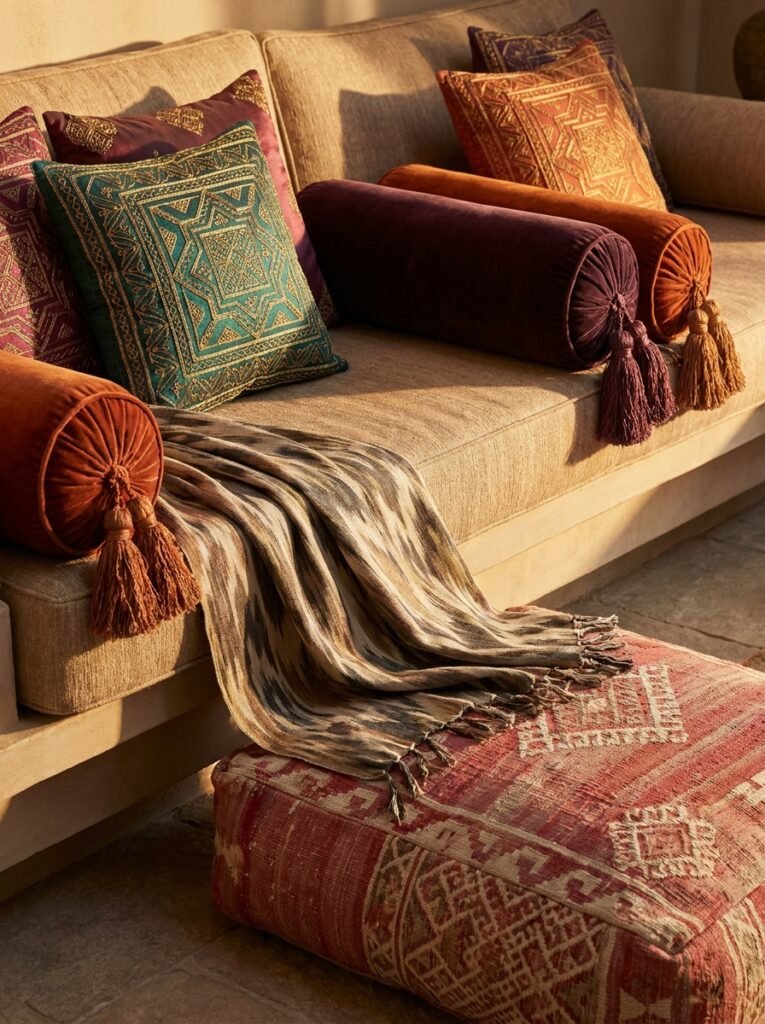
Imagine walking into a room where every surface invites touch — where the cushions are silk-embroidered, the throw draped over the divan has the slight roughness of handwoven wool, and the rug beneath your bare feet is so plush it feels like a small act of generosity. That is the textile experience of an Arabic style living room.
Textiles are not accessories in this design tradition — they are architecture. They define the space, absorb the sound, warm the walls, and layer the room into something that feels like a long-loved home rather than a showroom.
“In Arabic design, textiles aren’t decoration — they’re the room’s warmth made visible, its hospitality made tangible.”
Look for: embroidered silk or velvet cushion covers in jewel tones, kilim-style rugs with geometric borders, Moroccan wedding blankets (the famous handira, with their sequined texture), sheer muslin or linen curtains that filter afternoon light into something golden, and draped throws in rich, warm wool. The key is layering — cushions on top of cushions, rugs over rugs, textures that build on each other until the room feels genuinely opulent without feeling staged.
—
6. Moroccan Lanterns and the Art of Lighting an Arabic Room
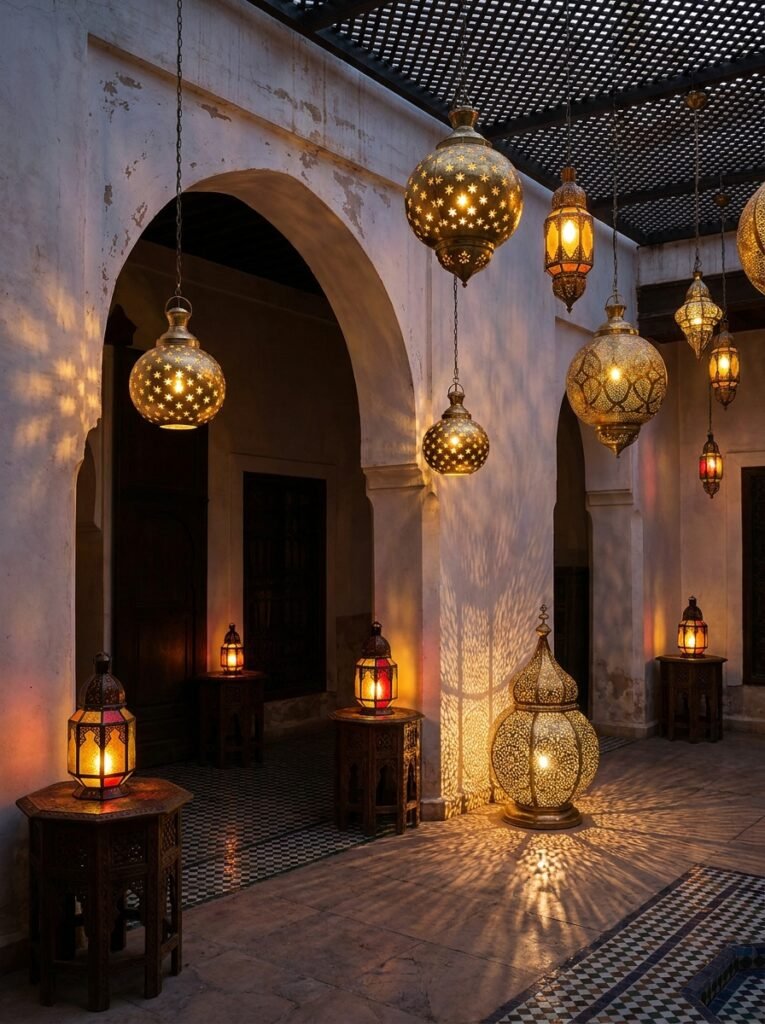
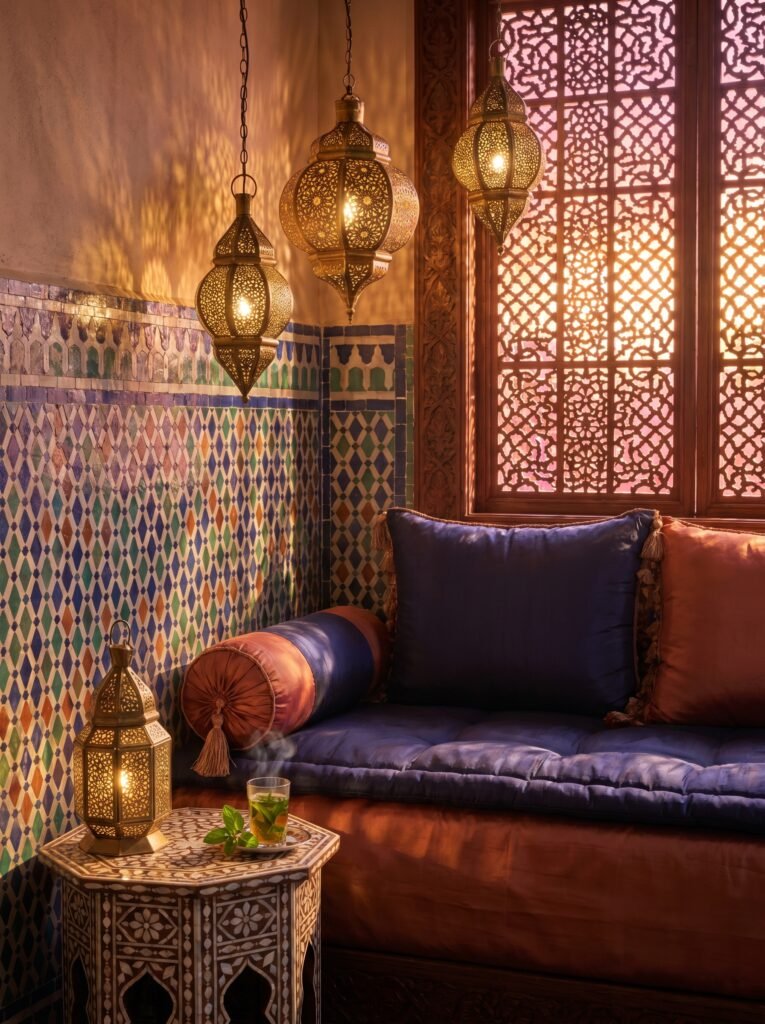
Few design elements are as transformative — or as reliably Pinterest-worthy — as Moroccan-style lanterns. Whether hanging from a ceiling in a cluster, placed on a low table, or standing tall in a corner, these hand-cut metal lanterns scatter geometric light across walls and ceilings in a way that no other light fixture can replicate. At night, an Arabic living room lit by lanterns becomes something close to magical — the patterns dance, the shadows deepen, and the entire space shifts into something intimate and otherworldly.
Authentic Moroccan lanterns are made from brass, copper, or silver-toned metal, with hand-cut geometric perforations and — in more ornate versions — colored glass panels in amber, red, or blue. Even inexpensive reproductions, when clustered thoughtfully, create a compelling effect.
Beyond lanterns, Arabic-inspired lighting includes: hammered brass pendant lights, candlelight in abundance (tea candles in metal holders across a low table create instant atmosphere), and uplighting that washes arched walls or decorative screens with warm, directional glow. The goal is always warmth over brightness — light that invites you to stay rather than light that insists you be productive.
—
7. The Furniture — Low, Layered, and Built for Lingering
Arabic style furniture philosophy is almost the opposite of contemporary Western design, which tends to elevate and minimize. Arabic furniture goes low and layers deeply. The majlis seating sits close to the floor, encouraging a relaxed, reclined posture. Coffee tables are low and wide. Floor cushions — tuffets and poufs in embroidered leather or kilim fabric — scatter across the rug for additional seating or footrests.
This lowness creates a room that feels grounded and unhurried — a room where no one feels the pressure to leave. In a modern context, you can approximate this philosophy without going fully traditional: a standard sofa paired with a very low coffee table, supplemented by floor cushions and poufs, achieves the layered, welcoming quality without requiring a complete architectural overhaul.
Look for carved wooden furniture with geometric inlay, brass-tipped legs, mother-of-pearl details, and painted or lacquered surfaces in deep jewel tones. A classic Moroccan arabesque side table — the kind with a hand-painted geometric top — is one of the single best investments you can make for this style.
—
8. The Role of Arches — Why Curved Architecture Changes Everything
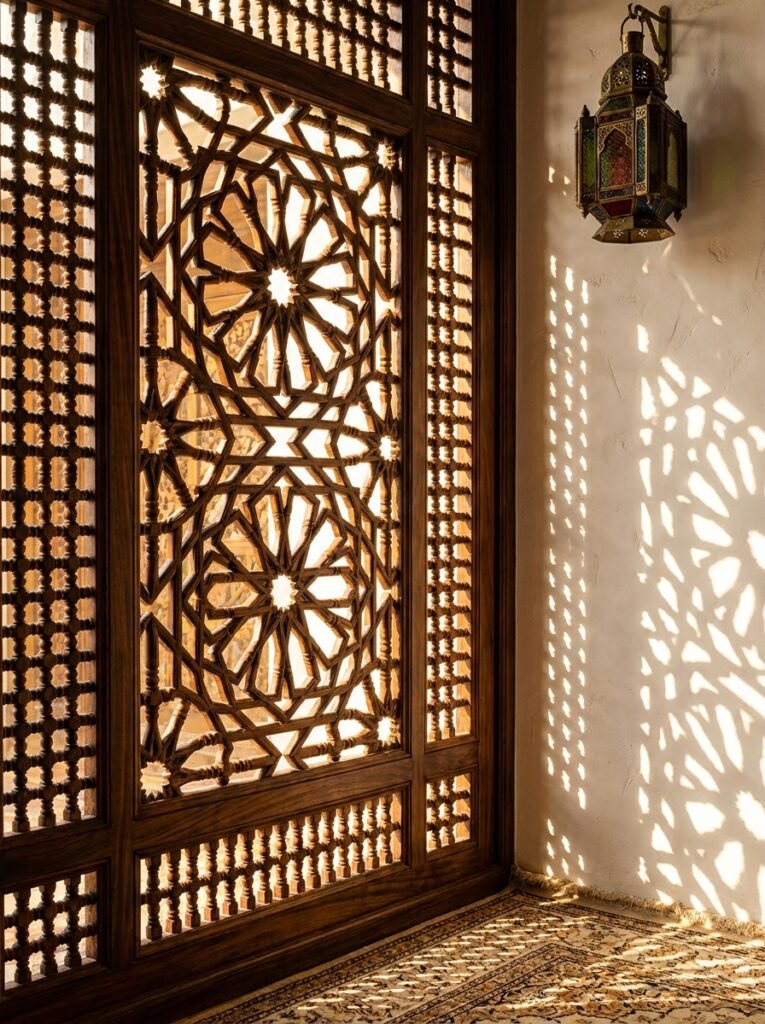
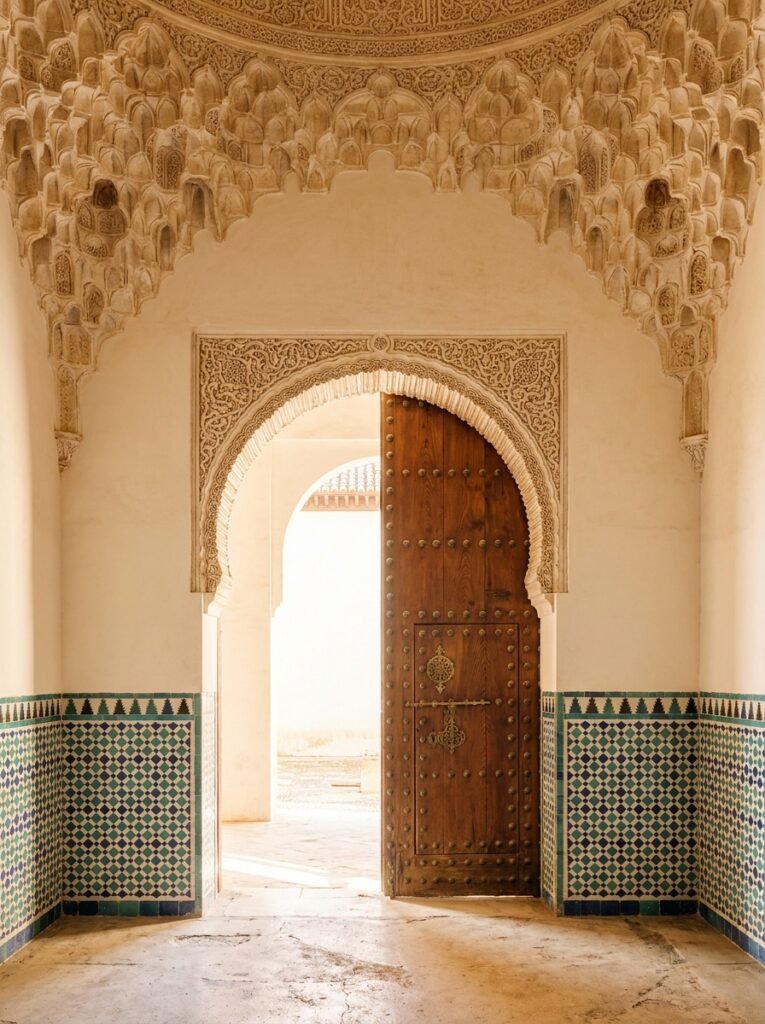
One of the most recognizable architectural features of Arabic design is the arch — specifically the horseshoe arch, the pointed ogee arch, and the muqarnas (the tiered, stalactite-like carved plaster ceiling feature found in the grandest examples of Islamic architecture). Even in a contemporary apartment, the suggestion of an arch changes the emotional register of a room entirely.
You don’t need to knock down walls. An arched mirror above the sofa, a Moorish-arch-shaped doorway frame made from painted MDF, a headboard or shelving unit that incorporates curved arches — all of these introduce the architectural language of Arabic design without structural changes. Arched windows, if you’re lucky enough to have them, can be dressed with sheer layered curtains to emphasize their shape rather than hide it.
—
9. Natural Materials — Bringing the Desert Landscape Indoors
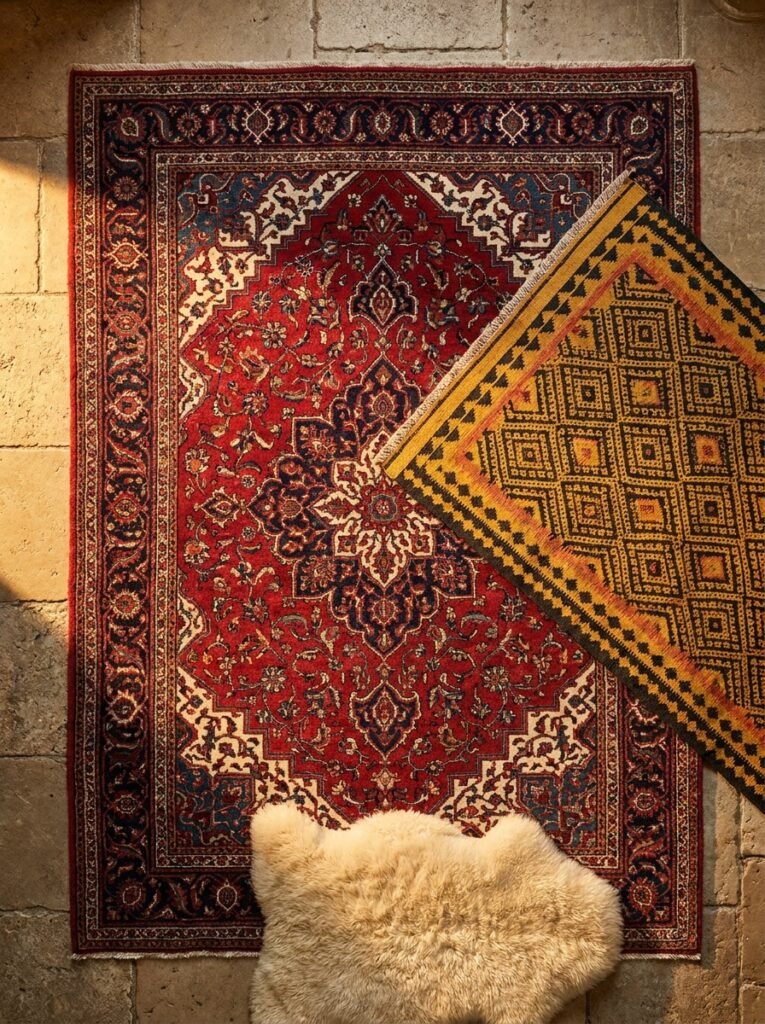
Arabic architecture has always been in dialogue with its landscape — the terracotta of desert earth, the cool stone of riads, the cedar wood of Moroccan mountain towns, the palm of the oasis. Bringing natural materials into an Arabic style living room grounds the richness of the textiles and metalwork in something elemental and real.
“The most beautiful Arabic interiors feel as though the desert, the mountain, and the sea all contributed something — and somehow, together, they make perfect sense.”
Terracotta pots (unglazed, rough-textured) with trailing plants or architectural succulents add organic life to the room. Cedarwood furniture or carved wooden screens bring warmth and scent. Zellige tiles — even as a panel behind a shelf or as a tray — introduce the color and texture of North African craft. Woven baskets, natural raffia, and unbleached cotton layer texture without adding visual noise.
The combination of these organic elements with the richness of embroidered textiles and polished metalwork is what gives an Arabic room its particular quality of balance — neither precious nor sparse, but deeply, confidently itself.
—
10. Scent, Sound, and the Sensory Layers of Arabic Hospitality
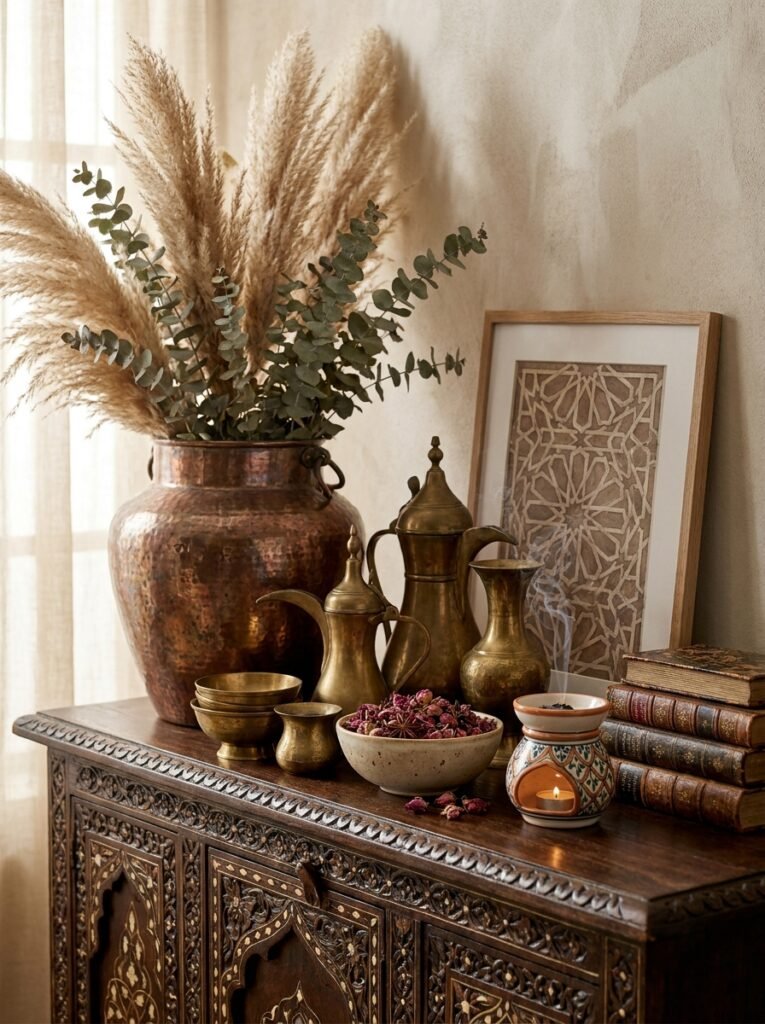
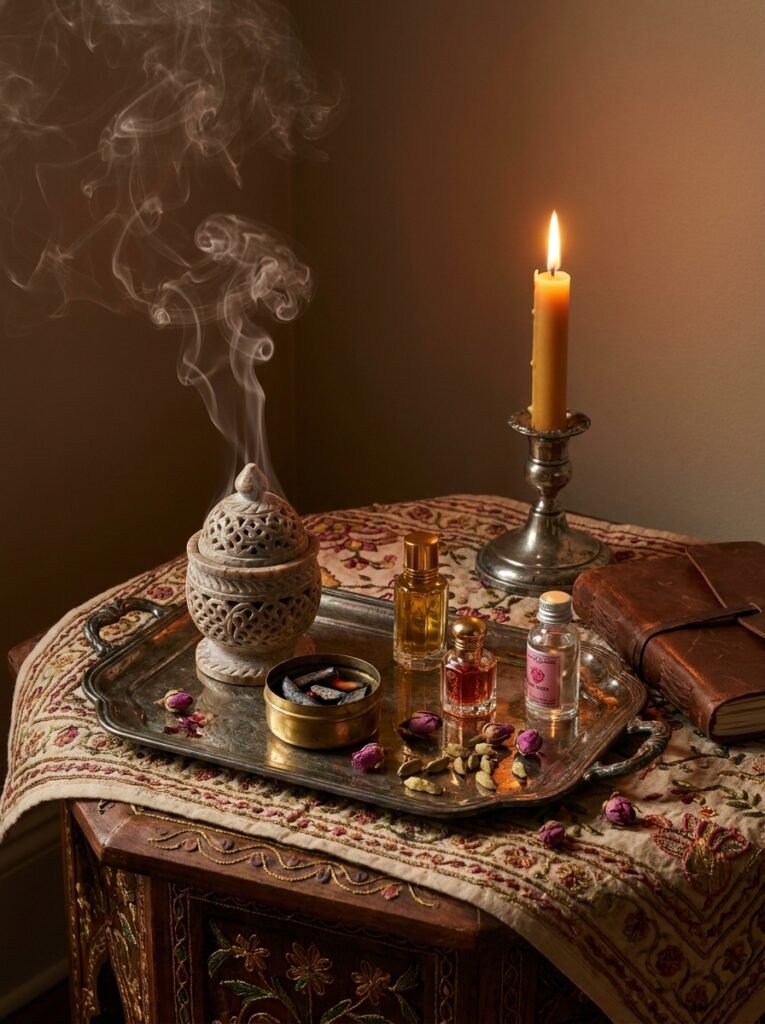
An Arabic style living room isn’t just a visual experience — it’s fully sensory. Traditionally, bakhoor (wood chips soaked in perfumed oils) was burned in ornate brass censers to scent the home and its guests as an act of welcome and honor. Oud incense, rose water, amber, and musk are deeply associated with Arabic domestic life — and incorporating scent into your living room is one of the most immediate and emotionally powerful design moves you can make.
A brass incense burner with oud chips, a diffuser with sandalwood or amber oil, a candle in a warm oriental fragrance — these details signal to everyone who enters the room that this is a space where hospitality is taken seriously, where arrival is celebrated.
Sound matters too. The tradition of Arabic music — the oud, the qanun, the gentle percussion of tabla — creates an auditory layer that deepens the atmosphere of any gathering in this kind of space. Even a softly played playlist can shift the mood of a room from aesthetically beautiful to genuinely transportive.
—
11. How to Modernize the Arabic Style Without Losing Its Soul
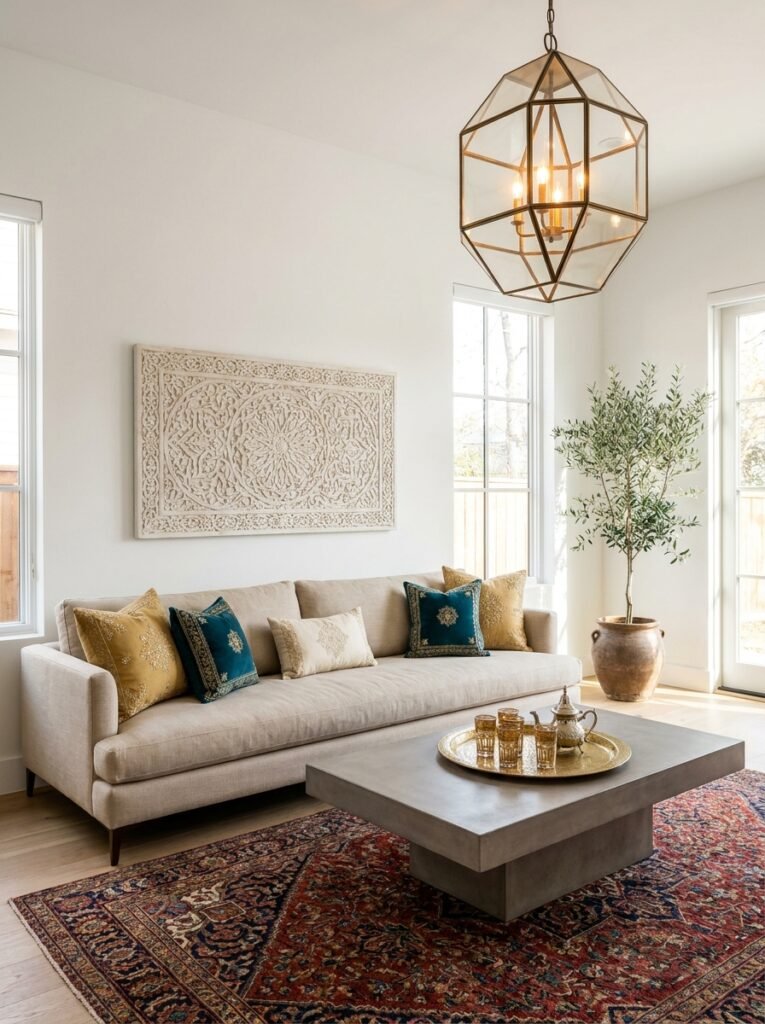
One of the most common anxieties about Arabic style decorating is that it will tip into cultural costume — a room that looks like a stage set rather than a home. The antidote to this is integration and restraint: choosing a few meaningful elements and letting them coexist with the contemporary bones of your actual living space.
A sleek, modern sofa in a neutral linen — grounded by a geometric Beni Ourain rug, flanked by a hammered brass side table, with a cluster of Moroccan lanterns overhead — is completely at home in a contemporary apartment. The Arabic elements don’t compete with the modern ones; they warm them, deepen them, and give them a cultural richness that flat contemporary minimalism often lacks.
The rule of thumb: choose quality over quantity, layer slowly, and let each piece breathe. An Arabic living room that feels overcrowded stops feeling like sanctuary and starts feeling like a souvenir shop. Restraint is elegance.
—
12. Where to Start — Your First Steps Toward an Arabic Style Living Room
Beginning this kind of design transformation doesn’t require a renovation budget or a trip to Marrakech — though the latter is never a bad idea. It starts with one anchor piece: perhaps a large geometric patterned rug in deep burgundy and ivory. From there, you build.
Add layered cushions in velvet and embroidered silk. Introduce a hammered brass tray table and fill it with small brass vessels and candles. Hang a cluster of Moroccan lanterns at varying heights from your ceiling. Drape a handira-style throw across the arm of your sofa. Place a carved wooden screen panel against a wall. Add a terracotta pot with an olive tree or trailing jasmine.
Step back. Look at what the room has become — how it holds light differently now, how the textures invite you closer, how the whole space seems to breathe with a warmth and a depth that was simply not there before. That is the power of Arabic style design done well: it doesn’t redecorate a room. It gives it a soul.
—
🌿 How to Care for Arabic Style Living Room Pieces
Arabic style décor often involves materials and craftsmanship that reward a little mindful care. Here’s how to keep your pieces beautiful for years:
Hammered brass and copper metalwork develops a natural patina over time — which is part of its beauty. To clean, use a gentle mixture of lemon juice and baking soda, then buff with a soft cloth. Avoid harsh chemical cleaners that strip the finish. For Moroccan lanterns, a dry microfiber cloth removes dust from the cut metalwork without scratching.
Handwoven kilim and Beni Ourain rugs should be rotated every few months to ensure even wear, especially in high-traffic areas. Vacuum gently without a beater bar, and spot-clean spills immediately with cold water and mild soap. Professional cleaning once a year keeps the fibers vibrant and prevents buildup.
Embroidered silk and velvet cushion covers respond best to hand washing or dry cleaning — never machine wash silk embroidery, as the threads can snag and distort. Store them away from direct sunlight to prevent fading of the jewel-tone dyes.
Carved wooden pieces — side tables, screens, and frames — benefit from occasional treatment with a natural wood oil or beeswax polish. This prevents drying and cracking, particularly in homes with air conditioning that reduces ambient humidity.
Finally, zellige tiles and terracotta surfaces should be sealed if used near areas of moisture or regular handling, as their porous nature can absorb stains. A quality tile sealant applied annually keeps them looking freshly crafted.
—
❓ FAQ
Q: Can I create an Arabic style living room in a small apartment? A: Absolutely — in fact, the low-seated majlis format actually works beautifully in smaller spaces because it creates a sense of intimacy rather than exposure. Focus on two or three key elements: a geometric rug, layered cushions in jewel tones, and a cluster of lanterns. These three changes alone will transform even a compact room into something genuinely evocative.
Q: Is Arabic style interior design expensive to achieve? A: It can be as affordable or as luxurious as your budget allows. Many of the most impactful elements — embroidered cushion covers, brass trays, geometric-print textiles — are widely available at accessible price points from homeware stores, online marketplaces, and import shops. The investment worth making is in one high-quality rug, which anchors everything else and genuinely elevates the entire room.
Q: How is Arabic style different from Moroccan or Bohemian design? A: Moroccan design is a specific regional expression of the broader Arabic and Islamic design tradition — it shares the geometry, the lanterns, and the zellige tiles, but has its own particular color palette and craft vocabulary. Bohemian style borrows freely from many global traditions including Moroccan, but is less architecturally grounded and more eclectic in its mixing. Arabic style, as a broader category, encompasses Moroccan but also Persian, Levantine, and Gulf traditions — and tends to carry more formality and refinement than pure Bohemian design.
—
💭 Final Thought
An Arabic style living room is not a trend — it is a tradition of beauty that has endured for over a thousand years precisely because it understands something deeply human: that the spaces we inhabit should honor the people inside them, that beauty is not a luxury but a form of nourishment, and that a room filled with warmth, pattern, and the soft glow of lantern light is a room that makes life feel richer. Every element of this design tradition began as an act of welcome.
So as you look around your own living room and imagine what it could become — what soul it could hold, what conversations it could host — ask yourself this: what would it feel like to walk into your home every single day and feel genuinely, deeply welcomed by the room itself?