

The Cozy Cottage Living Room: How to Create a Space That Feels Like a Long, Warm Hug
There’s a particular kind of magic that happens when you walk into a cottage living room that’s been done just right — the kind of room that makes your shoulders drop, your breath slow, and your whole body whisper finally. It’s not about perfection. It’s about feeling like the room was built specifically around human comfort, warmth, and the quiet joy of simply being home.

—
1. Why Cottage Living Rooms Feel So Different From Everything Else

Walk into a modern minimalist space and you might feel impressed — maybe even a little intimidated. Walk into a cozy cottage living room and something entirely different happens. You feel held.
That’s the fundamental difference between decorating for aesthetics and decorating for feeling. Cottage living rooms prioritize the latter. They’re layered with texture, soft with color, worn in all the right places — and they don’t apologize for any of it. There are throws folded imperfectly over armchairs. There are stacks of well-loved books on windowsills. There are candles that have actually been burned.
The cottage style traces its roots back to the small, charming countryside homes of England and New England — spaces where resourcefulness met beauty, where families lived fully and warmly inside modest square footage. Today, that aesthetic has become something of a cultural craving. After years of cold, sleek interiors and the pressure to live in spaces that looked more like showrooms than homes, people are turning back toward warmth. Toward softness. Toward realness.
“A cozy cottage living room doesn’t ask you to be smaller — it invites you to be fully, comfortably yourself.”
What makes this style so emotionally resonant is that it’s deeply human. It acknowledges that homes are lived in — and that’s not a flaw to hide, but a beauty to celebrate.
2. The Color Palette That Makes Everything Feel Warmer Instantly

Before you move a single piece of furniture or hang a single frame, start with color — because color is doing more emotional heavy lifting in your living room than almost any other element.
In cottage-style spaces, the palette is almost always rooted in nature. Think warm creams and aged whites, soft sage greens, dusty mauves, faded terracotta, and the kind of blue that reminds you of a cloudy morning sky. These aren’t stark, saturated shades — they’re quiet colors with depth, colors that look like they’ve been softened by years of sunlight coming through linen curtains.
The psychology here is deliberate. Cool, high-contrast color palettes activate alertness — which is exactly what you don’t want in a room designed for rest and connection. Warm, muted tones slow the nervous system down. They signal safety. Historically, these colors appeared in cottage homes because they were derived from natural pigments — clay, chalk, plant dyes — but the effect on the human brain is timeless and very, very real.
If you’re painting walls, consider warm off-whites like linen or parchment rather than stark bright white. Pair them with woodwork in soft sage or a dusty, chalky blue for that quintessential cottage contrast. On accent walls or in small cozy corners, a deeper tone — a warm mushroom brown or a moody sage — can make a corner feel like it’s wrapping its arms around you.
3. Furniture That Looks Like It Has a Story to Tell
Here’s the thing about cottage living room furniture that separates it entirely from other design styles: it doesn’t need to be new. In fact, the more character it has, the better.
Think about a wide, deep sofa upholstered in a faded linen slipcover — the kind that’s been washed so many times it has that perfect, soft drape. Or a wooden coffee table with legs that have small nicks and a surface that bears the faint ring of a hundred mugs set down without a coaster. These imperfections aren’t design failures. They’re the point.
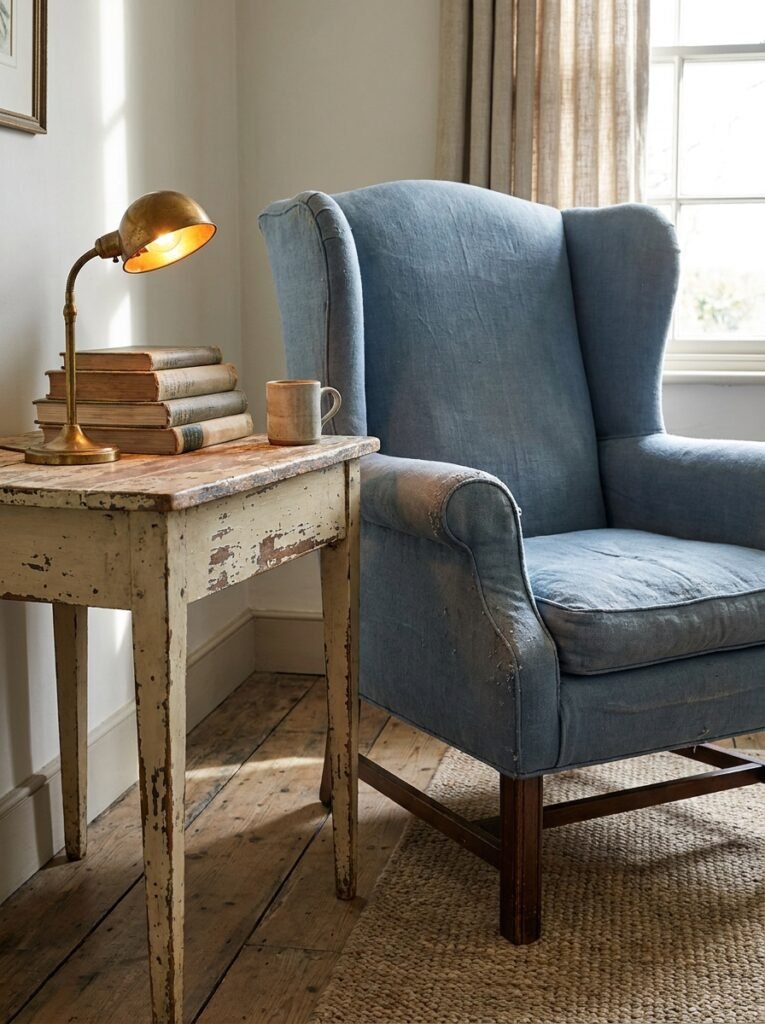
Cottage interiors have always celebrated what the design world calls “patina” — the beautiful aging of materials over time. A distressed wooden side table, a painted armchair with slightly worn corners, a vintage leather footstool — these pieces carry a sense of history that brand-new furniture simply cannot replicate. And that history makes a space feel inhabited, loved, and safe.
When shopping for cottage living room furniture, the best sources are estate sales, thrift stores, antique markets, and your own storage. Pieces don’t need to match — they just need to share a sense of warmth, scale, and a certain quiet, unhurried beauty. If everything matches perfectly, it starts to feel like a furniture catalog. Mix and mismatch with intention.
4. The Role of Natural Texture — and Why It Matters More Than You Think

If color is the emotional foundation of a cozy cottage living room, texture is the language it speaks. And in a cottage space, you want texture to speak loudly.
Layer woven baskets with soft wool throws. Combine rough linen cushion covers with a velvet pillow in a complementary shade. Lay a jute rug underneath a plush sheepskin. Put a smooth ceramic vase next to a wooden bowl full of pine cones or dried botanicals. This layering of textures — rough against soft, matte against slightly sheen — creates visual warmth that photographs beautifully and feels extraordinary in person.
Natural materials are especially important here: cotton, linen, wool, jute, wood, stone, and clay. Synthetic materials often look flat and cold, even when they’re warm in tone. Natural fibers carry light differently — they have depth, shadow, and movement — and they age gracefully, which feeds right back into that cottage philosophy of celebrating the beauty in imperfection.
A tactile living room is also a more emotionally comforting one. Researchers studying sensory comfort have found that environments rich in natural textures lower stress responses and promote feelings of safety. So when you’re layering that chunky knit throw over the arm of your sofa, you’re not just styling — you’re genuinely creating a more calming, restorative space.
5. Windows, Light, and the Art of Letting the Outside In
There’s a reason cottage living rooms always feel so beautifully lit — and it’s not because they have great overhead lighting. It’s because they are deeply intentional about natural light.
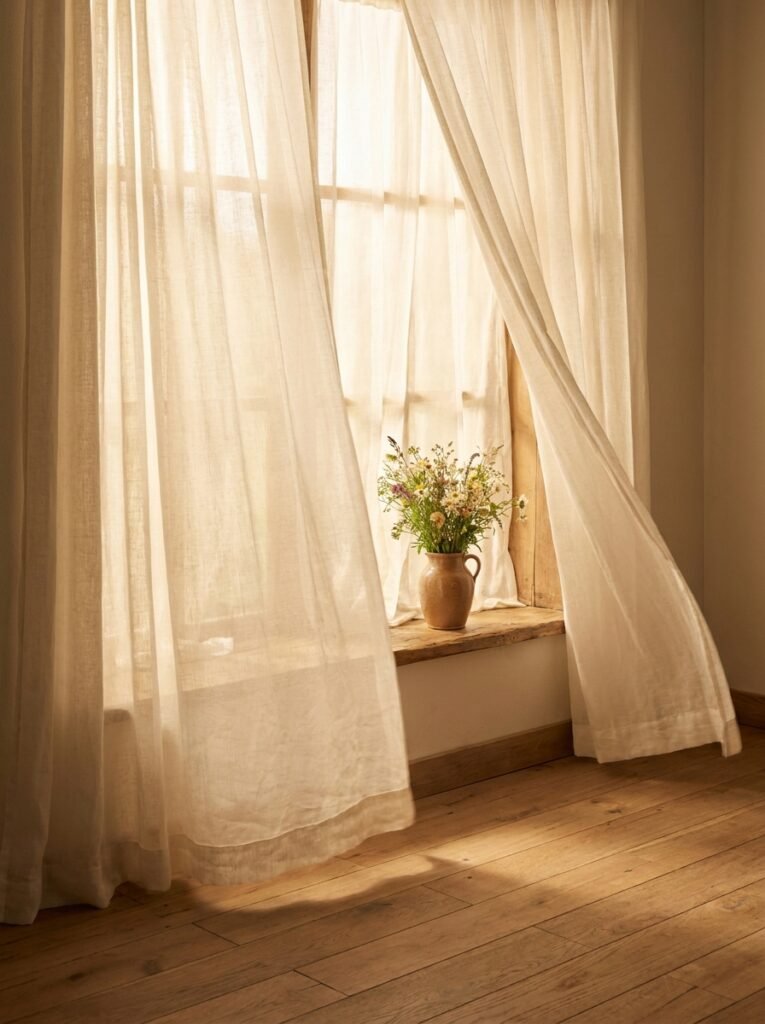
The classic cottage window treatment is soft, floaty, and unlined: white or cream linen panels that diffuse sunlight into that golden, honeyed glow rather than blocking it out entirely. Heavier curtains can make a small cottage room feel like a cave. Lightweight panels keep it feeling open, airy, and connected to the garden or the landscape just beyond the glass.
“Natural light doesn’t just illuminate a room — it breathes life into it, makes colors sing, and turns ordinary moments into something almost sacred.”
If your living room doesn’t have an abundance of natural light, the answer isn’t to compensate with harsh overhead fixtures. Instead, layer warm, low lighting: floor lamps with fabric shades, table lamps with amber bulbs, strings of warm fairy lights tucked along a bookshelf or over a mantle, and always — always — candles. The flicker of a candle flame in a cottage living room is not decorative. It’s deeply primal. It signals warmth, safety, gathering, and home.
6. The Fireplace as the Emotional Heart of the Room

If you are fortunate enough to have a fireplace in your cottage living room, everything you do in that space should radiate outward from it — because the fireplace isn’t just a heat source. It is the soul of the room.
The arrangement of furniture in a cottage living room should always honor the fireplace as the focal point. Two armchairs angled slightly inward, facing the hearth. A sofa positioned close enough to feel the warmth on a cold evening. A low coffee table between them, close enough to rest a mug without stretching.
The mantelpiece deserves its own careful attention. A collection of mismatched candlesticks in varying heights. A heavy wooden clock. A hand-thrown ceramic vase with dried lavender or cotton stems. A framed mirror to reflect light back into the room. A string of greenery draped softly across the mantle shelf. Nothing should look too curated — it should look like it was gathered slowly over time, by someone with quiet, certain taste.
For rooms without a working fireplace, consider a decorative firebox, a candle-filled fireplace insert, or simply treat the chimney breast or a prominent wall as your focal anchor and arrange the room around it anyway.
7. Books, Botanicals, and the Small Details That Change Everything
Scroll through any collection of cottage living room images on Pinterest and notice something: they are full of small, specific, personal details — and those details are what makes you stop and save every single one.
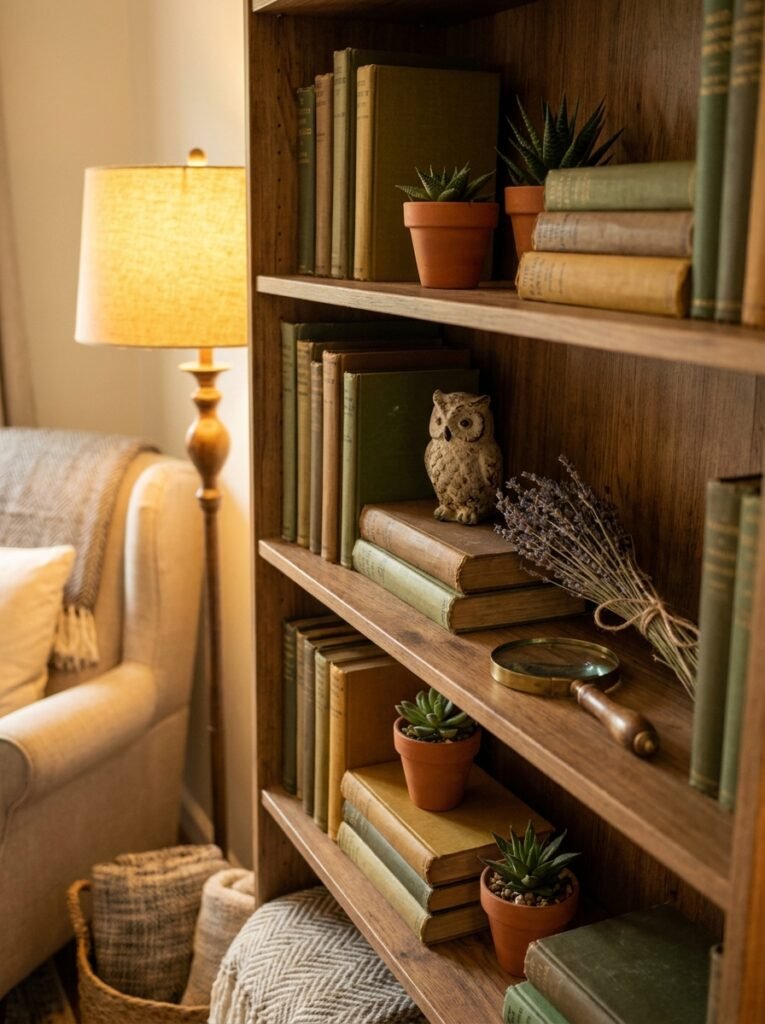
Books are perhaps the most powerful cottage styling tool available. Not arranged by color (though that can look beautiful) but arranged by life — stacked horizontally on some shelves, standing vertically on others, interspersed with small objects and plants. Books signal that people actually live here, that they read, that they gather ideas and stories. They add depth and personality that no purely decorative item can match.
Botanicals — both living and dried — bring the outside in, which is a cornerstone of cottage philosophy. A sprawling pothos trailing from a high shelf. A single stem of eucalyptus in a ceramic jug. A bunch of dried wheat or lavender tied with cotton string and hung from a beam. A windowsill lined with terracotta pots of herbs: rosemary, thyme, mint. These small gestures of nature make the air feel different, the room feel alive, and the space feel genuinely inhabited.
8. Rugs That Ground the Space and Tie the Whole Room Together

A living room without a rug often feels like a conversation that never quite finishes — something is missing, the room floats, and comfort doesn’t fully land. In a cottage living room, the rug is doing enormous work.
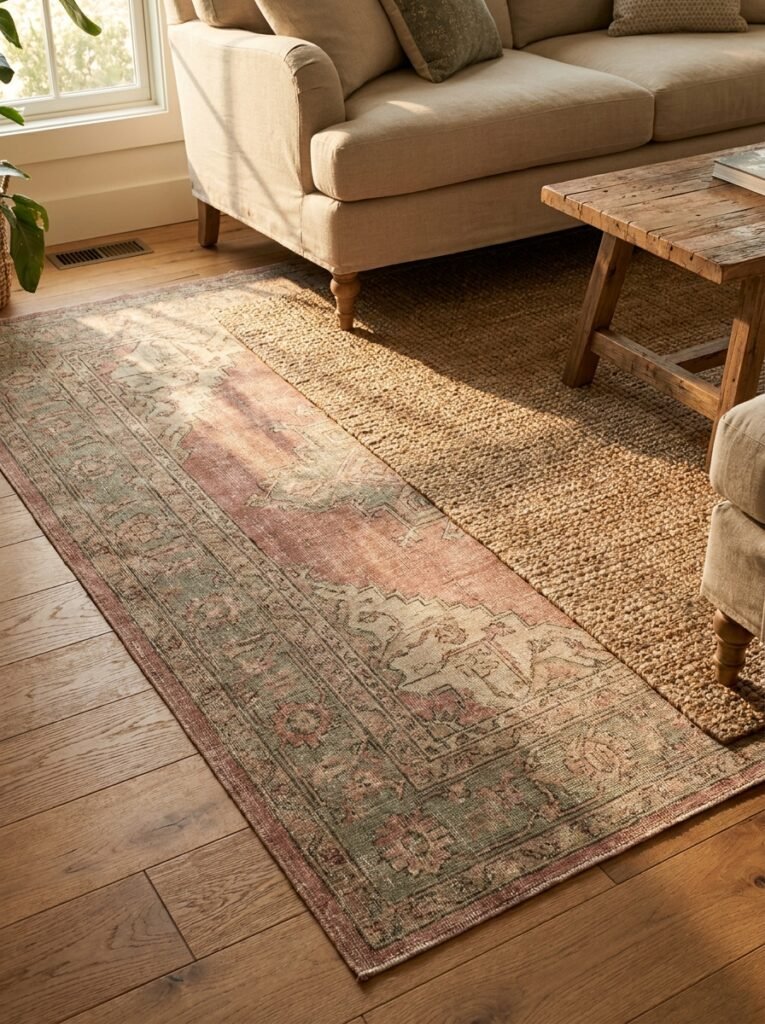
The right cottage rug is typically natural in fiber: jute, sisal, or wool. It might be a faded Turkish kilim picked up at an antique fair. It might be a vintage Persian-style wool rug with roses and vines worn soft by years of footsteps. It might be a simple, textured cotton flatweave in warm cream or oatmeal. What it almost never is, is a sharp, high-pile synthetic rug in a bold geometric pattern — that energy contradicts everything the cottage interior is trying to create.
Scale matters enormously. A rug that’s too small for a living room makes the furniture look like it’s floating on a life raft. The front legs of all seating pieces should sit on the rug, anchoring everything into a unified, grounded arrangement. Get the size right and the whole room will suddenly feel more intentional, more harmonious, more finished.
9. The Cozy Corner Principle — Every Cottage Room Needs One
One of the most beloved and most-pinned elements of any cottage living room is the cozy reading corner — and it deserves its own dedicated section because getting one right can transform not just a corner of your home, but how you actually spend your time within it.
“A well-designed cozy corner doesn’t just look inviting — it becomes the most-used, most-loved spot in your entire home.”
The formula is simple: one generous armchair (deep, soft, with wide arms to rest a book or a mug), a floor lamp positioned just over the shoulder, a small side table at arm’s reach, a basket of throws nearby, and something living — a plant, a trailing vine, a window with a view of the garden — to keep the corner feeling connected to the natural world.
This corner should feel deliberately apart from the main social seating of the room — a retreat within a retreat. It should signal, visually and emotionally, that this is a place for slowness. For reading, for thinking, for the quiet kind of Saturday mornings that feel like a gift.
10. Styling the Coffee Table Like a Cottage Creative

The coffee table is the center of daily life in a living room — it’s where mugs get set down, books get opened, candles get lit, and small objects find their temporary resting place. Styling it well, in a cottage context, means resisting the urge to make it look like a magazine shoot and instead making it look like someone wonderful lives here.
A loose stack of books — two or three, different sizes. A small tray holding a candle, a tiny vase of dried flowers, and perhaps a smooth stone or a hand-thrown ceramic piece. A bowl of seasonal fruit or a cluster of pine cones. A half-finished cup of tea placed casually at the corner. This is not mess — this is life, and in a cottage living room, life is the most beautiful decoration of all.
11. Seasonal Styling and the Magic of Changing Your Space With the Year

One of the most practical and deeply satisfying things about a cottage living room is how naturally it lends itself to seasonal decoration — because the cottage aesthetic is rooted in nature, and nature changes constantly.
In autumn, swap your linen throws for chunky wool knits in burnt orange and deep rust. Bring in dried seed heads, cinnamon-scented candles, and a bowl of foraged pinecones. In winter, pile the sofa with every soft thing you own, turn every lamp on by three in the afternoon, and let the space become a fortress of warmth against the cold. In spring, bring in fresh florals, lighter textiles, open the windows, and let the curtains breathe. Summer calls for simple, airy arrangements — cotton, white, green, the smell of cut flowers from the garden.
This practice of seasonal restyling doesn’t require spending money. It requires attention — to the natural world outside, to how the light has changed, to what your body and spirit are craving. That attentiveness is itself deeply cottagecore in spirit.
12. The Feeling You’re Really Designing For
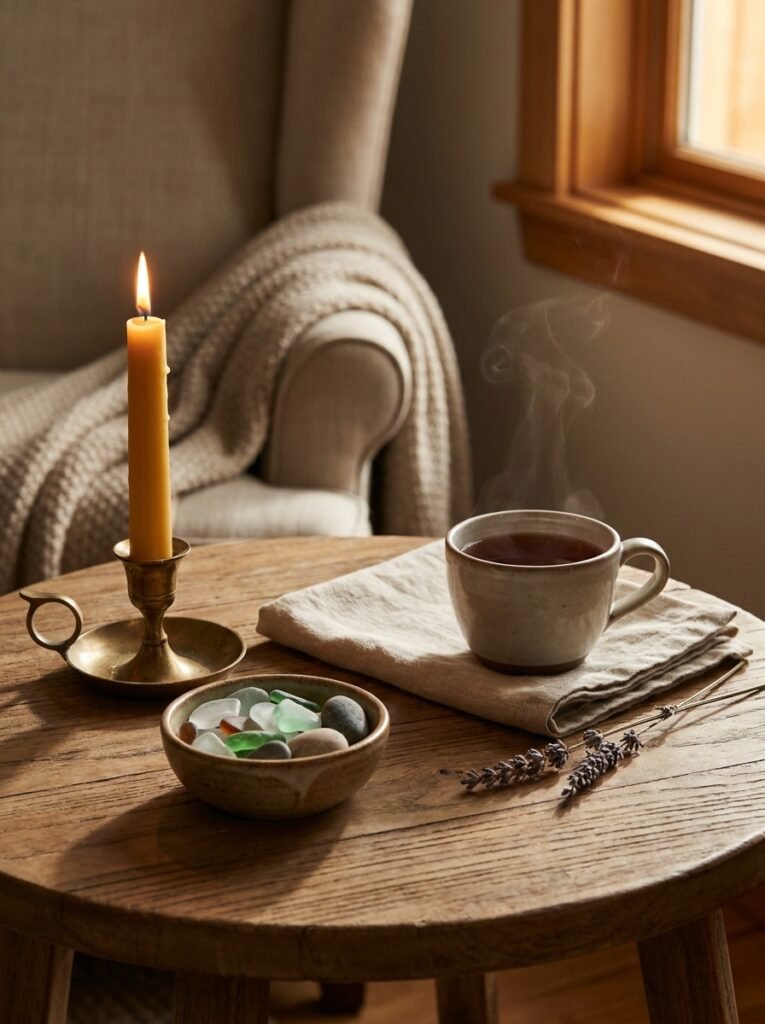
After all the rugs and the linen curtains and the mismatched furniture and the candles and the books — after all of it — here is the essential truth about designing a cozy cottage living room: you are not designing a room. You are designing a feeling.
That feeling is safety. Slowness. Warmth. Belonging. The feeling of a Sunday afternoon that stretches out in front of you with no particular agenda. The feeling of rain against the windows and a warm mug between your palms. The feeling of a home that welcomes you back every single time you walk through the door, without condition or judgment.
Every element you choose — every color, every texture, every candle, every imperfect piece of furniture — should be in service of that feeling. And when the room is finished and you stand in the doorway and your shoulders drop and your breath slows, you’ll know you got it exactly right.
—
🌿 How to Take Care of Your Cottage Living Room
Maintaining that cozy, effortless feeling takes a little ongoing intention — but it’s genuinely enjoyable once it becomes part of your rhythm.
Refresh your botanicals regularly. Dried flowers and branches look beautiful but lose their magic when they get dusty or faded — replace them seasonally to keep the room feeling alive.
Rotate and wash your textiles. Linen and cotton covers, throws, and cushion cases all look better when they’re regularly laundered and re-draped rather than just plumped. A freshly washed linen throw has a softness that’s impossible to manufacture otherwise.
Edit rather than add. Cottage rooms live or die by their layers, but layering can tip into clutter. Every few months, step back with fresh eyes and ask which objects are earning their place — and which ones are just taking up space that could breathe.
Light candles regularly, not just for company. The smell, the flicker, and the warmth of a regularly lit candle changes the atmosphere of a room in a way that’s surprisingly powerful and deeply connected to the cottage spirit.
Keep the floor clear. No matter how layered and textured the surfaces around it are, a clear floor makes a small cottage room feel generous and open. Baskets are your best friend for storing everyday items without sacrificing the visual calm.
—
❓ FAQ
Q: Can I create a cozy cottage living room in a modern apartment or rental? A: Absolutely. The cottage aesthetic is more about layering texture, choosing warm colors, and gathering meaningful objects than it is about architectural features. Removable wallpaper, layered rugs over existing flooring, slipcover sofas, and warm lighting can transform almost any space — and most elements are completely renter-friendly.
Q: What’s the difference between cottage style and farmhouse style in a living room? A: Both share a love of natural materials and a relaxed, lived-in quality, but cottage style tends to be softer, more romantic, and more layered — with florals, vintage pieces, and a more eclectic mix of objects. Farmhouse style typically leans more toward clean lines, rustic wood, and an airier, more neutral palette. Cottage rooms feel collected over time; farmhouse rooms often feel more intentionally curated.
Q: How do I make a small living room feel cozy without making it feel cramped? A: The key is choosing furniture that’s appropriately scaled — not oversized pieces that crowd the room, but pieces that are generous enough to feel comfortable. Use light, warm colors on walls to open the space up, layer rugs to define the seating area, and resist the urge to fill every surface. Strategic coziness comes from depth of texture, not volume of stuff.
—
💭 Final Thought

A cozy cottage living room is never really finished — and that’s exactly what makes it so alive. It grows with you, shifts with the seasons, collects the evidence of a life fully and warmly lived. It is, at its heart, a daily act of self-care disguised as interior design.
So here’s the question I want to leave you with: when you close your eyes and imagine your most comforting, most beautiful, most you version of home — what does it actually feel like, and what’s one small thing you could do today to bring your living room one step closer to that?