
The Chandelier That Changed Everything: How One Light Fixture Can Transform Your Entire Living Room
There’s a moment — you know the one — when you walk into a living room and something just feels different. Not the furniture, not the paint color, not even the rug. It’s the light hanging above it all, casting warmth across the room like a quiet invitation to stay a little longer. A chandelier in a living room doesn’t just illuminate a space. It defines it.
—
1. Why a Chandelier Belongs in the Living Room (Not Just the Dining Room)
For decades, chandeliers lived almost exclusively above dining room tables — a fixture so tied to formal entertaining that most people never considered bringing one into the living room. That thinking has shifted dramatically, and for good reason.
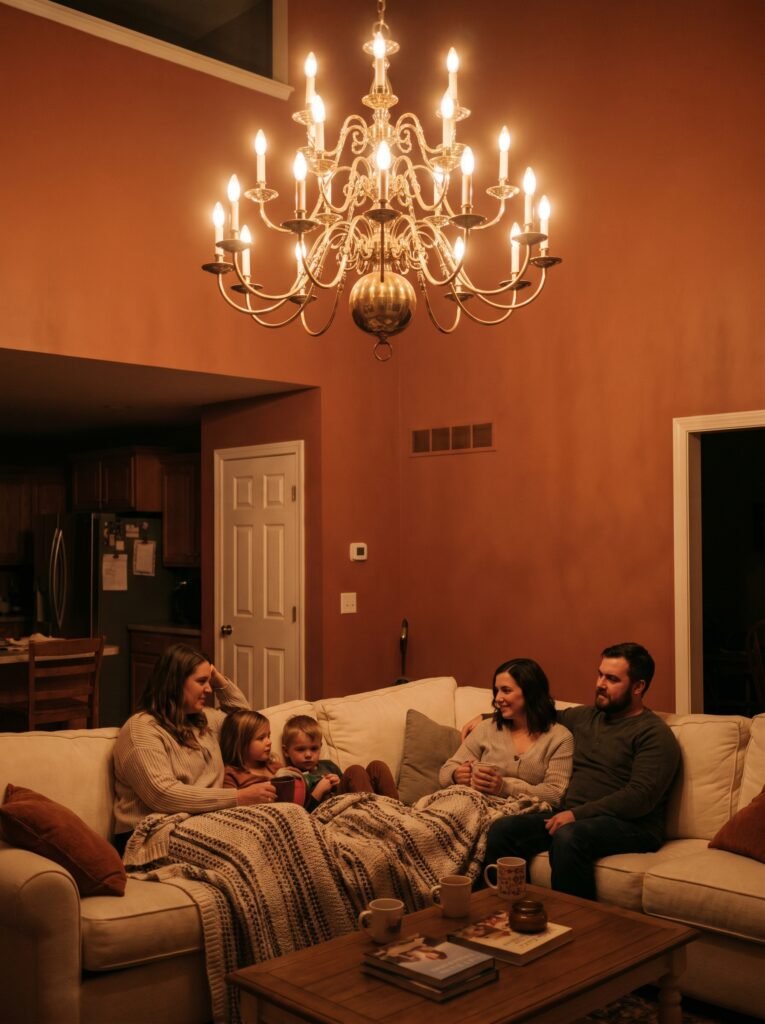
The living room is arguably the most personal space in your home. It’s where you collapse after a long day, where your kids pile onto the couch for movie night, where you host friends and let conversations run long past midnight. A chandelier in that space does something overhead lighting simply cannot: it creates atmosphere. It transforms a functional ceiling into a design statement.
Interior designers consistently point to overhead lighting as one of the most underestimated elements in living room design. Most people rely on floor lamps and table lamps — which are wonderful — but without a strong anchor of light above, even a beautifully furnished room can feel slightly unfinished. A chandelier provides that anchor, pulling the eye upward and giving the room a sense of vertical depth that makes even standard eight-foot ceilings feel grander.
“A chandelier doesn’t just light a room — it gives the room a soul.”
The best part? You no longer need a formal or traditional space to justify a chandelier. From rustic farmhouses to sleek modern apartments, there is a chandelier style designed specifically to live in your living room and make it feel like home.
—
2. The Psychology of Light: Why It Matters More Than You Think
Before you even start shopping for a fixture, it’s worth pausing to understand what light actually does to us emotionally and psychologically — because the way a chandelier scatters light is deeply connected to how a room makes you feel.
Warm-toned light, typically in the 2700K to 3000K range, triggers a sense of safety and relaxation. It’s the color temperature closest to candlelight and firelight, the kinds of light humans have gathered around for thousands of years. When a chandelier throws that warm glow across your walls and furniture, your nervous system subtly responds with a release of tension. That’s not poetic exaggeration — it’s neurological fact.
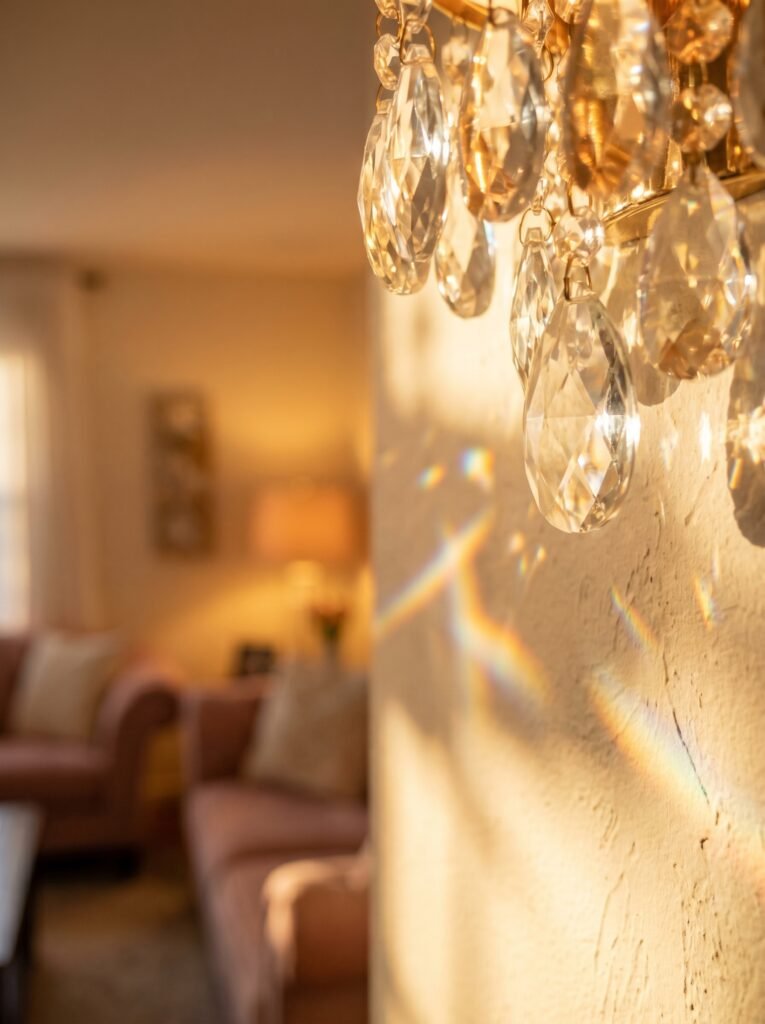
A chandelier also plays with light in ways that a recessed can or a flat flush mount never can. Crystal pendants refract light into dancing patterns. Matte black iron frames cast dramatic shadow lines. Rattan and wicker shades diffuse light into soft, honeyed circles. Each of these effects tells a different emotional story in your room — and understanding what you want your living room to feel like is the first step to choosing the right fixture.
—
3. How to Measure Your Living Room for the Perfect Chandelier Size
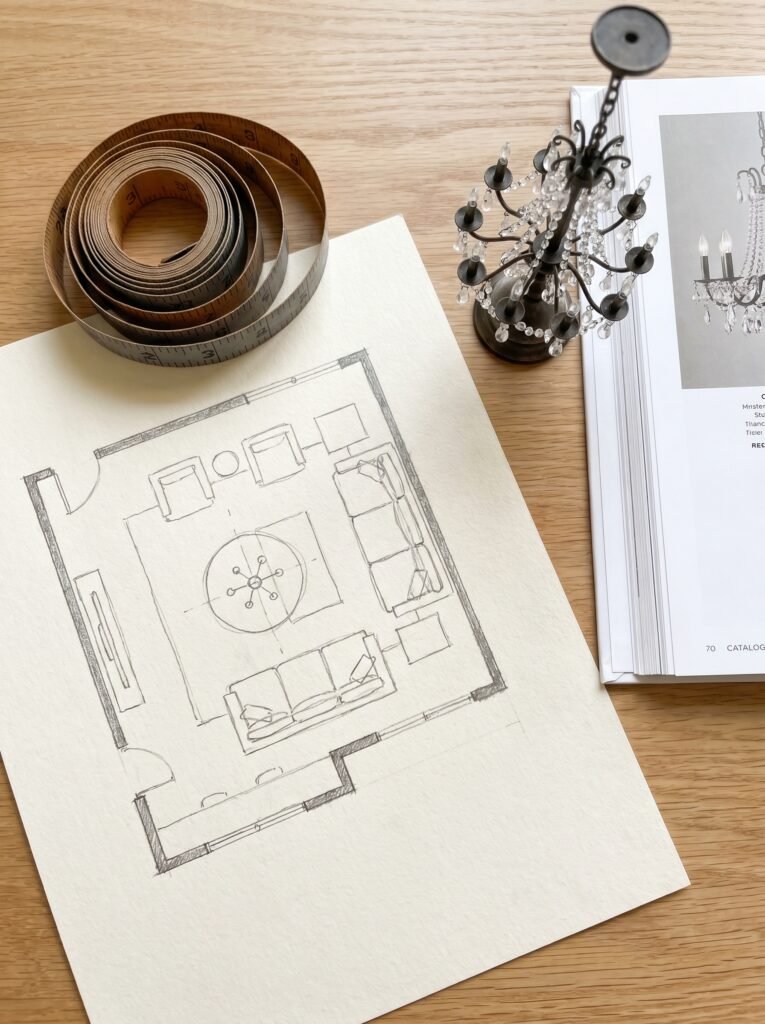
Nothing derails a beautiful chandelier moment faster than a fixture that’s the wrong size. Too small, and it looks like a lost earring floating in the middle of your ceiling. Too large, and it becomes an overwhelming presence that crowds the room.
The most reliable sizing formula used by professional designers is elegantly simple. Add the length and width of your room together in feet, and that number in inches gives you the ideal chandelier diameter. So a living room that is 14 feet by 18 feet would call for a chandelier roughly 32 inches in diameter. This isn’t a rigid rule, but it’s a remarkably accurate starting point.
Height matters just as much. In a living room without a dining table beneath the chandelier, you have more flexibility — but the general guideline is to keep the bottom of the fixture at least seven feet from the floor to maintain a comfortable sense of openness. In rooms with higher ceilings, you can go higher, and in fact should — a chandelier hung too low in a tall room loses its visual impact and can make the space feel choppy rather than soaring.
—
4. The Living Room Chandelier Styles That Are Dominating Pinterest Right Now

Pinterest search trends are a remarkable window into what people genuinely love and want in their homes — and living room chandeliers have been surging in saves and clicks for good reason. Several styles are leading the moment right now.
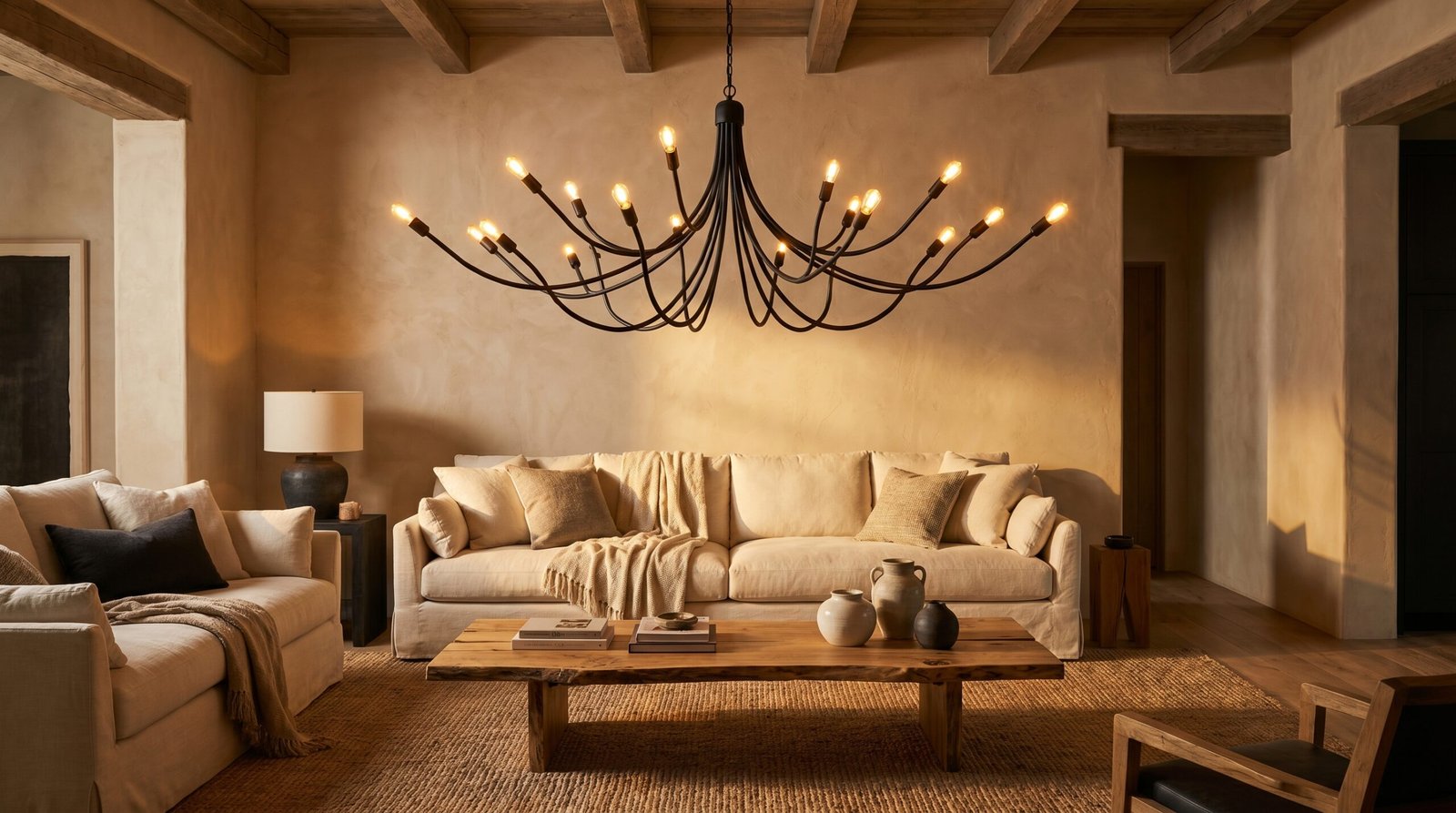
Sculptural black iron chandeliers with organic, branching forms have become a staple of modern farmhouse and transitional interiors. They’re bold without being fussy, and they pair beautifully with both warm wood tones and crisp white walls.
Rattan and woven chandeliers bring texture and an organic warmth that feels simultaneously casual and intentional. They work particularly well in boho, coastal, and eclectic interiors, and their natural materials photograph beautifully — which explains why they dominate lifestyle feeds.
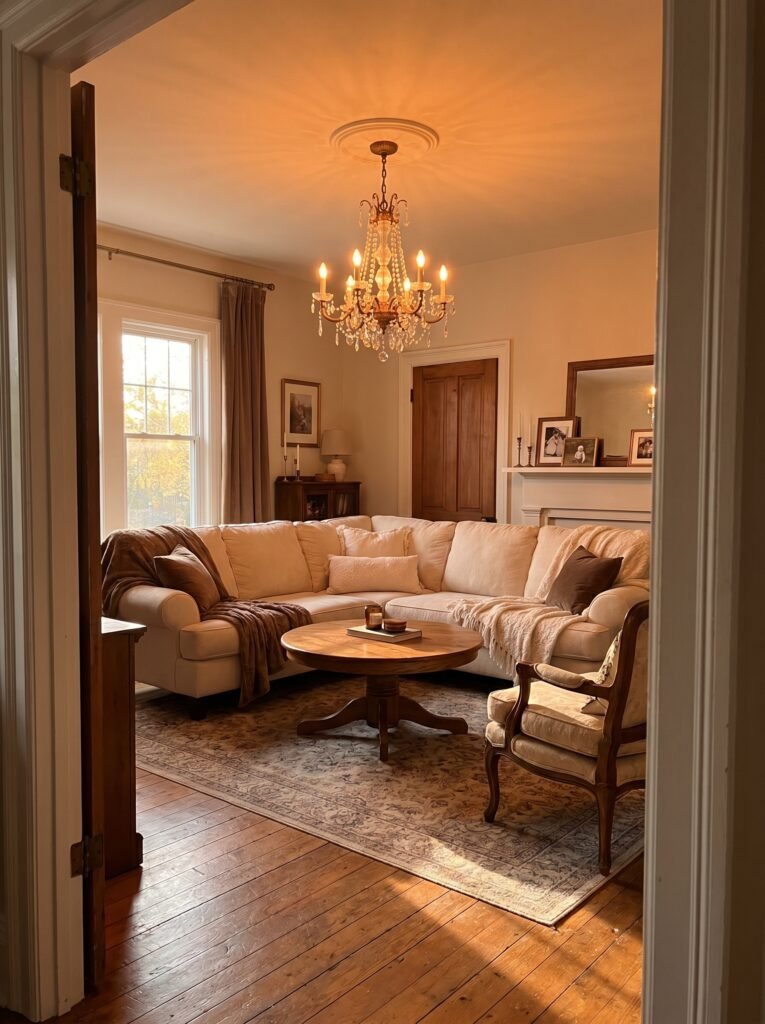
Tiered crystal chandeliers are experiencing a genuine renaissance, but with a modern twist. Rather than the ornate, gilded versions of decades past, today’s crystal fixtures tend toward cleaner lines and simpler silhouettes that feel elegant without tipping into fussy territory.
Globe and bubble chandeliers — clusters of glass spheres in smoke, amber, or clear tones — add a playful sculptural quality that works especially well in contemporary and mid-century modern spaces.
—
5. Matching Your Chandelier to Your Living Room’s Design Language
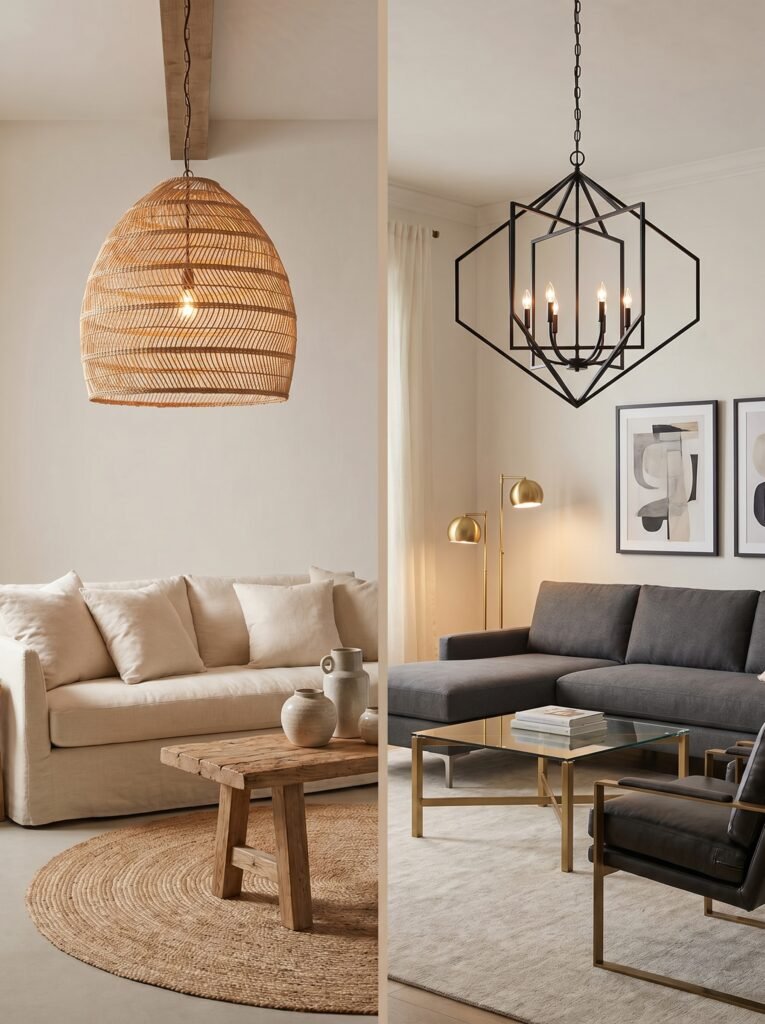
Here is where many people stumble: choosing a chandelier they love in isolation, only to bring it home and find it fighting with everything else in the room. A chandelier should feel like the natural conclusion of the design story your room is already telling.
In a room built around natural textures — linen sofas, jute rugs, raw wood coffee tables — a woven rattan or driftwood chandelier will feel completely at home, as though it grew there organically. In a room with clean-lined furniture, matte finishes, and a restrained color palette, a sculptural metal chandelier in brushed brass or matte black will feel like punctuation — exactly the right visual emphasis.
Color matters more than most people realize. A brass chandelier warms up a cool-toned room. A black iron fixture provides visual weight and grounding in an airy, all-white space. A chrome or nickel finish keeps things light and sleek in a modern setting.
“Your chandelier should finish the sentence your furniture started.”
Don’t be afraid to let the chandelier be slightly unexpected — a moment of contrast can be the most interesting design choice you make. A rustic wooden chandelier in a mostly modern room adds warmth and personality. A crystal fixture in an otherwise casual, textured space adds a deliberate touch of glamour. Contrast, when done intentionally, is sophisticated rather than confused.
—
6. The Ceiling Height Conversation You Need to Have Before You Buy

Ceiling height is the single most important practical factor when choosing a living room chandelier, and it’s the detail most overlooked by people shopping online.
Standard eight-foot ceilings can absolutely accommodate a chandelier — but they call for lower-profile designs, often referred to as semi-flush chandeliers or flush-mount chandeliers with some drop. These fixtures give you the visual presence of a chandelier without consuming the vertical space that a long-drop pendant style would require.
Nine- and ten-foot ceilings open up the full range of options. You can work with longer drops and more elaborate silhouettes without any risk of the fixture feeling oppressive.
Vaulted, cathedral, or double-height ceilings call for statement fixtures with real vertical presence — large-scale chandeliers, sometimes with adjustable chain lengths, that can hold visual weight across a dramatically tall space. In these rooms, the temptation is to go too small. Resist it. A large, commanding chandelier in a soaring room is one of the most stunning effects in residential interior design.
—
7. Dimmer Switches: The Accessory Your Chandelier Desperately Needs
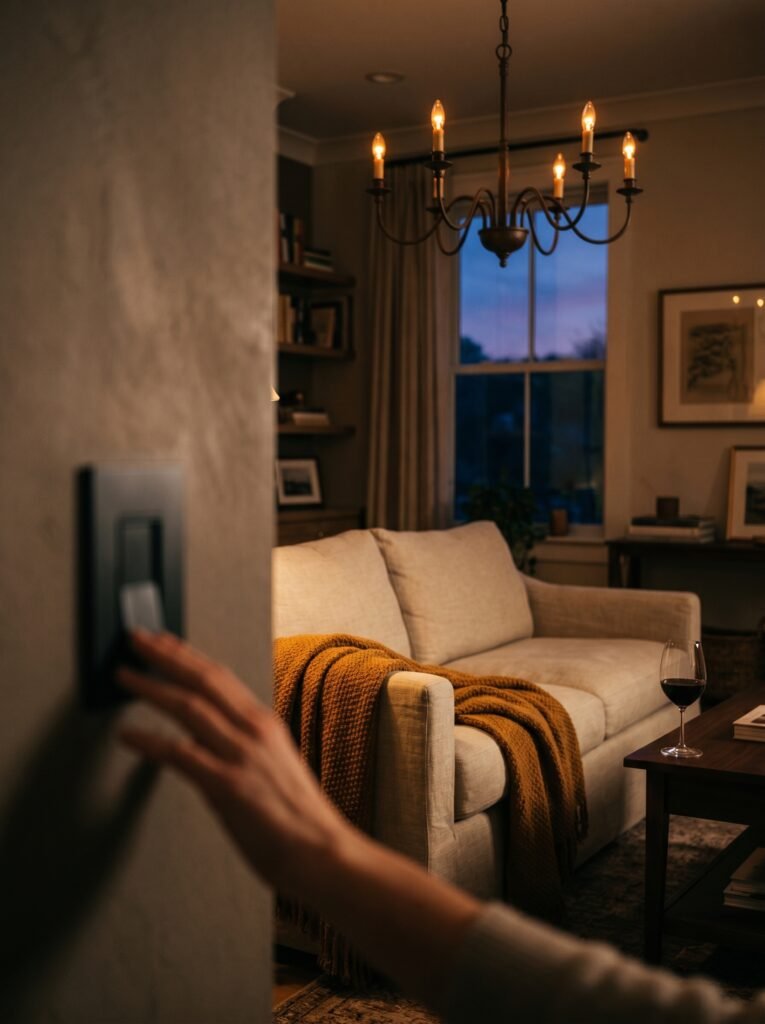
If you take one piece of practical advice from this entire article, let it be this: never install a living room chandelier without a dimmer switch. This is, without exaggeration, one of the highest-value upgrades in home design — costing very little but transforming the way you experience your living room completely.
A chandelier on full brightness serves its function. A chandelier dimmed to 40 or 50 percent on a quiet evening becomes something else entirely — something closer to a warm, private world. It’s the difference between a living room that’s lit and a living room that glows.
Most modern LED-compatible dimmers are straightforward to install and widely available. Many smart home systems allow you to control chandelier brightness with your phone or a voice assistant, which adds a genuinely convenient layer of ambiance control that quickly becomes one of those small daily luxuries you wonder how you lived without.
—
8. How Chandeliers Work With Other Light Sources in the Living Room
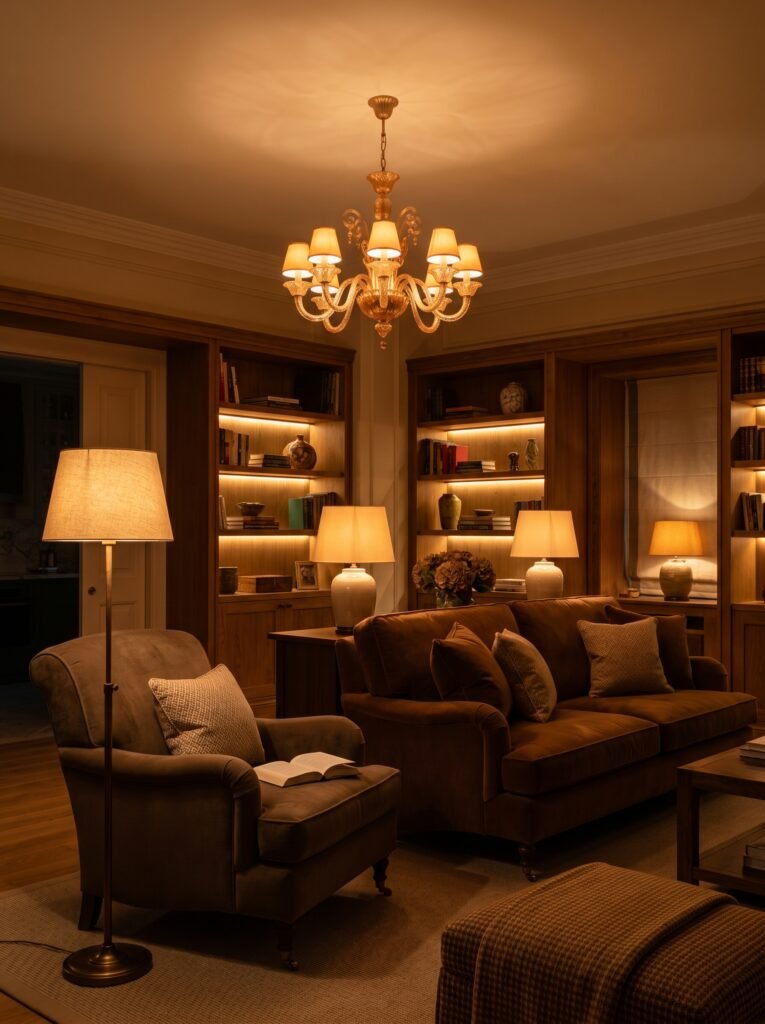
A chandelier is most powerful when it functions as part of a layered lighting plan rather than a standalone source. Lighting designers use the term “layered lighting” to describe the practice of combining ambient light, task light, and accent light in a single room — and a chandelier typically serves as the ambient, or general, layer.
What that means practically is that your chandelier pairs beautifully with floor lamps positioned near reading chairs, table lamps on side tables and consoles, and accent lighting like picture lights or under-shelf LEDs. When all these sources are on together at varying intensities, the living room achieves a depth and richness that a single light source simply cannot create.
“Layered light is the invisible architecture of a beautiful room.”
Think of your chandelier as the conductor of your lighting orchestra — it sets the overall tone and brings the room to life, while your other fixtures play their supporting roles with warmth and purpose.
—
9. Budget Breakdown: What You Can Actually Expect to Spend
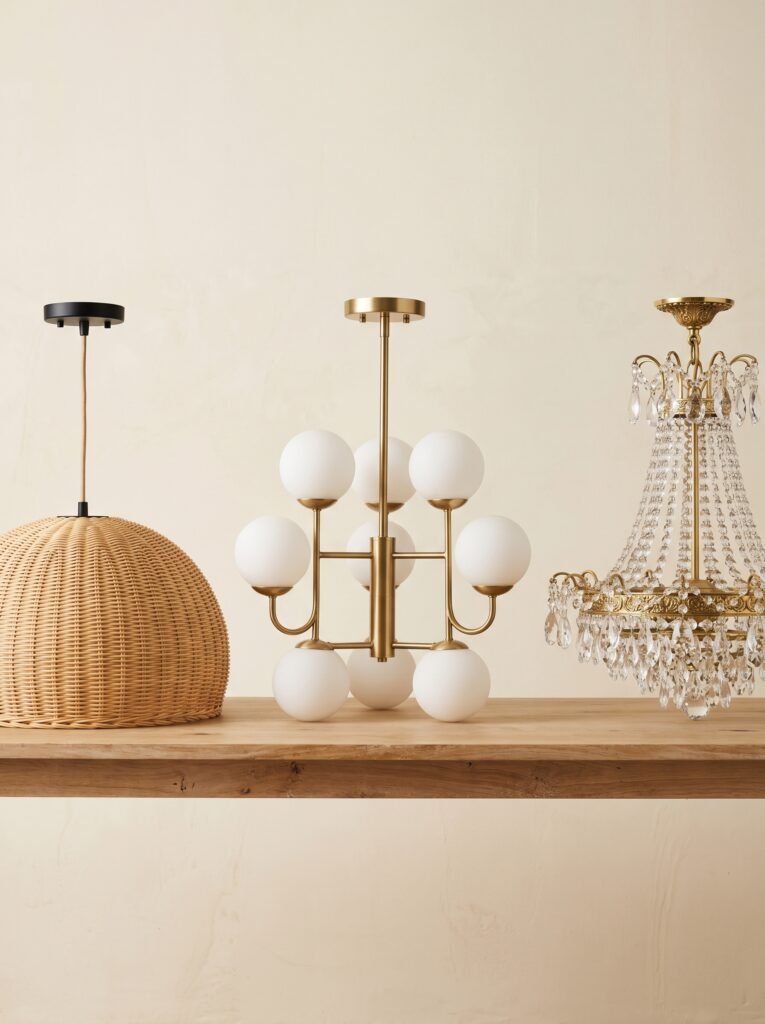
Let’s talk real numbers, because the range for living room chandeliers is genuinely vast and can feel overwhelming without some guidance.
At the entry level — roughly $50 to $200 — you can find surprisingly attractive options, particularly in rattan, simple metal, and basic globe styles. Quality varies significantly in this range, and careful research and reading reviews is essential, but beautiful budget fixtures absolutely exist.
The mid-range of $200 to $800 is where most design-forward homeowners land, and it’s a sweet spot. In this range, you access better materials, more considered designs, and longer-lasting construction. Many of the fixtures you’ve admired in design blogs and on Pinterest fall into this category.
Above $800 and into the thousands, you’re entering heirloom territory — hand-blown glass, solid forged iron, genuine crystal, and custom or semi-custom pieces from design houses. These are investments in the truest sense, fixtures that will outlive trends and become part of a home’s character for decades.
—
10. Installation Basics: When to DIY and When to Call a Professional

The honest answer about chandelier installation is this: if you are comfortable with basic electrical work and your fixture weighs under 35 pounds, a careful DIY installation is entirely reasonable for many homeowners. If the fixture is heavier, if your wiring situation is uncertain, or if the installation requires a ladder on a high ceiling, hiring a licensed electrician is worth every penny of the cost.
What’s non-negotiable regardless of who does the work: the fixture must be supported by an electrical box rated for the weight of the chandelier, not just a standard junction box. Chandelier-rated boxes and brace bars are inexpensive and widely available — and this is the one structural step that must not be skipped.
—
11. The Unexpected Rooms That Deserve a Chandelier Moment
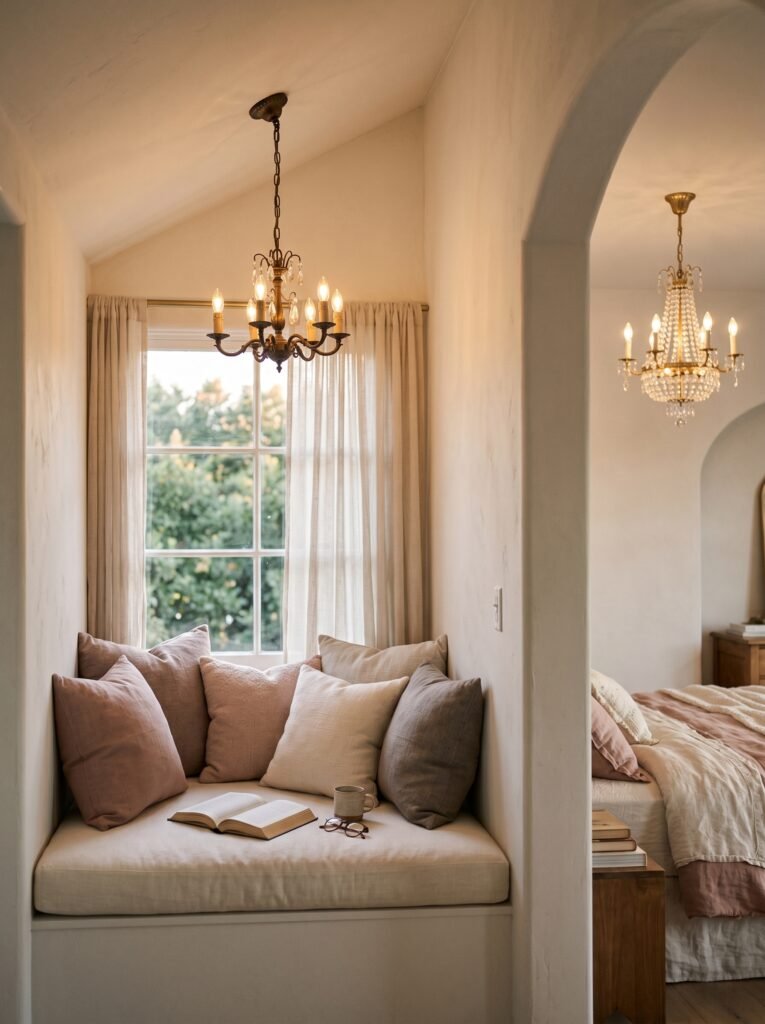
While this article is focused on the living room, it’s worth noting that the chandelier conversation doesn’t have to stop there. The energy and intention that a chandelier brings to a living room can be applied thoughtfully throughout the home.
A small chandelier in a reading nook — even a battery-operated one — transforms that corner into a destination. A chandelier over a kitchen island replaces the standard pendant cluster with something more dramatic and unified. A chandelier in a primary bedroom adds romance and a sense of considered luxury that few other choices can match.
The point is that chandeliers, in any form, are ultimately about the decision to make a space feel intentional — to say that this room deserves beauty, and I am choosing to give it some.
—
12. The Small Details That Make a Chandelier Look Professionally Designed
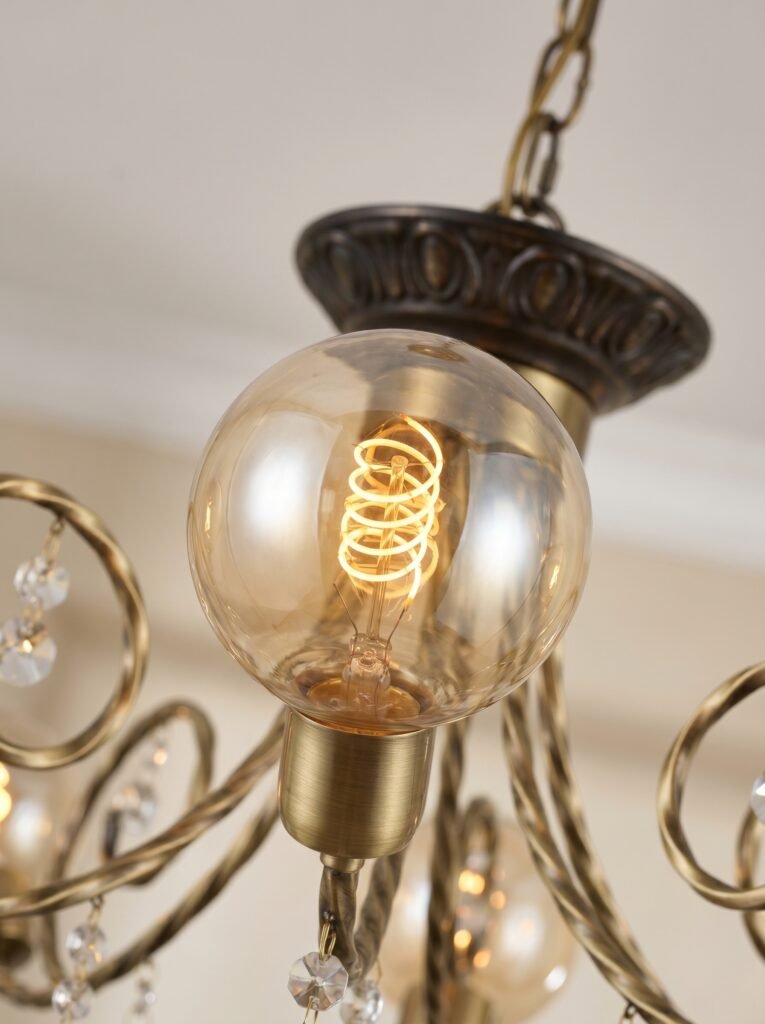
The difference between a chandelier that looks “installed” and one that looks designed often comes down to a handful of small details that are easy to get right once you know what they are.
Canopy size and ceiling plate should be proportional to the fixture — a tiny canopy on a large chandelier looks unfinished. Bulb choice is critical: LED filament bulbs in warm white (2700K) maintain the visual warmth of vintage Edison bulbs while being energy-efficient. Chain or cord length should be adjusted so the fixture hangs at exactly the right height — not left at the factory default, which is almost never ideal.
Finally, cleanliness and maintenance matter more than people expect. A dusty chandelier mutes its own light output significantly. A clean fixture gleams with intention and keeps your living room looking the way it deserves to look — like a space that is genuinely cared for.
—
🌿 How to Take Care of Your Living Room Chandelier
Maintaining a chandelier is simpler than most people assume, and a small amount of regular attention keeps it looking its absolute best.
Dust your chandelier every two to four weeks using a microfiber cloth or a soft duster with an extendable handle. For crystal or glass elements, a light spray of glass cleaner on the cloth (never directly on the fixture) followed by gentle wiping removes fingerprints and restores brilliance. Always turn the fixture off and allow bulbs to cool completely before cleaning. For a deep clean two or three times a year, carefully remove any glass or crystal elements and wash them individually in warm soapy water, drying thoroughly before replacing. Check that all bulbs are functioning and replace burned-out bulbs promptly — a chandelier with dark spots loses its visual symmetry and warmth almost immediately.
—
❓ FAQ
Q: Can I put a chandelier in a living room with low ceilings? A: Absolutely. For eight-foot ceilings, look for semi-flush or low-profile chandelier styles that provide the visual presence of a traditional fixture without requiring long drop lengths. Many beautiful designs exist specifically for this purpose, and the right choice will feel intentional rather than compromised.
Q: How do I know if my ceiling can support a chandelier? A: The key factor is whether your existing electrical box is rated for chandelier weight. Standard junction boxes are typically rated for only 35 pounds or less. If your chandelier weighs more, you’ll need to install a fan-rated or chandelier-rated electrical box, which is a straightforward upgrade that any electrician can handle quickly.
Q: Do chandeliers work in small living rooms? A: Yes — and a well-chosen chandelier can actually make a small living room feel larger by drawing the eye upward and adding vertical dimension. The key is choosing the right scale using the measurement formula described above, and opting for styles with visual openness rather than heavy, dense silhouettes that might feel crowding in a compact space.
—
💭 Final Thought
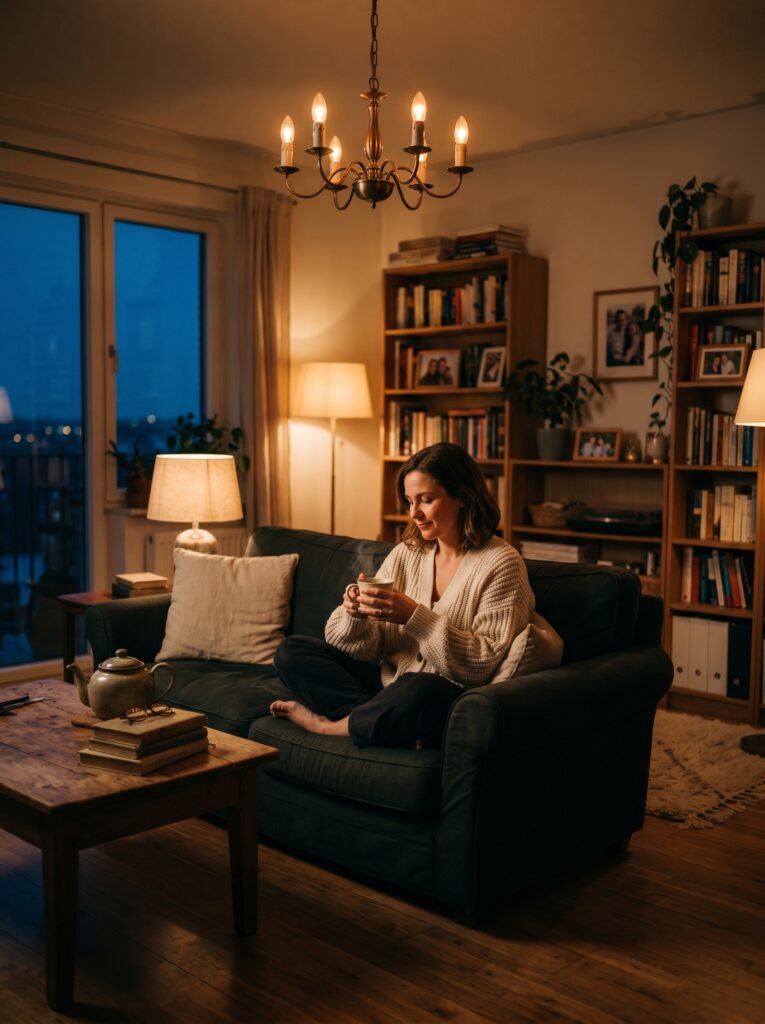
A chandelier in the living room is one of those decisions that seems purely aesthetic until you actually live with it — and then you realize it was always about something deeper. It’s about the quality of the light you come home to, the atmosphere you create for the people you love, and the quiet, daily joy of a space that feels genuinely beautiful. Long after you’ve forgotten what you paid for it or how long it took to install, it will still be there above you, casting its warm light on every ordinary evening that turns, somehow, into a memory.
What does the light in your living room say about the life you want to live inside it?