The Cosy Cottage Living Room That Actually Feels Like Coming Home (Not a Pinterest Mood Board)
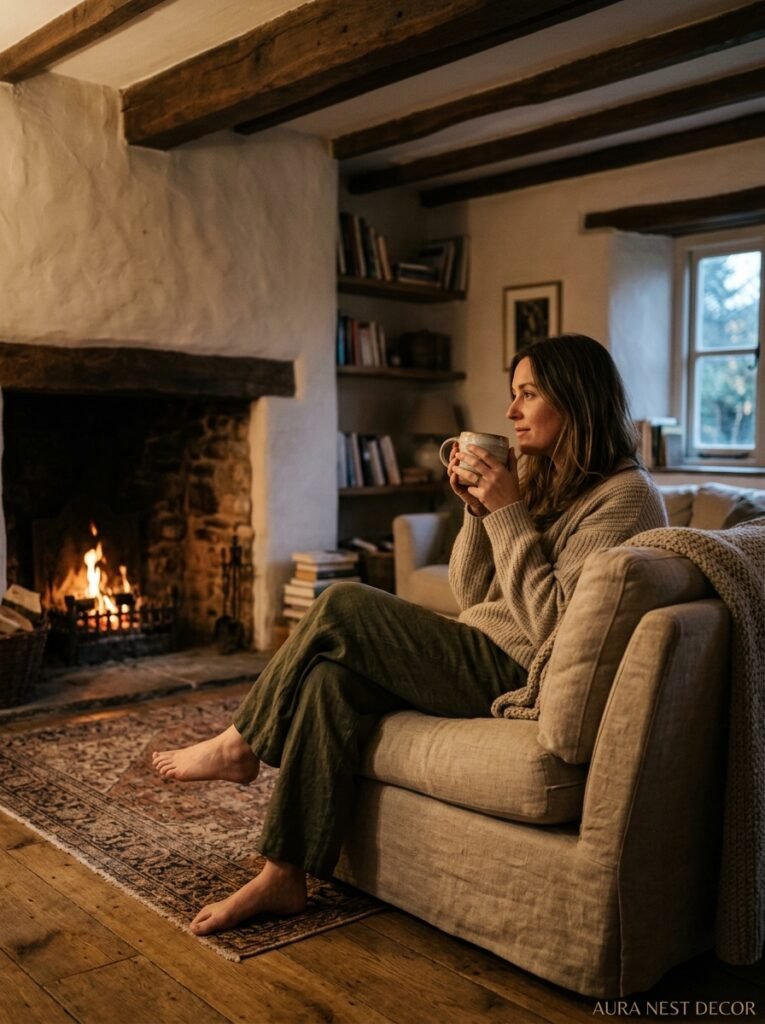
You know the feeling when you walk into a room and something in your chest just… releases? Like you’ve been holding a breath all day and that room caught it. That’s what a real cottage living room should do. Not impress you. Not perform for you. Just catch you.
—
1. Why Most “Cosy” Rooms Feel Wrong the Second You Sit Down
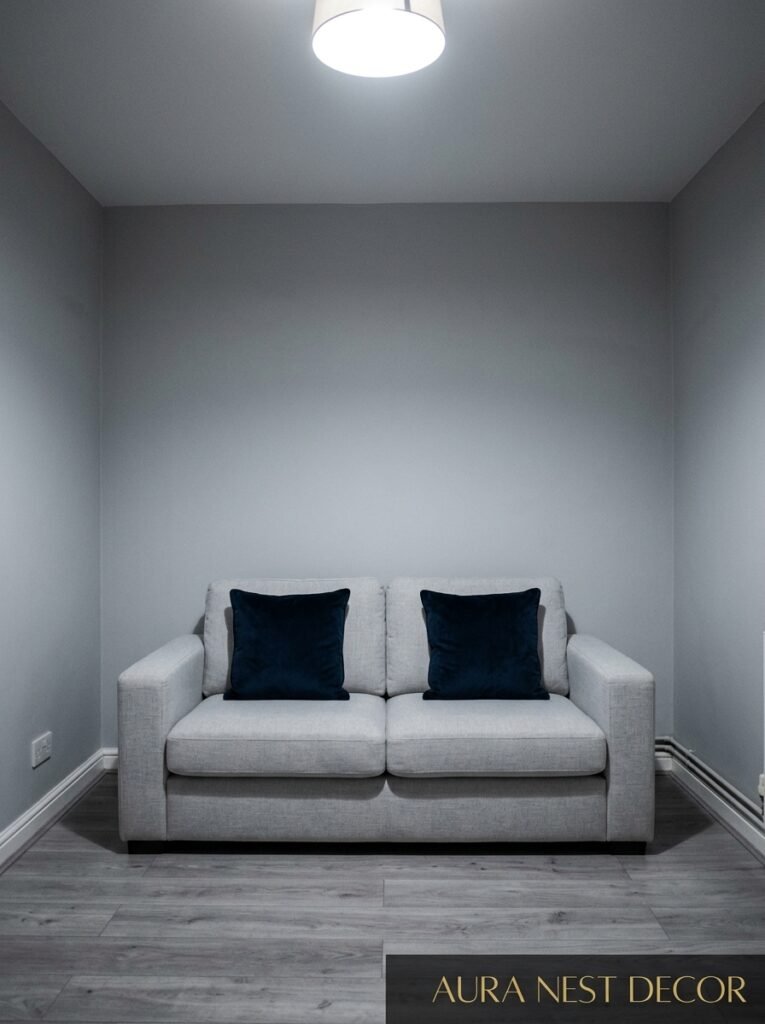
There’s a difference between a room that looks cosy in photos and a room that actually is cosy when you’re in it. And most people — I’ve done this too, I won’t pretend I haven’t — they chase the aesthetic and end up with a room that’s beautiful and cold at the same time.
You know the type. The throw blanket is folded too perfectly. The candles are unlit. There’s nowhere to put your mug down without worrying about a ring mark. It’s a room that says “admire me” when what you actually needed was a room that says “stay awhile.”
Cottage cosy is different. It’s a bit imperfect. The armchair’s been sat in so many times it’s shaped itself to you. The bookshelves aren’t colour-coded — they’re just FULL, in the best possible way. There’s probably a dog-eared novel somewhere. A mug that’s been used three times today already.
So before we get into anything practical, I want you to let go of perfection as the goal. Because the second you start designing for perfection, you design out all the coziness.
“Cosy isn’t a look. It’s a permission slip to actually live in your living room.”
2. The Colour Nobody Can Stop Painting Their Walls Right Now

Okay so let’s talk about colour because it’s where cottage living rooms either completely nail it or go sort of… beige and apologetic.
The shade I keep seeing everywhere — and honestly, I get it — is a kind of warm aged-linen white. Not crisp white. Not grey-white. Something that looks like it’s been in a sunny room for about thirty years and is completely fine with that. In the UK, Little Greene’s ‘Aged White’ and Farrow & Ball’s ‘Pointing’ are doing this beautifully. For American readers, Benjamin Moore’s ‘White Dove’ hits the same register.
But here’s what I actually think is more interesting: dark walls.
I know. Hear me out. A deep forest green or a slate blue in a cottage living room doesn’t make it feel smaller. It makes it feel like NIGHT in the best way — like being inside something, rather than standing in it. It wraps around you. My friend painted her living room in Little Greene’s ‘Obsidian’ and the room felt like a warm cave in November. I was jealous for about three weeks.
The key is keeping the trim light. That contrast is everything. It keeps the room from feeling like a tunnel and gives your eye somewhere to land.
3. The Thing About Fireplaces That Everyone Forgets to Actually Use
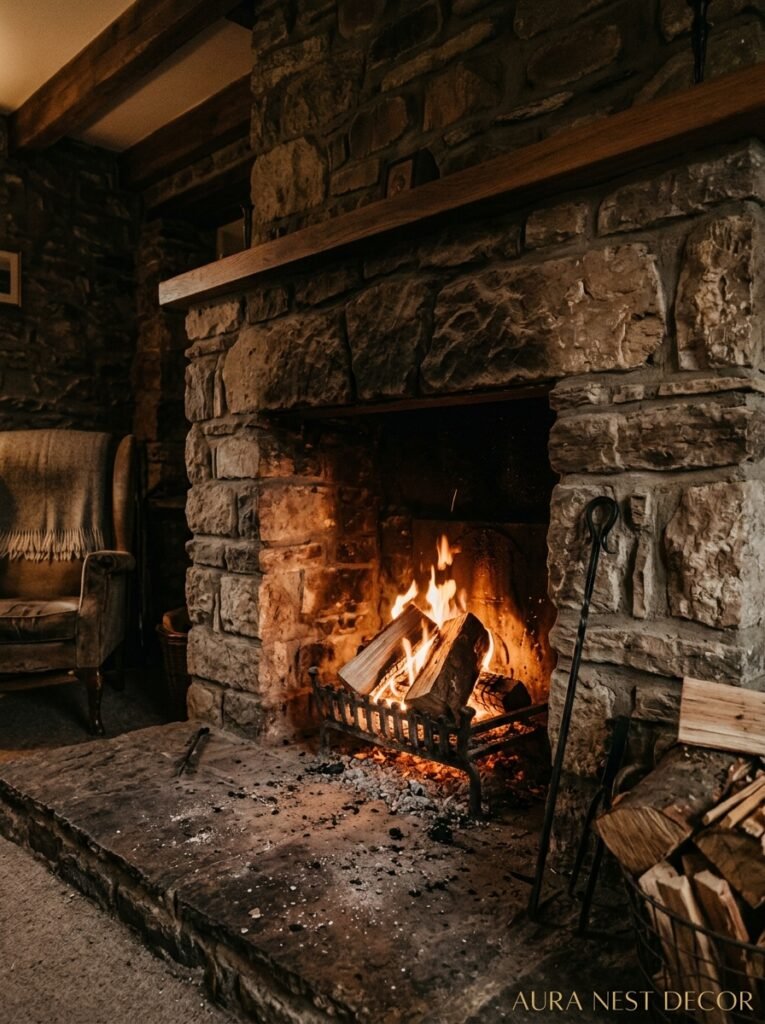
If you have a working fireplace and you’re not lighting it in autumn, I don’t know what to tell you. That’s like owning a record player and only looking at it.
But even if you don’t have a working fireplace — or even a real fireplace at all — the PRINCIPLE of one is something you can build into a room. The principle being: give the room a focal point that radiates warmth, even visually. A deep, well-lit alcove. A chunky candle arrangement on a vintage mantelpiece that’s been mounted to the wall. A cluster of amber-glowing table lamps gathered in one corner that do the same job of drawing the eye and softening the space.
The fireplace in a cottage room isn’t really about heat anyway, or not JUST about heat. It’s about the quality of light it produces. Flickering. Low. Orange and gold in a way that electric light basically never is. If you’ve got the real thing, use it obsessively from October to March. If you don’t, you’re chasing that specific warmth through other means — and knowing that clearly helps you choose lighting that actually achieves it.
Side note — those log-effect electric fires have come on SO much in the last few years. Some of them are genuinely convincing. Not all of them. But some.
4. Why Every Cottage Living Room Needs at Least One Thing That’s Genuinely Old

Not vintage-inspired. Not distressed on purpose in a factory in Vietnam. Actually old.
It doesn’t have to be expensive. A ceramic lamp base from a charity shop. A wooden side table with a proper history of scratches. A kilim rug that somebody’s grandmother had. One genuinely old thing in a room changes the energy of everything around it. It makes the room feel like it has a story instead of a spec sheet.
“One real antique does more for a room than a hundred carefully curated ‘rustic’ pieces from a big-box store.”
I think this is because old objects carry actual imperfection — the kind that can’t be manufactured. A hand-thrown pot from a craft fair in the 1970s has a wobble to it that machine-made ceramics just don’t. And that wobble is exactly what makes a room feel human.
In the US, estate sales are gold for this. In the UK, boot fairs and local auction houses. You don’t need a big budget. You need patience and the willingness to carry something slightly awkward to the car.
5. The Fabric Combination That’s All Over Cottage Interiors Right Now (And Why It Works)

Linen and wool. That’s it. That’s the combination.
Not velvet and silk. Not polyester-blend anything. The reason linen and wool keep dominating real cottage interiors is that they both have TEXTURE — actual, visible texture that light catches differently depending on the time of day. At noon, a linen sofa looks crisp and clean. At 6pm in lamplight, it goes warm and almost golden. Wool cushions do the same thing. They’re not flat. They’re not shiny. They breathe.
There’s also something genuinely tactile about both fabrics that matters for a space you actually want to touch. A sofa you want to sit on has to feel good, not just look good. That’s so obvious and yet so many people buy sofas based entirely on how they photograph.
For the cottage aesthetic specifically, I’d say: linen for large surfaces (sofa, curtains), wool for smaller ones (cushions, a single armchair, a throw). Add in one piece of aged leather somewhere — a footstool, a journal on the coffee table — and you’ve got a combination that feels like it’s been in the room for decades.
6. Curtains Are Doing Way More Work Than You Think
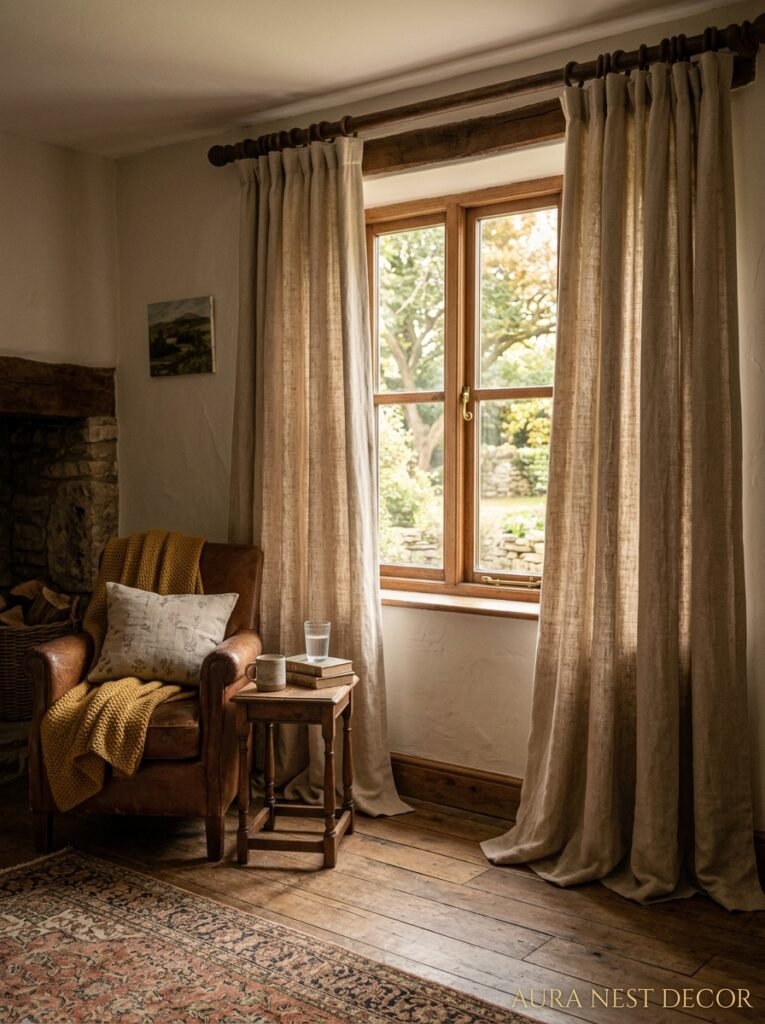
This is the detail that separates a good cottage room from an AMAZING one and almost nobody talks about it enough.
Curtains in a cottage living room should be substantial. Heavy. Floor-length with an extra two or three inches of fabric pooling slightly on the floor. The fabric should have some weight to it — a linen-cotton blend at minimum, ideally interlined if you want them to hang properly.
Why does this matter so much? Because thick, floor-length curtains change the acoustics of a room. They absorb sound. The room literally gets quieter and that quiet registers as warmth. It’s one of those things you can’t see but you absolutely feel.
Also — and I feel strongly about this — don’t buy curtains that exactly reach the floor. Let them breathe. Let them pool just slightly. It looks intentional and expensive even when it isn’t. British cottage interiors have been doing this forever. Americans are catching on.
7. The Art of Arranging Books So They Look Loved and Not Styled

Bookshelves in a cottage living room should not look like a bookshop. Or an art installation. Or like someone spent four hours colour-coordinating by spine.
They should look like someone reads.
That means some books are horizontal and some are vertical. There are objects mixed in — a small plant, a candle, a postcard from somewhere — but not so many that the books are just props. There are probably some slightly too many books, shoved in sideways because the shelf ran out of room and the book had nowhere else to go.
“A shelf full of books you’ve actually read is more beautiful than any shelf someone styled for Instagram.”
I know the colour-coordinated bookshelves look incredible in photos. I know. But they feel wrong in a real room, and a cottage living room especially is about what something FEELS like from the inside. Books arranged by colour have a personality that says “look at me.” Books arranged by what was closest to hand and read most recently say “come in, sit down, stay.”
8. Lighting Layers That Actually Create That Amber 7pm Glow
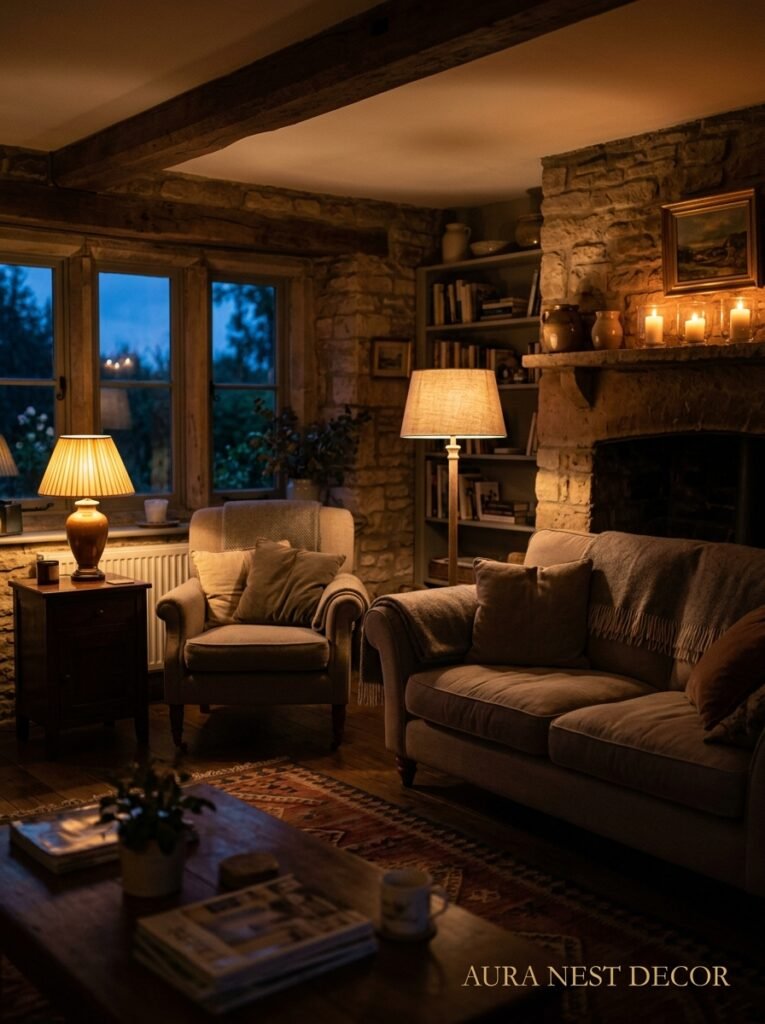
Here is the thing about overhead lighting: in a cottage living room, you basically want to pretend it doesn’t exist.
I don’t mean literally. I mean — you should have it, sure, especially in older homes where the wiring is already there. But you should almost never use it as your main source of light. Overhead lighting flattens everything. It removes shadow. And shadow, counterintuitively, is what makes a room feel warm and dimensional.
What you want instead is about four to five sources of low light. Table lamps. A floor lamp in a corner. Maybe a small wall light if you can manage it. Possibly a string of very warm Edison bulbs on a low shelf, the ones that glow amber rather than yellow or white.
The wattage matters. You want 2700K or lower — that’s the amber zone. Anything above that tips into the kind of cold white light that makes a room feel like a waiting room. Not the vibe.
And candles. Obviously candles. Not as the primary light source, but as punctuation. The kind of light a candle makes is genuinely different from any electric source — it moves, and your eye tracks that movement in a way that’s almost unconsciously relaxing.
9. The Coffee Table Nobody Thinks to Look For (But Should)
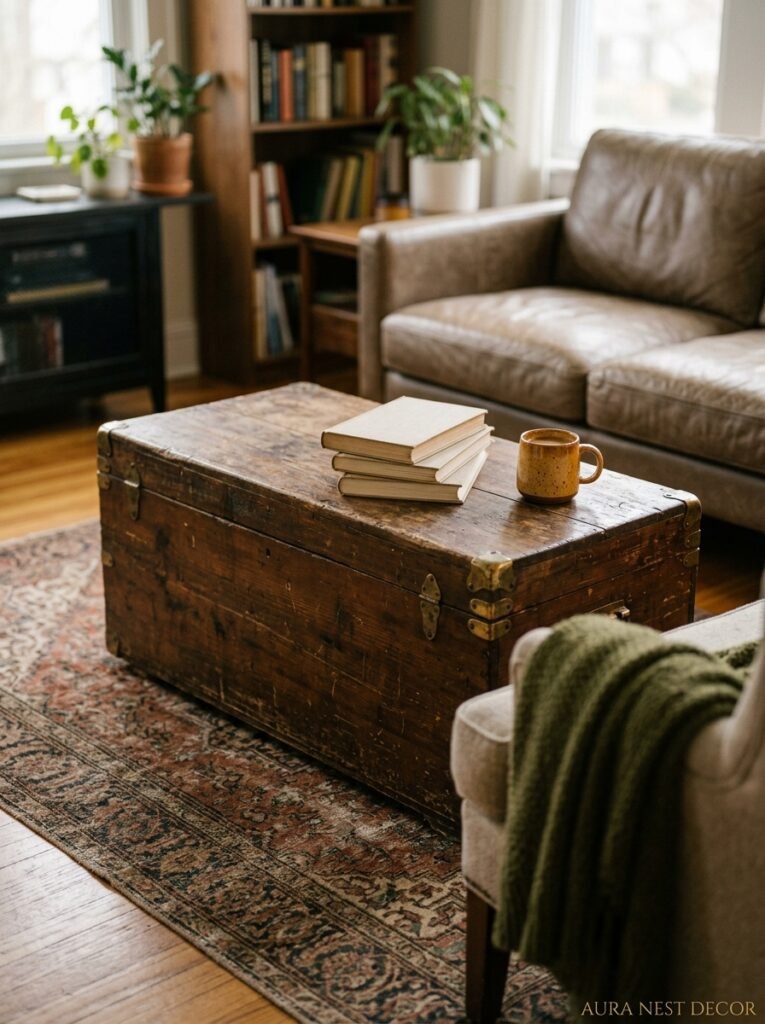
Don’t buy a coffee table from a furniture shop. Or at least, exhaust every other option first.
An old wooden trunk. A stack of oversized art books topped with a tray. A low wooden stool from a flea market. A marble slab on chunky wooden legs that someone made themselves, or that you commission from someone local for not very much money. A reclaimed door section mounted on hairpin legs.
The coffee table is one of the most visible pieces of furniture in any living room and it’s also one of the places where the “this came from a catalogue” vibe is most immediately obvious. Old trunks are incredible because they also solve the storage problem that every living room has — extra blankets in there, board games, whatever you need. Style AND function. That’s always the move.
10. What to Do With Low Ceilings Instead of Fighting Them
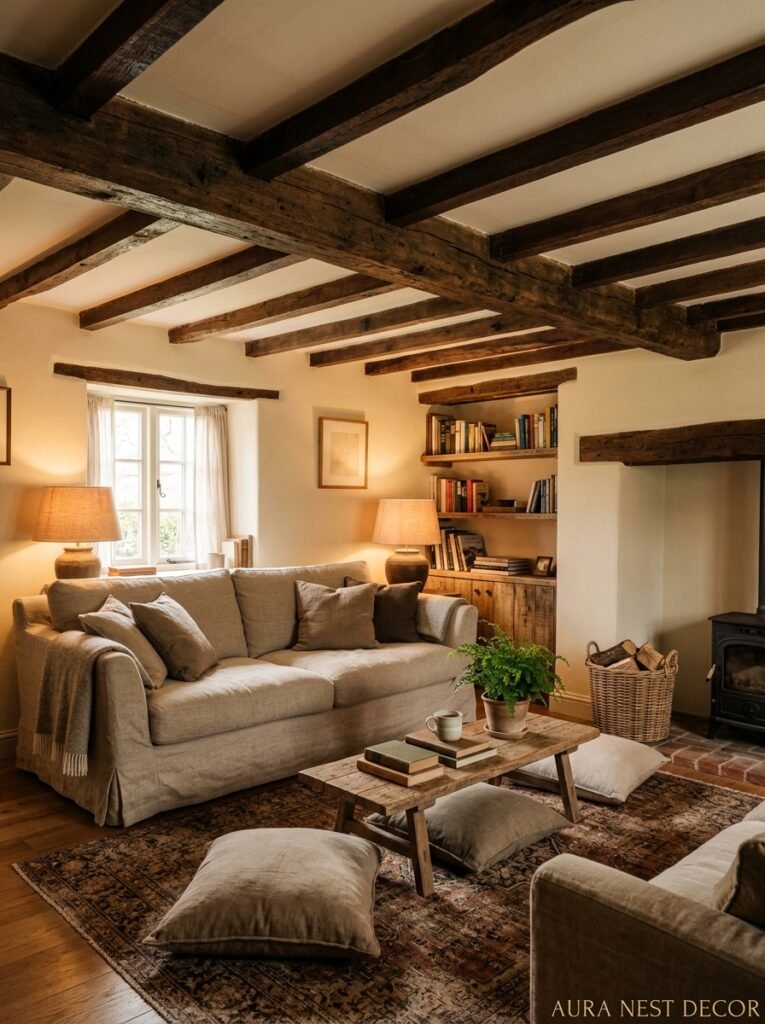
A lot of cottage living rooms have low ceilings. And a lot of people spend a lot of energy trying to “visually raise” them with tricks that kind of work but are also slightly exhausting to think about.
Can I offer a different idea? Lean into it.
Low ceilings are COSY. They’re intimate. They make a room feel enclosed in exactly the way a good cottage room should feel enclosed. Instead of trying to make the ceiling feel higher, double down on what the low ceiling gives you: a space that feels like it’s wrapping around you. Keep the furniture low and substantial. Put things on the floor — floor cushions, a low lamp, a basket of logs. Let the eye stay low. Don’t fight the architecture. The architecture is doing the heavy lifting for you.
11. The Small Sensory Details That Make Someone Say “I Love Your House”
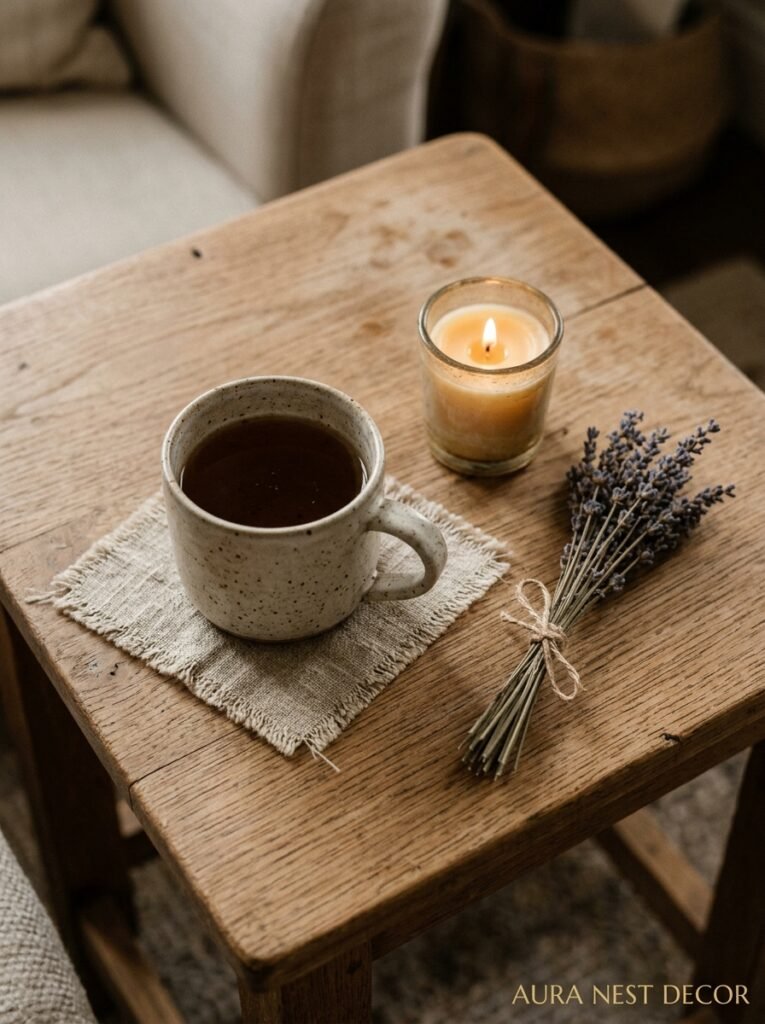
Nobody says “I love your house” because of your sofa selection. They say it because of something they can’t quite name — something in the air, something they smelled when they walked in, something that felt immediately right.
That feeling is built from tiny things. A beeswax candle that smells like honey and woodsmoke rather than synthetic “vanilla.” Wool blankets that feel heavy when you pull them over. A wooden floor that creaks slightly, and you don’t fix it. A houseplant that’s a bit too big for the room. A bowl on the coffee table with things in it — a pinecone, a couple of smooth stones, a dried flower — that doesn’t look like a shop display because you didn’t buy it as a shop display, you just gathered it over time.
These things aren’t expensive. Most of them are free. But they add up to an atmosphere that’s genuinely yours and genuinely warm, and that atmosphere is the whole point.
12. The One Thing That Instantly Makes a Cottage Living Room Feel Like a Sanctuary
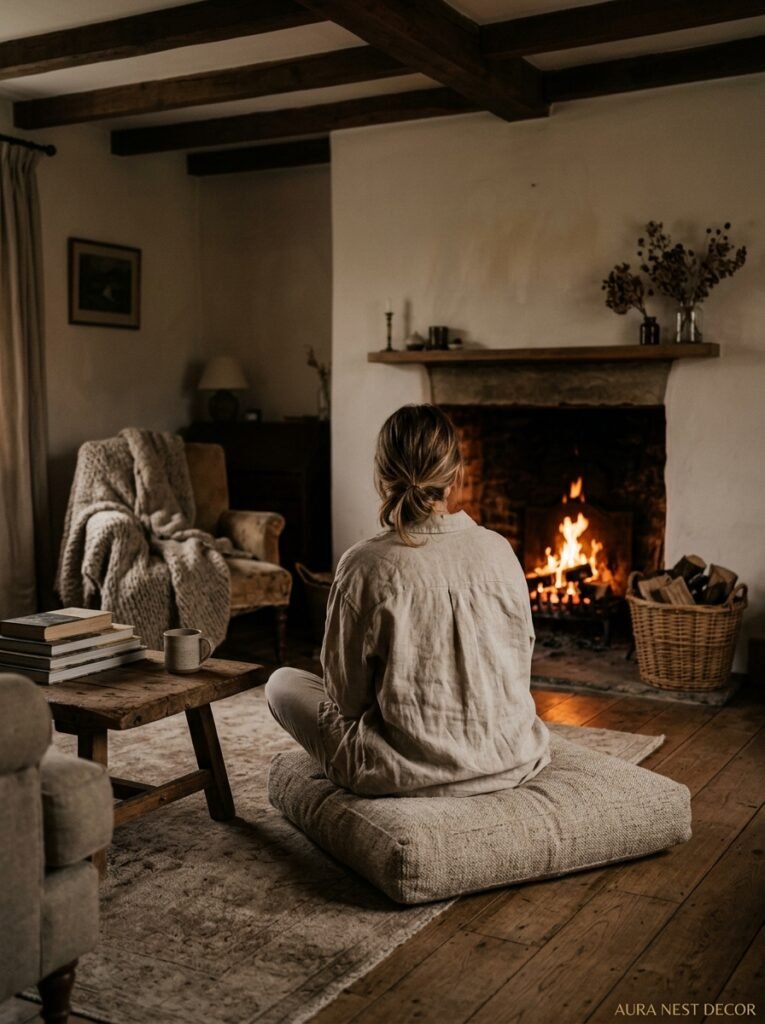
Slow down the room.
I mean this practically: remove anything that feels hurried. The charger cable on the floor. The stack of stuff by the door. The items that ended up in the living room because they had nowhere else to go yet. Not because tidiness is the goal — a cottage room can be gloriously cluttered — but because there’s a difference between the clutter of a life well-lived (books, candles, plants, cushions) and the clutter of logistics (the thing you need to return, the bag you haven’t unpacked).
Give the room permission to be purely for living. For sitting. For reading something that’s not on a screen. For talking to someone you love, slowly, with nowhere to be.
That’s what makes people walk in and feel that release in their chest. That catch of the breath. The room isn’t performing — and because it isn’t performing, neither are you.
—
❓ FAQ
Q: How do I make a modern house feel like a cottage living room? A: It’s more achievable than you’d think. The three biggest moves are: warm the lighting immediately (swap every cool-toned bulb for amber 2700K), add one genuinely old or secondhand piece, and swap any synthetic fabrics on your sofa and cushions for linen or wool. Those three things change the feel of a room faster than almost anything else.
Q: What’s a good colour palette for a cosy cottage living room on a tight budget? A: Focus on the wall colour first because it’s the biggest surface and does the most work. A warm off-white won’t cost more than a stark white — it’s just a different choice. Then layer in warm tones through charity shop or thrift store textiles: a cream wool throw, a slightly faded floral cushion, a terracotta pot for a trailing plant. You don’t need expensive paint or furniture to get the palette right.
Q: Can a small living room actually feel cosy, or does it just feel cramped? A: Small is honestly an advantage for cottage style — smaller rooms are inherently more intimate. The key is to not fight the size by trying to make the space look bigger. Choose one large rug rather than leaving floor bare (bare floor emphasises the boundaries of the room), go for a proper deep sofa rather than several small pieces, and keep the lighting low and warm. Small and cosy is completely different from small and cramped.
—
💭 Final Thoughts

A cottage living room isn’t really about where you live or how much you have. It’s about the decision to make a room that serves the people in it instead of impressing the people who walk through it. There’s something quietly radical about that, actually — especially when the internet keeps telling us our homes are supposed to be aspirational.
Make a room you want to sit in. Make a room that catches you. What does “coming home” feel like to you right now, and does your living room feel like that?