
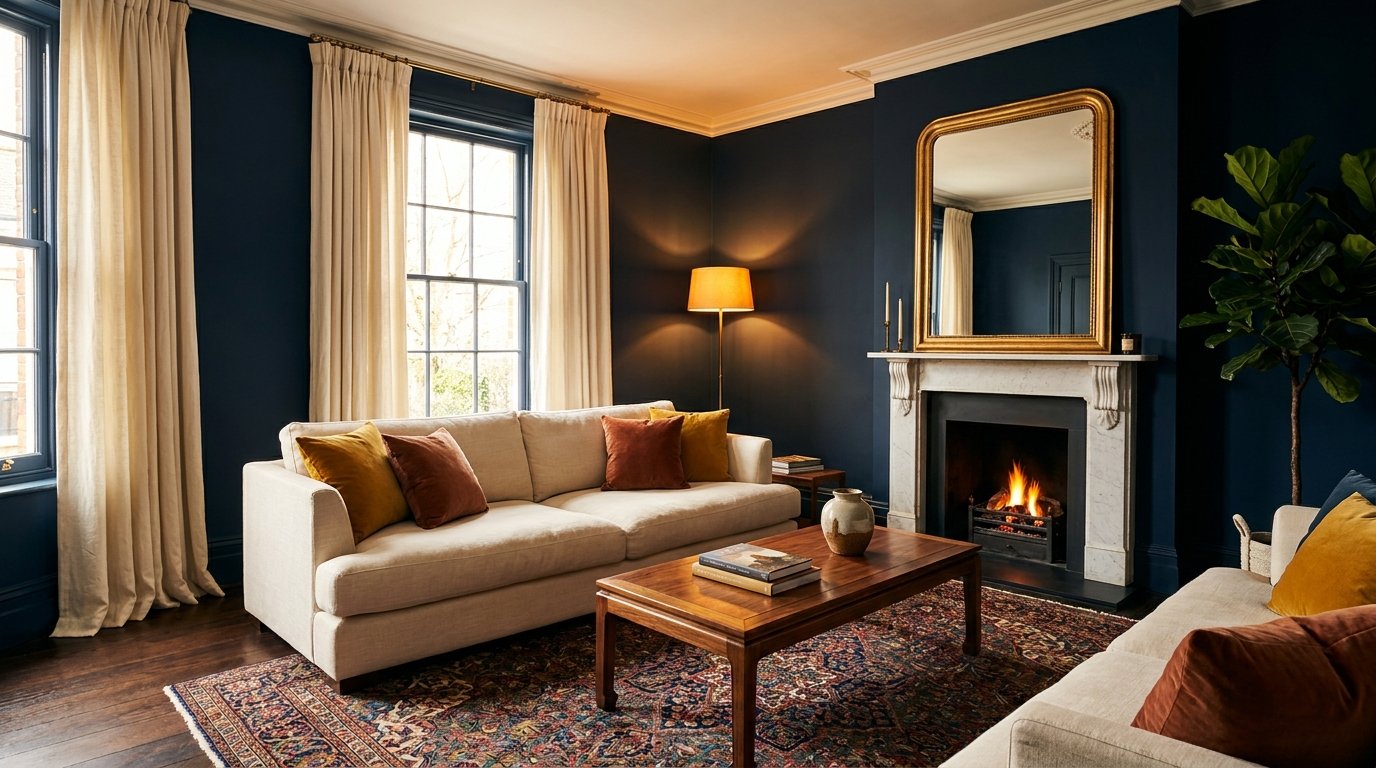
The Dark Blue Living Room: How One Bold Color Choice Can Transform Your Home Into a Sanctuary
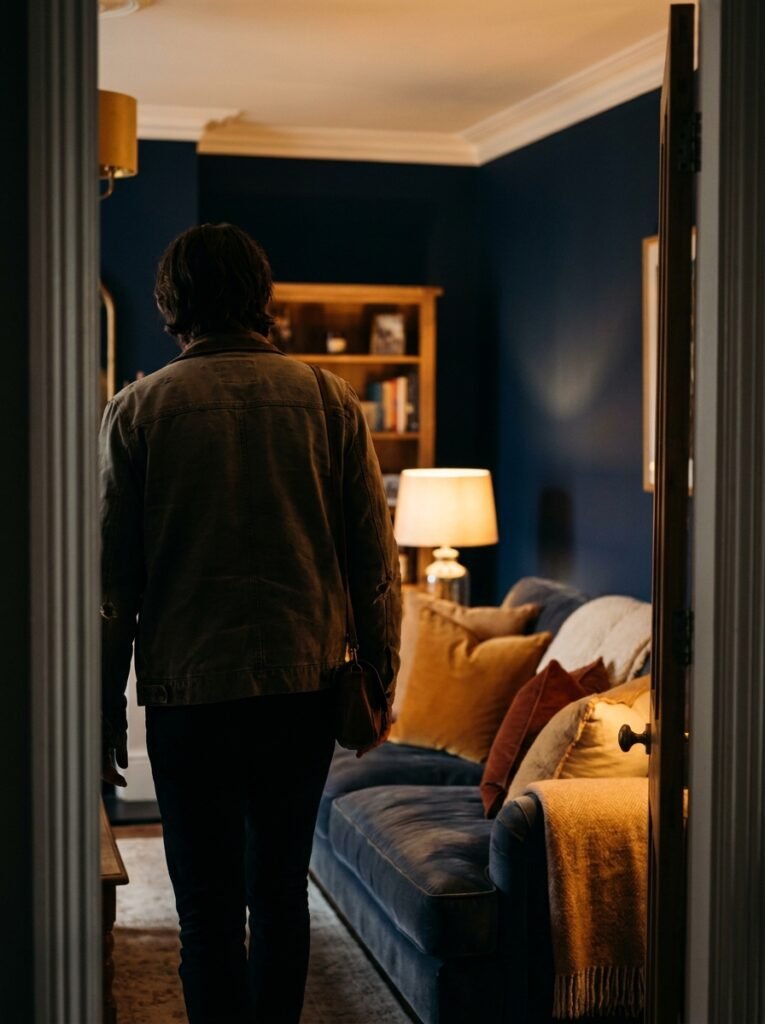
There’s a moment — maybe you’ve had it too — when you walk into someone’s living room and something just stops you cold. Not in a bad way. In that breathless, I didn’t know a room could feel like this kind of way. More often than not, the walls are dark blue.
—
1. Why Dark Blue Feels Like Coming Home
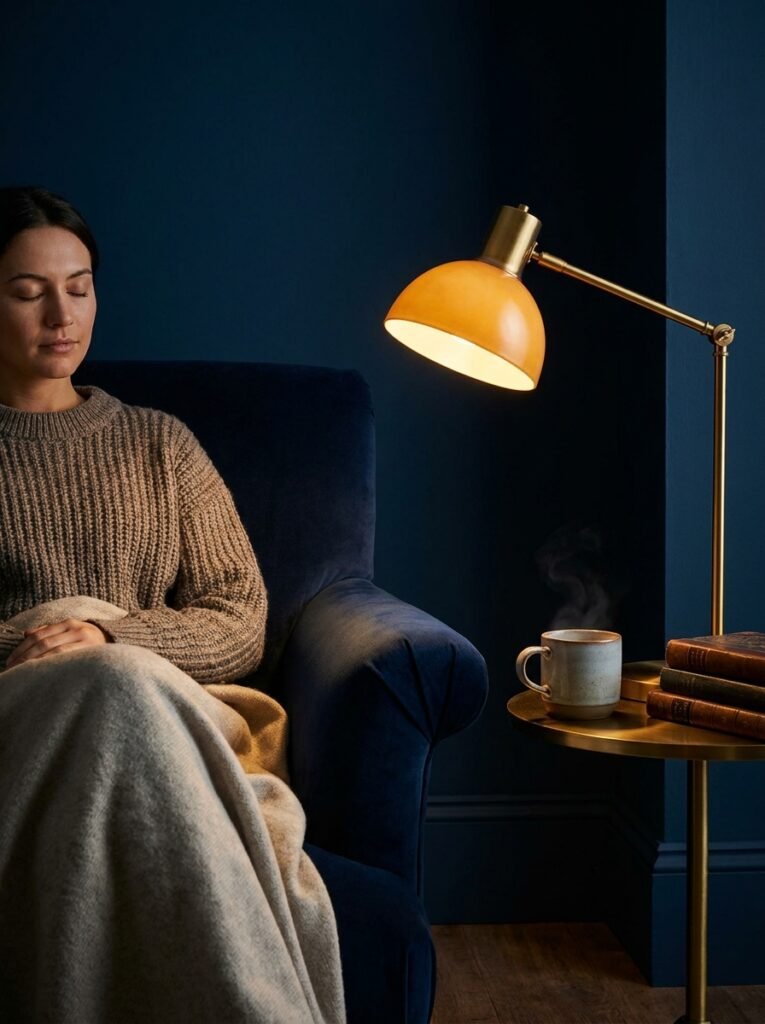
Dark blue is not simply a color. It’s a mood, a memory, a feeling wrapped in pigment. There’s a reason so many of us are drawn to the deep end of the color spectrum when we want to feel safe — psychologically, blue is one of the most calming colors the human brain can process. It lowers heart rate. It quiets mental chatter. It makes a room feel like the world outside has been turned down a few notches, and honestly, isn’t that exactly what a living room should do?
Interior designers have long understood what the rest of us are only now catching up to: dark blue doesn’t make a room feel smaller or heavier. When used intentionally, it makes a room feel anchored. Like the furniture belongs there. Like you belong there.
“A dark blue room doesn’t close you in — it wraps you up.”
The shades within the dark blue family run a surprisingly rich spectrum. Navy sits at the classic end — timeless, structured, almost nautical in the best possible way. Midnight blue leans deeper, flirting with near-black while still holding that unmistakable blue warmth. Indigo carries a faint purple undertone that makes it feel slightly bohemian, slightly mysterious. And then there’s ink blue — rich, dramatic, the color of a sky just after the last light has faded. Each shade creates a subtly different emotional atmosphere, and choosing between them is less about what looks right on a paint chip and more about how you want the room to feel at 9 p.m. on a Tuesday.
—
2. The Science Behind Why Dark Walls Work (When Everyone Said They Wouldn’t)
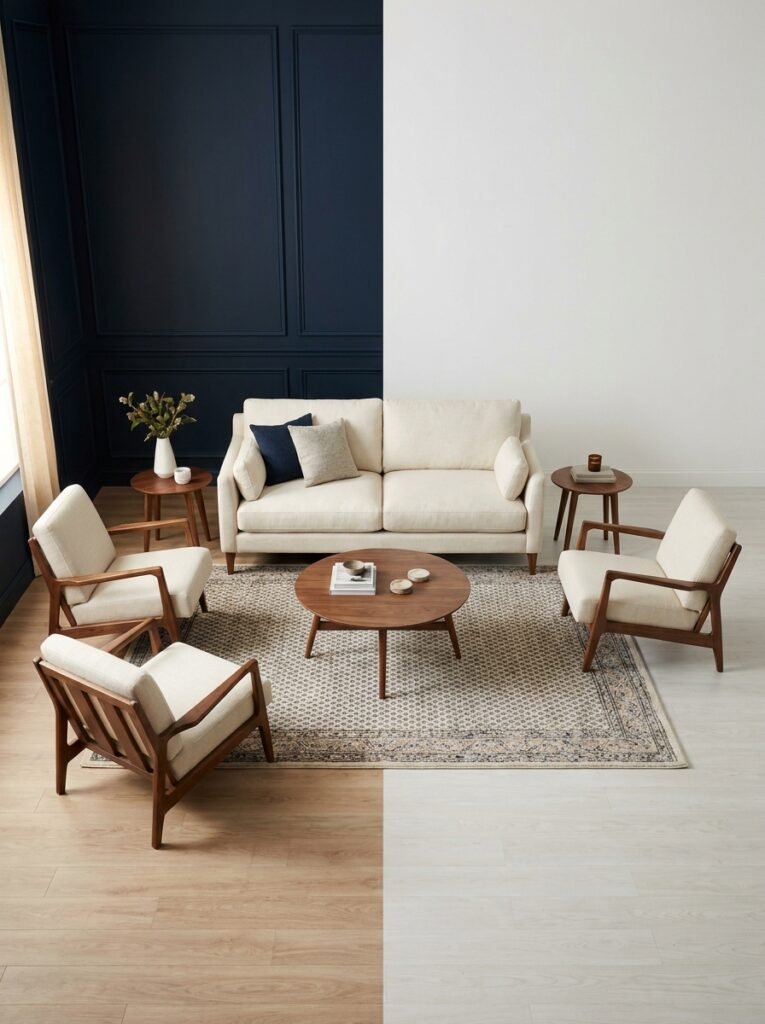
For decades, conventional decorating wisdom insisted that small rooms needed light walls and that dark colors were reserved for large, well-lit spaces with cathedral ceilings. That advice wasn’t wrong, exactly — but it was incomplete. The truth is more nuanced and far more exciting.
Dark walls create what designers call “visual compression.” Instead of the walls pushing outward and the room feeling scattered, dark walls pull everything toward the center, creating a sense of intimacy and cohesion. Your furniture stops floating and starts belonging. The overall effect isn’t a room that feels cramped — it’s a room that feels curated.
Studies in environmental psychology have shown that people in rooms with deeper, cooler wall colors report feeling more relaxed and more creative than those in bright white or beige rooms. That’s not coincidental. Dark blue, in particular, has strong associations with nighttime, rest, and reflection — all things we actually want in the room where we unwind after a long day.
—
3. The Shades That Actually Work: Navy vs. Midnight vs. Ink
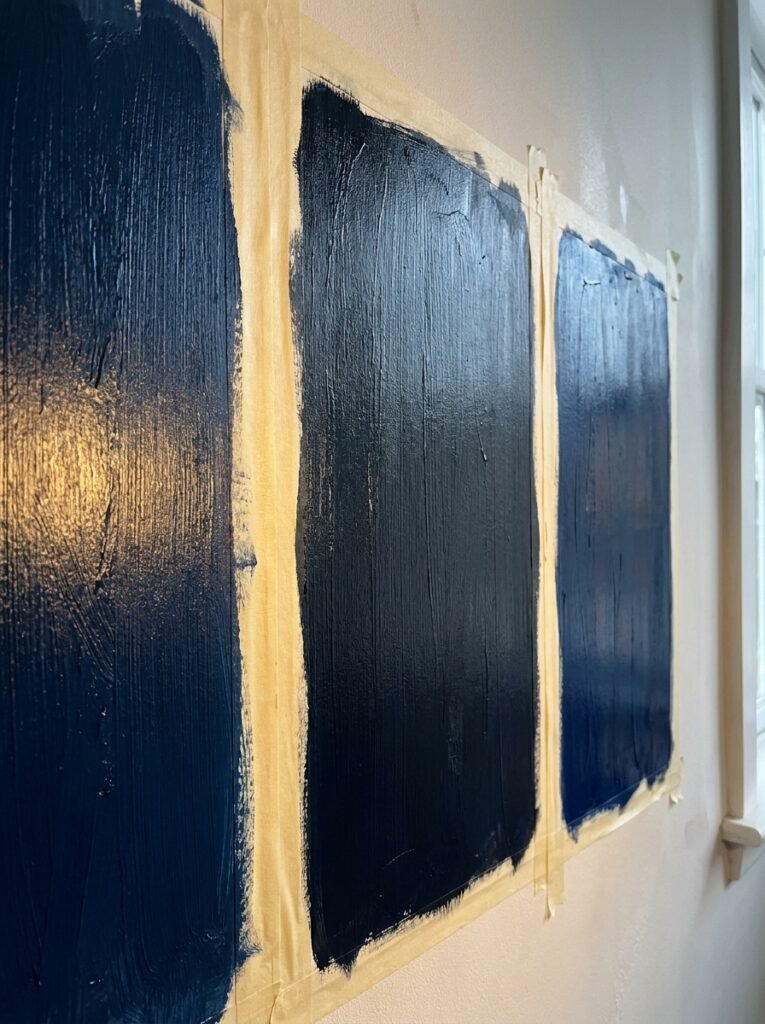
Choosing your exact shade of dark blue is the single most important decision in this whole process, and it deserves more thought than a quick Saturday trip to the hardware store. Pull a few swatches and live with them for at least 48 hours — tape them directly to the wall and observe them in morning light, afternoon light, lamplight, and that particular grey-afternoon light that happens in autumn.
Navy blue is the most forgiving entry point. It has enough warmth to work with wood tones, enough boldness to make a statement, and enough familiarity to feel classic rather than trendy. If you’re a dark-blue-living-room newcomer, this is your starting point.
Midnight blue is for those who want the drama turned up. It sits just a hair away from black in certain lighting conditions, and in lamplight it becomes almost jewel-like — deep and dimensional in a way that lighter colors simply cannot achieve. Pair it with warm metals and cream-colored textiles to prevent the room from feeling cold.
Ink blue carries a sophistication that’s hard to describe but immediately felt. It works particularly well in rooms with large windows, high ceilings, or substantial natural light during the day — because at night, under warm lighting, it transforms into something that feels almost cinematic.
—
4. Furniture That Was Made for a Dark Blue Room
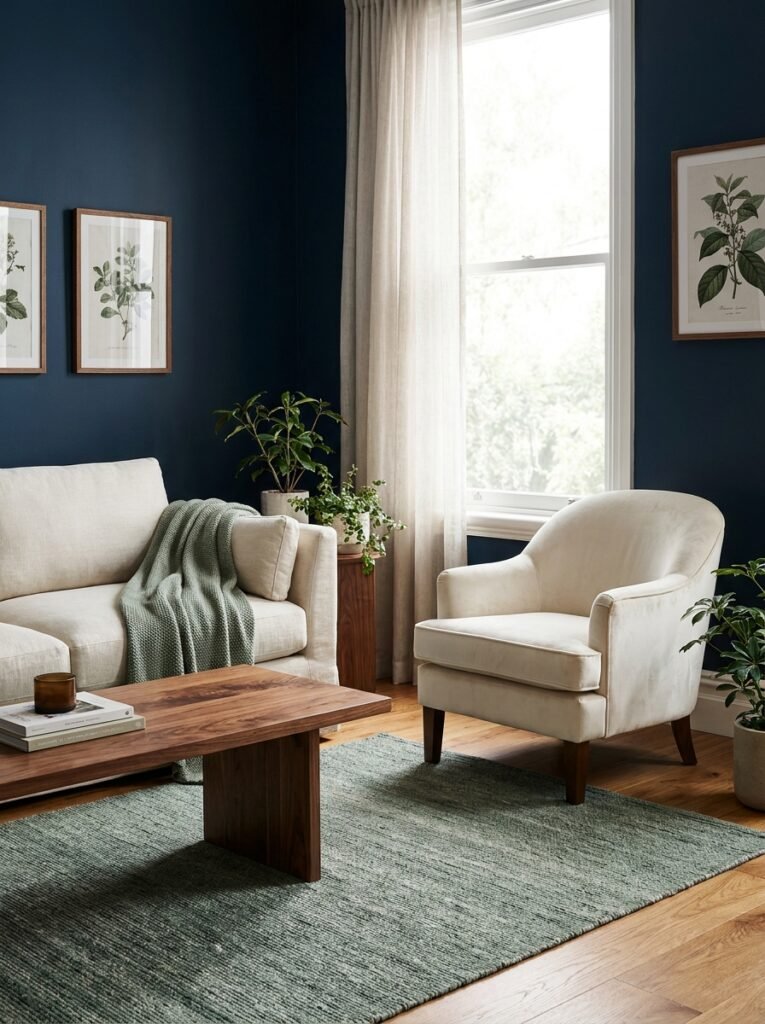
Here’s where so many people stumble — they paint the walls and then realize their existing furniture is fighting the color instead of dancing with it. Dark blue walls are remarkably versatile, but they do have strong partnerships.
Warm wood tones — walnut, oak, warm cherry — are perhaps the most natural companions to dark blue. The contrast between the warmth of wood grain and the coolness of blue creates a visual tension that feels balanced rather than jarring. A walnut coffee table against navy walls looks like it was destined to be there.
Cream and off-white upholstery adds brightness without introducing the harshness of pure white. Think a linen sofa in warm ivory or a velvet armchair in antique white — both of these will catch the light beautifully against a deep blue backdrop and keep the room from feeling too serious.
Soft greens — sage, eucalyptus, dusty olive — are a more unexpected pairing that shouldn’t work as well as it does. But something about the coolness of blue and the earthiness of muted green creates a palette that feels natural, almost botanical. Layer in a sage green throw, a eucalyptus-toned rug, and the room suddenly feels like a place where the outside world has gently come inside.
“Choose furniture that warms the blue, and you’ll have a room that feels like a permanent exhale.”
—
5. Lighting: The Secret Ingredient That Makes or Breaks Everything
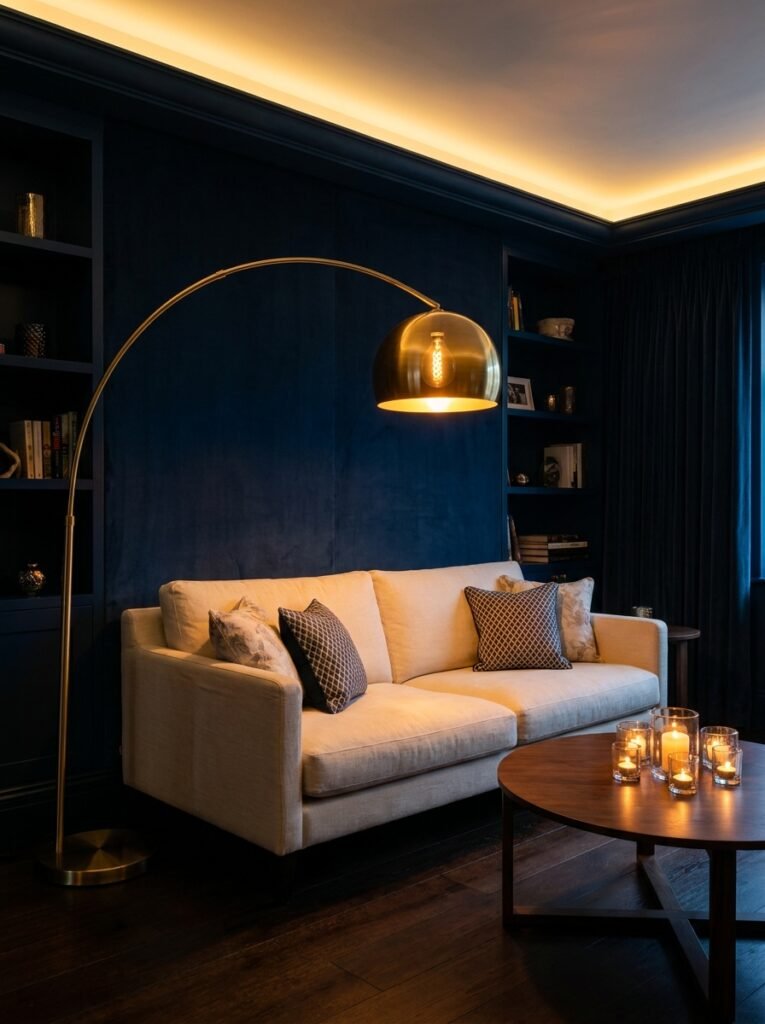
You can have the most perfectly chosen shade of midnight blue and the most beautiful linen sofa, but if your lighting is wrong, the room will feel like a cave — and not the cozy kind. Lighting in a dark blue living room isn’t just functional; it’s the difference between a room that feels moody-in-a-good-way and one that simply feels dark.
The golden rule: layer your light sources. Overhead lighting alone will flatten the room and drain the color of its warmth. Instead, aim for three tiers: ambient (the general glow of the room), accent (highlighting artwork, architectural details, or plants), and task (reading lamps, table lamps near seating areas).
Warm bulbs — 2700K to 3000K on the color temperature scale — are your best friend in a dark blue room. Cool white bulbs will push the blue toward grey and make the space feel institutional. But a warm, amber-toned bulb will bring out the depth of the color, making it feel rich and enveloping rather than merely dark.
Don’t underestimate the power of candlelight, either. Even a cluster of pillar candles on the coffee table or a grouping of tea lights on a side table adds a flicker and a warmth that no electric bulb can fully replicate. In a dark blue room, candlelight becomes something close to magic.
—
6. Textiles and Texture: Layering Your Way to Luxury
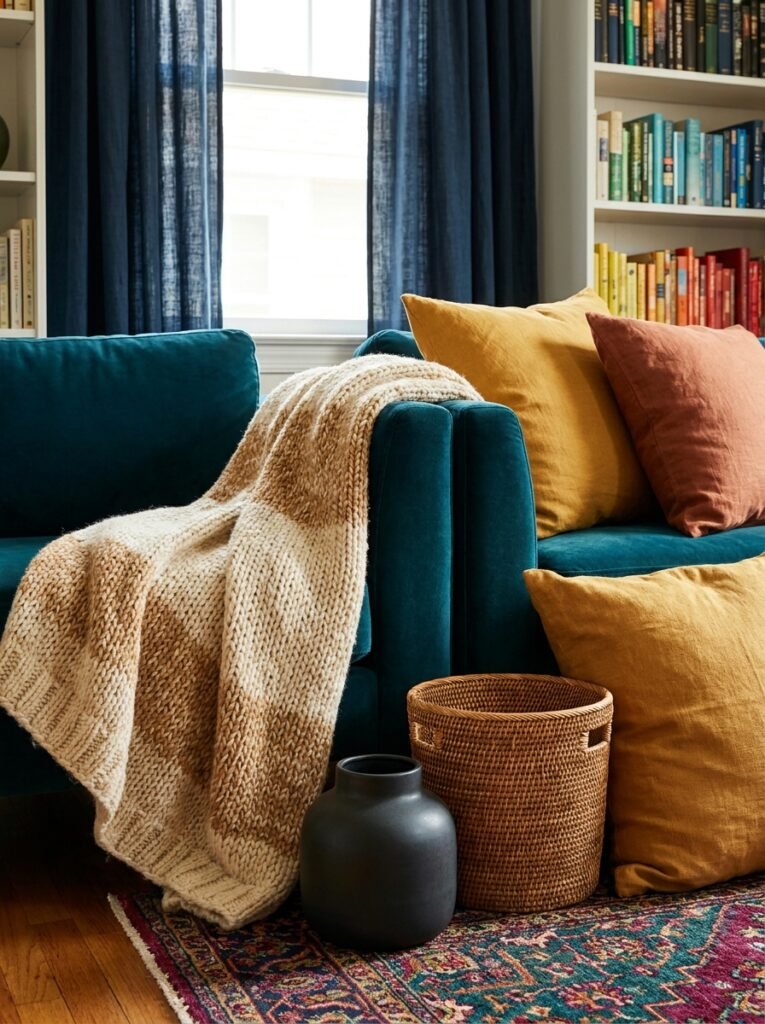
One of the greatest gifts of a dark blue room is the way it forces you to think in layers. Because the walls are doing the heavy lifting visually, the textiles become incredibly important — not just as color accents but as texture, warmth, and tactile interest.
Think about a velvet sofa in a deep teal or emerald — it reads as a complement to the blue while adding a richness that only velvet can provide. Layer a chunky knit throw over the armrest in cream or camel, add a few linen cushions in warm mustard or terracotta, and scatter a Persian-style rug in jewel tones across the floor. Suddenly the room isn’t just blue — it’s layered.
Texture is what separates a dark room that feels cozy from one that feels flat. Incorporate woven baskets, ceramic vases with a matte finish, linen curtains that puddle slightly on the floor, and bookshelves lined with books whose spines add gentle, unplanned color. The more varied the surfaces, the more alive the room feels.
—
7. Art and Mirrors: How to Add Light Without Losing Drama
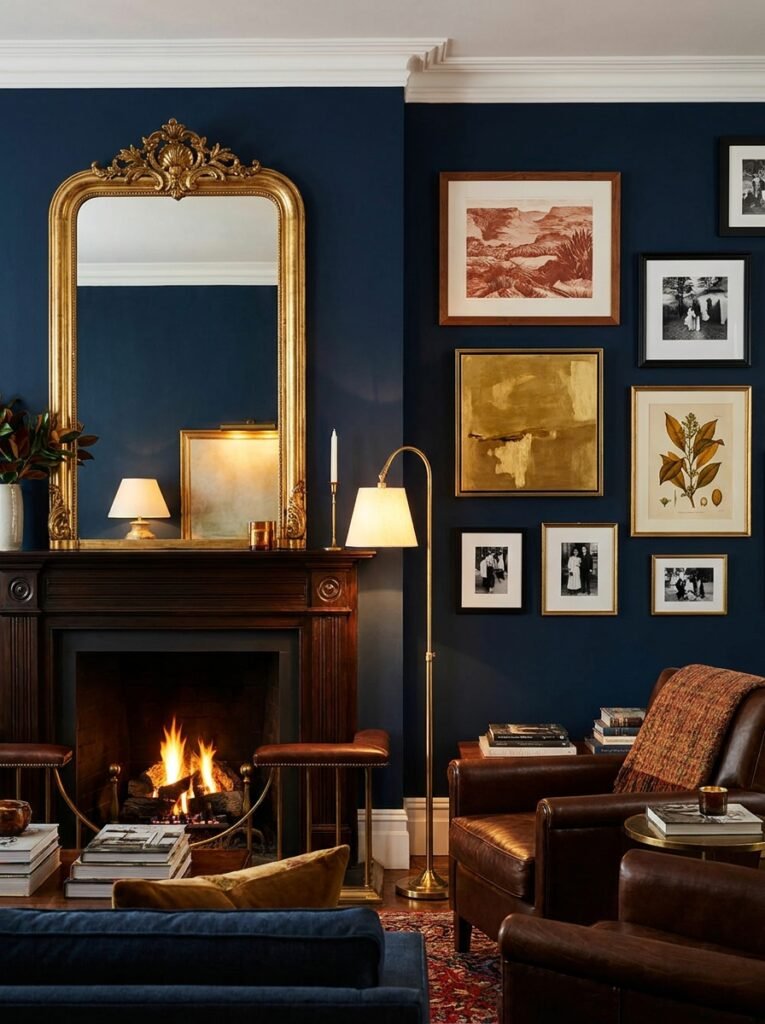
Dark rooms and art have a complicated, beautiful relationship. Because the walls are dominant, artwork needs to be deliberate — not necessarily large, but considered. A single oversized print in warm tones (think terracotta landscapes, golden abstracts, or botanical illustrations in amber and green) becomes an anchor point for the eye and a source of warmth in an otherwise cool palette.
Mirrors deserve a special mention. In a dark blue room, a large mirror serves two functions: it reflects light (making the room feel brighter without changing the wall color) and it adds a sense of depth. A gilded or brass-framed mirror above a fireplace or mantle is particularly effective — the warm metal of the frame bridges the cool blue of the walls and the warm light bouncing off the glass.
Gallery walls work beautifully in dark blue rooms too, but they require a curation approach that leans toward the warm spectrum. Mixing black-and-white photography with warm-toned prints and perhaps a botanical or two creates a collected, lived-in feeling that suits the moody backdrop perfectly.
—
8. The Role of Natural Materials in a Dark Blue Living Room
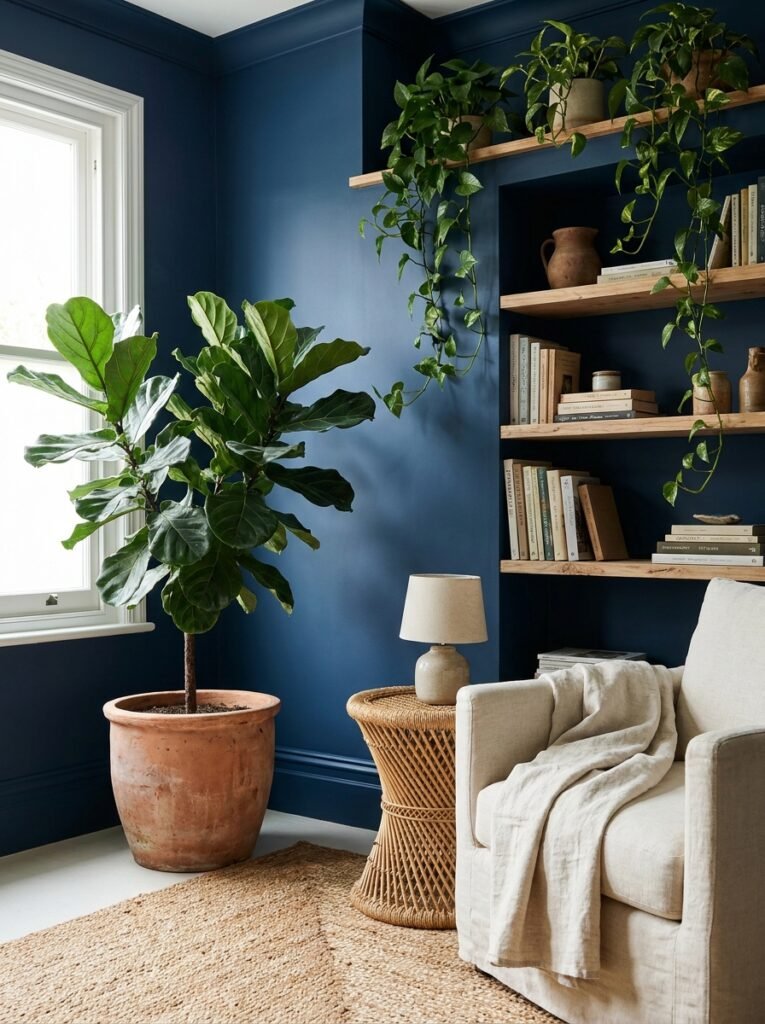
There’s a tendency, when designing a dark and dramatic room, to go all-in on the moody aesthetic — dark metals, dark wood, deep fabrics. And while that can be stunning in a very curated, editorial way, it can also make the room feel heavy rather than restful. Natural materials are the antidote.
Rattan, jute, linen, raw cotton, unfinished wood — these materials bring a breath of air into a dark room. A jute rug grounds the space with natural texture. A rattan side table adds warmth and lightness. A linen throw in undyed natural cream reads as effortless and organic against the formality of a deep blue wall.
Plants are perhaps the most powerful natural element you can bring into a dark blue living room. A large fiddle-leaf fig in the corner, trailing pothos on a bookshelf, or a cluster of smaller plants on a windowsill — the green of living plants against deep blue creates a contrast that is, quite literally, beautiful in nature and translates perfectly indoors.
“Natural materials remind a dramatic room to breathe.”
—
9. Small Dark Blue Living Rooms: Yes, It Can Work
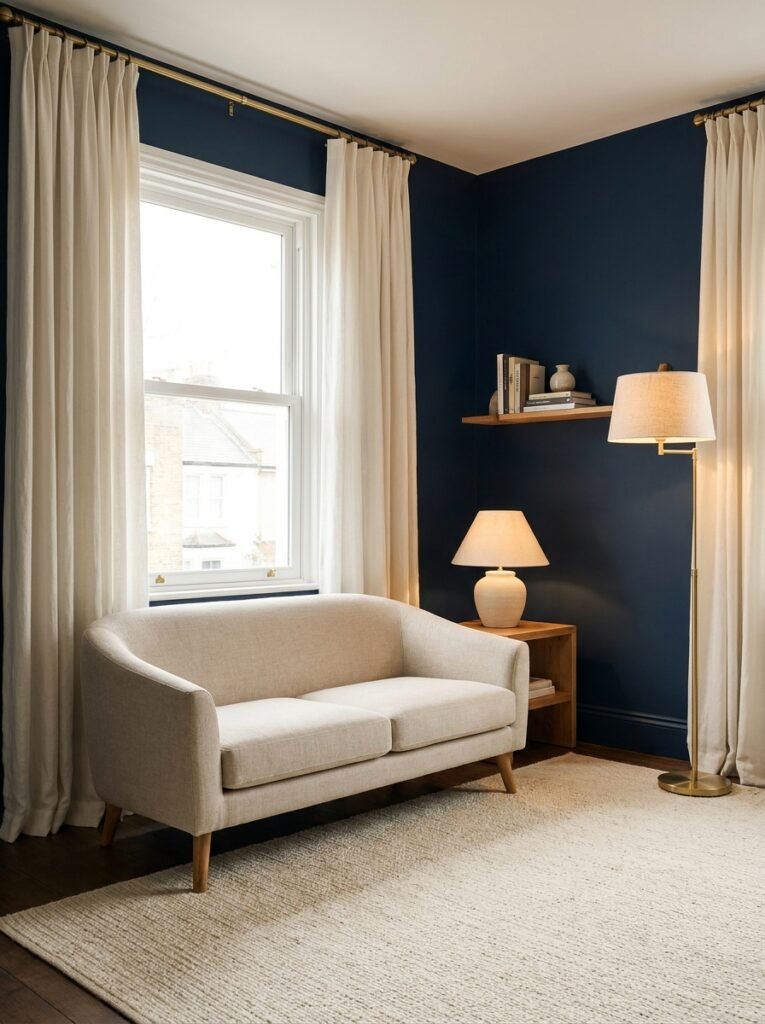
The question everyone is silently asking: what if my living room is small? The conventional answer would be to stick with light colors. The more accurate answer is that a small dark blue living room, done correctly, is often better than a large one because the intimacy the color creates is amplified by the size of the space.
The key is keeping the floor light. A light-colored rug — cream, pale grey, natural jute — visually expands the floor plane and prevents the room from feeling closed in. Keep furniture legs visible (low-profile pieces with legs always make a room feel larger than solid, skirted furniture) and avoid overcrowding the space with too many pieces.
Curtains hung high and wide — close to the ceiling and extending well beyond the window frame on either side — make a small room feel taller and the windows feel larger. In a dark blue room, linen curtains in warm white or soft cream will frame the windows beautifully while bouncing additional light into the space.
—
10. Dark Blue and Metallics: The Partnership That Elevates Everything
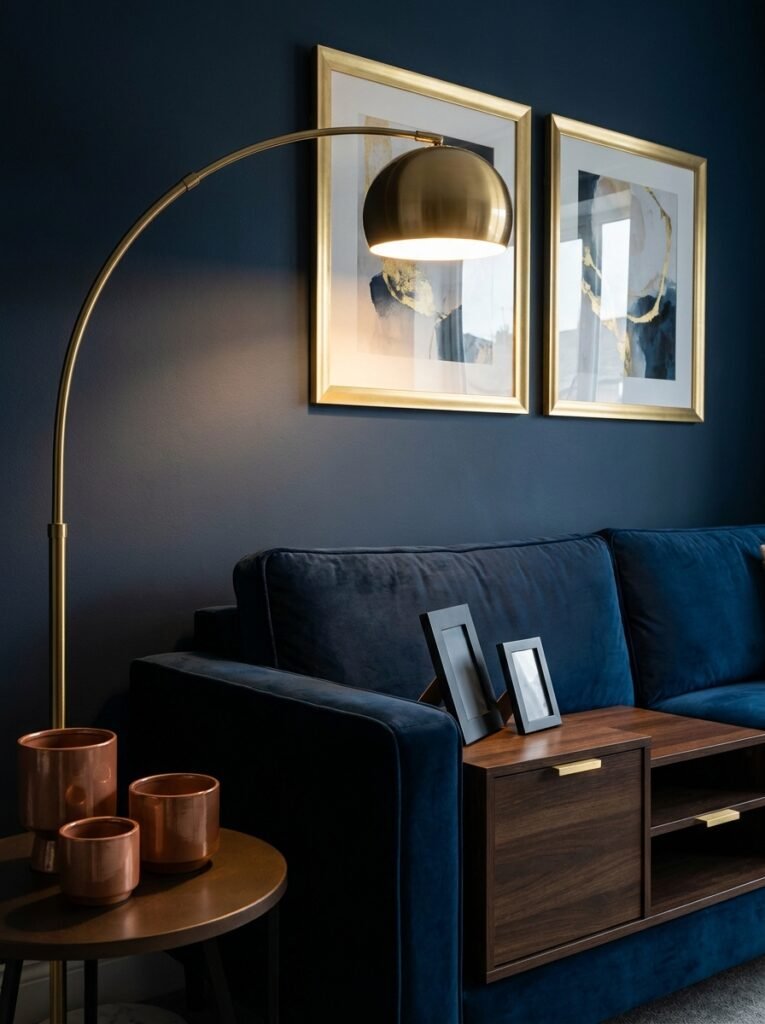
If dark blue is the melody of a room, metallic accents are the harmony that makes the whole thing sing. Brass and gold are the most natural partners — their warm, rich tones create a contrast against cool blue that feels simultaneously sophisticated and approachable. A brass floor lamp, gold-framed artwork, or a set of brass cabinet handles on a media console — these details elevate the entire room without demanding a renovation.
Copper sits in a similar warm family and works particularly well with navy or midnight blue. A copper pendant light or a cluster of copper-toned plant pots brings an artisanal warmth to the space.
Matte black is a cooler metallic option that works well in more modern or minimalist dark blue rooms. It provides structure and contrast without warmth, creating a more graphic, editorial feel. If your aesthetic leans toward clean lines and contemporary design, matte black hardware, frames, and fixtures will sharpen the whole composition.
—
11. Seasonal Styling: Your Dark Blue Room Through the Year
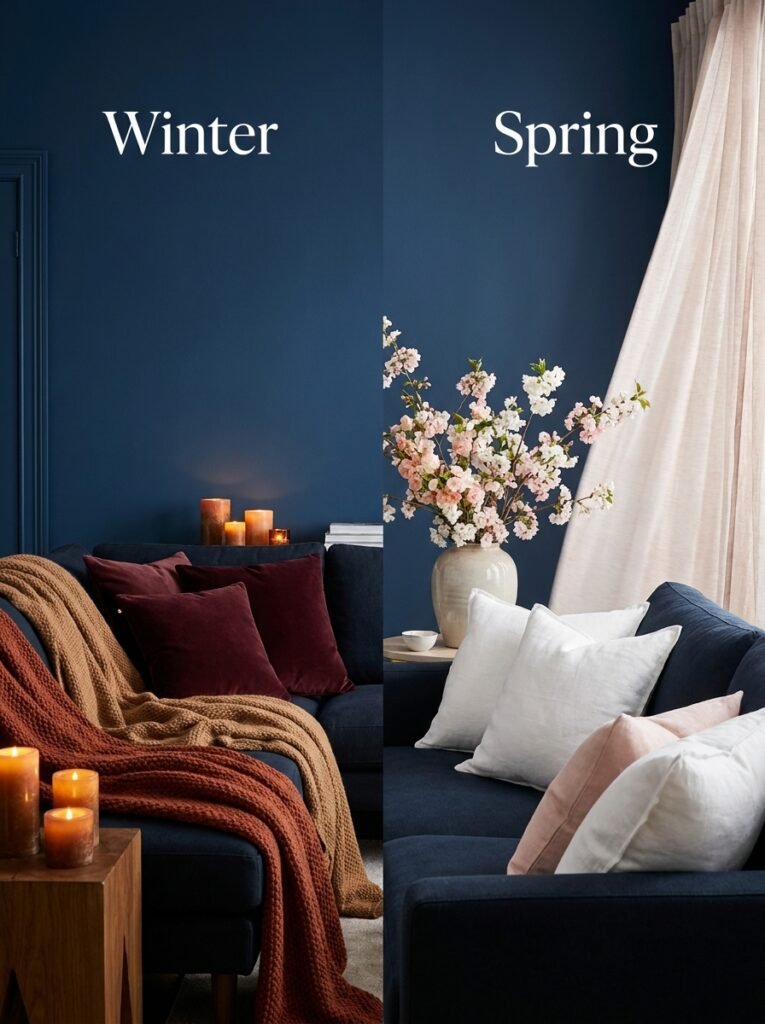
One of the most underappreciated qualities of a dark blue living room is how naturally it adapts to the seasons. With a few simple swaps in textiles and accents, the same room can feel warm and cozy in winter and fresh and airy in summer.
In autumn and winter, lean into the depth of the color. Layer chunky knit throws in rust and camel, bring in spiced-tone candles, swap out summer cushions for velvet in deep burgundy or forest green. The room will feel like the coziest place on earth — and that’s exactly what a winter interior should be.
Come spring, lighten the textiles. Switch to crisp linen cushions, bring in fresh flowers (blush pink and white work beautifully against dark blue), and let the curtains drift open to flood the room with spring light. In summer, add a few rattan and natural fiber accents, swap the candles for a diffuser with a clean, citrus-forward scent, and the room transitions effortlessly without a single drop of paint.
—
12. How to Commit: Taking the First Step Toward Your Dark Blue Room
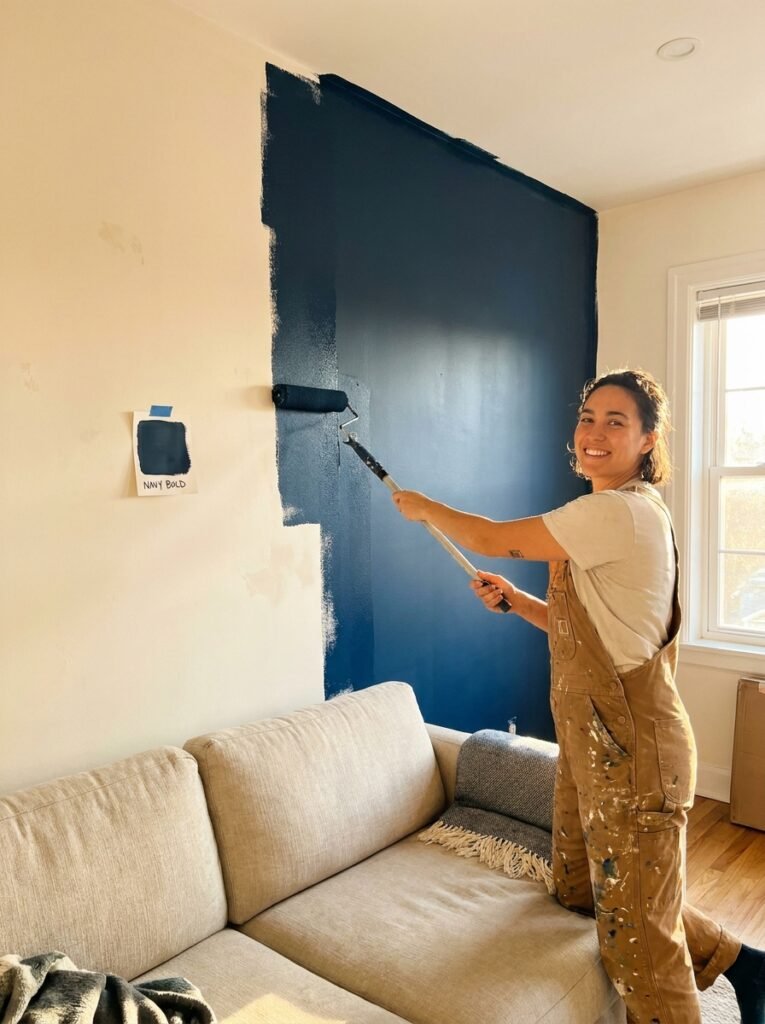
Here’s the honest truth about decorating with deep, bold color: the hardest part is the commitment. Everyone loves the idea of a dark blue living room on Pinterest. The hesitation comes when it’s time to open that paint can. But here’s what every interior designer will tell you — the people who commit to bold color are almost never the ones who regret it. Regret, in interior design, tends to belong to the people who played it safe.
Start with a single accent wall if you need a runway. Choose the wall behind your sofa or the one that faces you when you walk in from the hallway — your natural focal point. Paint it dark blue and live with it for two weeks before deciding whether to extend it to the other walls. More often than not, you’ll be reaching for the paint roller by week one.
If even a painted wall feels like too much of a leap, there are softer entry points: a large dark blue area rug, deep blue velvet curtains that pool on the floor, or a blue painted fireplace surround. Each of these introduces the color in a way that’s reversible, allowing you to fall in love with it before you make it permanent.
—
🌿 How to Care for a Dark Blue Living Room
Maintaining the beauty of a dark blue room is less complicated than most people expect — it just requires a bit of intentionality.
First, touch up paint regularly. Dark colors show scuffs and nicks more visibly than light ones, so keep a small jar of touch-up paint tucked away. A quick dab with a small brush every few months will keep the walls looking freshly painted.
Second, protect your textiles. Dark velvet and linen fabrics attract lint and pet hair more visibly against a dark backdrop — invest in a good fabric roller and store throws in a way that keeps them looking fresh.
Third, clean your windows regularly. Natural light is precious in a dark room, and grimy windows can subtract significant brightness from the space. Clean glass means more light, which means your dark blue walls will be lit beautifully rather than simply dim.
Fourth, rotate your accent pieces seasonally. This doesn’t need to be a major undertaking — swapping a few cushions and changing out a vase or two keeps the room feeling alive and prevents that stale feeling that can settle into any heavily decorated space over time.
Fifth, don’t be afraid to edit. Dark rooms can tip into cluttered more quickly than light ones because everything is visible against that strong backdrop. Periodically remove pieces that no longer serve the composition and keep surfaces clean enough to breathe.
—
❓ FAQ
Q: Will dark blue make my living room feel too small? A: Not necessarily — in fact, when used intentionally, dark blue can make a small living room feel more intimate and cozy rather than cramped. The key is keeping your flooring light, choosing furniture with visible legs, and layering warm lighting to prevent the room from feeling dim. Many designers argue that a small, well-styled dark room is more charming than a large, poorly decorated light one.
Q: What colors go well with dark blue walls in a living room? A: Warm neutrals like cream, camel, and warm white are the most natural companions to dark blue, as they balance the coolness of the color with gentle warmth. Earthy tones like terracotta, rust, and mustard add energy and contrast. For a more lush, layered effect, muted greens like sage and eucalyptus work beautifully. Metallic accents in brass, gold, or copper add sophistication and tie the whole palette together.
Q: What kind of lighting works best in a dark blue living room? A: Layered lighting is essential. Combine ambient overhead lighting with accent lamps and task lamps to create warmth at multiple levels. Always use warm-toned bulbs (around 2700K) rather than cool white or daylight bulbs, which will push the blue toward grey and make the space feel cold. Candlelight and dimmable fixtures are particularly effective for evening ambiance.
—
💭 Final Thought
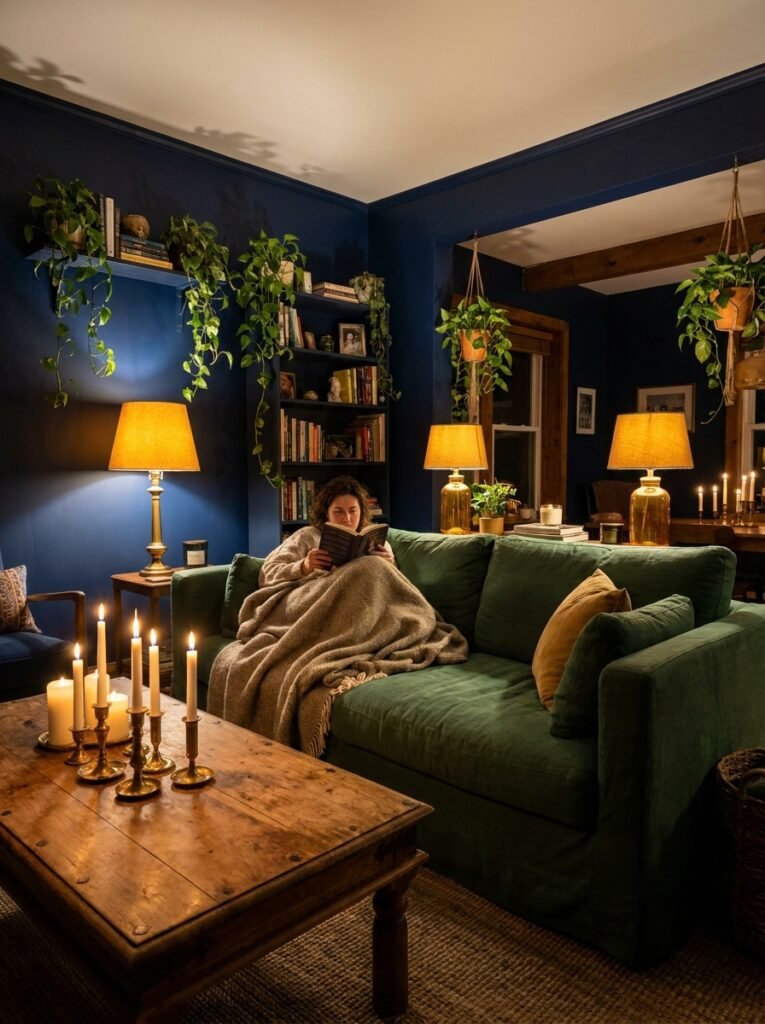
A dark blue living room is, at its heart, a declaration — a statement that you are done settling for safe and beige and forgettable. It’s the color of late evenings and deep conversations and the feeling of finally being somewhere that is entirely, unapologetically yours. It takes a little courage to commit to, and it repays that courage every single day.
So here’s the question to sit with: if your living room could feel like any emotion, which one would you choose — and is the color on your walls saying it?