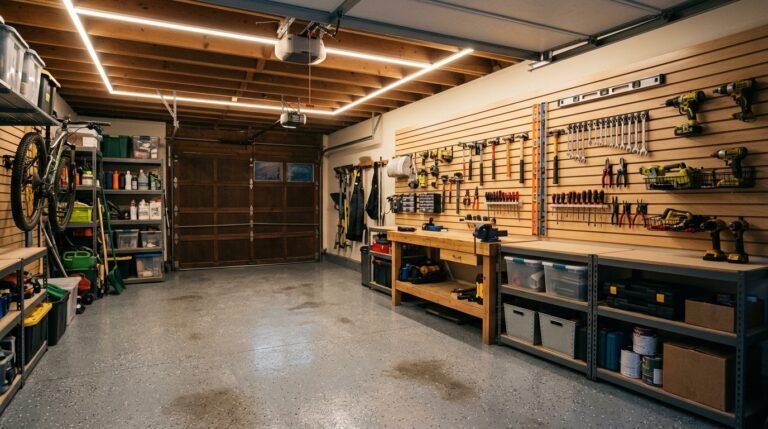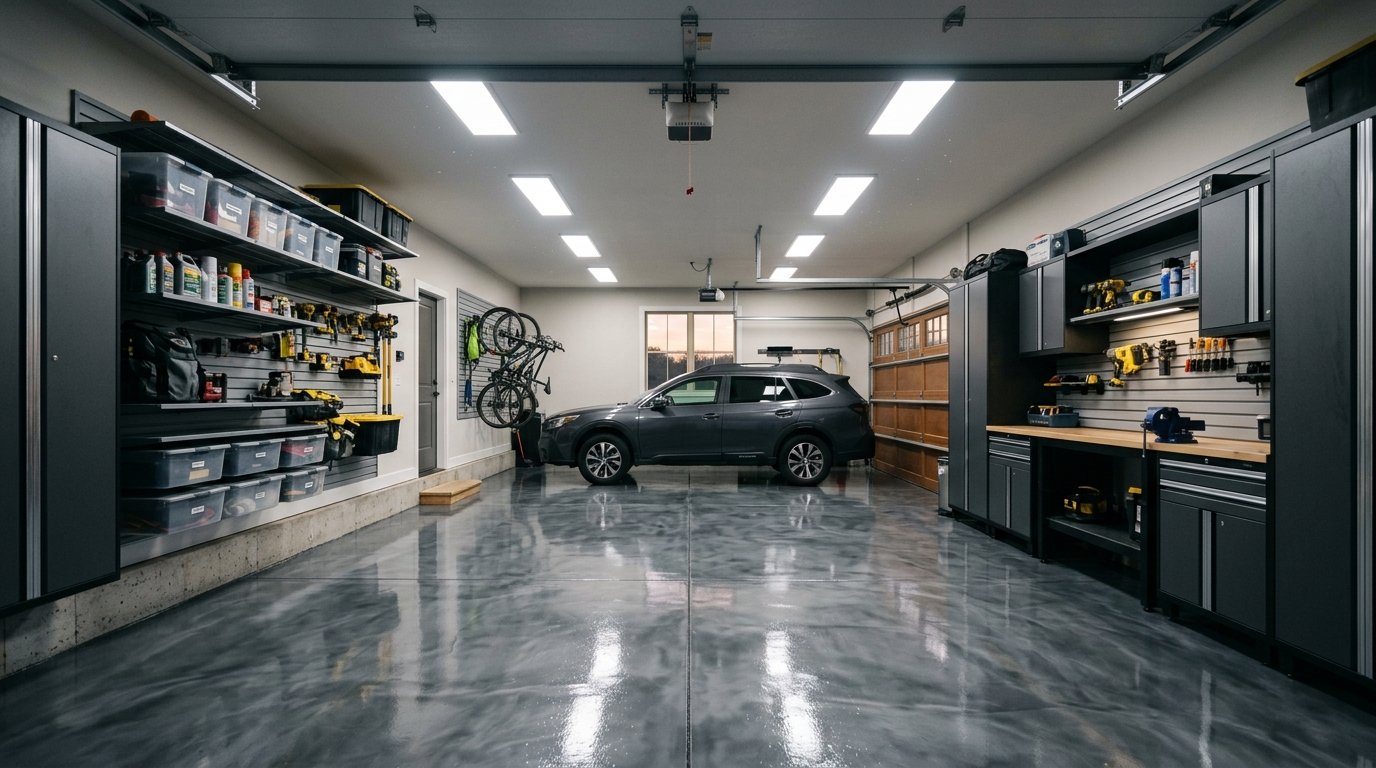
The Garage Glow-Up Nobody Talks About (But Everyone Needs)
My neighbor knocked on my door last spring and said, “I don’t even know what’s in there anymore.” She was talking about her garage. Two cars worth of floor space, completely invisible under bikes nobody rides and boxes from a move six years ago.
Sound familiar?

—
1. Why Your Garage Feels Like a Punishment Room (And How to Stop That)

The garage has this weird cultural reputation — it’s the place where intention goes to die. You park there, you dump there, and you absolutely do not think about it. And I get it, because for years mine was the same way. But here’s what shifted my thinking: the garage is literally attached to your house. It shares walls with rooms you care about. So why are you decorating your living room down to the throw pillow angle and then treating the garage like a forgotten storage unit?
The garage deserves a strategy. Not a complete renovation, necessarily, but a real honest look at what it’s doing and what it COULD be doing.
The moment it clicked for me was when I realized I wasn’t just storing stuff in there — I was storing chaos. And chaos leaks. It leaks into your morning when you can’t find your kid’s helmet, it leaks into your weekend when you trip over the lawnmower getting to the recycling bins, and it leaks into how you FEEL about your home generally.
So let’s fix it.
—
2. The Wall That Changes Everything (No, Really, Just One Wall)
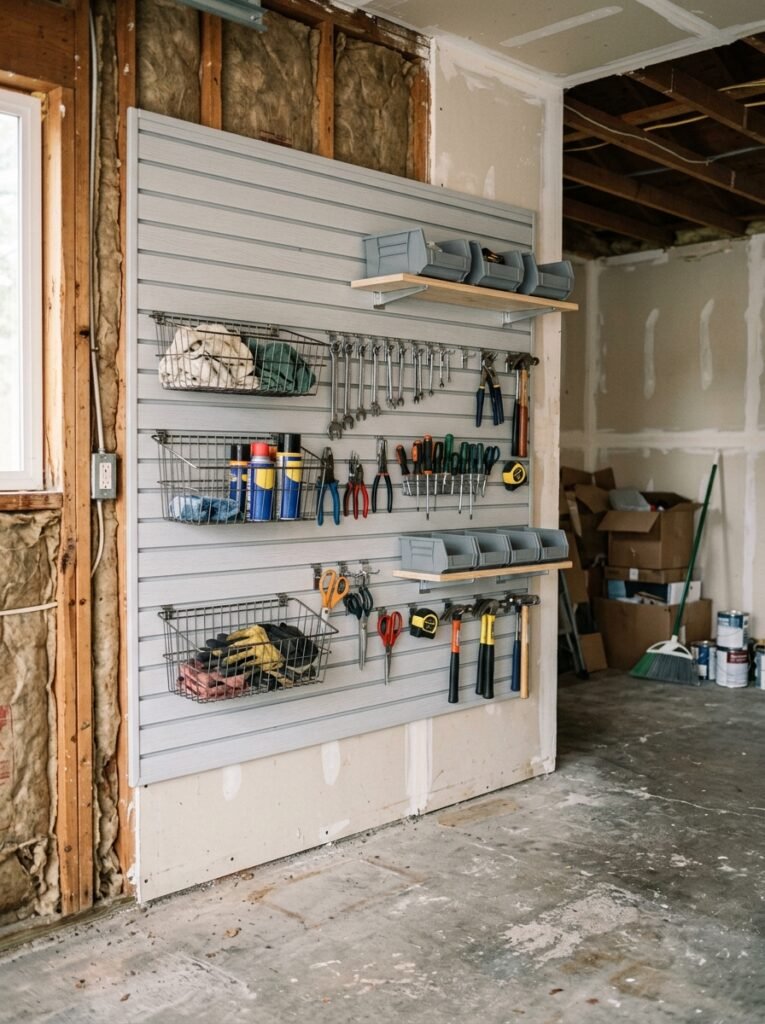
Don’t try to tackle the whole garage at once. I’m serious — pick one wall, preferably the longest one, and make it do all the heavy lifting.
A solid wall storage system with vertical panels and adjustable hooks is genuinely the single highest-impact thing you can do for a garage. You can hang bikes, garden tools, sports gear, extension cords, basically anything with a handle or a loop. The floor beneath it stays clear, and CLEAR floor space is what makes a garage feel intentional instead of accidental.
The trick is going vertical. Most people think horizontally — they line stuff up along the walls at shoulder height and then wonder why it still feels cramped. Go floor to ceiling. Use the full height. Your garage likely has eight or even ten feet of vertical space that’s doing absolutely nothing for you right now.
“The floor beneath it stays clear — and clear floor space is what makes a garage feel intentional instead of accidental.”
Don’t overthink the system. Adjustable is the key word. Your storage needs change — summer to winter, kids getting older, hobbies starting and stopping. A flexible wall system moves with your life.
—
3. The Forgotten Floor: Why Epoxy Coating Is Having a Moment
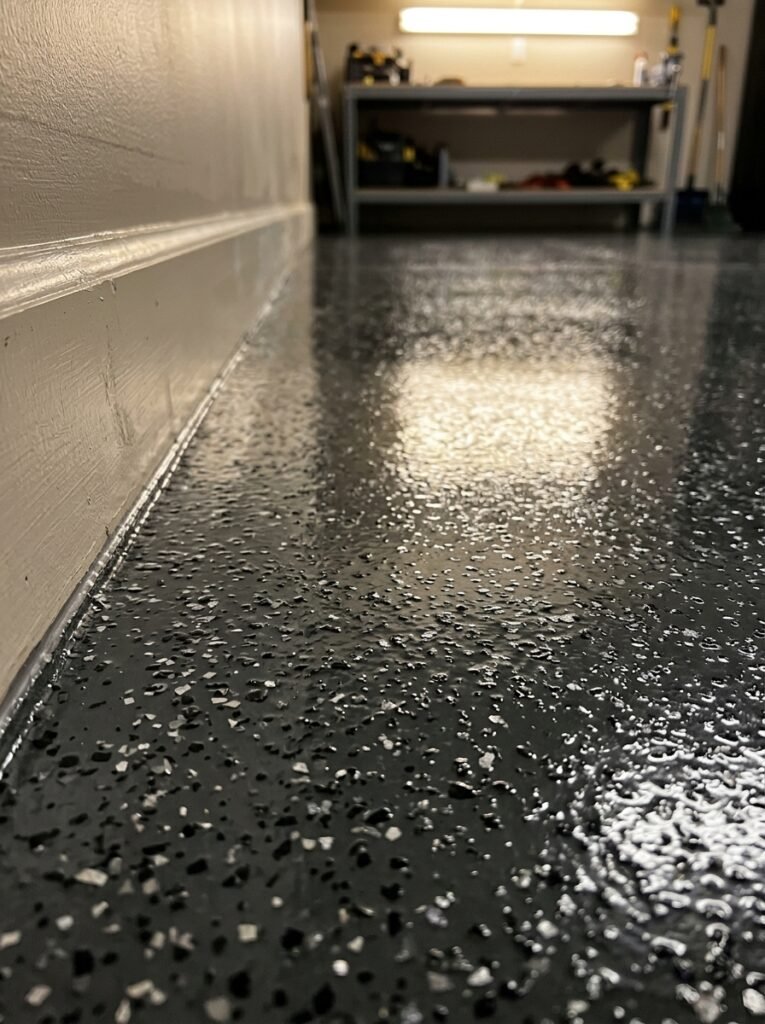
Okay, this one gets overlooked constantly, and I’ll never understand why. The floor is enormous. It’s the first thing you register when you pull in. And most garage floors look like… a crime scene, honestly. Oil stains, scuff marks, random paint splatters from that one weekend project.
Epoxy coating. I can’t stop recommending it. It’s a liquid coating you roll or spread over clean concrete, and when it cures it looks like something between a showroom and a very chic industrial kitchen. It comes in grey, charcoal, tan, even a flecked speckle finish that hides any stain that dares show up later.
The practical upside is huge — it’s easier to sweep, easier to spot a dropped screw, and it just LOOKS clean even when it isn’t perfectly clean. Psychologically, a good floor is huge. It anchors everything else.
Is it a weekend project? Sort of. You’ll need to prep the concrete (clean it, etch it, let it dry completely) before anything goes down. But it’s not a contractor-required job, most people do it themselves, and the before/after is one of the most satisfying reveals in home improvement.
—
4. Ceiling Storage That Sounds Intimidating But Genuinely Isn’t
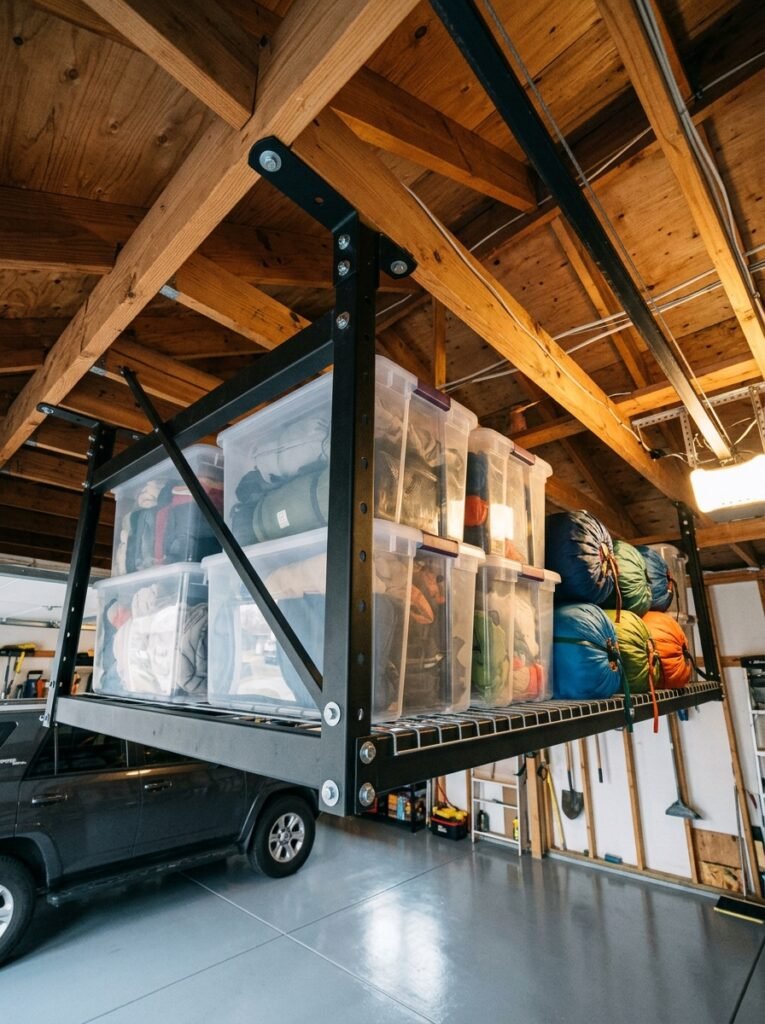
I avoided ceiling storage for years because it seemed like a thing contractors do, not a thing regular people do on a Saturday morning. I was wrong.
Overhead ceiling racks — the kind that hang on adjustable drop rods from the ceiling joists — are genuinely straightforward to install with basic tools and a helper. You mount the brackets into the joists (find them with a stud finder, that part matters), hang the platform, and suddenly you have four by eight feet of elevated storage you didn’t know you had.
Seasonal stuff lives up there perfectly. Holiday boxes, camping gear, luggage, items you need twice a year at most. They’re off the floor, off the wall, completely out of the way.
One important note: check the weight rating before you load it up. Don’t use it for anything too heavy, and don’t store anything fragile. Up high and gravity are not a combination for your grandmother’s china.
But for bulky, lightweight stuff? It’s genuinely life-changing. Or at least life-tidying.
—
5. The Color That Makes a Garage Look Like Someone Designed It On Purpose
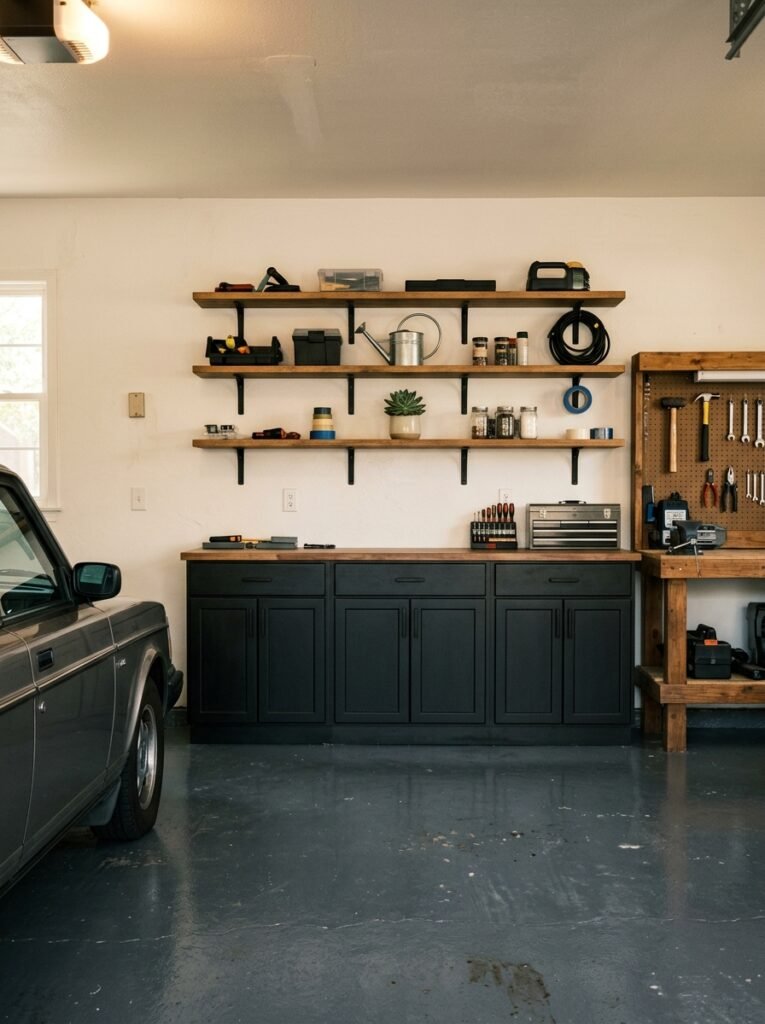
Here’s my strong opinion: paint your garage walls. Not the default builder beige, not an aggressive white, but a real considered color.
Light grey is the current quiet favorite, and it works because it reads neutral but not boring, especially with the right lighting. Warm greige — that grey with just a hint of brown — does something lovely in a garage that has any natural light from a window or side door.
But honestly? I’ve also seen garages painted a deep charcoal on three walls with white on the fourth, and it looks like someone’s really cool workshop. A forest green. A navy. These don’t feel wrong — they feel committed, and commitment reads as style.
The ceiling is often forgotten here. Paint it white. Not the same color as the walls. A bright white ceiling in a garage with colored walls creates contrast, makes the space feel taller, and bounces light around in a way that genuinely makes the whole room feel cleaner and more considered.
“Commitment reads as style. It’s the difference between a space that looks accidental and one that looks like you meant it.”
Two coats. Good primer first, especially if the walls were previously bare drywall or unpainted cinder block. Worth every minute.
—
6. Lighting: The Thing Every Garage Gets Completely Wrong
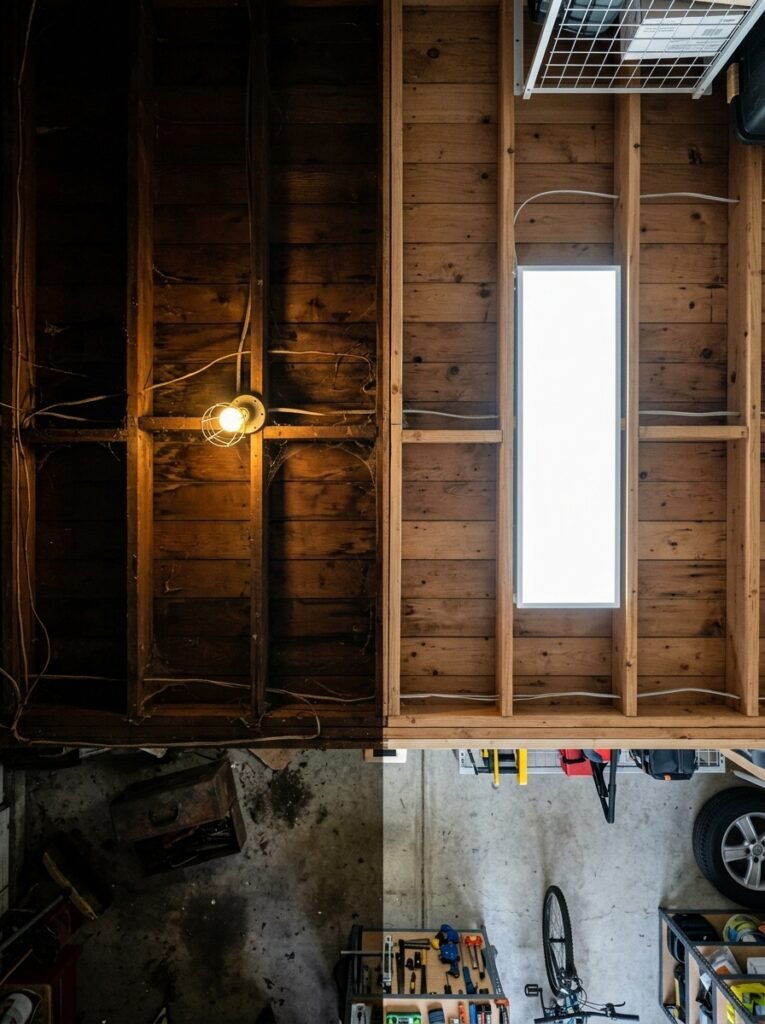
Strip fluorescent tubes. That’s what most garages have. And I understand why — they’re cheap and functional. But the light they produce is flat, cold, slightly aggressive, and it makes even a beautifully organized garage feel like a place you want to escape.
Swap them out. LED shop lights with a warm-to-neutral color temperature (look for something around 4000K — it’s bright but not harsh) make a genuinely dramatic difference. Hang two or three of them down the center of the ceiling with a bit of space between them, and suddenly your garage is evenly lit, everything is visible, and it doesn’t feel like a holding cell.
If you’re using the garage as a workshop or hobby space, add under-shelf lighting above your workbench. Just a simple plug-in LED strip. The focused task lighting makes working there actually pleasant instead of slightly miserable.
Side note — if your garage has any windows, please don’t cover them. Natural light is doing something for that space that no fixture can fully replicate.
—
7. The Workbench Setup That Works for Non-Workshop People Too
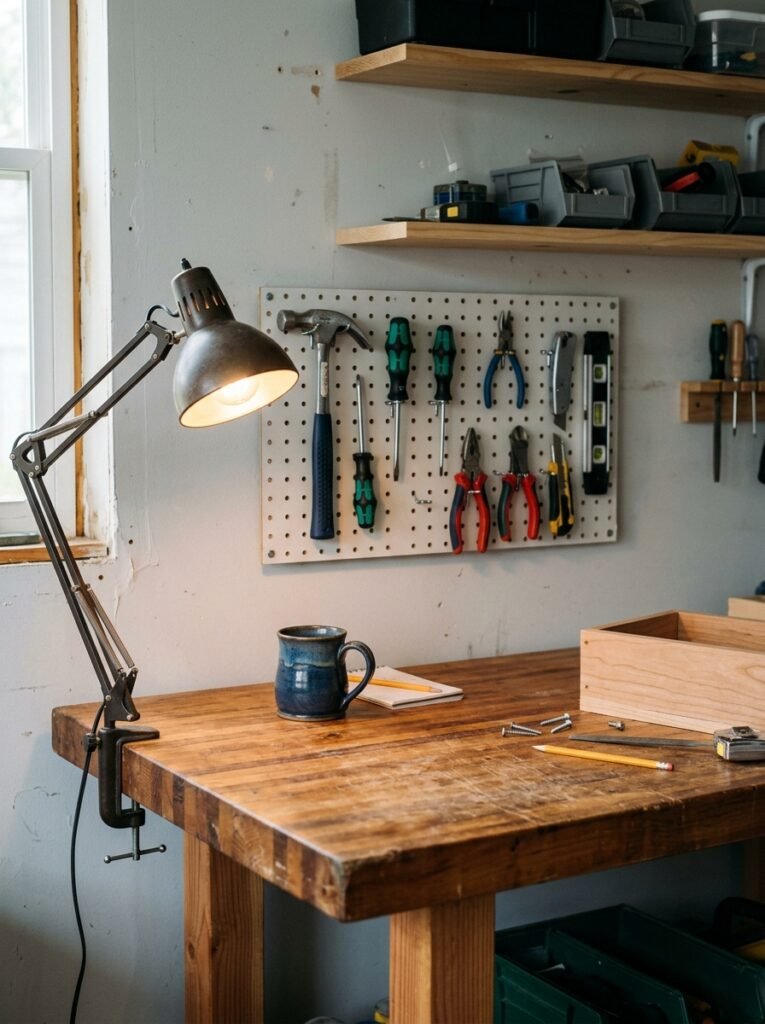
You don’t have to be building furniture or restoring a motorbike to benefit from a workbench. Hear me out.
A dedicated surface — even a single counter-height shelf along one wall — gives you a place to set things down intentionally. Repotting a plant. Wrapping a birthday present. Charging the electric bike. Sorting the recycling. These tasks need a surface, and right now you’re probably doing them on the floor or the bonnet of your car.
A workbench with open shelving underneath it is even better. Store paint tins, cleaning products, tools, batteries, all the functional clutter that doesn’t belong in the house but needs to be accessible. Label the shelves. Or don’t label them and just know where things go — either works as long as the system is consistent.
The height matters more than most people think. Counter height (around 34 to 36 inches) is comfortable for standing work. If you’re taller or shorter than average, adjust accordingly. This is a space built for you, not for a showroom photograph.
—
8. Bikes, Boards, and Big Awkward Things That Live in Every Garage
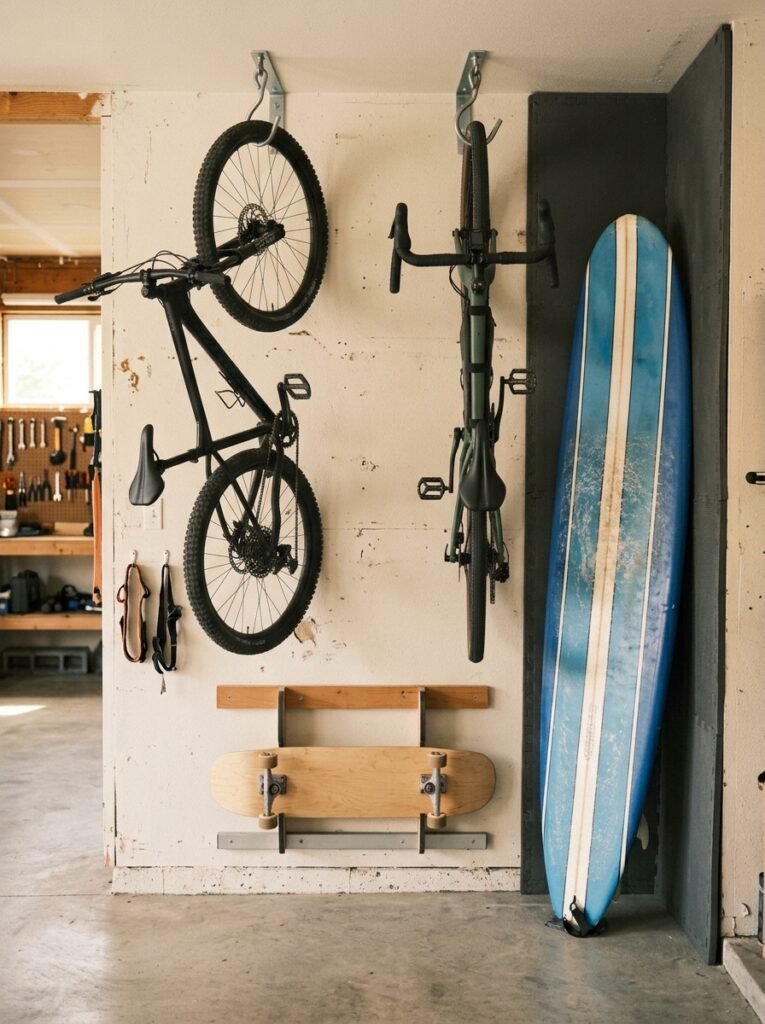
Bikes are the nemesis of garage organization. They’re big, they’re shaped like nothing else, and everyone in a family of four seems to have at least two of them.
Wall-mounted bike hooks are the standard solution and they genuinely work, but the installation angle matters. A horizontal hook that holds the bike parallel to the wall takes up less visual space and lets you fit more bikes along a single wall. A vertical hook (front wheel up) works better if wall space is limited but you have ceiling height.
For paddleboards, kayaks, snowboards — same principle. Wall straps and ceiling mounts keep them stored without taking floor space. These things spend eleven months a year not being used; they shouldn’t occupy prime real estate on the floor.
Balls are annoying to store because they roll. A simple wire shelf or a mesh bag hung from a hook solves this and takes about four minutes to set up.
I know it sounds too simple. But the number of people who have bins of sports balls on the floor when a fifteen-dollar mesh bag would fix the entire problem is genuinely surprising.
—
9. Making Space for a Car (Which Is, After All, the Point)
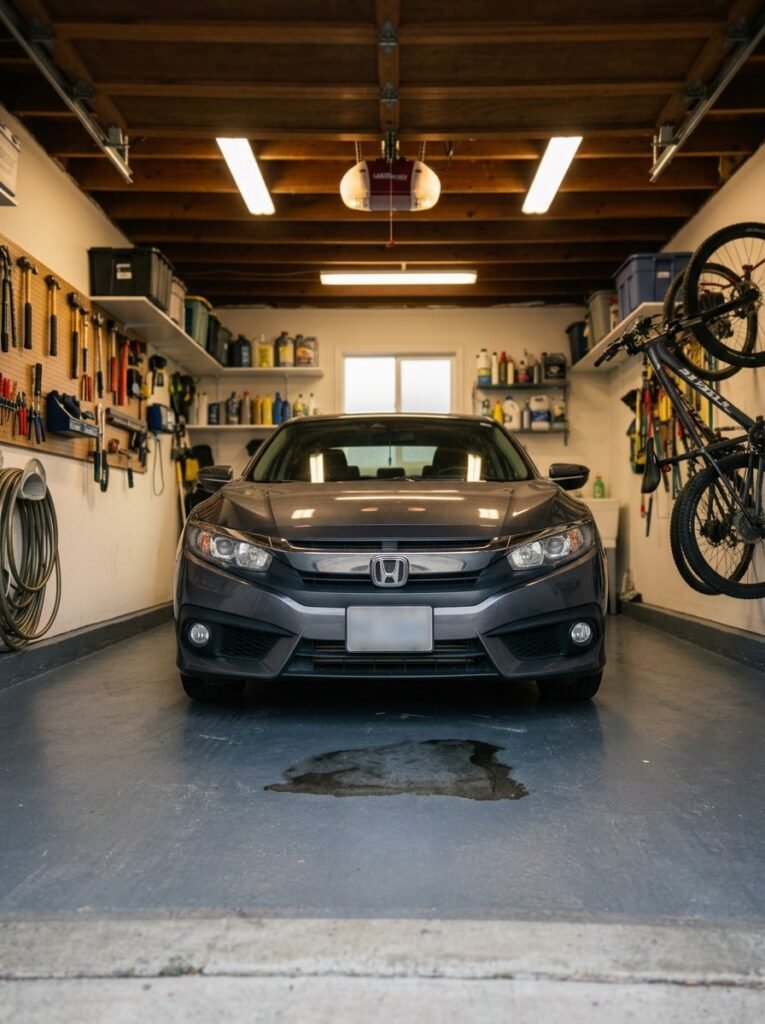
This feels obvious but apparently isn’t, because roughly half of Americans with a garage can’t fit a car inside it. Same in the UK — the garages are smaller and the cars are somehow still not fitting.
The goal is one clear car-width lane, ideally with two to three feet on each side for opening doors without scraping your knuckles. Everything else organizes AROUND that lane, not into it.
Use floor markings if it helps. Tape or painted lines showing where the car goes creates a psychological boundary. It sounds silly until you actually do it and realize how much it changes the way you use the space.
And if you do have two-car capacity? Keep one lane clear permanently. The second side can do double duty as workshop, storage, hobby space — whatever you need. But keep at least one car inside. That’s what it’s FOR.
“A clear floor lane is a commitment, not just a layout choice. You’re deciding, in advance, that the garage will stay functional.”
—
10. The Pegboard Comeback (And Why It Deserved the Moment)
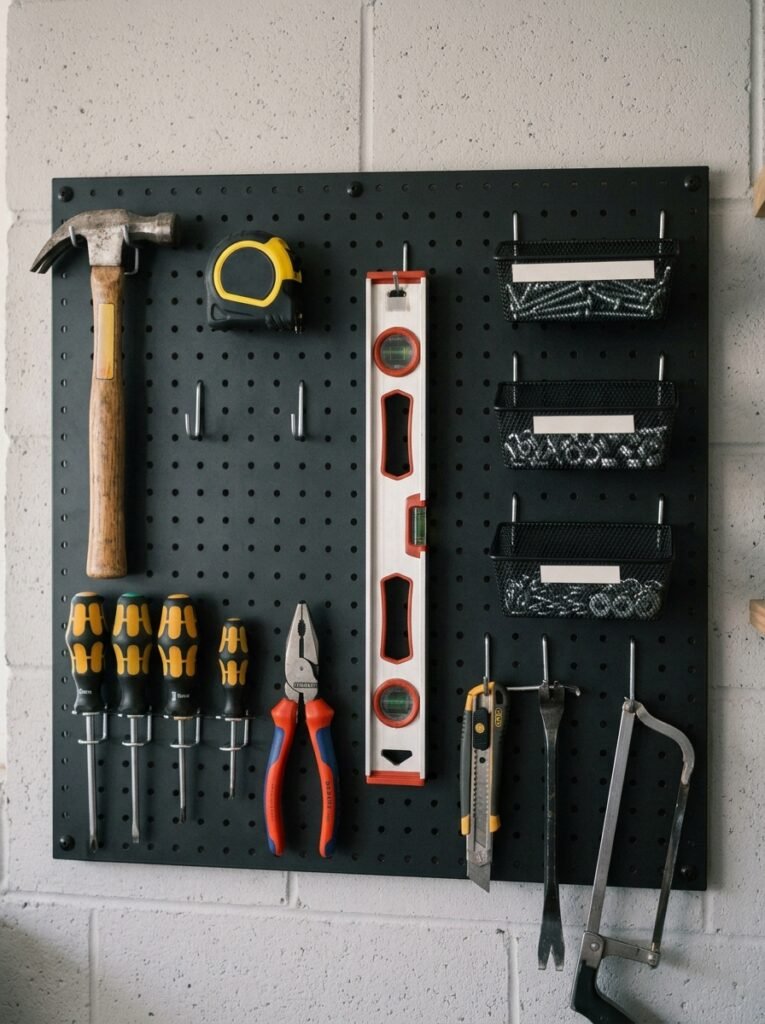
Pegboards had a rough few decades reputation-wise. They felt old-fashioned, a bit dad-garage, not exactly something you’d pin. But they’ve come fully back, and honestly they deserved the comeback.
A painted pegboard — especially in a matte black or deep grey — looks genuinely modern and is still the most flexible small-tool storage solution ever invented. You can rearrange it whenever you want. You can see everything at once. You can add hooks, shelves, small bins, even a magnetic strip.
Paint it to match your walls for a more seamless look, or go high contrast (black pegboard on a white wall) for something with a bit more visual personality. It’s functional and it looks intentional — that combination is really hard to beat.
Put it above the workbench. That’s the sweet spot. Everything you need while working is visible, within arm’s reach, and nothing is lost at the bottom of a drawer.
—
11. The Mudroom Moment at the Garage Entry Door
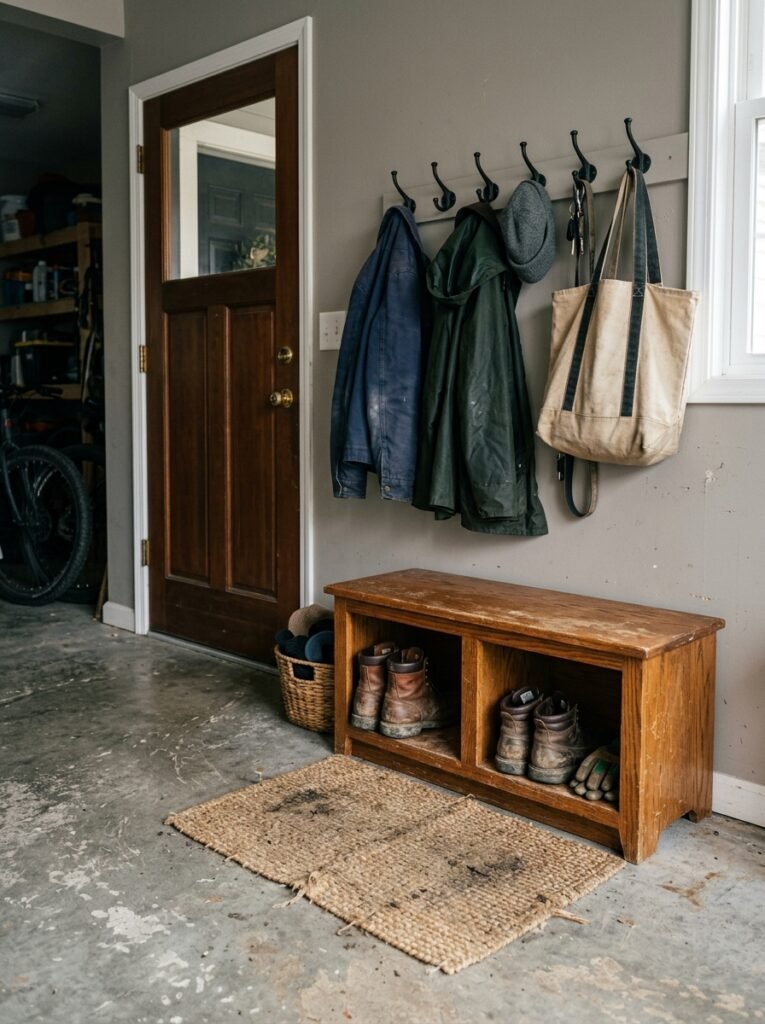
The door between your garage and your house is doing a lot of work. People come in through it with muddy boots, wet coats, school bags, football boots, helmets, and approximately six hundred other things. And most of the time that entry point is… nothing. Just a door and a step.
Add hooks. Immediately. A row of sturdy hooks at coat height (and a second lower row for kids if you have them) changes the entire dynamic of that entry. Coats stay in the garage. Bags stay in the garage. The mess stops at the door instead of continuing into the kitchen.
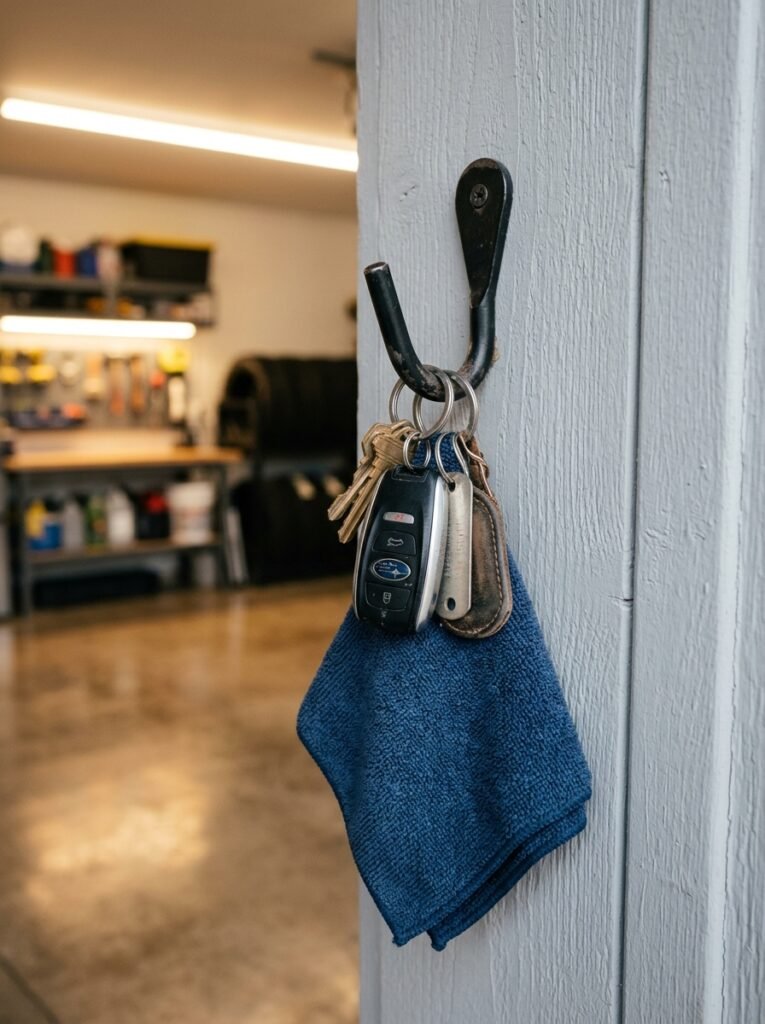
A small shelf or bench by that door for shoes is equally powerful. A boot mat underneath catches the worst of the mud. A couple of hooks for keys, maybe a small shelf for sunglasses or post — it becomes a proper entry system in about a weekend.
This isn’t just about the garage. It’s about every room connected to it. A well-designed garage entry keeps the house cleaner, calmer, and noticeably more organized without you doing anything differently in the rest of the house.
—
12. The Garage as a Room You Actually Want to Spend Time In

This is the part people resist a little. But I’m going to say it anyway: your garage can be a place you WANT to be, not just a place you have to go.
It doesn’t need to be a full conversion. You don’t need drywall and a rug and a sofa. But with good lighting, a considered color on the walls, organized storage, and a workbench you actually want to use — it becomes something. A workshop. A home gym. A hobby room. A place where you potter around on a Sunday afternoon and feel genuinely settled.
The garages that feel best aren’t the most expensive ones. They’re the ones where someone clearly thought about how they actually live — what they need, where they’d naturally put things, what they’d want to see when they walk in.
That’s the goal. Not a showroom. Not a Pinterest-perfect grid of labeled bins. Just a space that works for YOUR actual life, organized around what you actually do.
That’s the real glow-up.
—
❓ FAQ
Q: What’s the best flooring option for a garage on a budget? A: Interlocking floor tiles (the rubber or polypropylene kind) are the most budget-friendly option and can be installed without any prep work at all. They won’t look as sleek as epoxy, but they’re durable, comfortable underfoot, and you can take them with you if you move. Epoxy is the step up if you want something more permanent and polished.
Q: How do I stop my garage from getting damp and musty? A: Ventilation is the main culprit — if air isn’t moving, moisture builds up. A small dehumidifier runs quietly and makes a real difference, especially through winter. Check your door seals too; gaps along the bottom of the main door let in rain, damp air, and cold. A proper rubber seal strip is cheap and fixes a surprising amount of the problem.
Q: Can I convert a small UK garage that won’t fit a modern car anyway? A: Absolutely, and it’s often a smarter use of the space. If your garage is the older single-width type that doesn’t realistically fit a current car plus door-opening space, converting it to a home gym, office, or hobby room makes a lot of sense. Check with your local planning authority about any permitted development rules first — most interior conversions don’t need planning permission, but it’s worth confirming.
—
💭 Final Thoughts
The garage is usually the last room people get to, and I think that’s a mistake. A little time, a clear plan, and a couple of weekend projects, and it becomes one of the most functional spaces in the house. Maybe even one of the most satisfying.
There’s something genuinely lovely about a garage that works — where you can find things, park the car, and close the door knowing it’s all under control.
So what’s the one thing in your garage right now that, if you moved it, would make everything else feel better?