The Kitchen Aesthetic That’s Actually Worth Obsessing Over (And Why Most People Get It Wrong)
My friend stood in her kitchen last spring and said, “I don’t know what’s wrong with it. Everything matches. It’s just… nothing.” And honestly? That stuck with me for weeks.
Because THAT is the problem. Matching isn’t a vibe. Matching is just math.
—
1. The Difference Between a Kitchen That “Looks Nice” and One You Actually Want to Be In
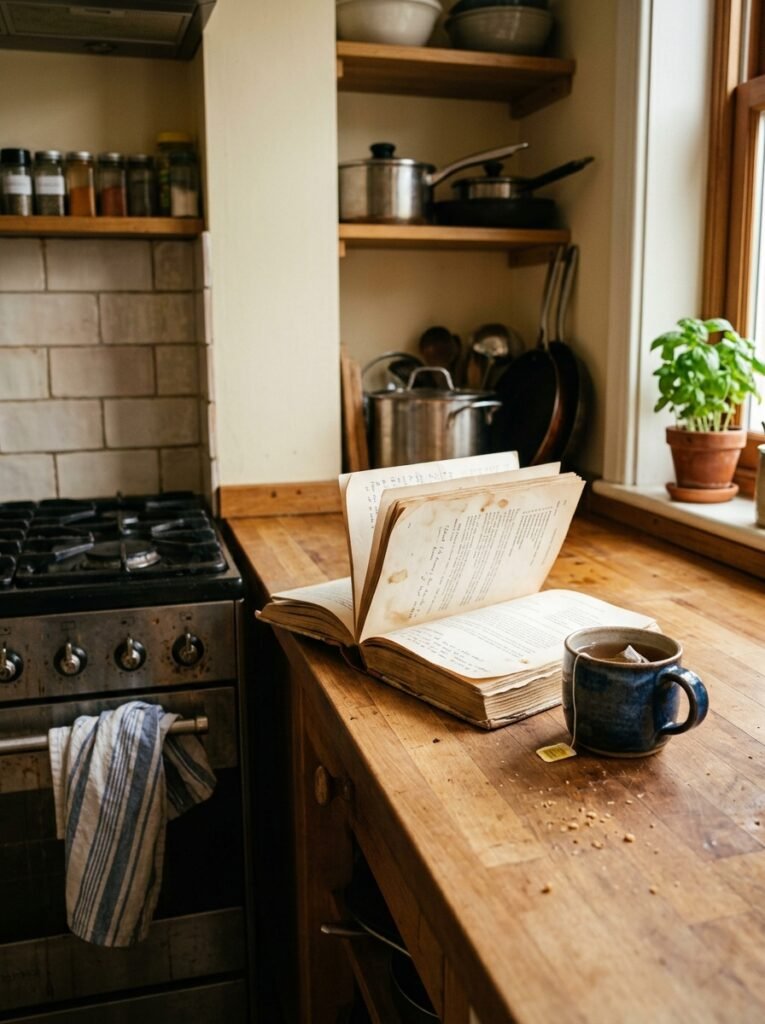
Here’s something nobody says out loud: a beautiful kitchen isn’t the one with the best appliances or the most expensive countertops. It’s the one where you’d happily stand for two hours making soup on a Sunday.
That distinction matters more than people realize. One is a showroom. The other is a home.
The kitchens that stop you cold on Pinterest — the ones you save at midnight without really knowing why — they almost always have something slightly imperfect about them. A shelf that’s a little too full. A worn wooden cutting board that’s clearly been through it. A mug that doesn’t match anything else but somehow fits.
That’s not an accident. That’s someone who stopped trying to curate and started living in the space.
So before you think about colors or countertops or cabinet hardware, ask yourself what you actually WANT the room to feel like when you’re standing in it at 7am, still half asleep, waiting for the coffee to finish. That answer is your starting point.
2. The Color That Keeps Showing Up in Every Beautiful Kitchen Right Now
It’s not white. Well — it’s kind of white. But it’s not white.
It’s more like the color of old plaster, or the inside of an oyster shell, or the paint on a Parisian apartment that hasn’t been touched since 1994. Off-whites with a slightly warm or grey undertone are absolutely everywhere, and for good reason. They’re humble. They don’t fight with anything. And under natural light, they do something genuinely magic — they shift. Morning looks different from afternoon looks different from the soft lamp-glow of 8pm, and the wall just quietly keeps up.
But here’s the thing most people miss: this only works if SOMETHING in the room has depth. A flat off-white kitchen with flat white cabinets and matte white tiles is just… beige. Add a dark grout line. Add aged brass. Add one piece of furniture — a stool, a small table — in a warm wood tone that looks like it came from somewhere. The off-white needs contrast to breathe.
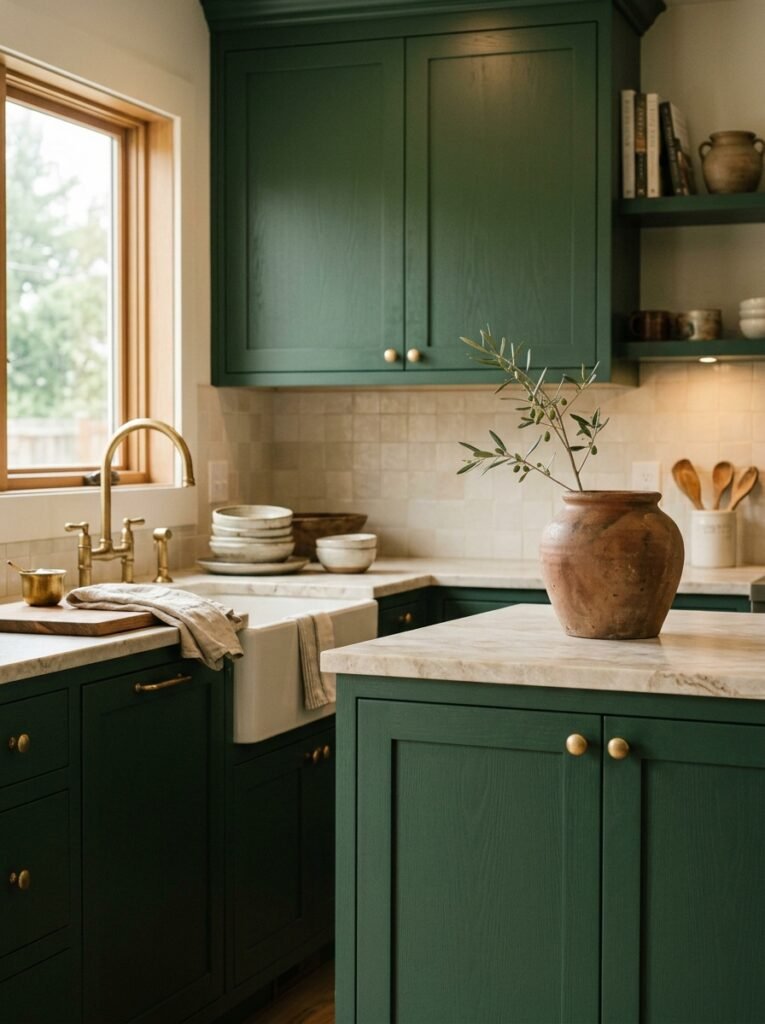
And if pale isn’t your thing? Dark kitchens are having a full-on moment. Deep navy, forest green, near-black — bold cabinets with warm lighting feel unexpectedly cozy rather than heavy, which surprises almost everyone who tries it.
“The kitchens that stop you cold on Pinterest almost always have something slightly imperfect about them.”
3. Why Your Cabinet Hardware is Doing More Work Than Your Cabinets Are
Cabinet hardware is one of those things that sounds incredibly boring until you change it and suddenly your entire kitchen feels different. Like, genuinely different. I know people who’ve described it as a “before and after moment” and I used to think they were being dramatic. They weren’t.
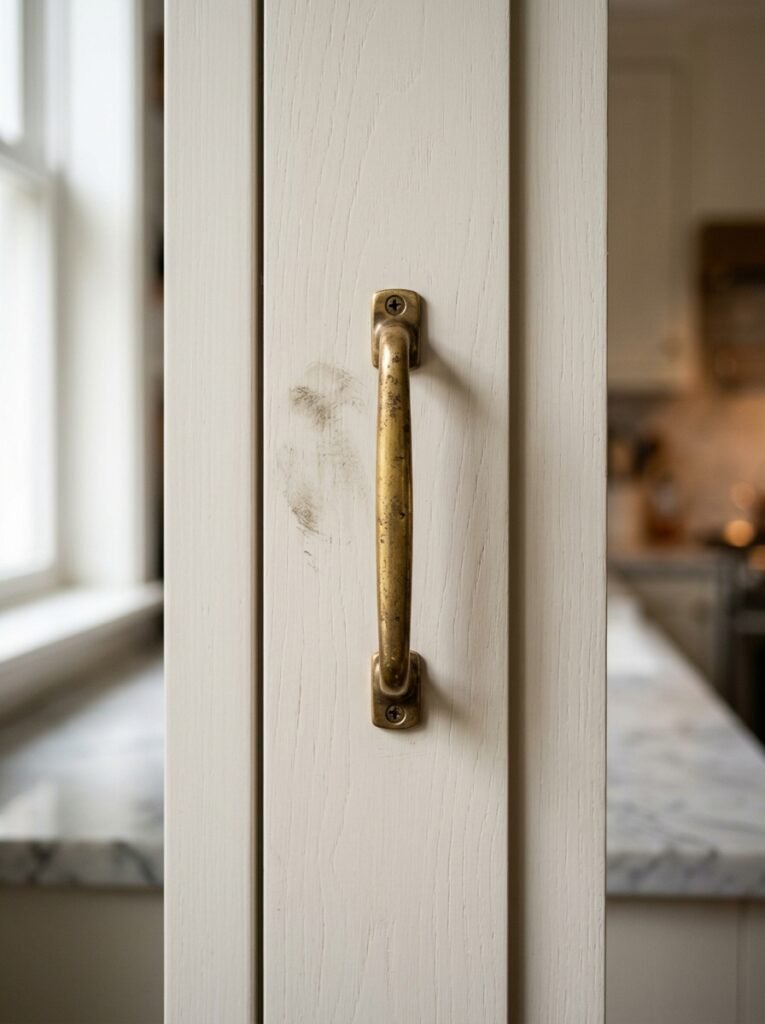
Flat, basic hardware reads as an afterthought. Slightly unusual hardware — a chunky bar pull in unlacquered brass, small ceramic knobs in a muted dusty blue, something with actual physical weight to it — that reads as a decision. A considered one. And considered decisions are exactly what make a space feel designed rather than assembled.
Unlacquered brass is especially good because it tarnishes. I know that sounds like a downside and every rational part of your brain says yes, that’s bad. But it’s NOT bad. That warm, slightly muted patina that develops over a year or two? Irreplaceable. You can’t buy aged brass, you have to earn it.
Brushed nickel still works if the rest of the space runs cool and modern. Matte black does a lot of heavy lifting in contrast-heavy kitchens. But honestly? Don’t match everything. Slightly mismatched metals that share a warm or cool undertone look collected, not confused.
4. The One Surface That Either Pulls the Whole Look Together or Quietly Ruins It
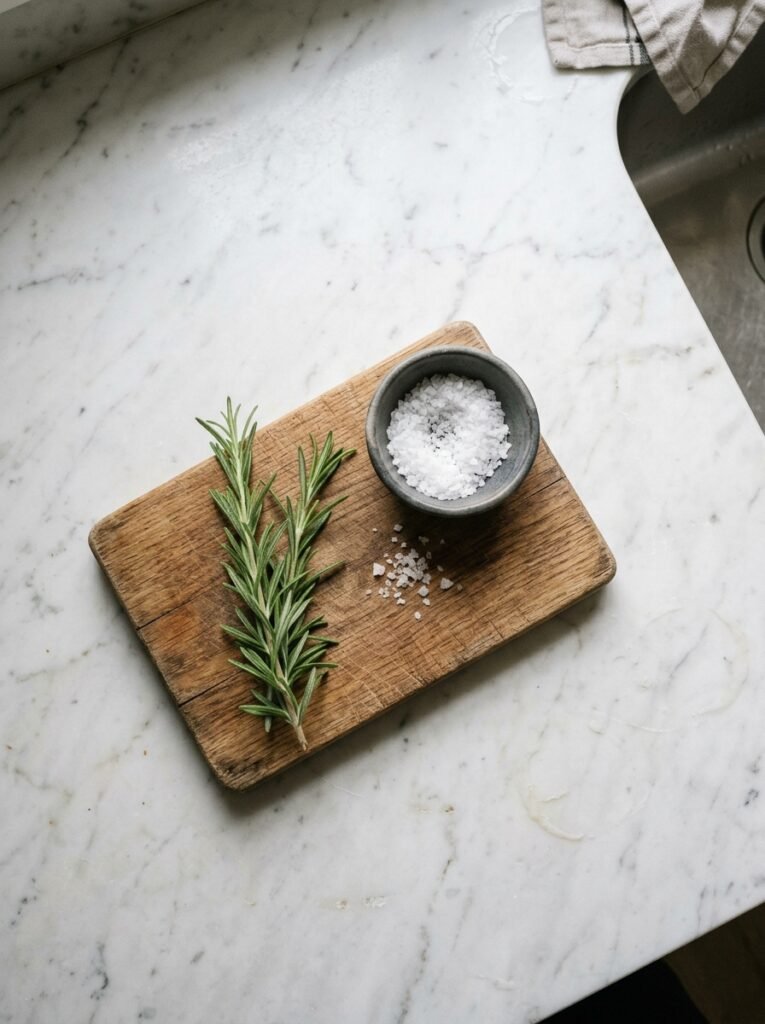
Countertops. Always countertops.
Not because they’re the most important thing aesthetically — though they’re up there — but because they’re the surface you interact with ALL THE TIME and you’ll either love or resent them every single day.
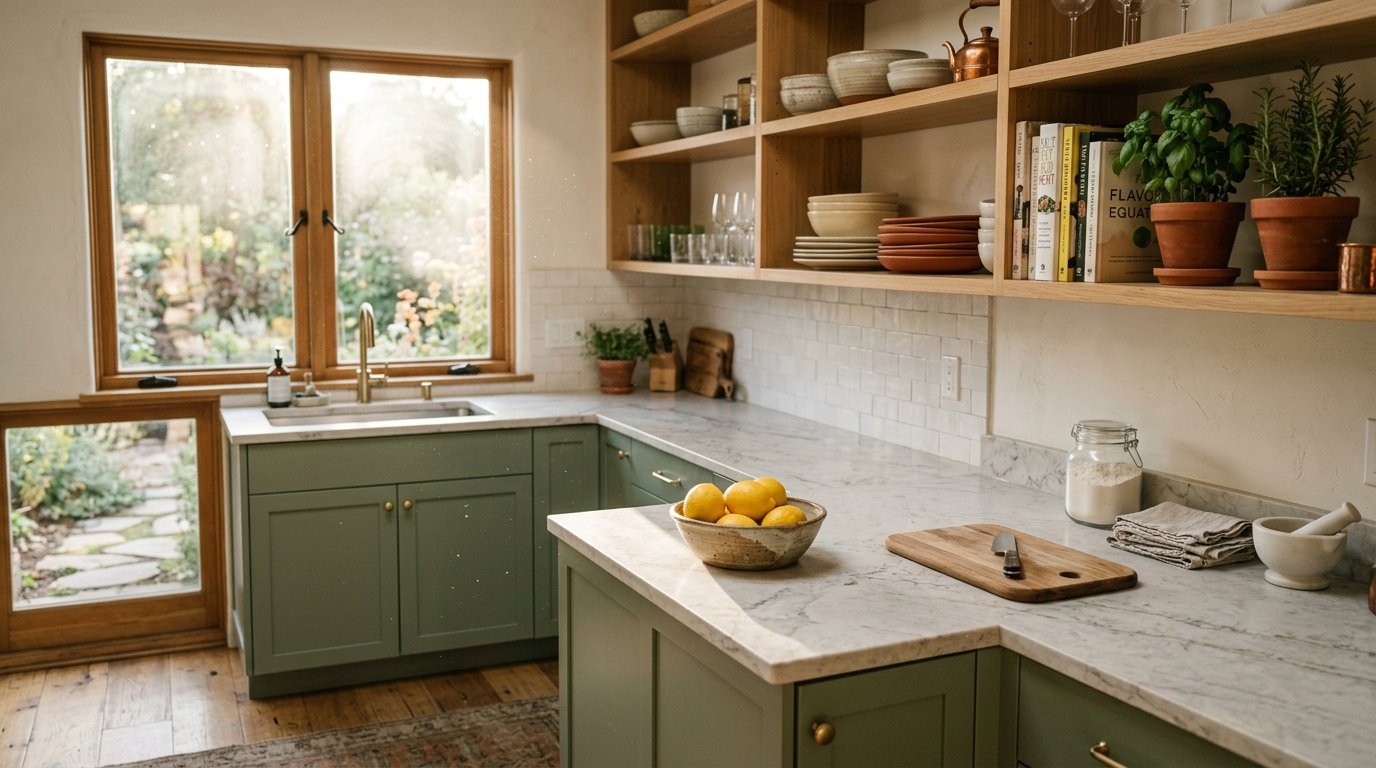
Marble is dreamy and I will never pretend otherwise, but it’s also needy. It stains. It etches. It needs sealing. If you’re the kind of person who would actually do that maintenance, go for it. If you are not that person (no judgment, I’m barely that person), there are sintered stone surfaces and good-quality laminates that read almost identically from three feet away and will not make you feel guilty every time you set a lemon down without a cutting board.
Butcher block is having a genuine comeback and I think it deserves it. It’s warm in a way that stone simply isn’t. It sounds different when you set things down on it. It smells faintly of wood when it’s oiled. Those sensory things aren’t nothing — they’re actually a big part of why certain kitchens feel ALIVE and others feel like a hotel lobby.
Concrete counters are for people with a very specific vision and the commitment to live in it. Respect.
5. The Part of the Kitchen Most People Forget to Style (Until They See It Done Right)
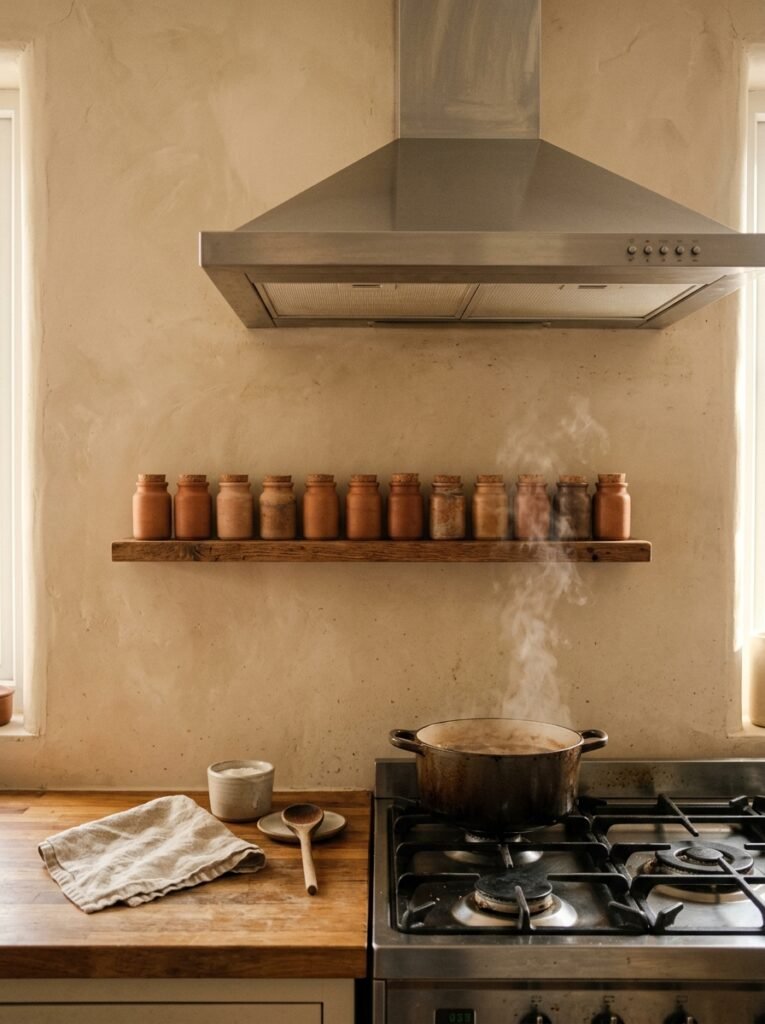
The space above the cabinets.
Or, if you don’t have cabinets reaching the ceiling, the counter itself — specifically, the stuff you leave out.
Here’s where a lot of really nice kitchens quietly fall apart. The appliances are good, the surfaces are great, the lighting works. And then there’s a sad little collection of miscellaneous items on the counter: a paper towel holder that was never really chosen, a random piece of mail, a fruit bowl that looks like it came from a clearance bin.
What you leave OUT in a kitchen is a design choice whether you treat it that way or not.
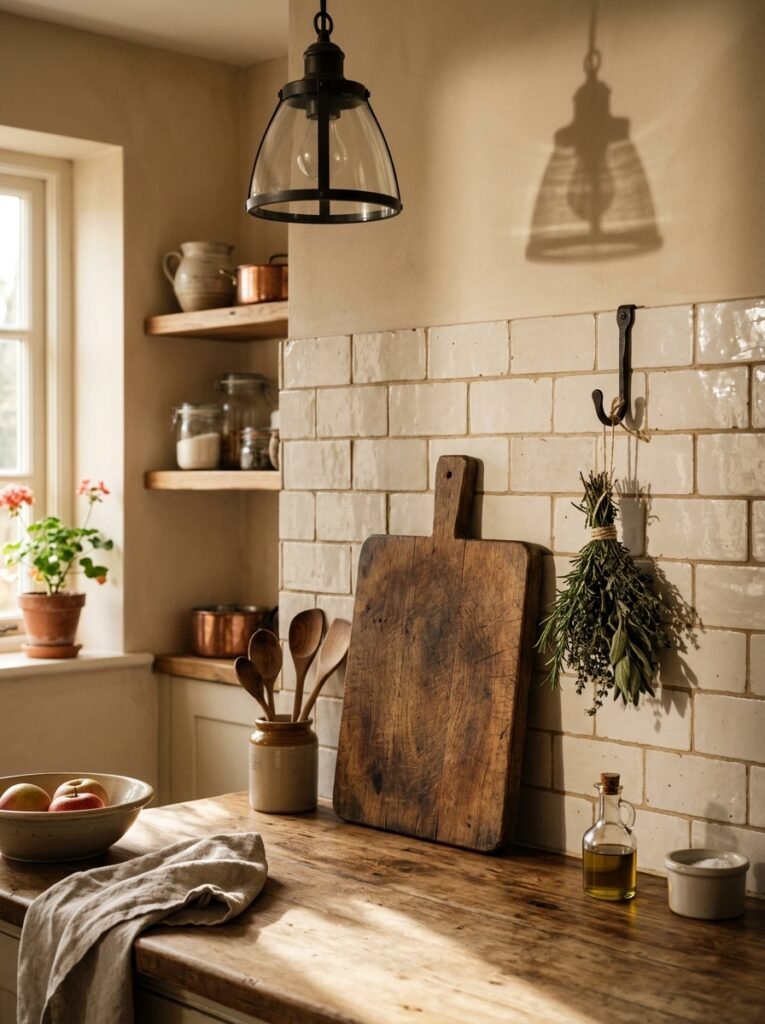
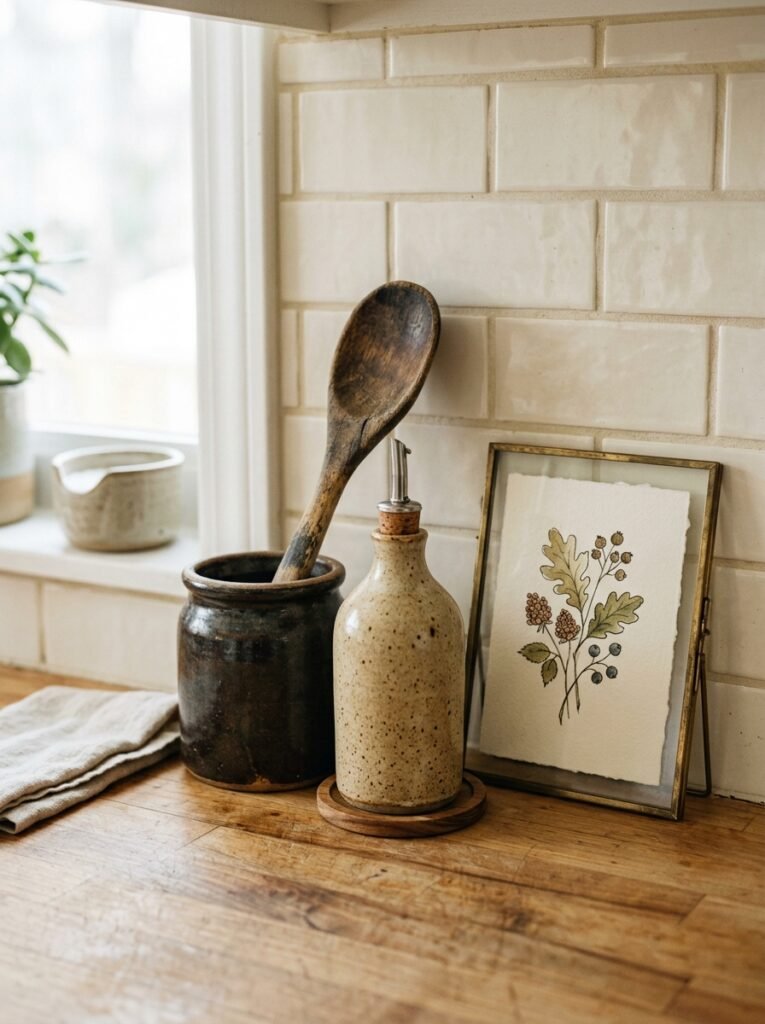
The kitchens that work treat the counter as a kind of still life. A wooden salt cellar. A bunch of dried herbs tied with twine, hung near the window. A small clay pot of olive oil with a ceramic pour spout. A single cookbook that’s actually used, propped open or stacked with two others that have cracked spines. None of this has to be precious. It just has to be intentional.
“What you leave out in a kitchen is a design choice whether you treat it that way or not.”
6. Lighting Is the Cheat Code Nobody Talks About Enough
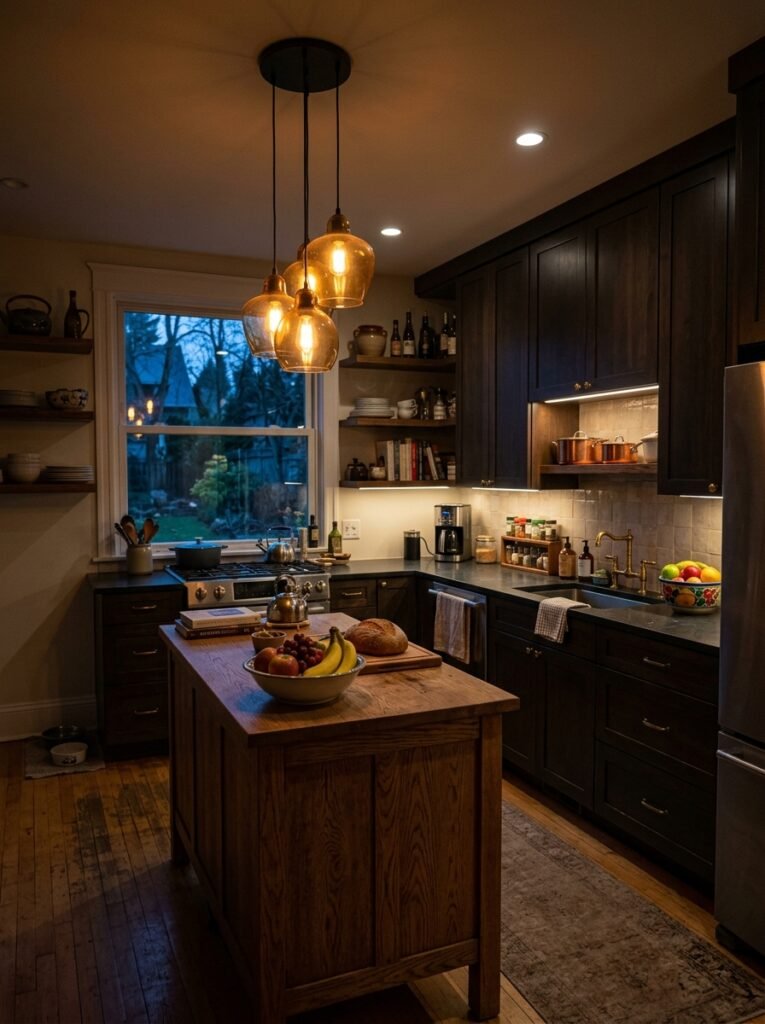
I am going to say something that might seem obvious and I don’t care: bad lighting will destroy a beautiful kitchen. Conversely, good lighting can make a pretty basic kitchen feel genuinely warm and special.
Overhead LED panels. That’s the enemy. Flat, blue-white, forensic-level illumination — it doesn’t matter how nice your cabinets are, they will look sad under those lights.
What you want is layered light. Task lighting under the cabinets, warm-toned (2700K to 3000K if you want to get technical, which is the temperature of incandescent-adjacent warmth, nothing colder). Pendant lights over an island or peninsula if you have one — and these should be interesting objects in their own right, not just functional. Then ambient light that can be dimmed. Edison bulb warmth at 7pm, when you’re cooking with a glass of something nearby, changes the entire emotional register of the room.
Pendant lights over a kitchen island are one of those things where spending a bit more genuinely shows. They hang at eye level, you see them constantly, and a beautiful pendant makes you happy every single time. A boring one makes you vaguely sad every single time. That math is simple.
7. The Open-Shelf Argument (Taking a Side, Actually)
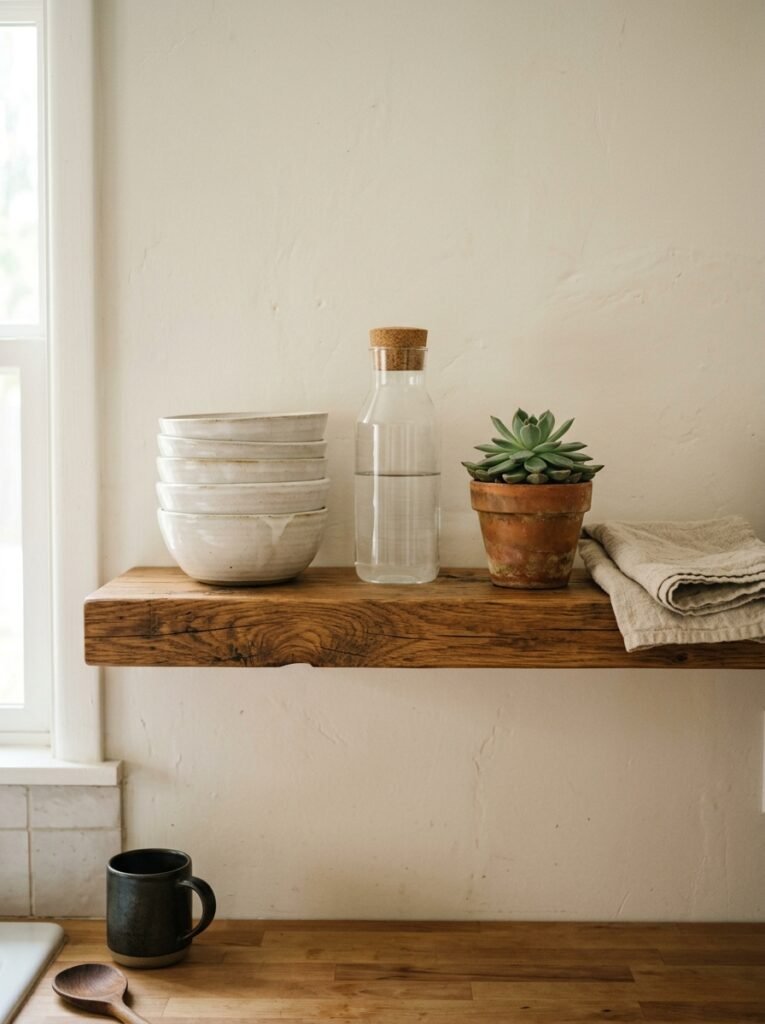
Open shelving gets a bad reputation in practical circles. “Too much dusting.” “Everything looks cluttered.” And honestly, if you’re the kind of person who would stack random things on those shelves without thinking about it, they’re probably not for you. That’s not an insult, it’s just a self-awareness check.
But done well? Open shelving is the single fastest way to add visual warmth and personality to a kitchen. Stacks of cream-colored ceramic bowls. A couple of small plants. Glasses that catch the light. Some spices in matching jars, a couple of cookbooks bookended by a heavy stone object. It takes maybe forty minutes to style properly and then the room has a different quality entirely.
The key is restraint. Not the kind of restraint where you take everything off and leave three things on a bare shelf — that just looks like you couldn’t figure out what to put there. The kind where you edit down to things that are genuinely useful OR genuinely beautiful, and then arrange them with a bit of negative space between groupings so each thing can breathe.
One short section of open shelving in a closed-cabinet kitchen can do all the work. You don’t need to go full open-everything.
8. Flooring That Actually Makes Sense for the Way Real People Cook
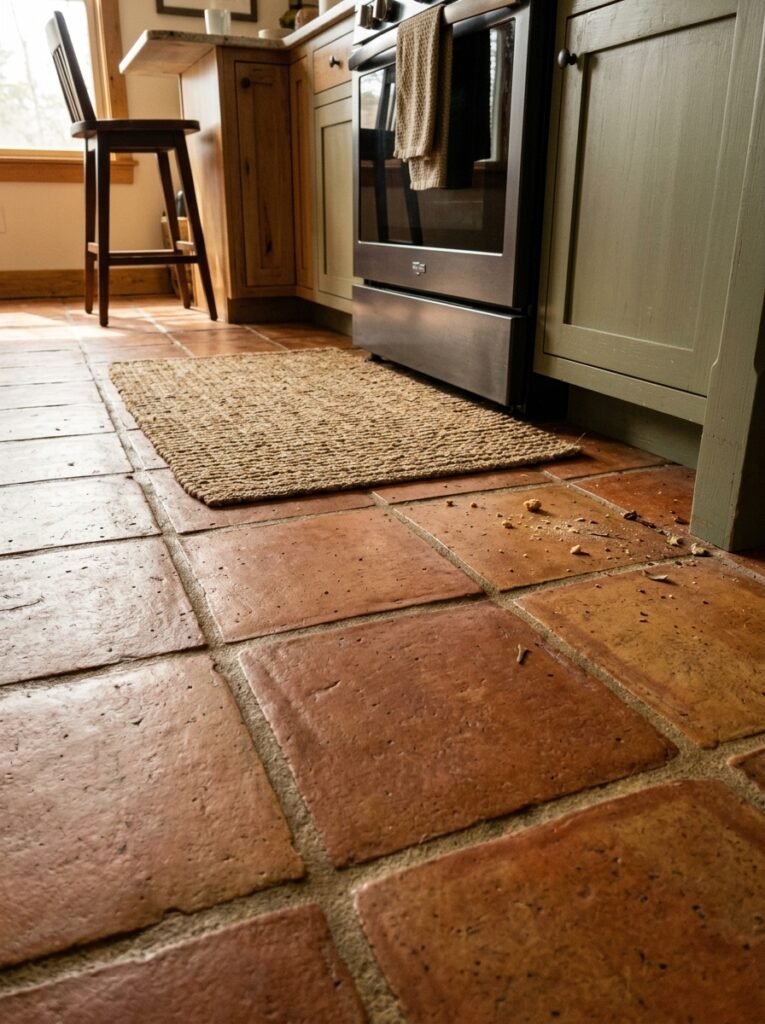
Kitchens are hard on floors. Spills, dropped things, standing for long stretches, pets, children, someone who definitely wears outdoor shoes inside even though there is a sign. The floors have to work, not just look good.
Encaustic cement tiles look absolutely spectacular and photograph like a dream. They’re also porous, they chip at the edges, and they need sealing. Worth it for some people, not worth it for others.
Hardwood or engineered wood floors that flow from another room into the kitchen feel cohesive in a way that’s really hard to achieve otherwise. The warmth of wood underfoot when you’re standing at the stove is genuinely nice. The practical concern is water — a small rug in front of the sink helps, and modern engineered wood handles moisture much better than solid hardwood anyway.
Large-format tiles are having a significant moment. The fewer grout lines, the easier the cleaning, and the bigger the tile visually expands the floor. In a smaller kitchen especially, this is worth knowing.
Worn flagstone for the UK readers with older homes — I know you know this, but just in case: don’t touch it. Worn flagstone floors in a British kitchen are worth approximately ten times whatever you might replace them with.
9. The Textiles Nobody Thinks About Until They See a Kitchen Without Any
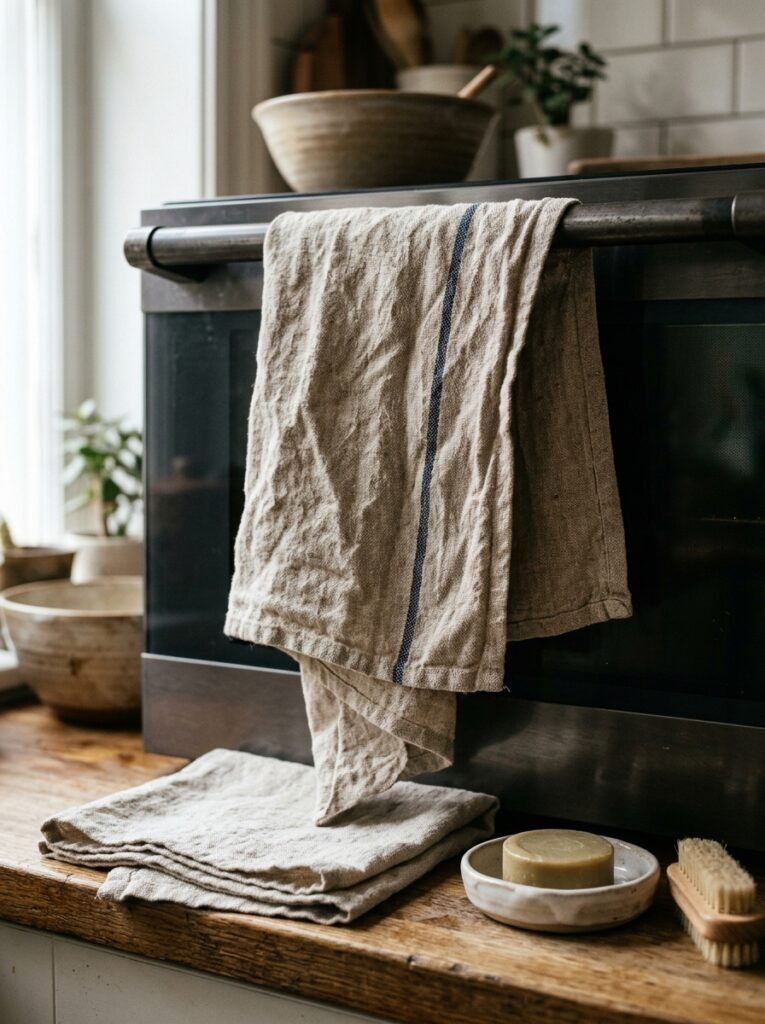
A kitchen without any textiles is a kitchen that sounds wrong. And looks wrong. And doesn’t feel like anyone really lives there.
You don’t need much. A linen or cotton runner in the hallway section. A small rug in front of the sink — a woven jute rug, or a flat-woven kilim-style one that can be shaken out easily. Tea towels that are actually attractive, hung somewhere visible. A chair cushion if there’s a chair.
Textiles absorb sound in a room that’s otherwise all hard surfaces. They soften. They add color or pattern in a way that’s easy to change if your taste evolves. And they make people feel immediately more comfortable in a space — there’s something about softness in a utilitarian room that signals “this is somewhere people actually want to be.”
The tea towel thing sounds like a small detail. But hanging two or three really nice linen tea towels from an oven handle or a hook instantly elevates the whole composition of that corner. It’s one of those things where the effect is much larger than the effort involved.
“Textiles absorb sound in a room that’s otherwise all hard surfaces. They soften.”
10. When Plants Work in a Kitchen and When They Really Don’t
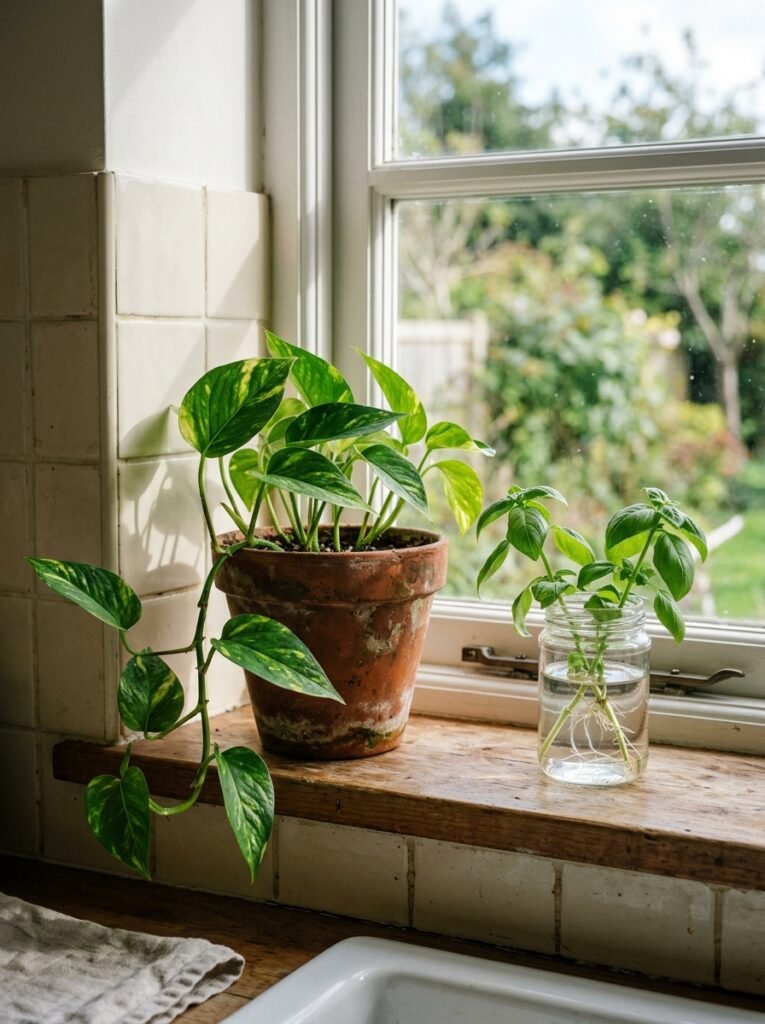
Plants work when they’re the RIGHT plants. Not every plant wants to live in a kitchen, and not every kitchen wants every plant.
Herbs on a windowsill are basically mandatory at this point, but there’s a reason for that — they’re genuinely useful, they smell amazing when you brush past them, and a little terracotta pot of basil in a sunny window is one of the most reliably beautiful things you can put in a kitchen for almost no money.
Trailing plants from a high shelf work brilliantly if the shelf gets any natural light. Pothos, heartleaf philodendron, something with a bit of drape to it — the downward movement adds something that upright plants don’t.
Where it goes wrong: large statement plants crammed into a kitchen that doesn’t have the floor space, or plants in bad health (a struggling, yellowing plant reads worse than no plant at all), or fake plants that aren’t fooling anyone.
Dried botanicals — eucalyptus, lavender bunches, dried grasses in a simple vase — are actually a great option for kitchens with low light. They just sit there, looking intentional, needing nothing.
11. The One Rule That Makes Any Tiny Kitchen Feel Intentional Rather Than Just Small
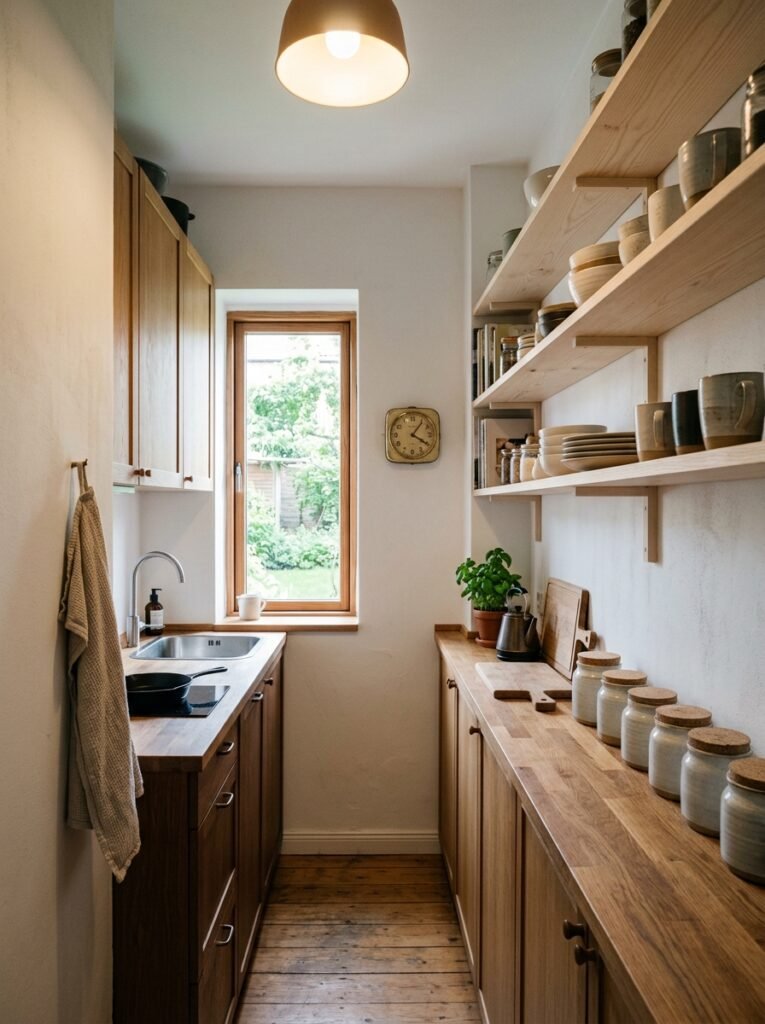
Stop trying to make it feel bigger.
I know that’s the opposite of every “small kitchen” article ever written, but hear me out. The impulse to make a small kitchen FEEL bigger leads to decisions like: all white everything, no pattern, minimal texture, hiding everything. And the result is a room that’s crisp and airless and kind of forgettable.
A small kitchen that OWNS its smallness — that leans into deep color, into shelves packed with beautiful things, into a single bold tile choice that takes up the whole splashback — feels cozy and specific. Like a particular place, with a particular personality.
Scale still matters. You don’t want a chandelier that hits your head. But choosing smaller, thoughtfully scaled versions of the things you actually love is very different from stripping out personality in the name of visual space. One tends to make the kitchen feel bigger in a photograph. The other makes you want to be in it.
12. The Last Thing to Choose Is Usually the Thing That Makes People Recognise the Kitchen as Yours
Most kitchen aesthetics get assembled from the outside in. Colors, cabinets, counters, hardware — and then at the end, the personal stuff gets added like garnish.
That’s backwards, sort of.
The thing that makes a kitchen feel individual is always the most particular thing in it. The collection of mismatched vintage mugs that someone’s been adding to for eight years. The single piece of art — actually framed, actually hung — on the wall above the doorway. The cookbook that’s so used the spine has completely given up. The hand-thrown ceramic fruit bowl that someone brought back from a trip.
None of those things are design decisions in the traditional sense. They’re just accumulation with some taste applied. And you can’t buy that as a package. You kind of have to live your way into it.
The kitchens that feel genuinely beautiful — not just aesthetically competent but actually warm and specific and alive — always have something in them that could only be there because of who the person is. That’s the part that can’t be Pinterest-ed into place.
Start with the bones. Get the light right, make a considered color call, choose hardware that feels like a decision. And then, slowly, let the kitchen become yours.
—
❓ FAQ
Q: How do I create a cohesive kitchen aesthetic without spending a fortune? A: Start with the things that have the most visual impact per pound or dollar spent — lighting, hardware, and what you leave on the counter. Swapping out old hardware for something with genuine personality costs relatively little and the difference is immediate. Thoughtful styling of what’s already in the kitchen (editing things down, arranging intentionally) costs nothing and often does more work than any purchase.
Q: Can I mix kitchen styles, like modern and rustic, without it looking chaotic? A: Yes, and honestly the most interesting kitchens usually do. The key is finding a common thread — either in color temperature (warm-toned materials throughout, even if the styles vary) or in material family (wood, stone, ceramic all in the same palette but different eras). Mixed styles look chaotic when they disagree on both tone AND era. Get them agreeing on one of those two things and the mix usually reads as collected.
Q: What’s the best way to update a rental kitchen without making permanent changes? A: Lighting (swapping a pendant if it’s a plug-in, or adding under-cabinet LED strips that peel off), textiles (rug, tea towels, a small cushion), open shelving if there are existing rails or hooks you can use, and a serious styling session on whatever counter space you have. Plants and meaningful objects do a surprising amount of heavy lifting. You can shift the entire feeling of a kitchen without touching anything structural.
—
💭 Final Thoughts
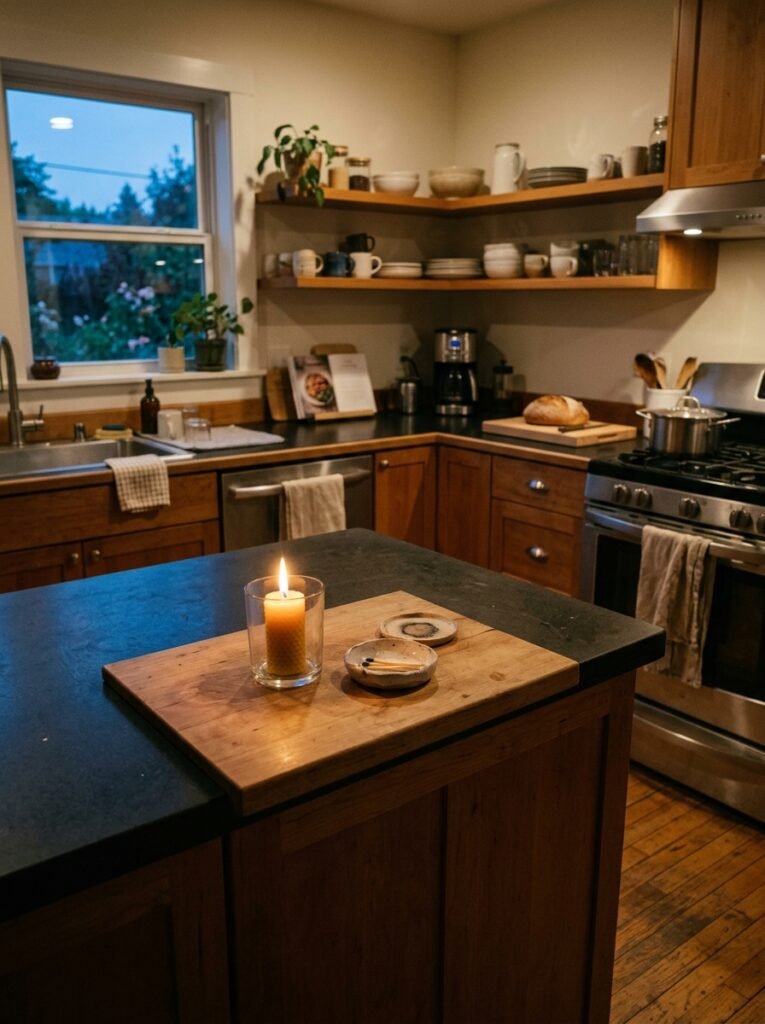
The best kitchens I’ve ever been in weren’t the ones I photographed. They were the ones I didn’t want to leave — the ones where something smelled good and the light was doing something kind and there were signs, everywhere, of a person who actually cooked there.
That’s the aesthetic worth chasing.
What would YOUR kitchen feel like if you stopped trying to make it look like anything and just made it feel like you?