The Mirror Wall Trick That Makes Any Tiny Living Room Look Twice the Size (And Way More Interesting)
You walk in, and something feels off. The room’s fine, technically. But it feels small and a little flat, like it’s holding its breath. One wall of mirrors later — totally different story.
—
1. Why Everyone’s Suddenly Covering Their Living Room Walls in Mirrors (And Why It Actually Works)
Okay so mirrors on walls aren’t new. We know this. But the way people are using them right now — in small living rooms, layered and intentional and kind of wild — that part IS new, and it’s working in ways that traditional decorating advice never quite explained.
Here’s the actual reason it works, beyond the obvious “mirrors make rooms look bigger” thing you’ve heard a hundred times. A mirror doesn’t just reflect light. It reflects depth. So when you’ve got a 12×14 living room that feels like a box, a mirror wall gives your eye somewhere to go. Your brain reads it as space. Real, physical space. Even when it isn’t.
And in small homes — British terraced houses, US city apartments, cozy starter homes — that visual trick is genuinely life-changing. Not an exaggeration. You stop feeling like the walls are closing in, and suddenly the room breathes.
The other thing nobody talks about is how a mirror wall adds personality. Done right, it doesn’t look like a gym or a dance studio. It looks considered. It looks like someone who knows what they’re doing made a choice, and stuck with it.
“A mirror doesn’t just reflect your living room — it reflects a better version of it.”
—
2. The One Question You Need to Answer Before You Buy a Single Mirror
What does your wall face?
I’m serious. Before you pick shapes or frames or a layout, stand in your living room at the time of day you actually use it most — probably evening, honestly — and figure out what’s across from where you want to put the mirrors.
Because here’s the thing. Mirrors amplify whatever they’re pointed at. If that’s a beautiful window with afternoon light pouring through? Incredible. You’re done, it’s going to look stunning. But if it’s a pile of coats by the front door, or a slightly grim view of a brick wall, or your neighbor’s fence — you’re going to want to rethink the placement, or at least the angle.
In small living rooms especially, this matters MORE than style. A poorly placed mirror doesn’t just fail to help — it actively makes a room feel weirder and smaller, because now you’re seeing two of something you didn’t want to see once. Take ten minutes. Really look at what your wall is going to be bouncing back at you all day.
The best thing to reflect is natural light. Second best is a plant, or a lamp, or a piece of art on the opposite wall. The amber glow of an Edison bulb at 7pm reflected in a large arch mirror? Genuinely ridiculous how good that looks.
—
3. The “Gallery of Mismatched Frames” Approach That Feels Curated, Not Chaotic
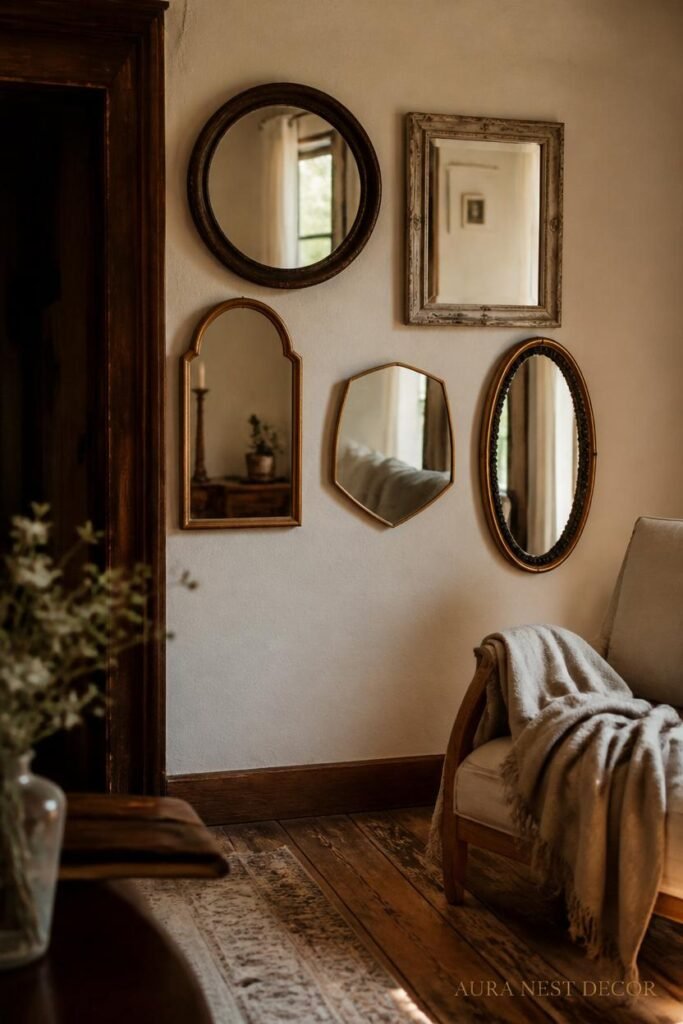
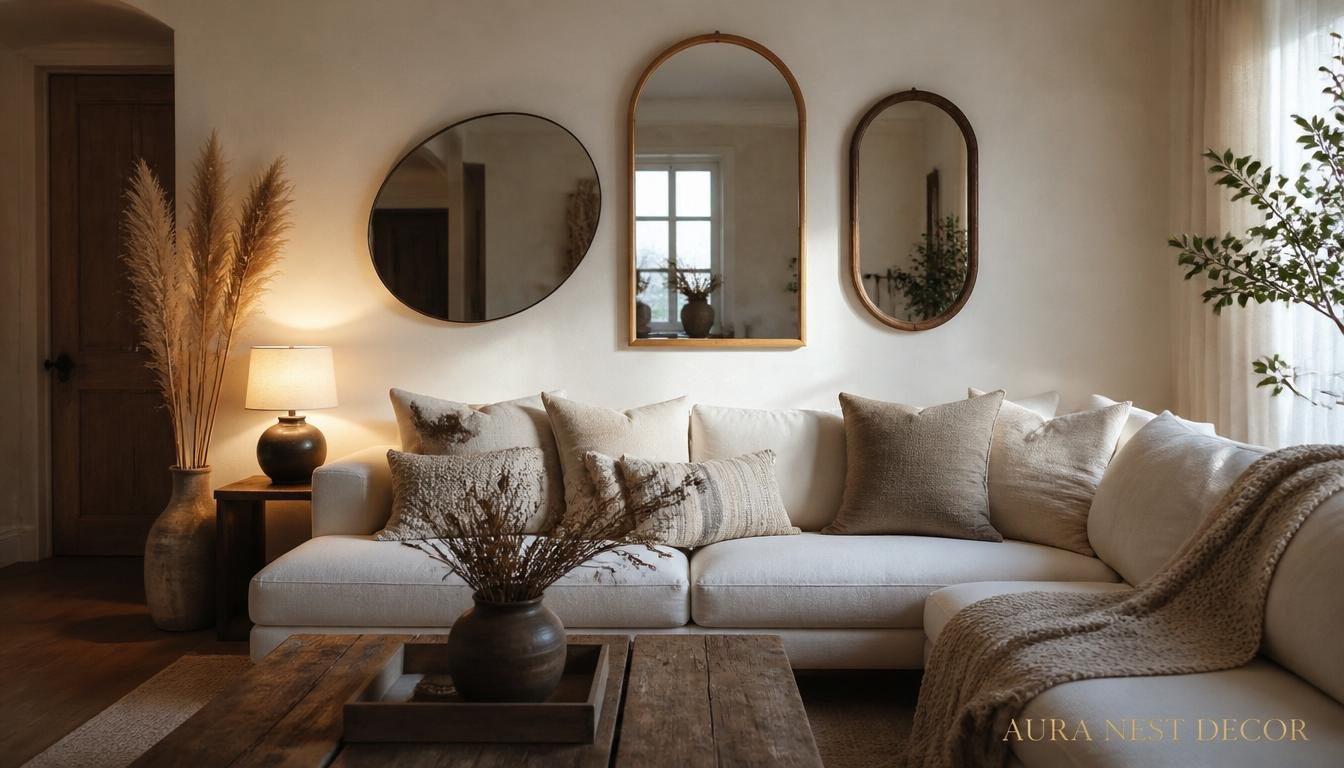
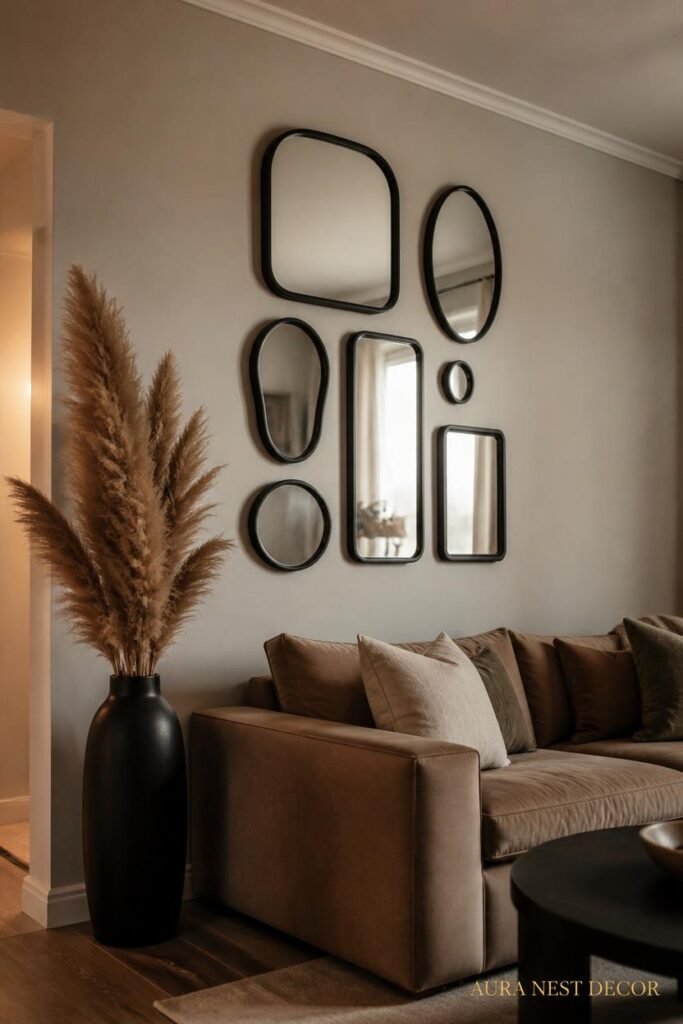
This is probably my favorite approach for small rooms, and it’s also one of the easier ones to pull off on a budget. The idea is simple: you collect mirrors in different shapes and sizes, all with different frames, and hang them as a loose gallery arrangement on one wall.
The key word there is loose. Not a grid. Not symmetrical. Just… arranged, with intention.
What makes it feel curated instead of chaotic? A few things. First, stick to a frame color family — not the same color, but the same family. So warm metals: brass, gold, bronze, antique copper. Or cooler tones: chrome, gunmetal, pewter. Or all wood. Pick your universe and stay in it.
Second, vary the shapes. A round mirror next to a rectangular one next to a small oval creates visual rhythm. All rectangles? Kind of flat. All circles? A bit much. The mix is what makes it interesting.
Don’t overthink the sizes. Honestly, I’d say let yourself be surprised at thrift shops and charity shops — in the UK especially, you can find incredible ornate frames for almost nothing. A £4 find from a British Heart Foundation shop can look incredible cleaned up and hung next to a proper Anthropologie piece.
—
4. The “One Big Statement Mirror” Rule for When You Don’t Want to Think About It
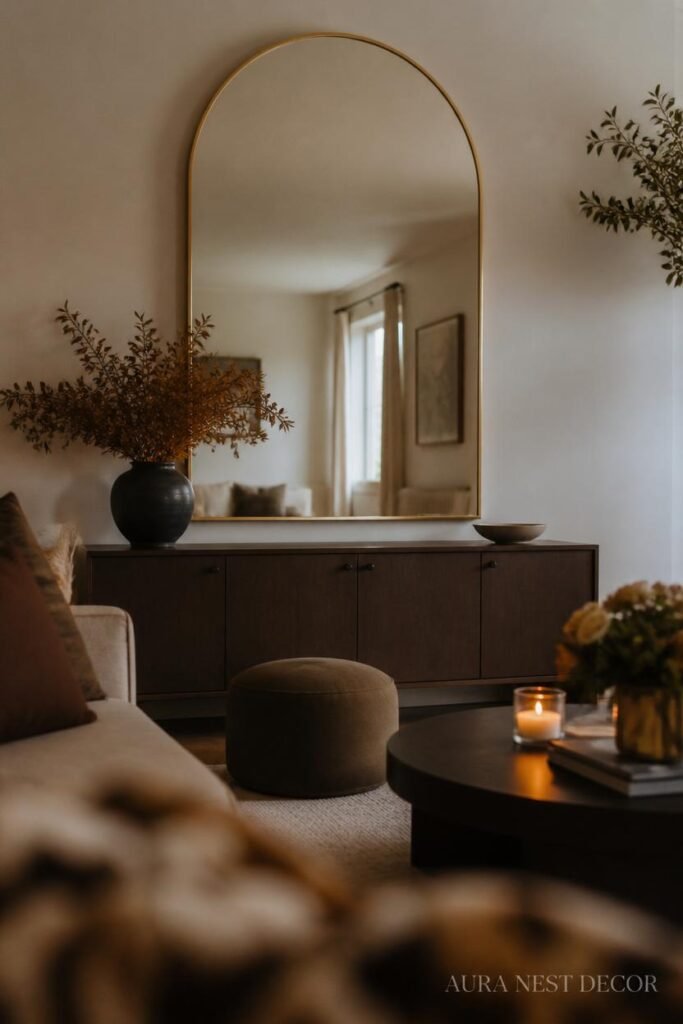
Sometimes you just don’t want a project. You want one thing, one decision, done.
Totally valid.
A single large mirror — and I mean LARGE, like floor-to-ceiling or close to it — on one wall of a small living room is one of the most effective design choices you can make. Full stop.
The reason it works better than a gallery wall for some spaces is that it doesn’t break up the wall visually. Your eye reads it as one expansive surface, which makes the room feel — and I cannot stress this enough — significantly bigger than it is. A gallery of small mirrors can sometimes do the opposite, drawing attention to how many separate little things are hanging there.
For small living rooms, an arch mirror is doing a LOT of heavy lifting right now and for good reason. The curved top softens a room that might have harsh corners. It reads as modern but with a kind of old-world weight to it. And the tall format pulls the eye upward, which makes ceilings feel higher. I’ve seen this trick work in rooms with 8-foot ceilings that felt like they had 10.
“One big mirror, placed with intention, is always going to out-perform ten small ones placed carelessly.”
—
5. The Lean-Against-the-Wall Move That’s Actually Not Lazy At All
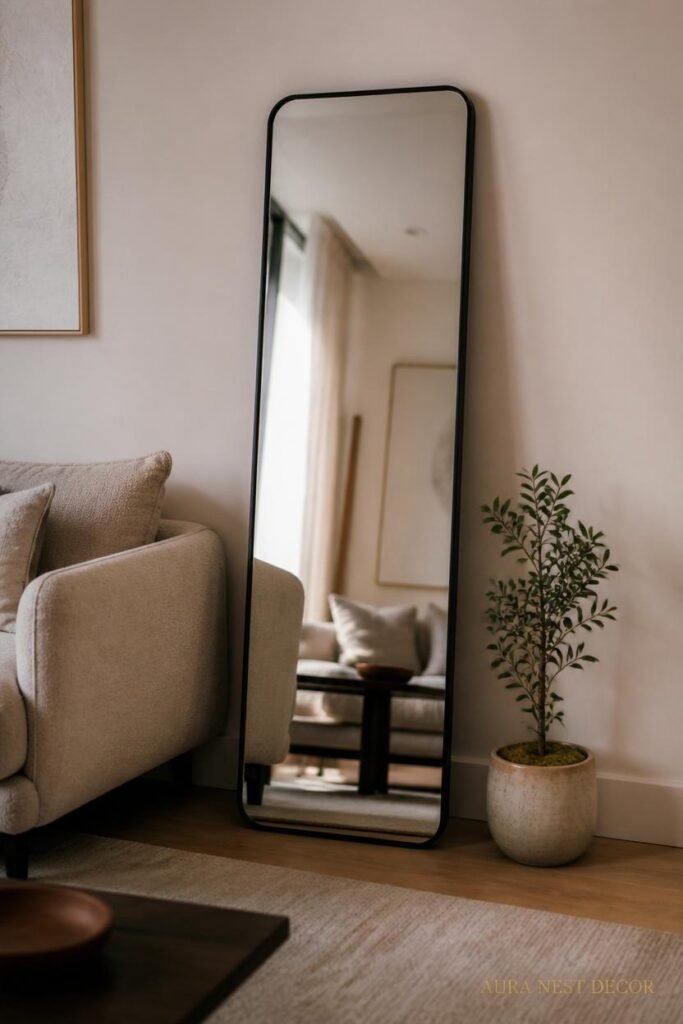
Not everything needs to be hung. This is something I think gets forgotten.
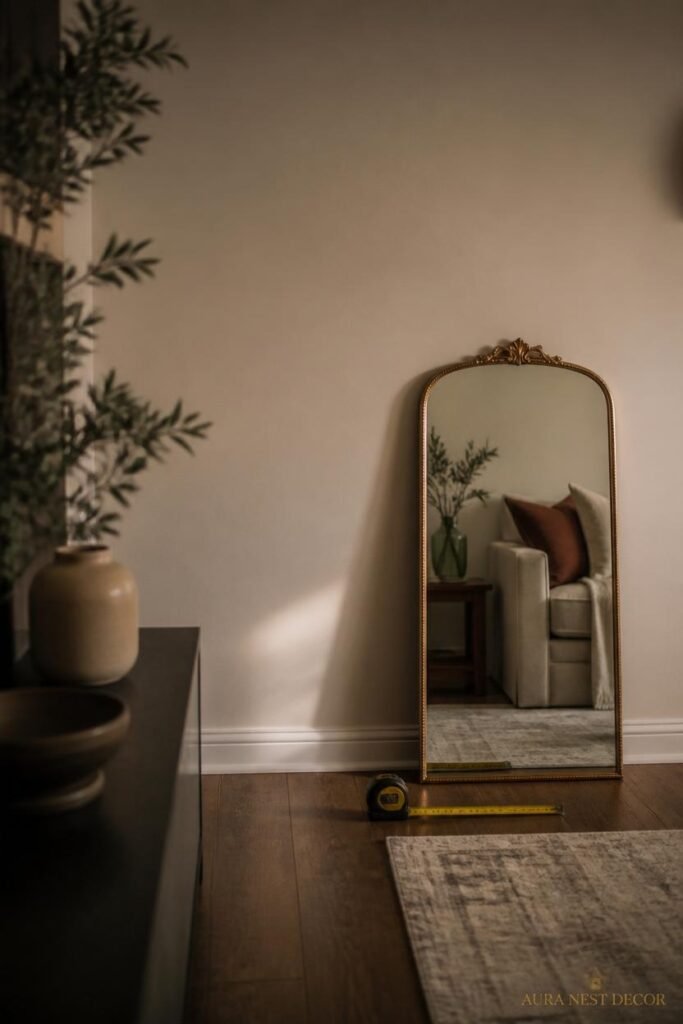
Leaning a large mirror against the wall — especially in a small living room — is a legitimate design choice, not a “I’ll get to it eventually” situation. And it can look AMAZING.
Here’s why it works so well in small spaces: when a mirror is leaned rather than hung, it sits at a slight angle. That angle means it’s reflecting the floor, and more of the room’s lower half. Which actually creates a different kind of depth than a wall-mounted mirror does — a more vertical depth, almost like looking into a room that extends downward.
It also makes a small room feel more relaxed. Less like a showroom, more like a home. There’s something inherently casual about a leaned mirror, and in a cozy sitting room or small flat lounge, that casualness is often exactly the vibe you want.
The only thing to watch: safety. Make sure it’s stable, especially if you’ve got kids or pets. You can get affordable anti-tip straps that attach to the back and hook into the baseboard or wall. Don’t skip that step.
—
6. What’s Actually Happening With Mirrored Panels Right Now
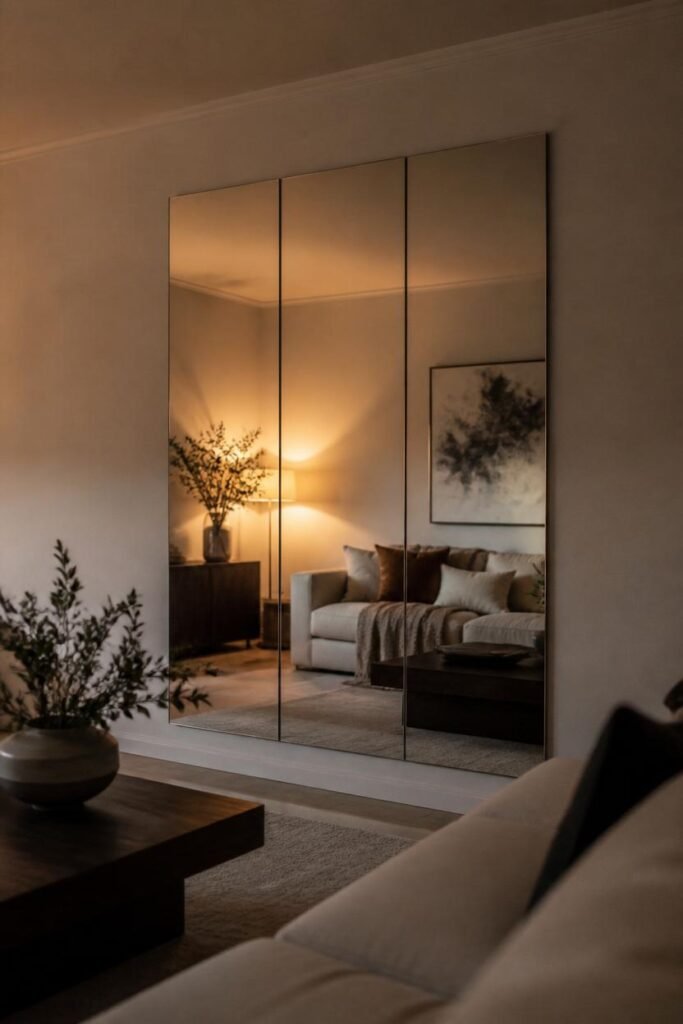
This is a slightly different thing from decorative mirrors, and I want to flag it because it’s having A moment.
Mirrored panels — think full sheets of mirror or smoked mirror adhered to or leaning against a wall — are showing up everywhere in small living rooms, and honestly they look expensive. Really expensive. Even when they’re not.
The smoked mirror version especially. It’s got this moody, slightly vintage quality — less reflective than a clear mirror, which actually makes it easier to place because it’s not bouncing harsh light everywhere. It works brilliantly in rooms that don’t get a ton of natural light, which… honestly describes most British ground-floor flats, doesn’t it.
You can get this look without a full renovation by using large frameless mirror panels or even adhesive mirror tiles (the higher-quality ones, not the 90s bathroom situation). Arranged in a clean pattern or offset grid, they can cover a significant portion of a wall and look genuinely stunning. Pair them with a warm lamp nearby and the effect is almost theatrical.
—
7. The Corner Mirror Trick Most People Have Never Tried
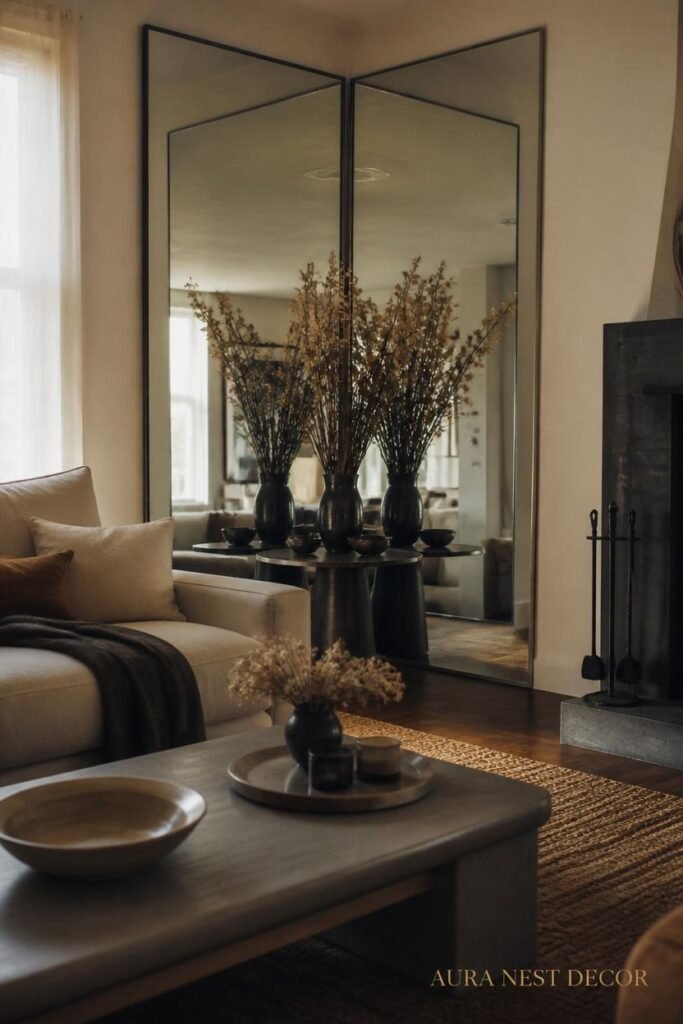
This one’s a bit surprising. Bear with me.
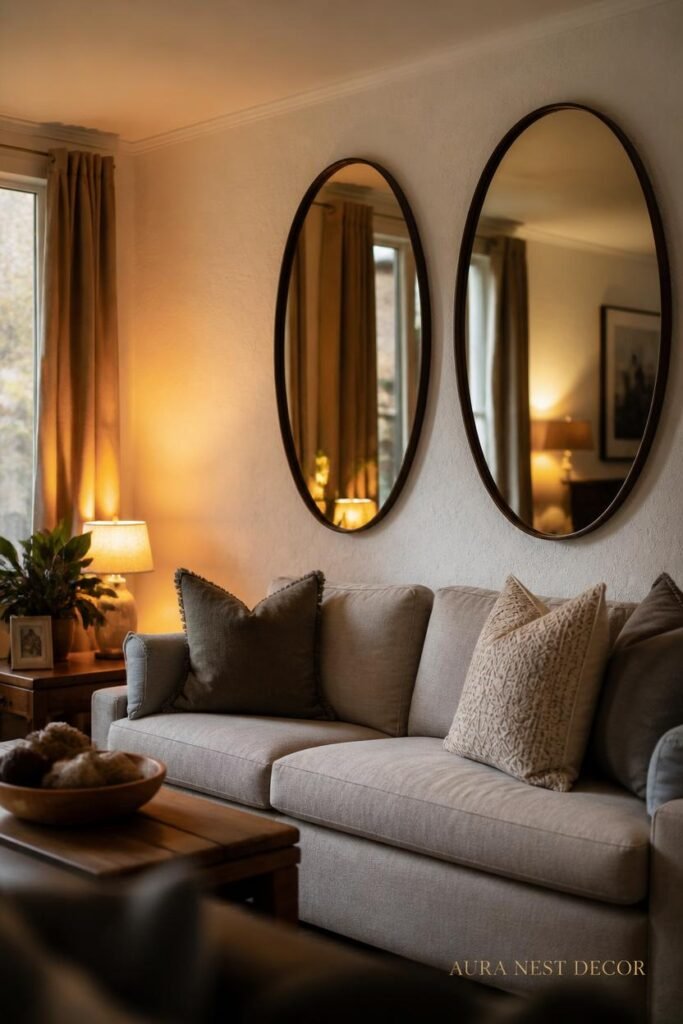
Instead of putting mirrors on the flat face of a wall, consider placing two mirrors — at a slight angle, or just flat — on the TWO WALLS of a corner. Not wrapping the corner with one piece, but hanging one mirror on each wall, close to the corner, so they face each other.
The effect is a kind of infinite depth, almost like a kaleidoscope, without being dizzying. Your eye gets pulled into the corner rather than bouncing off the center of the room. And in a small space, that directional depth trick genuinely works to make the room feel wider.
This also works with a single tall mirror positioned just beside a corner, angled slightly inward. The reflected wall behind it basically disappears into depth.
“When every other wall is spoken for, the corner is always waiting.”
—
8. The Color and Finish of the Frame Matters More Than You Think
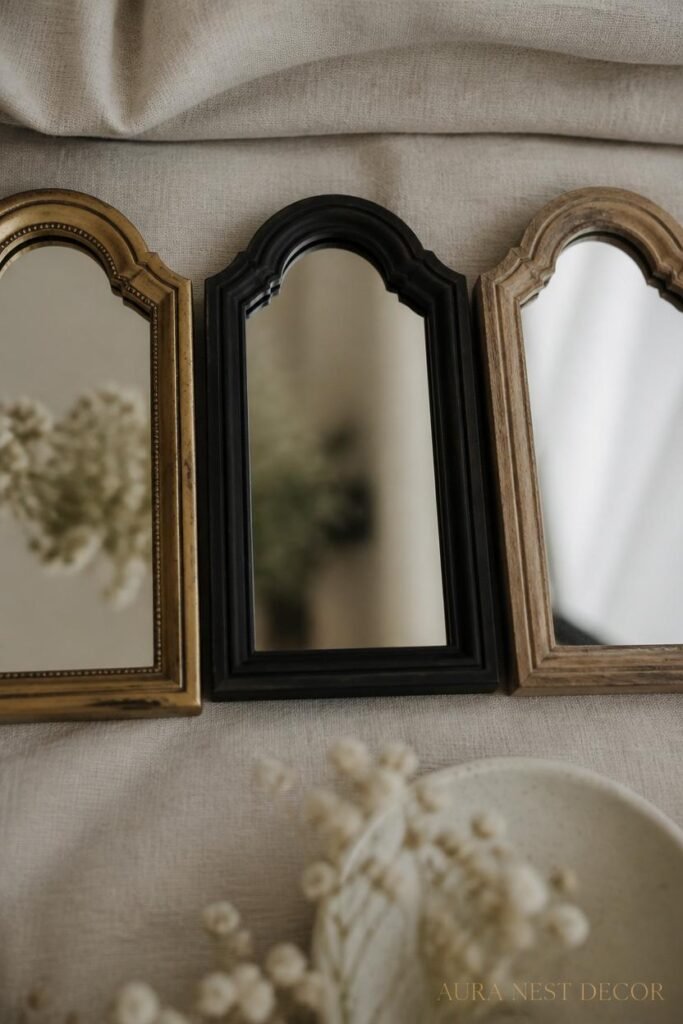
I’ve seen people choose a beautiful mirror and then the frame kills the whole thing for their specific room. So let’s talk about this properly for a second.
In US and UK living rooms, the dominant trend right now is leaning warm. Warm wood tones, warm metals, earthy plaster finishes. So a chrome-framed mirror in a room with linen sofas and jute rugs? It’s going to feel cold and slightly disconnected. Not wrong necessarily, but you’ll feel something’s off and not know why.
Black frames are having a serious moment and for good reason — they work in almost any color scheme, they ground a room, and they photograph beautifully, which matters if you’re pinning your space. A black-framed arch mirror in a white living room is kind of iconic at this point.
Brass frames are the other safe bet, especially in rooms with any warm or earthy color palette. They add richness without going loud. Antique brass specifically — not shiny, not polished, just that slightly worn warm gold — is very hard to get wrong.
Avoid: really ornate gold frames in modern rooms (it clashes, not in the fun way), and avoid frameless mirrors that are too small (they look like bathroom offcuts, sorry).
—
9. How to Pull This Off for Under $100 / £80 Without It Looking Cheap
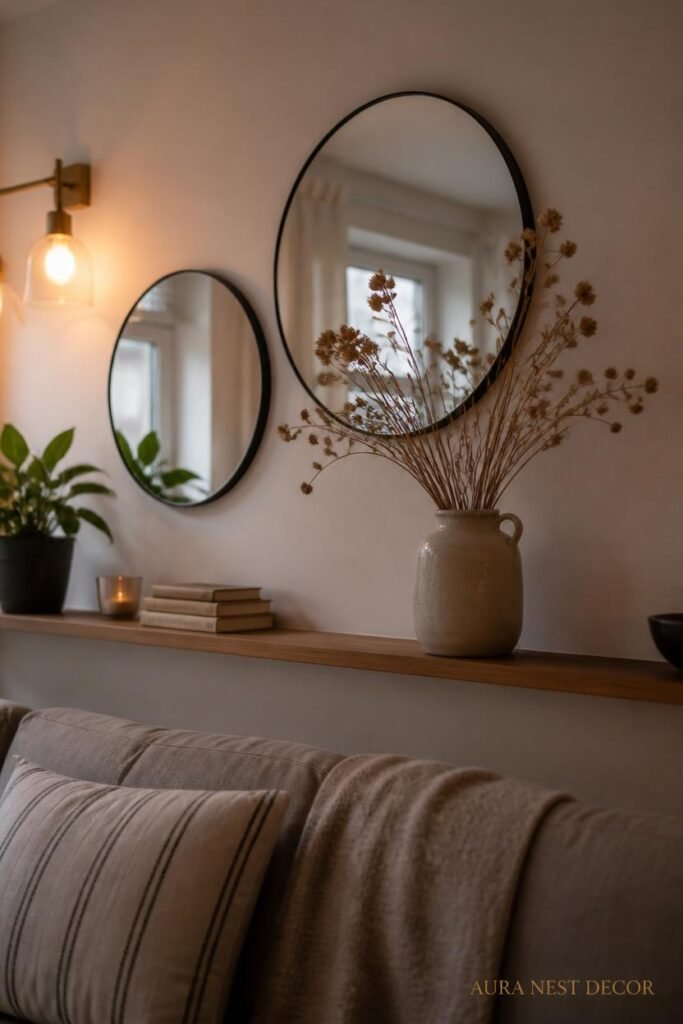
This is the section most people actually need, let’s be real.
Good news: mirrors are one of the home decor categories where the budget options genuinely compete with expensive ones. A mirror doesn’t wear out or look old the way fabric does. And the actual mirror surface doesn’t change based on what you paid — glass is glass.
IKEA’s HOVET and NISSEDAL mirrors have been living room staples for years and honestly? Still excellent value. A NISSEDAL at around $60 or £45 covers a lot of wall real estate and looks intentional, especially in a white or light-painted frame.
Amazon and Wayfair both have surprisingly decent arch mirrors in the $50-80 range. Read reviews specifically about the quality of the mirror surface (look for anyone mentioning distortion) because that’s where cheap mirrors reveal themselves.
For the gallery wall approach: charity shops in the UK (OXFAM, BHF, Scope) and thrift stores in the US are genuinely your best option. Ugly frame? Spray paint it. The shape and quality of the glass underneath matters way more than whatever the frame looked like before.
Side note — Facebook Marketplace and Nextdoor are genuinely underrated for finding large mirrors that people are giving away because they moved or redecorated. I’ve seen gorgeous full-length mirrors go for $15 because someone just needed them out of their house.
—
10. The Small Room Mistake That Ruins the Whole Mirror Effect
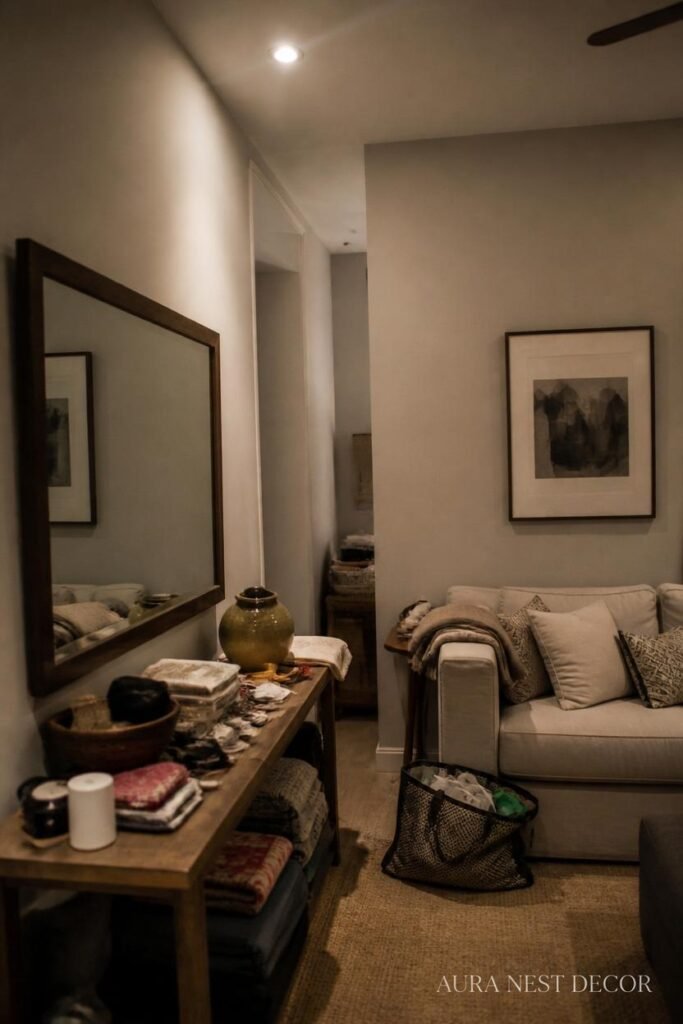
Too many mirrors, too spread out.
This is the big one. People buy a bunch of mirrors, distribute them across multiple walls, and then wonder why the room feels more cluttered and weird, not bigger and lighter.
Mirrors work in small rooms when they’re concentrated. One wall, or one primary wall with a supporting piece nearby. When you scatter them — one here, one there, one on a totally different wall — they stop doing the “expand the space” work and start doing “make the room feel like a funhouse” work. Which is not the vibe.
Pick your wall. Commit to it. That’s where the mirrors go. The other walls get art, or shelving, or are left alone entirely.
—
11. The Styling Around the Mirror That Most People Forget About
Okay so you’ve hung the mirror. Beautiful. You’re done, right?
Kind of, but not quite.
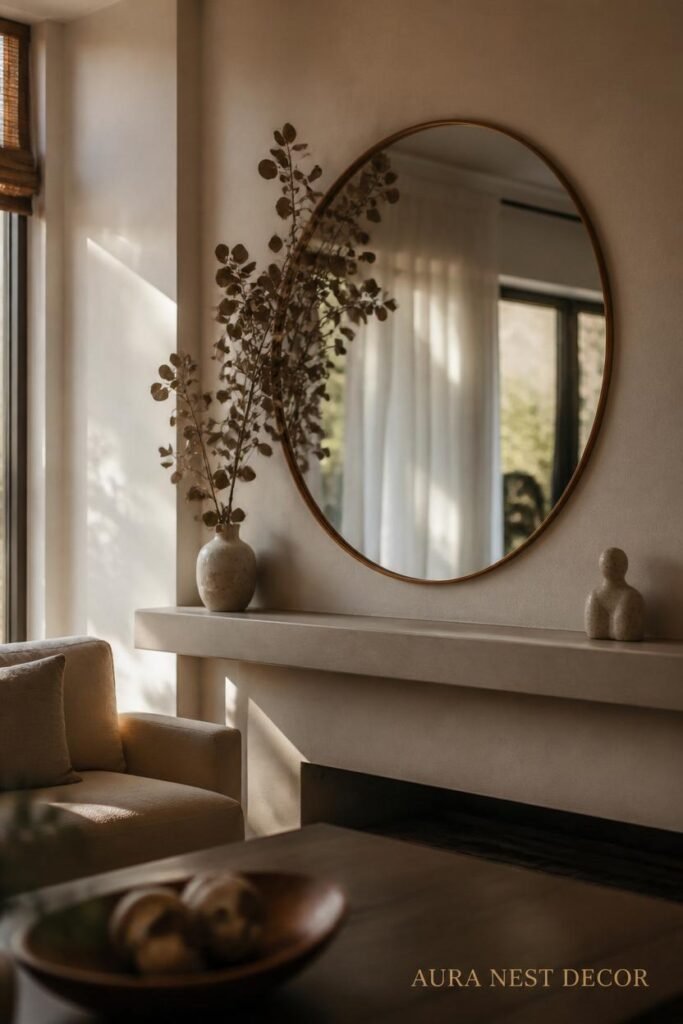
What’s around the mirror — immediately adjacent to it or in front of it — is going to show up IN the mirror. So you’re essentially styling twice the surface area, whether you think about it or not.
A mirror with a beautiful rattan shelf in front of it, holding a trailing plant and a candle, reflected back at you? Stunning. That same mirror with a random stack of magazines and your dog’s leash visible in the reflection? Less so.
Think about what you’re staging in the mirror’s field of vision. A tall floor lamp nearby creates gorgeous light reflection. A linen accent chair at an angle looks wonderful doubled. Fresh flowers on a nearby surface, reflected — honestly one of the easiest “my home is beautiful” visuals you can create for pennies.
—
12. The One Thing That’ll Make Your Mirror Wall Look Expensive Without Spending More
Lighting. Always lighting.
A mirror that’s reflecting harsh overhead lighting looks flat and a bit cold. A mirror that’s reflecting soft, warm, directional lighting looks like something from an interior design magazine.
If your small living room has overhead lights only, get a floor lamp. Specifically one with a warm-toned bulb — something around 2700K color temperature, which gives that golden late-afternoon light quality even at 10pm. Position it so the lamp itself, or its glow, is visible in the mirror’s reflection.
Even better: a wall sconce nearby, on either side of the mirror. The light from a sconce is directional and warm and it makes whatever it illuminates look softer and richer. It’s the reason hotel lobbies always look better than our living rooms. They’ve figured out that overhead lighting is the enemy.
You don’t need expensive fixtures for this. A simple rattan or linen shade floor lamp from a budget home store, with a warm bulb swapped in, will change the entire feeling of a mirror wall. This is not an overstatement.
—
❓ FAQ
Q: Will mirror walls actually make a small living room look bigger, or is that a myth? A: It’s real, but it works best when the mirror is reflecting something good — natural light, a plant, a lamp, depth of the room itself. A large mirror on the right wall can genuinely make a small room feel significantly wider or taller. The effect is strongest with one large mirror rather than many small scattered ones.
Q: I’m renting — can I still do a mirror wall without damaging anything? A: Yes, with some adjustments. Leaning large mirrors against the wall avoids drilling entirely. For lighter mirrors, strong removable picture-hanging strips (like 3M Command strips rated for the weight) work well, though always check the weight limits carefully. A gallery of smaller mirrors hung with removable strips is very doable in most rental situations.
Q: What’s the best mirror shape for a small living room right now? A: Arch mirrors are genuinely the most versatile and flatter most rooms — the curved top adds softness and the tall vertical format makes ceilings feel higher. Round mirrors are close second if you want something more relaxed and casual. Avoid very wide, squat rectangular mirrors in small rooms — they tend to emphasize the horizontal and can make low ceilings feel lower.
—
💭 Final Thoughts
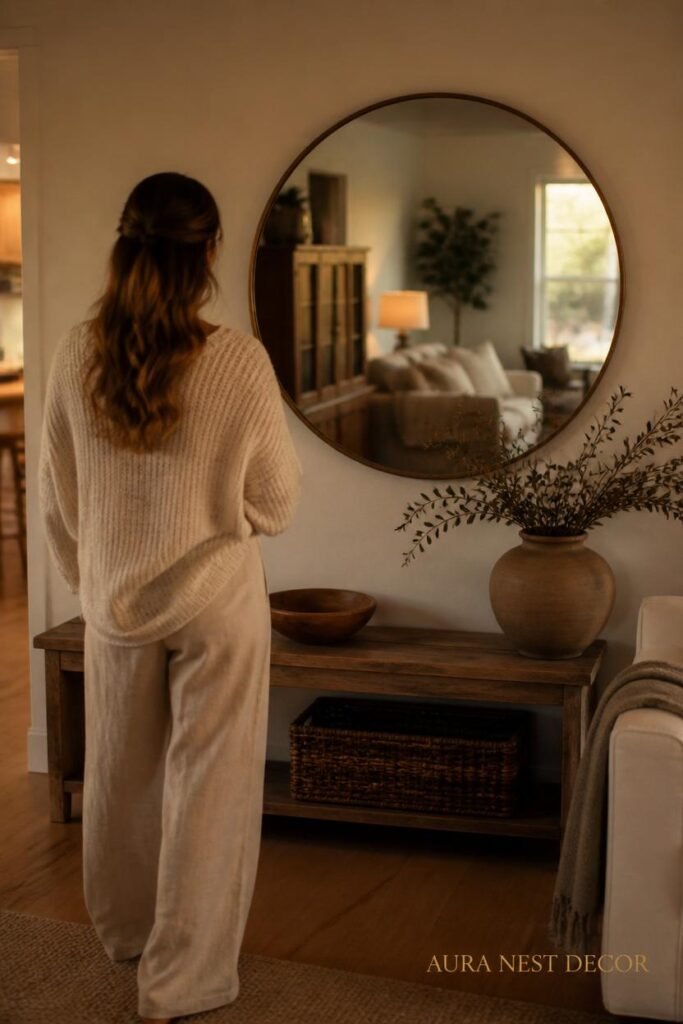
There’s something kind of quietly exciting about a mirror wall in a small room — this idea that the space you have isn’t a fixed thing, that you can push back against it a little. A good mirror placement doesn’t lie to you exactly, it just shows you the room at its best. And isn’t that kind of what all of decorating is?
What would you reflect?