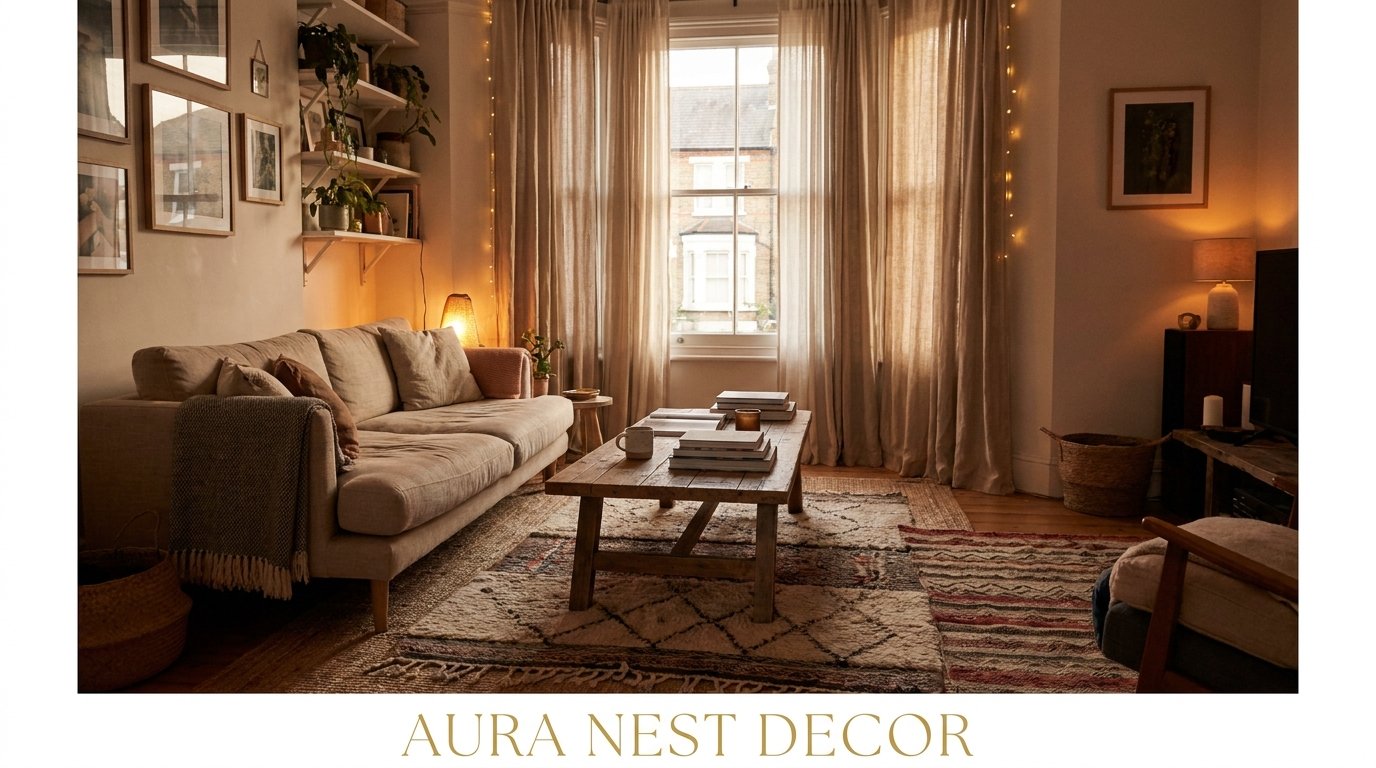
The Small Living Room That Feels Like a Hug: Cozy Ideas That Actually Work in Tight Spaces
My friend called her own living room “a hallway with pretensions.” She wasn’t wrong. But three weeks and about forty dollars later, it felt like somewhere you’d actually want to stay.
That’s the thing about small spaces. They don’t need more room. They need more intention.
—
1. The Furniture Mistake Almost Everyone Makes First
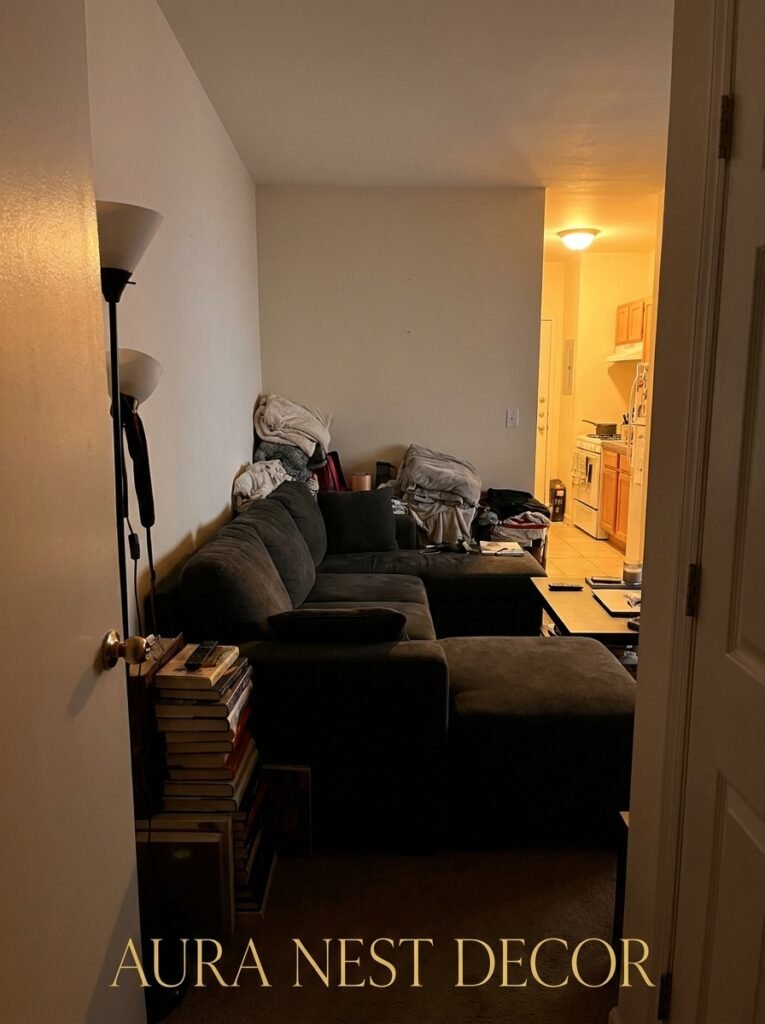
You know what tiny living rooms have in common? Too much furniture pushed against the walls.
I know. It feels like the logical move — pull everything back, create floor space, let the room breathe. But it does the opposite. Rooms with all furniture shoved to the perimeter feel like waiting rooms. Awkward. Hollow in the middle. Cold in a way that has nothing to do with temperature.
Try floating your sofa even six inches away from the wall. It sounds terrifying when you don’t have space to spare, but something genuinely shifts. The room starts to feel like a room instead of a corridor with cushions. Pull a small chair or a footstool into the center of the conversation. Create a cluster, not a ring.
It takes maybe ten minutes to try. If you hate it, push everything back. But I’ve never heard of anyone pushing it back.
—
2. The Color Nobody Talks About for Small Rooms (And It’s Not White)
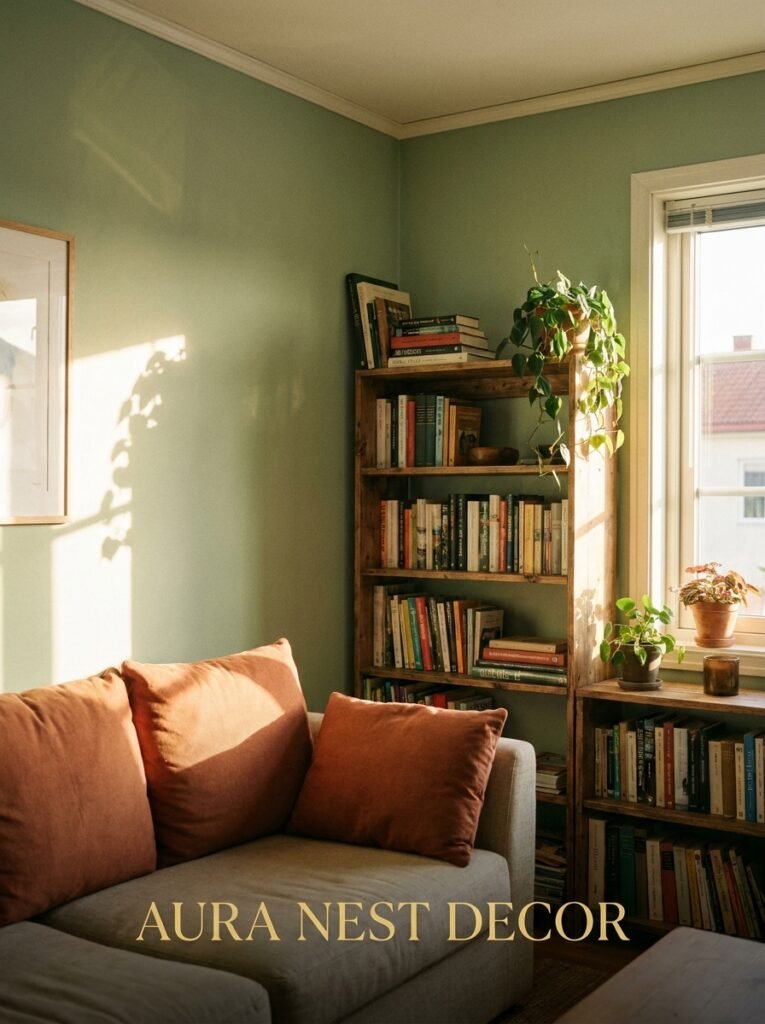
Here’s the thing about white walls in a tiny living room. They can work. But they can also make a cramped space feel clinical rather than cozy, and there’s a real difference between “airy” and “hospital waiting area.”
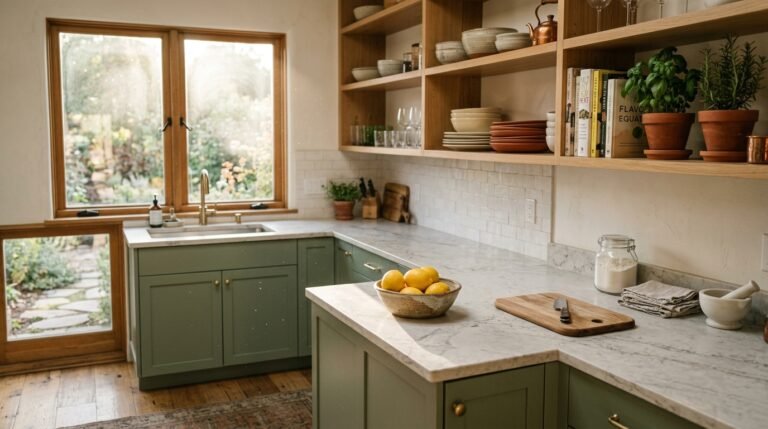
The color that keeps coming up in every small room that actually feels good? A warm, slightly greyed green. Not sage exactly — something a bit earthier, a bit murkier. Think lichen, or old moss, or the inside of a forest in November. It does something to a room that’s hard to explain until you’re sitting in it. It pulls the walls in but somehow makes that feel intentional. Like being wrapped up rather than boxed in.
In the US, people are reaching for Benjamin Moore’s Pale Avocado or Dried Thyme. In the UK, Farrow & Ball’s Mizzle or Card Room Green keeps appearing on small-living-room Pinterest boards with thousands of saves.
Dark colours have been having a moment for years now, and in small spaces they’re still underused. Don’t be scared of them.
“A wall colour that feels bold on the swatch often reads as grounded and warm once it’s actually on the walls of a small room.”
—
3. What Lighting Is Actually Doing to Your Tiny Room (It’s Not What You Think)
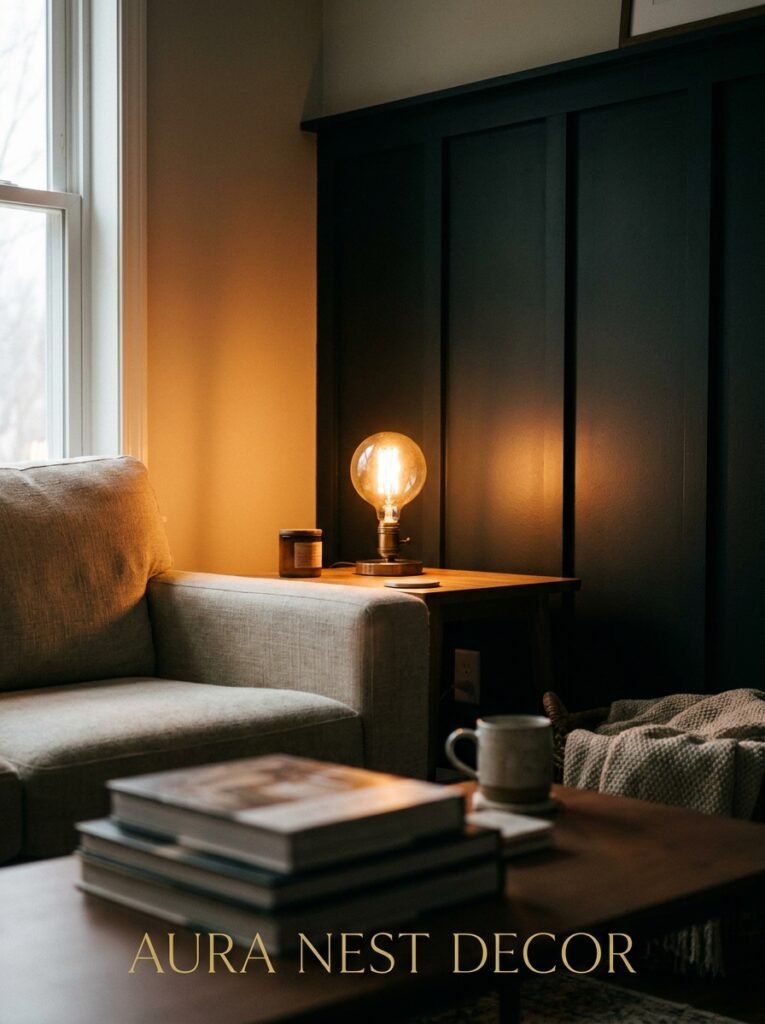
Ceiling lights in small living rooms are, honestly, kind of the enemy.
Not because they’re ugly — though a lot of them are — but because overhead lighting flattens everything. It kills shadow, which kills depth, and a room without depth is a room that feels smaller than it is. This matters a LOT in tiny spaces.
Here’s the swap: floor lamps in corners. Table lamps at eye level. Candles on surfaces. The goal is to light the room from multiple low points so the ceiling disappears a bit. The amber glow of a warm-toned bulb at around 2700K does more for a small living room than any rug or curtain. Turn on four small lamps and turn off the overhead light and then look at the room. Most people are surprised. Some people tear up a little, which feels dramatic but I get it.
Side note — if your small house exterior has a porch or a covered entryway, solar-powered outdoor lanterns flanking the front door will carry that same warmth from outside in. First impressions matter even in tiny homes.
—
4. The Rug Size Rule That Changes Everything in a Small Space
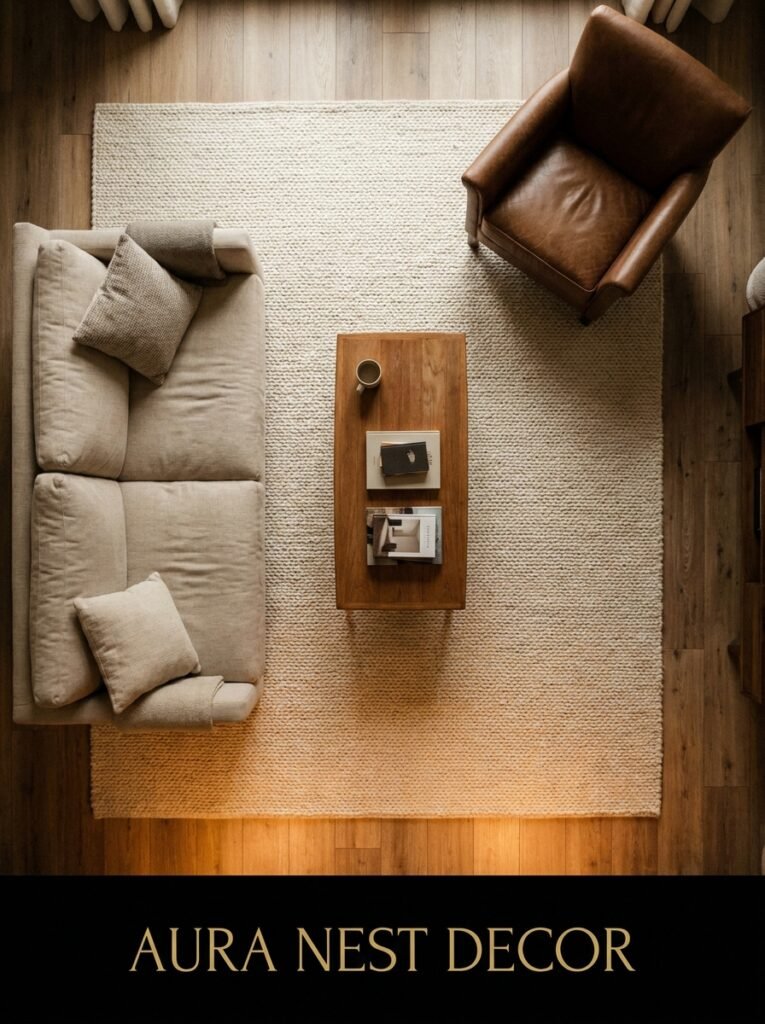
A rug that’s too small doesn’t just look a bit off. It actively makes the room look smaller and more chaotic. Because it floats. It becomes a decorative island in the middle of a sea of floor, and your eye bounces off it rather than settling.
In a small living room, your rug should be big enough that at least the front legs of your sofa and chairs sit ON it. Ideally all four legs, but front legs at minimum. If you’re in the US, most people working with a small living room need at least an 8×10 rug. In a UK terraced house with a narrow front room, a 6×9 can work if the room is genuinely tiny — but go bigger if you possibly can.
And don’t go light-coloured thinking it’ll make the room feel larger. A warm, medium-toned rug grounds the space without shrinking it. A white rug in a busy small room just reads as a cleaning anxiety waiting to happen, which is a specific kind of stressful.
—
5. Curtain Height — The Free Trick That Adds Two Feet to Any Room
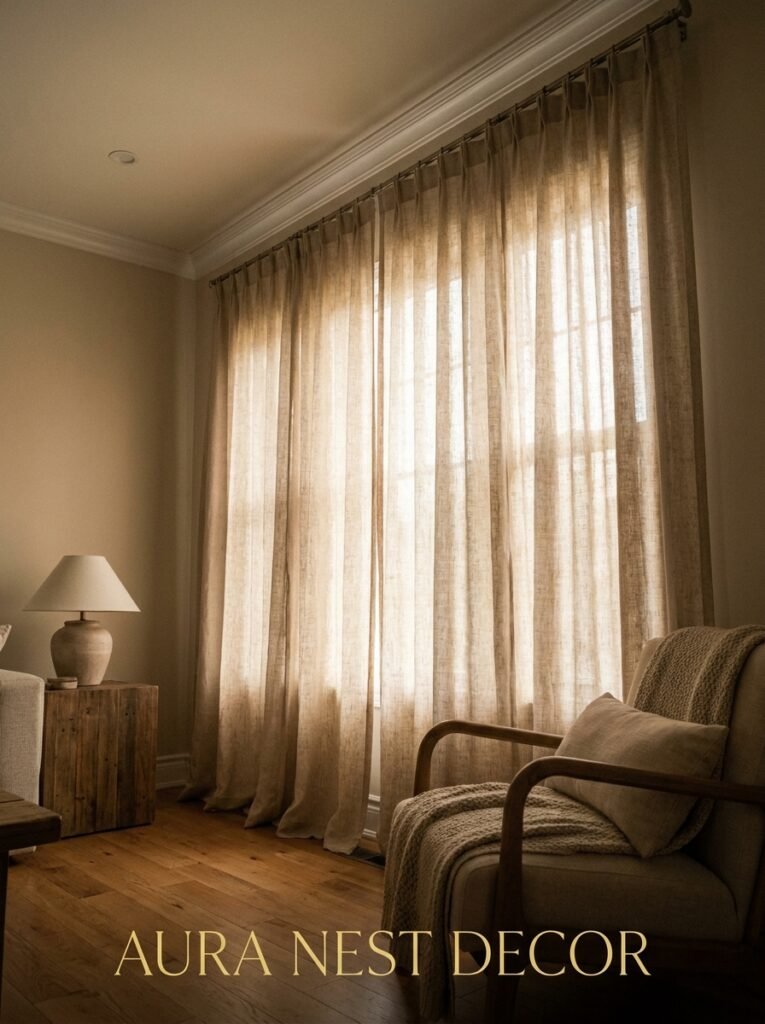
This one costs nothing if you already have curtains. And yet.
Hang your curtains as close to the ceiling as you can get them. Not halfway up. Not just above the window frame. CEILING. Then let them puddle or just graze the floor. It doesn’t matter that your actual window might be only four feet tall — the eye reads the length of the curtain drop, and it reads it as height.
This works in tiny houses and small UK terraced living rooms better than almost anything else I know. The room suddenly has vertical drama. It feels taller. And because height reads as space, it feels less cramped.
Wide panels help too. Curtains that stack back generously on each side of the window make the window look wider even when it’s not. Use a rod that extends 8-12 inches past the window frame on each side and you’ll be amazed.
—
6. The Only Gallery Wall Approach That Doesn’t Overwhelm a Small Room
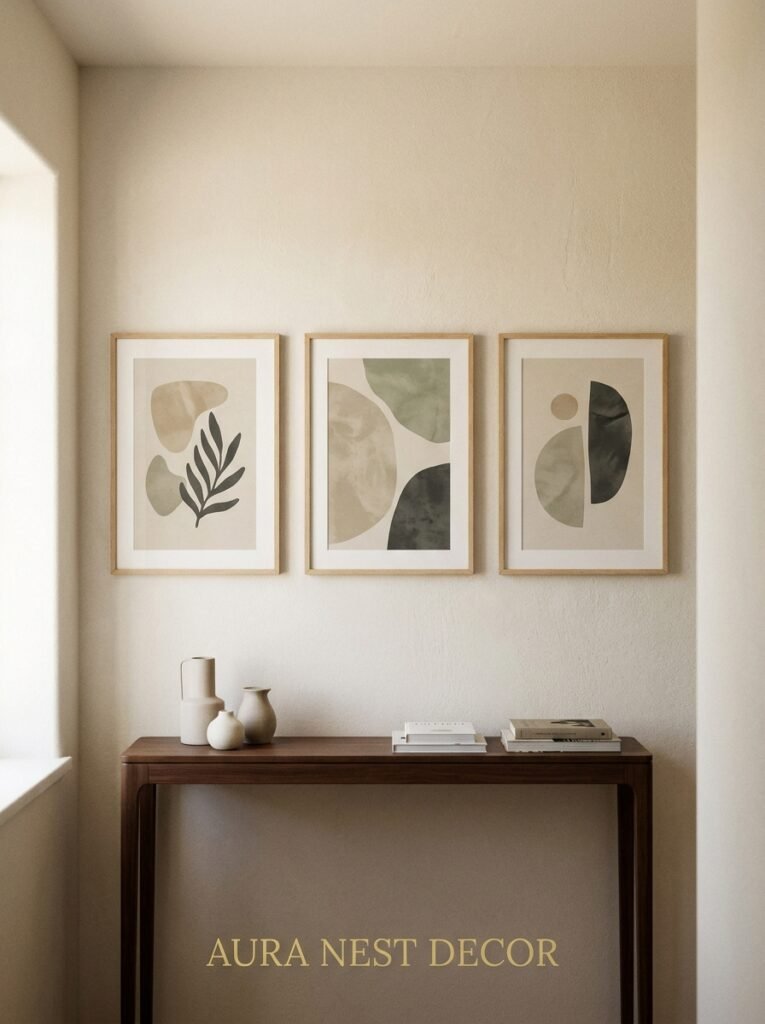
Gallery walls in tiny spaces CAN go wrong. But the mistake isn’t the idea — it’s the execution.
A chaotic grid of 15 different frames in 9 different sizes on a small wall becomes visual noise. Your eyes don’t know where to go and the room just feels cluttered and anxious. Not cozy. Cluttered.
What works instead: a small cluster. Three to five frames, tightly grouped, similar tone or matching frames. Black frames with black and white photography. Or all white frames with botanical prints. A cohesive little collection that hangs together as one piece rather than trying to cover the whole wall.
Leave more white space around it than you think you need. That negative space is doing work. It’s what makes the cluster feel intentional instead of like you ran out of room somewhere else.
“In a small living room, a single considered grouping of art says more than a wall covered in an attempt to fill every inch.”
—
7. How Small House Exteriors Can Set the Tone Before Anyone Steps Inside
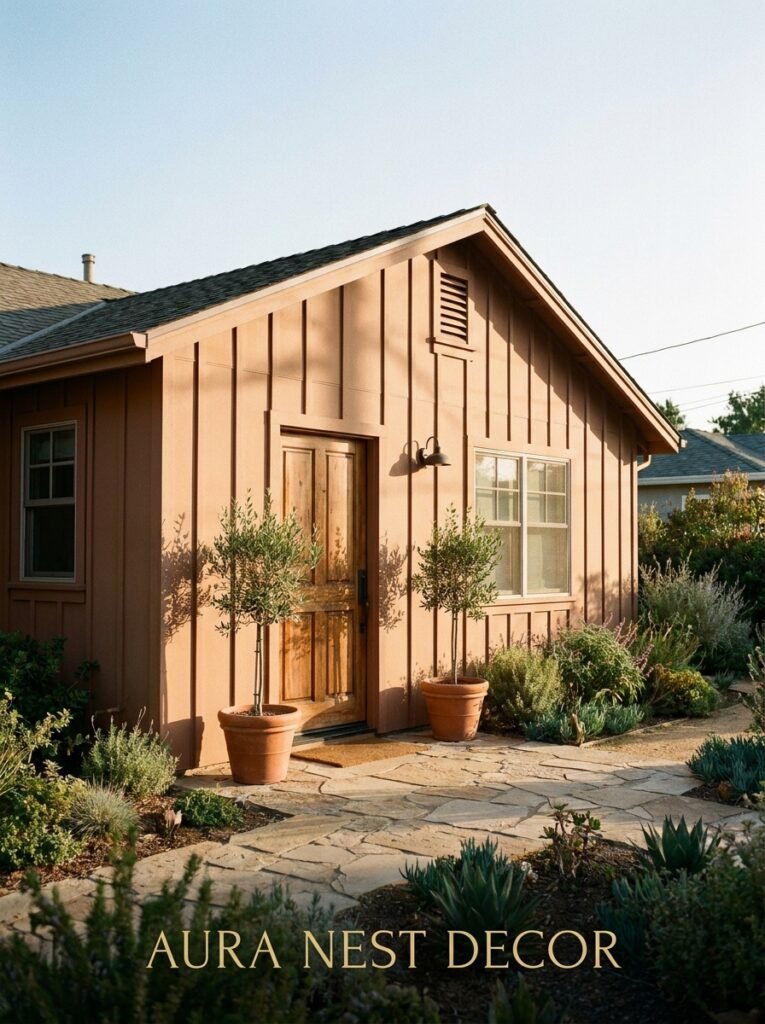
The exterior of a tiny house carries a specific responsibility. You’ve got less square footage to communicate charm and warmth, so what’s happening outside matters more, not less.
Window boxes are almost a cheat code for small house exteriors. Even plastic planter boxes filled with trailing ivy, herbs, or seasonal flowers — in the UK, something like violas or trailing lobelia in summer, ornamental cabbage in autumn — transform a plain façade into something that looks cared for. That’s the goal. Not impressive. Cared for.
A painted front door in the right colour does more than any exterior renovation. Deep navy, forest green, rich burgundy — these communicate personality and warmth before a guest has touched the handle. In the US, a Statement Door on a small craftsman or ranch exterior makes the whole house feel bigger and more intentional. In the UK, on a terrace or semi-detached, it makes yours stand out on a whole street of identical ones.
Lighting on the exterior matters too. A lantern-style pendant or two flanking a small front porch creates a sense of welcome that costs maybe $40 at most.
—
8. The Shelving Arrangement That Makes Books Feel Like Decor (Not Storage)
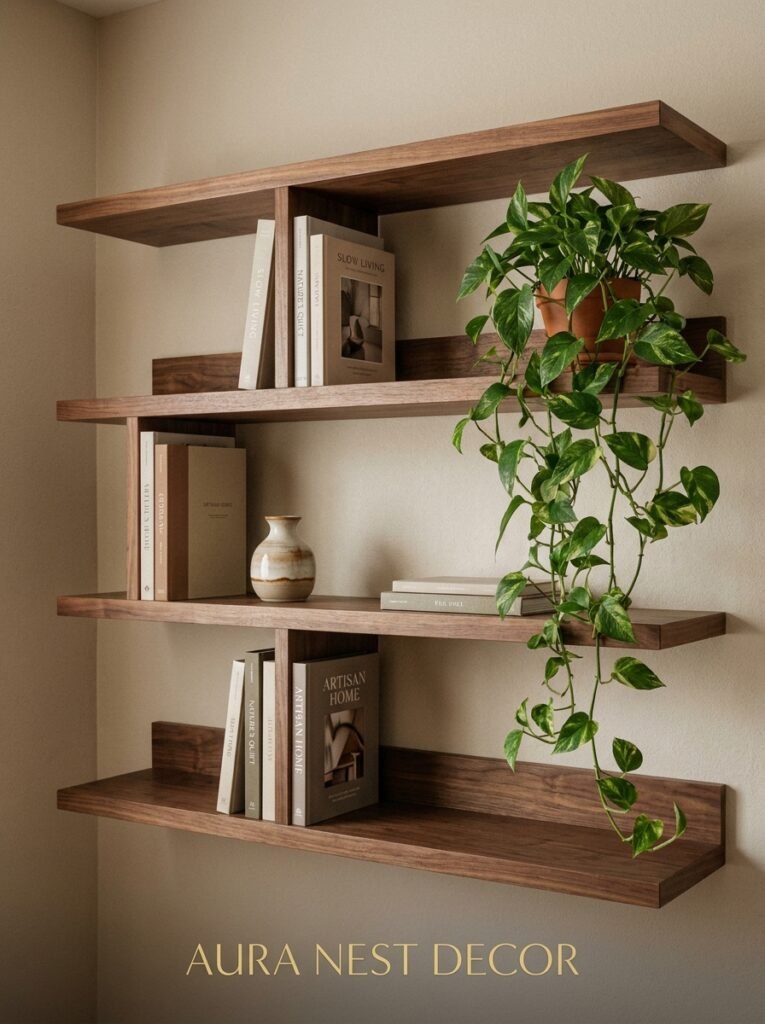
In a small living room, open shelving is a gift or a curse depending entirely on how you use it.
Shelves crammed floor to ceiling with books and random objects create visual chaos. But considered shelving — where maybe 70% is books and objects and 30% is deliberately left empty — reads as curated. Peaceful even. The empty space isn’t wasted. It’s what makes the full parts look good.
Group books by colour if you can stand to do it. I know some people are horrified by this and I understand the ideological objection, but a shelf that moves from cream through tan through dark brown through black just makes everyone feel calmer. It reads as intentional in a way that matters a lot when your living room is small and every visual element has a bigger impact.
Add one plant. One candle. One object that means something. Then stop.
—
9. Why Your Sofa Might Be the Wrong Shape for Your Room
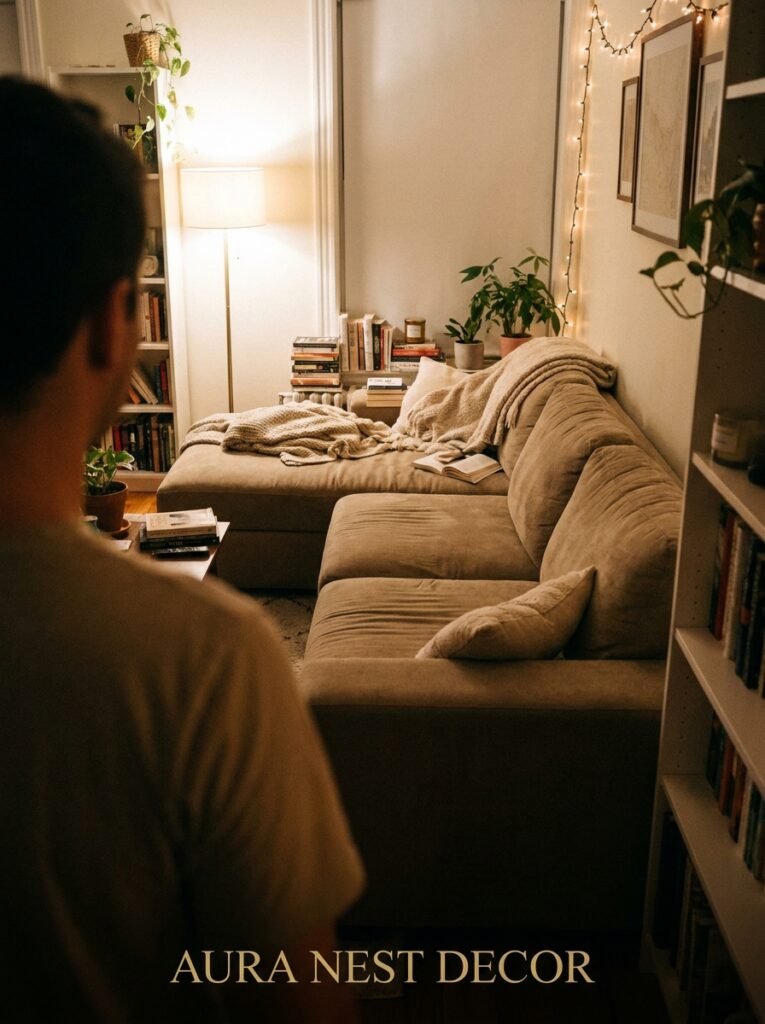
Not wrong as in ugly. Wrong as in the wrong silhouette for the specific problem of smallness.
Deep, oversized, cloud-like sofas are everywhere right now and they’re beautiful in big rooms. In small rooms? They eat the space whole. You sit down and suddenly you’re looking at sofa, and then wall, and then sofa again, and there’s no breathing room between any of it.
In a tight living room, a mid-century or apartment-sized sofa with slightly raised legs does something structural. The gap between the sofa and the floor is actual visual space, and your eye counts it. The room looks less blocked. Less like the furniture is sitting on top of you.
Loveseats often work better than people want to admit. A loveseat plus two occasional chairs can seat the same number of people as a large sofa and actually leave the room feeling like it has a layout, rather than a sofa that consumed it.
—
10. The Tiny Detail on Cushions and Throws That Tells the Room Its Vibe
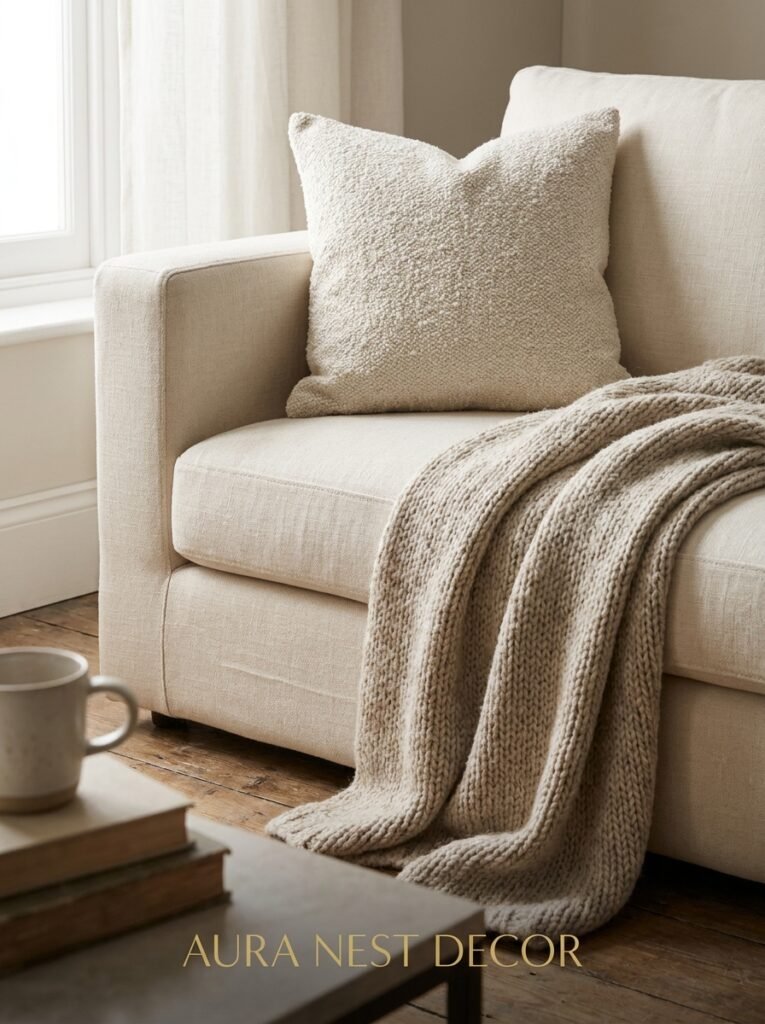
Cushions in a small living room have an outsized job. Because the sofa is probably one of the biggest surfaces in the room, whatever’s on it reads loudly.
Three cushions in slightly different textures but the same tone family — say, cream linen, ivory boucle, oatmeal velvet — looks intentional without matching in a boring way. Add one that’s a slightly deeper tone, like a warm tan or a dusty terracotta, and suddenly you’ve got depth without contrast that fights.
The throw is where I’d spend a tiny bit more money if you can. A waffle-weave or chunky-knit throw draped over one arm of the sofa (not folded perfectly, just loosely draped like someone left it there on purpose) does more for the cozy factor than almost any other single object. It says: someone curls up here. And that’s EXACTLY what a small living room should say.
“Cozy isn’t a style. It’s evidence that someone actually lives there.”
—
11. The Mirror Placement Most People Get Wrong in Small Rooms
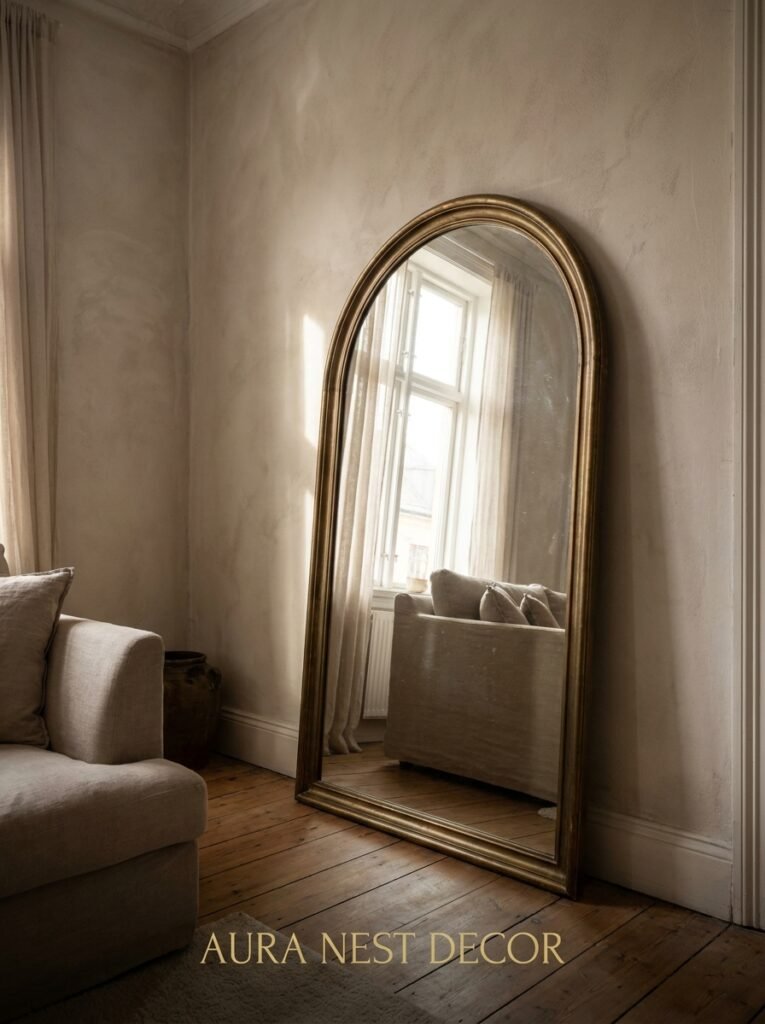
Mirrors in small spaces — yes, we all know about them. Reflect light, make the room feel bigger, classic trick. But placement is everything and most people default to hanging a mirror directly opposite a window, which works, but isn’t always the best option.
Try hanging a large mirror on the wall that’s at a diagonal or perpendicular to your main window. It catches the light at an angle instead of bouncing it straight back, which creates a softer, more interesting kind of glow. It also reflects a view of the room rather than just reflecting the window itself, which gives the impression of more SPACE rather than just more brightness.
Leaning a large mirror against a wall, rather than hanging it, also reads more casual and intentional at the same time — which is a hard combination to pull off, honestly, but leaned mirrors manage it. You’d never get that from a hung mirror.
—
12. The Final Layer — Scent, Sound, and the Parts of Cozy You Can’t See on Pinterest
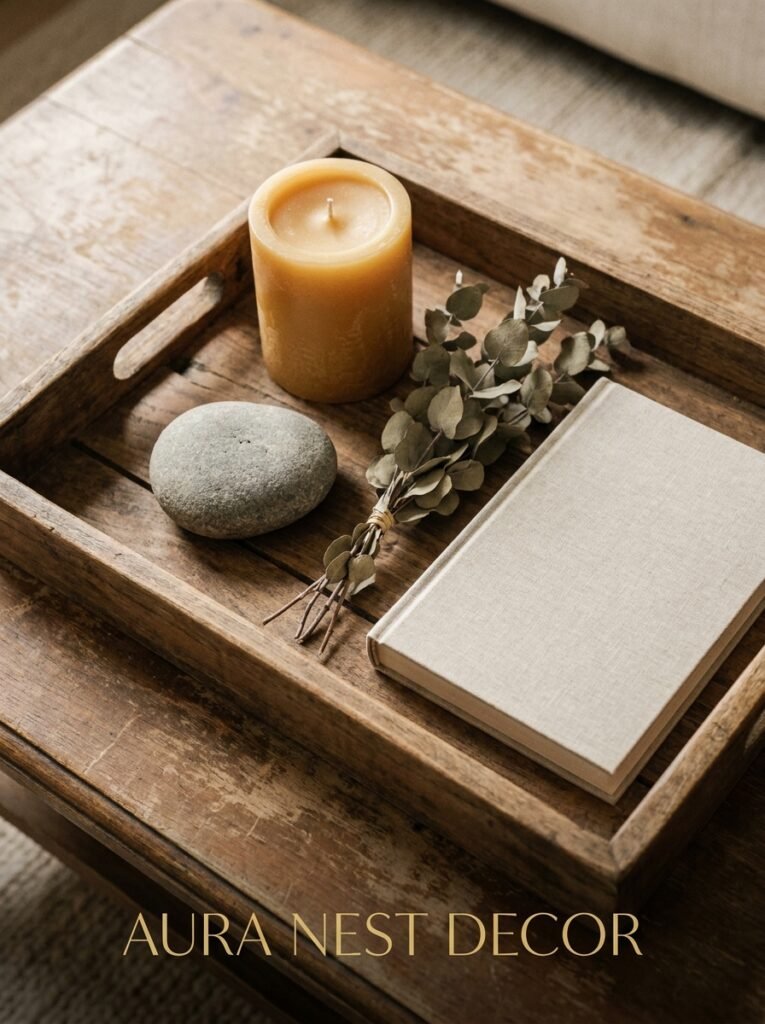
Here’s something Pinterest can’t actually show you. A room can look perfect in a photo and feel completely wrong in person. And a room can look a bit simple, a bit unfinished, and still feel like somewhere you never want to leave.
That gap is usually scent and sound.
A candle burning — not some overwhelming synthetic vanilla blast, but something quieter, like cedar, eucalyptus, or a clean linen-type scent — shifts the feeling of a room in a way that’s almost unfair. You walk in and you relax before you even consciously notice the space. A small diffuser in a corner works the same way.
Sound matters too. A tiny Bluetooth speaker playing something at low volume — ambient music, low jazz, whatever works for you — makes a small room feel inhabited rather than staged. It sounds obvious. But so many people style their small spaces and forget that cozy isn’t a visual experience exclusively. It’s something you feel when you walk in.
The best small living rooms aren’t the ones where every object is perfect. They’re the ones where you sit down and forget to look at your phone for a while.
—
❓ FAQ
Q: What’s the best sofa colour for a small living room? A: Honestly? A warm neutral — oatmeal, warm grey, or a soft camel tone — gives you the most flexibility to change everything else around it without replacing the sofa. A very dark or very bold sofa can work beautifully but commits you to a colour story, which is fine if you know what you’re doing. If you’re not sure yet, go warm neutral and don’t look back.
Q: Should I use wallpaper in a small living room? A: Yes, but choose wisely. A smaller-scale print or a textured wallpaper (limewash, grasscloth, linen effect) adds depth without overwhelming. Big bold florals on every wall can close a tiny room right in. One wallpapered wall — the wall behind your main sofa or your chimney breast — is almost always the move.
Q: How do I make a tiny house exterior look bigger? A: A few things: paint the trim and the body a similar tone to reduce visual “chopping,” use vertically-aligned exterior elements like tall narrow windows or board-and-batten siding, and keep landscaping tidy but not sparse. Overgrown front gardens make small houses look cramped; simple, intentional planting makes them look considered. A bold front door colour also draws the eye in rather than letting it wander to the edges.
—
💭 Final Thoughts
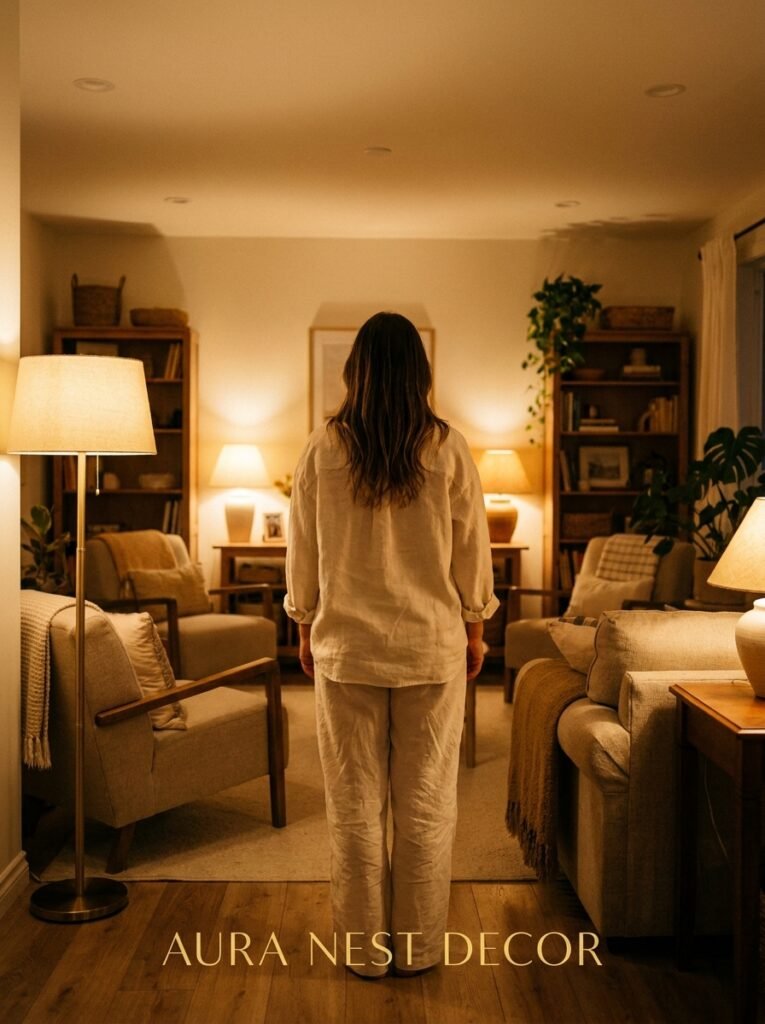
Small living rooms aren’t a compromise to work around. They’re a constraint that, when you lean into it, forces you to be more intentional than you’d ever bother being in a bigger space — and that intentionality is exactly what makes them feel so good to be in.
There’s something about a room that’s been thought about carefully that you feel the moment you sit down. It’s not about size. Never was.
What’s the one change in your small living room that made the biggest difference?