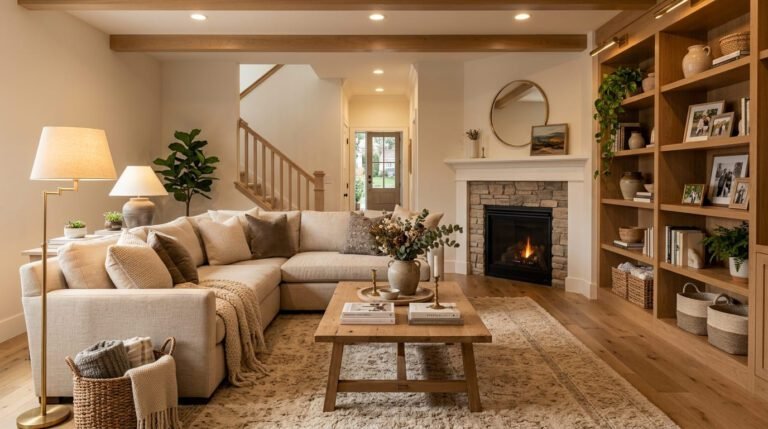
Why the Bohemian Living Room Is the Only Design Style That Actually Feels Like You
You walk into someone’s house and it just feels right. Not perfect — better than perfect. There’s a worn kilim rug, a stack of books with broken spines, something hanging on the wall that probably has a story. That’s boho. And once you see it done well, you can’t unsee it.
—
1. The Difference Between Boho Done Right and Boho That Just Looks Cluttered
Here’s the thing nobody tells you upfront: bohemian style has a secret structure to it. It LOOKS effortless, but there’s actual intention underneath all those layers. The rooms that make you stop scrolling on Pinterest — the ones with the macramé and the monstera and the velvet cushions that somehow all work together — those weren’t accidents.
The difference between a boho room that feels deeply personal and one that just feels chaotic usually comes down to one thing: a consistent warm undertone running through everything. Even if you’ve got green plants, rust-colored throws, a tapestry — wait, I mean a wall hanging — a pattern-heavy rug, and mismatched furniture, if the underlying tones are all warm (think amber, ochre, terracotta, warm brown), it reads as collected and curated, not thrown together.
Cold undertones break the spell. A bright white wall, a chrome lamp, a gray sofa that leans too cool — any of these can make the whole room feel accidentally unfinished instead of intentionally eclectic. So before you buy anything, ask yourself: is this warm or cold? That one question does most of the work.
And honestly, the clutter thing is sometimes just about scale. If everything in a room is small and fussy, it reads busy. But one LARGE statement piece — a big floor cushion, an oversized woven hanging, a sprawling plant — anchors the whole space.
“Boho isn’t about having a lot of stuff. It’s about having the RIGHT stuff, layered with purpose.”
—
2. The Color Palette That Keeps Showing Up in Every Beautiful Boho Room Right Now
Terracotta. I know, you’ve heard it. But there’s a reason it won’t quit — it’s warm, it’s earthy, it has that handmade clay-pot quality that immediately signals “this room has been lived in by a human who has actual taste.” And right now the color it’s pairing with that I’m completely obsessed with is deep forest green. Not sage — forest. Dark, moody, like looking into a jungle at dusk.
Those two together? Especially against off-white walls or a raw linen sofa? Something happens. The room starts to feel like it has a heartbeat.
In UK homes, I’m seeing this palette a lot against exposed brick walls and those beautiful Victorian fireplaces, which is a completely unfair advantage, not gonna lie. American living rooms tend to run more open-plan, and boho actually handles that really well because you can zone the space with rugs and textiles instead of walls.
Beyond terracotta and forest green, the other tones that keep appearing: dusty rose (not pink, not blush — dusty rose specifically, the one that looks like it’s been faded by sunlight for a few years), warm mustard, and a kind of faded indigo that shows up in vintage rugs and block-print cushions. These aren’t flashy. They’re layered. And they get better over time.
—
3. The Rug Is Actually the Whole Conversation
If you get nothing else from this article, get this: in a bohemian living room, the rug isn’t a finishing touch. It’s the starting point. It’s the anchor. It’s basically the whole conversation that every other piece of furniture is responding to.
Start with the rug. Seriously. Find something beautiful — a vintage kilim, a Moroccan berber, a Persian-style flatweave from somewhere like IKEA’s Persisk collection or a find from a car boot sale or an Etsy vintage shop — and then build everything outward from there. The rug tells you what colors to bring in, what textures to layer on top, what the whole room wants to feel like.
The size matters too, and almost everyone goes too small. Your rug should be big enough that at least the front legs of every sofa and chair sit on it. A small rug floating in the middle of a big room looks sad and a little lost. Go bigger than feels right. In my experience, you almost never regret going bigger.
And don’t be afraid of pattern on pattern. A geometric rug under a floral cushion actually works in boho — the rule is that one pattern should be larger-scale and the other smaller. They coexist because they don’t compete for the same visual frequency. Kind of like how a whisper and a shout can live in the same room because they’re different enough.
—
4. Lighting That Actually Changes the Room’s Personality After 5pm
This is one of those things that sounds obvious until you really sit with it. In a bohemian living room, the overhead light is basically just for finding things you’ve dropped. It’s not the main event.
The magic is in layered lighting at different heights. A rattan pendant over the seating area (that warm honey glow when it’s on is — genuinely something else). A floor lamp in a corner with a warm Edison bulb. A few candles on the coffee table or the mantle, even if they’re not lit, because the visual weight of them matters. And string lights — yes, I know they can go tacky fast, but draped over a large plant or through a bookshelf, they just work.
The temperature of your bulbs is crucial. 2700K is the number you want. Not 3000K, which reads a little clinical. 2700K gives you that amber, late-afternoon quality that makes everyone look better and every room feel warmer. You can buy them at any hardware store and they’re honestly one of the cheapest upgrades you can make.
Side note — if your room faces north (very common in UK homes), natural light is always going to run a bit cool and blue, and warm artificial lighting matters even more. A north-facing boho room can still feel incredibly cozy, you just have to work the lighting harder.
“A rattan pendant and a 2700K bulb will do more for your living room than a full remodel.”
—
5. The Plant Situation: What Actually Survives vs. What You’ll Kill by October
Okay, real talk. The boho aesthetic is deeply tied to lush, full, trailing, climbing plant life. But there’s a version of this that involves buying a bunch of beautiful plants from the garden center, putting them in a room with inadequate light, and slowly watching them decline while feeling vaguely guilty. I’ve done this. More than once.
So here’s my honest plant list for boho living rooms that are not blessed with perfect south-facing windows.
Pothos. Unkillable. Trails beautifully. Looks intentional even when it’s taking over. Snake plants — upright, graphic, sculptural, actually PREFER neglect. ZZ plants are glossy and dramatic and will survive basically anything. And for big statement floor plants, the cast iron plant is literally named after the thing it’s made of.
If you do have decent light: a fig tree (ficus lyrata, the fiddle-leaf fig, high maintenance but STUNNING), a large monstera, or a rubber plant in burgundy. These are the ones that show up in every beautiful boho room photo, and they earn their place.
One styling tip that makes a huge difference: vary the height. Tall floor plant. Medium pot on a side table. Small trailing plant hanging from a macramé hanger or on a wall shelf. That vertical range makes the room feel like the plants have found their own way in, rather than being arranged.
—
6. The Furniture Shapes That Actually Work for This Style (And the Ones That Don’t)
Straight lines and hard angles work against you in a bohemian living room. Not totally — I’m not saying every piece has to be curved — but if you look at the rooms that feel most lived-in and layered, the furniture tends to have softer profiles. Rounded arms on sofas. Curved backs. Low-slung silhouettes that feel close to the floor.
A low velvet sofa in a dusty caramel or a faded olive is one of those pieces that does a ridiculous amount of work for you. It immediately sets a laid-back mood. Pair it with a couple of floor cushions for extra seating (super practical for gatherings, also brilliant for small UK living rooms where floor space is always a negotiation) and you’ve got a seating arrangement that feels genuinely social.
Rattan and cane furniture. Yes. Absolutely. A cane-back chair or a rattan side table doesn’t have to look like a beach house — against warm walls with the right cushion and rug situation, it looks sophisticated and layered. And it’s lighter than solid wood, which matters in smaller rooms.
The one furniture shape that consistently fights against boho: anything with very sleek, modern legs and a glass top. Clean-lined, contemporary pieces can work in an eclectic room, but they have to be used with care and warmth all around them or they just look like they got left behind from a previous design scheme.
—
7. Texture Is Doing 80% of the Work, Whether You Notice It or Not
Run your eye over any boho room you love on Pinterest and count the textures. Linen. Velvet. Woven cotton. Chunky knit. Jute. Leather. Worn wood. Hammered brass. Ceramic. Rattan. There are usually at least eight distinct textures in a room, and it’s that layering — not the color, not the individual pieces — that creates the sense of depth and richness.
The reason this matters so much is that texture catches and plays with light. Velvet looks different in the morning than it does at 9pm. A jute rug has shadows woven into it. A chunky knit throw looks heavier and cozier the darker the room gets. These things are alive in a way that smooth, flat, matte surfaces simply aren’t.
If your room is feeling flat and you can’t figure out why, texture is almost always the answer. Add a chunky throw. Swap a smooth synthetic cushion for something woven. Get a ceramic vase instead of a glass one. These are small swaps and the cumulative effect is SIGNIFICANT.
“If you can’t touch the room and feel at least five different things, you haven’t layered it enough yet.”
—
8. The Gallery Wall Rules Nobody Actually Talks About
Gallery walls in boho spaces are almost a genre unto themselves. But they’re also one of the easiest things to get wrong in a way that feels weirdly chaotic rather than intentionally eclectic.
The trick that actually works: create a loose visual anchor point in the center — usually your largest piece, maybe a vintage poster, a large print, or a piece of textile art — and then build outward from it with smaller things. Don’t be too symmetrical. One side can have three small pieces where the other has two larger ones. The slight imbalance is what makes it look curated rather than designed-by-committee.
Mix frame materials. Black frames, natural wood frames, and rattan frames together on one wall look so much more interesting than a matching set. Vary the orientation too — portrait, landscape, even square — and don’t limit yourself to only framed prints. A small mirror, a woven wall hanging, a dried flower arrangement in a little frame — these break up the flatness and give the wall actual dimension.
Lay it all out on the floor first. I know this sounds obvious but a lot of people skip this step and then end up with 47 nail holes and a mild existential crisis. Floor it first, photograph it on your phone, then transfer to the wall. Spacing between pieces should generally be 2-3 inches — close enough to read as a cluster, far enough that each piece has room to breathe.
—
9. Vintage and Secondhand: Where to Actually Find the Good Stuff
The soul of a boho room — the thing that separates it from a room that’s been “boho-themed” — is the presence of pieces that couldn’t have been bought all at once from one store. Vintage items, inherited pieces, market finds, things that have history built into them.
In the US, estate sales are extraordinary for this. Seriously, if you haven’t gone to estate sales, you are leaving incredible things behind. Old ceramics, Persian-style rugs, vintage wicker furniture, lamps that are just weird in the best possible way. Facebook Marketplace and Craigslist are also genuinely good for large secondhand furniture pieces — the kind of oversized velvet sofa or rattan bookshelf that would cost a fortune new.
In the UK, charity shops (especially in wealthier areas — Oxfam in a nice village is a different universe from a city-centre one), car boot sales, and eBay are where the real finds live. Hastings, Brighton, and Margate have brilliant vintage shops if you’re near the south coast. Online, Vinterior and Selency are really good for the kind of mid-century and bohemian pieces that photograph beautifully.
Etsy is also valid. The vintage section of Etsy has global reach and I’ve found things there that I genuinely couldn’t have found anywhere else. Sometimes you pay a bit more, but for a piece that makes the whole room, it’s worth it.
—
10. The Bookshelf That Actually Looks Intentional Instead of Like You Just Stuffed Things In
Books are central to the boho living room in a way they’re not always central to other design styles. And there’s something specific about the way they’re styled that makes the difference between “I read a lot” and “this is a designed space that values knowledge and beauty equally.”
Start by not facing all the books spine-out in neat, tidy rows. Some spines out, some stacked horizontally, one or two with the pages facing front if the covers are worn and beautiful. The horizontal stacks create visual variation in height and also give you surfaces for small objects — a little ceramic dish, a candle, a small plant. Those objects break up the wall of books and create a kind of rhythm.
Color-organizing books is controversial but I kind of love it for boho rooms. Not perfectly, obsessively sorted — but loose groups of warm-toned spines together, cooler tones elsewhere. It sounds fussy but it actually reads as a collected, intentional background rather than visual noise.
And lean things. Lean a framed print against the shelf instead of hanging it. Lean a small mirror. Tuck a postcard in. The slightly impermanent, personal quality of leaned objects is very boho — it says “I put this here because I love it, and I can move it when I find something better.”
—
11. The Candle and Scent Dimension That Most People Forget Completely
Here’s something interior design content almost never talks about, and it’s the thing that makes someone walk into a beautifully styled room and feel absolutely nothing — because it smells like nothing. Or worse, like that synthetic plug-in air freshener.
Scent is a design element. I really mean that. A room that smells like good beeswax candles, a faint trace of palo santo, and something warm and herbal — maybe dried lavender in a vase — has a physical quality to it that you feel before you consciously register it. It changes the atmosphere. It makes the room feel genuinely lived-in and cared for.
For boho specifically, the scents that work: warm woods (cedar, sandalwood), resins (frankincense, amber, palo santo), spice (clove, cardamom), and florals that lean earthy rather than sweet (rose absolue, ylang-ylang, dried herbs). Companies like Paddywax, Boy Smells, or UK brands like Earl of East or Earl & Watson do candles in this register really well.
Dried botanicals also contribute — bunches of dried pampas grass, eucalyptus, or lavender don’t just look beautiful, they add a subtle, natural smell to the room. It’s a quiet thing that accumulates into a whole atmosphere.
—
12. The One Rule About Boho Styling That Changes How You See Everything
There’s a question I started asking myself when I got serious about creating a living space I actually loved: does this thing have a story?
Not a made-up story — a real one. Where did it come from? Who made it? Did I find it somewhere interesting? Was it a gift? Has it been somewhere? Boho rooms that feel genuinely personal and full of character are almost always made up of pieces where the answer to that question is something other than “I bought it on Amazon last Tuesday.”
This doesn’t mean everything has to be vintage or handmade or expensive. It just means intentionality. Choosing a handwoven cushion cover made by an artisan somewhere instead of the mass-produced one. Keeping the slightly chipped ceramic mug on the shelf because you bought it at a market in Lisbon and it reminds you of that whole weekend. Hanging the embroidered piece your aunt gave you even though it’s not “perfectly on trend” — because it’s yours.
Boho is the style that most rewards this kind of collecting. Other design styles — minimalism, Scandi, contemporary — kind of punish sentimentality. They want clean lines and nothing extraneous. Boho says: bring all of it. The layers, the stories, the imperfections, the mismatched beautiful chaos. That’s not a flaw. That’s the whole point.
—
❓ FAQ
Q: How do I make a small living room feel boho without it becoming overwhelming? A: Stick to one large statement textile — a big rug or a bold wall hanging — rather than trying to layer everything at once. In small spaces, scale UP on one piece and keep the rest quieter. Floor cushions instead of extra chairs also free up visual space while staying very boho in feel.
Q: Can I do a bohemian living room if my rental has white walls I can’t paint? A: Honestly, yes, and sometimes better. Use large textiles, tapestries, gallery walls, and propped/leaned art to add color and pattern without touching the walls. A big floor-standing mirror and tall plants also draw the eye away from plain walls. White actually makes a decent neutral backdrop for warm boho tones.
Q: What’s the biggest mistake people make when styling a boho living room? A: Buying everything from the same place at the same time. When every piece comes from one store’s “boho collection,” it reads as a themed room rather than a personal one. Mix sources, mix time periods, and buy things gradually as you find them — the room gets better the more patient you are with it.
—
💭 Final Thoughts
A bohemian living room isn’t something you finish — it’s something you keep adding to, subtracting from, rearranging at midnight because something finally clicked. The rooms that stop you mid-scroll weren’t styled in a weekend. They were accumulated, the way a person accumulates experiences and things they love.
So don’t wait until you have the budget for the perfect sofa or the ideal lighting setup. Start with what you have and add from there, slowly. The imperfection is part of it.
What’s the one piece in your living room right now that feels genuinely, uncomplicatedly yours — and could you build outward from that?