Why a Dark Brown Leather Couch Might Be the Smartest Thing You Ever Put in Your Living Room
You walked past it in the furniture store and thought, that’s too serious. Too dark. Too much. Then you got home and couldn’t stop thinking about it. There’s a reason for that.
—
1. The Color That Keeps Showing Up in Every Living Room People Actually Want to Sit In
Dark brown leather doesn’t trend. That’s the thing. It doesn’t have a moment and then disappear. It’s just… always there, in the rooms that feel lived-in and real and genuinely inviting. Not the rooms staged for a photoshoot, but the rooms where you’d actually want to curl up on a Sunday morning with something warm to drink.
And I think people are finally letting themselves admit that.
There’s been this weird stretch of years where everyone was painting everything white and buying oatmeal-colored sofas and calling it “timeless.” And sure, fine. But there’s something almost cold about a room that’s all cream and linen and pale oak. Beautiful, yes. Cozy? Not always.
Dark brown leather does something different. It grounds the room. Pulls it down to earth in the best possible way. You walk in and you exhale. It’s that physical — the room just feels weighted and real. Not heavy in a suffocating way, more like… settled. Like a room that knows what it is.
And here’s the part nobody says out loud: it looks better over time. Most furniture doesn’t. Most sofas start declining the moment you bring them home. But leather — real, quality leather in a deep espresso or tobacco or walnut tone — it develops character. Little marks, slight fading in the seat cushions, that barely-there patina that takes years to build. You can’t buy that. It just happens.
“A dark brown leather couch isn’t just furniture — it’s the anchor your whole room has been waiting for.”
—
2. The Wall Color Question Everyone Gets Wrong First
So you’ve got the couch, or you’re planning for it, and now you’re staring at your walls thinking what now. Most people default immediately to beige or greige and call it done. Which works! But it’s not the only answer, and honestly it’s not always the best one.
Warm white — not stark white, but something creamy like Farrow & Ball’s “Pointing” or Benjamin Moore’s “White Dove” — is genuinely beautiful against dark brown leather. The contrast feels deliberate without being jarring. It’s light without being cold.
But deep sage green? That’s the combination that’s been making me stop mid-scroll every single time. There’s something about the way a muted, almost dusty green sits next to rich chocolate leather that feels completely organic. Like it grew there. Terracotta works too, which sounds intimidating but in practice feels incredibly warm and cozy, especially in rooms with decent natural light. Burnt orange. Deep rust. Dusty plum, even.
The colors that don’t work as well? Anything too cool or too blue-leaning. Lavender, cool gray, icy blue — they fight the warmth in the leather instead of working with it. You end up with a room that feels slightly confused. Not terrible, just not quite right.
Navy is the exception. Deep, proper navy can be stunning with dark brown leather — it creates this rich, club-room sort of energy that’s confident and moody and kind of wonderful.
—
3. The Rug That Actually Ties the Whole Thing Together (Hint: It’s Not What You Think)
Everyone wants to put a gray rug under a dark brown leather couch. I understand it. Gray feels safe and neutral and like it won’t mess anything up. But it’s such a missed opportunity.
The dark brown leather already has warmth. The rug is your chance to either amplify that warmth or add something totally unexpected. A vintage-style Persian or Turkish rug with deep reds, golds, and navy? Perfect. It sounds like a lot, but leather is actually really forgiving — it doesn’t compete the way patterned fabric would. A jute rug works beautifully for a more relaxed, almost beachy-British-country feel. Natural fiber, relaxed texture, unpretentious. It lets the leather be the statement.
Cream or off-white rugs are surprisingly great too, if you’re going for contrast. There’s something almost cinematic about a big cream rug under a dark leather sofa — very old-money British sitting room, but in a liveable way.
What you want to avoid is a rug that’s the same depth of tone as the leather. Medium brown rugs disappear under a dark brown couch. Everything blurs together. The room needs that ground layer to be noticeably different — lighter, or patterned, or textured — to give the couch something to sit on visually, rather than just sinking into.
—
4. Why Every Brown Leather Room Needs at Least One Thing That’s Soft and a Bit Unexpected
A room that’s all leather and dark wood can start to feel like a gentlemen’s club. Which is fine if that’s what you’re after. But most people aren’t — they want something that’s warm and sophisticated but also genuinely soft and personal.
Throw pillows do more work here than in almost any other room setup. Not decorative throw pillows — actually good ones. Deep ochre velvet. Forest green linen. A chunky cream knit that you’d actually want to grab. These textures are what break up the sleekness of the leather and make the room feel curated rather than decorated.
Throw blankets, same thing. Draped casually over the arm of the couch — not folded neatly over the back, that looks staged — a good throw in mustard or rust or a warm plaid does something to a leather couch that’s almost alchemy. It says this couch is used. People sit here. They get comfortable. They stay.
And honestly? Plants. I know everyone says plants. But a big leafy monstera or a dramatic fiddle-leaf fig in the corner of a room with dark leather — the combination is genuinely gorgeous. It softens everything. The green against the brown is almost primal in how good it looks together.
“Throw one imperfect, genuinely cozy thing onto that leather couch and watch the whole room relax.”
—
5. The Lighting Setup That Makes Dark Brown Leather Look Incredibly Rich (Not Flat and Dark)
Here’s where a lot of people go wrong, and it matters more than almost anything else. Dark furniture in bad lighting looks depressing. In the right light, it looks like a room from a boutique hotel in Tuscany.
Overhead lighting alone will kill the vibe completely. That flat, even light that comes from a single ceiling fixture — it’s death for a room built around dark furniture. You want layers. Multiple sources. Different heights.
A floor lamp with a warm-toned bulb placed near the corner of the couch is essential. Not a cool white LED — something amber, around 2700K, that throws a soft pool of light across the leather and makes it glow. That’s the amber glow of an Edison bulb at 7pm that makes you not want to leave the room. Side tables with small lamps add more layers. Candles on the coffee table, if you’re the candle type — and near dark brown leather, you really should be.
The leather itself picks up warm light differently depending on the finish. Aniline leather, which has a more natural, slightly matte finish, looks almost ALIVE under lamp light. Full-grain leather gets these gorgeous highlights. Even corrected-grain leather looks better than it does in a showroom when it’s lit properly.
Dimmer switches. That’s the unglamorous practical advice that changes everything. If your overhead light is on a dimmer and turned way down — just for ambient fill — combined with a couple of warm lamps, you’ve got a room that photographs beautifully and feels incredible to actually sit in.
—
6. The Coffee Table Pairing That’s All Over Pinterest for a Reason
Dark brown leather and a raw wood coffee table. You’ve seen it a hundred times and there’s a reason it keeps appearing — it works on a level that’s almost primal. Wood and leather together feel natural in a way that no other material combination quite manages.
But which wood? Lighter tones, like ash or pine or white oak, create a beautiful contrast against the dark leather. Walnut is stunning but can start to blur with darker leather if they’re too similar in depth. Reclaimed or live-edge pieces add a roughness that makes the room feel more interesting and less catalog-perfect.
Marble is the other one that keeps showing up. A white or cream marble coffee table against a dark leather sofa creates a gorgeous push-pull of warm and cool, rough and smooth, dark and light. It sounds like it shouldn’t work and then you see it in person and it absolutely does.
Metal-framed tables — particularly in brass or unlacquered bronze — add warmth without adding visual weight. Very good for smaller rooms where a chunky wood table might feel like too much.
What I’d avoid is glass. Clear glass coffee tables tend to disappear, which sounds like it’d be fine for a small space, but with dark leather you actually want something visible and substantial at that level. The room needs the grounding.
—
7. Small Living Room? Here’s the One Rule That Changes Everything
Dark brown leather in a small room sounds like a terrible idea. Conventional advice says go light, go small, go minimal. And yeah — in a small space with no natural light, a huge leather sectional in near-black tones would be rough.
But a well-proportioned leather sofa in a small room? Genuinely great. The key is scale. A tight two-seater or a compact three-seater in dark leather, on legs rather than a skirted base (legs make furniture feel lighter, always), in a room with decent light — it works.
The trick is contrast. Make sure everything around it is noticeably lighter. Light walls. Light rug. Light-toned wood. Even curtains in a creamy linen. You’re giving the room contrast points so the eye travels and the leather reads as a deliberate anchor rather than something eating all the light.
Also — mirrors. A large mirror on the wall opposite or beside a leather sofa bounces light and makes the whole thing work in a way that sounds like an interior design cliché but genuinely isn’t.
“A small room doesn’t need less personality — it needs one confident piece that commits completely.”
—
8. The Style the Brown Leather Couch Actually Belongs In (It’s More Than You Think)
Brown leather couches have been so associated with one look — the very traditional, slightly laddish, man-cave-adjacent thing — that a lot of people have mentally filed them under “not for me.” Which is a mistake.
Dark brown leather works in mid-century modern rooms, where its warmth balances the sometimes-cool geometric lines. It’s great in Japandi spaces, where natural materials and simplicity are the whole point. It works in eclectic maximalist rooms where it’s surrounded by layered textiles and art and plants. It belongs in British country house style — obviously — but also in very contemporary city apartments when the other furniture is clean and minimal.
The key is the surrounding pieces. Dress a leather sofa in sleek, low-slung mid-century furniture and it feels modern. Surround it with heavy linen, wood beams, and an open fireplace and it’s completely at home in a Cotswolds cottage. Put it against concrete and exposed brick with some industrial metal shelving and it becomes something entirely different again.
The sofa doesn’t define the style. You define the style, and the sofa lives there.
—
9. The Art That Looks Unbelievably Good Above a Dark Leather Sofa
Abstract art. Full stop. I know that’s a sweeping statement but hear me out. Abstract pieces — particularly in warm, earthy tones, terracotta, ochre, cream, deep green — look extraordinary above a dark leather sofa. The richness of the leather makes the art look more serious, more intentional. And the art stops the leather from feeling too heavy.
Botanical prints are having a big moment and for good reason. A large-format botanical print or a gallery wall of smaller ones, especially with simple matte black or raw wood frames, looks completely wonderful above dark leather. The green tones pick up the plant life in the room. The vintage feel works.
Black and white photography is interesting — it creates a really stark, editorial look that’s not for everyone but is genuinely striking when it works. Very magazine. Very confident.
What tends to look less great: very cool-toned art in blues and purples. Again, it fights the warmth instead of working with it. It’s not impossible to pull off, but you’d be working against your own room.
—
10. The One Thing Nobody Mentions When They Buy a Brown Leather Sofa
Cats. Dogs. Kids. Real life. And here’s the thing — this is actually where dark brown leather wins over almost everything else.
Light-colored fabric? Shows everything. Every crumb, every pawprint, every mystery stain. Needs constant cleaning and sort of panicked vigilance.
Dark brown leather? Wipe it down. That’s it. Spilled red wine — wipe it. Dog jumped up with muddy paws — wipe it. Kid with chocolate hands — wipe it. The leather doesn’t absorb stains the way fabric does, and the dark tone means even if there’s a faint mark it’s barely visible.
It’s not zero maintenance — it does need conditioning a couple of times a year to stop it drying out and cracking, and you want to keep it out of direct harsh sunlight. But the day-to-day reality of owning a dark brown leather sofa is so much easier than a light fabric one. It’s genuinely practical in a way that other beautiful furniture often isn’t.
—
11. The Accessory That Costs Almost Nothing and Makes an Immediate Difference
Side tables. People underestimate them constantly. Not the coffee table — the little tables that sit beside each end of the sofa, at arm height, where you put your coffee or your book or your phone.
A mismatched pair of side tables next to a dark leather sofa adds so much character. A small rattan table on one side, a dark metal and glass table on the other. They don’t have to match each other — in fact it’s often better when they don’t. Eclectic feels collected. Matching sets feel like a showroom.
Small table lamps on each one, a few candles, a coaster, maybe a small stack of books. That’s the whole kit. And it transforms the sofa from a piece of furniture into a destination. A place in the room. A room within the room.
—
12. The Combination That Photographs Best for Pinterest (and Looks Great in Real Life Too)
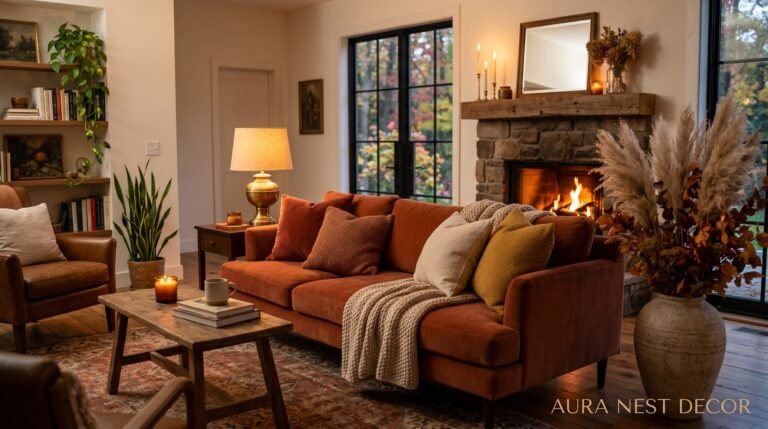
Dark leather couch. Cream shaggy throw draped over one arm. Two oversized velvet cushions in terracotta and forest green. A jute rug. Warm lamp light from a floor lamp in the corner. One large leafy plant. A coffee table with a couple of art books, a small candle, and something ceramic in a warm neutral tone.
That’s it. That’s the image. That’s the combination that people save and pin and try to recreate — and the reason it works is because every single element is doing something specific. The throw adds softness. The velvet cushions add richness and color. The jute adds texture and lightness. The plant adds life. The books and candle add personality.
Nothing in that list is expensive. Some of it’s genuinely cheap. But together, against that dark brown leather, it photographs like a room from a magazine and feels — in person — like somewhere you’d actually want to spend a Sunday afternoon. Which, honestly, should be the goal of any room you live in.
—
❓ FAQ
Q: Does dark brown leather furniture make a room look smaller? A: It can if you’re not careful, but it doesn’t have to. The key is keeping everything around it lighter — walls, rugs, curtains — and choosing a sofa on legs rather than a skirted base. Good lighting helps enormously too.
Q: How do I keep a dark brown leather sofa from looking too masculine or dated? A: Texture is your best friend here. Soft throws, velvet cushions, woven rugs, and plants all add warmth and femininity. Color choices matter too — terracotta, sage green, and warm cream soften the whole look considerably.
Q: What’s the best way to condition a dark brown leather sofa at home? A: Most leather sofas do well with a dedicated leather conditioner applied with a soft cloth a couple of times a year. Avoid anything with silicone or alcohol — they strip the leather over time. Always test on a hidden spot first, and follow the manufacturer’s guidance for your specific leather type.
—
💭 Final Thoughts
Dark brown leather has this reputation for being serious and traditional and a bit intimidating. But the rooms that use it really well are anything but. They’re warm and layered and genuinely lived-in — and there’s a good argument that they’re the most inviting rooms of all.
The couch isn’t the hard part. It’s everything around it that you get to play with, and that’s where it gets really fun.
So — if you’ve been sitting on the fence about it, what’s actually holding you back?