The Dark Couch Is Having a Moment — And Honestly, It Deserves It
You picked it up scrolling at midnight, that deep charcoal sofa with the low profile and the slightly moody energy. And now you can’t stop thinking about it. Good. Don’t let anyone talk you out of it.
—
1. Why Everyone’s Suddenly Scared of Beige (And What They’re Buying Instead)
There’s this collective exhaustion happening. You can feel it every time you walk into a showroom full of greige sofas and oatmeal throw pillows. People are tired of safe. Not in a dramatic way — just quietly, persistently tired of rooms that don’t have a point of view.
Dark sofas aren’t new, obviously. Chesterfields in oxblood leather have been anchoring British drawing rooms since forever. But what’s shifted is who’s buying them and why. It’s not just about looking sophisticated anymore. It’s about a room that actually holds attention. That feels like somewhere.
A deep navy velvet sectional does something a cream linen couch can’t. It pulls the whole room toward it. Everything else starts to orbit around it — the rug, the coffee table, the lamp in the corner with the amber bulb. The room gets a spine.
And I’ll say it plainly: light sofas are harder to live with than anyone wants to admit. That’s the dirty secret no stylist wants to lead with. A dark sofa in slate, forest green, aubergine, or near-black chocolate? It hides life. It wears well. It actually looks better after a few years, not worse.
“A room needs a spine. Your dark sofa just might be it.”
—
2. The Colors That Actually Work Next to a Charcoal or Black Sofa (Not What You’d Expect)
Most people panic here. They think dark sofa equals cave. So they overcompensate — white walls, white rug, white curtains, and then they wonder why it feels clinical instead of cozy.
Here’s the thing. White DOES work, but not all-over white. You want texture in there. A chunky cream boucle throw. Linen cushions that are almost-white, not quite. A plaster-finish wall in aged white rather than a flat painted bright. That variation is what makes it breathe.
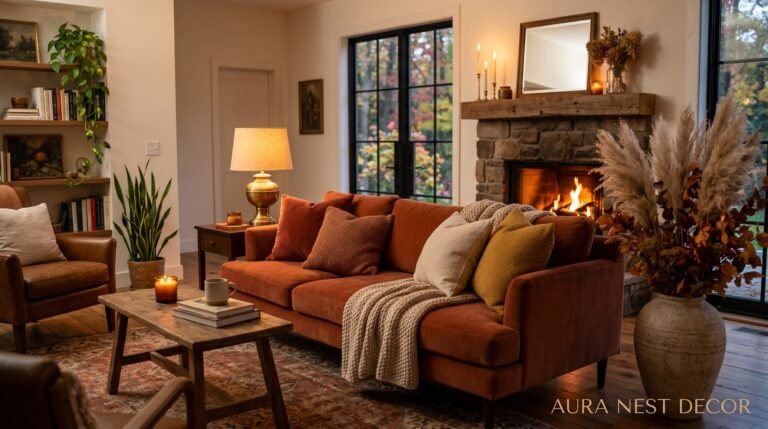
But honestly, my favorite combos aren’t even white-adjacent. Warm terracotta next to a dark slate sofa is stunning. Like, genuinely one of the best combinations in a living room right now. The warmth of the terracotta stops the slate from reading cold. And then if you pull in some natural wood — a low walnut coffee table, a raw oak shelf — the whole thing starts to feel intentional without trying too hard.
Soft sage green walls with a near-black sofa? Don’t sleep on this. It’s all over British design accounts right now and for good reason. It has this slightly old-world quality that feels expensive but not stuffy.
Dusty pink with a deep plum sofa. I know. Sounds wrong. It’s not. The pink stays soft and the plum stays rich and together they do something neither one could do alone.
—
3. The Rule About Lighting That Nobody Actually Follows (But Should)
Dark sofa. Low light. That’s where people go wrong.
Not because it looks bad necessarily — but because it limits the room to one mood. And living rooms need to be multiple things across a single day.
Layered lighting is the answer and I know everyone says that but let me be specific because “layered lighting” means nothing without examples. You need something overhead but DIMMABLE — not a harsh fixed overhead, never that. You need a floor lamp, ideally with a warm-toned shade that throws light downward and sideways at once. And you need at least one small table lamp or even a couple of candle clusters somewhere lower, near the skirting board level or on a low side table.
That amber glow of an Edison bulb at 7pm next to a charcoal sofa is one of those combinations that makes people walk into a room and immediately go quiet and relaxed. It’s almost chemical. The dark sofa absorbs the overhead harshness and the warm lamp light just pools around it.
In UK homes specifically — where natural light is genuinely limited from October through March — this matters even more. A dark sofa in a poorly lit British living room feels oppressive. That same sofa with thoughtful warm lighting feels like a cocoon. Two completely different rooms. Same sofa.
—
4. What Rugs Actually Do Underneath a Dark Sofa (And Why Matching Is a Trap)
Don’t match your rug to your sofa. I can’t stress this enough. A charcoal sofa on a dark grey rug is how rooms disappear. The floor and the seating merge into one indistinct mass and nothing reads.
Contrast is your friend here. Not loud contrast — considered contrast.
A natural jute rug under a dark sofa is almost always a good call. The texture does a lot of work. It adds warmth, grounds the space, and creates a visual break between the sofa and the floor without screaming for attention. Plus jute wears beautifully and it’s not precious, which matters if you have kids or dogs or both.
Cream and rust Moroccan-style rugs work beautifully too. The pattern adds interest without competing with the sofa. The lighter tones lift the floor plane so the sofa floats above it rather than sinking into it.
“Don’t let your rug and sofa merge into one indistinct mass. Contrast saves rooms.”
If you’re working with a forest green or deep teal sofa, a dusty pink or blush rug sounds counterintuitive but it pulls both colors to life. Something about the complementary undertones just clicks.
What I’d avoid: dark patterned rugs under dark sofas. Also navy rugs under navy sofas. And anything too shaggy under a sleek, low-profile couch — it throws the proportions off and the room starts to feel messy even when it isn’t.
—
5. The Exact Throw Pillow Formula That Works for Every Dark Sofa
Not a formula exactly. More like — a loose structure that gives you a starting point without locking you into something rigid.
One solid, in a lighter neutral. Cream, warm white, soft sand. Something that creates contrast. This is your anchor.
One textured piece. Boucle, velvet, knitted — doesn’t matter much, but the texture is doing real work. It keeps the eye moving.
One that’s patterned or has some personality. A geometric, a block print, a faded floral. This is where you can take a risk because it’s a pillow, not a wallpaper commitment.
And then stop. Three to five pillows depending on sofa size. Not seven. Not nine. Nine pillows is a furniture showroom, not a home.
The mistake I see constantly is people buying a whole set — four pillows from the same collection in coordinating prints. It’s coordinated but it’s not interesting. A set of four matching pillows on a dark sofa reads as furniture store display. Pull from different places. Let there be mild imperfection. That’s what makes it look styled rather than assembled.
—
6. Dark Sofas in Small Rooms — The Argument Nobody’s Making Loudly Enough
The conventional wisdom says light colors make rooms feel bigger. And yes, fine, that’s broadly true for walls and ceilings. But a dark sofa in a small room isn’t automatically a problem. In fact, sometimes it’s a solution.
Here’s what actually makes a small room feel cramped: too many different things competing for attention. Colors fighting each other. Patterns on patterns. Furniture at different heights going in different directions.
A dark sofa simplifies. It reads as one solid visual anchor. The rest of the room can be lighter and quieter around it, and suddenly there’s clarity. The room doesn’t feel small so much as focused.
In a British terrace living room — typically long and narrow with maybe one window at the front — a dark sofa against the longest wall with pale walls and good lighting can feel incredibly considered. Like the room knows what it’s doing.
The legs matter here, by the way. A sofa with visible legs in a small space always reads better than one that goes floor-to-ground. Legs mean visible floor, visible floor means the room breathes. Don’t skip this.
—
7. The Specific Types of Dark Sofas That Age Gracefully (and the Ones That Don’t)
Not all dark sofas are equal. And the material is going to matter more than anything else long-term.
Velvet is gorgeous and it photographs beautifully but velvet requires attention. It crushes. It marks. If you’ve got cats, I genuinely cannot recommend it without a very clear disclaimer. It will tell every story your life has. Some people love that. Others absolutely don’t.
Dark leather — proper full-grain leather, not bonded — ages spectacularly. Gets better. Develops character. That’s a real thing, not marketing. But it’s cold in winter and it sticks in summer and you will hear it every time you shift position. Some people find that annoying, others don’t notice after a week.
Linen or linen-blend in a dark slate or navy is underrated and works brilliantly in both American and British homes. It’s relaxed without being sloppy. It washes reasonably well. And it doesn’t have that I’m-trying-to-be-impressive energy that velvet can sometimes carry.
“The material doesn’t just set the tone — it writes the maintenance contract you’ll live with for years.”
Microfiber in dark colors is practical and I get why people buy it, but it reads cheap in person. The sheen goes wrong. The color looks flat. If budget is a constraint, a dark linen-look fabric will always photograph and feel better than microfiber in the same shade.
—
8. Styling the Wall Behind a Dark Sofa — What Actually Works
The wall behind the sofa is doing a job whether you think about it or not. Leave it blank and the sofa floats in nothing. Get it wrong and the whole scheme tips into too-heavy.
Gallery walls work if — and only if — the frames are lighter than the sofa. Dark frames behind a dark sofa is a lot. If you’ve got a charcoal sofa, try natural wood frames or brushed brass. Even matte white frames. Let there be contrast on that wall.
One large piece of art tends to look more deliberate than a gallery wall, especially in smaller British living rooms where you genuinely might not have the wall real estate for five to seven frames. A large landscape print — something with sky, something with open space — can make a dark sofa feel less heavy because the imagery does the work of opening the room up.
Mirrors. Underused behind sofas because people worry about placement but a large arched mirror above a dark sofa is genuinely one of the easiest ways to lift the room. The reflection doubles the light. The arch softens the sofa’s horizontal weight. It’s almost foolproof.
Plants. A tall fiddle leaf or a snake plant in a terracotta pot beside the sofa — not behind it, beside it — brings life in a way that no decor object can fully replicate.
—
9. The Living Room That Made Me Change My Mind About Forest Green Sofas
I was skeptical. Specifically forest green — I always thought it would feel like a pub, in the most British-cliché-of-a-pub way. And not the good kind of pub. The kind with sticky floors and bad lighting.
But I saw one styled in a terraced house in South London and it changed my entire perspective. The walls were this warm off-white — not cold, almost a very faded yellow — and the forest green sofa sat against them with these chunky natural wood bookshelves on either side. There was a vintage kilim rug on the floor in golds and reds and browns. One oversized pendant light with a rattan shade.
It didn’t look like a pub. It looked like the home of someone who’d traveled a lot and read actual books and had strong opinions about coffee. Which is to say, it looked like somewhere. Forest green did that. A beige sofa in that room would’ve been completely inert.
The lesson I keep taking from rooms like that is that dark sofas reward commitment. You can’t be half-in. Once you go forest green you need to let the rest of the room rise to meet it.
—
10. The One Styling Mistake That Makes a Dark Sofa Room Look Depressing
Too much dark. Obvious, maybe, but people still do it.
Dark sofa, dark coffee table, dark shelving, dark curtains, one dark accent wall. I’ve seen this. It doesn’t read as moody or sophisticated. It reads as unlit. Like the room’s given up on itself.
The dark sofa is doing its job as the anchor. Everything else needs to do the opposite job. Light up. Warm up. Add texture that catches light rather than absorbs it.
Brass and gold accents are particularly good at this. A brass floor lamp, a couple of gold picture frames, a brass bowl on the coffee table. These warm up a dark sofa scheme without making it feel like you’re overcorrecting. The warm metal tones work with deep navy, charcoal, slate, forest green — almost universally.
White or cream curtains instead of dark ones. Natural fiber cushions and throws. A lighter wood floor or a lighter rug. These aren’t compromises. They’re what make the dark sofa POP rather than sit there looking sorry for itself.
—
11. What British Interiors Do With Dark Sofas That American Rooms Often Don’t
This is a generalization, I know. But there’s a pattern.
British rooms — especially Victorian and Edwardian era homes — tend to lean into the architecture. Cornicing, ceiling roses, original fireplaces. A dark sofa in a room with beautiful period detail feels natural. The furniture doesn’t have to do all the work. The room already has character.
American open-plan living often asks the sofa to anchor a much bigger, more undefined space. And that changes the calculation completely. A dark sofa in a large open-plan room can feel lost if there’s not enough layering around it — area rug defining the zone, clear lighting separation, enough texture in the surrounding space to hold the eye.
The fix is zoning. You’re not decorating a room so much as creating a pocket within a room. The dark sofa is the heart of that pocket. The rug is its floor. The lighting is its ceiling. And then the rest of the space can do whatever it needs to do.
—
12. Where to Find a Dark Sofa Worth Actually Buying (Without Going Broke)
So here’s where I’ll be genuinely useful rather than vague.
For UK buyers, MADE and Loaf consistently have interesting dark sofa options in the mid-range. Loaf especially tends toward the relaxed, lived-in shapes that work beautifully in charcoal and deep navy. John Lewis is reliable quality, less exciting shapes, almost always a safe bet. For something with more character, vintage hunting on Vinted, eBay, or a Saturday at a local salvage yard — an older Chesterfield in dark leather is almost always better quality than anything new at the same price point.
For US buyers, Article is doing a lot right in the dark velvet and dark linen space at prices that don’t require a second mortgage. Castlery ships to the US and has interesting shapes. West Elm’s quality has been inconsistent but their sale sections occasionally have legitimately good finds in slate and charcoal.
The piece of advice I’ll give that nobody ever says: measure your doorway BEFORE you fall in love with a sofa. Dark velvet sectionals are heavy. And wide. And not every front door — especially in older British homes and narrower American city apartments — will accommodate them assembled. Ask about modular options. Save yourself that particular nightmare.
—
❓ FAQ
Q: Will a dark sofa make my living room feel smaller? A: Not necessarily — the bigger issue is usually low light and matching your rug to the sofa. A dark sofa with warm layered lighting, a lighter rug, and pale walls can actually feel incredibly cozy rather than cramped. What makes rooms feel small is too much visual clutter competing for attention, not the darkness of one piece of furniture.
Q: What’s the easiest color to decorate around a dark grey sofa? A: Warm whites and natural textures are your lowest-effort route. Cream boucle cushions, a jute rug, warm wood side tables, and brass lamp accents will make a charcoal sofa sing without requiring you to rethink the whole room. Terracotta is a more adventurous option that pays off fast.
Q: How do I keep a dark fabric sofa looking good over time? A: Velvet needs occasional brushing and rotating of cushions to prevent permanent crushing. Linen and linen-blend fabrics hold up well with light vacuuming and spot cleaning. Keep all dark fabric sofas out of direct sunlight if you can — prolonged sun exposure fades dark colors faster than any other factor, and you’ll see it within a year or two in a south-facing room.
—
💭 Final Thoughts
A dark sofa is a commitment, yes. But it’s the kind of commitment that ages well — like a good leather jacket or a cast-iron pan that’s been used properly. The rooms that feel genuinely special, the ones you walk into and immediately want to stay, almost always have one thing that’s doing something brave. Maybe that’s yours.
What’s holding you back from making the jump?