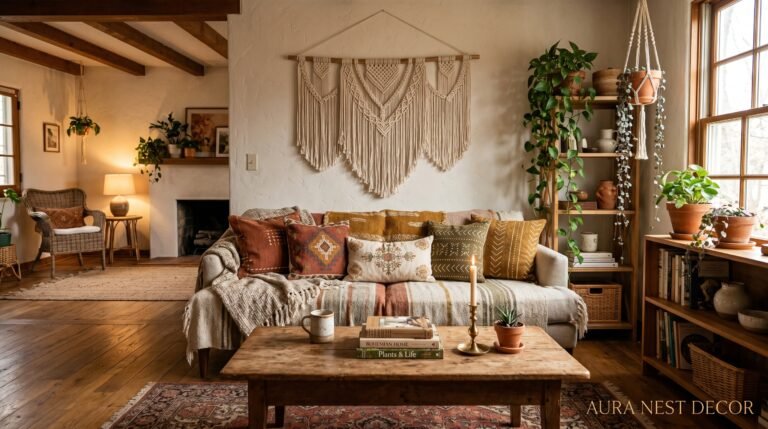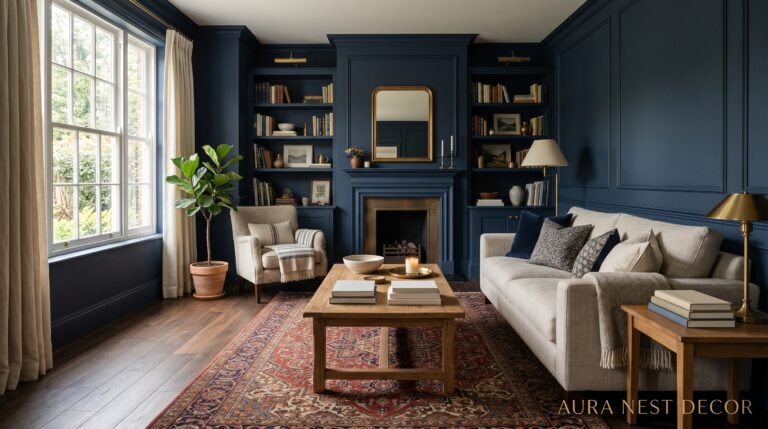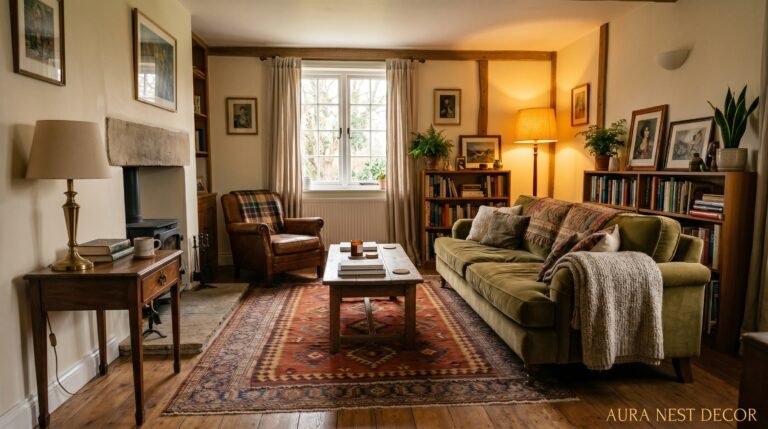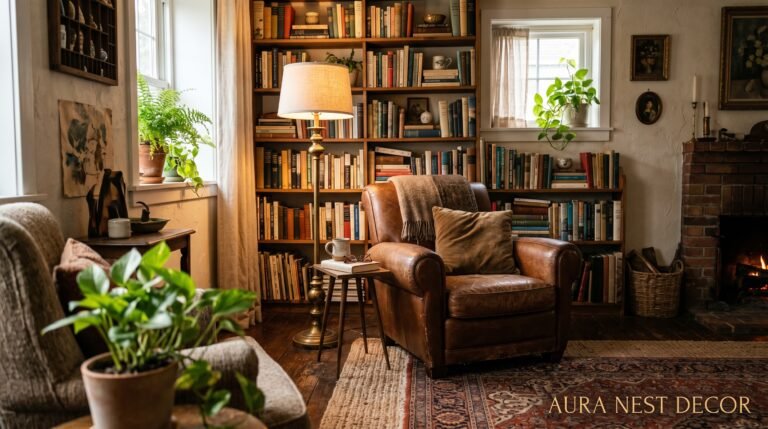
The Living Room That Feels Like a Deep Breath: Modern Rustic Farmhouse Decor Ideas That Actually Work
You know that feeling when you walk into someone’s home and just… exhale? The tension in your shoulders drops. You want to sit down, stay a while, never leave. That’s what modern rustic farmhouse done right actually feels like — and it’s not about buying a specific sofa or painting a shiplap wall. It’s about understanding why certain combinations of materials, textures, and light make a room feel like it has a heartbeat.
—
1. Why “Modern Rustic” Isn’t a Contradiction — It’s the Sweet Spot Most Rooms Are Missing
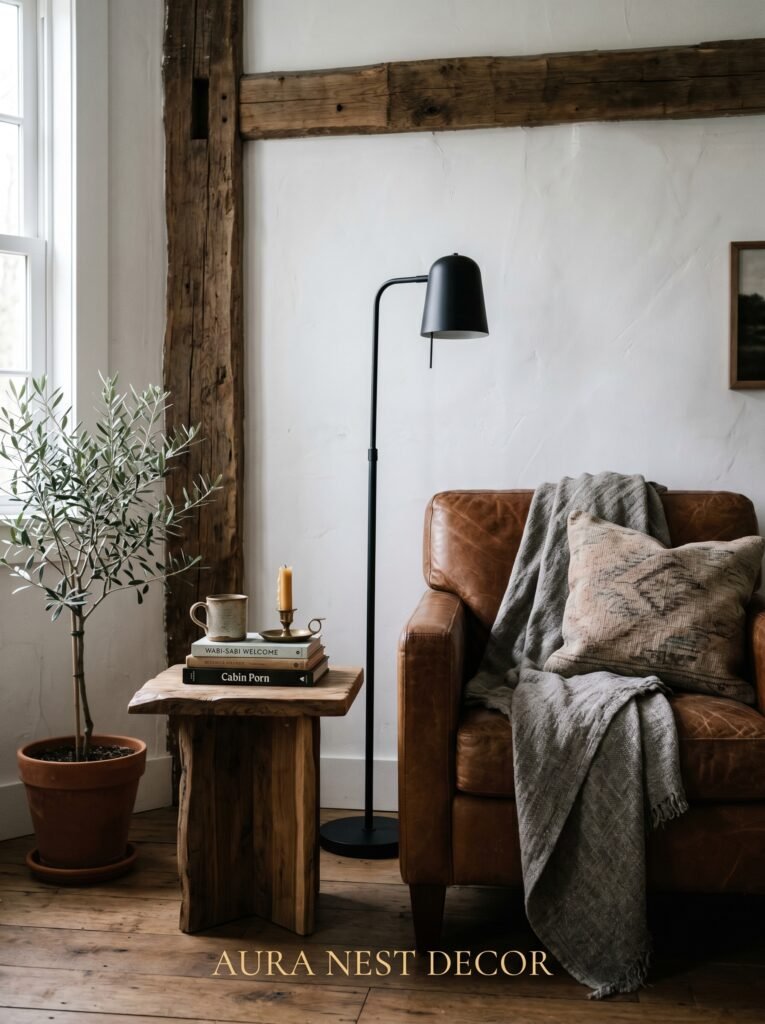
People get confused by this. Modern rustic farmhouse sounds like three different styles crammed into one, and when it goes wrong, it looks like exactly that. But when it works, it works because of tension — the productive kind.
Think about it this way: a raw oak beam over a clean-lined sofa. A chunky linen throw on a sleek, low coffee table. A worn leather chair beside a plaster-white wall with zero clutter on it. None of those combinations make logical sense on paper. But in a room, they create something that feels both alive and calming. The rawness of natural materials softens what might otherwise feel cold and minimal. The clean lines stop the natural elements from tipping into cluttered or chaotic.
The farmhouse part is the warmth. The modern part is the editing. And the rustic part is the honest acknowledgment that things should look like they were made by hands, not a factory floor algorithm.
That edit is what most people miss. They load a room with wooden crates, dried botanicals, and distressed furniture and wonder why it looks like a craft fair rather than a home. The answer is almost always that nothing is breathing. Modern rustic needs space to exist. It needs moments of stillness — a bare corner, a clean shelf, a wall with nothing on it — to let the textured, imperfect, beautiful pieces actually register.
“Modern rustic isn’t a mood board. It’s a conversation between old things and new ones, and someone has to be in charge of who speaks.”
—
2. The Specific Paint Colors That Are Showing Up in Every Beautiful Modern Farmhouse Living Room Right Now
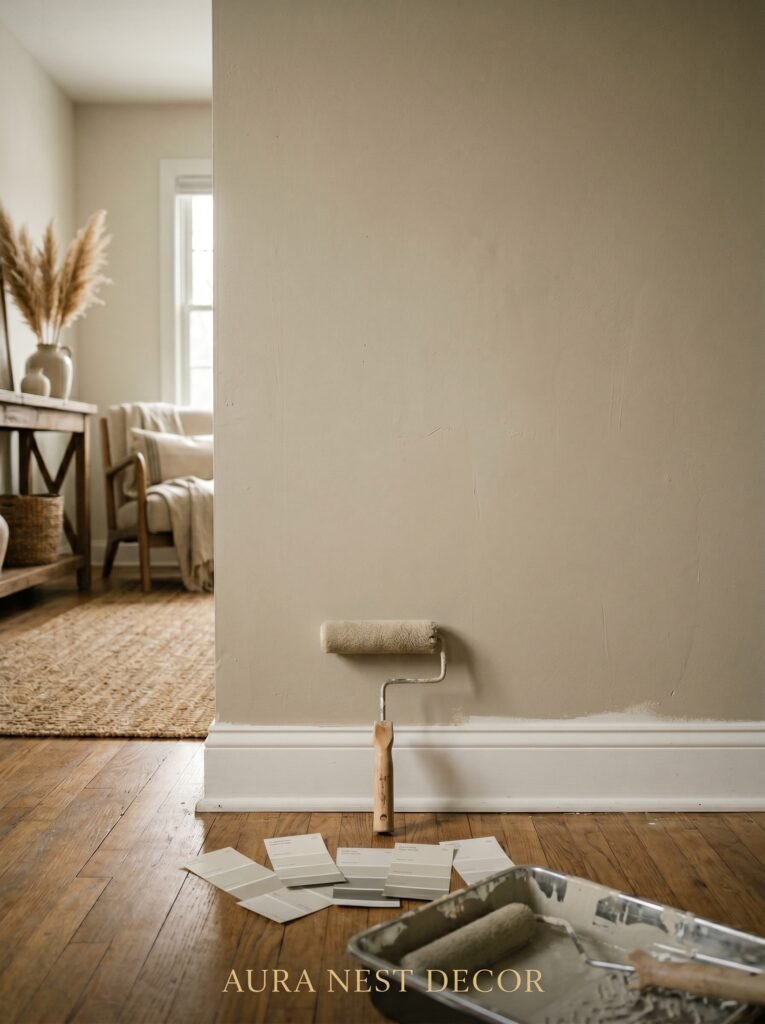
Not greige. Not anymore.
The rooms that are genuinely stopping people mid-scroll right now are painted in colors that are a little harder to name. Warm whites with a barely-there yellow undertone, like old cream linen left in the sun. Deep sage greens that are almost gray. Soft putty tones that sit somewhere between taupe and mushroom and somehow read as both neutral and interesting.
In the US, Benjamin Moore’s White Dove and Swiss Coffee are perennial favorites for a reason — they’re warm without being yellow, clean without being stark. In the UK, Farrow & Ball’s Elephant’s Breath and Skimming Stone do something similar, that slightly chalky, dusty quality that makes a room feel like it’s been lived in gently for years.
What all these colors share is an undertone of warmth that works with wood, linen, stone, and leather. They don’t compete with natural materials. They let them show off.
One thing worth knowing: modern rustic rooms almost never use cool whites or blues. The moment you introduce a cool tone, that sense of coming home, of the room wrapping around you, starts to dissolve. Keep everything warm and let the variations in wood grain and textile texture provide the visual interest.
—
3. The Furniture Rule That Stops a Farmhouse Room From Looking Like a Stage Set
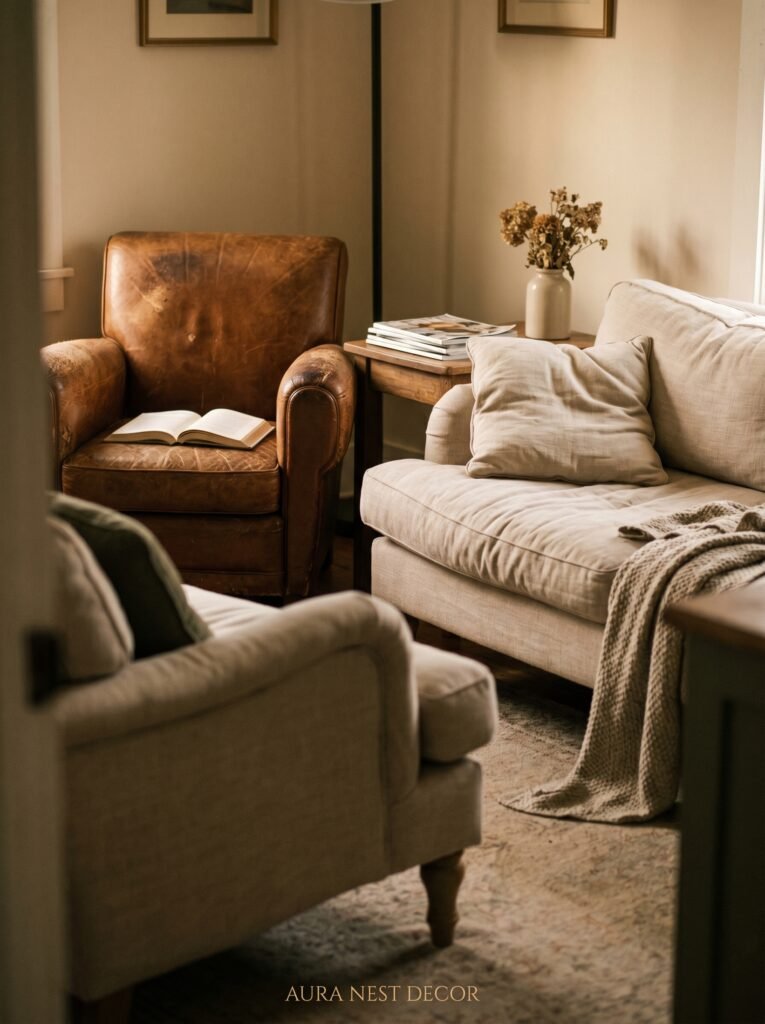
Two things will make a modern rustic living room feel fake: matching furniture sets and furniture that’s too new.
Not everything has to be antique. But everything should look like it has a story, or at least like it could have one. A sofa with slightly rumpled slipcover linen tells a different story than a sofa that still has showroom angles. A coffee table with rings on it, or a lamp base that’s clearly been repurposed from something else — these things signal that real people live here.
In practical terms, this means mixing your sources. Buy the big, comfortable sofa new if you need to. But find the armchair at a market, an estate sale, an antique shop in a small town you stopped in on a road trip. Americans have the incredible resource of estate sales and antique malls; British homeowners have car boot sales, charity shops with occasional gold in them, and places like Kempton Park Antiques Market that will reward patience with something genuinely original.
The rule is simple: in any room, at least one-third of your furniture and objects should have a provenance you can’t fully explain. Something you found, something someone gave you, something that was already here when you moved in. That’s what stops a room looking like it was styled for a photoshoot and never touched again.
—
4. What to Actually Put on Your Walls (and What to Leave Off)
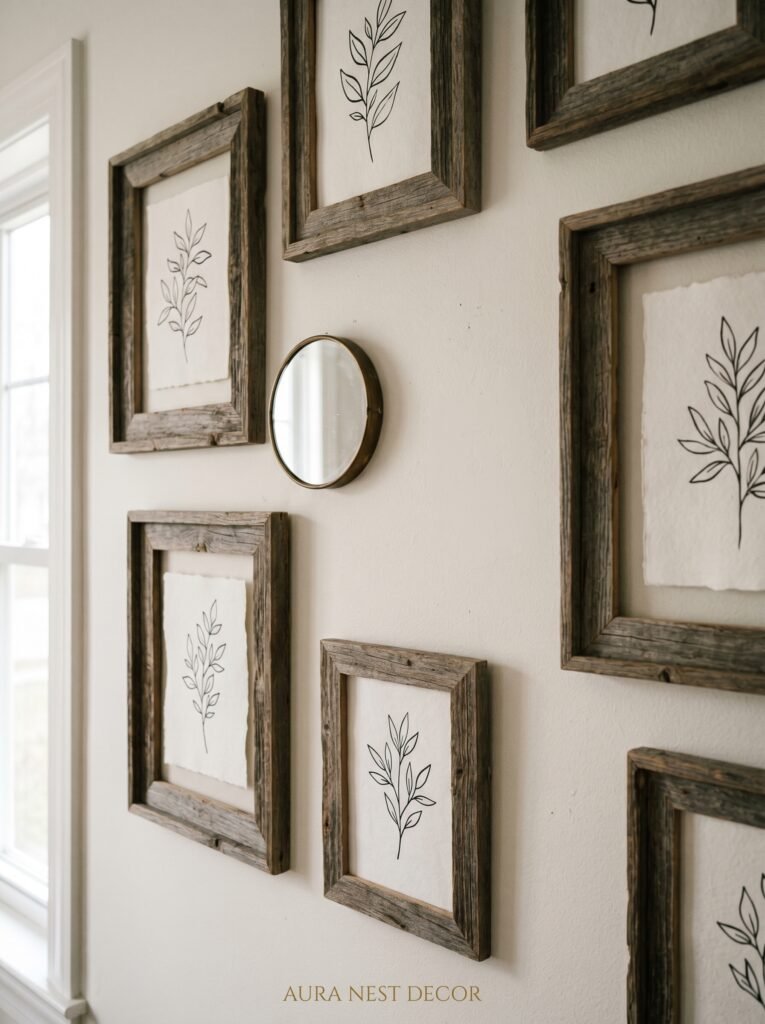
Farmhouse gallery walls are everywhere on Pinterest. Most of them are too busy.
The rooms that feel most genuinely modern rustic tend to have walls that breathe. One large piece rather than seven small ones. An oversized mirror that bounces light around. A single shelf with three things on it instead of twelve.
When art appears, it leans toward: botanical prints, black and white photography, abstract pieces in earthy tones, or something that looks genuinely handmade — a rough-edged canvas, a print that was clearly once a painting. Frames in black, natural wood, or aged gold. Not matching. Never perfectly matching.
One of the most effective and underused wall approaches in a modern rustic room is simply texture. A section of exposed brick if you have it. Limewash paint applied over a single wall to create that ancient, slightly uneven finish that photographs beautifully and costs less than you’d think. Wooden panelling — not necessarily shiplap, which has become so expected it’s almost become a cliché — but simple vertical planks painted the same color as the wall, adding subtle shadow and depth without screaming farmhouse.
“A wall with nothing on it is a design choice, not an oversight.”
—
5. The Specific Textiles That Do the Most Emotional Work in a Room
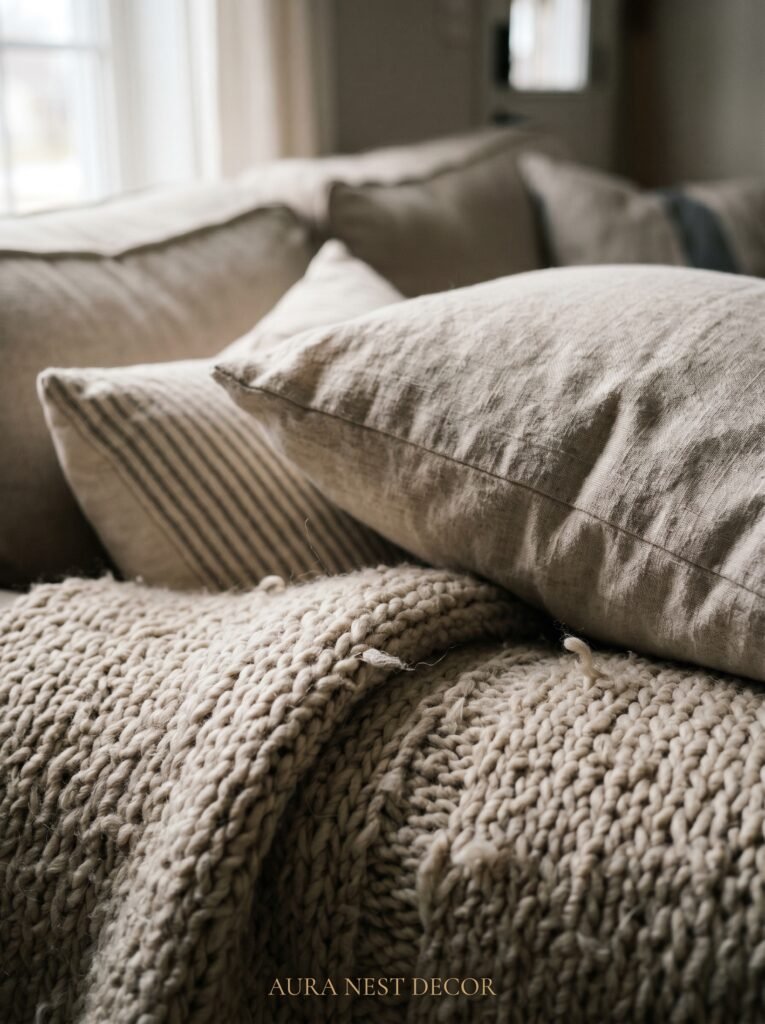
This is where farmhouse rooms live or die. Truly.
Texture is the thing that makes a room feel the way it feels. Before your eye consciously registers what it’s seeing, your nervous system has already responded to the visual information of texture. Rough, nubby, woven, chunky — these things register as safe, warm, human. Smooth, shiny, hard-edged — those register as sharp, alert, formal.
So for a modern rustic living room, the textile brief is essentially: layer warm textures until the room feels like something you could curl up inside.
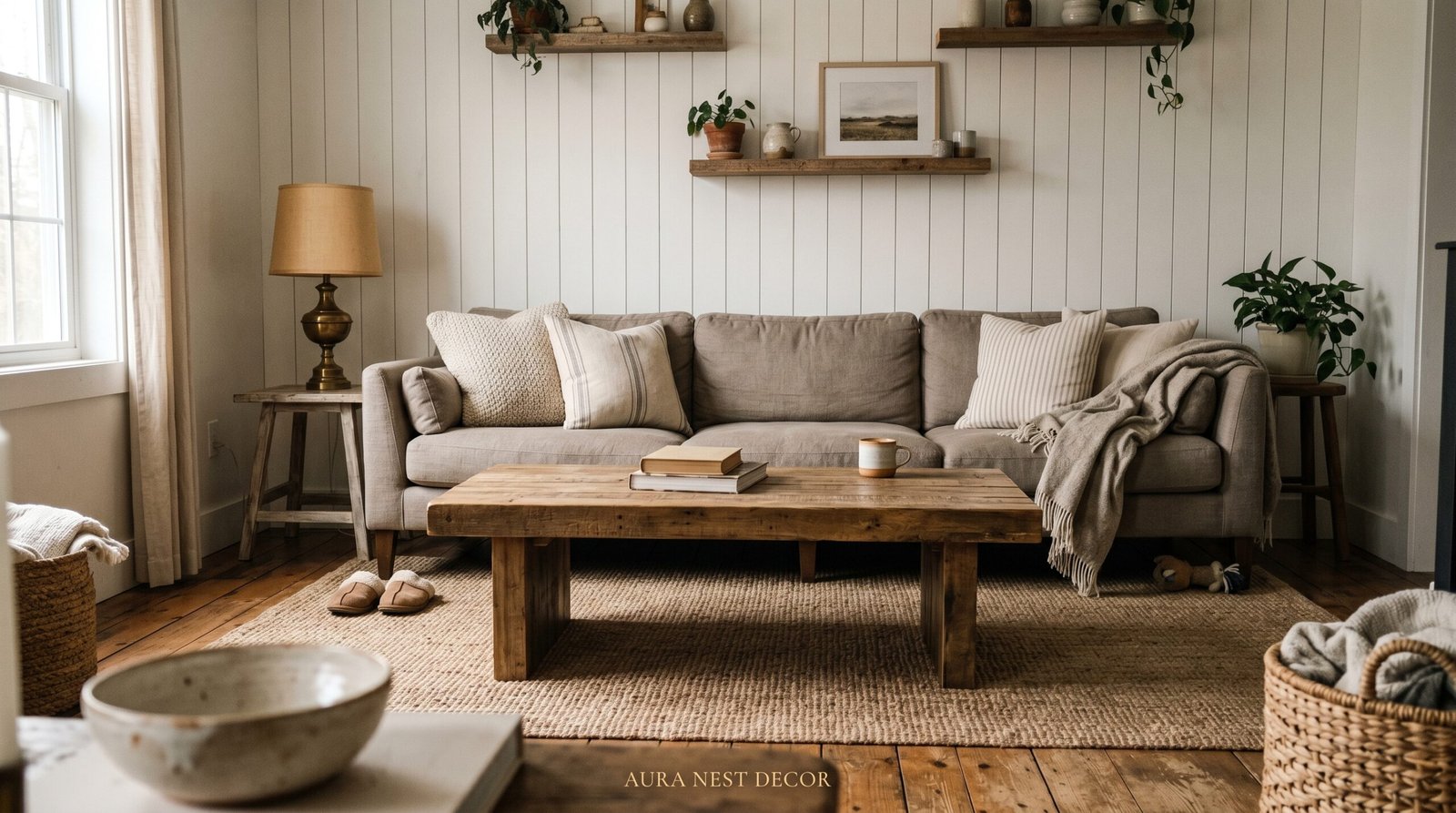
Linen is the backbone. Washed, slightly rumpled, natural-toned linen on cushions and throws does more for a room than almost anything else. Cotton slipcovers with that lived-in, slightly imperfect quality. Chunky knit blankets thrown over an armchair as if someone just stood up and left. Jute or sisal rugs underfoot, grounding everything and adding that roughness that makes the soft things above feel even softer by contrast.
Sheepskin. An actual sheepskin or a convincing faux one, draped over a chair or bench. The contrast of it against wood or metal is exactly the kind of tension that makes modern rustic sing.
Wool cushions with an interesting weave, not a smooth finish. Velvet in the right shade — deep dusty green or warm cognac — used sparingly as an accent that catches light differently than everything else.
—
6. The Lighting Approach That Makes Everything Else Work Harder
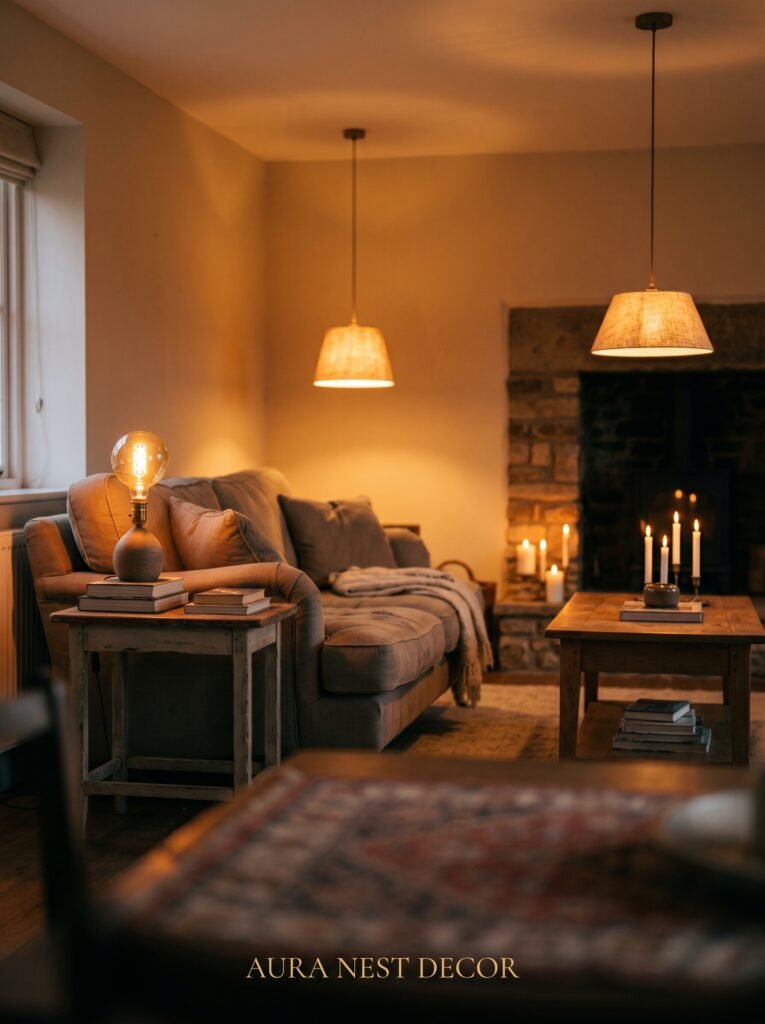
The amber glow of an Edison bulb at 7pm is not a cliché. It’s a physics lesson.
Warm-toned light, in the 2700K range or lower, makes wood look richer, makes linen look creamier, makes the whole color palette of a modern rustic room deepen and settle. Cool overhead lighting does the opposite — it flattens everything, makes the wood look gray, and turns your carefully chosen warm white paint into something clinical.
In a modern rustic living room, overhead lighting should be ambient and warm, never the main event. The main event is layers. A floor lamp in the corner that creates a pool of golden light. Table lamps on either side of a sofa that make the room feel centered and human-scale. A few candles — actual ones, not battery-powered — because the movement of a real flame does something no lightbulb can replicate.
Lampshades matter more than people realize. Linen lampshades filter light differently than white paper or fabric ones, giving it a slightly golden, diffused quality that suits this aesthetic perfectly. Natural rattan or woven pendant lights are everywhere right now and for good reason — they cast the most extraordinary dappled shadow patterns on ceilings and walls when the light is on, essentially becoming art.
Avoid: chrome fittings, anything too industrial with blue-white LED bulbs, overhead recessed lighting as your only source. The farmhouse room wants shadows in the corners. It wants to feel like it’s tucked in for the evening.
—
7. How to Bring Nature In Without Turning Your Living Room Into a Garden Centre
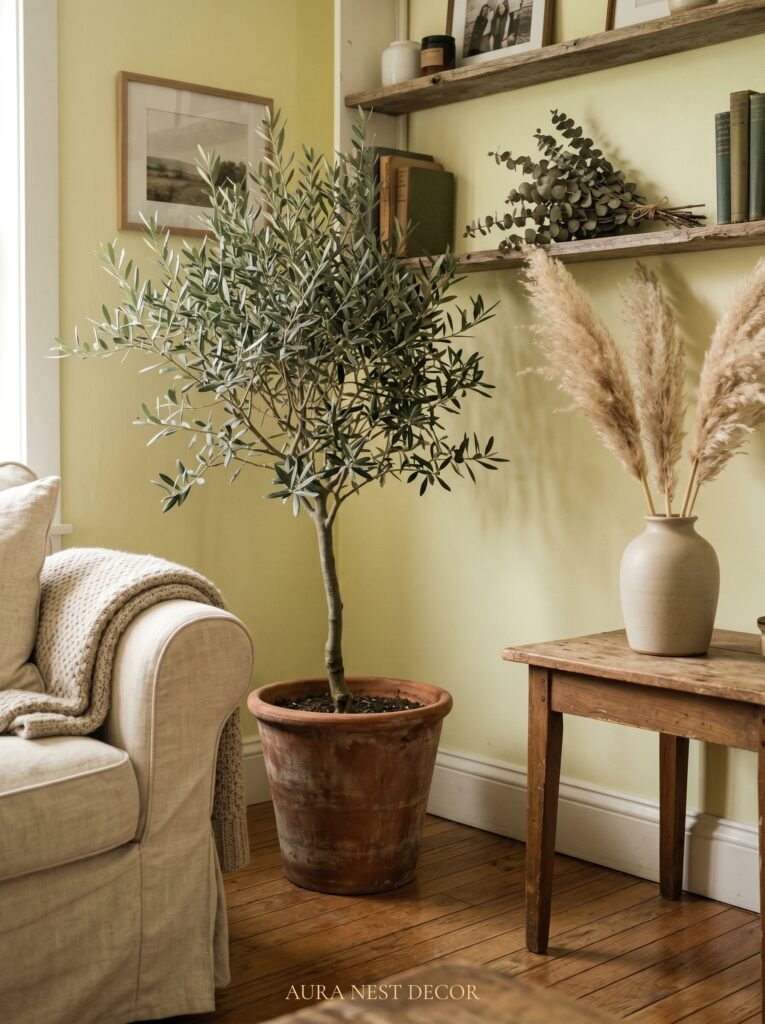
There’s a version of this aesthetic where every surface has a plant on it and dried pampas grass erupts from three different corners and there are twigs in a vase. That’s not what we’re doing.
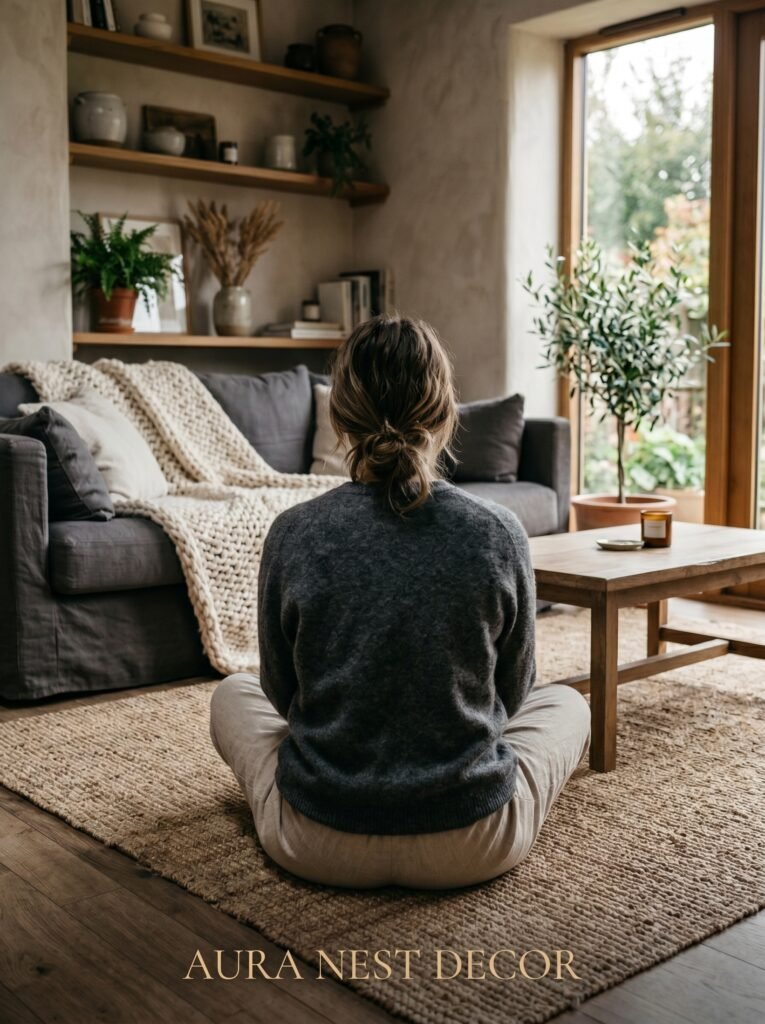
Nature in a modern rustic living room should feel considered. One large statement plant — a fiddle leaf fig, an olive tree, a large monstera — positioned where it gets light and where it can actually breathe. Something living and slightly imperfect, not a perfect topiary ball.
Dried botanicals, used sparingly. A single bunch of dried wheat or lavender in a simple stoneware jug. A wreath on the wall made from something genuinely foraged-looking. The key is that it should look like something you picked up on a walk, not something you ordered in a kit.
Wood as nature’s proxy. A knotty, live-edge coffee table brings in more of the natural world than ten plants would. A wooden bowl on a shelf, dark with age and use. A slice of something — a cross-section of a log used as a small side table — that still shows its rings and bark.
“The most beautiful modern rustic rooms don’t bring nature in. They make the room feel like nature never fully left.”
—
8. The Coffee Table Situation: Why This One Piece Makes or Breaks the Whole Room
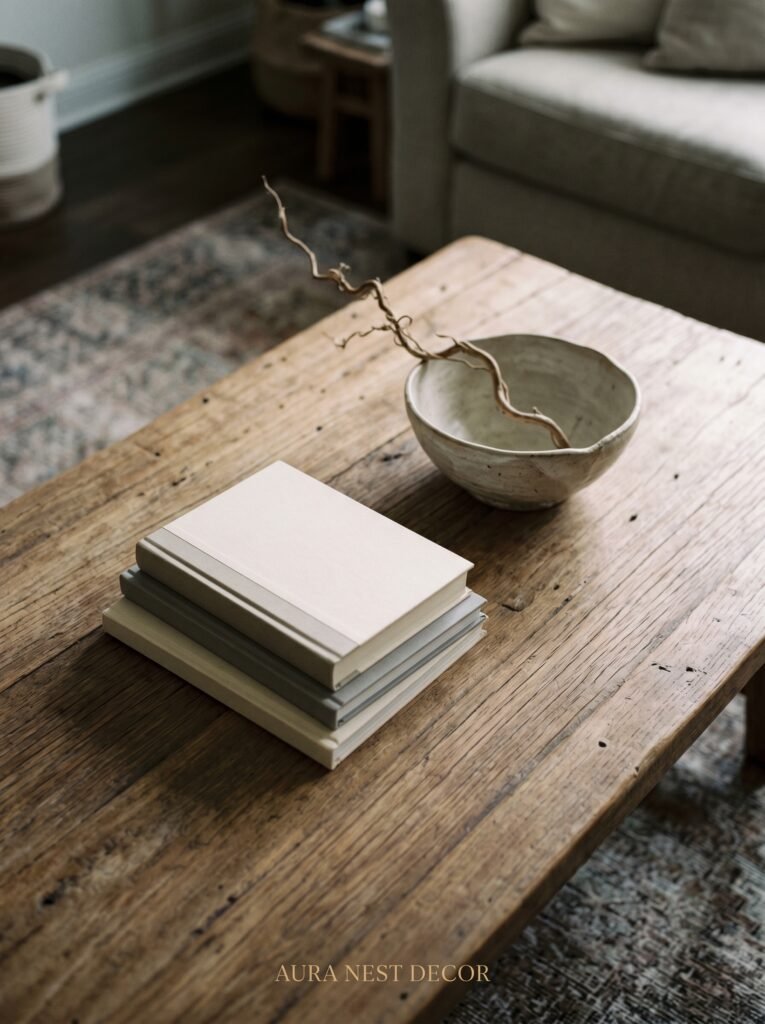
The coffee table is the room’s focal point. Not the fireplace (though a fireplace obviously changes everything), not the sofa, not the rug. The coffee table is what the eye returns to, what you gather around, what defines the center of the space.
In a modern rustic room, the coffee table wants to be substantial. A solid, slightly imperfect piece — a thick slab of reclaimed wood on simple metal hairpin legs (a classic combination that earns its ubiquity), or a single massive piece of timber left raw, or a vintage chest that does double duty as storage. Low and generous. Something that looks like it weighs something.
What goes on it matters as much as what it is. A stack of a few books — actual ones you’ve read, not bought for color coordination. A candle in an interesting vessel. One small object that means something to you. Maybe a small bowl of something — a few smooth stones, some walnuts still in their shells in autumn, dried rosebuds.
The arrangement should look like someone lives here and sets things down. Not like it was styled this morning and hasn’t been touched since. One slightly off-center thing. One item that’s clearly functional, not decorative.
—
9. The Small Details That Signal “This Person Has Taste” Without Announcing It
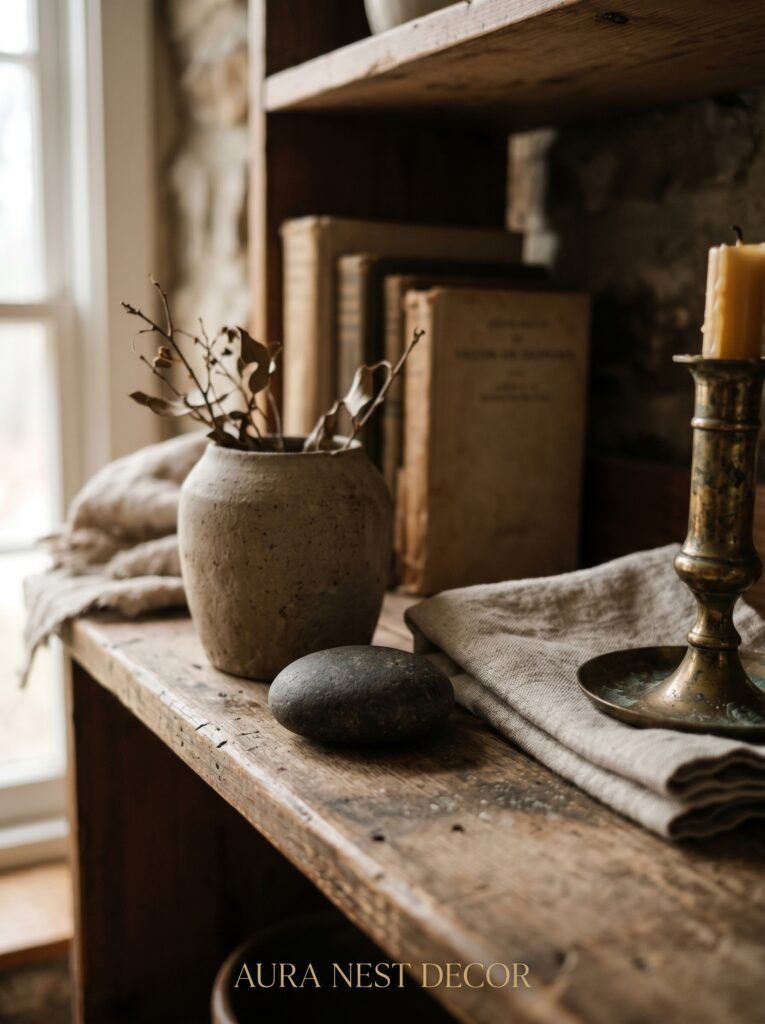
The difference between a room that looks designed and a room that looks like a mood board is the small decisions. The ones no one would necessarily notice consciously, but that everyone registers in aggregate.
Door handles in unlacquered brass that will age slightly over time. Light switch covers that match the wall rather than standing out in white against color. A doorstop that’s a smooth river stone rather than a plastic wedge. A tray on a coffee table or ottoman — it’s a small organizing trick, but it also signals intention, a little island of arrangement within the larger room.
Books genuinely read, not arranged by color. Candles burned down at least slightly, with some wax drip character. A houseplant that has one slightly yellow leaf because it’s actually growing in a real house with real light conditions, not a showroom.
These things don’t cost money. They cost attention. And attention, in a room, is everything.
—
10. How Fireplaces (Real and Not) Anchor the Whole Aesthetic
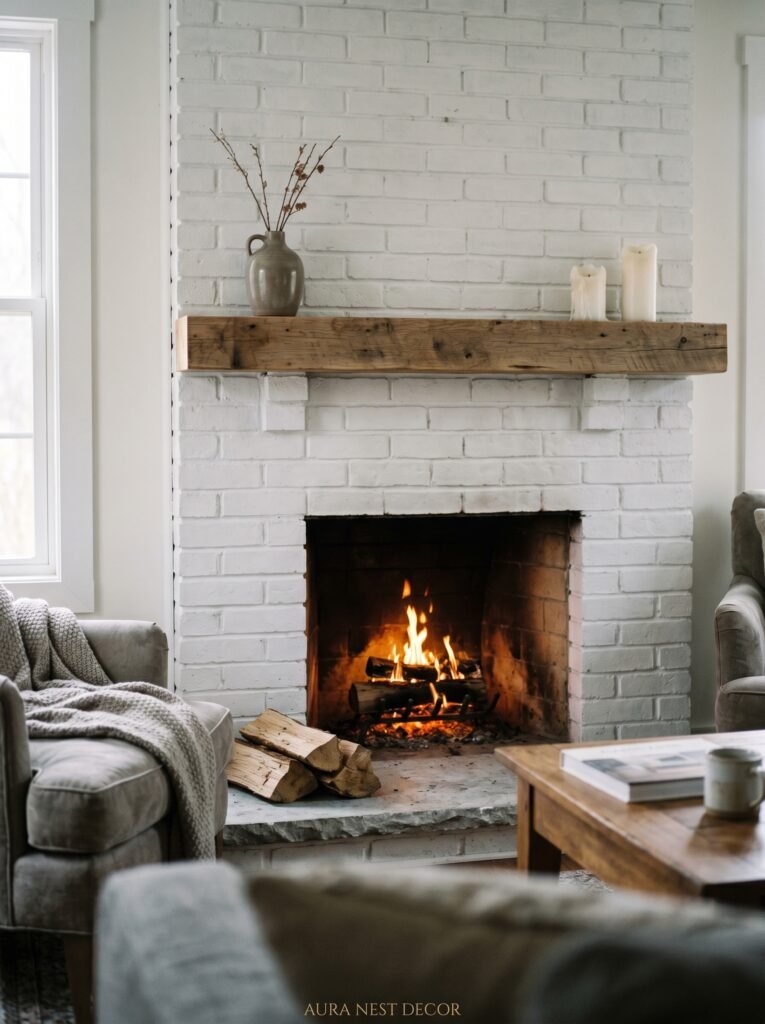
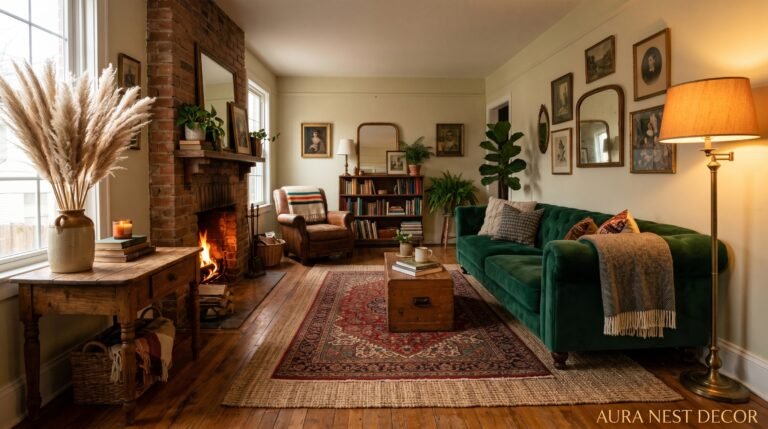
A working fireplace in a modern rustic farmhouse living room is essentially cheating. You have it, you win. There is no more powerful center for this kind of room than a real fire in a real hearth.
But even if you don’t have one — and many modern homes, particularly apartments and newer builds, don’t — you can create something that functions similarly as a room anchor.
A fireplace surround, even without a working fire, gives a wall a reason to exist as the focal point. In the UK, Victorian fireplaces are common in older homes and can be beautifully incorporated, tiled with simple handmade-looking ceramics or left bare with the original cast iron. In American homes, the farmhouse aesthetic gravitates toward simple wood mantels, painted white or the same color as the wall, with a plain opening that you can fill with stacked logs, candles, or botanicals.
The mantel above is as important as the fireplace itself. Keep it spare. One or two things at most: a mirror, a single painting, a clock that you actually use. Resist the urge to fill it.
An electric fireplace, positioned well and framed by the right surround, can absolutely hold the room if the flame quality is good. The newer models are genuinely convincing and the warmth they provide is a real practical benefit on both sides of the Atlantic.
—
11. The Storage Strategy That Keeps Farmhouse From Becoming Cluttered
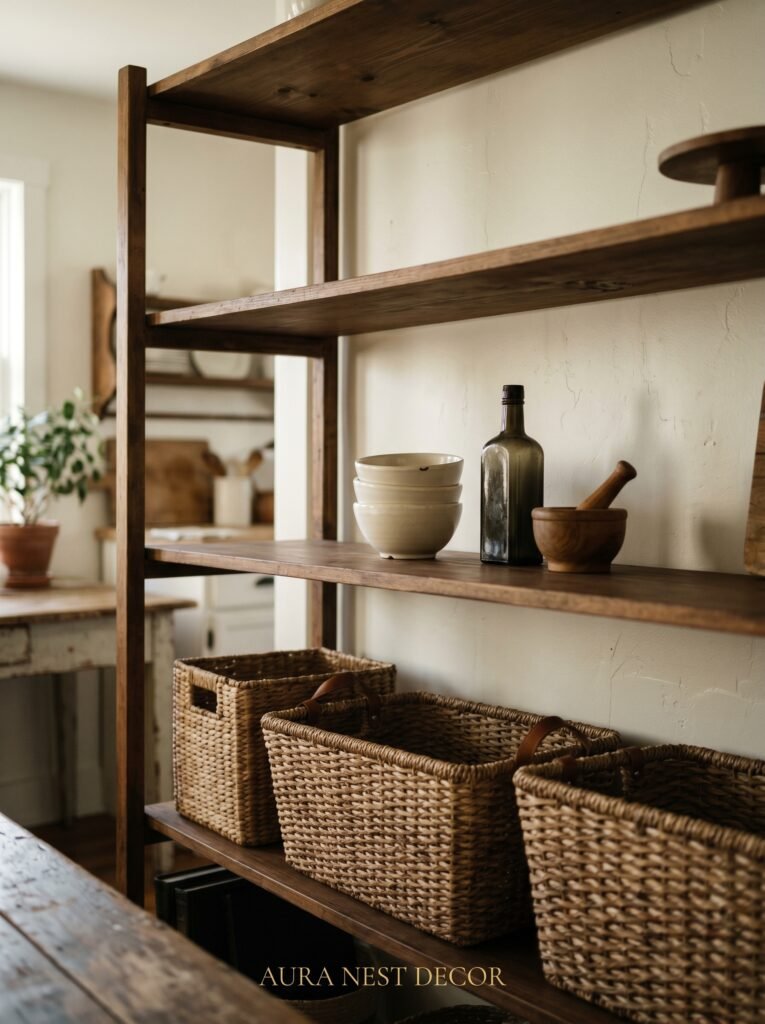
Modern rustic rooms love objects. That’s part of their warmth. But objects, without a system, become clutter. And clutter is the enemy of that deep, exhaling feeling we’re after.
The answer isn’t minimalism. It’s intentional containment. Baskets are the obvious one — and they earn their cliché status because they actually work. Deep, lidded baskets for blankets and throws that you want within reach but don’t want piled visibly. Open baskets for magazines and books you’re currently reading. Baskets under console tables, in corners, tucked under benches.
Closed storage in furniture. An ottoman with a lid. A sideboard with doors. A bench with a hollow inside for dog toys, sports equipment, the detritus of actual life. The principle is that the things you use daily should be close but contained, and the things on display should be deliberately chosen.
One shelf, styled properly with breathing room, does more than five shelves crammed with things. The modern part of modern rustic means editing aggressively. It means asking, every time you’re about to set something down: is this adding to the room, or just occupying it?
—
12. Why the Entrance to Your Living Room Matters More Than Any Piece in It
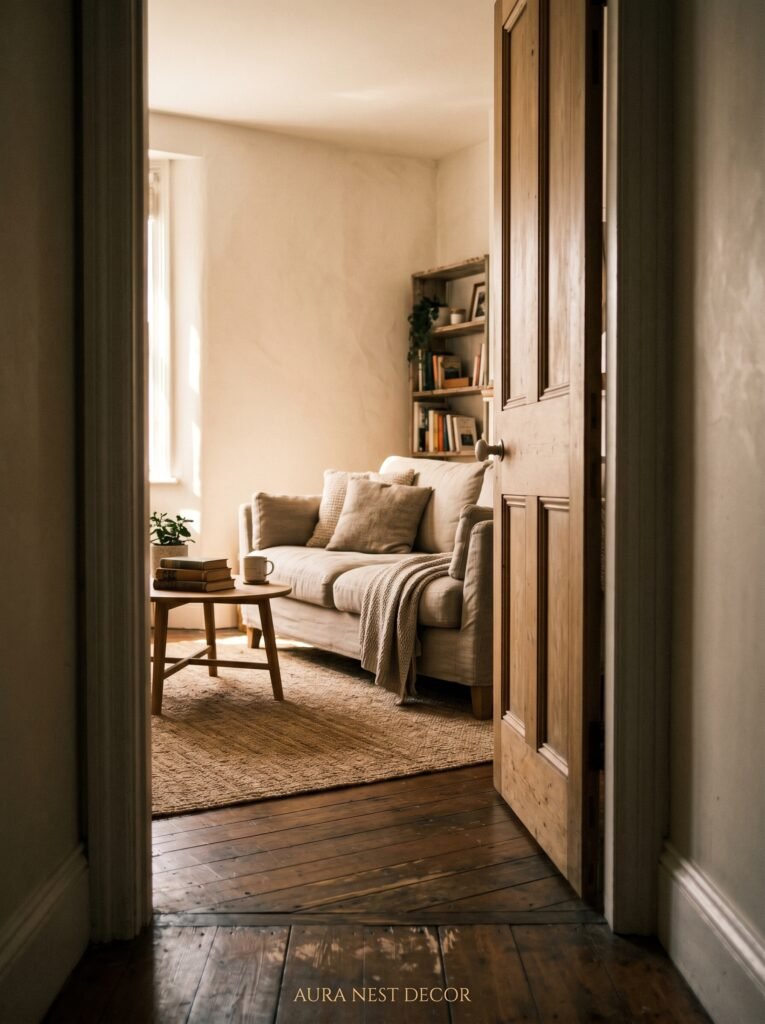
The transition into a room shapes how it’s experienced before a single detail is registered.
If someone walks from a cluttered hallway into your living room, they’re already carrying stress from that transition. If they walk in from a calm, considered entrance — a simple bench, a hook for coats, a small plant or mirror — they arrive in your living room already in the right headspace to appreciate what you’ve done in it.
In American homes, the living room often opens directly from a front door or a foyer. In British terrace houses and semis, you’re often moving from a hallway that can feel very compressed. In both cases, the answer is the same: keep the transition simple, warm, and uncluttered.
A narrow console table or hallway shelf between the entrance and the living room, with a lamp on it, creates a psychological threshold — a moment of gentle arrival. A rug that changes at the living room door tells feet, unconsciously, that this is a different kind of space now. A slightly lower light level in the living room compared to the hall makes the room feel like you’re stepping into something intimate.
The room earns its feeling before anyone sits down in it. That’s the real design insight that no mood board tells you.
—
❓ FAQ
Q: How do I make a modern rustic farmhouse living room work in a small space? A: Scale everything down but don’t compromise on texture. One large-ish piece of furniture in a small room reads better than several small ones fighting for attention. Keep the walls light, layer textiles for warmth, and let one wall be completely bare to give the eye somewhere to rest.
Q: Is shiplap still a thing in modern farmhouse decor, or does it look dated now? A: Shiplap has become so associated with a specific era of farmhouse design that it can look self-conscious if used as a feature wall in an otherwise modern room. Simple vertical plank paneling painted the same color as the wall, or limewash plaster, tends to feel fresher right now while achieving a similar depth and texture.
Q: How much does it cost to decorate a living room in this style on a budget? A: Honestly, modern rustic farmhouse is one of the most budget-friendly aesthetics because imperfection is the point. Charity shops, estate sales, Facebook Marketplace, and car boot sales are your best friends. Prioritize a good sofa and rug if you’re spending, and find everything else secondhand. The things that look like they have a history often genuinely do — and they’re cheaper for it.
—
💭 Final Thoughts
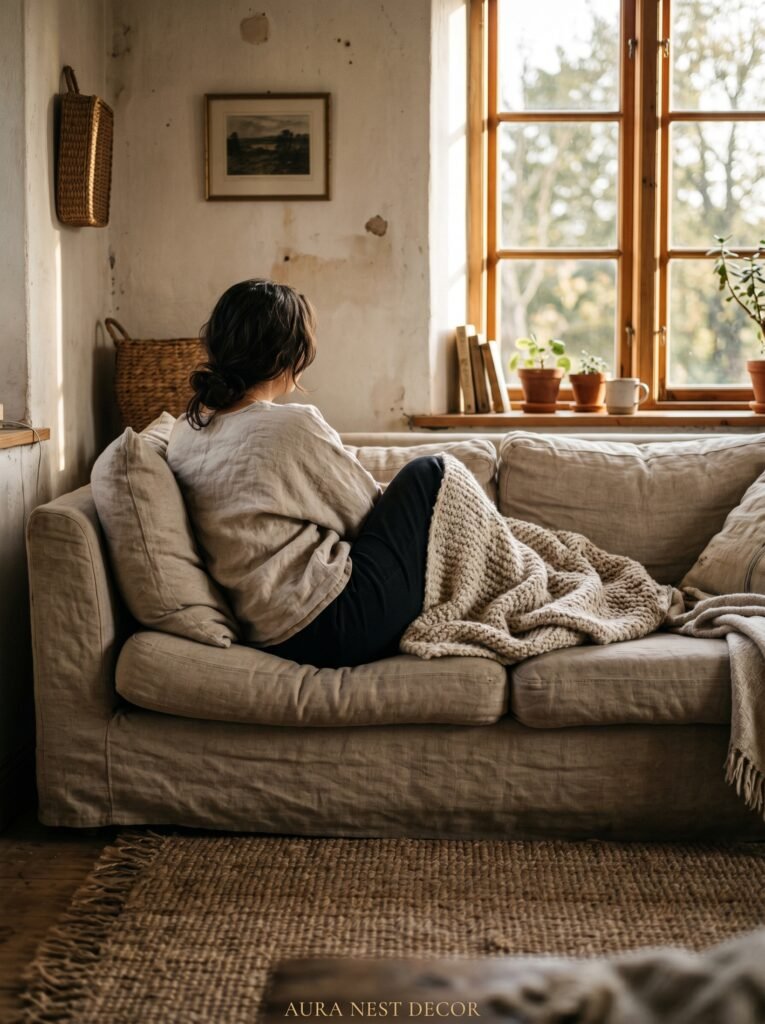
A room done right in this style doesn’t announce itself. It just makes you want to put your phone down, pour something warm, and stay a while. That’s the whole goal — not to impress people as they walk in, but to make them forget, just briefly, that there’s anywhere else they’re supposed to be.
The best version of your modern rustic living room already exists somewhere between your instincts and your patience — in the piece you haven’t bought yet, the corner you haven’t figured out, the lamp that will change everything once you find it.
What does your living room feel like when you walk in right now, and is that feeling the one you’re trying to keep?