The Living Room That Looks Like It Was Collected Over a Lifetime (And How to Fake That in a Weekend)
You walk into a room and it just feels right. Nothing matches perfectly. Nothing was bought as a set. And yet everything belongs. That’s the quiet magic of modern boho — and it’s more achievable than any interior design trend I’ve ever tried.
—
1. Why “Modern Boho” Hits Different Than the Original Bohemian Look
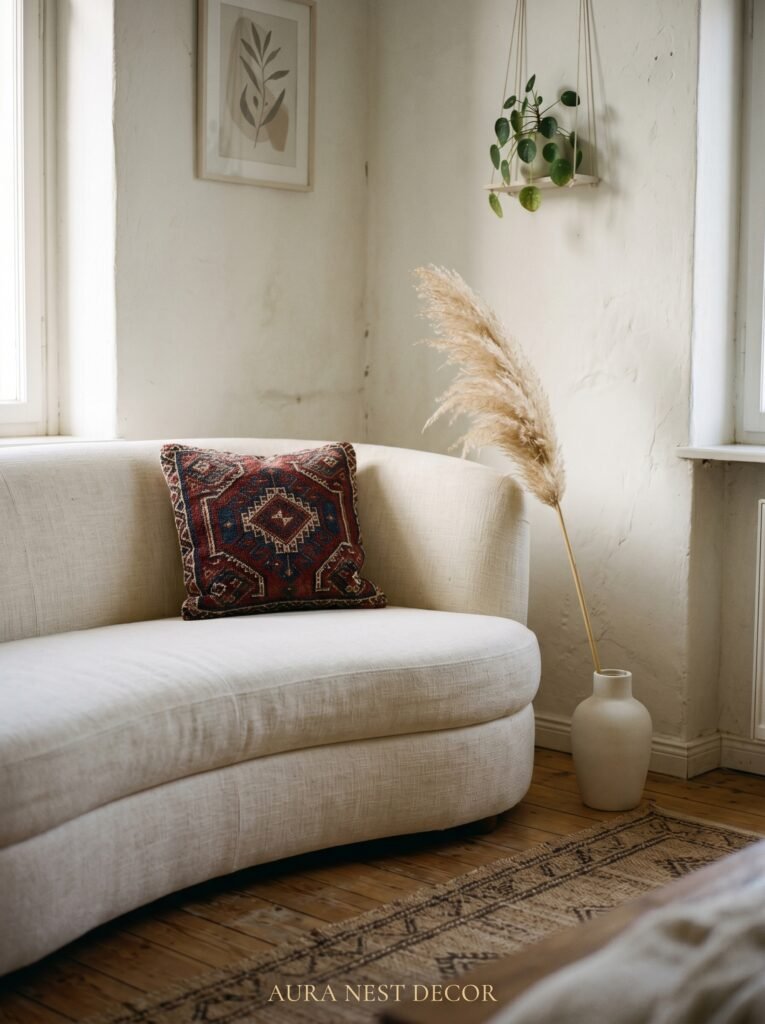
The old bohemian aesthetic had a reputation. Macramé wall hangings the size of a bedsheet. Floor cushions that made your back hate you. Seventeen plants in various states of survival. It was maximalism with no guardrails, and while some people pulled it off brilliantly, most living rooms just ended up looking chaotic.
Modern boho learned from that. It kept everything that actually worked — the warmth, the texture, the sense that the room has a story — and gave it a cleaner backbone. Think streamlined furniture in natural materials paired with layered textiles. Think a neutral base that lets a single vibrant rug or an intricate throw do all the talking. The difference is intentionality. Every piece still looks found rather than bought, but it earns its place in the room.
In the US, this has evolved alongside the rise of desert-inspired interiors from the Southwest — terracotta, dusty sage, sand tones. In the UK, it tends to run slightly cooler, with deeper earthy hues and more nods to globally sourced crafts and vintage market finds. But the heart of it is the same on both sides of the Atlantic: a living room that feels lived in, loved, and completely, irreplaceably yours.
“A room that looks collected over decades is worth more than one that looks bought in an afternoon.”
—
2. The Neutral Base That Makes Every Bohemian Element Pop
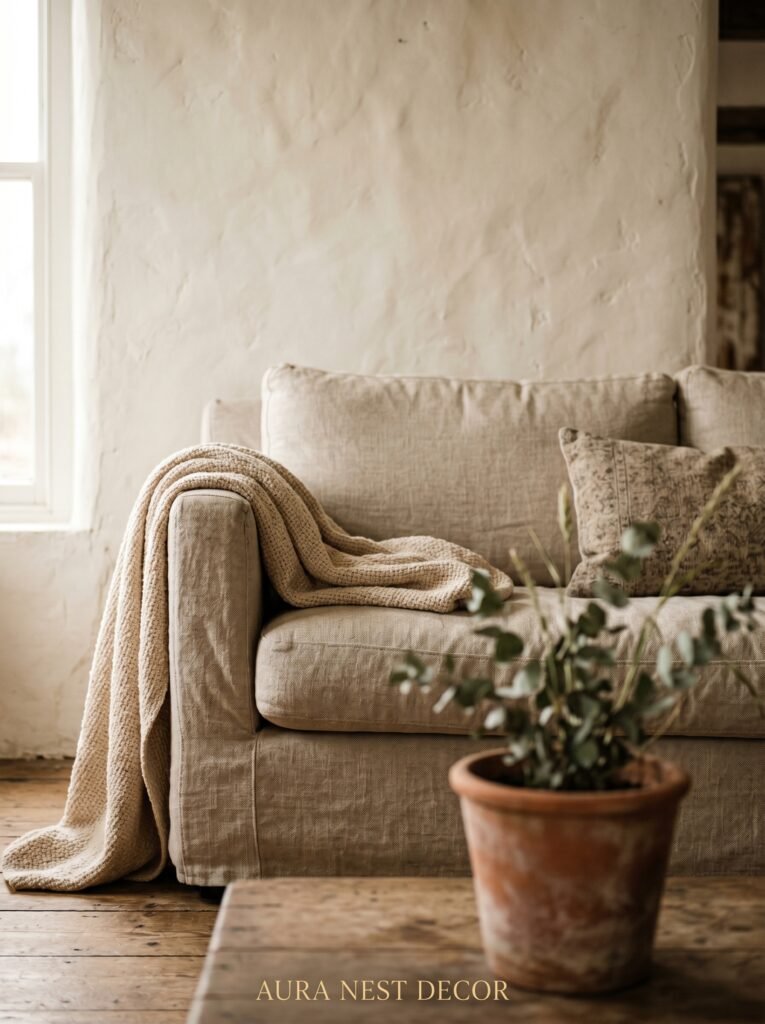
Here’s the thing about boho rooms that fail: they usually skip this step.
You need a foundation. A quiet, steady backdrop that lets the interesting stuff breathe. That means walls in warm white, sand, raw linen, or soft putty. It means a sofa in oatmeal, cream, warm grey, or natural canvas. It means resisting the urge to add color everywhere and instead concentrating it in the layers that come later.
This isn’t boring. I promise. Think of it like a museum wall — soft, receding, the color of nothing in particular — so the art in front of it gets to be everything. Your neutral base is that wall. Your carved wooden coffee table, your ochre lumbar pillow, your worn vintage rug — those are the art.
For paint specifically, look at tones with warm undertones rather than cool. A white with a yellow or pink base rather than a grey one. Benjamin Moore’s Linen White is a perennial US favorite for this. In the UK, Farrow & Ball’s Elephant’s Breath or Clunch gives that same barely-there warmth without ever tipping into yellow.
Your floors matter here too. Natural wood, bamboo, or even concrete-effect tile all work beautifully as base layers. Avoid anything with a strong red or orange tone — it tends to clash rather than harmonize once you start layering rugs.
—
3. The Rug Situation: Why One Isn’t Enough
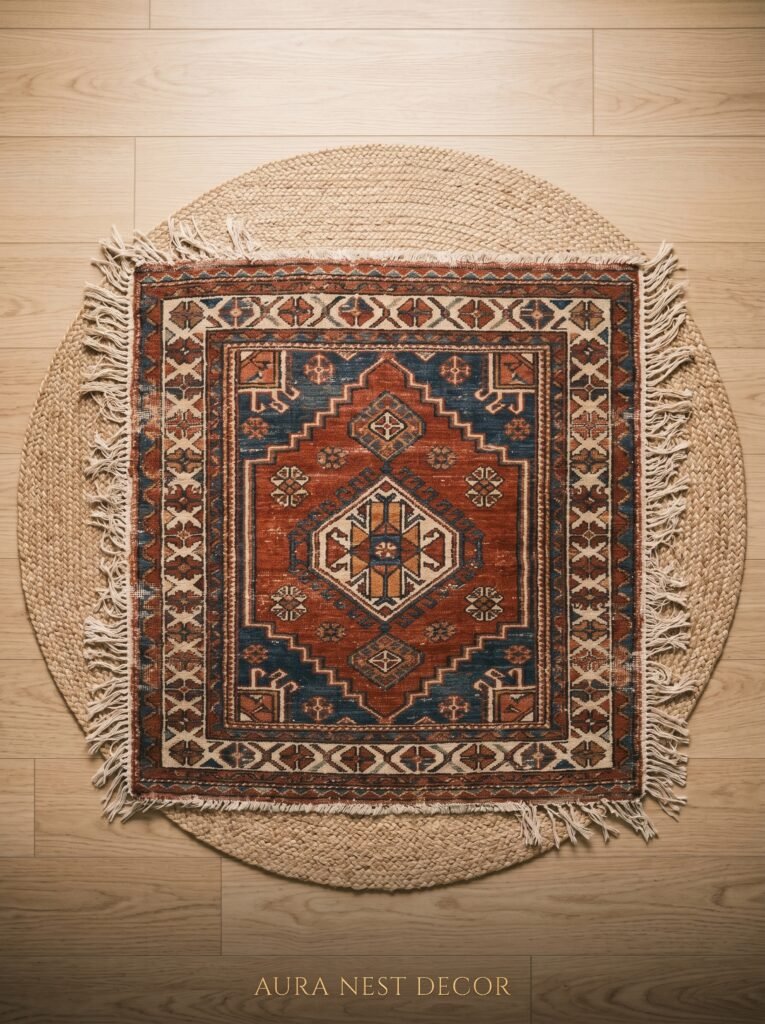
Ask any boho decorator what the single most impactful investment in their living room was. The answer is almost always the same.
The rug.
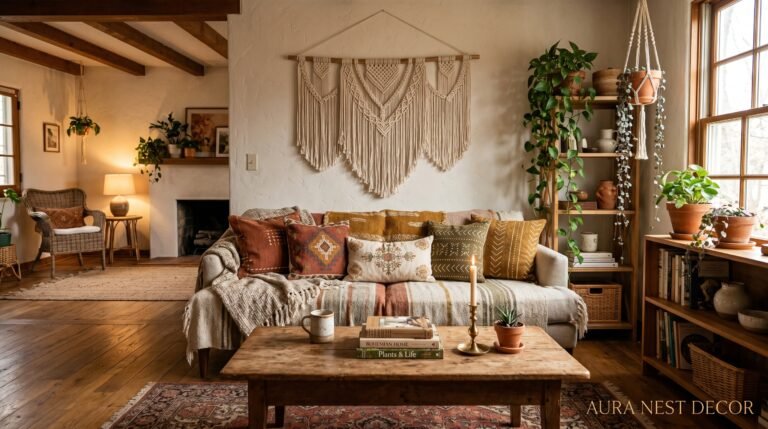
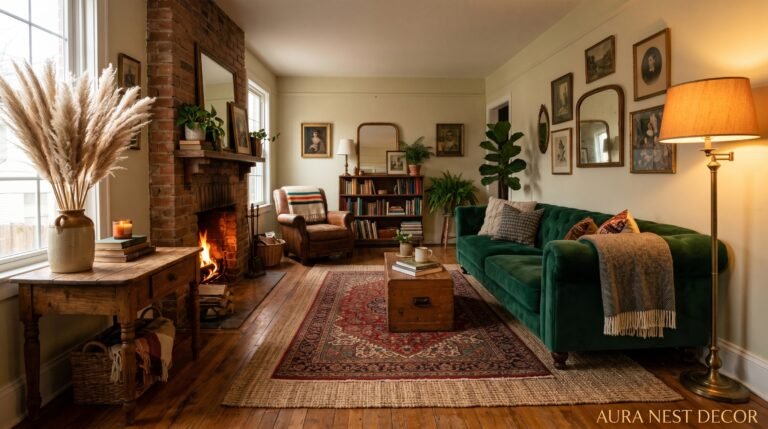
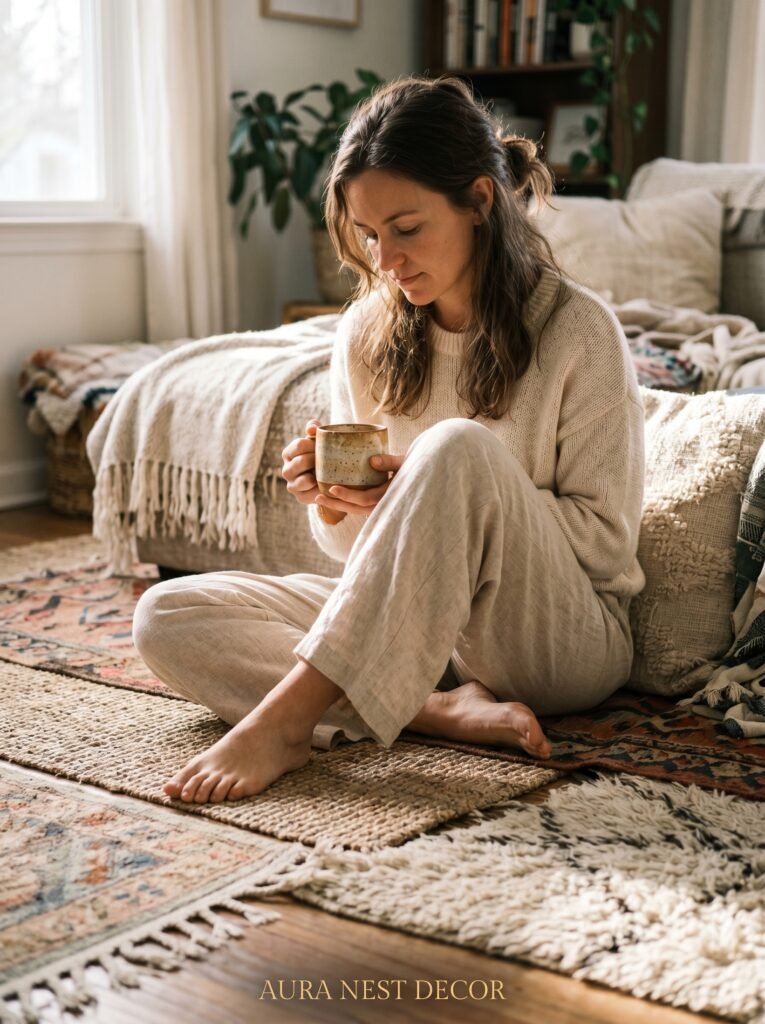
Not a single flat rug laid down and forgotten, but rugs. Layered, mismatched, slightly overlapping in places. A large flat-weave in faded indigo as the base, then a smaller beni ourain-style in cream and black on top. Or a vintage Persian kilim paired with a natural jute underneath it, the fringe edges meeting at angles.
The reason this works so well in a modern boho room is that rugs are one of the easiest ways to introduce pattern, texture, and warmth without committing to anything permanent. They’re also — and this matters — reversible. Moved a little to the left. Swapped out next season. Sold on Facebook Marketplace when you’ve moved on.
For size, go bigger than your instinct tells you. The rug should tuck under at least the front legs of your sofa and chairs. A too-small rug floating in the middle of the room is one of the most common styling mistakes I see, and it makes even a beautiful piece look like an afterthought.
In terms of budget, Ruggable and Wayfair in the US have made layerable boho rugs accessible. In the UK, Cox & Cox and Nkuku both stock beautifully worn-looking vintage-style options that won’t ask you to remortgage your house.
—
4. Furniture That Looks Like It Has a Passport
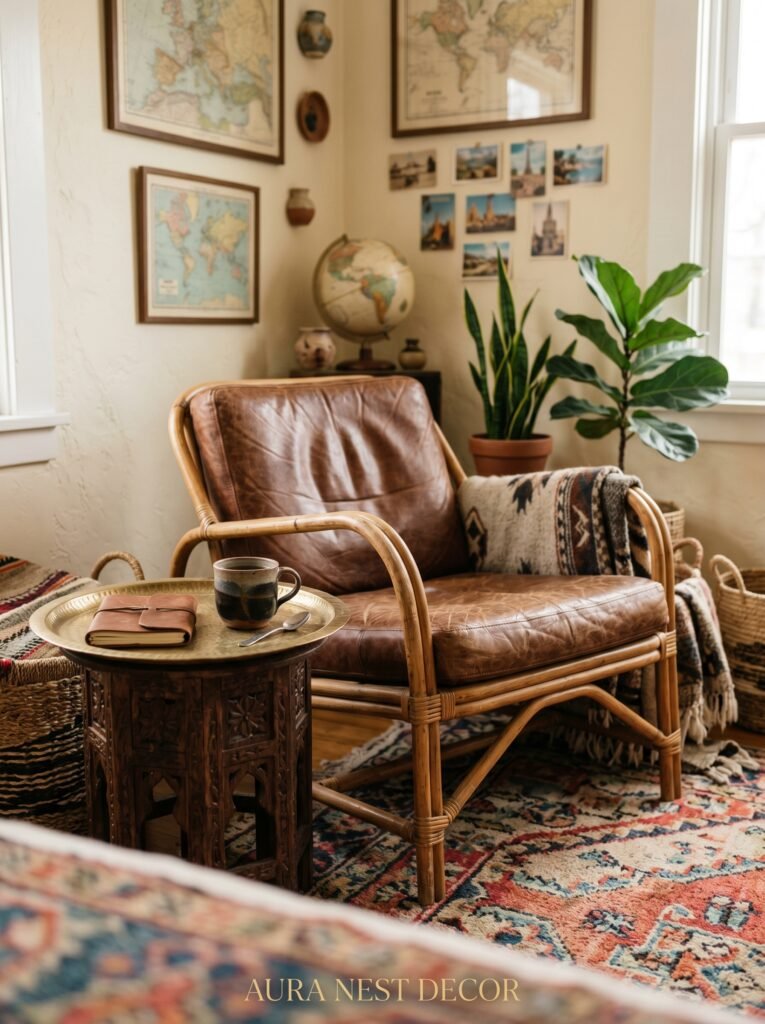
Modern boho furniture doesn’t come from one country or one era. That’s the whole point.
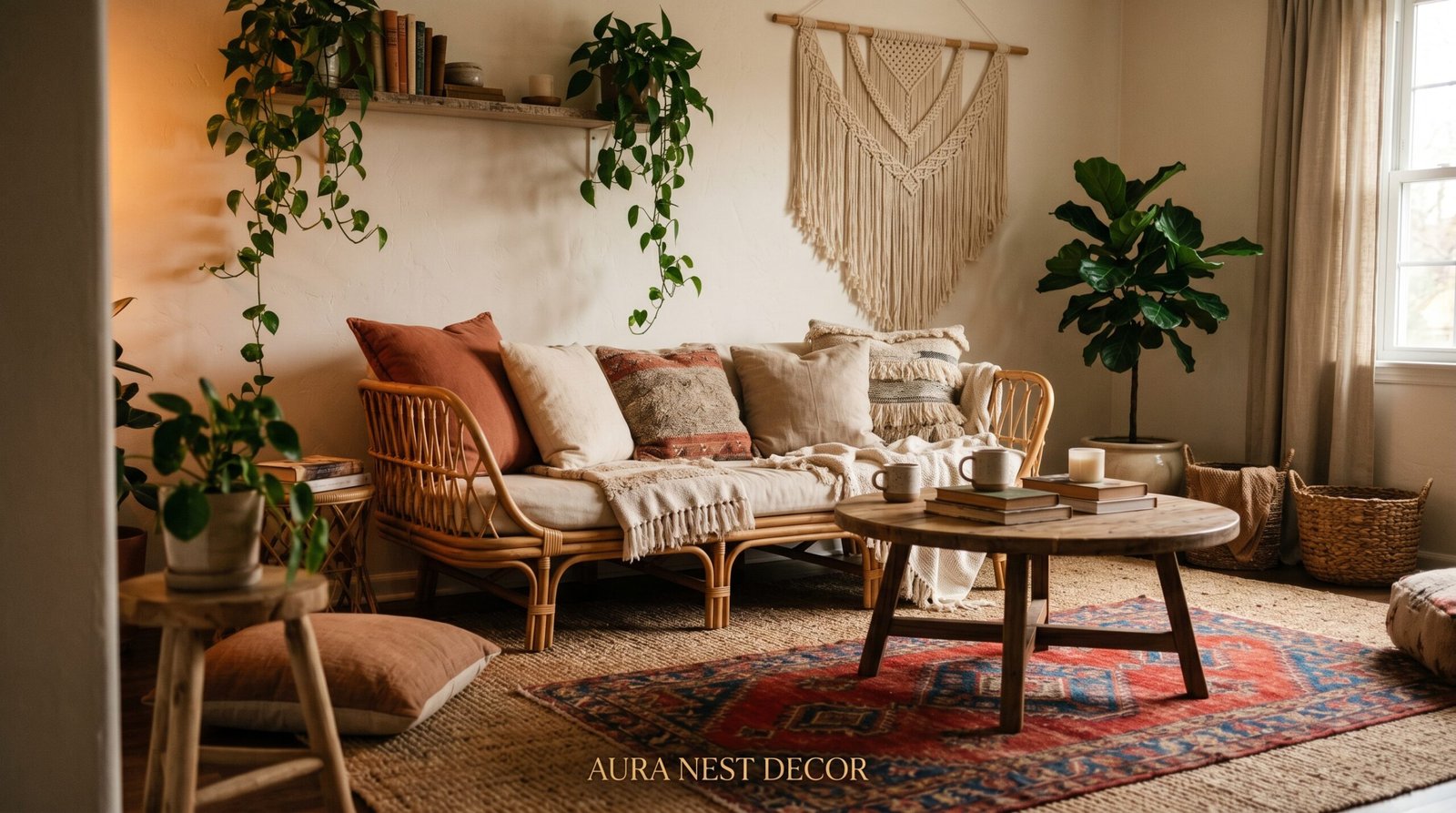
A low-slung sofa with clean lines — something that could almost be Scandinavian in its restraint — sits beautifully next to a side table that looks like it was carved in Morocco. A rattan accent chair brings lightness and warmth. A wooden trunk that doubles as a coffee table tells a story. None of it needs to “match” in any conventional sense. What it needs to do is belong.
The woods that work best here are warm, natural, and imperfect: mango wood, acacia, bamboo, reclaimed teak. Anything with visible grain, knots, or variation. Nothing lacquered to a glossy finish. Nothing that looks like it was extruded from a factory rather than made by hands.
For seating, think about height and how it shapes the room’s energy. Lower seating — sofas that sit closer to the ground, floor cushions, a pouffe or two — gives a room a relaxed, unhurried quality. Paired with a few taller elements like a woven floor lamp or a tall leafy plant, you get that layered visual rhythm that makes boho rooms so easy to sit in for hours.
In the US, Article and West Elm both do well-priced pieces that have that globally-inspired quality. In the UK, Swoon, Loaf, and La Redoute hit the mark without the price tags that would make you wince.
“Low furniture, warm wood, nothing too precious — the formula for a room you’ll actually live in.”
—
5. The Textile Stack: Throws, Cushions, and the Art of Not Overdoing It
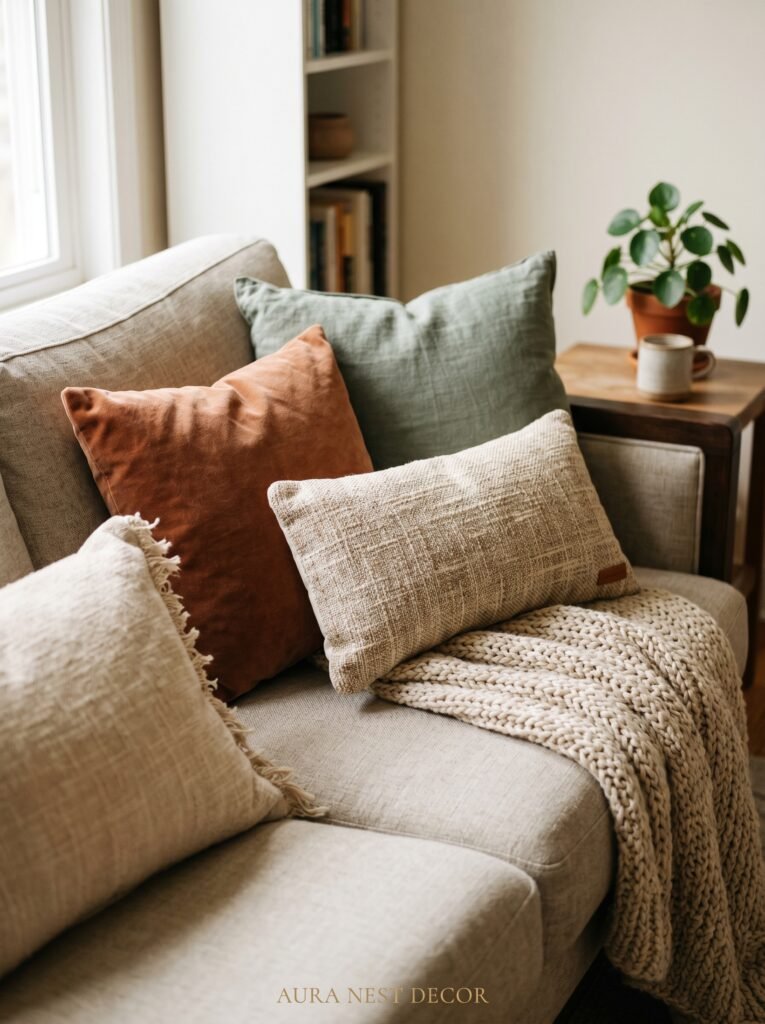
There’s a version of this that goes wrong very quickly. Too many cushions, too many patterns fighting each other, too much fringe. The room starts to feel like a craft fair rather than a home.
The key is mixing textures more than patterns. A chunky knit throw. A velvet cushion in deep rust. A smooth linen pillow in natural white. A woven cushion with just a little embroidery. Each of these has a different feel under your hand, and that tactile variation is what makes the stack look considered rather than random.
For colors within your textile collection, work within a family. Warm earthy tones — terracotta, rust, ochre, olive, sand — play beautifully together and are the backbone of most modern boho living rooms. You can bring in a deeper jewel tone, a dusty plum or forest green, as an accent. But keep it to one. Two starts pushing toward clash.
The odd number rule is real and worth following. Three cushions feel intentional. Four feels fussy. Five feels like you ran out of ideas. When in doubt, edit down.
—
6. Lighting That Makes 7pm the Best Hour in Your House
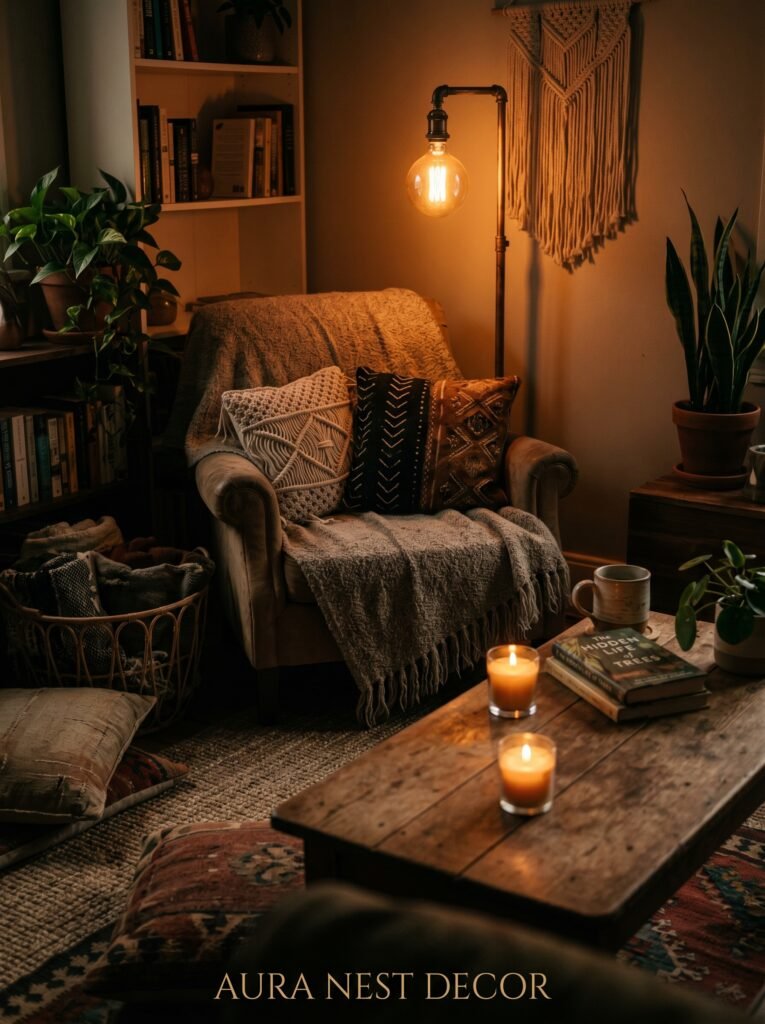
Modern boho living rooms earn their magic most at dusk.
This is when the right lighting makes everything come alive — the shadows in the woven texture of your wall hanging, the warm grain of your wooden shelf, the slight sheen of that velvet cushion. And all of it depends on the temperature and placement of your light sources.
Cool, overhead light is the enemy of atmosphere. If you’re still relying on a single ceiling fixture, that’s the first thing to change. Layer your light: a floor lamp with a linen shade tucked into a corner, a cluster of hanging pendants over a coffee table area if you have height, table lamps on either side of the sofa, and candlelight — actual candles, or good quality LED candles — on trays, in lanterns, across your mantelpiece.
Edison bulbs and warm-toned LED bulbs (around 2200K–2700K color temperature) are the sweet spot. They give that amber glow that makes every textile look richer and every face look better. That’s not a small thing.
In the US, IKEA’s RANARP and HEKTAR lamps are classics for a reason — simple shapes, warm light, great value. In the UK, the same applies, and Dunelm and Habitat both have strong ranges of boho-adjacent lighting that won’t break the budget.
—
7. Plants: The Living Texture You Can’t Buy at a Furniture Store
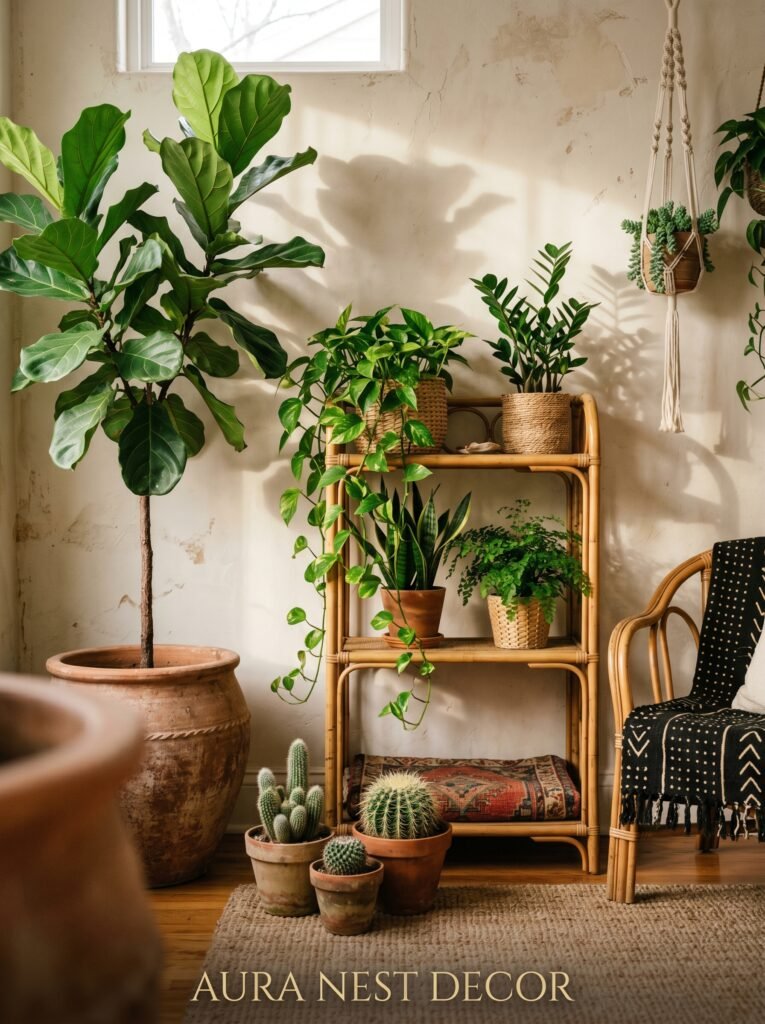
No modern boho room is complete without them. But not just any plants, and not just any placement.
Scale matters enormously. A single large statement plant — a monstera, a fiddle-leaf fig, a dramatic bird of paradise — does infinitely more for a room than twelve small pots scattered on every surface. One big plant in a beautiful terracotta or woven basket planter anchors a corner, adds height, and brings that organic, living quality that no printed textile can replicate.
From there, you can add smaller plants thoughtfully: a trailing pothos along a shelf, a small cactus on a wooden side table, a cluster of three succulents in mismatched ceramic pots on a windowsill. But always in service of the big anchor, not instead of it.
The planters themselves are part of the decor. Terracotta is the obvious choice and still the right one — warm, earthy, imperfect when aged. Woven seagrass baskets work beautifully for larger plants. Handmade ceramic pots in matte glazes — dusty green, sandy beige, clay pink — add that artisan quality that pulls everything together.
“One large plant in the right corner will do more for your living room than three reorganized shelves ever could.”
—
8. The Wall Art Philosophy That Changes Everything
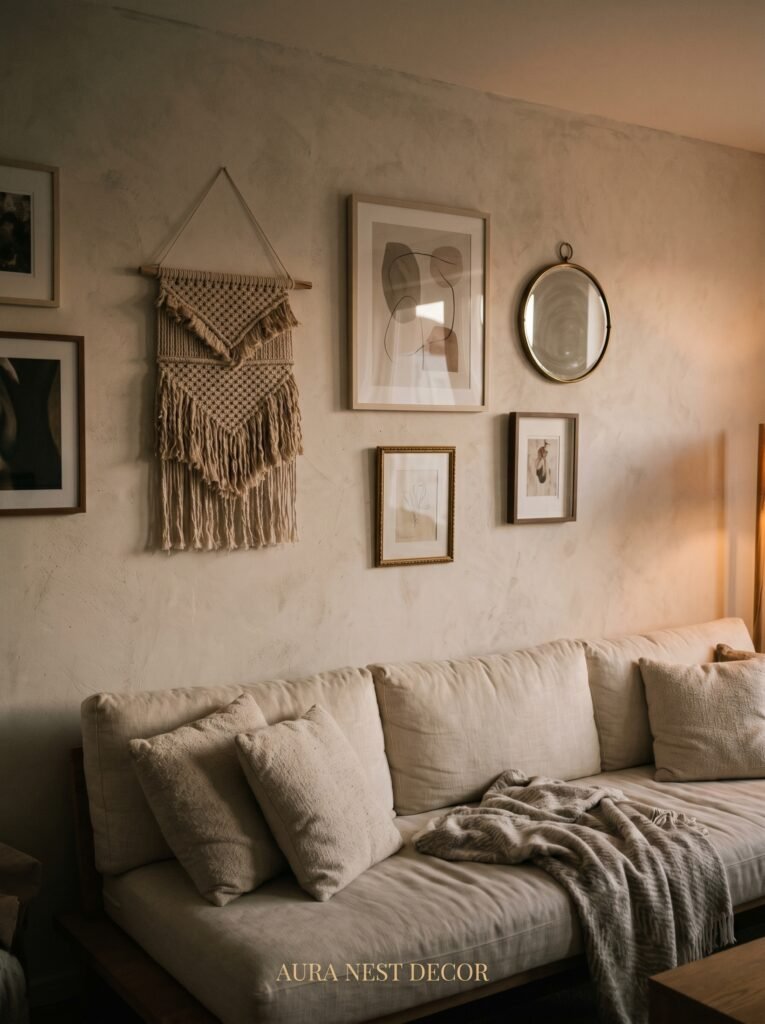
Don’t hang a print from a big-box store directly on your wall and call it done.
Boho walls have layers. A large macramé piece — yes, they’re back, and they’re better than ever in their modern, restrained forms — can anchor a wall beautifully when it’s the only thing on it. A gallery wall of mismatched vintage frames, architectural prints, travel photographs, and woven pieces works when there’s genuine curation behind it.
The thing that makes boho wall art look authentic is imperfection. Slightly uneven hanging heights. Frames that don’t match. A mix of mediums — photograph, painted artwork, textile, maybe a pressed botanical. The wall should look like it grew rather than like it was installed.
Leaning is underrated. Leaning a large canvas or a vintage mirror against a wall rather than hanging it gives a room that relaxed, not-quite-finished quality that is, paradoxically, extremely difficult to achieve when everything is hung perfectly.
In the US, Etsy artisans doing original boho-adjacent wall art are having a genuine moment. In the UK, TOAST and Rockett St George both stock pieces that have genuine craft and character without requiring a gallery budget.
—
9. The Shelf Styling Secret That No One Talks About Enough
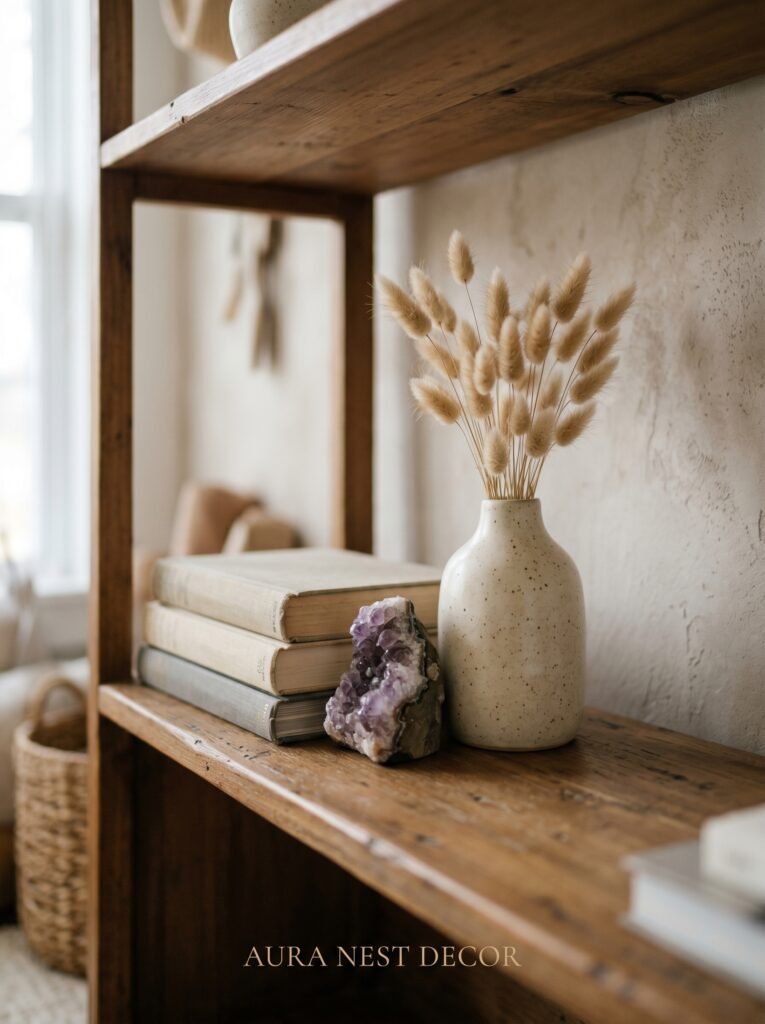
Books spine-out on a shelf. A small plant. A candle. Done.
That’s what most people do, and that’s why most shelves look forgettable.
Boho shelf styling is about rhythm and variation. Tall things next to short things. Books stacked horizontally in a stack of three, used as a riser for a small ceramic object. A woven basket on the bottom shelf hiding less attractive items. A piece of driftwood or a branch propped casually. Space — actual, deliberate empty space — between clusters of objects so the eye gets to rest.
The objects themselves should feel personal and collected. Not a matched set of decorative objects bought together. A small sculpture you brought back from somewhere. A vintage brass candlestick from a market. A handmade ceramic bowl in a glaze you can’t stop looking at. These things tell a story, and that story is what gives shelves their texture.
Edit constantly. Every few months, take everything off and put back only what you genuinely love. The rest goes into a box. You’ll be surprised how much better the shelf looks with a third less on it.
—
10. Color That Feels Warm Without Being Overwhelming
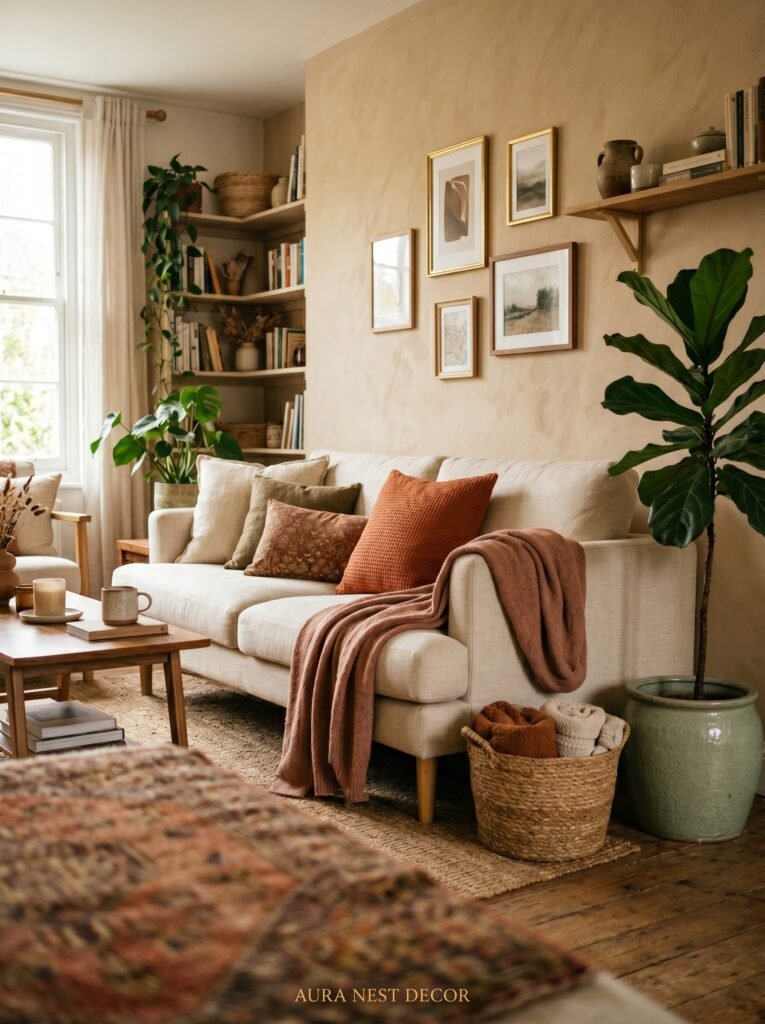
The modern boho palette is not brown. I want to be clear about that.
It is warm. Which sounds similar but isn’t. There’s a richness to it — terracotta that glows, ochre that reads as sunshine, rust that ages beautifully, forest green that grounds everything, dusty pink that reads more mauve than candy. These are the colors that make a room feel like it’s been lived in by someone with taste and a passport.
The trick is proportionality. Roughly 60% of your room should be your neutral base — walls, sofa, large rug. About 30% can be your warm earth tones in furniture, secondary rugs, and large textiles. The remaining 10% is your accent, and this is where you get to be bold: a single deep plum cushion, a forest green throw, a set of amber glass vases.
When you look at it that way, the whole palette becomes manageable. You’re not choosing between terracotta and ochre for the whole room. You’re choosing which one gets to be the 30% and which one gets to be the accent.
—
11. The Vintage Piece That Makes Everything Else Make Sense
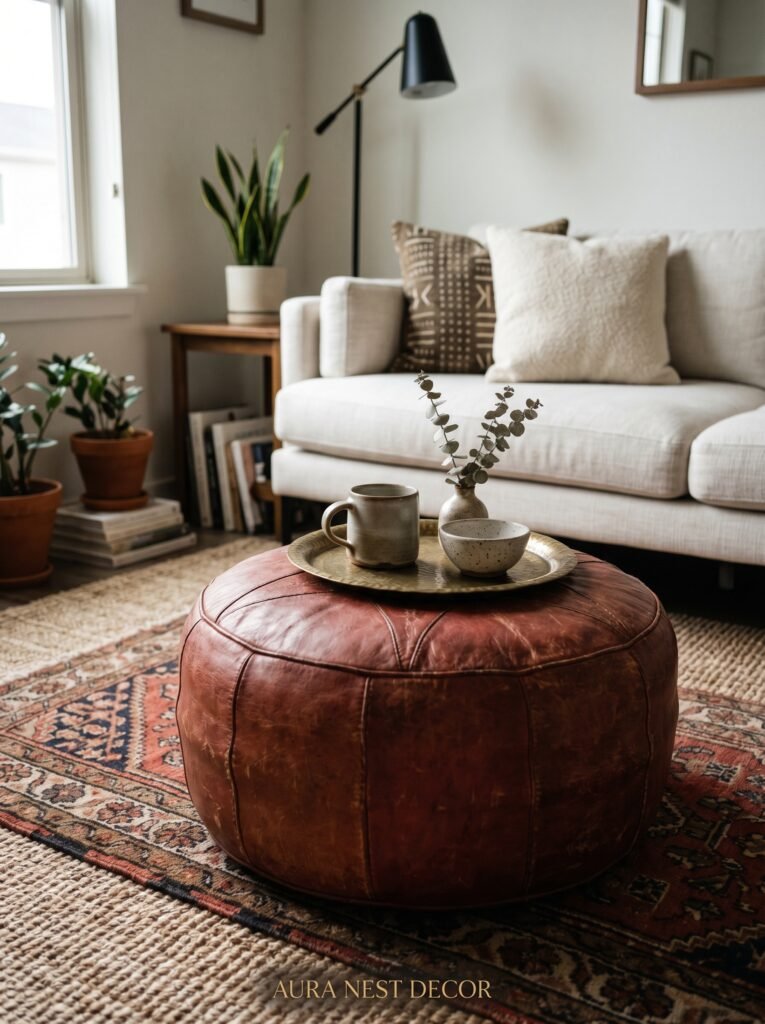
Every great boho living room has one. The piece that people ask about.
Sometimes it’s a vintage Moroccan rug found at an estate sale, worn thin in the middle from decades of foot traffic. Sometimes it’s a carved wooden mirror picked up at a Sunday market in Portobello Road or at an antique mall off Route 9 in New Jersey. Sometimes it’s a set of brass candlesticks that belonged to someone’s grandmother, repurposed now on a floating shelf alongside modern ceramic vases.
This piece does something that no new purchase can do. It gives the room credibility.
It’s the thing that makes a carefully curated modern boho room look genuinely collected rather than Pinterest-assembled. And you don’t need many of them — one or two is enough. But you do need at least one. eBay, Etsy vintage, Facebook Marketplace, and local antique markets are your hunting grounds. The goal is something with patina, age, and a history you’ll never fully know.
—
12. The Small Details That Separate Good Rooms From Rooms That Stop Scrolling
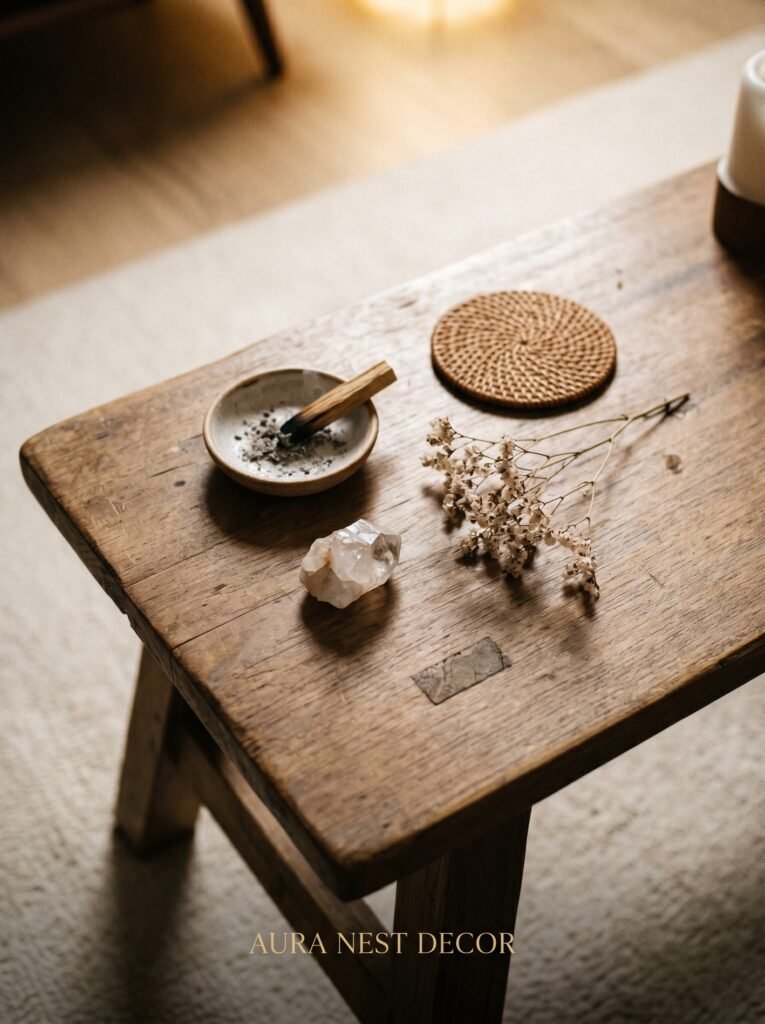
It’s always the small things.
A tray on the coffee table holding a chunky candle, a small cactus, and a couple of crystals or smooth stones — that’s a vignette. It takes thirty seconds to put together and it makes the room feel finished in a way that nothing expensive could. A stack of beautiful books on the floor beside the sofa. A linen table runner used on a console. A ceramic jug holding dried grasses or pampas stems in the corner.
These are the details that stop someone mid-scroll on Pinterest. Not the expensive sofa or the dramatic pendant light — those register, but they’re expected. It’s the tray. The stack of books. The way the light catches the brass bowl at golden hour.
Dried botanicals have had a sustained moment and I don’t think they’re going anywhere. Pampas grass, dried lavender, eucalyptus, preserved magnolia leaves — these add organic shape and warmth to corners and surfaces without requiring any maintenance. In the US, Target and HomeGoods have surprisingly beautiful options now. In the UK, H&M Home and Oliver Bonas consistently stock them at sensible prices.
The last small detail worth mentioning: scent. A living room that smells like warm sandalwood or cedarwood at 6pm on a Friday communicates coziness before a single cushion is appreciated. A reed diffuser or a slow-burning candle is not an optional extra in a boho room. It’s part of the atmosphere.
—
❓ FAQ
Q: How do I make a small living room look boho without it feeling cluttered? A: Focus on one large statement piece rather than many small ones — a single large rug, one big plant, one piece of oversized wall art. Keep your base colors very neutral and light, and edit your textiles to just a few high-quality pieces. The key in small rooms is deliberate spacing: not everything needs to be filled.
Q: What’s the difference between modern boho and just “bohemian” style? A: Modern boho has cleaner lines and a more restrained approach to layering. It keeps the warm textures, globally-inspired pieces, and collected feel of traditional bohemian style but pairs them with sleeker furniture and a more neutral base palette. Think less maximalism, more intention — beautiful, not busy.
Q: Can I do a boho living room on a tight budget? A: Absolutely, and honestly it lends itself to it. The whole aesthetic is built around things that look found, vintage, and imperfect — which means charity shops, car boot sales (UK), estate sales (US), Facebook Marketplace, and markets are your best friends. A good vintage rug, some dried botanicals, a secondhand rattan chair, and a few well-placed candles can do more than a full room of expensive new furniture.
—
💭 Final Thoughts
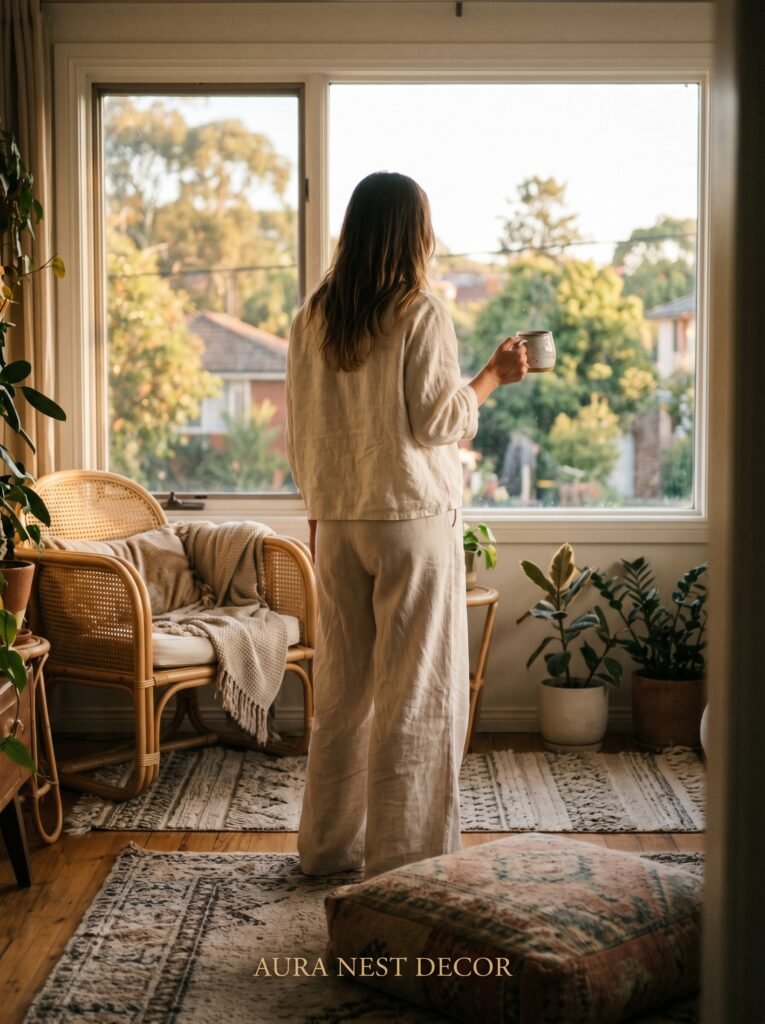
Modern boho isn’t really about buying the right things. It’s about building a room that feels like a reflection of how you actually want to live — unhurried, layered, warm, and entirely your own. The most beautiful versions of this style I’ve ever seen were rooms that had clearly been adjusted, edited, added to, and subtracted from over years. Which means you don’t have to get it right all at once. Start with one corner. Layer one thing at a time.
What’s the one piece in your living room right now that already feels a little bit boho — the thing you never planned but somehow can’t imagine the room without?