The Modern Boho Living Room That Looks Like It Took Years to Collect (But You Can Do It This Weekend)
You know that feeling when you walk into someone’s living room and it looks effortlessly put together — layers of texture, a mix of old and new, plants in every corner — and you ask how they did it, and they just shrug? That’s modern boho. It’s not a kit you buy. It’s a feeling you build. And the good news? Most of it is cheaper and easier than you think.
—
1. Why “Boho” Stopped Meaning What It Used To (And What It Means Now)
Here’s the thing. Old-school bohemian decor had a reputation — and honestly, not always a great one. Fringed everything. Macramé gone wrong. Dream catchers that looked like they came from a gas station near a highway. It felt more like a costume than a home.
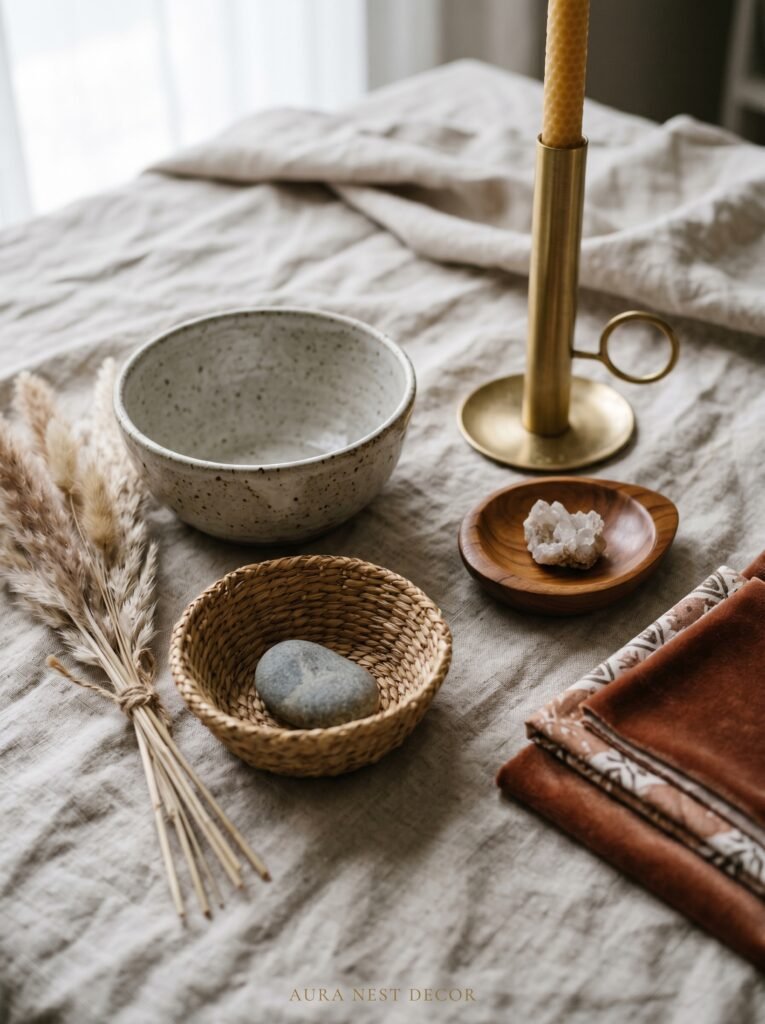
Modern boho is different. It kept the good stuff — the warmth, the layering, the sense that a real person actually lives here — and stripped out the chaos. Now it sits right at the intersection of Scandinavian restraint and free-spirited eclecticism. Think neutral base tones with rich, earthy accent colors. Natural materials like rattan, jute, and raw wood that feel grounded rather than scattered. Textiles that invite you to actually touch them.
What makes it feel modern is the editing. Every piece earns its spot. There’s no “just in case” clutter pretending to be decor. It’s the kind of room that looks collected, not purchased — even when most of it came from IKEA and a couple of charity shops in town.
The other thing modern boho does brilliantly is tell a story. Not a perfectly coordinated, showroom story. A personal one. And that’s what this whole article is going to help you create — room by room, layer by layer, with your own two hands where possible.
“Modern boho isn’t about owning more. It’s about choosing better.”
—
2. The Wall Color That Actually Works as a Foundation (Hint: It’s Not White)
Everyone defaults to white. And yes, white walls are clean and bright and Pinterest-perfect. But in a modern boho living room, white can actually work against you — everything you layer on top of it will compete for attention rather than settling in.
The color that keeps showing up in every beautiful boho living room right now is warm greige. Not gray, not beige — that exact in-between tone that shifts in different lights. Think Farrow & Ball’s Elephant’s Breath, or Benjamin Moore’s Pale Oak. Something that reads creamy in sunlight and slightly moody in lamplight.
If you’re renting and can’t paint (a frustration known by almost every young homeowner in London and most of the US), the trick is to lean heavily into your textiles and large furniture pieces to create that warm base tone. A sofa in camel or terracotta does more for the feel of a room than a freshly painted wall.
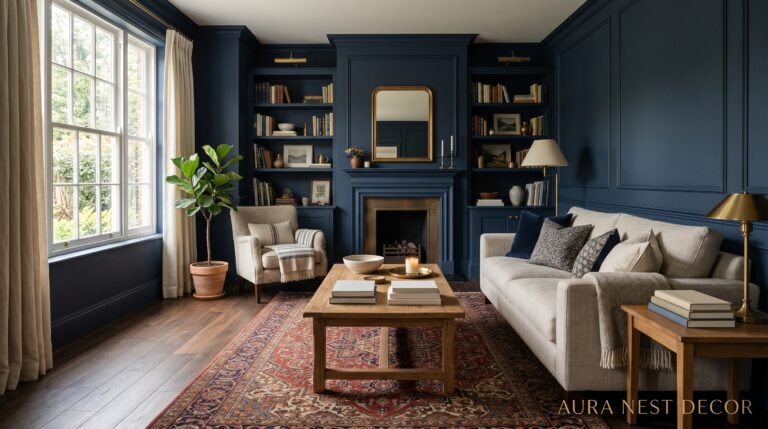
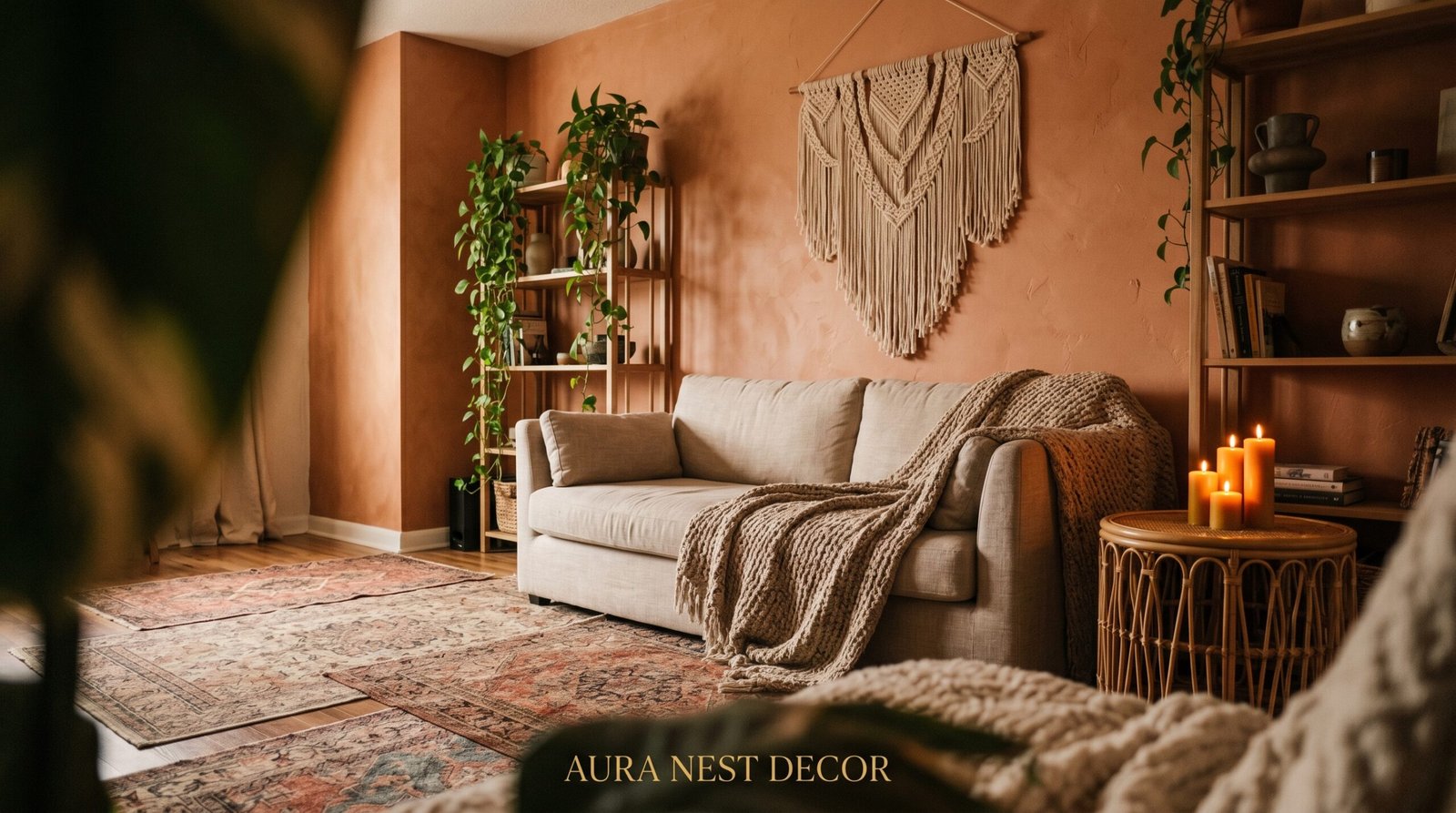
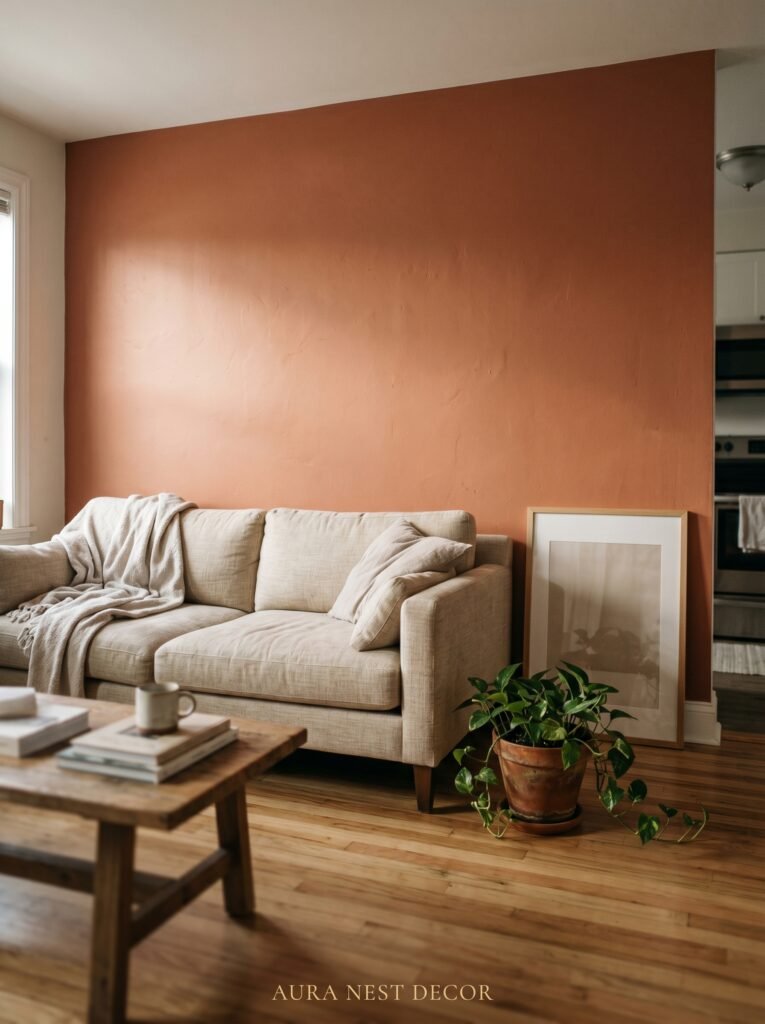
For those who can paint: consider doing just one feature wall in a deeper, earthier tone — dusty sage, warm terracotta, dried clay. It grounds the space immediately. It gives you something to push the furniture toward. And it makes the room feel like it was designed, not just assembled.
—
3. The Sofa You Build Everything Around (And Why Secondhand Is Actually Better)
Your sofa is the anchor. Get this right and the rest of the room almost falls into place around it.
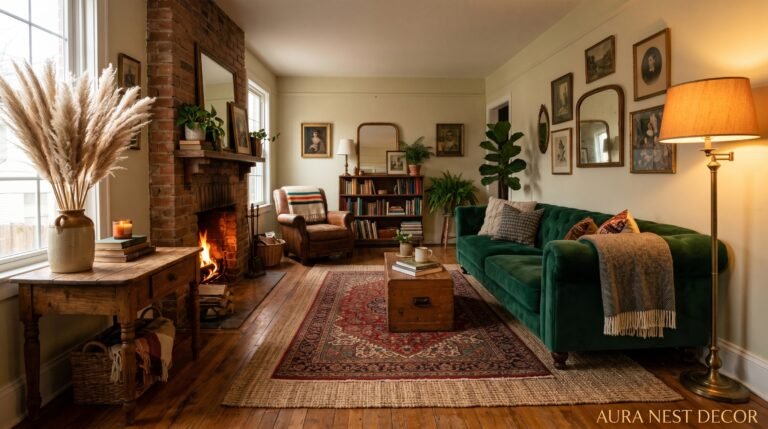
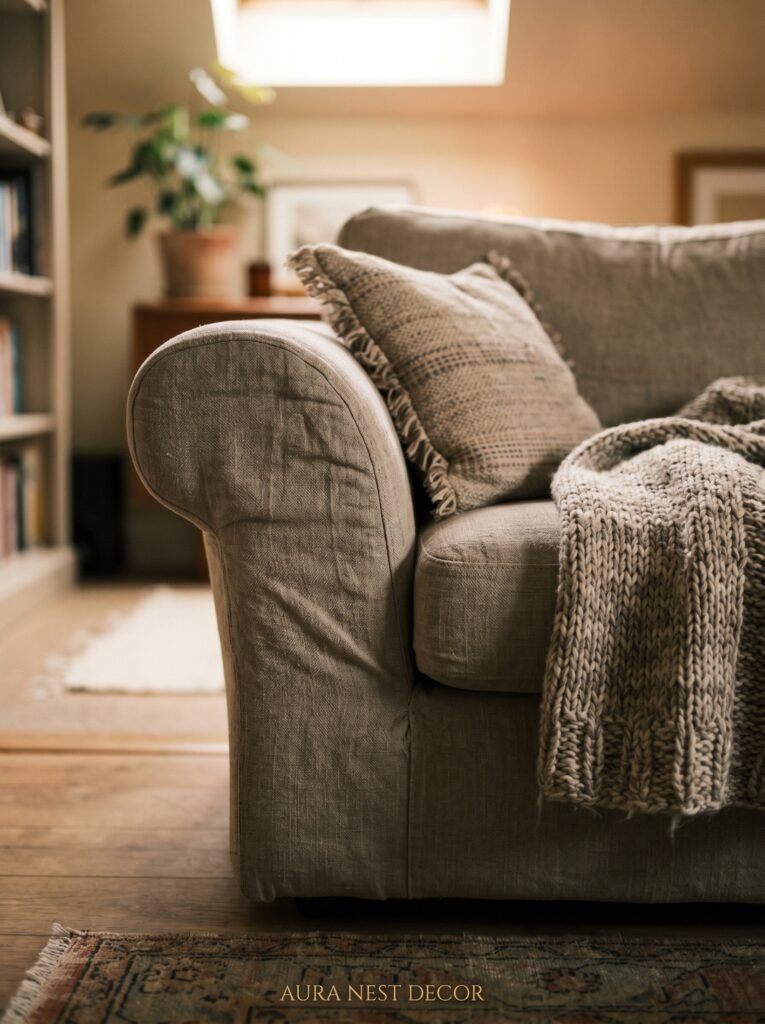
In modern boho, sofas tend to be low-slung. Close to the ground, wide, with deep cushions — the kind that genuinely invite you to sit down and not get up for two hours. Linen is the dream fabric here. It wrinkles beautifully, it breathes, and it has that lived-in quality that every other fabric is trying to imitate. Colors to look for: natural oatmeal, sage, warm tan, dusty blush, or a very deep forest green that reads almost like a neutral in a warm-lit room.
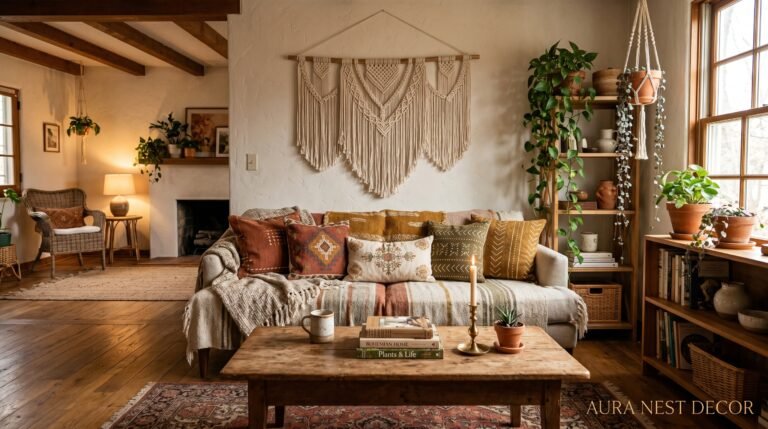
Now, here’s where secondhand wins. Boho styling loves a slightly imperfect, slightly aged sofa. Not a damaged one — a characterful one. A linen sofa from a local Facebook Marketplace listing or a charity furniture shop that has a few soft creases and a slightly lived-in frame? That’s more boho than anything you’ll buy new from a chain store. Throw a hand-dyed cotton blanket over one arm, add three mismatched cushions in different textures, and you have a sofa that looks like it took years to find.
The cushion rule: odd numbers, mixed textures, maximum two patterns. One plain knit, one simple geometric, one textured solid. That’s the formula.
—
4. The Rug That Ties the Whole Feeling Together
Nothing changes a room faster than a rug. Nothing. Not a new lamp, not a gallery wall, not fresh flowers. A rug sets the temperature of a space — and in a modern boho room, you want warmth underfoot and visual interest without visual noise.
The rugs that work best here are flatweave kilim-style rugs in faded, earthy tones. Reds and oranges that have been worn down to a dusty warmth. Aged indigo patterns on cream. Abstract hand-dyed looks. You can find incredible versions online — Ruggable and RugsUSA in America, and Dunelm or Etsy sellers in the UK, all have options that won’t break you financially.
Sizing is where people go wrong. The rug should be large enough that the front legs of all your main seating sit on it. If the rug is too small and floating in the middle of the room, the whole space feels unsettled — like furniture that doesn’t know where to stand. Go bigger than you think you need. The oversized rug is almost always the right call.
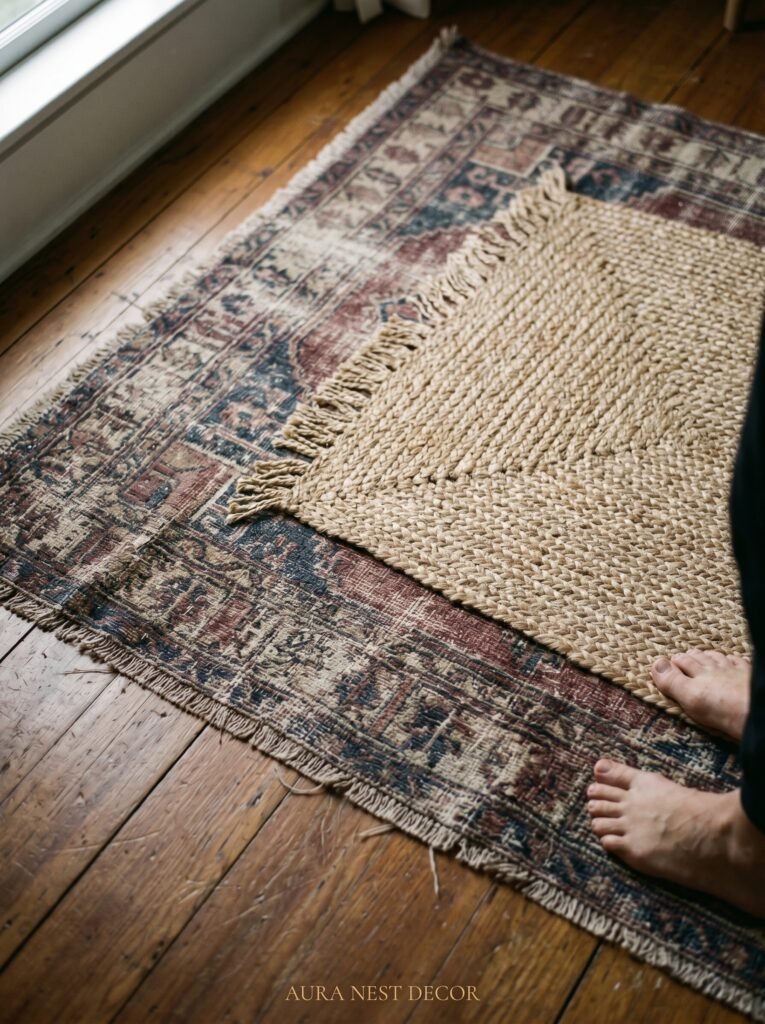
One more thing: layering rugs. A smaller natural jute rug layered over a larger flatweave? That’s a very classic modern boho move that adds immediate depth and texture without adding any visual clutter.
“The right rug doesn’t just cover the floor. It makes the whole room feel intentional.”
—
5. DIY Macramé That Doesn’t Look Like It Came From 2014
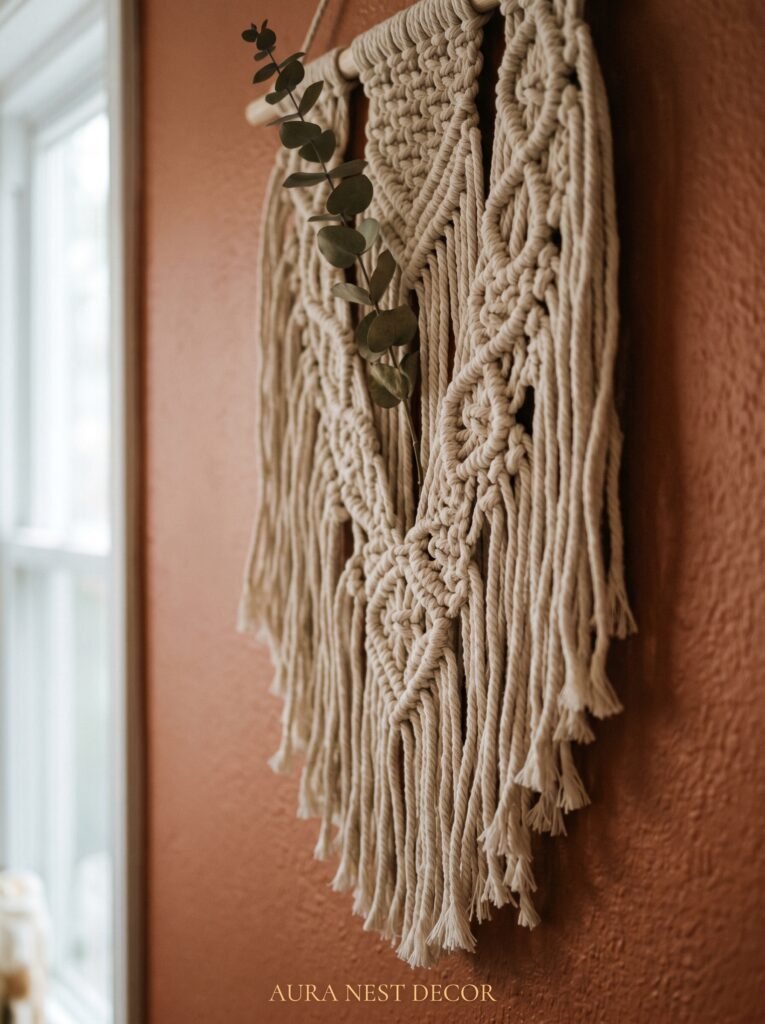
Yes, macramé is back. But modern macramé is nothing like the chunky, overwhelming wall hangings of the last boho wave. It’s slimmer. More sculptural. More intentional in where and how it’s placed.
The good news is that basic macramé is genuinely one of the easiest DIY crafts you can learn in a weekend. You need a wooden dowel, some 3mm single-strand cotton rope, and about three hours and a YouTube video. The knots you actually need to know: the square knot and the spiral half-hitch. That’s it. Those two knots make up 90% of everything beautiful you’ve ever seen in a boho living room.
What makes modern macramé feel current is restraint. A single long, lean wall hanging with clean lines rather than a wide, dense piece. Natural undyed cotton rather than colored rope. Or try a small plant hanger for a trailing pothos in a terra cotta pot — that combination alone hits about fifteen different boho aesthetic checkboxes at once.
Hang it somewhere considered. Above a console table. In a corner where you’re layering plants. On a wall that needs height but not visual weight. And leave space around it. The negative space is part of the piece.
—
6. The Plant Styling Secret That Makes Rooms Look Magazine-Ready
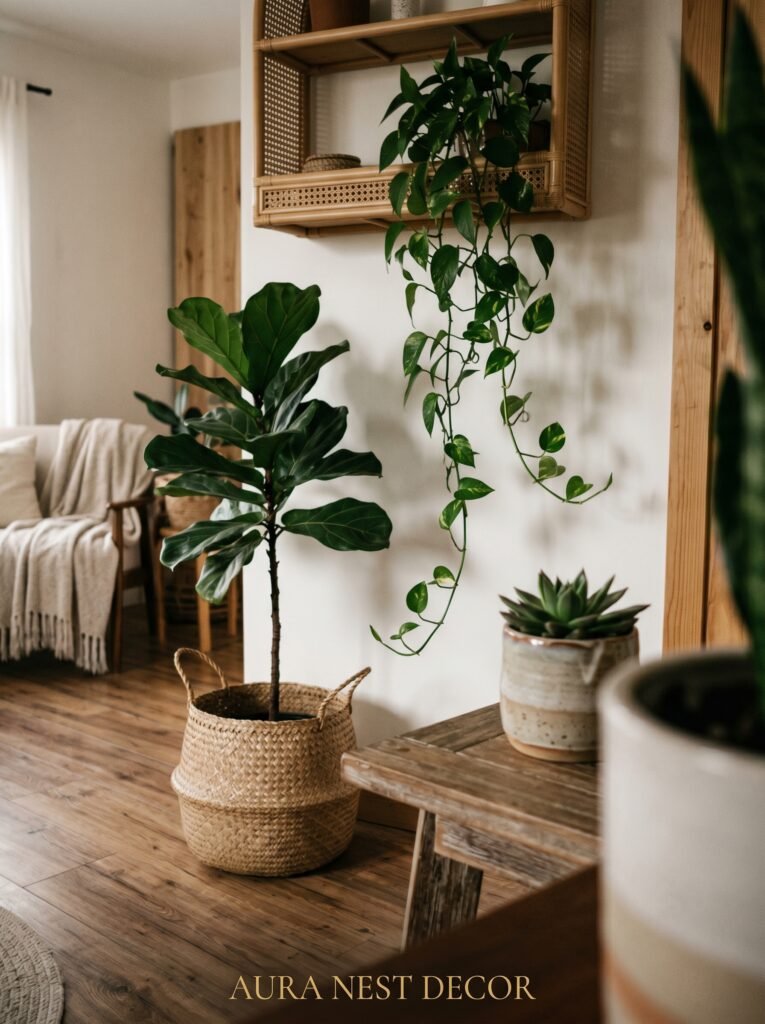
Plants are non-negotiable in modern boho. But it’s not about having the most plants — it’s about placing them with intention.
The trick is varying height dramatically. A tall fiddle-leaf fig or olive tree in a corner creates a canopy effect that makes ceilings feel higher. Mid-height plants on stands or stools — a trailing string of pearls or a full-bodied pothos in a woven basket — fill the middle register. Small terracotta pots grouped in threes on a shelf or coffee table add detail at eye level when you’re seated.
The containers matter just as much as the plants. Terra cotta is the backbone of boho plant styling — warm, earthy, slightly imperfect. You can DIY textured terra cotta pots by coating plain nursery pots with a thin layer of air-dry clay and pressing a simple pattern in before it dries. The result looks handmade and beautiful. Because it is.
Baskets are equally essential. Large woven seagrass or rattan baskets at floor level, housing a rubber plant or large peace lily, root the whole plant scheme and add texture that reads from across the room. They also hide the nursery pot, which is doing you no favors aesthetically.
Real plants are ideal, but high-quality faux plants have gotten genuinely good in the last few years — especially for spaces with low light. No shame in it. The room doesn’t need to know.
—
7. Building a Gallery Wall That Looks Curated, Not Chaotic
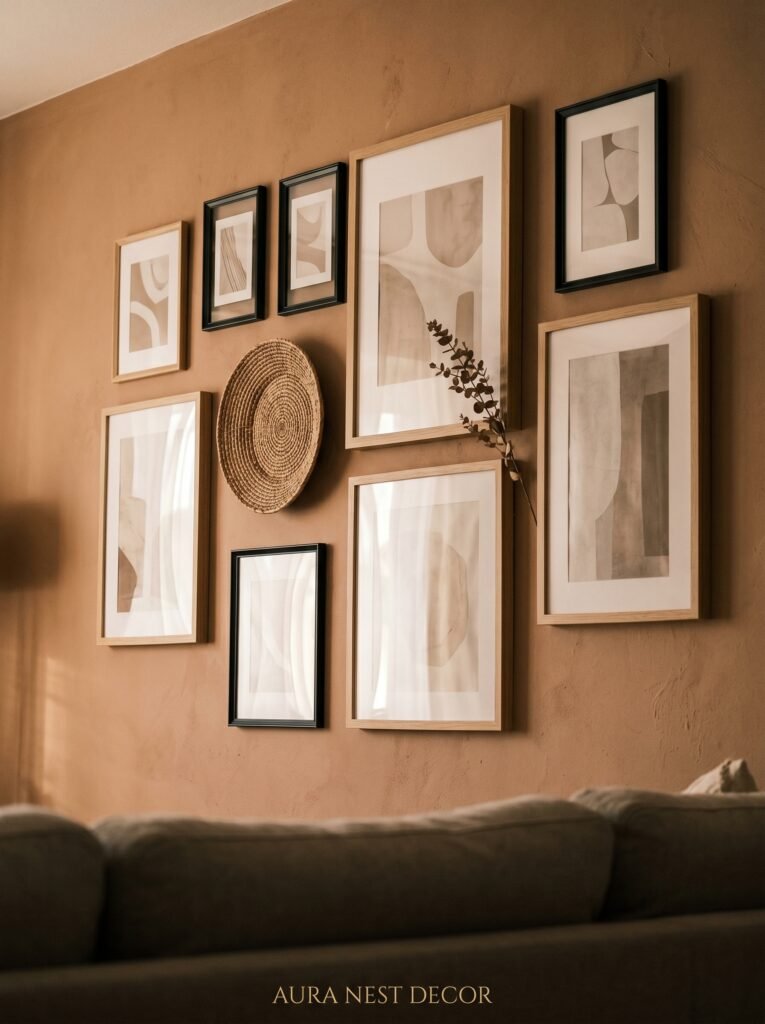
The gallery wall is the piece of modern boho that intimidates people most. And it shouldn’t. Because the secret is embarrassingly simple.
Pick one thing to repeat. It could be a frame color — all black frames, or all natural wood. It could be a material — all linen-textured prints. It could be a tone — every piece shares warm ochre or terracotta. That one repeating element is what creates cohesion. Everything else — sizes, styles, subject matter — can vary freely.
What to include: a mix of actual art (prints are absolutely fine, Etsy has thousands of beautiful digital downloads you can print at home or at a print shop for a few dollars or pounds), personal photographs printed in a warm sepia or faded tone, small found objects mounted in simple frames, dried botanicals behind glass, handwritten quotes in your own handwriting on good cardstock. The personal pieces are what make it a gallery wall rather than a shop display.
Before you put a single nail in the wall, lay everything on the floor first. Take a photo. Move things around until it feels right. Then trace each frame on newspaper, cut it out, and tape the newspaper to the wall. Step back. Live with it for a day. Then hang.
“A gallery wall should look like you collected it slowly. Even when you didn’t.”
—
8. Lighting That Changes Everything After 6pm
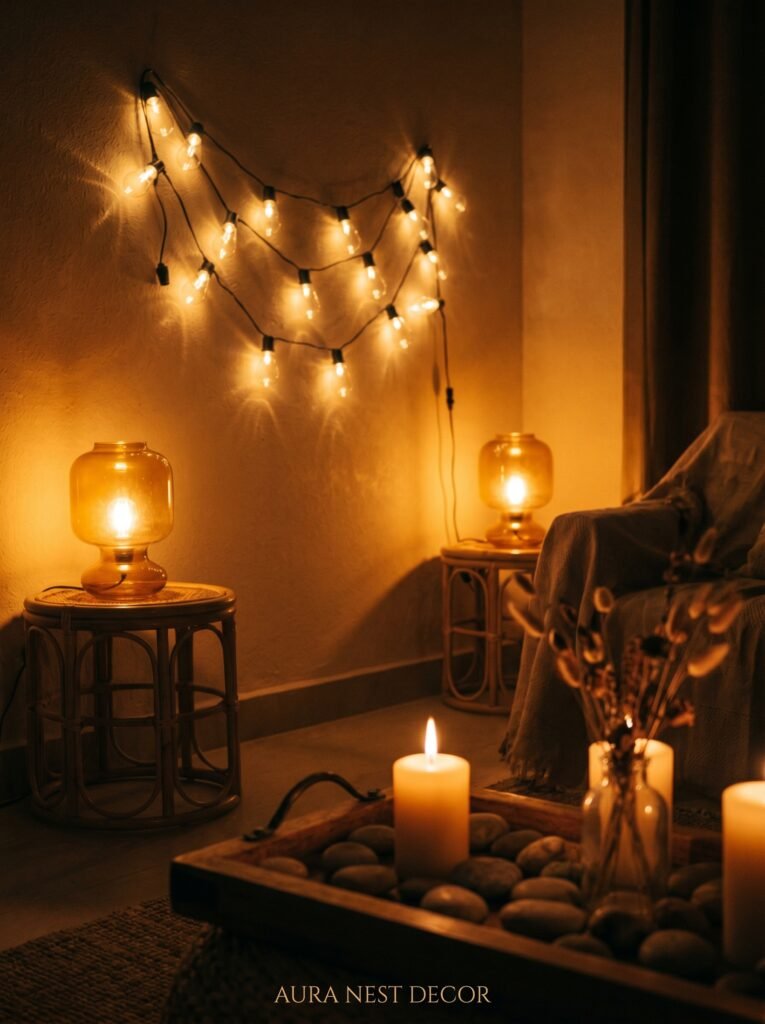
Here is an underappreciated truth about interior design: a room is two completely different spaces depending on its lighting. The most beautifully styled living room in the world will feel flat and uninspiring under the wrong light. The most basic room will feel extraordinary under the right light.
Modern boho lighting has one rule: layers. You need at least three light sources, and none of them should be overhead on full brightness. An arc floor lamp throwing warm light down over the sofa. A table lamp on a console or side table creating a soft pool of amber. String lights or fairy lights tucked into a bookshelf or wound through a woven wall basket for the lowest, warmest glow.
The color temperature matters enormously. You want bulbs in the 2700K range — that’s the warm amber end of the spectrum, not the blue-white daylight bulbs you’d use in a workspace. In the US, look for bulbs labeled “soft white” or “warm white.” In the UK, anything in the 2700K range at your local B&Q or Dunelm will do it.
Dimmer switches are one of the highest-return investments you can make in a room. They cost very little. They change everything.
And candles. Yes, real ones. The kind that smell faintly of cedar or sandalwood and make the room feel like somewhere you actually want to be at 8pm on a Tuesday.
—
9. The Vintage Piece That Grounds the Whole Room
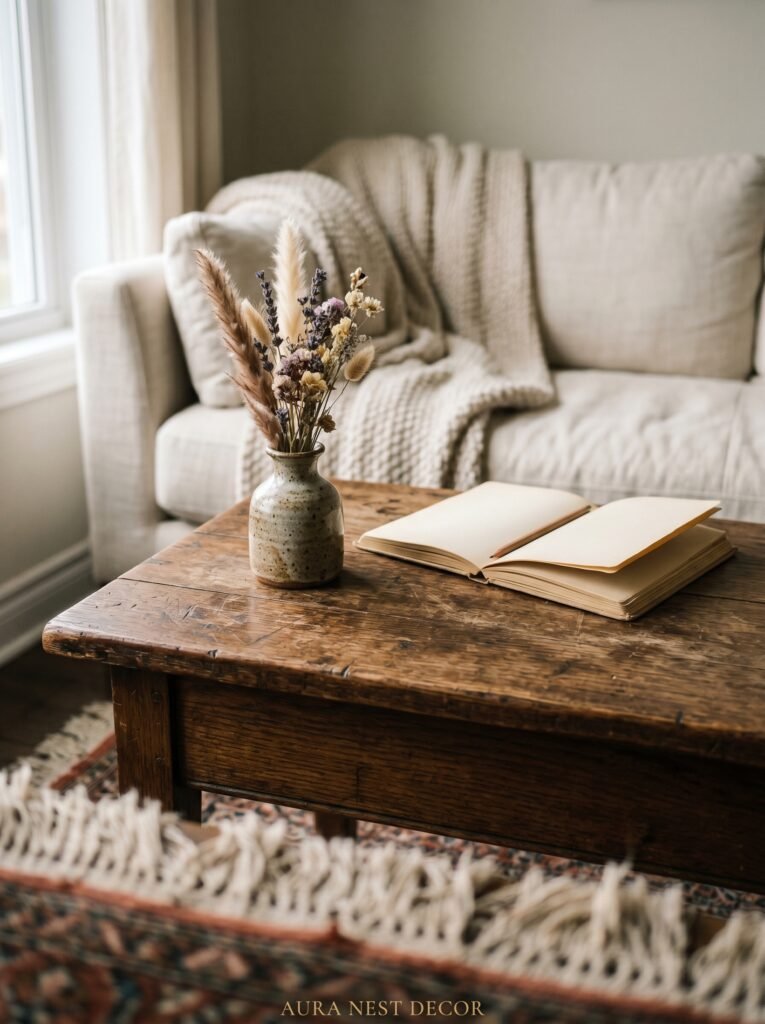
Every good modern boho room has at least one piece that looks genuinely old. Not shabby. Not distressed-from-the-factory. Actually old.
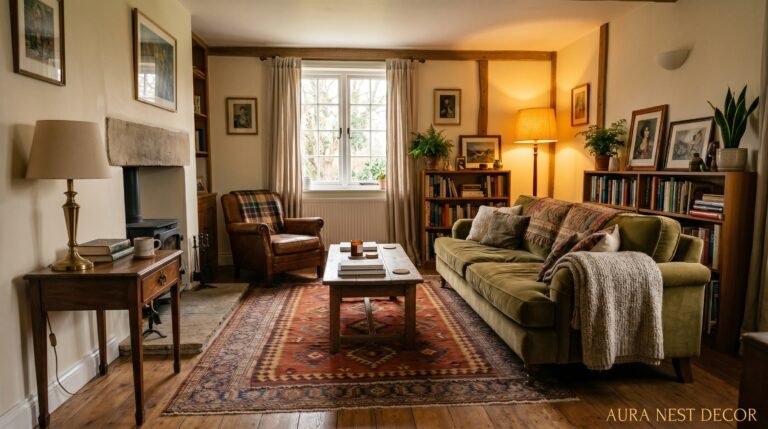
It could be a side table from a thrift store or charity shop with beautiful patina and original brass hardware. A stack of vintage hardback books in warm spines, sourced for fifty cents each at a car boot sale or library sale. An old woven blanket from an antique market. A ceramic bowl that belonged to someone’s grandmother.
These pieces do something no new item can replicate. They add a layer of realness. They tell the room’s story without saying a word. They make the whole space feel like it evolved organically rather than being assembled in one weekend.
In the US, Goodwill, estate sales, and Facebook Marketplace are your best friends here. In the UK: charity shops in market towns (the ones in wealthier areas tend to have genuinely beautiful donations), car boot sales in spring and summer, and eBay sellers who specialize in vintage homeware.
The one rule: bring it home and clean it. Polish the wood, wash the textile, wipe down the ceramic. Old pieces deserve a fresh start.
—
10. Open Shelving Styled the Way Interior Designers Actually Do It
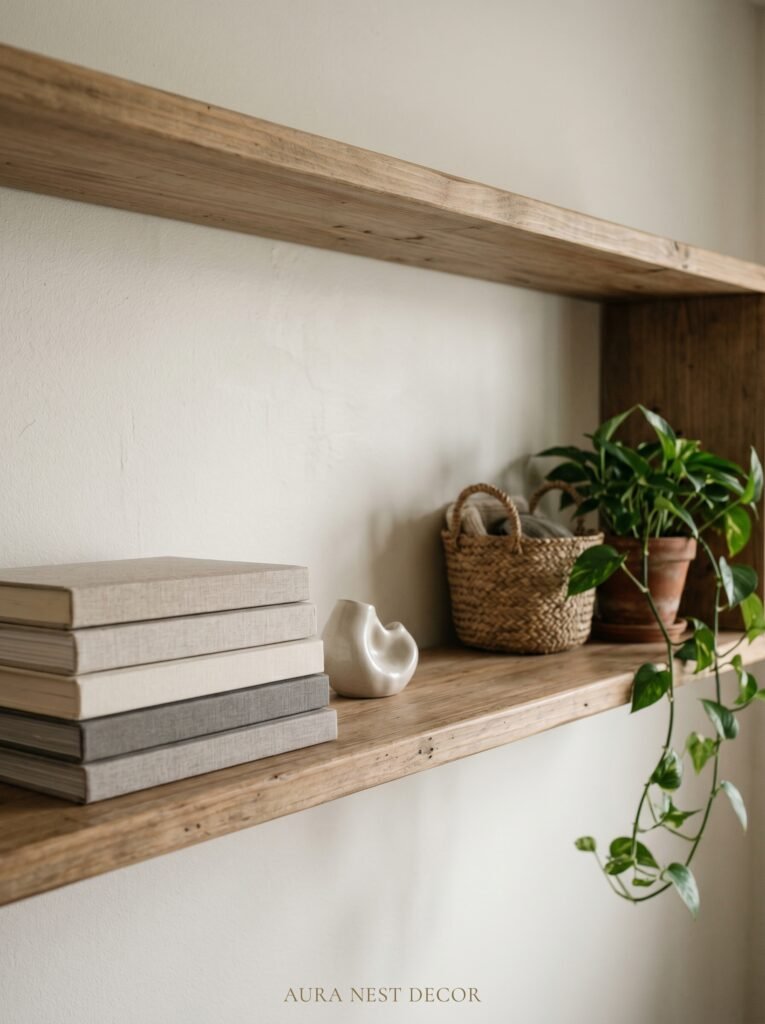
Open shelving is either the most beautiful thing in a living room or the most stressful. The difference is almost entirely in the approach.
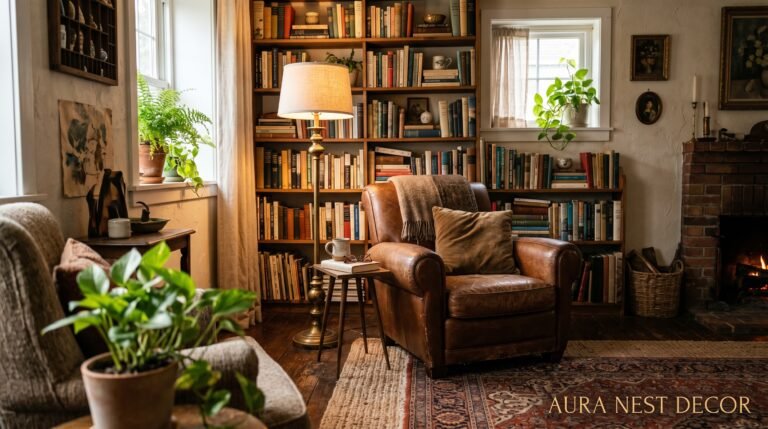
The designer secret is this: style in clusters, not rows. Three or four items grouped together — a plant, a stack of books, a small sculpture — create a moment. That moment sits next to an intentional gap of negative space. Then another cluster. This rhythm of full and empty is what makes styled shelving look professional rather than packed.
For a modern boho living room, your clusters should mix three types of objects: something organic (a plant, dried botanicals, a piece of driftwood), something textural (a woven basket, a clay pot, a rough ceramic), and something personal or meaningful (a book you love, a photograph, a souvenir from a trip that mattered). That three-part formula works for every shelf, every time.
Color-code your books if you want the tidiest, most Pinterest-worthy result. Pull all the books with spines in similar tones and group them together. Warm neutrals — creams, tans, faded terracottas — will blend beautifully with the rest of your boho palette.
—
11. The DIY Textile Project That Looks Like It Cost Three Times What It Did
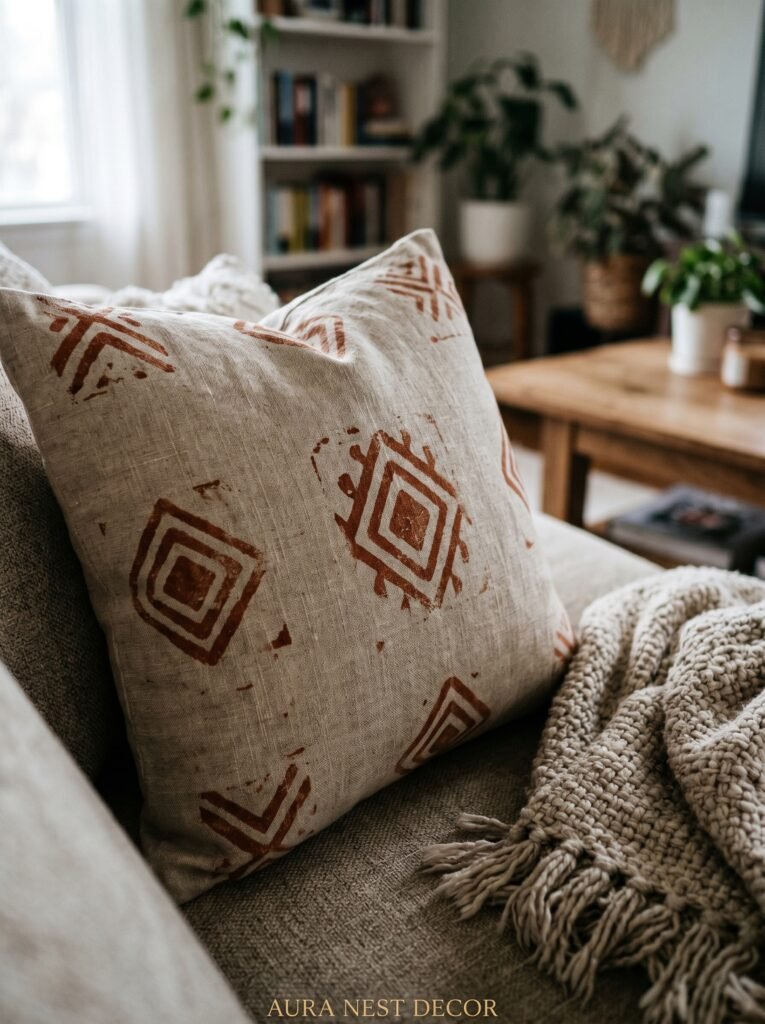
Natural dyeing with turmeric, avocado pits, or black tea is having a serious moment — and for good reason. It’s inexpensive, the results are genuinely beautiful, and the process is surprisingly meditative.
Turmeric is the easiest starting point. You need a 100% cotton or linen fabric (pillowcase, plain curtain panel, tote bag), a large pot, water, and turmeric powder. Simmer the fabric in a turmeric bath for an hour. The result is a warm, golden yellow with subtle variation that no factory dye can replicate.
Avocado pits and skins give you dusty pinks and warm tans — colors that look like they came from a Scandinavian design store and cost forty dollars per napkin. Save your avocado pits in the freezer over a few weeks (you need about eight to ten for a good dye bath), then simmer fabric in the resulting liquid.
What to dye: pillowcases, throw pillow covers, linen napkins you use as decorative layering on a coffee tray, a simple curtain panel for a doorway. These handmade textiles, used throughout the room, create a cohesion that feels deeply intentional — because it is.
—
12. The One Rule That Makes Any Boho Room Feel Complete, Not Cluttered
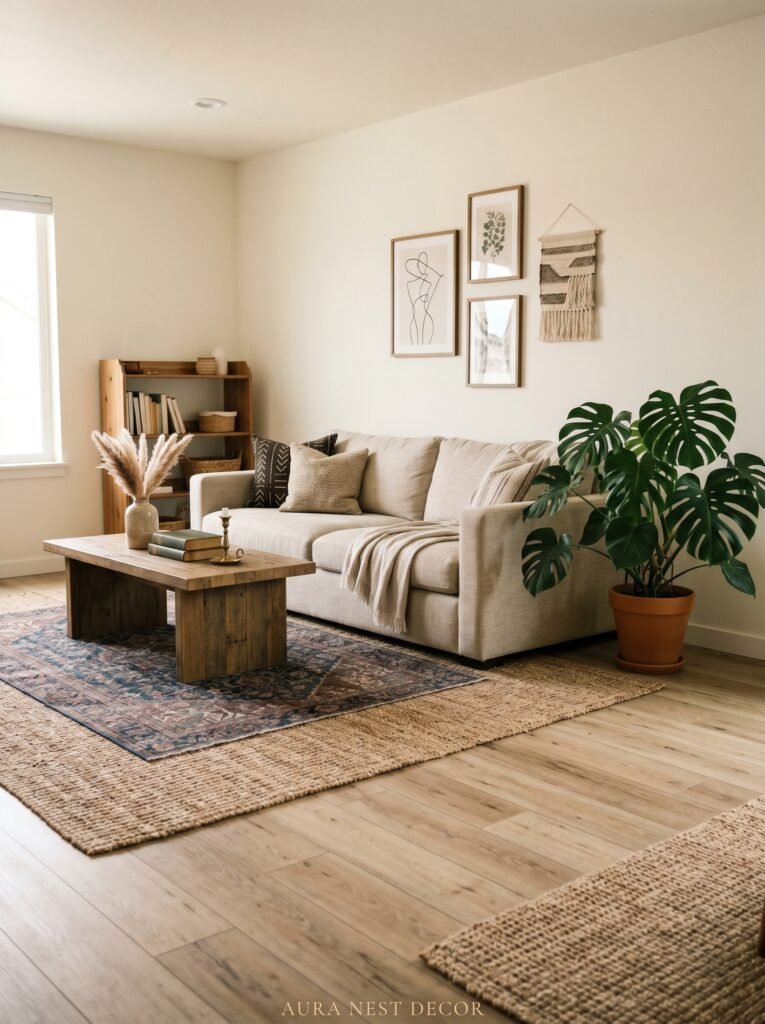
Here it is. The rule that holds all of this together.
Every single item in your room should have a reason to be there — either it’s beautiful, useful, or meaningful. Ideally two of those three. If something is none of those things, it shouldn’t be in the room.
That sounds obvious. It isn’t. Most cluttered spaces — spaces that look “trying too hard” or just plain busy — are full of things that don’t pass that test. Impulse buys. Gifts you felt obligated to display. Decor that matched something else you don’t even own anymore.
Modern boho can hold a lot of layers. Texture, pattern, color, plants, art, vintage pieces, handmade objects — it can hold all of it, and it can look incredible. But it can only hold things that earned their place. The moment you start filling space for the sake of filling it, the whole feeling shifts.
Walk around your living room right now. Pick up three things. Ask: beautiful, useful, or meaningful? If none of the above, let them go.
The room you’re building doesn’t need more. It needs better.
—
❓ FAQ
Q: How do I make a modern boho room look intentional without it feeling too designed or fake? A: The key is mixing sources deliberately — something vintage, something handmade, something you’ve had for years, something new. When a room contains objects from different time periods and price points, it naturally reads as collected rather than styled. The personal pieces are what make it feel real.
Q: What’s the difference between modern boho and just regular boho decor? A: Modern boho edits more aggressively. Where traditional bohemian style layered endlessly and embraced maximum maximalism, modern boho keeps a neutral, restrained base and uses natural materials as the backbone. It borrows from Scandinavian minimalism for the framework, then adds warmth, texture, and personality within that structure.
Q: I’m renting and can’t make permanent changes — can I still pull off this look? A: Absolutely. The biggest wins in modern boho decor — rugs, textiles, plants, lighting, gallery walls (with Command strips), and furniture arrangement — don’t require a single nail or a drop of paint. You can change the entire feel of a rented living room without touching the walls, and take everything with you when you leave.
—
💭 Final Thoughts
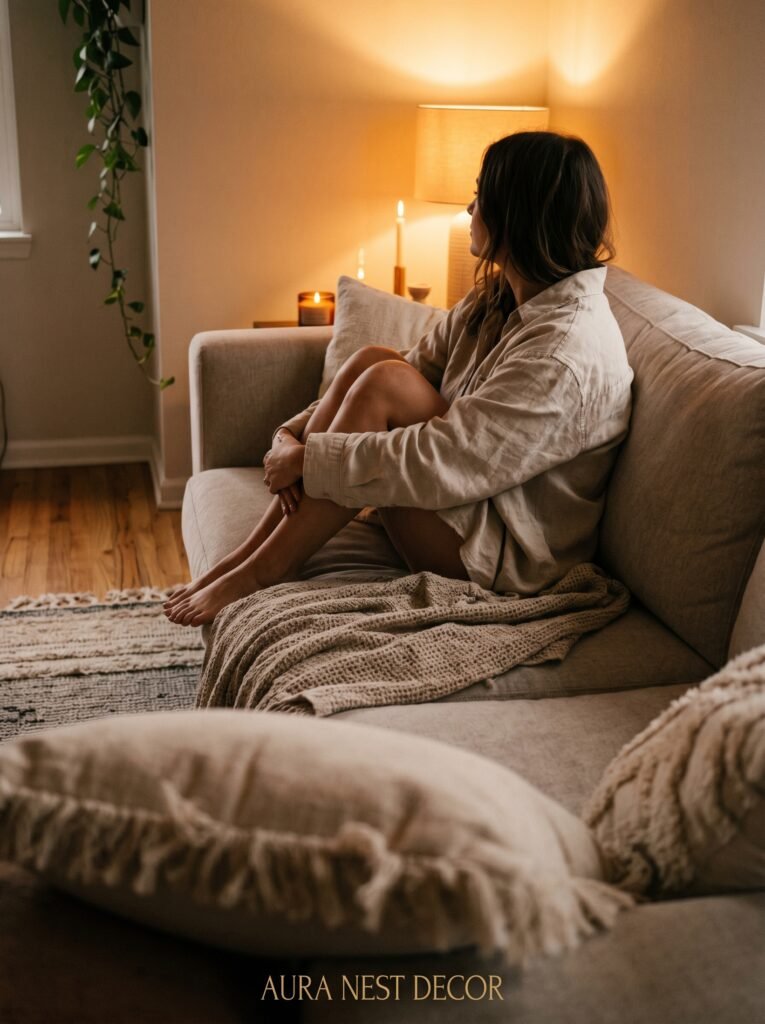
The living room you’re imagining — that warm, layered, feels-like-you space — isn’t that far away. Most of it is simpler and more affordable than it looks. Start with one corner. Get the light right. Add one thing that’s genuinely yours.
The best modern boho rooms don’t look decorated. They look lived in — by someone who knows exactly what they love.
What’s the one corner of your living room you’d want to transform first?