The TV Stand That Actually Makes Your Living Room Feel Like Somewhere You Want to Be
You know that feeling when you walk into someone’s house and their living room just feels right — and you can’t immediately figure out why? Nine times out of ten, it’s the TV stand area. It’s the thing nobody talks about, but everybody notices.
—
1. Why the TV Stand Is the Most Underestimated Spot in the Entire Room
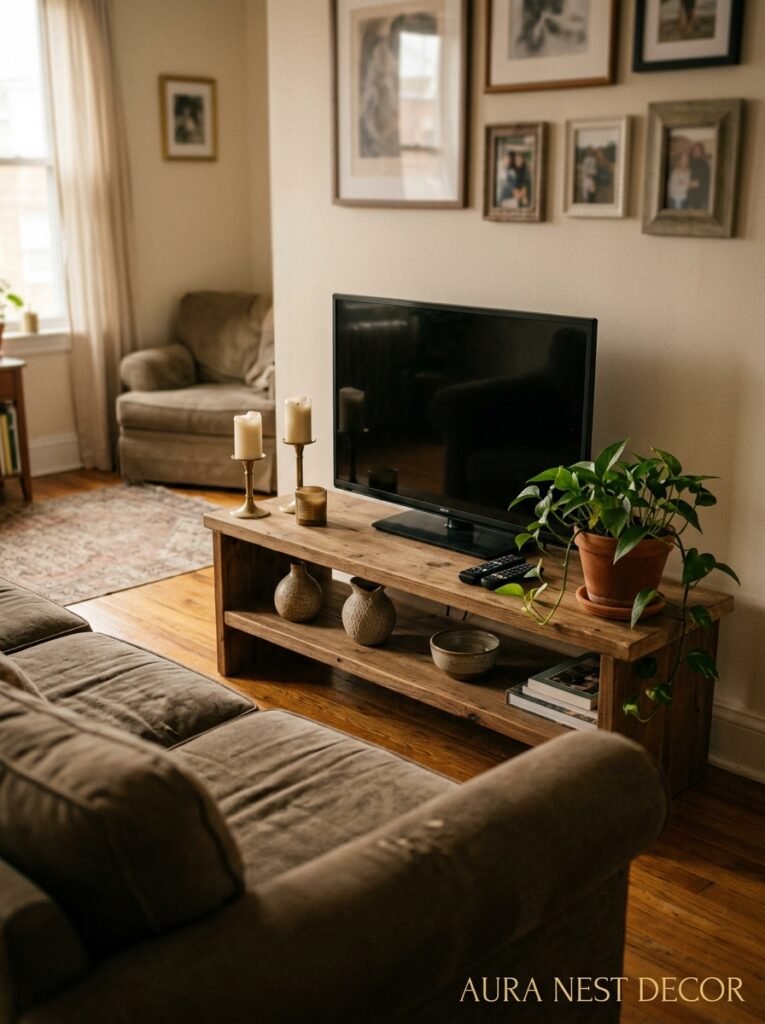
Here’s the thing: we spend so much time talking about sofas, throw pillows, rugs — all the obvious stuff — and almost nobody gives the TV stand a second thought beyond “will it hold the TV?” But that whole zone, that horizontal stretch of furniture beneath a screen, is basically the anchor of your entire living room. Everything faces it. Everyone looks at it constantly.
And most of them look… like a tech display at an electronics shop. Cords everywhere, a random remote, maybe a sad little plant that’s seen better days.
But it doesn’t have to be that way. I’ve spent way too long obsessing over this specific spot, and I can tell you it’s one of the highest-impact changes you can make without touching a single wall or buying a new sofa. The key is understanding what you’re actually working with — you’ve got surface space, vertical height (if your stand has shelves), and the wall behind and above the screen. That’s three separate styling zones and most people treat them like one big problem to ignore.
Start thinking of the TV stand not as “where the TV lives” but as a proper display area that just happens to have a screen in the middle of it. That mental shift is kind of everything.
“Stop decorating around the TV. Start decorating with it.”
—
2. The Case for Leaning Into Warm Wood Tones Even If Your Room Isn’t “Rustic”
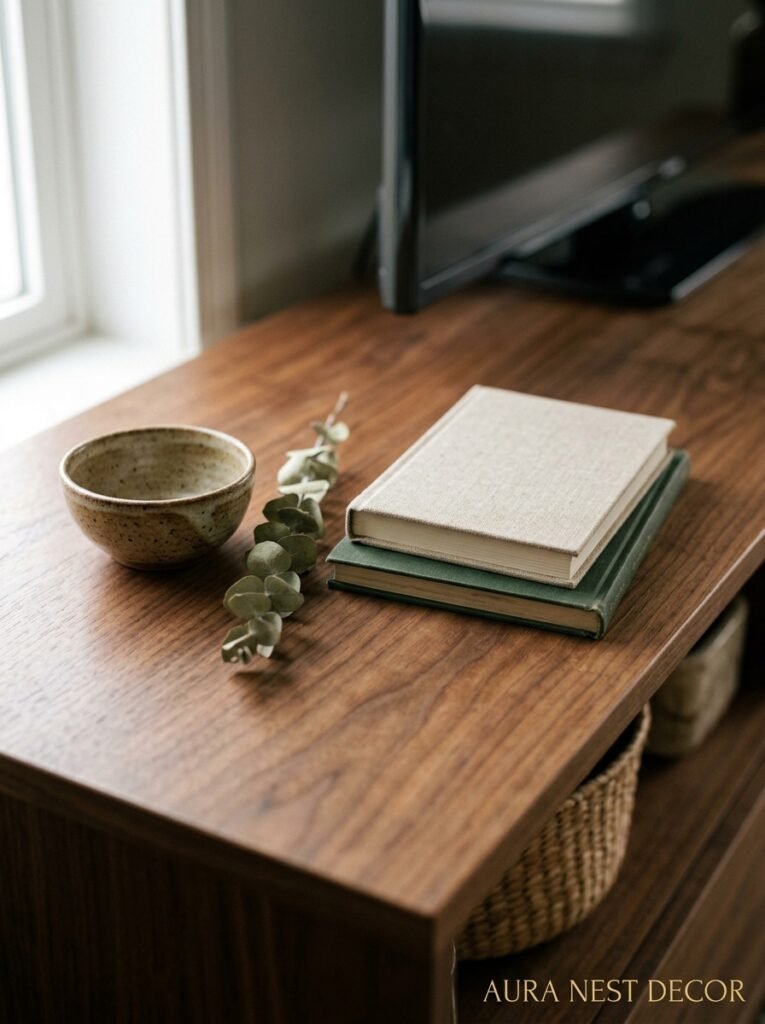
Warm wood is everywhere right now — and I don’t mean in a trendy, it’ll-be-over-in-eighteen-months way. I mean it’s showing up in genuinely beautiful rooms because it WORKS. It adds warmth, obviously, but more than that, it breaks up the cold, flat quality that screens bring into a room.
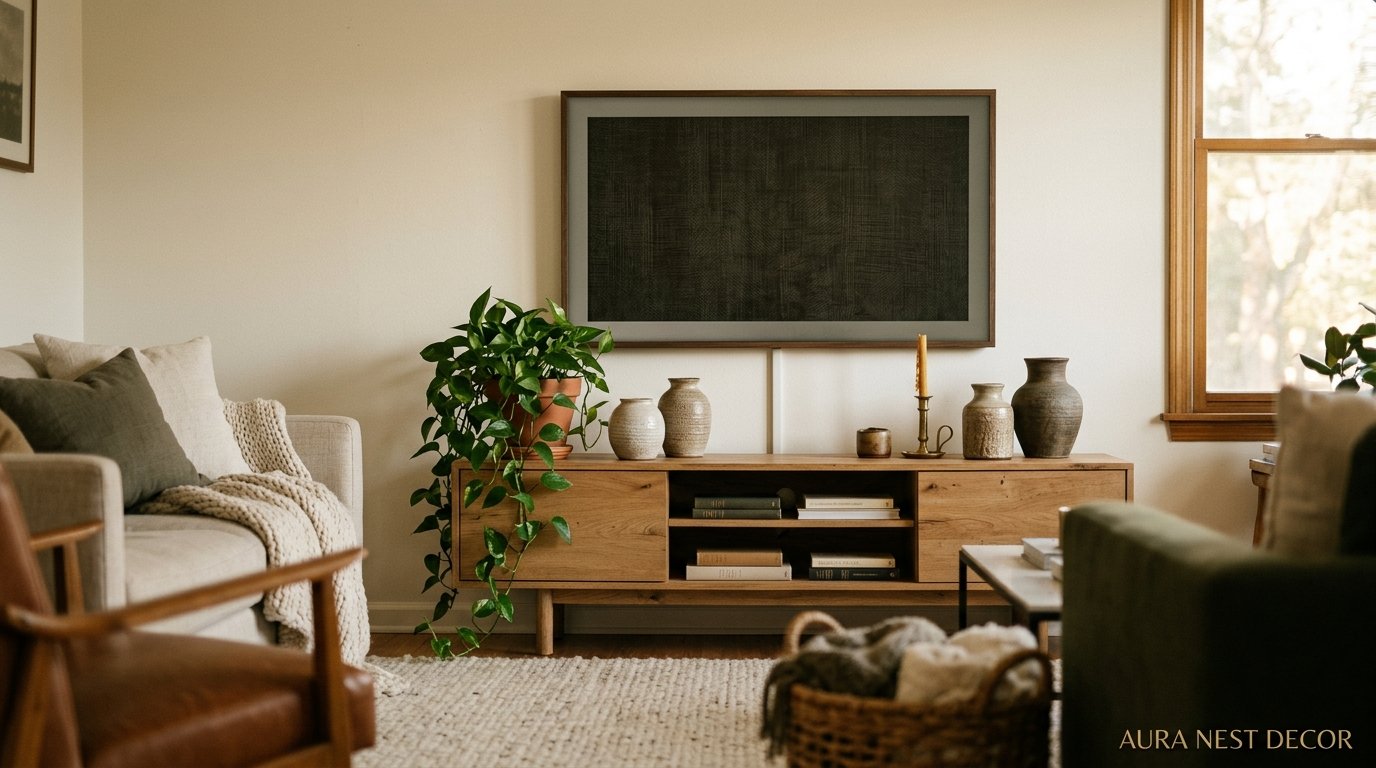
If your TV stand is already a warm oak or walnut tone, you’re ahead. If it’s black, white, or that weird grey laminate — okay, we can work with it. Layer in wood elements on top: a chunky little wooden bowl, a small stacked-book stack with a spine showing, a raw-edge tray you use to corral your remotes. Suddenly the stand reads “intentional” instead of “leftover.”
For UK readers especially — a lot of period homes have beautiful warm undertones in the walls and floors that practically beg for this palette. Don’t fight it. And for American homes that tend toward cooler, more neutral finishes, warm wood is actually the contrast that makes the whole room feel less stark.
There’s something about the texture of wood grain that your eye genuinely relaxes into. Can’t explain the science of it, but I believe it completely.
—
3. Height Is Everything — And Most People Get It Wrong
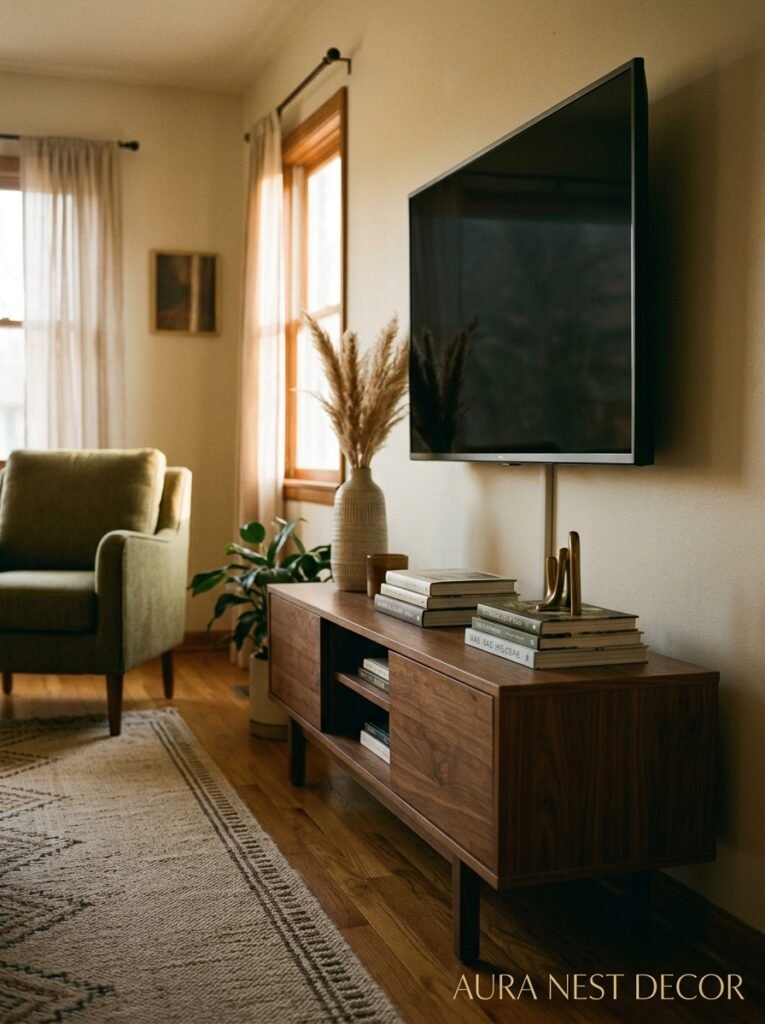
Not gonna lie, this one took me ages to figure out. The objects you put on a TV stand almost always need to vary in height more than you think. Not in that “stair-step everything perfectly” way — that looks staged and a little stiff — but in a genuinely uneven way, where your eye has to actually travel around.
Think: one very tall thing (a sculptural vase, a narrow floor-adjacent candlestick), one very low thing (a small stack of books lying flat, a dish), and everything else somewhere in between. The tall thing anchors. The low thing grounds. The middle stuff fills in without competing.
The mistake I see most often is everything landing at the same height — a row of similarly-sized objects that your eye reads as a flat line and immediately dismisses. Your brain wants movement. Give it movement.
Side note — this is also why a single trailing plant works so well in this spot. The drape of the leaves creates a natural diagonal that breaks up any rigid horizontal feeling. Pothos, string of pearls, trailing ivy — any of them will do the job and they’re basically unkillable, which, honestly, is a requirement.
—
4. The Colour That Keeps Showing Up in Every Cozy TV Stand I’ve Ever Admired
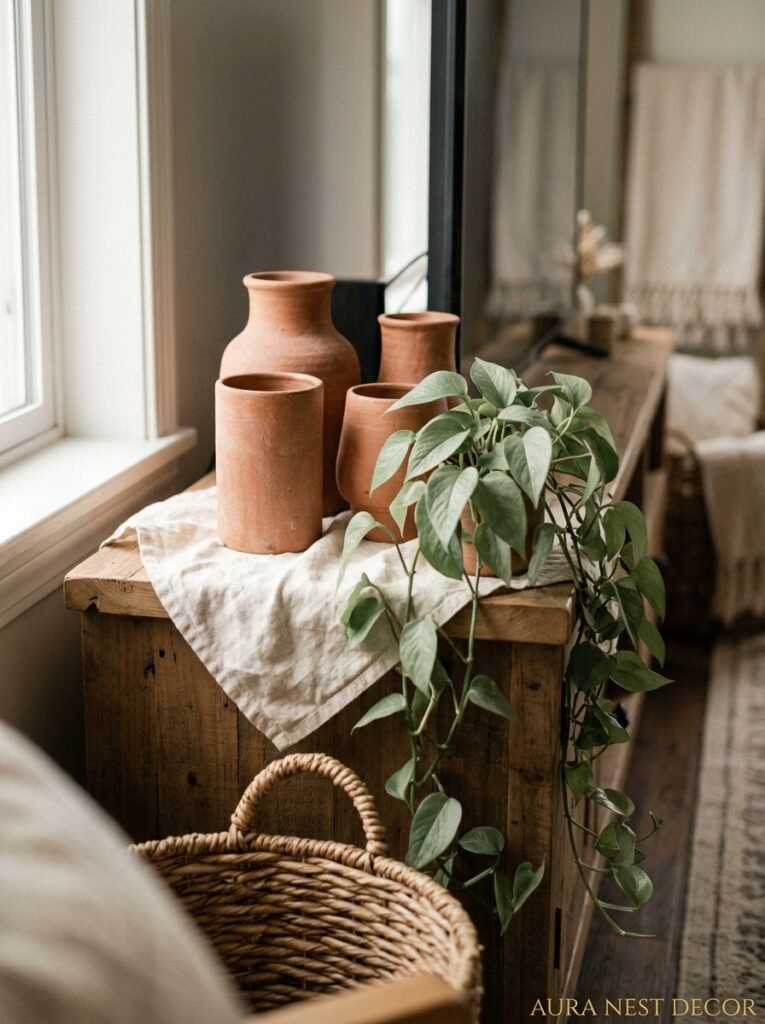
Terracotta. And before you say “I’m not doing a whole southwestern desert thing” — hear me out, because that’s not what I’m talking about at all.
I mean one terracotta element. A single small pot. A low clay candle holder. A folded throw in that dusty orange-rust tone draped over the corner of the stand. It reads warm, earthy, and slightly vintage without going full maximalist. And it plays beautifully against both warm wood AND against cooler grey or white furniture, which is maybe why it keeps appearing everywhere.
The other colours I’d push toward: deep forest green, especially in matte ceramics, and a very muted dusty blush — not pink-pink, but almost a faded rose that reads more like a neutral. Both of those have that same quality of adding warmth and life without shouting.
“One warm colour you actually love is worth ten ‘safe’ neutrals you’re just tolerating.”
What I’d steer away from: anything too bright, anything that matches your wall colour exactly (boring), and — I’m just going to say it — live succulents in those tiny pots. They look great in photos and die within six weeks. Get a good fake one or get something that actually survives.
—
5. Candles: The Non-Negotiable That Changes the Whole Evening Atmosphere
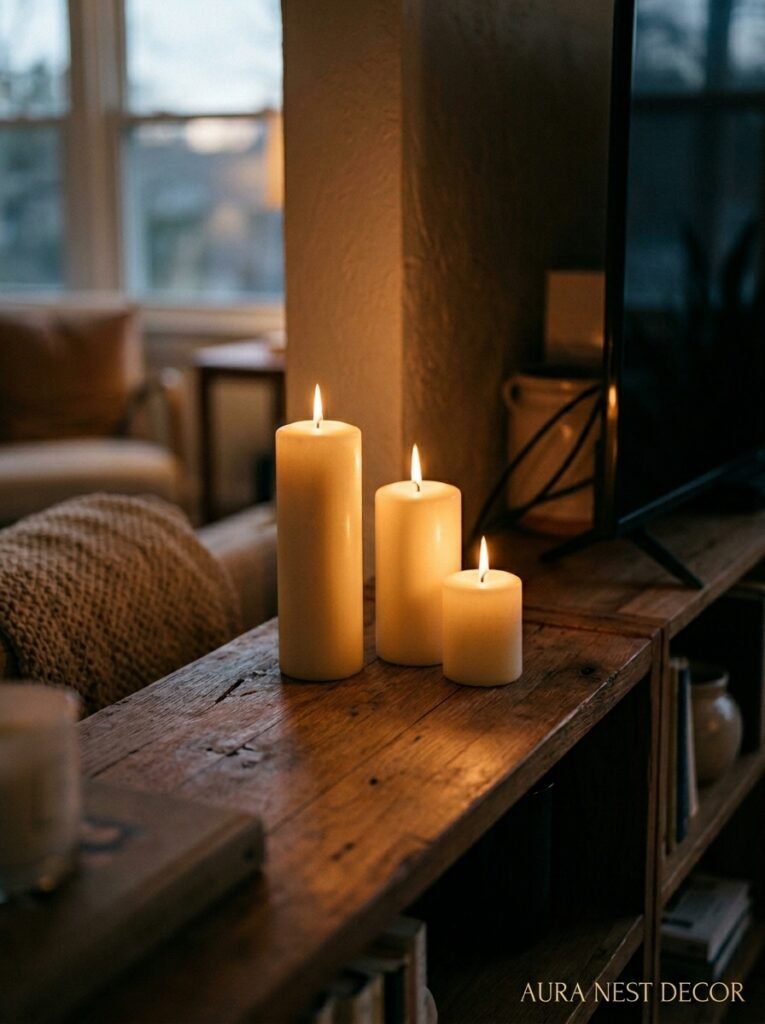
You probably already know candles are cozy. But there’s a specific way to use them on a TV stand that goes from “I put some candles out” to “this room feels like a hotel spa someone actually lives in.”
First: clusters. Three candles at different heights, grouped close together, beat five candles spread evenly across a surface every single time. Grouping creates intimacy. Spreading creates inventory.
Second: the vessels matter as much as the candles. A pillar candle in a low glass hurricane. A taper in a heavy marble holder. A small concrete tea light cup. The containers are decor even when the candles aren’t lit — and during daylight hours, that matters.
Third — and this is the bit people miss — unscented or very lightly scented for the living room. I know. But strong candle scent competes with everything in a room you’re actually using. Save the intense bergamot and amber for a bedroom or bathroom. In the lounge, you want atmosphere, not aromatherapy.
British note: those tall pillar church candles that show up in every M&S home section right now are genuinely brilliant for this. They’ve got that slight imperfection in the wax that looks like they’ve been burning for decades. Very beautiful.
—
6. The Rule That Makes Shelf Styling Feel Less Like a Chore
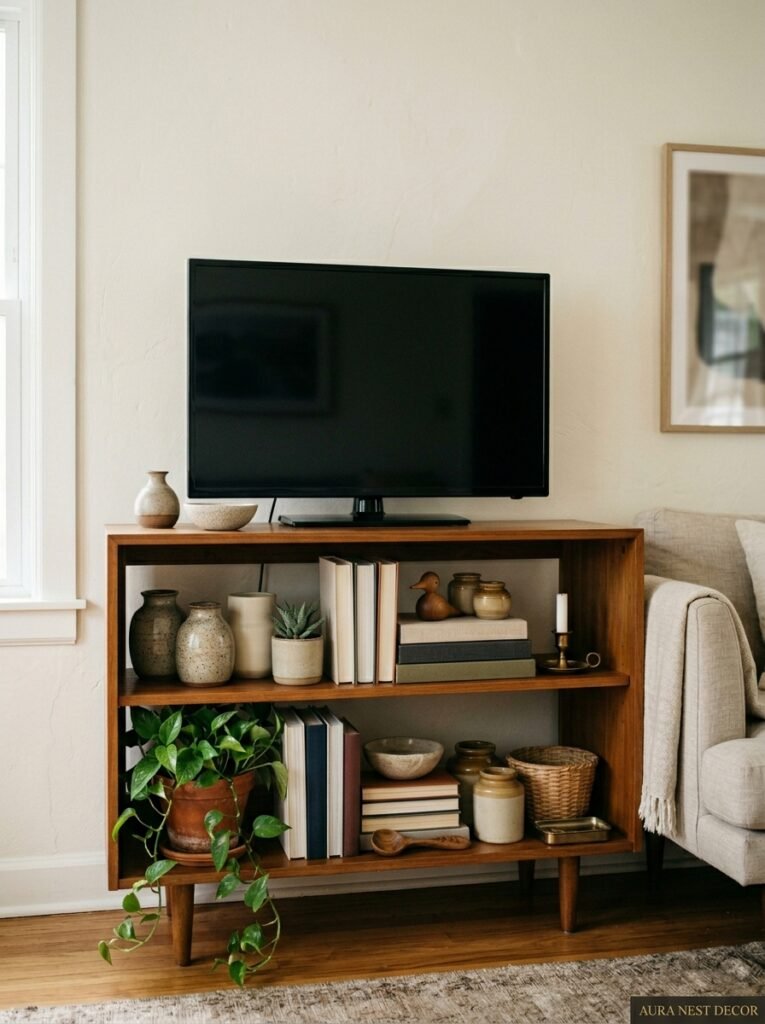
If your TV stand has open shelves underneath, here’s the only rule you need: mix something beautiful with something functional on EVERY shelf. Not a shelf of pretty things, not a shelf of ugly practical things — every shelf, mixed.
So: a stack of your actual favourite books you’re genuinely reading or want to, next to a small ceramic piece you love. Your games console or cable box (the necessary ugly thing), but surrounded by a small potted plant and a wooden storage box that hides the seventeen remotes you somehow own.
This works because it stops the shelves from reading as either a display case (which feels precious and untouchable) or a storage unit (which feels like giving up). The blend says: this is a real home, someone lives here, and they have taste but they’re not precious about it.
The other thing — don’t fill every inch. A little breathing room on a shelf is not wasted space. Some of the most beautiful shelfies I’ve seen on Pinterest have as much empty shelf as they have stuff. Counterintuitive, but real.
—
7. How the Wall Behind the TV Can Work FOR You Instead of Just Existing
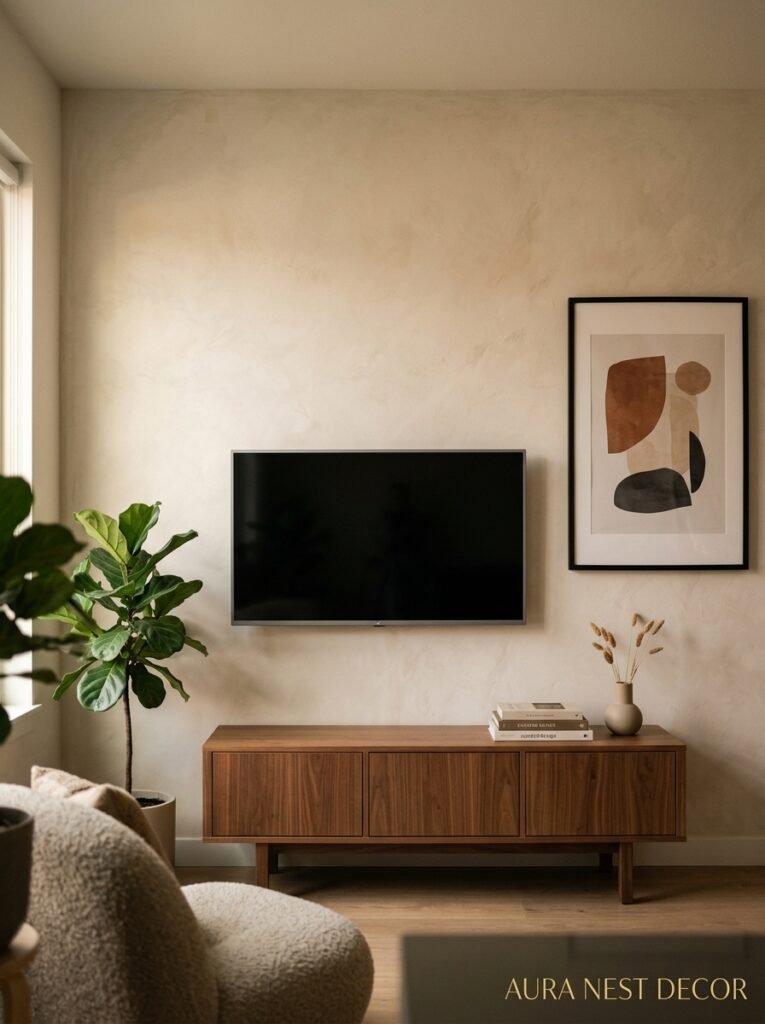
Most living rooms have the TV sitting against a flat, empty wall and it’s fine but it’s just… fine. If you want the whole area to feel cozy and considered, the wall is where you can do serious work.
Gallery walls directly behind a TV are tricky — the sizes often compete and it can get busy. But here’s what DOES work: a single oversized piece of art or a large round mirror positioned slightly above and behind the screen. The scale contrast is satisfying. The screen looks deliberate instead of just parked there.
For UK homes especially, picture rails are your best friend here. You can hang a large canvas or even a textile — a woven wall hanging, a macramé piece — without touching the walls, which is crucial if you’re renting.
“The wall behind your TV isn’t background — it’s the frame for the whole room.”
Alternatively: panelling or wallpaper on that single wall. A rich navy or deep green behind a TV stand makes the whole thing look like an installation. It’s one of those changes that feels extreme in theory and completely obvious once it’s done.
—
8. Books as Decor (Without Making It Look Like You’re Trying Too Hard)
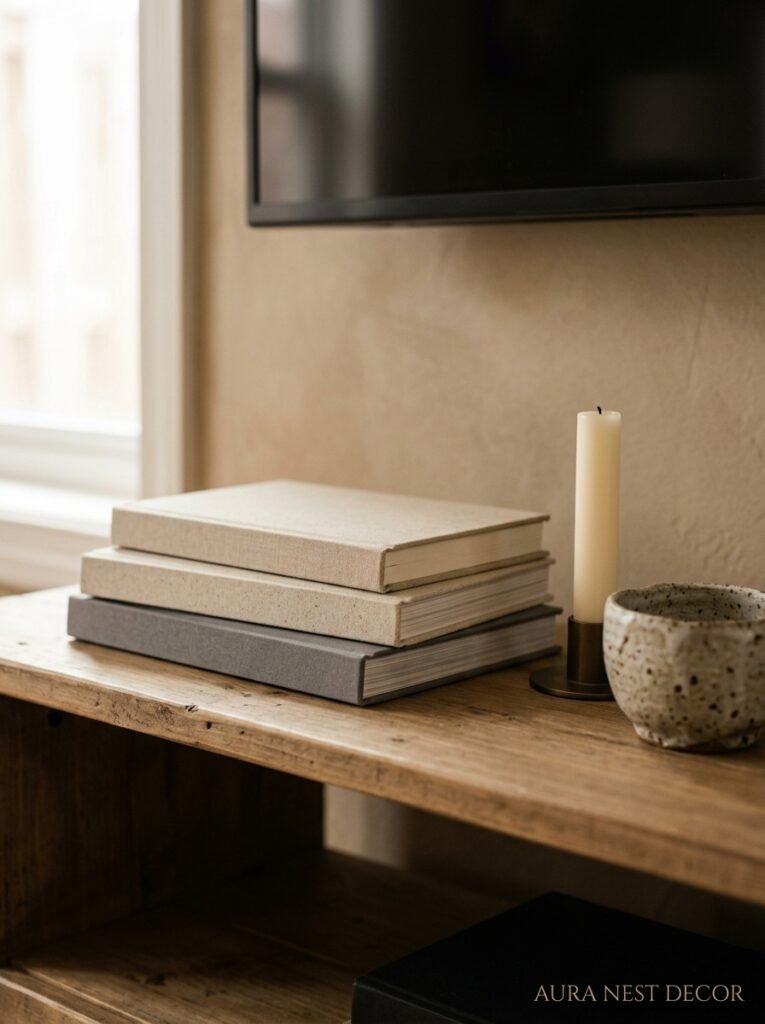
Books on a TV stand hit different than books on a bookshelf, for some reason. Maybe because it’s unexpected. A small, casual stack — three or four max, lying flat with a small object balanced on top — reads as life being lived, not decor being deployed.
The keys: don’t remove the dust jackets if you like them. Ignore anyone who tells you to — that advice got very tired very quickly and some covers are genuinely beautiful. BUT if you have a run of very mismatched, visually chaotic spines, turning a few of them spine-in (so just the white pages show) gives you a clean moment without hiding that you own books.
Coffee table books work brilliantly here because they’re designed to be seen. A beautiful photography book, a thick architectural monograph, something about food or nature — they add colour and content without being fussy.
And if you’re thinking “nobody’s going to be impressed by my paperback thrillers” — honestly? A couple of battered paperbacks in a stack reads really authentically. It doesn’t all have to be curated. Some of the cosiest stands I’ve seen have a half-finished novel with a bookmark sticking out of it, and it’s completely charming.
—
9. Greenery: The Specific Plants That Actually Suit This Spot
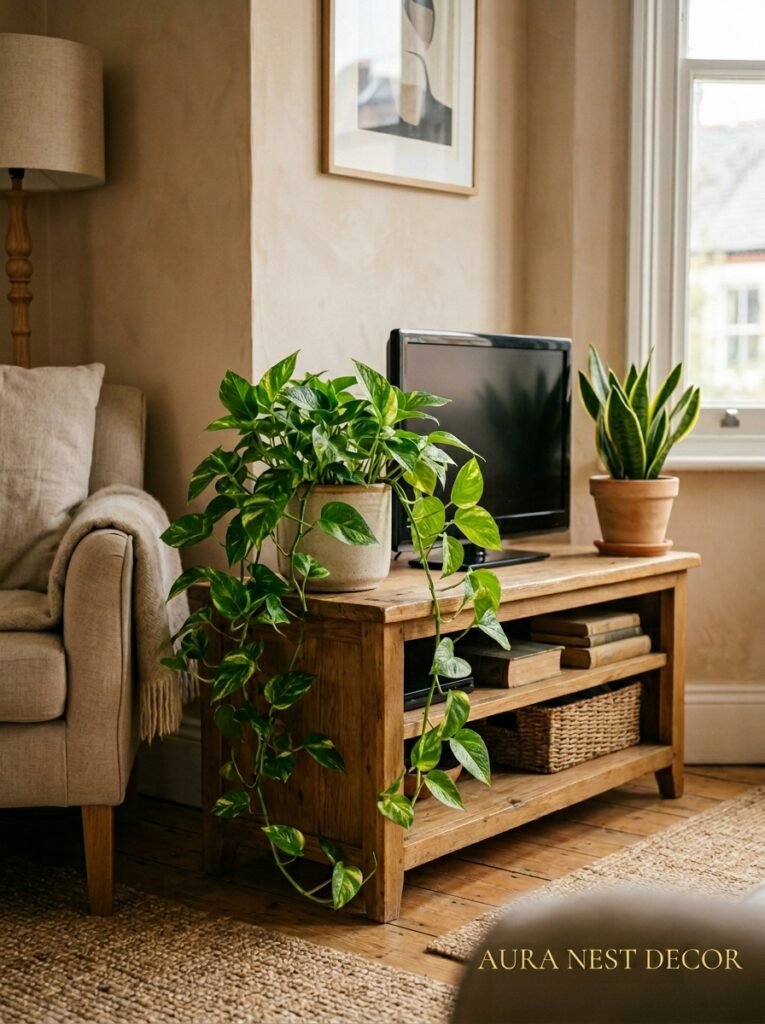
The TV stand plant situation is its own science. Most plants want natural light. Most TV stands are against interior walls away from windows. So let’s be realistic.
Low-light legends for this spot: pothos (trailing beautifully over a shelf edge), snake plants (if there’s any ambient light at all), ZZ plants (practically indestructible), and cast iron plants (which are basically invincible, and which have a certain dark, graphic quality that’s very satisfying).
If you’re near a window or you’ve got decent ambient light — a fiddle leaf fig or olive tree beside (not on) the stand adds enormous visual height and that organic quality that makes a room feel alive.
Dried botanicals are an option too, and they’ve come a long way from the dusty pampas grass phase. Dried magnolia leaves, preserved eucalyptus, bleached seed pods — properly arranged in a good vase, they look considered rather than neglected.
Just please: no fake flowers. Fake foliage, I’ll allow. Fake flowers, in a living room, in 2025 — I can’t get behind it. That’s a personal line and I’m drawing it.
—
10. The Cord Management Secret That Nobody Wants to Do But Everyone Should
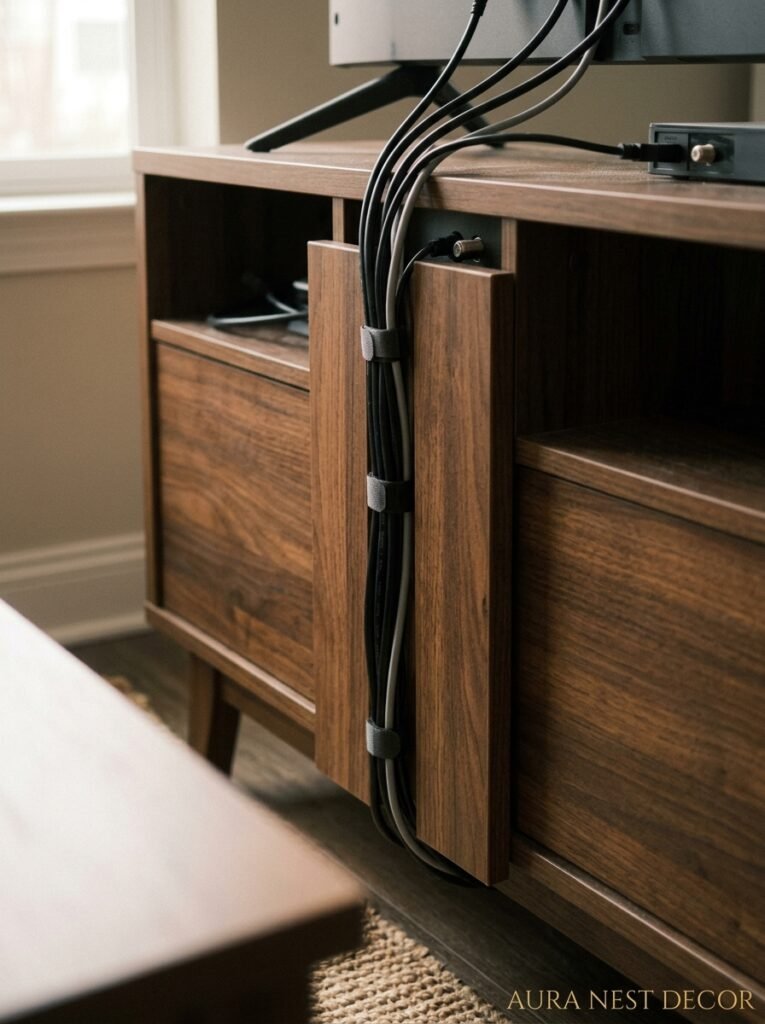
Okay, real talk. You can style the most beautiful TV stand in the history of interior design and a single dangling cable will undo thirty percent of it. This is just true. I don’t make the rules.
You don’t need to go full custom-built-in to solve this. Cable management channels that stick to the back of furniture are cheap, widely available, and completely invisible once they’re in place. A cable box (the kind you buy at any hardware store) zip-ties multiple cables together and turns a visual mess into one clean line.
For the TV itself — if you can mount it and run cables through the wall, do it. That’s the dream. But if not, a cable raceway in a colour that matches your wall (white on white walls, cream on cream) reads as invisible from more than three feet away.
The thing about cable management is it’s one of those boring tasks you avoid for six months and then do in forty minutes and wonder why you lived like that for so long. I speak from experience.
—
11. Texture: The Invisible Thing That Makes Everything Feel More Expensive

If I had to give one piece of advice about making a TV stand area feel genuinely luxurious without spending serious money, it’s this: vary the textures.
Glossy ceramic next to rough raw wood. Woven rattan basket next to smooth marble. A linen-covered box next to a glass hurricane. The contrast is what creates that quality you can’t quite name but immediately feel. It’s why everything matchy-matchy looks expensive in the shop and a bit flat at home — without texture variation, your eye processes it all the same and moves on.
This is also how you can mix budget pieces with nicer ones without it being obvious. A cheap smooth ceramic vase next to a single genuinely good textured piece looks considered. The same cheap vase next to another cheap smooth thing just looks cheap.
—
12. The Evening Light Situation — Because All of This Looks Different After Dark
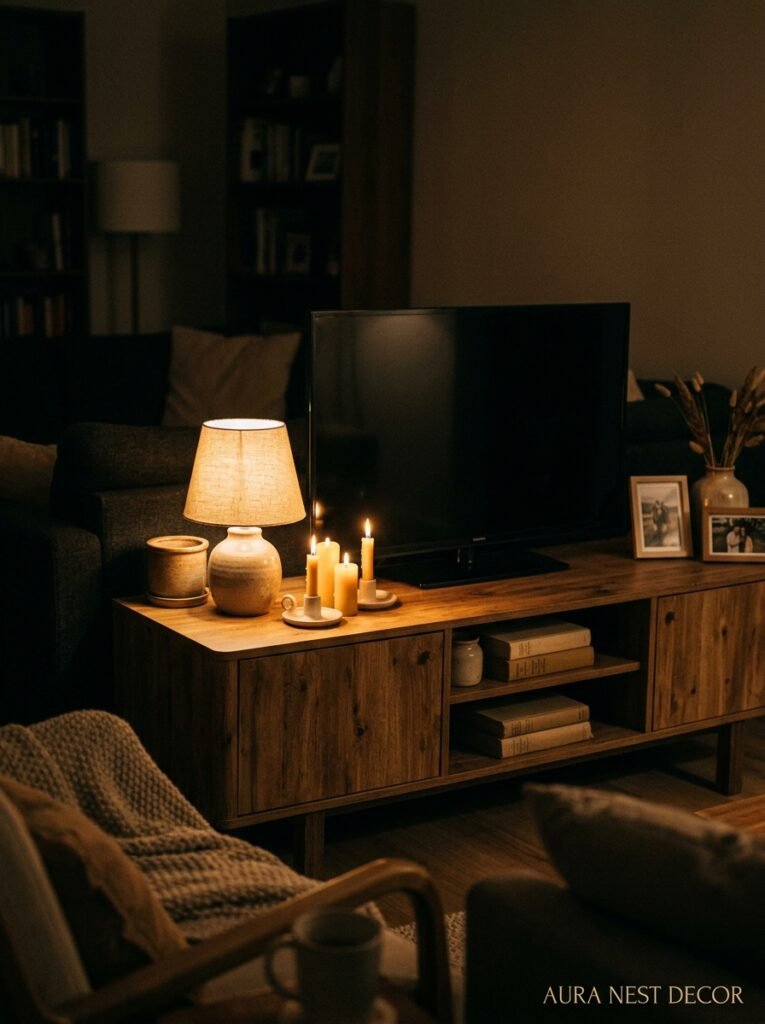
Everything we’ve talked about changes when the sun goes down. And a TV stand that looks great in daylight can feel cold and flat in the evening without the right lighting.
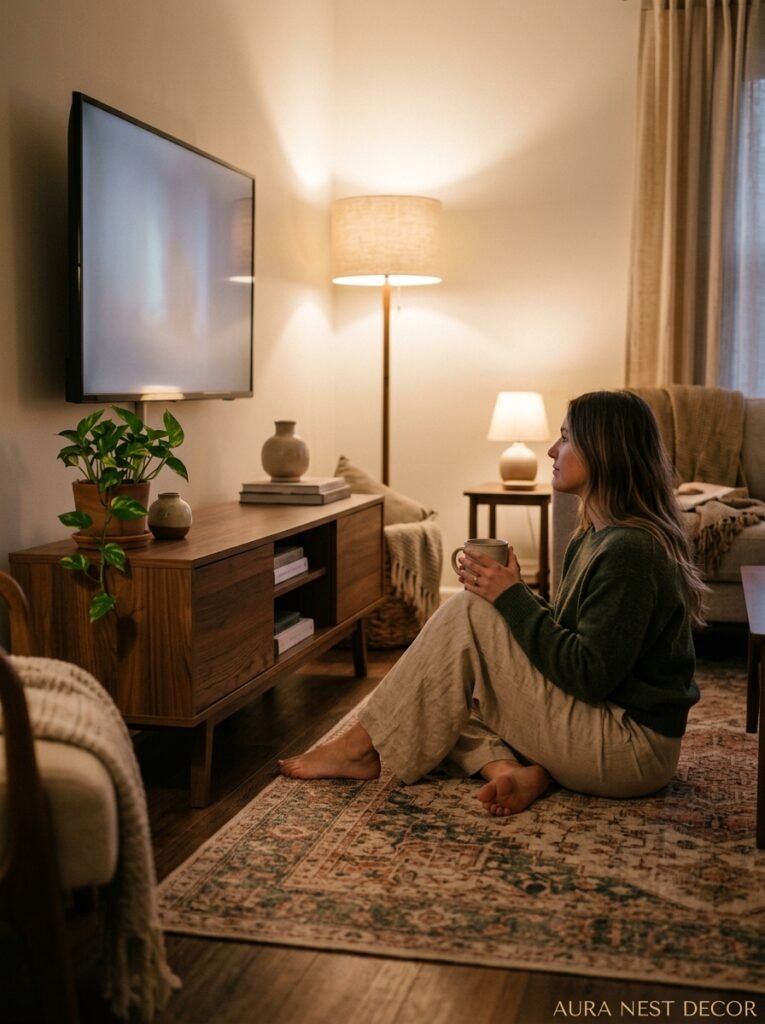
Side table lamps flanking a TV stand are the gold standard — they frame the screen and cast that warm side-light that makes every face and every object look better. But not everyone has the outlet situation for that, so alternatives: LED strip lights tucked behind the TV stand (not tacky if done in warm white, not cool white — this is non-negotiable), small battery-powered spotlights trained at a piece of art or a plant, or simply a floor lamp positioned nearby at the right angle.
The goal is to not be relying on overhead lighting alone after dark. Overhead lighting is the enemy of cozy. It flattens everything. You want pools of warm light at different heights — and your TV stand area, already the focal point, deserves to be one of those pools.
Honestly, a few candles lit and one good lamp and the whole thing comes together in a way no photograph fully captures. You just have to experience it in the room.
—
❓ FAQ
Q: How do I decorate around a TV stand without making the room look cluttered? A: The key is restraint more than anything — pick three to five meaningful objects rather than filling every surface, and make sure there’s visible breathing room between things. Variety of height and texture does more with less than a crowded display ever will.
Q: What’s the best way to hide cables on a TV stand without doing a full renovation? A: Cable management raceways or channels are the quickest fix — they’re inexpensive, available at most hardware stores, and can be painted to match your wall. A cord-cover box zip-tied around multiple cables running down the back of the stand also works well and takes about twenty minutes.
Q: Can a floating TV unit look cozy, or does it always feel a bit cold and modern? A: Floating units absolutely can feel cozy — the trick is what you put on and around them. A warm wood floating shelf with good textural objects, a trailing plant, grouped candles, and warm lighting on either side reads every bit as cozy as a solid floor-standing unit. The warmth comes from the styling, not the furniture.
—
💭 Final Thoughts
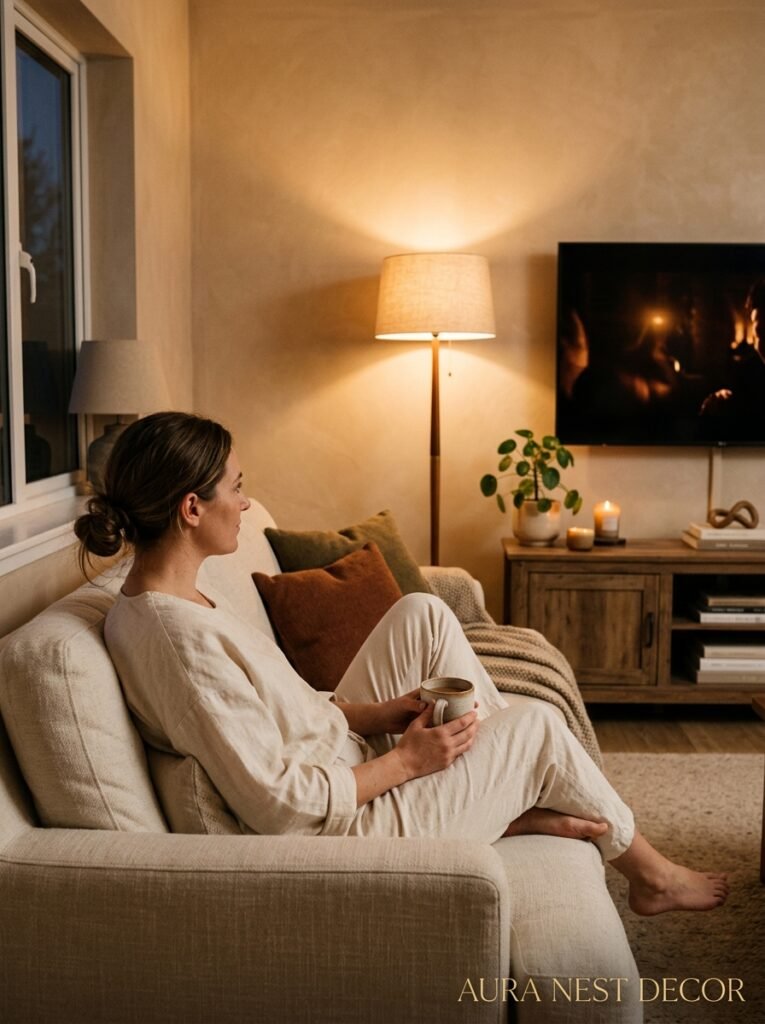
Your TV stand isn’t just storage. It’s the thing your whole room is organized around, whether you intended that or not. Treating it like it matters — really matters, not just “I’ll shove a plant there” — changes how the whole room feels to live in.
You don’t have to do everything here at once. One good change, done well, does more than twelve half-hearted ones.
What’s the one thing in your current living room setup that you walk past every day wishing it were different?