The Dark Living Room Glow-Up Nobody Warned You About (And Why It’s Better Than Any Beige Room I’ve Ever Sat In)
You know that moment when you walk into a dark, moody room and your whole body just… exhales? That’s not a coincidence. There’s something deeply right about a living room that doesn’t apologize for being dramatic.
—
1. Why “Cozy” and “Dark” Finally Belong in the Same Sentence
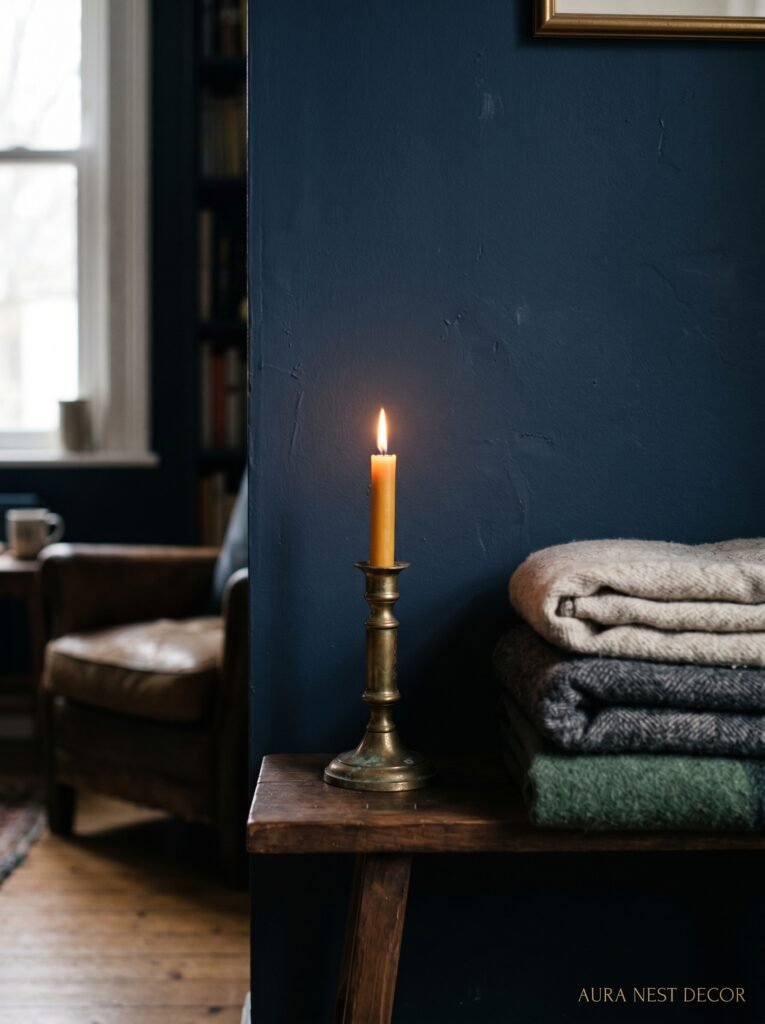
For years, every design magazine was screaming about light and bright. White walls, pale linen, natural light streaming through sheer curtains. And look, I get it — it photographs beautifully. But I’ve sat in those rooms. And they don’t always feel anything.
Dark living rooms feel like something.
There’s a reason hygge became a whole lifestyle movement in Scandinavia, where winter eats the sunlight for months. Deep colors, heavy textures, candles everywhere — that’s not a trend, that’s a human need. And honestly, the rooms I remember most — the ones that made me want to stay for hours — they were always the ones with walls the color of midnight ink or old forest moss. Never the white ones.
The shift that’s happening right now in American and British homes is real. People are done fighting their rooms. Done painting over character. A dark living room done well isn’t depressing — it’s anchoring. It’s the design equivalent of a weighted blanket. And once you understand how it actually works (which is mostly about layering light, not fighting it), you won’t look back at beige the same way again.
“A room that feels like nothing does nothing for you. Dark rooms ask you to stay.”
—
2. The Paint Color That Keeps Showing Up in Every Moody Living Room Right Now
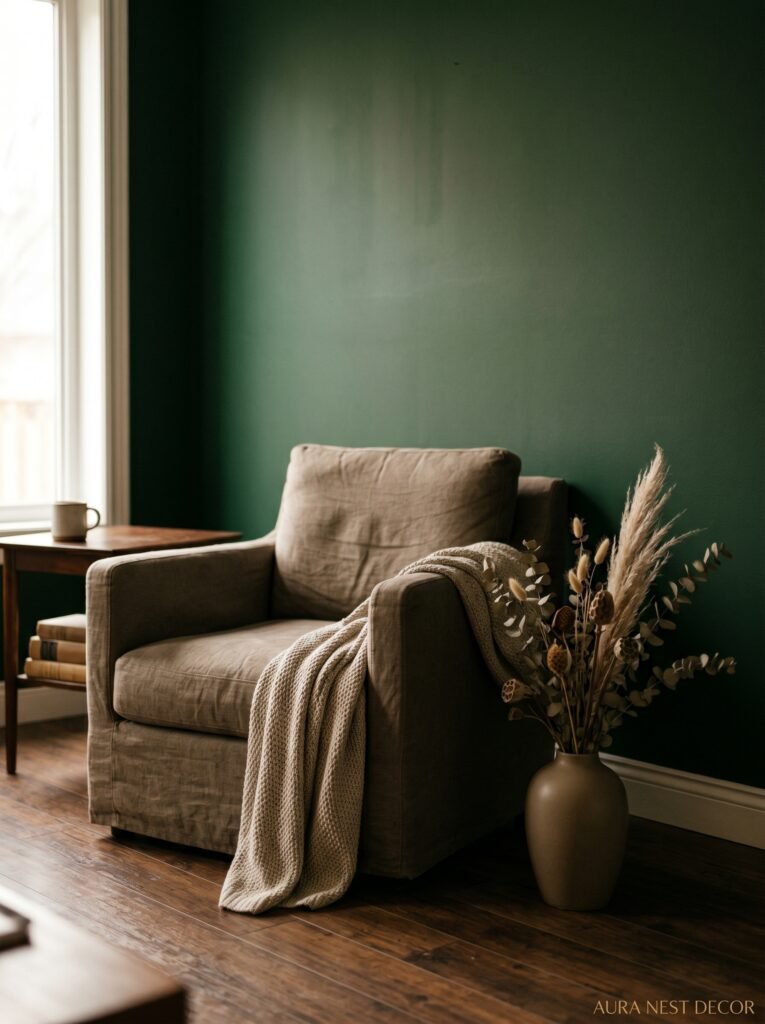
It’s not black. I mean, black is stunning, but it’s not the answer for most people, and not every room can carry it without feeling like a cave in a bad way. The color I keep seeing everywhere — on walls in London flats, in cozy brownstone living rooms in Brooklyn, all over Pinterest boards with tens of thousands of saves — is a deep, slightly green-leaning navy. Or dark charcoal with a plum undertone. Colors that shift depending on the light.
Farrow & Ball’s Hague Blue. Benjamin Moore’s Black Forest Green. Sherwin-Williams Iron Ore. These aren’t just colors, they’re moods.
The secret most people don’t know? Dark paint actually makes a room feel bigger at night. During the day you lose the walls — they recede. Come evening with lamps on, the room compresses into something intimate and intentional in a way that’s almost theatrical. Not gonna lie, I’ve repainted the same wall three times chasing that feeling, and it was worth it every single time.
Go darker than you think. Your first instinct is probably two shades too light. Just trust it.
—
3. The One Lighting Rule That Separates Cozy-Dark From Just Dark
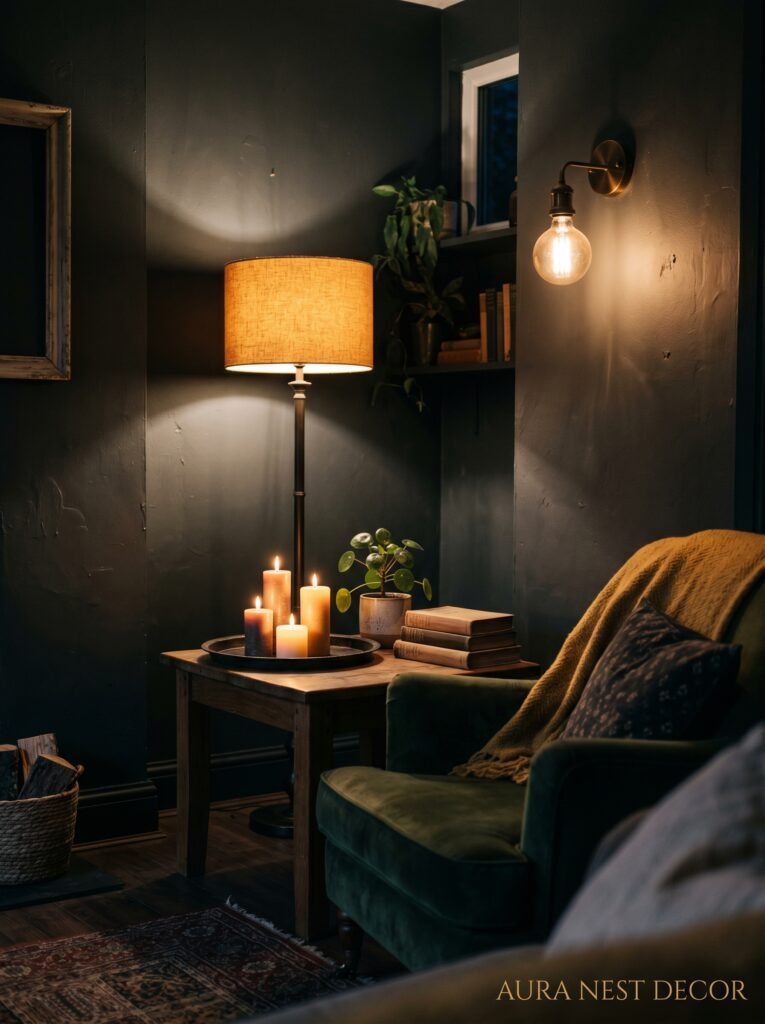
Overhead lighting is the enemy. I said what I said.
Ceiling fixtures — especially recessed LED panels, which are basically the fluorescent lighting of our generation — they flatten everything. They kill shadows. And shadows are exactly what make a moody room work. You need shadows. You want the corners to be slightly mysterious.
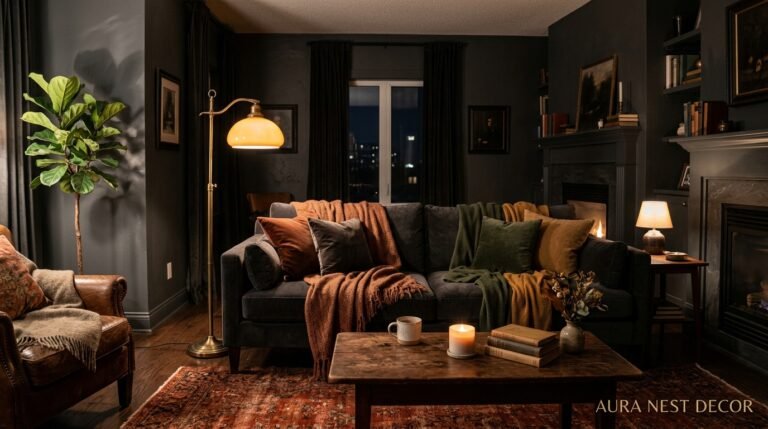
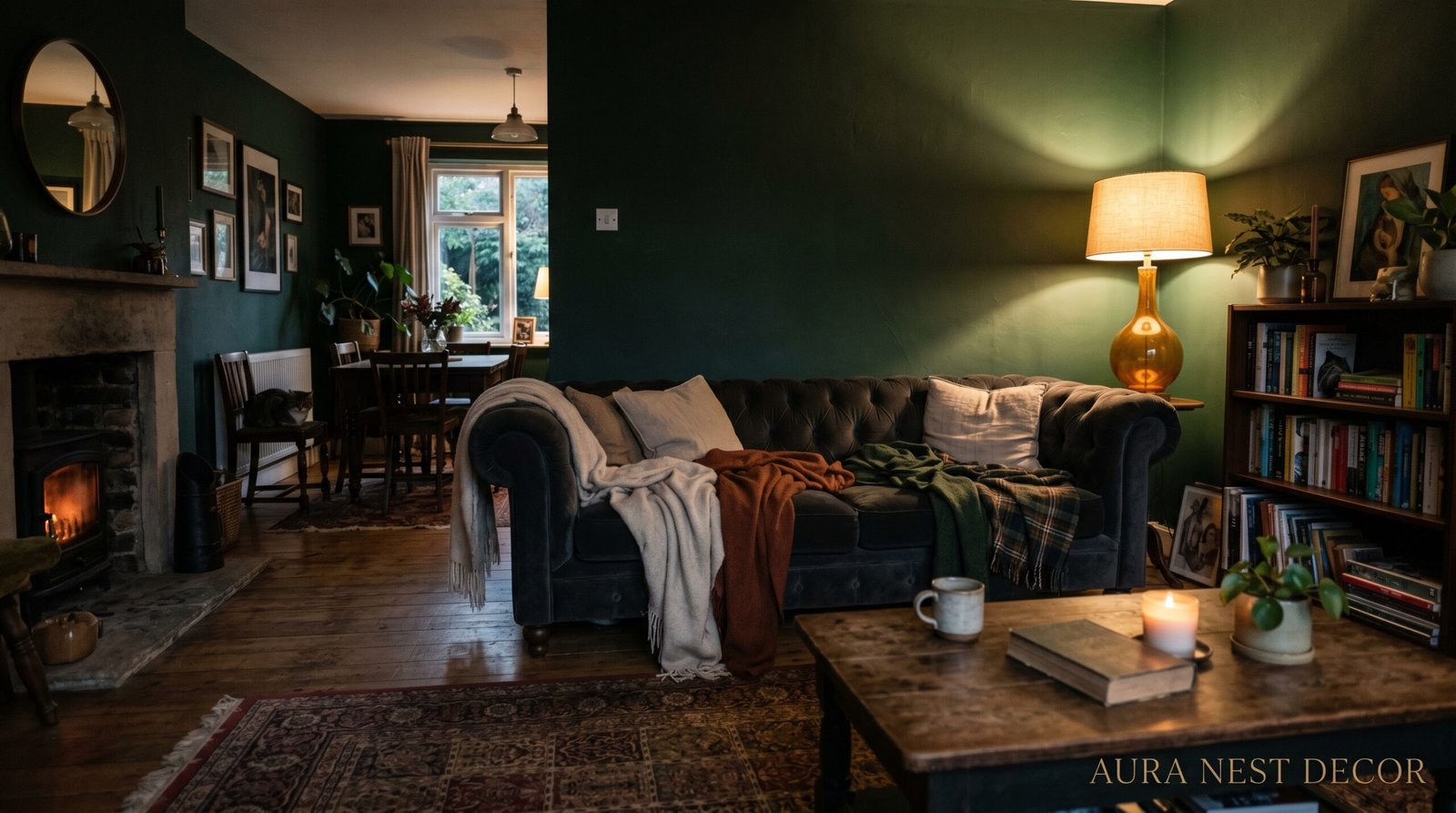
So: lamps. Multiple. Low. Warm-toned. The amber glow of an Edison bulb at 7pm on a Tuesday does more for a room than any renovation project I’ve ever witnessed. Pair that with actual candles (pillar candles on a tray, a cluster of tapers in an old iron holder) and something shifts completely. The room stops being a room you’re in and starts being a place you belong.
In terms of actual bulbs — 2200K to 2700K color temperature is the sweet spot. That’s the warm, almost honey-toned range. Anything above 3000K and you start losing the coziness. Aim for a mix: a tall floor lamp in one corner, table lamp on a side table, maybe some LED strip lighting tucked behind furniture if you want that ambient glow without visible bulbs. Layer it up. You want at least four light sources in a living room before it starts feeling intentional.
—
4. Velvet, Wool, and the Textures That Actually Do the Heavy Lifting

Here’s the thing about dark rooms — without texture, they go flat. Fast. The color does half the work and then the materials have to carry the rest.
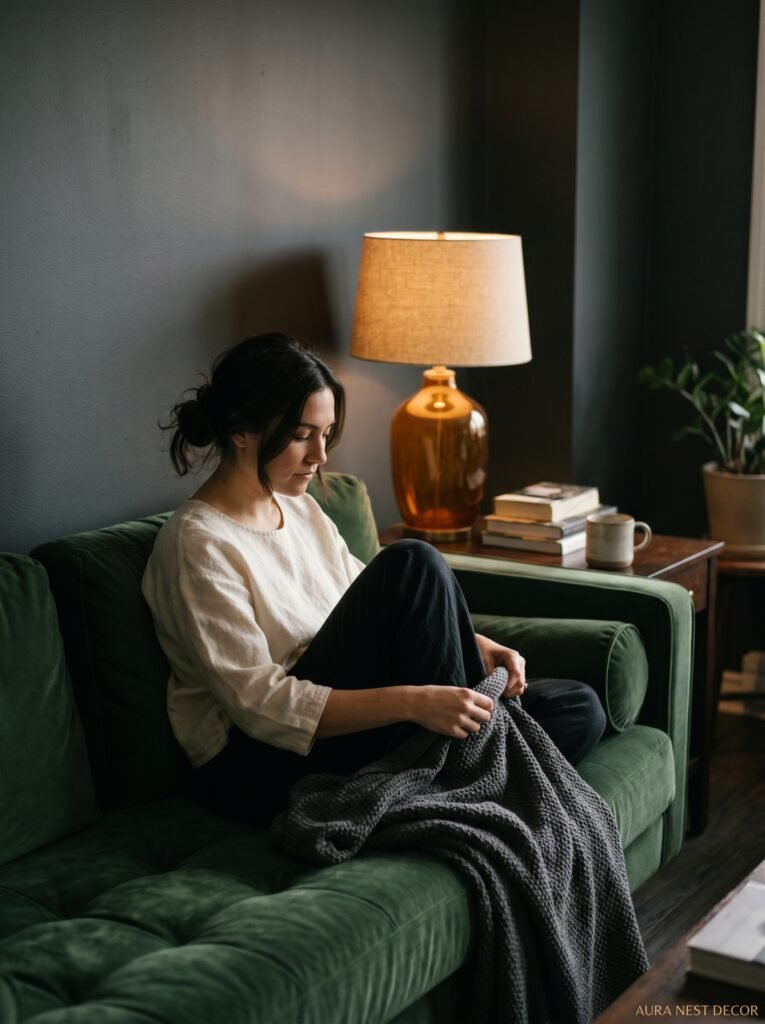
Velvet is the obvious answer and I’m not even a little bit sorry about that. A deep forest green velvet sofa against a dark blue-grey wall is one of the most satisfying combinations in residential design, full stop. It absorbs light differently than any other fabric, which means it shifts from almost black in the shadows to jewel-bright where the lamp hits it. It feels expensive without necessarily being expensive — a velvet throw from TJ Maxx or IKEA will fool anyone.
But don’t stop at velvet. Chunky knit cushions, a wool area rug in a muted plaid or herringbone pattern, linen curtains in an off-white or biscuit color (yes, lighter curtains in a dark room — the contrast is gorgeous). Brushed brass hardware. A ceramic vase with a rough, matte finish. The goal is surfaces that all respond differently to the same light source, which gives the room depth without you having to do anything technically complicated.
“Texture in a dark room isn’t decoration — it’s what keeps the whole thing from becoming a void.”
—
5. The Furniture Arrangement Nobody Tells You About for Dark Spaces
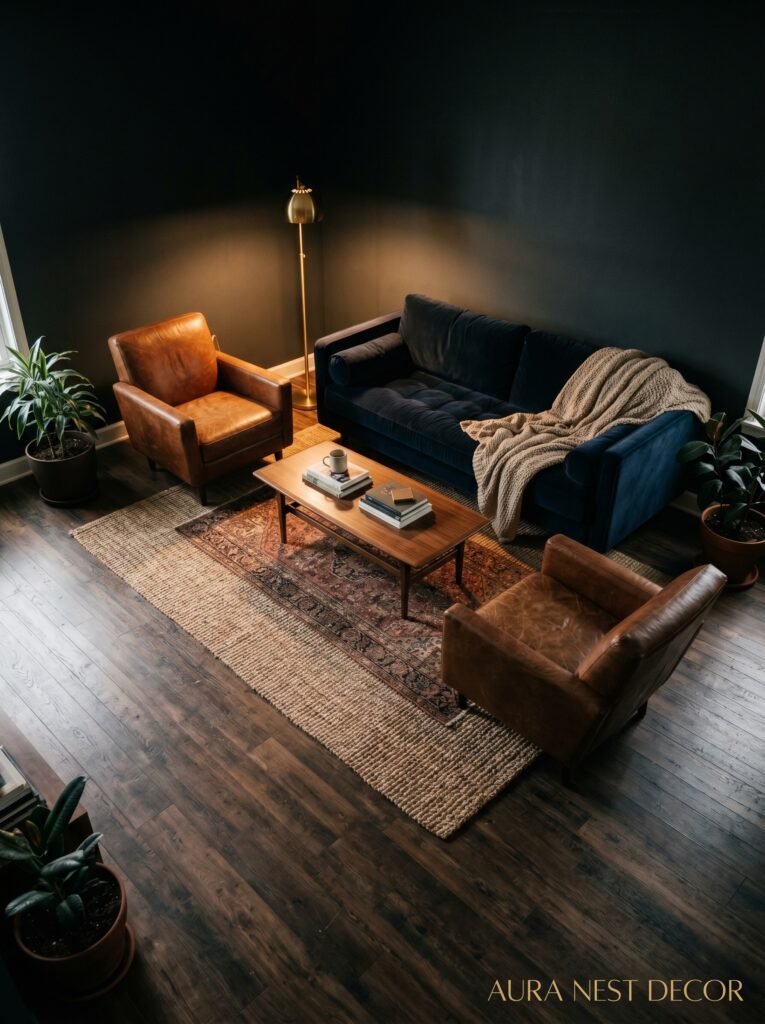
Most people arrange furniture to face the TV. Which, fine, I get it. But in a moody, cozy living room, the arrangement that actually works is facing inward. Pulling furniture away from the walls. Creating a circle-ish conversation space where the focus is the people (or the coffee table, or the fireplace) rather than a glowing rectangle on the wall.
Dark rooms already do some of this work naturally — you’re less aware of the walls when they’re dark, so the center of the room becomes the focal point. Lean into that. A big, round coffee table in the middle. Chairs angled toward each other, not toward a screen. A sofa that’s pulled 18 inches from the wall so there’s space to breathe behind it.
This sounds counterintuitive but I promise it reads immediately when you walk in. The room feels curated instead of just furnished. And in a small flat or a tight living room, this trick actually makes the space feel more generous, not less.
—
6. Curtains That Make the Room, Not Just Cover the Window
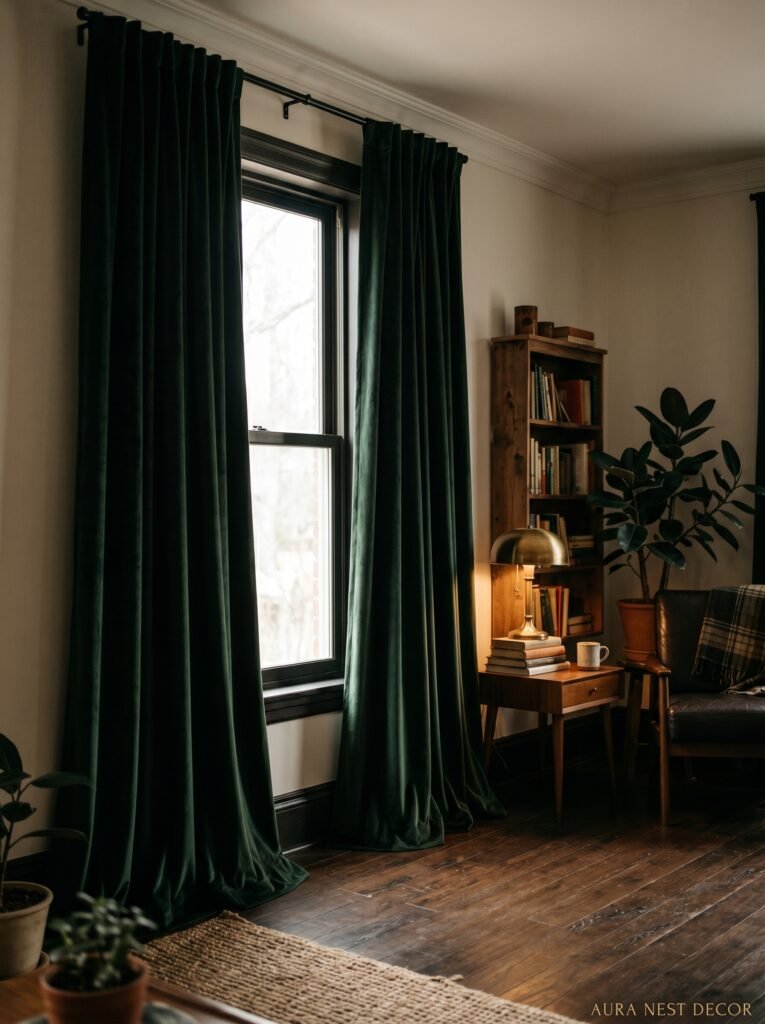
Floor-length curtains hung as close to the ceiling as possible. That’s it. That’s the whole tip. And yet somehow it’s still the most underused trick in British and American homes alike.
In a dark living room, curtains aren’t functional — they’re architectural. They create vertical lines that draw the eye up and make ceilings feel higher. In a rental flat where you can’t paint the walls? Heavy curtains in a dramatic color can do almost everything paint does. I’ve seen rooms completely transformed by swapping out beige tab-top curtains for long, pooling velvet drapes in terracotta or deep burgundy.
The pooling-on-the-floor thing is a bit of a debate, but in a moody room? I’m pro-puddle. That extra inch or two of fabric on the floor makes curtains look more expensive and more intentional than anything you can buy. And for the love of all that is cozy, please don’t stop them at the sill. Not in this room. Not with this vibe.
—
7. The Small Details That Hit Different in a Dark Room (And the Ones That Don’t Work at All)
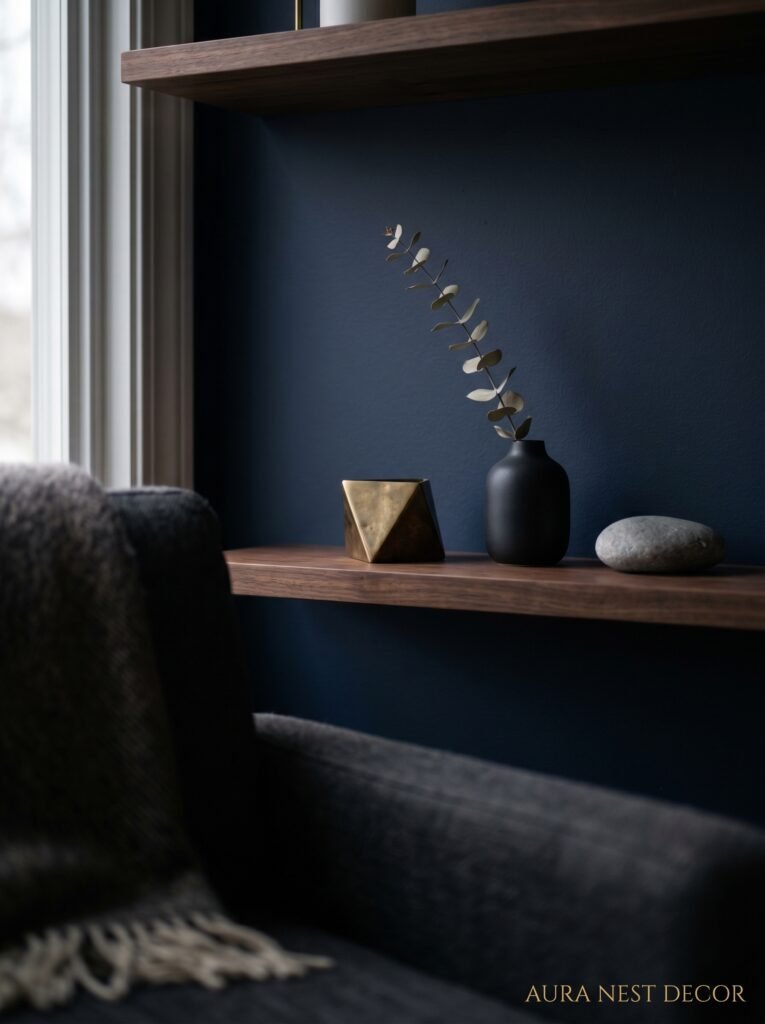
Dark rooms show details in a completely different way than light rooms. Things that look ordinary on a white wall suddenly become interesting in a moodier space. A gallery wall of vintage black-and-white prints. A single large oil painting in a gilded frame. Stacked books on a low shelf with their spines facing out.
But also: certain things just don’t work. Shiny chrome anything looks cheap and clinical. Stark-white furniture gets weird and ghost-like. Anything too matchy-matchy — like a full matching lounge suite in one color — reads as flat and uninteresting. The dark room rewards collecting over coordinating. Different eras, different materials, different scales. A Victorian side table next to a midcentury floor lamp next to a modern sofa. That mix is exactly right.
Side note — houseplants go absolutely wild in the visual sense against a dark wall. The green pops like nothing else. A big monstera or a trailing pothos in a terracotta pot is basically free art.
“Against a dark wall, a plant stops being a plant. It becomes a statement.”
—
8. Fireplace or No Fireplace — What to Do With That Wall Either Way
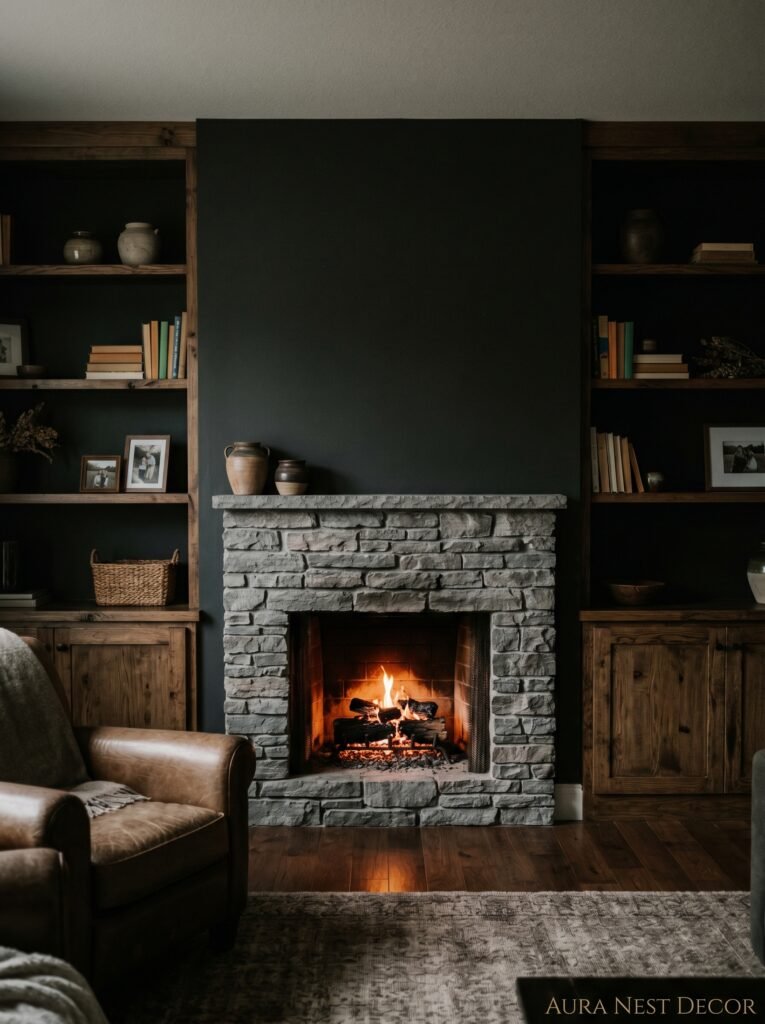
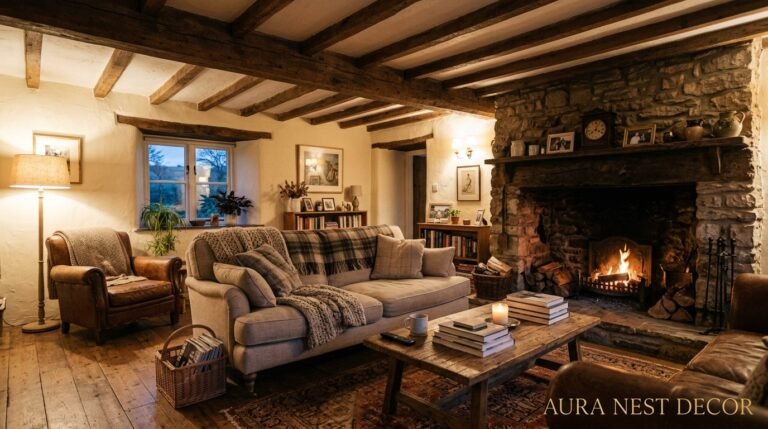
If you have a fireplace, you already have the best anchor in any cozy-dark living room. Full stop, no notes. Paint the chimney breast a shade or two darker than the rest of the room for a dramatic alcove effect. Style the mantle with a mix of candles, one interesting object (a clock, a vase, a sculptural piece), and some asymmetry — resist the urge to put matching things on either end of it.
If you don’t have a fireplace? There are so many options that actually work now. An electric fireplace insert built into a console or entertainment unit looks genuinely convincing in dim, candlelit conditions. A cluster of large pillar candles in a fireplace-sized lantern or on a stone slab can create almost the same visual focal point. Or — and this is underrated — lean a large mirror against the wall in that spot and put candles in front of it. The reflection doubles the light and creates depth that a flat wall simply can’t.
The point is that dark rooms need focal points, something for the eye to land on. Without one, the darkness just becomes oppressive. With one, it becomes cozy.
—
9. The Scent Layer (Which Most Interior Design Articles Forget to Mention)
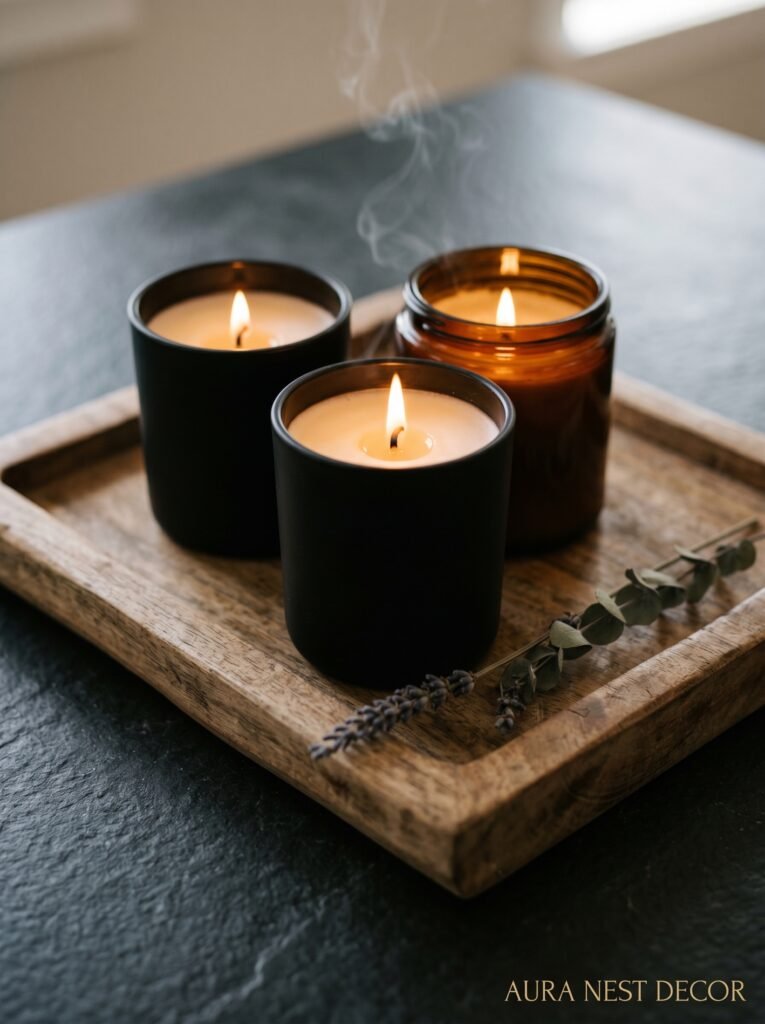
Okay, bear with me on this one because I genuinely believe scent is as much a part of a cozy room as any of the visual stuff.
A dark room that smells like cedar and vanilla or like a warm, smoky oud candle creates an experience rather than just a look. The sensory consistency matters. You can’t have the moodiest velvet-and-dark-wall room and then have it smell like clean laundry or nothing at all — it breaks the spell.
My current obsession is Apotheke’s Tobacco & Cedar candle for American readers and Skandinavisk’s Hygge candle for UK folks. Both of them hit that sweet, woody, slightly smoky register that just makes a dark room feel completely finished. Not gonna lie, I’ve walked into rooms that looked a 6 out of 10 visually but smelled incredible and felt like a 9.
Scent is the part of your room design that gets into people’s memories. It’s the detail they can’t name but can’t forget.
—
10. Rugs Are Load-Bearing in This Aesthetic (No, Really)

Don’t underestimate the rug. In a dark room with dark walls, a rug is often the element that grounds the whole thing and stops it from feeling like a moody art installation you’re afraid to touch.
Size matters enormously. Go bigger than you think you need — the rug should ideally sit under at least the front legs of every piece of seating furniture. A rug that’s too small looks like a bath mat that got lost. In a dark room, this mistake is MORE obvious, not less, because there’s less visual noise to distract from it.
Color-wise, you have options. A very dark rug in a similar tone to the walls creates a cocoon-like, fully enveloping atmosphere. A lighter rug — a washed cream or a faded antique Persian-style pattern — adds contrast and warmth to the floor. Both work, but they create completely different feelings. The dark-on-dark is dramatic and intentional. The light rug against dark walls is more editorial, more dynamic.
Texture in the rug counts too. A flat-weave is fine but a high pile or a boucle adds that tactile layer that makes someone want to take their shoes off the moment they walk in.
—
11. How to Pull Off a Dark Living Room in a Rental (Without Losing Your Deposit)
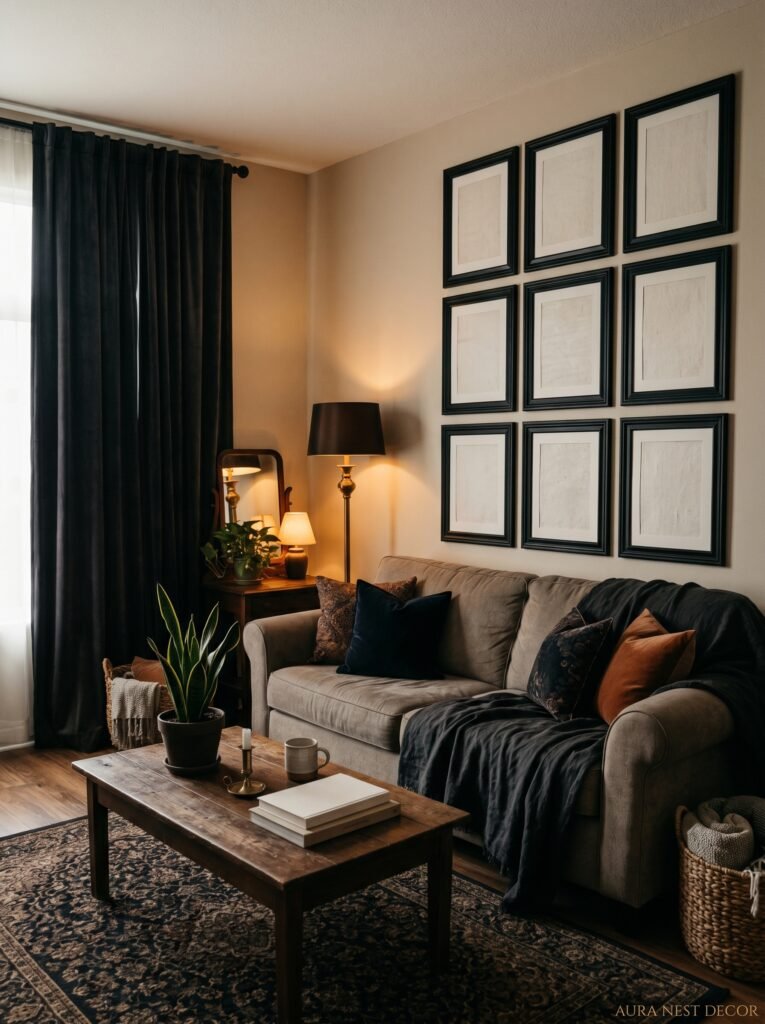
This one’s for the renters — and there are a lot of us, especially in UK cities where renting is just… a permanent life stage, apparently.
You can’t paint. So what do you do? Honestly, quite a lot. Dark removable wallpaper exists and it’s genuinely good now — peel-and-stick options in deep botanical prints or moody geometric patterns are available at all price points. Temporary wall panels. Large-scale tapestries hung from tension rods. Dark linen curtains that span the whole wall, not just the windows.
And here’s the biggest rental hack: if you can’t change the walls, you go for a dark layer instead. Every piece of furniture, every textile, every accessory is deep-toned and moody, and suddenly the white rental walls become the neutral background that the dark room exists within. It’s not quite the same, or maybe it’s the opposite, honestly — but styled correctly, it reads almost identically on camera and in person, it creates a warmth that white walls on their own never could.
—
12. The One Mistake That Ruins an Otherwise Perfect Dark Living Room
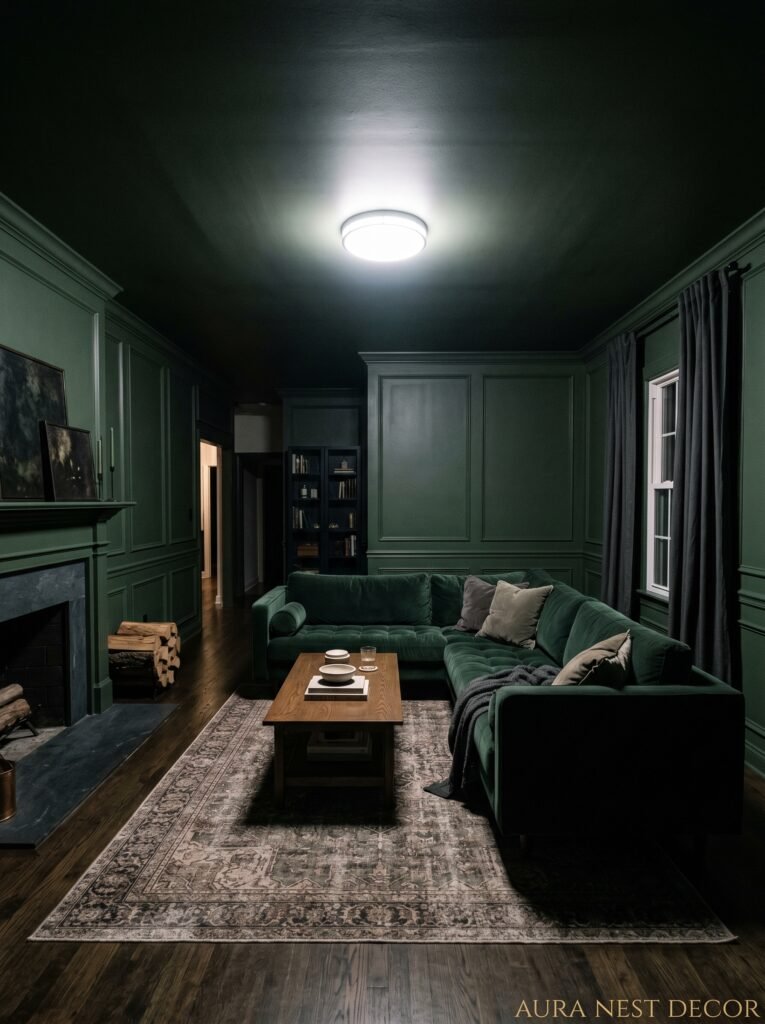
No art.
Dark rooms with bare walls aren’t moody, they’re just dark. The walls become the problem rather than the backdrop. Art — even mismatched art, even cheap art, even IKEA frames with pages torn from coffee table books — gives the eye something to travel to. It breaks up the expanse of color. It makes the room feel like someone lives there and has opinions and collected things over time.
The fastest way to make your dark living room look intentional and finished? Commit to the wall space. One large piece above the sofa. A cluster of smaller frames in the alcoves. Something leaning against the wall on the floor (which is more relaxed and actually quite chic). Don’t leave the walls empty and expect the paint color alone to carry it. It can’t. The color is the foundation but the art is the personality.
—
❓ FAQ
Q: Will a dark living room make my room look smaller? A: Not necessarily — and this surprises a lot of people. During the day, dark walls recede visually and can make the room feel less enclosed. In the evening with warm lamp lighting, the room does compress, but in a cozy and intentional way. The effect is more “intimate boutique hotel” than “tiny box,” especially if you use mirrors, tall curtains, and the right furniture arrangement.
Q: What’s the easiest dark color to start with if I’m nervous? A: Go with a deep warm grey or a greyed-down navy rather than a pure black or a very saturated jewel tone. Colors like Dulux’s Night Jewels, Benjamin Moore’s Newburyport Blue, or Farrow & Ball’s Mole’s Breath give you that moody feel without full commitment. Sample it on a large card first and look at it at different times of day — especially in the evening under lamps.
Q: Can I do a cozy dark living room if I don’t have much natural light? A: You can, and honestly some of the best dark rooms I’ve seen had very little natural light. The key is to lean into the dimness rather than fight it. Layer warm artificial light sources generously — at least four to five lamps — and use candles freely. Avoid cool-toned bulbs completely. The room won’t look like it’s trying to be bright; it’ll look like it was designed to be dim. Which is different, and better.
—
💭 Final Thoughts
There’s a particular kind of evening — autumn, cold outside, rain against the glass — where a dark living room becomes the best place on earth. The whole room just wraps around you like a long exhale. That’s not a style choice, really, or maybe it is. But it also feels like something more fundamental than that — like finally letting a room be exactly what it wants to be.
Have you ever walked into a dark room and felt immediately, completely at home?