Dark Cozy Living Rooms That Actually Feel Like a Hug (Not a Cave)
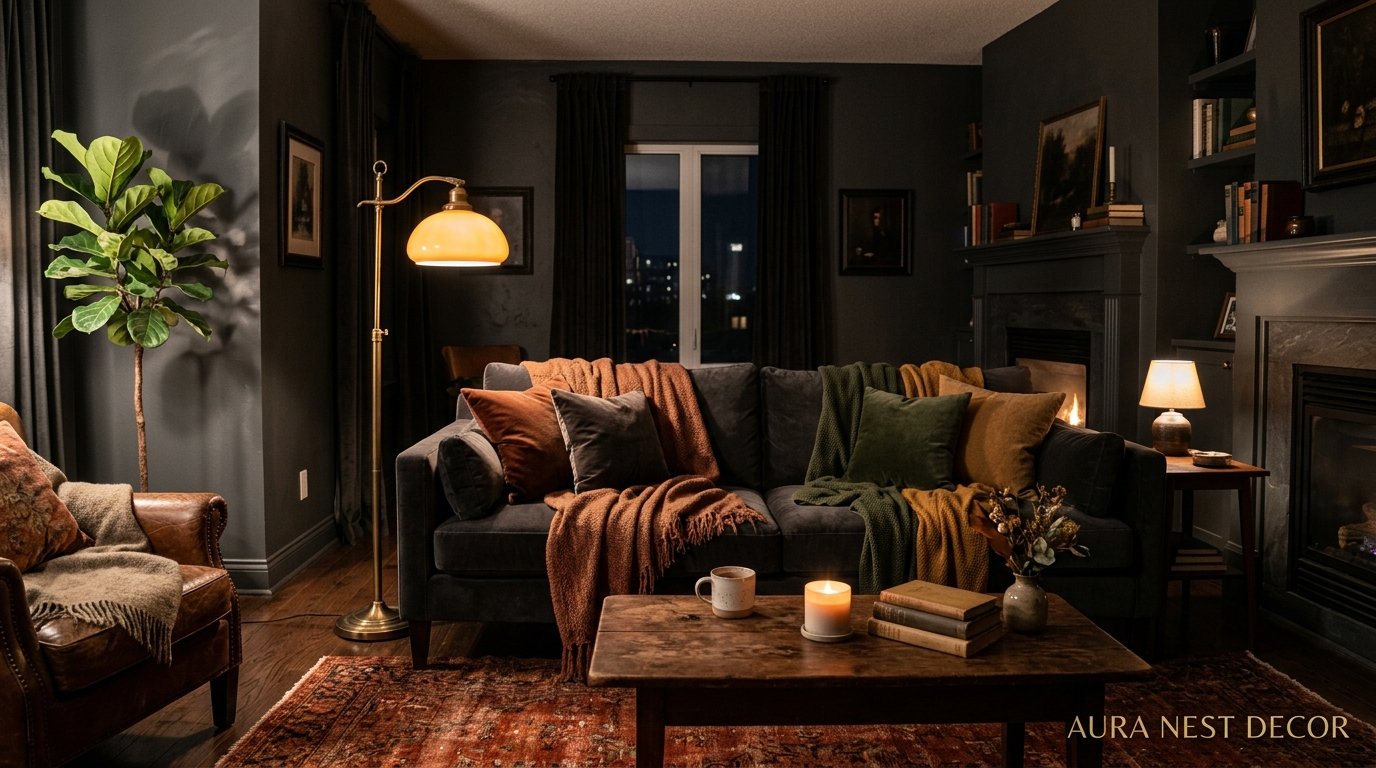
There’s a version of “dark room” that makes people nervous — the one that feels like a basement, a little sad, like someone gave up on natural light and called it aesthetic. That’s not what we’re doing here. What we’re doing is entirely different. It’s the dark that feels like being wrapped in something warm, like the first night you light a candle in October and suddenly your whole house makes sense again.
—
1. Why Dark Rooms Feel Cozy and Bright Rooms Often Don’t (The Science Nobody Talks About)
Here’s the thing nobody really explains when they tell you to “paint your walls white for a bigger space.” Bright rooms scatter your attention. Your eye has nowhere to rest. Everything is equally lit, equally visible, equally demanding — and that’s exhausting in a way you probably haven’t named yet.
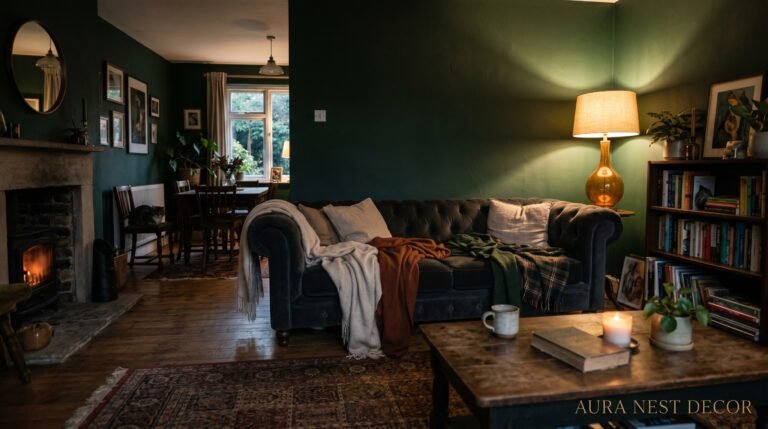
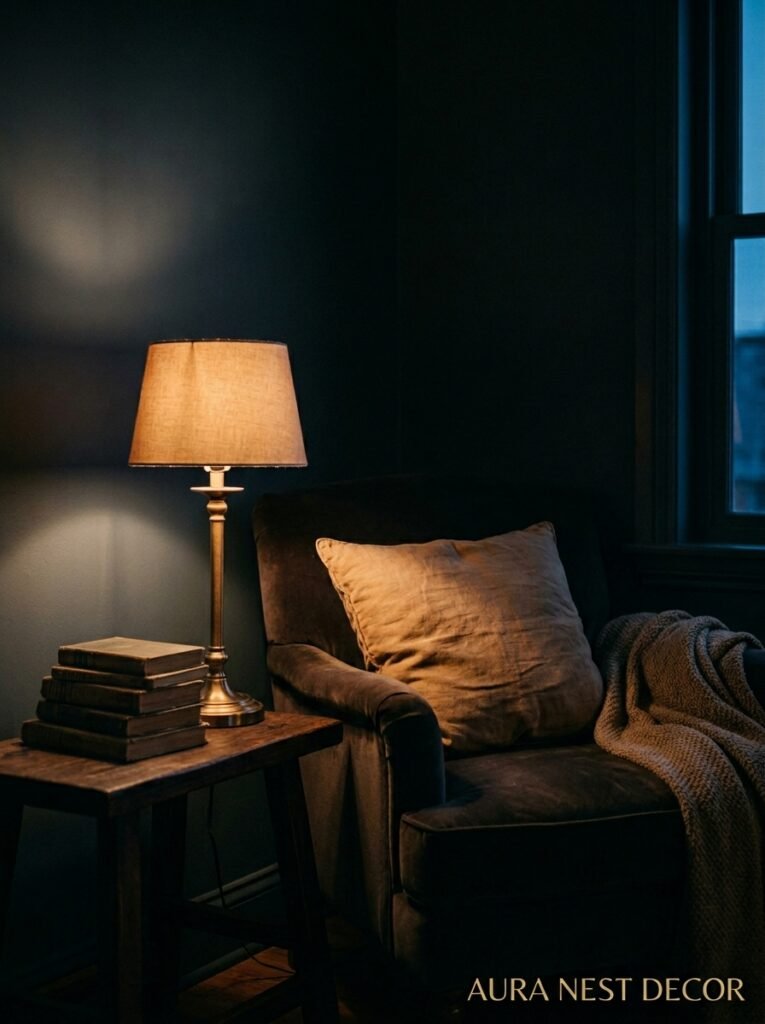
Dark rooms do something different. They pull the light inward. A deep charcoal or forest green wall doesn’t absorb light so much as it concentrates it — the candles glow brighter, the lamp in the corner becomes a destination, and suddenly your room has atmosphere instead of just… ceiling height.
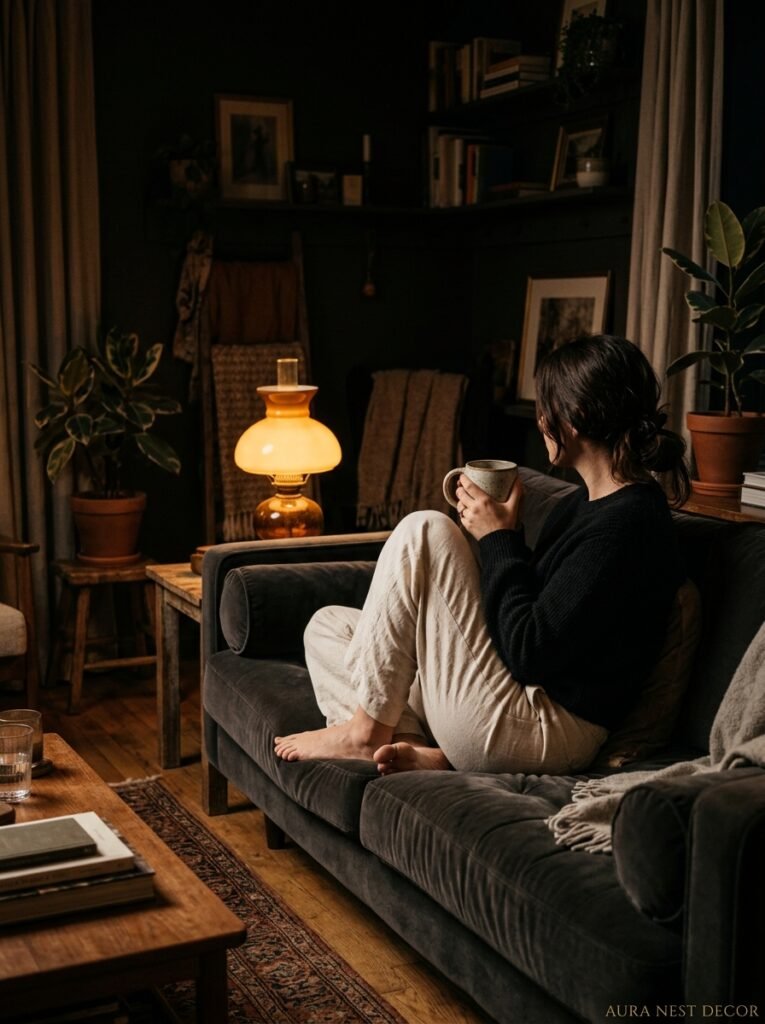
I think this is why dark living rooms photograph so well on Pinterest. But honestly, it’s even better in person. You walk in and your nervous system just… settles. There’s a reason libraries, old English pubs, and those very specific coffee shops where everyone looks genuinely at peace all tend toward darkness and wood and something that smells faintly of old books.
So no, you don’t need 14 windows and a whitewashed floor to have a beautiful living room. Sometimes the most beautiful thing you can do is lean INTO the dimness.
—
2. The Paint Color That Keeps Showing Up in Every Cozy Dark Living Room Right Now
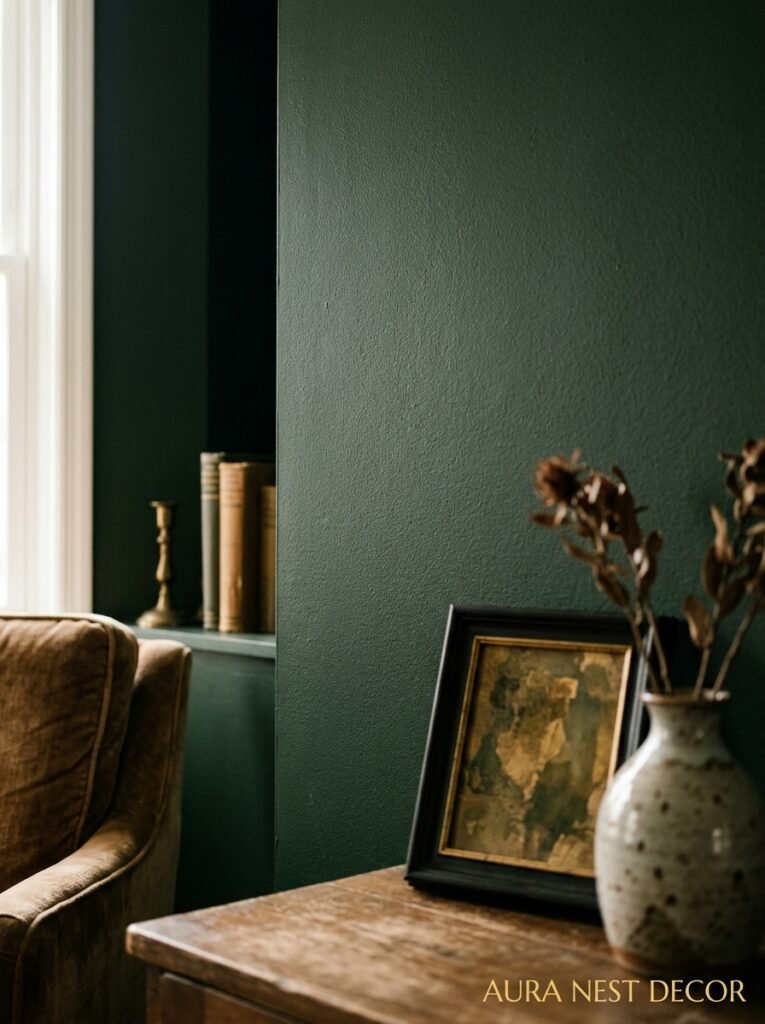
It’s not black. People always assume black, but black is actually the hardest to live with — it’s stark, it needs very specific lighting to not look flat, and honestly it’s a bit of a flex that can tip into cold.
The colors actually doing the heavy lifting right now are deep, complex, slightly unsaturated tones. Think Farrow & Ball’s Down Pipe — this gorgeous blue-grey that changes completely depending on the time of day. Or Hague Blue, which is midnight without being aggressive. On the American side, Benjamin Moore’s Black Forest Green and Wrought Iron are having a genuine moment.
But here’s the real secret: the finish matters as much as the color. Flat or matte finish on dark walls gives you this velvety, almost fabric-like quality that eggshell totally kills. The light doesn’t bounce off matte paint — it lands softly and STAYS there. That’s the difference between moody-cozy and moody-cold. Side note — if you’re renting and can’t paint, I’ll get to that.
The ceiling. Don’t forget the ceiling. Painting it the same shade as your walls — or one tone darker — closes the room in a way that feels deliberate and enveloping rather than just cramped. It’s the single most underused trick in the dark room playbook.
—
3. The One Furniture Move That Makes a Dark Room Feel Rich Instead of Gloomy
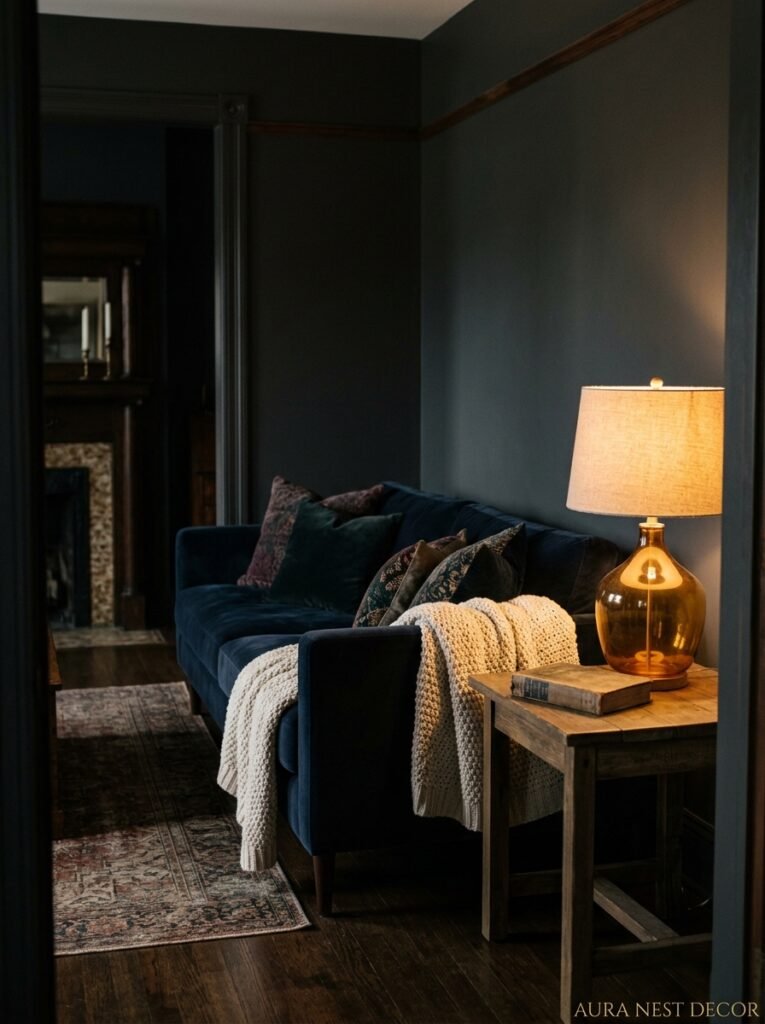
Not gonna lie, I resisted dark furniture for years. I thought you were supposed to contrast — dark walls, light sofa. And you can do that. But the rooms that really stopped me mid-scroll were the ones where everything was layered in the same tonal family.
A deep brown leather sofa in front of a charcoal wall. Walnut coffee table. Dark-stained bookshelves. It sounds like it should be oppressive but it isn’t — it reads as DEPTH. Like the room has been collecting character for twenty years.
The key is texture. When everything’s the same dark tone, texture becomes the thing that separates one element from another. Velvet cushions against linen throws against a smooth wooden surface against rough jute — your eye reads it as rich, not monotone. So if you’re going tonal, vary your textures aggressively. Like, more than feels comfortable at first.
One concrete thing: a dark room with only smooth surfaces feels cold. A dark room with chunky knit, aged leather, and rough-woven baskets feels like somewhere you’d cancel plans to stay in.
“A dark room with only smooth surfaces feels cold. Add something rough, something aged, something that looks like it has a story.”
—
4. Lighting That Doesn’t Ruin Everything (Because the Wrong Bulbs Will Absolutely Ruin Everything)
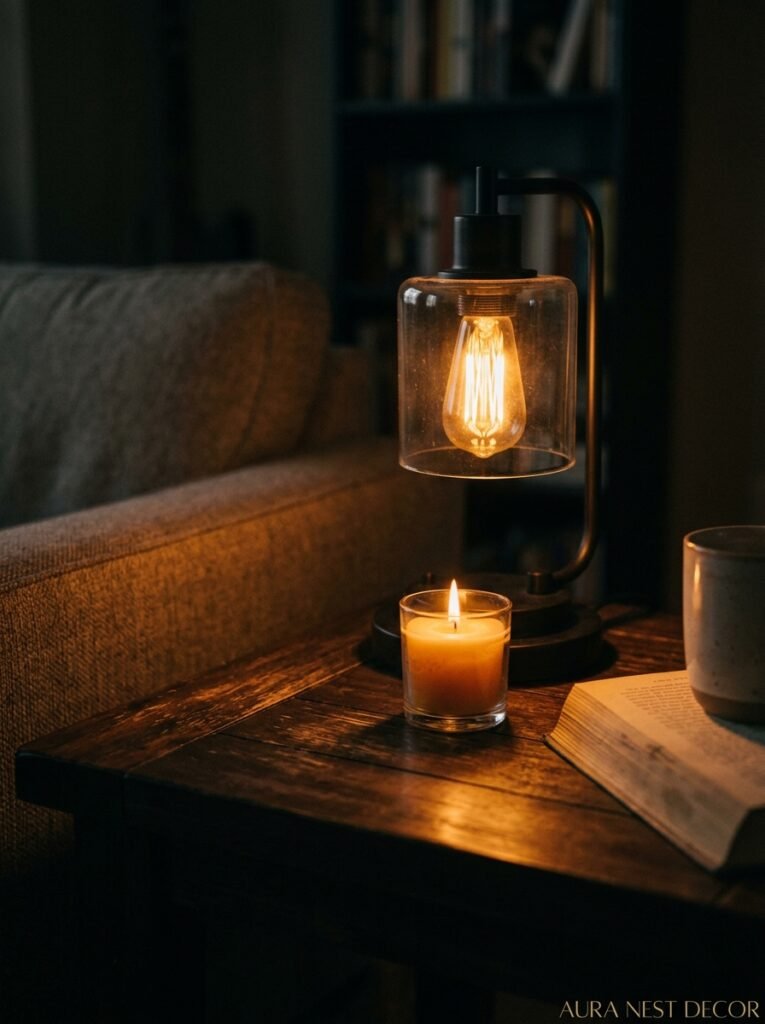
This is where most people go wrong. They paint the walls a beautiful dark color, then turn on their overhead light and wonder why it looks terrible. It looks terrible because overhead lighting is the enemy of atmosphere. Full stop.
The amber glow of an Edison bulb at 7pm — that’s what we’re chasing. Not the bluish-white of a cool LED that makes everyone look slightly ill. Not the harsh overhead fixture that casts shadows downward on people’s faces. Warmth. Pools of it. Scattered deliberately.
In a dark living room, lighting becomes architecture. A floor lamp in the corner creates an implied wall of light. A table lamp on a side table says “this is where you sit.” Candles on the mantelpiece say “this is where you look.” String lights draped along a bookshelf (don’t knock it, it works) say “this room wants you to feel something.”
The rule I always come back to: aim for at least three separate light sources in a dark living room, all of them lower than your eye level when standing. None of them overhead if you can help it. Your overhead fixture can stay — just put it on the dimmest possible setting and let the floor lamps do the actual work.
Warm white bulbs only. 2700K or lower. This isn’t negotiable.
—
5. The Rug That Anchors It All (And Why Lighter Is Sometimes Better)
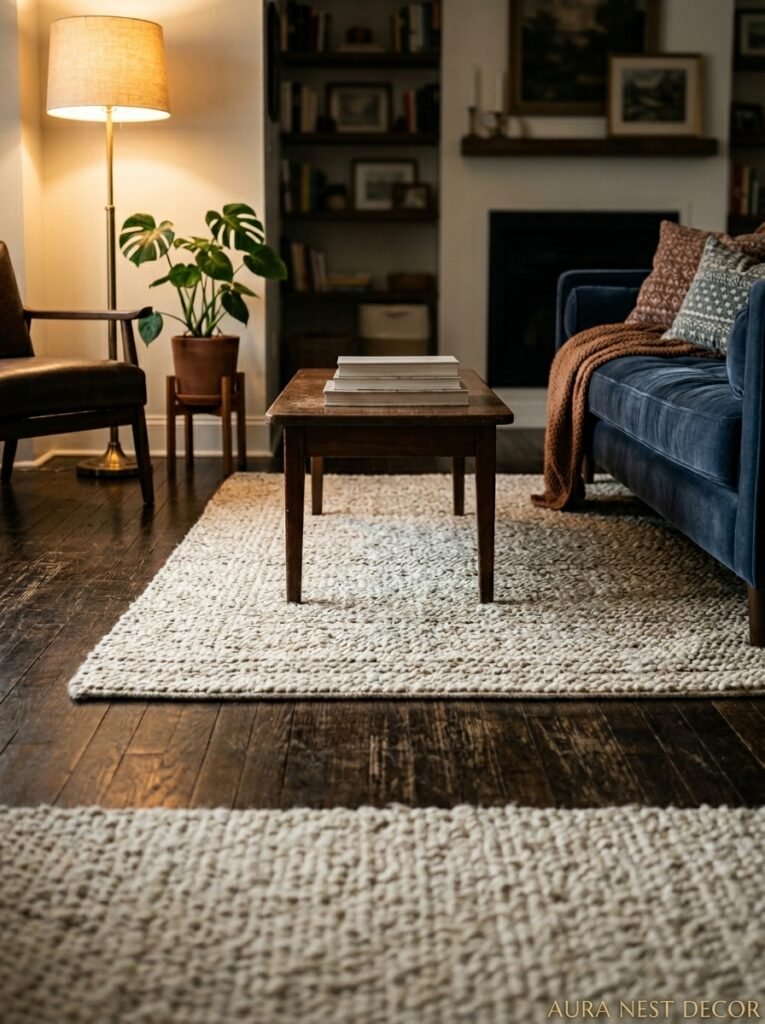
You’d think a dark room needs a dark rug. But actually — and this surprised me when I started noticing it — a slightly lighter rug can be exactly what grounds the space without muddying it.
A warm ivory or oatmeal jute rug on dark wood floors, under a charcoal sofa, with a green wall behind it? The contrast gives your eye a place to rest. It also bounces warmth upward in a way that a very dark rug doesn’t. Or maybe it’s the opposite, honestly — maybe the dark rug creates that enclosed cave-like quality that some people genuinely love. It depends on what you’re going for.
What does NOT work: a cold-toned rug. Anything grey-blue, anything that reads clinical. It interrupts the warmth. The entire project of a dark cozy room is creating warmth, and a cold rug severs that immediately. Even a very dark rug in warm chocolate or burnt sienna works better than a medium-toned cool grey.
Also: go bigger than you think. Rugs that are too small in dark rooms make the furniture look like it’s floating anxiously. The rug should sit under at least the front legs of everything.
—
6. Bookshelves Are the Secret Weapon and I Won’t Hear Otherwise
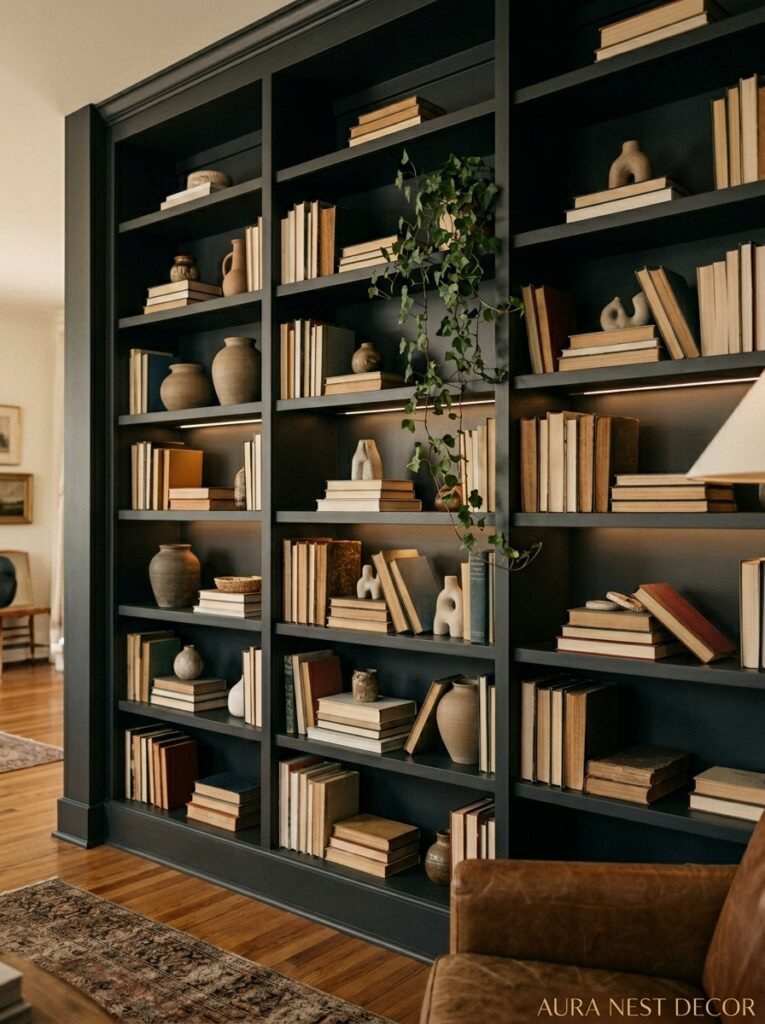
A dark living room with built-in bookshelves or even a large standalone bookcase becomes something completely different from a room without them. Because bookshelves add this sense of collected life — of time passing, of layers, of someone who actually lives here.
Paint the back of the shelves the same dark color as your walls if they’re built-in. Or — and this is genuinely gorgeous — one shade darker. The books float out against it like they’re displayed rather than just stored.
Arrange books by color. Not everyone’s thing, I know, but in a dark room with limited light, a section of warm cream and ochre spines reads like its own little light source. Intersperse objects: a small sculpture, a trailing plant, a candle, a framed photo. The mix of vertical and horizontal, books and objects, keeps it feeling alive.
Don’t over-style them. The rooms that feel most real have shelves that look like someone actually reads those books. A little chaos is permission.
—
7. Plants in Dark Rooms — It’s Not As Complicated As You Think
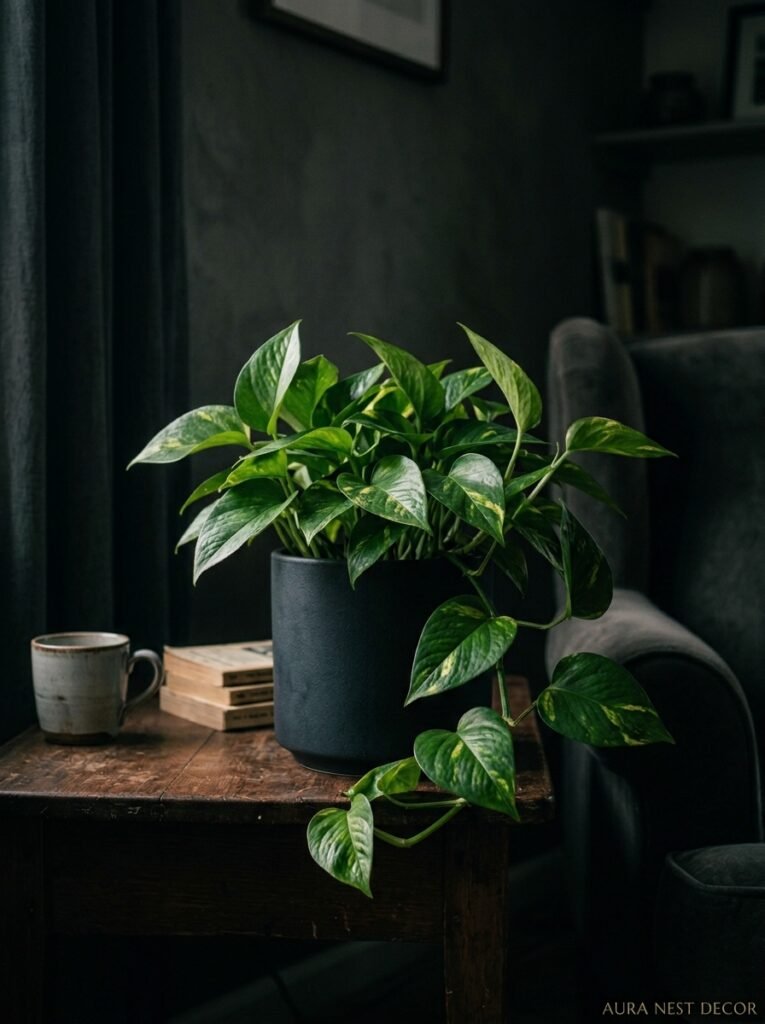
People worry that plants won’t survive in dark rooms and then skip them entirely, which is a shame because the right plants in a dark room look genuinely stunning. The contrast of something living and green against a dark wall has this ancient, almost greenhouse-in-winter quality to it.
The plants that actually work in low light: pothos, snake plants, ZZ plants, peace lilies, cast iron plants (the name is not a coincidence). These aren’t second-choice plants — a trailing pothos cascading off a dark bookshelf, with a warm light hitting it from below, looks expensive and intentional.
Big architectural plants work especially well. A large fiddle leaf or bird of paradise in a terracotta pot against a dark wall creates this bold silhouette that’s almost like art. And if the plant doesn’t thrive, no shame in moving it to a brighter spot during the day.
“The right plant in the right dark corner looks like something from a film set — and it’s usually a pothos from a garden center.”
—
8. Curtains That Don’t Make the Room Look Smaller (The Wrong Choice Is Very Easy to Make)
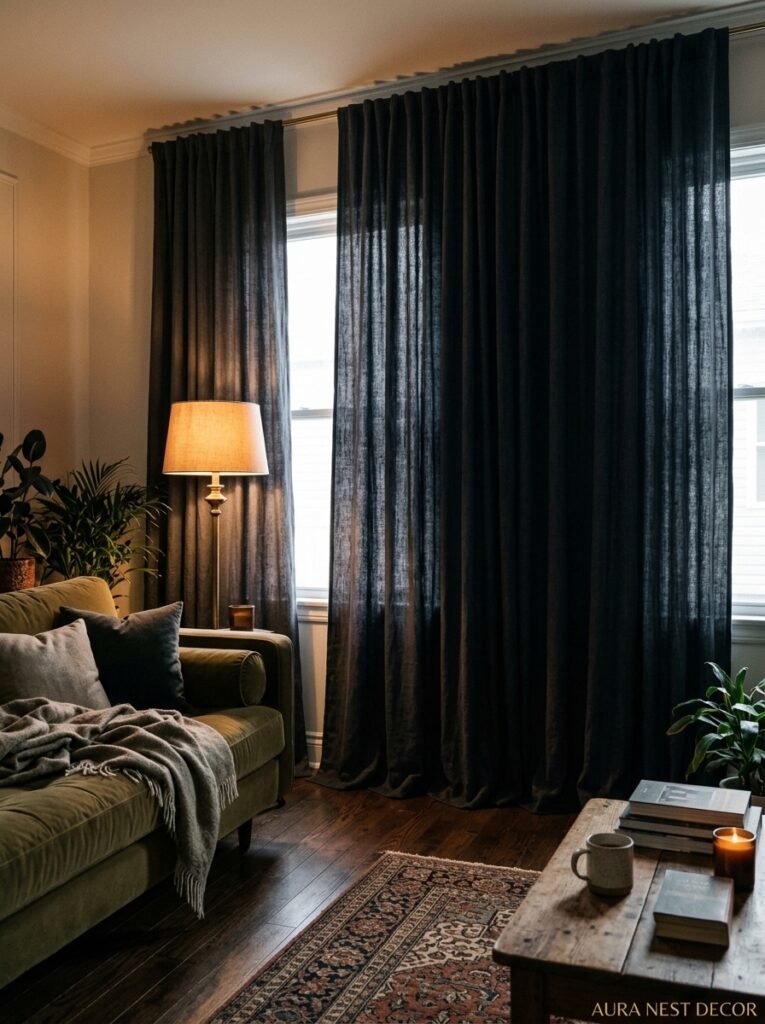
Here’s a curtain mistake that’s incredibly common in dark room attempts: choosing curtains that are darker than the walls, in a heavy fabric, and hanging them at the window frame rather than at the ceiling. The result is a room that feels crushed.
In a dark living room, curtains serve a different purpose than they do in a bright one. They’re not here to frame a view or let in light — they’re here to add texture and softness and signal that the room is complete. So you want them at ceiling height. Always. And you want them to pool slightly on the floor, just an inch or two, because that deliberate excess is what makes them look like a choice rather than an accident.
Color: go with the walls or go lighter. Deep velvet curtains in the same tone as your wall — incredible. Or a warm linen in cream or soft gold against a dark green wall — that contrast is fresh. But mid-range, undefined, slightly-not-matching curtains will drag the whole room down. Don’t default to grey.
—
9. The Gallery Wall That Belongs in a Dark Room (It’s Not What You’re Picturing)
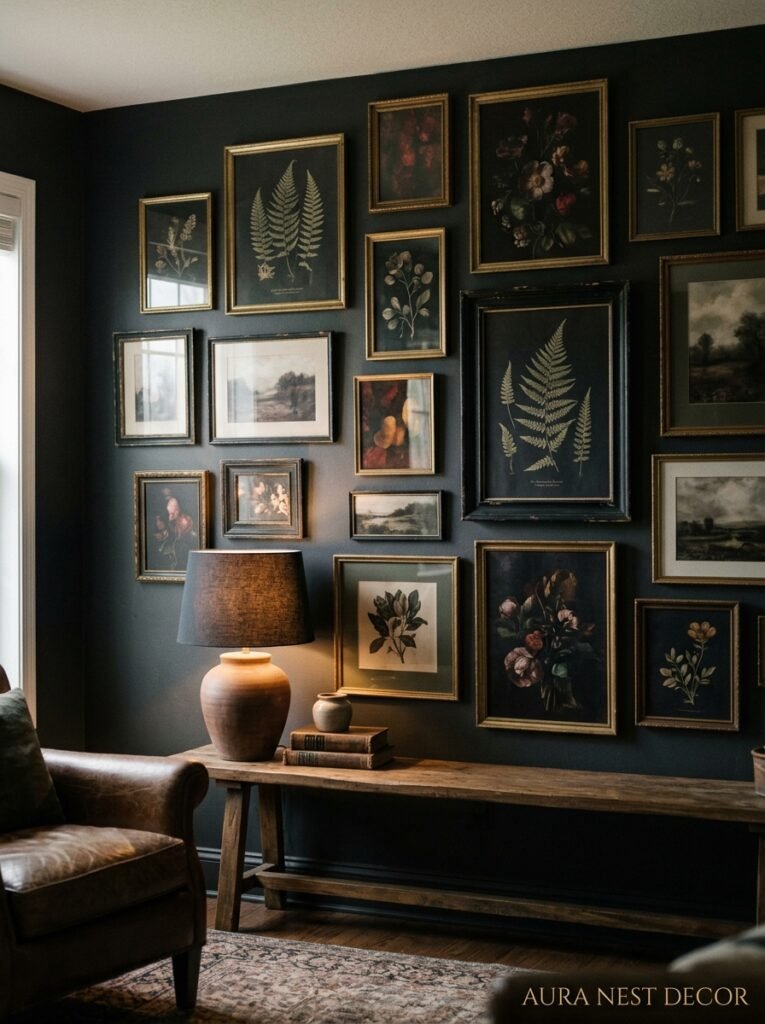
Forget the crisp white frames with lots of space between them — that’s a bright room move. In a dark room, gallery walls need weight. Gilded frames, dark wood frames, mismatched frames in black and aged brass and deep mahogany, all hung relatively close together so there’s density.
The effect is more European antique study than Instagram-clean, which is entirely the point. Old oil painting prints, family photos in old frames, a small ornate mirror mixed in — it tells a story that pre-dated Pinterest and will outlast it.
Mix sizes dramatically. A large statement piece surrounded by much smaller frames creates that intentional asymmetry. And don’t hang them TOO high — lower than you think, so the whole arrangement sits within the intimate scale of a person sitting down rather than floating up near the ceiling.
—
10. Why Mirrors Are Non-Negotiable in Dark Rooms
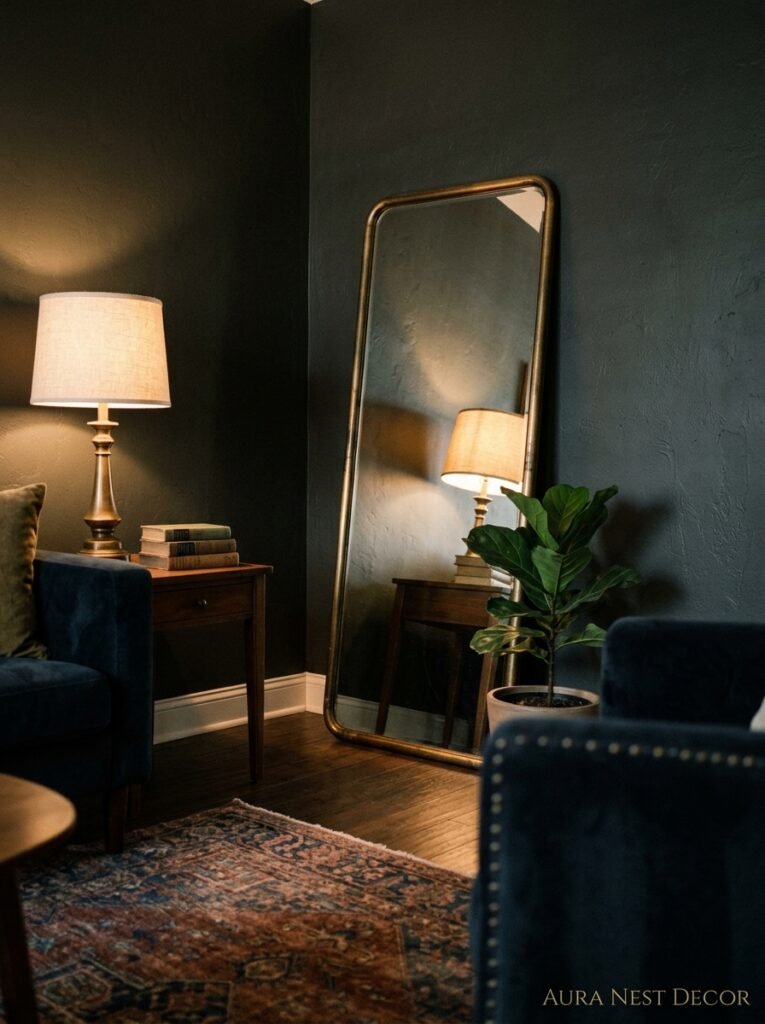
The fear is that a dark room will eat light. The solution everyone jumps to is adding more lamps (correct), but the SECOND answer nobody gets to is mirrors.
An ornate, gold-framed mirror above a fireplace in a dark room does something extraordinary. It catches every candle, every lamp, every reflection of the window at dusk and multiplies it. The room suddenly has depth, has bounce, has this quality of being larger and warmer all at once.
Don’t go for minimal frameless mirrors — they work in bright modern spaces, not here. You want presence. An overmantel mirror with a heavily carved frame, or a large tarnished-gold vintage find, or even a series of smaller antique mirrors grouped together. The more characterful the frame, the more it contributes to the cozy darkness rather than just bouncing light around clinically.
—
11. The Small Things That Actually Make the Room Feel Considered

Not gonna lie, sometimes it’s the very small decisions that make a dark room feel finished versus feeling like it’s trying too hard.
Candles everywhere. But specifically: candles in glass vessels so the flame glows through, candles at different heights, candles that smell like vetiver or amber or smoke or cedarwood — not tropical fruit, not sugar. Scent matters in a cozy dark room in a way it doesn’t in a bright airy one. The darkness makes you more aware of other senses, or maybe that’s just me.
Throws draped specifically. Not folded neatly, not tossed carelessly. Draped over the arm of the sofa with one end pooling on the floor — that’s the move. Chunky knit in cream or oatmeal. A soft mohair in rust or dusty rose. Something that looks like you just got up from under it.
A tray on the coffee table with a few things on it — a candle, a small plant, a book — grounds the surface and makes it look styled without looking decorated. There’s a difference.
—
12. What to Do If You’re Renting and Can’t Paint a Single Wall
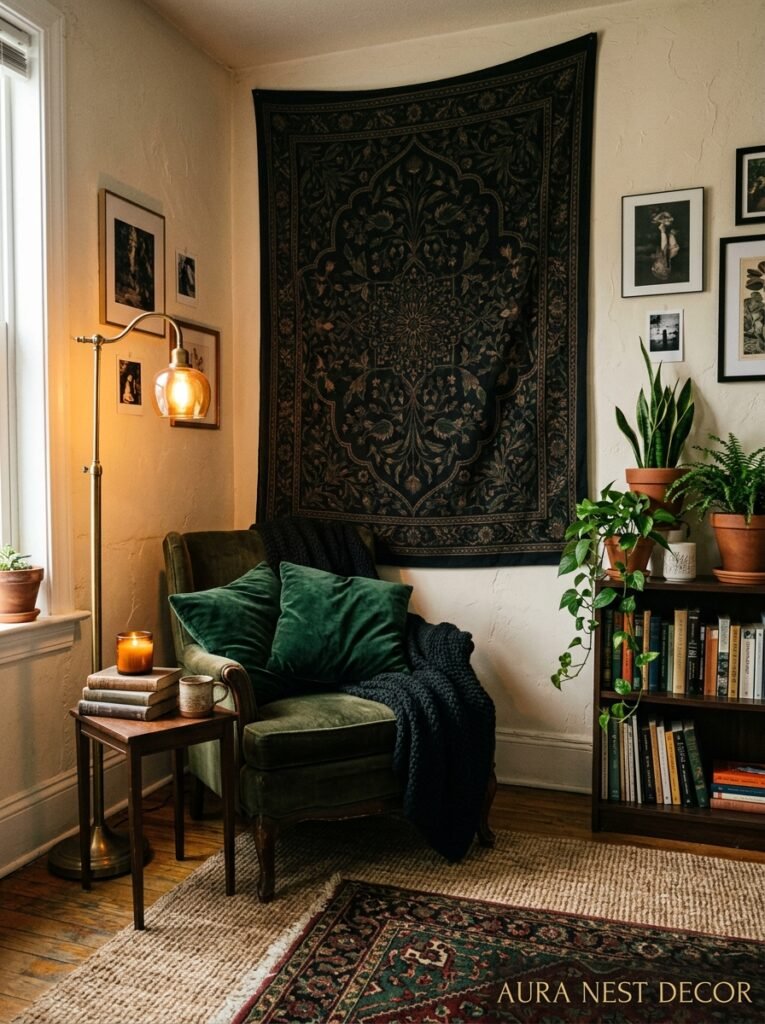
The whole vision, and you’re renting. I know.
But honestly? You can get about 80% of the way there without touching a wall. And that 80% is mostly about light and layering.
Dark sofas or deep-toned sofa covers transform a room. A huge dark rug over whatever terrible carpet exists creates an immediate change of atmosphere. Curtains hung at ceiling height from a tension rod (removable, no holes required) in a deep velvet dramatically shift the whole energy. Bookshelves — freestanding, full of warm-spined books and objects — give you that sense of enclosed, layered depth.
And the lighting thing doesn’t require a single change to the rental’s fixtures. Swap bulbs to warm 2700K. Add floor lamps. Scatter candles. Turn off the overhead. Suddenly it’s a different room.
Removable wallpaper has also come a very long way. There are some genuinely beautiful dark options — moody florals, deep geometric patterns, richly textured looks — that install and remove without damage. A single accent “wall” created with a large wallpaper panel or even a large piece of dark fabric pinned at ceiling height does most of what paint would do.
“You don’t need to own the walls to own the atmosphere. Light and layering will take you most of the way there.”
—
❓ FAQ
Q: Will a dark living room make my small space feel even smaller? A: Not necessarily — and this is genuinely the most common misconception. Dark walls create depth rather than reducing it, and a small room with good layered lighting, a large mirror, and thoughtful furniture scale can feel intimate and intentional rather than cramped. The key is keeping the clutter absolutely minimal and making sure the lighting is warm, layered, and plentiful.
Q: What’s the best dark paint color for a north-facing living room? A: North-facing rooms get cool, blue-toned light, which can make some dark colors (especially cooler greys and blues) feel a bit flat or even cold. Warmer dark tones tend to work best — think deep greens, warm navies, dark taupes, or anything with brown or red undertones. Farrow & Ball’s Mole’s Breath, Studio Green, or Benjamin Moore’s Midnight Forest are all worth sampling first.
Q: How do I stop a dark living room from feeling depressing in winter? A: Winter is actually when dark rooms tend to look their absolute best — the contrast between the dark interior and the grey outside is exactly what makes them feel like shelter. The thing that tips it toward “depressing” is usually insufficient lighting. Add more lamps than you think you need, keep candles going in the evenings, and bring in warm organic textures. The room should feel like a response to winter, not a surrender to it.
—
💭 Final Thoughts

Dark cozy living rooms aren’t for everyone, and that’s completely fine — but if you’ve always been drawn to them and held back out of some fear of going too far, I’d gently push you to lean in. The rooms that feel most alive, most personal, most like somewhere you’d actually want to spend a Sunday afternoon tend to have a bit of darkness in them. A bit of weight.
Start with the lighting. Everything else follows.
And honestly — what’s the worst that happens? You repaint in two years? That’s not a reason to keep living in a room that doesn’t feel like yours.