The Modern Boho Living Room: How to Make It Feel Collected, Not Chaotic
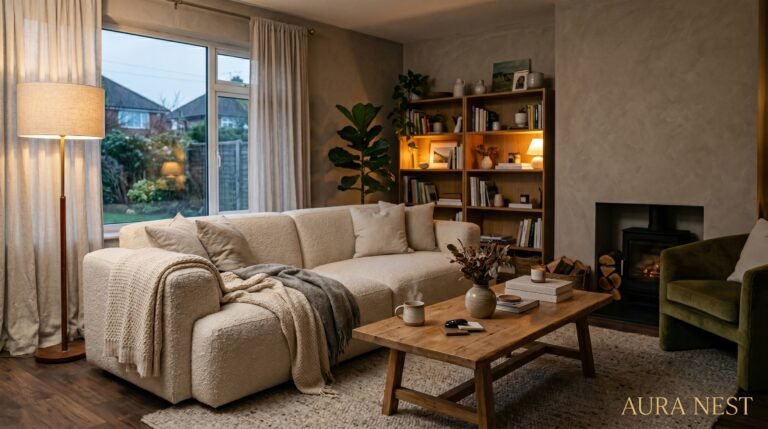
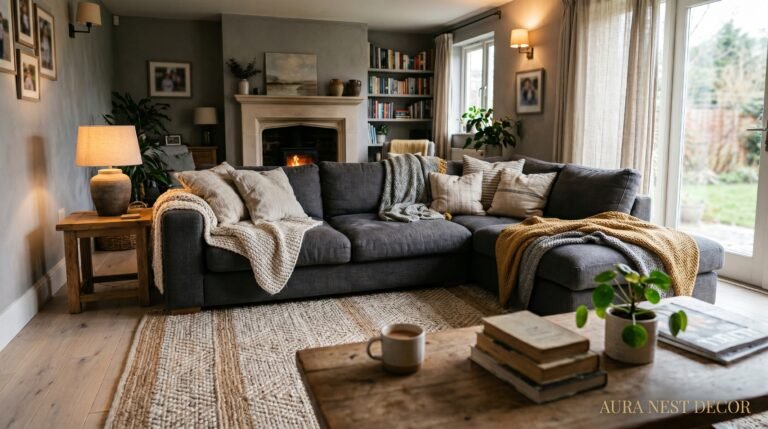
You know that feeling when you walk into someone’s home and everything looks beautiful but also somehow like it just happened? No two pieces match exactly, and yet the whole room feels completely intentional. That’s the thing about modern boho — it looks effortless, but there’s a quiet logic underneath all of it.
—
1. Why “Boho” Got a Bad Name (And How Modern Boho Fixed Everything)
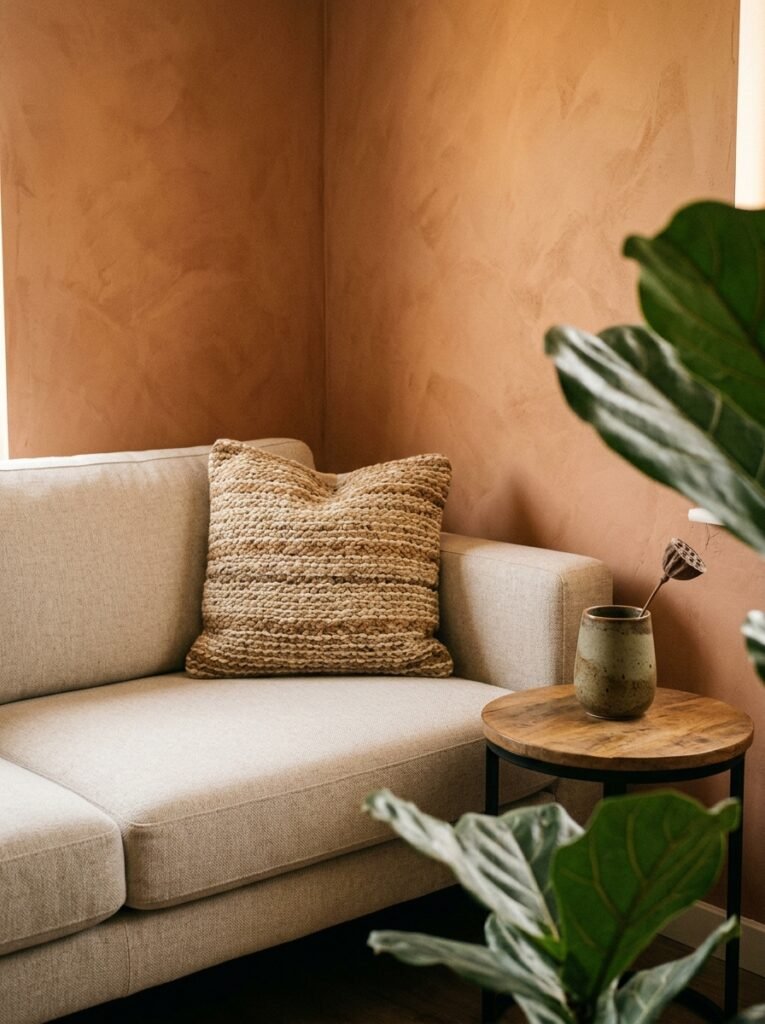
For a long time, boho was the style that interior designers quietly rolled their eyes at. Too many macramé wall hangings. Too many mismatched cushions fighting each other for attention. A fringe situation that got out of hand somewhere around 2016. The problem was never the aesthetic itself — it was the execution. People were chasing the mood of the style without understanding the underlying structure that makes it work.
Modern boho corrected course. It kept all the warmth, the texture, the layered personality — and then it borrowed restraint from Scandinavian minimalism. It said: one statement hanging, not six. Neutral walls so the collected pieces breathe. Natural materials that feel earned rather than purchased as a set.
The result is a living room that looks like someone genuinely lives there. A room with stories in it. Not a showroom, not a mood board printed at full scale. The reason this style resonates so deeply with people right now is because it pushes back against rooms that look flawlessly empty. We’ve had enough of perfectly staged, soullessly pristine spaces. We want warmth. We want the worn edge of a rattan chair and the softness of a throw that’s been used.
That’s the promise of modern boho, and it delivers on it every time when you understand the rules well enough to break them thoughtfully.
“Modern boho isn’t about collecting things. It’s about keeping only the things that make the room feel like you.”
2. The Color Palette That Keeps Showing Up in Every Beautiful Living Room Right Now
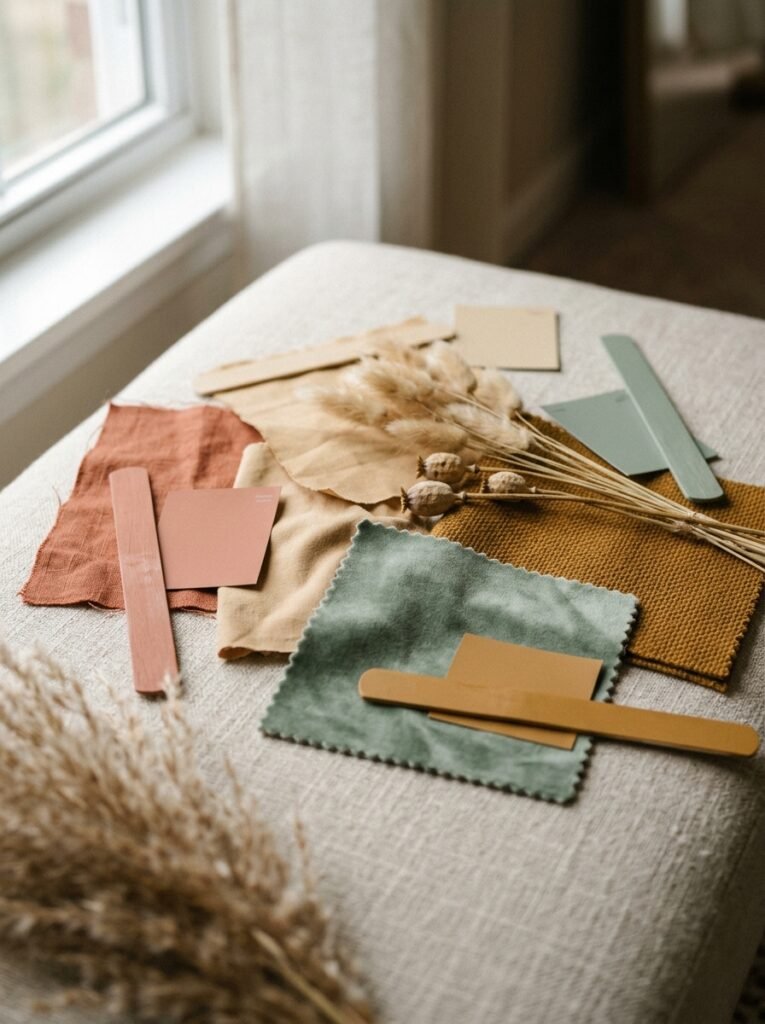
Warm terracotta. Dusty sage. Off-white that leans ever so slightly cream. These are the colors doing the heavy lifting in modern boho living rooms across the US and UK right now, and they work for one specific reason: they all look like they belong to the earth.
Not trendy colors. Ground colors.
Start with your walls. Warm white is the backbone — Benjamin Moore’s White Dove or Farrow & Ball’s Pointing both hit that sweet spot between crisp and cozy. You don’t want a cold white in a boho space; it fights everything else you’re trying to do. From there, your color story gets told through textiles, ceramics, and plants.
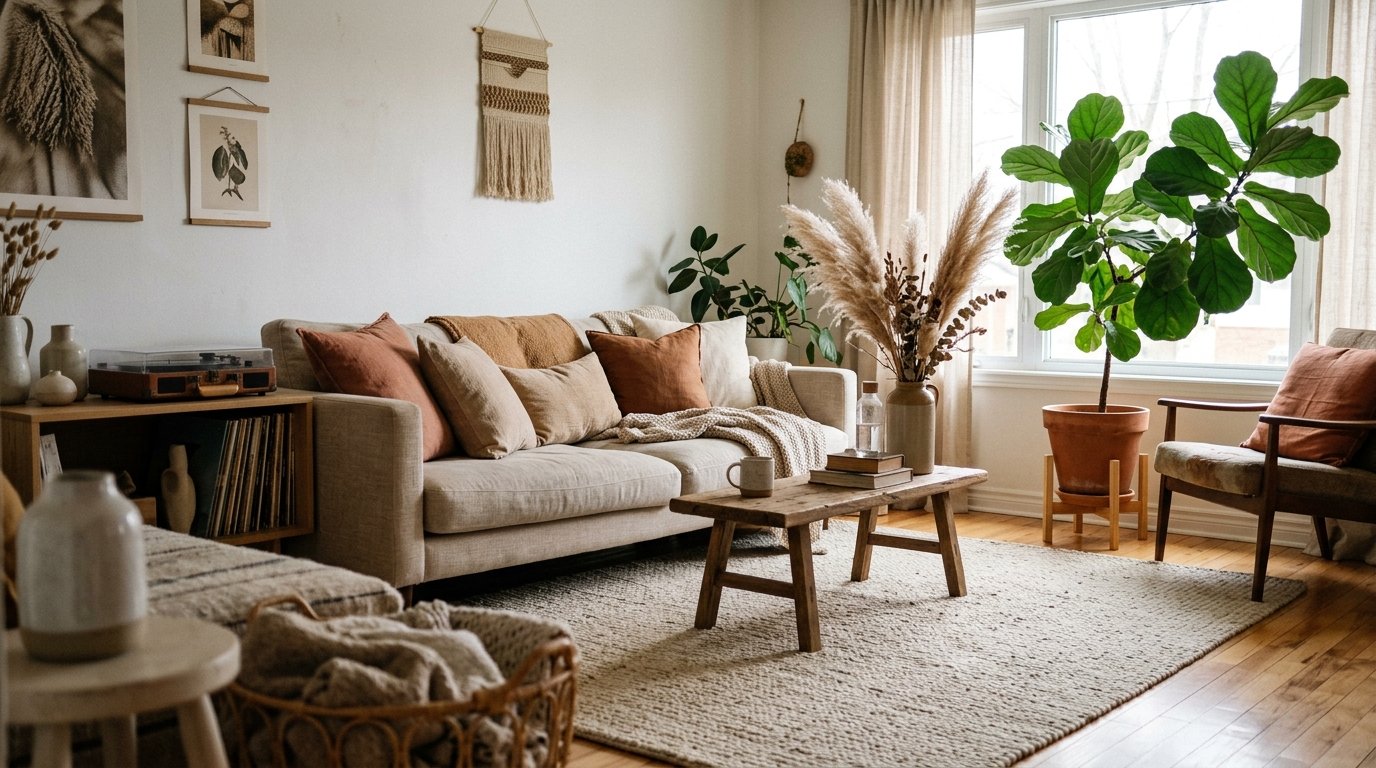
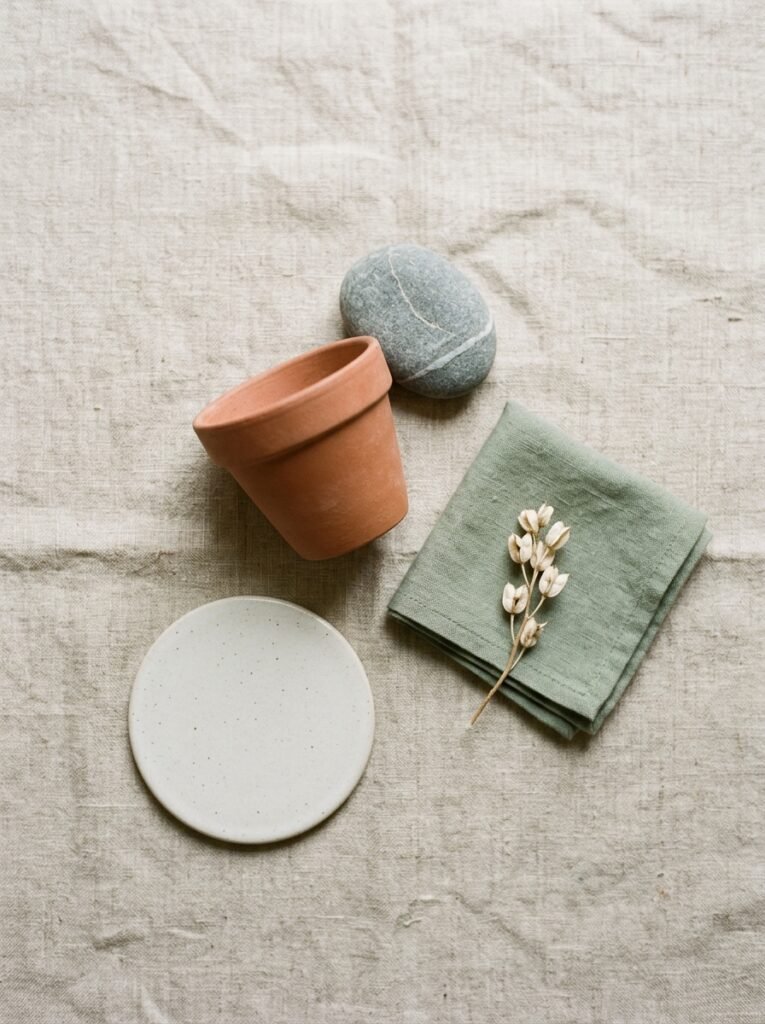
Terracotta appears as a throw pillow, a pot, a small ceramic vase on the coffee table. Sage appears in a linen cushion cover or a eucalyptus arrangement left to dry against the wall. Deep rust shows up in a vintage-style rug, and suddenly the room has warmth in every corner without a single brightly painted wall.
This palette also ages beautifully. It doesn’t look dated after two years the way a stark-white-and-black scheme can. The earthy tones patina well alongside real materials — wood that gets more beautiful as it scratches, linen that softens as it wrinkles. The colors and the materials are speaking the same language, and that’s why the room always feels cohesive even when nothing technically matches.
3. The Rug Is the Most Important Decision in the Whole Room (Don’t Rush It)
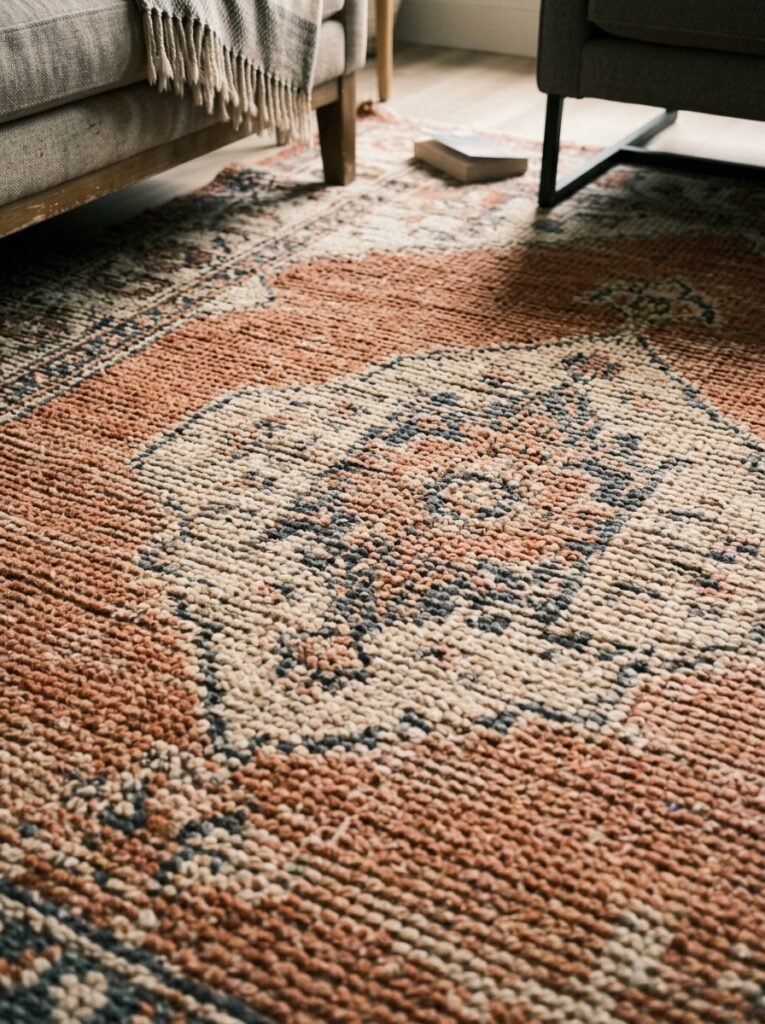
There is no modern boho living room without a rug that anchors it. Full stop.
The rug is the piece that everything else responds to. Get it right and the whole room breathes. Get it wrong — too small, too pattern-heavy for the space, too synthetic — and you’ll spend months wondering why the room never quite clicks.
Size first. In a US living room, your rug should be large enough that at least the front legs of every seating piece sit on it. In a standard British sitting room, this can be trickier with smaller square footage, but the principle holds: go larger than you think you need. A rug that floats in the middle of the space with nothing touching it makes the whole room feel adrift.
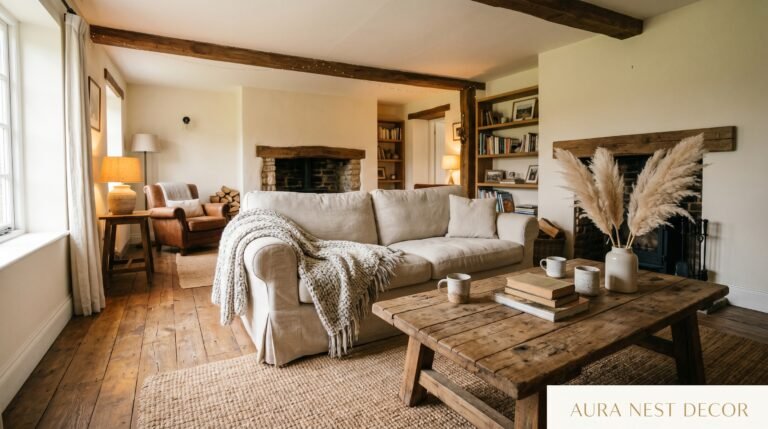
For the modern boho aesthetic, look for vintage-inspired flat-weave kilims, distressed Persian-style rugs, or simple jute and sisal layered over a softer underrug. The layering trick — a jute base with a smaller vintage rug on top — is one of those combinations that looks expensive but is genuinely practical and budget-friendly.
Pattern-wise, low contrast is your friend. A rug with muted tones in terracotta, navy, and cream does infinitely more work than a high-contrast geometric. It holds the room together without demanding attention every time someone walks in.
4. The One Furniture Rule That Stops Modern Boho From Feeling Like a Jumble Sale
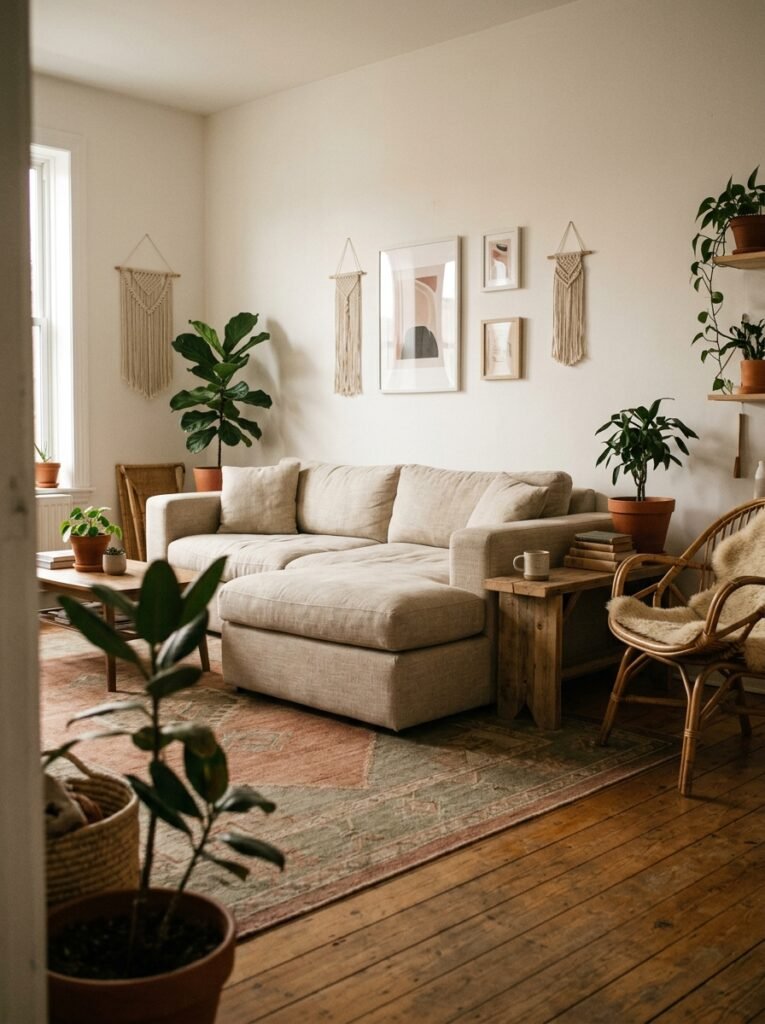
Here it is: every room needs one clean piece.
One sofa, chair, or storage unit that is simple in shape, neutral in color, and asks nothing of the eye. This is the visual resting place that makes all your beautiful, textured, found, interesting pieces look intentional rather than haphazard.
In most modern boho living rooms, this is the sofa. A linen or cotton sofa in off-white, warm grey, or dusty oat is the platform everything else performs on. It’s not boring — it’s strategic. Because when your sofa is clean and quiet, your Moroccan pouf and your rattan side table and your pile of vintage hardcovers on the coffee table all read as deliberate choices.
If you’re working with a smaller British sitting room, the clean piece might be a loveseat or even just a streamlined armchair. The principle scales to any size space.
Where people go wrong is treating every piece of furniture as a statement. Two statement chairs, a statement sofa, a statement coffee table, and suddenly nothing is a statement — everything is just noise. One beautiful, specific, interesting piece per seating group. The rest supports it.
“Give every beautiful thing room to be seen. Crowd it and you lose it entirely.”
5. What to Actually Do With Your Walls (This Isn’t a Gallery Wall Tutorial)
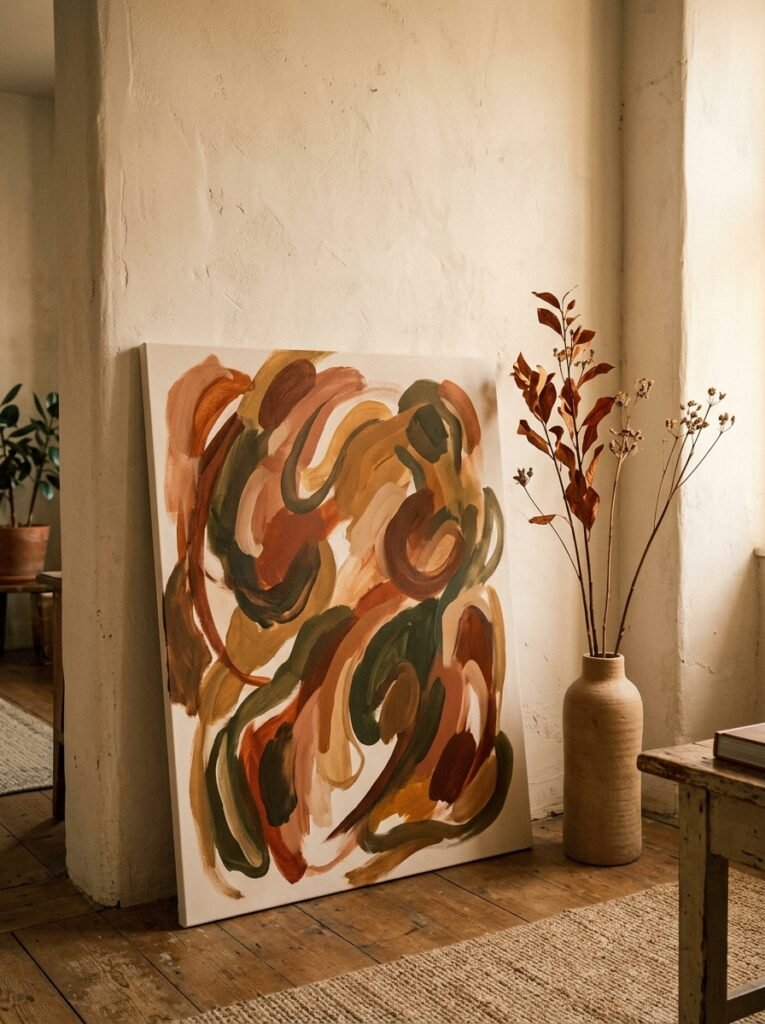
Gallery walls are everywhere. They’re also often the first thing that tips a modern boho space from curated into cluttered. So let’s talk about a different approach.
One large piece. That’s frequently the answer.
A single oversized artwork — a framed vintage textile, a large abstract canvas in earthy tones, a woven wall hanging with real presence — does more for a boho living room than fourteen small frames competing for dominance. In a narrow British terrace sitting room, one vertical piece can make the ceiling feel three feet taller. In a wide American living room with a long sofa wall, one horizontal piece pulls the whole seating arrangement into focus.
What works beautifully in modern boho: a handwoven textile in natural fibers, an abstract print in a simple wide frame, dried pampas grass or botanicals arranged large-scale, or even a series of three identically-framed prints given careful breathing room between them. Three is not a gallery wall. Three is a considered arrangement.
Keep the wall behind your main seating area the focal point. Resist the urge to fill every surface. The negative space on a warm white wall is doing something — it’s giving your eye somewhere to rest, and it’s making the pieces you’ve chosen look chosen.
6. Texture Is the Thing Your Room Is Probably Missing
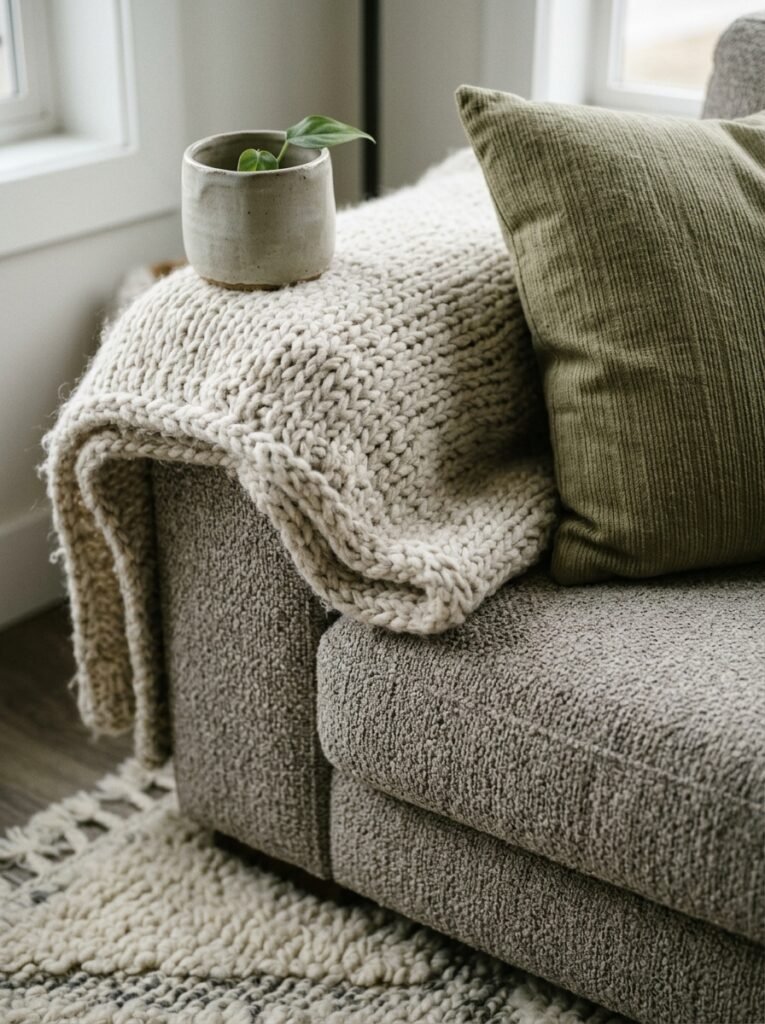
Most living rooms that feel “almost right but not quite” are missing texture. Not color. Not furniture. Texture.
Run your hand across a modern boho room done well and you’d feel something different everywhere you touched. The slightly rough weave of a linen throw. The smooth cool of a ceramic lamp base. The softness of a sheepskin draped over a chair arm. The irregular surface of a wooden coffee table that was clearly once a tree. The tightly coiled rope of a sisal basket in the corner.
Texture is what makes a room feel three-dimensional in photographs — which matters enormously if you’re creating spaces you want to share or save. And more importantly, texture is what makes a room feel real when you’re sitting in it. It creates a sensory environment, not just a visual one.
Here’s where to start: your throw situation. If you have a smooth sofa (and the strategic neutral sofa from section four is indeed smooth), you need at minimum two texturally different throws — perhaps a chunky knit in cream and a lighter cotton-weave in a warm rust. Drape, don’t fold. Draped throws look lived-in. Folded throws look like a showroom.
From there: layer your cushions. Mix a velvet cushion with a linen one. Add one with a subtle woven pattern. They should feel different in your hand, not just look different at a glance.
7. Plants That Actually Work in the Style (And the Ones That Look Wrong)
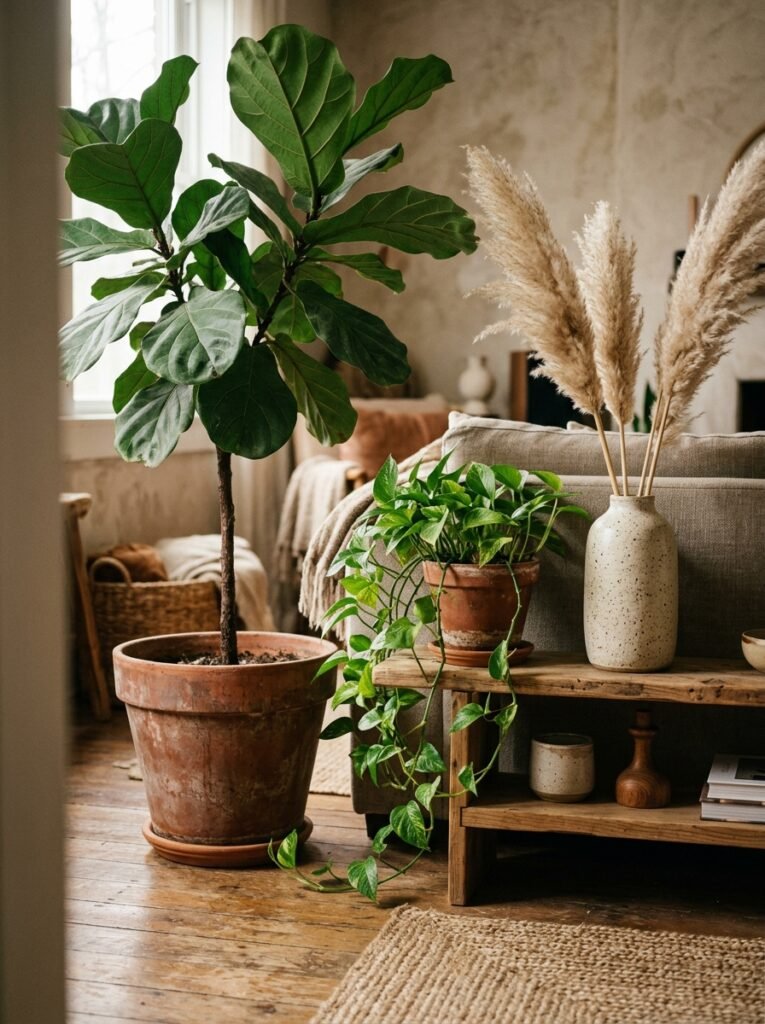
Not every plant belongs in a modern boho living room. It’s worth being specific about this.
The plants that work are the ones that have personality — that grow asymmetrically, that trail dramatically, that have an interesting silhouette. A large fiddle-leaf fig in a terracotta pot near a window. A trailing pothos on a high shelf. A mature monstera with real presence in a corner. Dried botanicals: pampas grass, cotton stems, dried eucalyptus in a simple vase that makes the room smell faintly of something good.
What looks wrong in this style: uniformly perfect, highly manicured topiaries. Plastic plants (always, but especially here). Plants in matching white IKEA pots lined up in a row — that reads too minimalist, too deliberate in the wrong direction. And anything tropically graphic in pattern, like bird of paradise used purely as a prop rather than a living thing with room to breathe.
Vary your heights. A tall floor plant, a mid-height shelf plant, a small trailing thing on the coffee table. And vary your containers too: terracotta, wicker plant baskets, simple ceramic in earthy tones. A rattan plant stand changes everything — it adds height and visual interest and works with every plant you put in it.
“A room with real plants is never fully finished. They keep becoming.”
8. The Lighting Secret That Every Beautiful Boho Room Has in Common
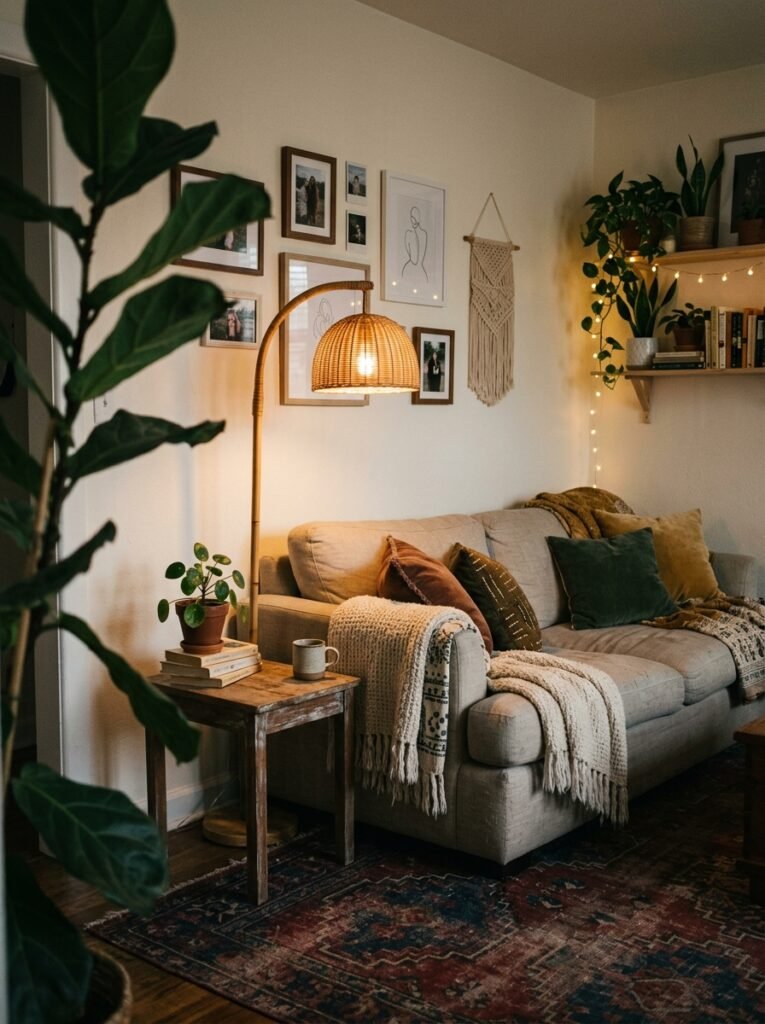
Not one overhead light doing all the work.
That’s it. That’s the secret. Overhead lighting is fine as a base layer, but in a modern boho living room it cannot be the only light source, and it probably shouldn’t be the primary one after about 5pm.
What you want instead: layers of warm light at different heights. A floor lamp with a linen shade in the corner, casting a wide soft glow. A table lamp on a side table with an Edison bulb — that amber warmth at 7pm when the daylight drops is one of the most genuinely cozy things you can do to a room. A string of warm fairy lights tucked into a shelf or along a bookcase edge, not in a childish way but in a way that suggests candlelight.
In the US and UK both, so many rental homes and new builds come with a single ceiling fixture per room, and it produces that flat, harsh, overhead glare that makes everything look like a waiting room. The fix is inexpensive: two lamps from a charity shop or thrift store, rewired if needed, with warm-toned bulbs. The difference is not subtle.
Dimmer switches are worth every penny if you own your home. Or, shorter-term: simply unplug the overhead when you’re home for the evening. Use only the lamps. You will feel the change in your body within minutes.
9. The Coffee Table Moment That Makes the Room Feel Finished
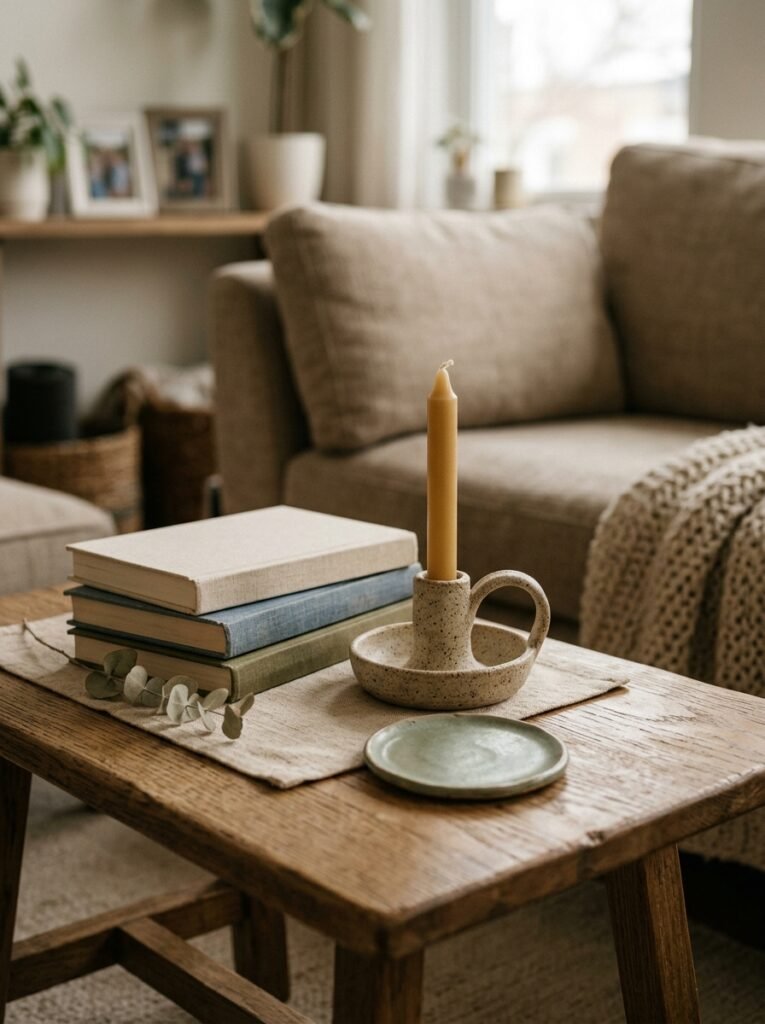
The coffee table isn’t a surface. In modern boho, it’s a composition.
There’s a formula worth knowing: height variation, one organic element, one functional element, and one element that’s purely beautiful for no practical reason. Apply it and your coffee table will look styled without looking like you tried.
Height variation: a stack of two or three oversized books underneath a small object creates instant dimension. Organic element: a small ceramic bowl of dried seed heads, a branch of eucalyptus laid casually, a single stem in a bud vase. Functional element: a coaster stack, a small tray holding a candle and matches. Beautiful-for-no-reason element: a smooth piece of driftwood, a vintage brass object, a geode slice.
Keep negative space in the composition. Half the table should be empty. This is the version of “less is more” that modern boho actually agrees with.
In terms of the table itself: wood with visible grain, rattan, a vintage trunk used as a table, or a glass-topped piece with a base in natural material all work. What doesn’t work as well: lacquered high-gloss finishes, anything that looks too new and factory-perfect, or glass-topped with chrome legs — that’s not the vibe, and it will fight everything else.
10. Second-Hand Shopping Is Not a Budget Move — It’s the Whole Point
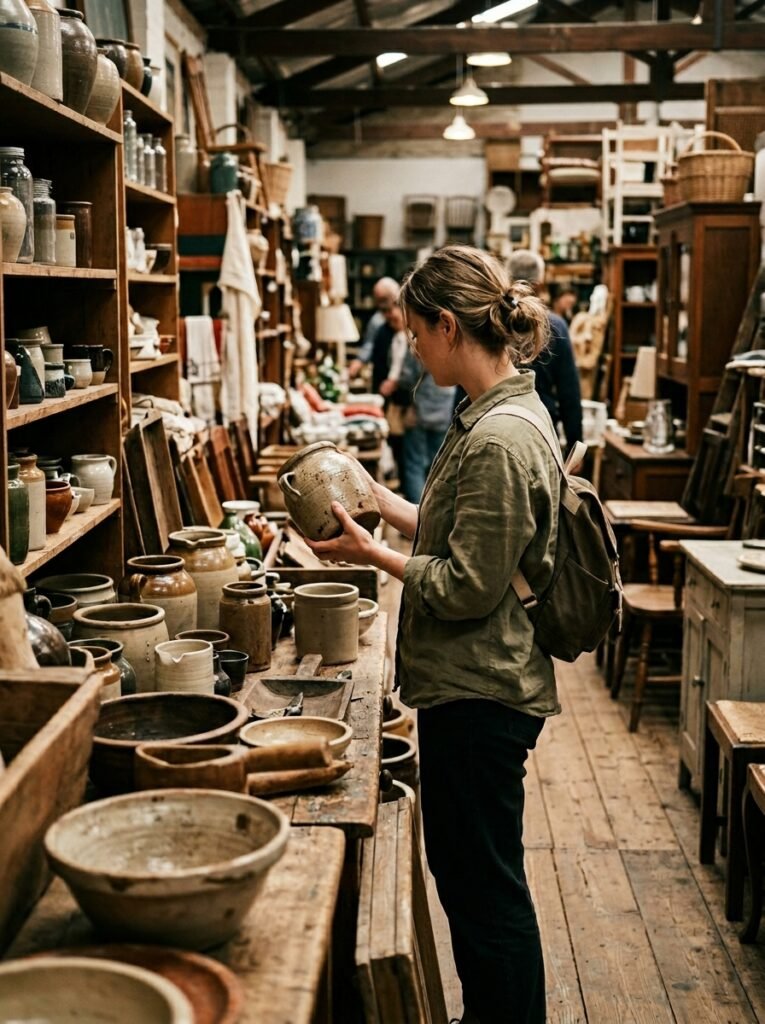
Let’s reframe something important: the pieces in a modern boho living room that make it feel genuinely good are almost always not from a single store.
This isn’t about budget. It’s about authenticity. A rattan chair from 1972 found at an estate sale has a patina that no new rattan chair from a high-street retailer can replicate. A kilim rug bought from a market stall in a small town has a story in it. A ceramic lamp base from a charity shop is one-of-a-kind in the only way that matters — nobody else has exactly that one.
Modern boho is, at its core, a style that rejects the perfectly matched, perfectly new, perfectly curated showroom approach. Which means that shopping second-hand isn’t cutting corners — it’s doing the style correctly.
In the US: estate sales, Facebook Marketplace, Craigslist furniture sections, and thrift stores like Goodwill regularly turn up extraordinary pieces. In the UK: charity shops, car boot sales, eBay local collection listings, and sites like Vinterior or Selency are goldmines for the exact vintage and handmade pieces this style needs.
The rule of thumb: aim for roughly 60-70% new or newish foundational pieces (the sofa, the rug, lighting) and 30-40% found, vintage, or handmade. That ratio is where the magic lives.
11. Small British Sitting Rooms and the Specific Challenges They Throw Up
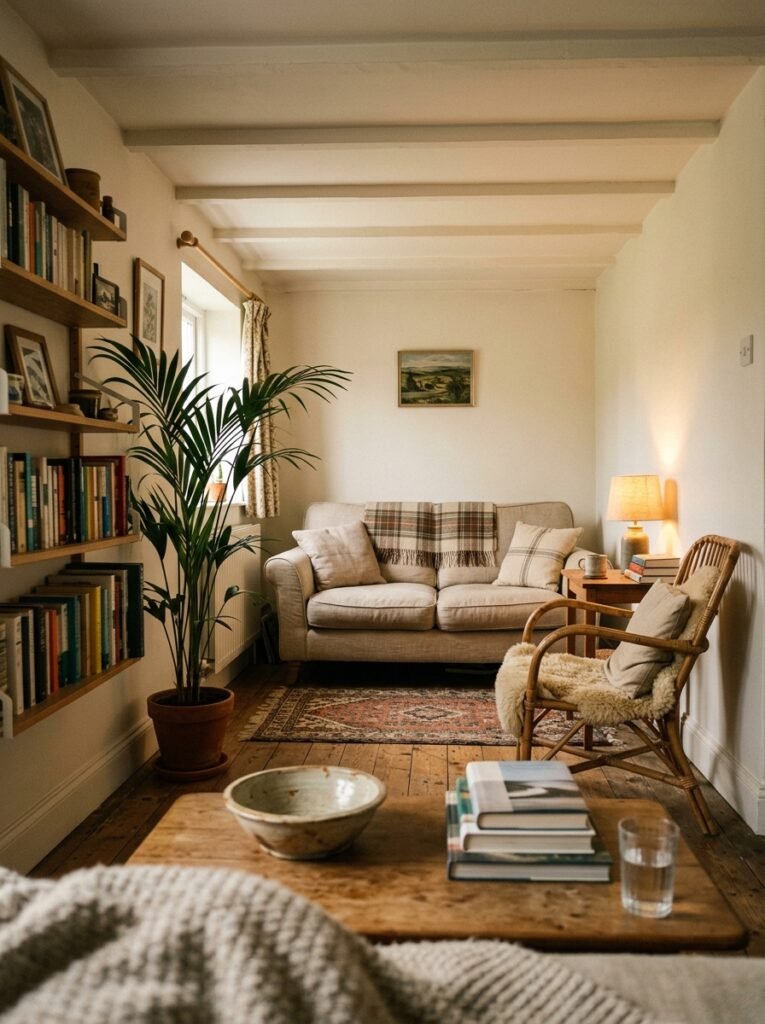
Most American homes and most British homes are not playing the same game when it comes to living room size. The British sitting room — particularly in terrace houses, Victorian conversions, and modern new-build semis — is often working with significantly less square footage, lower ceilings, and sometimes awkward alcoves or chimney breast proportions.
Modern boho scales down beautifully, but you have to edit more aggressively.
One large plant instead of three medium ones. A loveseat instead of a full three-seater sofa. A single oversized wall piece instead of any gallery arrangement. The layered rug trick actually works brilliantly in smaller rooms because it adds visual interest at floor level without adding height or bulk to the room.
Alcoves are assets. In a Victorian terrace with the classic pair of alcoves flanking a chimney breast, you have built-in symmetry to work with. Float a shelf in each alcove at picture-rail height, fill with plants and a few beautiful objects, and the room gains enormous personality without any structural work.
Low furniture is your friend in lower-ceilinged rooms. A low-profile sofa, a coffee table that sits at the correct height rather than towering, and a floor lamp rather than a tall arched lamp all keep the eye moving horizontally — which makes the room feel wider and the ceiling feel higher.
12. The Test That Tells You When to Stop Adding Things
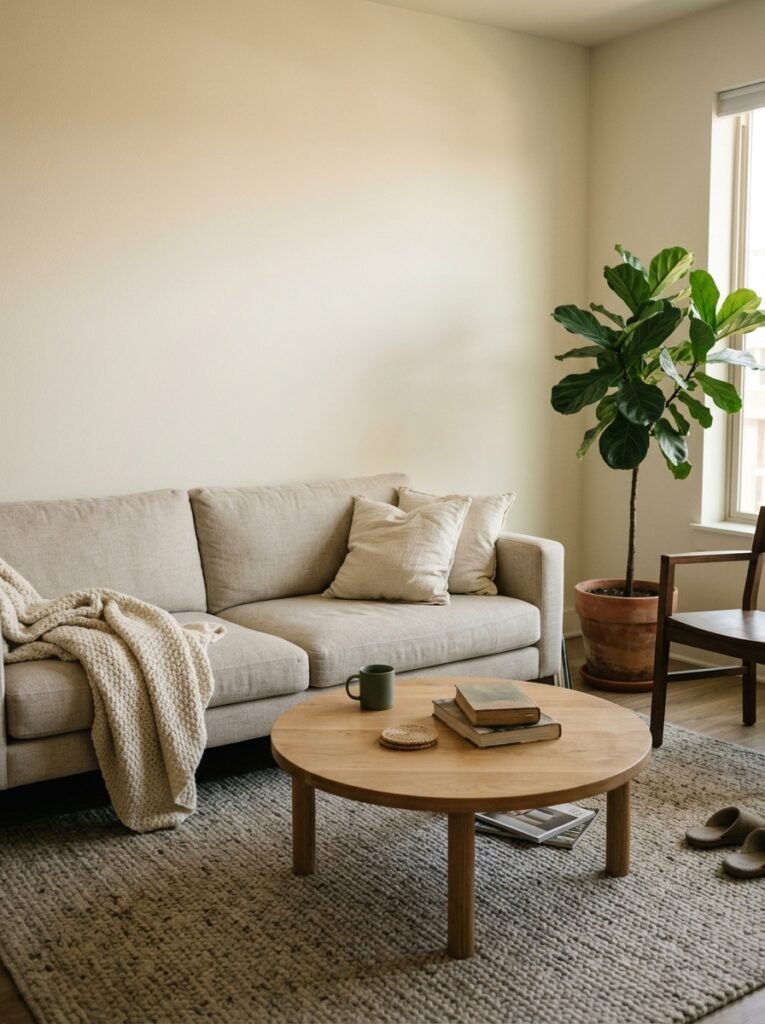
There’s a question worth asking yourself as you style any room, and it works particularly well for modern boho because this is the style most at risk of tipping into chaos: if I took one thing away, would the room miss it?
Walk around your living room and try it. Pick up a cushion. Remove a piece from the coffee table composition. Take down one item from a shelf. If the room misses it — if something in the visual balance or warmth shifts — put it back. If the room looks better or even just the same, that thing was working too hard to justify its presence.
Editing is the most underrated skill in interior styling. Anyone can add. Taking away requires genuine confidence in what you already have.
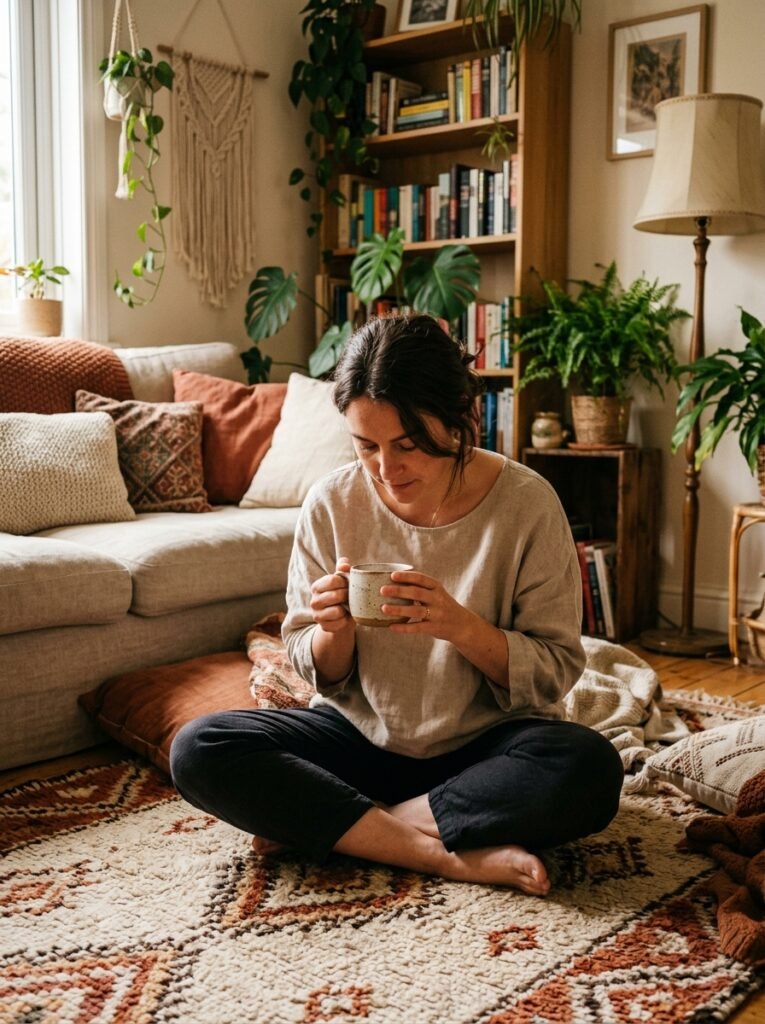
Modern boho is ultimately a style about meaning. The rattan chair you love sitting in on Sunday mornings. The rug your mother helped you pick. The ceramic your partner brought back from a trip. These are the things the room is actually made of. The rest is just filling space.
When the room tells you to stop, stop. Trust it.
—
🌿 Quick Tips
Swap your lightbulbs to warm-toned 2700K LED bulbs in every lamp tonight — it will immediately make your room feel more cozy and cohesive, and it costs almost nothing.
Never buy a rug without lying a piece of tape on the floor first to map the exact size. The number one rug mistake is buying one that’s too small, and tape prevents it every time.
If your room feels busy, pick one shelf or surface and clear it completely. Negative space in a boho room doesn’t look empty — it looks confident.
Dried flowers and botanicals last for months, look beautiful, and require zero maintenance. Pampas, cotton stems, and dried eucalyptus are the three to start with.
Before buying new décor, do one pass through every room in your home looking for pieces that belong in the living room. You likely already own something that wants to be in there.
—
❓ FAQ
Q: What’s the difference between boho and modern boho living room decor? A: Traditional boho tends to layer more freely — more pattern, more color, more of everything. Modern boho applies a more edited eye to the same raw materials. It borrows restraint from minimalism while keeping all the warmth, texture, and personality. The result feels collected rather than chaotic, intentional rather than haphazard.
Q: How do I make my living room look boho without spending a lot? A: Honestly, second-hand and thrift shops are where this style is won. Charity shops in the UK and thrift stores or Facebook Marketplace in the US regularly stock the exact rattan, vintage textiles, ceramic, and natural material pieces that form the backbone of this look. Layer a jute rug with a smaller vintage find on top, swap your lightbulbs for warm-toned ones, add one trailing plant, and you’ve done most of the work.
Q: Can modern boho work in a small British sitting room? A: Absolutely — and in many ways, a smaller, cozier room suits the intimacy of this style better than a vast open-plan space. The key is to edit more aggressively: one large plant rather than many small ones, low-profile furniture, and one strong wall piece rather than a gallery arrangement. Use alcoves and chimney breasts as structural anchors rather than problems to solve.
—
💭 Final Thought
The living rooms that stay with you — the ones you think about long after you’ve left — are never the perfectly matched ones. They’re the ones that feel like someone actually lives there. Like the room accumulated itself over time, through decisions made with real preferences rather than trend reports.
Modern boho gives you the framework to build that kind of room. The rest is just paying attention to what you already love.
What’s the one piece already in your home that you think deserves more room to breathe?