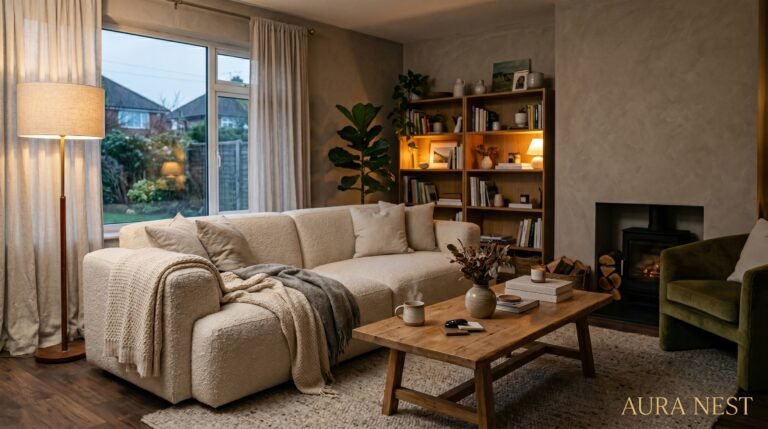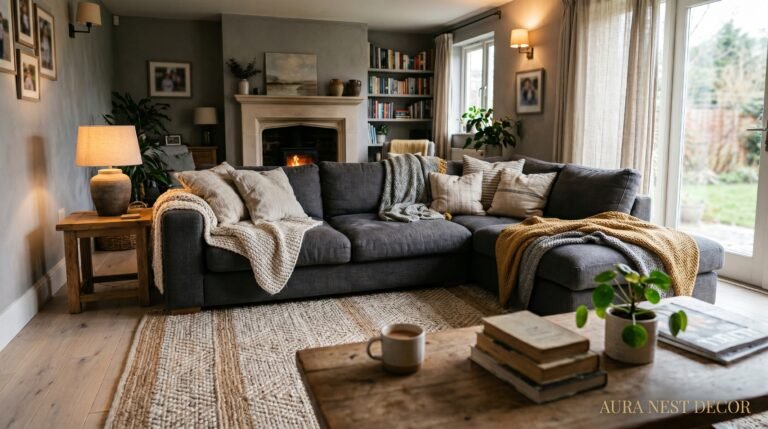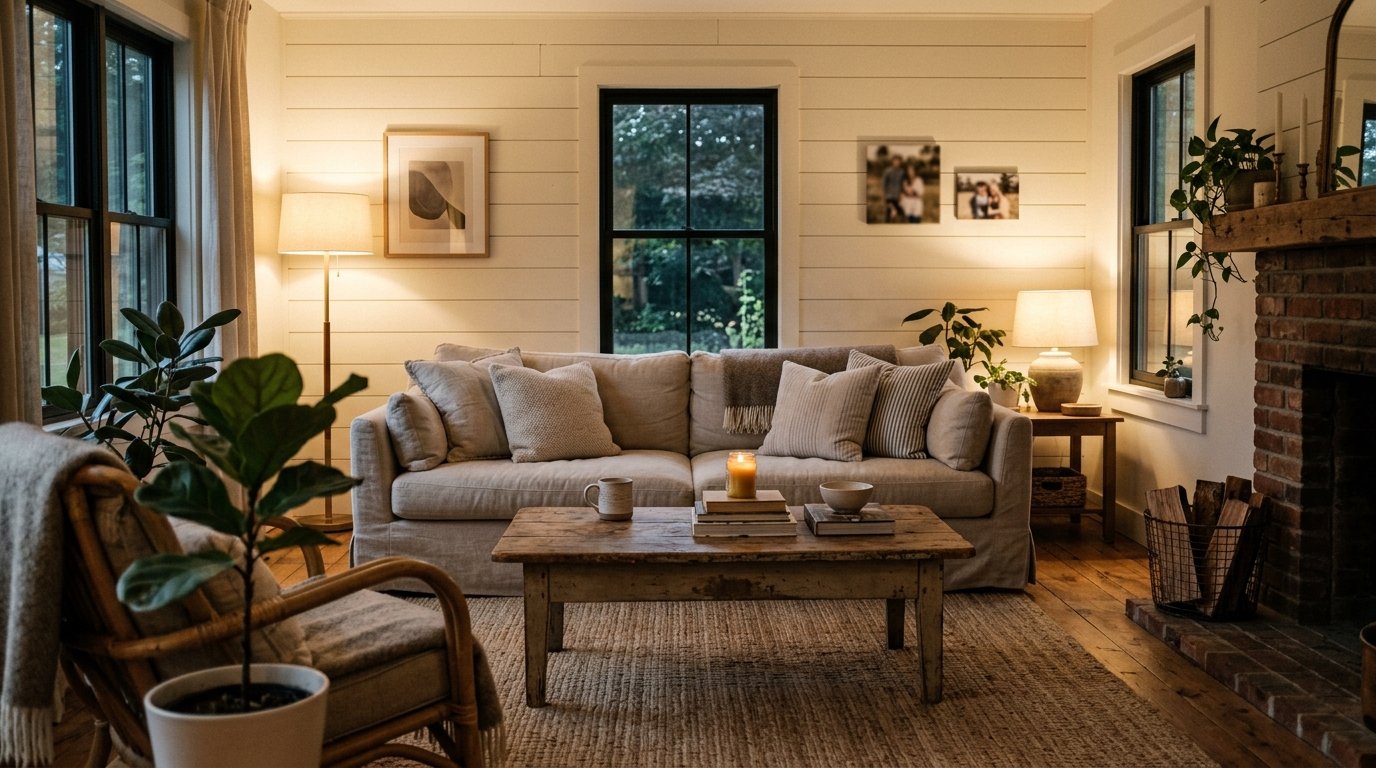
The Modern Farmhouse Living Room That Doesn’t Look Like a Catalog Copy
You know the feeling when you walk into someone’s home and everything just settles? The kind of room where you drop your bag, sink into the sofa, and immediately stop thinking about your to-do list. That’s what modern farmhouse does when it’s done right — and it’s nothing like the shiplap-and-chalkboard version that peaked around 2016.

—
1. Why the Best Modern Farmhouse Rooms Start With One Imperfect Thing
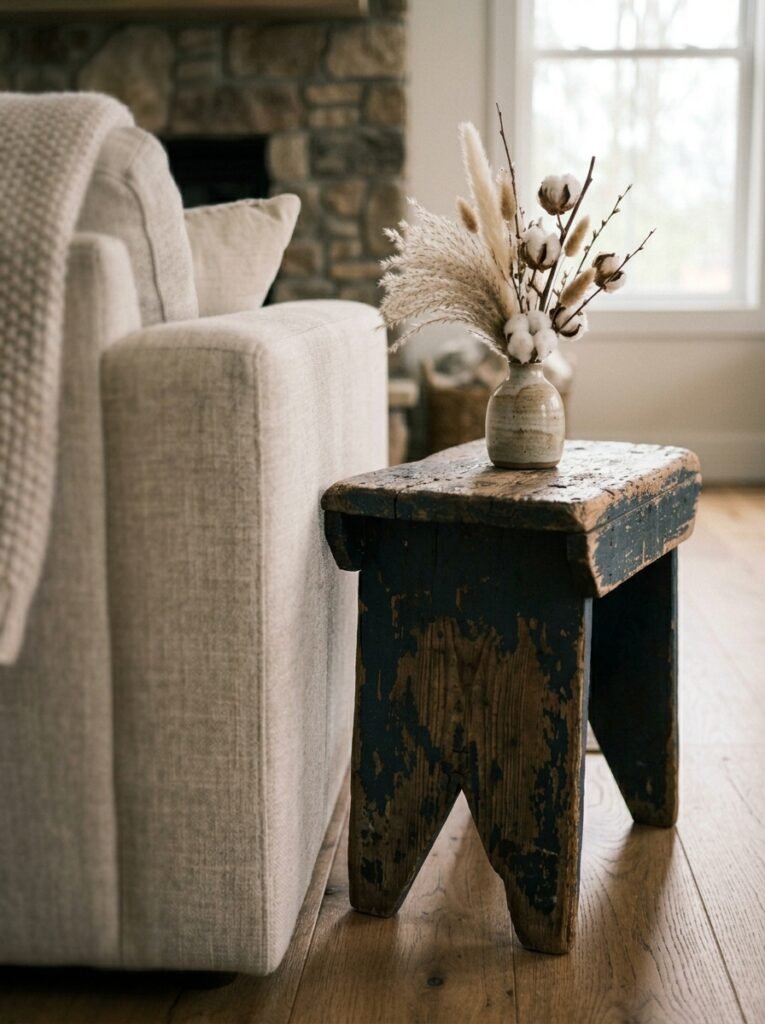
Here’s the secret that no one puts in the Pinterest caption: the rooms that actually feel like modern farmhouse — not a theme park version of it — always have something that shouldn’t work but does.
A knackered old trunk used as a coffee table. A genuinely rough-hewn beam that your builder wanted to hide. A piece of pottery that’s slightly lopsided because it was made by someone’s hands, not a machine. That imperfection is the whole point. Modern farmhouse sits at the intersection of “I have taste” and “I also live here,” and the lived-in quality is what makes it magnetic.
Before you buy a single throw pillow, think about what your space already has that feels honest. An older home in the UK might have original sash windows or a stone fireplace surround that’s been painted over seven times. An American craftsman or colonial might have original hardwood floors that creak in exactly the right place. Start there. Work outward from what already exists, rather than layering a style on top like a coat of paint.
The imperfect anchor piece gives the room permission to breathe. Everything else can be considered, even expensive — but it all bows to that one thing that’s genuinely, unapologetically real.
“Modern farmhouse isn’t a style you buy. It’s a feeling you build around what’s already true about a space.”
2. The Neutral Palette That Actually Has a Point of View
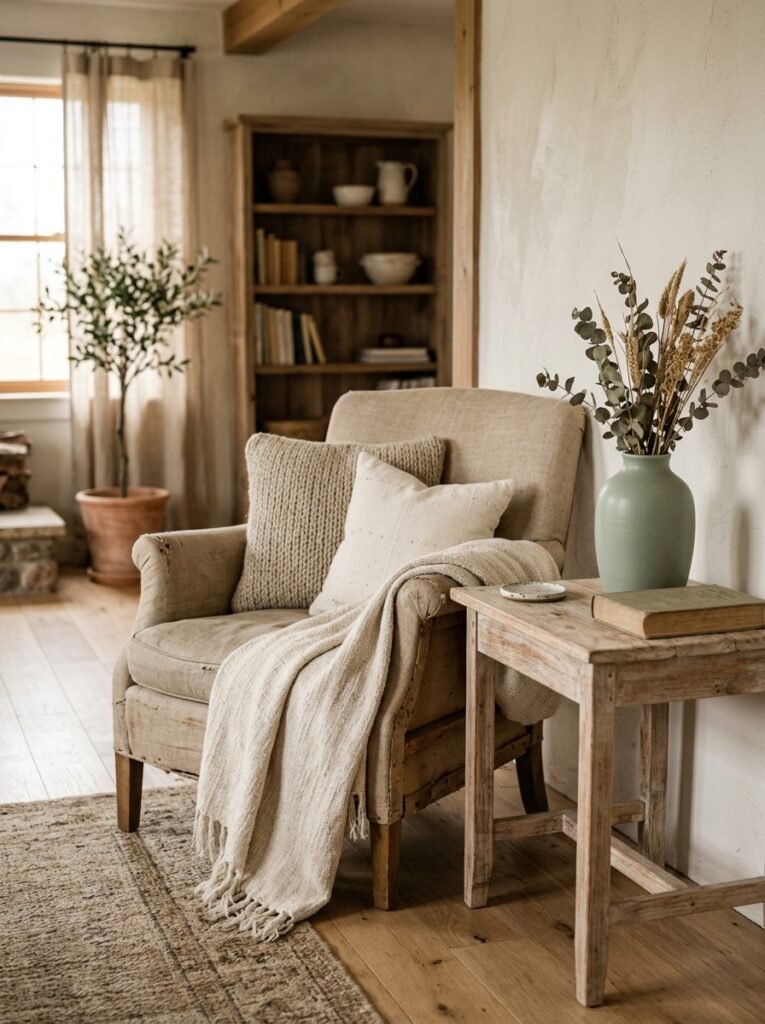
Every article about modern farmhouse says “stick to neutrals.” Fine. But which neutrals? Because there is a massive, visible difference between a room painted in the wrong white and a room that glows.
Warm whites with a yellow or pink undertone — think Farrow & Ball’s “Pointing” or Benjamin Moore’s “White Dove” — read as creamy and old in the best way. They feel like Sunday mornings. Cool whites, the slightly blue-grey ones, feel more editorial, more Scandinavian-adjacent. Both can work in a modern farmhouse, but they create completely different moods.
Then there are your deeper anchors. A warm greige on an accent wall (Farrow & Ball’s “Elephant’s Breath” has become a cliché for a reason — it genuinely works). Deep navy on built-in shelving. Even a dusty terracotta on a single chimney breast that makes the whole room feel like it was decorated by someone who spent a summer in Tuscany and brought a little of it home.
The trick is layering your neutrals so they have depth. A white wall next to a cream linen sofa next to a natural jute rug — three “neutrals” that are completely different in warmth and texture. That layering is what prevents the room from looking like a show home and makes it look like yours.
3. The Sofa Decision That Will Make or Ruin the Whole Room
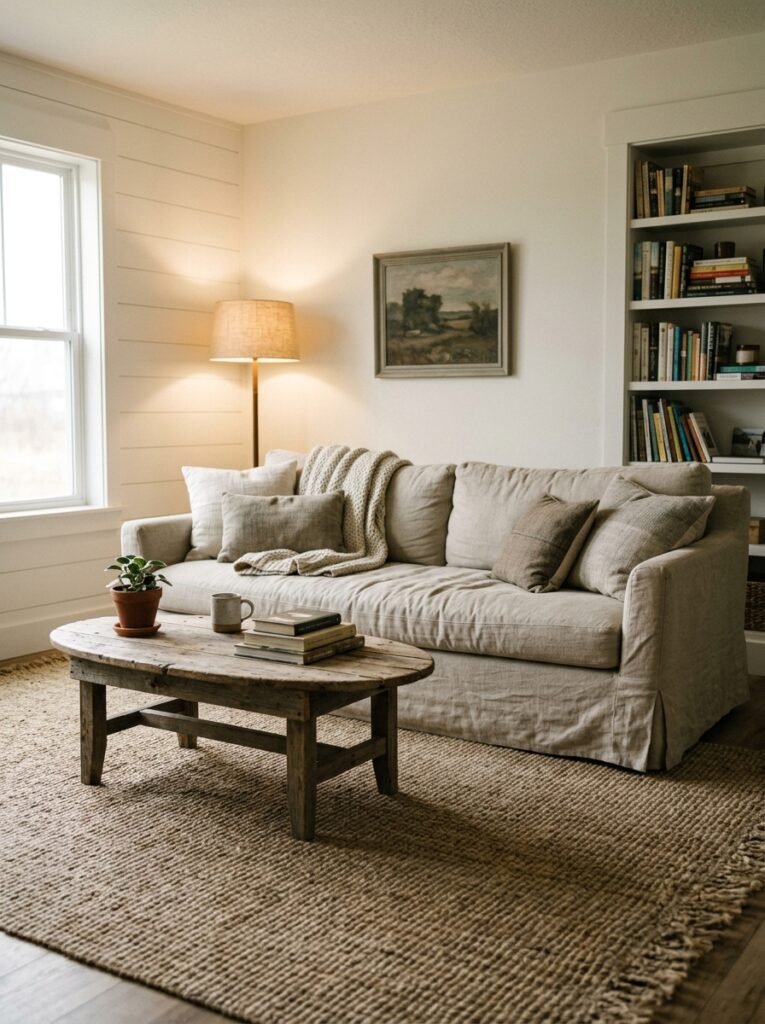
Spend your money here. Not on the accent chairs, not on the coffee table, not on the vintage finds. The sofa.
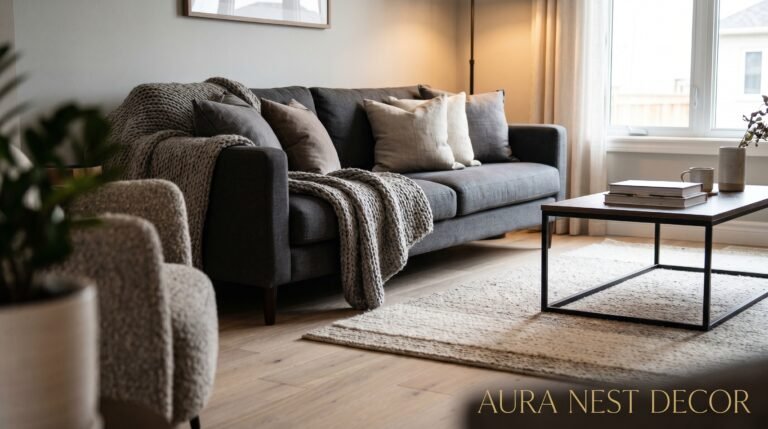
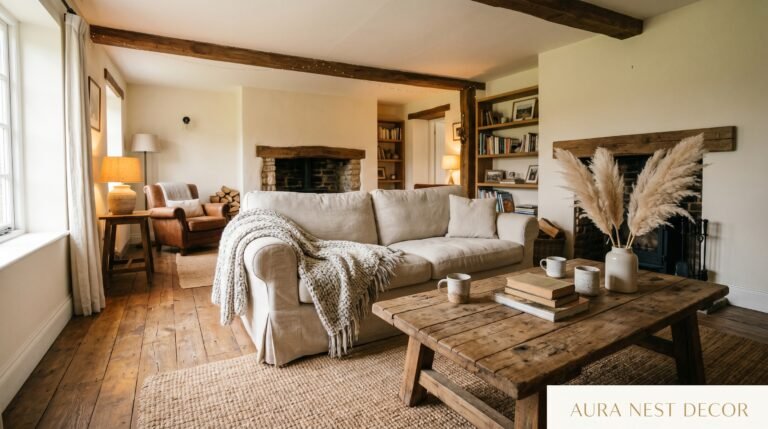
A modern farmhouse living room needs a sofa that looks like it has a past. Not damaged — just settled. A loose-cushion linen sofa in natural, off-white, or a warm mid-grey. A rolled-arm chesterfield in a worn leather (cognac or tobacco, not the shiny stuff). A slipcovered cotton sofa in a slightly wrinkled, slightly soft white that you don’t panic about when someone sits on it with jeans.
The shape matters enormously. Deep seats. Generous proportions. Arms that are either very simple and straight or classically rolled — nothing in between, nothing too angular, nothing that looks like it belongs in a tech company breakout room. You want people to want to stay on this sofa. You want it to be the social center of the house.
In the US, Article and Pottery Barn do this well at their respective price points. In the UK, Loaf makes sofas that feel exactly right for this aesthetic — the kind that look better after two years than they did in the shop. Sofa.com has solid options if you’re working with a tighter budget. Whatever you choose, choose it for comfort first, looks second. They’ll align if you’re looking at the right pieces.
4. The Color That Keeps Showing Up in Every Beautiful Modern Farmhouse Room Right Now
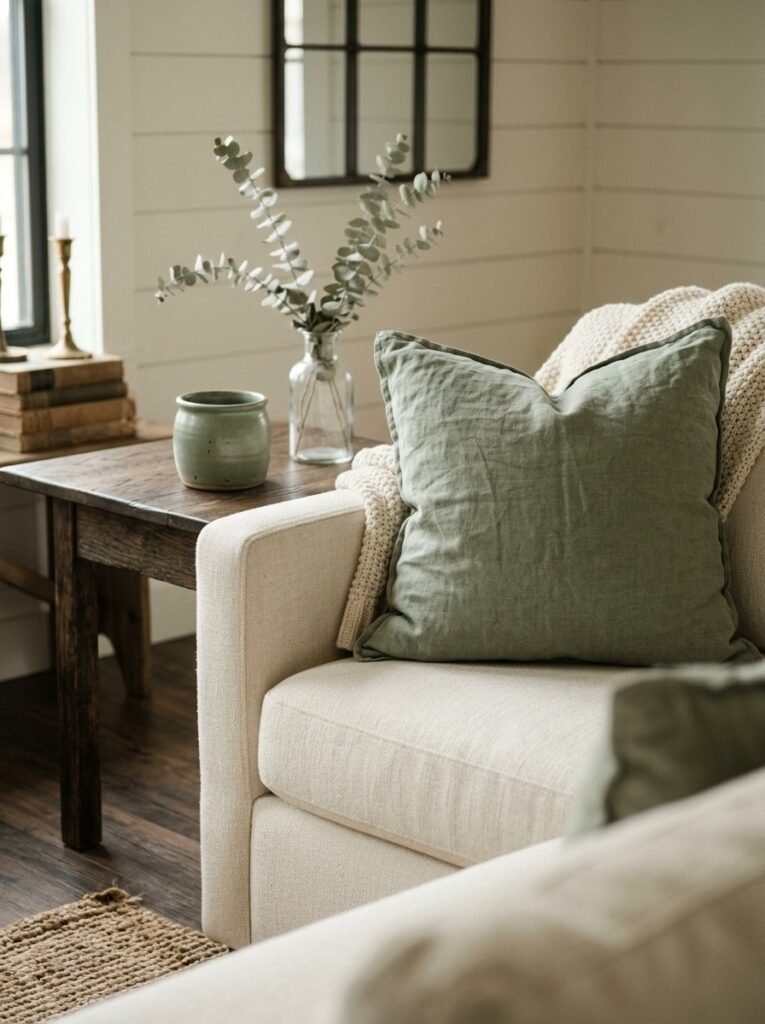
Warm black.
Not the flat, stark black of a minimalist loft. Warm, slightly aged black — think wrought iron, cast iron pans, antique window frames. It’s showing up on light fixtures, on fireplace surrounds, on the thin frames of steel-and-glass internal doors, on cabinet hardware. And it works with literally everything in this palette.
A matte black lantern pendant over a coffee table area. Black iron curtain rods with simple linen drapes. A cluster of black candleholders on the mantel. These moments of dark create contrast without coldness, and they anchor a room full of soft, pale, warm tones so it doesn’t float away into beige nothingness.
This is the single easiest way to sharpen up a modern farmhouse room that feels a bit too soft or a bit too safe. Add one thing in warm matte black. Stand back. Feel the difference.
“Warm black is the punctuation mark. Without it, the whole paragraph is just a run-on sentence.”
5. What to Do With Your Windows (Because Most People Get This Wrong)
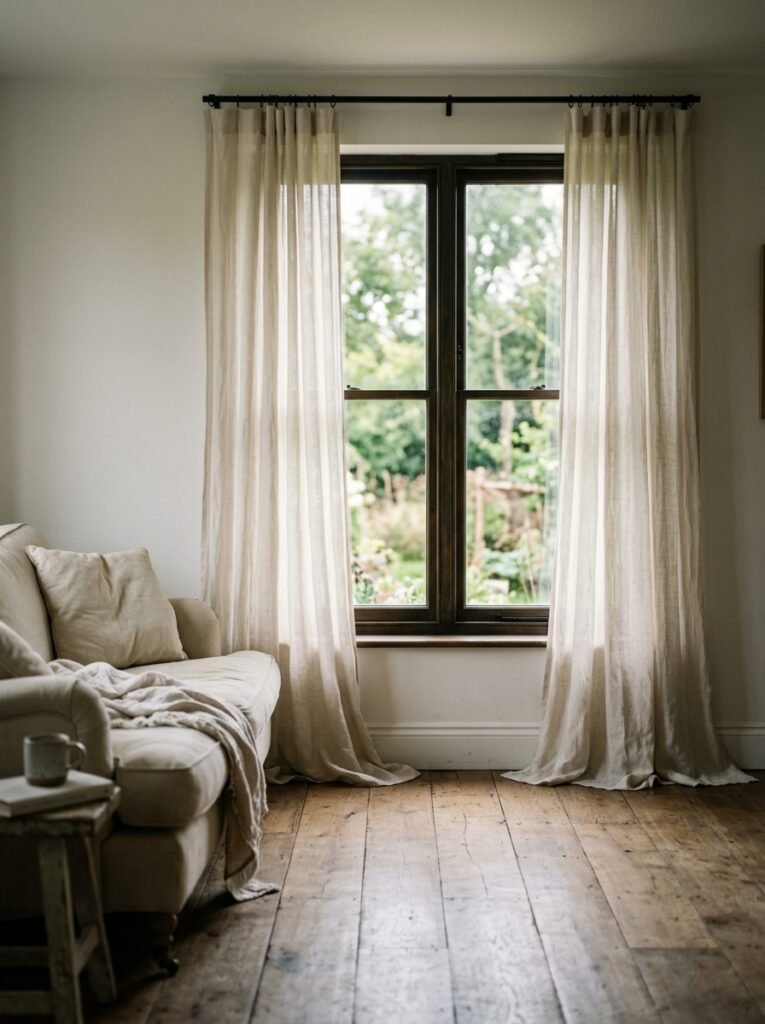
The curtains are not decorative. Or — they are, but they’re also functional, and so many people buy beautiful curtains that hang at completely the wrong height and ruin the entire effect.
Hang them high. Near the ceiling, if you can. And let them puddle or at least touch the floor. This is non-negotiable in a modern farmhouse room because it gives the space height and drama that fights against any tendency to feel low or cottage-y in the wrong way. Even if your ceilings are only 8 feet, curtains hung near the top make them feel 10.
The fabric: linen. Washed, slightly crumpled linen in natural, cream, soft white, or even a dusty sage or warm oatmeal. Not blackout, unless there’s a genuine light problem — the way morning light comes through linen is one of the most beautiful things a living room can do.
In smaller UK terraced houses, this is the trick that changes everything. A narrow room with curtains hung at ceiling height suddenly has presence. It reads as chosen rather than accidental. And in larger American homes with picture windows, flowing linen panels soften what can otherwise feel hard and glass-heavy.
Keep the hardware simple and slightly heavy. Wood poles in a natural or walnut finish, or matte black metal rods. Nothing too thin, nothing too shiny, nothing that looks like it came from a flat-pack furniture shop in 2009.
6. The Fireplace Wall as the Soul of the Room
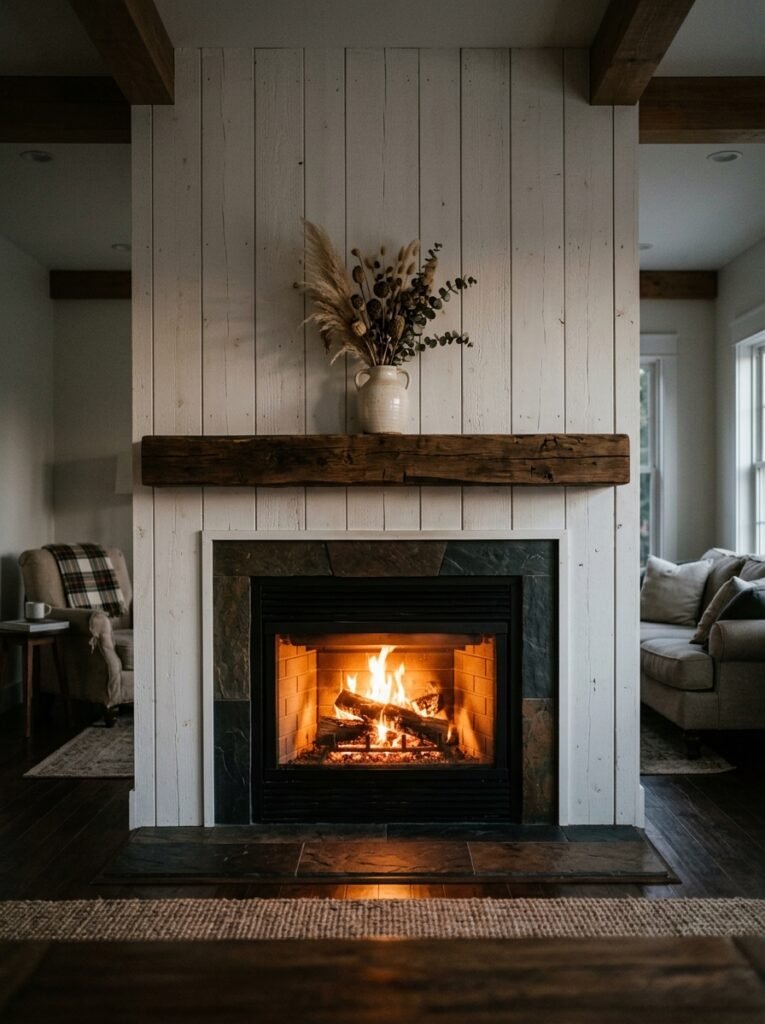
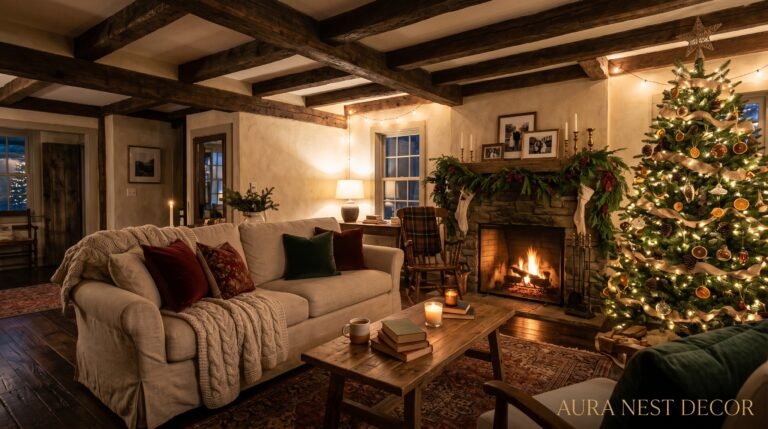
If you have a fireplace, everything else in the room should orient toward it. Not subtly — obviously. The sofa faces it. The armchairs angle toward it. The coffee table sits in its field of warmth. A room that treats its fireplace as furniture rather than as the emotional center of the space is a room that never quite comes together.
The surround itself matters. Original stone, brick, or plaster is ideal — work with what you have and resist the urge to tile over it with something trendy. If you’re updating a dated surround, a simple painted mantel in a soft white or warm cream with a cast iron or stone hearth beneath is timeless in a way that marble and gold simply isn’t, at least in this context.
The mantel display is worth thinking about for longer than you might expect. The modern farmhouse approach is: one large thing, a few small things, and space. A substantial vintage mirror or a piece of simple art. A cluster of candles or a ceramic vase. Maybe something from outside — a branch, a eucalyptus bundle, a handful of dried botanicals that smell faintly of something you can’t quite name. Leave room. Crowded mantels belong to a different decade.
7. The One Rule That Makes Any Sitting Room Feel Intentional, Not Assembled
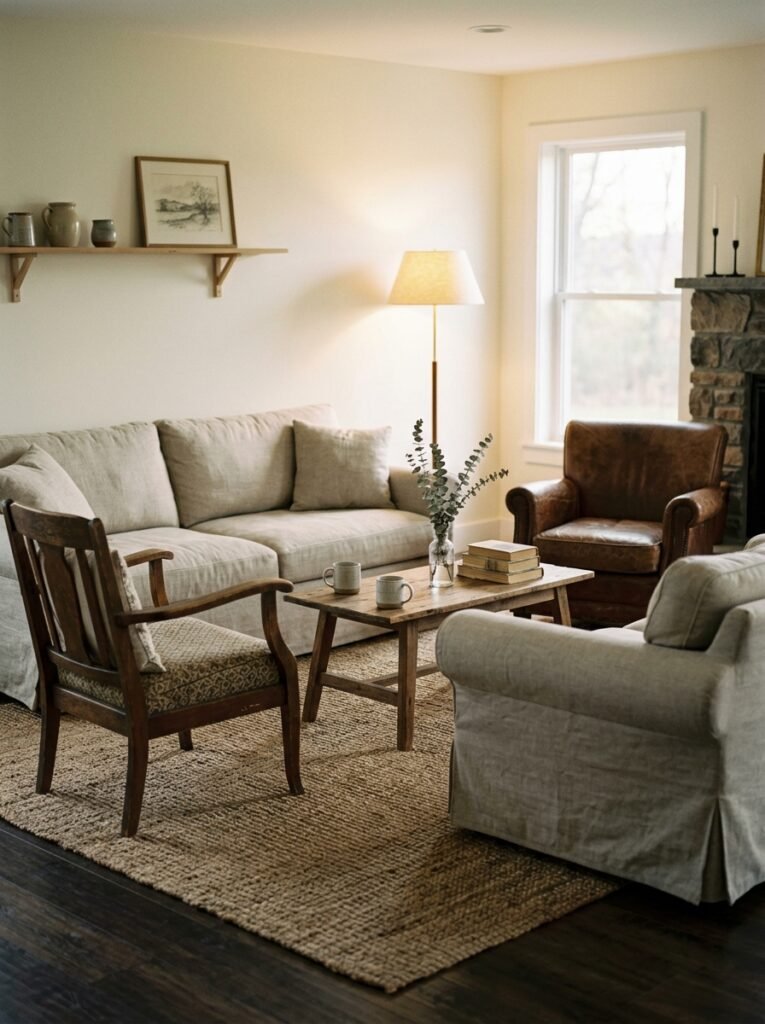
Every single thing in the room should look like it was put there by someone who loves it.
Not like it was ordered from a bundle. Not like it came from a “living room set.” Not like it was chosen because it matched. Chosen because it mattered.
This is the hardest rule and the most important one. It means mixing periods — a Victorian button-back chair reupholstered in a modern fabric, sitting next to a very new, very clean coffee table. It means buying one thing from an antiques market and one thing from IKEA and knowing that they can absolutely coexist. It means having things that tell stories: the blanket your mum knitted, the lamp you bought in a shop in New Orleans, the stack of books you’ve actually read.
Modern farmhouse fails when it looks curated by an algorithm. It succeeds when it looks like a person with good instincts lived here for years and slowly, gradually, made it beautiful.
“The rooms people can’t stop photographing are the ones that look like someone actually lives in them.”
8. Texture Is Doing the Work Your Color Palette Can’t
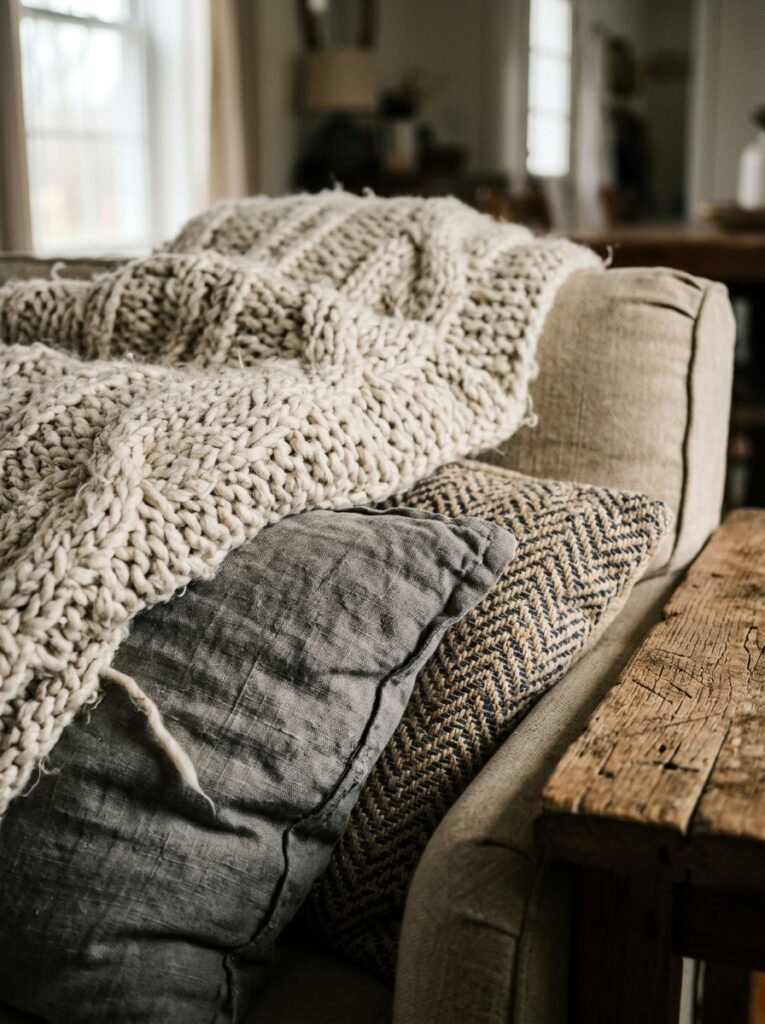
When your palette is neutral — and in modern farmhouse, it almost always is — texture is your loudest voice.
Chunky knit throws over the arm of the sofa. A bouclé cushion next to a smooth linen one. A jute rug with actual heft and roughness underfoot, not the thin, flat kind that slides across your hardwood floors. A ceramic vase with an uneven glaze that catches the light differently at different times of day. A wooden tray on the coffee table where you can see the grain.
You want your eye to move around the room finding things to touch. That’s the mark of a room with real texture: you want to reach out. The velvet, the linen, the wood, the stone, the wicker — all of these together in a room that’s mostly cream and white and warm grey create a richness that twenty different colors couldn’t achieve.
Don’t underestimate the ceiling and floor either. A wood-beamed ceiling, even if it’s decorative rather than structural, changes the acoustic and visual quality of a room entirely. And a good rug — large enough, always larger than you think — grounds every piece of furniture and makes the whole arrangement feel deliberate rather than accidental.
9. Plants That Belong in a Farmhouse and Plants That Don’t
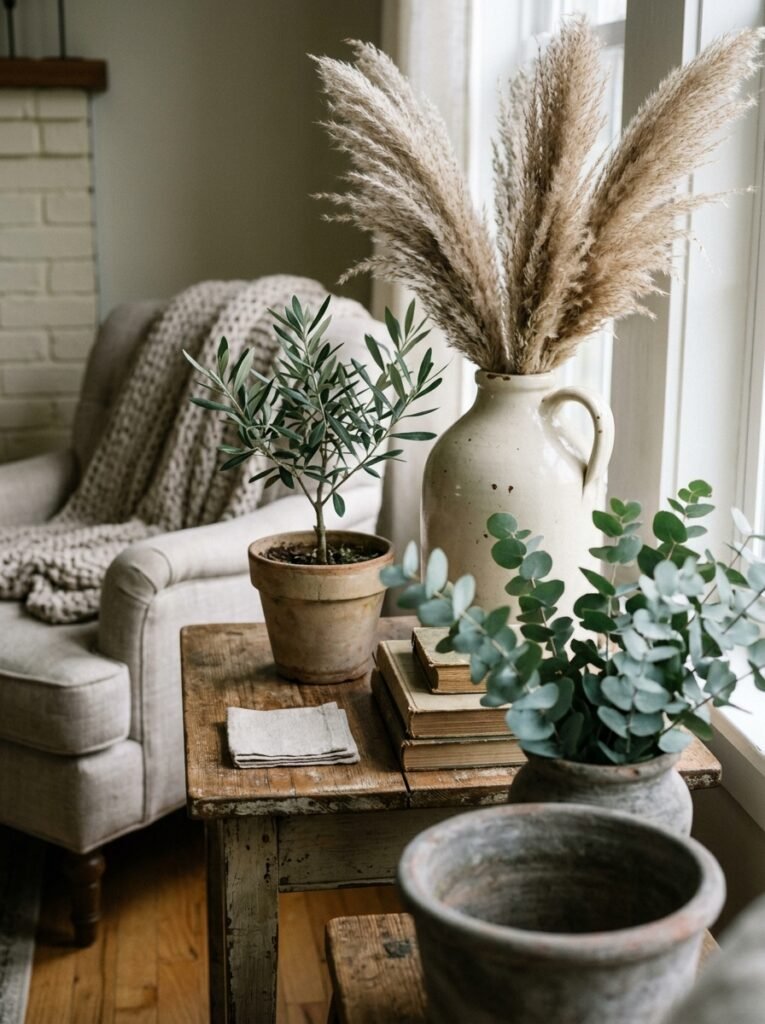
Let’s be honest about this.
A fiddle-leaf fig in a terracotta pot? Perfect. A sculptural olive tree in a stone planter? Absolutely yes. A trailing pothos on a high shelf where it spills down toward the wall? Beautiful. A rigid, plastic-looking succulent in a geometric grey pot? No. Put it somewhere else.
The plants in a modern farmhouse living room should look like they came from outside. Soft, slightly unruly, growing in a direction you didn’t entirely plan. Fresh herbs in a clay pot on the hearth in winter. A big bunch of dried pampas grass that you’ve been looking at for two years and still love. A simple glass vase with whatever is in season at the market — tulips in spring, sunflowers in August, eucalyptus in December.
In the UK especially, houseplants have become part of the interior design conversation in a way that feels genuinely new. A big, generous Boston fern or a fig tree in the corner of a sitting room makes the whole space feel alive in a way that no lamp or mirror can replicate.
10. The Coffee Table Equation Nobody Talks About
The shape of your coffee table should be the opposite of the shape of your sofa.
Square, boxy sofa? Round or oval table. Long, curved sofa? A rectangular table with clean lines. This isn’t a rigid rule — it’s a visual relief principle. The contrast between shapes prevents the room from feeling monotonous, and it gives the eye somewhere to rest between the bigger, heavier pieces.
For modern farmhouse specifically: reclaimed wood, stone, a vintage trunk, woven rattan, scrubbed pine. Something with age or the suggestion of age. Not glass — glass reads too contemporary and too cold for this aesthetic. Not high gloss — same issue.
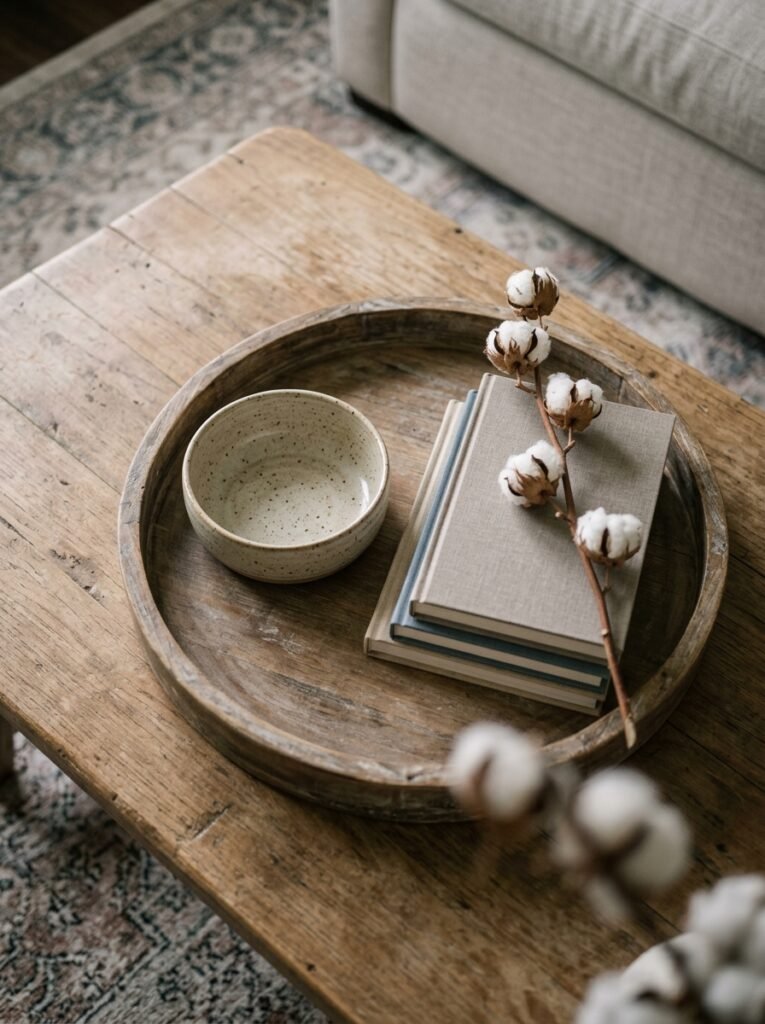
Style it simply. A stack of coffee table books (the ones you actually want to look at, not ones chosen for their spines). A single object of interest — a sculptural piece of driftwood, an interesting rock, a small ceramic bowl. A candle. And space. Always space, because a coffee table crowded with things is a coffee table that makes the room feel smaller and more stressful than it needs to be.
11. Lighting at Three Different Levels Changes Everything
Overhead lighting is a trap. One central ceiling light, switched on at full brightness, flattens a room completely. It kills the atmosphere that all your other careful choices have been building.
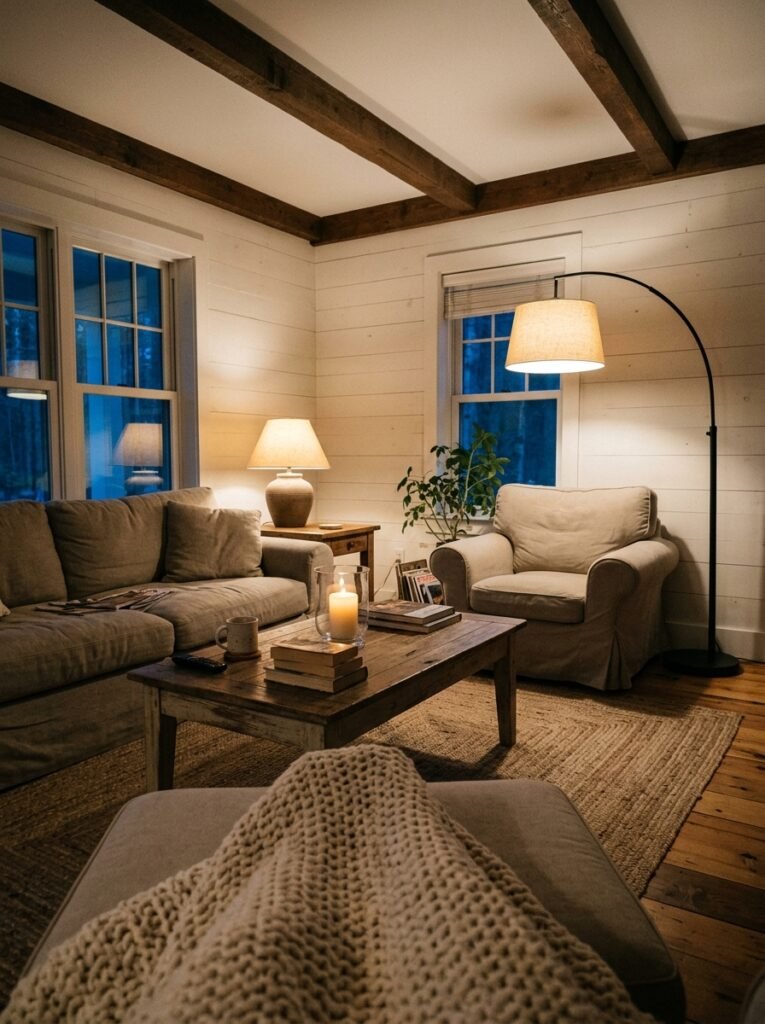
Modern farmhouse rooms need lighting at three levels: overhead, mid-height, and low. The overhead fixture — a rattan pendant, a simple linen drum shade, an aged iron lantern — gives ambient light and visual interest, but it shouldn’t be your primary source of illumination in the evenings. At mid-height, table lamps on side tables or consoles create warmth and pools of light that draw you in. And low: floor lamps behind chairs, candles on the coffee table and mantel, the small lamp on a bookshelf.
In the evening, the overhead light goes off. The lamps come on. The candles get lit. And the room becomes a completely different place — the same furniture, the same rugs, the same walls, but suddenly warm and enclosed and absolutely worth staying in.
This is a £30 change, not a renovation. New lampshades, a few more candles, a dimmer switch if you can manage it. The transformation is not subtle.
12. The Small Decisions That Signal Real Confidence in a Room
Doorknobs. Light switch covers. The hooks by the door. The baskets you use for storage. The frames on your photographs.
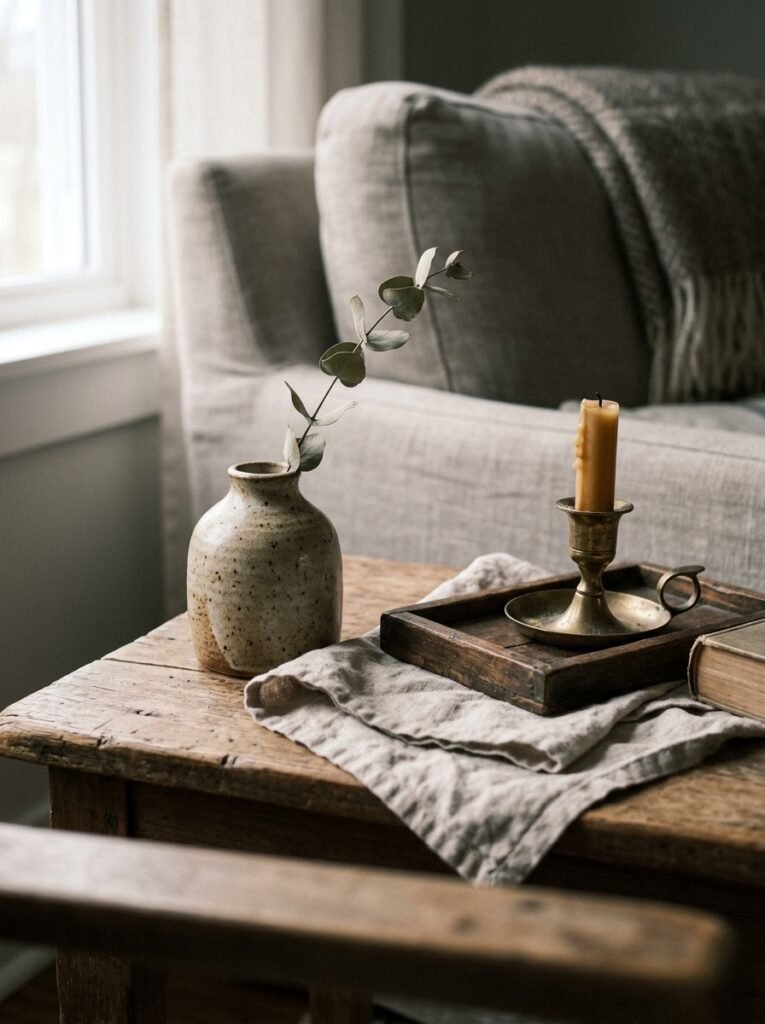
These details are the ones that separate a room that looks carefully considered from one that looks almost there but not quite. In a modern farmhouse living room, these finishing touches should all speak the same quiet language: aged brass or matte black hardware, simple wooden frames, handwoven or hand-thrown storage. Nothing that looks like it came in a shrink-wrapped kit.
A hook rack made from a piece of driftwood. A ceramic bowl by the door for keys. Frames in a warm wood or a slightly off-white that doesn’t quite match the wall — intentionally. These are the things your guests won’t notice consciously but will feel subconsciously. The room will seem coherent in a way they can’t entirely explain, and they’ll say it feels “put together” without knowing exactly why.
It’s because you cared about the doorknobs. That’s the reason.
—
🌿 Quick Tips
Start with the sofa and the rug — get these two things right and the rest of the room will want to follow. Everything else is adjustable; these two are the foundation.
Resist buying everything at once. A modern farmhouse room that looks genuinely lived-in usually took two or three years to arrive at. The best pieces were found, not ordered.
If your room has one ugly feature you can’t change — a radiator, an awkward alcove, ugly flooring — lean into it rather than fighting it. Style around it with intention and it becomes a quirk instead of a flaw.
Layer your lighting before you decide you need to repaint. Nine times out of ten, the right lighting makes the existing paint color suddenly work in a way you couldn’t see under the wrong bulbs.
In small UK sitting rooms especially: mirrors, high curtains, and one large-scale piece of art rather than a gallery wall. Scale up, not down. Small rooms with small art look smaller. Small rooms with one confident large piece look purposeful.
—
❓ FAQ
Q: How do I make modern farmhouse look less “Pinterest-generic” and more personal? A: Mix in things that are genuinely yours — a family piece, something handmade, something imperfect. The rooms that look most like modern farmhouse without looking like a mood board are always the ones where someone’s actual life is visible. Don’t edit out all the personality.
Q: Can modern farmhouse work in a small UK terraced house with low ceilings? A: Absolutely, and honestly it can work beautifully. Focus on warm texture, one or two statement pieces rather than many small ones, and hang your curtains high. Avoid too much dark wood in a small space — lean into the lighter neutrals and let natural light do the work.
Q: Do I need shiplap or barn doors to achieve this look? A: No. Both have become so associated with a particular early-2010s version of farmhouse that using them now risks dating the room rather than grounding it. You can achieve every quality of modern farmhouse — warmth, texture, natural materials, lived-in ease — without either. Focus on the furniture and the layering instead.
—
💭 Final Thought
The best modern farmhouse living rooms aren’t designed. They’re accumulated. Slowly, over time, by someone who kept buying what they loved and eventually looked up and realized the room had become something beautiful. That’s what you’re working toward — not a finished room, but a room that keeps getting better.
What’s the one thing already in your living room that you’d build the whole space around?