The Rustic Living Room Guide That Actually Makes Sense (No Barn Required)
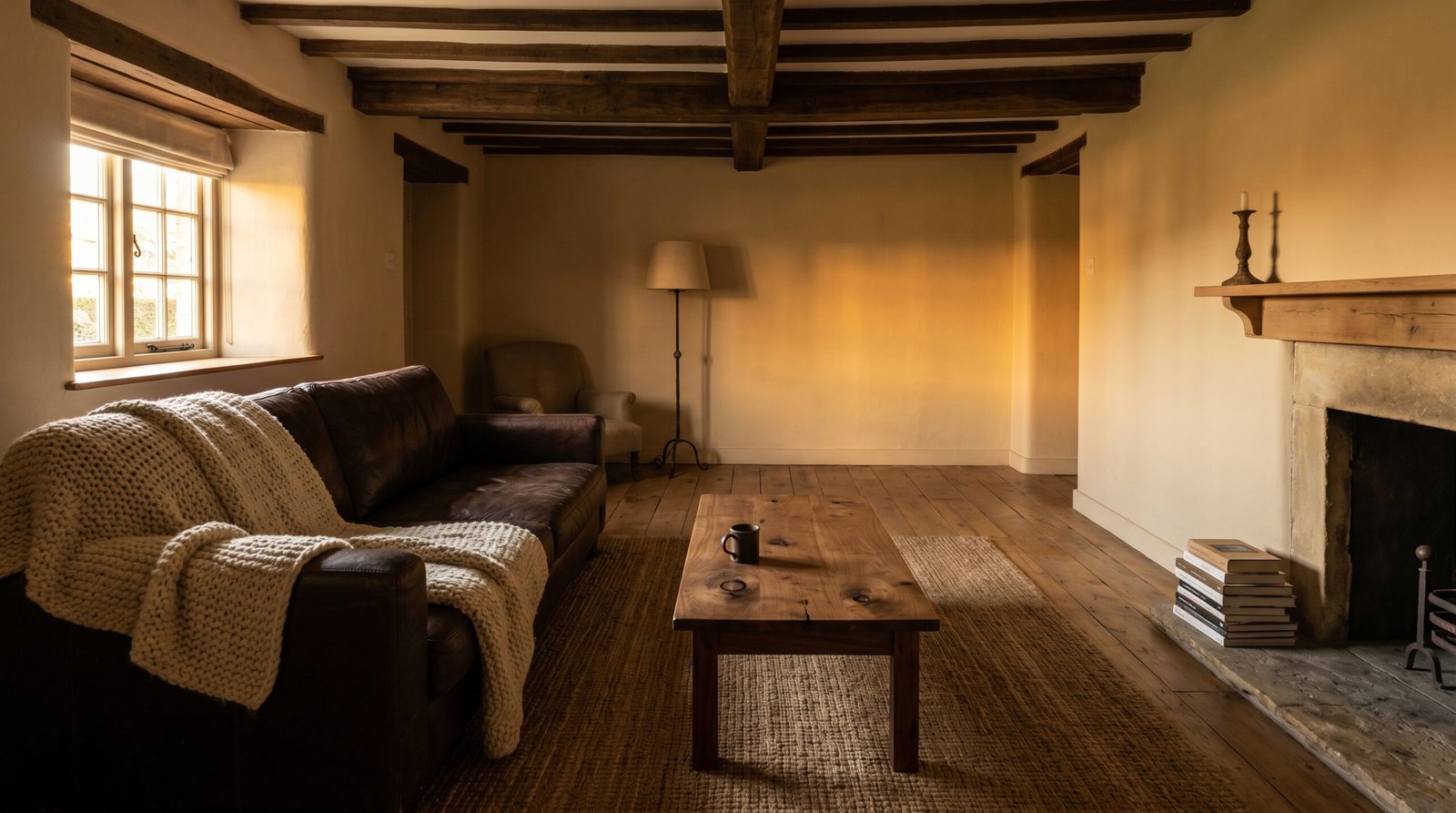
There’s a moment — you know the one — when you walk into someone’s living room and everything just settles. Your shoulders drop. You exhale. You look around and think: I want to live here. Nine times out of ten, that room has something rustic going on. Not Pinterest-perfect-cabin-in-the-woods rustic. Real rustic. The kind that feels like it grew slowly, piece by piece, from actual life.
That’s what we’re chasing today.
Not a theme. A feeling.
—
1. What “Rustic” Actually Means (Because It’s Not What You Think)
People get this wrong constantly. Rustic doesn’t mean mason jars on every surface. It doesn’t mean a deer head on the wall or shiplap for shiplap’s sake. Those are signifiers of rustic — props, essentially. They can work. They often don’t.
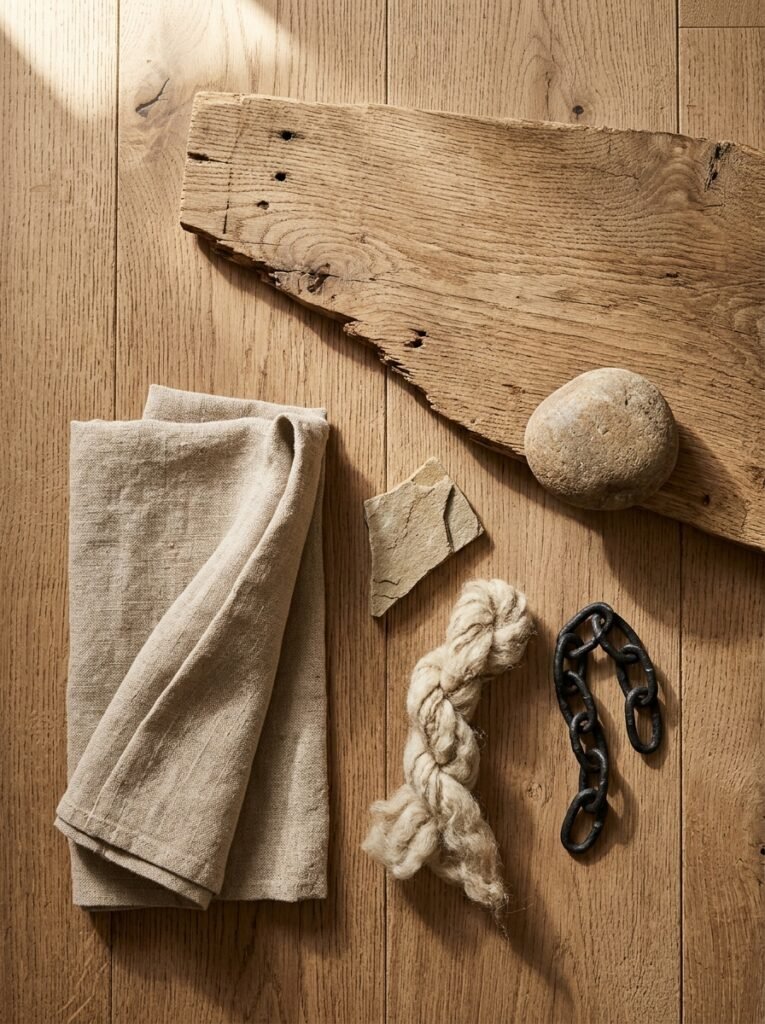
Real rustic is about honest materials. Wood that looks like it came from somewhere. Textiles that feel like they’ve been washed a hundred times. Stone that you could imagine being cold to the touch. Metal that has been useful, not decorative.
“Rustic design, at its best, is just the visual proof that a room has been lived in — not styled for a photoshoot.”
In the USA, rustic tends to run warmer, heavier — log cabin influences, Appalachian mountain aesthetics, the wide open plains of the Southwest. In the UK, it leans more toward the Cotswolds farmhouse feel: flagstone floors, plaster walls the colour of old cream, low wooden beams that you duck under without thinking.
Both are rustic. Both start from the same premise: nature came first, design came second.
—
2. The Three Textures That Are Doing Almost All the Work
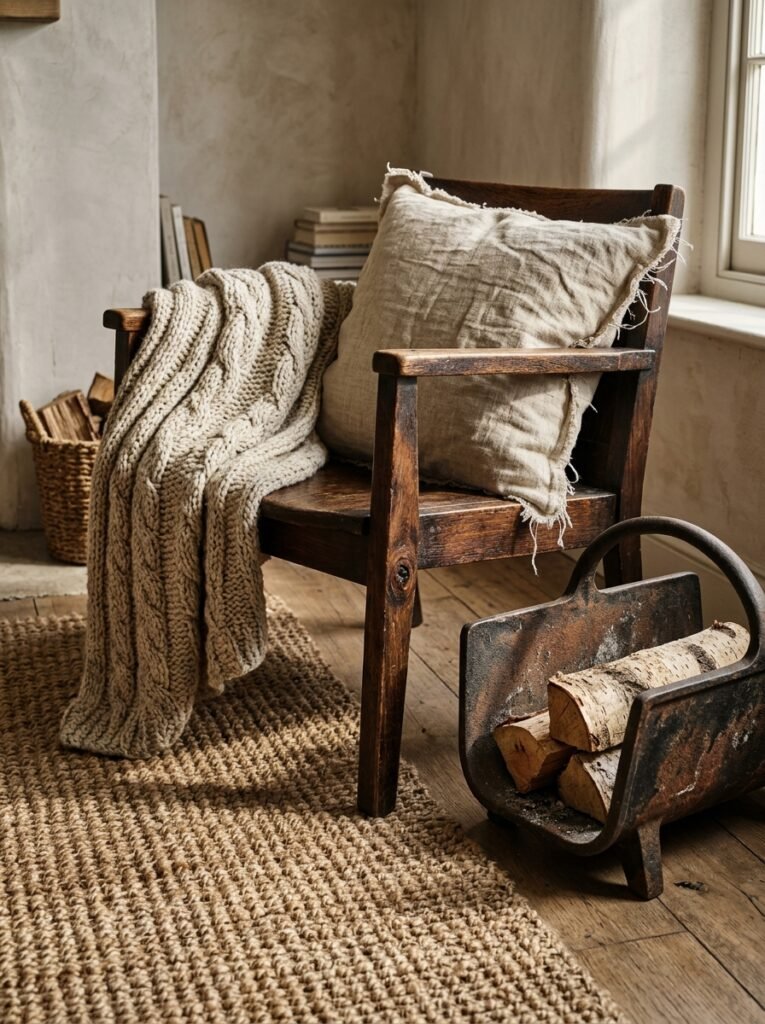
If your rustic living room isn’t landing, it’s almost always a texture problem. Specifically, too little of it.
Smooth, flat surfaces read as modern. Rough, varied, layered surfaces read as old, earned, warm. The gap between those two things is the entire difference between a room that feels rustic and a room that just has brown furniture.
The three textures that carry the most weight:
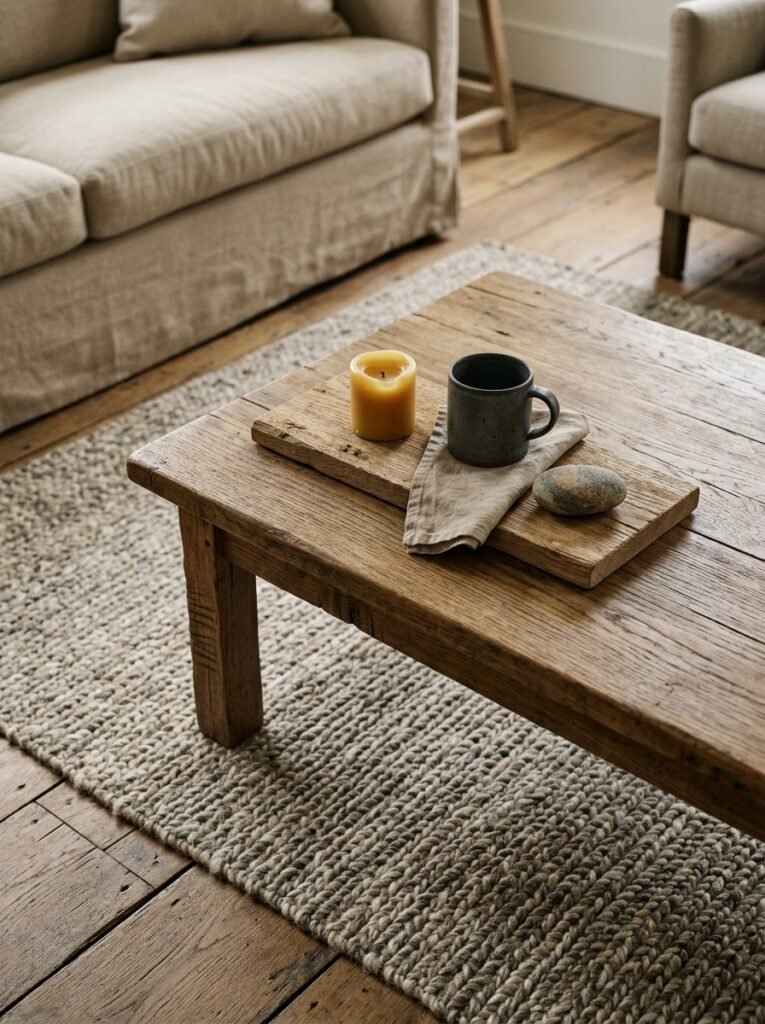
Raw wood grain. Not a wood-look laminate. Not a wood-toned vinyl. Actual grain you can run your finger along and feel the ridges of. A coffee table with knots still in it. A mantelpiece that hasn’t been sanded perfectly smooth. This is the foundation.
Woven textiles. Chunky wool throws. A jute rug with enough thickness that it catches light differently throughout the day. A linen cushion that wrinkles when you sit against it. Weave creates shadow, and shadow creates the illusion of depth and age.
Aged or oxidized metal. Not chrome. Think wrought iron lamp bases, copper candle holders that have started to develop that greenish tinge, cast iron log holders. Metal that looks like it’s been near a fire for twenty years.
These three alone — wood, woven, aged metal — can transform a room from “modern with brown accents” into something genuinely rustic.
—
3. The Wall Colour No One Tells You to Try (But Should)
White walls in a rustic room can work. Bright white specifically? Almost never works.
The tone that consistently delivers is what I’d call old linen. Not cream. Not off-white. Think of the particular colour a white cotton shirt turns after two or three years of regular washing — that slight, warm yellowish tint that isn’t quite beige but isn’t quite white either. Benjamin Moore’s “White Dove” gets close. Farrow & Ball’s “Pointing” is basically perfect for UK spaces.
Here’s why it works: rustic rooms depend on warm light bouncing around. Bright white walls reflect too much light and flatten everything. Old linen walls absorb warm light, hold it, make the whole room feel like late afternoon even at noon.
If you’re brave, go darker. A deep, earthy tone — that particular shade of greenish-grey you see on old timber-framed buildings in the English countryside, or the warm terracotta that appears on the walls of century-old adobe houses in New Mexico — these colours anchor a rustic room in a way that lighter walls simply cannot.
—
4. The Fireplace Problem (And Why Most People Solve It Wrong)
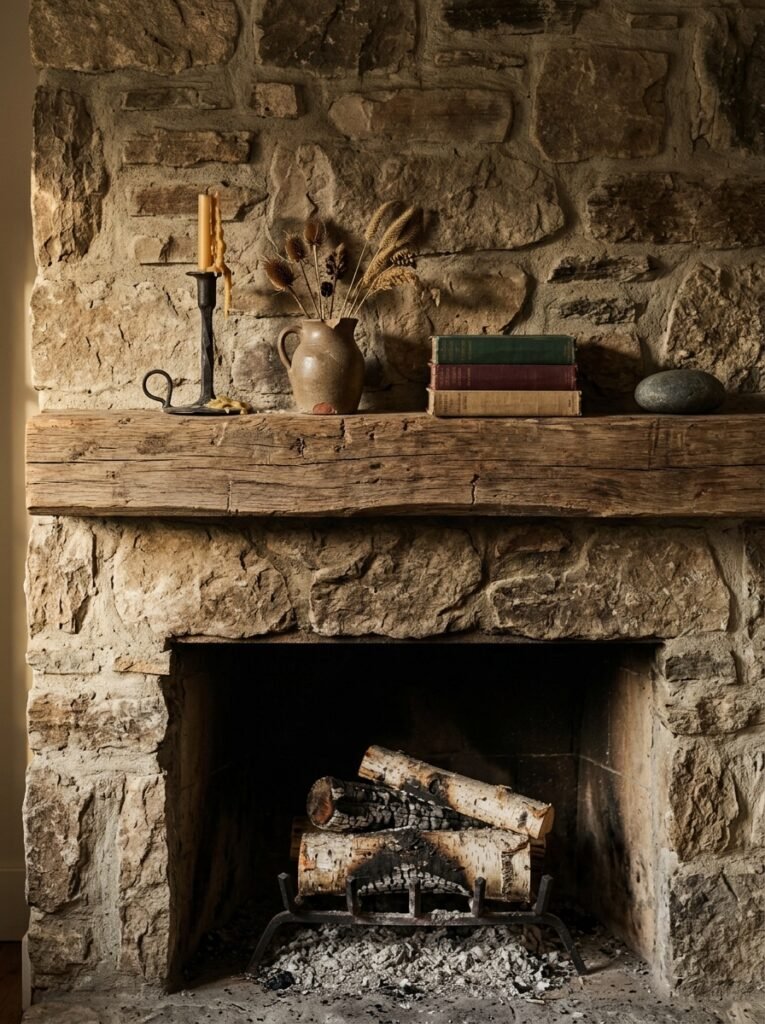
Here is a truth that decorating articles rarely say out loud: a fireplace doesn’t make a rustic living room. But a badly styled fireplace can absolutely ruin one.
The most common mistake is over-dressing the mantel. Symmetrical candles, a mirror in the centre, matching vases on either side. That’s formal. That’s traditional. It’s not rustic.
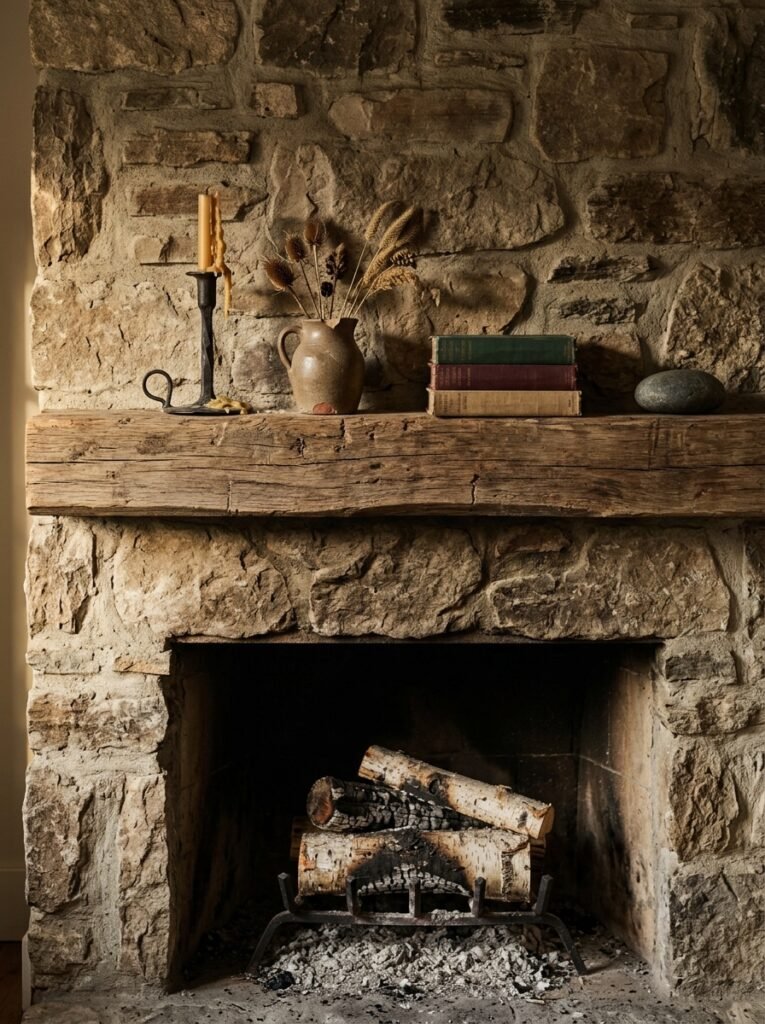
Rustic mantels look like they were assembled over decades, not styled in an afternoon. A clock that belonged to someone’s grandmother. A single candlestick, slightly taller than seems quite right. A piece of driftwood. A small oil painting that’s been in the family long enough that no one quite remembers where it came from. Odd numbers. Mismatched heights. Something that shouldn’t be beautiful but somehow is.
If you don’t have a fireplace, and you’re in a flat or a newer build — this is more common in the UK than people admit — a large, shallow wicker basket filled with chunky pillar candles and set into an alcove does something remarkable. Your eye reads it as a hearth. Not literally. But emotionally, the warmth lands in the same place.
—
5. The Shelf That Changed How I Style a Rustic Room Completely
I used to think rustic shelving was about what you put on the shelves. Books, plants, little ceramic animals, that kind of thing. Then I started paying attention to the shelves themselves.
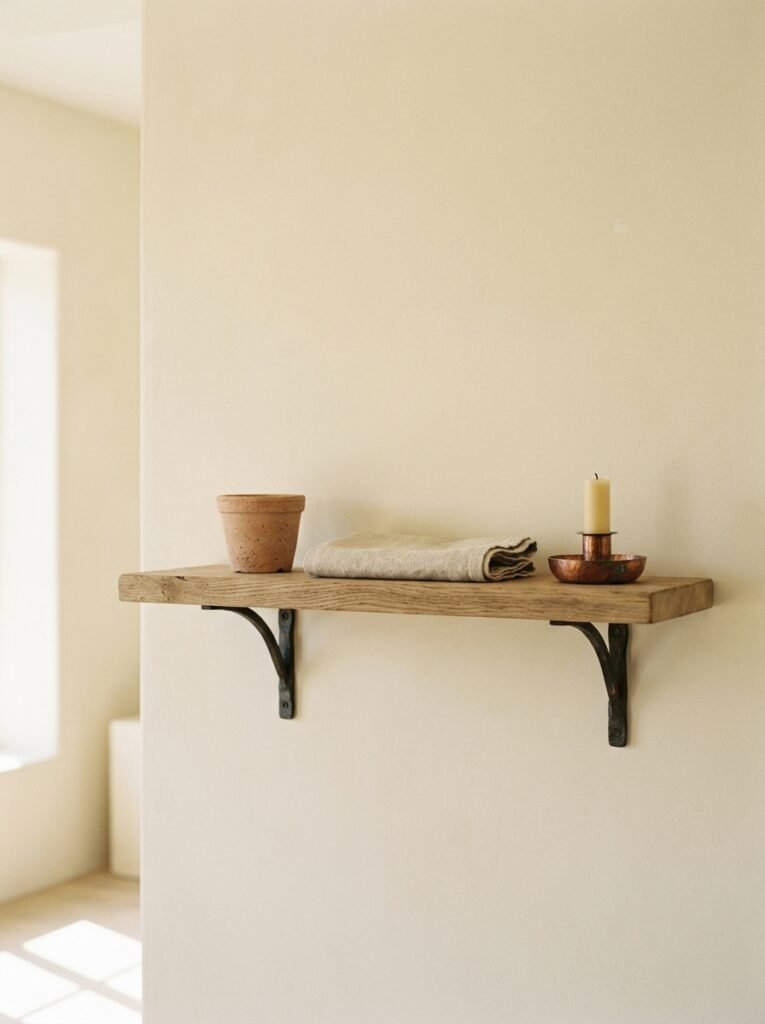
A floating shelf made from a single plank of reclaimed wood — pine, oak, elm, it doesn’t matter much — tells a story the moment you look at it. The saw marks on the underside. The way the grain changes colour where a knot used to be. The slightly uneven surface that means a glass placed on it rocks just slightly. That shelf was once a tree. You can feel it.
That quality — the sense of a previous life — is what separates rustic from shabby, from vintage, from farmhouse, from all the adjacent aesthetics that sometimes get confused with it.
Pair that shelf with simple brackets, ideally iron, ideally showing a little rust or patina, and you have something that no amount of IKEA hacking will replicate. It costs roughly the same. The difference is material honesty. The real thing announces itself quietly but unmistakably.
—
6. Lighting: The Rule That Makes Everything Warmer
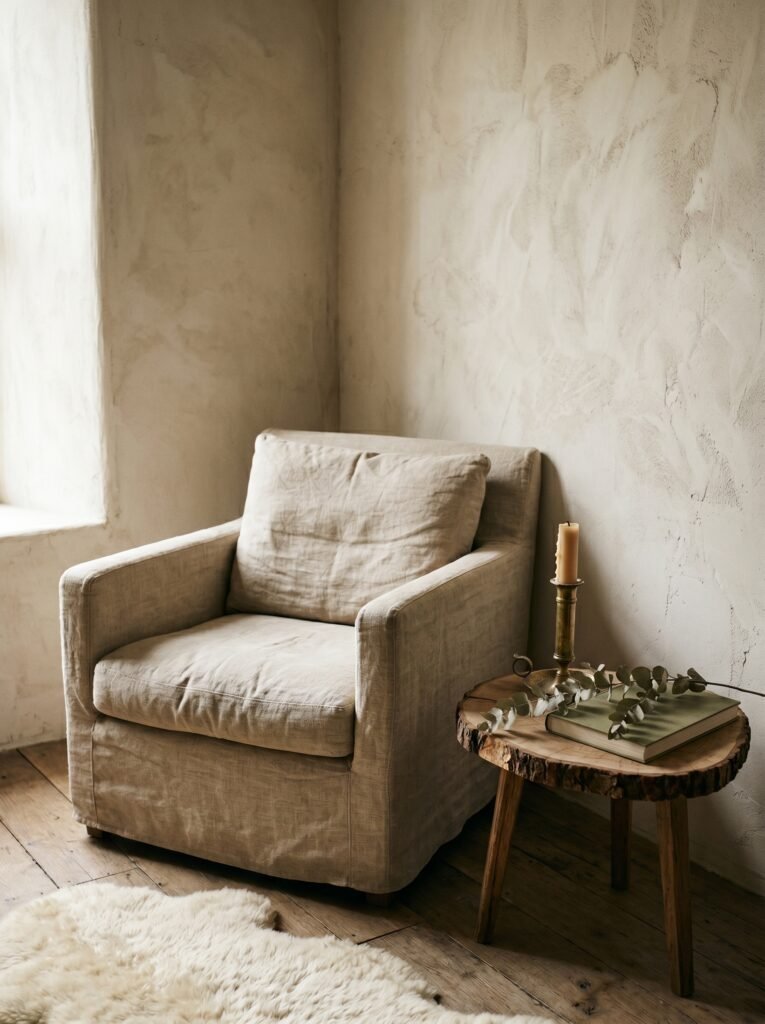
You could have every single other element exactly right and still ruin a rustic living room with the wrong lighting.
The rule is simple and non-negotiable: nothing above 2700K, ever.
Colour temperature is measured in Kelvin. Daylight bulbs run around 5000-6500K — blue, sharp, clinical. Standard warm white runs about 3000K — better, but still slightly cold. Warm white at 2700K and below reads as candlelight adjacent. That amber glow that makes wooden surfaces look richer, makes textures cast tiny shadows, makes the whole room feel like it’s exhaling.
This one change — just swapping bulbs — costs almost nothing and does more than a new rug.
Layer your light sources too. A single overhead light, even a warm one, creates flatness. You want floor lamps. Table lamps. Candles. Wall sconces if you have them. Every light source at a different height means shadows move differently across the room, and that movement is what creates the sense of depth that rustic rooms depend on.
—
7. What to Do With the Sofa (Because Sofas Are Almost Always the Problem)
A grey modular sofa with clean lines and tight upholstery sits in approximately 60% of living rooms in both the USA and UK right now. That sofa is fine. It is often very comfortable. It is also the natural enemy of rustic design.
You have two real options:
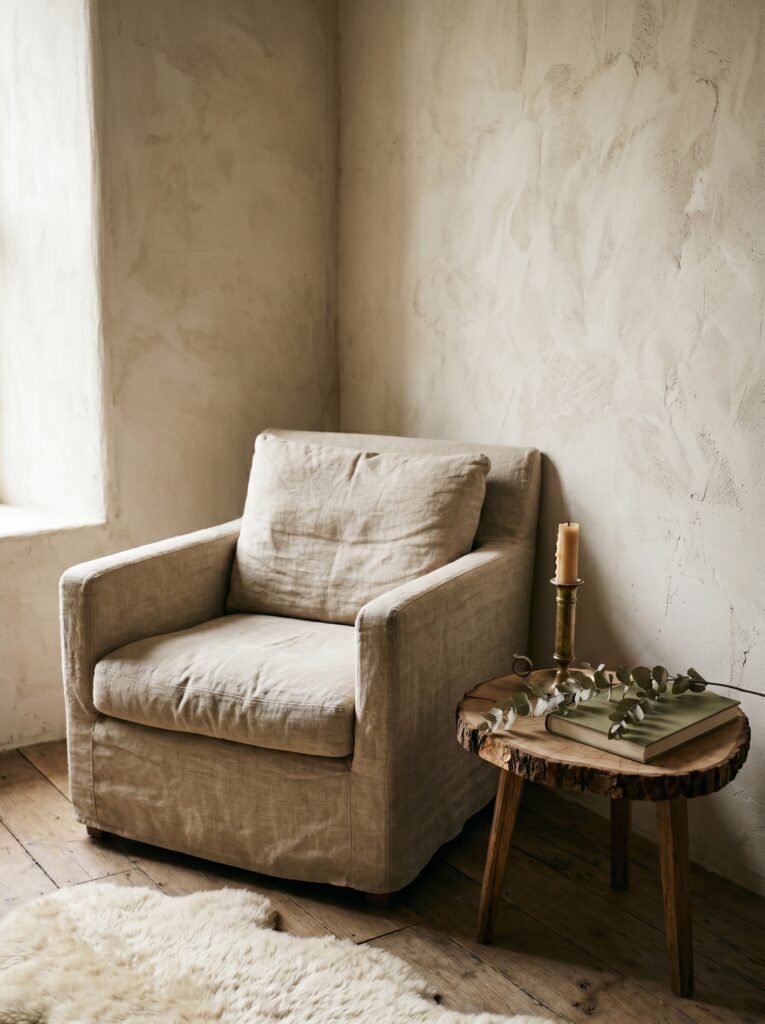
Replace or reupholster. If you’re committed long-term, look for sofas with visible frame — feet that look like actual wooden legs, arms that taper and show the wood grain at the end. Upholstered in linen, canvas, or a slightly rough-textured velvet in a warm neutral. This is the ideal.
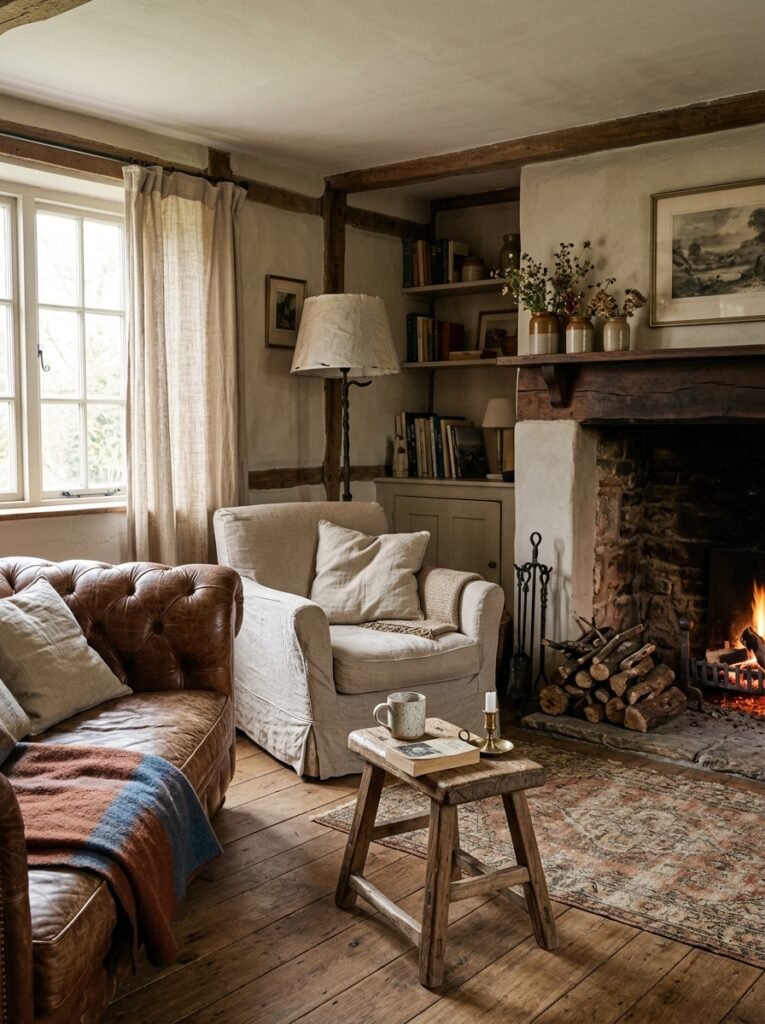
Layer it into submission. If you’re keeping the grey modular sofa, pile it with texture. A chunky-knit throw in oatmeal or deep rust. Cushions in different sizes, different weaves, no matching sets. A sheepskin draped over one arm. The goal is to cover enough of that smooth upholstery that the eye stops reading “modern” and starts reading “comfortable farmhouse.”
It works better than you’d think.
—
8. Plants That Actually Belong in a Rustic Living Room
Not all plants suit this aesthetic. A cactus collection in terracotta pots leans Southwest and can work, but it’s specific. A fiddle-leaf fig in a white planter reads as Instagram-modern, not rustic.
The plants that feel genuinely at home:
Trailing ivy, especially in an old terracotta or ceramic pot that’s accumulated some mineral staining. Dried lavender bundles hung from a beam or propped in a wide-mouthed jar. A robust rosemary plant in a heavy stone pot. Eucalyptus — dried or fresh — in a stoneware vase on the hearth. A large, slightly rangy fern in a wicker basket liner.
The key is wildness. Not manicured. Not perfectly trimmed. Rustic plants look like they grew there, like someone put them on a surface six months ago and they decided to stay.
—
9. The One Mistake That Makes Rustic Rooms Look Like Stage Sets
Too much coordination.
When every element of a rustic room has been purchased as part of a “rustic collection” — the lamp, the side table, the picture frames, the blanket basket, all from the same aesthetic range, all released in the same season — the room looks like a showroom. It looks like someone’s idea of rustic. It doesn’t look like a room that happened organically.
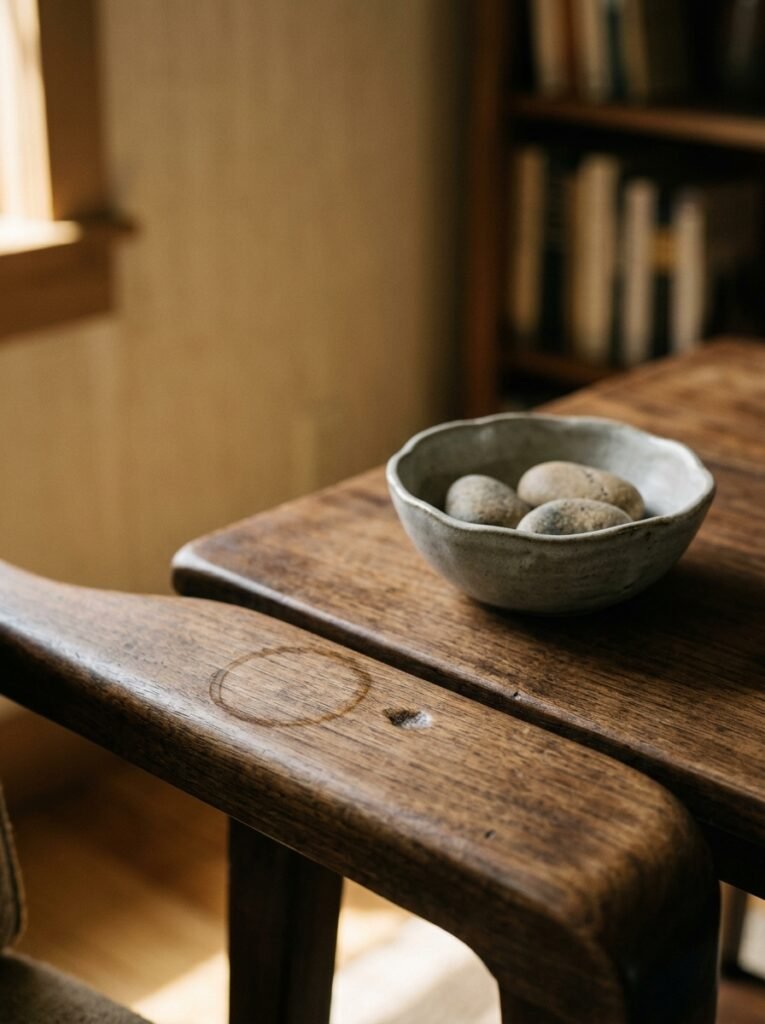
The solution is mismatching with intention. Your oldest piece should be genuinely old, or at least look genuinely old. Your newest piece should feel slightly out of step with everything else — a contemporary linen cushion in a room full of wood and iron reads as refreshingly honest, not inconsistent. The range of eras, the range of sources, is precisely what creates authenticity.
“A rustic room should look like it took twenty years to assemble, even if it took two weeks.”
Buy one thing from a salvage yard or an estate sale. Just one. It will change the entire energy of the room. Everything else you bought new will start to look more real next to it.
—
10. Floor Decisions That Carry More Weight Than You Realise
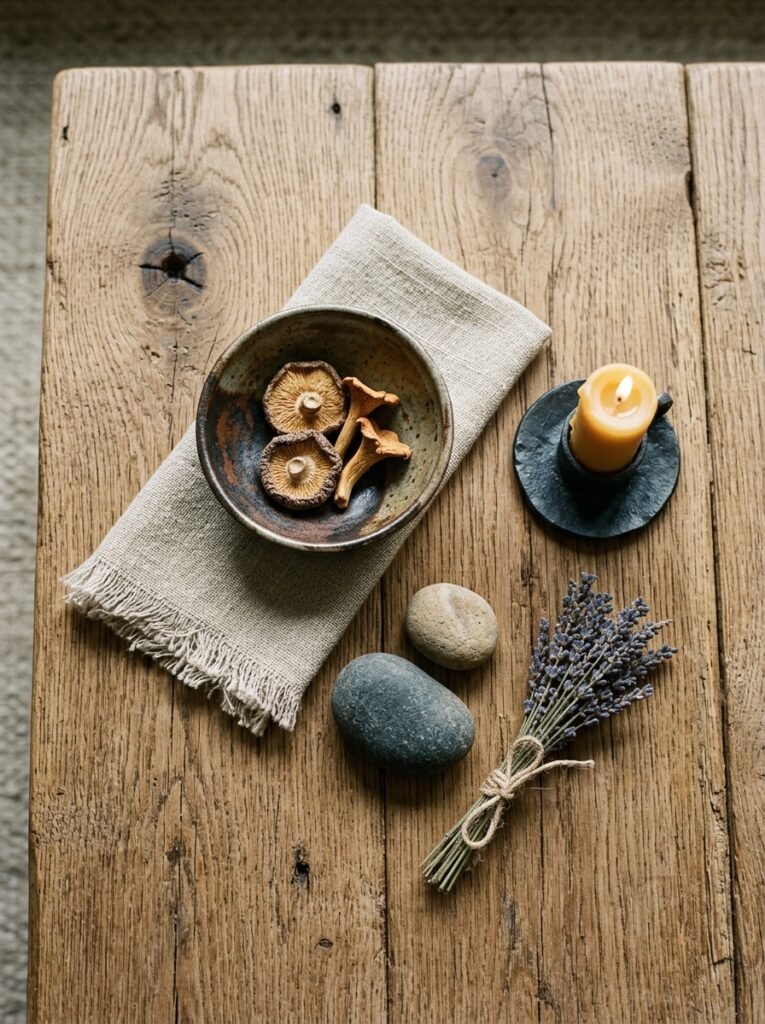
Original hardwood floors in both the USA and UK are usually worth exposing if you have them hiding under carpet. Almost always. The warmth that engineered wood tries to imitate, real aged floorboards simply are.
If you’re laying new flooring, wide plank is non-negotiable for rustic. Narrow strip flooring reads as traditional or colonial. Wide planks — 5 inches across and wider — read as farmhouse, old mill, log cabin. The wider, the better. The more visible the grain, the better.
Area rugs do critical work here. A jute or sisal rug is the classic choice and for good reason — the natural fibre adds warmth without competing with the floor beneath. A vintage Persian or Oushak rug in warm reds and golds works brilliantly in rustic settings in a way that surprises people who expect them to look too formal. They don’t. They add the kind of colour and pattern that feels earned rather than applied.
—
11. The View From the Doorway: How to Check If It’s Working
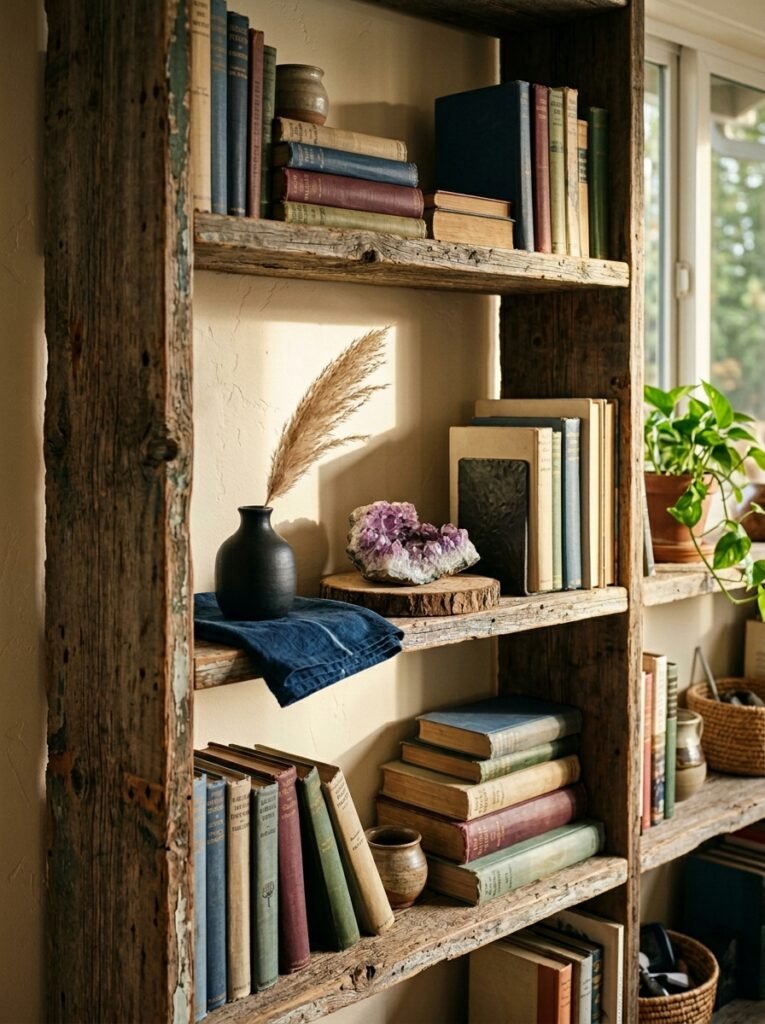
This is the test I always use. Stand in the doorway of the room you’re decorating — not inside it, in the doorway — and look at it like you’re seeing it for the first time.
What’s the first thing your eye goes to? If it’s a smooth, flat, bright, or synthetic surface, that’s the problem. The eye should land on something warm, textured, slightly imperfect. A piece of wood. A candle cluster. The pile of a rug.
Is there shadow in the room, even during the day? Rustic rooms have shadow. They’re layered enough that light falls differently on different surfaces at different depths. A room with no shadow reads as modern, regardless of the furniture inside it.
Does it smell like anything? This sounds strange, but rustic rooms often do — cedar, beeswax, old paper, a faint trace of woodsmoke if there’s a real fire. Linen room sprays and beeswax candles can do real work here. Scent is part of the feeling.
—
12. Small Rustic Living Rooms: What Works When the Space Is Tight
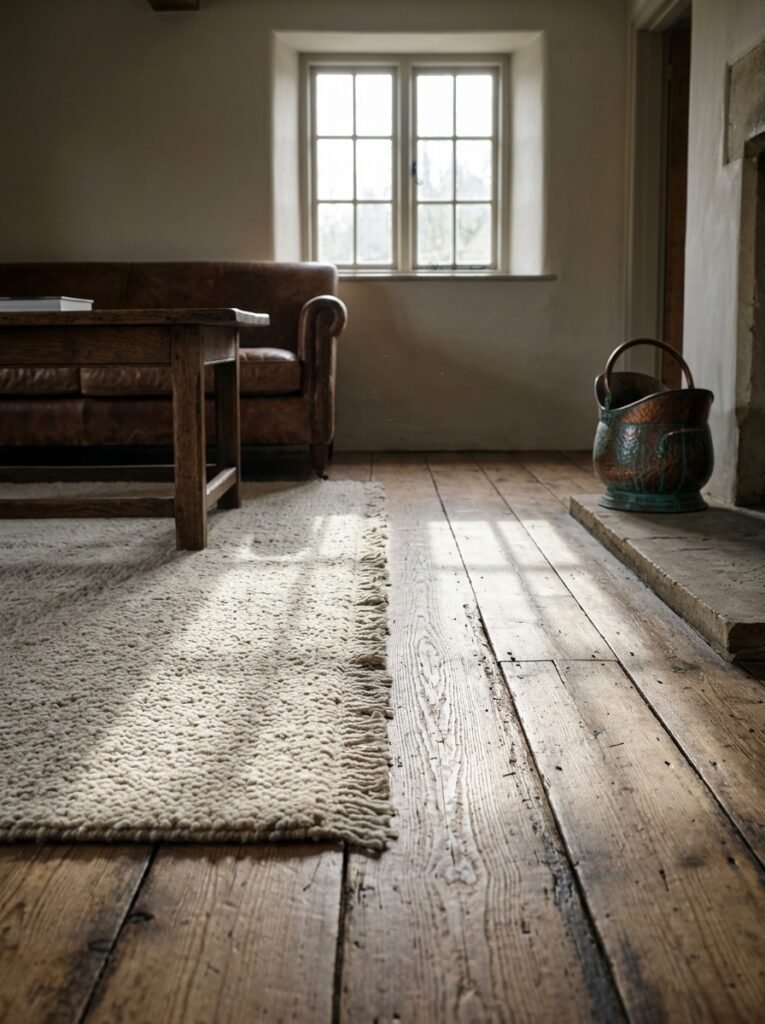
British living rooms in particular — Victorian terraces, converted flats, Edwardian semis — often run small. And the instinct when a room is small is to keep everything light, minimal, pale. With rustic design, you can go darker and smaller than you’d think, provided you nail the lighting.
A small rustic room benefits enormously from a single large piece — one substantial wooden coffee table, one oversized woven rug that almost touches the walls. Restraint everywhere else. Two or three carefully chosen objects rather than twelve small ones. The scale contrast between one large, grounded piece and a small room creates intimacy rather than claustrophobia.
Mirror placement matters more here. A single large mirror with a rough wooden or rusted iron frame on the wall opposite the window doubles the natural light without reading as modern. It reads as old farmhouse. Do not use frameless mirrors in a rustic room. The frame is the whole point.
—
13. The Colours That Show Up in Every Rustic Living Room Worth Looking At
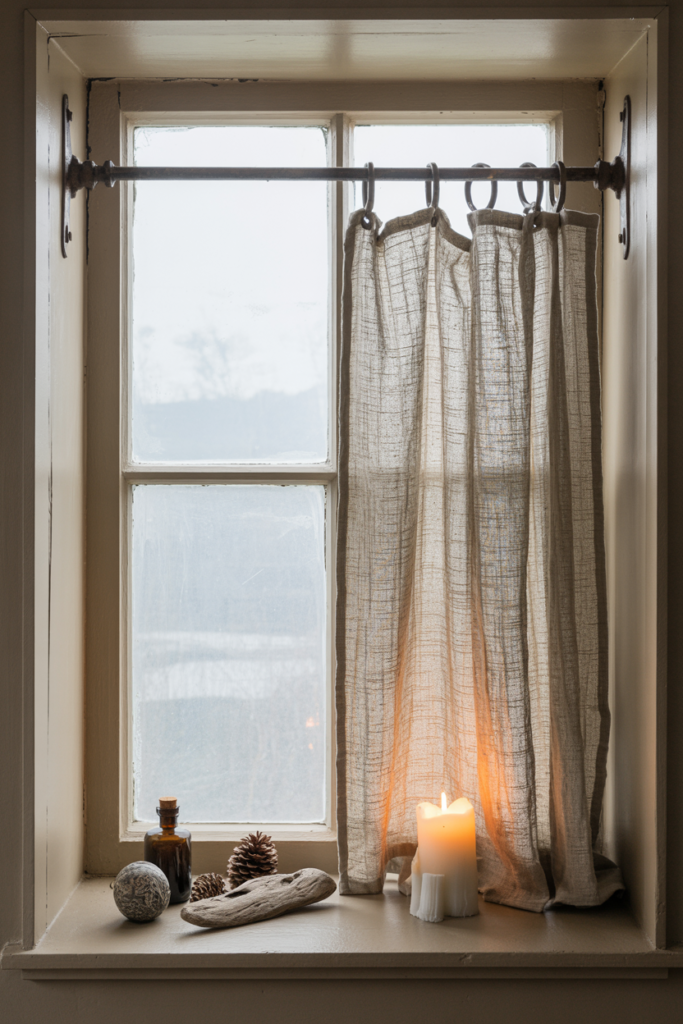
Not a palette in the design-school sense. More like a frequency.
Warm ochre. The particular amber of beeswax on pine. Deep forest green that’s almost black in shadow. Burnt sienna that appears in old brick and aged terracotta. The red-brown of dried beans, of old leather, of autumn bracken. Creamy off-white that has absorbed years of lamplight.
These colours share a quality: they all exist in nature, and they all look better with age. They patina. They settle. They deepen.
Cool colours — true blues, greys without warmth, anything clinical or sharp — work against rustic. Not impossibly, but against. If you want blue, make it the blue of old indigo dye, the colour of a piece of linen that’s been washed in iron-rich water until it’s more grey than blue. That blue belongs in a rustic room.
—
14. Where to Actually Find Rustic Pieces (That Don’t Cost a Fortune)
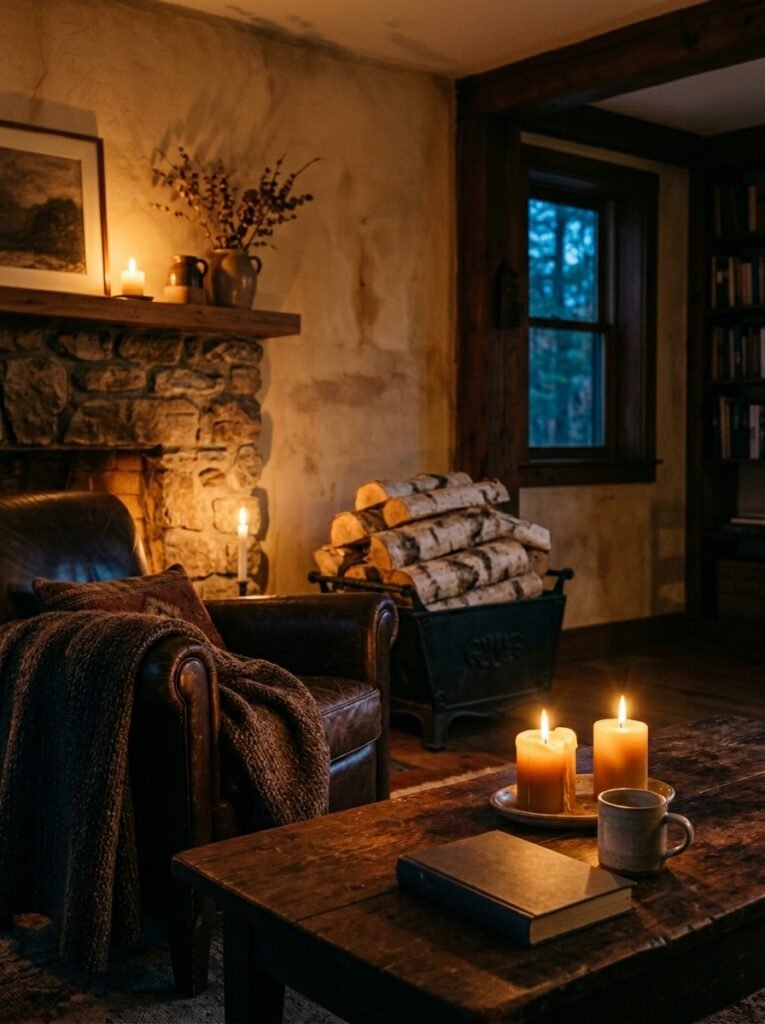
This gets asked constantly, and the honest answer is: you probably walk past the best sources without stopping.
Estate sales and auctions. In the USA, estate sales are a largely underused treasure. In the UK, provincial auction houses — not the famous London ones, but the ones in market towns — sell real, old, worn, beautiful pieces for almost nothing because they’re not fashionable.
Architectural salvage yards. For larger pieces — old doors repurposed as headboards or console tables, reclaimed timber, stone corbels used as bookends, old radiators that become sculptural objects — salvage yards are irreplaceable. One afternoon in a good salvage yard will give you ideas that no Pinterest board can manufacture.
Charity shops and thrift stores. Specifically: look for things that are slightly damaged, slightly unloved, slightly wrong in some way. Those pieces, fixed or simply accepted as-is, carry authenticity that a pristine piece never will.
What you’re looking for, in all of these places, is the proof of previous life. A scratch. A repair. A colour that’s faded unevenly from the sun. That’s not damage. That’s exactly what you came for.
—
Frequently Asked Questions
What makes a living room look rustic? The combination of natural, aged materials — real wood, stone, iron, woven textiles — with warm, layered lighting and an overall sense of things assembled over time rather than purchased as a set. It’s less about specific items and more about texture, warmth, and the feeling that the room has a history.
How do I make my living room rustic on a budget? Start with lighting (swap to 2700K warm bulbs immediately), add one large jute or natural-fibre rug, introduce a reclaimed or salvaged piece from an estate sale or charity shop, and layer throws and cushions in natural textures. These four steps cost relatively little and shift the entire feel of a room.
What colours work best in a rustic living room? Warm, natural tones: old linen whites, warm ochres, deep forest greens, burnt terracotta, and the amber-browns of aged wood and leather. Avoid cool whites, greys without warmth, or anything that reads as synthetic.
Can a rustic living room feel modern? Yes, and it’s one of the most interesting directions to take it. Rustic materials — raw concrete, steel, reclaimed wood — with clean lines and reduced ornamentation creates what’s often called “industrial rustic” or “modern rustic.” The key is not combining styles randomly, but finding where they share a quality (usually material honesty) and building from there.
What furniture is typical for a rustic living room? Heavy wooden coffee tables and side tables, preferably with visible grain and some irregularity. Sofas in linen, canvas, or rough-textured fabrics. Bookshelves in raw or reclaimed timber. Iron or wrought-metal light fixtures. Woven or upholstered ottomans in natural materials.
How do I make a small living room feel rustic without making it feel cramped? Choose one or two large, grounded pieces rather than many small decorative objects. Use a large rug to anchor the space. Keep walls in warm neutrals rather than dark tones unless your lighting is very strong. A single large wooden mirror with a rustic frame opposite the main window adds depth and warmth simultaneously.
Does rustic work in a modern new-build home? It does, with some deliberate effort. New builds lack the inherent texture and age that older homes have built in, which means you need to work harder on surface materials and layering. Reclaimed timber, stone tiles, and heavy textile layers compensate for the smoothness of new construction. The lighting adjustment — warm, layered, never overhead-only — is especially important in spaces that were designed for a different aesthetic.
—
The Thing Worth Remembering
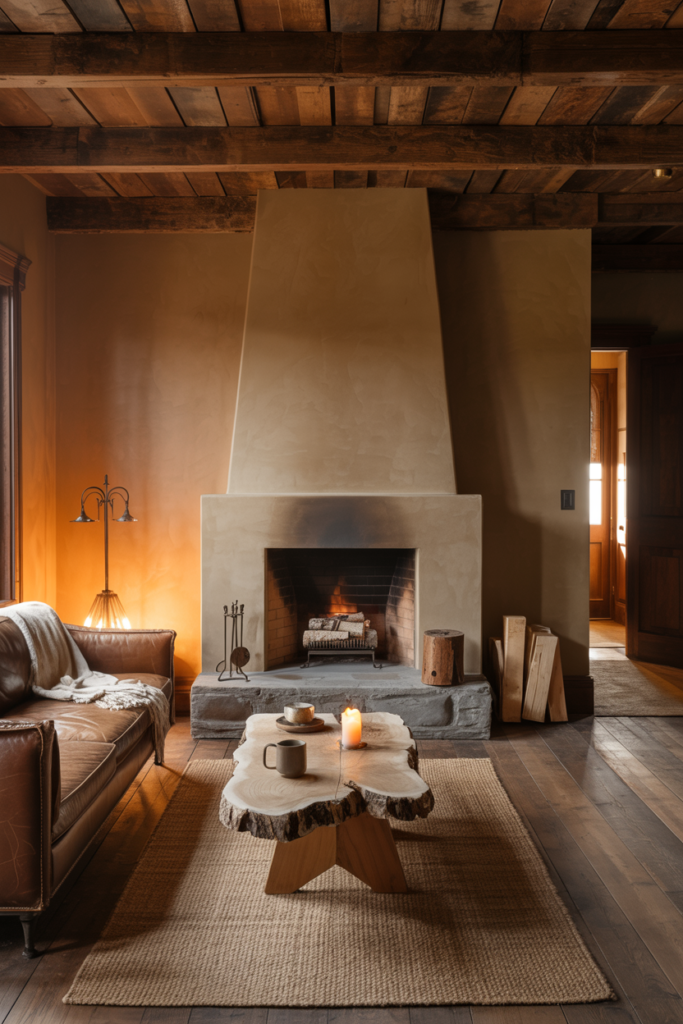
A rustic living room is not an aesthetic you install.
It’s the accumulation of choices that all point in the same direction: toward the real, the worn, the warm, the things that existed before you found them. You don’t achieve it by buying the right set of objects. You achieve it by being slightly patient, slightly selective, slightly willing to bring home the piece that’s not perfect but is true.
The rooms that stop you in the doorway, that make your shoulders drop, that make you want to stay — they’re never the ones where everything matches. They’re the ones where everything belongs.
Find the things that belong. Let go of the things that don’t. Give the room time.
That’s the whole secret, actually.