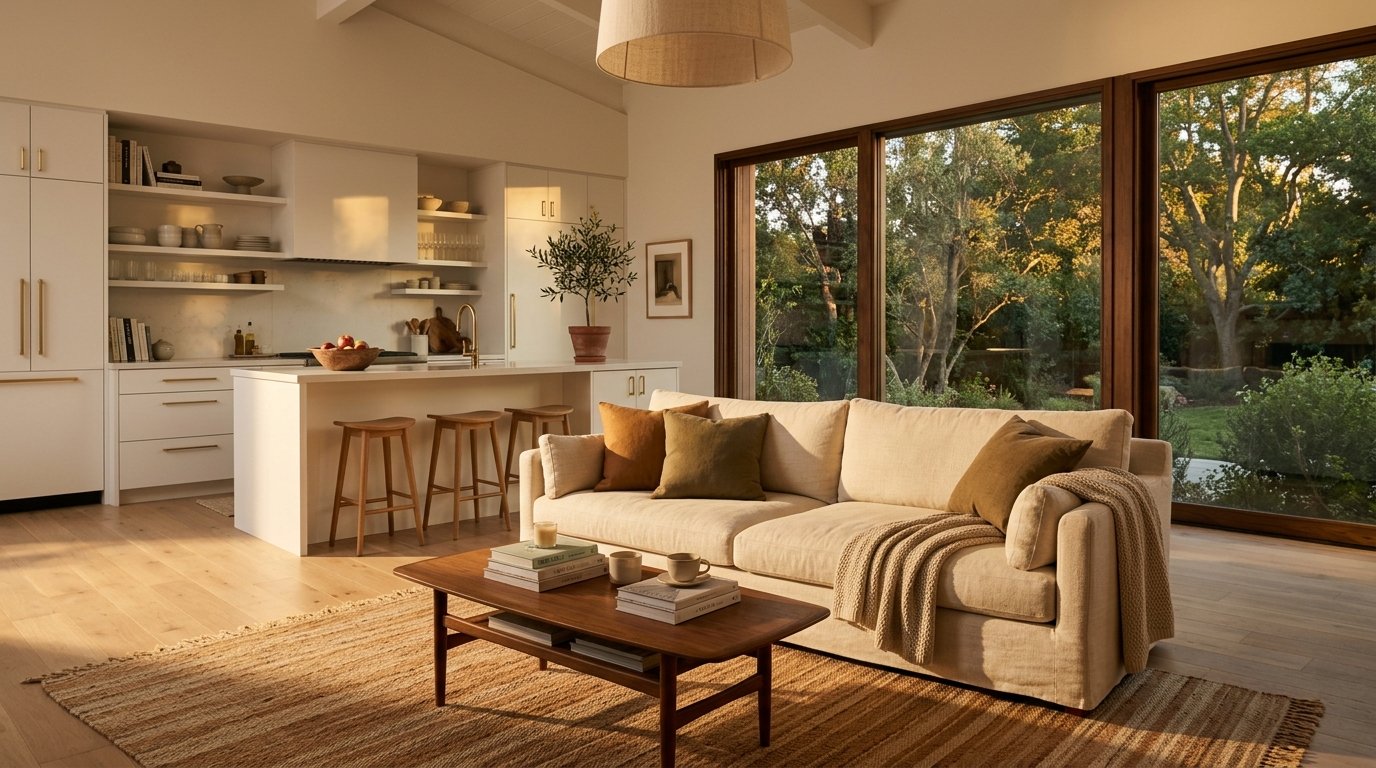
The Open Plan Dream Nobody Talks Honestly About (And How to Actually Make It Work)
There’s a moment, usually around 7pm on a Tuesday, when the open plan living room and kitchen either reveals itself as the best decision you ever made — or the quiet source of a very specific kind of domestic chaos.
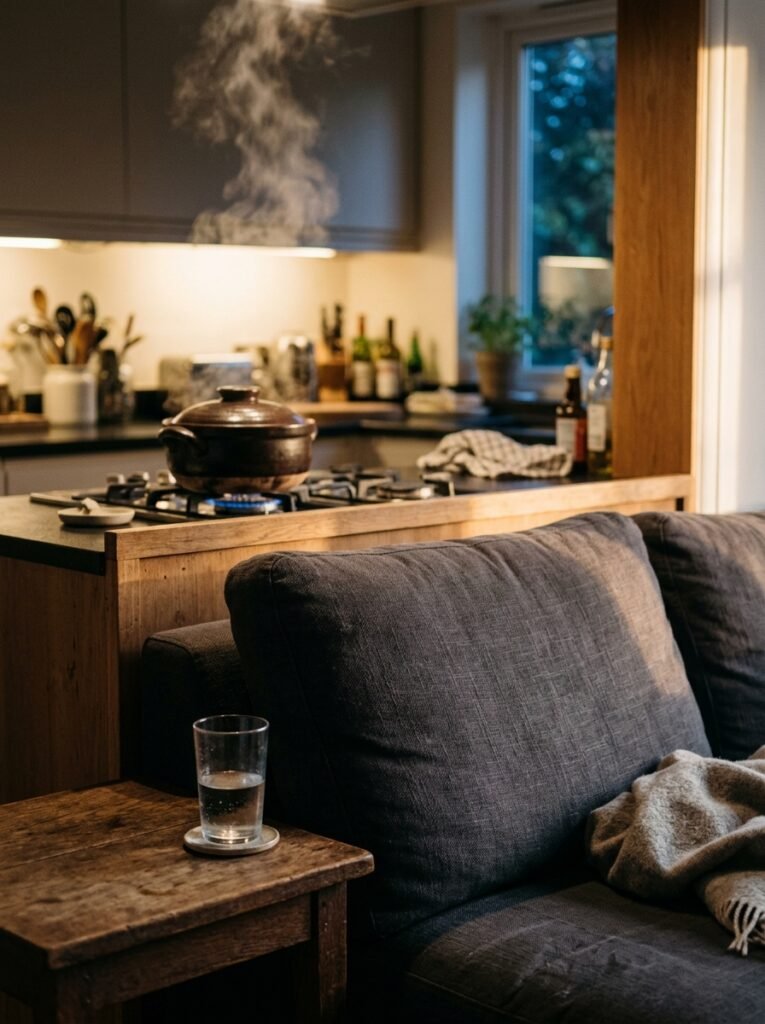
The smell of garlic hits the couch cushions. The podcast playing in the living room bleeds into the kitchen where someone is trying to concentrate. A stack of dishes sits in full view of the spot where you were trying to relax.
And yet.
You wouldn’t trade it. Not for anything.
That paradox is exactly what makes open plan spaces so worth understanding properly. Not the glossy version you save on Pinterest at 11pm. The actual, lived-in, imperfect, genuinely beautiful version that happens when you understand what you’re working with.
—
Why the Walls Came Down and Why We’re Not Putting Them Back Up
The open plan kitchen and living room didn’t become the dominant layout of modern homes by accident. It emerged from a real shift in how we actually live. We stopped entertaining in formal dining rooms. We started cooking while talking to the people we love. We wanted to be present in multiple parts of our lives at once — watching a child do homework, stirring something on the stove, half-listening to the news.
The wall between the kitchen and the living room was a barrier to all of that.
So we took it down. Architecturally, socially, emotionally.
What replaced it is something more complex than a floor plan. It’s a philosophy of how a home should function — and understanding that philosophy is the difference between an open plan space that sings and one that just feels like a large, slightly chaotic room with a sofa in it.
—
The Invisible Line That Makes or Breaks Everything
Here’s the thing nobody puts in the caption beneath the Pinterest photo.
Open plan spaces live and die by their zone definition. Not walls. Not even necessarily furniture dividers. But a clear, intuitive sense — felt more than seen — of where one world ends and another begins.
The kitchen is a workspace. High energy, task-focused, sensory and a little chaotic by nature.
The living room is a rest zone. Lower energy, comfort-first, built for decompression.
When these two zones bleed into each other without any intentional design language differentiating them, the whole space starts to feel unsettled. Not ugly, exactly. Just off. Like a song that’s slightly out of tune — you feel it before you can name it.
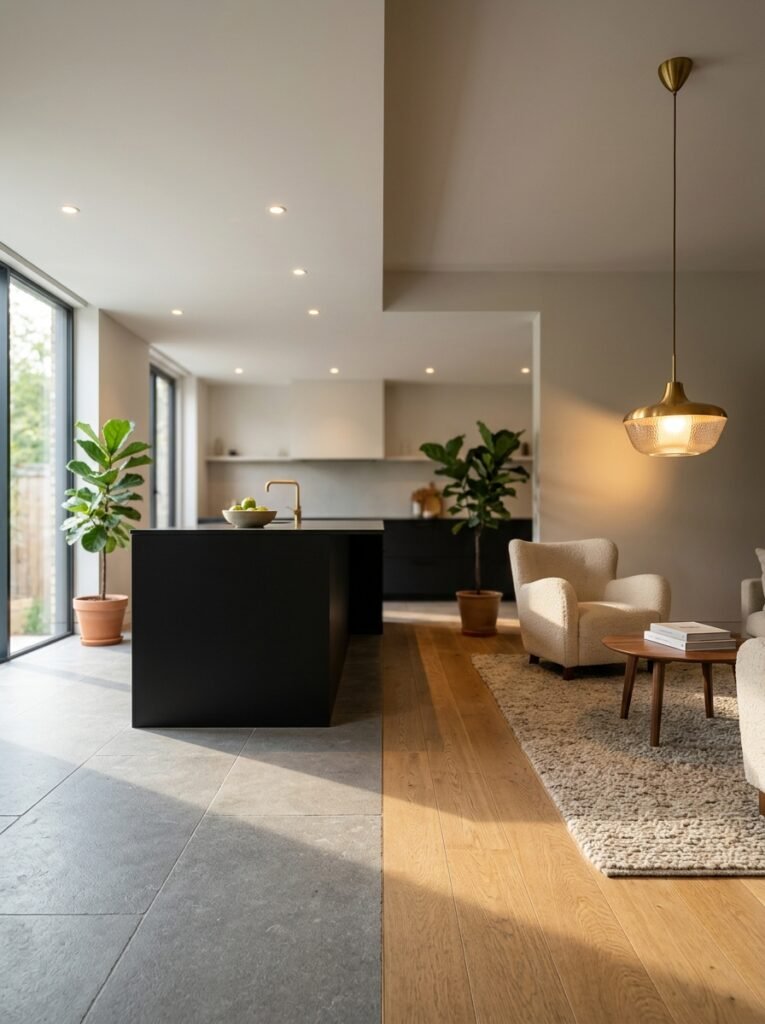
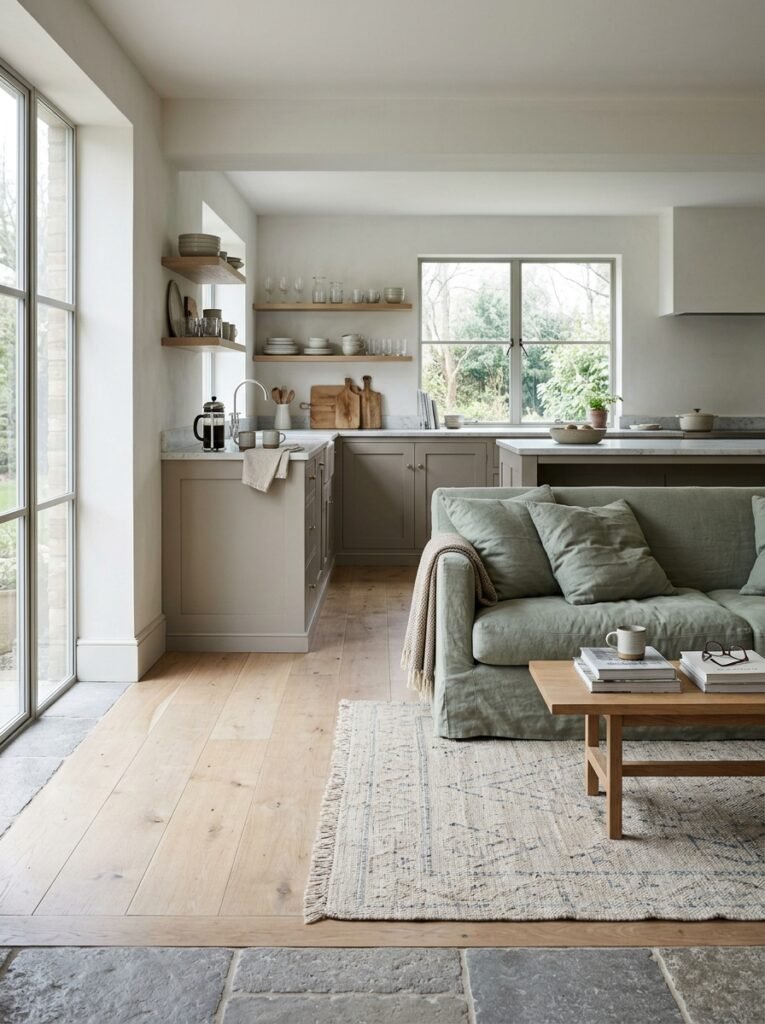
The invisible line between your kitchen and living room should be drawn with at least two of these tools: a change in flooring material or tone, a shift in lighting character (task vs. ambient), a difference in ceiling treatment, the placement of a kitchen island or peninsula, or a deliberately chosen rug that anchors the seating area with absolute confidence.
You don’t need all of them. But you need enough.
—
The Rug That Actually Has a Job to Do
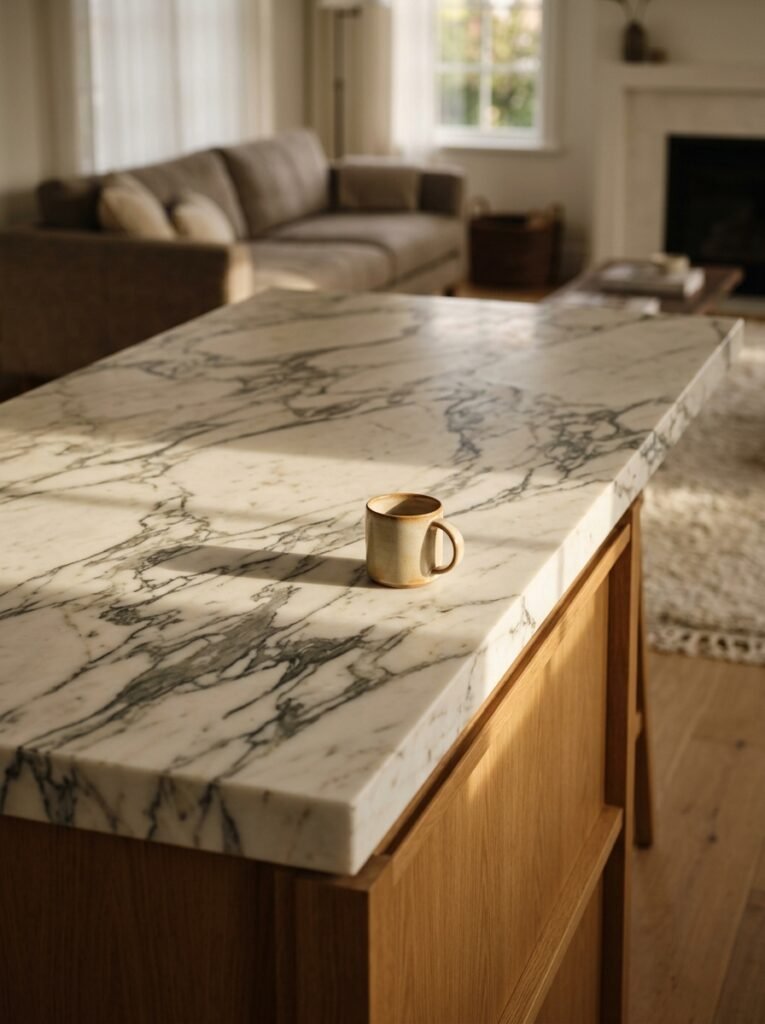
Let’s talk about the rug.
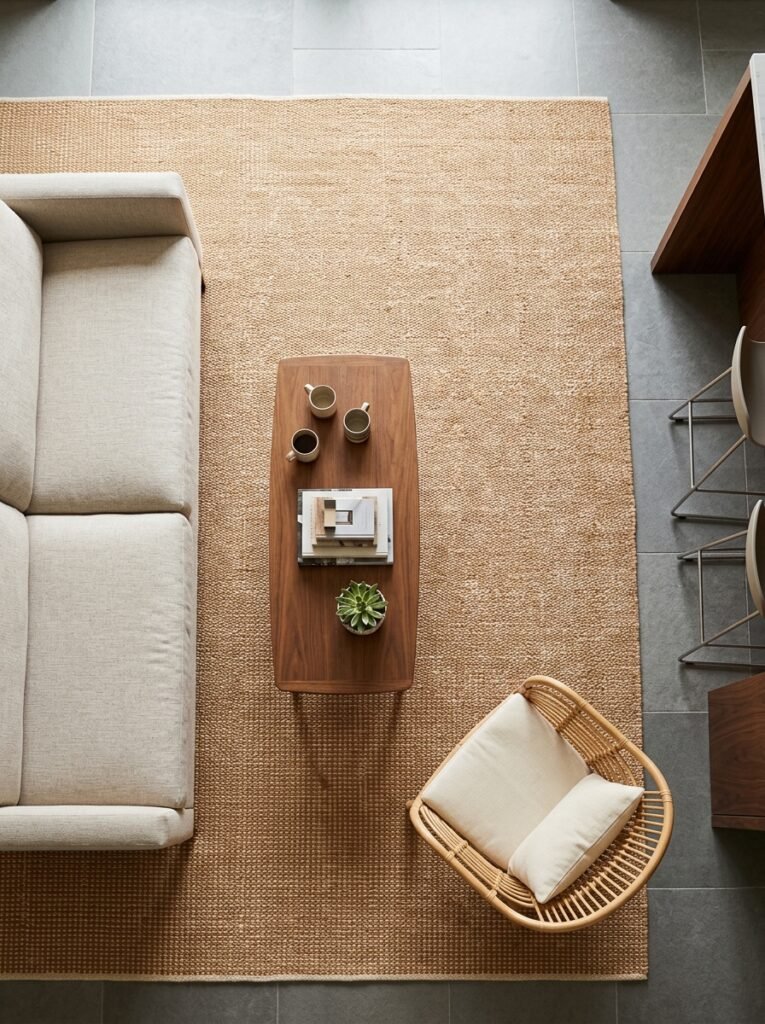
In an open plan space, the living area rug isn’t decorative. It’s structural. It defines the boundary of the conversation zone. It says: this is where you sit down, slow your breathing, take your shoes off mentally even if not literally.
A rug that’s too small in an open plan space is one of the most common — and most fixable — mistakes I see. All four legs of your sofa should sit on it. All four.
The most grounding rugs for open plan living rooms tend to have low, flat pile — something like a flatweave or a tightly looped wool — because they read clearly from a distance, which matters when your “room” is actually half of a larger space. Thick shags can feel visually heavy and spatially confusing in these environments. They absorb the eye when the eye needs to travel.
Color: aim for something that borrows a tone from the kitchen but deepens it. If your kitchen has warm oak cabinetry, a rug with caramel undertones creates a thread of visual logic without matching. Matching is boring. Logic is elegant.
—
The One Thing a Kitchen Island Does That No One Mentions
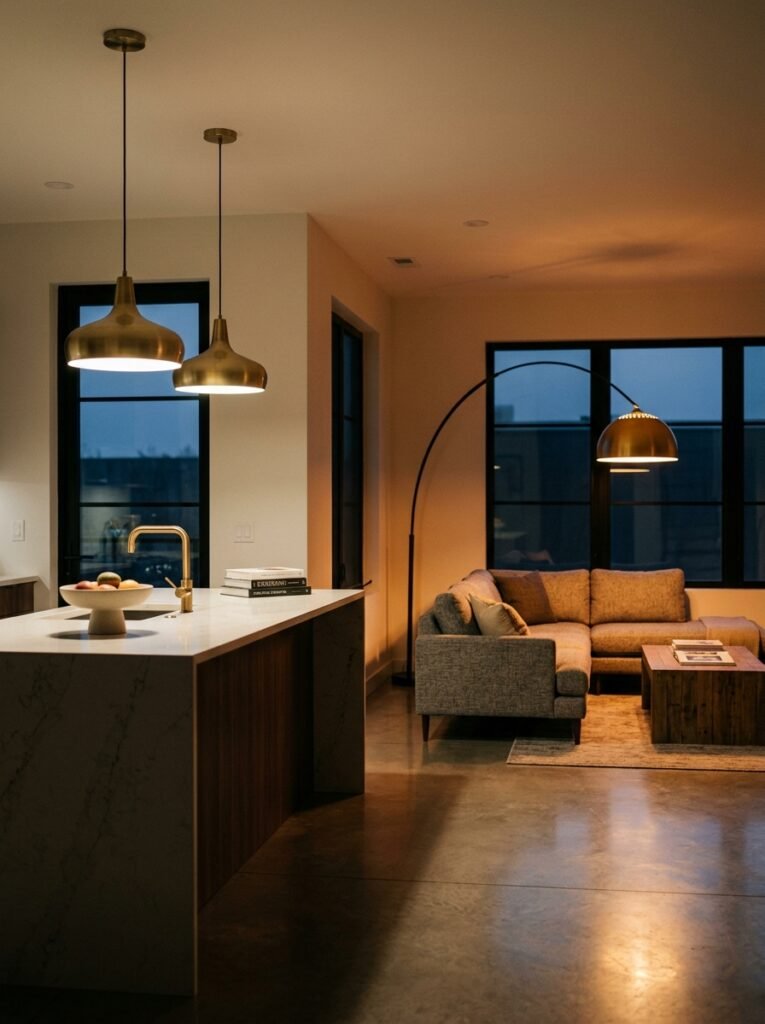
A kitchen island in an open plan space does something that transcends storage or prep surface or breakfast bar functionality.
It creates the conversation threshold.
That moment where someone walking from the living room meets someone standing at the stove — the island is where they pause. Where the coffee gets set down. Where the “how was your day” actually happens. It’s the informal hearth of the modern open plan home.
This is why island placement matters enormously. Too close to the kitchen perimeter and it just becomes another counter. Too far out and it strands itself awkwardly in no-man’s-land between zones.
The sweet spot is a position that creates a clear sense of arrival — where someone coming from the sofa can lean their elbows on the edge and feel in the kitchen without being in the way of the cooking. That distance, that implied invitation, is everything.
Pendant lights above the island do double duty here. They define the island as a distinct zone within the kitchen while also serving as the visual anchor point that your eye lands on when you look at the kitchen from the living room. Choose them carefully. This is not where you reach for the safe option.
—
What Natural Light Does to a Shared Space (And How to Work With It, Not Against It)
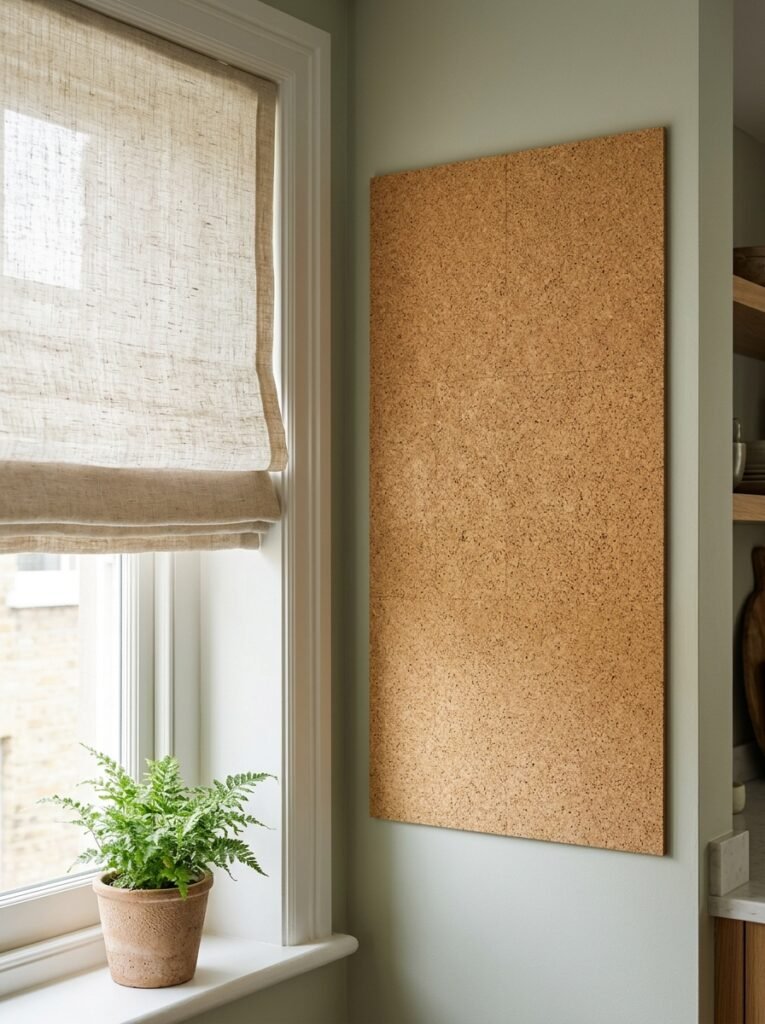
In a combined kitchen and living room, natural light is not evenly distributed. It almost never is.
Usually, the living room end gets the best windows — the ones facing the street, or the garden, or wherever the architect was thinking about the view. The kitchen end often lives in slightly more shadow, under artificial task lighting, by necessity.
This creates a challenge: how do you make both zones feel equally alive without turning your kitchen into a surgery suite of white LEDs?
The answer is layering light sources with genuine intentionality.
Your kitchen needs task lighting — under-cabinet strips or pendants directly over prep surfaces. But it also needs ambient warmth. A small wall sconce at the far end of the kitchen, angled upward. Pendants over the island on a dimmer. Even the warm glow of the range hood light used alone at night can turn a functional kitchen into something almost romantic.
Then let your living room chase the natural light rather than compete with artificial. Sheer curtains that diffuse rather than block. Mirrors placed to bounce light deeper into the space. A lamp positioned where the evening sun hits, so it reads as part of the golden hour rather than a replacement for it.
The goal is not brightness. The goal is evenness with character.
—
The Sofa That Has to Work Harder Than Any Other Sofa
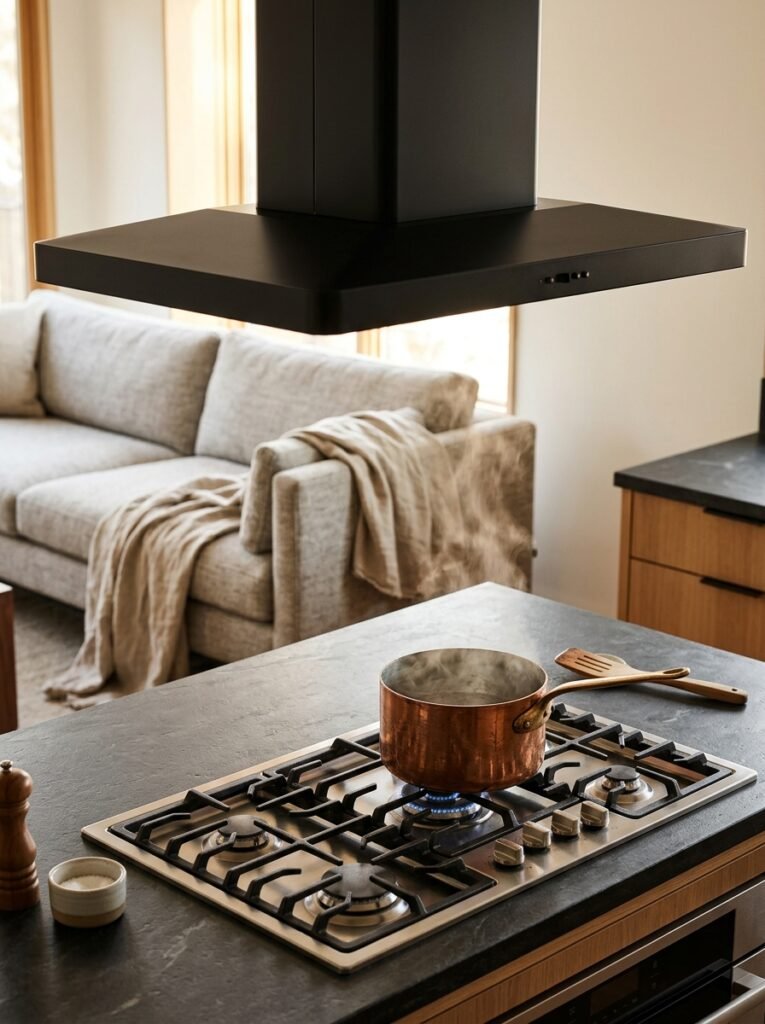
In a traditional living room with four walls and a door, your sofa has context. It has a backdrop.
In an open plan space, your sofa is floating in the geography of a larger world. It needs to project confidence. A sofa that works in a contained room will often look tentative and lost in an open plan space — too small, too neutral, too apologetic.
This is where people discover that size matters more than they thought. Not a “bigger is always better” approach, but an awareness that a sofa which fills its zone with appropriate presence becomes the visual anchor that holds the living area together.
Color applies here too. In open plan spaces, a living room sofa in a color or texture that has no relationship to the kitchen palette can make the two zones feel like they belong to different homes. A subtle echo — a cushion in the same tone as your kitchen tiles, or an upholstery fabric that borrows the warmth of your wooden shelving — is not about being matchy-matchy. It’s about creating a single visual language across a larger, more complex space.
—
The Smell Problem (And the Design Solution Nobody Talks About)
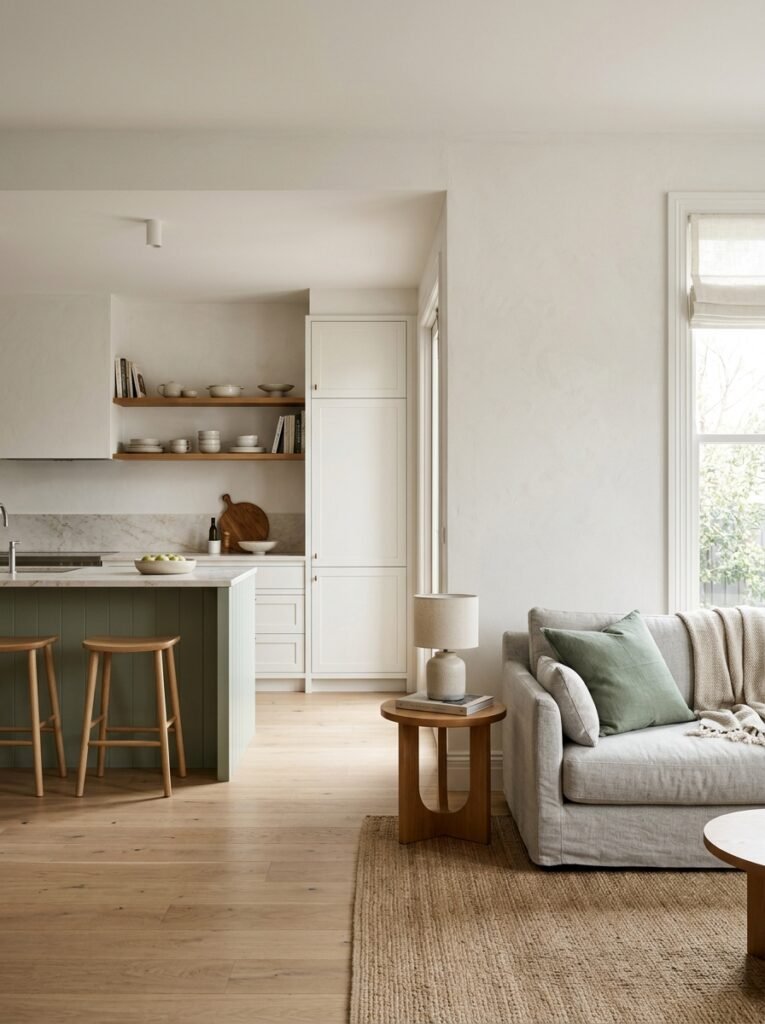
Let me be real with you for a second.
Cooking smells travel. In an open plan space, they travel far and they stay long. That garlic-and-onion situation from Tuesday dinner? Still faintly present on Thursday.
This is not a reason to close off your kitchen. But it is a reason to take ventilation seriously in a way that goes well beyond the standard builder-grade range hood.
A ducted extraction system — one that vents air outside rather than recirculating it through a filter — is worth every penny in an open plan home. If you’re renovating, this is not the place to compromise. If you’re working with what you have, the addition of a high-quality air purifier in the living zone (positioned at the boundary between kitchen and living room) will do meaningful work.
On the design side, softer textiles in the living area — a linen sofa cover, wool cushions, a cotton throw — do absorb ambient smells more than leather or synthetic fabrics. This cuts both ways: they absorb the lovely smell of a Sunday roast and the less-lovely smell of a fish curry. Choose accordingly.
A good candle, lit in the living area while cooking, does something that no air purifier can: it layers a chosen scent over the kitchen smells rather than fighting them, and it signals — visually, olfactorily — that this part of the room is the rest zone.
—
That Particular Shade of Paint That Does All the Heavy Lifting
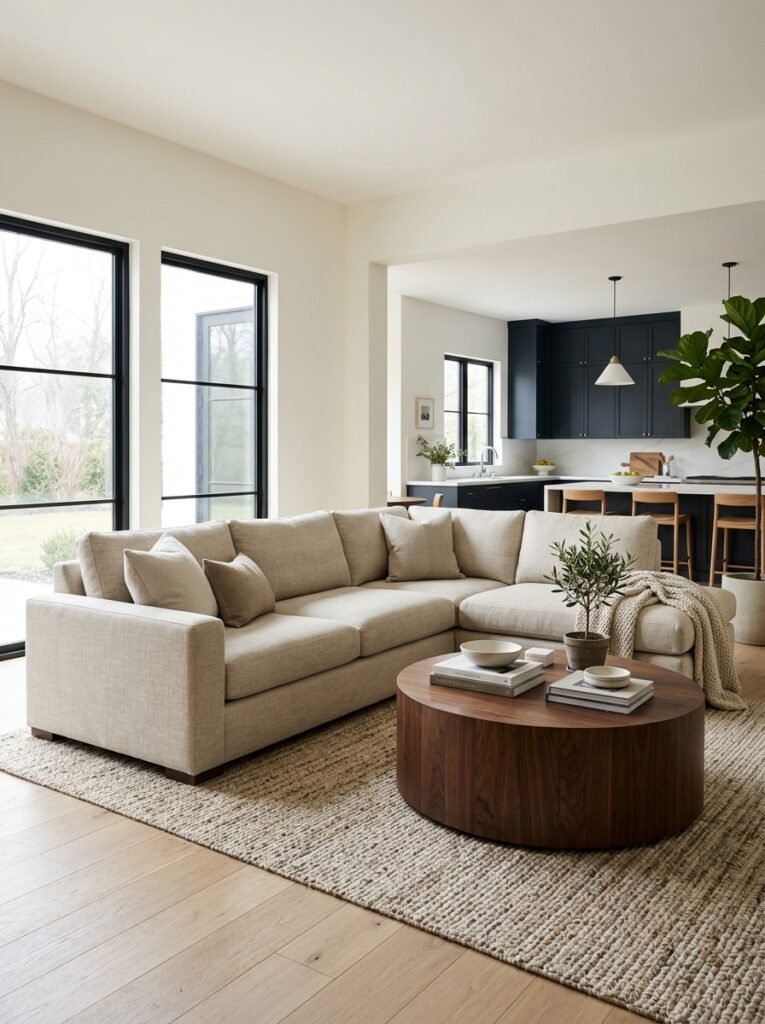
Paint color in an open plan kitchen and living room is one of the most consequential decisions you’ll make — and the most underestimated.
The instinct is to go with one color throughout, which makes logical sense. One space, one color. Unity.
But here’s what happens in reality: a single paint color applied uniformly across a large open plan space can flatten the architecture and erase the zone differentiation you’ve worked so hard to create through furniture and lighting.
The better approach is one color family, two depths.
Use a slightly deeper version of your chosen color in the kitchen zone — it grounds the workspace energy and makes the cabinetry read more intentionally. Use a lighter, softer version in the living area — it feels expansive, open, breathable. Stand in the middle of your space and the shift should be felt before it’s consciously noticed.
The transition between the two tones typically happens naturally at the kitchen island or peninsula. If your space is more open than that, a ceiling treatment — even just painting the ceiling above the living area in a tone slightly different from the kitchen ceiling — can create the same subliminal differentiation.
There’s a particular shade of warm off-white that sits somewhere between putty and bone, with just enough green in the undertone to read as organic rather than clinical, that works in almost every open plan space I’ve ever seen done well. It’s not exciting to describe. But it makes everything around it look intentional and beautiful, which is its entire job.
—
Storage That Doesn’t Ruin the View
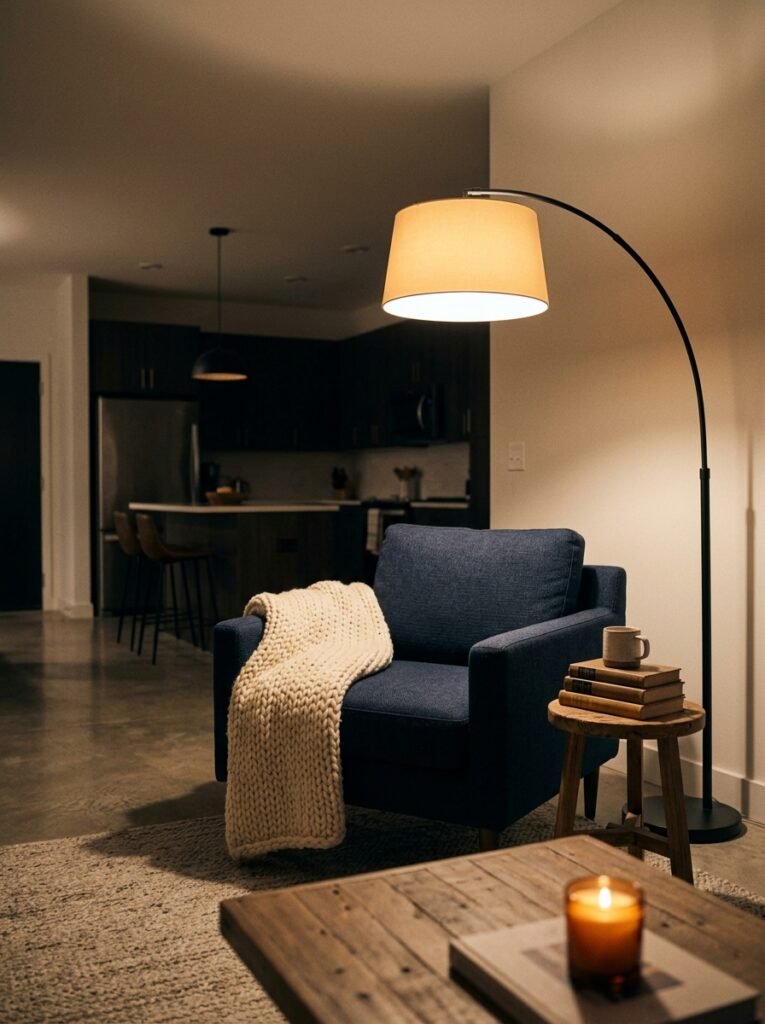
In an open plan space, storage has to do something it doesn’t have to do in a room with walls and a closing door.
It has to look good from the sofa.
Every lower cabinet in your kitchen, every shelf, every pantry door — it’s all visible from your living room seating position. Which means that the kitchen clutter you used to close a door on is now part of your living experience.
This changes what good storage means.
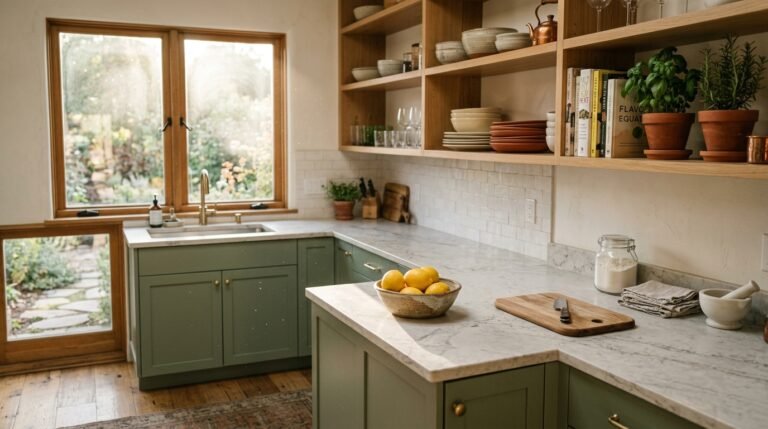
Open shelving in an open plan kitchen only works if you’re willing to curate it genuinely. Not styled for a photo. Curated for daily life — meaning the things that live there are either beautiful in themselves (a stack of wooden cutting boards, glass jars of grains, a single handmade ceramic pitcher) or hidden within containers that are. A metal tin with a patina. A linen-lined basket. A set of matching bowls in a matte glaze.
Lower cabinets should have hardware that reads well from a distance. Long bar pulls rather than small knobs — they give the eye a clean horizontal line to follow, which calms a large expanse of cabinetry.
And somewhere in the living area, you need closed storage too. A sideboard, a cabinet, a storage ottoman. Because the small debris of daily life — the remote controls and charging cables and the magazine you’re halfway through — needs somewhere to disappear when it’s not being used, and in an open plan space, there is nowhere to just put it down without it being visible.
—
The Floor That Ties It Together (Or Doesn’t)
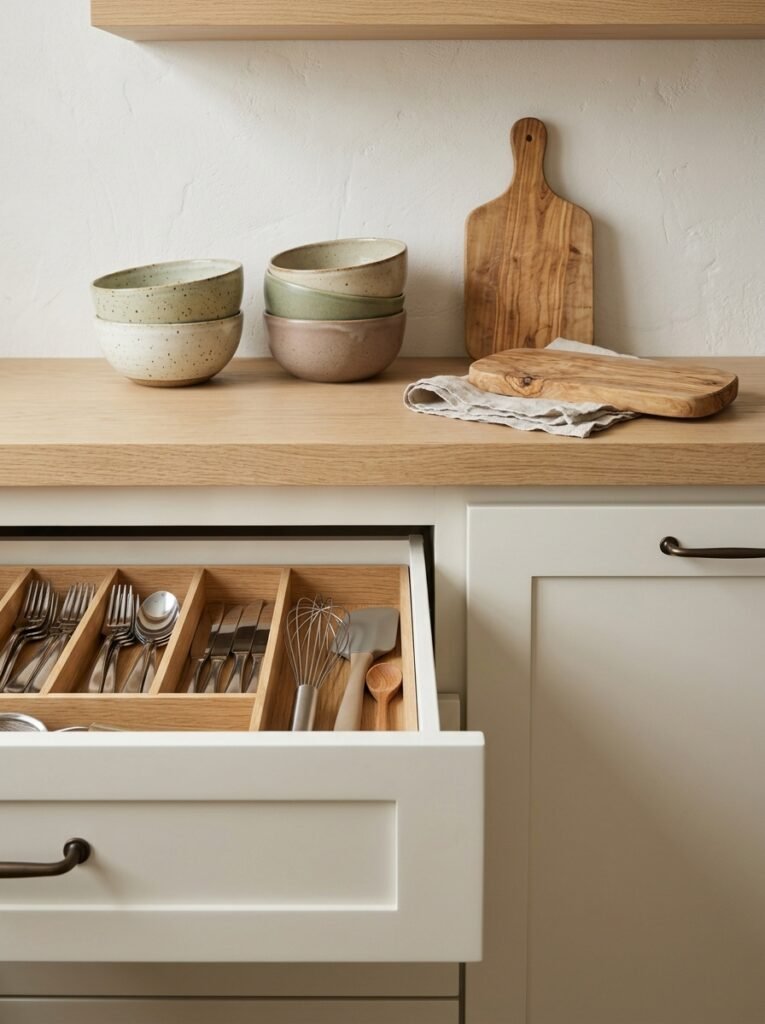
Flooring in an open plan spaces is a debate that design forums will fight about until the end of time.
One continuous floor throughout: maximum sense of space, seamless flow, elegant in principle.
Two different floors meeting at the zone threshold: clear zone differentiation, easier to update one area independently, more dynamic visually.
Both are right depending on the space.
Where I land, having seen both done beautifully and both done catastrophically: continuous flooring is almost always the better choice in smaller open plan spaces, where differentiation can feel cramped and make the total square footage feel divided rather than united.
In larger open plan spaces — where the total square footage is significant and the zones need grounding — different flooring materials meeting at the island or sofa-back line can be genuinely stunning.
The choice should never be driven purely by aesthetics. Think about the practical reality: your kitchen floor sees spills, splatter, dropped pans, and repeated mopping. Your living area floor sees bare feet and pet traffic. The flooring that works best in each zone is not necessarily the same material. Engineered hardwood across both, with a large rug anchoring the living zone, is often the most honest answer to both realities.
—
The Light Fixture That Makes the Kitchen Feel Like a Room Instead of a Workspace
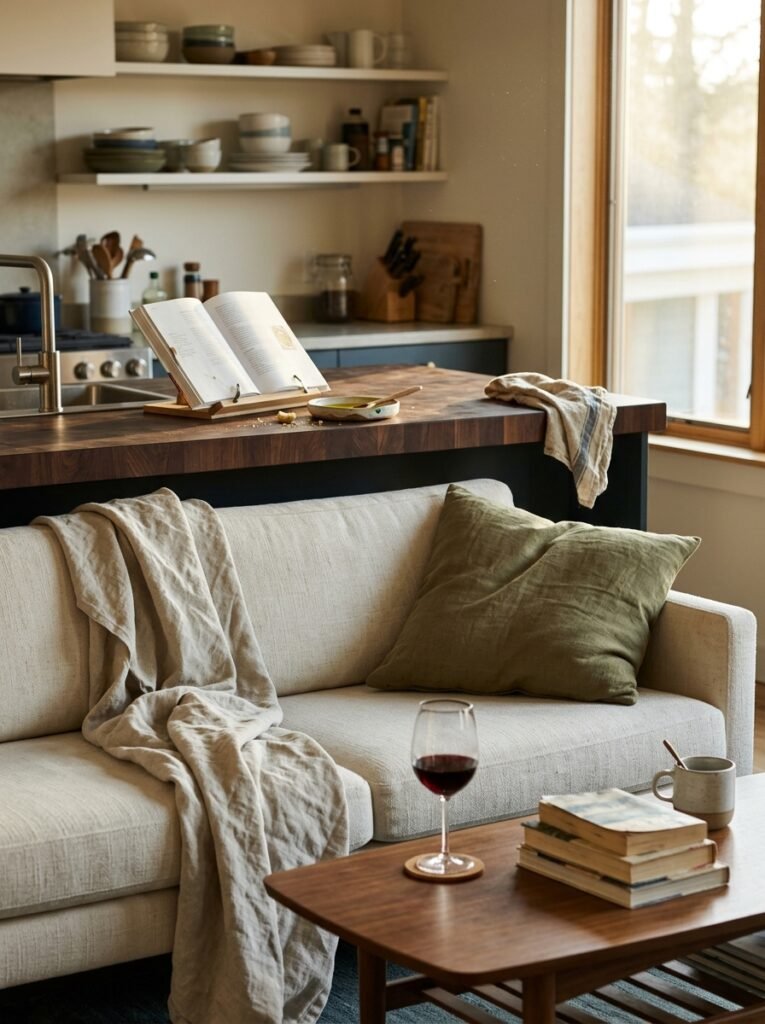
There is one thing that transforms how a kitchen reads from a living room.
A statement pendant or ceiling fixture positioned over the island or dining table portion of the kitchen that belongs to the language of interior design rather than the language of kitchen appliances.
Not a fluorescent panel. Not a downlight grid. Something with form. Something that reads as chosen.
This single fixture announces that the kitchen, even in its functional state, is a designed space. It gives the kitchen visual weight that pulls it into relationship with the living room, rather than leaving it feeling like a utility annex attached to a real room.
Rattan, sculptural concrete, hand-blown glass, blackened metal — the material almost matters less than the intention. It should be the kind of fixture that someone walking into your home looks at and thinks where did you get that, not because it’s expensive, but because it’s specific.
—
FAQ: What People Actually Ask About Open Plan Kitchen Living Rooms
Can I have an open plan space in a small apartment? Yes — and it often makes more sense than in a large one. Removing the visual separation between kitchen and living area in a small apartment can make both spaces feel significantly larger. The key is that zone definition becomes even more important when the total square footage is modest. A strong rug, deliberate lighting, and a clear sense of where cooking happens versus where living happens will do the work that walls used to do.
What’s the best way to separate kitchen and living room without a wall? A kitchen island or peninsula is the most functional solution — it creates physical and visual separation while maintaining flow. A large area rug in the living zone, a change in lighting character between zones, and a difference in ceiling treatment (even paint depth) can all reinforce the separation without any structural work.
How do I stop cooking smells from taking over the living room? Ducted extraction is the structural answer — prioritize it if you’re renovating. A high-quality air purifier at the zone boundary helps in existing spaces. Natural ventilation during cooking (cross-draft from windows) makes a significant difference. In design terms, softer natural textiles in the living area absorb and diffuse ambient cooking smells better than synthetic materials.
Should I use the same color throughout an open plan space? One color family is smart. Exactly the same shade at the same depth throughout can flatten the space. Using a slightly deeper tone in the kitchen zone and a softer, lighter version in the living zone creates subtle zone differentiation while maintaining visual cohesion.
Is open plan bad for noise? It’s honest about noise, which is different from bad. Conversations, cooking sounds, and background media do travel freely across open plan spaces. Soft furnishings — rugs, curtains, upholstered seating, cushions, throws — all absorb sound and reduce echo in ways that hard-surfaced open plan spaces don’t. If noise separation is genuinely important for how you live, a partial partition wall or a large open shelving unit used as a room divider can provide acoustic help without fully closing off the space.
What size rug should I use in an open plan living room? Larger than you think you need. As a practical guide: all the front legs of your sofa and chairs should sit on the rug at minimum, and ideally all four legs of every major seating piece. In an open plan space, an undersized rug makes the living zone feel tentative and unresolved. When in doubt, go bigger.
—
What You’re Really Building
Here’s what I’ve come to believe, after years of thinking about how spaces work and how people live inside them.
The open plan kitchen and living room isn’t a layout choice. It’s a decision about what kind of life you want to live inside your home.
It says: I want to be present with the people I love while I do ordinary things. I want cooking to feel like part of the evening rather than a separate task performed behind a closed door. I want light to move through my home without interruption.
The open plan space, done well, is an argument that domestic life doesn’t need to be compartmentalized to be meaningful.
It takes intention to get there. A rug that means it. A light fixture that was chosen, not defaulted to. A paint color that does quiet, important work. Storage that holds the chaos rather than displaying it. Zones that feel distinct without feeling divided.
None of it requires a renovation budget or a designer’s eye.
Just a willingness to think about how you actually live — not how the listing photos suggested you might — and design toward that truth instead of away from it.
That’s what makes an open plan space feel like a home rather than a floor plan.
And that, in the end, is everything.