The Sectional That Changed How I Think About Modern Farmhouse Living Rooms
You know that moment when you walk into someone’s living room and everything just feels right? The air is warm, the furniture makes sense, and you can’t quite explain why you want to stay for three hours. Nine times out of ten, there’s a big, thoughtful sectional at the center of it — and it’s doing more work than people realize.
Modern farmhouse living rooms are having a serious moment. And the sectional is the reason they work.
—
1. Why the Sectional Is the Heart of the Modern Farmhouse Look Right Now
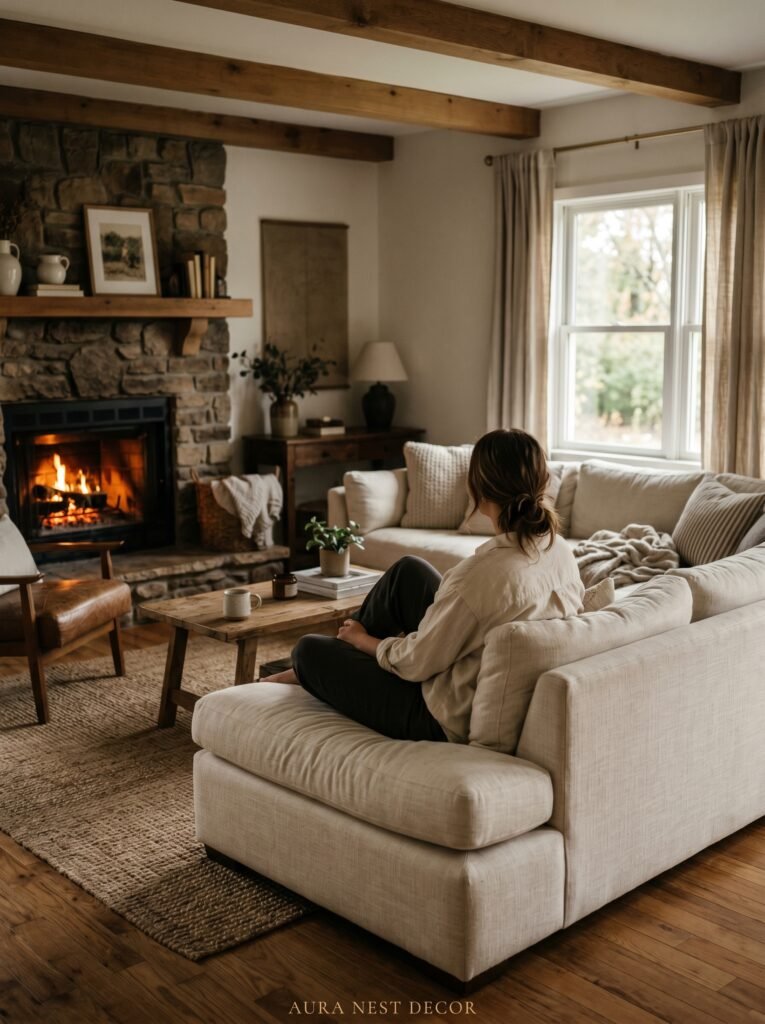
It starts with scale. Modern farmhouse design has always been about spaces that feel lived in, not staged — and a sectional communicates that instantly. It says: people actually sit here. People pile blankets here. Somebody’s dog has definitely claimed the corner piece.
That’s the emotional core of this whole aesthetic. It’s not about perfection. It’s about warmth that feels earned.
A well-chosen sectional anchors a living room in a way that a sofa-and-loveseat combo simply can’t. The continuous line of it creates a visual calm. The sheer generosity of the seating says something about how you want to live — openly, comfortably, with room for everyone.
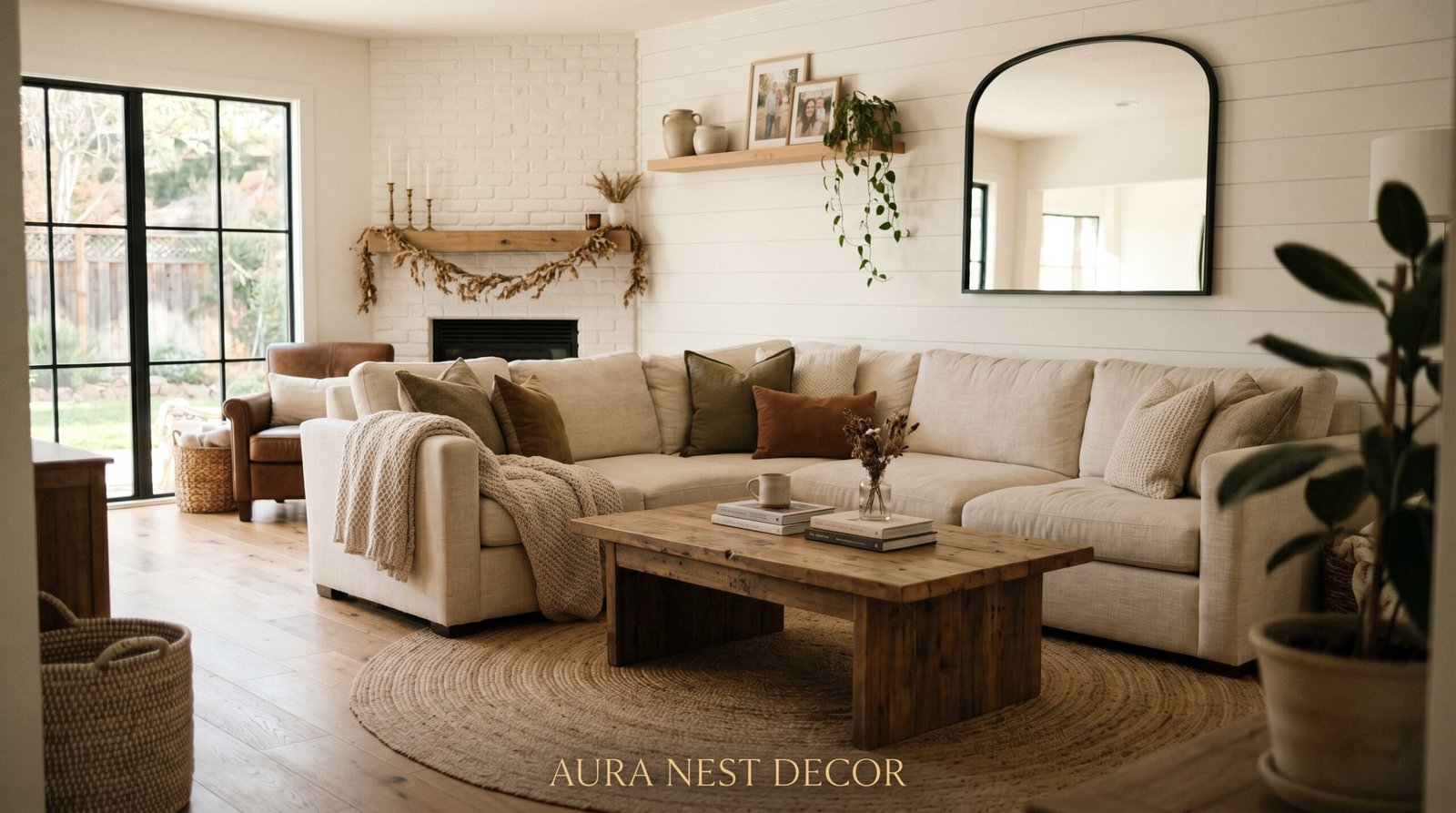
In modern farmhouse design specifically, the sectional bridges the gap between rustic and contemporary. A linen-upholstered L-shape in warm white next to shiplap walls and black iron hardware? That’s the look people are pinning obsessively right now. It’s not accidental. The sectional is doing a lot of the heavy lifting — pulling together the soft with the structural, the cozy with the clean-lined.
“The sectional isn’t just furniture. In a modern farmhouse living room, it’s the whole mood.”
—
2. The Exact Shade of Cream That Makes a Sectional Look Expensive (Not Sad)
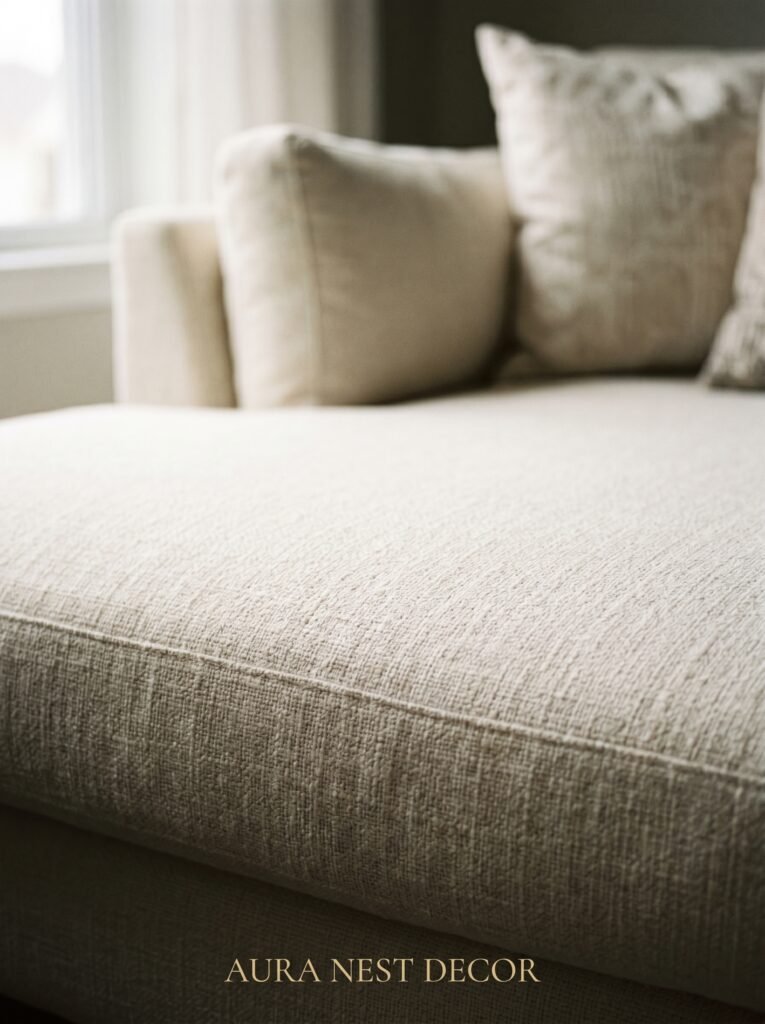
Color is where people stumble first. They want a light, neutral sectional — which is the right instinct — but they grab the wrong white and suddenly their living room looks like a waiting room at a dentist surgery.
The secret is warmth. Not gray-white. Not stark white. The shades that work are the ones that look like heavy cream or raw linen in afternoon light. Think: Benjamin Moore’s White Dove or Sherwin-Williams Alabaster, if you were painting a wall to match. That’s the zone you want.
Warm greige and oat tones work brilliantly too. There’s a version of this look where the sectional is almost a muted caramel — barely-there, like a coffee with too much cream — and it sits against white oak floors and looks absolutely stunning.
What to avoid: anything with a blue or purple undertone. It will fight with your wood tones endlessly. It will make your warm Edison bulb lighting look harsh and confused. You’ll spend money on throw pillows trying to fix it and never quite get there.
If you’re based in the UK and shopping at the likes of Swoon, MADE, or John Lewis — their “natural” and “flax” linen colorways are almost always in this safe, warm zone. In the US, Article, Pottery Barn, and West Elm’s natural linen options tend to land right.
—
3. The Shiplap Conversation: Should It Stay or Is It Finally Over?
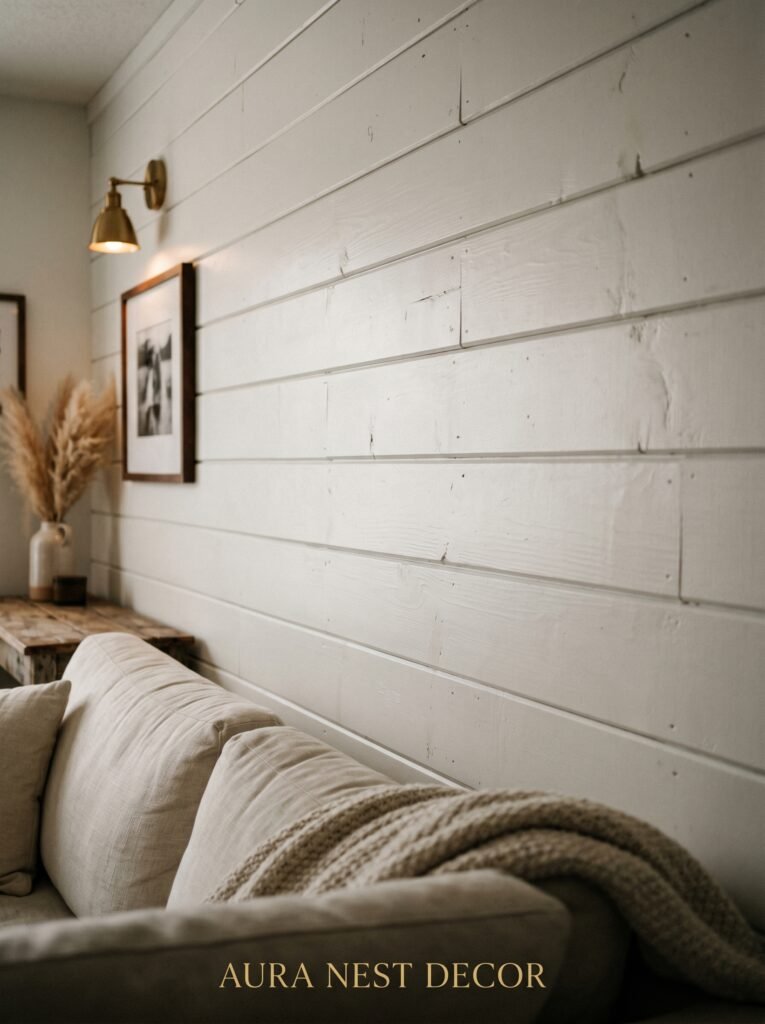
Let’s be direct: shiplap is not going anywhere.
Yes, it’s been overdone. Yes, every open-concept renovation from 2016 onward has some version of it. But here’s the thing — when it’s used well, with restraint, it still looks genuinely beautiful behind a modern farmhouse sectional. The horizontal lines create a quiet rhythm. They give the eye a place to rest. And in a room that’s trying to feel warm rather than cold, that texture matters.
The key word is restraint. One wall. Maybe just the wall behind the television, or the wall the sectional faces. Not all four walls. Not the ceiling. Not both.
The contemporary update on shiplap that’s working right now is spacing. Instead of tight, flush planks, designers are leaving a small gap — about a quarter inch — between boards. It makes the same material read as more intentional. More modern. Less “farmhouse TV show renovation” and more “architect made a considered choice.”
In UK homes, where you’re working with older walls and trickier period proportions, a single shiplap feature wall can do incredible things in terms of grounding a room without overwhelming it.
Pair it with a textured linen sectional and you’ve got contrast that works: the rough with the soft, the structural with the draped.
—
4. The Throw Pillow Formula That Actually Works (Not the One Everyone Gets Wrong)
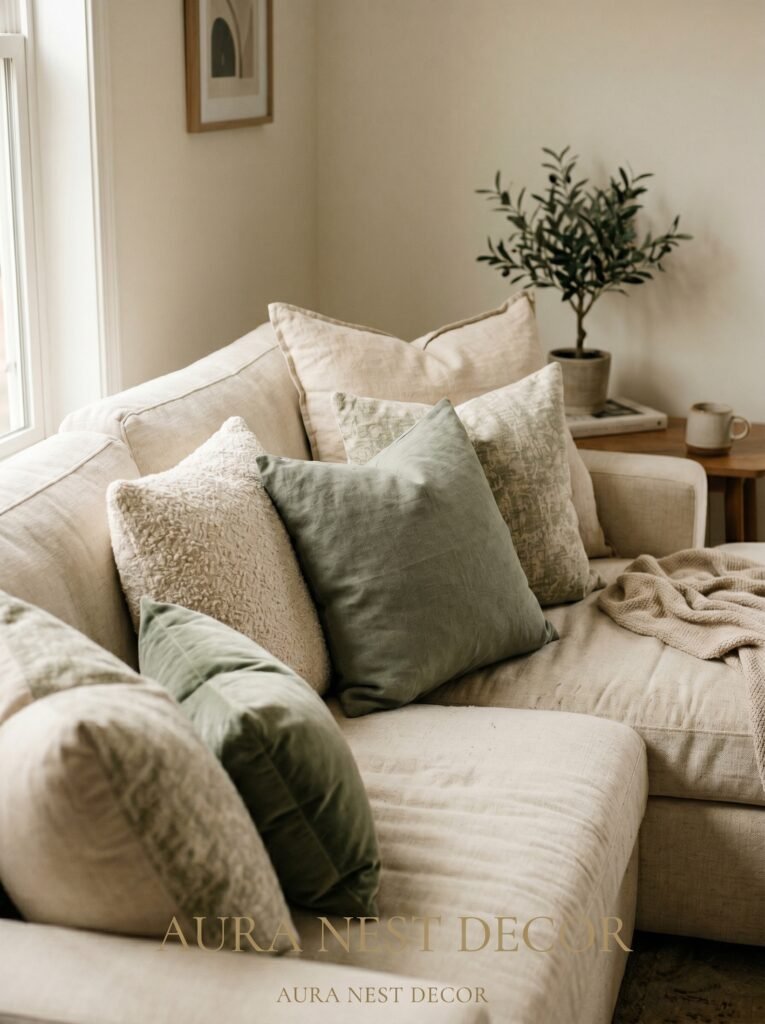
Throw pillows are where modern farmhouse sectionals go wrong almost every single time. Too many. Too matchy. Too Pinterest-board-perfect in a way that looks stiff and curated rather than warm and real.
Here’s the formula that actually works: odd numbers, varied textures, two to three colors maximum.
For a large L-shaped sectional, think seven to nine pillows total — not placed symmetrically. Group them with intention, not precision. The difference is huge.
Textures to reach for: chunky boucle, washed linen, subtle stripe in cotton, maybe one or two with a touch of embroidery or a simple woven pattern. What you’re avoiding: shiny fabrics, anything too slick, and definitely any pillow that has a word on it. “Gather,” “Home,” “Cozy” — no. Just no.
“Throw pillows on a sectional should look like someone actually arranged them. Not like someone photographed them for a catalog.”
Colors for the modern farmhouse palette: work within warm neutrals — oatmeal, warm white, natural linen — and then add one soft earthy tone. Muted sage, dusty terracotta, faded rust. One. Not three earthy tones fighting for attention.
The pillow that always earns its place: a large, square European-style pillow in a cream boucle. Put it in the corner of the sectional. It’s a scene.
—
5. What Your Wood Coffee Table Is Telling the Room (And Whether It’s Lying)
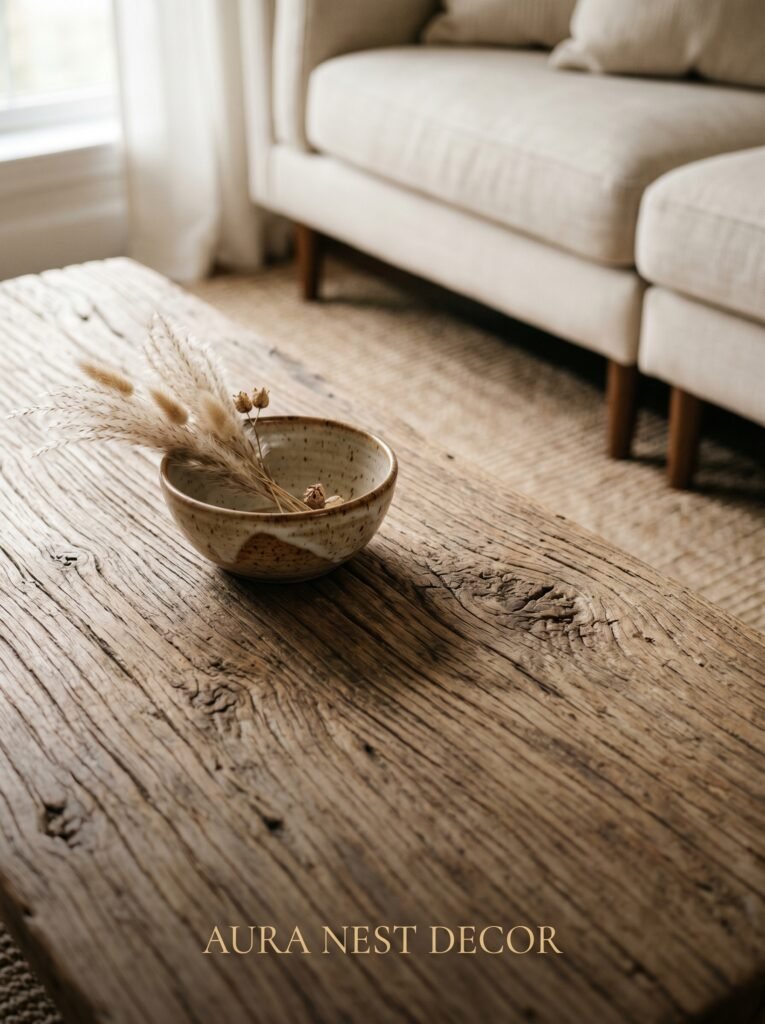
The coffee table is in conversation with the sectional constantly. And in a modern farmhouse living room, the choice here is one of the most important decisions you’ll make.
Solid wood is the obvious answer, and it’s the right one — but the kind of wood matters. The modern farmhouse aesthetic is currently moving away from the very dark, heavily stained woods and toward lighter, more natural finishes. White oak is having its absolute moment. So is natural pine with minimal staining, and reclaimed wood that keeps its natural variation and imperfections.
Those imperfections are the point. A coffee table that looks like it’s been somewhere, that has some history in the grain, creates the groundedness that this whole aesthetic is built on.
Shape matters too. A rectangular table in a long living room feels formal. An oval or rounded-rectangle table in front of a sectional immediately softens the geometry. It’s surprising how much that single change does.
In terms of scale: go bigger than you think. The coffee table in front of a large sectional should feel substantial, not like it’s apologizing for being there. If you’re in a smaller UK Victorian terrace living room, a 40″ oval table is not too big for a three-piece sectional. It’s probably exactly right.
—
6. The Rug That Grounds It All (and the Size Mistake That Undermines Everything)
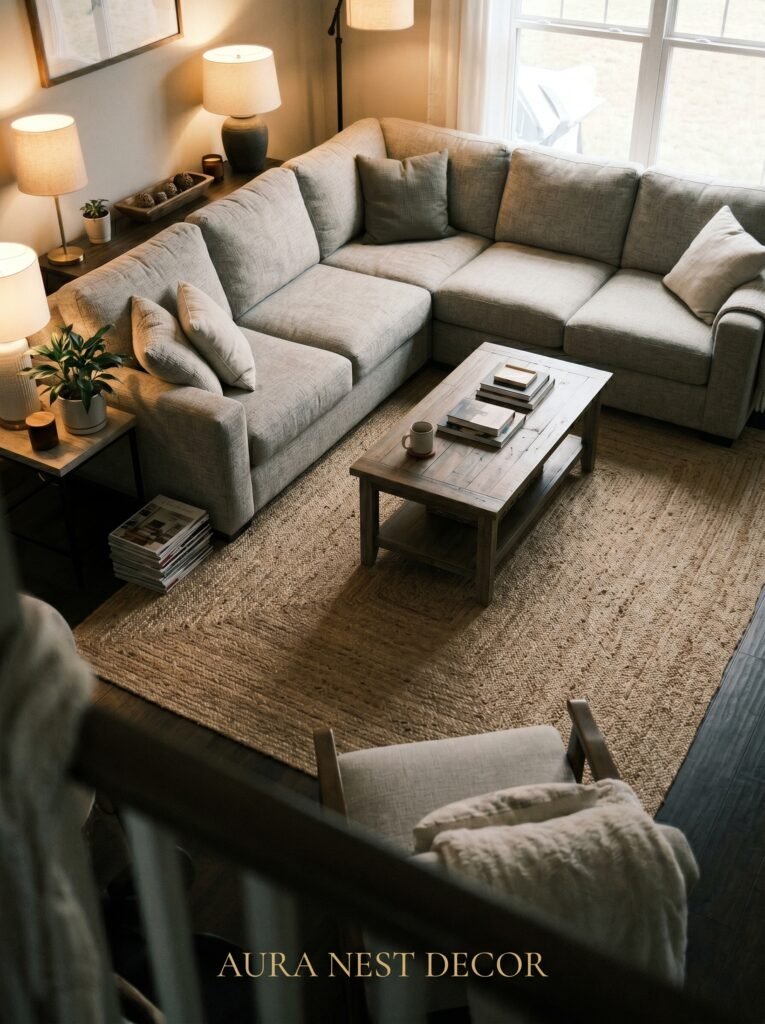
The rug is the piece most people get wrong first, fix second, and then can’t believe they ever got wrong.
Size. It is almost always about size.
In a modern farmhouse living room with a sectional, you need a rug that all the major furniture sits on, or at minimum one where all the front legs of the sectional are on the rug. A rug that floats in the middle of the room like an island — with the sectional pushed back to the wall behind it — looks unmoored. It makes the space feel unintentional, no matter how beautiful the individual pieces are.
For a standard US living room with a large L-shaped sectional, an 8×10 rug is usually the minimum. A 9×12 is often better. In the UK, where rooms tend to be narrower and longer, you might size down slightly, but the principle holds.
For texture and material: natural fiber is the classic modern farmhouse choice. A jute or sisal rug brings incredible warmth and that slightly rough, organic texture that looks brilliant under a linen sectional. The visual contrast is everything.
For color: warm neutrals. Natural, undyed jute. A low-pile wool in warm ivory. A vintage-style flatweave in muted terracotta and cream. What you’re not doing: anything geometric and graphic, anything with high contrast pattern, anything that looks like it belongs in a different design era entirely.
—
7. The Wall Treatment Above the Sectional That Everyone Keeps Getting Right
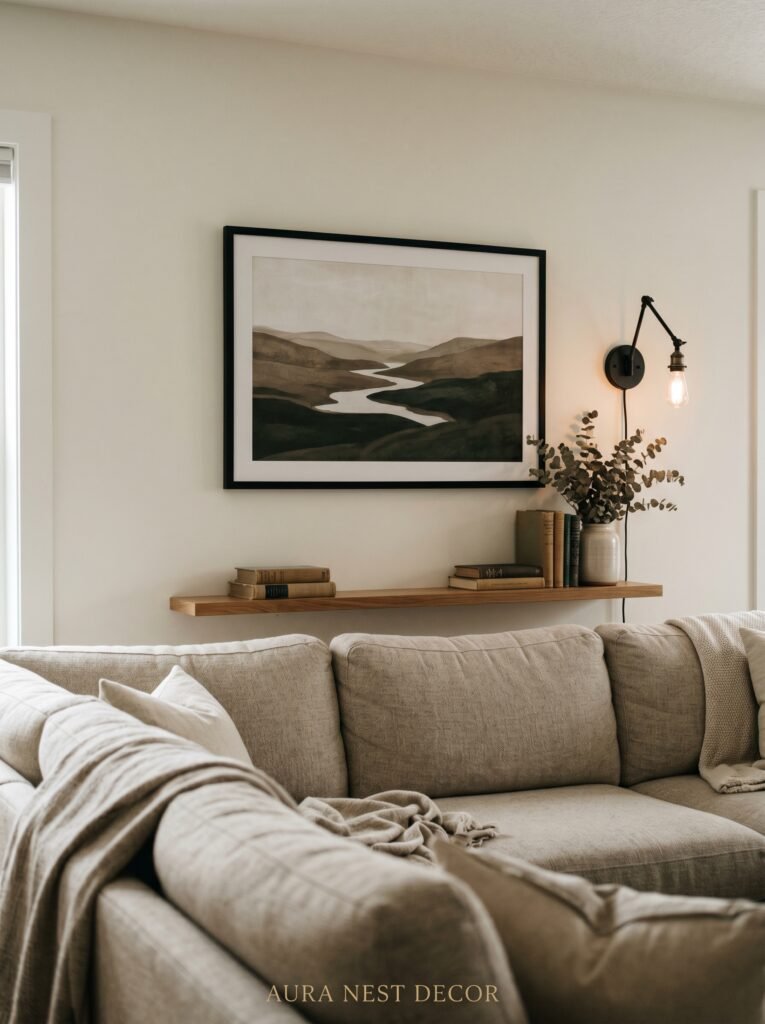
There’s a particular arrangement you’ve probably saved twenty times on Pinterest without quite noticing: a modern farmhouse living room where the wall above the sectional is doing something beautiful, layered, and organic. Not a single large print. Not a grid of twelve identical black frames. Something with dimension.
This is the gallery wall done with actual restraint.
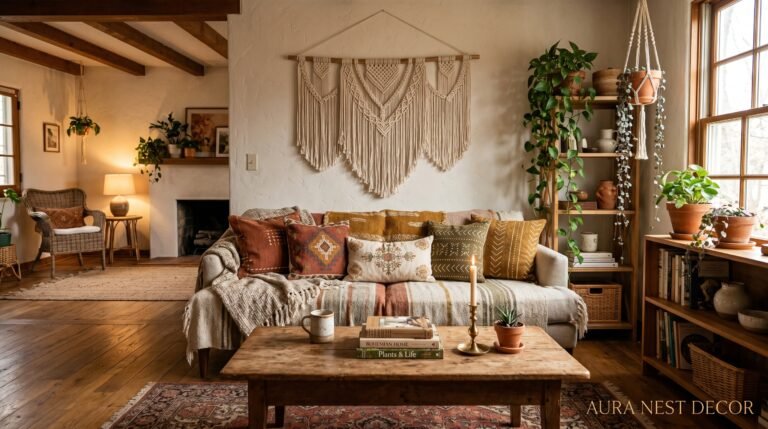
The arrangement that’s working right now involves mixing: a large neutral art print (abstract or botanical, watercolor or line drawing), one or two smaller frames in a similar palette, maybe a woven wall hanging or a small ceramic plaque, and some negative space that you consciously protect.
“The wall above your sectional isn’t a blank problem to solve. It’s an opportunity to show what kind of space you’re building.”
Heights vary slightly. Not a perfectly measured grid — but not chaos either. Everything within a general horizontal band, roughly centered on the wall, with breathing room between pieces.
For the modern farmhouse palette: all frames in the same finish (warm brass, matte black, or natural wood — pick one). Art in warm tones — cream, warm white, sage, terracotta. Nothing cold. Nothing that looks like a stock photo.
In UK homes with period cornicing or picture rails, work with what you have. Hang from the picture rail, keep frames in a warmer wood finish, and the Victorian architecture and modern farmhouse aesthetic end up in a really interesting dialogue.
—
8. Lighting That Makes a Modern Farmhouse Sectional Look Like a Movie Set
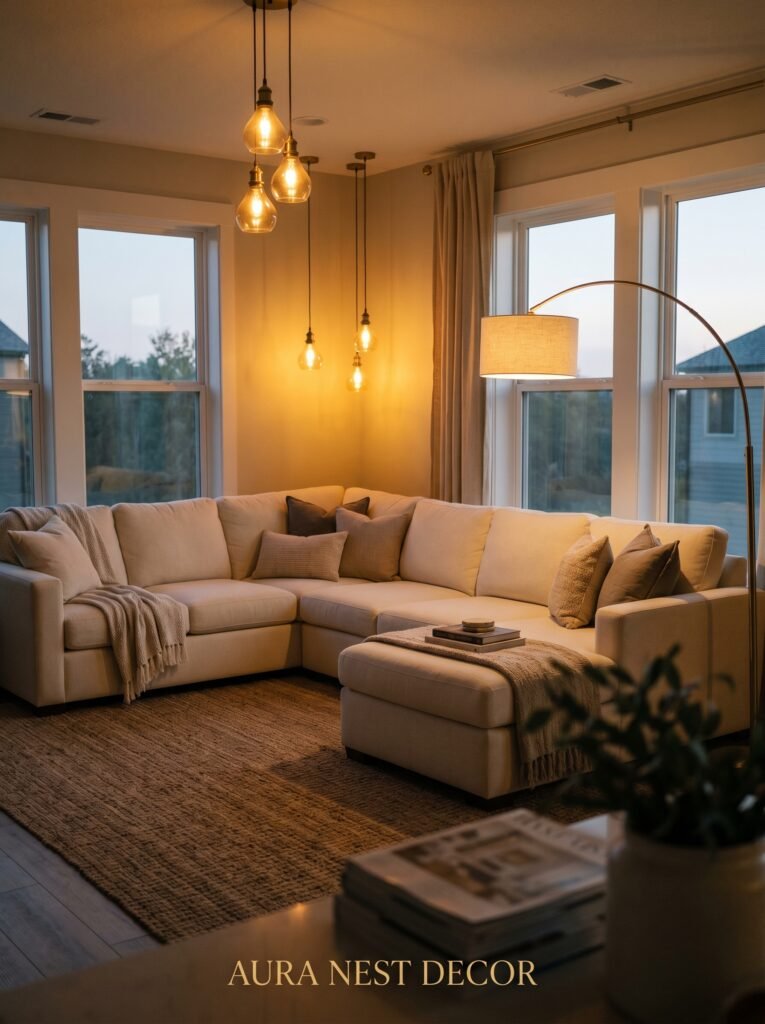
This is the section people skip and shouldn’t.
The overhead lighting in most living rooms is working against everything else you’ve put together. A single ceiling fixture directly overhead creates flat, unflattering light that makes warm colors look cool and cozy textures look flat. It is the enemy of the mood you’re trying to build.
What modern farmhouse living rooms do differently: they layer the light low. Table lamps on either side of the sectional (or at the end of it, on a side table). A floor lamp pulled up close to one end of the sectional for reading and ambiance. Candles on the coffee table. The overhead light used sparingly, dimmed down, or replaced entirely with a beautiful fixture that becomes a piece of the decor itself.
The fixtures that belong in this aesthetic: black iron pendants, rattan or woven pendant shades (if your ceilings allow), simple linen-shaded table lamps, Edison-style bulbs in warm white (2700K is the exact color temperature to look for — it’s the amber warmth you want at 7pm when the room looks like a scene from a film).
In the UK, where overhead pendants are far more common than in the US, swapping out the pendant for a rattan or iron fixture is one of the highest-return changes you can make. It changes the whole character of the room.
—
9. The Plant That Keeps Showing Up in Every Beautiful Modern Farmhouse Living Room
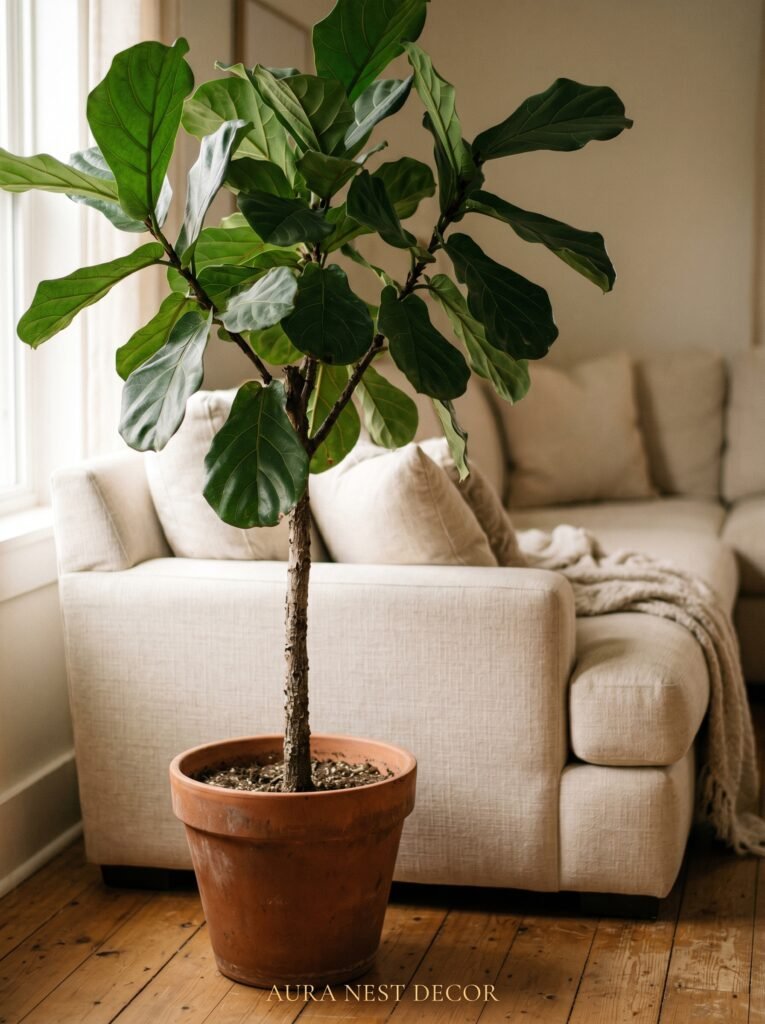
It’s a fiddle leaf fig or an olive tree. You already knew that.
But here’s what people miss: it’s not the plant, it’s the placement. The plant in a corner behind the sectional that’s just filling space — that’s not working. The plant that’s pulled forward, standing beside or slightly in front of the sectional, becoming part of the composition — that’s what you’re seeing in those Pinterest images you can’t stop saving.
Scale matters enormously. A small snake plant on the coffee table is fine, but it’s not going to do what a 5-foot fiddle leaf fig beside the corner of the sectional does in terms of grounding the room and adding vertical life.
The pot is part of it too. Terracotta, matte white, natural stone-effect ceramic, or woven seagrass basket — all work beautifully. Shiny, glazed, or brightly colored pots fight with everything around them. The pot is supporting the plant, which is supporting the room. It’s not the moment to be bold.
For UK homeowners with less natural light, a snake plant or pothos in a beautiful pot does the same visual work with far less commitment to direct sunlight.
—
10. The Blanket Situation: How to Style It Without Looking Like a Show Home
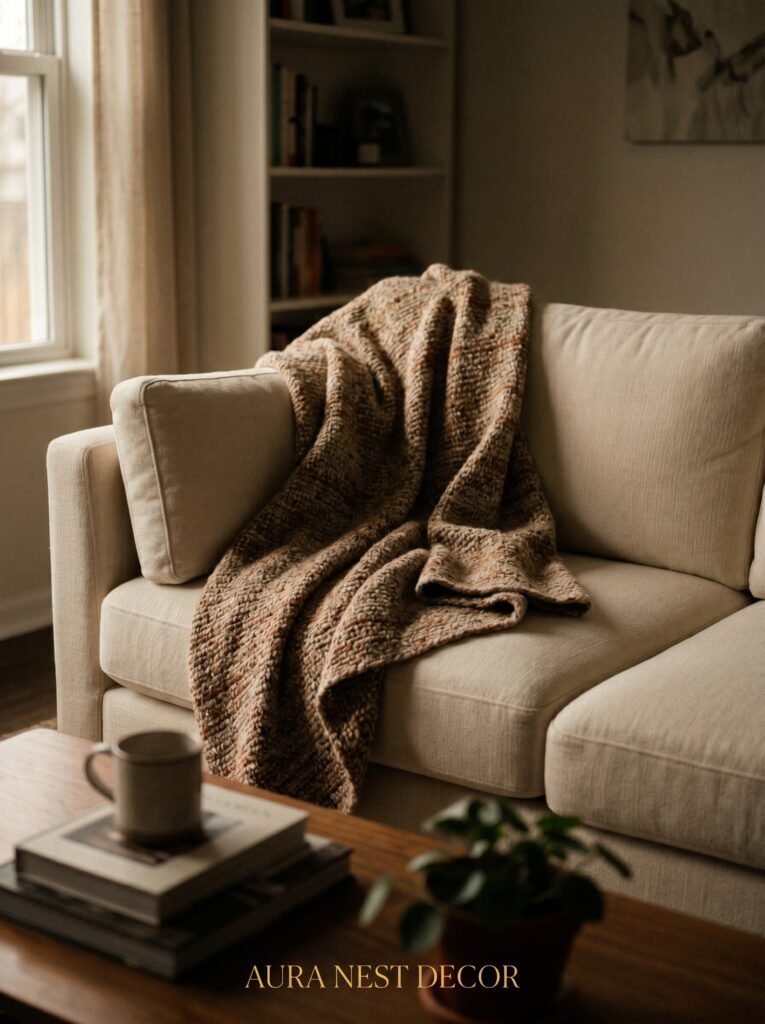
Every modern farmhouse sectional worth its salt has a throw. But the styling of that throw is where things either click or look weirdly staged.
The throw should not be folded neatly in a thirds-fold and draped over the arm of the sectional like a display in a showroom. No. It should look like it was used recently and put back almost-but-not-quite. Slightly tousled. The kind of fold that happened because someone watched three episodes of something and then briefly tidied.
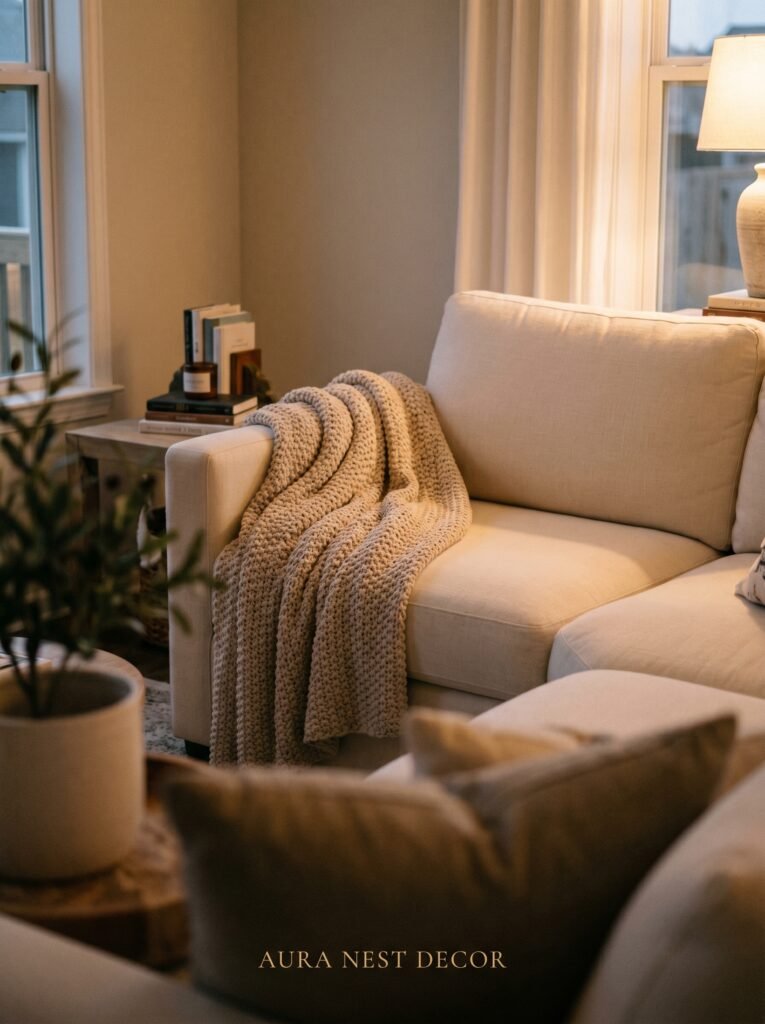
Textures that work: chunky knit in cream or warm ivory, a simple cotton waffle weave, a lightweight wool in a faded plaid (very modern farmhouse, very much having a moment), or a linen blend in a natural warm tone.
Where to drape it: the far corner seat, or pooled slightly at the end of the chaise. Not spread across the whole sectional like bedding. Not folded on a separate blanket ladder across the room. On the sectional, within reach, as if someone’s actually going to use it.
—
11. The One Accent Color That Keeps a Modern Farmhouse Sectional From Going Beige All the Way Down
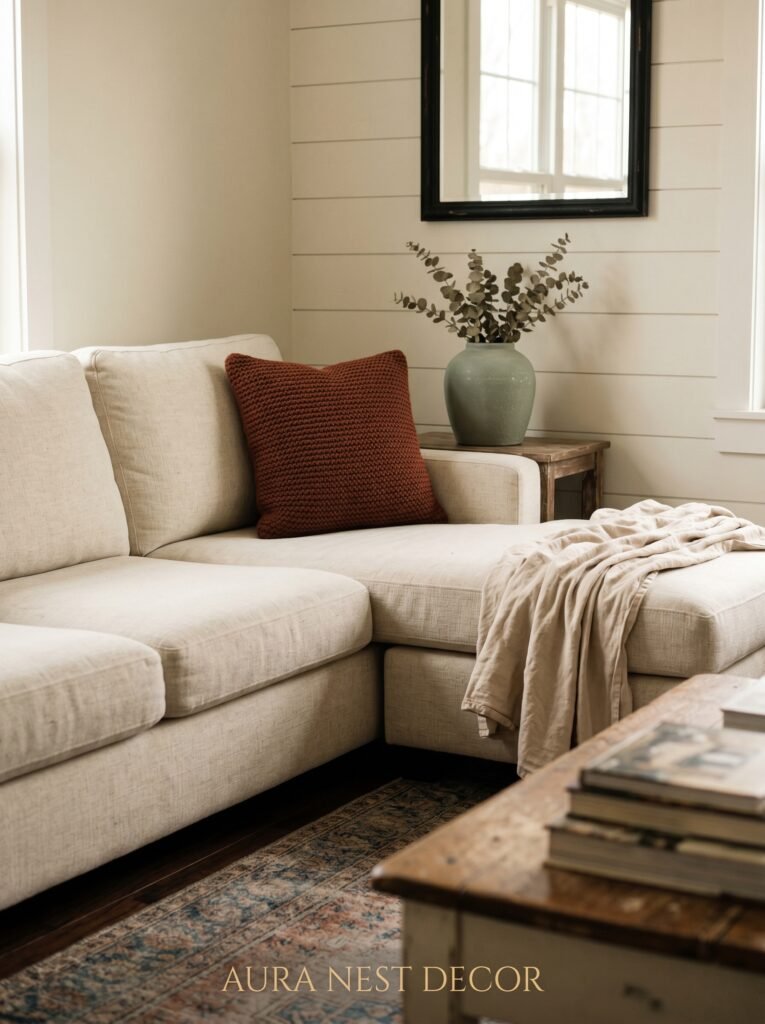
Neutral-on-neutral on neutral is the foundation of this aesthetic. But the rooms that feel alive — not just beige — have one accent color threading through them. Not a feature wall. Not a whole new palette. Just a thread.
Right now, the accent colors showing up in the most striking modern farmhouse living rooms are: warm sage green, dusty terracotta, faded rust, and a muted navy that reads almost like a neutral itself. These aren’t bright. They’re not saturated. They’re the version of these colors that have been left out in the sun for a season.
The thread: throw pillows in that accent color (one or two, not five), a ceramic pot or a vase in that tone, maybe the spine of a few carefully chosen books stacked on the coffee table. That’s enough. You’re not repainting. You’re just giving the eye something to follow through the room.
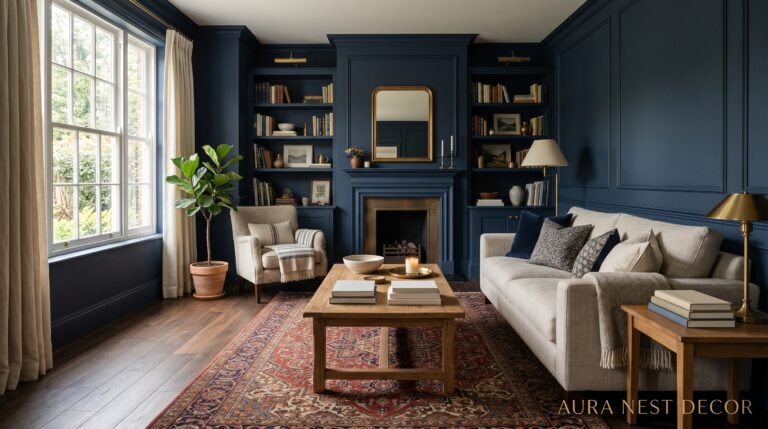
The sage green thread works particularly well against warm white walls and a natural linen sectional. The terracotta thread works brilliantly with white oak floors. The muted navy thread is the one you choose when you want the room to feel slightly more dramatic without losing its warmth.
—
12. The Small Detail That Makes the Whole Room Feel Considered (Not Decorated)
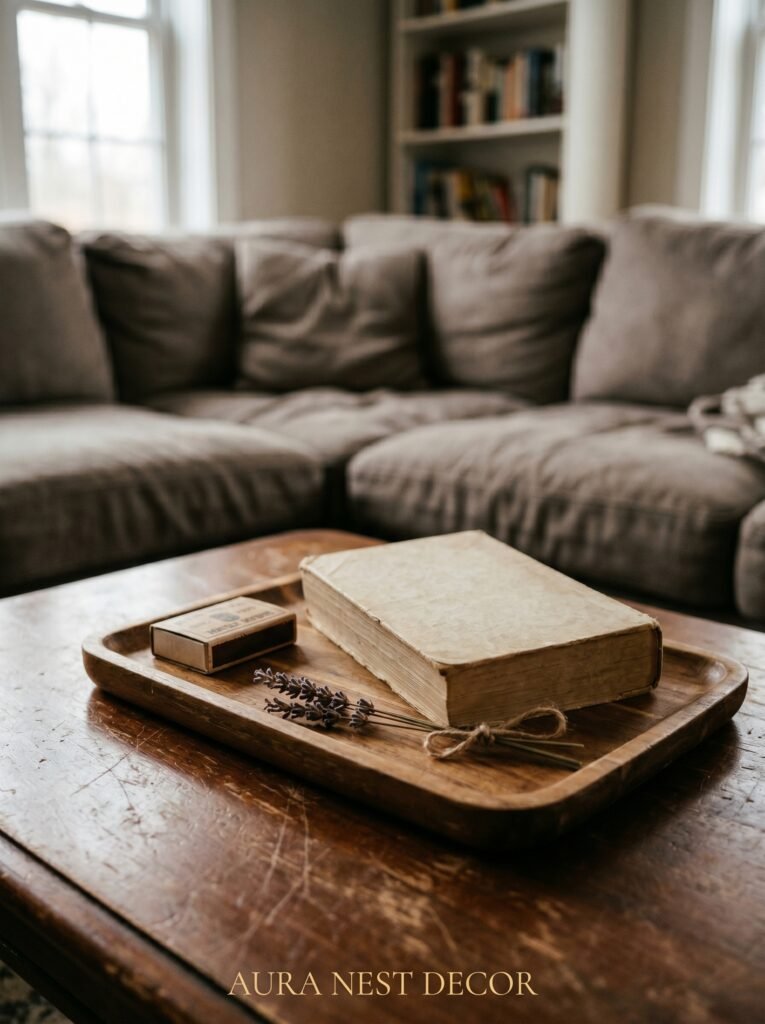
There’s a difference between a room that’s been decorated and a room that’s been considered. You feel it the moment you walk in.
The considered room has a stack of two or three books on the coffee table — not arranged for photography, but real books someone’s reading. It has a small ceramic bowl with something in it (a candle, a few stones, nothing precious). It has a throw that’s slightly rumpled. It has a window with curtains that actually reach the floor and pool slightly, even in a room that cost half what the staged version cost.
The detail that keeps coming up in the most beautiful modern farmhouse living rooms is this: curtains. Floor-length, slightly oversized, in a natural linen or cotton weave. Hung high — close to the ceiling — so the windows look taller than they are. Let them be a little imperfect. A slight gather on the floor is romantic, not messy.
In both US and UK homes, this is the change that makes people say “I can’t explain it, but this room just looks right now.” It’s not the sectional, it’s not the rug, it’s not even the art. It’s the curtains framing everything, giving the whole composition an edge.
“The rooms that feel like home aren’t the ones with the most beautiful objects. They’re the ones where every detail knew what it was supposed to do.”
—
❓ FAQ
Q: What’s the best sectional configuration for a modern farmhouse living room? A: An L-shaped sectional is the workhorse of this aesthetic — it creates the generous, grounded feeling the style calls for, and it works beautifully in both open-plan spaces and more traditional room proportions. If your room is smaller, a smaller three-piece L-shape still delivers that lived-in warmth without overwhelming the space.
Q: Can I do modern farmhouse style in a smaller UK terrace or semi-detached house? A: Absolutely, and often it looks better for it. The key is proportion — choose a sectional that fits your room rather than scaling up to match what you see in US homes. A compact L-shape in warm linen, a natural fiber rug, and one shiplap or panelled wall can completely transform a typical UK living room without making it feel crowded.
Q: How do I keep a light linen sectional clean with kids or pets? A: Slipcovers are your best friend — many modern farmhouse sectionals are designed with removable, washable covers specifically for this reason. Look for performance fabrics labeled “stain-resistant” or “performance linen,” which are treated to resist spills without sacrificing that soft, natural look. A slightly darker linen blend (oatmeal rather than white) also hides daily life far more forgivingly.
—
💭 Final Thoughts
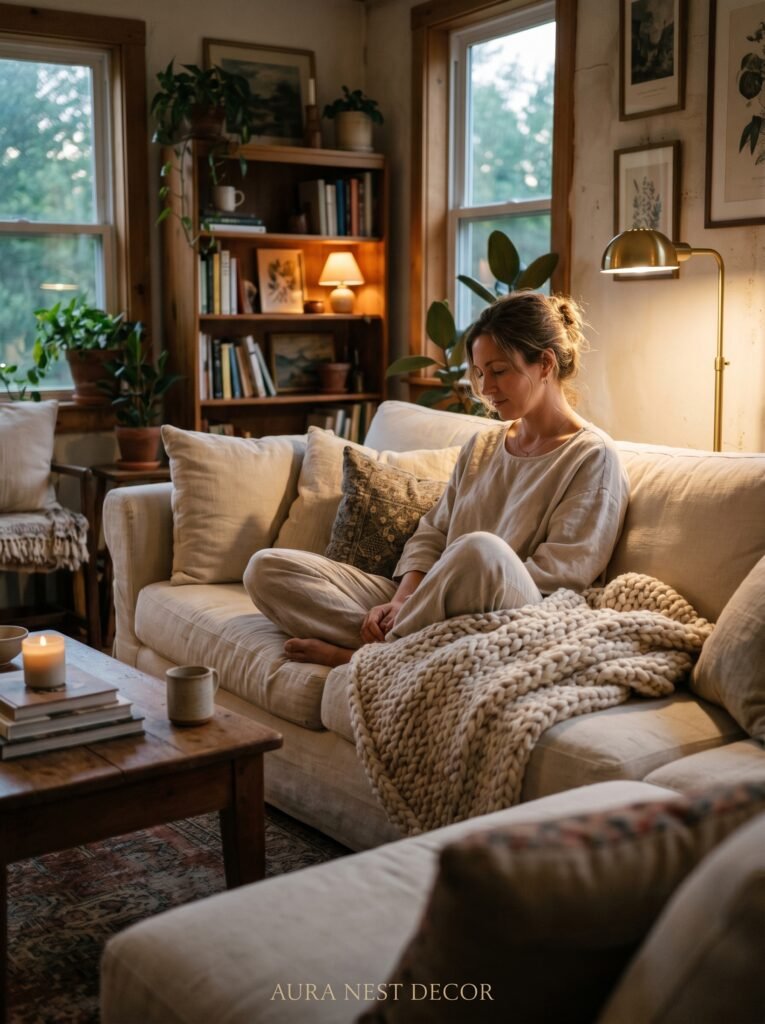
The best modern farmhouse living rooms don’t feel designed — they feel arrived at, the way a home does when you’ve been living and choosing and adjusting over time. The sectional starts it. The textures and the light and the small considered details finish it.
Start with the sectional, get the scale right, and then build the warmth slowly around it.
What does your living room feel like the moment you walk in — and what’s one thing you’d change tomorrow if you could?