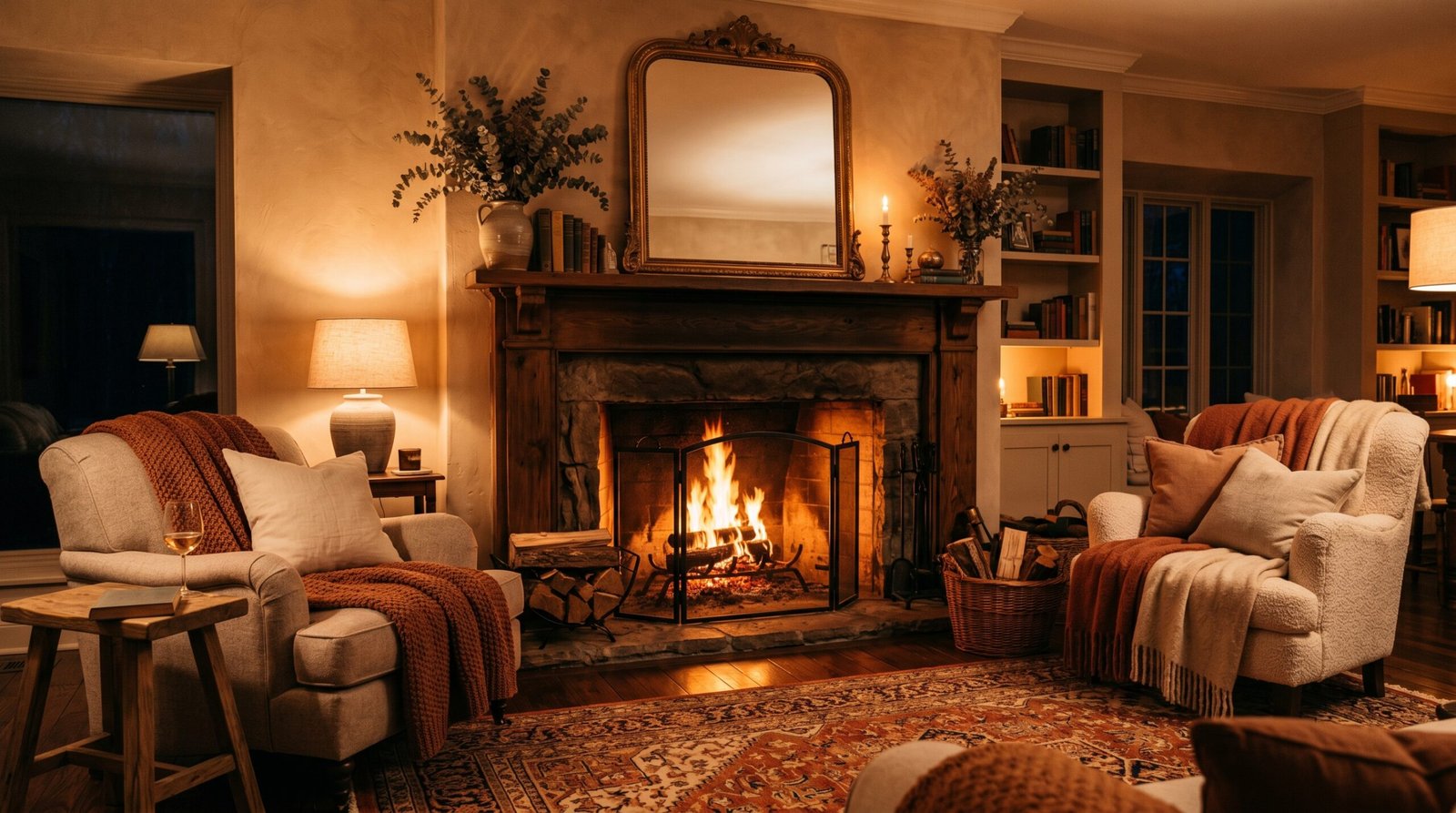
The Fireplace Interior: How One Flickering Flame Can Transform the Soul of Your Home
There’s something almost primal about a fireplace — the way it draws every person in the room toward it, the way conversation slows and deepens when the logs catch light. A fireplace interior isn’t just a design feature; it’s the beating heart of a home, and getting it right changes everything about how a space feels.
—
Table Of Content
1. Why a Fireplace Is the Most Emotionally Powerful Element in Interior Design
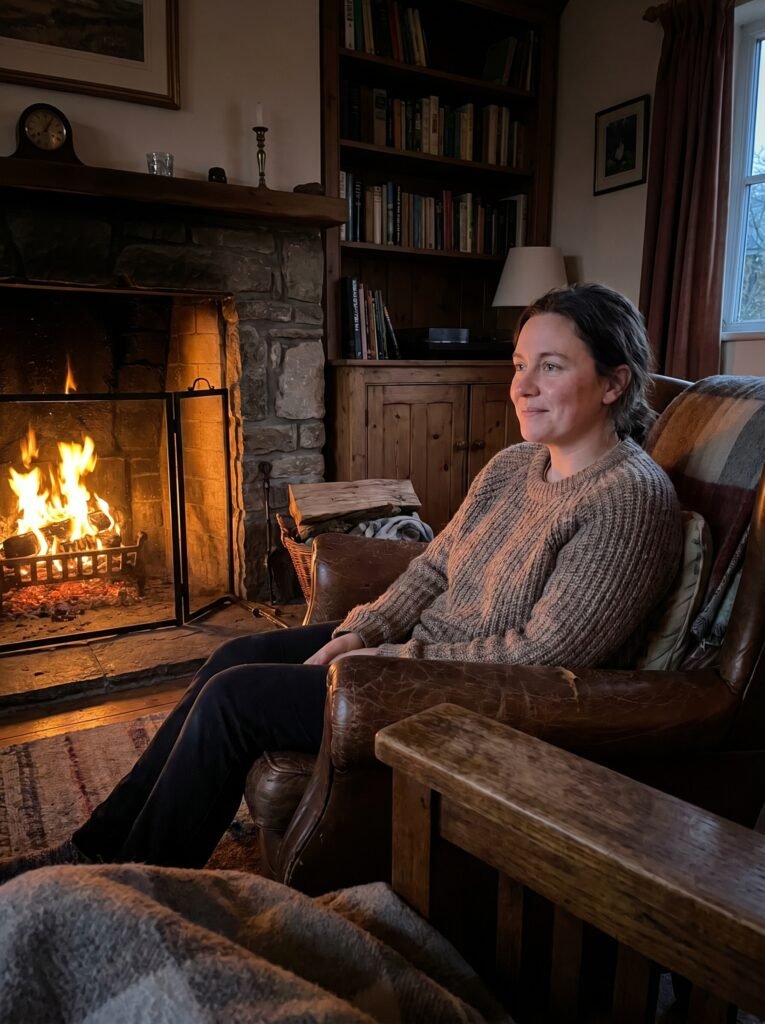
Think about the last time you walked into a room with a beautifully styled fireplace. Something shifted in you, didn’t it? The room felt purposeful, anchored — like someone who actually lived there cared deeply about how it felt to be human inside those walls. That’s the quiet power of a well-designed fireplace interior.
Designers have long understood what psychology is only now confirming: fire is neurologically calming. Studies in evolutionary psychology suggest that watching flames lowers blood pressure and promotes a meditative state, something our ancestors discovered around campfires thousands of years ago. When you bring that primal element into your living room, bedroom, or kitchen, you’re not just decorating — you’re tapping into something ancient and deeply comforting.
The fireplace becomes a focal point not by accident but by intention. Every piece of furniture, every rug edge, every framed artwork on the wall begins to orient itself around that glowing center. This is called anchoring in interior design, and nothing anchors a room more naturally or more beautifully than a fireplace.
“A fireplace doesn’t just warm a room — it gives the room a reason to exist.”
2. The Mantel: Where Style Meets Story
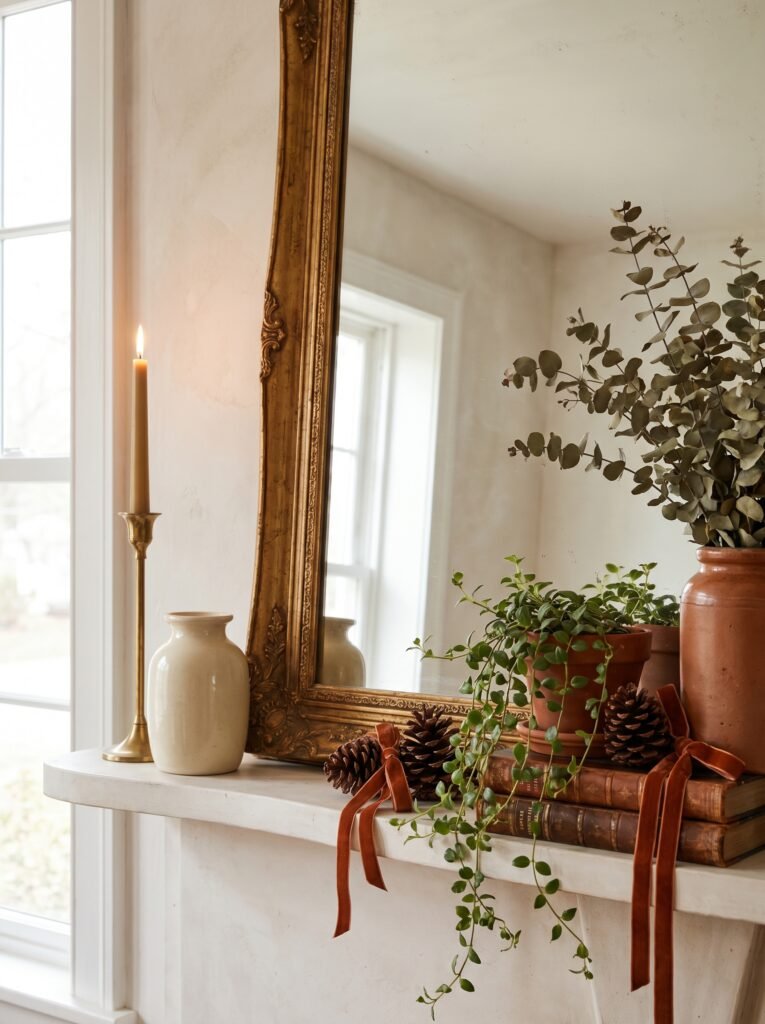
If the fireplace is the heart of the room, the mantel is its face. It’s the surface that holds your story — the framed photos, the heirloom clock, the vase of dried eucalyptus you brought home from the farmers market last autumn. Getting your mantel styling right is one of the most rewarding and creatively fulfilling parts of fireplace interior design.
The golden rule of mantel styling is layering with intention. Start with one large anchor piece — a mirror, an oversized painting, or a dramatic piece of sculptural art. Then build forward in layers, mixing heights, textures, and materials. A tall candlestick beside a short ceramic vase. A trailing plant softening the edge of a stacked book pile. The goal is something that looks effortless but tells a story.
Color matters enormously on a mantel. For a warm, cozy aesthetic, lean into terracotta, burnt amber, cream, and aged brass. For something more contemporary and cool, think charcoal, sage green, matte black accents, and clean white architectural objects. The mantel should feel like a curated extension of the room’s personality — not a separate vignette that exists in isolation.
Seasonal mantel styling is one of the most popular content categories on Pinterest for a reason: it gives your space permission to evolve. Winter calls for pine cones, candles, and velvet ribbon. Spring invites fresh blooms and woven baskets. Summer and autumn each bring their own palette. Your fireplace mantel becomes a living, breathing reflection of the season outside your window.
3. Fireplace Surround Materials That Actually Change a Room’s Character
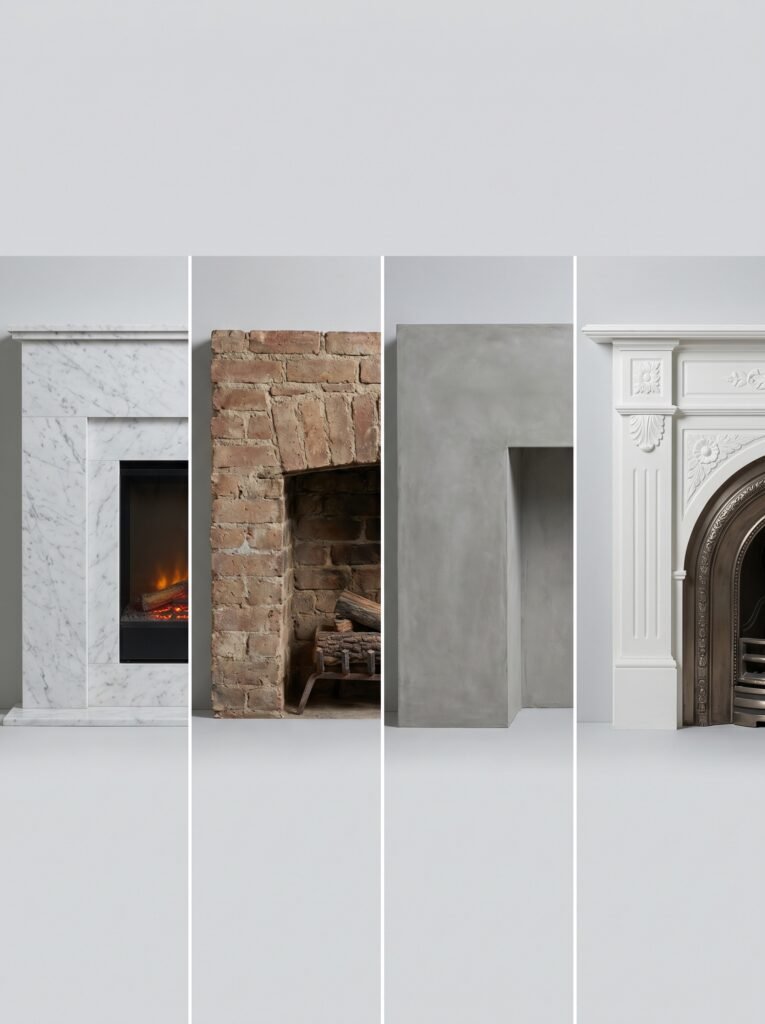
The surround — the frame around the firebox opening — is arguably the most architecturally significant part of the entire fireplace interior. And the material you choose for it communicates so much before a single flame is lit.
Marble surrounds carry an air of timeless elegance that never feels dated. White Carrara marble with soft grey veining is perhaps the most classic choice, equally at home in a traditional Georgian townhouse and a modern minimalist apartment. It reflects light beautifully and feels genuinely luxurious even in modest applications. If full marble feels like too large a commitment, a marble tile surround achieves a similar effect at a fraction of the cost.
Brick surrounds feel entirely different — raw, honest, and warmly imperfect. An exposed brick fireplace interior has a storytelling quality that polished materials simply can’t replicate. Every uneven edge, every variation in the mortar, speaks to age and authenticity. If your brick has seen better days, consider limewashing it: a diluted white or off-white wash that softens the rawness while preserving all of that beautiful texture.
Concrete and plaster surrounds belong firmly to the contemporary interior design conversation. They’re bold, understated, and sculptural — the kind of fireplace you find in design magazines shot with a lot of natural light and a single perfect linen sofa. Cast concrete in particular has a coolness and weight to it that feels genuinely architectural.
Wood surrounds, especially painted ones, offer the most flexibility. A crisp white-painted timber surround is endlessly versatile — you can dress it up or strip it back entirely depending on the season and your mood. Ornate Victorian-style carved wood surrounds are having a genuine revival right now, especially in homes that blend historical architecture with modern furnishings.
4. The Firebox and Hearth: The Details Most People Overlook
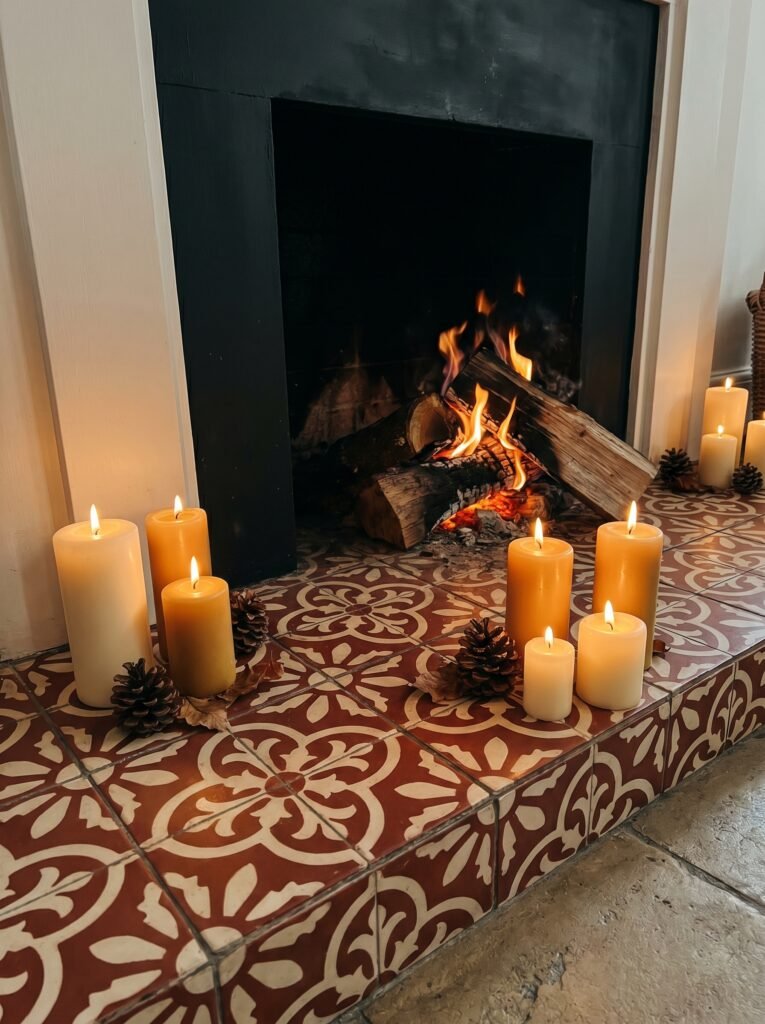
While everyone agonizes over the mantel and surround, the firebox and hearth are quietly doing enormous design work — and they’re almost always underestimated.
The hearth, that flat horizontal surface at the base of the fireplace, is a practical and aesthetic opportunity rolled into one. Stone hearths — particularly slate, limestone, or rough-cut granite — add a grounding, earthy quality. A hearth that extends further into the room creates a visual pause, a natural invitation to sit close to the fire. Tiling the hearth in patterned encaustic cement tiles is a trend that has gained enormous traction on Pinterest because the visual payoff is so dramatic relative to the cost.
Inside the firebox itself, consider painting the brick a matte black if it’s looking tired or mismatched. This single change is transformative — it makes the firebox look deeper, more dramatic, and it frames the actual fire in a way that feels intentional. For a non-working decorative fireplace, a painted black interior with candles of varying heights creates the illusion of warmth and depth without a single log.
“The details no one notices consciously are the ones that make a room feel undeniably right.”
5. Fireplace Interior Styles: From Rustic Farmhouse to Sleek Modern
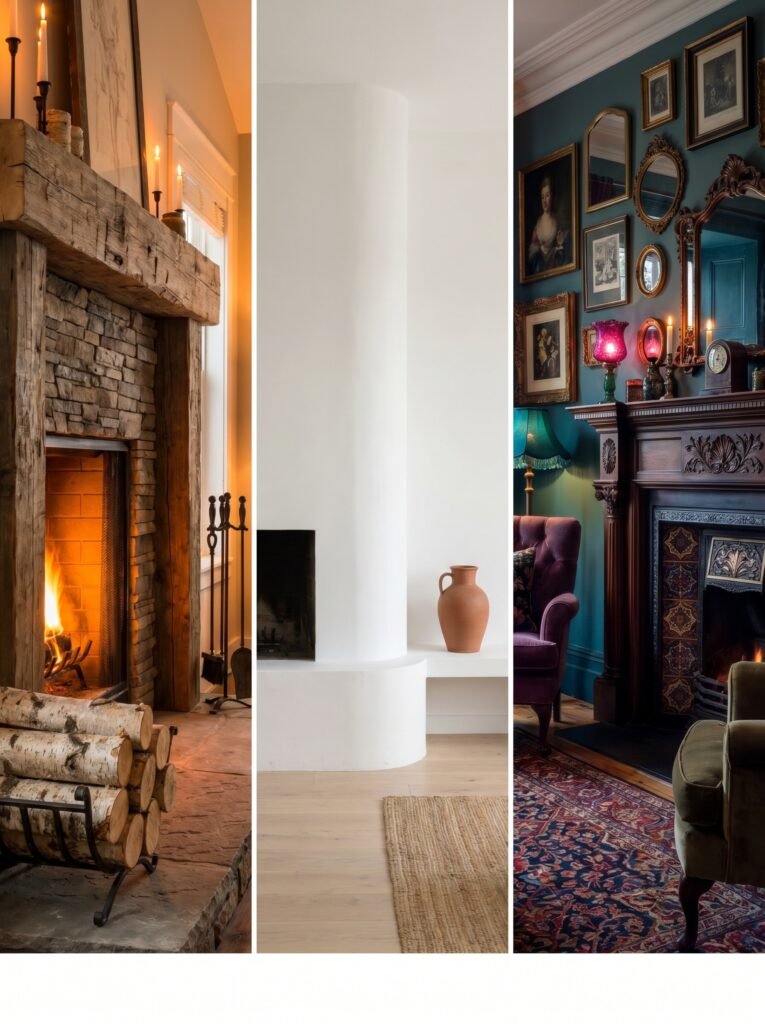
One of the most useful things you can understand about fireplace interior design is how dramatically different a fireplace can feel depending on the stylistic lens you apply. The bones are the same — firebox, surround, mantel, hearth — but the spirit of the space changes completely.
A rustic farmhouse fireplace leans into imperfection and warmth. Think reclaimed wood beams as a mantel shelf, rough-textured stone surrounds, iron fireplace tools, and a hearth stacked with actual logs. Layered wool throws on nearby armchairs, a braided jute rug, and warm Edison bulb lighting complete the picture. This is the fireplace interior that makes you want to call in sick to work and spend the day with a book and a pot of soup.
A Scandinavian-inspired fireplace interior strips everything back to quiet essentials. Clean lines, minimal mantel decor, pale wood accents, and a firebox that might be surrounded by nothing more than smooth white plaster. It’s restrained in the most beautiful way — every object that remains has been specifically chosen to stay. This style photographs extraordinarily well in natural light and consistently performs on Pinterest.
The maximalist Victorian fireplace is experiencing a significant design comeback right now. Ornate carved mantels, richly patterned encaustic tiles, dense gallery walls above the mantelpiece, and a surround packed with personality. It’s a style that rewards attention to detail and rewards the type of person who believes more is genuinely more.
Mid-century modern fireplace interiors tend toward horizontal lines, floating hearths, and slender surrounds that prioritize architectural form over ornamentation. The materials lean warm — walnut wood, terracotta, warm stone — and the overall effect is simultaneously retro and timelessly contemporary.
6. The Art of Stacking: How to Store Firewood Beautifully
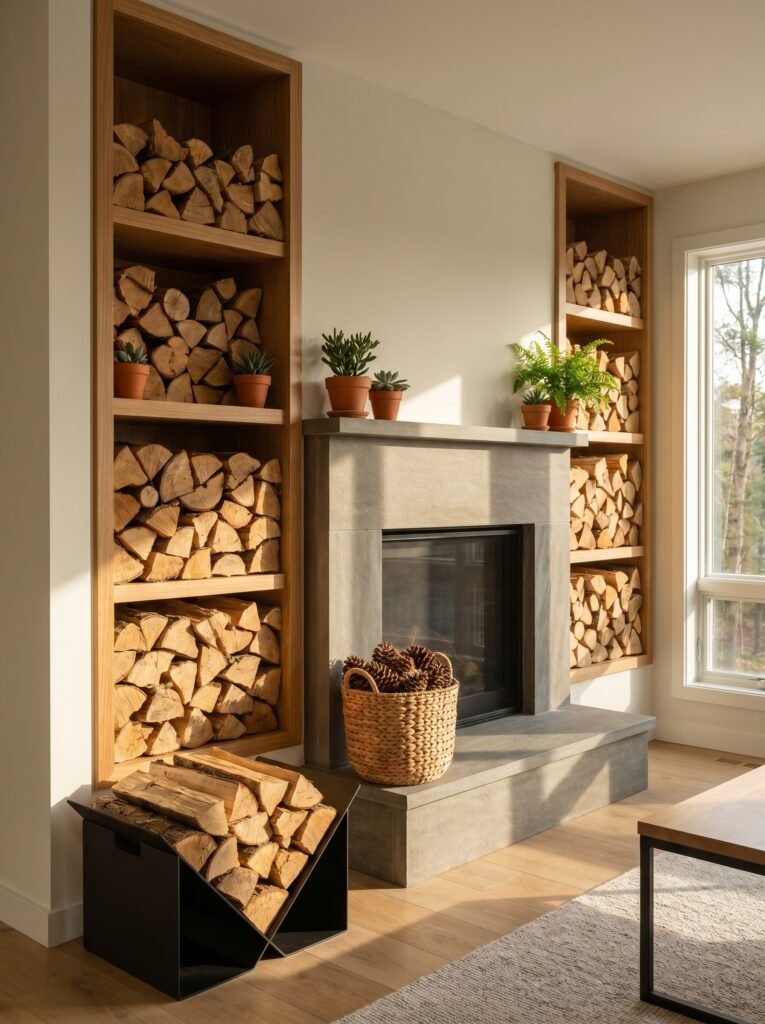
Here’s something that rarely gets enough attention in fireplace interior conversations: firewood storage is a legitimate design element. How you store and display your logs says something surprisingly specific about your aesthetic sensibility.
A custom built-in log store flanking the fireplace on either side creates symmetry and makes the entire fireplace wall feel designed rather than assembled. Even a simple alcove on one side, thoughtfully stacked with split logs and decorated with a few small potted plants or a basket of pine cones, achieves that same sense of purposeful design.
Freestanding log holders have evolved far beyond the utilitarian iron cradle. Today you’ll find beautifully minimal concrete log holders, geometric black steel frames, rattan baskets that soften a room’s hard lines, and woven seagrass storage that feels genuinely decorative. The key is choosing a log holder that speaks the same material language as the rest of your fireplace interior.
7. Fireplace Lighting: The Layer That Changes Everything After Dark
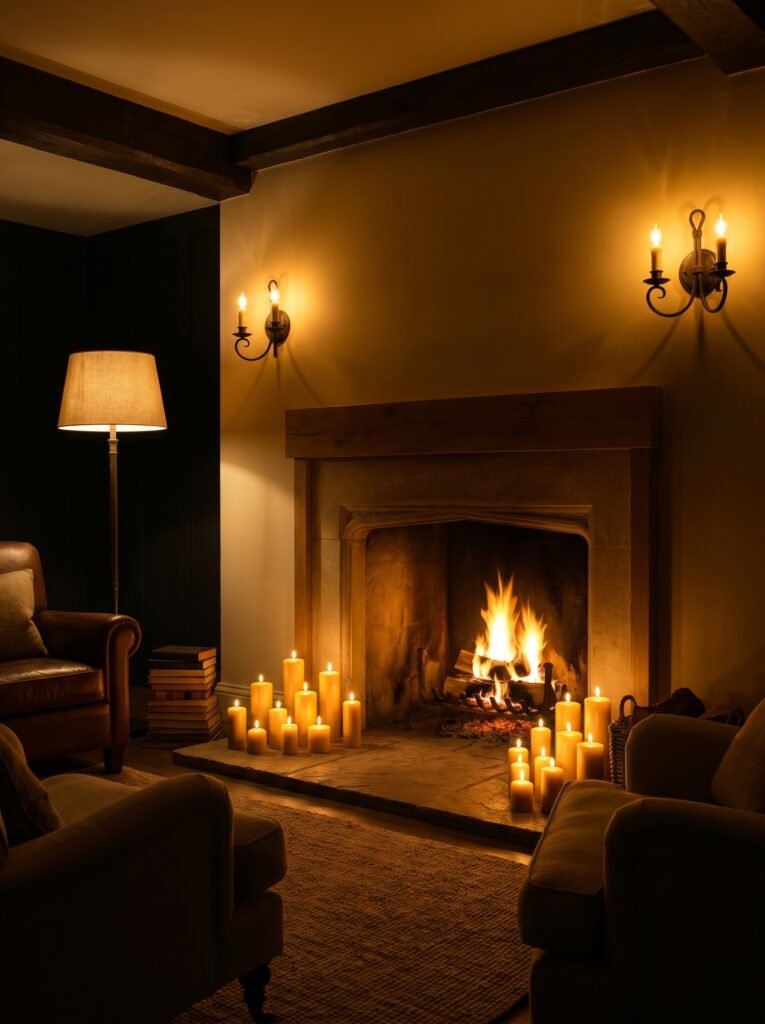
A fireplace already contributes the most beautiful light in any room, but the lighting you build around it determines whether the full atmosphere is realized or left incomplete.
Wall sconces positioned on either side of a fireplace are a classic approach for good reason — they frame the focal point, provide balanced warm light, and add an architectural quality that overhead lighting alone can never achieve. Candle-style sconces with warm-toned bulbs are ideal; they extend the golden, flame-like quality of the fire itself into the wider room.
Floor lamps placed in the corners of the seating arrangement around a fireplace create depth and layers of light that feel genuinely inhabitable after dark. The goal is never one source of overhead light that flattens the whole room — it’s multiple sources at different heights that create pools of warmth and shadow.
Candles on the mantel and hearth deserve their own mention. When the main fire isn’t lit, a collection of pillar candles in varying heights grouped on the hearth creates a softer echo of a real fire. Choose unscented or subtly scented candles in natural beeswax or soy for the most authentic warm glow.
“Good lighting doesn’t illuminate a room — it gives it an atmosphere worth returning to.”
8. Furniture Arrangement Around a Fireplace: The Rules Worth Keeping
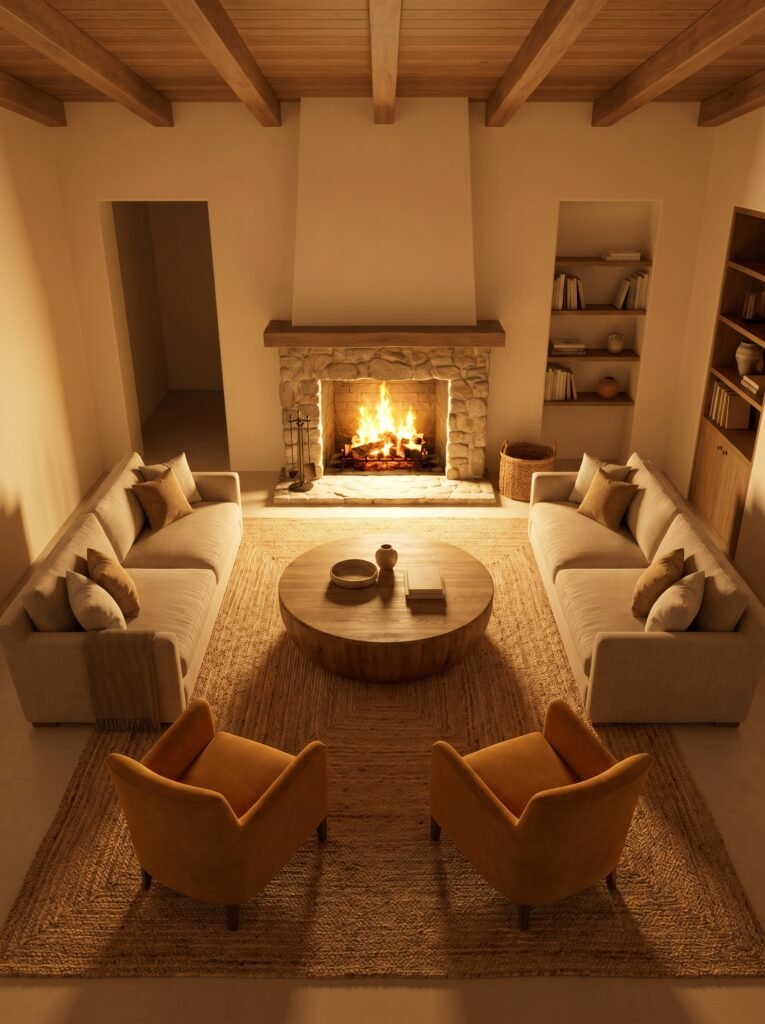
Arranging furniture around a fireplace is one of those interior design challenges that looks obvious in retrospect but trips up almost everyone the first time. The instinct is often to push sofas against walls, but this almost always undermines the fireplace’s power as a focal point.
Pull seating into a conversation circle around the fireplace. The fire should be visible, not just present. Two sofas facing each other with the fireplace at the head of the arrangement is a classic solution for larger rooms. For smaller spaces, a single sofa angled toward the fireplace with two accent chairs completing the grouping creates intimacy without overcrowding.
The distance from seating to fire matters practically and aesthetically. For a wood-burning fireplace, a minimum of 3 feet of clearance is important for safety. Aesthetically, sitting too far back disconnects you from the warmth and visual drama — the sweet spot is a distance that lets you feel the heat and watch the flames without straining forward.
Coffee table placement within a fireplace seating arrangement should follow the sofa: approximately 18 inches from the sofa edge, centered within the group. A round coffee table in a fireplace grouping prevents any one piece of furniture from dominating and creates easy flow for people moving around the space.
9. Color Palettes That Make a Fireplace Interior Sing

The colors you choose for the wall, surround, and mantel work together as a conversation — and when that conversation flows, the entire room feels like a coherent, deeply considered design.
For traditional and farmhouse fireplaces, warm whites and off-whites on the wall allow the natural materials of the surround to speak clearly. Benjamin Moore’s White Dove or Sherwin-Williams’ Alabaster are perennial favorites that keep the room light while maintaining warmth. Against these soft backgrounds, the texture of brick, stone, or wood reads beautifully.
For a more dramatic, contemporary fireplace interior, consider painting the entire chimney breast a deep, saturated color while keeping the surrounding walls lighter. Deep forest green, inky navy, warm charcoal, or rich burgundy on the chimney breast creates an instant sense of depth and makes the fireplace feel like a deliberate architectural statement rather than a functional afterthought.
Contrasting the surround against the wall color adds visual definition. A white painted wood surround against a warm grey wall. A dark marble surround against a dusty sage wall. A raw concrete surround against warm terracotta plaster. These contrasts give the eye somewhere specific to land and make the fireplace feel intentionally framed.
10. Small Space Fireplace Interiors: Big Impact in Tight Quarters
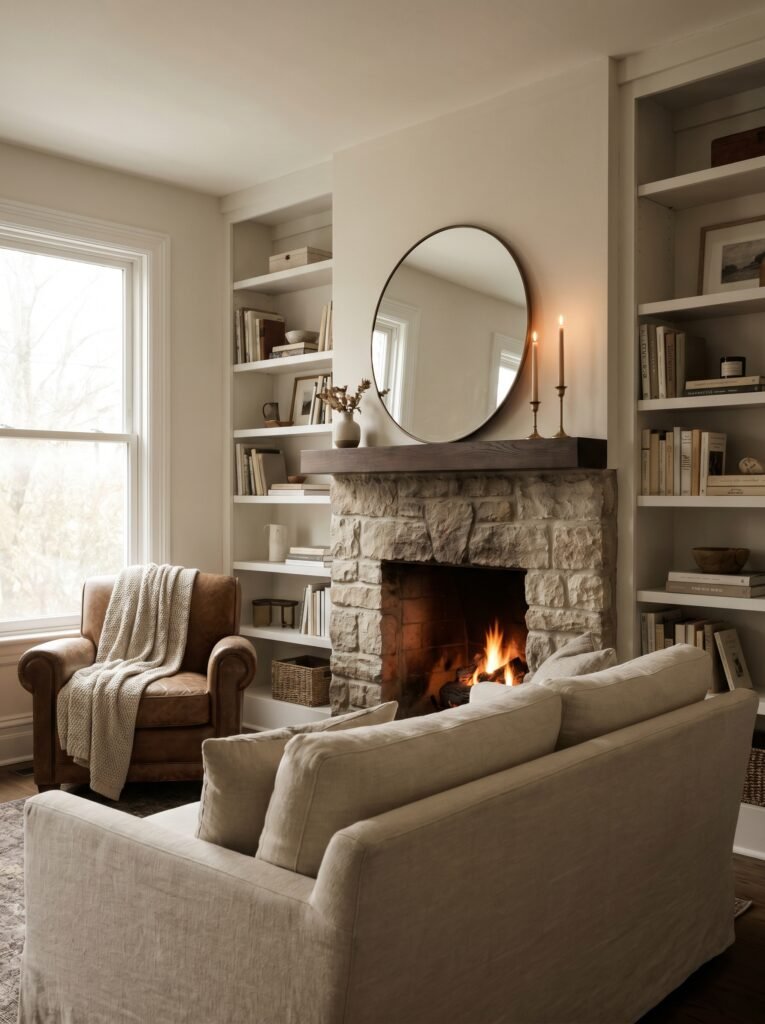
Not every fireplace lives inside a grand Victorian drawing room or a wide-open open-plan living space. Many of the most beautiful fireplace interiors exist in smaller rooms — and the constraint, handled thoughtfully, often produces the most intimate and emotionally resonant results.
In a small living room, let the fireplace do all the heavy lifting as the single focal point. Resist the urge to compete with it. Keep the mantel lightly styled — a single mirror, two candles, perhaps one small plant. The more breathing room you give the fireplace in a tight space, the more powerful its presence becomes.
A floating mantel shelf in a small room, rather than a full surround, keeps the visual weight low and the room feeling open. Combined with clean-lined ceramic or concrete accents, a floating shelf fireplace in a compact room can feel decidedly modern and editorial.
Built-in shelving flanking a fireplace in a small room solves two problems at once: it gives the room storage and it creates the illusion of a larger, more custom architectural feature. Even in a bedroom or home office, a modest fireplace flanked by built-in bookcases feels like the room was designed from the beginning with intention.
11. Non-Working Fireplaces: Styling a Fireplace That Doesn’t Burn
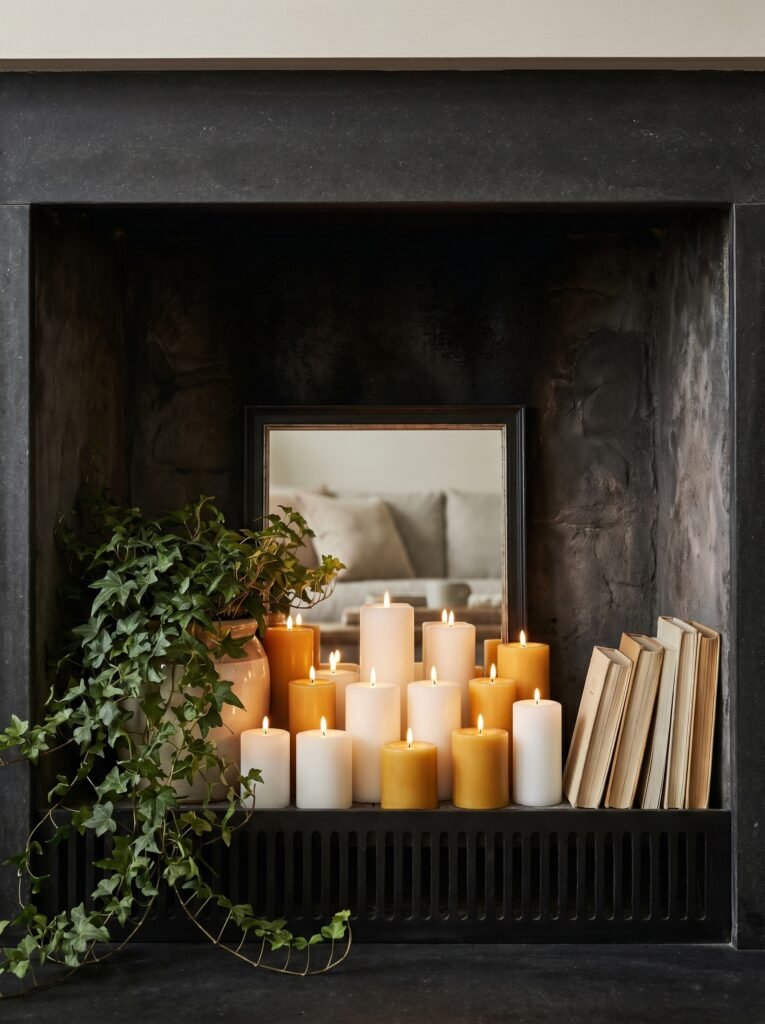
Perhaps you’ve moved into a home with a sealed, decorative, or gas fireplace that no longer works. Far from a disappointment, a non-working fireplace is an extraordinary creative opportunity — and some of the most stunning fireplace interior photography on Pinterest features fireplaces that never see a single flame.
Fill the firebox with an arrangement of pillar candles at varying heights — white, cream, and beeswax tones feel most authentic. The flickering candlelight against the dark interior of the firebox creates a convincing, beautiful echo of a real fire. In summer especially, this is an effortlessly elegant solution.
Stack the firebox with books spines-out in tonal arrangements of cream, white, and tan. This is a slightly more unexpected approach that reads as thoughtful and creative rather than default. Alternatively, a large potted fern or trailing ivy plant placed inside the firebox brings a surprising, organic life to an otherwise static architectural feature.
Mirrors placed inside the firebox reflect light back into the room and create depth — particularly effective in darker rooms or north-facing spaces where natural light is limited.
12. The Fireplace as a Gathering Space: Designing for Connection
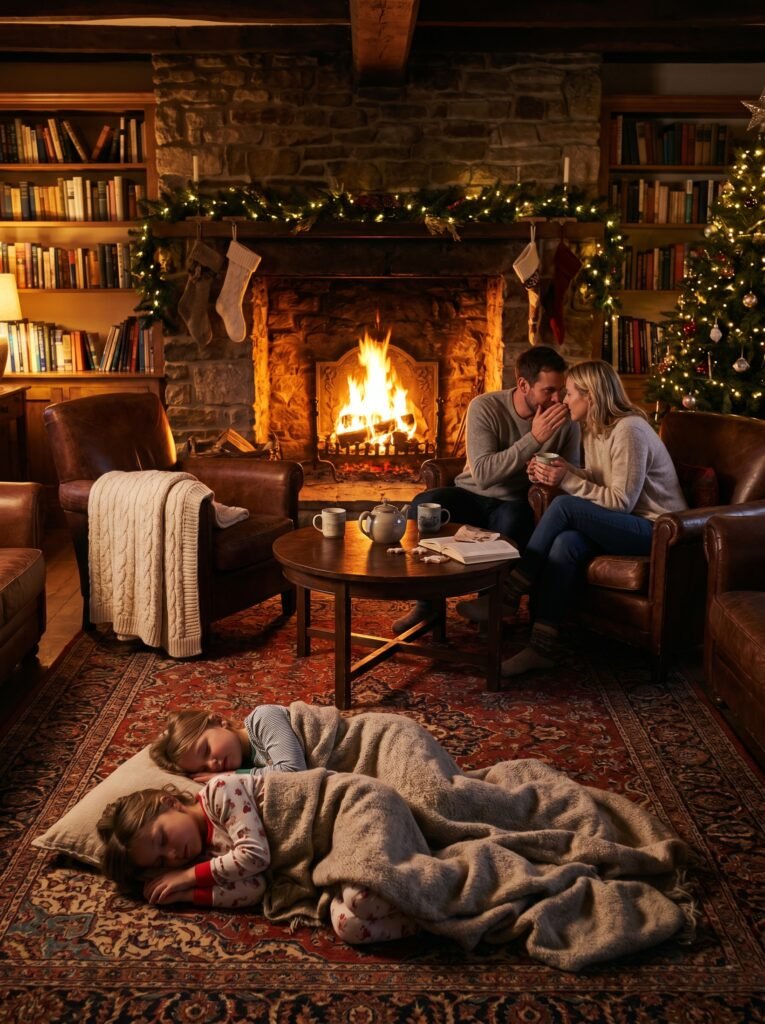
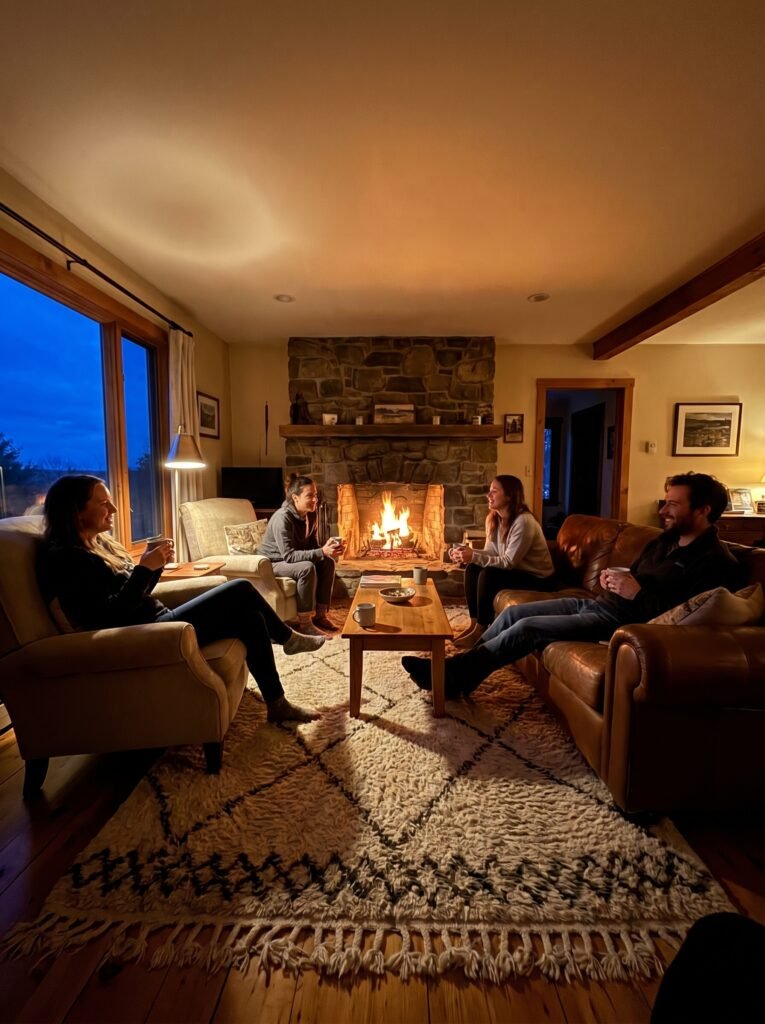
At its deepest level, fireplace interior design isn’t really about design at all. It’s about people — about creating a space where conversations last longer than they should, where children fall asleep on rugs while the adults talk quietly, where someone always volunteers to make another pot of tea.
The most successful fireplace interiors are the ones that feel genuinely inviting rather than impressively styled. The difference is subtle but real. Inviting means there are enough seats for everyone. Inviting means the rug is soft enough to sit on. Inviting means the lighting is warm and the room doesn’t feel too precious to actually live in.
Design your fireplace interior with a specific moment in mind. Maybe it’s Sunday morning with coffee and a newspaper. Maybe it’s Christmas Eve with the whole family. Maybe it’s a quiet Tuesday night with a book and a glass of wine. Let that moment guide your decisions — the materials, the seating, the lighting, the palette. When design serves a real human moment, it always lands.
—
🌿 How to Take Care of Your Fireplace Interior
Maintaining a fireplace interior well is about protecting both the structural elements and the decorative ones — and it’s simpler than most people think.
Have your chimney professionally swept at least once a year if you use a wood-burning fireplace. Creosote buildup is a fire hazard, and a clean chimney also means a more efficient, better-smelling fire. This is non-negotiable maintenance, not an optional extra.
Clean the glass doors or the firebox surround tiles regularly with a gentle, pH-neutral cleaner. Soot and smoke residue build up gradually and are much easier to manage with regular maintenance than a twice-yearly deep clean.
Inspect your mantel for dust accumulation at least weekly — fireplace mantels attract dust at a remarkable rate due to the air convection created by the fire. A quick wipe with a barely damp cloth keeps the display looking intentional rather than neglected.
Rotate seasonal mantel decor every 6 to 8 weeks, not just for the aesthetics, but because it keeps the space feeling alive and genuinely inhabited rather than frozen in a single styled moment.
Treat natural stone and marble surrounds with an appropriate stone sealer annually to prevent staining and discoloration, particularly important in homes where the fireplace is used heavily through winter.
—
❓ FAQ
Q: What is the most timeless fireplace surround material? A: Marble is consistently considered the most enduringly elegant choice — particularly white or cream marble with soft veining. It works across traditional, transitional, and contemporary interiors and never feels dated. If the budget is a concern, large-format marble-look porcelain tile achieves a remarkably similar effect at a significantly lower price point.
Q: How do I make my fireplace the focal point of a living room? A: The most effective approach is to orient your seating arrangement toward the fireplace, keep the wall treatment around it slightly different from the rest of the room (a deeper color, architectural paneling, or built-in shelving), and keep the mantel styling intentional rather than crowded. Reducing competing focal points — like a television mounted above the fireplace — also helps immensely.
Q: Can a fireplace work in a small bedroom? A: Absolutely — and often beautifully. A smaller-scale surround with a floating mantel shelf keeps the visual weight appropriate for a bedroom. Non-working fireplaces styled with candles or plants are particularly well-suited to bedrooms where the aesthetic warmth matters more than the actual heat output.
—
💭 Final Thought
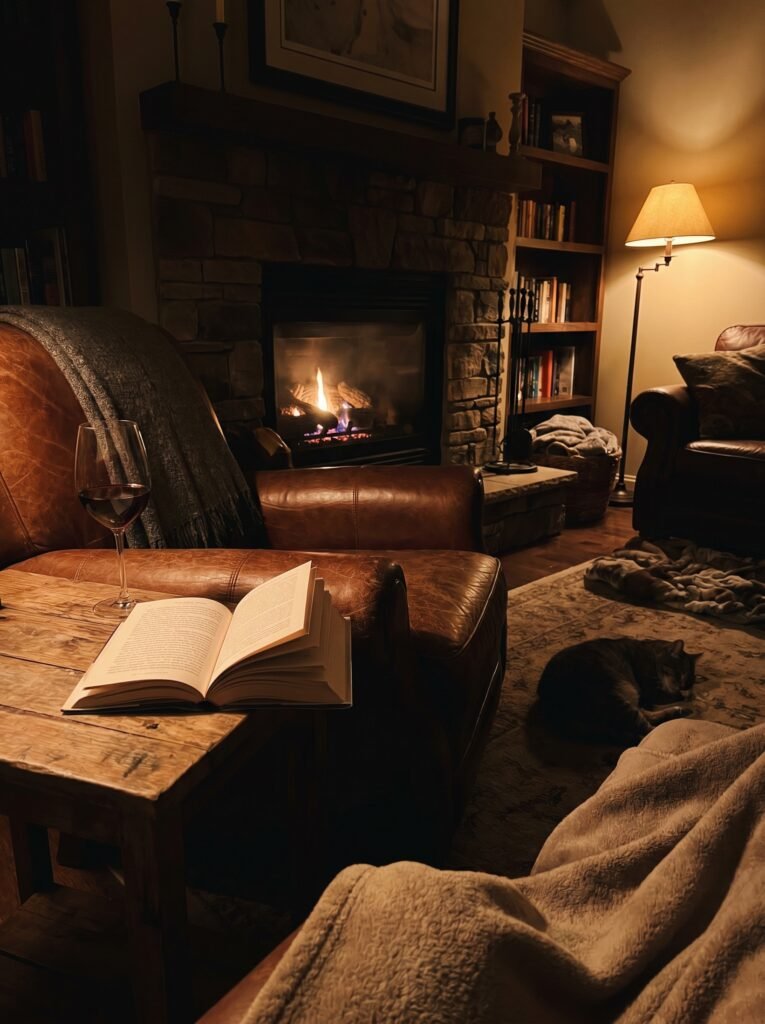
A fireplace interior, at its best, is a daily reminder that some of the most important things in a home can’t be measured in square footage or listed in a specifications sheet. It’s the pause in a busy evening, the reason the living room feels like it belongs to your family and no one else, the architectural feature that makes an ordinary Tuesday feel a little more like a memory worth keeping.
So as you plan or reimagine the fireplace interior in your own home — what feeling are you really designing toward?