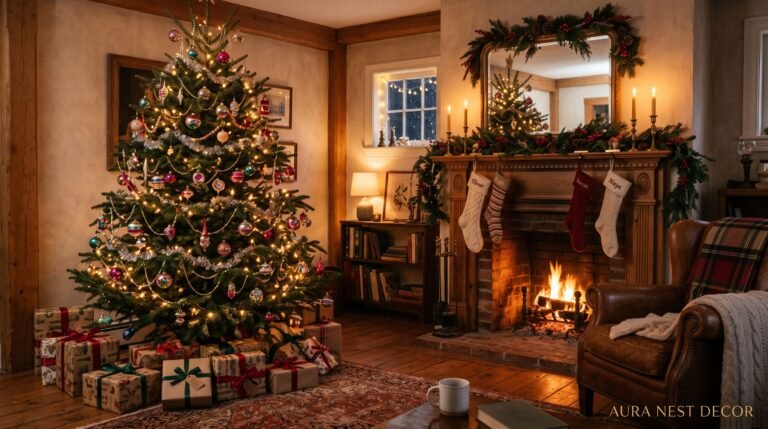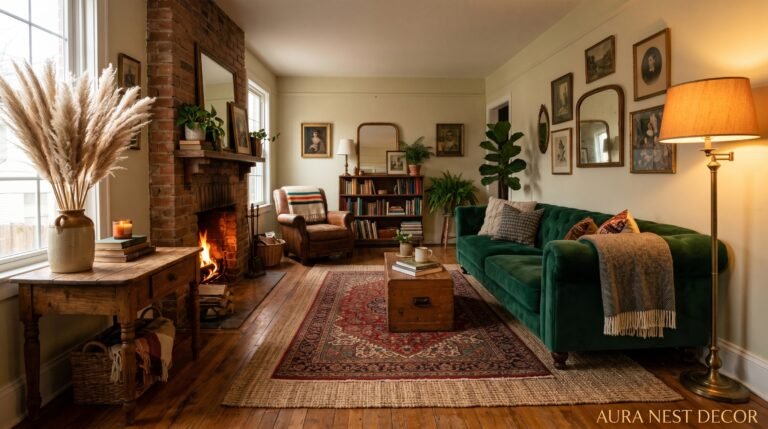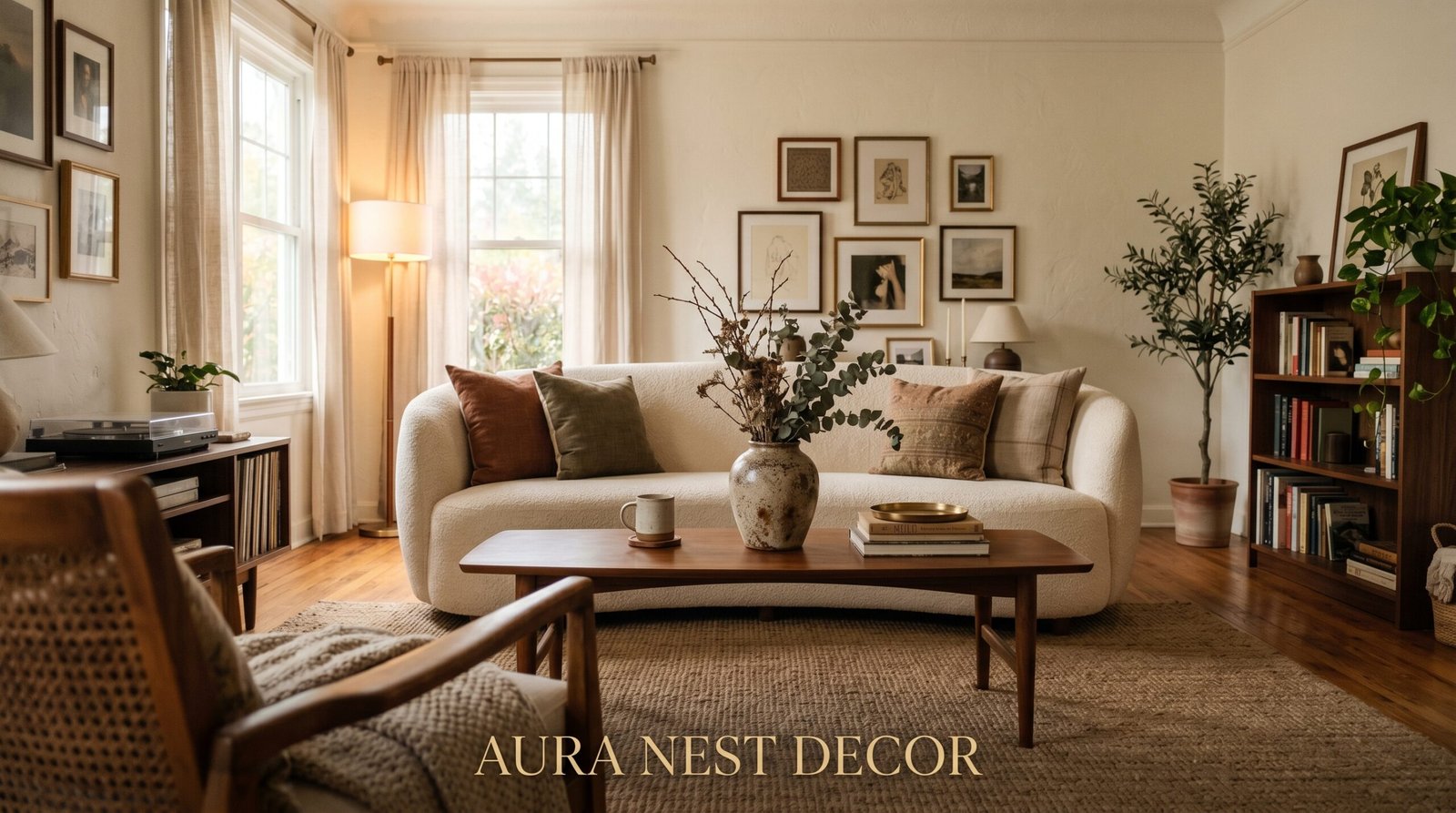
The Living Room That Looks Like It Took Decades to Put Together (And Exactly How to Get There)
You walk into a room and something just feels right. Not decorated — inhabited. Like someone with actual taste and actual history lives there. That’s the magic of vintage modern, and it’s more achievable than most people think.
—
1. Why Every “Perfect” Pinterest Room Looks Slightly Old
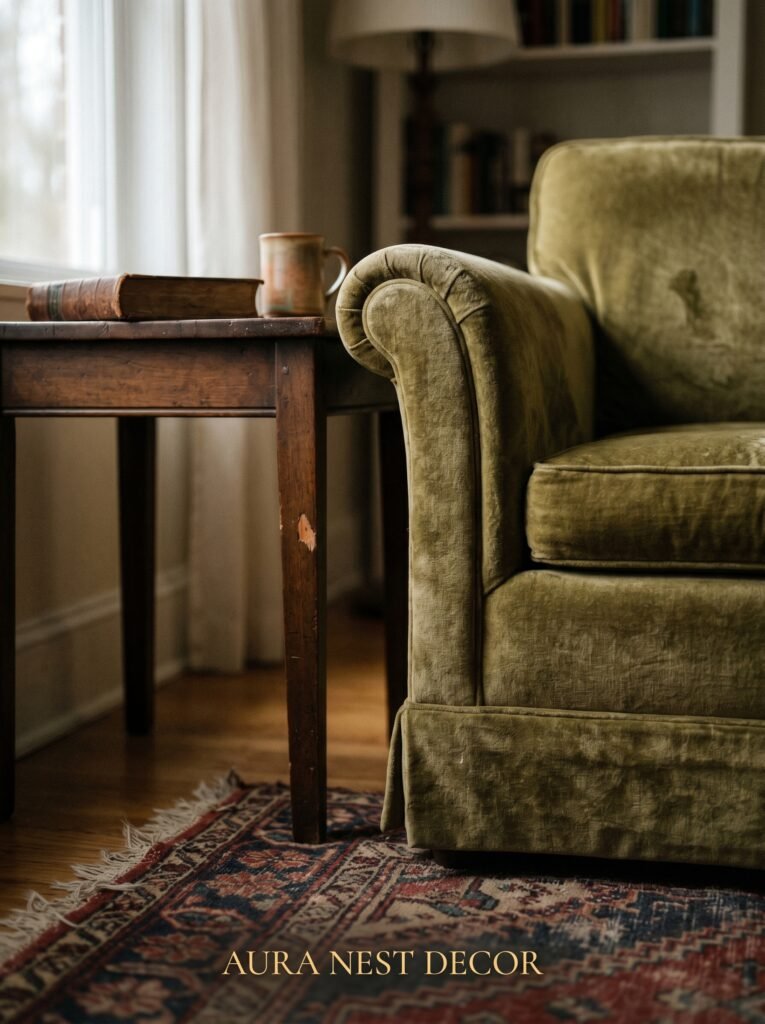
There’s a reason the most-saved living rooms on Pinterest aren’t the brand-new showroom ones. It’s the rooms with a 1960s credenza sitting under a contemporary pendant light. The ones with a battered leather armchair tucked next to a clean white wall. The ones that whisper time passed here.
Vintage modern isn’t a style. It’s a philosophy. It says that beauty accumulates. That a room gains something — weight, personality, warmth — when not everything in it came from the same place at the same time.
Interior designers have known this forever. The rule they live by is simple: mix decades, not styles. A mid-century sofa works next to a contemporary linen rug because they share a design language — clean lines, honest materials, nothing fussy. The era is different; the sensibility is the same. That coherence is what makes a room feel curated rather than chaotic.
The mistake most people make is buying everything new and then trying to add “vintage character” with a few props. A string of Edison bulbs. A fake-distressed photo frame. It never quite works, and somewhere in the back of your mind you know why. You can’t fake lived-in. You have to actually live in it — or at least start sourcing from places that have.
“You can’t fake lived-in. You have to actually live in it.”
2. The One Piece Every Vintage Modern Room Needs First
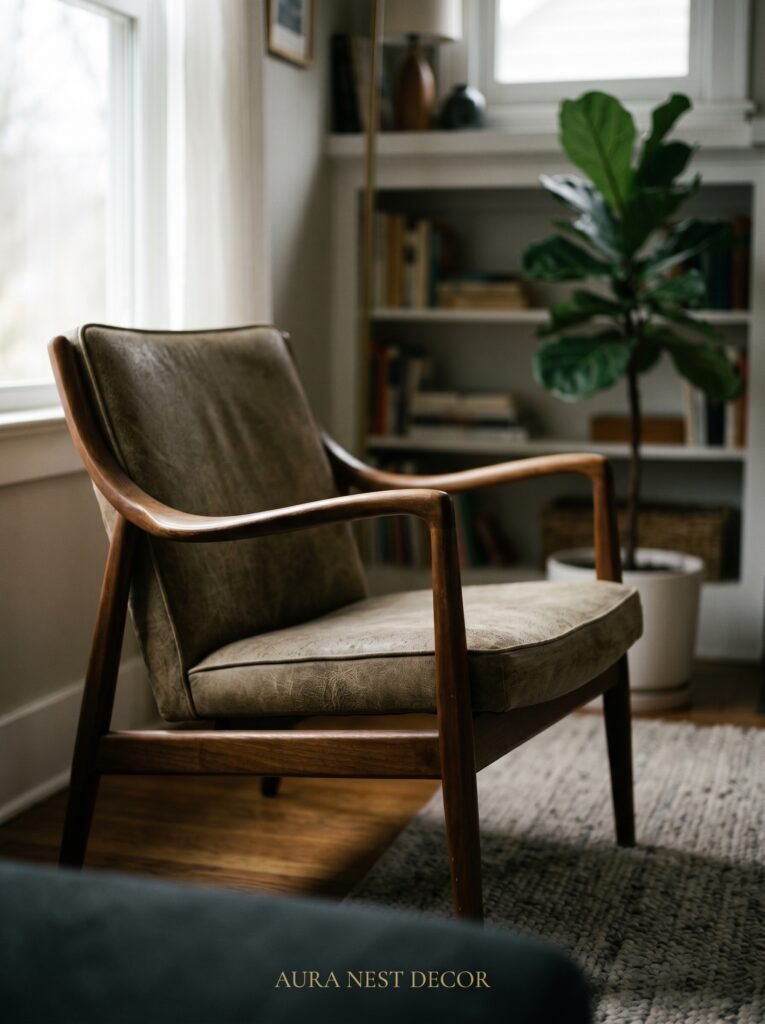
Before you do anything else — before you choose a paint colour, before you order that sofa — find your anchor piece.
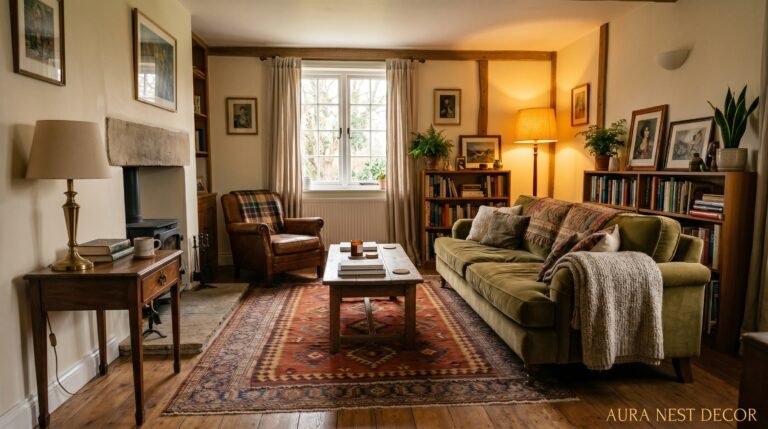
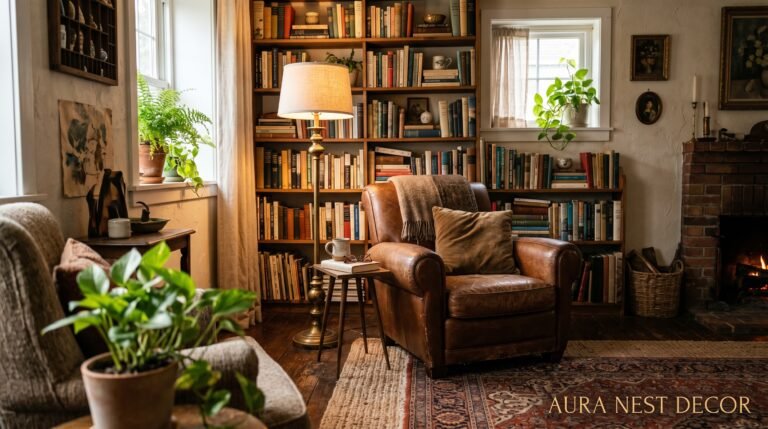
This is the vintage item that everything else orbits. It could be a sideboard with those gorgeous tapered legs from the 1950s. A pair of curved club chairs from the 1970s in a tobacco-brown leather. A dramatic floor lamp with an original brass arm. It doesn’t matter what it is. It matters that it has presence.
The anchor piece is the thing guests comment on. It’s the thing that makes your room look like it wasn’t assembled in an afternoon from a catalogue. And practically speaking, it sets your palette, your tone, your mood. Everything you buy after it should feel like a response to that piece — complementary, in conversation, never competing.
Where to find it: charity shops and thrift stores are still the gold standard if you’re patient. In the UK, head to local auction houses outside London — you’ll pay a fraction of what the city dealers charge for the exact same era of furniture. In the US, estate sales remain the single best source for authentic pieces with genuine patina. Facebook Marketplace has become remarkably good in both countries, particularly for larger furniture items people need gone quickly. And don’t overlook antique markets — they’re not always cheap, but the curation is done for you.
3. The Color That Keeps Showing Up in Every Beautiful Vintage Modern Room Right Now
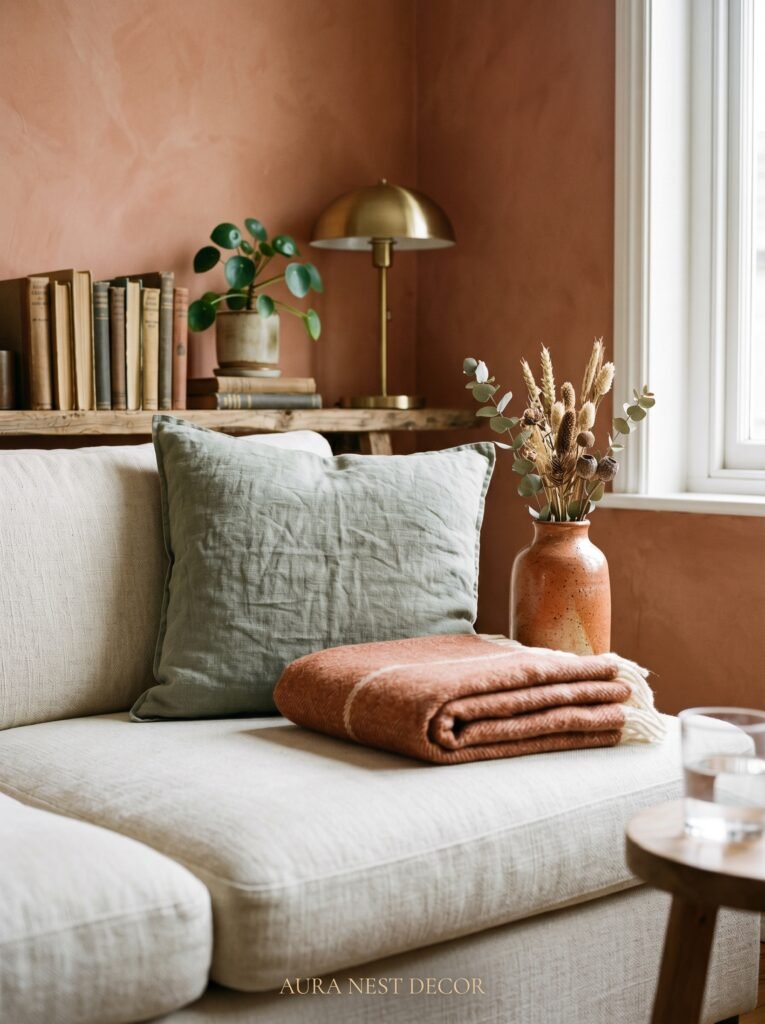
It’s not terracotta. It’s not sage green. It’s a warm, slightly dusty white — the kind that looks like it might have been painted decades ago and has mellowed just slightly with time.
Think aged linen. Think the pages of an old novel. That slightly off-white that photographs like cream in certain lights and like barely-there taupe in others.
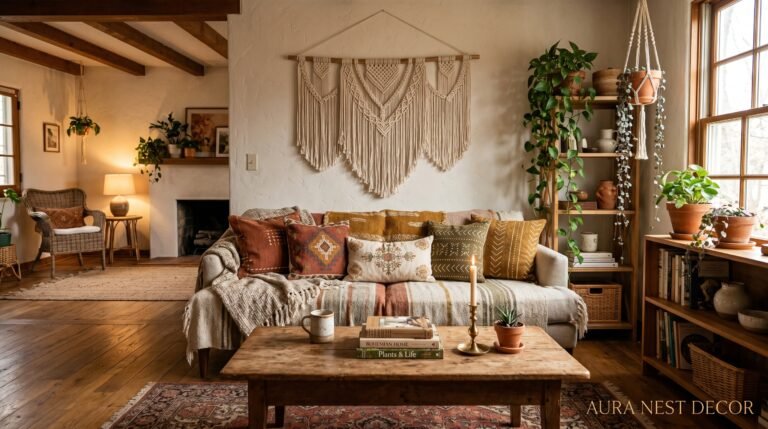
This color does something remarkable in a room. It doesn’t compete. It recedes beautifully, letting your vintage pieces — a walnut coffee table, a rust-colored throw, a collection of ceramic vases — become the thing your eye travels to. Bright white walls are too crisp, too now. They push the vintage elements forward in an almost theatrical way that reads as “deliberately decorated” rather than naturally evolved.
In the UK, Farrow & Ball’s ‘Wimborne White’ and ‘Pointing’ are perennial choices for exactly this reason. In the US, Benjamin Moore’s ‘White Dove’ and ‘Linen White’ hit the same register. They’re all slightly warm, slightly retreated, slightly timeless.
Pair this with natural wood tones — walnut, oak, teak — and you’ve already got eighty percent of your palette sorted before you’ve even thought about cushions.
4. Why Mixing Decades Works Better Than Sticking to One Era
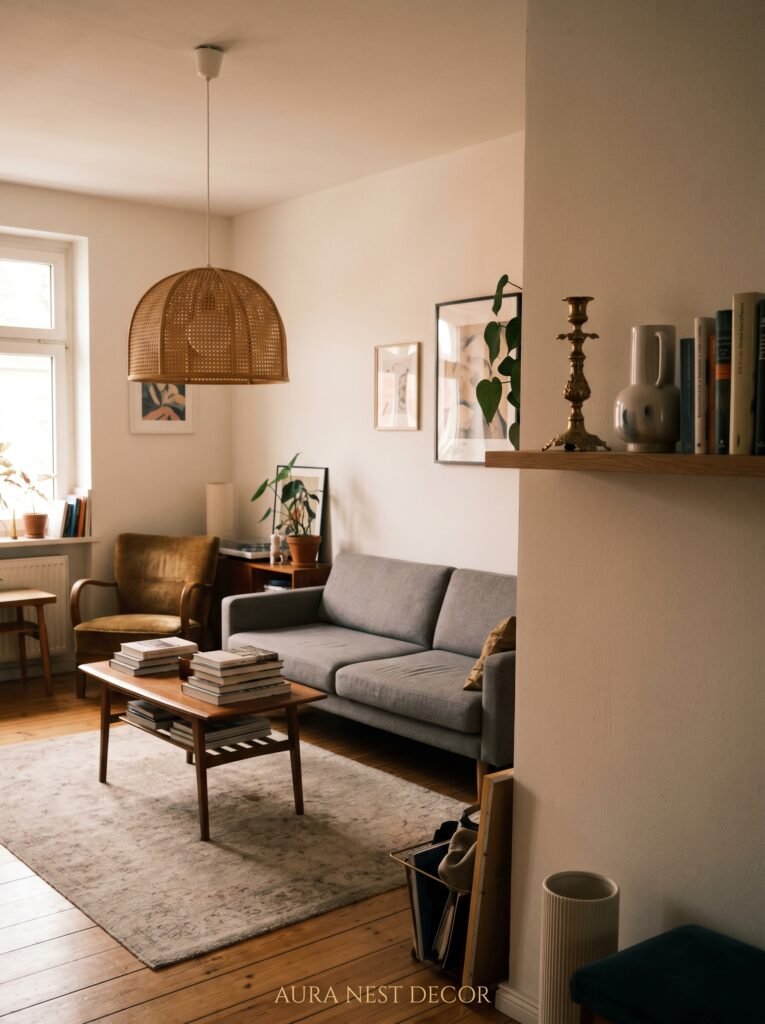
Here’s the thing about going all-in on one vintage era: it starts to look like a museum. Pure mid-century. Pure Art Deco. Pure anything. It becomes a concept, not a home.
The vintage modern approach thrives on deliberate mixing. A Brutalist concrete table lamp next to a velvet Victorian-style chaise. A 1970s rattan pendant over a sleek, contemporary sofa. The contrast is the point. It creates visual tension in the best possible way — the kind that makes your eye move around the room, finding new details, making new connections.
The key to making this work is restraint. Pick two, maybe three, eras to draw from. A core decade — say, the 1950s or 60s — and one accent era that creates the contrast. Don’t throw in everything. A Victorian chest of drawers, a 1950s lamp, a 1980s glass coffee table, and a 1970s wicker chair is too much conversation happening at once.
Think of it like cooking. A great dish has a dominant flavour and a counterpoint. Not five competing flavours all shouting at once.
“A great room has a dominant era and a counterpoint. Not five competing aesthetics all shouting at once.”
5. The Sofa Situation: What Actually Works Long-Term
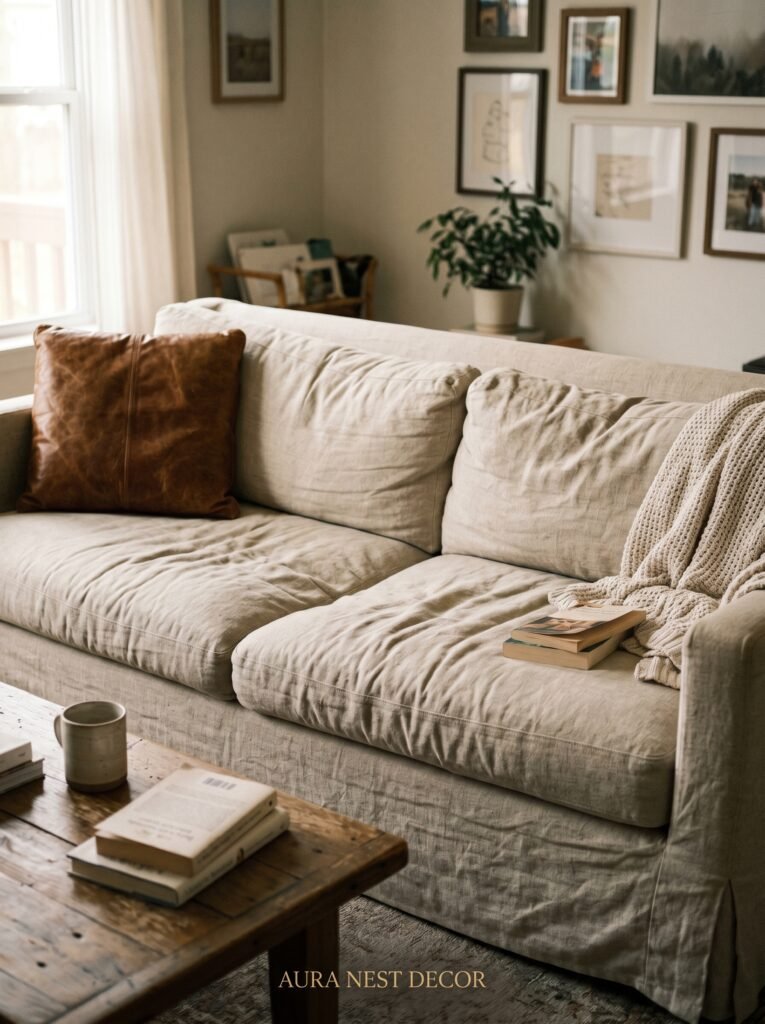
Sofas are where people panic. And understandably — they’re expensive, they take up enormous visual space, and you have to live with them for years.
Here’s the honest advice: for vintage modern, your sofa should be contemporary. Or at minimum, reupholstered in a fresh, clean fabric.
This sounds counterintuitive. But think about it. An original vintage sofa, unless it’s been professionally restored, often comes with problems — sagging cushions, dated silhouettes that aren’t actually comfortable, fabric that smells of other people’s decades. The structure of a vintage sofa can be beautiful. But you want to sit on it comfortably, in your actual life, in 2025.
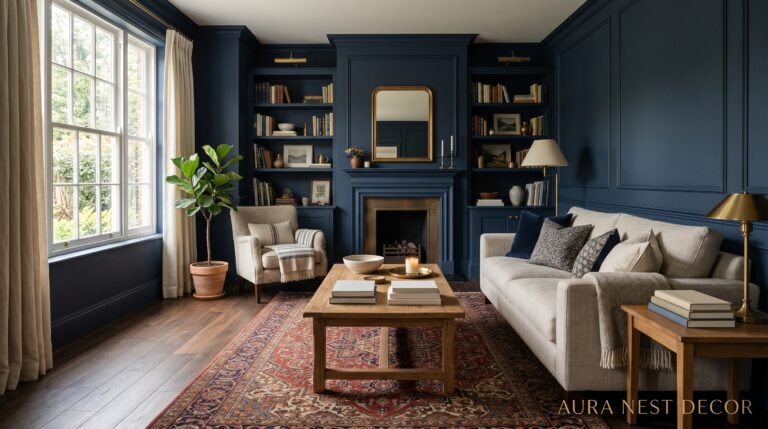
The better approach: buy a new sofa in a classic, clean-lined silhouette. Low back, simple arms, no decorative legs trying too hard. Upholster it in linen, boucle, or velvet in a neutral or muted tone. Then let your vintage accent pieces — the lamp, the coffee table, the side table, the cushion covers — do the era work around it.
In the UK, brands like Neptune, Loaf, and Swyft make sofas that sit beautifully in a vintage modern context. In the US, Article and Joybird have carved out exactly this aesthetic. None of them are cheap, but they hold their shape and their dignity over years.
6. The Light That Changes Everything at 6pm
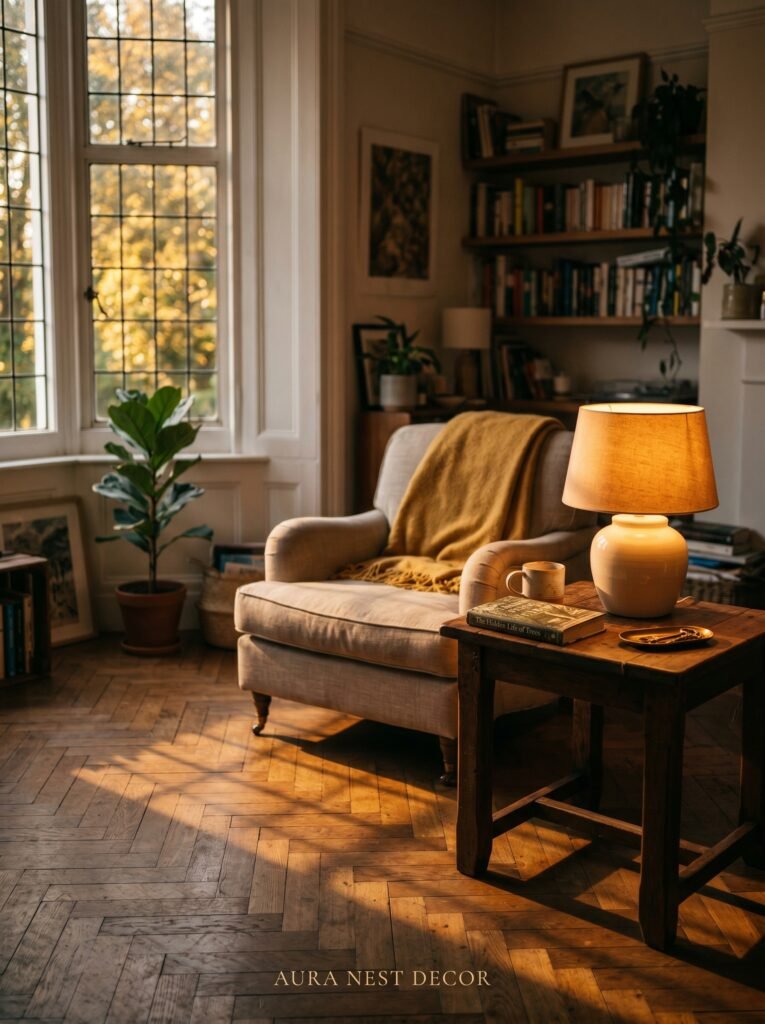
Natural light is the easy part. What vintage modern rooms do differently is artificial light — specifically, they use multiple light sources at low levels rather than one overhead fixture doing all the work.
The overhead ceiling light is the enemy of atmosphere. One harsh source flooding a room evenly makes everything flat and contemporary in the worst sense — like a supermarket.
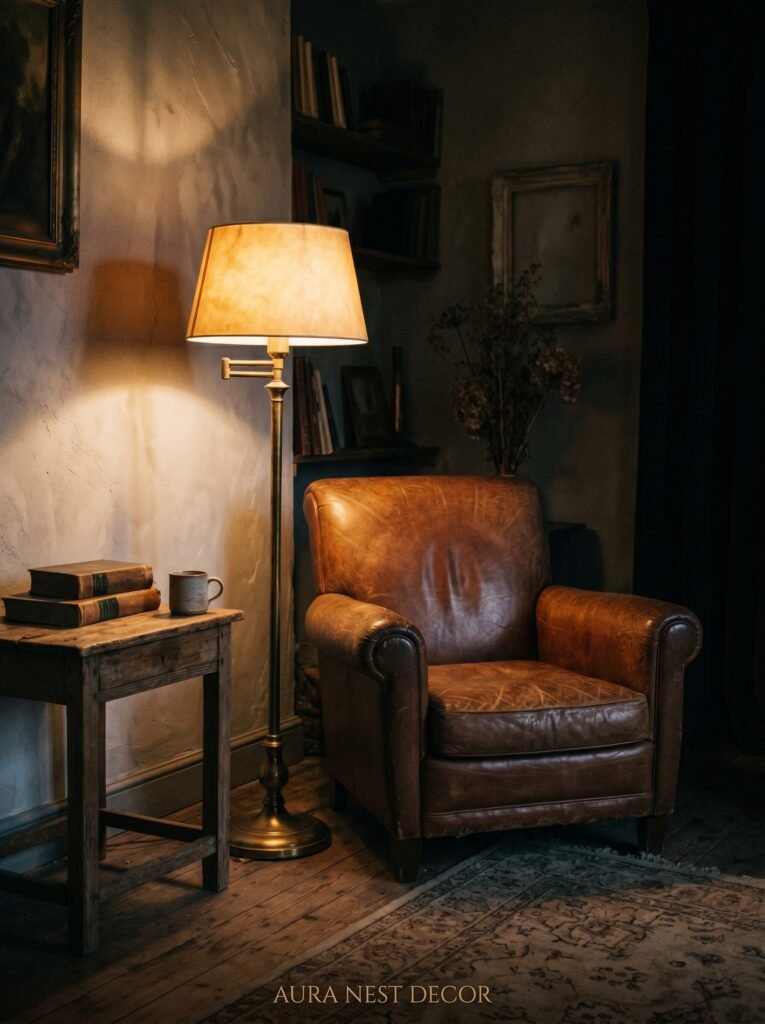
Instead: a floor lamp in the corner, throwing an amber pool upward. A table lamp on the sideboard with a shade that filters warm light. Candles, genuinely, not just as decoration. The effect at 6pm — when outside has gone dark and the room is lit entirely by these softer sources — is extraordinary. This is when vintage modern rooms earn their keep. The wooden furniture glows. The shadows get interesting. The room feels genuinely cosy rather than performatively cosy.
For the vintage modern aesthetic specifically: brass and aged-brass lamp bases are extraordinarily versatile. They read as both old and contemporary depending on what surrounds them. A ceramic lamp base in earthy tones — a sort of deep rust or forest green — adds character that a plain base simply can’t. Hunt these at antique fairs, or look at brands like Heals and OKA in the UK, or Rejuvenation in the US.
7. Textiles: The Difference Between a Styled Room and a Lived-In One
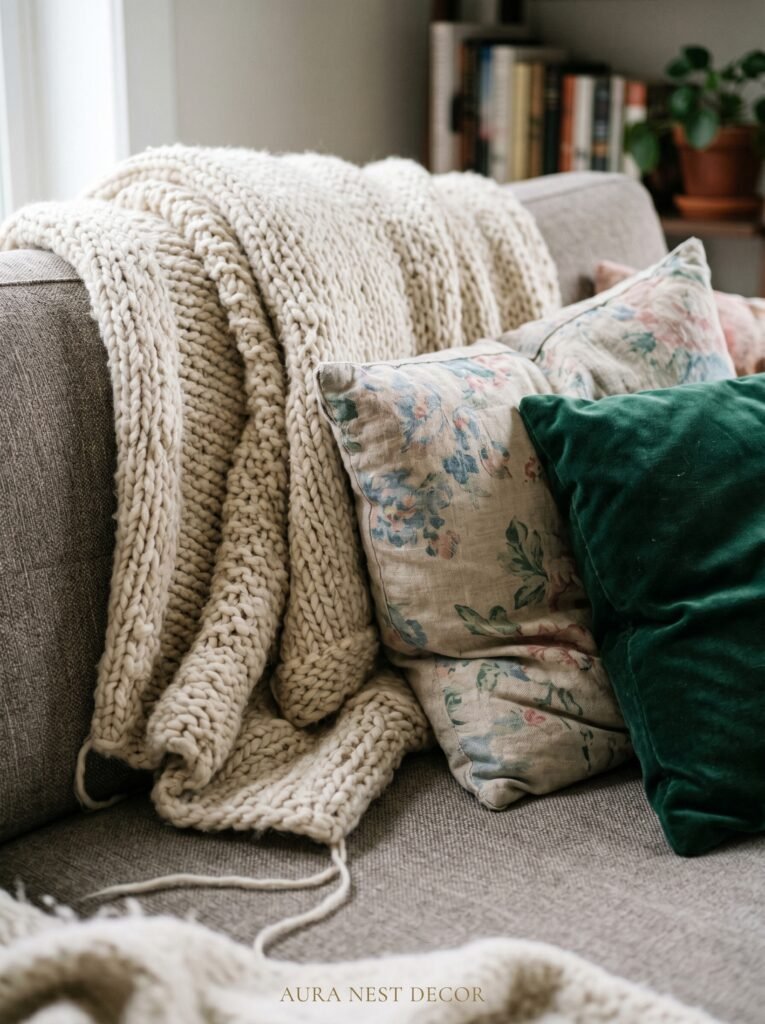
This is where so many rooms fall slightly flat. The furniture is right. The paint is right. But then there are four matching cushions in coordinating shades and a rug that was bought as a set with the curtains, and the room somehow still looks like a catalogue page.
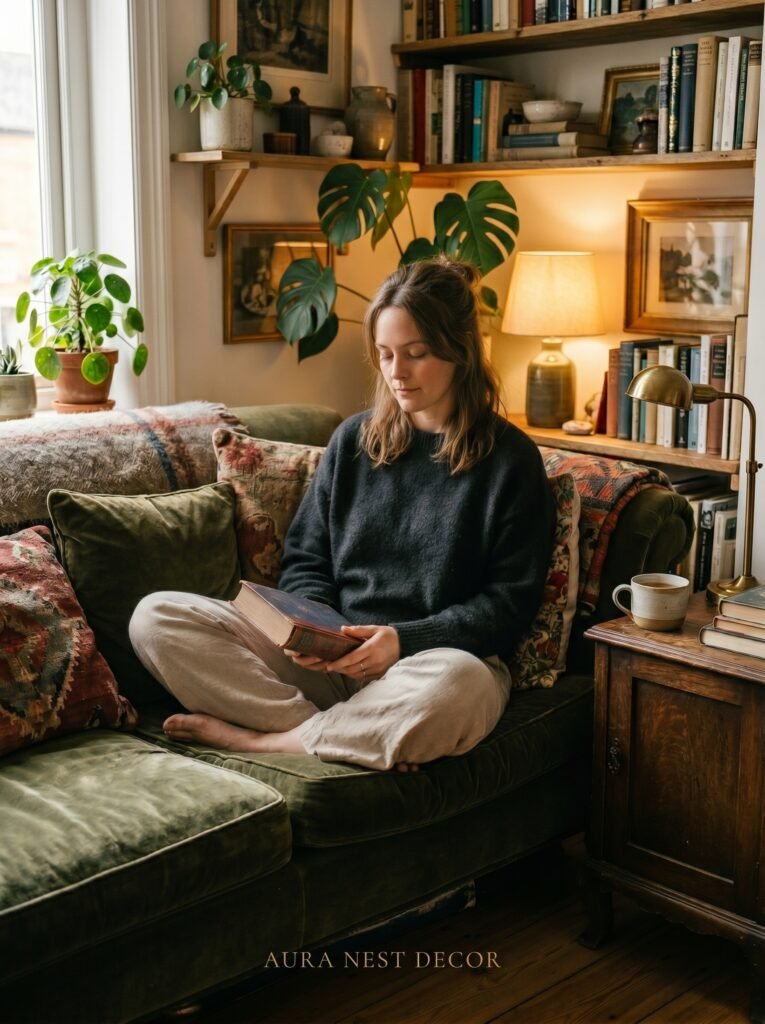
Textiles need to feel accumulated. Gathered. Like they’ve been picked up over time from different places for different reasons.
That means the rug shouldn’t perfectly match the cushions. It means having a throw that looks genuinely used — not artfully draped in a way that would fall off if anyone actually sat down. It means mixing textures: a rough-woven linen cushion cover next to a velvet one next to a Turkish kilim pillow. The pile heights, the weaves, the weights should all be different.
For pattern: vintage modern handles this beautifully because mid-century geometric prints and contemporary abstract designs share enough visual DNA to coexist. A 1960s-style graphic print cushion on a contemporary sofa. A vintage floral — not twee, genuinely old and slightly faded-looking — as a single statement on an otherwise plain arrangement.
“Textiles need to feel accumulated. Gathered. Like they’ve been picked up from different places for different reasons.”
8. What Gallery Walls Get Wrong (And How to Fix Yours)
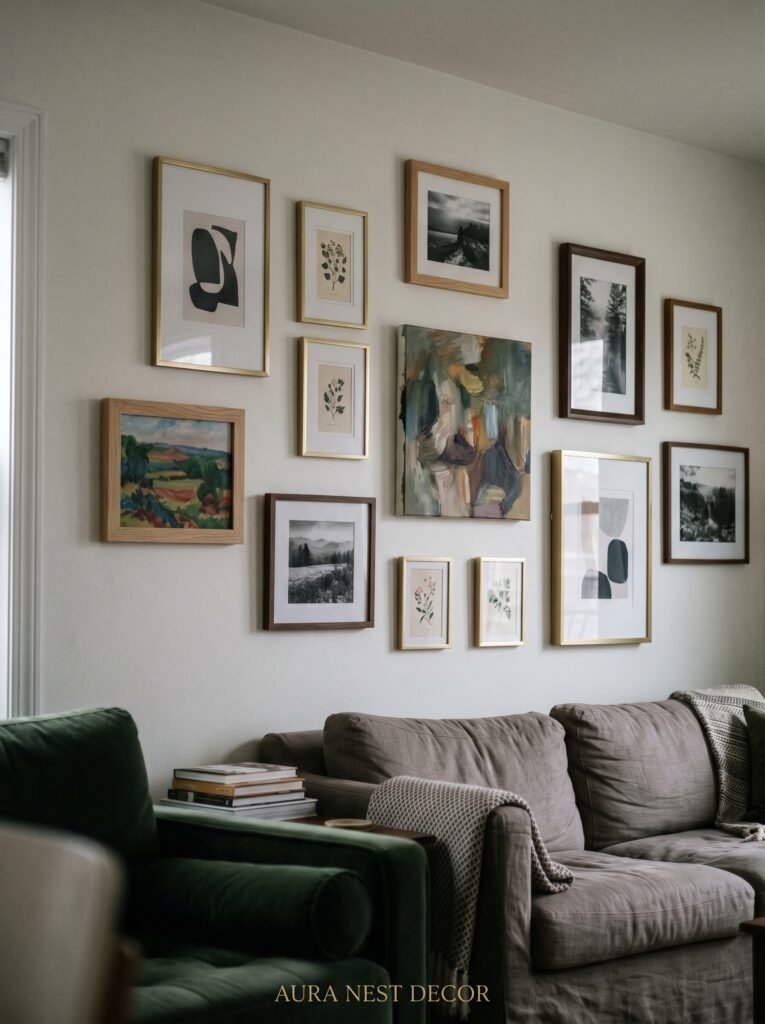
Gallery walls, when they’re done badly, are immediately obvious. Matching frames, evenly spaced, same-sized prints in a coordinated colour scheme — they look like a product you can buy ready-made. Because you can.
A vintage modern gallery wall tells a story. It mixes sizes wildly. It includes things that aren’t prints at all — a small vintage mirror, a ceramic wall piece, a framed textile, an old map. The frames don’t match but they share a finish family: all dark wood, or all warm metal, or all natural frames.
The arrangement is less grid, more conversation. Some pieces nearly touch. Others have generous breathing room. The eye moves between them finding unexpected pairings, and that movement is the point.
For sourcing: car boot sales and flea markets in the UK are still unbeatable for genuine vintage frames and original prints. In the US, thrift stores often have genuinely beautiful old prints — botanical illustrations, architectural drawings, abstract mid-century works — that just need a clean frame and some confidence to hang.
One rule that always works: anchor the wall with one large piece, then build outward and downward from it. It gives the arrangement a centre of gravity that keeps it from looking randomly scattered.
9. The Rule About Wood Tones Nobody Tells You
You were probably told to match your wood tones. All the furniture in the same finish. Everything cohesive.
This is wrong for vintage modern, and honestly it’s fairly wrong in general.
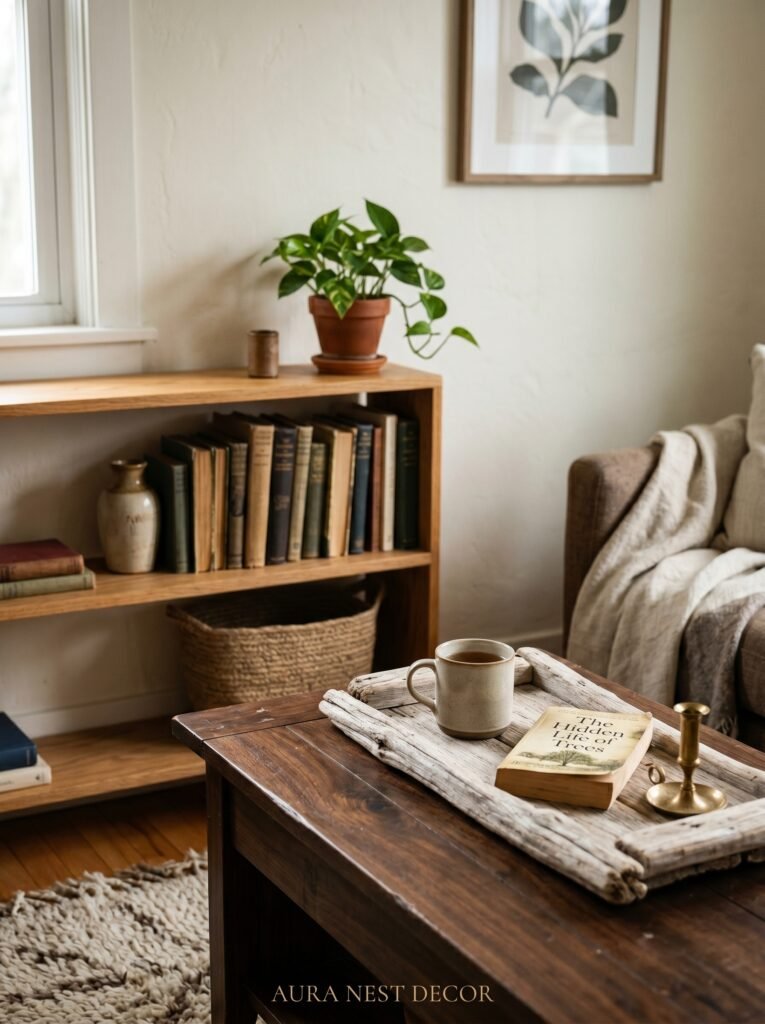
Mixing wood tones creates depth. A walnut coffee table. An oak bookcase. A painted side table with original pine visible through worn edges. These variations don’t clash — they coexist, the way wood does naturally in a forest, in different lights and conditions.
The caveat: you need something that unifies them. Usually that’s the wall colour, the rug, or the metallic tones you’re using for hardware and lamps. If your brass lamp base threads through the room — a brass wall sconce here, brass handles on that old cabinet there — it creates a through-line that holds mixed wood tones together comfortably.
In practice: stop trying to find a side table that matches your coffee table. Find one that looks right — interesting, individual, well-made — and trust the room to absorb it.
10. Shelves That Look Curated, Not Cluttered
Open shelving is either beautiful or a disaster. In vintage modern rooms, it tends toward beautiful because the objects worth displaying are genuinely worth displaying.
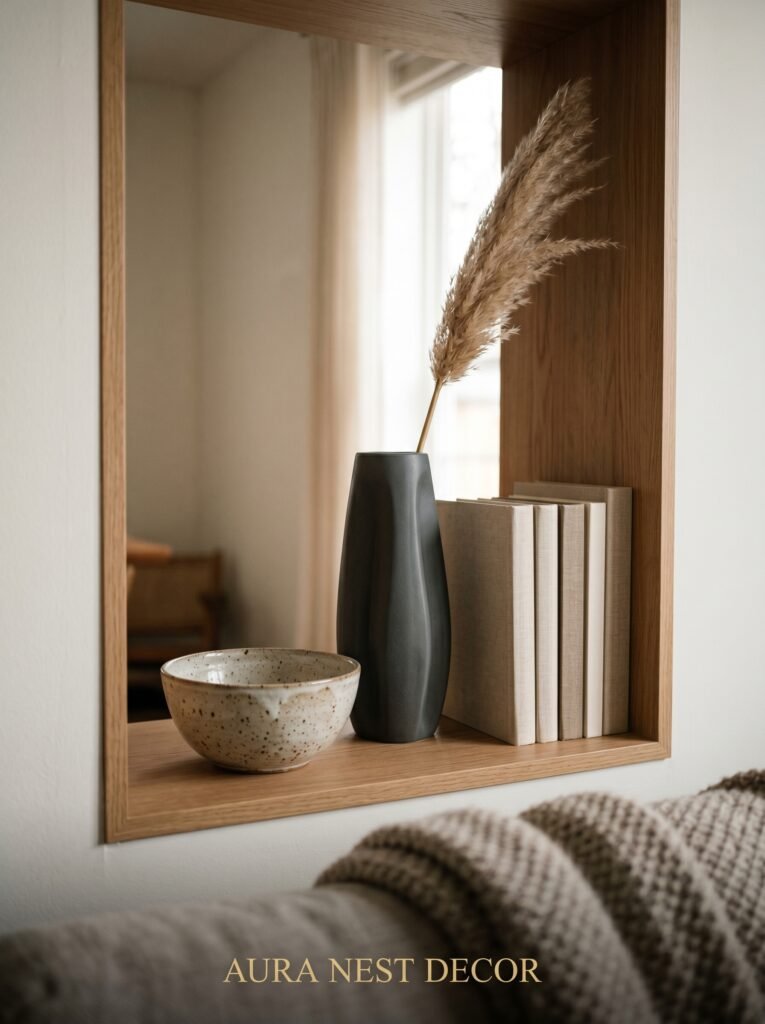
The principle is negative space. For every cluster of objects — a small stack of books, a ceramic vase, a found stone or piece of coral — there should be empty shelf space on either side. The emptiness isn’t wasted space. It’s breathing room. It makes the objects matter.
What to put on them: books with their spines facing out in clusters by height. Ceramics in complementary shapes — a tall narrow vase next to a short wide bowl. Objects from travel that have actual meaning. One or two pieces of original art or prints leaning rather than hung. Small plants or dried botanicals.
What not to put on them: anything that needs to be hidden in a basket. Anything purely functional. Anything that arrived as a set and is displayed as a set without editing.
The visual rhythm of a well-styled shelf is like good music. Not every beat — rests, spaces, the silence between notes.
11. The Forgotten Room Element That Vintage Modern Nails Perfectly
Scent.
It sounds like a small thing. It isn’t. Smell reaches the brain faster than sight, and a room that smells right — not perfumed aggressively, just… settled and natural — feels more like a home than any amount of furniture arrangement.
Vintage modern rooms smell like wood. Like beeswax polish and old paper and something slightly botanical. Candles in warm, resinous scents — cedarwood, amber, labdanum, tobacco flower — rather than anything aquatic or synthetic-fresh.
This is partly practical and partly aesthetic. But it’s also deeply connected to the vintage modern philosophy. These rooms aren’t trying to smell “clean” in the contemporary, chemical sense. They smell like materials. Like things with history.
In the UK: Skandinavisk and Aesop candles fit this register beautifully. In the US: Boy Smells and Paddywax make exceptional candles in exactly this sensory territory. None of them are cheap. One or two in the right spots are worth the investment.
12. The Biggest Mistake People Make When Starting a Vintage Modern Room
They do it too fast.
They get excited — Pinterest boards, a new vision, a weekend of rearranging — and they try to arrive at the final room immediately. They buy everything in one go. They style it in a day. And then something feels off, and they can’t identify what.
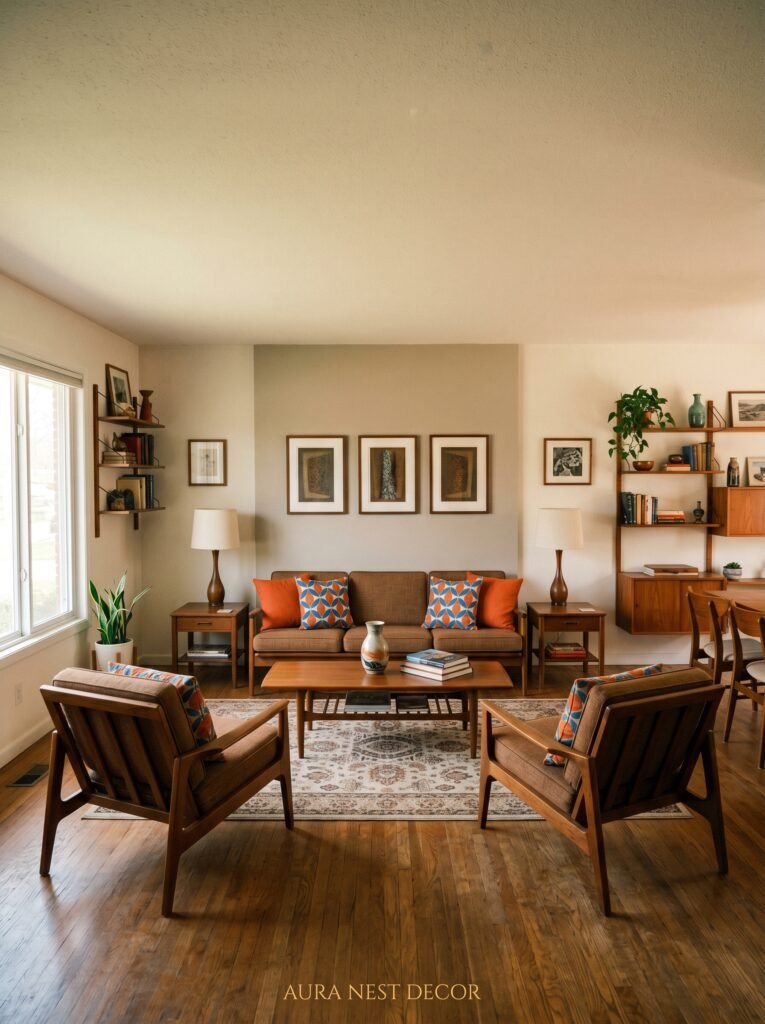
The best vintage modern rooms were built over time. A lamp discovered on a random Tuesday. A rug found at a market six months after the sofa arrived. A print bought on holiday and finally hung, two years later, in the exact right spot.
The patience is part of the process. Every time you bring something new into the space, you’re in dialogue with what’s already there. You’re learning what the room needs and what it doesn’t. That dialogue — slow, considered, genuinely curious — is what makes the end result feel like a room that grew organically rather than one that was installed.
Give yourself a year. Live with pieces before committing to them. Move things around constantly. Trust your gut over any trend, over any algorithm, over anyone else’s opinion about what your room should look like.
Your room. Your history. Your time.
—
❓ FAQ
Q: How do I make a vintage modern living room work in a small space? A: Focus on fewer, better pieces. One strong vintage anchor item — a beautiful lamp, a small but characterful side table — reads more powerfully in a compact room than several competing pieces. Use mirrors strategically to increase depth, keep the sofa contemporary and light-scaled, and resist the urge to fill every surface. Negative space is especially important when there isn’t much of it to begin with.
Q: Where’s the best place to find authentic vintage furniture in the UK and US? A: In the UK, provincial auction houses (outside major cities), charity shops in wealthier postcodes, and Facebook Marketplace are your best bets for value. Markets like Portobello Road and Newark Antiques Fair are wonderful but priced accordingly. In the US, estate sales remain unmatched for quality and price — apps like EstateSales.net make finding them easy — alongside Craigslist, Facebook Marketplace, and local thrift stores in older, established neighbourhoods.
Q: How do I stop my vintage modern room from looking messy rather than curated? A: Edit ruthlessly. The difference between curated and cluttered is usually just removing thirty percent of what’s on display. Give your best objects room to breathe. When in doubt, take something away rather than add something new. A room with slightly too little in it always looks more intentional than one with slightly too much.
—
💭 Final Thoughts
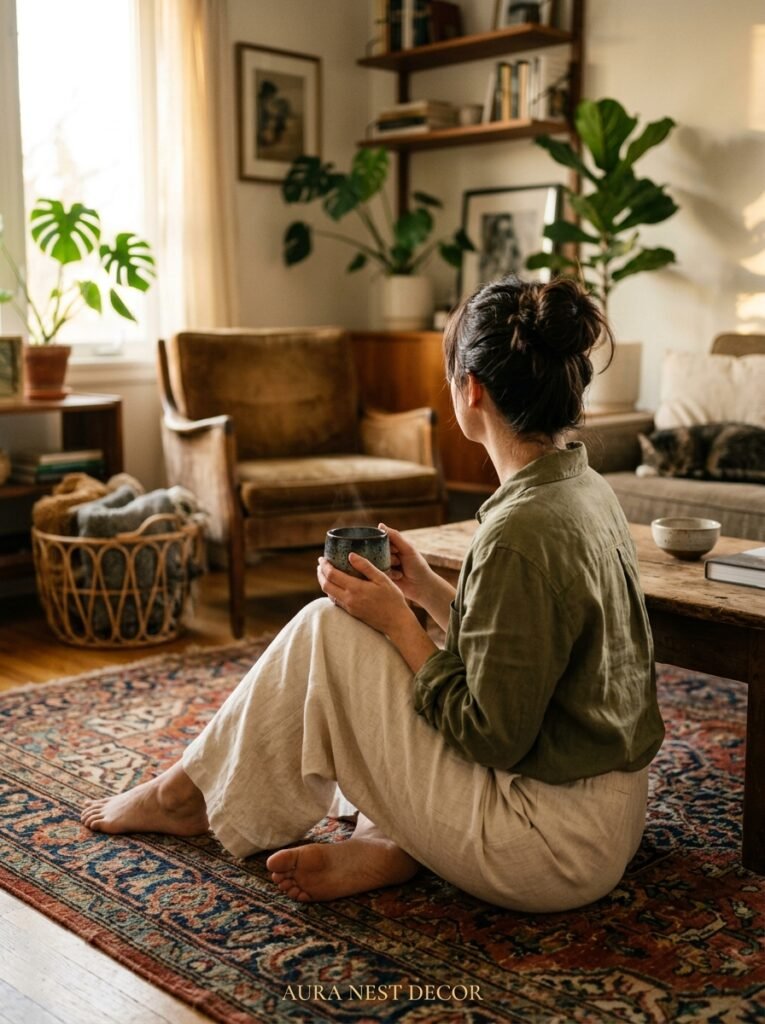
The rooms that stay with you — the ones you photograph, pin, revisit in your memory — aren’t the newest or the most expensive ones. They’re the rooms that feel like someone actually lives there. Like time passed there and left something good behind. That’s what vintage modern is really chasing: not an aesthetic, but a feeling. What’s the one piece already in your home that might be the starting point for all of it?