The Boho Modern Living Room Walls That Actually Look Intentional (Not Accidental)
You know that feeling when you walk into someone’s living room and the walls just work — layers and textures and something woven, but nothing cluttered, nothing chaotic? That’s boho modern. Not a mood board accident. A deliberate, beautiful tension between warmth and structure.
Here’s how to get it right on your own walls.
—
1. Why Most Boho Walls Feel Messy (And the One Thing That Fixes It)
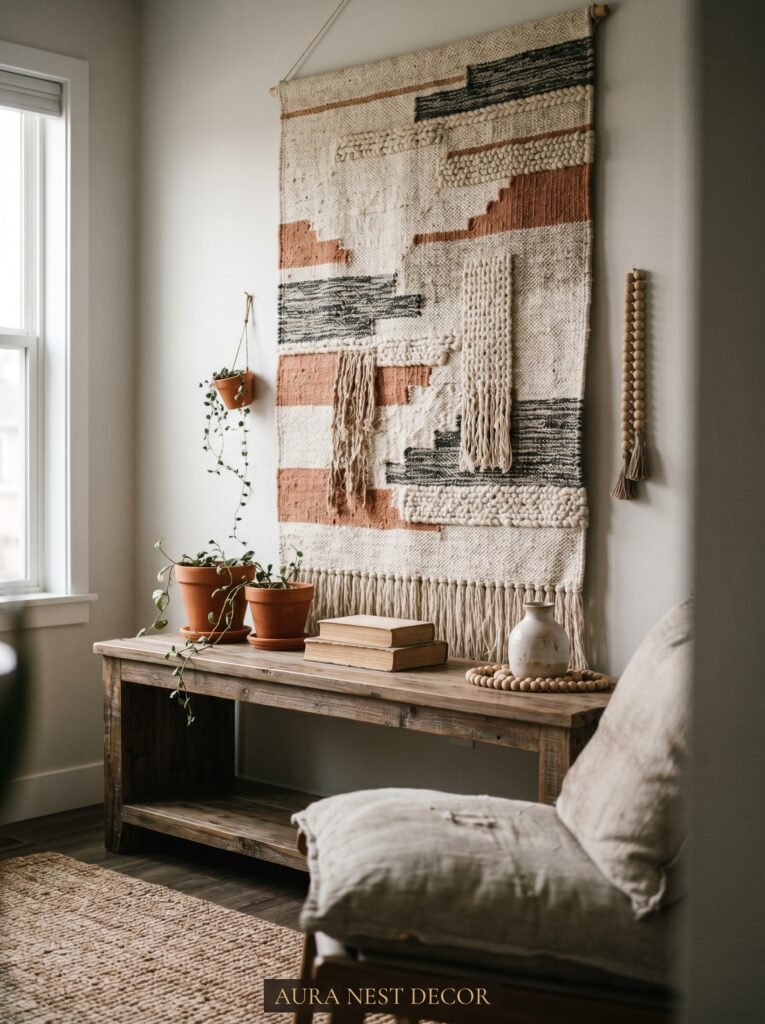
The number one mistake people make with boho wall decor is treating it like a free-for-all. More macramé, more prints, more baskets — and suddenly the room feels like a craft fair exploded against your drywall.
The fix is deceptively simple: commit to a single anchor piece first.
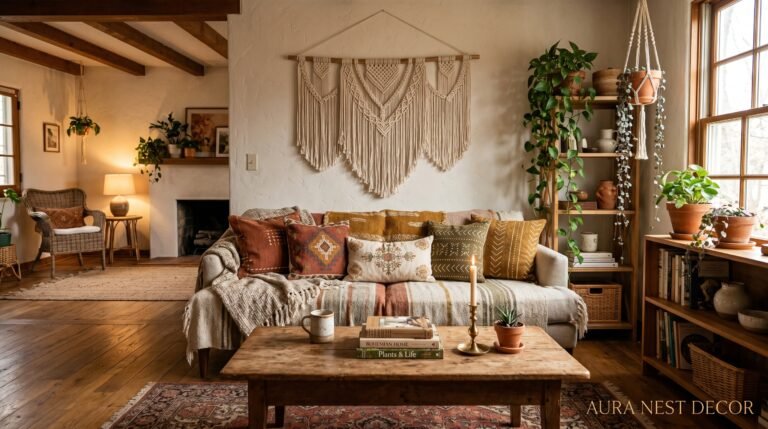
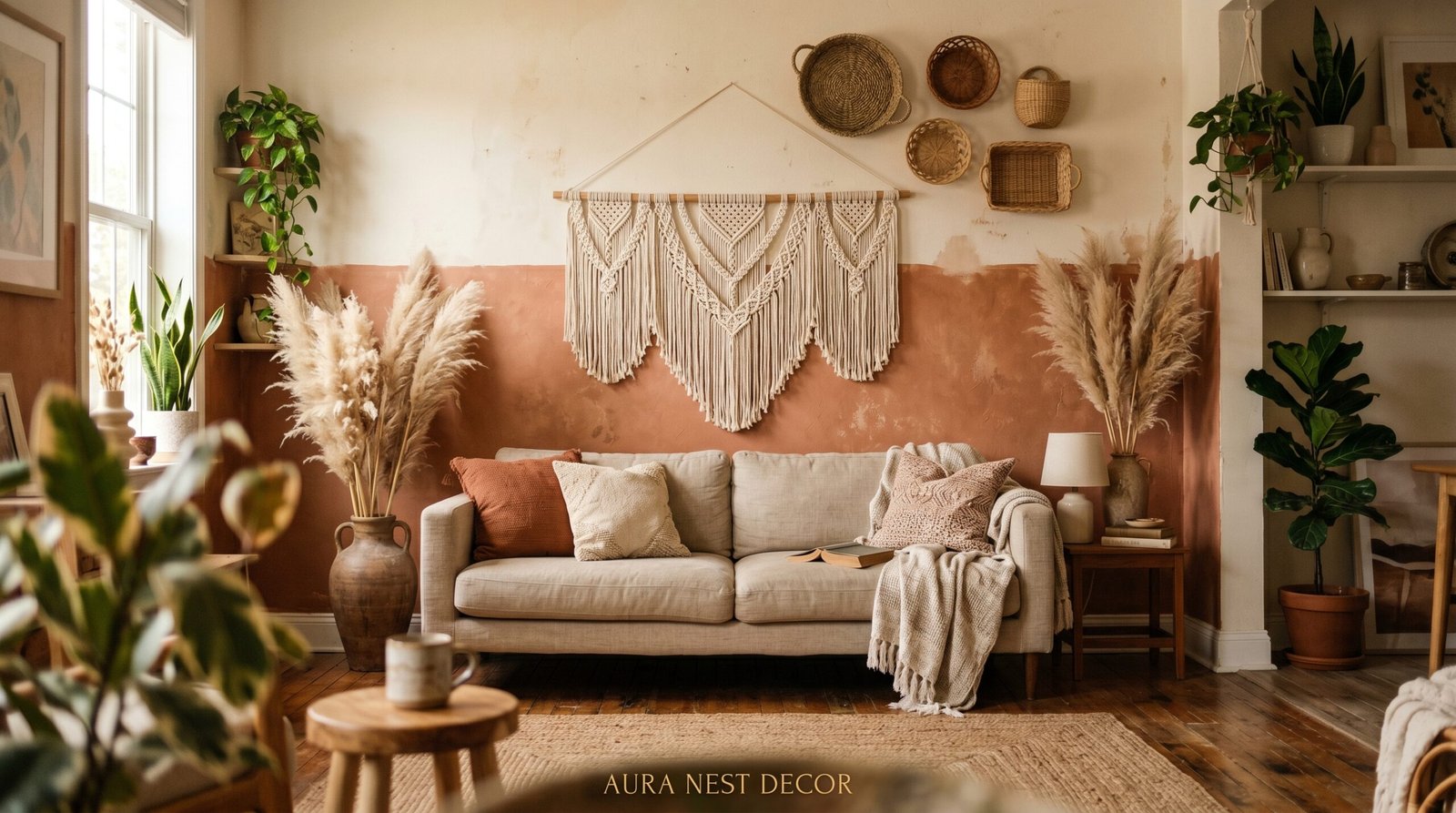
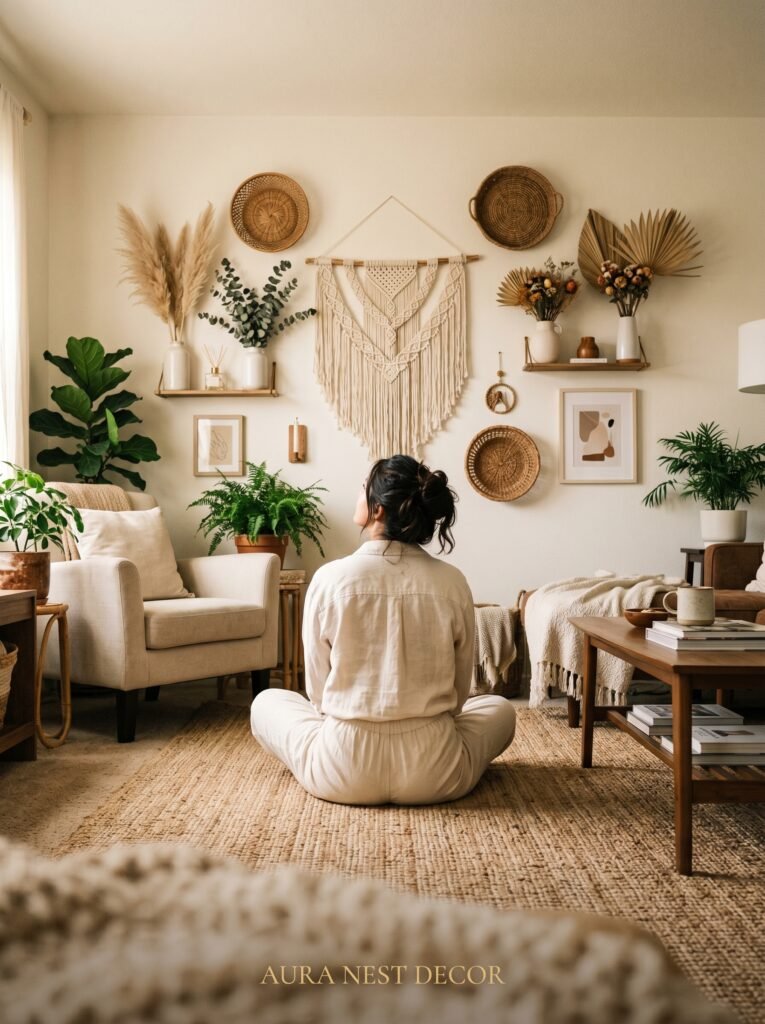
Everything else hangs in relationship to that anchor. Maybe it’s a large woven wall hanging, three feet wide, in warm undyed cotton. Maybe it’s an oversized canvas in terracotta and cream. Whatever it is, it sets the gravitational center. Every other piece orbits it. That’s how the best boho modern rooms maintain their sense of calm even while being visually rich — there’s a hierarchy, even when it doesn’t look like one.
Think about it the way a stylist thinks about an outfit. You don’t put on the statement earrings, the bold bag, the printed scarf, and the embroidered jacket all at once. You pick one statement and let the rest support it. Your walls work exactly the same way. Start with your anchor, hang it, live with it for a few days, and only then start layering around it.
“The rooms that look effortlessly styled are usually the most carefully edited.”
2. The Color Palette That Shows Up in Every Beautiful Boho Modern Living Room Right Now
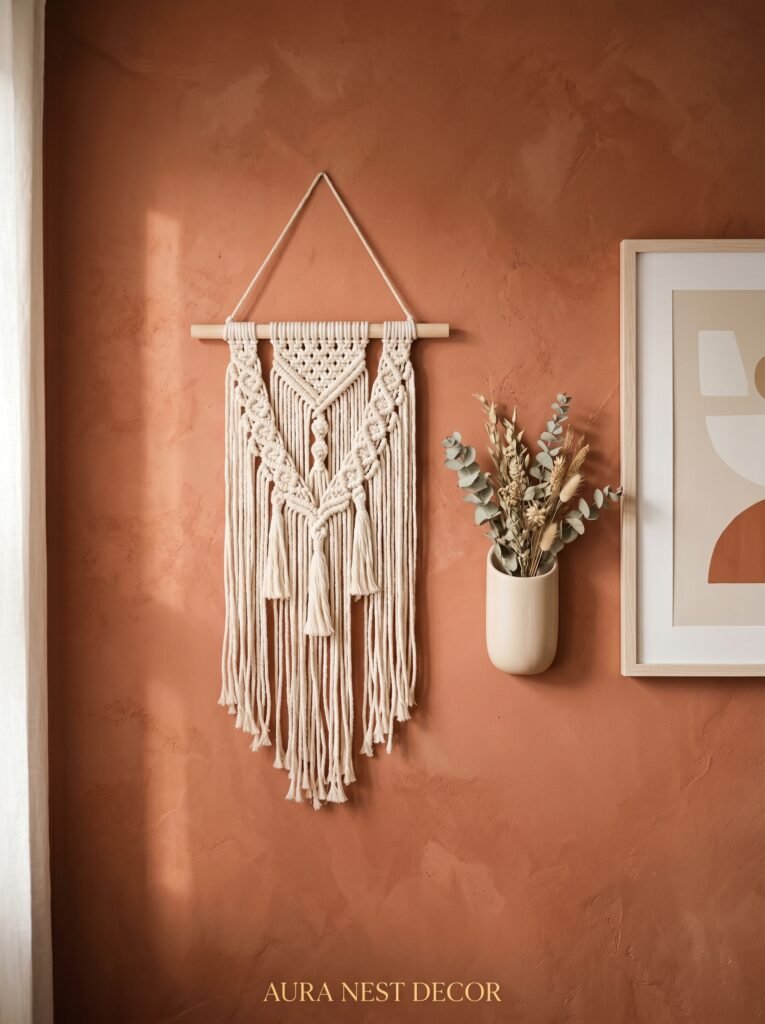
It’s not white walls with pops of color. It’s not all-white anything, actually. The palette that keeps appearing in the most pinned, most saved boho modern living rooms right now is warm neutrals with one deep, unexpected accent.
Think warm sand as your base. Not stark white — warm white, or better yet, a soft greige or an actual plaster-toned paint. Against that, natural textures read like color: the honey-brown of rattan, the dusty-green of dried pampas grass in a basket, the pale blonde of raw wood shelving. These aren’t exactly colors but they behave like them on a wall.
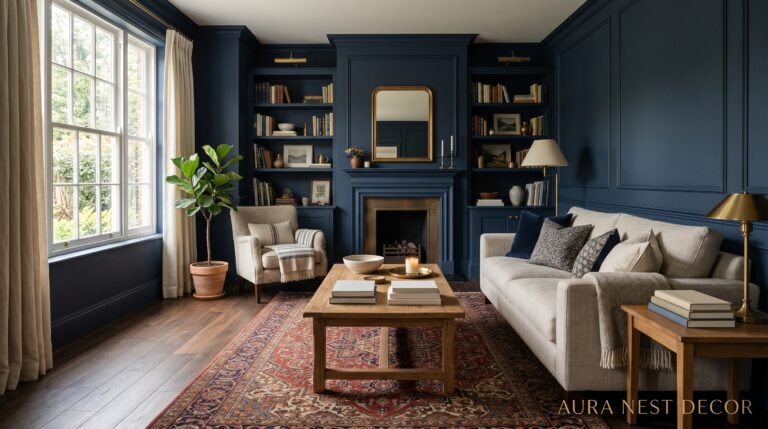
Then comes the one unexpected accent. Deep rust. Forest green. Inky navy. Something that shouldn’t work against the softness but absolutely does. A single framed print in that color, or a woven piece with threads of it running through. Just enough to anchor the whole thing and stop it reading as beige.
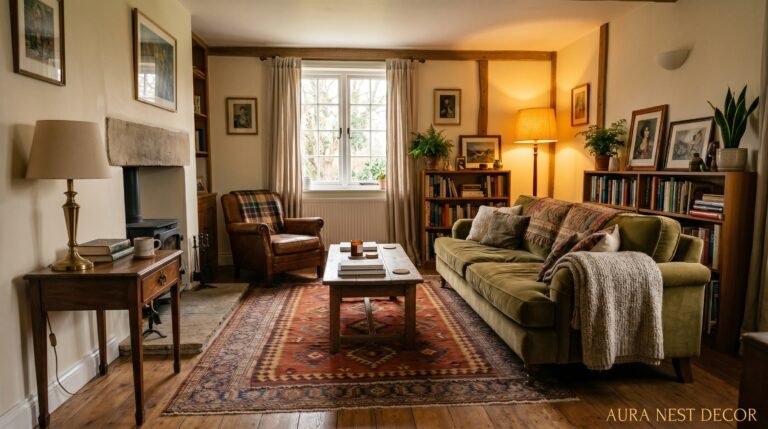
In the US, this palette reads particularly well against the warm undertones of hardwood floors. In British homes with their older bones and slightly cooler natural light, leaning warmer in your base — even a whisper of ochre in the wall color — makes the same palette feel cozy rather than cold.
3. Macramé Without the 1970s Time Warp
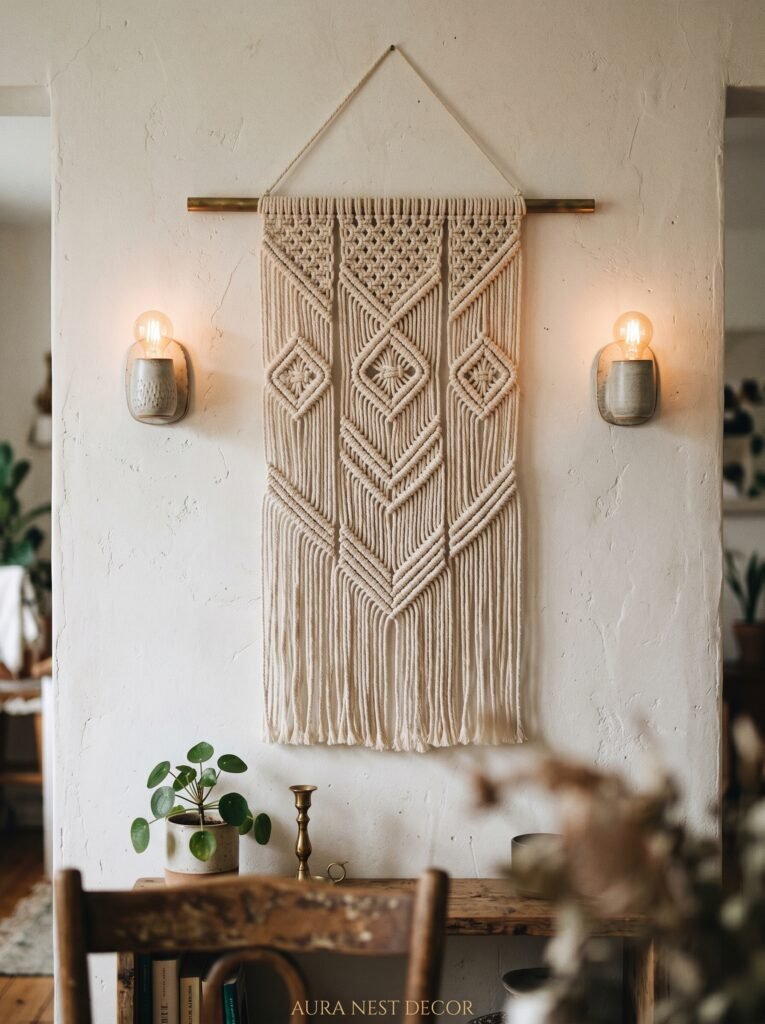
Macramé is back. Has been for a while. But there’s macramé that looks current and there’s macramé that looks like it came from your grandmother’s holiday cottage in Devon circa 1974.
The difference is in the execution, not the material.
Modern macramé tends to be cleaner in its knotting patterns — more geometric, less fringe-heavy. The pieces that feel fresh right now are often smaller and more precise, rather than the enormous, heavily-fringed cascades that dominated the first wave of the revival. A tightly-knotted geometric wall piece in natural or bleached cotton, framed in a simple wooden dowel, can feel almost Scandinavian in its restraint — which is exactly what gives it that boho-modern balance.
Scale matters enormously. A tiny macramé piece on a large wall reads as an afterthought. Either go big — genuinely big, conversation-piece big — or cluster a few smaller pieces together with intention. If you’re clustering, keep them within the same tonal family. Mixing stark white macramé with warm ivory with bleached natural all in one grouping creates visual noise. Choose your tone and commit.
One more thing: the hanging method matters as much as the piece itself. A thick, beautiful branch as a dowel instead of a dowel painted black makes a real difference. It keeps the organic quality of the piece alive all the way up to the wall.
4. Gallery Walls That Feel Curated, Not Frantic
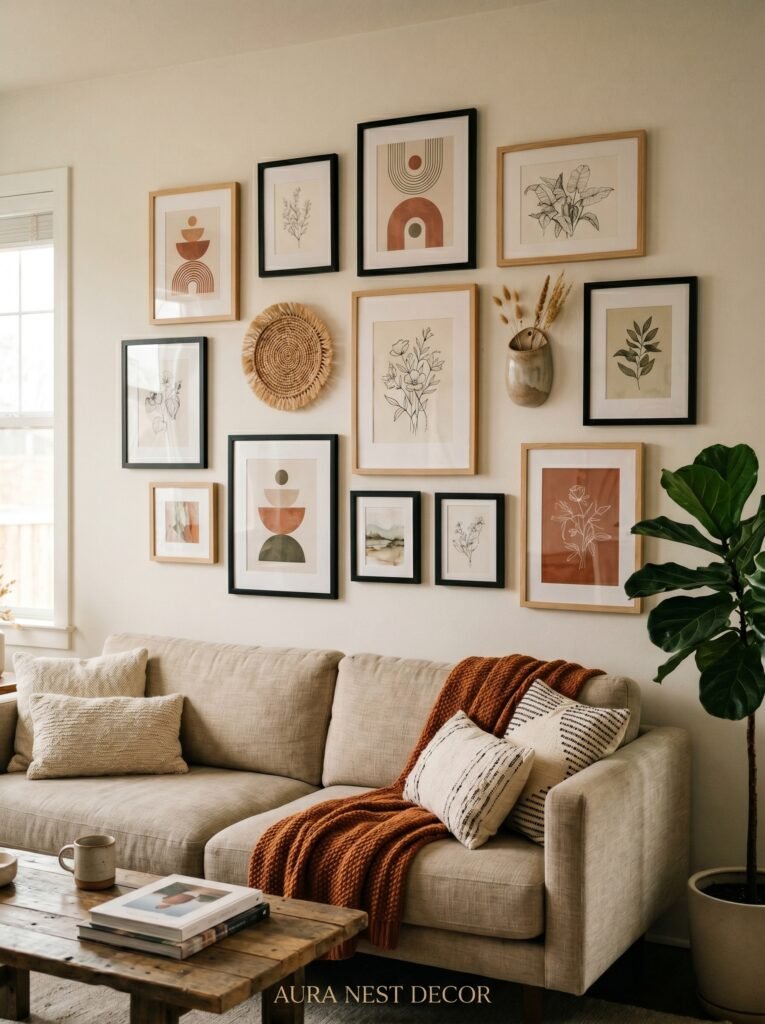
Gallery walls get a bad reputation in the boho modern world because most of them are over-done. Too many frames, too many sizes, no consistent logic, and the wall ends up looking like an anxiety attack.
The gallery walls that actually work in this aesthetic tend to share three qualities. First, there’s a consistent frame treatment — not identical frames, but frames that agree with each other. Black thin-line frames mixed with natural wood works. Gold ornate mixed with black mixed with natural wood and a couple frameless canvases does not.
Second, the negative space is treated as intentionally as the pieces themselves. The gaps between frames breathe. You can feel the wall behind. It’s not packed edge to edge.
Third, the content has a point of view. In boho modern, that usually means a mix of botanical prints, abstract art with organic shapes, maybe a piece of text if it’s genuinely meaningful rather than generic, and one or two photographs treated as art rather than snapshots. Black and white photography works beautifully here — it reads as considered rather than casual.
“Leave more wall than you think you need. The empty space isn’t a gap — it’s part of the composition.”
5. The Specific Way Dried Plants and Pampas Grass Work on Walls
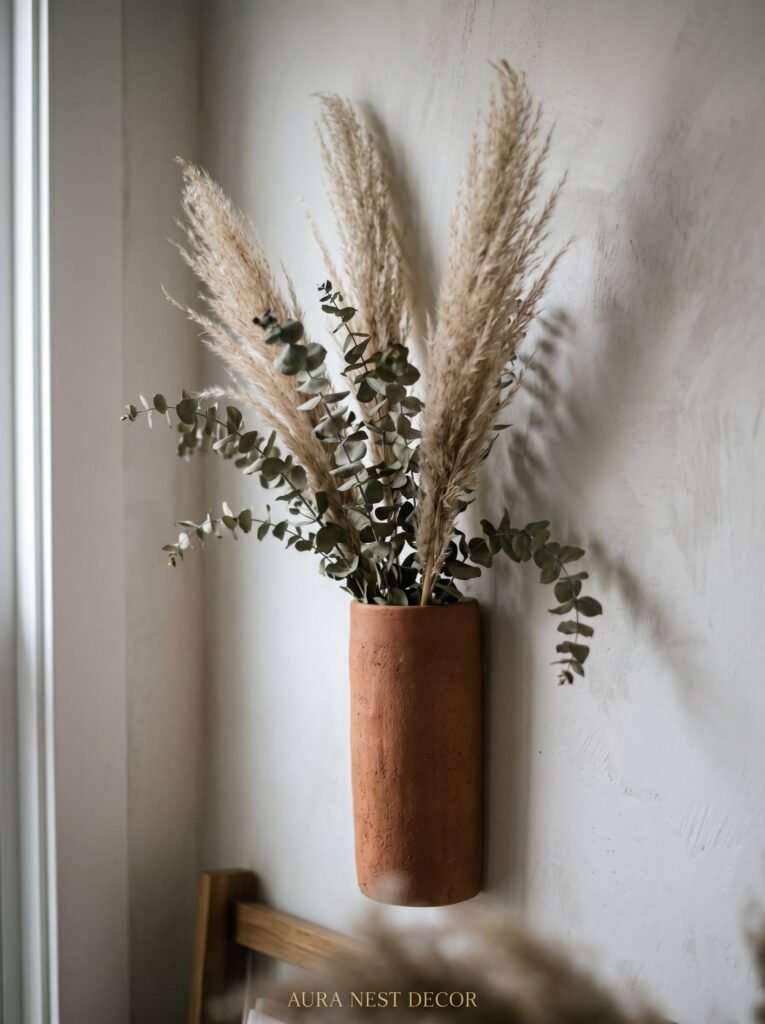
Dried botanicals as wall decor — pampas grass, dried cotton stems, bundles of eucalyptus, dried lavender — have had their moment, and they’re still having it, because they do something no print or canvas can do. They bring actual texture into the third dimension. They move slightly when there’s a breeze from an open window. They catch the light differently at different times of day.
The key to using them well in a boho modern space is containment. Loose bundles of dried stems resting in a vase on a shelf look beautiful but they’re not wall decor — they’re shelf decor. To work on a wall, dried botanicals need a framework. A wall-mounted vase or vessel. A framed dried arrangement under glass (pressed botanical art is having a real moment right now and it’s worth looking into). Or a tightly arranged wreath form in a muted, dried palette.
What you want to avoid is the look of pampas grass simply stuffed into a corner bucket near the wall and counted as decor. It reads as unfinished. The wall and the arrangement need to have a relationship — the botanical element should feel like it belongs to the wall, not just near it.
6. How Mirrors Actually Work in This Style (Hint: It’s Not About Bouncing Light)
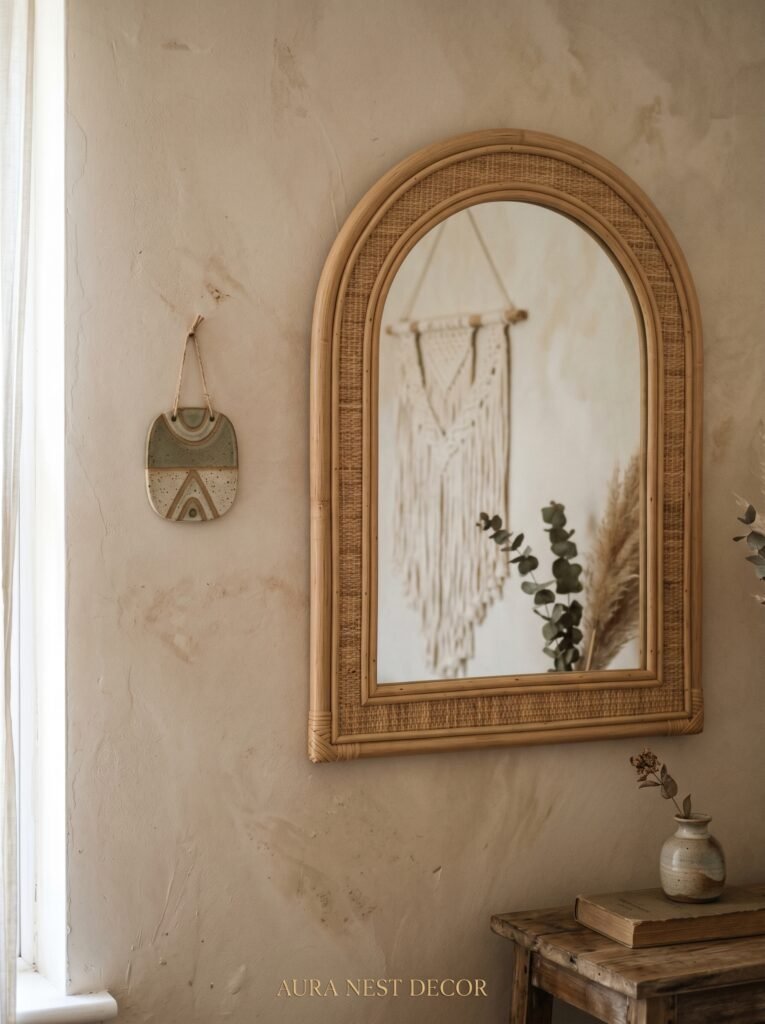
People will tell you to hang mirrors to make a room feel larger or to bounce light. That’s fine advice but it’s not why mirrors are interesting in boho modern decor. They’re interesting because of what they bring to the wall itself — their frames, their shapes, their age.
An arched mirror in aged brass or dark iron feels genuinely architectural. Hung alone on a warm-toned wall, it becomes sculpture. It doesn’t need anything around it. An irregular, organically-shaped mirror — the kind sometimes called a “mushroom” or “blob” mirror — adds something almost playful, a softness that cuts against any tendency for the room to feel too precious.
The mistake is treating mirrors the same way in every style of room. In a maximalist space, a mirror can be part of a gallery wall. In boho modern, mirrors tend to work better solo — large, confident, making a singular statement. Two mirrors of very different sizes side by side can work if they’re clearly in conversation, but three mirrors of three different sizes hung together usually reads as confusion.
What you’re always doing with mirrors in this context is adding depth without adding more visual content for the eye to process. That’s the balance boho modern is always seeking.
7. Woven Baskets as Wall Art — Yes, Really
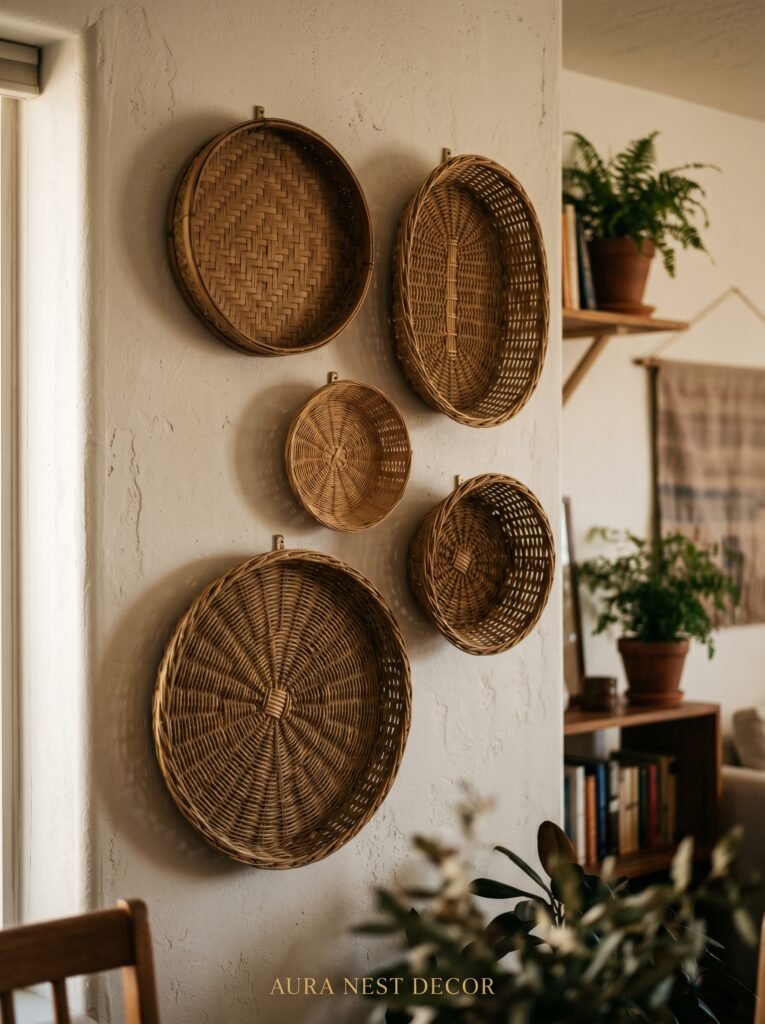
This one still surprises people who haven’t tried it, but a cluster of woven baskets on a wall is one of the most texturally satisfying things you can do in a boho modern living room.
The effect works because baskets carry that handmade, artisan quality that sits at the heart of the boho aesthetic, but their circular forms and the way they can be arranged in loose organic clusters gives them a modern, graphic quality as well. It’s the meeting point the whole style lives at.
You want odd numbers — three, five, or seven baskets in a grouping. You want variation in weave pattern and basket depth, but harmony in tone. Warm natural tones, maybe one piece in a slightly darker or richer straw color, possibly one with a thin strip of black or charcoal woven through. Nothing that reads as a different color family altogether.
“Baskets on a wall aren’t quirky anymore. They’re one of the most sophisticated things you can do with a blank space.”
The arrangement on the wall doesn’t need to be a perfect cluster. Let some sit slightly apart from the others. Overlap two if the sizing allows. The goal is something that looks considered but not geometric. Felt, not calculated.
8. The Shelf-as-Wall-Decor Move That Changes Everything
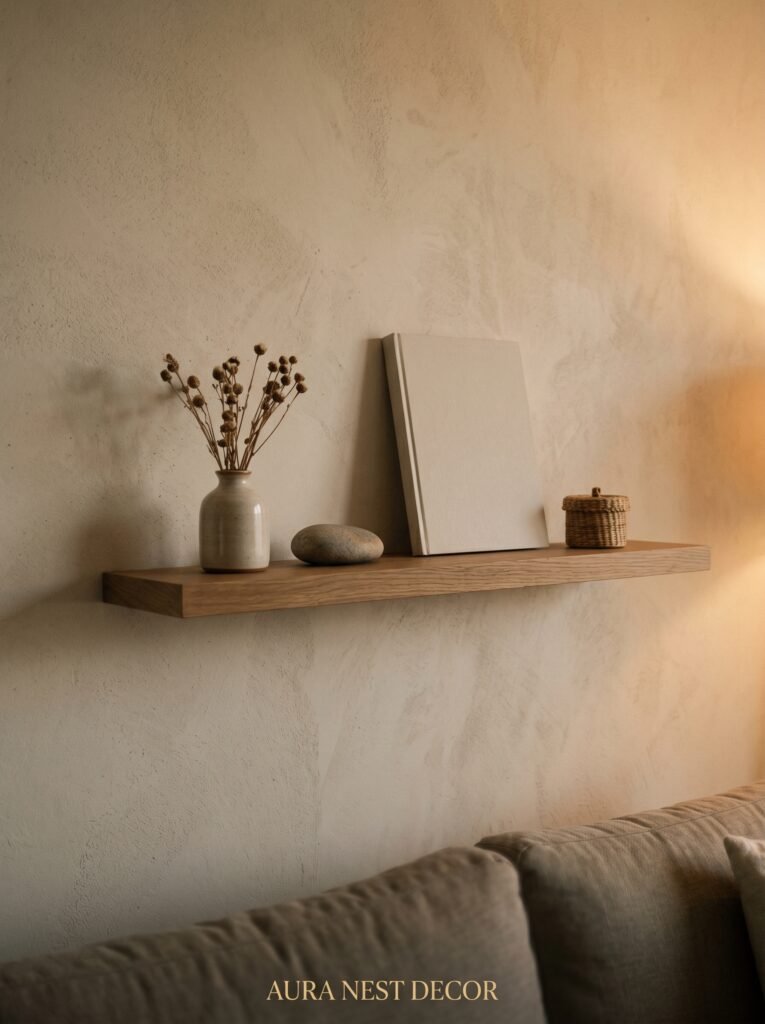
Floating shelves in a boho modern living room are not storage. They are display. The distinction matters enormously.
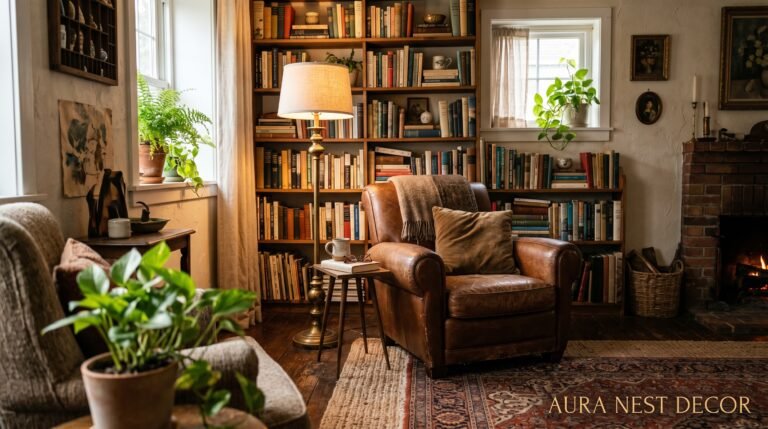
A floating shelf loaded with things you need to access — remote controls, phone chargers, the book you’re currently reading — looks like a shelf doing its job. That’s fine for some rooms but it’s not decor. A floating shelf in a boho modern living room holds a small ceramic vase, two or three beautiful spines of books stood upright, a single trailing plant cutting in a vessel, and deliberate empty space. That’s a visual composition. That’s the wall doing something.
Natural wood shelving in a warm finish works best here — raw oak, walnut, pine with a wax finish, or even a painted shelf in a color that picks up something in your anchor piece. Bracket style matters too. Invisible brackets for a truly floating look, or hand-forged iron brackets for something with more character. The bracket is part of the aesthetic decision, not an afterthought.
Position these shelves with the same care you’d give a painting. Not necessarily centered on the wall, not necessarily at eye level — slightly lower often feels better, more intimate. Let them work with the wall, not just sit against it.
9. When to Break the Rules and Go Full Maximalist on One Wall
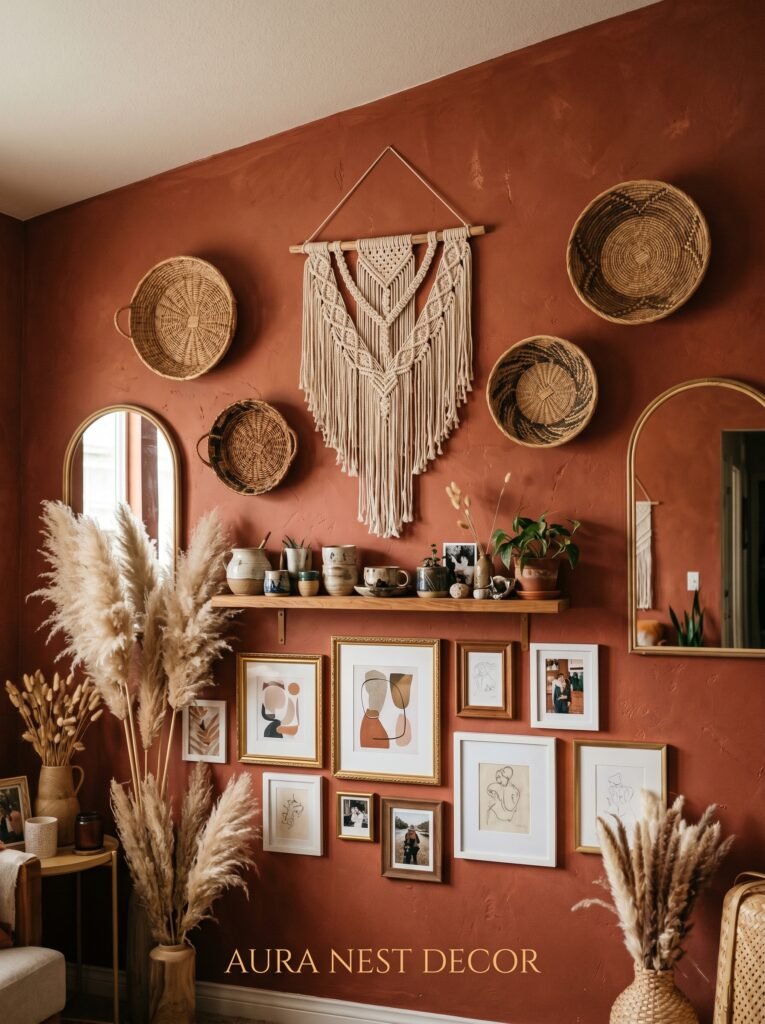
Everything said so far has been about restraint, about editing, about letting things breathe. Here’s when to ignore all of it.
One wall. One full, layered, glorious maximalist wall. And the rest of the room kept deliberately quieter.
This is the most advanced move in boho modern wall decor and it’s genuinely stunning when done well. You pick the wall most people see first — usually the one behind the sofa or the one opposite the door — and you commit to it completely. Woven wall hanging as anchor, baskets clustered to one side, a shelf cutting across with botanicals, a small gallery cluster above, maybe some trailing ivy from a shelf bracket. A lot. A whole lot.
But the adjacent walls? Nearly bare. Maybe one small piece on each, almost as a whisper. This contrast is what makes the full wall sing. The eye has a destination. The room has drama and stillness in the same space.
It takes confidence to go this far in one direction, but it almost always pays off more than spreading everything evenly and quietly across all four walls.
10. Textiles on Walls — The Most Underused Boho Modern Move
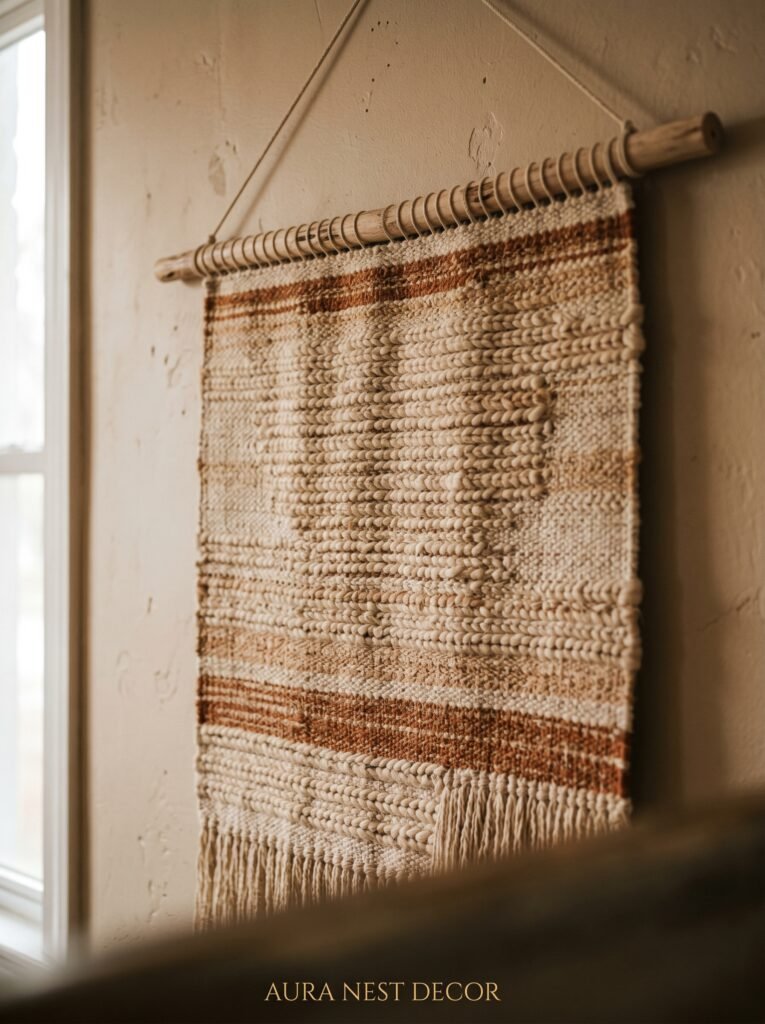
A textile hung as art. A vintage kilim. A piece of block-printed fabric mounted on a wooden frame. A beautiful piece of tapestry fabric stretched over a canvas form. These are deeply boho at their roots but handled with the right framing and scale, they become genuinely modern art.
The framing is everything. Mounted fabric that looks floppy or sagging looks like something went wrong. Fabric pulled taught over a simple wooden stretcher frame, or hung from a perfect clean dowel with equal tension throughout, looks intentional and beautiful.
Block-print fabrics in indigo and white have a clean, almost Japanese quality that pairs beautifully with the warmer, earthier elements of boho modern. Kilim-style patterns work if the colors are kept in check — a heavily multicolored kilim can read as too much, but one in earthy reds and warm creams against a neutral wall is stunning.
In the UK especially, vintage textiles from charity shops and antique markets are a genuinely affordable way to get one-of-a-kind wall art that no one else has.
11. The Lighting on and Around Your Wall — The Part Everyone Forgets
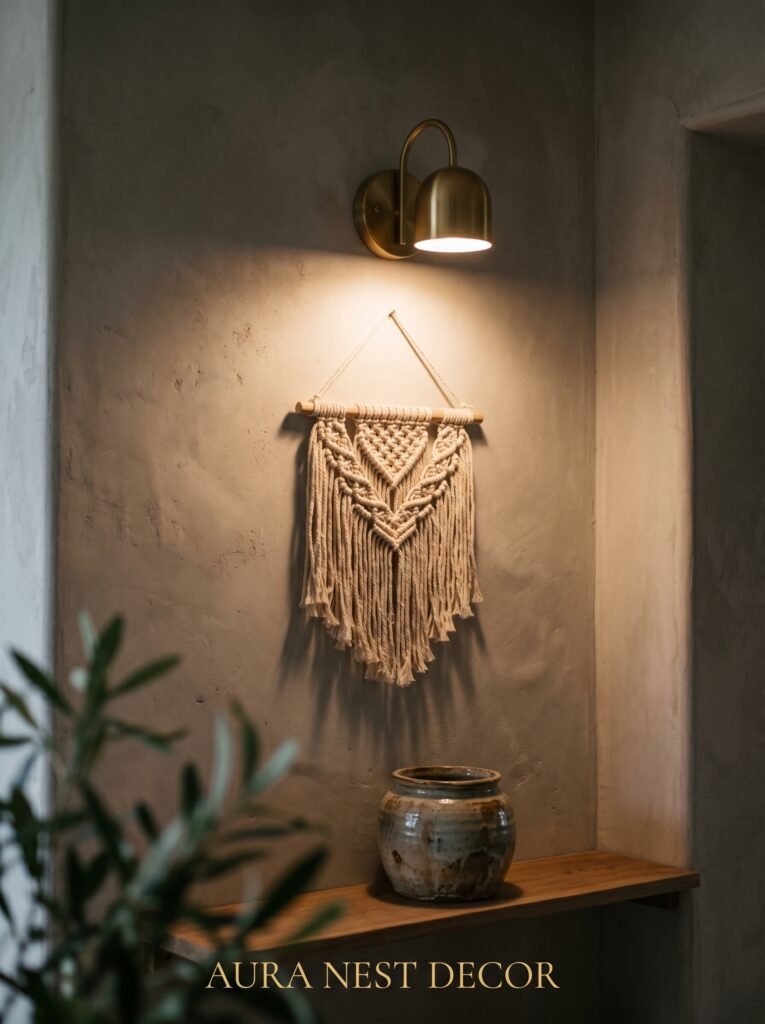
The art on your wall at noon is not the same as the art on your wall at 7pm with a table lamp and candles lit. Most people hang things and forget that lighting is part of how those things look.
In a boho modern living room, warm ambient lighting — particularly from multiple low light sources rather than one overhead light — is what makes textured wall decor come alive. The way a woven piece picks up amber light along its threads. The shadows a woven basket casts against the wall behind it. The glow that falls across a gallery wall from a sconce positioned just to its side.
A small picture light mounted directly above a key piece — an arched mirror, an oversized woven piece, a piece of textile art — is a design move people consistently underestimate. It’s inexpensive, it’s easy to fit, and the effect is immediate. The piece suddenly has the quality of a museum exhibit. It looks important, because it is.
Think about the lighting in the room alongside the wall decor, not as an afterthought once everything is hung.
12. The Finishing Move That Actually Makes It Look Like a Designer Did It
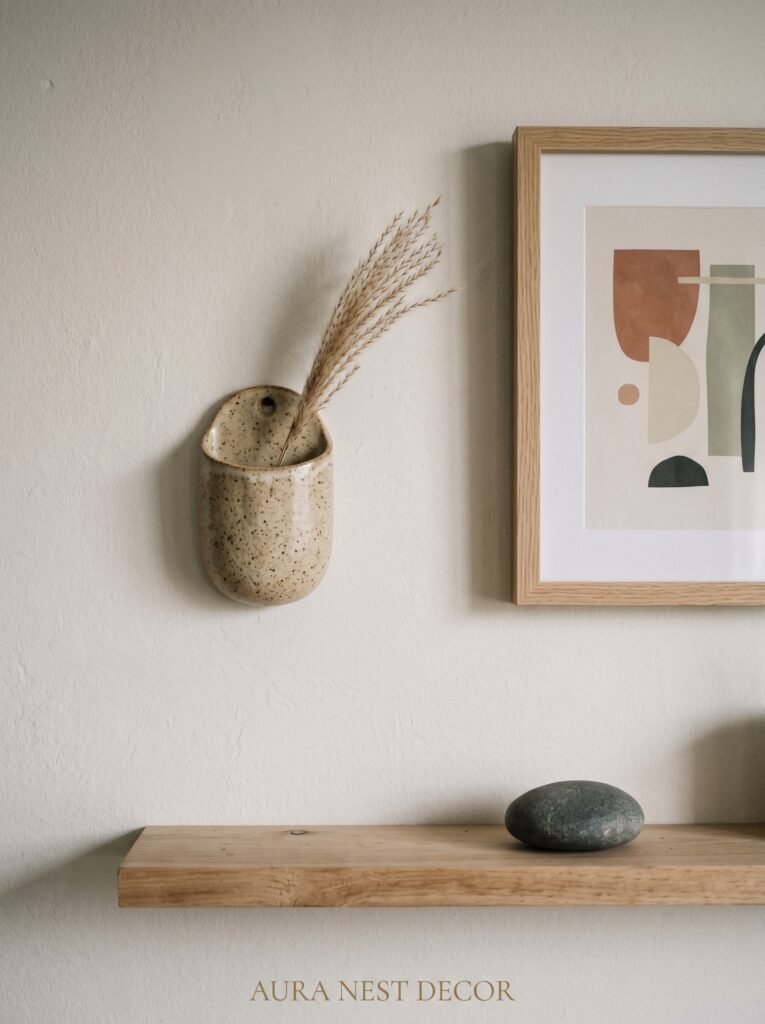
After everything is hung, arranged, clustered, and lit, there is one last move that separates the rooms that look like they were styled and the rooms that look like they were just decorated.
Step back. Far back. Look at the whole wall from the main seating position in the room. What’s pulling your eye to an awkward corner? What feels too heavy on one side? What’s missing in a gap that your eye keeps returning to?
This final editing pass is where you move one basket two inches to the left. Where you realize the gallery wall needs one more small piece in the lower right to balance the visual weight at the top. Where you discover the shelf would look better if you removed one of the three ceramics and left the space empty.
Design this specific is felt before it’s understood. You’ll know when it’s right because your eye will stop moving and start resting. That’s the moment. That stillness, that satisfaction — that’s what you’ve been building toward the whole time.
—
❓ FAQ
Q: How do I make boho modern wall decor work in a small living room without it feeling overwhelming? A: Scale everything to the wall, not the room. One medium-to-large anchor piece and two supporting elements works beautifully in a small space — the mistake is going too small with everything, which paradoxically makes the room feel cluttered. Keep significant empty wall space visible and the room will breathe.
Q: What’s the best way to hang heavy woven wall hangings without damaging plaster walls? A: Use a stud finder first and always anchor into a stud where possible. For plaster walls — particularly common in older UK homes — use proper plaster wall anchors rated well above the weight of the piece. A French cleat system hidden behind the dowel is a beautiful solution for very heavy woven pieces and means you can adjust positioning without re-drilling.
Q: Can I do boho modern wall decor in a rented flat where I can’t make many holes? A: Yes, genuinely. Command strips now hold up to 16 pounds, which covers most prints, mirrors, and lighter woven pieces. Leaning art against the wall — a large canvas or mirror on a shelf or floor — is also a completely legitimate design choice that actually reads as very current and intentional.
—
💭 Final Thoughts
The best living room walls aren’t the ones where everything was bought as a matching set from the same shop in an afternoon. They’re the ones where each piece was chosen because it meant something, or stopped the heart for a second, or just felt right in a way that couldn’t quite be explained. Boho modern gives you a framework that’s forgiving enough to hold all of that — the handmade and the intentional, the collected and the considered.
Start with one piece you genuinely love. Everything else will find its place around it.
What’s the one thing currently on your living room walls that you know in your gut has to go?