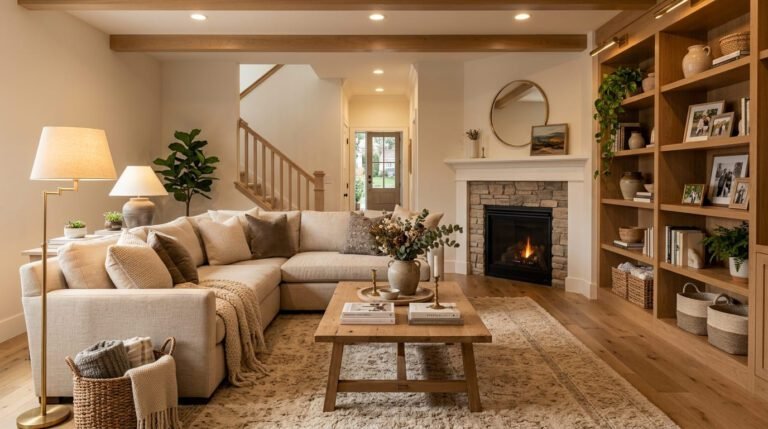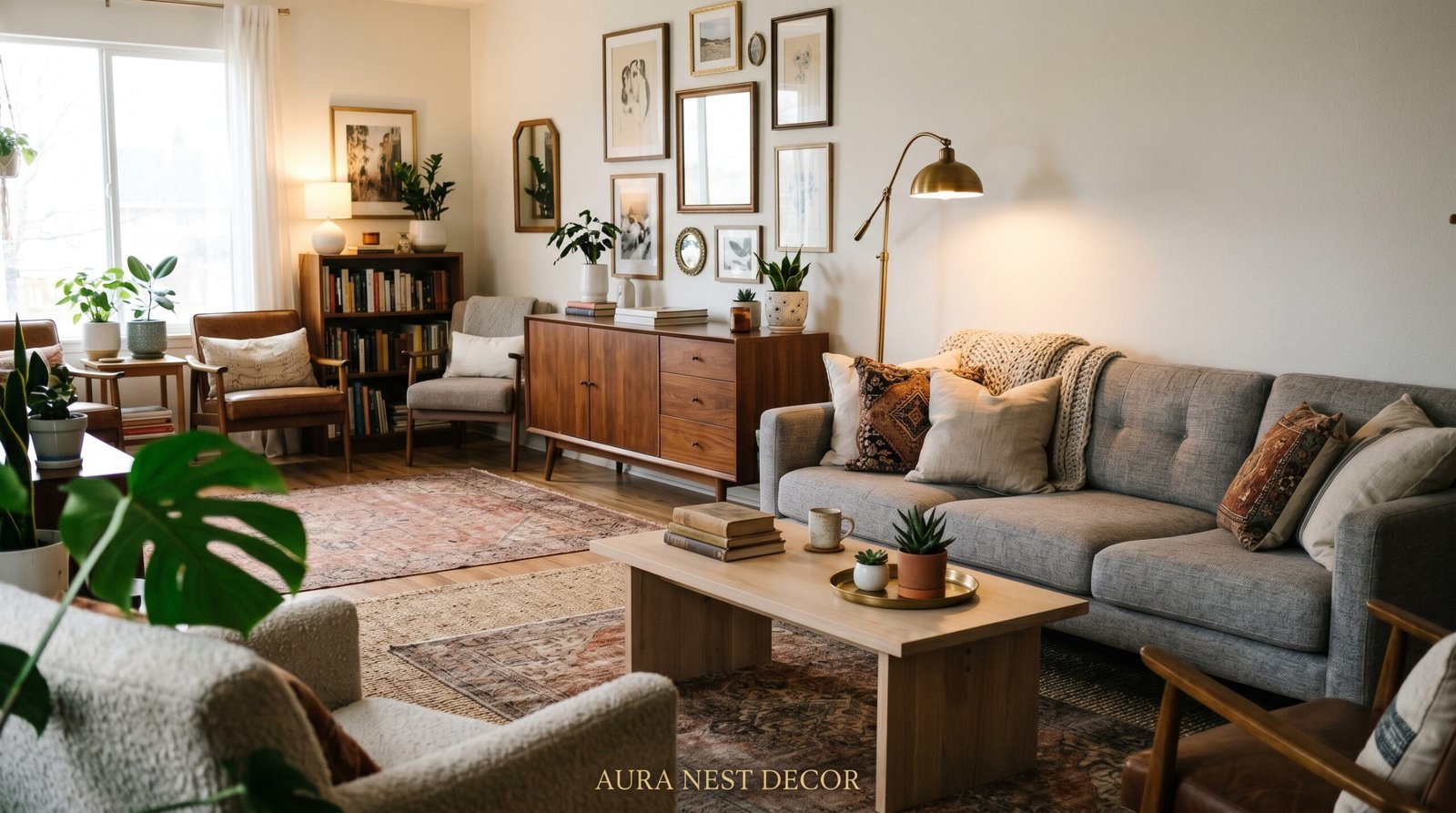
The Living Room That Looks Like It Was Collected, Not Decorated
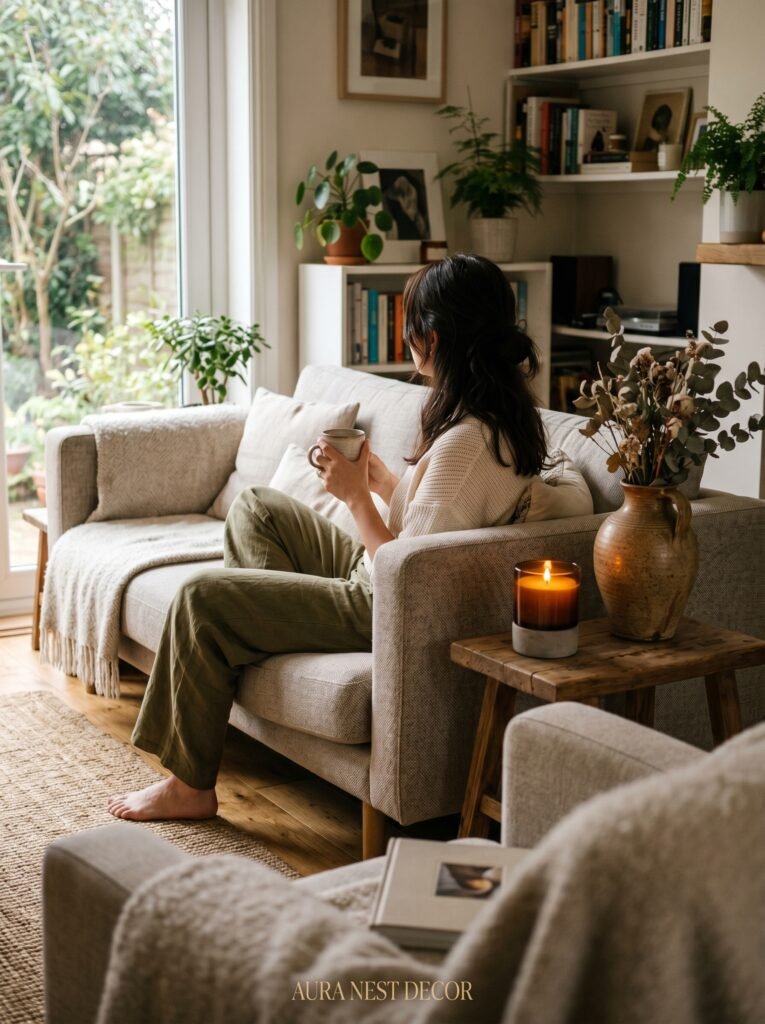
You know that feeling when you walk into someone’s home and everything just clicks? It’s not a showroom. It’s not a catalog page. It’s a room that feels like a person actually lives there — with history and intention and a few beautiful contradictions.
That’s the magic of mixing vintage and modern. And it’s more achievable than you think.
—
1. Why the Rooms That Stop You Mid-Scroll Always Have This One Thing in Common
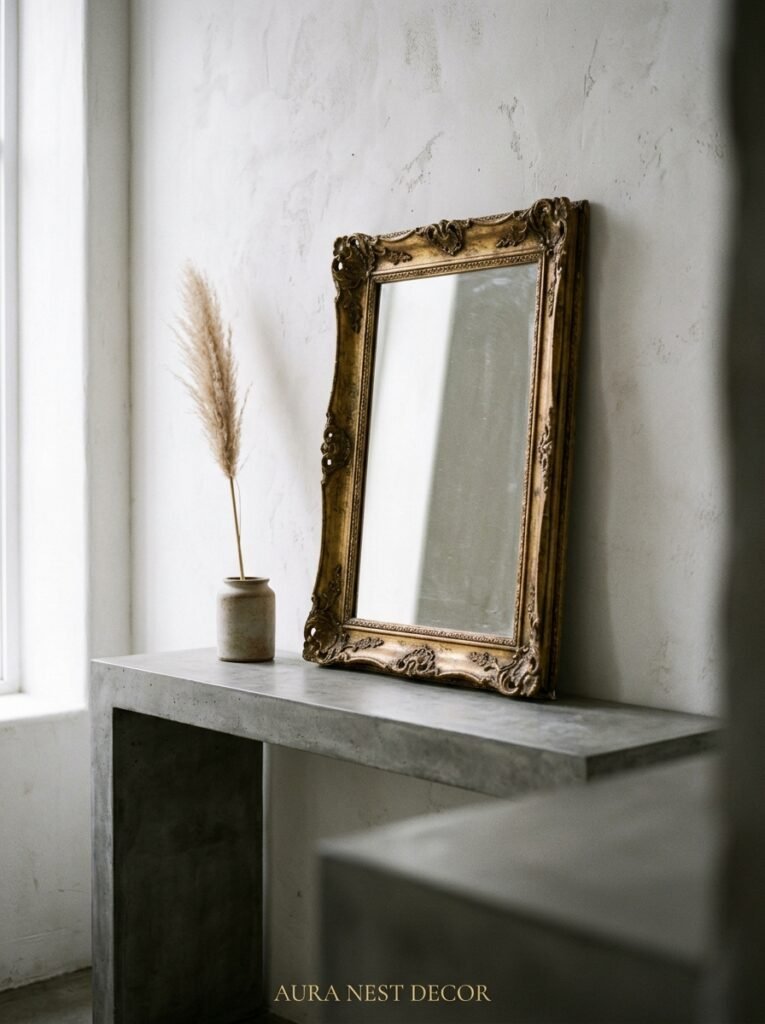
It’s not the expensive sofa. It’s not the perfect paint color. It’s tension.
The best living rooms have a quiet visual argument happening — something old pushing against something new, something rough sitting next to something refined. That friction is what makes a space feel alive instead of staged. Interior designers have known this for decades, but it’s taken Pinterest and Instagram to really spread the gospel to the rest of us.
Think about the rooms that made you pause and save. Really think. Nine times out of ten, there’s a sleek linen sofa next to a battered wooden trunk. A vintage oil painting above a concrete fireplace. A modern pendant light hovering over a Victorian settee. The contrast isn’t accidental — it’s the whole point.
What you’re actually responding to when you feel that pull is authenticity. A room that contains multiples eras of living tells a story. It suggests someone who has been somewhere, collected something, lived a life. That is worth chasing in your own home, regardless of your budget.
“A room that looks like it was collected over time will always feel more interesting than one that was bought all at once.”
2. The Invisible Grid: How to Balance Old and New Without Making It Look Like a Junk Shop
Here’s the question everyone’s afraid to ask out loud: how do you know when you’ve gone too far?
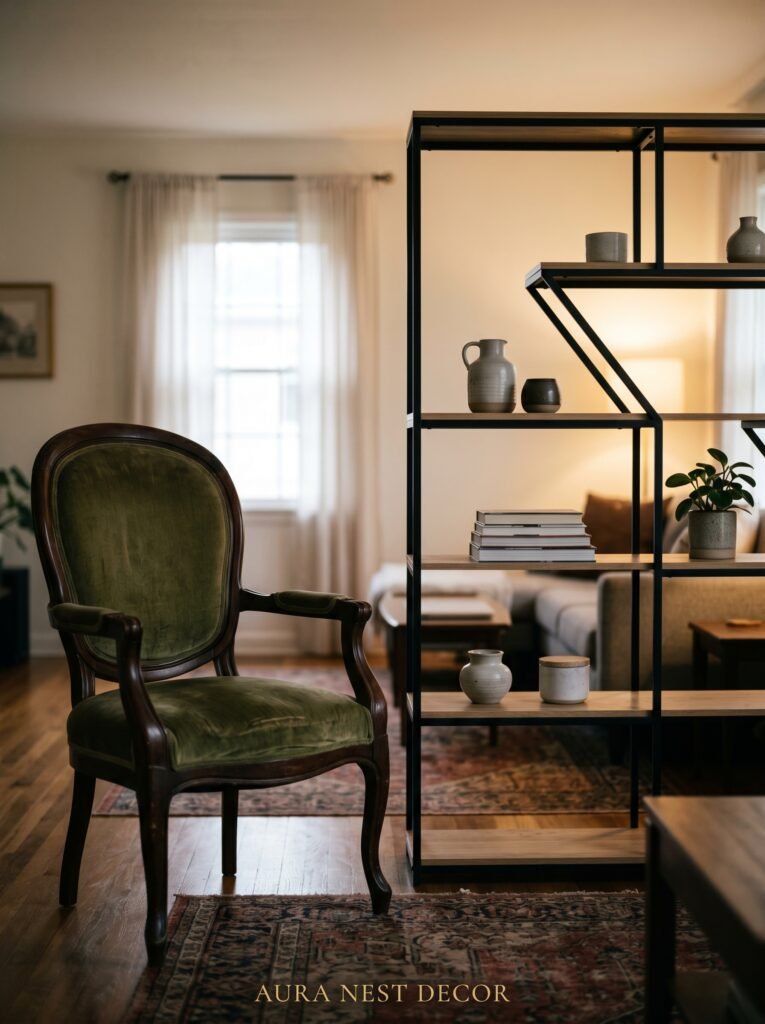
The answer is simpler than any design book will tell you. You need a rough ratio. Somewhere around 60/40 or 70/30 tends to work beautifully — either 60% modern with vintage accents, or 60% vintage-leaning with a few clean contemporary pieces to stop it tipping into grandma’s parlor territory. The exact split matters far less than the commitment to having one.
Pick your dominant era first. Are you mostly modern, with vintage as the storytelling layer? Or are you starting from a foundation of antique and period pieces, with modern elements stopping it from feeling like a period drama set? Neither is wrong. But trying to do both equally, without intention, is where rooms start to feel chaotic.
Furniture tends to carry the most visual weight, so it’s smart to anchor that category to one side of your ratio. Let the smaller objects — lamps, books, ceramics, textiles — do the bridging work. A sleek modern sofa is far easier to soften with a faded kilim rug and a stack of old leather-bound books than the other way around.
3. The Color That Keeps Showing Up in Every Beautiful Mixed-Era Living Room Right Now
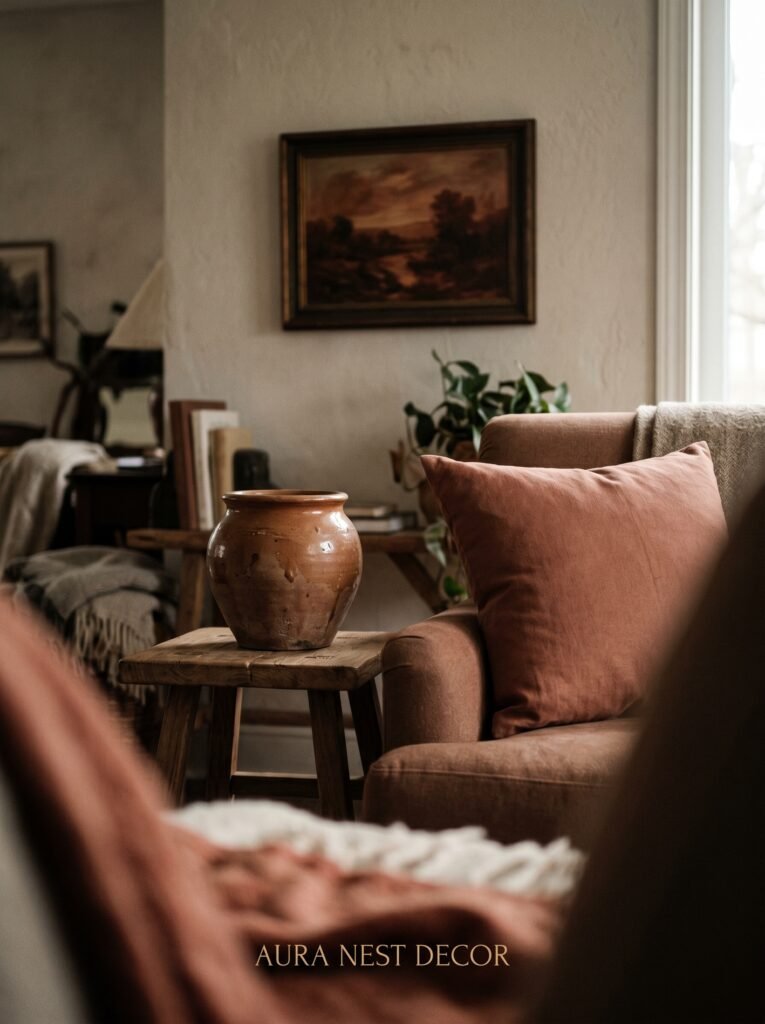
Warm white. Off-white. Aged linen. Whatever you want to call it — that not-quite-white, not-quite-cream wall color is doing heavy lifting in nearly every stunning mixed-era living room you’re saving to your boards.
And there’s a reason.
It’s the great neutralizer. Warm white walls don’t compete with either the vintage or the modern pieces in your room — they create a backdrop that lets both breathe. It also mimics the effect of aged plaster, which means a room with these walls already has a slight sense of history before you’ve put a single antique in it.
In the US, Benjamin Moore’s White Dove and Chantilly Lace both work beautifully. Farrow & Ball’s All White and Pointing are the British equivalents people reach for constantly. They read slightly differently under different light — Pointing goes warmer and almost buttery by lamplight, which is exactly what you want at 7pm when the room should feel like it’s wrapping around you.
The alternative approach — darker, richer walls — also works brilliantly in mixed-era spaces, particularly in UK homes with older architectural bones. A deep sage, a dusty terracotta, or a blue-green that sits somewhere between teal and slate will ground vintage pieces and make modern furniture feel dramatically deliberate rather than randomly placed.
4. The Furniture Combinations That Interior Designers Actually Use in Their Own Homes
Not the ones they style for clients. Their own homes.
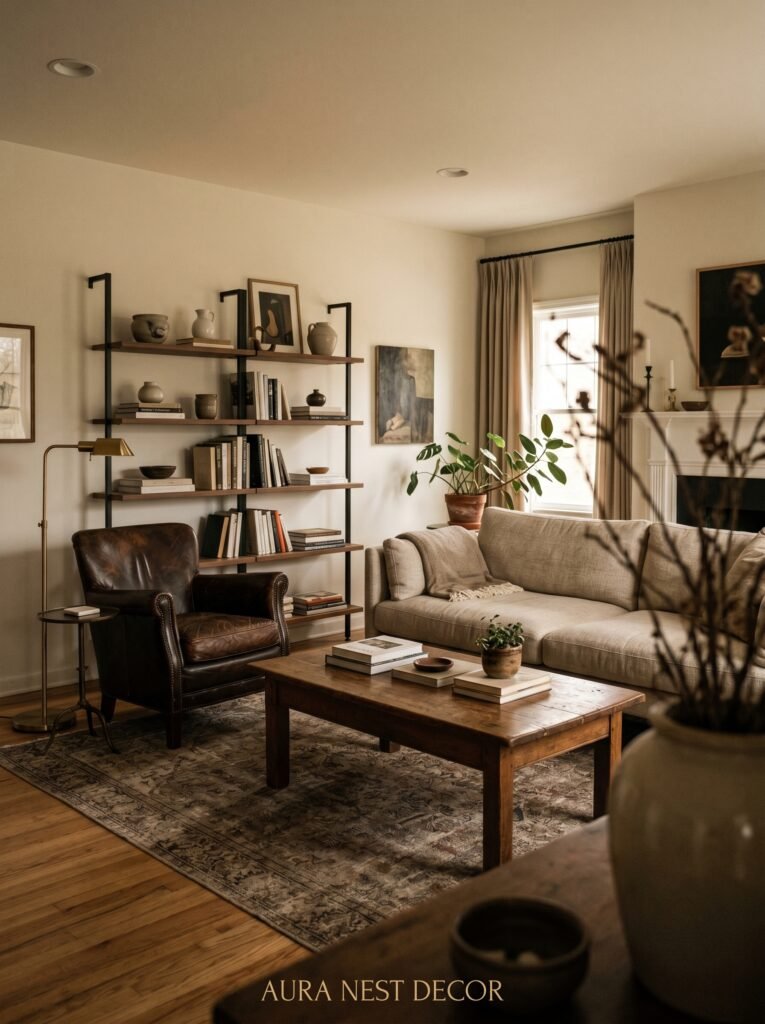
A Chesterfield sofa — tufted leather, slightly battered, ideally in cognac or forest green — next to a simple Scandinavian-influenced wood coffee table with clean lines. That combination appears in designer living rooms on both sides of the Atlantic with almost embarrassing frequency. Because it works. The Chesterfield brings history and weight. The simple table brings lightness and stops the whole thing from feeling heavy.
A pair of sleek modern accent chairs — tight upholstery, visible legs, no fussiness — flanking a Victorian fireplace. Again: the contrast does the work. The fireplace is the anchor of period detail. The chairs signal that the people living here aren’t trying to recreate a specific era; they’re living now, in a space with beautiful bones.
Mid-century modern pieces are perhaps the most versatile bridge pieces in existence. A walnut sideboard from the 1950s or ’60s feels equally at home next to Georgian architectural details or a clean, minimalist modern interior. If you’re building a mixed collection from scratch and you’re not sure where to start, a genuine or well-made reproduction mid-century piece is almost always a safe first step.
“The Chesterfield sofa is the single most versatile antique you can own. It agrees with almost every other era of design.”
5. What to Do With Your Grandparents’ Furniture (That Isn’t Just Repainting Everything Chalk White)
Let’s talk about this honestly.
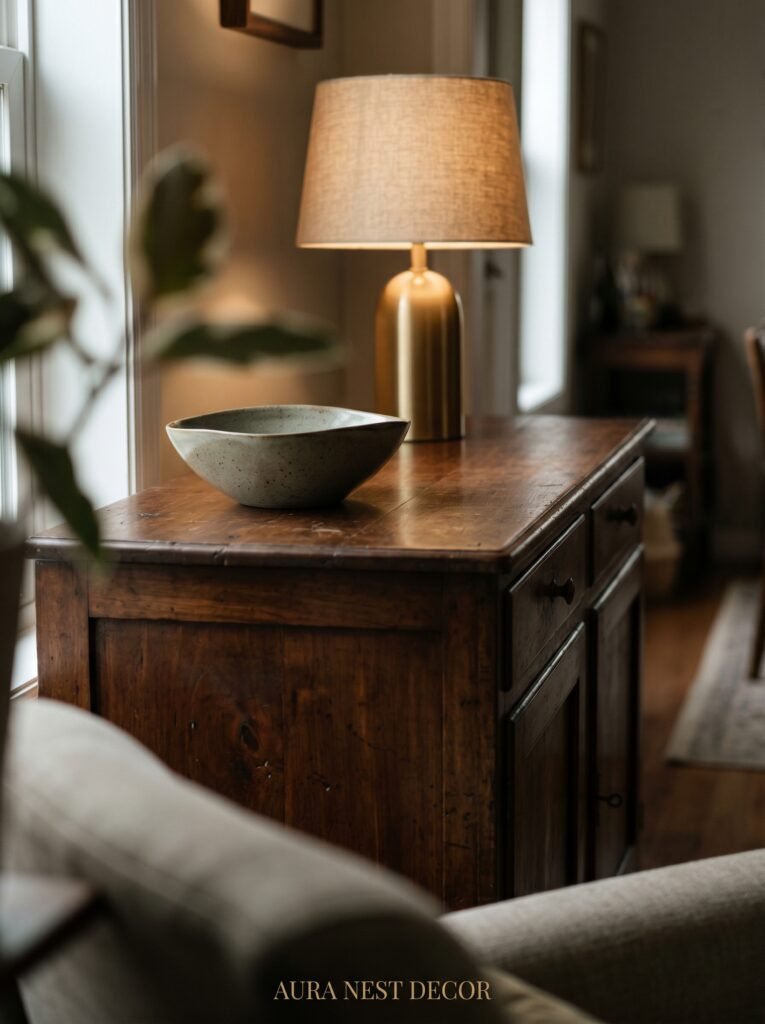
A lot of us have inherited pieces. A carved oak sideboard. A wing chair in faded tapestry fabric. A dark wood dresser that came from someone’s childhood bedroom. These things carry emotional weight, and they deserve better than a hasty coat of chalk paint that strips their character in an attempt to make them “modern.”
Here’s what actually works. Reupholstery with a deliberately contrasting fabric is one of the most powerful things you can do to a vintage piece. Take that carved Victorian chair frame and put a bold geometric or a plain contemporary linen on the seat and back. The frame stays exactly as it is — which is the whole point — but the fabric signals that someone made a considered choice. It’s not inherited passively. It was chosen.
Lighting placement is another underrated tool. An inherited dark wood piece will feel dramatically different — more intentional, more curated — if it has a contemporary lamp standing beside it or if you’ve hung a modern mirror above it. You’re recontextualizing it without touching it.
And sometimes? Sometimes doing nothing is right. A genuinely beautiful piece of old furniture doesn’t need to be “updated.” It needs space to exist, with enough room around it that the eye can appreciate it properly.
6. The Rule About Rugs That Nobody Tells You Until You’ve Already Made the Mistake
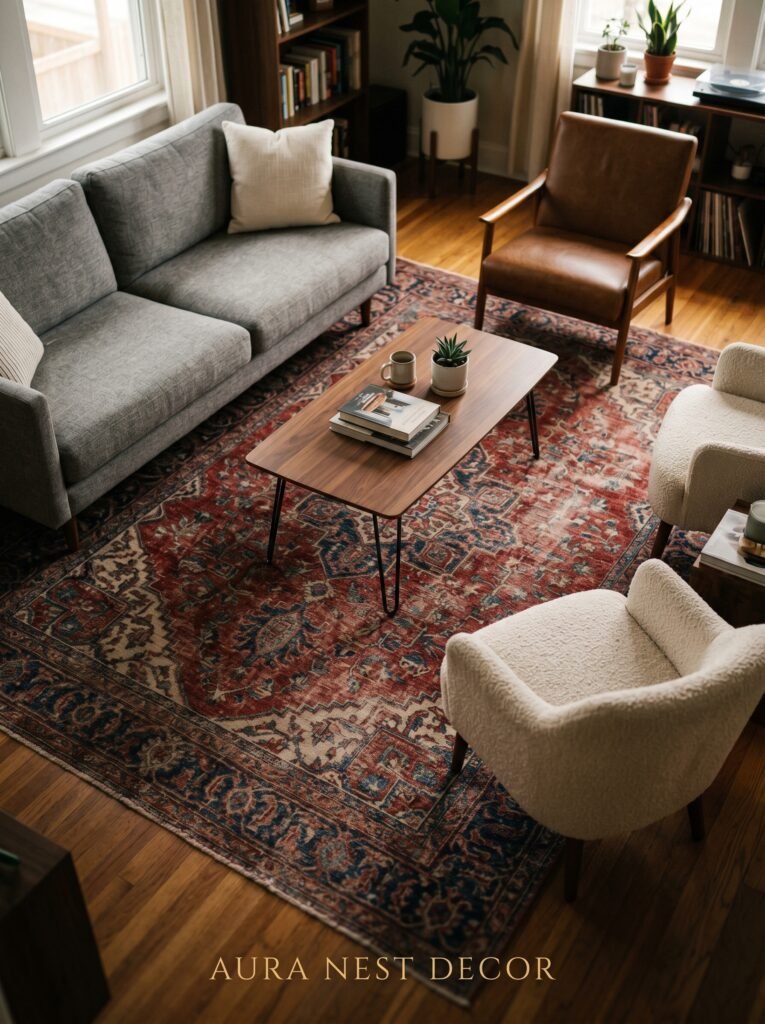
Rugs are the single most powerful tool in a mixed-era living room, and they’re also the thing most people get wrong first.
The mistake is choosing a rug that “matches.” A traditional Oriental rug with only vintage furniture, or a modern geometric with only contemporary pieces. This is a missed opportunity of the highest order.
The rug is your bridge. It’s the thing that can make two completely different furniture eras look like they belong in the same room. An antique or vintage Persian or Turkish rug under a modern sofa is practically a design cliché at this point — but it’s a cliché because it’s reliably, consistently beautiful. The worn, rich colors of a well-aged rug warm up the clean lines of contemporary furniture in a way that almost nothing else can.
Conversely, a modern flatweave — simple stripe, solid color, plain texture — can ground a room full of antiques and period pieces, providing the visual “floor” of contemporary life beneath all that history.
The one rule worth memorizing: the rug should connect to something in the room, but it doesn’t have to match everything. One thread of color, one material echo, one tonal relationship. That’s enough.
7. How People in Small British Terraces Are Making This Look Extraordinary
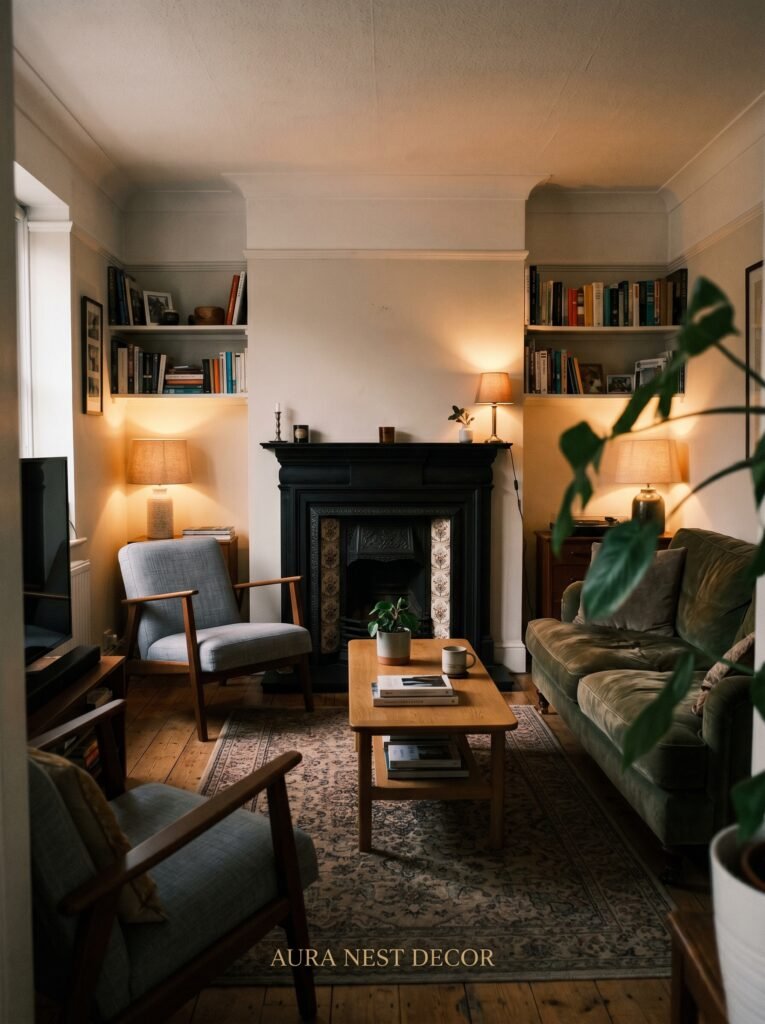
Space is finite. Character is not.
UK homes — particularly Victorian and Edwardian terraces, which make up a huge proportion of the housing stock — come with built-in vintage bones. Cornicing, picture rails, fireplaces with original tiles, bay windows, original floorboards. These are not problems to design around. They are assets to build from.
The most beautiful small mixed-era British living rooms I’ve seen keep the architectural details absolutely intact and then introduce a handful of very deliberate modern pieces. A single contemporary sofa. One clean-lined floor lamp. A pair of simple open shelves instead of a bulky traditional bookcase. The period features of the room become the “vintage” element — you don’t even need antique furniture. The room’s architecture is doing that work already.
And then there’s the gallery wall approach. Original Victorian fireplaces and cornicing paired with a mix of modern art prints, vintage botanical illustrations, and personal photographs. No single era dominates. The wall tells a story in layers, which is exactly what a mixed-era room should do.
“In a Victorian terrace, the house itself is the vintage piece. Everything else is just in conversation with it.”
8. The Lighting Decision That Changes Everything (And Costs Less Than You’d Think)
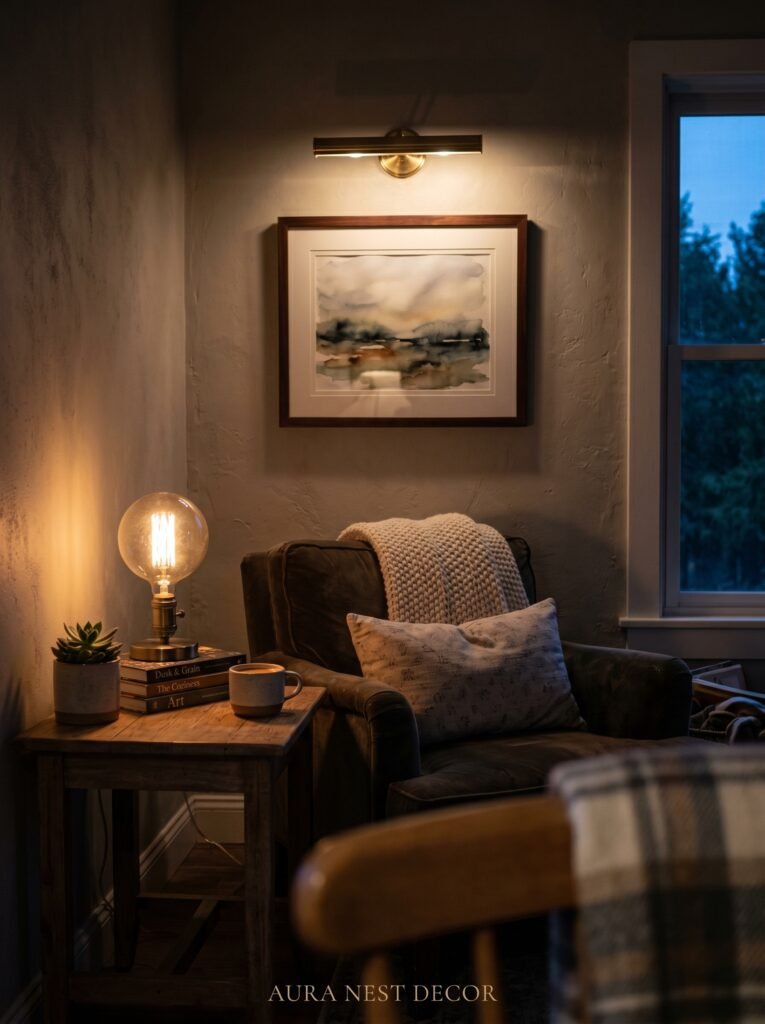
I’ll be direct. If your lighting is wrong, nothing else matters very much.
Overhead lighting is the enemy of warmth, in nearly every living room, in every country, at every price point. A single central overhead light — especially a cool-toned one — will flatten a room’s character and make even the most beautiful furniture look ordinary.
The solution in a mixed-era living room is layered light from multiple sources, and here’s where the vintage-modern mix actually pays off in the most practical way. A vintage or antique lamp — a ceramic base from a charity shop, a brass floor lamp from an estate sale, a rewired Victorian oil lamp — gives warm, directional, intimate light that transforms the atmosphere of a room at no great cost. Pair it with something cleaner and more contemporary — a simple arc floor lamp, a modern pendant if your ceiling allows — and you have exactly the kind of layered warmth that looks expensive but often isn’t.
The specific quality of light from an old brass lamp at 7pm on a winter evening is genuinely different from modern alternatives. It has a quality — slightly amber, slightly imperfect — that no LED strip will replicate. That is worth seeking out.
9. The Objects on Your Shelves Are Telling a Story — Make Sure It’s a Good One
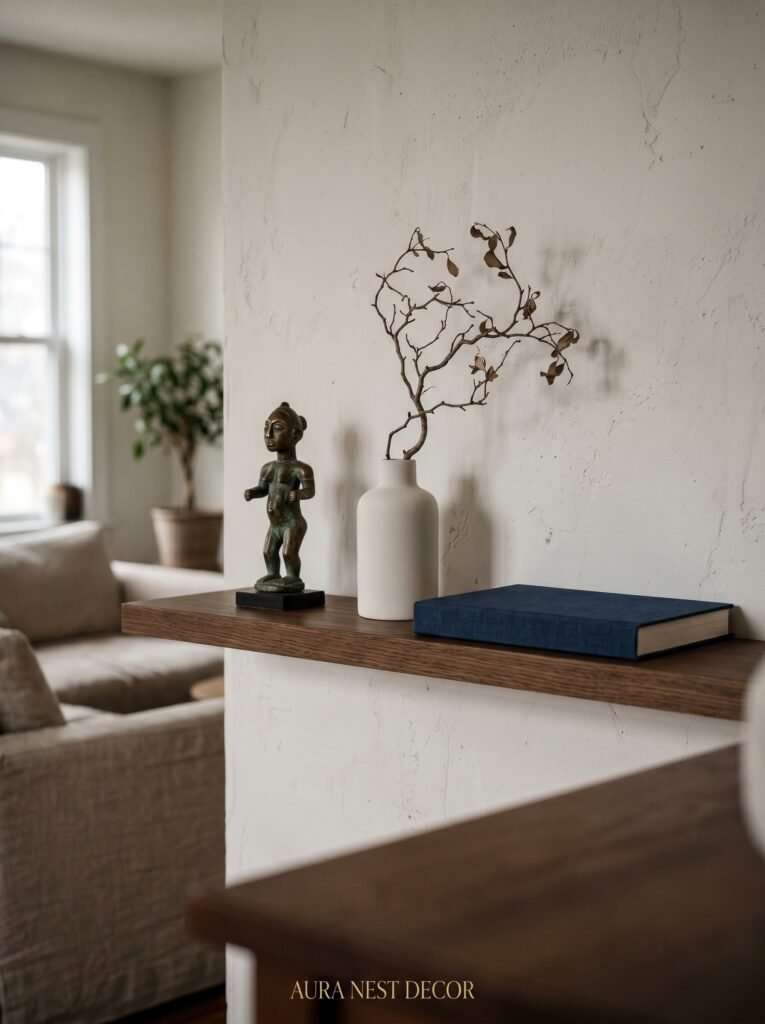
Shelf styling in a mixed-era room is where a lot of people either nail it completely or unravel all their good work.
The principle is simple: edit. Ruthlessly. Whatever you think you want to display, remove one third of it. The objects that remain will look twice as considered and the eye will actually land on them instead of sliding past overwhelmed.
What to mix: old books (real ones, with interesting spines) next to simple modern ceramics. A piece of sculptural driftwood next to a clean contemporary vase. A vintage clock next to a modern lamp. The objects should be varied in height, material, and era — but the shelf as a whole should feel calm, not crowded.
What to avoid: themed collections that tip into “decor shop display.” Multiple items in the same category — several vintage clocks, a whole row of identical ceramic pots — remove the sense of personal collection and replace it with something that feels retail. One clock is interesting. Five clocks is a statement you have to really commit to.
10. Where to Actually Find Vintage Pieces That Don’t Look Like Sad Charity Shop Rejects
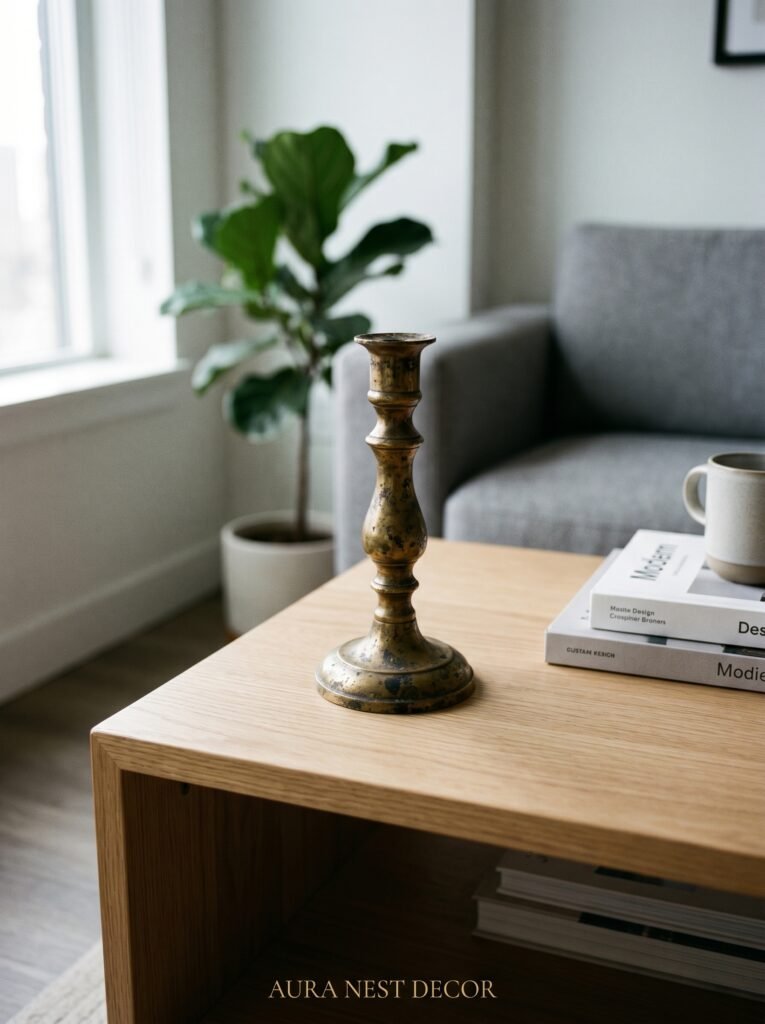
Let’s be practical.
In the US: estate sales are your best source, full stop. Not antique malls (overpriced and often curated to within an inch of their life), not most vintage shops (same problem), but actual estate sales, which still move furniture at prices that feel almost wrong. Facebook Marketplace has also become genuinely excellent for local vintage finds, particularly mid-century furniture. Craigslist remains underestimated.
In the UK: charity shops in wealthy areas — particularly in the home counties and affluent market towns — regularly have genuinely good furniture and objects donated by people who are simply downsizing or clearing out a family home. Car boot sales in the summer months can be extraordinary. Architectural salvage yards for fireplaces, doors, and hardware. And eBay, which in the UK has a genuinely strong market in Victorian and Edwardian furniture that often goes for far less than it deserves to.
For both countries: auctions. Local auction houses — not Sotheby’s, but the regional equivalents — are some of the best-kept secrets in furniture sourcing. Lots of beautiful things go for almost nothing because the room isn’t full and nobody is competing.
11. The One Mistake That Makes Mixed-Era Rooms Look Accidental Instead of Curated
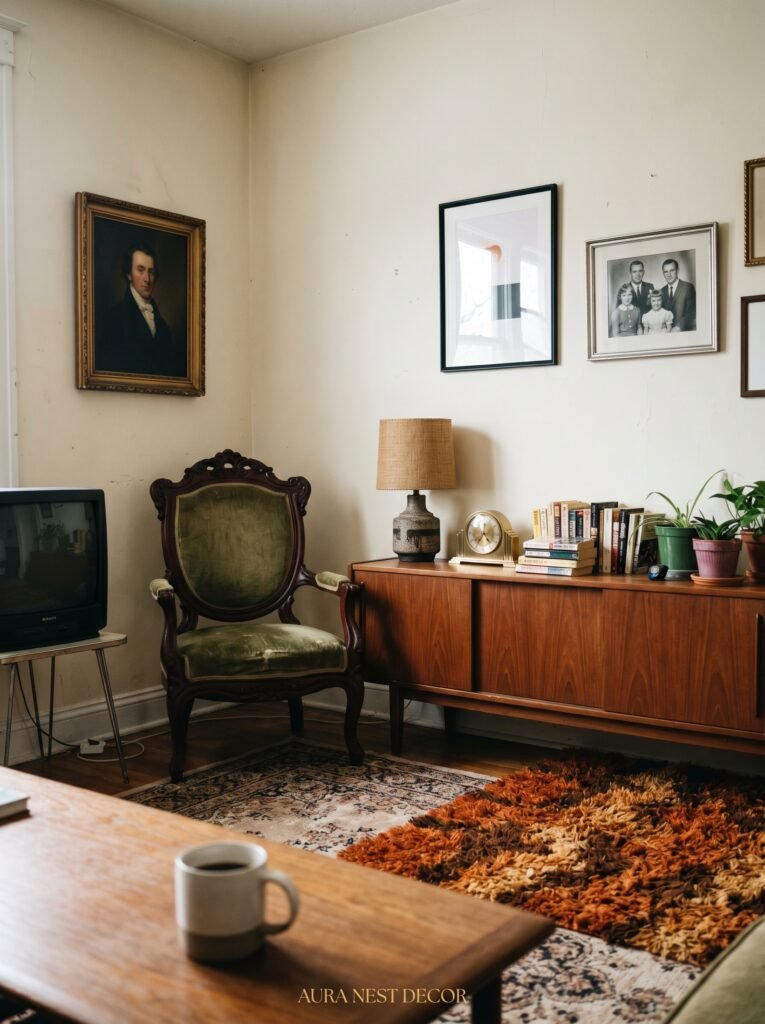
You’ve done everything right. You’ve got the ratio. You’ve got the rug. You’ve got a genuine vintage piece you love next to a clean contemporary sofa, and something still feels off.
Nine times out of ten, it’s repetition — or rather, the lack of it.
A well-curated mixed-era room has threads. A color that appears in the vintage rug and again in a modern throw pillow and again in a piece of art on the wall. A material — brass, or dark walnut, or aged linen — that shows up in at least three places in the room. These repetitions are what turn “a collection of interesting objects” into “a room with a point of view.”
Without threads, a room full of beautiful individual pieces still reads as random. With them, the same pieces read as deliberate. It’s the difference between a room that makes guests say “oh, what a lovely lamp” and one that makes them say “I love this room” — and not quite know why.
This is also the argument for buying things you genuinely love rather than things that are “vintage appropriate” or “on trend.” Your real aesthetic preferences will create threads naturally, because they come from the same person.
12. The Case for Leaving One Thing Unfinished
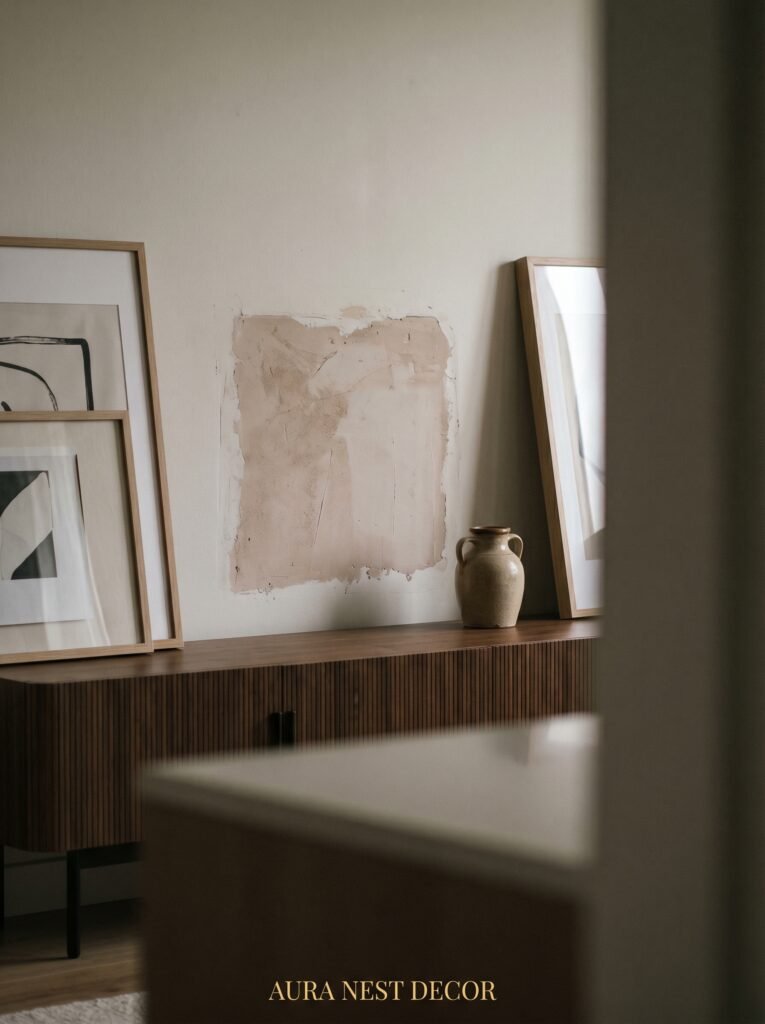
The most alive living rooms I’ve ever been in — in old farmhouses in the Cotswolds, in brownstones in Brooklyn, in Edinburgh flats with original floors — have all had one thing in common.
They weren’t finished.
There was a corner that wasn’t quite resolved. A wall with nothing on it yet. A piece of furniture waiting for the right companion. And far from making the room feel incomplete, it made it feel ongoing. Like the people living there were still paying attention. Still discovering. Still in conversation with their home.
A living room that mixes vintage and modern is, by its very nature, a work in progress. You find things. You fall out of love with things. You stumble on something at a car boot sale or an estate sale that changes the whole feeling of a corner. That’s not a sign you’re doing it wrong.
That’s exactly the point.
—
❓ FAQ
Q: Do my vintage and modern pieces need to be from specific eras to work together? A: No, and this is one of the most liberating things about this approach. Victorian, mid-century, Art Deco, 1970s, and contemporary pieces can all coexist in the same room. What matters far more than era-matching is material consistency and intentional contrast — a thread of color or texture that runs through the pieces, rather than a strict timeline.
Q: I have a very small living room. Can mixed-era decorating work in a tight space? A: It actually tends to work better in small rooms, because you have fewer pieces to commit to and every object carries more weight. Choose one or two vintage pieces with real character and keep the remaining furniture clean and understated. The vintage pieces will do all the storytelling the room needs without overwhelming the space.
Q: Is it worth investing in genuine antiques, or do good reproductions work just as well? A: Genuinely good reproductions — particularly of mid-century pieces — can work very well and are often far more practical. But there is a quality of light, wear, and material aging in genuine vintage pieces that reproductions rarely capture fully. Even one or two real antique or vintage objects in a room of otherwise new furniture will make a noticeable difference to how the whole space feels.
—
💭 Final Thoughts
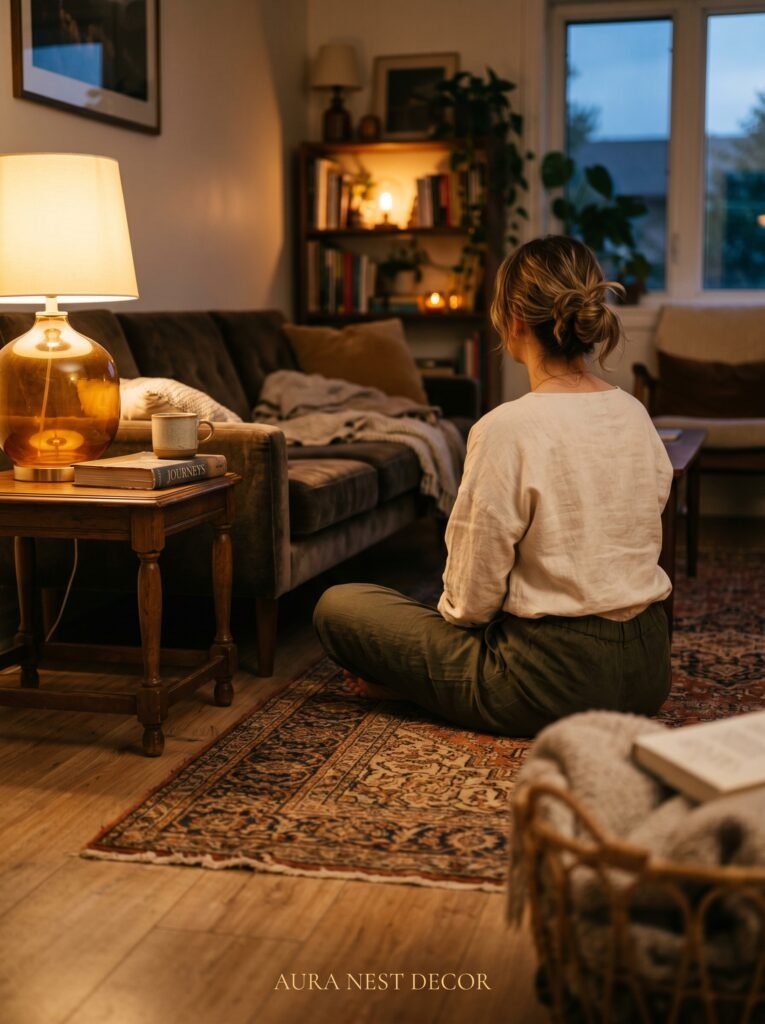
The rooms we remember are never the perfect ones. They’re the ones that felt like someone actually lived inside them — rooms with a story told in layers, with contradictions that somehow made sense, with one lamp that cast exactly the right shadow at exactly the right time.
You don’t need to buy everything at once, or get it right immediately, or follow a strict formula. You just need to start looking — at what you already own, at what moves you, at what a room is trying to become.
What’s the one piece in your living room right now that you’d never give up, no matter what era surrounds it?