When Old Ornaments Meet New Rooms: Vintage Christmas Decor Ideas That Actually Work in Modern Living Spaces
You know that feeling when you walk into someone’s home in December and it just feels like Christmas — not in the overwrought, every-surface-covered way, but in the way that makes you slow down and actually look? That’s almost always vintage doing the heavy lifting. Here’s how to bring that feeling into a modern living room without making it look like your grandmother’s attic exploded.
—
1. The Single Vintage Piece That Does More Work Than a Whole Tree
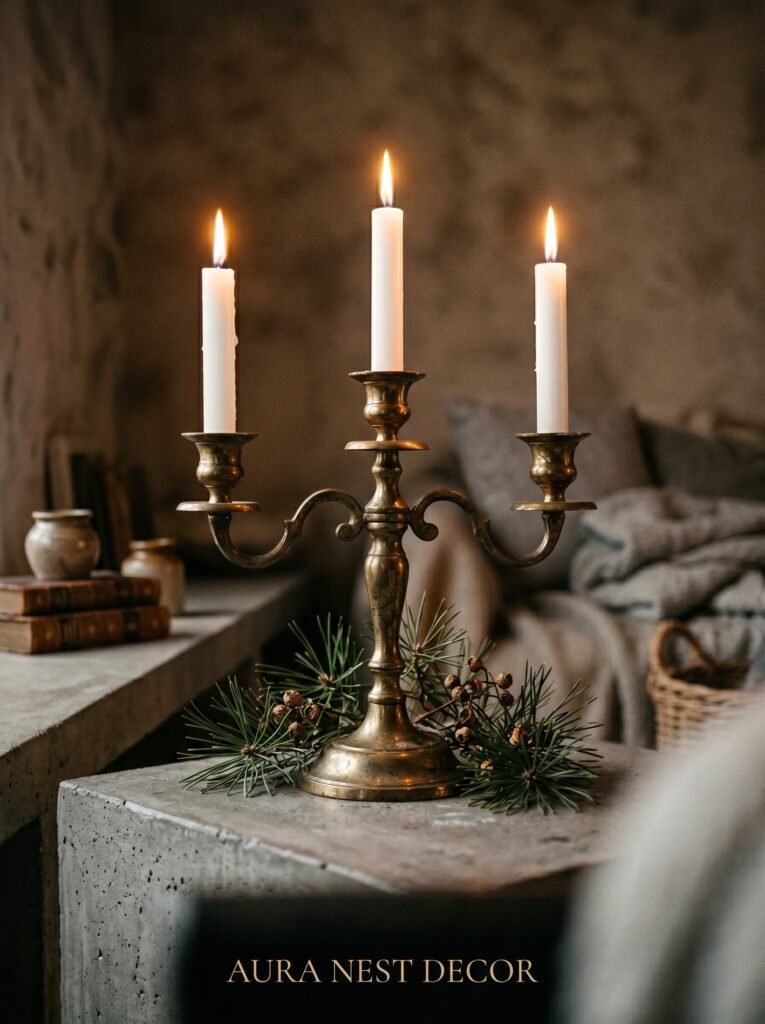
Here’s the thing nobody tells you about vintage Christmas decor: restraint is the secret weapon.
One genuinely beautiful antique piece — a mercury glass reindeer, a set of hand-blown German glass baubles in faded coral and gold, a brass candle holder with decades of patina — does more for a modern living room than a dozen trendy items from a big-box store. It creates a focal point that stops people in their tracks. It asks to be touched. It tells a story, and modern rooms desperately need stories.
Think about your mantelpiece, your console table, your bookshelf. Pick one surface. Now imagine placing a single piece there — something with age and weight and beauty — surrounded by intentional negative space. That negative space isn’t emptiness. It’s a frame. It tells everyone looking that you knew exactly what you were doing.
The piece doesn’t need to be expensive. A single mercury glass vase found at a car boot sale in November, placed on a linen cloth with one candle beside it, will outperform anything mass-produced every single time.
“One piece with a past beats a hundred pieces with no story.”
2. The Color Palette That Shows Up in Every Stunning Vintage-Modern Christmas Room Right Now
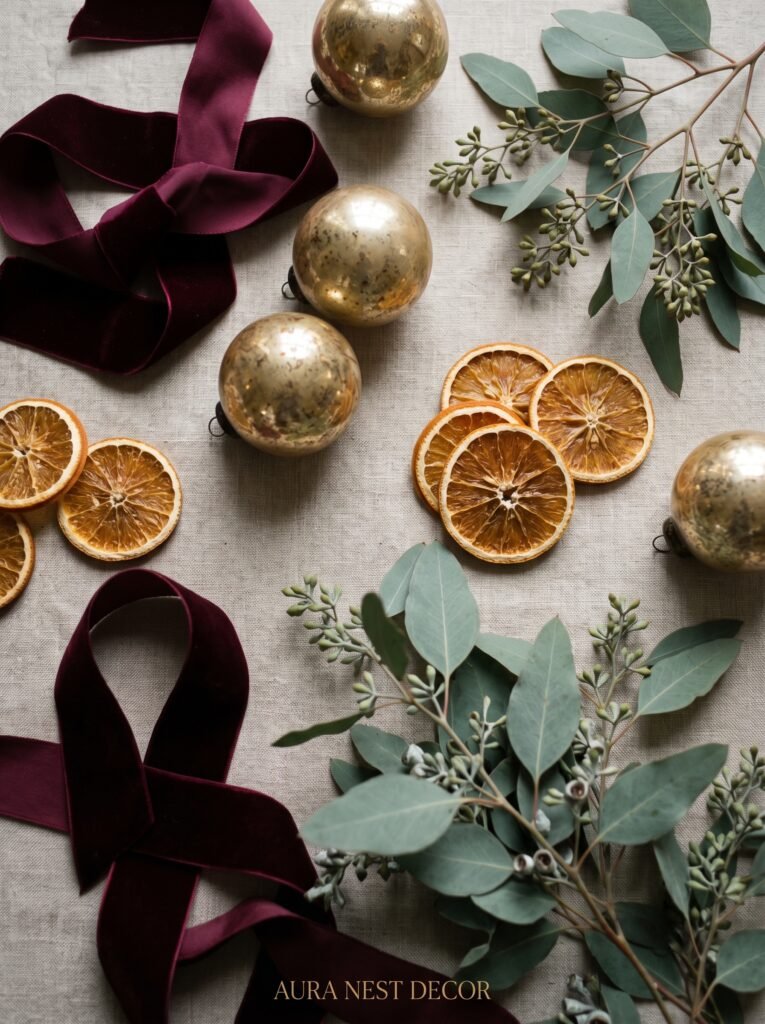
Forget red and green. Or rather — keep them, but rethink them completely.
The vintage-modern Christmas palette that’s everywhere right now is built on muted, almost dusty versions of traditional holiday colors. Think: burgundy instead of red. Forest green instead of bright green. Antique gold instead of shiny gold. Cream instead of white. And anchored throughout by a color that doesn’t get nearly enough credit — deep, almost-brown bronze.
What makes this palette work in a modern living room is the fact that it doesn’t fight the room. It sinks into it. If your sofa is slate gray, a burgundy and bronze scheme reads as sophisticated rather than festive-for-the-sake-of-it. If your walls are white or warm cream, antique gold picks up light in a way that feels genuinely luxurious without being loud.
For American readers: think Pottery Barn’s warmest colorways, then age them by twenty years. For UK readers: think National Trust gift shop palette, then strip away everything twee. What’s left is exactly right.
The trick is to commit. Half-measures in color make everything look muddy. Choose your palette, find vintage pieces in those tones, and hold the line. Consistency is what separates styled from merely decorated.
3. Why Victorian Paper Decorations Are Having Their Best Decade Yet
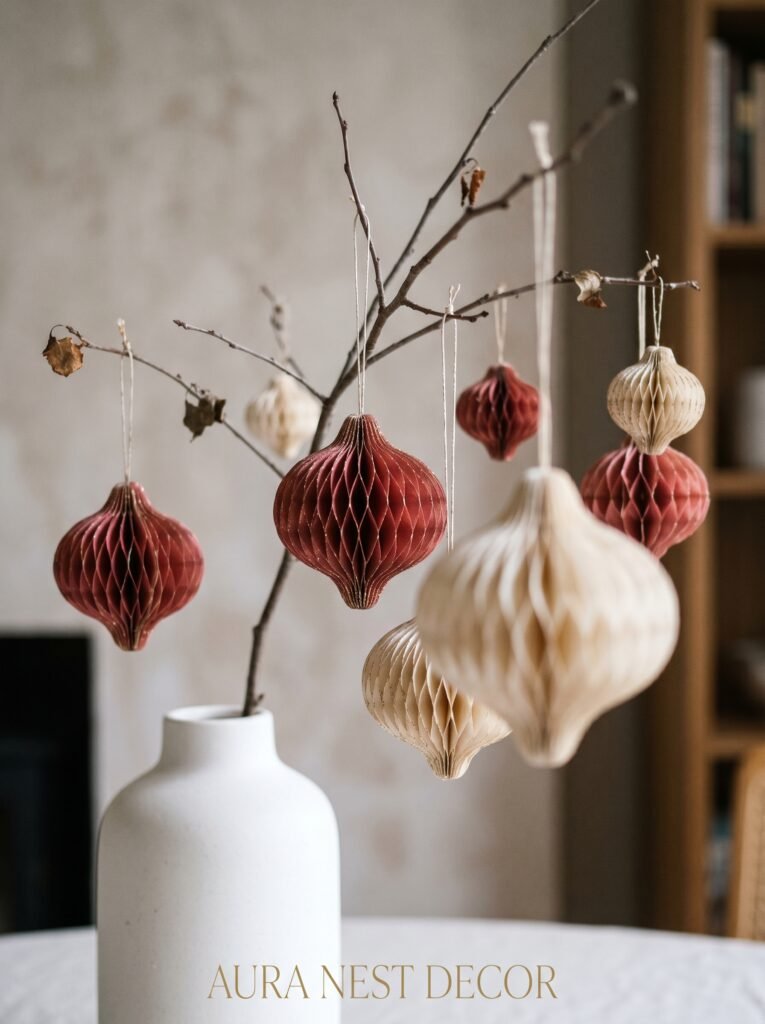
Scherenschnitte. Chromolithograph die-cuts. Paper chains made the way your great-grandmother made them, from strips of colored paper and a pot of paste.
Victorian paper decorations fell out of fashion so decisively that when they started coming back, they felt genuinely new. That’s the peculiar magic of things that have been gone long enough. They arrive again wearing fresh eyes.
In a modern living room, paper decorations do something that glass and metal cannot: they bring texture without weight, color without opacity, handmade imperfection without rusticity. Strung across a window, a Victorian-style paper garland catches light like stained glass. Draped along a bookshelf, paper chains create a softness that no string of fairy lights can replicate.
You can buy reproduction Victorian die-cuts on Etsy — the robins, the Santas, the winter flowers — and they’re beautiful. But paper chains you can make yourself in an hour on a Sunday afternoon, and they will be the thing guests comment on most. Not because they’re impressive. Because they feel personal. Because they look like someone made them with their hands, which is the most vintage thing of all.
4. The Exact Type of Vintage Lighting That Makes a Modern Room Feel Like a Painting
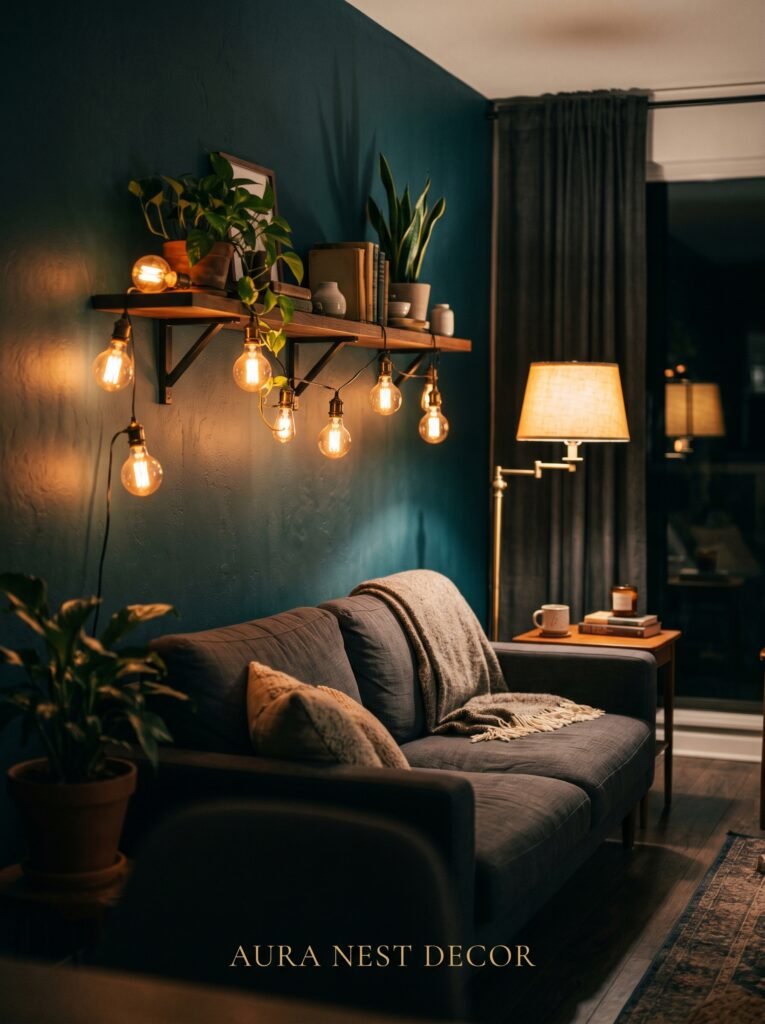
Strip lights. Recessed downlights. The cold, flat overhead glow that most modern living rooms run on by default. These are functional. They are not magic.
Here is what makes a vintage-modern Christmas room feel like something from a film set: you turn the overhead lights off entirely, and you light the room with small, warm, imperfect sources instead. Candles in vintage brass holders. A cluster of Edison-style bulb string lights draped without fuss. One or two small vintage lamp bases — milk glass, smoked amber, dark ceramic — with warm-toned bulbs inside.
The amber glow of a vintage lamp at seven in the evening during December does something to a room that cannot be achieved any other way. It softens edges. It makes people lean in. It makes a modern living room look considered and cozy rather than generic and lit.
For a true vintage effect, look for old oil lamp conversions — original oil lamps rewired for electric use — at antique markets. They cast the most extraordinary light. In the UK, car boot sales and charity shops in November and December often have exactly these. In the US, estate sales are where they hide.
“Turn off the overheads. Light a candle. Watch your whole room change.”
5. Vintage Fabrics That Mix With Modern Furniture Better Than You’d Expect
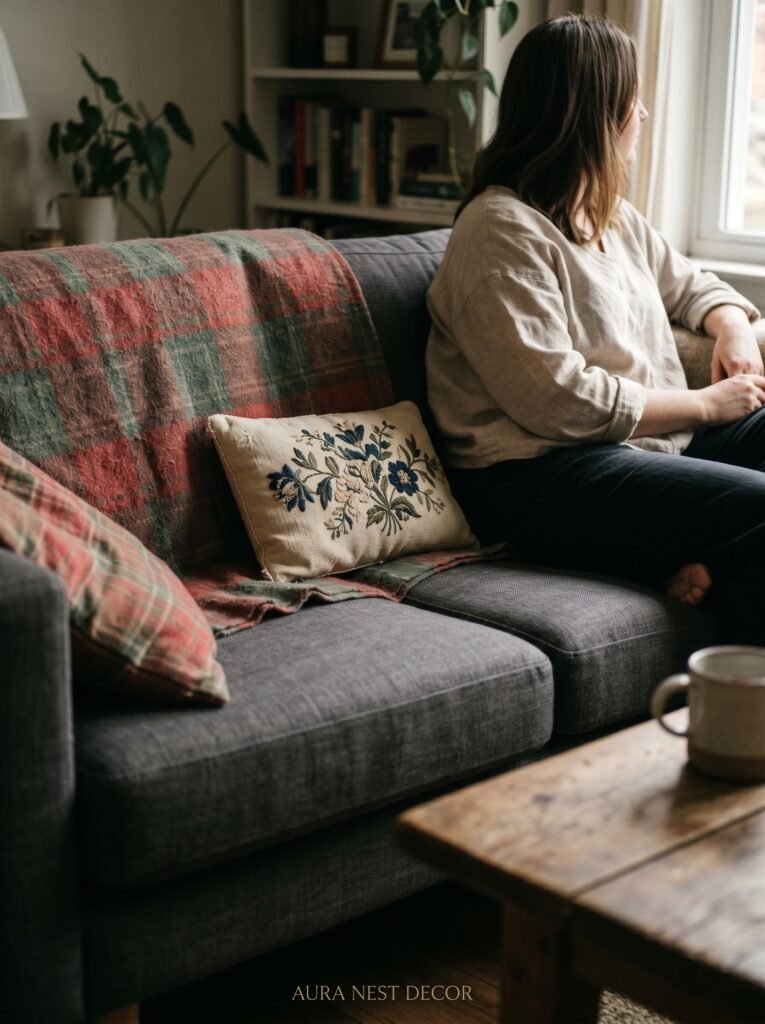
A mid-century modern sofa. Clean lines, solid upholstery, very much of-the-now. Now drape a vintage wool blanket across one arm — something plaid, maybe Pendleton, or a British tartan in deep navy and green. Add two needlepoint cushion covers from a charity shop. Place a small crewelwork piece on the armchair.
It sounds like it shouldn’t work. It completely works.
Vintage fabrics are the fastest, cheapest, most reversible way to bring heritage warmth into a modern room. They add texture that new textiles simply cannot replicate — that slightly worn, slightly faded quality that says this has been loved for a long time and it’s still beautiful.
For Christmas specifically, look for vintage red and cream quilts, old Fair Isle throws, heavy damask table runners repurposed as shelf liners, and anything with a star or geometric pattern in traditional holiday colors. Tuck them in, drape them over, fold them in thirds on a blanket ladder. They don’t need to be precious. They need to be present.
6. What to Do With the Fireplace That Every Pinterest Board Gets Wrong
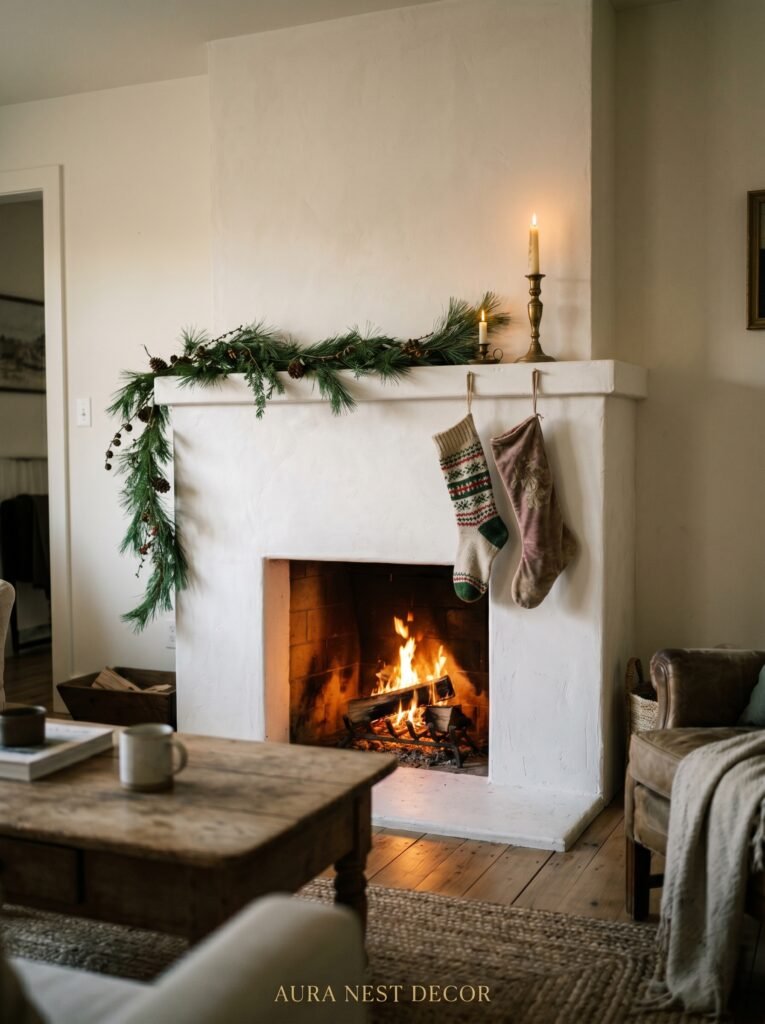
The mantelpiece is the most important surface in the room at Christmas. Most people know this. What most people get wrong is treating it like a shelf to fill rather than a composition to build.
The vintage-modern fireplace arrangement that actually works follows this logic: anchor with height on one side only. This is not symmetrical. A tall vintage candle stick, a stack of old books, an antique clock that stopped working decades ago but is beautiful — these go on one side, decidedly taller than everything else. The opposite side drops lower. The center is where the most special single piece lives.
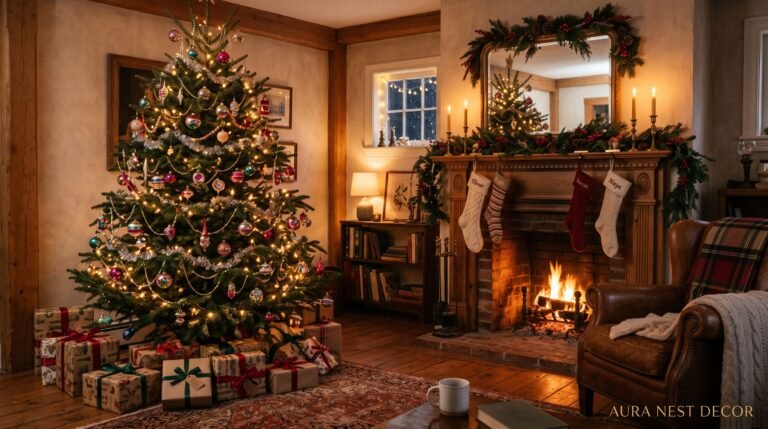
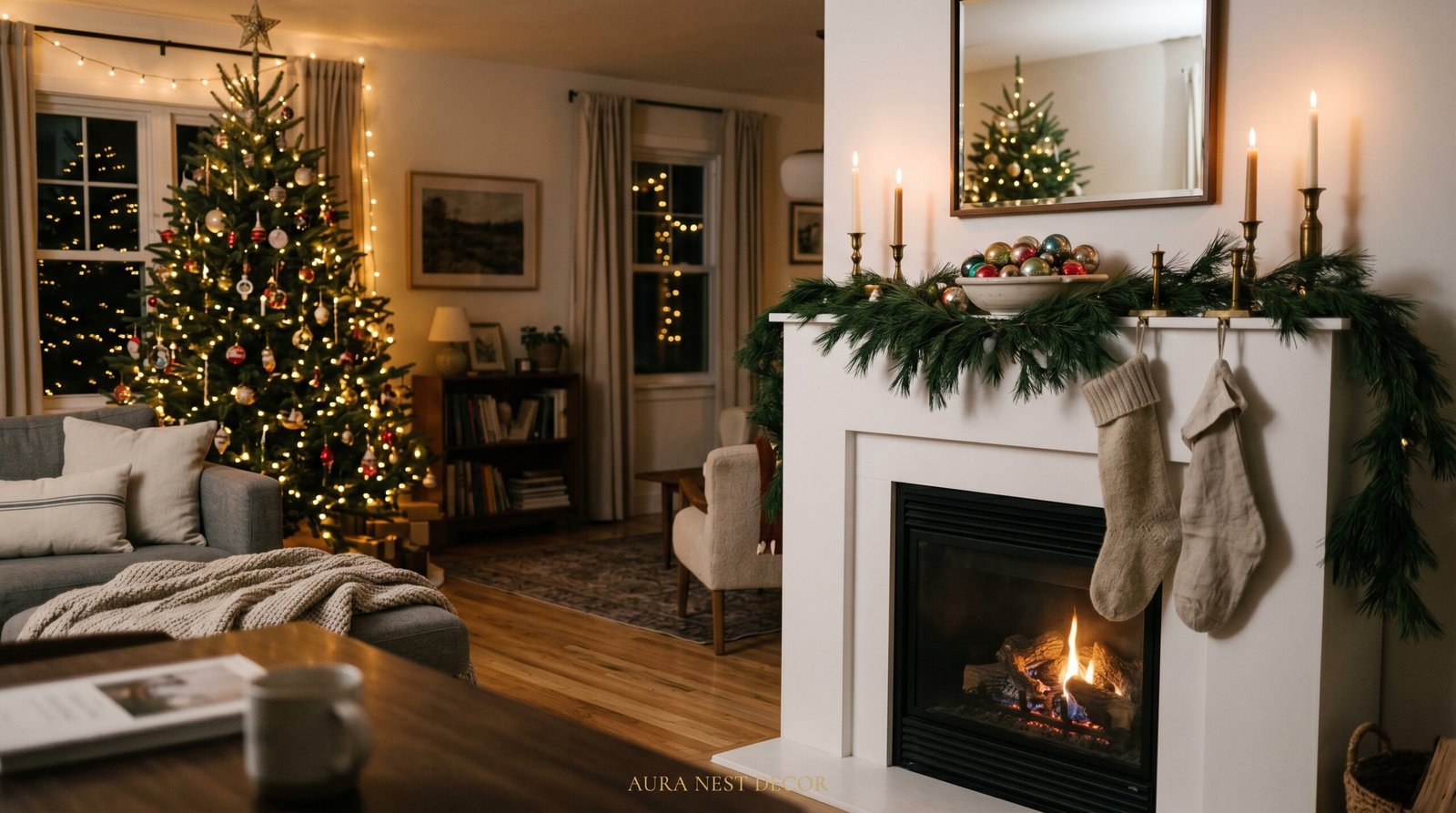
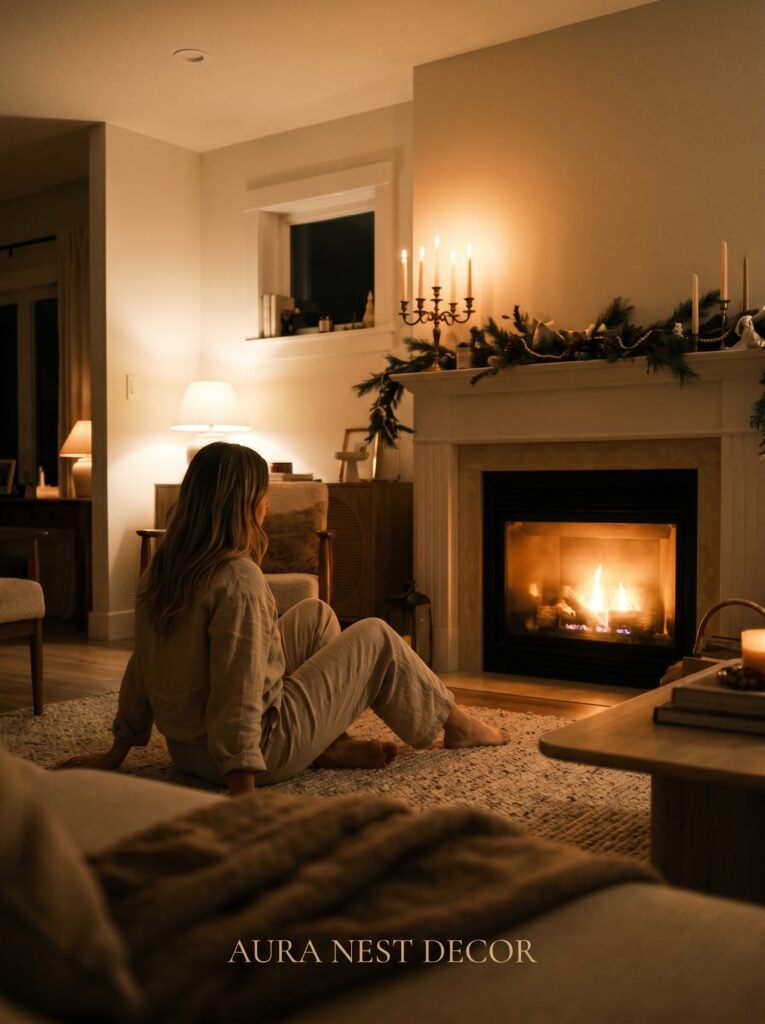
Swag a garland — loose, not overstuffed — along the mantel shelf. But leave gaps. Lay a few old mercury glass baubles in the spaces between greenery. Put a single brass candlestick with a real candle at the center. That’s it. The restraint is the point.
In a modern room with no fireplace — which describes many UK flats and American open-plan spaces — the same composition logic applies to a console table, a sideboard, or a tall bookshelf. The fireplace isn’t the requirement. The vertical anchor point is.
7. The German Glass Ornaments That Interior Designers Actually Use
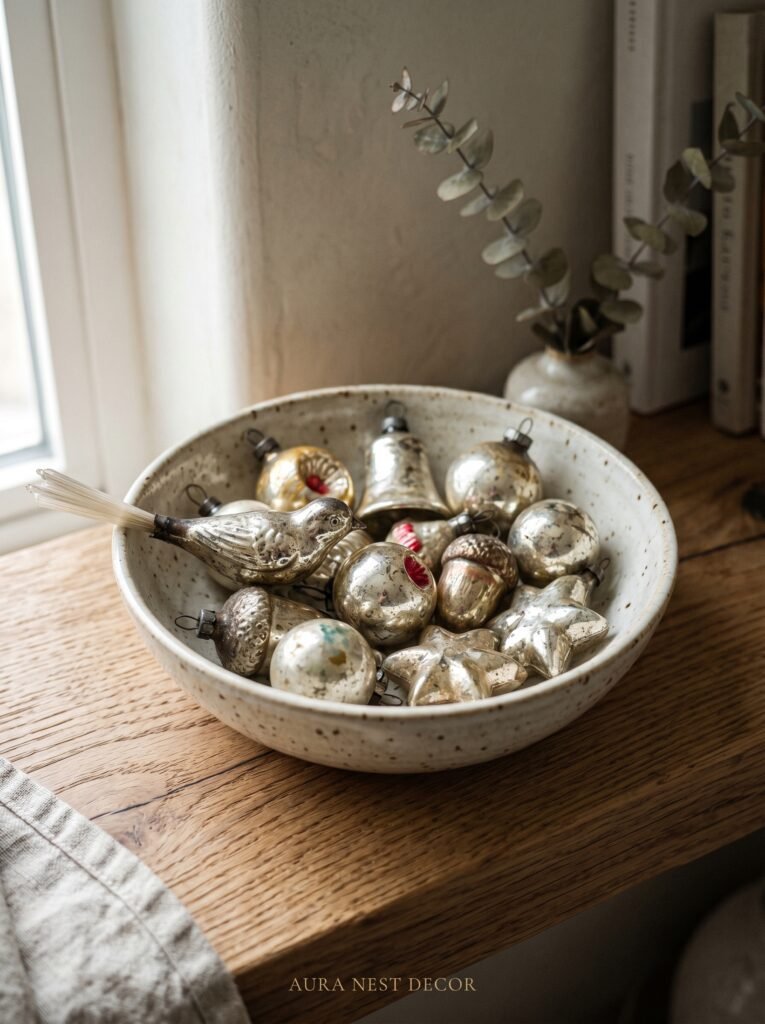
Shiny Brite. Lauscha. Inge-Glas. If these names mean something to you, you already know. If they don’t, here’s what matters: the quality of mouth-blown German glass ornaments, both vintage originals and faithful reproductions, is in a completely different category from what you find at most Christmas stores.
Vintage Shiny Brite ornaments — American-made from the 1940s through 1960s — have a particular faded luminosity that new ornaments cannot replicate. They come in colors that feel slightly wrong in the best possible way: dusty pink, silver with hand-painted stripes, pale aqua with gold caps. A small collection of them in a vintage bowl, placed on a coffee table, reads as art.
Original Lauscha glass from Germany is more expensive and harder to find but worth hunting for. These are the ornaments that started everything — made in a small Thuringian town from the 1800s onward, by families who passed the skills between generations. When you hold one, you can feel the difference.
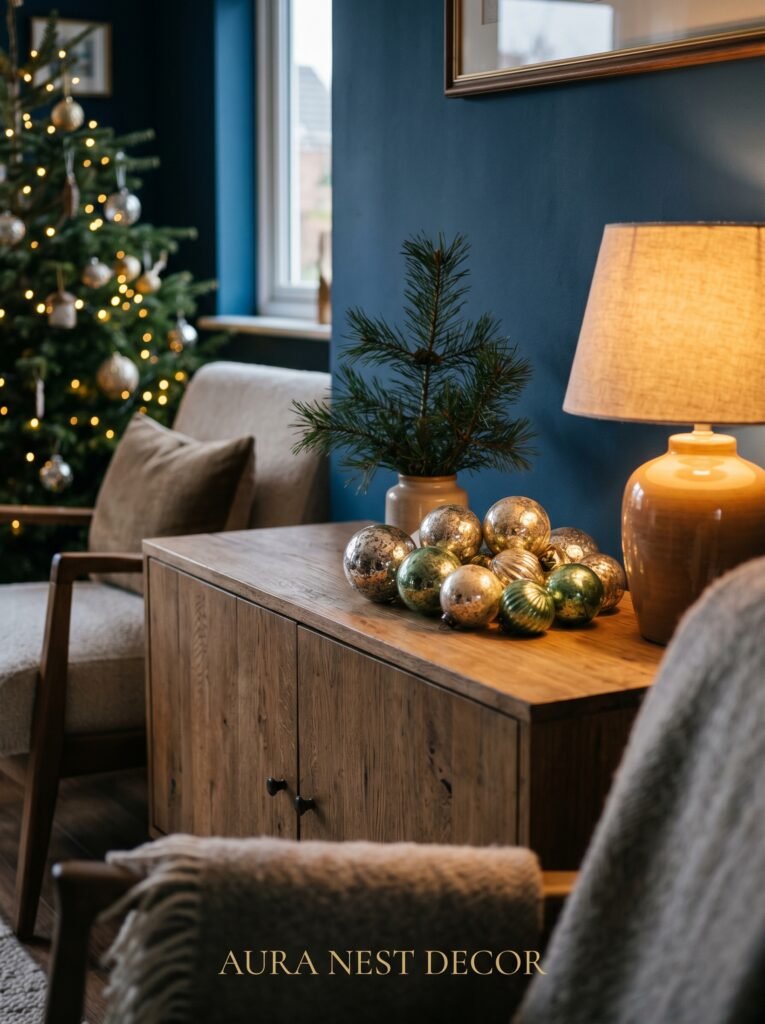
For a modern living room, the approach that works best is to cluster vintage ornaments rather than hanging them. A low bowl, a hurricane vase, a vintage tin — fill it with ten to fifteen ornaments in a tight, intentional color story, and place it where the light will catch it. You’ve just made a centerpiece that will stop scrolling fingers flat.
“Old ornaments in a bowl. That’s it. That’s the centerpiece.”
8. The Rule About Greenery That Changes Everything
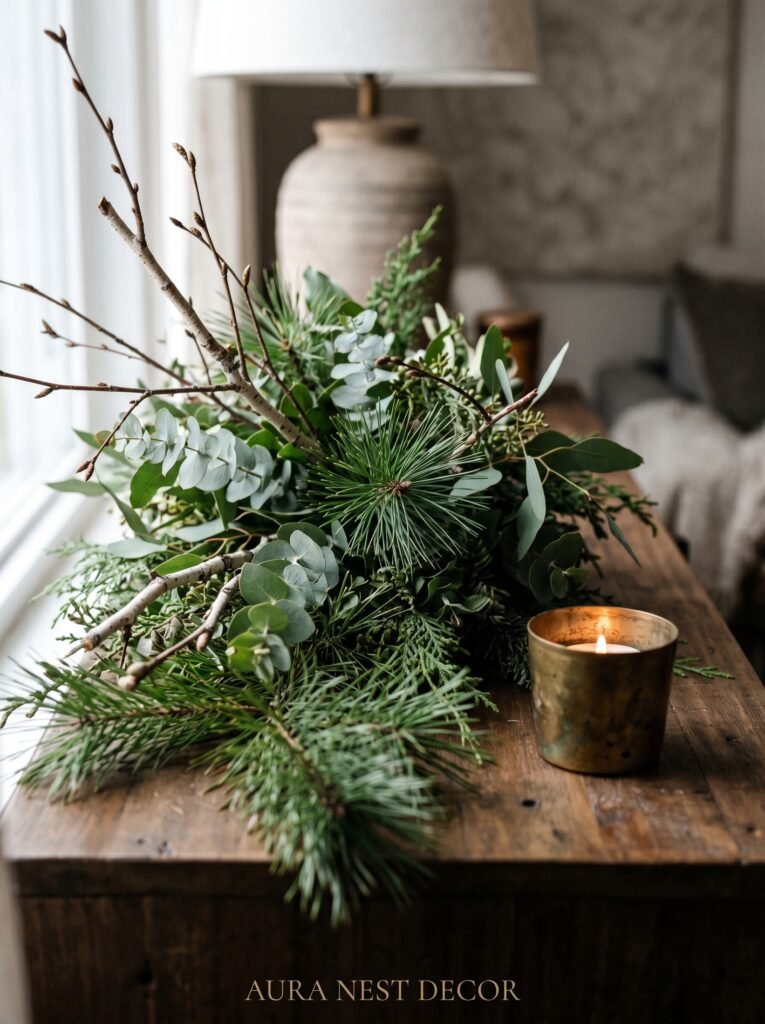
Fresh greenery smells like Christmas. This is non-negotiable and not actually about decor — it’s about sensory memory and why your whole body relaxes when you walk into a room that smells like pine and eucalyptus and cold air.
But the way most people use greenery in a modern room is too tidy. Too arranged. Too obviously from a kit.
The vintage approach to greenery is loose and abundant but not precious. It’s the way Victorian households would have cut from the garden — branches rather than sprigs, mismatched lengths, some with berries and some without. Mix eucalyptus (which keeps beautifully) with pine branches, holly, and a few dried orange slices tucked in between. Don’t wire everything into submission. Let it breathe.
For the mantelpiece or console table, lay greenery in a long, trailing sweep that hangs slightly over the edge on one side. For a small side table, place a single pine branch in a vintage ceramic jug with a candle beside it. That’s the whole arrangement. It costs almost nothing. It looks like someone who really knows what they’re doing lives here.
In the UK, forage if you can — public footpaths often have wild holly and ivy that is completely legal to take in small amounts. In the US, Christmas tree farms frequently sell branches by weight, which gives you the most beautiful raw material at very low cost.
9. How to Hang Vintage Ornaments Without a Traditional Tree (And Why This Looks Better)
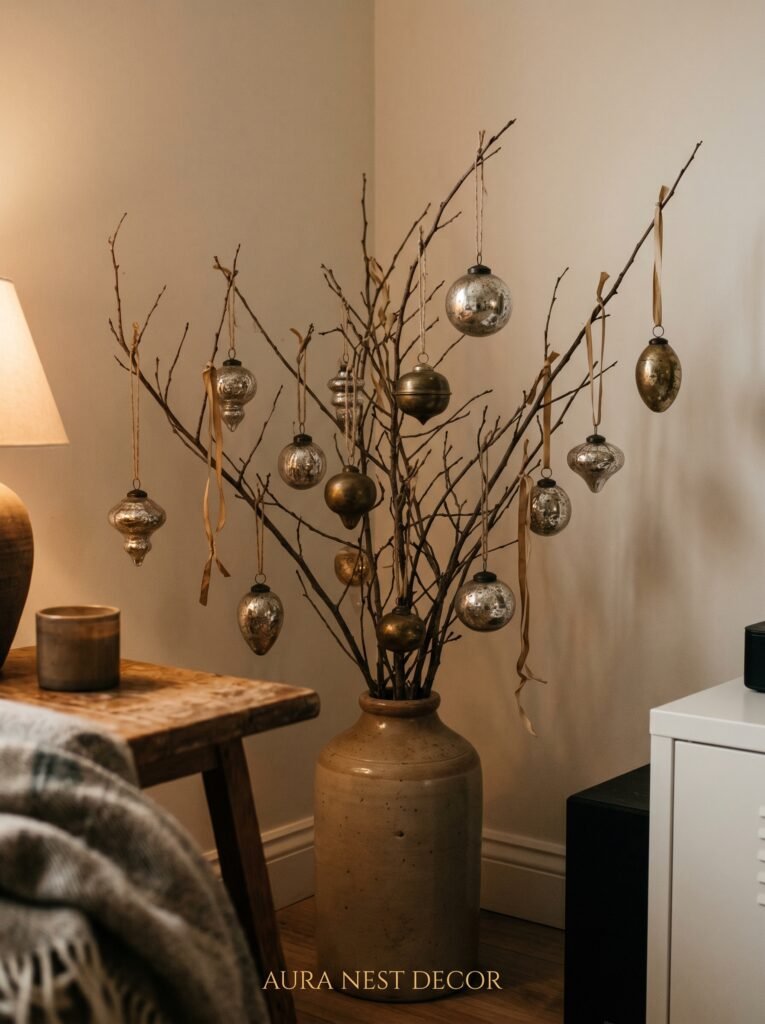
Not everyone wants a full Christmas tree in their modern living room. This is a legitimate aesthetic choice, not a failure of holiday spirit.
The alternatives that work with vintage ornaments: a sculptural bare branch in a heavy vase, spray-painted white or left natural. A ladder — wooden, vintage — leaned against a wall and dressed with greenery and ornaments. A single beautiful wreath hung not on the door but on a wall above the sofa, dressed with three or four especially precious vintage ornaments.
The bare branch approach in particular has something almost Japanese about it — the idea that beautiful things deserve space around them, that a single branch with twelve extraordinary ornaments is more powerful than a tree with two hundred ordinary ones. It photographs beautifully. It fits into modern rooms without competing for attention. And it lets vintage ornaments be truly seen rather than just hung.
10. The Forgotten Charm of Vintage Christmas Cards as Actual Decor
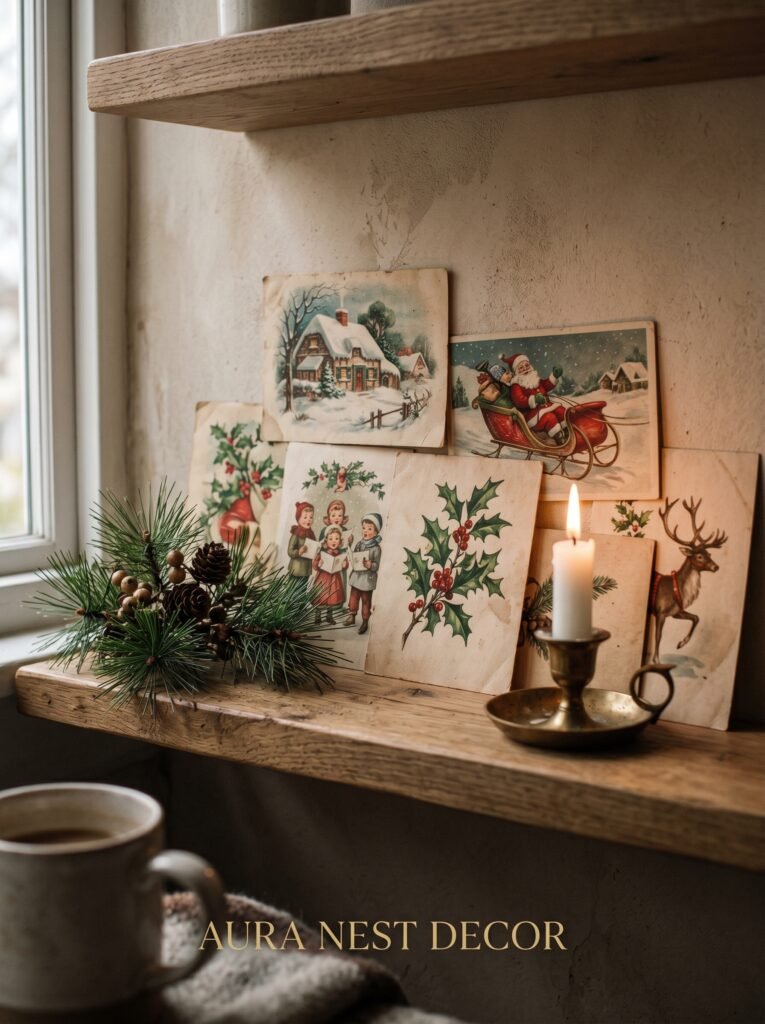
Edwardian Christmas cards. 1950s American greeting cards with their geometric prints and mid-century typography. The hand-illustrated British cards from the 1930s with their wintry pastoral scenes.
These are beautiful objects, and in December they are decor.
String them along a length of twine with small wooden pegs, running along a mantelpiece or across a window. Lean a few of the most beautiful ones against books on a shelf. Frame one — a particularly gorgeous illustrated card from a vintage market — and hang it as you would hang art, because it is art.
You can find original vintage Christmas cards at antique markets, estate sales, and charity shops for almost nothing. Most people walk past them. The ones who stop and look — those are your people. Those are the homes that feel different.
11. What Candlelight at Christmas Actually Requires (Beyond Just Candles)
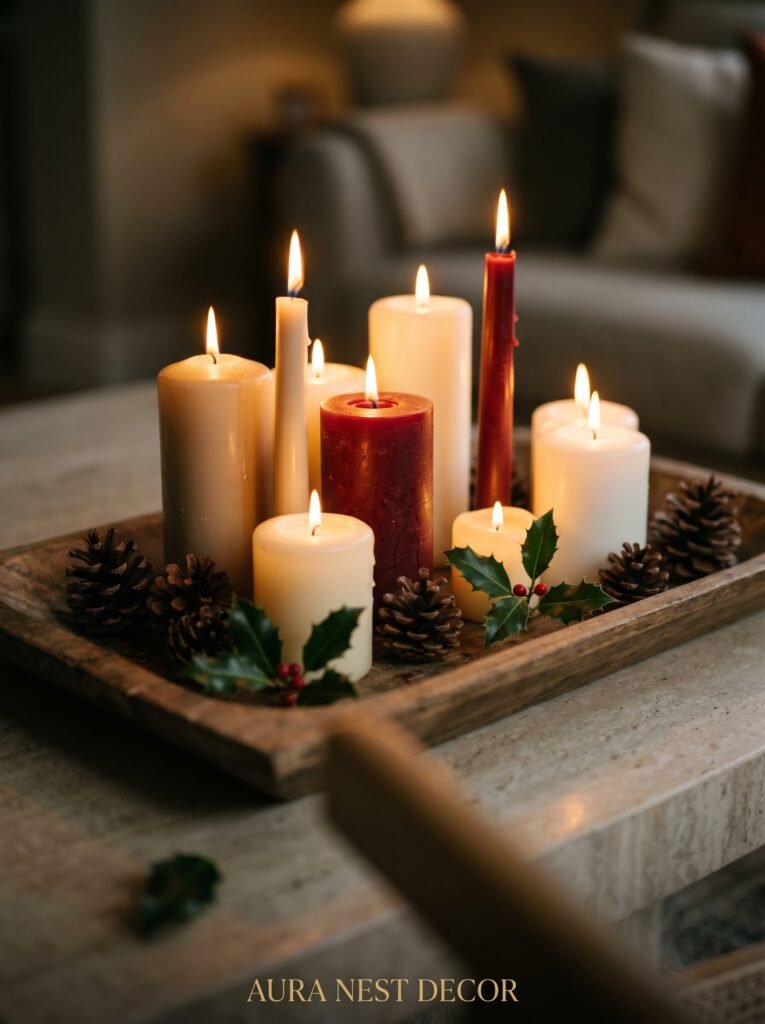
Candles alone are not the magic. The vessels they live in are the magic.
A taper candle in a modern candlestick holder is fine. That same candle in a Georgian silver candlestick found at a market, or in a collection of mismatched vintage brass holders arranged in a cluster at different heights — that’s the thing people can’t stop looking at.
Collect vintage candlesticks without worrying about matching them. Brass, silver plate, dark pewter, milk glass — the variety is the point. Group them in odd numbers (three, five, seven) at different heights. Light them all at the same moment and watch what happens to the room.
For the UK: brass candlesticks from British car boot sales are absurdly affordable and often in wonderful condition. Look for them from October onward. For the US: estate sales are where beautiful old silverplate lives, usually priced at nothing because the sellers don’t know what they have.
The only rule with candlelight and vintage holders: never leave them unattended. The warmth and beauty are worth having. The safety is non-negotiable.
12. The Coffee Table Moment That Ties Every Vintage-Modern Room Together
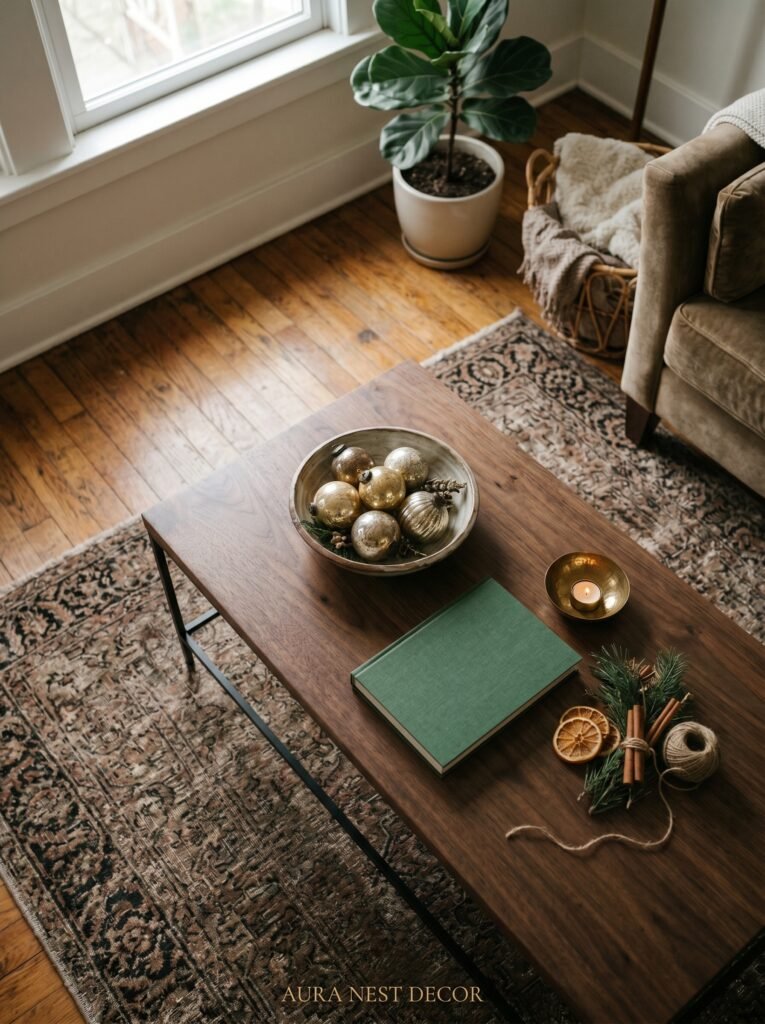
The coffee table is where everything comes together or falls apart. It’s the center of the room, the most-seen surface, the thing in every photograph.
For a vintage-modern Christmas coffee table: start with a tray — something old, lacquerware or brass or painted wood. Inside the tray, place a cluster of vintage ornaments in a bowl, one small candle in a beautiful holder, and a pine branch or sprig of eucalyptus laid at an angle. Stack two or three design books nearby, spines showing. Leave everything else off the table entirely.
That’s it. A tray, a bowl of ornaments, a candle, a branch.
The reason this works is tray-thinking: a tray groups things into a composition, which makes even simple objects look deliberate. And deliberate is the entire point of vintage-modern styling. You’re not going for maximalist nostalgia. You’re going for this specific thing, chosen for this specific reason, placed with intention. That’s the quality that makes someone stop and actually look. That’s what vintage, done right, gives any modern room.
—
❓ FAQ
Q: How do I mix vintage Christmas decor with my modern, minimal living room without it looking cluttered? A: Less really is more here — choose two or three vintage pieces you genuinely love and build around them rather than layering everything at once. Keep your color palette tight (two or three tones maximum) and leave plenty of negative space around each piece. The restraint makes everything you do choose look more intentional.
Q: Where’s the best place to find vintage Christmas ornaments in the US and UK? A: In the US, estate sales (especially in the Midwest and Northeast) are gold mines for Shiny Brite ornaments and vintage tins. In the UK, car boot sales from October onward, charity shops in market towns, and antique centers are your best bets. Online, Etsy has genuine vintage sellers alongside reproductions — filter by price and read descriptions carefully for authentic pieces.
Q: Can I use vintage decor if my living room is very contemporary — white walls, concrete floor, clean-lined furniture? A: Absolutely, and honestly a very contemporary room is one of the best canvases for vintage Christmas decor. The contrast does the work for you. One beautiful antique piece against a white wall reads like art. The key is to not over-decorate — let the vintage piece and the clean modern backdrop be in conversation with each other, rather than filling every surface.
—
💭 Final Thoughts
Vintage Christmas decor in a modern living room isn’t about recreating the past — it’s about bringing something real and weighted and imperfect into a space that might otherwise feel a little too finished. The dented brass candlestick. The faded ornament your grandmother would have recognized. The paper chain you made yourself on a slow Saturday afternoon in November. These things matter because they carry time, and time is the one thing that can’t be designed around. What’s the one vintage piece you already own that deserves to be the star of your Christmas room this year?