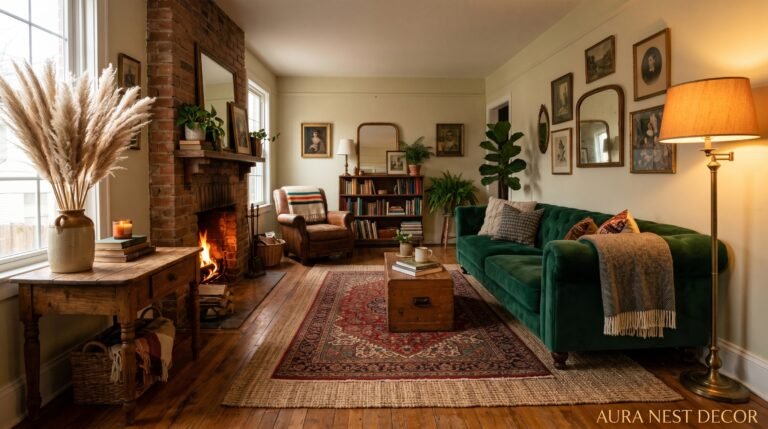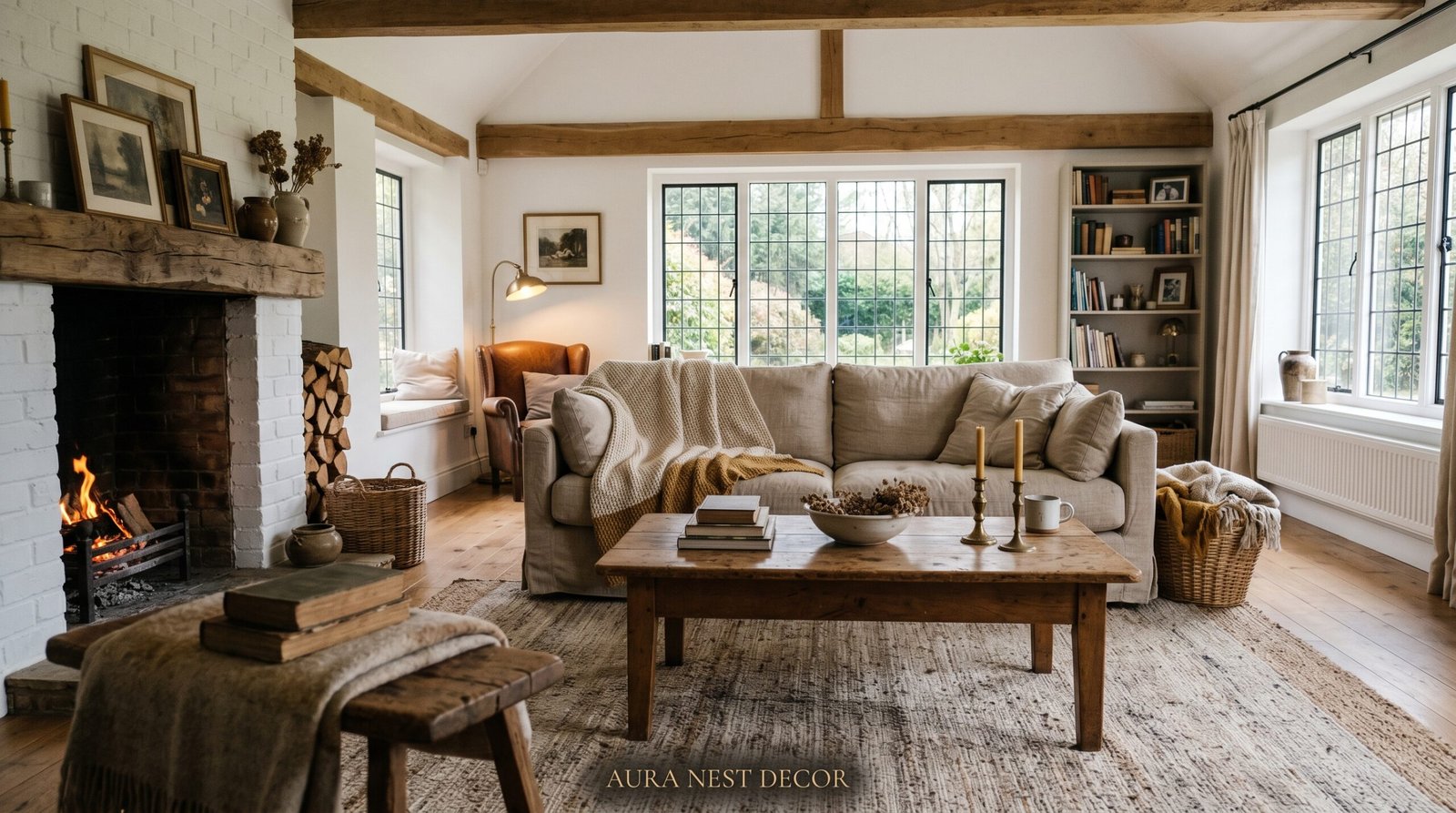
The Modern Farmhouse Living Room That Feels Lived-In (Not Staged)
You know the difference the moment you walk into a room. One feels like a showroom — beautiful, untouchable, slightly cold. The other wraps around you like a good blanket. That second kind of room is what we’re building today, and vintage pieces are exactly how you get there.
—
1. Why “Modern Farmhouse” Went Sideways — And How Vintage Fixes It
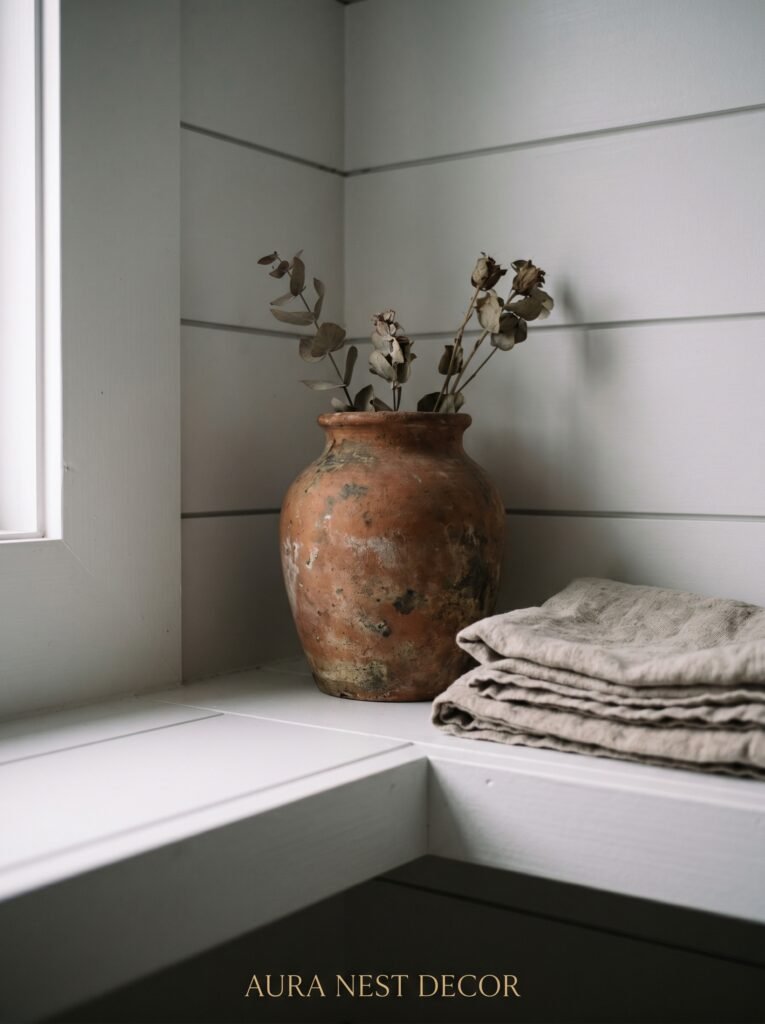
Modern farmhouse had a moment. A big one. Shiplap on every wall, matching galvanized metal everything, white on white on white with exactly one black accent. It was gorgeous in 2017. By 2022, it had become a formula — and formulas, no matter how pretty, never feel like home.
Here’s the thing nobody tells you: the original farmhouse aesthetic was never curated. It was accumulated. A grandmother’s quilt folded over a chair that came from someone’s barn. A wooden coffee table that used to be a workbench. Things that arrived in the room because they meant something, not because someone styled them.
Vintage pieces are the antidote to the catalog look. They carry weight. Visual weight, yes — but also the kind of weight that makes a room feel like it has a story behind it. When you pull a chippy painted sideboard into an otherwise clean, modern space, something shifts. The room exhales. It stops trying so hard.
This is the sweet spot we’re chasing: modern lines and light-filled spaces doing their job, while vintage finds do the emotional heavy lifting.
“A room without history is just furniture in a box.”
—
2. The Sofa Rule That Changes Everything About Mixing Old and New
Most people try to build outward from their sofa. Wrong direction entirely.
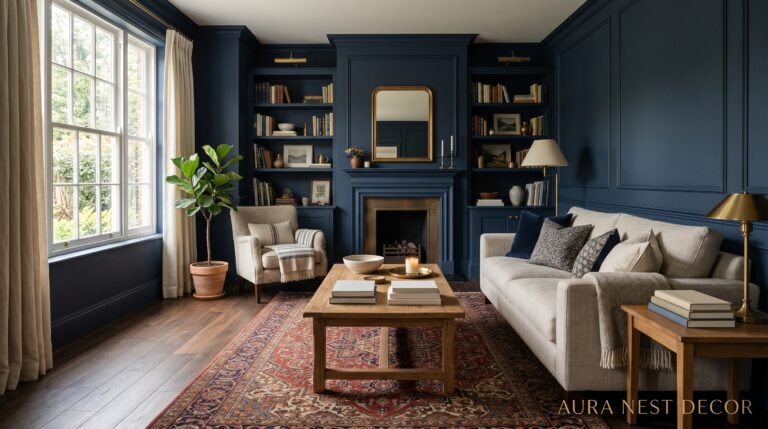
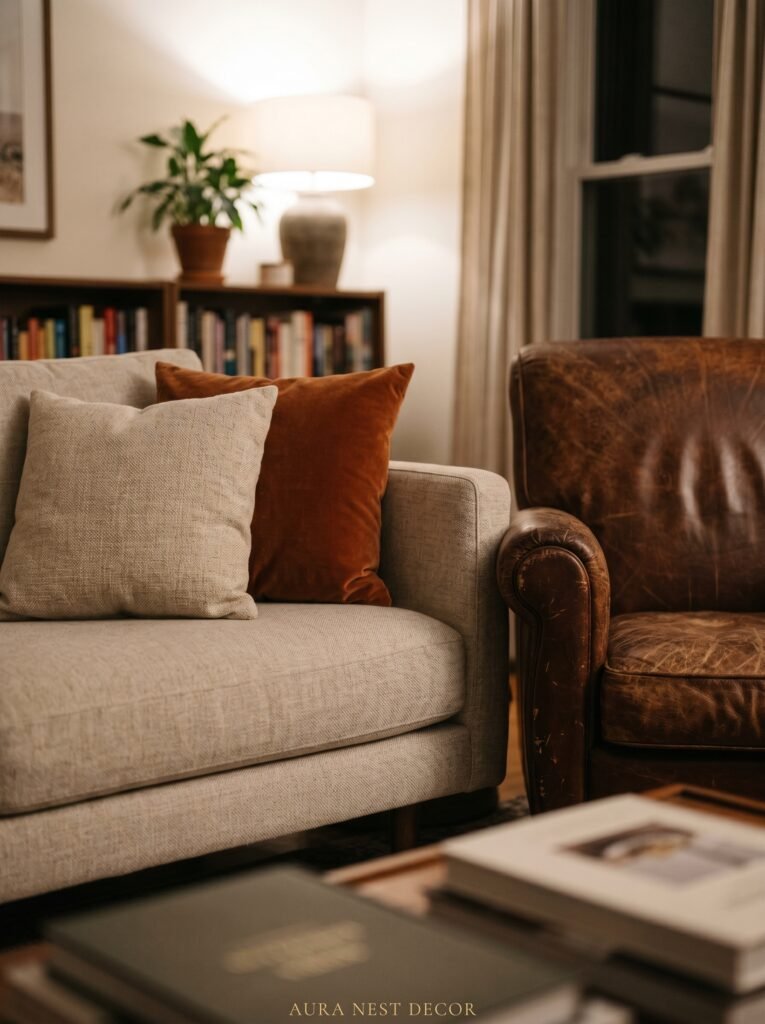
Your sofa should be your most neutral piece in a modern farmhouse room. Clean-lined, low-armed, upholstered in something that reads calm — a warm oatmeal linen, a faded sage, a dusty cream. Not trendy. Not statement-making. Its job is to receive the vintage elements you’ll layer in around it, not compete with them.
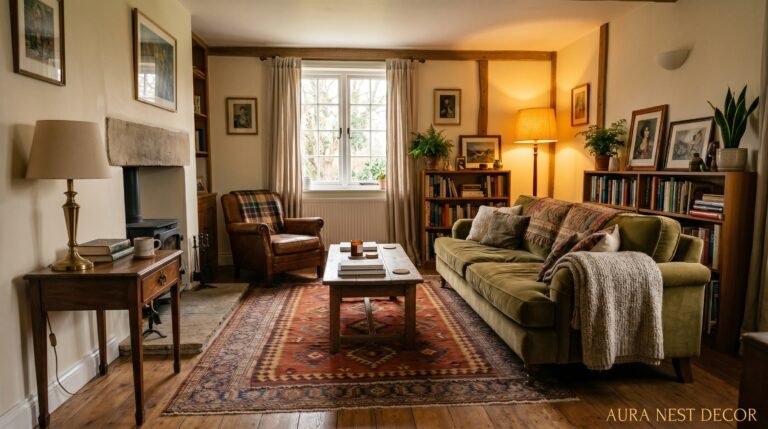
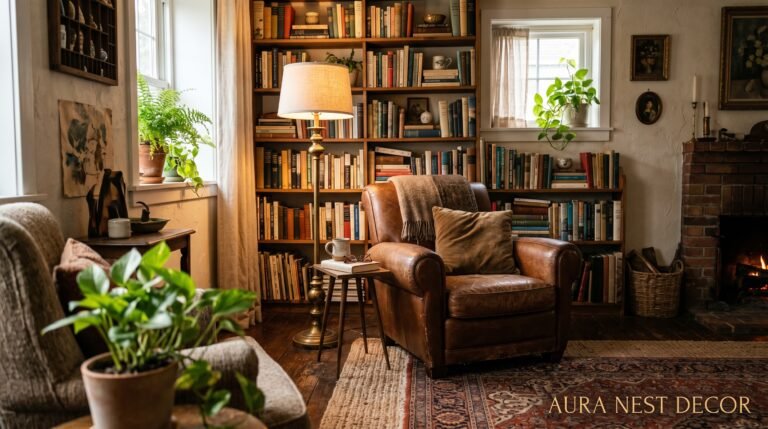
Once you have that grounding piece, suddenly everything else gets easier to place. A worn leather armchair doesn’t clash with a linen sofa — it converses with it. An antique wooden trunk used as a coffee table doesn’t look random — it anchors the whole arrangement.
The shape matters too. Avoid sofas with too many design details — turned legs, tufted backs, nailhead trim — because those compete with your vintage finds for attention. A clean, generous sofa in a muted fabric is essentially a canvas. Think of it that way. You wouldn’t paint a picture on a busy background.
In the UK, you’ll often find brilliant rolled-arm sofas in charity shops and vintage markets that read perfectly for this aesthetic — they have soul without screaming “antique.” Worth looking before you buy new.
—
3. The Wood Tones That Are Secretly Doing All the Work
Ask anyone why a farmhouse room feels warm and they’ll say the throw blankets or the candles. It’s almost never the candles. It’s the wood.
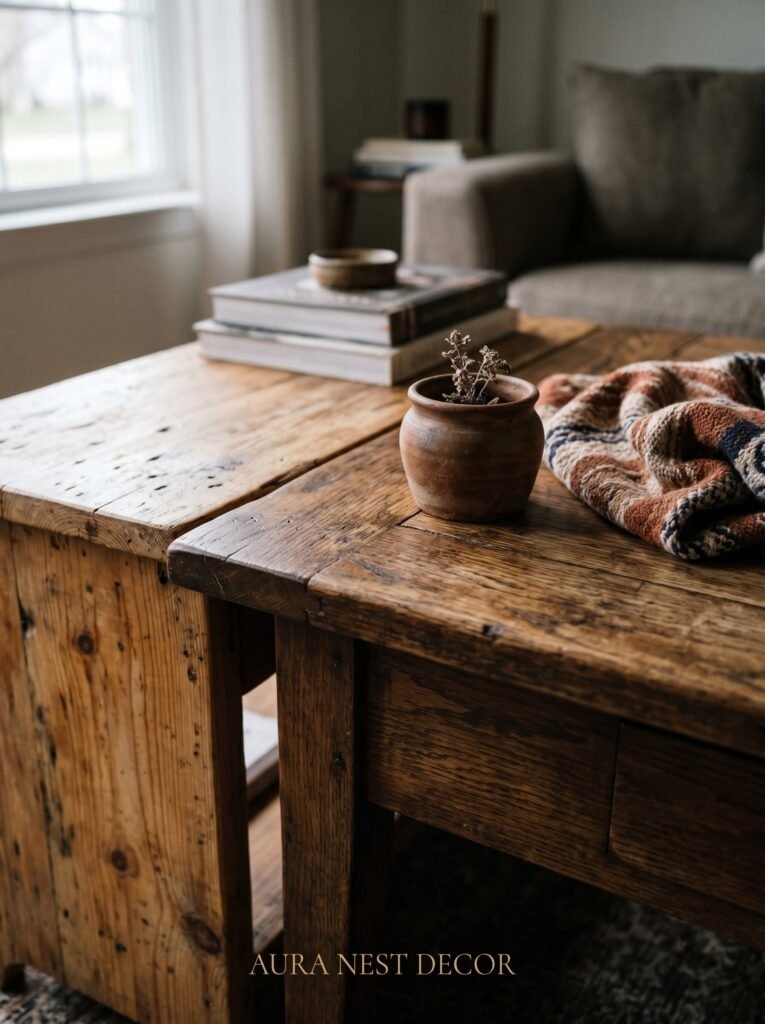
Specifically, it’s mixed wood tones done with intention. The old design rule about matching your wood finishes is completely irrelevant here. In a modern farmhouse room, you want variation — a dark walnut picture frame next to a bleached pine shelf next to a honey-toned oak coffee table. That layering of warm, cool, light, and dark wood tones is what gives a room its textural richness.
The secret is to keep the undertones cohesive even when the finishes differ. Warm amber-toned woods tend to play well together. So do grey-washed and weathered pieces. Where it goes wrong is when you mix warm and cool woods without intention — a red-toned cherry wood next to an ashy driftwood finish creates visual tension that reads as mistake rather than character.
For vintage sourcing, look specifically for pieces with visible grain, knots, or repairs. A tabletop with a faded ring stain that someone sanded down tells a story. That’s not damage. That’s depth.
—
4. The Specific Vintage Pieces That Photograph Best on Pinterest (And Why They Work IRL Too)
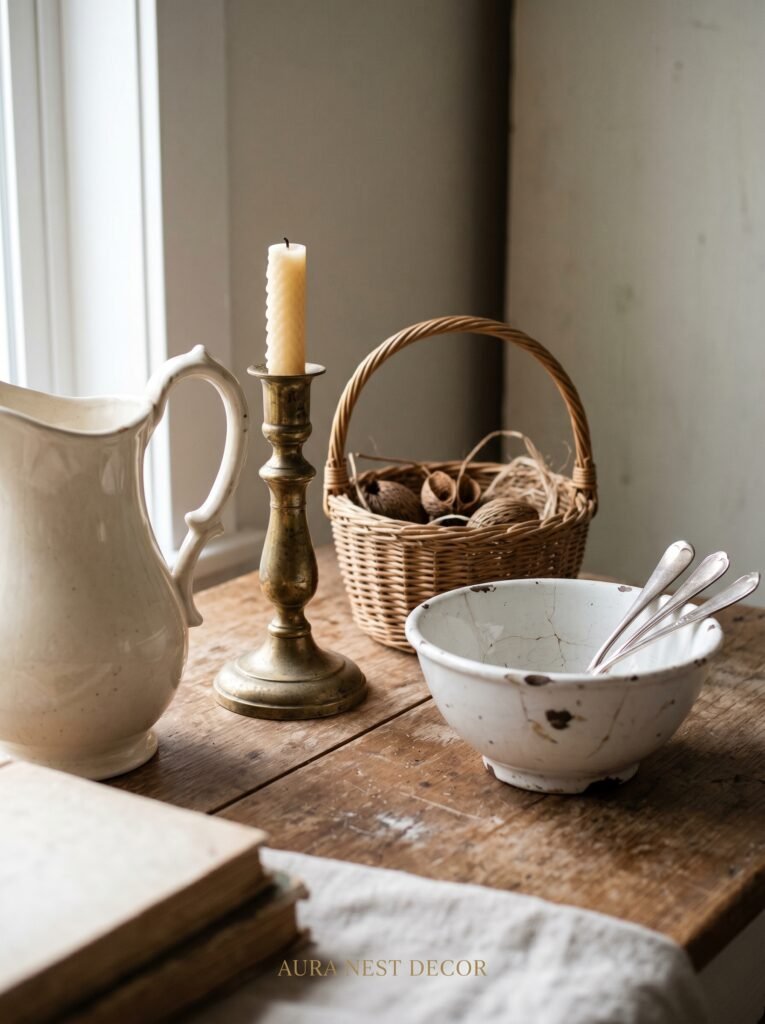
Let’s be practical for a second. If you’re here from Pinterest — and there’s a good chance you are — you already know that some vintage pieces photograph gloriously and then look weird in real life. So let’s talk about what actually works in both worlds.
Old wooden ladders repurposed as blanket storage are genuinely useful. They look great photographed from a distance and when you’re actually sitting next to them in the evening. They add vertical interest without taking up floor space, which is brilliant in smaller British terraced houses or open-plan American rooms alike.
Antique or vintage mirrors with ornate frames are possibly the single best investment in this aesthetic. A heavily framed mirror in a modern farmhouse room does three things: adds age and character, reflects light (which every room needs more of), and creates a focal point that doesn’t require a single other piece of art on that wall.
Cane and rattan chairs — particularly from the 1960s and 70s — photograph beautifully and feel genuinely interesting in person. They add texture and lightness at the same time.
Stoneware and ceramic vessels grouped on shelves or a coffee table bring an organic, handmade quality that no new piece can replicate.
“The best vintage finds are the ones that make people ask where you got them — and you get to say a car boot sale in Hampshire or a flea market outside Austin.”
—
5. Textiles Are Where the “Farmhouse” Actually Lives
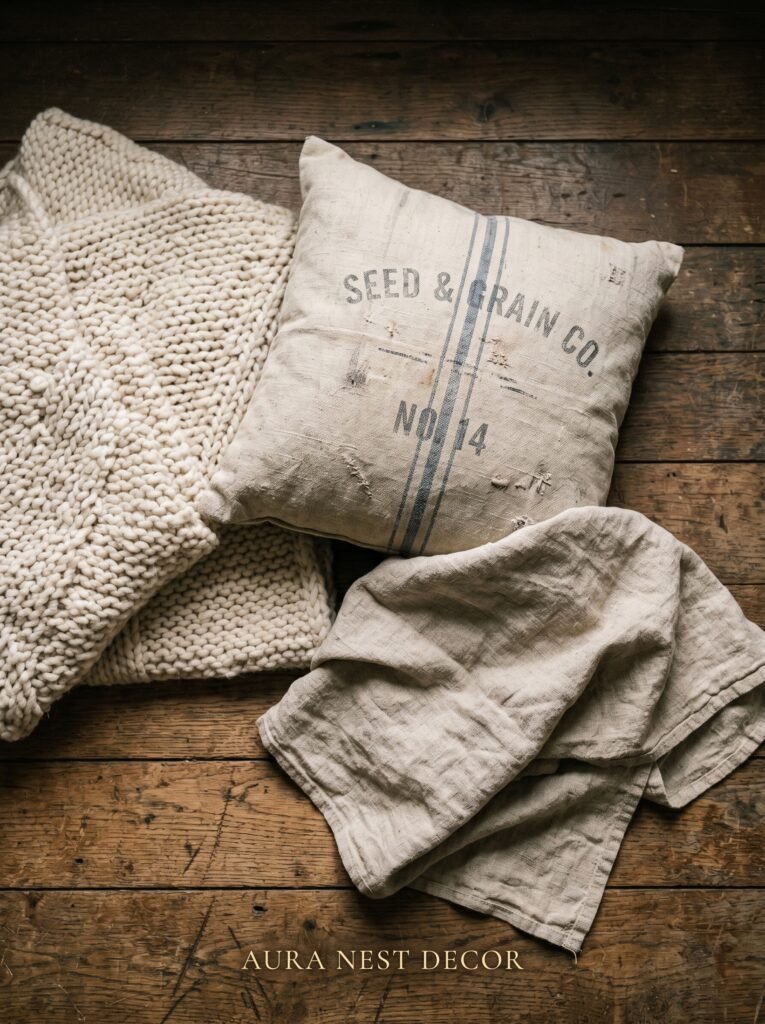
Paint your walls whatever you want. Get any sofa you like. But if your textiles are wrong, the room will never feel right.
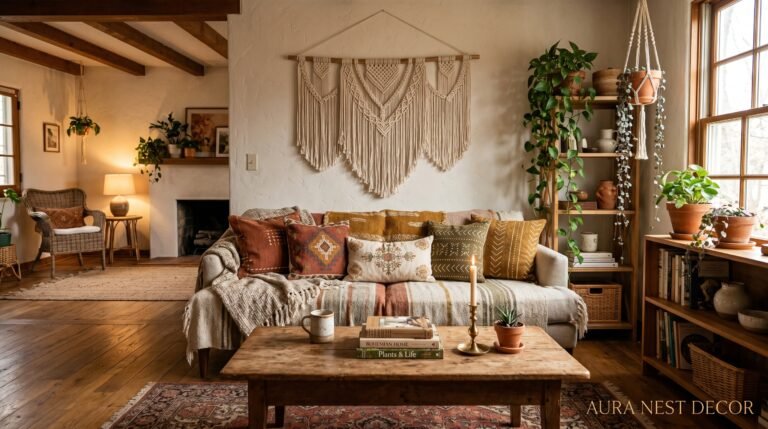
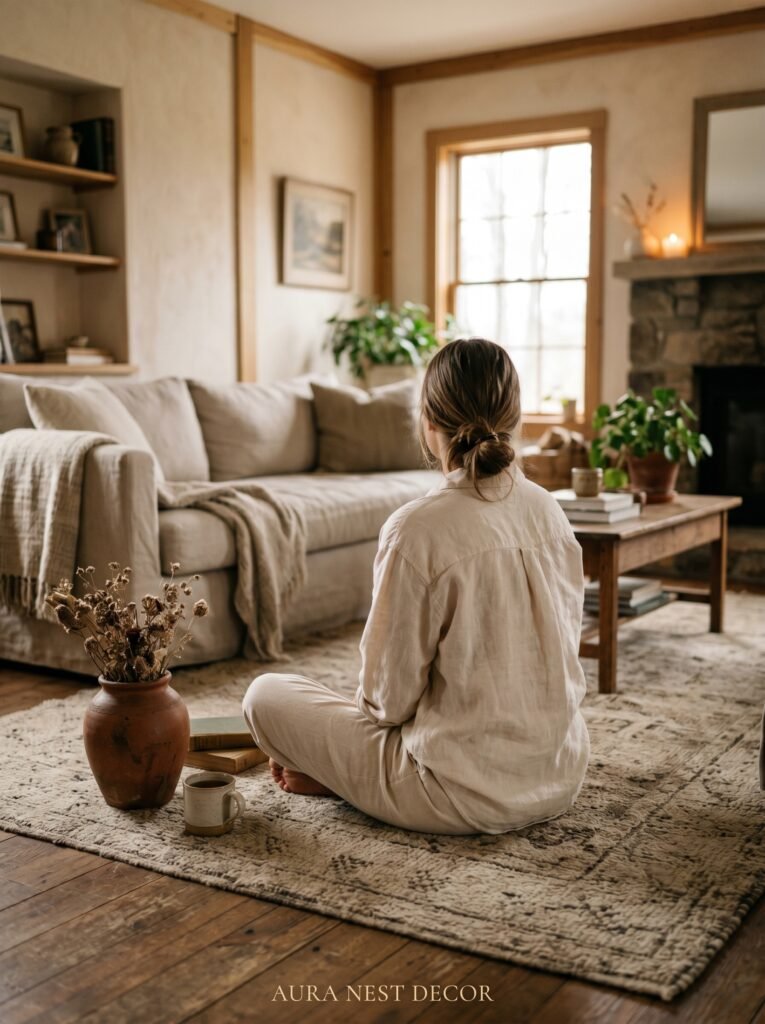
For a modern farmhouse look with vintage soul, you want textiles that feel like they’ve been washed a hundred times — even if they haven’t. Linen throws with raw edges. Faded quilts in indigo or rust. Chunky hand-knit cushion covers in undyed cream. Woven cotton rugs with a little give underfoot.
The key is layering without matchy-matching. A linen cushion next to a striped ticking cover next to a faded floral — three different patterns, all in the same muted palette, and somehow they work because they’re all speaking the same low-key, worn-in language.
Actual vintage textiles are worth hunting for. American quilt patterns from the 1930s and 40s are particularly beautiful — geometric, bold, but faded to perfect softness. UK readers: Welsh blankets are extraordinary. Heavy, graphic, incredibly cosy, and steeped in actual craft tradition. One draped over the back of a sofa does more for a room than any throw blanket you’ll find in a high street shop.
—
6. The Wall Treatment That Feels Farmhouse Without Being a Shiplap Cliché
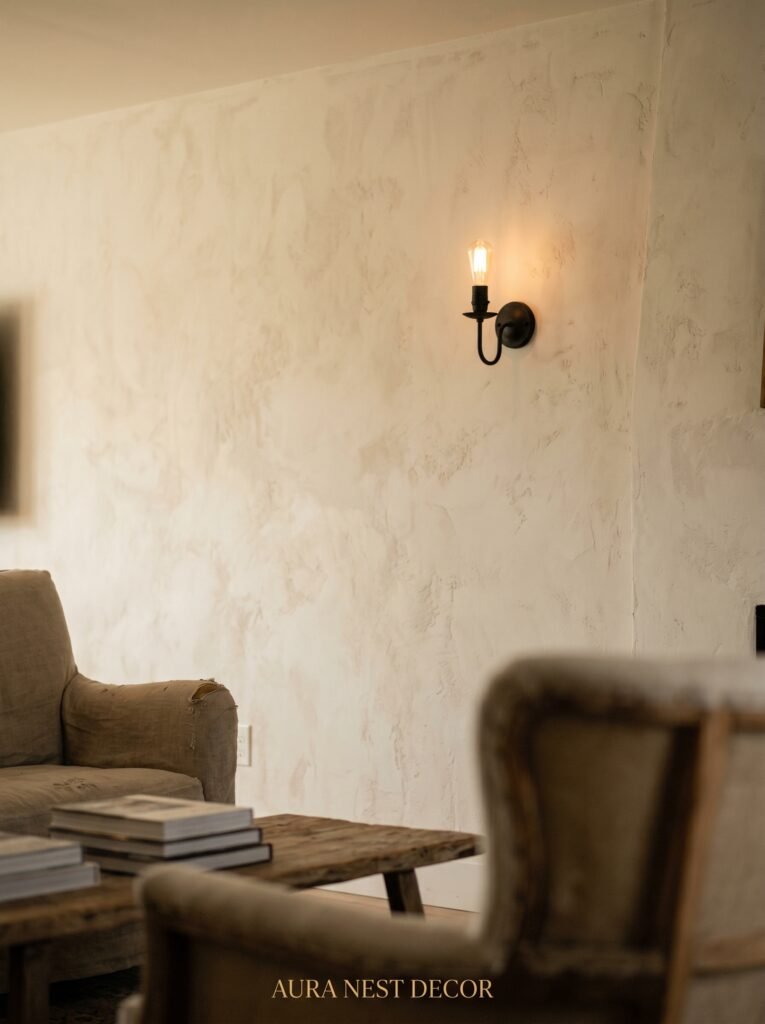
Shiplap had its moment. If you love it, keep it. But if you’re looking for something that feels fresher and just as farmhouse-adjacent, there are better options now.
Limewash paint is having a genuine and well-deserved resurgence. Unlike regular matte paint, limewash has variation built in — lighter in some areas, deeper in others, slightly rough to the eye even when smooth to the touch. It gives walls age and texture without any paneling at all. In a warm cream or dusty terracotta, it reads as authentically old in a way that no standard finish achieves.
Bare plaster walls, sealed with a matte finish rather than painted, are enormous in the UK right now and quietly spreading to the US. The raw, slightly uneven surface photographs beautifully and adds genuine character.
If you do want paneling, consider unpainted board and batten — left in natural wood tone rather than white — for something that feels more rustic and less catalog-fresh.
And then there’s the gallery wall done the farmhouse way: not matchy frames, not a grid, but a loose, slightly crooked collection of frames in different sizes and finishes — wood, weathered gold, black — hung with room to breathe. Add a vintage botanical print, an old map, a child’s drawing in a beautiful frame. The imperfection is the point.
—
7. Lighting That Actually Sets a Mood (Not Just Illuminates a Room)
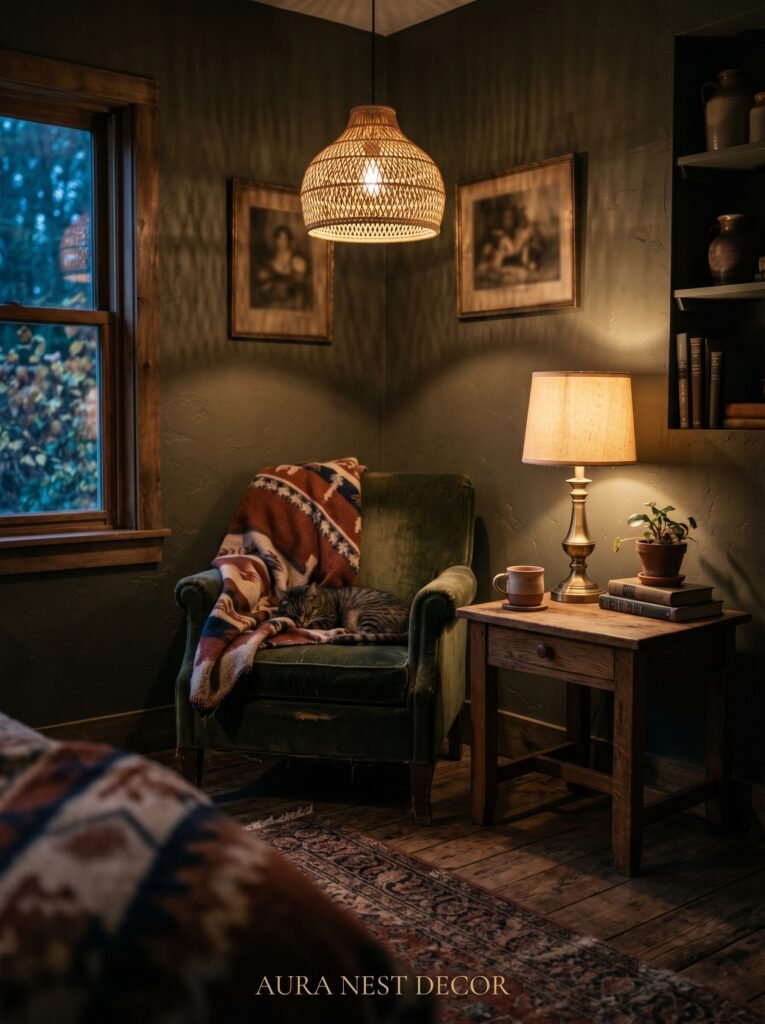
The amber glow of an Edison bulb at 7pm is one of life’s genuinely underrated pleasures. But good farmhouse lighting is about more than bulb type.
It’s about layering. Overhead light is almost never enough on its own — it flattens a room and makes everything look equally important, which means nothing feels special. Instead, think in three levels: ambient (overhead), task (a reading lamp, a table lamp), and accent (candles, a lantern, a small plug-in light tucked behind a plant).
Vintage and vintage-style light fixtures are particularly well-suited to this aesthetic. A wrought iron chandelier with visible candlestick bulbs. A ceramic table lamp with a fabric shade in a warm cream. A wire pendant over a reading nook. These pieces have presence in daylight and create atmosphere at night — a rare double quality.
In the UK, look at auctions and estate sales for old ceramic lamp bases. They’re frequently undervalued and pair beautifully with new shades. American readers: Etsy’s vintage lighting category is genuinely excellent for one-of-a-kind pieces that won’t appear in your neighbor’s house.
“Great lighting isn’t about brightness. It’s about what it makes the room feel like at 9pm on a Tuesday.”
—
8. The Bookshelf Styling Approach That Looks Effortless but Isn’t Random
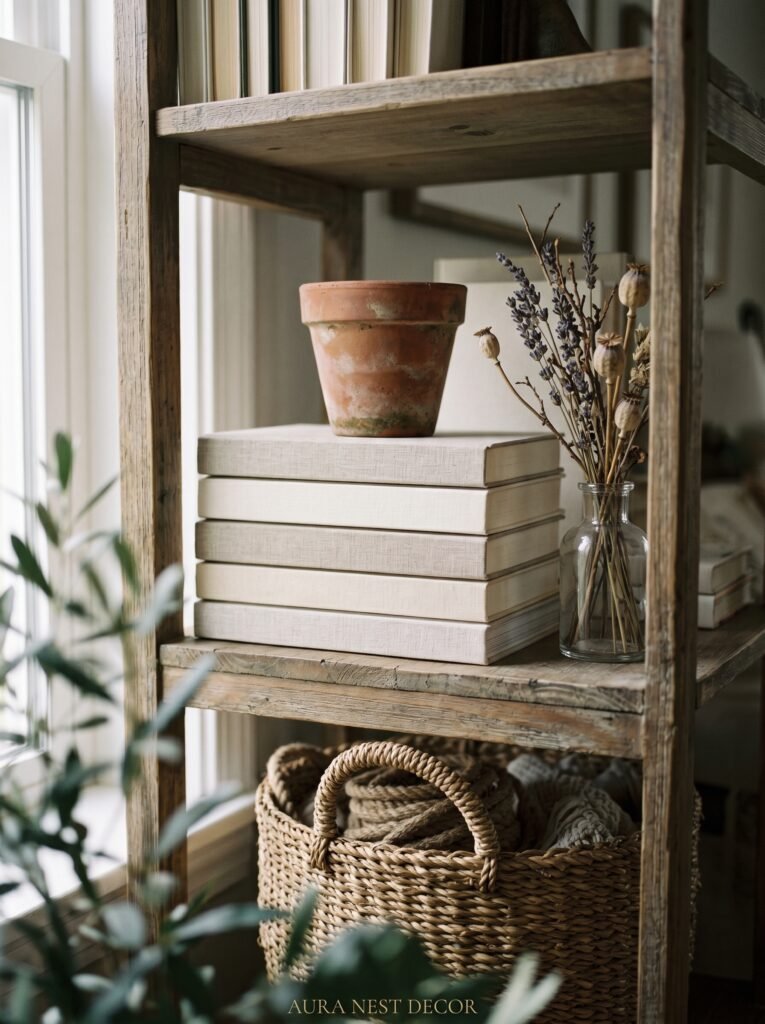
Bookshelves in farmhouse rooms should look like they evolved over time — not like they were styled in an afternoon. The trick is knowing how to make deliberate choices look casual.
Start by pulling out every book whose spine color clashes violently. You don’t have to hide all your books — just the ones that look like they’re fighting with each other. Warm-spined books, neutrals, and a few dark navy or forest green volumes tend to work well together.
Then break the rows. Lay some books horizontally, stack them, and place a small object on top — a piece of pottery, a small plant, a framed photo. Leave some open space. Empty shelves aren’t failures; they’re breathing room.
Add one or two vintage objects per shelf level: an old clock face, a found object, a stack of antique books with cloth covers. The mixture of new books and genuinely old objects is the thing that makes the whole arrangement feel authentic rather than assembled.
—
9. The Color Palette That’s Quietly Replacing Gray Everywhere
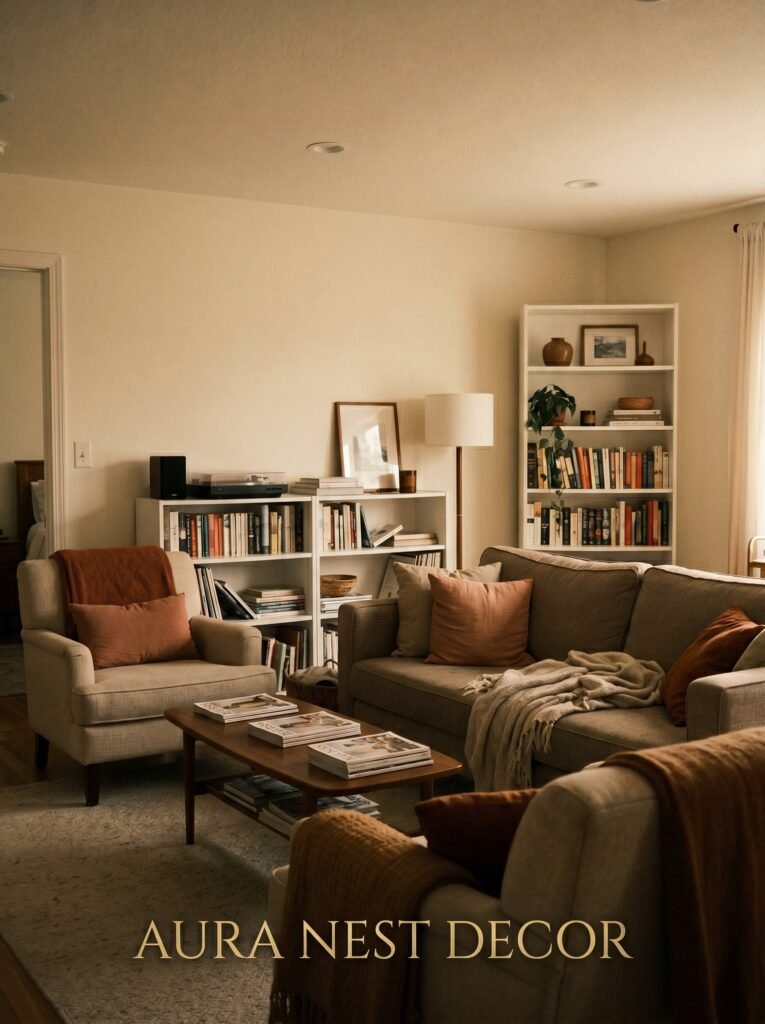
Gray had a long run. A long, cool, slightly flat run. And now, without much fanfare, it’s being nudged out of the modern farmhouse room by something warmer, earthier, and honestly much more interesting.
The palette people are gravitating toward in 2024 and into 2025 is built on warm whites (Benjamin Moore White Dove, Farrow & Ball All White), soft terracottas, aged linen, deep sage green, and warm charcoal — the kind of charcoal that’s almost brown rather than almost blue.
What makes this palette feel farmhouse rather than just warm? The imperfect layering of it. These aren’t colors that match — they cohere. A sage green velvet cushion against a warm linen sofa against a terracotta wall and an oak wood shelf. Every element is doing something different but they’re all speaking the same language of earth and warmth.
This palette also photographs beautifully in natural light, which matters both for your Pinterest board and for how your room actually feels at noon on a Sunday.
—
10. Finding Vintage Pieces Without Spending a Fortune (Or Weeks Searching)
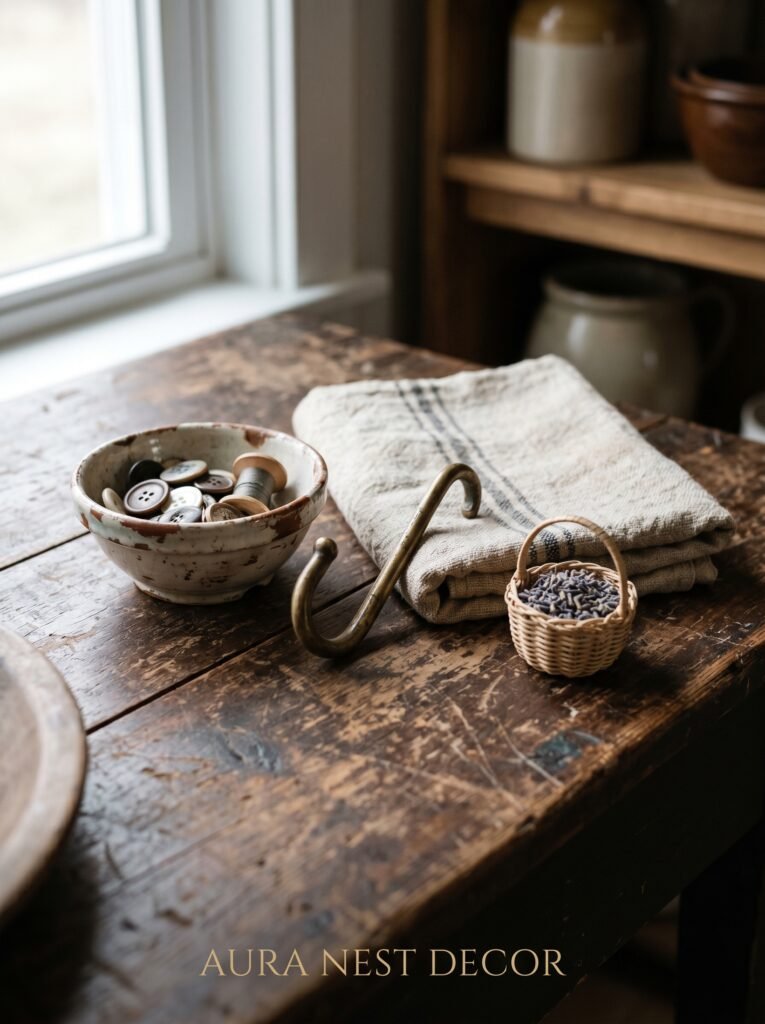
The myth of the perfect vintage find is that it requires either extraordinary luck or extraordinary budget. Neither is true — it requires strategy and patience, which are both learnable.
For US readers: Facebook Marketplace is genuinely the best place to start. Estate sales (especially in older neighborhoods) consistently yield solid wood furniture at fraction-of-retail prices. Habitat for Humanity ReStores are overlooked goldmines. And flea markets — particularly in the South and Midwest — offer the kind of quantity that makes browsing rewarding.
For UK readers: Charity shops in affluent areas consistently cycle through quality pieces. Car boot sales in rural areas outperform urban ones. Vinterior and Selency are excellent for online vintage finds with actual photos and dimensions. Local auction houses — the unglamorous kind, not Christie’s — sell house clearance contents that often include exactly the worn, beautiful furniture this look needs.
The rule I live by: if you’re not sure about a piece, photograph it and walk away. If you’re still thinking about it two days later, go back. If it’s gone, it wasn’t yours. If it’s still there, it was waiting.
—
11. Plants That Read as Farmhouse (And the Ones That Don’t)
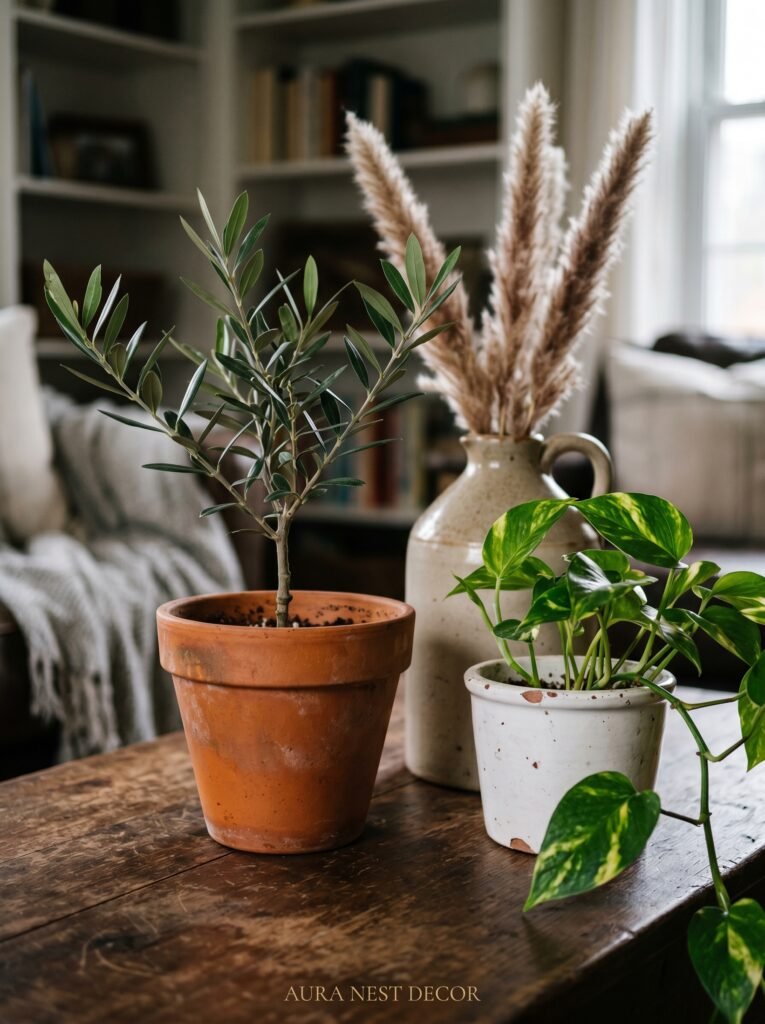
Not every plant belongs in a modern farmhouse room. Some plants read clearly — they feel earthy, abundant, a little wild. Others feel contemporary and sculptural in a way that pulls the room toward a different aesthetic.
Plants that work: trailing pothos in an old ceramic pot. A large olive tree in a terracotta urn. Dried lavender bundles tied with twine and hung from a hook. A simple jam jar of fresh wildflowers on a coffee table. Eucalyptus in a stoneware vase. Herbs in mismatched pots along a windowsill.
Plants that pull the room in a different direction: architectural succulents in modern geometric planters, dramatic fiddle leaf figs styled as design objects, air plants in metallic holders. Beautiful, but a different conversation.
The container matters as much as the plant. A plain terracotta pot aged with a little yogurt rubbed on the outside — a genuinely old trick — has more character than anything you’ll find in a garden centre. Old enamelware, crockery, wooden crates used as planters: these are the details that make a room feel like a home.
—
12. The One Thing That Ties the Whole Room Together
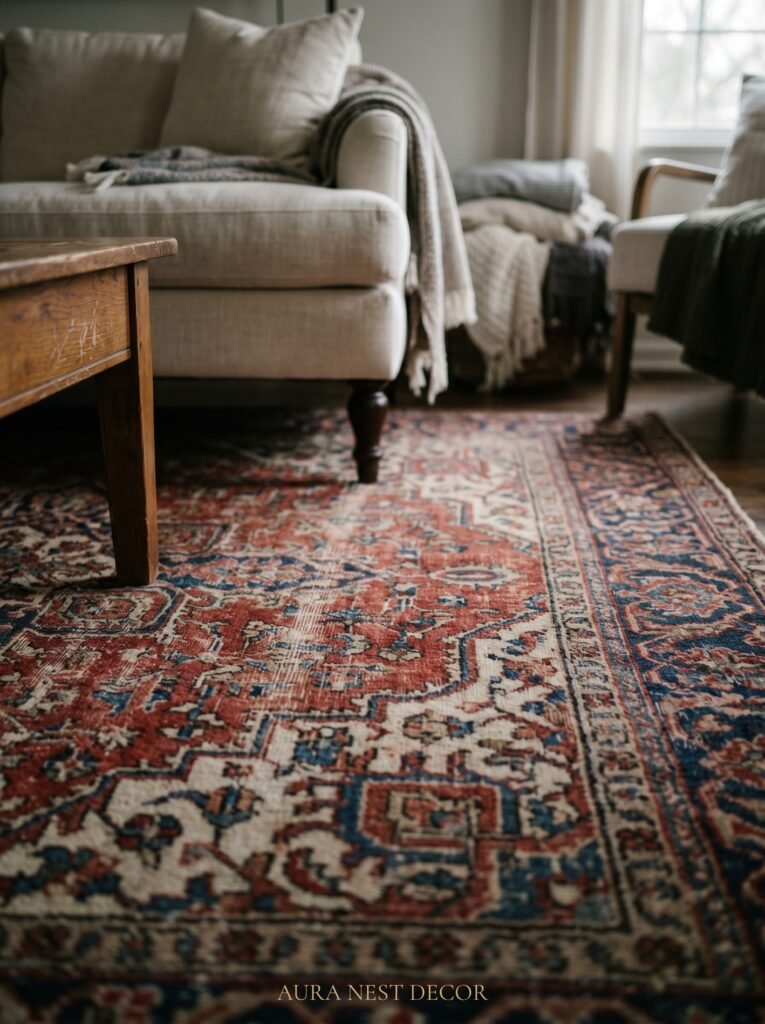
You can do everything right — the vintage mirror, the linen sofa, the layered textiles, the limewash walls — and a modern farmhouse room can still feel like it’s missing something.
What ties it together is almost always something personal.
Not generic personal — not “I have photos on the wall.” Specifically personal. The pottery mug your friend made that you use as a pen holder on the bookshelf. Your grandmother’s crocheted throw, slightly moth-eaten, folded over the back of a chair where everyone can see it. A single framed piece of art you bought at a craft fair three years ago and have moved to every apartment since.
These objects cost nothing to incorporate. They require no styling skill. They simply need to be allowed into the room rather than kept in boxes because they don’t match the aesthetic perfectly.
The rooms that stop people mid-scroll on Pinterest are never the rooms that look perfect. They’re the rooms that look like someone genuinely lives and loves in them. That’s not a style choice. It’s a permission. Give yourself that permission, and the room will follow.
—
❓ FAQ
Q: How do I mix vintage pieces with modern furniture without the room looking mismatched? A: The key is keeping your larger modern pieces neutral — a simple sofa in linen, a clean-lined coffee table — so they act as a backdrop rather than a competitor. Vintage pieces should be the ones with personality and detail. Cohesion comes from a unified color palette across everything, even when the styles differ.
Q: Where’s the best place to find affordable vintage farmhouse furniture in the UK? A: Car boot sales in rural areas, charity shops in market towns, and local auction house house-clearance sales are consistently the best value. Online, Vinterior and Facebook Marketplace are reliable — search specifically for “pine,” “oak,” “Victorian,” or “farmhouse” to filter toward what you want.
Q: Can a modern farmhouse living room work in a small space? A: Absolutely, and sometimes it works better — smaller rooms benefit from the warmth and texture of this aesthetic more than large open-plan spaces do. The trick is vertical interest: use wall-mounted shelving, tall mirrors, and lighting that draws the eye upward. Keep your largest furniture piece low-armed and open-legged so it doesn’t block sight lines.
—
💭 Final Thoughts
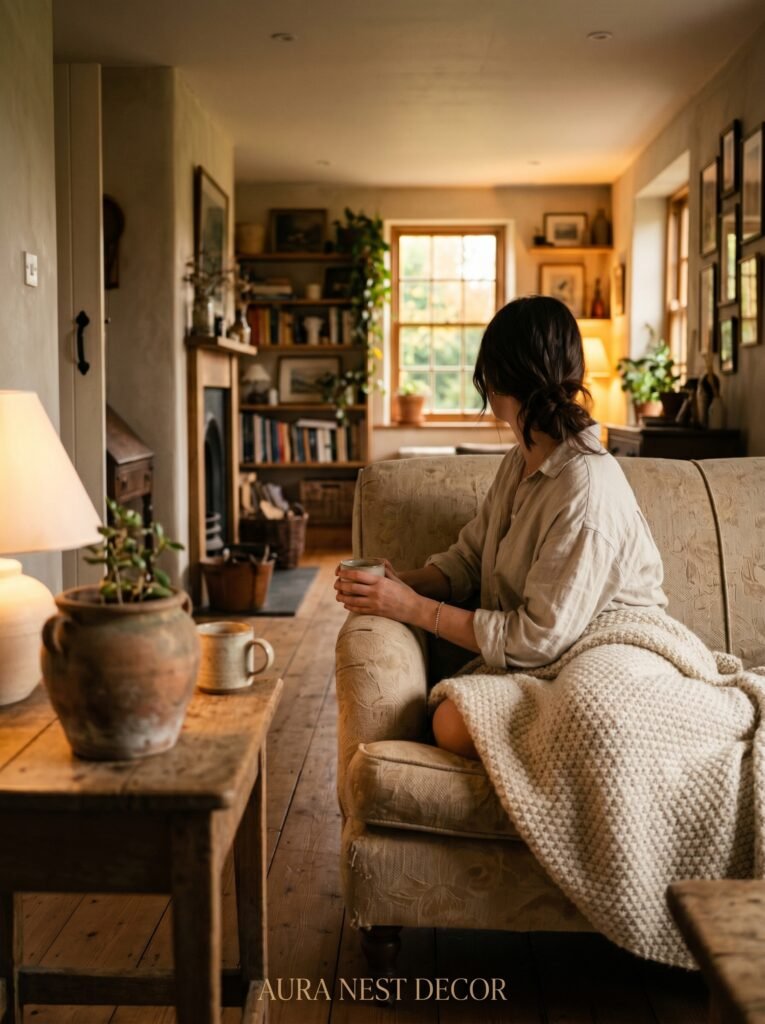
The best modern farmhouse living rooms aren’t designed — they’re gathered. Slowly, over time, with intention and a little bit of luck. A piece from a Sunday market here, a textile you couldn’t leave behind there, a color on the wall that finally made the room exhale.
That’s the thing about vintage: it refuses to be rushed. And maybe that’s exactly why these rooms feel so good to be in.
What’s the one vintage piece in your home that you’d never part with?