The Living Room Halloween Aesthetic That Actually Looks Good All October Long
You know that feeling when you scroll past a Halloween living room and think that — that’s the one. Not too costumey. Not too stark. Just perfectly, unsettlingly beautiful. Here’s how to build that room yourself.
—
1. The Difference Between “Decorated” and “Styled” (and Why It Changes Everything)
Most Halloween living rooms look decorated. Yours is going to look styled.
There’s a real difference, and once you see it, you can’t unsee it. Decorated means you went to the shop, bought the orange plastic pumpkins and the dangly skeleton garland, and scattered them across every surface with equal enthusiasm. Styled means you made intentional choices — you pulled from a specific palette, you considered texture and height and light, and everything in the room feels like it belongs to a single, considered vision.
The secret is restraint mixed with commitment. You don’t need fewer Halloween things. You need the right Halloween things, placed with confidence. A single massive dried floral arrangement in deep burgundy and black sits on a mantel and does more visual work than fourteen small scattered decorations ever could. A cluster of candles in varying heights — beeswax, pillar, taper — creates atmosphere that no plastic prop can touch.
Start by choosing your aesthetic before you buy a single thing. Are you going for Gothic Romance? Dark Cottagecore? Moody Maximalist? Sophisticated Neutral? Each one has its own palette, its own textures, its own rules. Know which world you’re building before you walk into a shop or open a browser.
“Styled rooms have a point of view. Decorated rooms just have stuff.”
—
2. The Colour Palette That Makes a Halloween Room Look Expensive
Forget orange and black as the only option.
The most beautiful Halloween living rooms right now are working with much richer, more unexpected combinations. Think deep terracotta and warm cream with touches of aged gold. Or dusty sage, charcoal, and burnt sienna — earthy and strange in the best possible way. Or the deeply saturated combination of plum, forest green, and warm brass that’s been appearing in every stunning Halloween home account worth following.
Orange can absolutely stay — but shift it. Instead of bright pumpkin orange, reach for a deeper terracotta or a rust that feels like it belongs to autumn itself rather than a party supply store. That one swap alone will change how your whole room reads.
Black works best as an accent rather than a base. A few matte black candle holders, a black throw draped over your sofa, a single black vase — these create the drama without darkening the room so much it loses its warmth. Because warmth is the thing you’re protecting. Halloween should feel atmospheric, not cold.
Metallic notes in aged gold or bronze tie a room together in October the same way they do in December. They catch candlelight beautifully and they prevent the whole scheme from feeling flat or heavy.
—
3. What to Do With Your Mantel When You Don’t Have a Fireplace
If you have a fireplace, you already know it’s the natural centrepiece. Fill it, layer it, don’t overthink it.
But the rest of us — the ones living in flats above the tube, or in open-plan American homes where the fireplace was casualty of a 1970s renovation — need an anchor point. Here’s what actually works.
A console table or sideboard pushed to the main wall becomes your mantel substitute. The key is height: you need something tall to create that same upward visual pull. A large framed mirror or a cluster of vintage frames works beautifully. A tall candelabra. A big, dramatic arrangement of dried pampas grass dyed black or deep brown.
In front of that, you layer like you’re building a scene: medium-height objects in the middle tier (think books stacked with a small skull sitting on top, or a cluster of pumpkins in graduating sizes), then smaller objects at the base — a few tea lights in amber glass holders, a trailing sprig of dried eucalyptus.
The rule is: odd numbers, varying heights, and at least one unexpected texture. Velvet, rust, dried botanicals, aged wood, raw linen. The contrast between those textures is what makes a surface feel considered rather than collected.
—
4. The Candle Strategy That Does Most of the Atmospheric Work
Candles are not accessories in a Halloween living room. They are the foundation.
At 7pm on an October evening, the right collection of lit candles does something that no amount of styling can replicate: it makes the room feel alive. The shadows move. The amber light shifts. Every surface glows differently depending on where you’re sitting, and that variation is exactly what creates atmosphere.
Here’s the approach: think in zones. You’re not just scattering candles — you’re placing warm light sources at different heights around the room so that the light feels layered, the way it would in an old house that relies on flame rather than overhead bulbs.
Tall black taper candles in brass or iron holders on a mantel or console. A cluster of three pillar candles in varying heights — unbleached ivory or deep oxblood — on the coffee table. Tea lights in amber glass votives tucked into a bookshelf between books. And if you want to take it further, a few of those fat church candles with dried botanicals or dark wax embedded in them placed on the floor beside the sofa.
Turn off your overhead lights. Turn on one or two warm lamps. Light everything. Then look at your room.
That’s the room you were trying to build.
“The right candles at the right height don’t just light a room — they haunt it, gently.”
—
5. Pumpkins: The Version That Doesn’t Disappear in November
Pumpkins are non-negotiable in October. But the way you use them can either look seasonal-and-done or genuinely timeless.
The pumpkins doing the best aesthetic work right now aren’t the bright orange globe kind. They’re the ones with personality — the white and cream varieties with bumpy, ridged surfaces that look almost sculptural. The small, squat Cinderella pumpkins in dusty rose and sage green. The dramatic long-necked gourds that look like they belong in a Dutch still life painting.
Group them. Pumpkins placed alone look like props. Pumpkins arranged in an intentional cluster — with one large, one medium, one tiny, maybe a gourd trailing alongside — look like a composition.
Here’s the transition magic: none of these varieties look remotely out of place in November or even into December. The white and cream ones sit comfortably beside evergreens and fairy lights. The dusty Cinderellas can stay on your coffee table well past Guy Fawkes Night or Thanksgiving and nobody will clock them as Halloween stragglers. Buy for October, but buy smart enough that November doesn’t make you scramble.
—
6. The Bookshelf Styling Trick That’s Worth Five Times More Effort Than It Looks Like
A styled bookshelf in October is one of the most quietly satisfying things you can create.
It doesn’t require much. But it requires you to look at your bookshelf differently: not as a place to store books but as a three-dimensional display surface with depth, shadow, and seasonal possibility.
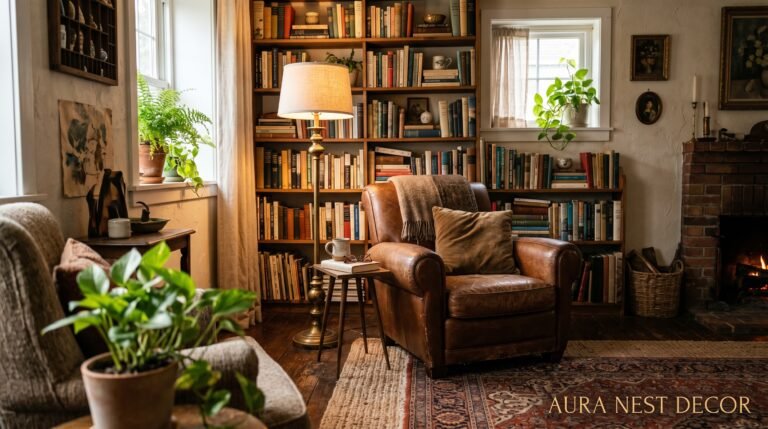
Start by pulling books with dark spines to the front. Cluster them. Lean one or two facing outward if their covers are beautiful — old illustrated novels, botanical prints, anything with worn gilded edges. Intersperse with small objects: a single taper candle in a small holder, a tiny ceramic skull (subtle, not cartoonish), a sprig of dried botanicals in a narrow bud vase, a small framed vintage print of a crow or moth.
What makes it work is negative space. Leave some shelves intentionally sparse — a single candle, one object, empty air. The restraint makes the styled sections feel more deliberate and makes the whole thing look considered rather than crammed.
This works in both the US and UK because it draws from a broader aesthetic of gathered, curated living that doesn’t read as American or British — it just reads as someone who loves their home.
—
7. The Textile Swap That Signals Autumn Without Screaming Halloween
Your sofa is your biggest canvas in the living room, and October is the time to use it.
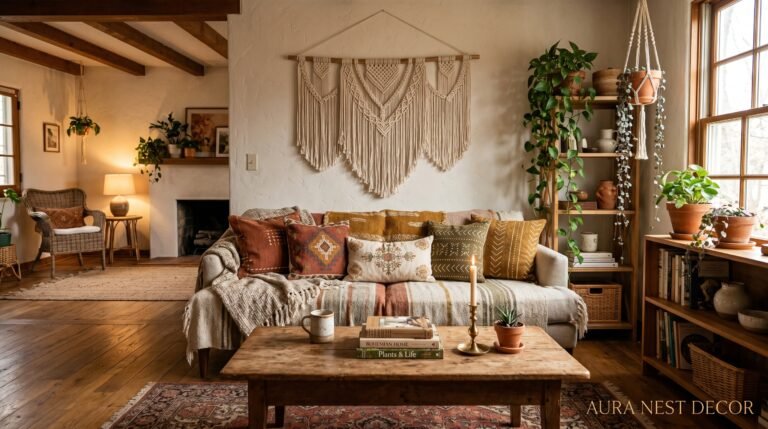
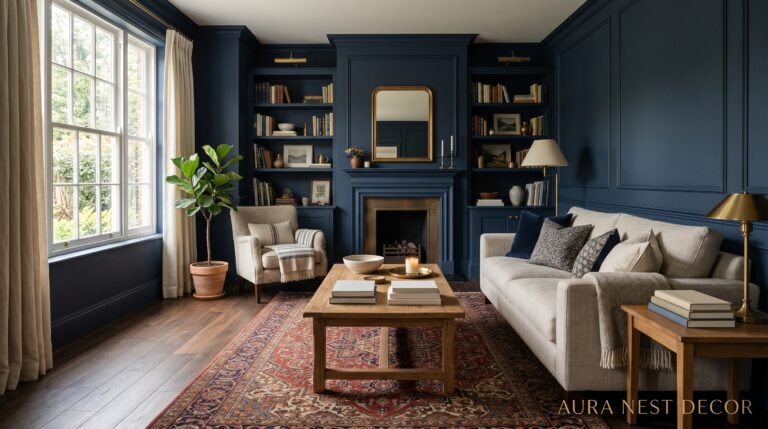
Swap your usual cushion covers and throw for something that shifts the whole palette of the room without a single pumpkin in sight. Deep jewel tones — velvet in forest green, chenille in warm terracotta, linen in faded black — change the emotional temperature of the room immediately. You walk in and you feel autumn, even if you haven’t seen a decoration yet.
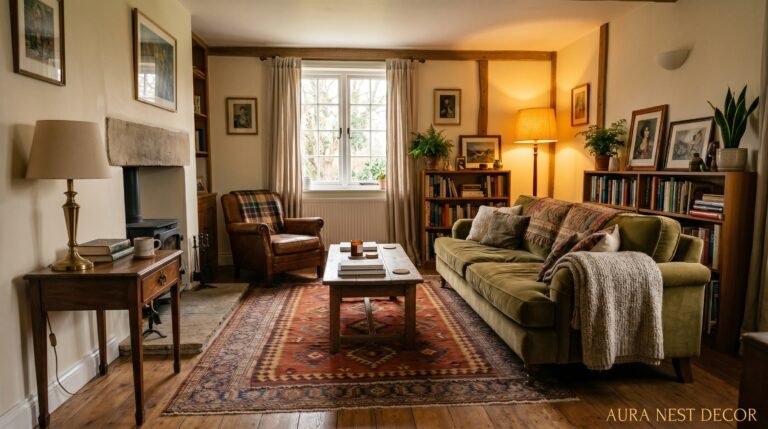
The throw deserves particular attention. A chunky-knit throw in oatmeal or dark cream draped over the arm of a sofa signals cosiness in a way that feels October-specific without being on-the-nose. Americans tend to love the oversized chunky-knit look; British readers will often reach for a more restrained heritage wool or a simple merino in a muted tone. Both work. Both feel like autumn.
Cushion layering: three cushions in different textures but the same tonal palette is the combination that photographs beautifully and lives comfortably. One velvet, one linen or cotton, one with a subtle pattern or embroidered detail. They don’t need to match. They need to agree.
“Textiles do in ten seconds what hours of decorating can’t: they make a room feel like it has a season.”
—
8. The Wall Space Most People Forget About Until It’s Too Late
Walls are underused in most Halloween living rooms and overdone in others.
The sweet spot is a single, well-chosen gallery moment — not an entire wall plastered with seasonal prints, but one corner or one wall section where you create something deliberately atmospheric. Vintage botanical prints with dark frames. A collection of small antique mirrors with tarnished silver frames that catch the candlelight in unpredictable ways. An oversized framed print of something dark and beautiful — a moth, a raven, a night-blooming flower — that would look at home year-round but reads especially well in October.
In the UK, there’s a long tradition of dark landscape prints and moody countryside imagery that slides straight into Halloween aesthetic without needing any adjustment at all. An old fox hunt lithograph, a brooding moor scene, a Victorian botanical study in a wide mount — these are already gothic if you tilt your head.
In the US, folk art with a dark edge — black cats, harvest moons, bare-branched trees — sits beautifully in this space between aesthetic and seasonal.
The rule: hang it as if it’s permanent. Not slapped up for October, but placed with the same care you’d give any other piece on your wall. That intention is what saves it from looking like a costume.
—
9. How Dried Botanicals Became the Backbone of Every Beautiful October Room
If you haven’t started using dried botanicals in your home styling, October is the moment to begin.
They’re having a genuine long-term moment, and for very good reason: they’re inexpensive, they’re endlessly versatile, and they’re the single best textural bridge between summer warmth and autumn atmosphere. A tall arrangement of dried pampas grass, dark lunaria seed pods, and blackened sunflower heads in a wide-mouthed earthenware vase sits at the exact intersection of beautiful and October without trying hard at all.
Dried botanicals also last. That’s the quiet joy of them. They don’t wilt, don’t need water, don’t make demands. You can arrange them once and they’ll carry you through October, November, and into December with minor adjustments. In the UK, where the cooler autumn gives us dried hydrangeas and pressed garden roses in extraordinary abundance, making your own arrangement from the garden at the end of summer is deeply satisfying. In the US, farmers markets in September and October are full of possibilities — dried corn husks, sorghum, seed pods, and wild grasses that arrange beautifully and cost almost nothing.
Mix textures aggressively. The contrast between something feathery (pampas, dried ferns) and something structural (seed heads, bare branches) is where arrangements start to look like compositions.
—
10. The Floor Space You’re Not Using (But Should Be)
Most people decorate every surface from waist height upward and completely forget the floor.
The floor is where Halloween gets atmospheric in a very specific, very effective way. A cluster of pumpkins and gourds arranged directly on the floor beside the fireplace, with a few pillar candles placed among them. A pile of three or four thick vintage books stacked beside the sofa with a candle sitting on top. A basket filled with dried gourds and tied with a length of dark linen ribbon.
In front of a fireplace, the floor is the stage. The hearth itself is the backdrop. You arrange and you light and you step back, and suddenly the fireplace is doing exactly what fireplaces were made to do in October — making a room feel like a story is happening in it.
For those without fireplaces, the floor beside the main sofa or beside a console table gives the same layered depth. Low light sources especially — lanterns, fat pillar candles in safe holders — at floor level create upward-cast light that is genuinely theatrical. Use it.
—
11. The One Thing That Makes a Halloween Living Room Look Sophisticated Instead of Spooky
Edit yourself.
This is the single most important piece of advice in this entire article. The difference between a Halloween living room that looks sophisticated and one that looks like a haunted house walkthrough is almost always editing.
More specifically: once you’ve placed everything you think you want, take three to five things away. The ones that are working hardest will become clearer once the room isn’t competing with itself. Often it’s the most obviously Halloween things — the plastic skull, the cobweb garland, the battery-operated jack-o’-lantern — that you remove first, and the room immediately sharpens.
What’s left should be things you’d almost keep year-round. The dried botanicals. The dark textiles. The candles. The interesting pumpkins. The atmospheric lighting. The small, unexpected objects that reward a closer look. These are the things that make a Halloween living room feel like it belongs to someone with genuine taste rather than someone who visited a seasonal shop with an open budget.
Restraint isn’t about using less. It’s about knowing which things are doing the work and letting them do it.
—
12. The Small Details That People Notice Without Knowing Why
The best rooms have details that you feel before you consciously see them.
A book left open on the coffee table — a collection of Gothic poetry, a volume of folklore, a beautifully illustrated field guide to moths or mushrooms. A single dried flower tucked into a candle holder. A small dish of chestnuts or acorns sitting beside the remote control. A vintage glass cloche covering something small and interesting — a tiny skull, a dried flower, a smooth dark stone.
These details don’t announce themselves. They build the world quietly. And collectively, they communicate something important to everyone who walks into your living room: this person pays attention. This person notices things. This home is looked after.
That’s the impression a beautifully styled October living room leaves. Not “they went all out for Halloween.” Not “there are a lot of decorations.” Just: this room feels like it knows what month it is and it’s entirely comfortable with that.
That’s the room worth building.
—
❓ FAQ
Q: How do I style for Halloween without it looking too childish or too spooky? A: Lean into natural materials, muted palettes, and candles over plastic props. Dried botanicals, interesting pumpkin varieties, and dark textiles create a Halloween atmosphere that reads as atmospheric rather than costume-party. If you wouldn’t keep it in the room in December, reconsider whether it belongs in October.
Q: How early can I put up Halloween living room decor? A: Early October is the sweet spot for most of the styling described here — dried botanicals, textiles, and non-perishable pumpkins can go up on October 1st without feeling premature. Real pumpkins are best bought in the final two weeks of October so they’re at their freshest for Halloween itself.
Q: What’s the best single change I can make to my living room for October if I’m on a budget? A: Swap your throw and cushion covers for something in deep jewel tones or warm terracotta, and add a cluster of beeswax or pillar candles in varying heights. Those two changes — textiles and candles — will shift your room’s entire atmosphere more than anything else you could do, and both can be done for under £30 or $35.
—
💭 Final Thoughts
The best October living rooms don’t stop being beautiful when November arrives. They were always beautiful — just a little more honest about the season. Something about autumn gives us permission to be more considered about warmth and atmosphere and the things we surround ourselves with.
What would your living room feel like if you styled it not for Halloween specifically but for October — for the whole moody, amber, closing-in feeling of the season?