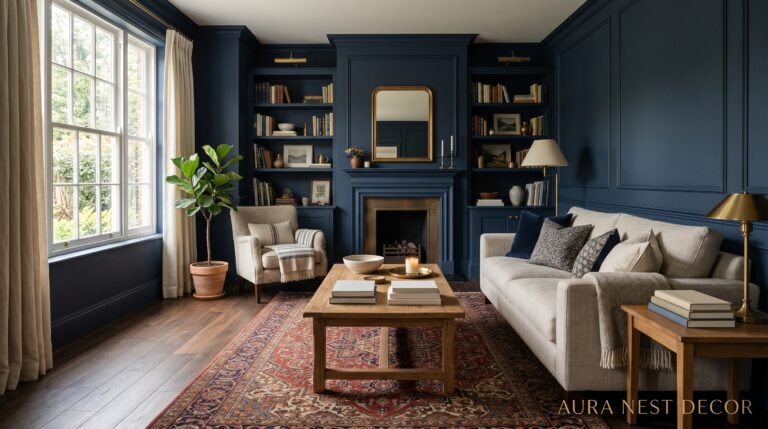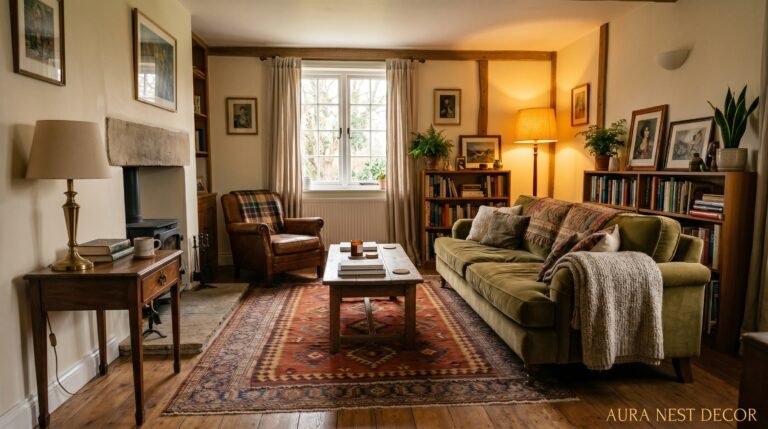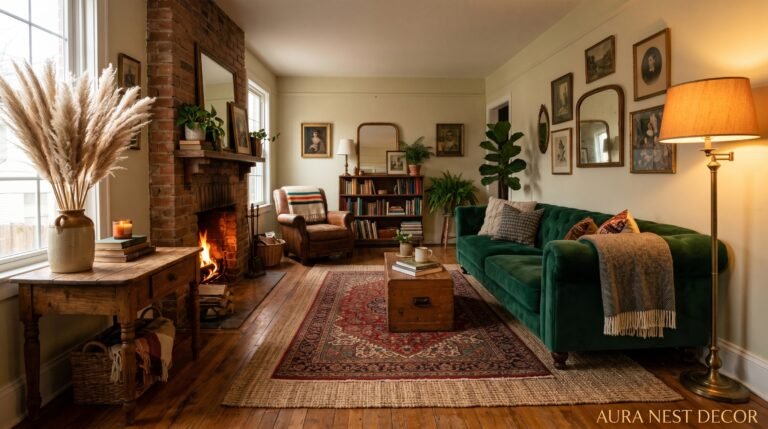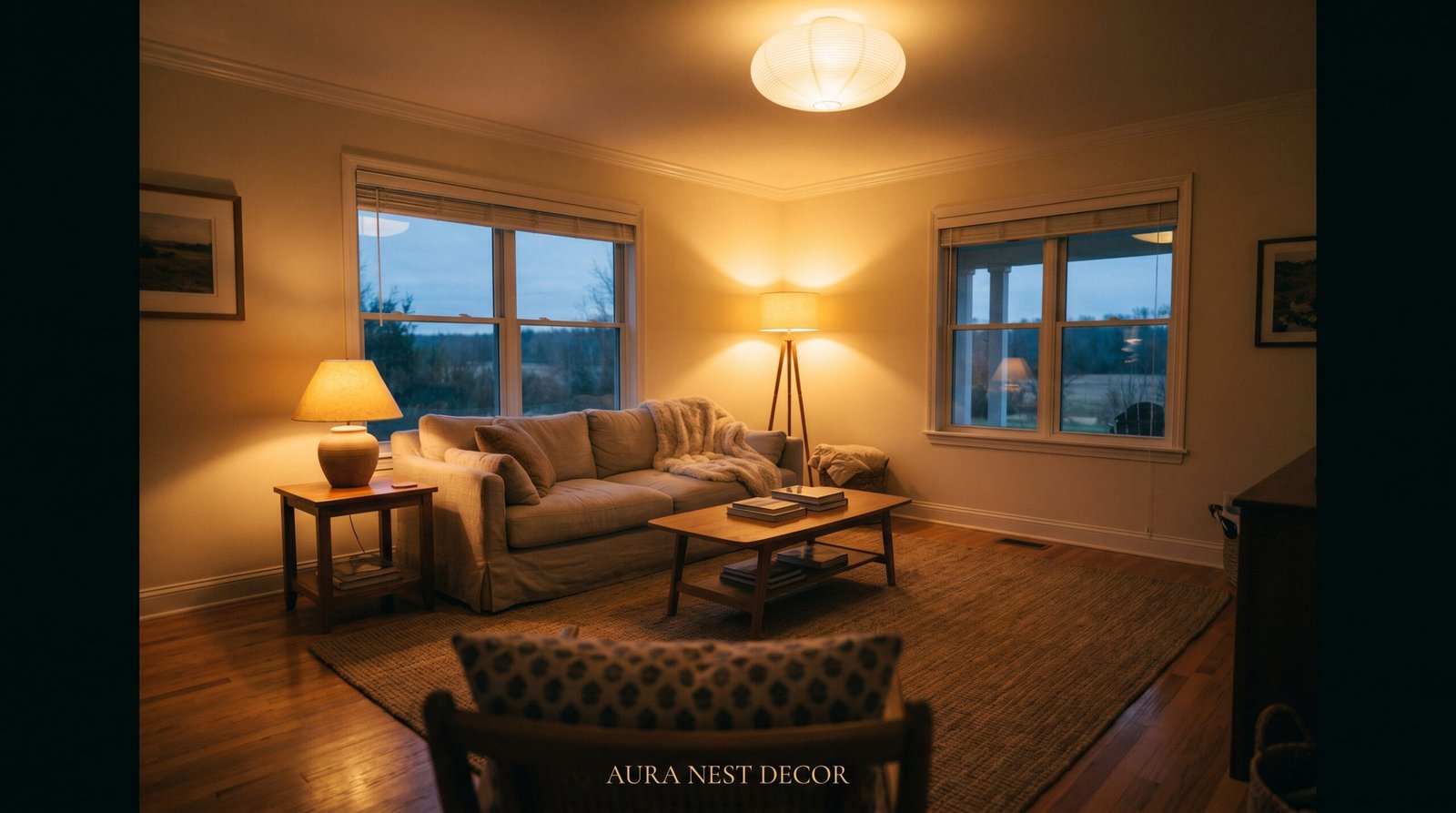
Why Your Living Room Always Feels “Off” — And How Lighting Is Almost Always the Answer
You’ve rearranged the furniture three times. Bought new throw pillows. Repainted the walls a color that looked perfect on the swatch. And still, every evening, you walk into your living room and something just feels… not quite right. Nine times out of ten, it’s the lighting. And once you see it, you can’t unsee it.

—
1. The Reason One Overhead Light Is Quietly Ruining Your Entire Room
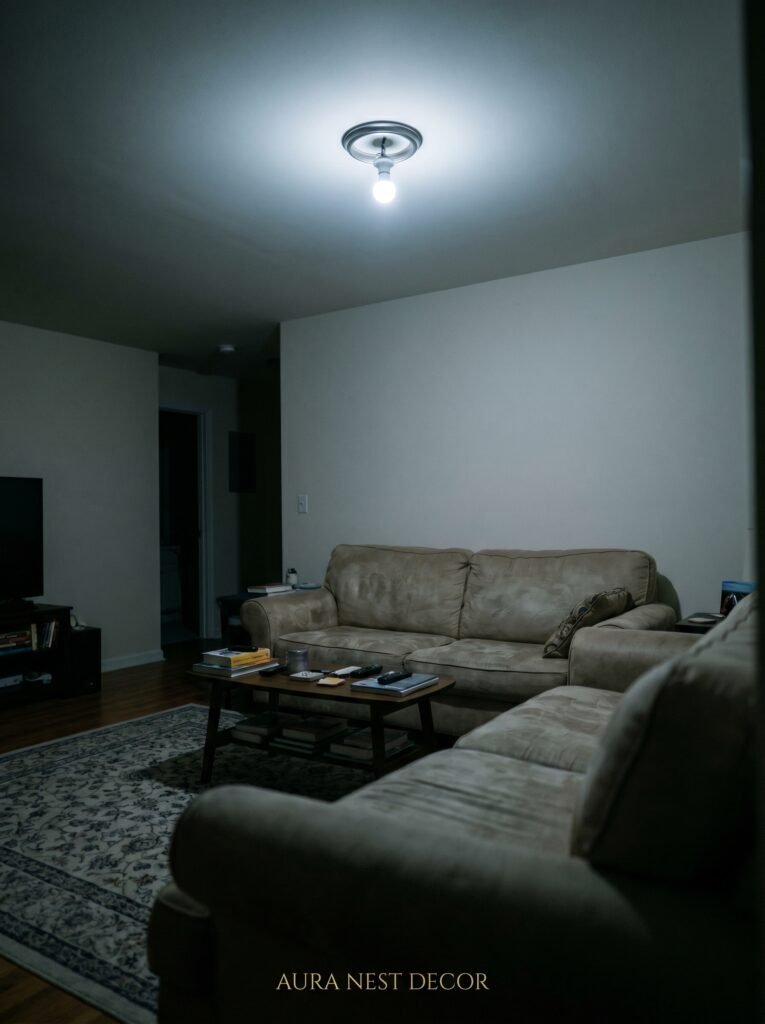
Let’s start with the culprit. That single ceiling light — whether it’s a flush mount, a basic pendant, or a recessed can — is doing something very specific and very unflattering to your living room. It’s casting light straight down. Straight down means harsh shadows under chins, under furniture edges, in the corners of the room. It flattens everything. It makes a thoughtfully styled space look like a waiting room.
The problem isn’t the fixture itself, necessarily. It’s the assumption that one source can do all the work. No beautifully lit room you’ve ever seen — in a magazine, in a hotel lobby, in that one friend’s flat you always feel instantly cozy in — was lit by a single overhead light. Every one of those spaces used multiple sources at multiple heights. High, mid, and low. That layering is what creates depth. It’s what makes a room feel dimensional rather than flat, inhabited rather than just furnished.
This is the most important thing to understand before you spend a single pound or dollar on new fixtures: you don’t necessarily need better lighting. You need more of it, placed differently.
“One overhead light doesn’t set a mood. It interrogates the room.”
2. What “Layered Lighting” Actually Means in Plain English
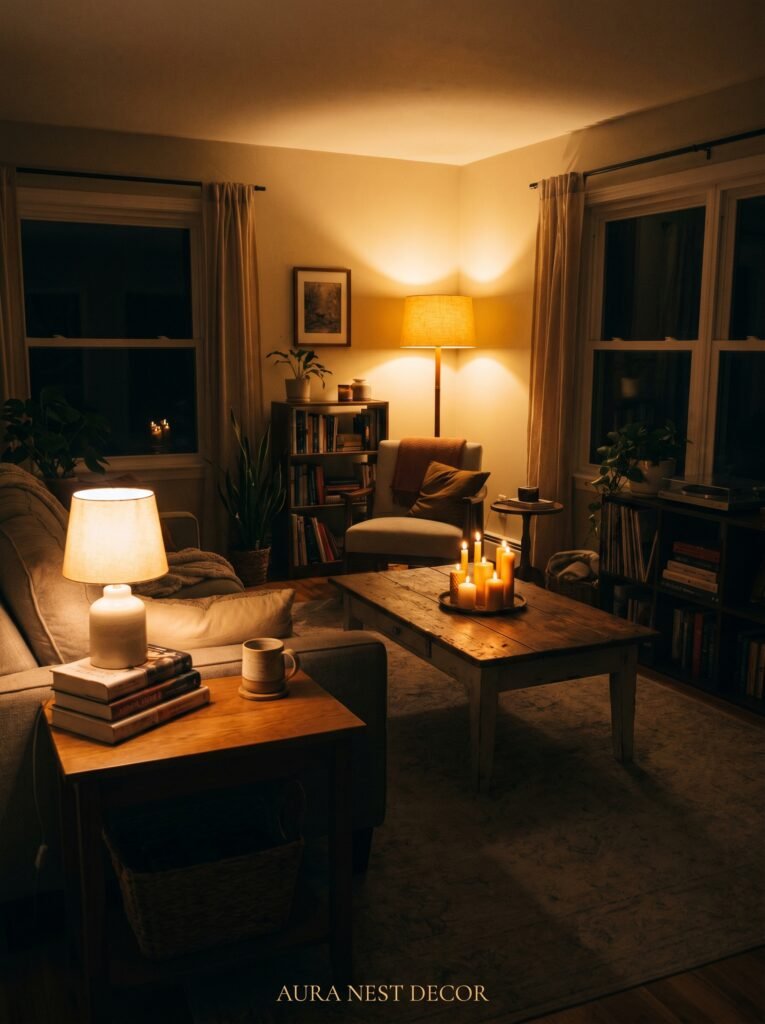
Interior designers say “layer your lighting” constantly, and it sounds elegant but vague. Here’s what it actually means in practice.
There are three layers. Ambient light is your base — it fills the room generally and usually comes from overhead. Think ceiling fixtures, recessed lighting, or a chandelier. Then there’s task lighting, which is focused and functional — a lamp next to the sofa for reading, a light above a games table. Finally, there’s accent lighting. This is the layer most people skip entirely, and it’s the one that does the most emotional heavy lifting. Accent lights highlight things: a piece of art, a bookshelf, a beautiful corner plant. They create little moments of warmth that draw the eye and give the room a sense of intentionality.
You need all three. Not in equal measure, not in a rigid formula, but present and working together. Think of it like cooking. Ambient light is your base flavor. Task lighting is salt — functional, necessary. Accent lighting is the finishing oil you drizzle at the end. Without it, the dish is fine. With it, it’s genuinely good.
Most living rooms in the US and UK have robust ambient lighting and a reading lamp. The accent layer is almost always missing. That’s where to start.
3. The Color Temperature Secret That Interior Designers Rarely Spell Out
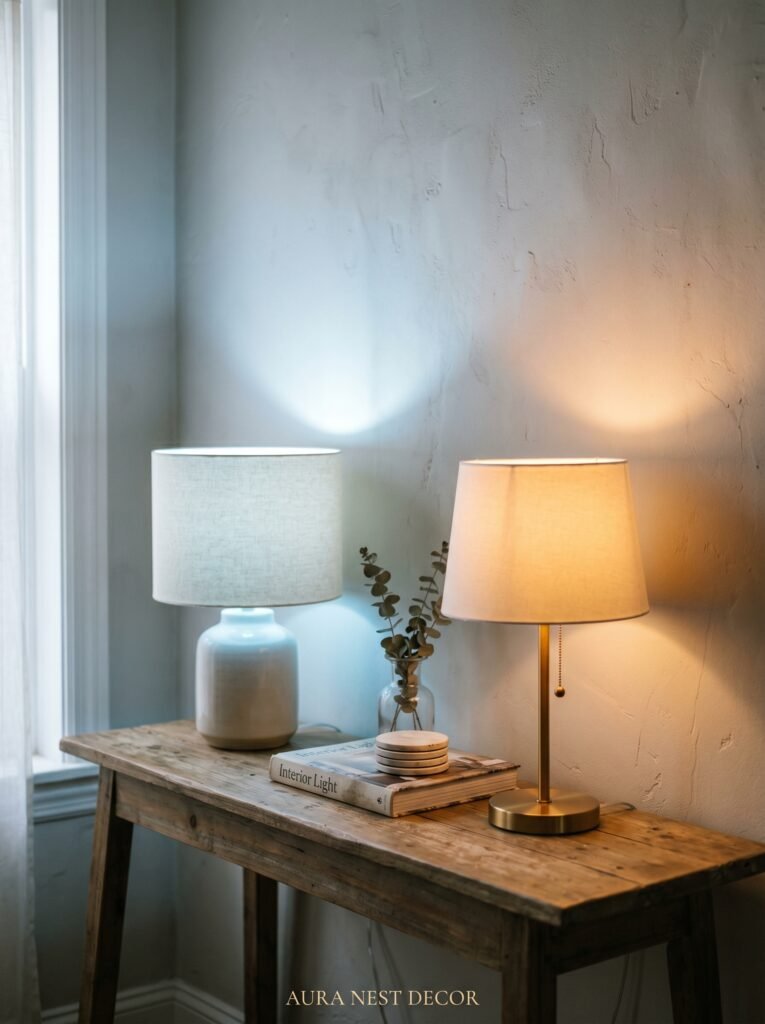
Bulb color temperature is measured in Kelvins, and the number on the box changes everything. A bulb labeled 6500K is close to daylight — blue-white, crisp, clinical. Great for a home office. Genuinely awful for a living room at 8pm. A bulb at 2700K glows amber and warm, the way candles do, the way the sun does in the last hour before it sets.
For living rooms, you want to stay between 2700K and 3000K. That’s the range that makes skin look good, makes wood tones sing, makes a cream linen sofa look expensive and intentional rather than grubby and beige. Go above 3000K and the room starts to feel like a showroom. Beautiful but not warm. The kind of beautiful you don’t want to sit in for very long.
Here’s the thing nobody warns you about: mixing color temperatures looks awful. If your overhead light is 4000K (cool white) and your table lamps are 2700K (warm amber), your room will feel visually incoherent without you being able to explain why. Everything will feel slightly wrong. Commit to a temperature for the whole room and stay there. For almost everyone reading this, that temperature should be 2700K.
4. The Lamp Placement Rule That Changes How Big Your Room Feels
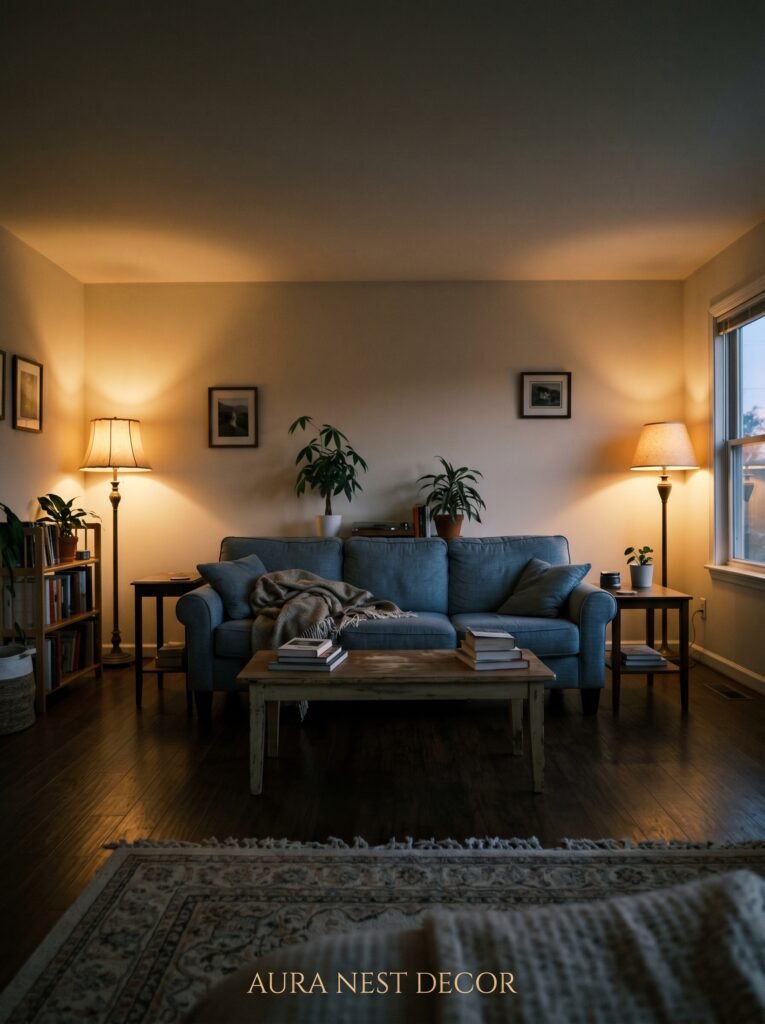
Where you put a lamp matters more than which lamp you buy. Controversial, but true.
The instinct most people have is to push floor lamps into corners and place table lamps on console tables against the wall. This is fine. It keeps things tidy. But it also means all your light sources are at the perimeter of the room, and your center — the actual living space, the sofa, the coffee table, the place where you spend your time — is in relative shadow.
Try this instead: bring light into the center of the room. A table lamp on a large ottoman or a sofa-side table that sits in the middle of the seating arrangement. A floor lamp that arcs over the sofa from behind. A low, glowing lantern on the coffee table. When light exists in the center of the room, the room feels larger, warmer, and more complete. The light is where you are, not around the edges looking in.
In smaller UK terraced houses or American apartments where rooms run narrow, this principle matters even more. Side and perimeter lighting can make narrow rooms feel like corridors. Central light — even a simple pillar candle cluster on the coffee table — makes them feel like rooms you want to live in.
“Light placed at the edge of a room stays at the edge. Light placed in the center invites you into it.”
5. Why Dimmer Switches Are the Best £20 / $25 You’ll Ever Spend on Your Home
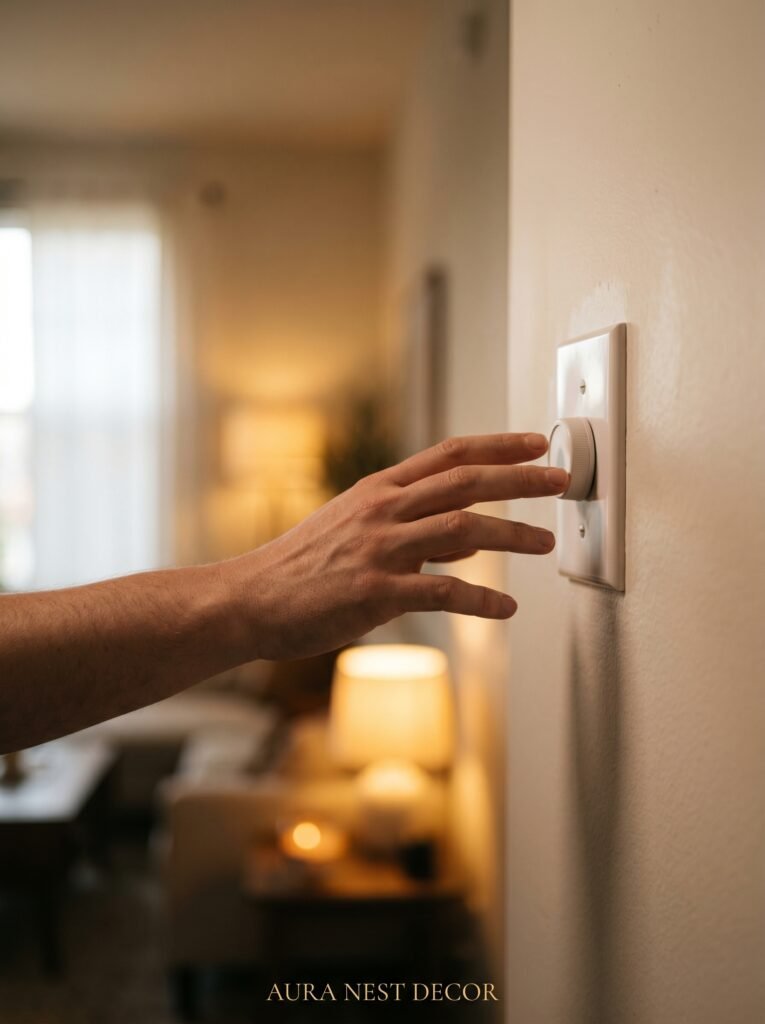
If you only do one thing after reading this, make it this: install dimmer switches in your living room. On every overhead circuit you can.
The difference between a room at full brightness and that same room at 40% is not subtle. It’s not a minor adjustment. It is, genuinely, the difference between a space that feels like a functional room and one that feels like a place you want to spend an entire Sunday in. Dim light slows time down a little. It makes conversation feel more intimate. It signals to your nervous system that the day is winding down, which — if you’ve ever struggled to relax in the evenings — is not a small thing.
Dimmer switches in the UK work with most standard LED bulbs, though you do need to check compatibility — not every LED dims smoothly, and the flickering or buzzing of a mismatched bulb is its own special kind of misery. In the US, Lutron makes dimmers that work beautifully with almost everything. In the UK, brands like MK and Varilight are reliable and come in finishes that won’t look out of place in a well-styled room.
This is a change a confident DIY-er can make in an afternoon. It doesn’t require an electrician. And the result — being able to shift the entire atmosphere of your living room with one twist of a dial — is something you’ll wonder how you ever lived without.
6. The Specific Kind of Floor Lamp That Makes Every Room Look More Expensive
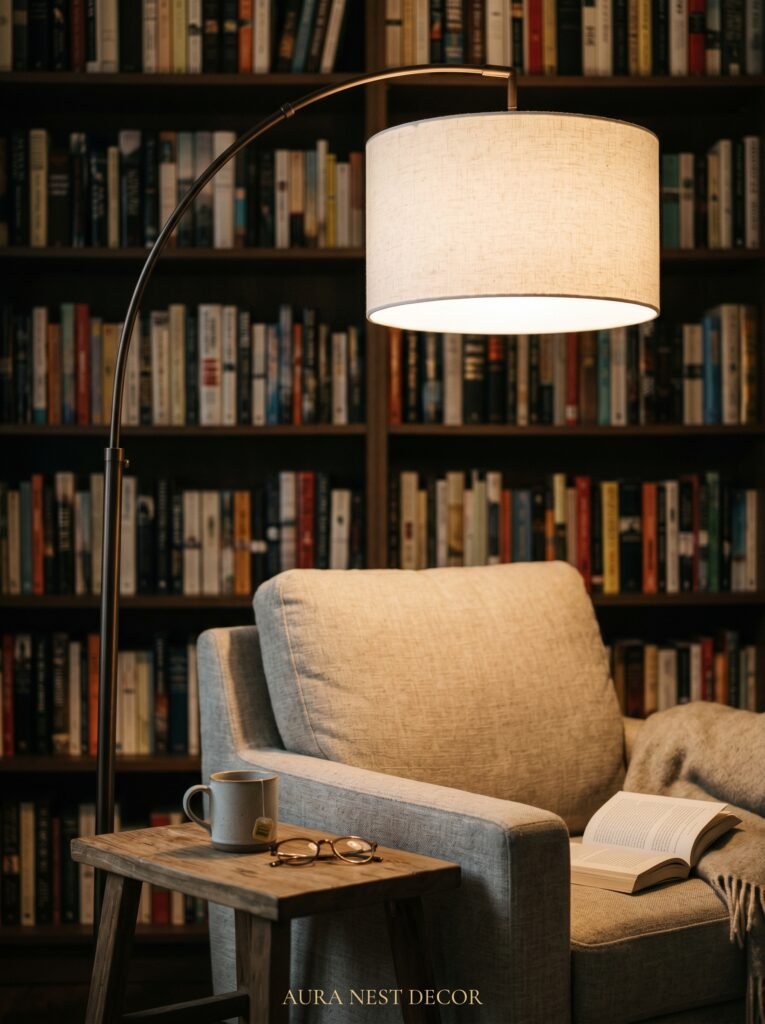
Not all floor lamps are equal. The ones that look expensive almost always share a few characteristics: they’re tall (at least 60 inches), they have a shade that points upward or diffuses light broadly rather than focusing it in a single cone, and they have a base that has visual weight — heavy marble, brushed brass, matte black iron — rather than a thin chrome stick.
Torchière-style floor lamps, the ones with the upward-facing bowl shade, are having a massive moment right now across US and UK interiors. And for good reason. When you point light upward toward a ceiling, it bounces back down across the entire room softly, without a single harsh shadow. It creates the illusion of a much larger, higher-ceilinged space. It’s particularly brilliant in rooms with lower ceilings — a common challenge in older British homes and many American mid-century builds.
Arc floor lamps — the ones with a long curved arm that swings out over a sofa or chair — are the other style worth knowing. They solve a specific problem beautifully: how to get warm, close light next to your reading spot without a side table. The shade hangs roughly at eye level when you’re seated, which creates an almost private little pool of warmth around that corner of the sofa. Very cozy. Very intentional-looking.
7. Sconces — Why the British Have Been Right About This All Along
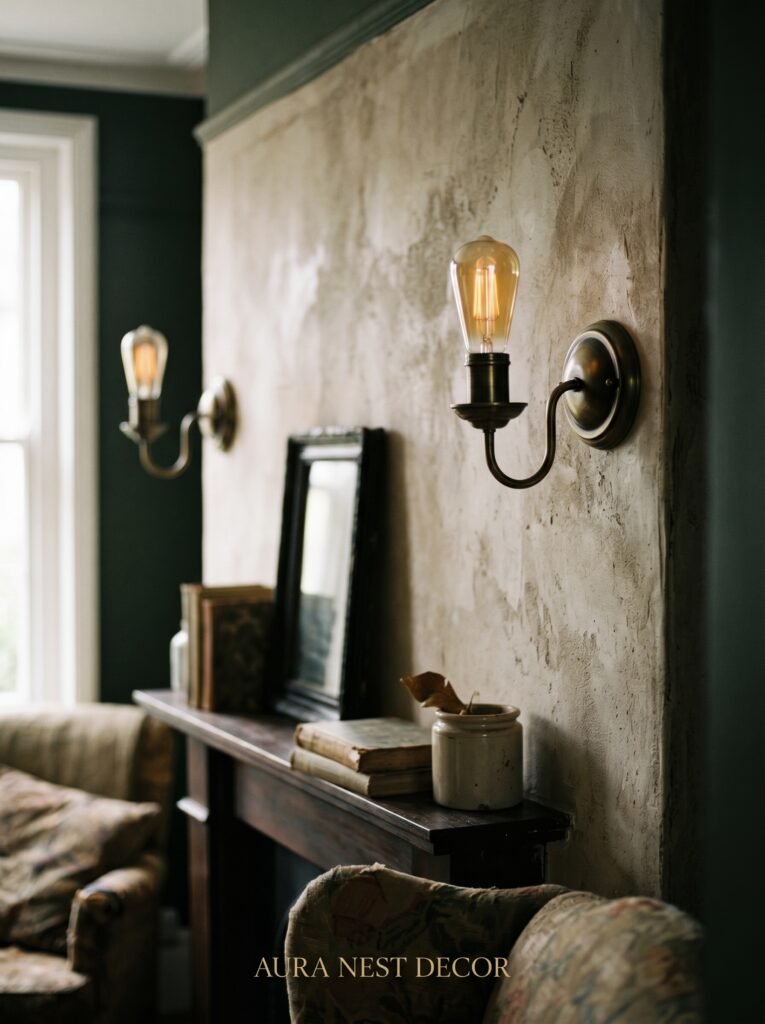
Wall sconces are common in UK homes and wildly underused in American ones. This is a genuine shame, because a well-placed pair of wall sconces does something no floor lamp or table lamp can quite replicate: they fix the light to the architecture of the room itself.
When light comes from the walls at a mid-height — roughly seated eye level, or just above — it creates a warmth that feels baked into the room rather than added on top of it. The room looks finished in a way that’s hard to articulate but immediately felt. It’s the difference between a furnished room and a considered one.
You don’t need wiring to make this work. Battery-operated, rechargeable sconces have become genuinely convincing in recent years. Brands like Gantom and IKEA’s wireless options in the UK have changed what’s possible without calling an electrician. A pair of simple sconces flanking a fireplace, a console table, or a piece of art transforms the whole wall. One on each side of a TV unit can make even a screen-dominant wall feel designed rather than defaulted to.
“Sconces don’t decorate a wall. They make the wall part of the room.”
8. How to Light a Fireplace Surround So It Looks Like a Magazine Page
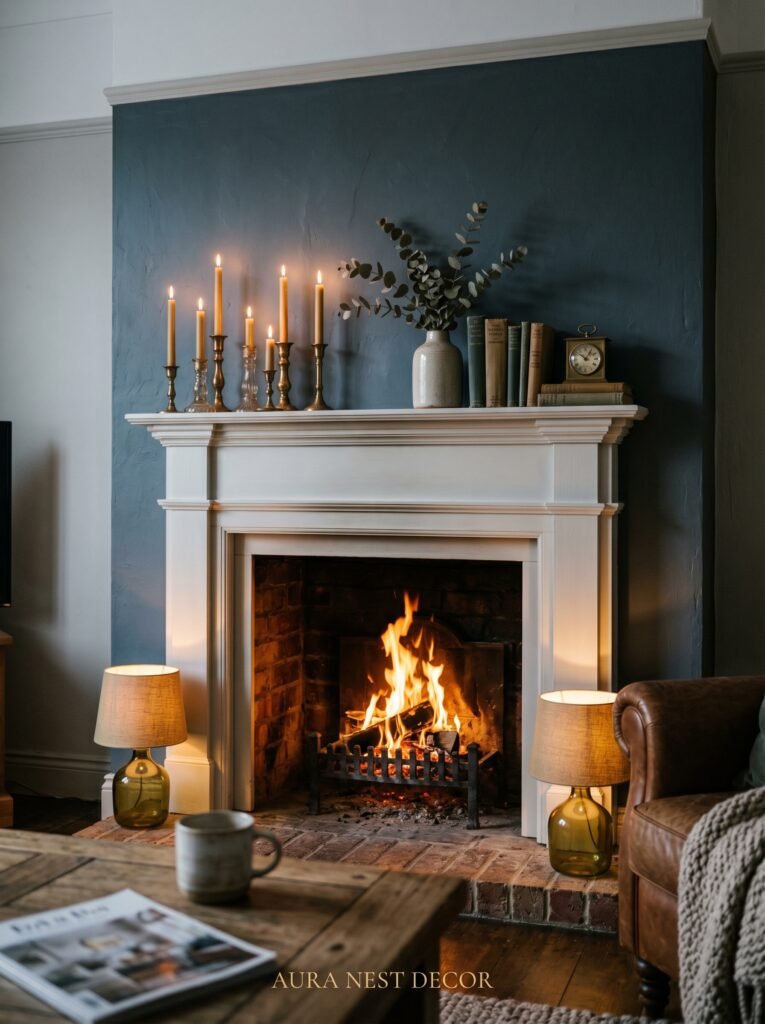
The fireplace is almost always the focal point of a British or American living room, but most people only light it well when there’s an actual fire burning. The rest of the time — which is most of the time, even in winter — it sits in relative darkness and loses its power as a centerpiece.
There are a few ways to fix this. The first is the flanking lamp approach: a pair of identical lamps on either side of the fireplace at the same height create a symmetry that frames the mantel beautifully and draws the eye exactly where you want it. The second is accent lighting on the mantel itself — a small LED picture light above a piece of art hung over the fireplace, or a cluster of LED candles on the hearth itself when the fireplace isn’t in use.
The third, and most impactful, is placing a warm-toned lamp or lantern inside the firebox itself during the warmer months when you’re not burning wood or gas. A cluster of pillar candles or a set of realistic flame LED candles in the hearth fills the dark void with warmth and completes the focal point even in August. This is the trick that makes living rooms in summer look just as intentional as they do in December.
9. The Forgotten Light Source That Decorators Always Include
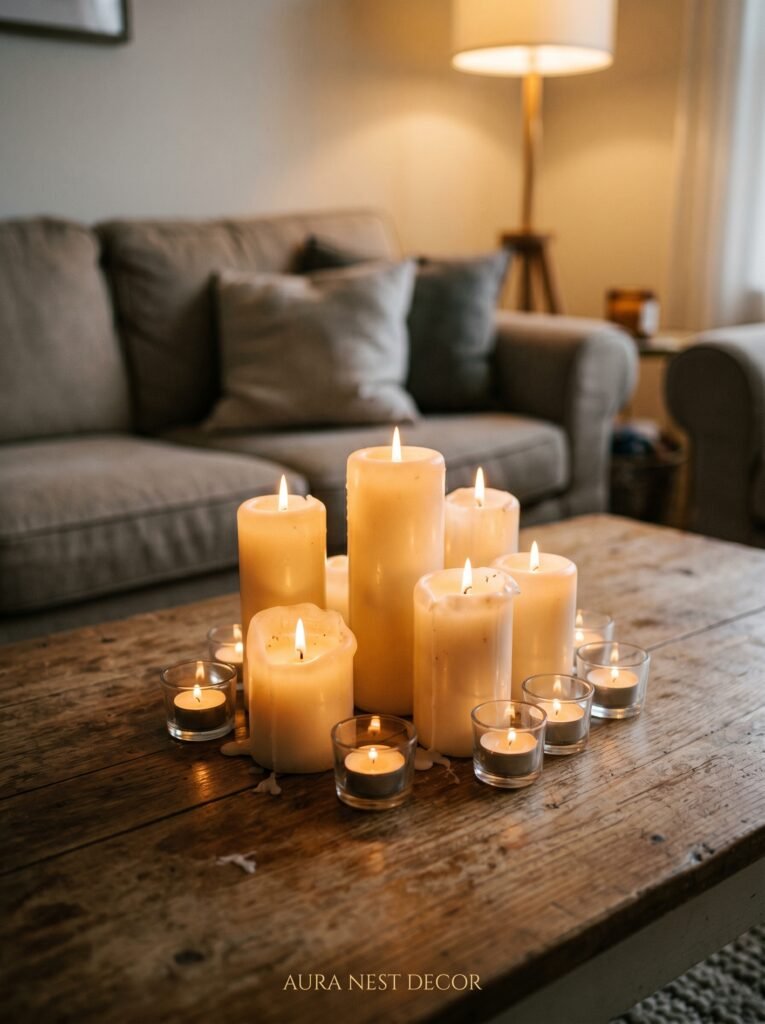
Candlelight. Real, actual candles. Or very good fakes.
I know. It feels obvious. But walk through your living room right now and count how many lit candles you actually have on any given Tuesday evening. Most people have decorative candles — lovely ones, even — that never get lit. They’re treated as objects rather than light sources. This is a missed opportunity that costs nothing to fix.
Three lit pillar candles on a coffee table at 7pm, when the overheads are dimmed and the lamps are warm, create an entirely different room from the same space an hour before. The light moves. Real flame has a quality of aliveness that no bulb has ever perfectly replicated, and that quality changes how the whole room feels — not just the corner with the candles in it.
If open flames aren’t practical — you have young children, curious cats, a forgetfulness about extinguishing things — the new generation of flame-effect LED candles is genuinely impressive. Brands like Luminara and Gideon make options where the “flame” flickers and gutters in a way that’s difficult to distinguish from the real thing at a glance. Worth every penny for the atmosphere they create.
10. The Color That Keeps Showing Up in Every Beautifully Lit Living Room Right Now

Warm terracotta. And it’s not a coincidence.
Terracotta — as a lampshade color, as the tint of a vintage amber glass pendant, as the warm peach-brown of a rattan floor lamp base — interacts with warm-toned light in a way that makes a room feel sun-drenched even in a north-facing room in November. When 2700K light hits a terracotta shade, what comes through is deeply amber and warm. Genuinely beautiful in a way that a white or cream shade just isn’t.
This is something you can work with even without replacing any fixtures. Terracotta or amber glass votive holders scattered at different heights. A clay table lamp base. A shade swapped from cream to a soft rust on an existing lamp. These are small moves with disproportionately large impact on how a room feels after dark.
11. The One Rule That Makes Any Small Living Room Feel Intentional
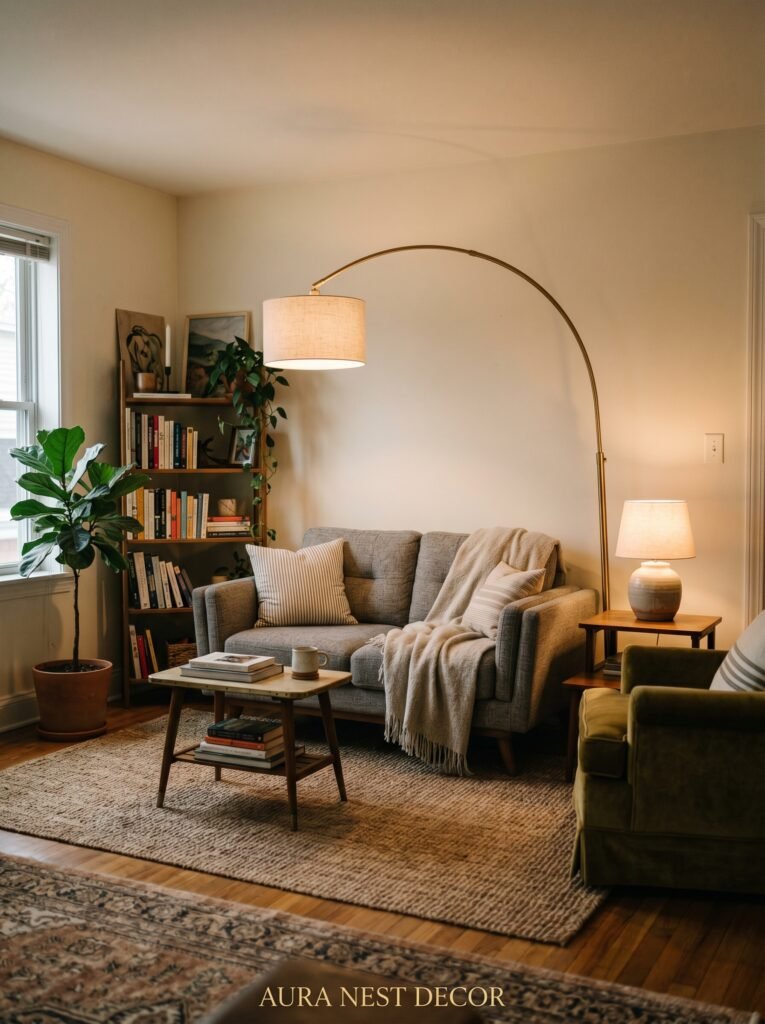
Use at least five separate light sources.
That’s it. That’s the rule. Five sounds like a lot until you count: an overhead fixture, two table lamps, a floor lamp, and a candle cluster on the coffee table. That’s five, and you can build from there.
The reason this works in small rooms especially is that multiple small pools of light create the perception of multiple zones within one space. Rather than seeing a small room lit evenly and in its entirety — which emphasizes its size — you see warm pockets: a reading corner, a cozy sofa nook, a glowing shelf. The eye moves between them. The room feels richer, more layered, more interesting. The size stops being the dominant characteristic of the space.
Small rooms in British homes — and in New York or Chicago apartments — can feel genuinely cozy rather than cramped when this rule is applied well. It’s one of the most democratic design principles there is. It requires no renovation, no significant budget. Just intention and a few more lamps.
12. What to Do This Weekend That Will Actually Change How You Feel About Your Home
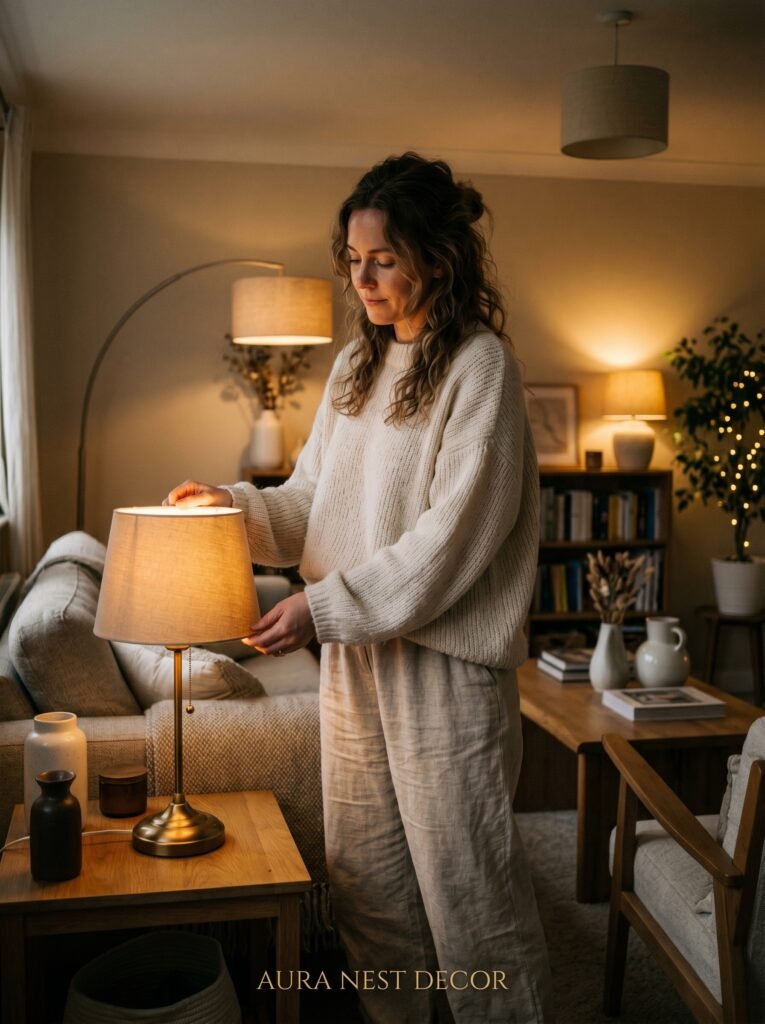
Start with the bulbs. Go through every lamp and overhead fixture in your living room and replace anything above 3000K with a warm 2700K LED. This single change — which costs less than $20 / £15 for a pack of bulbs — will make a visible difference before you’ve moved a single thing.
Then dim. If you have a dimmer switch, try your room at 50% tonight instead of full brightness. If you don’t have dimmers, turn off the overhead entirely after 6pm and rely only on lamps. This feels slightly terrifying the first time and completely right by the third.
Then add one new light source. Just one. A small table lamp from a thrift store. A candle on the mantel. A wireless sconce from IKEA. Put it somewhere that isn’t a wall or a corner — somewhere in the center of the room, near where you actually sit.
These three things, done this weekend, will make your living room feel different by Sunday evening. Not because you’ve spent a fortune or undertaken a renovation. Because light is the most powerful styling tool there is, and you’ve finally started using it on purpose.
—
❓ FAQ
Q: How many lamps do I actually need in a living room? A: Most designers suggest a minimum of four to five separate light sources for an average-sized living room. This doesn’t have to mean five floor lamps — it includes table lamps, overhead fixtures, candles, sconces, and accent lights. The goal is layering, not quantity for its own sake.
Q: Can I mix warm and cool light bulbs in the same room? A: You can, but it tends to look visually jarring even if you can’t immediately identify why the room feels off. Sticking to one color temperature — ideally 2700K for living rooms — creates a cohesive, harmonious atmosphere. If you’re mixing for a specific design reason, keep cool light very contained (like inside a display cabinet) rather than as a general room source.
Q: Is it worth hiring an interior lighting designer or can I do this myself? A: For most living room lighting updates, you can absolutely do this yourself. Swapping bulbs, adding lamps, installing dimmer switches, and repositioning existing fixtures are all DIY-friendly changes with significant impact. A professional lighting designer is worth considering for larger projects involving new wiring, built-in lighting, or a full room renovation.
—
💭 Final Thoughts
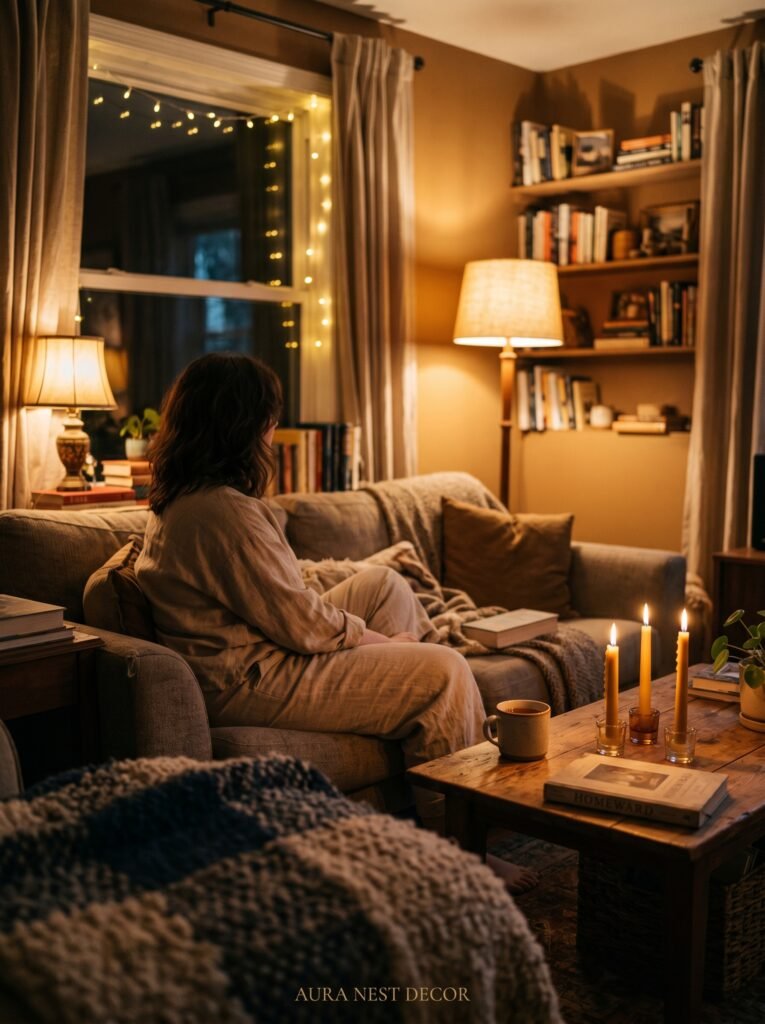
Lighting is the one thing in interior design that changes not just how a room looks, but how it feels to be inside it — and how you feel about yourself once you’re there. It deserves the same attention and care you give to paint colors or furniture. You don’t need to start over. You just need to start noticing.
What would it change for you to actually enjoy the way your living room looks at 8pm on a Tuesday?