The Living Room That Looks Like It Was Collected Over a Lifetime (But Came Together in One Weekend)
You know the rooms that stop you mid-scroll? Not because they’re perfect — but because they feel lived in and considered at the same time. That’s the modern traditional rustic sweet spot, and it’s harder to fake than it looks. Here’s exactly how to get there.
—
1. Why “Modern Traditional Rustic” Isn’t a Contradiction — It’s the Whole Point
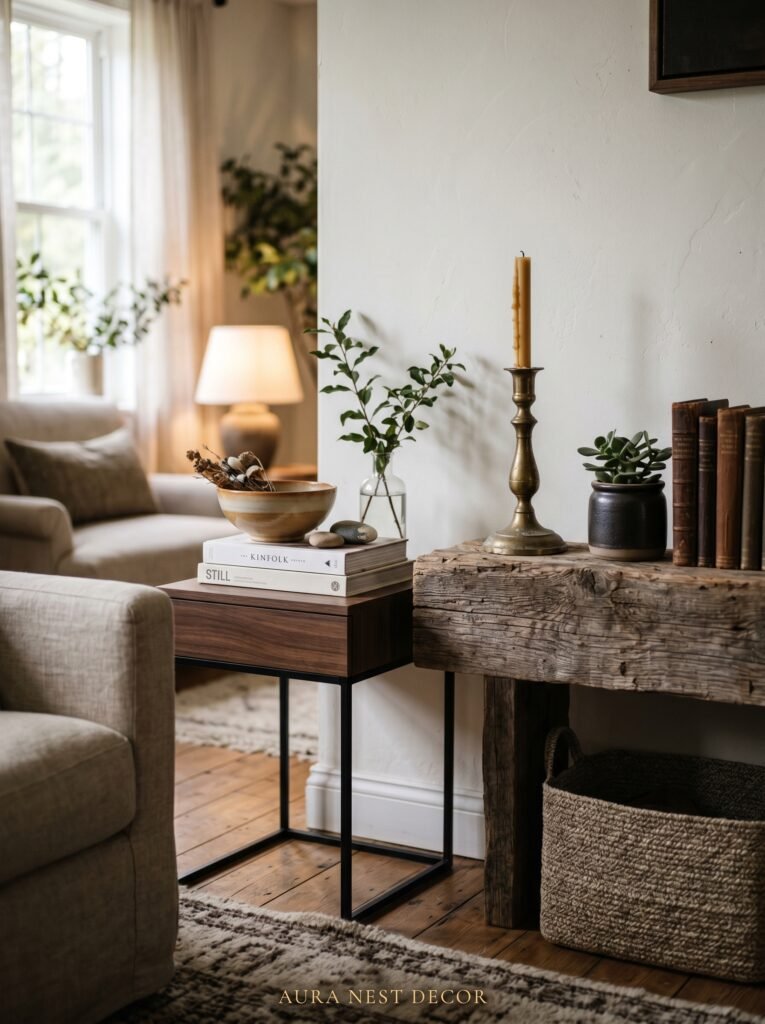
Most people hear “traditional” and picture fussy curtains and furniture their grandmother wouldn’t throw out. They hear “rustic” and imagine reclaimed barn wood and mason jars. Neither is wrong, exactly. But modern traditional rustic is something else entirely — it’s the feeling of a room that knows its own history.
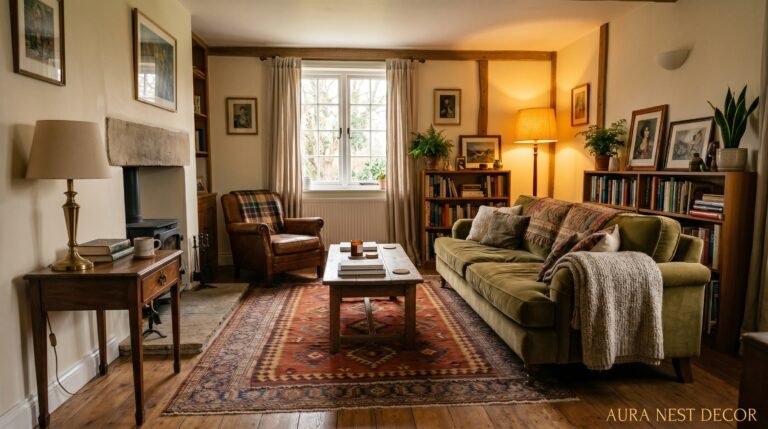
Think about the best living rooms you’ve ever stepped into. The ones where you immediately want to sit down and stay for three hours. Nine times out of ten, they aren’t decorated in a single style. They have an old leather armchair next to a clean-lined sofa. A rough wooden coffee table sitting on a well-worn Persian rug. A simple white wall with one painting that clearly meant something to someone.
That mixture — the warmth of age, the comfort of tradition, the restraint of modern editing — is what we’re chasing.
The modern element is about editing. Choosing less. Letting materials breathe. The traditional element is about quality and familiarity — shapes we recognize, pieces that feel like they belong to a long story. The rustic part? That’s the texture. The imperfection. The honesty of a material that shows its age without apology.
Getting all three into one room feels impossible until you realize they were always meant to live together.
“The best living rooms don’t look decorated. They look inhabited.”
2. The Neutral Base That Does More Than You Think
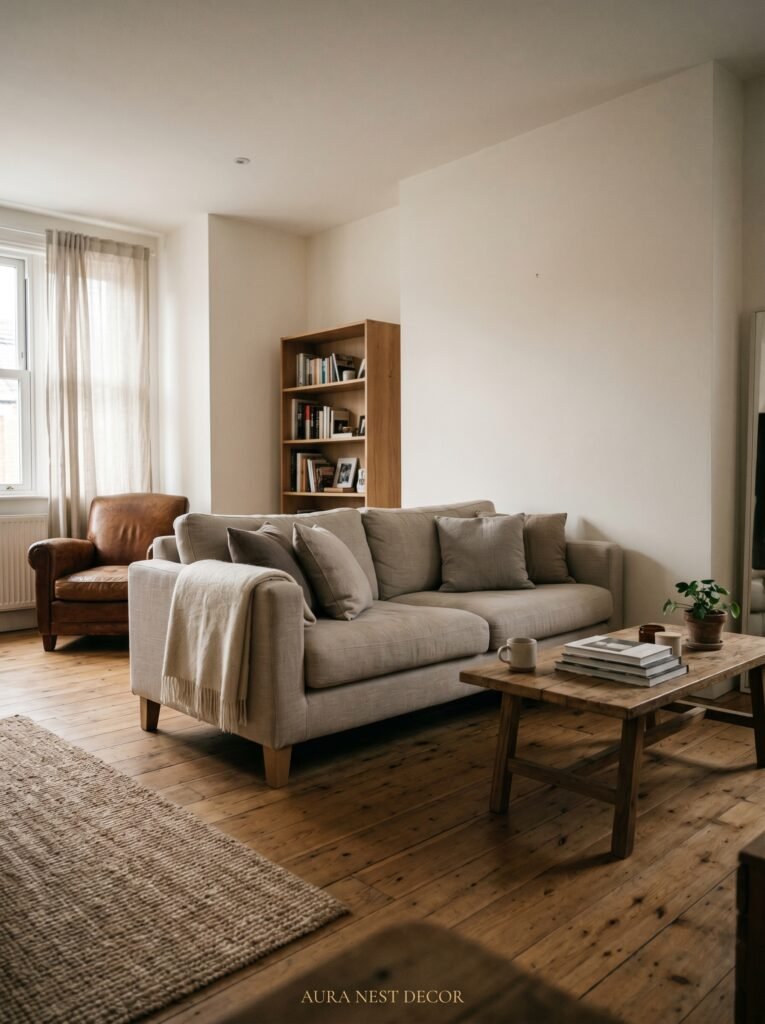
Before you touch a single piece of furniture or art, you need to think about your walls and floors — because this is where every beautiful modern traditional rustic room quietly begins.
The instinct is to go beige. And honestly? That instinct isn’t wrong. But there’s beige and then there’s warm white with clay undertones, and the difference between the two in natural light is the difference between a room that feels flat and one that feels like the sun lives there.
In the US, Benjamin Moore’s Pale Oak and White Dove are classics for good reason. In the UK, Farrow & Ball’s Elephant’s Breath and Skimming Stone do the same heavy lifting — grounding a space without dominating it. These aren’t trendy colors. They’re quiet colors that make everything else in the room look better.
For floors, if you’re lucky enough to have original hardwood or flagstone, don’t cover all of it. A good rug should feel like an anchor, not a cover-up. The floor needs to be visible at the edges. The contrast between the expanse of a worn wood floor and the softness of a rug underfoot is one of those details that’s almost impossible to articulate but immediately felt by anyone who walks in.
If you’re renting or working with carpet you can’t change, a large, flat-weave or low-pile rug in a warm earth tone can do a lot of the heavy lifting. The key word is large. Too-small rugs are one of the most common mistakes in living room decorating, full stop.
3. The One Sofa Shape That Works in Every Version of This Style
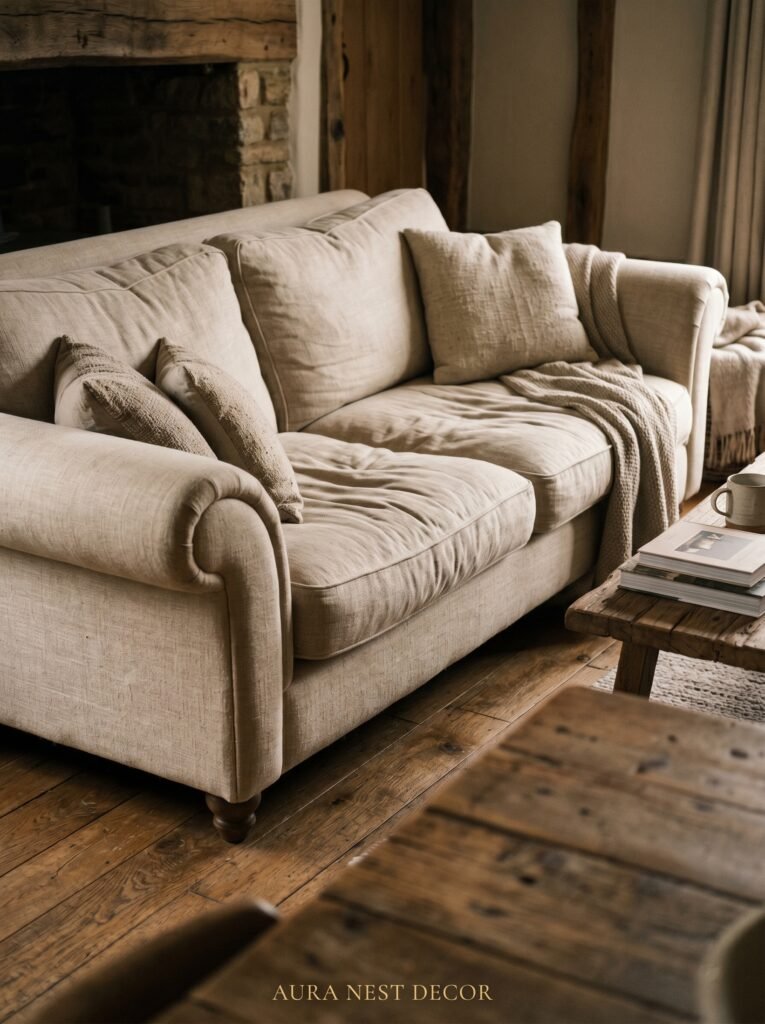
There are sofas that shout for attention and sofas that anchor a room. For modern traditional rustic, you want the latter.
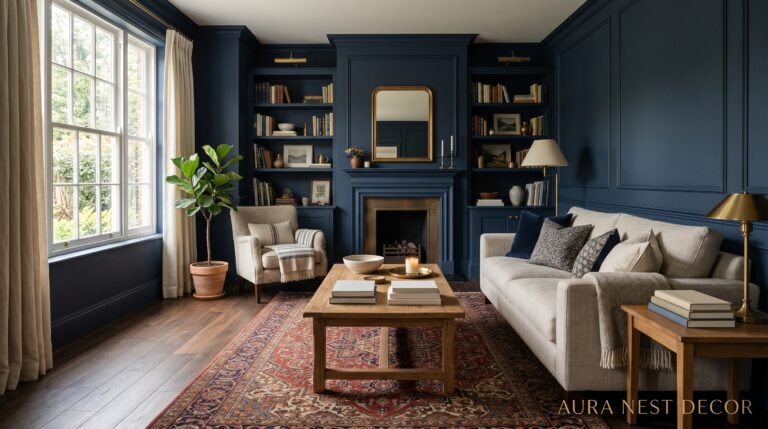
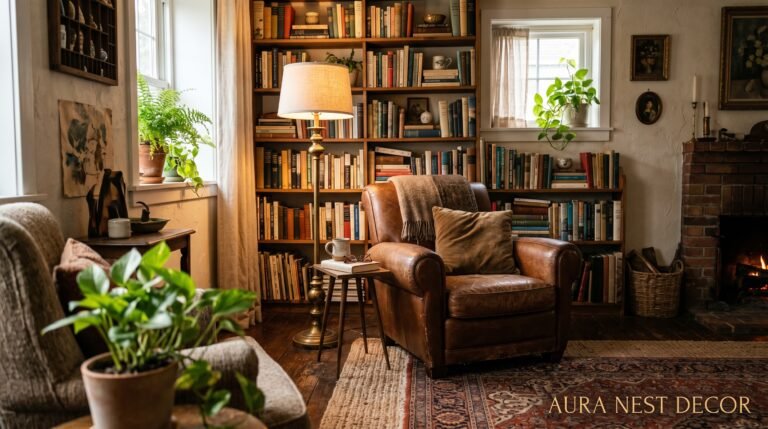
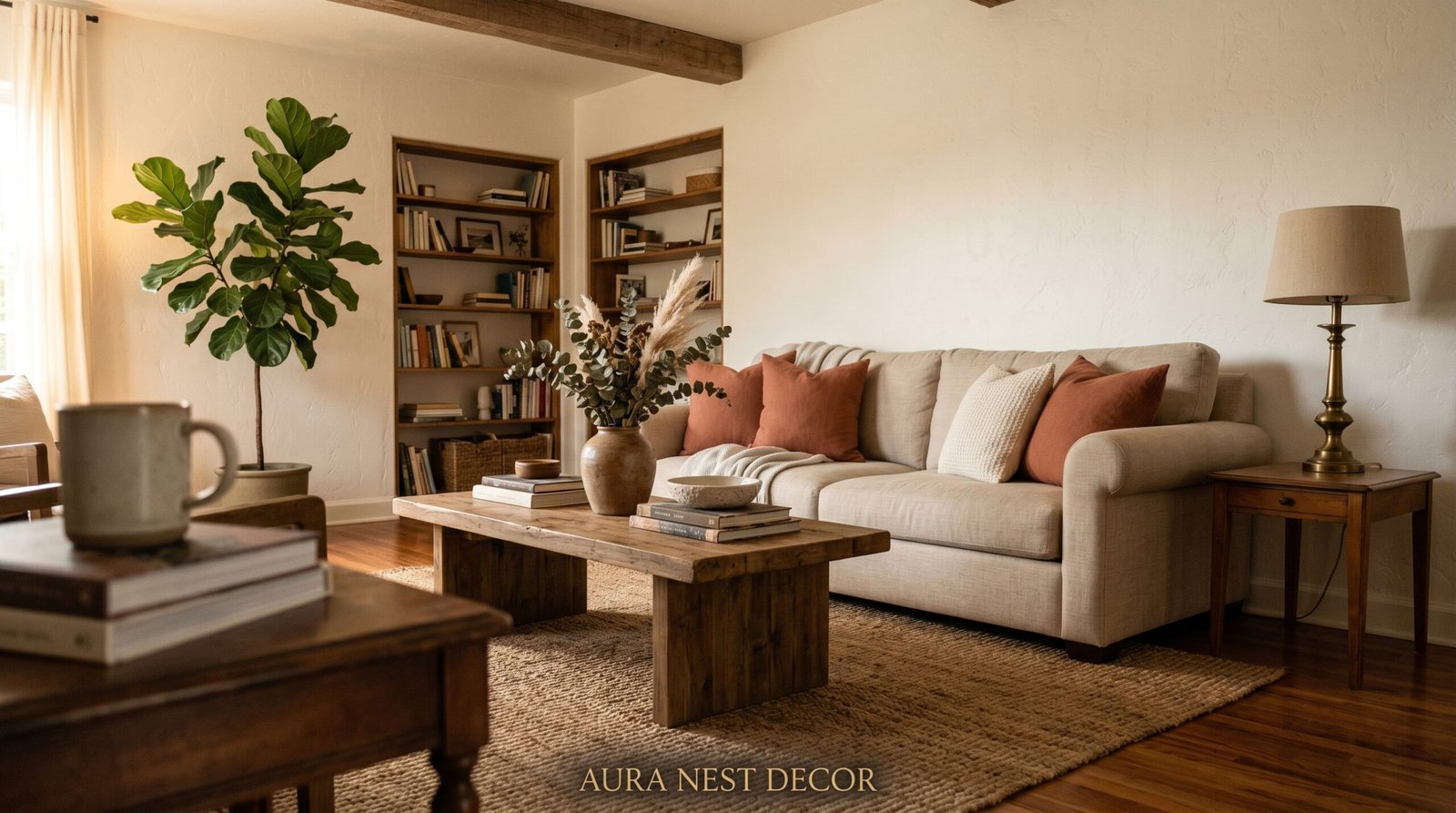
A rolled-arm or track-arm sofa in a neutral — warm linen, oatmeal boucle, aged leather — is almost universally right for this style. The shape matters more than the fabric, but both matter. You want something that has a sense of weight without being heavy-handed. A sofa that says I was chosen carefully without saying anything loud at all.
In practice, this often means avoiding legs that are too spindly, cushions that are too stiff, and backs that are too low. A sofa that you can genuinely sink into — with a back high enough to rest your head — communicates comfort in an immediate, visual way before anyone even sits down.
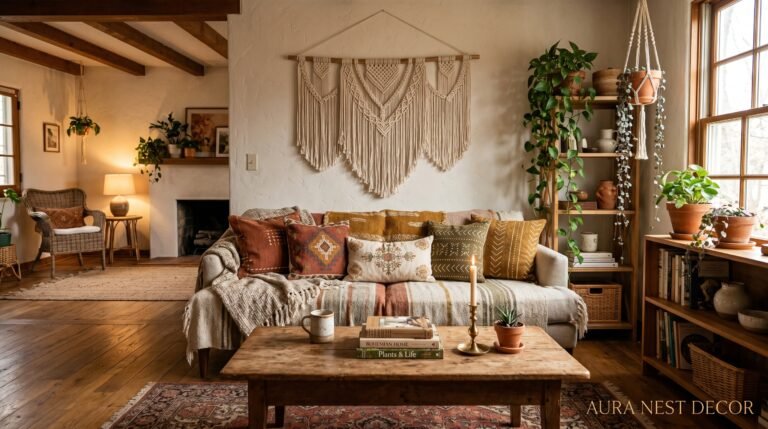
What you drape over it matters just as much as the sofa itself. A chunky-knit throw in a natural oatmeal or warm terracotta. A couple of cushions in different textures — something woven, something velvet, something linen. The key is not to match. The key is to coordinate while suggesting that nothing was purchased as a set.
That last point is important enough to repeat.
Nothing in a great modern traditional rustic room should look like it came in a set.
4. The Coffee Table Rule That Interior Designers Never Actually Say Out Loud
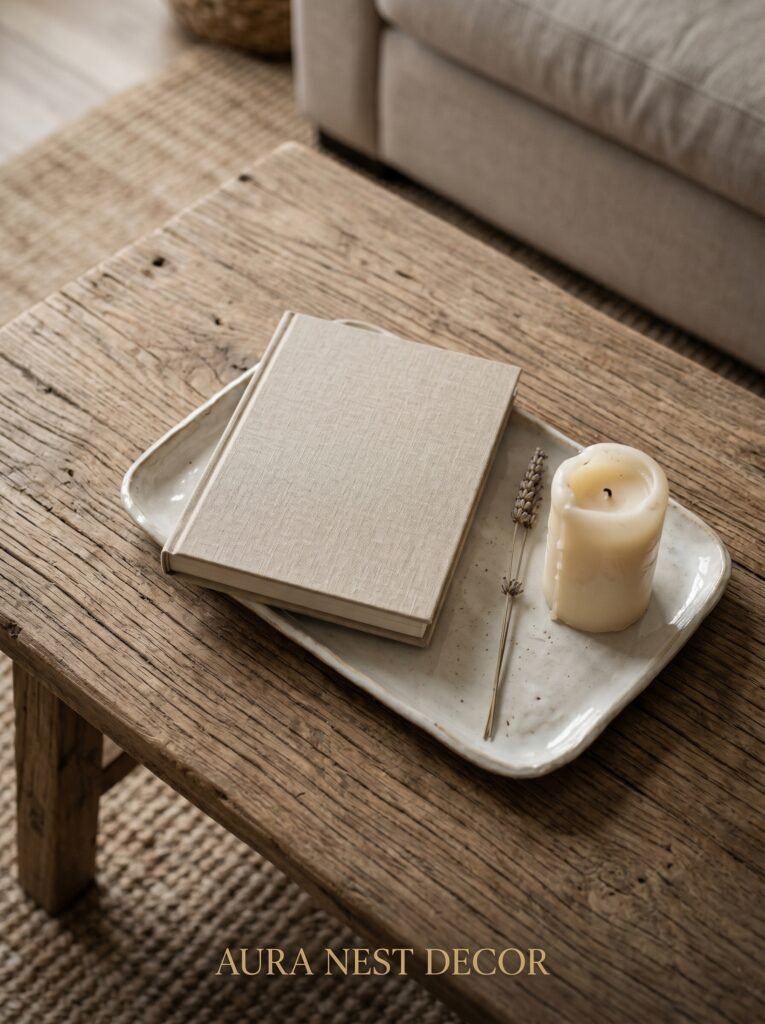
A wooden coffee table in this style is almost non-negotiable. But not just any wood. You want something with grain, with history, with the suggestion that it survived something.
Reclaimed oak with visible knots. A thick slab of walnut with a live edge. A dark mahogany piece with turned legs that’s been in someone’s family since 1987. All of these work. What doesn’t work is wood that looks too perfect, too uniform, too new. Ironic as it sounds, the wood in this style should look like it was never trying.
The height matters too. Coffee tables that sit too low feel like an afterthought. The general rule — and it’s a good one — is that the table surface should sit roughly at the same height as your sofa cushions. Easy to reach without bending uncomfortably, visually balanced in the room.
Style the surface with intention but without overthinking. A stack of two or three books. A small ceramic bowl. A candle in a glass vessel. A little empty space. Resist the urge to fill every inch — the breathing room is part of the design.
5. The Color That Keeps Showing Up in Every Beautiful Living Room Right Now
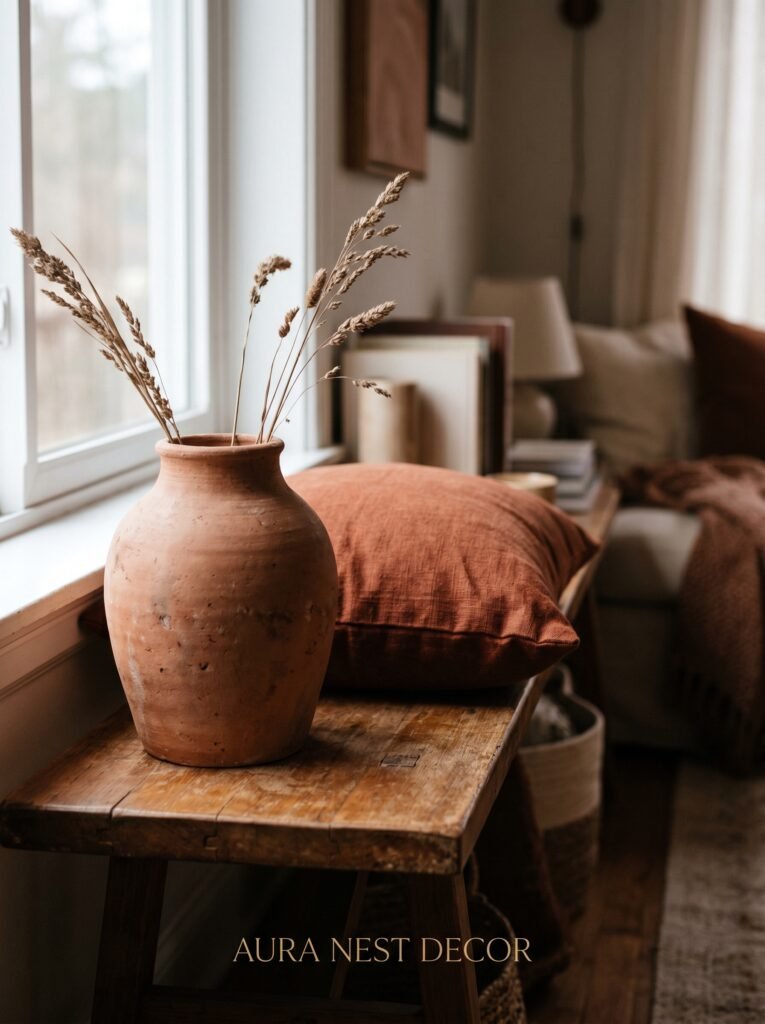
Terracotta. It’s been circling for a few years now and it’s still not going anywhere — and in the context of modern traditional rustic, it makes complete sense.
Terracotta is warm without being aggressive. It has the quality of something baked, something ancient, something pulled from the earth. A terracotta cushion against a cream linen sofa is one of the easiest wins in decorating. A terracotta-glazed ceramic vase on a wooden shelf does more for a room’s atmosphere than most people expect a single object to do.
If terracotta feels too warm for your space, consider its quieter cousins: dusty sage, warm rust, faded olive. These are all colors that live happily alongside natural wood, aged leather, and neutral walls. They feel neither aggressively trendy nor obviously safe. They feel considered.
What to avoid: cool greys, stark whites, anything with a blue-black undertone. These pull the modern part of the equation too far toward minimalism and lose the warmth that makes this style feel welcoming rather than just stylish.
“Color in this style shouldn’t announce itself — it should deepen the room’s warmth like the last hour of afternoon light.”
6. How to Mix Old and New Without It Looking Like a Car Boot Sale
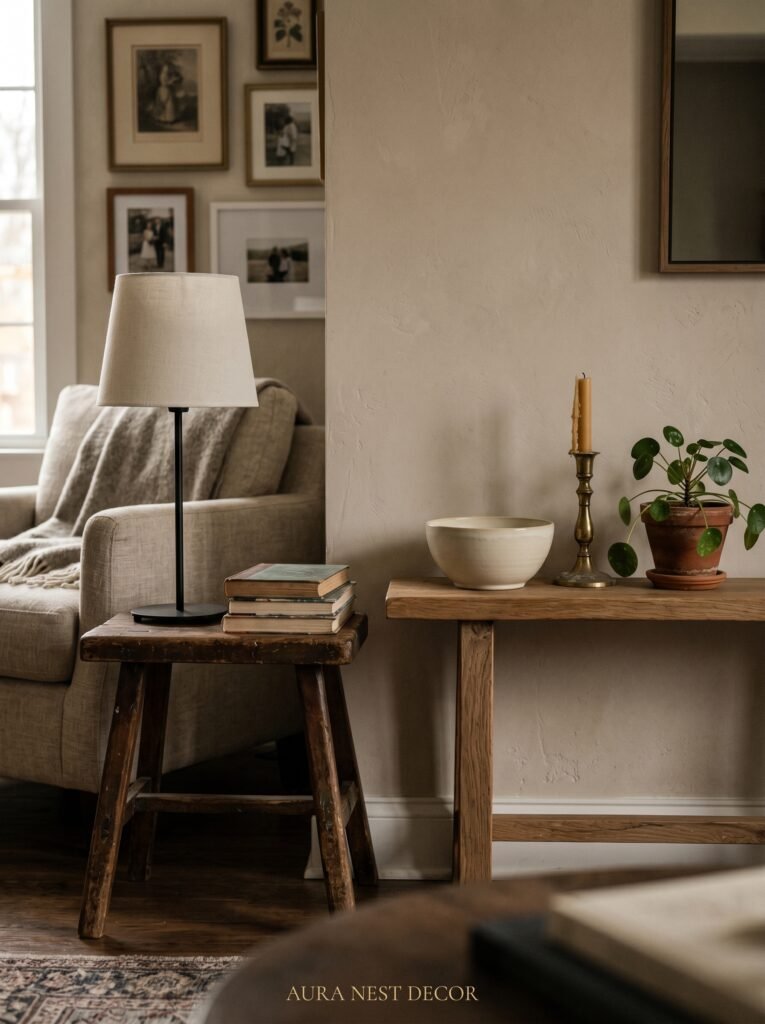
This is the part that scares people. And it’s the part that, when done well, is what separates a beautiful room from a forgettable one.
The rule isn’t complicated, but it requires conviction. Every room needs anchors — pieces that feel genuinely established, genuinely old, or genuinely substantial. And then the newer, cleaner pieces orbit those anchors without competing with them.
An old leather Chesterfield with a contemporary glass floor lamp beside it. An antique French farmhouse armoire against a white-painted wall hung with modern abstract art. A perfectly imperfect vintage rug under a low, clean-lined wood bench. In each case, the old piece sets the emotional tone of the corner. The new piece keeps it from tipping into museum territory.
In the US, estate sales and Facebook Marketplace are genuinely excellent for finding the old anchors. In the UK, car boot sales, charity shops, and eBay are full of them. You don’t need to spend a fortune. You need to be patient enough to recognize something good when you see it — and decisive enough to bring it home.
The only things that genuinely don’t mix? Opposite textures in the same finish. Rough-sawn wood next to smooth walnut veneer, for example, creates visual noise rather than variety. Stick to natural materials throughout — wood, stone, linen, leather, cotton, wool — and the old and new pieces will find their own harmony.
7. Lighting Is the Mood. Not the Accessory.
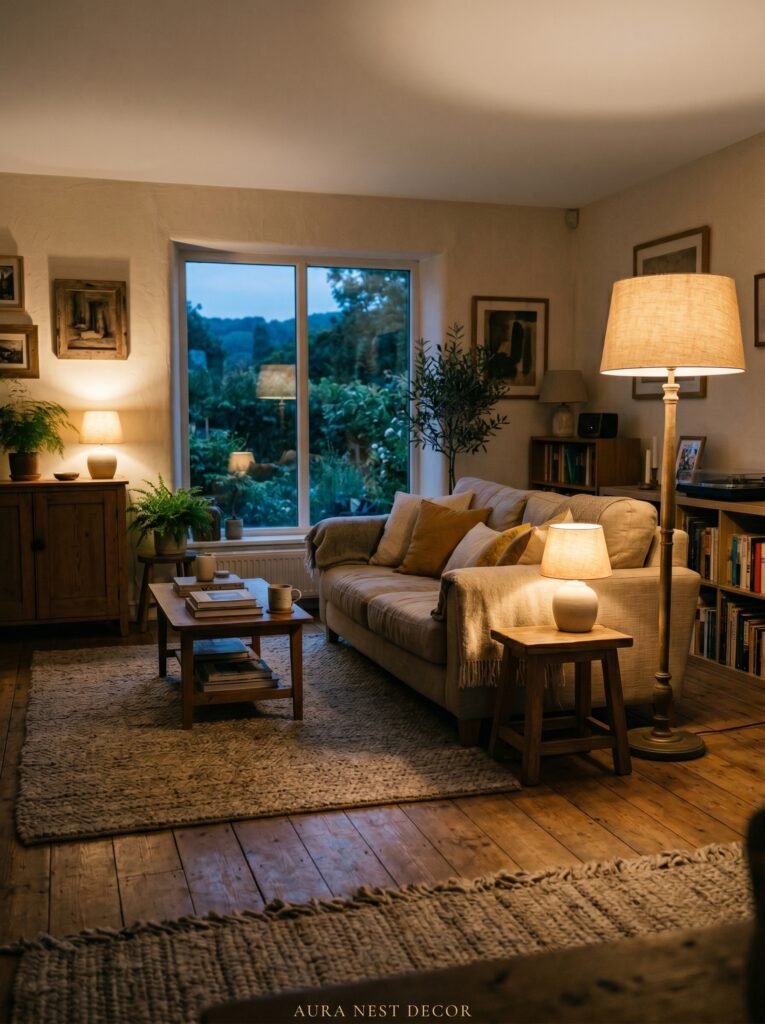
Here’s the thing about lighting that most decorating advice glosses over: the light fitting is almost secondary. What matters is what the light does to the room.
A living room lit by a single overhead fixture feels like an office. Or a waiting room. No amount of beautiful furniture survives that light. Conversely, a room lit by three or four different sources at different heights — a floor lamp in the corner, a table lamp on the sideboard, a low pendant over the seating area — feels immediately warmer, deeper, more dimensional.
The amber glow of an Edison-style bulb at 7pm does something to a room that no interior designer can fully explain and every person instinctively feels. It slows things down. It makes the room feel private, like a space that belongs to whoever is inside it.
For this style, lean toward warm-toned bulbs (around 2700K), linen or ceramic lampshades, and lighting that sits below eye level when you’re seated. The goal is to light the room from the inside out — starting from the corners, working inward — rather than flooding it from above.
Candlelight, where safe and practical, does the final mile of atmospheric work that no lightbulb quite manages. A grouping of pillar candles on a stone hearth, or a cluster of votives on the coffee table, creates a flicker that makes a room feel alive in a way that’s entirely different from anything electric.
“The right lighting doesn’t illuminate a room. It makes you forget it was ever dark.”
8. Shelving That Looks Styled Without Trying Too Hard
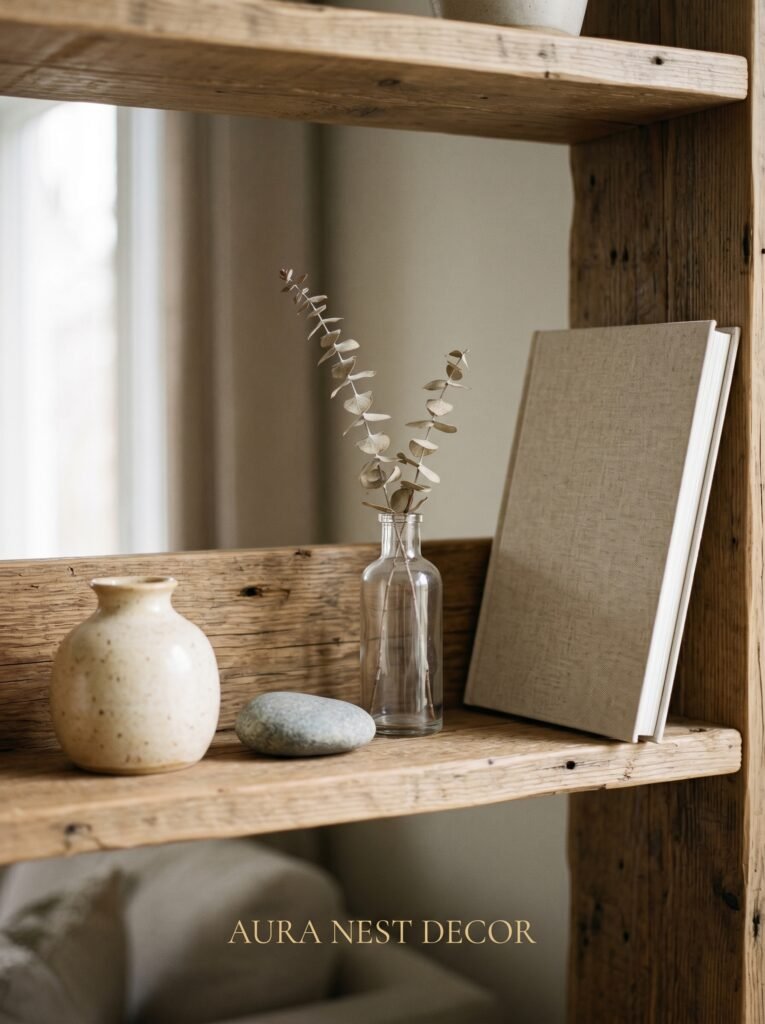
Open shelving in a living room is either a triumph or a disaster, and the line between the two is thinner than anyone wants to admit.
The disaster version: too many objects, too similar in size, too evenly spaced. It looks like a display cabinet at a craft fair. The triumph version: a few genuinely interesting things, some breathing room between them, and a conscious mix of heights and materials.
For modern traditional rustic, think in clusters of three. One taller object (a vase, a candlestick, a small sculpture), one medium (a stacked pair of books, a ceramic bowl), one low (a small stone, a single candle, a folded piece of linen). Leave at least one section of any shelving unit intentionally empty. That empty space isn’t a gap you haven’t filled yet. It’s part of the design.
Wood and ceramic are your best friends here. Natural fibers — a small woven basket, a rolled piece of hessian — add texture at low cost. Books, honestly, do more styling work than anything else on a shelf. They add color, texture, suggestion of intellectual life. Don’t spine them all outward in a perfect row. Turn a few backwards. Stack a few horizontally. Let them look read.
9. The Rug Decision That Changes Everything Else in the Room
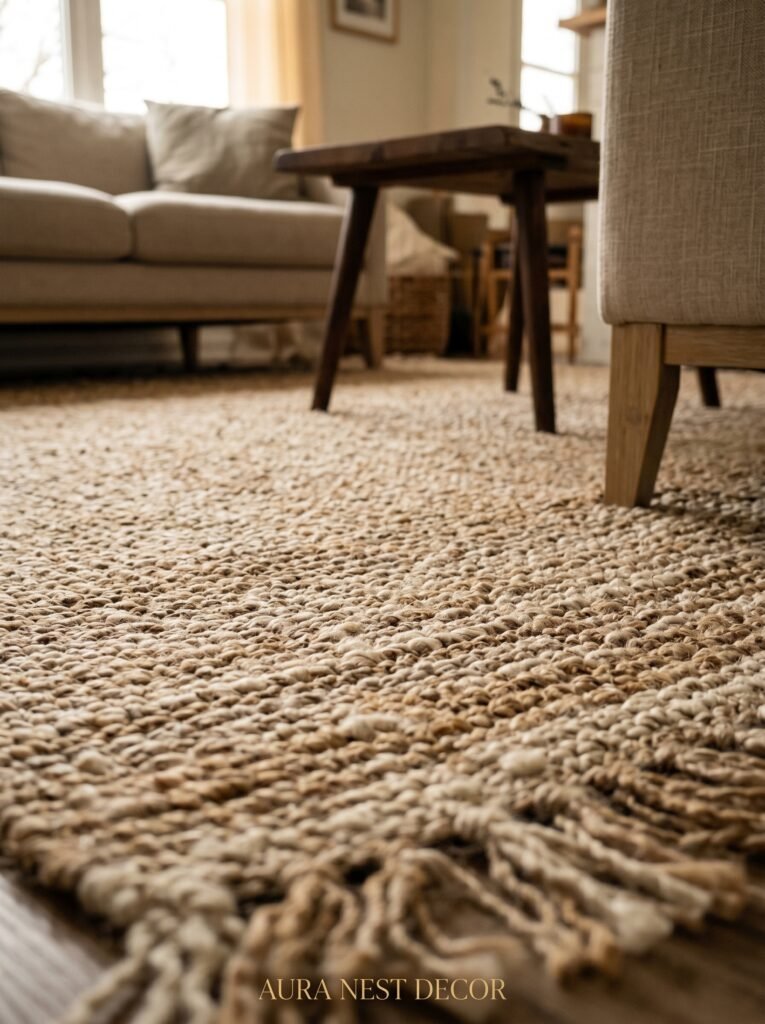
If there is one single decision in a living room that has the biggest effect on the whole feel of the space, it might be the rug. Not the sofa. Not the wall color. The rug.
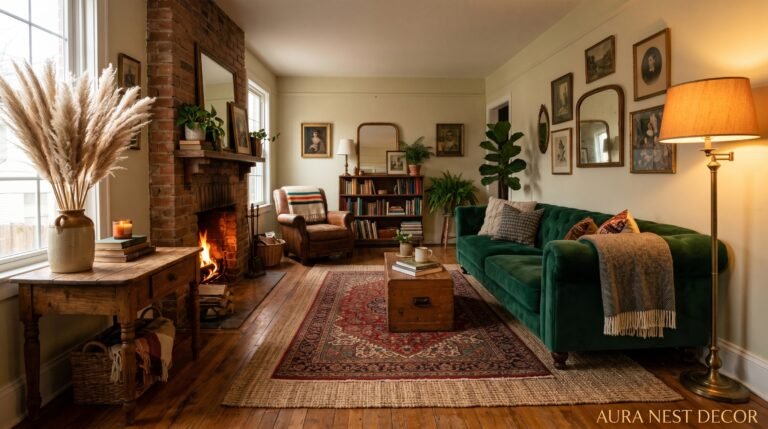
A Persian or Oriental-style rug in muted, time-worn colors — dusty reds, faded blues, warm creams — is one of the most reliably beautiful choices for this style. The pattern adds traditional character. The worn quality adds age. The color grounds without dominating. These rugs work in rooms that are otherwise very modern, very rustic, or anywhere in between.
If you want something simpler, a flat-weave kilim in earth tones does similar work with a slightly more laid-back, less formal energy. For something softer underfoot, a Moroccan-style shag in natural cream or warm ivory adds texture that reads as luxurious without looking fussy.
The size rule, one more time, because it bears repeating: all four sofa legs on the rug, or front legs only — but never the rug floating in the middle of the room with no furniture touching it. That’s the one rug mistake that immediately makes a well-decorated room look unfinished.
10. What Botanicals and Natural Materials Actually Do for a Room
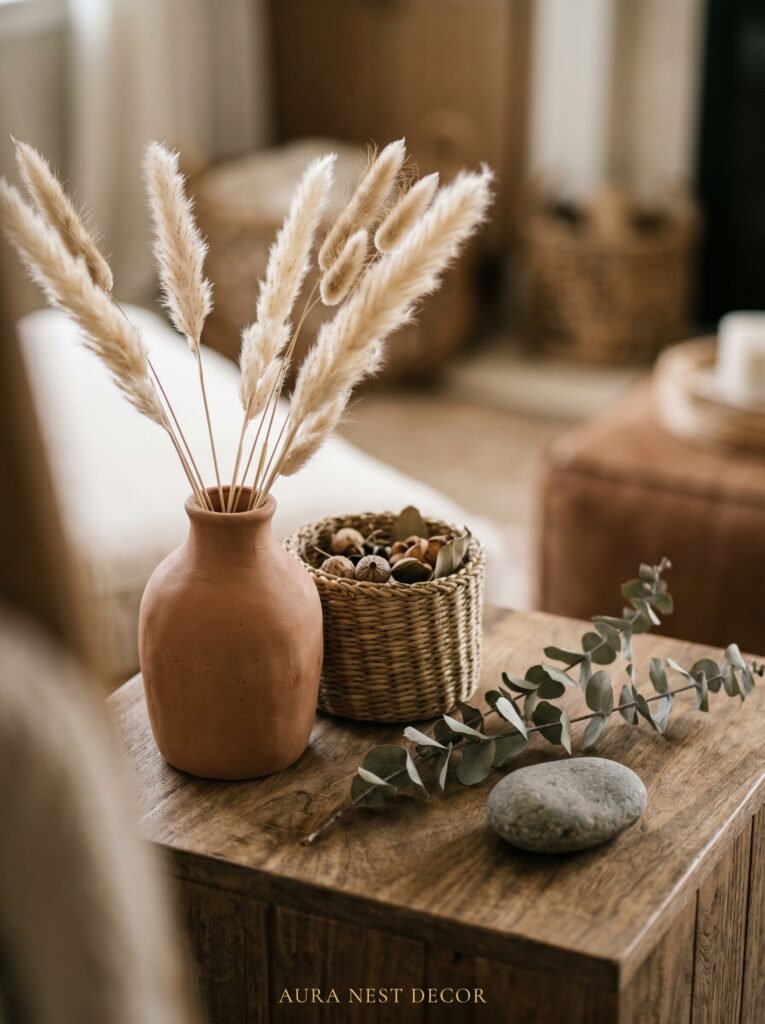
Plants are not just decorating accessories. In a modern traditional rustic living room, they’re doing structural work — filling corners, adding height, introducing color that doesn’t come from paint or fabric.
A large fiddle-leaf fig or olive tree in a simple terracotta pot in a corner is one of the most effective moves in this style. It adds scale without adding visual weight in the way furniture would. It brings life, in the most literal sense, into a space. It connects the room to something outside itself.
For smaller plants, think about grouping. Three different succulents in mismatched ceramic pots on a windowsill. A trailing pothos hanging from a high shelf. Fresh cut stems in a rough-glazed vase on the coffee table — eucalyptus, dried pampas, a few branches of something seasonal.
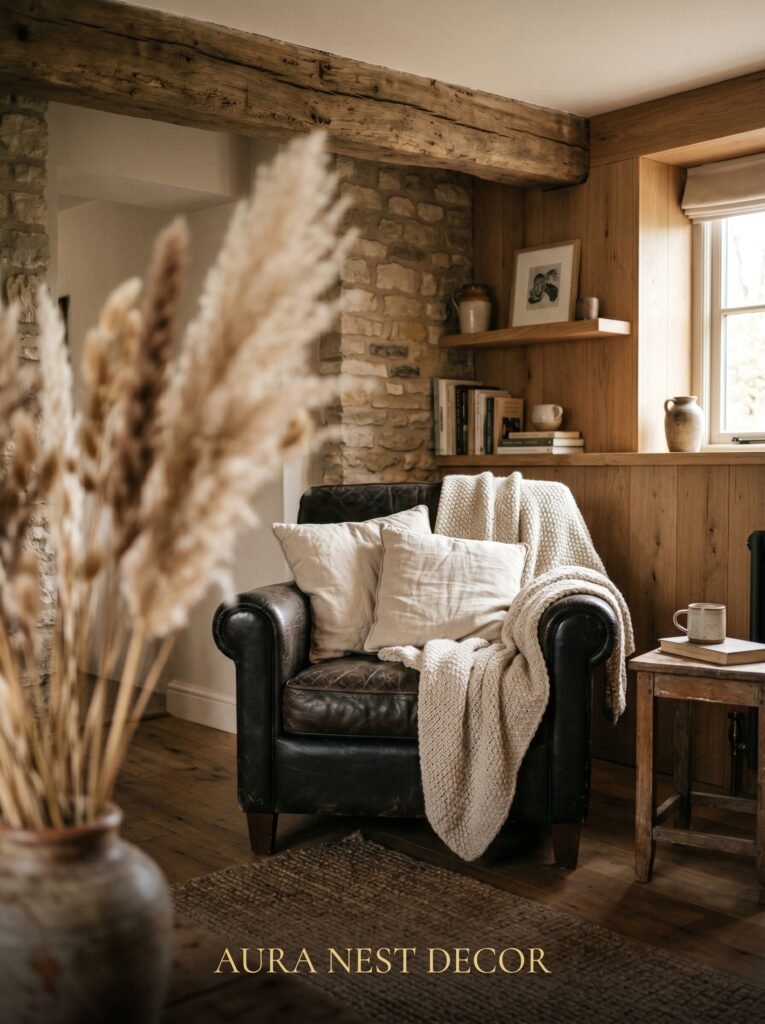
Dried botanicals have had a moment for a few years now and they’re not going away — because they genuinely work. Dried lavender, pampas grass, dried cotton stems. They add texture and a muted palette of natural color that’s impossible to achieve with synthetic decor. They also, practically, require zero maintenance. Which makes them perfect.
11. The Fireplace: Using What You Have and Faking What You Don’t
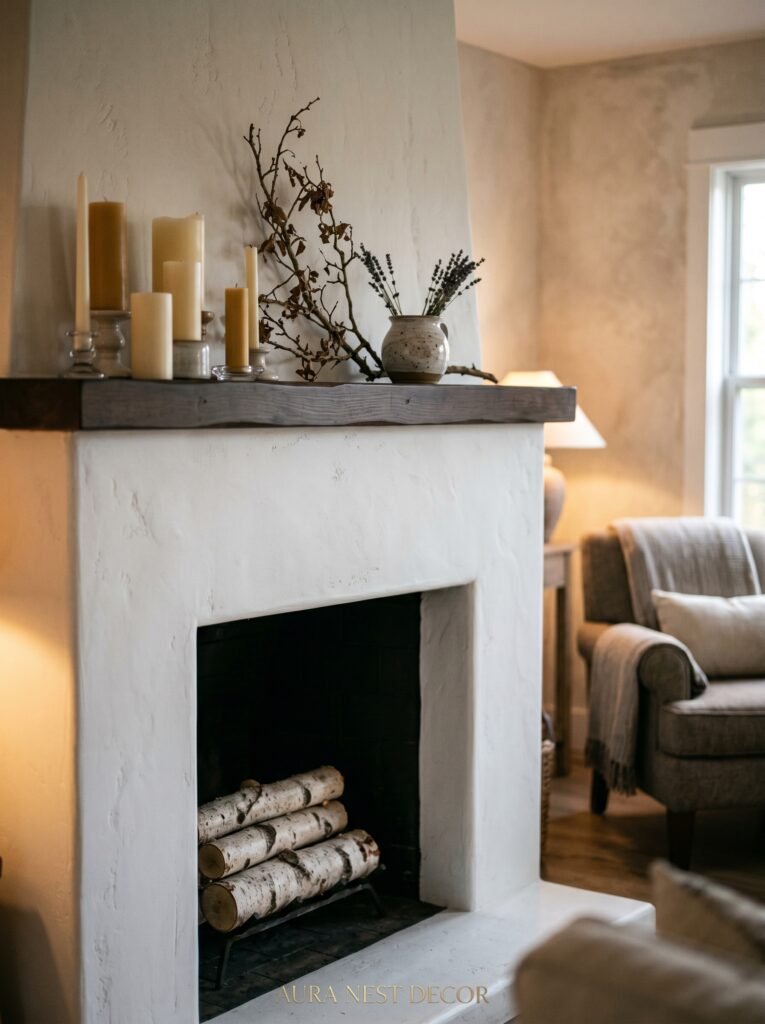
In a modern traditional rustic living room, the fireplace is the emotional center of the room. When there is one, everything else should acknowledge it. When there isn’t one, you need to find another way to create that anchor point.
If you have a working fireplace, the surround matters enormously. A simple stone or painted brick surround, with a wooden mantel above, is almost perfect for this style. Don’t over-decorate the mantel. A clock, a small mirror, a few candles, and some greenery. Let the fireplace speak for itself.
If you have a decorative fireplace — the kind that’s sealed and unused, common in both British Victorian terraces and American period homes — style the hearth intentionally. A grouping of pillar candles at different heights inside the grate creates the visual warmth without the fire. A large piece of art leaned against the breast of the chimney rather than hung on the wall has a relaxed quality that fits the style perfectly.
If you have no fireplace at all, a large console table or low sideboard against one wall can serve as a substitute focal point. Stack it with things that have warmth and weight. A large mirror above it reflects light back into the room and adds the sense of depth that a chimney breast would otherwise provide.
12. The Details That Take It from “Nice Room” to “I Need to Know Who Decorated This”
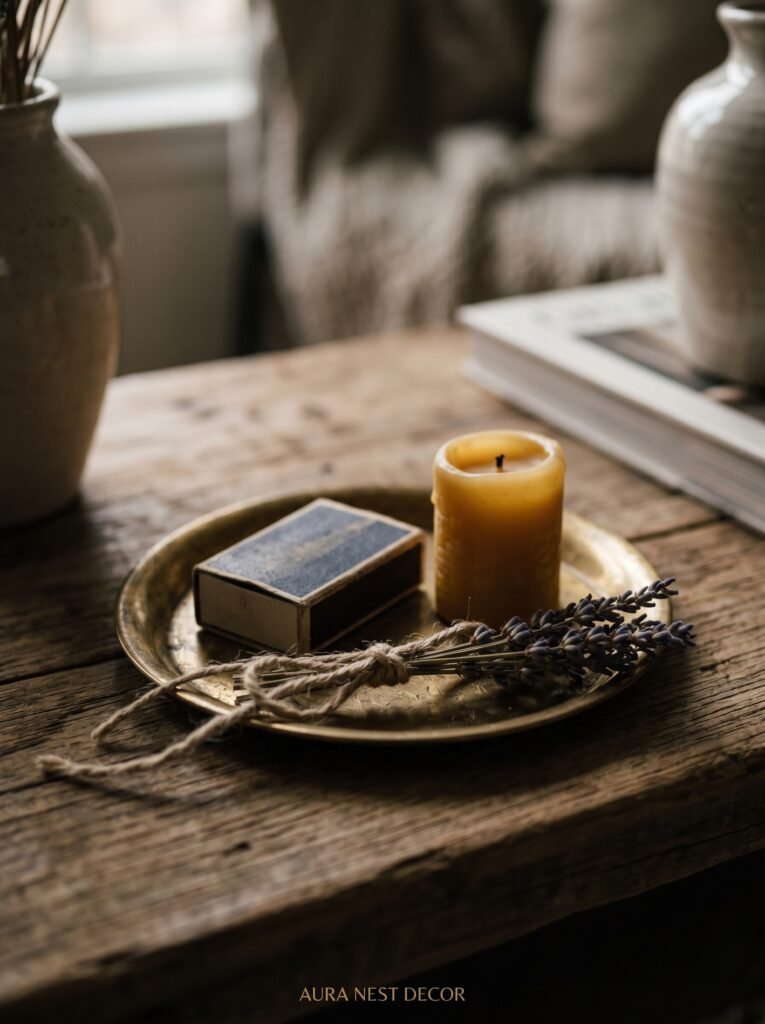
It’s always the small things. Every room that stops people in their tracks has details working overtime that most people couldn’t immediately name.
Linen curtains that pool very slightly on the floor. Not dramatically — just an inch or two of extra fabric that suggests ease and abundance rather than a tape measure. The warmth of a stack of hardback books on the coffee table where the spines suggest a personality rather than a curated Instagram aesthetic. A vintage clock that doesn’t need to work to look beautiful. A ceramic piece that is clearly handmade — slightly uneven, slightly irregular, unmistakably human.
The throw blanket that’s actually been used. Not folded with origami precision, but casually draped, slightly rumpled, as if someone just stood up. This is the single detail that most often separates a room that feels real from one that feels staged.
Hardware, too — often overlooked. The handles on your media console or sideboard. The curtain rod finials. Even the candlestick holders. When these are in brushed brass, unlacquered bronze, or aged iron rather than bright chrome or generic black, the warmth in the room increases in ways that are genuinely hard to attribute to any single thing but are absolutely, unmistakably felt.
That’s the whole game, really. Layer enough of the right details and the room stops being the sum of its parts. It becomes something with its own atmosphere. Its own gravity. The kind of room people walk into and immediately exhale.
—
❓ FAQ
Q: How do I make my living room look rustic without it feeling dated or country-kitsch? A: The key is restraint and quality of materials. Stick to natural textures — real wood, genuine linen, actual stone — and keep the rest of the palette clean and neutral. One or two genuinely rustic pieces (a reclaimed wood table, a raw ceramic lamp base) read as intentional when everything around them is edited and considered. The moment you start adding themed accessories — word art, antlers, novelty items — you’re tipping into kitsch territory.
Q: Can modern traditional rustic work in a small living room or a rented flat? A: Completely. In fact, the intimacy of a smaller room often makes the warmth of this style feel more concentrated and effective. The main adjustments are scale (choose furniture that fits the room, not furniture that would look good in a larger space) and lighting (multiple sources are even more important when the room is small, because they make the space feel larger and more layered). Rugs that cover most of the floor, rather than sitting awkwardly in the center, also help significantly.
Q: What’s the easiest way to start if I’m decorating from scratch on a limited budget? A: Start with the rug and the lighting. These two things have a disproportionate effect on the atmosphere of a room compared to almost anything else you can buy. A good vintage-style rug (check eBay, Wayfair, or IKEA for budget-friendly options) and two or three warm-toned lamps will immediately give any room warmth and layering. Then add a few well-chosen accessories over time — a ceramic vase, a throw, a stack of books — rather than filling the room all at once with things you’ll want to replace later.
—
💭 Final Thoughts
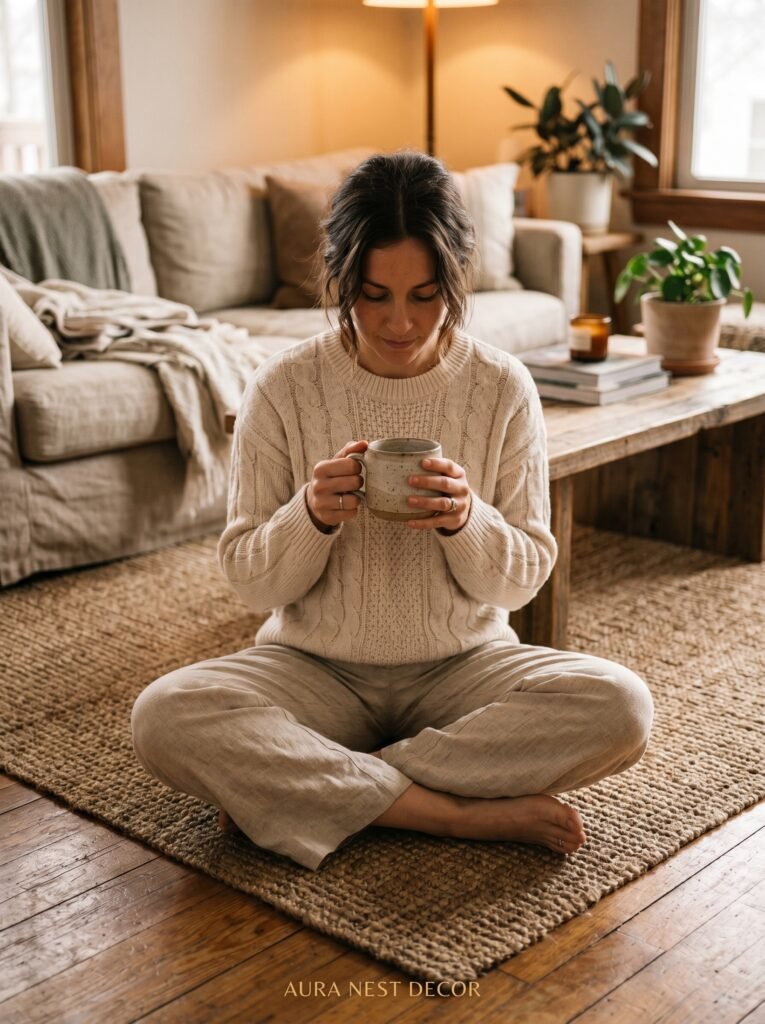
Modern traditional rustic isn’t a trend you’re chasing — it’s a feeling you’re creating. A room that’s warm without being fussy. Collected without being cluttered. Old and new at once, in the best possible way.
The rooms that stay with us aren’t the ones that followed all the rules. They’re the ones that felt like someone lived there and loved it.
What’s the one thing already in your living room that you’ve never quite known what to do with — but maybe always suspected had a place in the room you’re dreaming of?