The Modern Cozy Sitting Room: How to Make a Space That Actually Feels Like Yours
You know that feeling when you walk into someone’s home and the sitting room just gets you? It’s not because they spent a fortune. It’s because every corner feels chosen, not staged. That’s exactly the kind of room we’re building today.
—
1. Why “Modern Cozy” Is the Hardest Look to Get Right (And Why It’s Worth It)
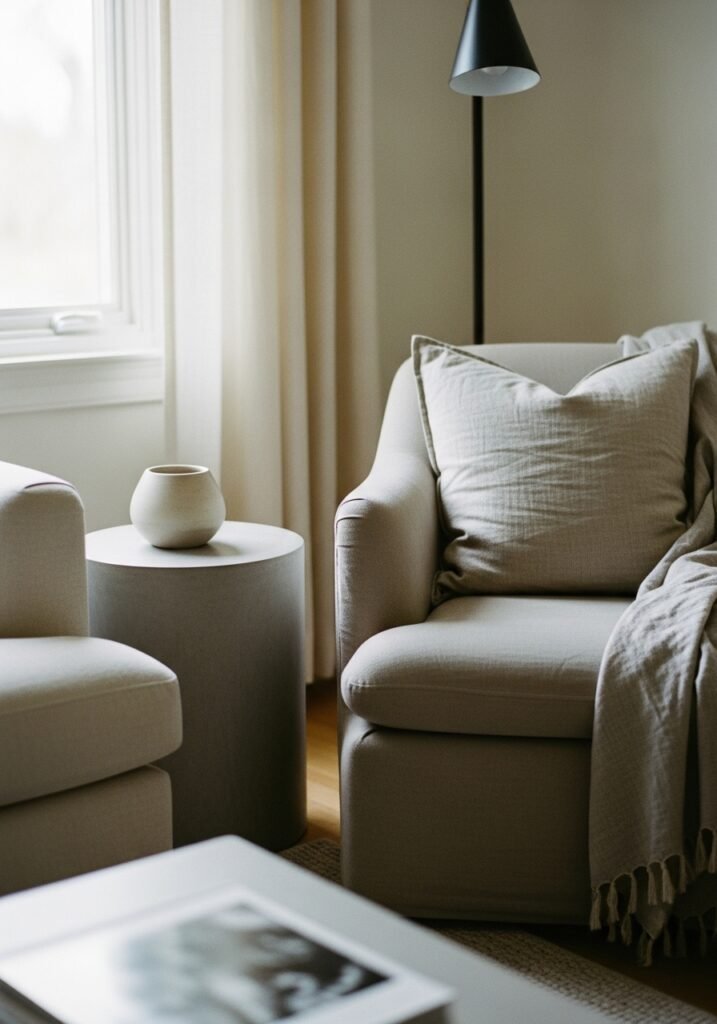
Most people think modern means cold. Clean lines, white walls, surfaces so bare they echo. And cozy means cluttered — blankets everywhere, a cat on every cushion, shelves groaning under the weight of accumulated life. The assumption is that you have to pick a side.
You don’t.
Modern cozy sits right in the tension between those two things, and when it works, it really works. It’s the room that feels designed but not untouchable. Calm but not sterile. Warm but not chaotic. The reason it’s hard to pull off isn’t because the aesthetic is complicated — it’s because most of us were never taught to trust our own eye. We look at Pinterest boards and try to recreate them wholesale instead of borrowing the feeling behind them.
Here’s what I’ve noticed in every modern cozy room that lands: restraint in the architecture, warmth in the textiles, and something — one thing — that’s a little unexpected. A curved sofa. A linen lampshade in a slightly wrong color. An art print that makes you stop and think. The bones are calm. The details are alive.
“The best sitting rooms don’t look designed. They look inhabited — by someone who knows exactly what they love.”
2. The Color That Keeps Showing Up in Every Beautiful Living Room Right Now
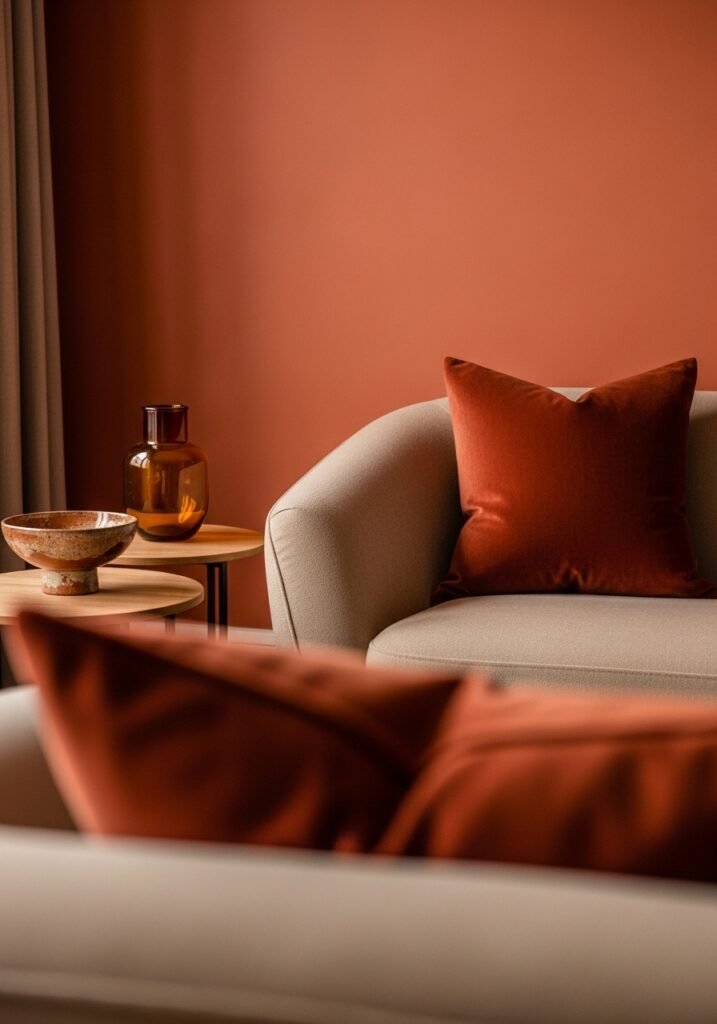
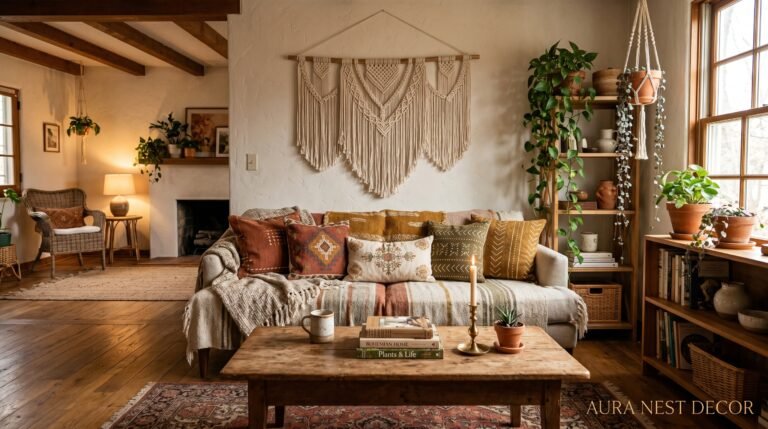
It’s not beige. Well — it’s not just beige. What’s everywhere in the sitting rooms I can’t stop looking at is warm clay. Terracotta’s quieter cousin. The kind of color that looks like the inside of a bread loaf or the walls of an old farmhouse in the south of France, but updated, slightly muted, sitting next to something soft and grey-green.
In US homes it’s showing up on walls — entire walls, not just an accent — often in rooms with high ceilings and natural wood floors. In UK sitting rooms it’s more likely to appear in upholstery, in a big linen sofa or a pair of armchairs that anchor the room in warmth. Either way, the effect is the same. The room exhales.
If clay feels too bold for you right now, start smaller. A clay-toned throw pillow against a light grey sofa. A terracotta pot — big, statement-sized — next to your fireplace. One wall in a warm plaster tone while the rest stay neutral. What you’re doing is giving the room a heartbeat. Something to return the eye to. Neutral rooms fail not because they’re too quiet but because they have no focal warmth, and this color fixes that almost immediately.
It pairs brilliantly with natural linen, aged brass, dark walnut wood, and matte black. It does not pair well with cool whites or chrome. Keep the metal tones warm and you’ll never go wrong.
3. The Sofa Rule Nobody Talks About (But Every Great Room Follows)
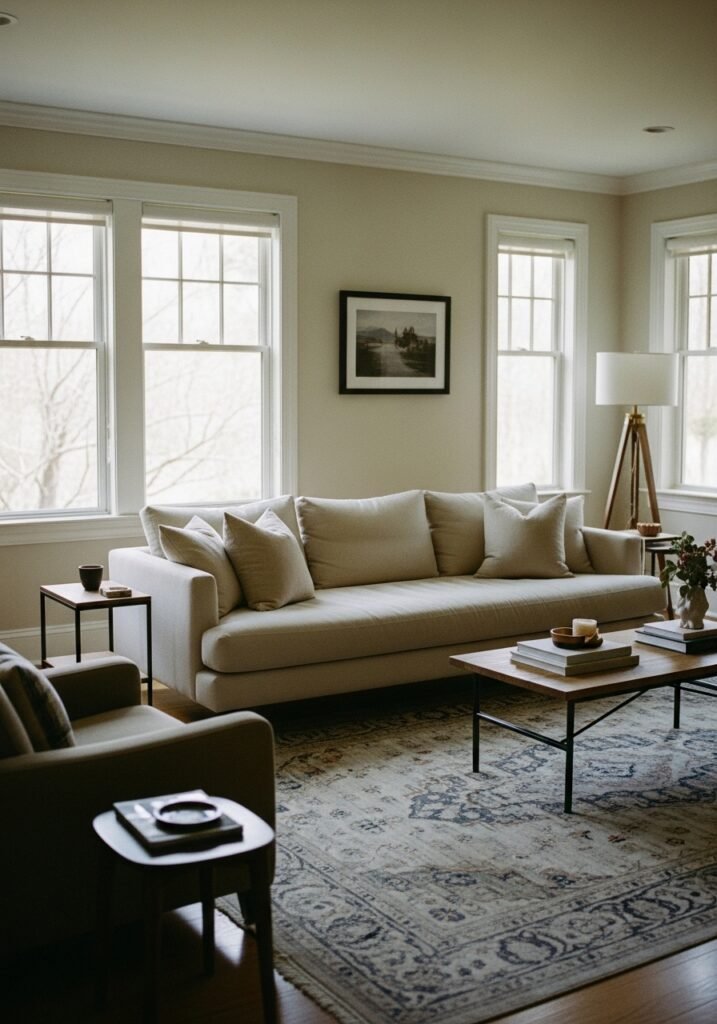
Buy the sofa you actually want to sit in. Not the one that photographs best. Not the one the design blogs say is trending. The one that, when you lower yourself into it after a long day, makes you go quiet inside.
This sounds obvious. It’s not. The number of beautiful sitting rooms that contain a sofa nobody actually relaxes on is staggering. They’re pristine. Styled to within an inch of their lives. And completely uninviting.
For a modern cozy room, you want depth in the seat — something you can curl up in, pull your legs under you, tip sideways against the armrest with a book. Squishy cushion interiors, not hard foam. Removable covers in linen or cotton bouclé that you’re not scared to sit on. A low back if your room has high ceilings, a slightly higher back if the space is more intimate and you want the room to feel wrapped.
Consider the legs seriously. Tapered wooden legs in walnut or oak lift a sofa visually and give the room breathing room underneath. Low platform styles look extraordinary in photos and can be deeply uncomfortable in practice. Think about how you actually live. Do you eat on the sofa? Sprawl? Have children? Nap? Let those answers drive the choice more than any design rule. A sofa that fits your life will always look better than one that doesn’t.
4. Lighting That Does More Than Just Light the Room
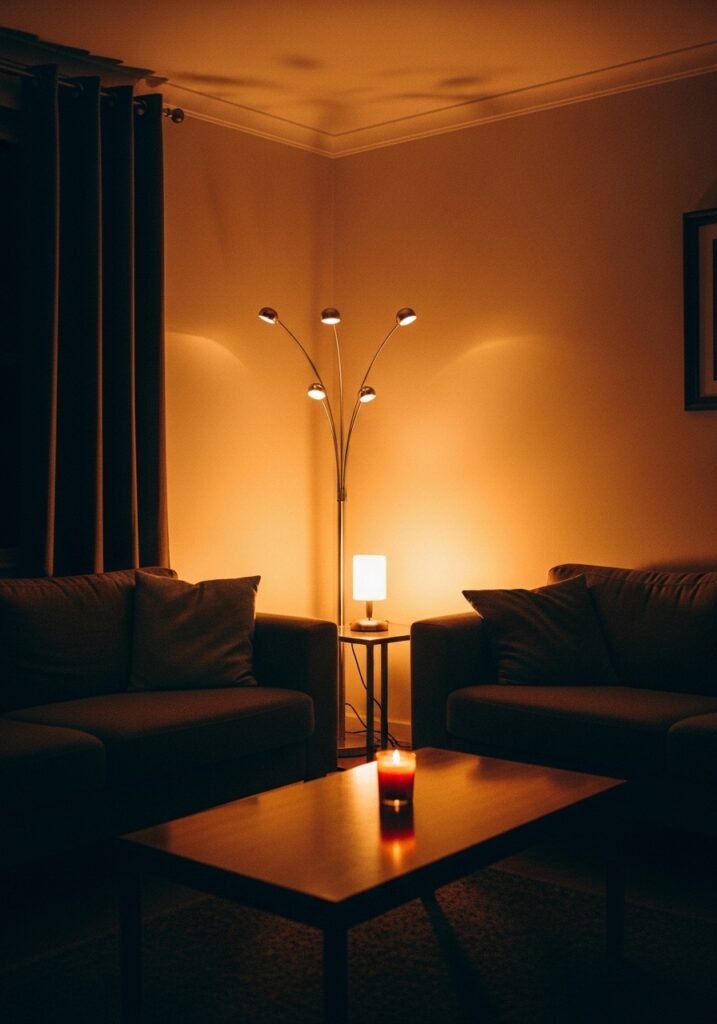
Overhead lighting is the enemy of cozy. I’ll say it again because people need to hear it.
Overhead lighting — the single ceiling fixture blasting light down from above — flattens a room instantly. It removes shadow. It removes mystery. It makes a sitting room look like a waiting area. And yet it’s the default in almost every home in the US and UK, because it’s what was already there when we moved in.
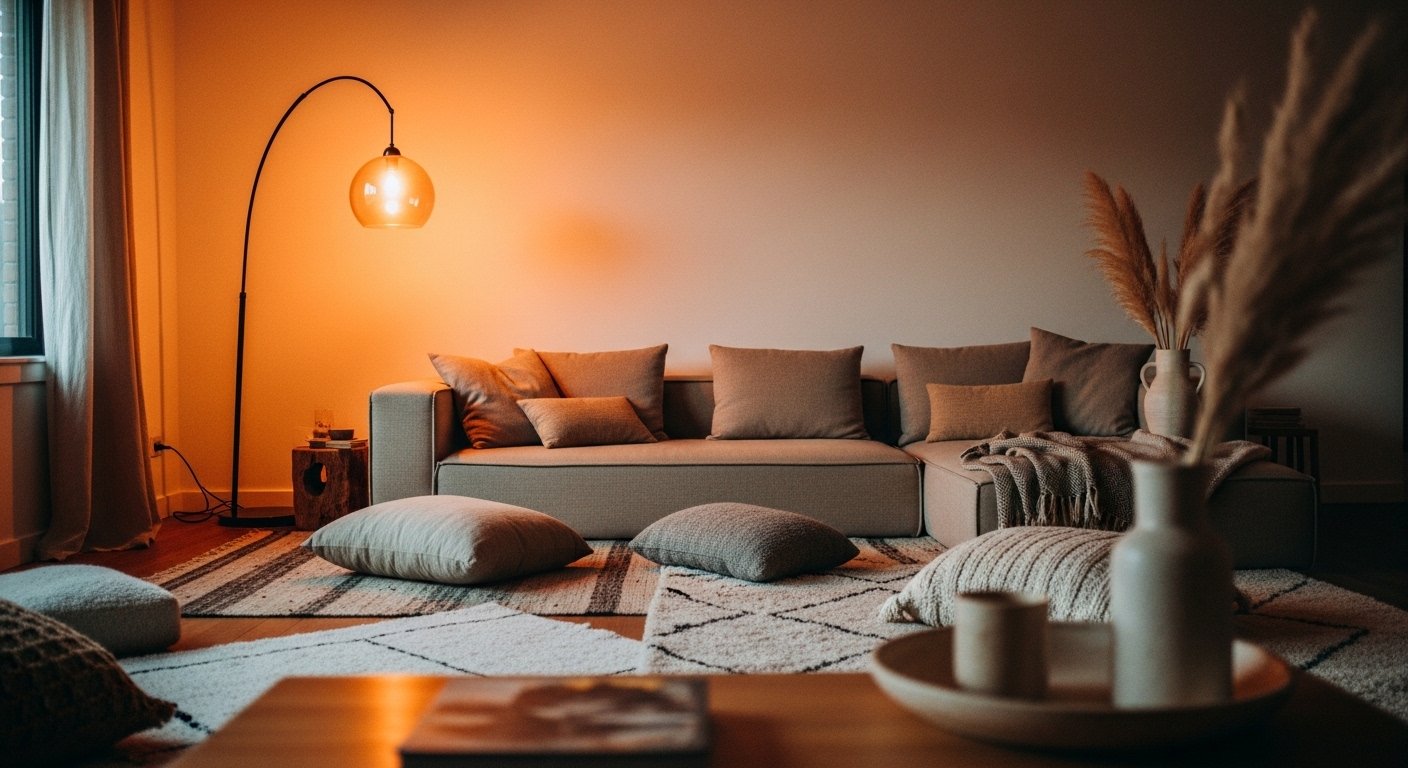
The fix is layering, and it doesn’t have to be expensive or complicated. You need light at three heights: low (table lamps and floor lamps at eye level when seated), mid (wall sconces if you can manage them, or taller arc floor lamps), and ambient (something warm and diffused overhead — a paper pendant shade, a dimmer switch, anything that takes the edge off the glare).
The amber glow of a table lamp at 7pm, throwing a pool of warmth across a pale linen sofa while everything above it sits in soft shadow — that’s the feeling. That’s what you’re building toward. Edison bulbs and filament bulbs give you the warmth in the tones; dimmers give you control. Candles, even battery-powered ones placed thoughtfully, add a flicker that no electric light can replicate.
“A room lit from below always feels like home. A room lit from above always feels like work.”
5. The Rug Mistake That Makes Rooms Feel Awkward (and the Fix Is Simple)
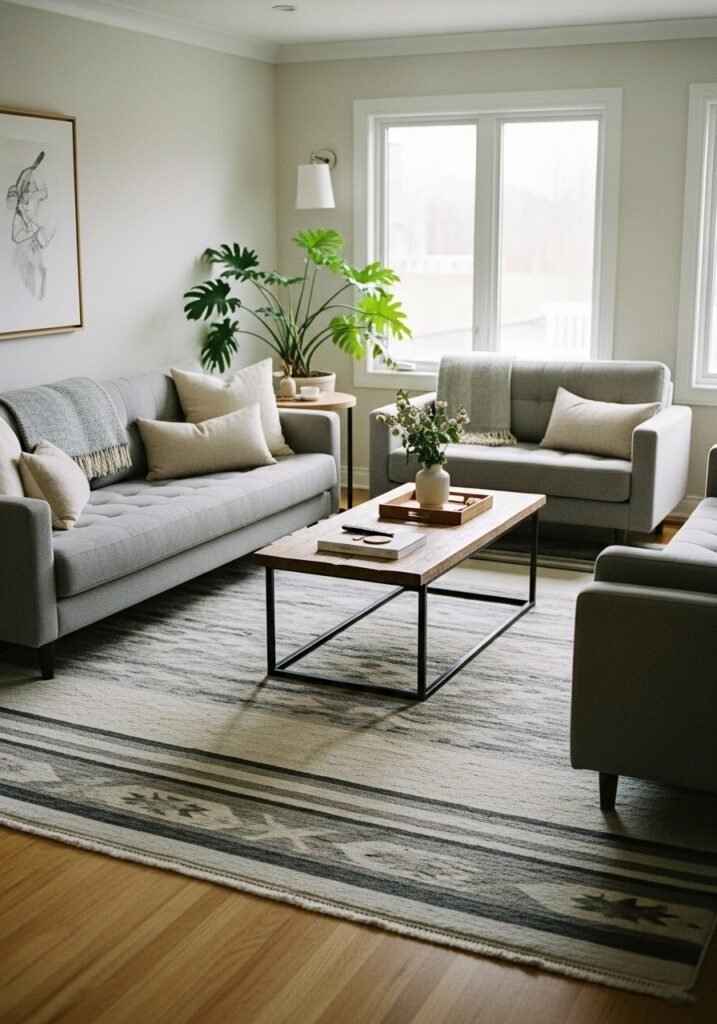
Too small. That’s the mistake. Almost always.
There is a rug in a sitting room somewhere near you right now that is too small for the space, floating in the middle of the floor with all the furniture legs perched around it like people standing on the edge of a puddle. It makes the room feel hesitant. Unfinished. Like someone almost committed to the look but pulled back at the last moment.
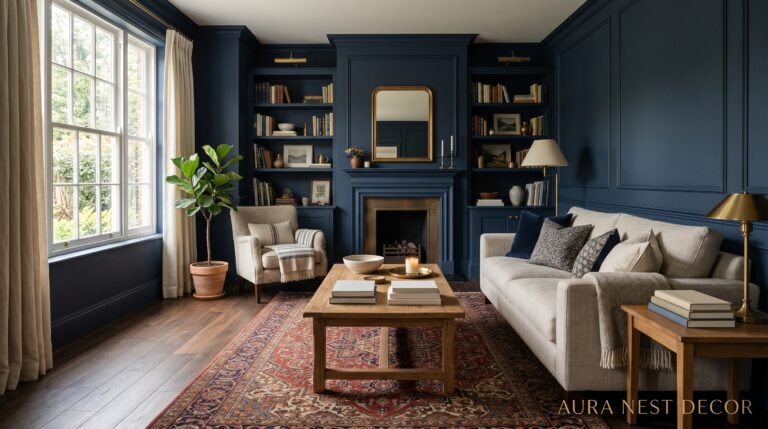
A rug should anchor a room. All main furniture legs — or at least the front legs — should sit on the rug. This pulls the seating group together, creates a visual room-within-a-room effect that makes even an open-plan space feel intentional and defined. In most sitting rooms, you want to go at least a size up from what you think you need. If you think you need an 8×10, get a 9×12. You won’t regret it.
For a modern cozy look, texture matters as much as pattern. A chunky jute rug adds warmth and natural texture that photographs beautifully and feels wonderful underfoot. A low-pile wool rug in a muted geometric keeps things clean but tactile. A Moroccan-style rug in faded tones brings history and softness at once. What you want to avoid is anything high-pile and fluffy (beautiful for five minutes, miserable to maintain) or anything too busy that fights with everything else in the room.
6. How to Style a Bookshelf So It Looks Curated, Not Chaotic
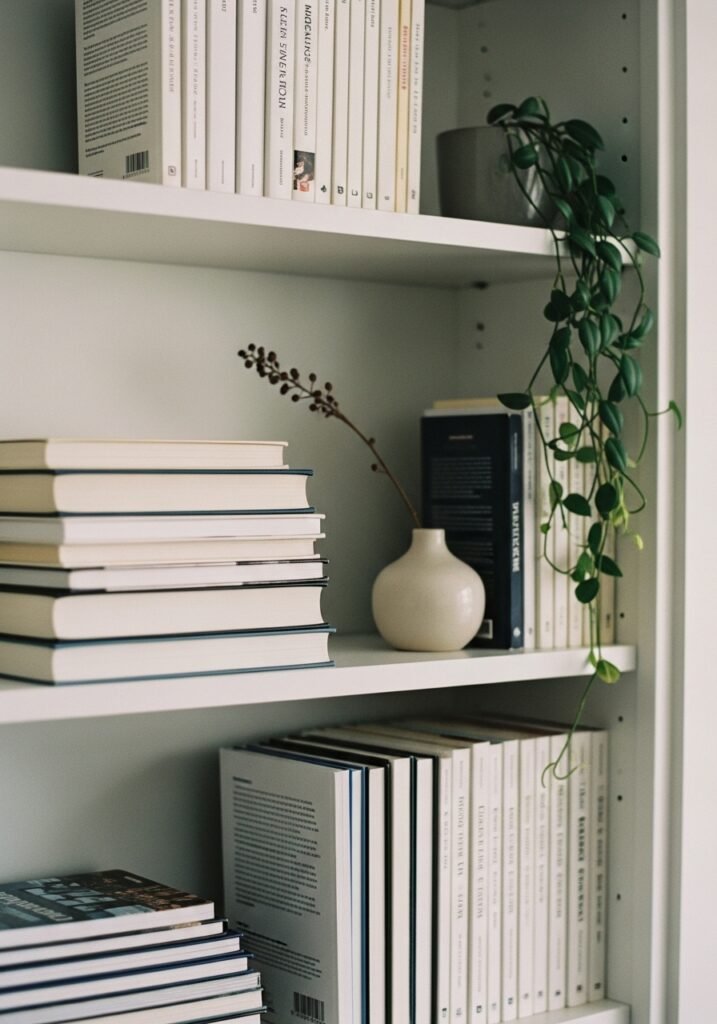
Bookshelves are the personality test of a sitting room. They reveal everything. And yet most of us style them wrong — we just put things on them, book by book, object by object, until they’re full and we call it done.
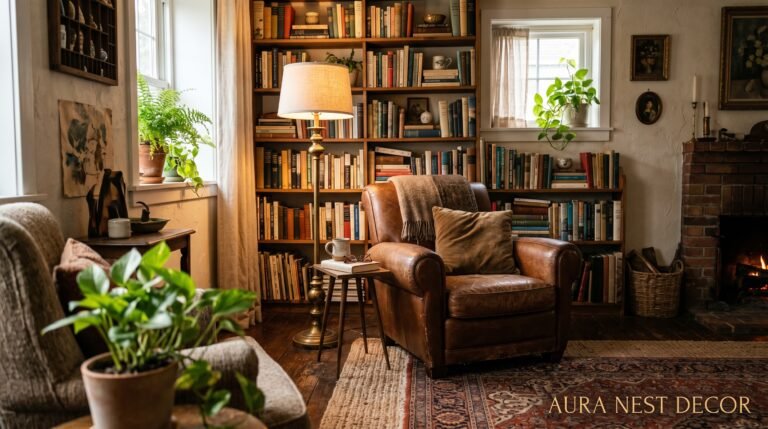
The secret is negative space. Leave some shelves deliberately bare, or nearly so. One shelf with just three objects. Another with a stack of books horizontal, topped with a small plant. The eye needs somewhere to rest, and empty space isn’t emptiness — it’s breathing room that makes the things around it look chosen rather than collected by accident.
Group objects in odd numbers (three or five feels natural; two feels symmetrical and stiff; four feels like you ran out of ideas). Vary the heights constantly. Mix books with non-books — a small sculpture, a ceramic bowl, a framed photo turned on its side, a trailing plant, a candle. Keep the color palette tight: too many spines in clashing colors read as noise. Turn some books spine-in for a tonal, calm effect that’s very current in UK interiors right now.
The one rule that changes everything: anchor each section with something organic. A plant, a piece of driftwood, a stone. It grounds the shelf and connects it to the rest of the room.
7. What Throws and Cushions Are Actually For (It’s Not What You Think)
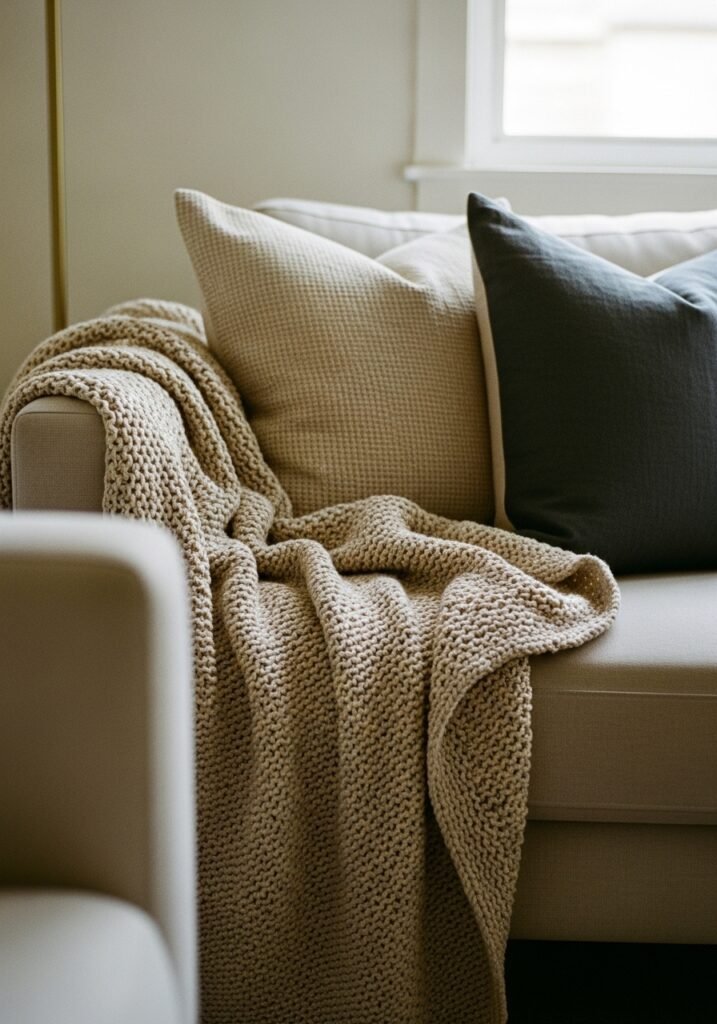
They’re not decoration. Or rather — they’re not only decoration.
In a modern cozy sitting room, throws and cushions do a specific job. They’re the invitation. They’re the thing that communicates, before anyone sits down, that this is a room for actual living. A sofa with no cushions is a display. A sofa with one blanket folded over the arm says something completely different. It says: stay.
Cushion styling doesn’t need a formula — it needs instinct. A mix of sizes (larger squares at the back, smaller rectangles or lumbar shapes in front), a mix of textures (boucle against linen against velvet), a restrained palette (two or three colors, maximum, or you’ll start looking like a market stall). The throw should look casually placed, not folded for a photoshoot. Drape it over one arm. Leave it a little rumpled. It shouldn’t look like it’s never been touched.
Material matters more than pattern. Chunky knit throws feel heavy and warm in hand even before you’re under them — there’s something deeply satisfying about a blanket that has weight to it. Waffle cotton is lightweight and looks clean. Sherpa fleece is divisible — some love it, some find it too casual. Choose what matches not your aesthetic but your actual evenings.
“Cushions are not decoration. They’re the story of who sits here.”
8. The Plant Moment That Changes a Room’s Entire Mood
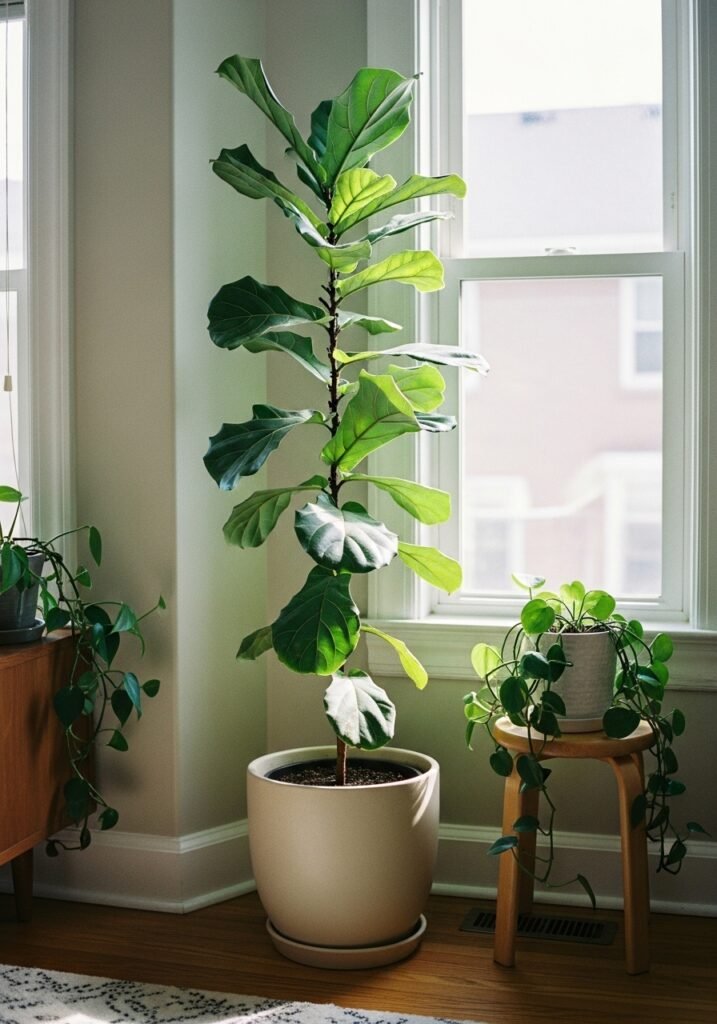
One large plant does more for a sitting room than ten small ones scattered around ever will.
This is the piece of advice that sounds too simple but is actually transformative — wait, I said I’d never use that word. Let me try again. This advice sounds too simple but it changes everything about how the room reads. A large fiddle leaf fig in a terracotta pot in the corner. An oversized monstera next to the window. A tall snake plant with graphic leaves against a plain wall. One plant, at scale, in the right spot creates the sense that the room is alive. It adds a vertical line that architecture alone rarely provides. It brings color in without pattern and texture without clutter.
In UK homes where natural light is frequently playing hard to get, shade-tolerant plants like pothos, ZZ plants, and cast iron plants work beautifully and require almost no attention. In American homes with bigger windows and more consistent light, you have more options — but even then, the principle holds. Scale first. One big plant beats a sill full of little ones every single time.
Place it where it gets the light it needs, not just where it looks good. A dying plant defeats the entire point.
9. The Fireplace Wall: Whether You Have One or Have to Fake It
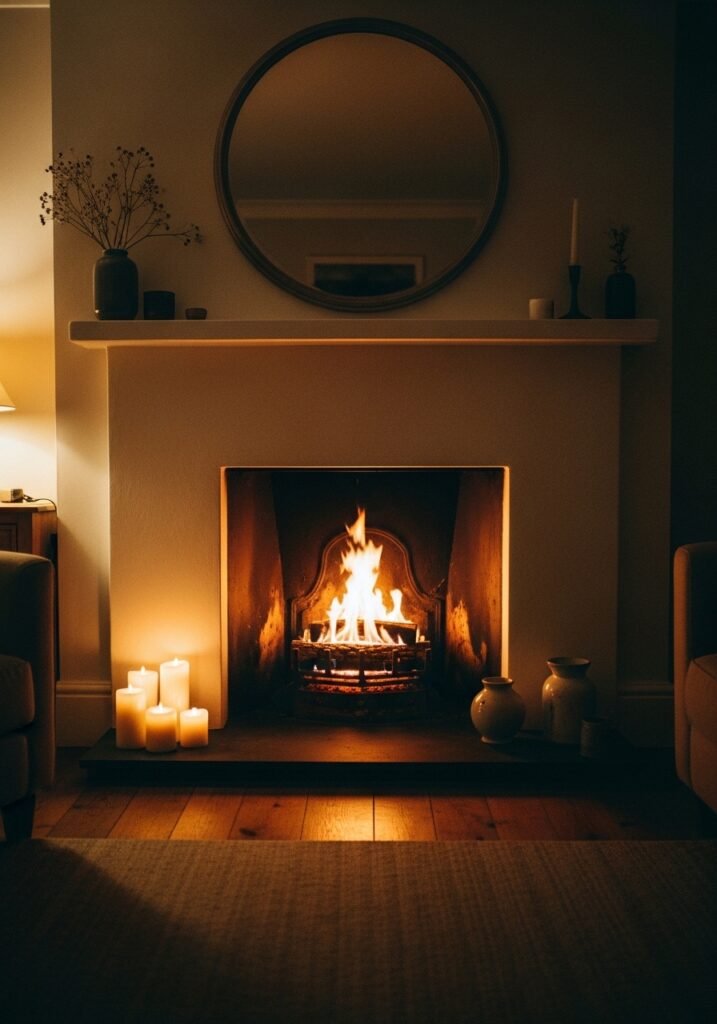
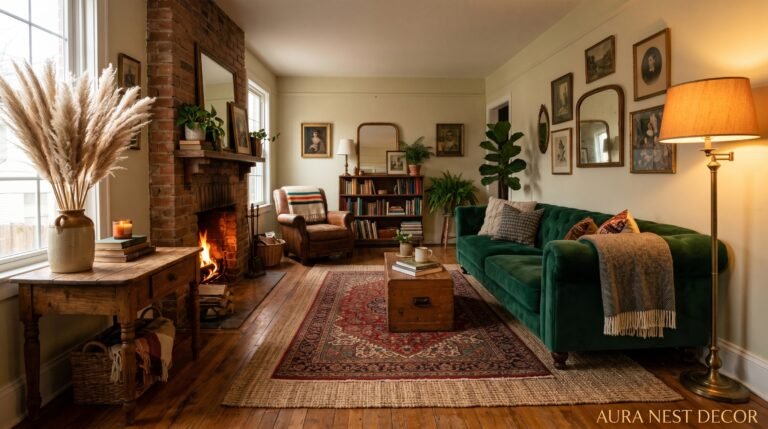
If you have a fireplace, you already have the soul of your sitting room. Everything else is built around it. The mantel is where you practice restraint — resist the urge to fill it. One or two objects of different heights, a mirror leaning rather than hung, a single candle or small vase. The fire does the heavy lifting. Let it.
If you don’t have a fireplace — and many US apartments and modern UK homes don’t — you can create the same visual anchoring with something else. An electric fireplace insert built into a simple surround is dramatically more effective than people expect, and the newer models have a flame effect that passes for real in certain lights. A large, low console with a single piece of art above it acts as a focal wall. A gallery wall arranged around an empty chimney breast creates the same weight and presence.
The sitting room needs a place where the eye goes first when you walk in. In traditional design that’s almost always the fireplace. In modern cozy interiors it can be a bold sofa, a large piece of art, or even a dramatically lit shelving unit. The point is that the room has an anchor. Without one, the eye drifts and the room never fully settles.
10. How to Mix Old and New Without It Looking Like a Mistake
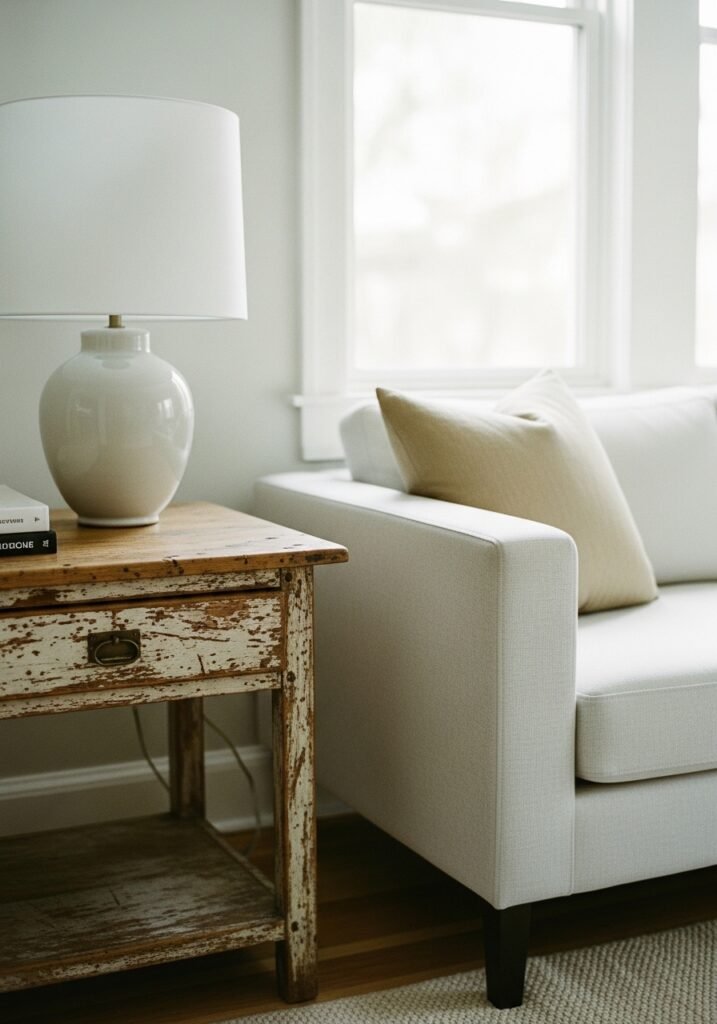
The rooms I return to again and again online — the ones I keep saving and re-saving to the same board — almost all have one thing in common. They mix eras deliberately.
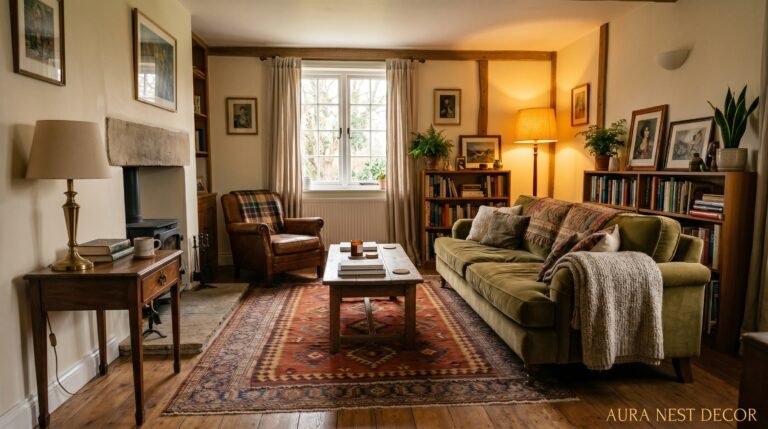
An antique wooden chest as a coffee table in a room with a modern linen sofa. A Victorian mirror above a minimal fireplace. A grandmother’s ceramic lamp rewired and placed next to a sleek, contemporary side table. The mix works because it signals that the room wasn’t bought all at once. It signals that someone lives here, that taste was developed over time, that things were chosen for love and not for a look.
The key to making it work is tonal consistency. The antique piece needs to belong in the room’s color story — if everything is warm and earthy, an ornate gilded piece might fight. But an aged brass lamp, a worn leather occasional chair, a faded botanical print in a simple frame? These things slot in as if they were always there.
Shop estate sales, eBay UK, Chairish, and Facebook Marketplace for the pieces with history. Spend new on the big items that need to perform — your sofa, your rug. Spend old on everything else.
11. The One Rule That Makes Any Small Sitting Room Feel Intentional
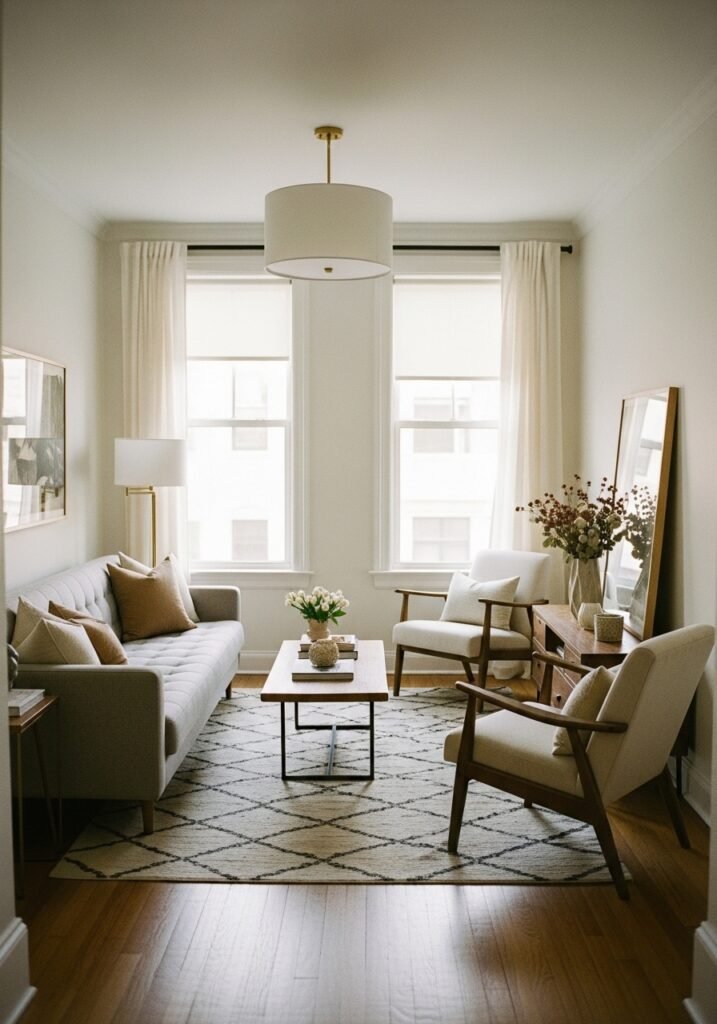
Scale down the furniture, not the ambition.
Small sitting rooms are ruined, repeatedly and consistently, by too much furniture at the wrong scale. Three-seater sofas crammed in where a loveseat and two armchairs would breathe. Side tables that are actually dining chairs pressed into service. A coffee table so large you can barely walk around it.
A room with fewer, better-scaled pieces always reads as intentional. A loveseat and one chair, properly arranged, is enough. One side table, not two. A rug that fits rather than a rug that dominates. Furniture with legs rather than floor-level bases — it lets the eye travel beneath the pieces and makes the floor feel bigger.
In a small sitting room, the wall above the furniture line is your real estate. Tall shelving, a large mirror, vertical art — these draw the eye up and make the ceiling feel higher. Don’t leave that space empty and don’t fill it with small, scattered things either. Go large, go intentional, go vertical. The room will feel twice the size.
12. The Final Touch Most Rooms Are Missing (It’s Smaller Than You Think)
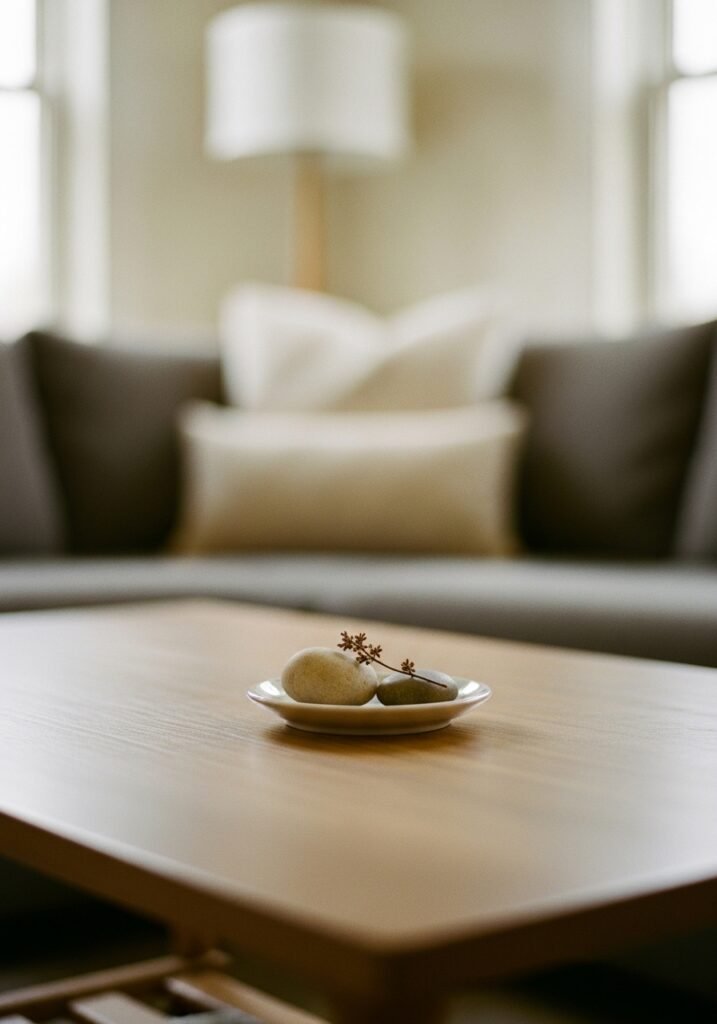
Scent. Sound. The things that aren’t visible but shape the entire experience of being in the room.
A sitting room that smells like nothing is a sitting room that doesn’t quite feel like home yet. I don’t mean overpowering — not the kind of candle that announces itself from the hallway. I mean something subtle and consistent: a diffuser with cedarwood and sandalwood; a candle in a warm amber or tobacco scent; a eucalyptus stem in a simple vase by the window. Something that makes people walk in and, without knowing why, exhale.
Sound matters in ways we underestimate. The tick of a clock. Music playing softly before guests arrive. The crackle setting on an electric fireplace. These things shift the nervous system. They say: this room is safe, this room is alive, slow down.
These are the details no interior design article tells you to buy, because you can’t photograph them. But they’re often the difference between a room that looks good on screen and one that actually feels extraordinary in person. Get your room looking right, then get it feeling right. That’s the full picture.
—
🌿 Quick Tips
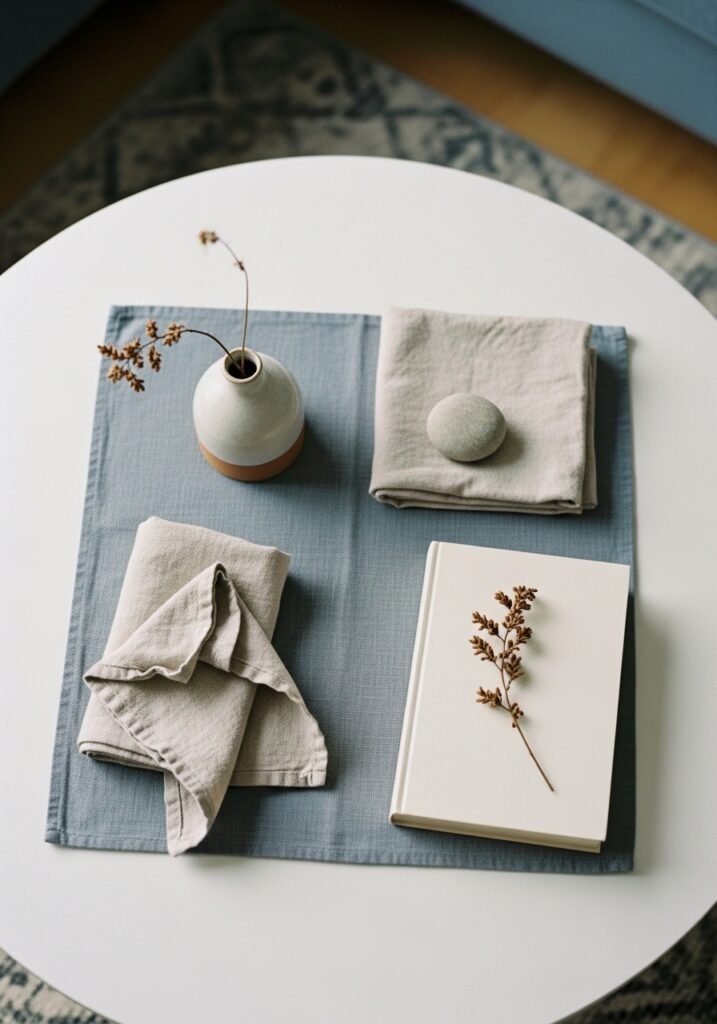
Don’t push furniture against the walls — floating it inward creates coziness and makes the room feel curated rather than cleared. Even a few inches off the wall makes a huge difference.
Swap your lightbulbs before you do anything else. Warm white (2700K) changes the feeling of a room immediately and costs almost nothing.
Layer your window treatments — sheer curtains behind heavier drapes give you privacy without blocking daylight and look effortlessly expensive.
In a rented home, lean into decor over renovation: a large mirror leaned against a wall, a statement rug, and plants do more work than any paint color you can’t actually use.
Edit more than you add. Before you buy one more thing, take five things out of the room and live without them for a week. What you miss, you put back. What you don’t — you might not need.
—
❓ FAQ
Q: How do I make a sitting room look cozy without making it look messy? A: Cozy and messy are solved by the same thing: intention. Cozy is a throw draped deliberately over a sofa arm and a plant in the right pot. Messy is the same throw on the floor and the plant in its plastic nursery container. The objects can be identical — it’s the care behind their placement that tells the difference.
Q: What’s the best color scheme for a modern cozy living room? A: Warm neutrals as your base — sandy beige, warm white, soft grey with warm undertones — with one or two deeper anchor tones like terracotta, forest green, or aged navy. Keep metals warm (brass, bronze, matte black) and textures varied. What you’re avoiding is anything with a cool or blue undertone, which will work against the cozy feeling no matter what else you do.
Q: Is it okay to mix different sofa styles in a sitting room? A: Absolutely, and it often looks better than a matched set. The key is visual weight — keep the pieces similar in scale and in tonal warmth. A curved linen sofa pairs beautifully with a structured leather armchair if the colors are in conversation. What doesn’t work is pieces that seem to come from entirely different aesthetic universes with nothing connecting them — that reads as unresolved rather than collected.
—
💭 Final Thought
The sitting room is the room that holds all of it — the quiet mornings, the long evenings, the conversations that matter. It doesn’t need to be perfect. It needs to be yours. Start with one thing you actually love, and build outward from there.
What’s the one piece in your sitting room that you genuinely couldn’t part with?