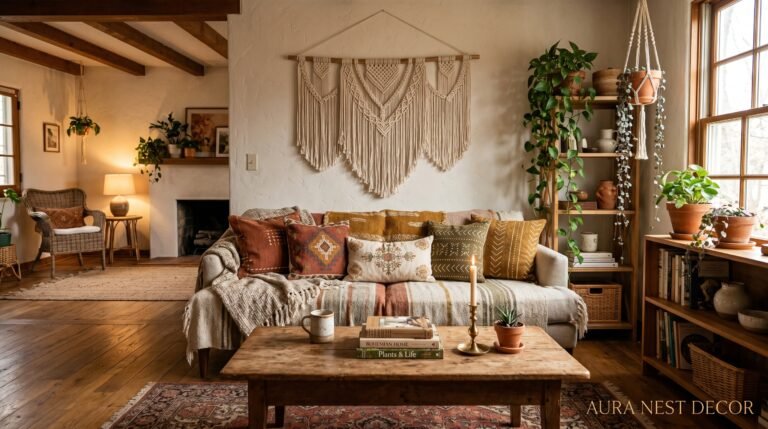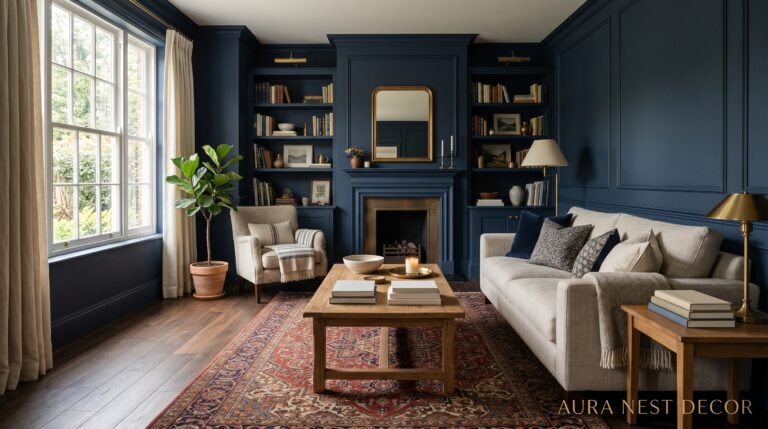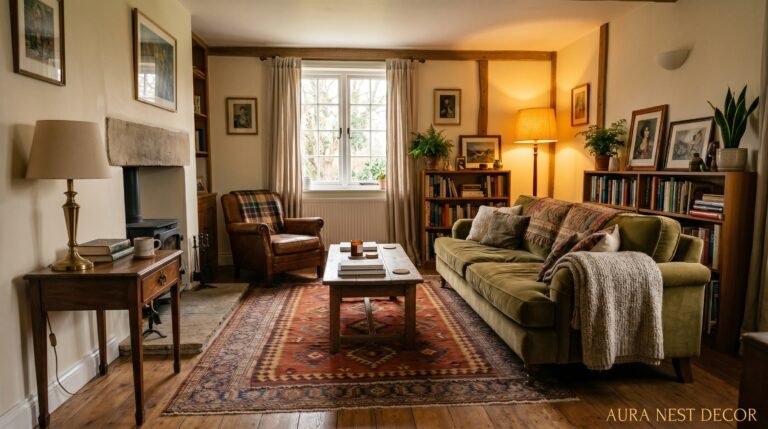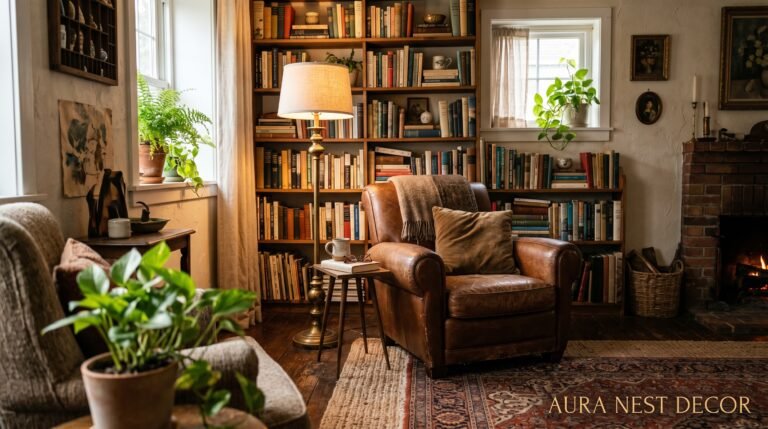
The Modern Farmhouse Living Room That Doesn’t Look Like a Pinterest Cliché
You’ve seen it a thousand times. Shiplap. Galvanized metal. A sign that says “gather.” And somehow, despite being surrounded by beautiful pieces, the room still feels flat. The modern farmhouse aesthetic has been done to death — but when it’s done right, it’s one of the most genuinely livable, gorgeous styles a home can have.
Here’s how to get it right.
—
1. The Wall Finish That Changed How I Think About “Farmhouse” Forever
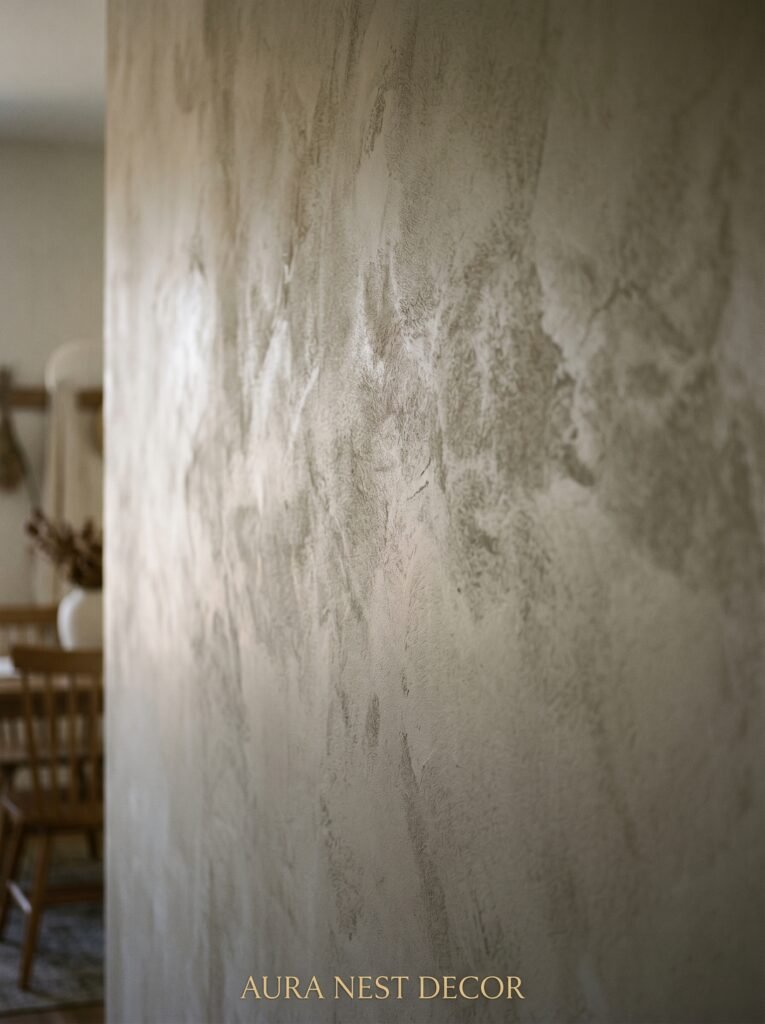
Let’s start with shiplap, because we need to have an honest conversation about it.
Shiplap is not bad. It’s not dated. It’s not overdone — when it’s done with intention. The problem isn’t the material; it’s the placement. When shiplap covers every single wall in a room, it stops being a design choice and starts being wallpaper. What actually makes it sing is restraint.
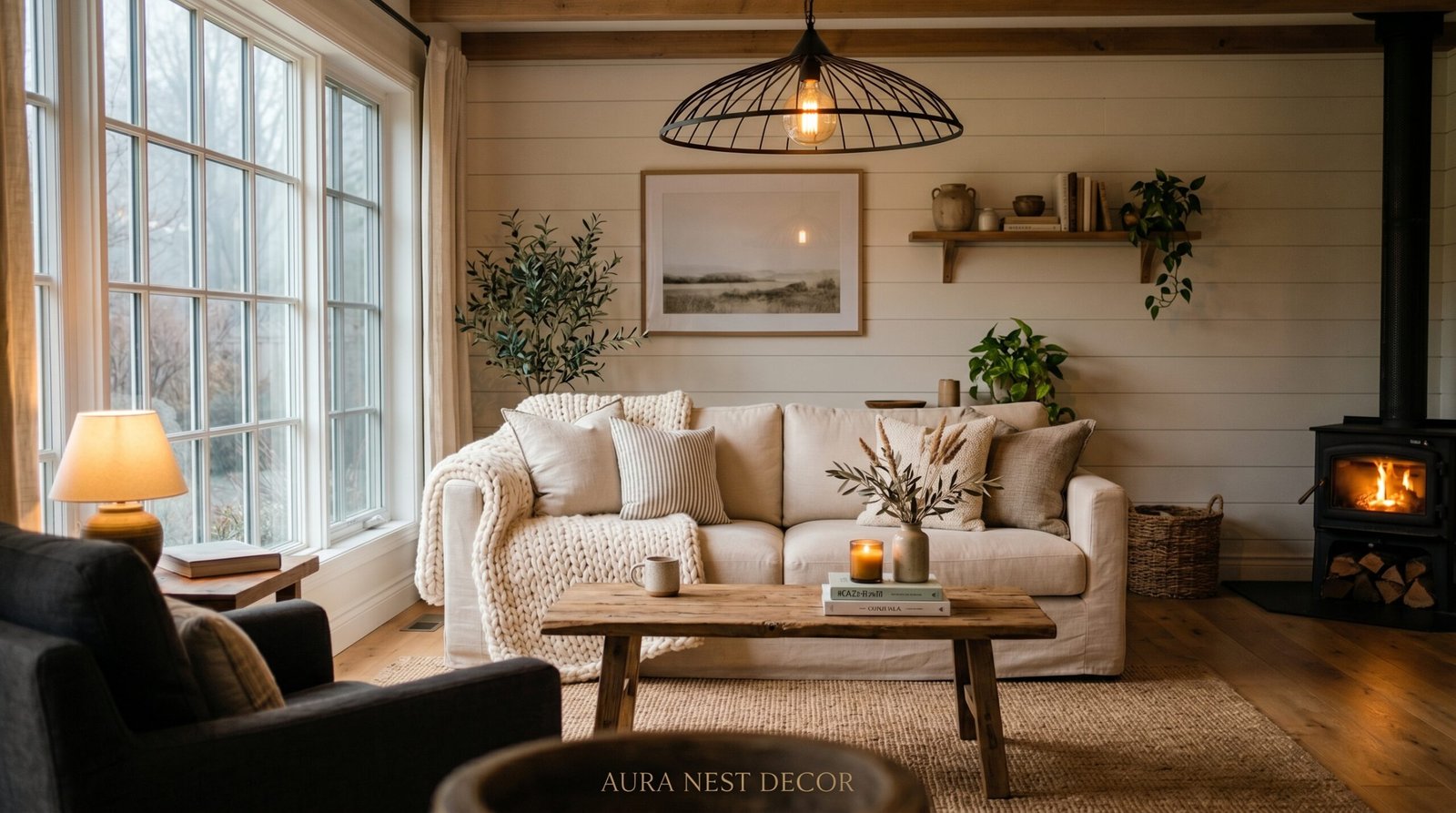
One wall. The chimney breast. A narrow vertical strip running floor to ceiling behind a built-in bookshelf. That’s where shiplap earns its keep. Pair it with flat, smooth plaster on the surrounding walls — painted in something warm and enveloping, like Farrow & Ball’s Elephant’s Breath or Benjamin Moore’s Pale Oak — and suddenly you’re not looking at a farmhouse cliché. You’re looking at architecture.
The other thing nobody tells you: the color of your shiplap matters enormously. Bright white shiplap in a room with cool northern light looks clinical. Off-white, cream, or even a very pale linen reads as warm and intentional. If your shiplap is already painted bright white and your room feels cold, try layering in warm wood tones and aged brass hardware elsewhere — it’ll shift the temperature of the whole space without touching the walls.
“Restraint is the design move nobody talks about, but everyone notices.”
2. The Sofa Decision That Most People Get Backwards
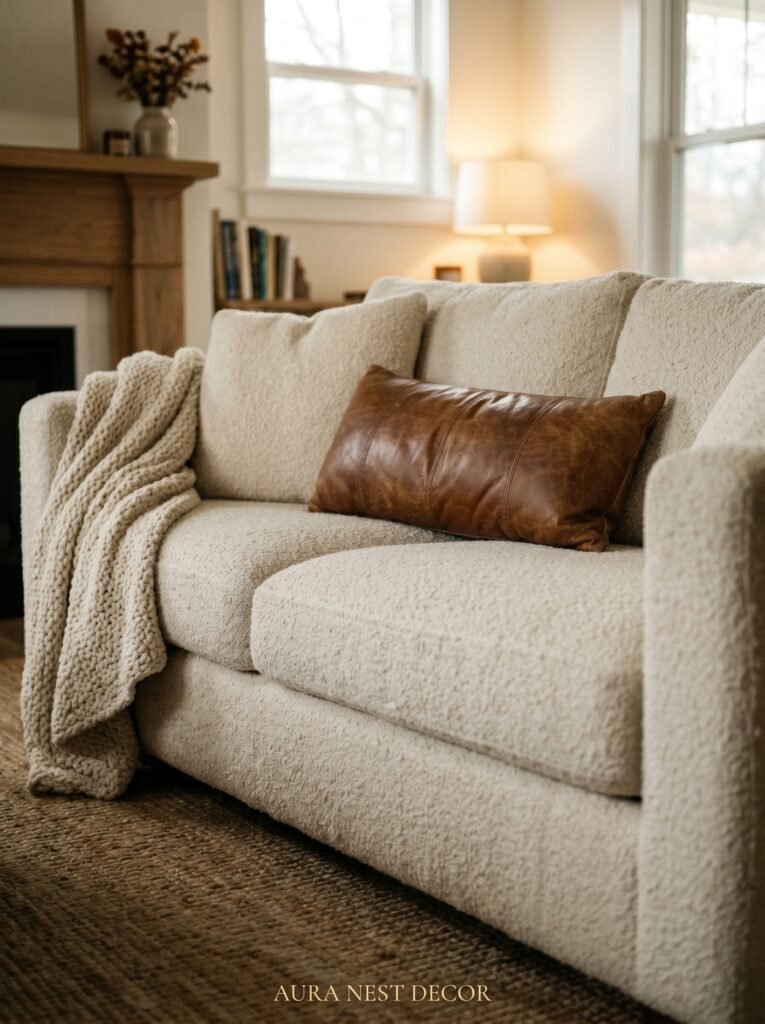
Most people choose their sofa last. They find a rug they love, they decide on a paint color, they source the coffee table — and then they try to stuff a sofa into whatever aesthetic gap remains. In a modern farmhouse living room, this is exactly backwards.
The sofa is the room. Everything else is a conversation with it.
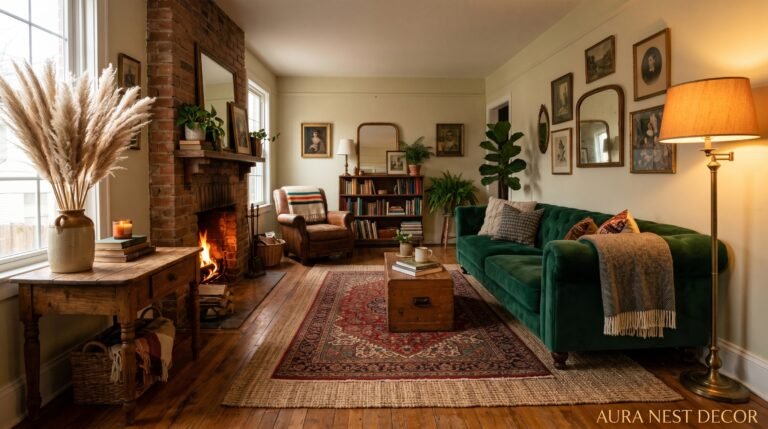
For this aesthetic, you want something that looks like it could have been there for thirty years but somehow still feels fresh. Deep, overstuffed cushions in natural linen or a heavy cotton canvas. A loose slipcover in oatmeal or warm white. A classic Chesterfield in aged leather — caramel, cognac, tobacco — that only looks better as it wears in. What you’re avoiding is anything that reads as sleek, low-profile, or minimalist-modern. Hard edges don’t belong here.
Legs matter more than people think. Turned wooden legs on a sofa, rather than a base that sits flush to the floor, immediately communicate something handmade and considered. They let light pass beneath the piece, which keeps heavy upholstery from feeling like it’s swallowing the room.
In the UK especially, there’s a beautiful tradition of the “worn-in” sofa — the one that’s been through a decade of Sunday mornings and still looks right. Lean into that. A brand-new sofa that looks a little imperfect is worth more in a farmhouse-style room than a pristine performance-fabric sectional.
3. Why the Right Coffee Table Will Do More Work Than Your Entire Gallery Wall
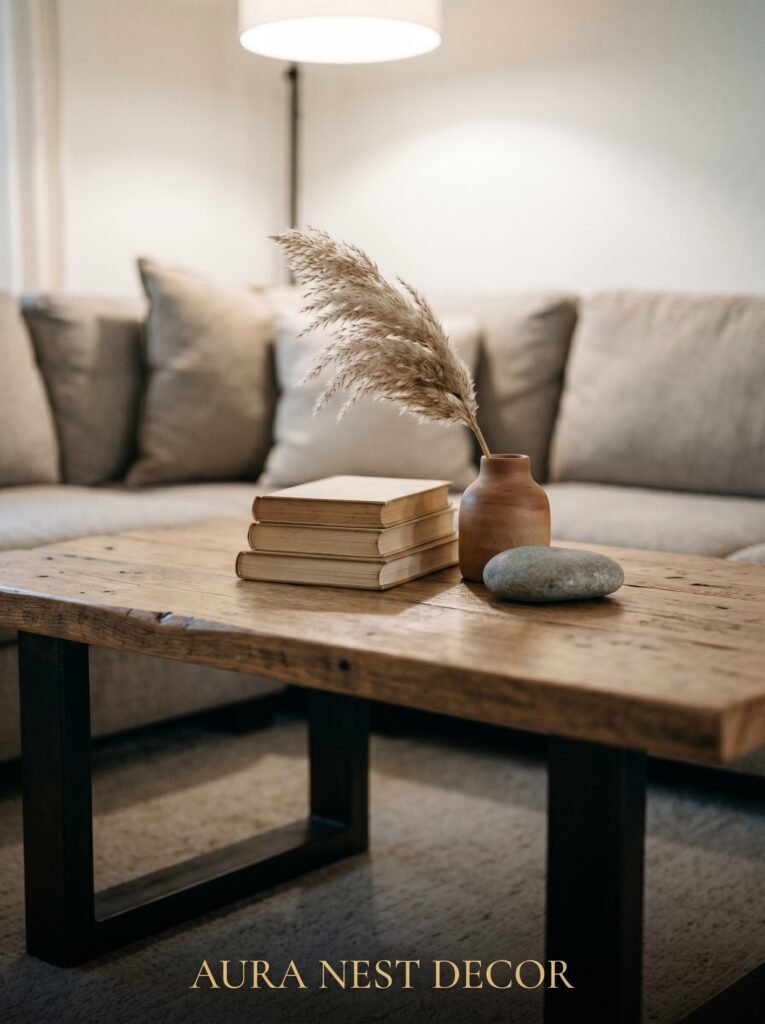
A coffee table in a modern farmhouse living room is never just a surface to put things on. It’s a statement about what you value.
Solid wood — real, honest, heavy wood — is the move. A thick-topped piece in reclaimed oak or walnut, with the grain visible and the knots intact, brings more warmth to a room than almost any other single piece of furniture. Don’t sand it to a mirror finish. Don’t lacquer it into submission. Let it breathe. Let it have texture.
The shape matters too. Round coffee tables soften a room — and in a space where you’ve already got lots of straight lines from architectural details and furniture frames, that softness is welcome. A round pedestal table in raw oak, maybe 40 inches across, gives everyone in the room easy access and makes the seating arrangement feel more intimate.
What goes on the table is just as important. Stack two or three coffee table books (actually interesting ones, not just for show). A low, wide bowl in matte ceramic — terracotta, stoneware, oatmeal glaze. One candle. A small jug of something from the garden or the market: dried grasses, a stem or two of eucalyptus, whatever’s seasonal. The goal is to make it look like someone actually lives here and happened to arrange those things naturally.
4. The Color Palette Shift That Moves You From Catalog to Cozy
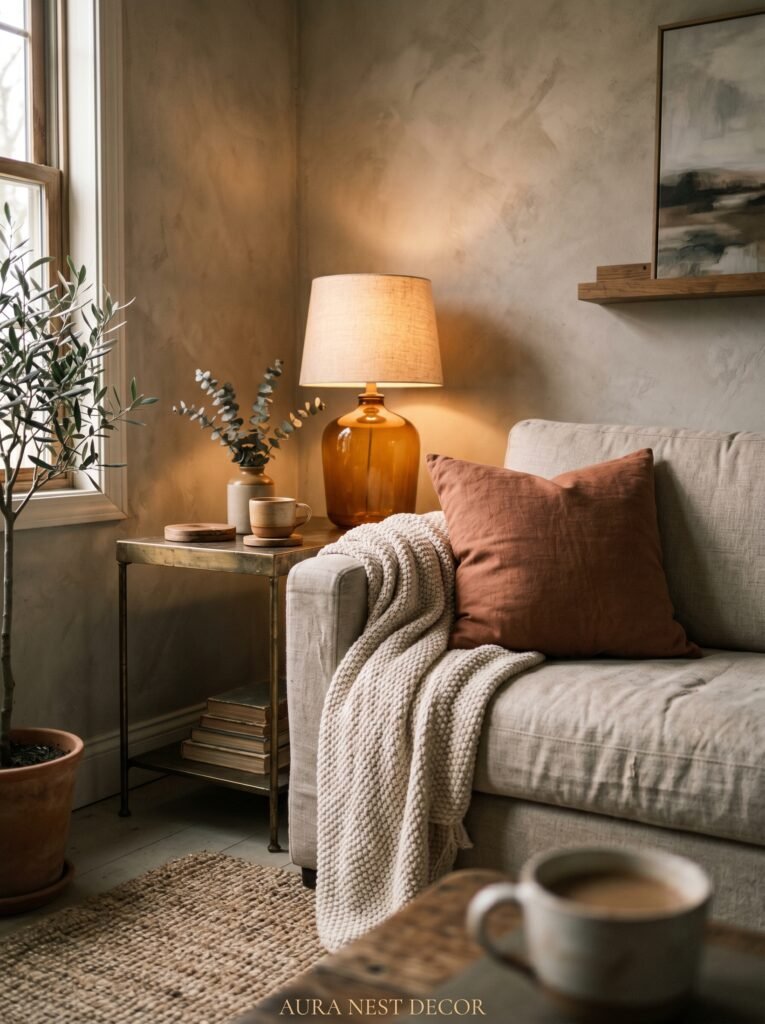
The classic modern farmhouse palette — white, grey, black, maybe some navy — is fine. It’s also a little cold if you’re not careful.
The rooms that actually feel like the ones you can’t stop saving to your boards are working in a warmer direction. Warm whites instead of cool whites. Soft terracotta introduced through a single accent chair or a cushion or a small ceramic pot. Aged brass rather than matte black for hardware and light fixtures. Natural linen that leans toward straw and honey rather than grey.
Think of it this way: a modern farmhouse palette should look like something that evolved over time rather than something someone chose off a mood board in an afternoon. That means layering. A warm white wall. A slightly deeper warm white on the trim. A rug that brings in a hint of rust or dusty rose or sage green. A throw in a natural wool that has a little variation in it, not a perfectly even dye.
If you’re in the UK, a great reference point is the kind of colors you see in old country house interiors — not grand or formal, but that faded, settled quality of a room that’s been loved for decades. That’s exactly the feeling you’re after.
“The most beautiful rooms look like they weren’t decorated — they look like they happened.”
5. The Light Fixture Conversation Nobody Is Having Loudly Enough
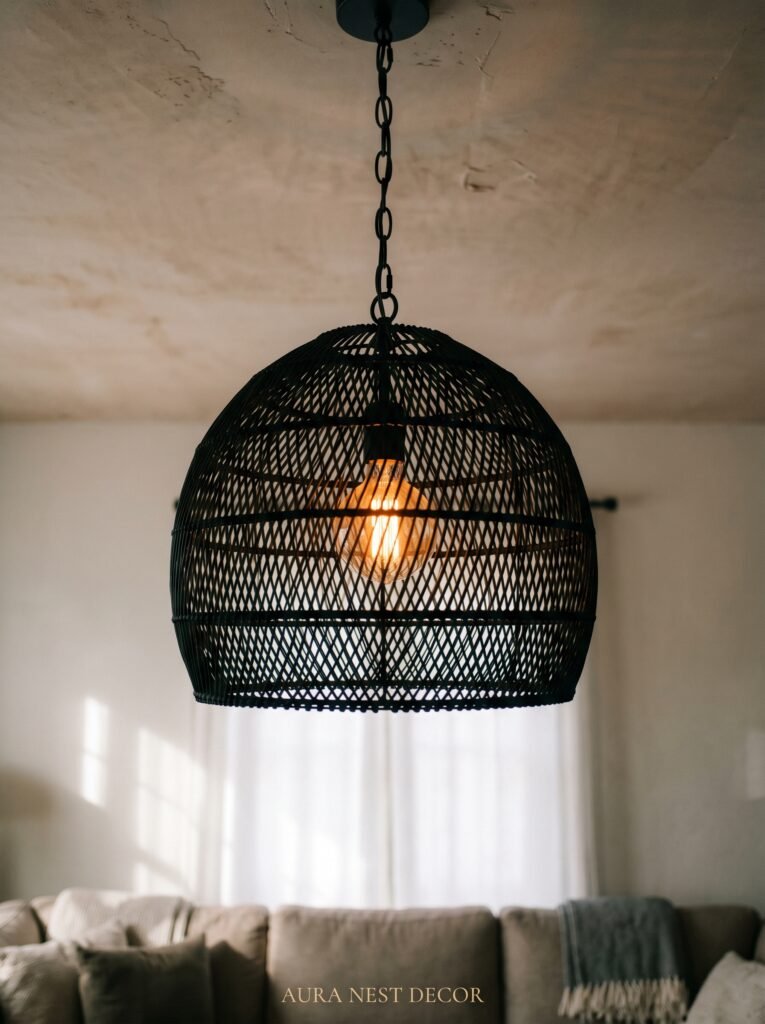
Lighting is where so many farmhouse-style rooms go wrong, quietly and completely.
The classic farmhouse pendant — the cage-style light with an Edison bulb, the galvanized drum shade — has become so ubiquitous that it reads as background noise now. You don’t notice it. And in a room where you want every element to feel considered, that’s a problem.
What’s working right now is the unexpected combination: something rough paired with something refined. A handthrown ceramic pendant in a matte oatmeal glaze over a farmhouse dining table. A raw linen shade on a floor lamp beside the sofa. Woven rattan pendants in a slightly asymmetric cluster — three of varying heights — over the coffee table area.
And then the bulb color temperature. This matters so much. 2700K bulbs emit that amber, golden-hour glow that makes every wooden surface look warmer, every linen fabric look softer, every person in the room look better. 3000K is the cooler end of warm — acceptable but not ideal for this aesthetic. Anything above 3000K will work against you.
Dimmers. Please. Every lamp, every overhead fixture. The ability to drop your lighting from “functional” to “atmospheric” at 7pm on a weeknight is one of the greatest domestic pleasures available to you, and it costs almost nothing to set up.
6. The Rug That Acts as the Room’s Anchor (and the Mistake That Unravels Everything)
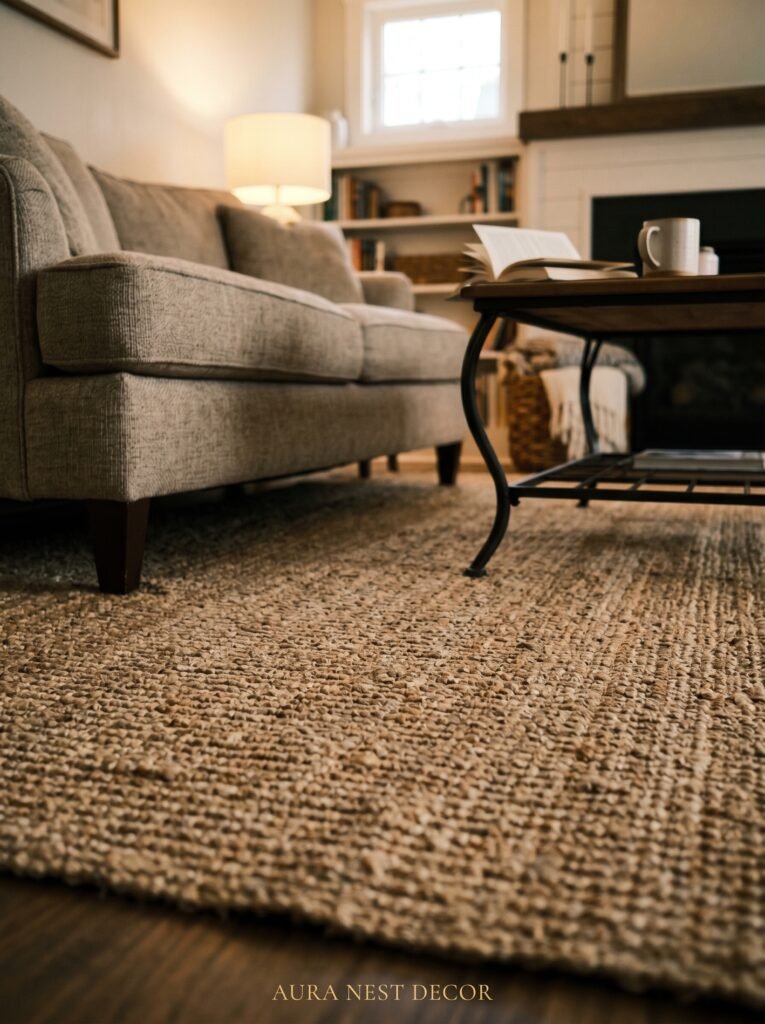
The rug in a modern farmhouse living room is not a decorative accent. It is the foundation.
Get this right and the rest of the room clicks into place. Get it wrong and nothing else you put in the room will feel settled.
The two biggest mistakes people make: buying a rug that’s too small, and buying a rug that’s too pattern-heavy. A rug that only sits under the coffee table and doesn’t extend beneath the front legs of the sofa and chairs looks like it’s floating. It makes the whole seating arrangement look temporary, like you’re about to pack it all up. For a standard living room, you’re typically looking at an 8×10 or 9×12 — bigger than most people’s first instinct.
As for pattern: in a room with already-textured elements (shiplap, wood, linen, ceramic), a heavily patterned rug competes rather than grounds. What works beautifully is a large-scale, low-contrast pattern — a faded geometric, a worn kilim with muted tones, a subtle stripe. Or go the other direction entirely: a solid, deeply textured rug in natural jute or sisal or a chunky wool that earns its place through texture alone.
7. The Shelf Styling Secret That Actually Works in Real Life
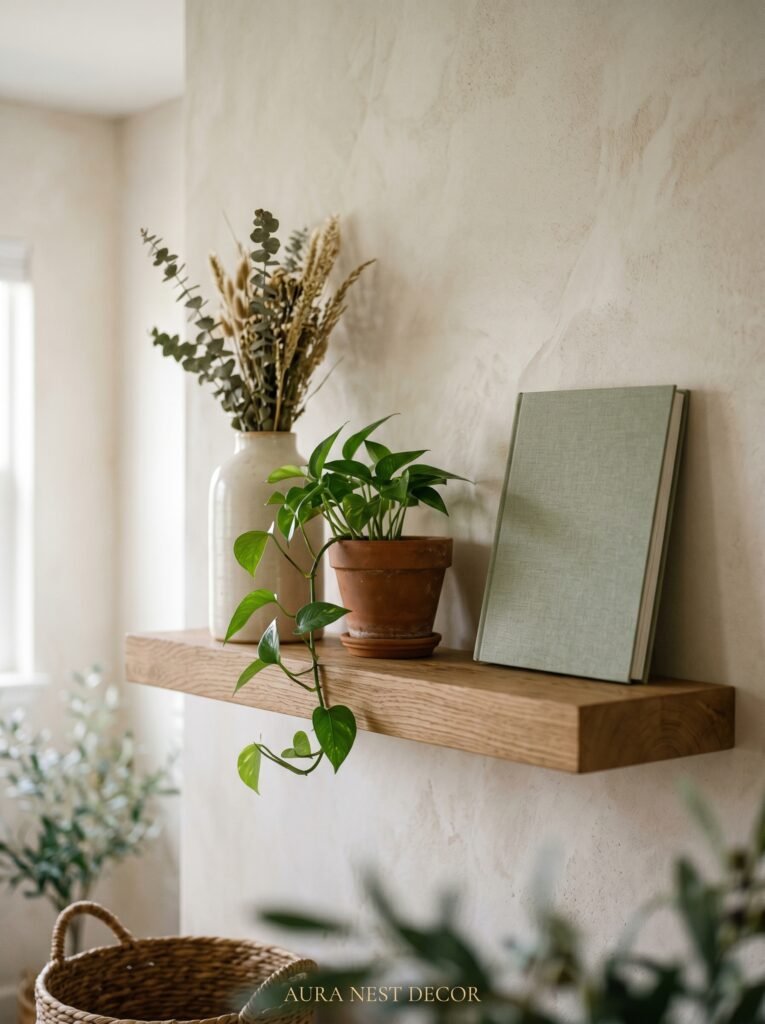
Open shelving in a farmhouse-style living room is a commitment. It’s a commitment to editing, to dusting, and to resisting the urge to fill every single inch.
The instinct is to treat a shelf like a storage unit. Books, photos, candles, plants, baskets — all of it, right up to the edges. The shelves that look beautiful on Pinterest, the ones that make you want to replicate them instantly, are doing something different. They’re leaving space. Deliberate, intentional space between objects that lets each thing breathe and be seen.
A solid rule: every shelf should have at least one “empty” zone, even if that zone is just a small gap between a stack of books and a ceramic vase. Visual rest. Your eye needs somewhere to pause.
Group things in odd numbers. Three books, a candle, and a small plant. One large ceramic piece, two smaller ones at different heights. A framed print leaning casually against the wall rather than hung, with a single object in front of it. The “leaning” element is key — it keeps things from looking too rigid, too arranged, too much like a showroom.
“The most compelling shelf in any room is the one that looks like you just live there.”
8. The Plant Situation: Why Most People Overdo It and What to Do Instead
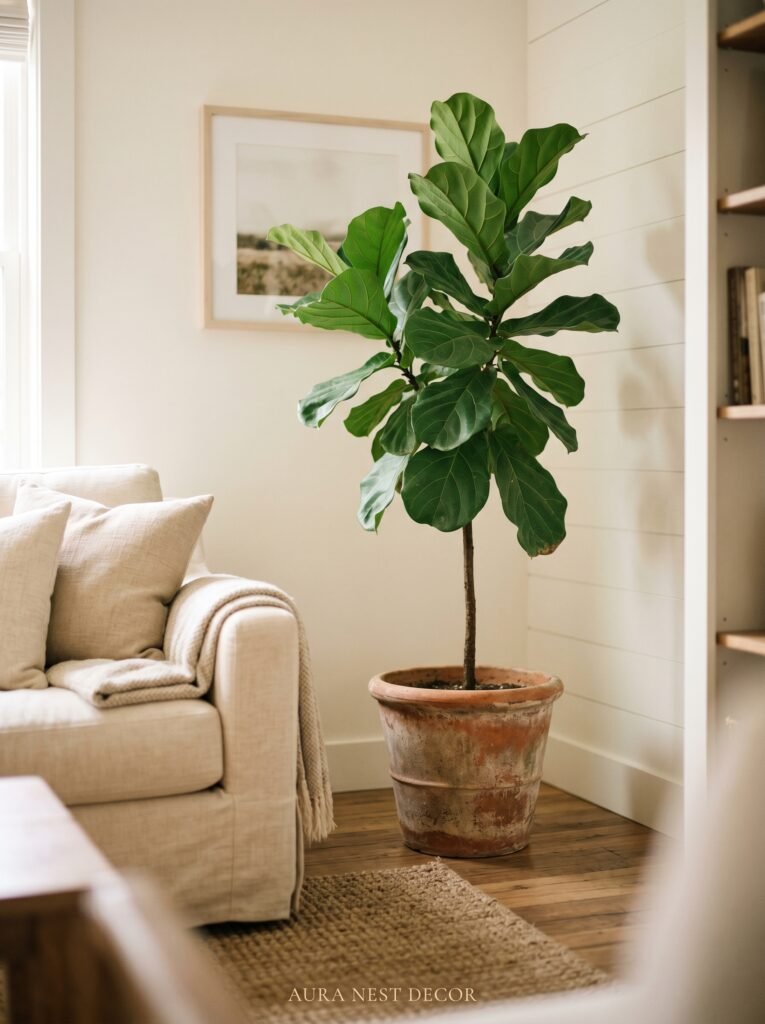
Plants in a farmhouse living room should feel like they grew there. Gradually. Over time.
One enormous fiddle leaf fig in the corner near the window. A trailing pothos on a high shelf, long enough that it drapes naturally over the edge. A small pot of rosemary or thyme on the coffee table — something that smells like a kitchen garden. That’s enough. That’s more than enough.
The rooms that look genuinely stunning don’t have seventeen plants in coordinated terracotta pots. They have three or four plants that are in truly excellent health and that are placed where the light is actually right for them. A half-dead plant in a beautiful pot is worse than no plant at all. It reads as neglect.
Choose simple containers. Unglazed terracotta — the real thing, not a trendy imitation — is perfect for this aesthetic. White ceramic. Woven seagrass baskets that add texture without competing with the plant itself. And please, repot your plants when they grow. A plant that’s outgrown its pot looks uncomfortable, and a living room should never look uncomfortable.
9. The Fireplace: The One Element Worth Spending More On Than You Think
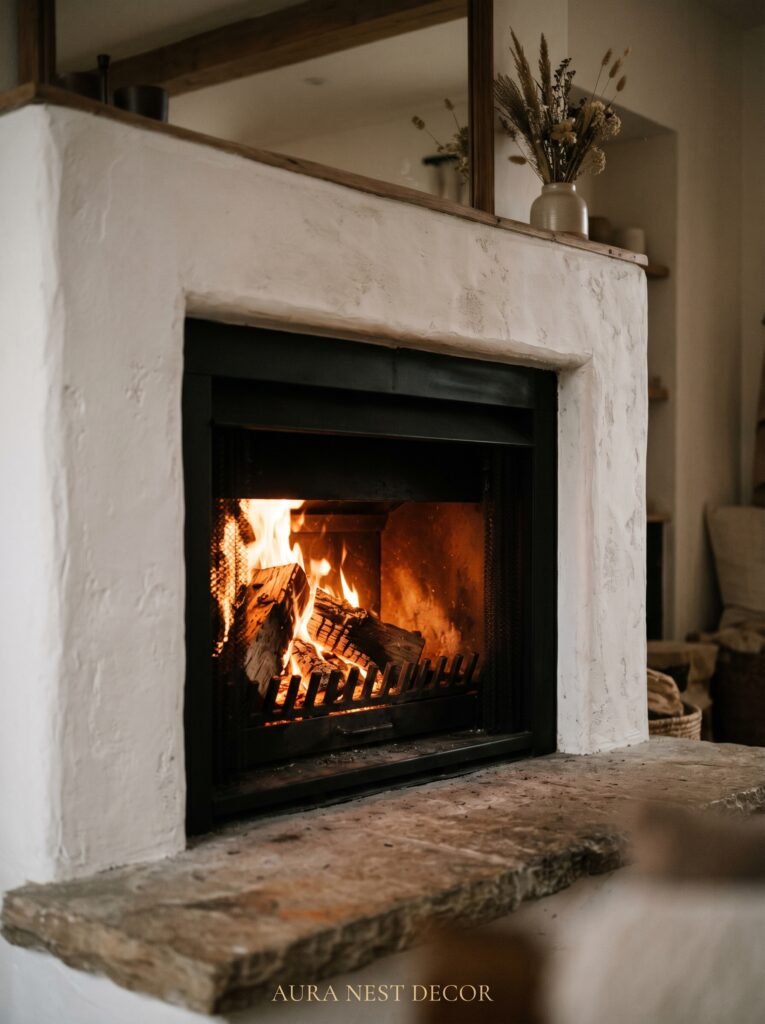
If your living room has a fireplace, it is your living room. Everything else arranges itself around it.
In a modern farmhouse aesthetic, the fireplace surround is your opportunity to bring in natural stone — and not the kind that’s been cut into perfectly uniform tiles. Real fieldstone. Slightly irregular limestone. Stacked stone with visible variation in color and texture. These materials have a weight and honesty to them that no tile can replicate.
If your fireplace surround is currently dated — a 1980s brass situation, or a shiny marble that feels more hotel lobby than home — you have options. A coat of limewash paint on a brick surround costs very little and completely changes the character. A new mantel in rough-hewn oak above an existing surround adds significant warmth without requiring structural work.
What goes on the mantel is its own art form. One large mirror — not ornate, something with a simple wood or aged iron frame — tilted very slightly forward rather than hanging flat against the wall. Three candles of varying heights. A small piece of something found: a smooth stone, a dried seed head, a small oil painting in a clip frame. That’s the mantel. Done.
10. The Textile Layering Method That Makes a Room Feel Lived-In Within an Hour
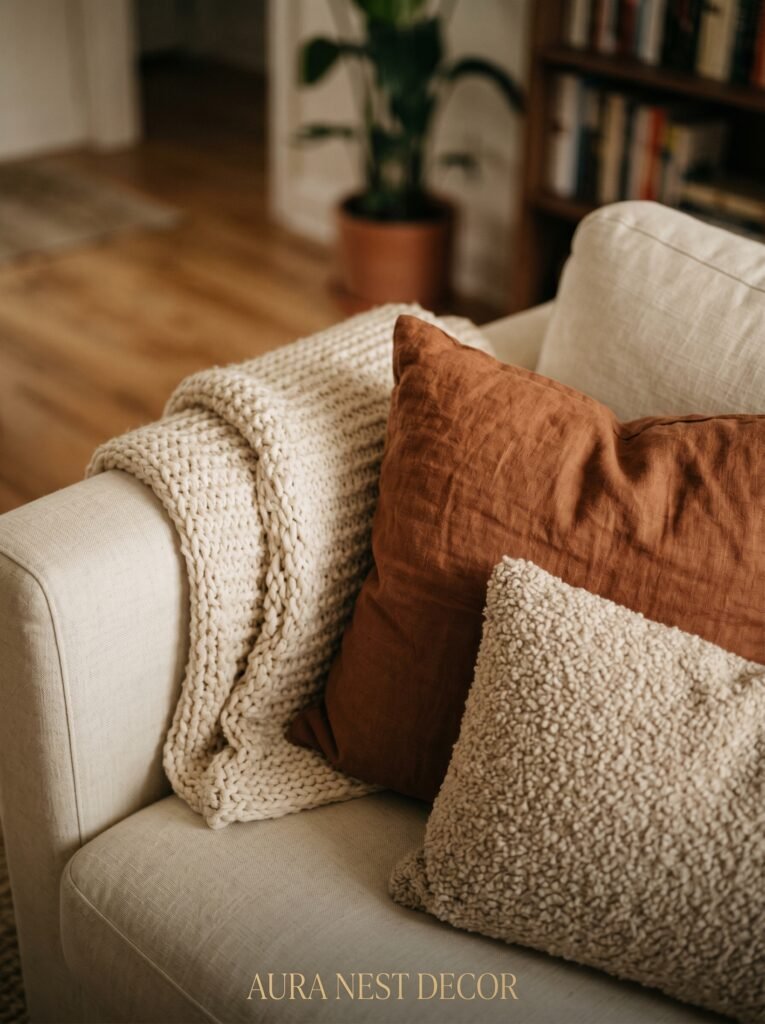
Throw blankets and cushions sound like small details. They are not small details. They are the difference between a room that’s been designed and a room that’s been lived in.
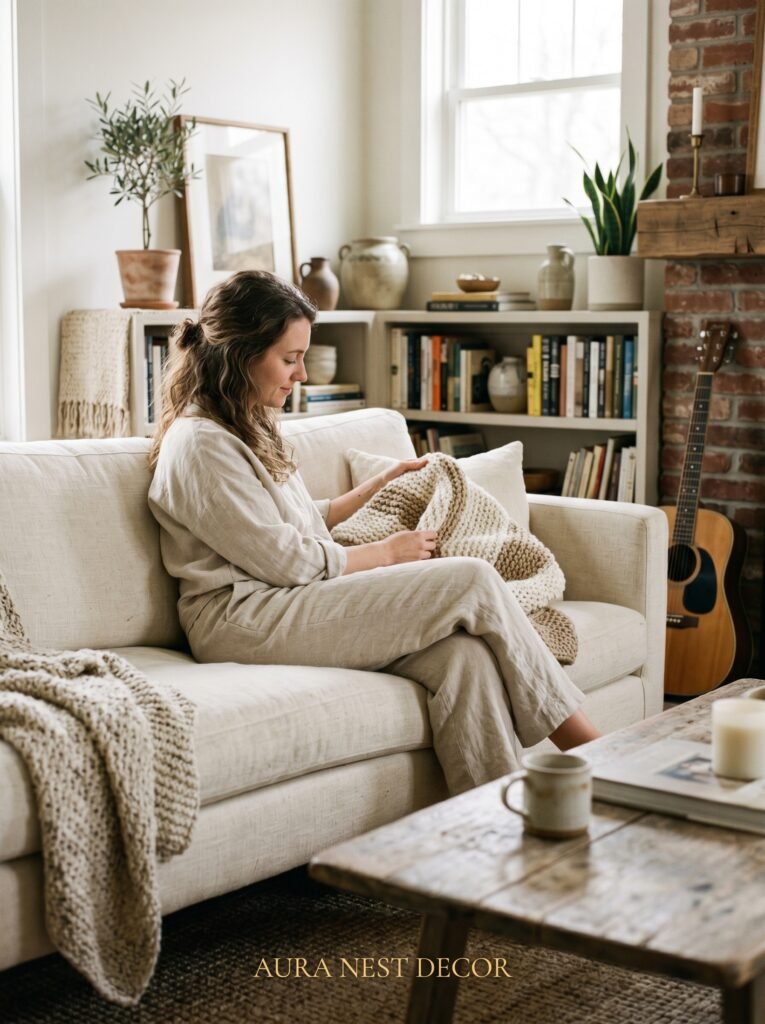
The rule is simple: textures first, colors second. A linen cushion, a knitted cushion, a velvet cushion — different textures, close in color. A chunky knit throw draped over the arm of the sofa, not folded neatly, just draped. A lighter cotton throw folded at the foot of a reading chair. A sheepskin — real or very good faux — on the seat of that chair.
The color palette for textiles in a modern farmhouse room should read like a British countryside walk in autumn. Oatmeal. Cream. Warm grey. A hint of rust. Sage green, muted and dusty. Tobacco brown in the leather. Nothing too saturated, nothing too bright, nothing that shouts.
The key is that nothing should look like it was placed. Everything should look like it landed there.
11. The Small Detail Almost Every Pinterest Room Gets Wrong
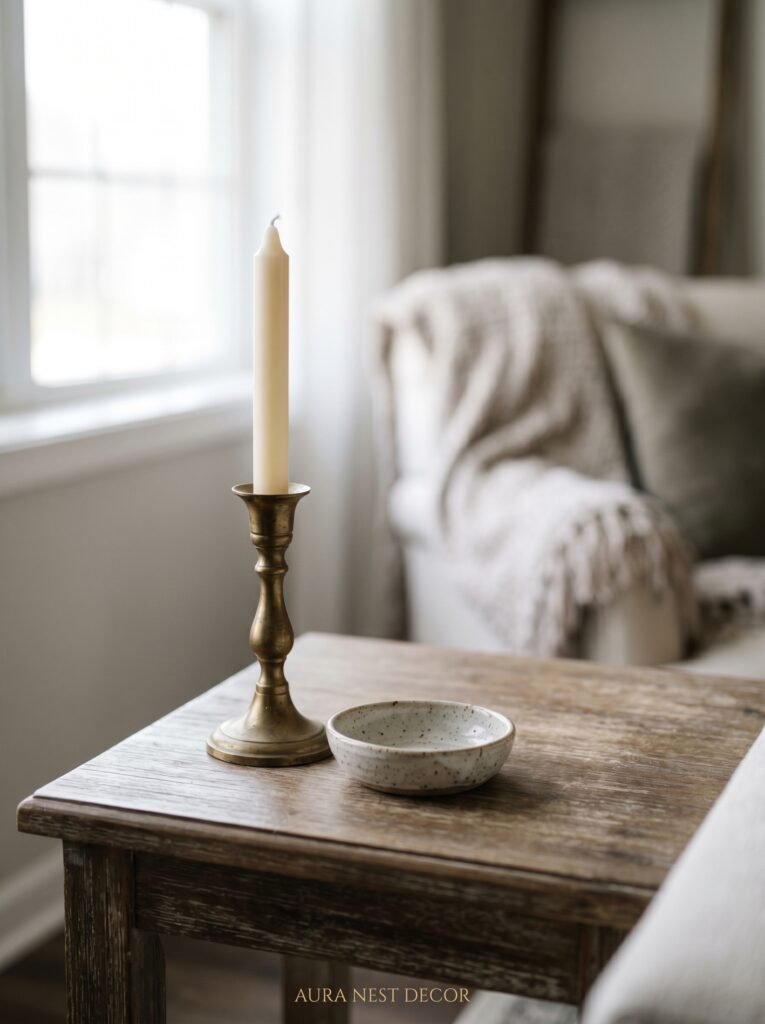
Hardware. Handles. Hinges. The small metal moments throughout a room that most people buy in bulk from a hardware store without thinking too hard about them.
In a modern farmhouse living room, these details are doing significant work. Every time someone opens a cupboard door on your media unit, or adjusts the lantern on your side table, or notices the curtain rings on your linen drapes — they’re experiencing your hardware choices.
Aged brass is the right answer for this aesthetic right now. Not shiny brass, not gold — aged. Unlacquered, so it’ll develop a patina over time and only improve. Bar handles in aged brass on a built-in unit. Simple cup handles on a sideboard. Antique-finish curtain rings on an iron rod.
The iron rod for curtains is worth mentioning specifically. Thin, matte black or dark iron, visible above the drapes. It communicates something handmade and real in a way that a plastic rail hidden behind a pelmet simply doesn’t. It costs more. It’s worth it.
12. The One Thing That Separates a Room You Love From a Room You Just Like
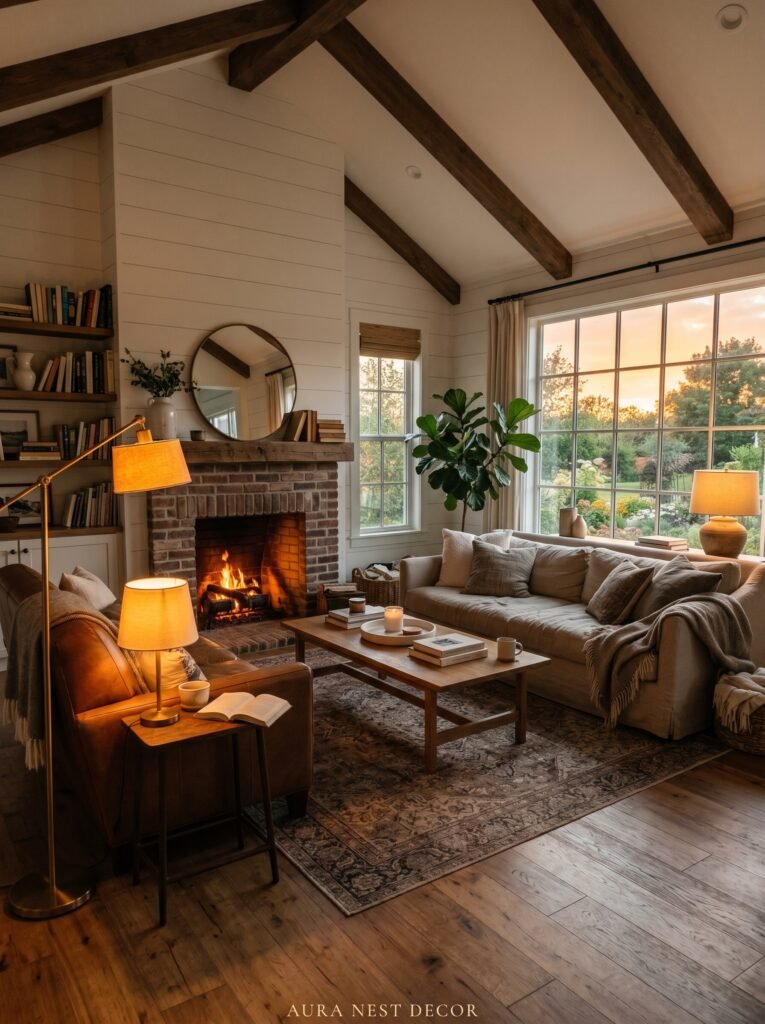
Personality. Actual, traceable, undeniable personality.
The farmhouse-aesthetic rooms that stop you mid-scroll and make you save-and-repost are never the perfectly curated ones. They’re the ones where something unexpected happened. A vintage oil painting of cows over a very contemporary sofa. A stack of genuinely-read paperbacks on the coffee table next to the linen-covered design books. A child’s drawing in a beautiful frame on the gallery wall, next to an expensive print. A single, bold piece of pottery that somebody brought home from a market and couldn’t justify but couldn’t leave behind.
That’s the thing no style guide can give you. It has to come from actually living in the space and bringing in the things you love rather than the things you think you should love. The modern farmhouse aesthetic, at its core, is about warmth and honesty — and honesty means the room looks like you live there, not a general idea of a person who appreciates natural materials and neutral palettes.
Trust your instincts. Buy the thing that makes you feel something. Put it in the room.
—
❓ FAQ
Q: How do I make a modern farmhouse living room feel cozy without it looking cluttered? A: Focus on texture over quantity — a few beautifully textured pieces (chunky knit, real wood, natural ceramics) will do more for warmth than filling every surface. Edit relentlessly, and leave breathing room between objects. The eye needs somewhere to rest.
Q: Can a modern farmhouse living room work in a small UK terraced house? A: Absolutely — and arguably better than in a large open-plan space. A smaller room benefits from the warmth and intimacy this aesthetic brings. Stick with a warm, light palette to avoid making the space feel smaller, choose one feature wall or detail rather than multiple, and focus on really good lighting.
Q: Is the modern farmhouse look going out of style? A: The cliché version — all shiplap and barn doors and galvanized metal signs — has peaked. But the underlying approach (warm natural materials, honest textures, comfortable furniture, a sense of lived-in ease) is not going anywhere. Those are just good design principles dressed in a particular vocabulary.
—
💭 Final Thoughts
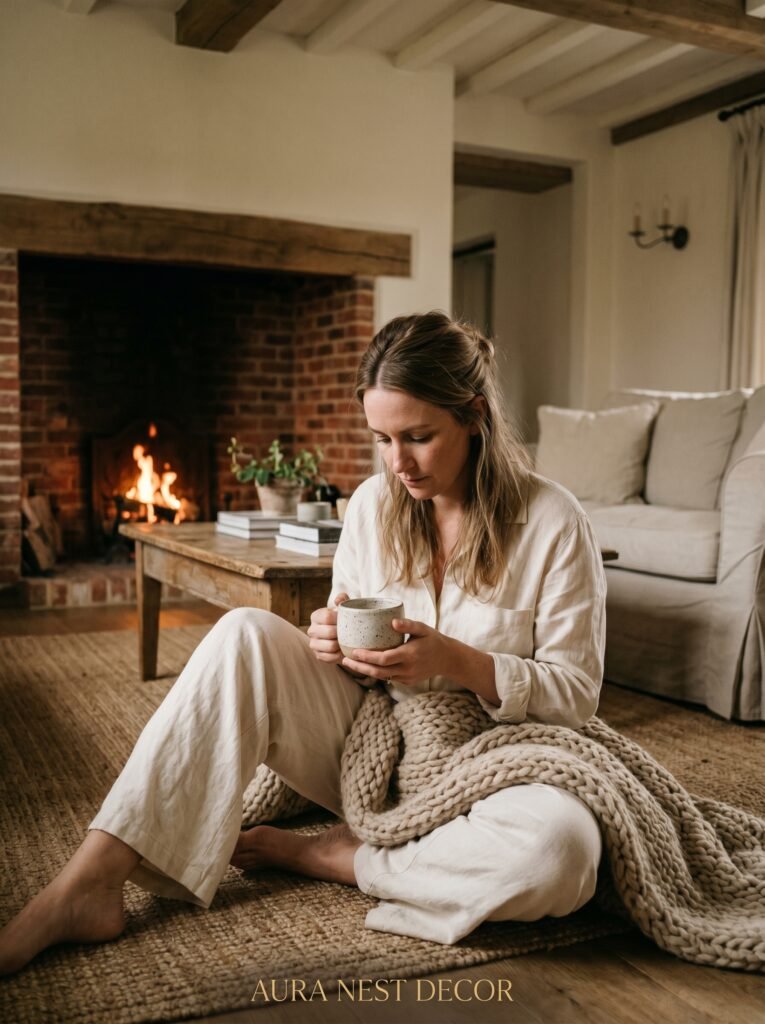
The rooms people fall in love with online aren’t perfect. They’re specific. They have a point of view, a history, a person behind them. The best version of a modern farmhouse living room is the one that feels unmistakably like the home of someone who actually cares — not the show home that happened to source good linen.
Start with one thing you love and build outward from there. Let it take longer than you thought.
What’s the one piece in your living room that you’d never change, no matter what style was trending?