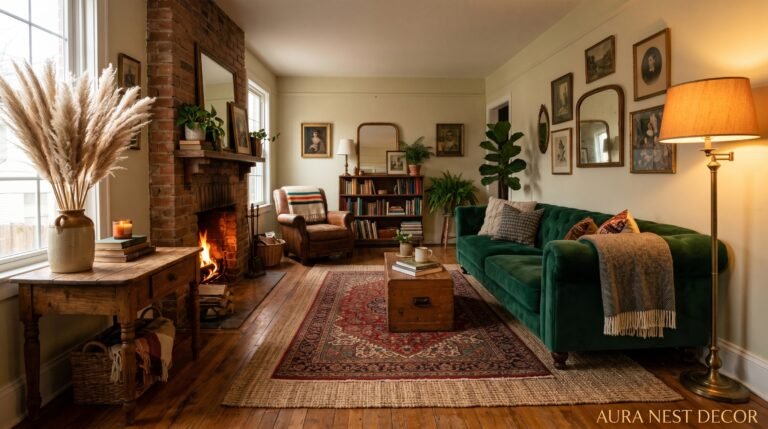
12 Aesthetic Wall Decor Ideas That Will Make Your Living Room Feel Like a Magazine Spread
You know that moment when you walk into someone’s living room and the walls just do something to you? Not because they’re covered in expensive art, but because whoever lives there made intentional choices. That feeling is completely achievable — and it starts with understanding that your walls aren’t just blank space. They’re telling a story whether you want them to or not.
—
1. The Gallery Wall Rule Nobody Talks About (But Every Stunning One Follows)
Gallery walls have been trending for over a decade, and yet the vast majority of them still look like someone emptied a storage box onto their wall and hoped for the best. The difference between a gallery wall that stops people mid-conversation and one that just… exists? It’s cohesion — but not the kind that means everything matches.
The rule is this: pick one thing to repeat. It can be the frame color (all black, all natural wood, all white with thin profiles), or the mat color, or even the subject matter. Every piece can be wildly different in size, orientation, and style — as long as that one thread runs through all of it. A moody oil painting next to a line-drawn botanical print next to a black-and-white photograph? Perfection, if every frame is the same warm brass.
Start by laying everything on the floor before a single nail goes in. Live with the arrangement for a few days. Photograph it. Move things around. The pieces you keep pulling your eye toward — those are your anchors. Build outward from them. Leave slightly more space between frames than feels natural. That breathing room is what makes it look considered rather than cluttered.
“A gallery wall isn’t about filling space. It’s about creating a whole new kind of space altogether.”
2. Why Dark Paint Behind Art Is the Move Interior Designers Keep Making
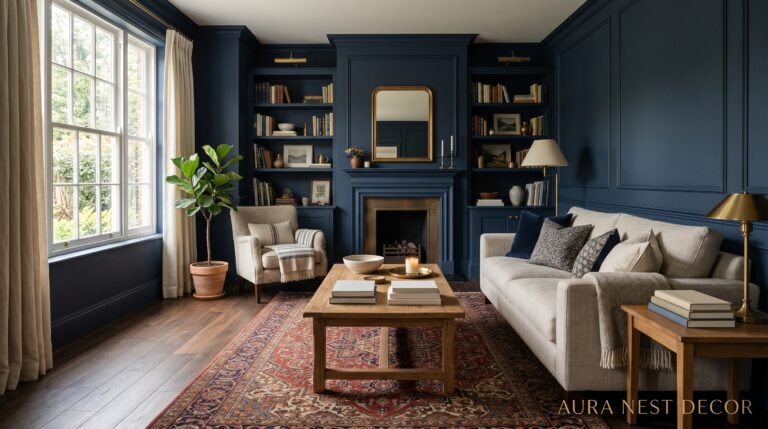
There’s a reason you keep seeing deep hunter green, navy, charcoal, and inky plum showing up in living rooms across both sides of the Atlantic. Dark paint does something to art that light paint simply cannot: it makes every single piece on that wall feel intentional, precious, museum-worthy.
This is called the gallery effect, and it works because contrast does the visual heavy lifting for you. A simple IKEA print in a plain black frame looks like something you’d find in a boutique hotel when it’s hanging against a wall painted Benjamin Moore Midnight Oil or Farrow and Ball’s Railings. The darkness recedes and the art comes forward.
The fear most people have is that a dark accent wall will shrink the room. In reality, it does the opposite — it creates depth. The wall appears to push back, and the room gains a dimension it didn’t have before. You don’t need to paint all four walls. One statement wall behind your sofa is enough to change everything. Pick the darkest shade you think you can handle, then go one shade darker. You’ll thank yourself every single evening when the lamps come on.
3. The Color That Keeps Showing Up in Every Beautiful Living Room Right Now
Terracotta. Warm clay. That dusty, sun-baked orange-red that looks like the inside of a pottery studio. It’s everywhere — and it belongs in your living room, on your walls, in your decor, threaded through your entire design story.
What makes terracotta so magnetic is that it plays well with almost every other tone. Pair it with cream linens and natural wood for that soft Mediterranean feel. Layer it against deep charcoal for something moodier and more dramatic. Bring in sage green accents and suddenly your living room feels like a Californian farmhouse that wandered off a Pinterest board and straight into real life.
For wall decor specifically, terracotta shows up beautifully in ceramic wall hangings, hand-thrown dishes mounted as art, woven pieces in warm earth tones, and framed prints with warm-toned botanicals. You don’t need to commit to painting your walls this color (though if you do, Sherwin-Williams’s Cavern Clay and Dulux Terracotta Fiesta are both extraordinary). You can introduce it purely through what you hang, and it’ll still shift the entire temperature of the room toward something that feels deeply, specifically warm.
4. Oversized Art Does More Work Than You’d Expect (And It’s Less Expensive Than You Think)
The single biggest mistake people make with living room walls is going too small. A cluster of small frames on a large wall doesn’t read as cozy — it reads as nervous. Like the wall isn’t sure it deserves to be decorated.
One large piece — even just one — anchors the entire room. It gives the eye a place to land and rest. And here’s the part that surprises people: large art doesn’t have to mean expensive art. A poster print in a large format frame from a platform like Desenio, Society6, or even a vintage map print from a charity shop resized at a print shop can look genuinely stunning. Canvas prints from your own photography, blown up to 24×30 inches, cost less than a dinner out and hit differently every single morning.
The sweet spot for a piece hanging above a sofa is that it should be roughly two-thirds the width of the sofa beneath it. Not wider, not dramatically smaller. That proportion is what creates visual balance. Hang it lower than you think — about 6 to 8 inches above the back of the sofa cushions so it reads as related to the furniture beneath it rather than floating in space.
“One oversized piece of art does more for a living room than ten small ones ever could.”
5. Mirrors Aren’t Just for Checking Yourself — They’re Structural Design Tools
Every interior designer uses mirrors strategically. Not because mirrors are a “trick” exactly, but because they fundamentally change the physics of a room. Light bounces. Space appears to double. A room that felt closed-in suddenly breathes.
In a living room with limited natural light — which describes the majority of British homes and a solid number of American ones — a large mirror placed opposite or adjacent to a window can genuinely change the quality of the room throughout the day. At 2pm on a grey November afternoon, a well-placed mirror catches whatever weak light exists and throws it back into the space. The effect is subtle but cumulative.
For aesthetic impact, lean into vintage and architectural mirror shapes: arched, sunburst, aged brass frames, or a simple oversized round. Lean a large mirror against the wall rather than mounting it if you want that effortless, editorial feel that keeps turning up in beautifully styled living rooms. Pair it with a floor lamp positioned just to its side and you’ve accidentally created something that looks very expensive and very considered.
6. The Shelf-as-Art Approach That Changes Everything About How You Think About Walls
A floating shelf isn’t storage. Not if you do it right. A floating shelf, styled with the same intention you’d bring to decorating a mantelpiece, becomes a three-dimensional piece of wall art that changes and grows with you.
The styling principle: thirds. One-third practical objects (a small stack of books, a candle), one-third organic or natural elements (a small trailing plant, a dried seed pod, a piece of driftwood), one-third pure aesthetic (a small framed print, a ceramic piece, a sculptural object). Don’t fill every inch. Space is part of the composition.
Dark shelves against light walls. Light shelves against dark walls. Natural wood against painted plaster. The contrast between the shelf and the wall behind it is what gives the arrangement visual pop. A single long shelf above a sofa can hold more visual interest than most gallery walls, and the beauty of it is that you can restyle it in twenty minutes on any given Sunday afternoon when the mood strikes.
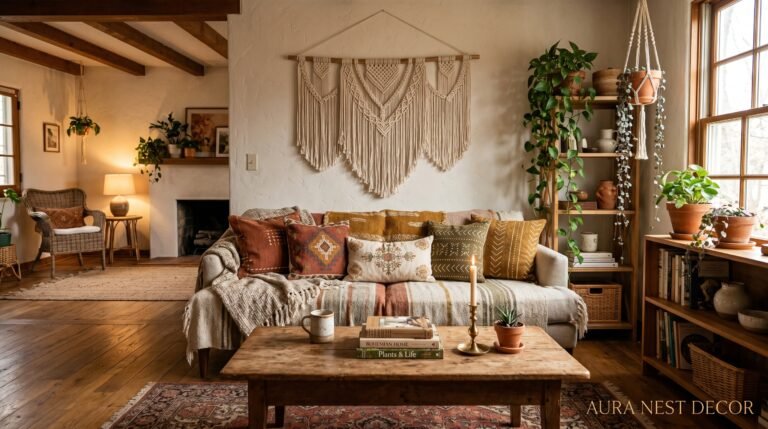
7. Woven Wall Hangings Are Still Here, and Here’s Why They’ve Earned It
Yes, macramé had a moment. And then another moment. And somehow it keeps having moments because when it’s done well — truly well — it doesn’t look trend-driven at all. It looks ancient. Like something that belongs on a wall the same way a window does.
The key is texture and scale. A small woven hanging in a large living room disappears and looks like an afterthought. Go big. Go layered. Look for pieces that combine natural fibers — jute, cotton, wool — in different weights and weaves so the eye has somewhere to travel. Neutrals read the most timeless: oatmeal, ivory, warm grey, dusty blush.
Hang woven pieces on walls that don’t have much else competing. They need room to breathe and be appreciated. A woven piece above a console table with a single ceramic lamp beside it? Stunning. The same piece crammed between two framed prints and a mirror? It just disappears. Let it be the sole focus of that wall, and it becomes architectural in its own quiet way.
“A woven wall hanging doesn’t just decorate a room. It changes its texture — literally and otherwise.”
8. The Plant Wall Moment: Why Trailing Greenery Belongs Vertically, Not Horizontally
There’s a reason plant shelves keep resurfacing on Pinterest every single season: plants as wall decor work because they’re alive. They move. They grow. They respond to light differently at different times of day, and that dynamism makes a wall feel less like a surface and more like part of the room’s actual life.
You don’t need a full plant wall installation to achieve this. A wall-mounted planter, a simple bracket shelf holding a golden pothos or string of hearts, a ceramic wall sconce designed for a small trailing plant — any of these introduces that vertical green dimension that most living rooms are completely missing.
For British homes especially, where natural light can be limited, choosing the right plant matters enormously. Pothos, heartleaf philodendron, and devil’s ivy will trail beautifully in relatively low-light conditions. Spider plants produce cascading offshoots that drape elegantly over shelves. Pair any of these with a simple terracotta pot or a white ceramic wall mount and you have something that costs under twenty pounds or dollars and looks like a lifestyle decision.
9. Architectural Salvage and Vintage Finds: The Wall Decor Category Nobody Talks About Enough
The most interesting living room walls aren’t filled with prints. They’re filled with objects. A vintage clock face. An old ironwork bracket. A set of antique keys on a simple hook. A section of ornate cornice found at a salvage yard, painted and mounted as sculpture.
This is the category of wall decor that separates rooms that feel genuinely lived-in and personal from rooms that feel like a showroom. Object walls tell stories. They suggest a life that has collected things, encountered things, found things beautiful for reasons that belong only to the person who chose them.
Start at salvage yards, antique markets, car boot sales, and estate sales. Look for anything with interesting texture, patina, or form: old frames even without their original art, vintage mirrors, metal letters, ceramic tiles, cast iron objects. Mount them deliberately. Give them space. You’re not decorating — you’re curating.
10. The One Rule That Makes Any Painted Accent Wall Feel Intentional Rather Than Random
Painted accent walls have taken some criticism over the years — seen as dated, too try-hard, or a 2010s relic. But the reason some accent walls look stunning and others look like a mistake is almost always the same: the color wasn’t tied to anything else in the room.
The rule is simple: whatever color you choose for your accent wall should appear somewhere else in the room, even if only in a small object, a cushion, a throw, or an element of your art. This repetition signals intention. It tells the eye that the choice was considered, not random. A deep teal accent wall that also appears in two throw pillows and a vase on the mantelpiece reads as a design decision. The same teal wall with nothing else teal in the room reads as an accident.
Beyond color, consider finish. A matte finish on an accent wall absorbs light and feels cozy. A slightly elevated sheen — an eggshell rather than flat matte — catches the light differently and makes the color feel richer. The finish is a detail that most people skip and most designers always think about.
11. Framing Things You Already Own (The Most Underused Aesthetic Hack in Any Home)
You don’t need to spend money on art. You already have things worth framing.
A vintage postcard you’ve had since a trip ten years ago. A piece of your child’s artwork that stopped your heart when you first saw it. A page torn from an old book, a map from a location that changed your life, a pressed flower from your garden last summer, fabric swatched from a dress you loved, a handwritten letter, an old photograph printed on thick matte paper.
The frame is everything. A cheap print in a thoughtful frame looks more beautiful than expensive art in the wrong one. Thin black frames feel graphic and modern. Wide natural wood frames feel organic and soft. Antique gold frames feel collected and layered. Match the frame to the feeling you want, not just the art.
Create a small cluster of these personal objects — all framed consistently — and hang them together. What you’ll have isn’t just wall decor. It’s a self-portrait of your home. It’s the thing guests stand in front of and ask about, and the thing you look at on a Tuesday afternoon when you need to remember why this place is yours.
12. The Evening Light Test: Why Your Wall Decor Looks Different After Dark (And How to Use That)
This is the thing almost nobody thinks about when decorating walls, and it makes an enormous difference. Your living room walls look completely different at 8pm than they do at noon. The art you choose, the objects you hang, the colors you paint — they all behave differently under lamplight.
Warm-toned art (earthy colors, warm neutrals, golden yellows, deep oranges) comes alive in the evening. Under the amber glow of table lamps and the soft wash of a floor lamp, these pieces deepen and saturate. They look like they belong to the night.
Cool-toned art — ice blues, stark blacks and whites, bright whites, cool grays — can look a little flat under warm evening light. Not always, but often enough to be worth considering before committing.
Before you hang anything permanently, prop it up against the wall and live with it through a full evening. See what the lamplight does to it. Some pieces are morning art. Some pieces are evening art. The best ones do something beautiful in both. That test — simple, free, and almost never done — will save you more redecorating energy than any other single thing on this list.
—
❓ FAQ
Q: How do I make my living room walls look more expensive without spending a lot? A: Consistency is free. Choose one frame finish and stick to it throughout, ensure everything is hung at a consistent eye level (57 inches from center to floor is the standard), and leave more space between pieces than feels natural. Negative space reads as luxury. These three things alone will make any collection of wall decor look significantly more considered and intentional.
Q: How high should I hang art above my sofa? A: The sweet spot is 6 to 8 inches above the top of the sofa cushions, which keeps the art visually connected to the furniture below it. Art hung too high floats away from the room’s logic and makes the walls feel taller in an awkward rather than elegant way. When in doubt, go lower than your first instinct tells you.
Q: What’s the easiest way to start creating an aesthetic gallery wall if I’ve never done it before? A: Start with three pieces and build from there. Choose pieces you genuinely love — not pieces you think you should love — and find one element to unify them (frame color works best for beginners). Lay them on the floor before committing to any nail holes, photograph the arrangement from above, and only hang when you’re confident in the composition. Growth happens naturally once the foundation is right.
—
💭 Final Thoughts
The most beautiful living room walls have one thing in common: they feel like someone actually lives there. Not like a catalog, not like a mood board, but like a person made choices over time and each choice meant something. That’s what aesthetic wall decor really is — not a style, but an accumulation of things that matter. So the question isn’t which trend to follow. It’s what do you want your walls to say about the life being lived in front of them?