The Cape Cod Interior Style That Makes Every Room Feel Like a Weekend by the Sea
There’s something quietly magnetic about a Cape Cod interior — the way soft whites and weathered blues seem to slow time down, the way every room whispers “stay a little longer.” It doesn’t shout for attention. It earns it, slowly, the way a good morning at the coast does.

—
Table Of Content
1. What Cape Cod Style Actually Means (And Why It Feels So Different)
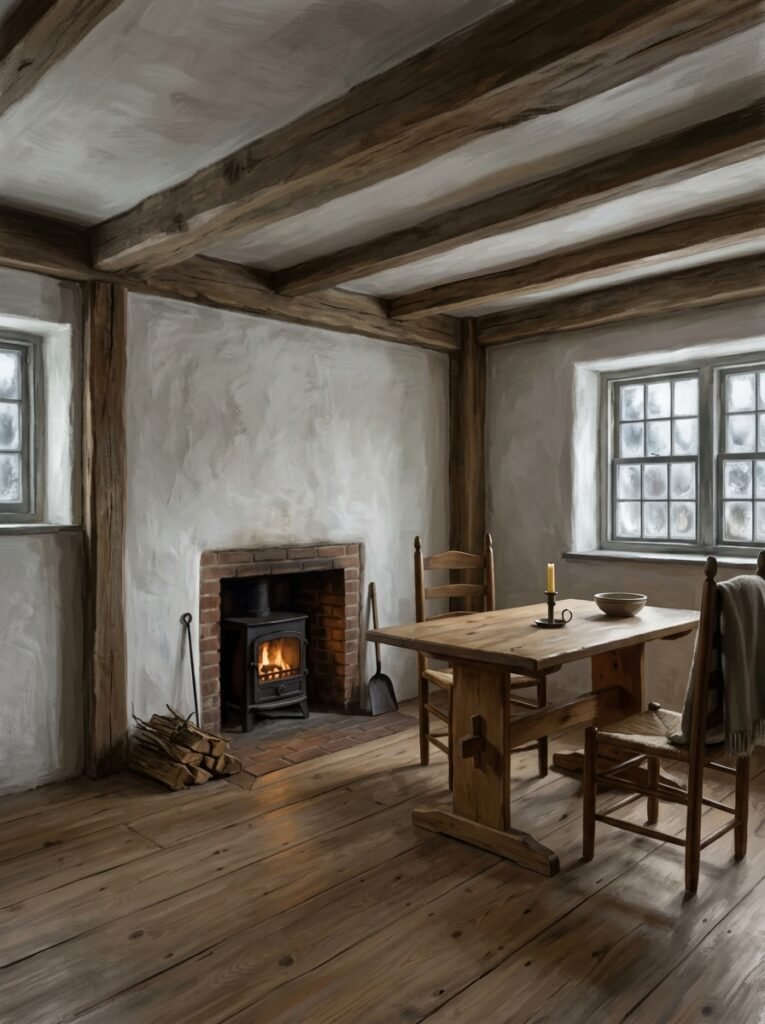
Cape Cod style isn’t just a design trend. It’s a feeling — and that distinction matters more than most people realize when they’re trying to recreate it in their own homes. Originating from the early colonial settlements of New England, Cape Cod architecture and interior design were built around one core principle: honest simplicity. Homes needed to be functional, sturdy, and warm enough to survive harsh Atlantic winters. There was no room for excess. Every element had to earn its place.
What makes Cape Cod interiors so emotionally compelling today is precisely that restraint. In a world of maximalism and over-curated feeds, a Cape Cod room breathes. It has negative space — intentional emptiness that gives your eye somewhere to rest. The walls aren’t competing with the furniture. The furniture isn’t competing with the windows. Everything works together in a kind of quiet harmony that modern interiors often sacrifice in the pursuit of visual drama.
“Cape Cod design doesn’t try to impress you — it simply makes you feel at home, and somehow, that’s far more impressive.”
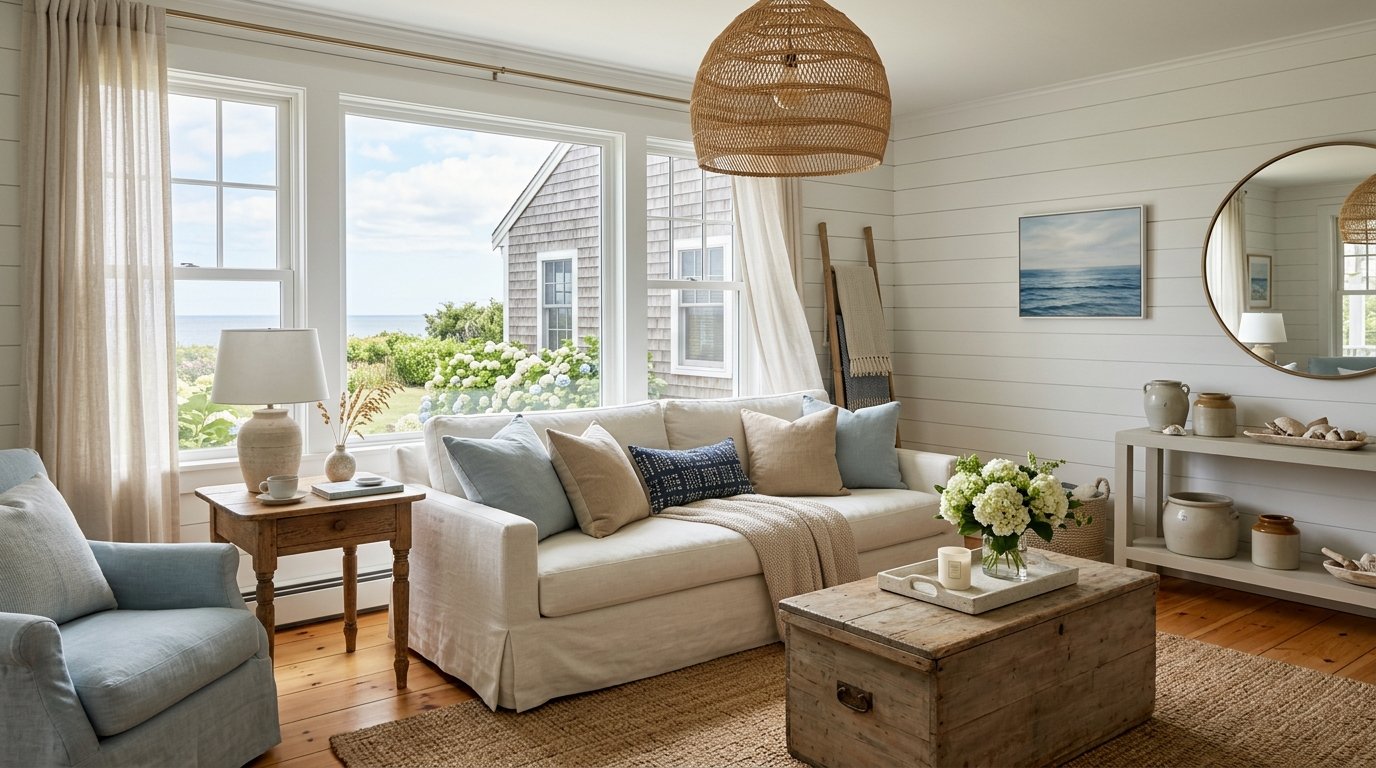
The style draws from a very specific coastal palette: sun-bleached whites, fog-grey blues, sandy beiges, and the occasional deep navy that reminds you of the ocean at dusk. But it’s not just about color. Cape Cod interiors are defined by natural textures — shiplap walls, exposed ceiling beams, woven rugs, linen drapes that catch the breeze from an open window. It’s a style that looks effortless because it’s built on elements that are genuinely, authentically relaxed.
2. The Color Palette That Does All the Heavy Lifting

If you’ve ever stood at the edge of the ocean and looked at the horizon, you’ve already seen the Cape Cod color palette in its purest form. Soft white sky. Grey-blue water. Sandy shore. These are the three foundational tones that anchor every authentic Cape Cod interior, and the magic is in how they’re layered rather than matched.
White is the dominant player — but not a stark, modern white. Think warm white, the color of sea salt, of old cotton, of Sunday mornings. It goes on the walls, the trim, the ceiling, and it becomes the canvas for everything else. From there, blue enters in measured doses: a navy linen sofa, a powder blue throw, a set of slate-blue dining chairs. The blues are never too bright, never too tropical. They carry the weight of Atlantic fog.
Sand and driftwood tones come in through the floors — wide-plank hardwood in honey or warm grey tones — and through natural textures like jute, rattan, and unfinished wood. Together, these elements create a palette that feels intentional without feeling designed. That’s the Cape Cod paradox: it takes real thought to make a room look this effortlessly uncontrived.
Accent colors are used sparingly — a terracotta planter here, a faded coral cushion there — like finding a pretty shell on the beach. They’re surprises, not focal points.
3. The Furniture That Feels Like It’s Always Been There
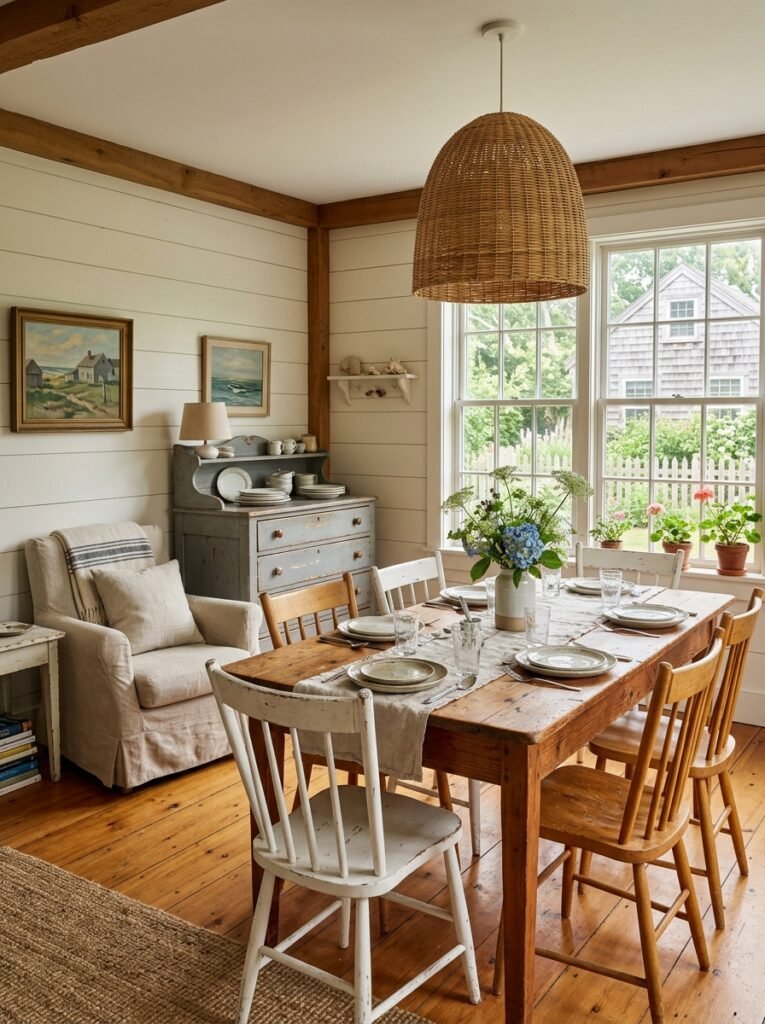
One of the most telltale signs of a genuinely Cape Cod interior is furniture that looks like it has a past. Not damaged or neglected — lived in. Loved. There’s a warm patina to Cape Cod furnishings that mass-produced modern pieces simply cannot replicate, which is why vintage and antique shopping is practically a rite of passage for anyone serious about this style.
The silhouettes lean classic and unfussy: a slipcovered sofa in white or natural linen, a farmhouse dining table with slightly mismatched chairs, a painted wooden dresser in a bedroom that’s seen a few decades go by. Scale matters enormously here. Cape Cod rooms don’t overfill. You’ll find fewer, larger pieces rather than many smaller ones — a design choice that goes back to the functional origins of the style.
Wicker and rattan are beloved staples, used for armchairs, side tables, and pendant light shades. They bring organic warmth without adding visual weight. Paired with a soft linen or cotton upholstered piece, the combination hits that perfect balance between casual and considered.
4. Shiplap, Beadboard, and the Walls That Tell a Story
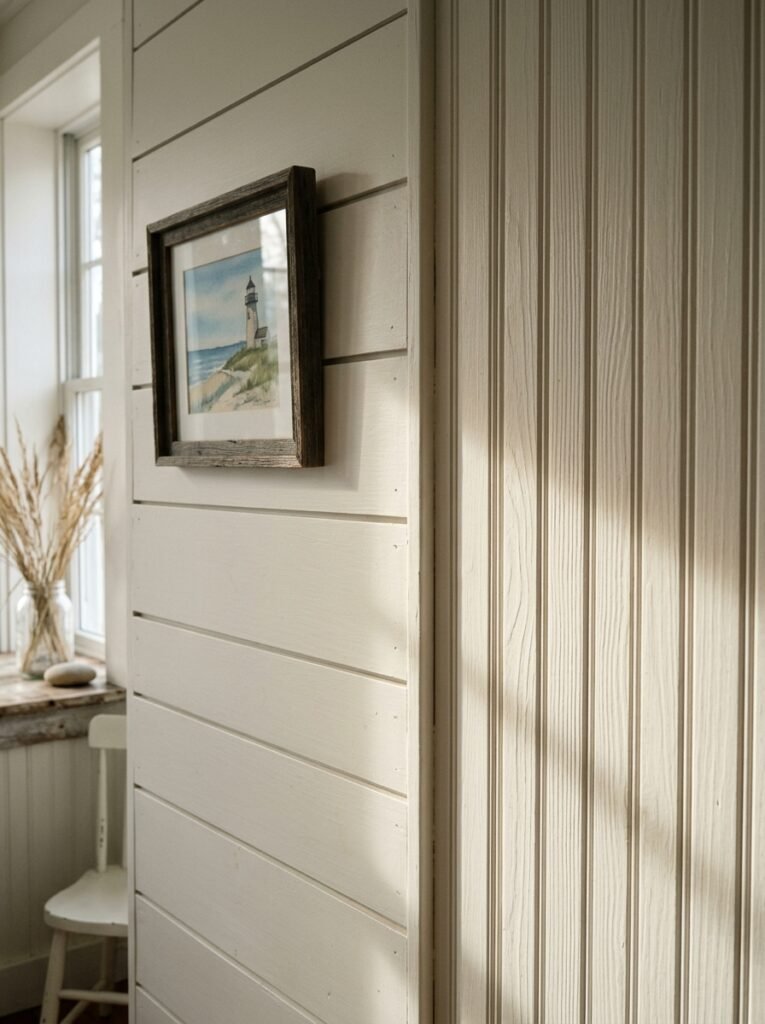
Walk into an authentic Cape Cod interior and the walls themselves will stop you. Not because they’re painted a dramatic color or covered in wallpaper — but because of their texture. Shiplap and beadboard paneling are the architectural signatures of this style, and they transform a flat wall into something that has genuine character and depth.
Shiplap — those horizontal boards with a small gap between each one — creates a sense of quiet rhythm on a wall. Painted in warm white, it reads as texture rather than pattern, adding visual interest without noise. Beadboard, with its vertical lines and rounded grooves, has long been used in coastal homes and gives even a simple bathroom or hallway a sense of place. Together, these elements root a room in its New England heritage.
The beauty of incorporating these details today is their accessibility. Shiplap and beadboard are available as panels or boards at most home improvement stores, and they can be installed on a feature wall without a full renovation. Even in a rental apartment, adhesive shiplap panels can bring that Cape Cod spirit into a room that previously had none. The transformation is remarkable — a flat wall becomes a story, and a story makes a room feel like a home.
5. Windows That Work Harder Than Any Piece of Furniture
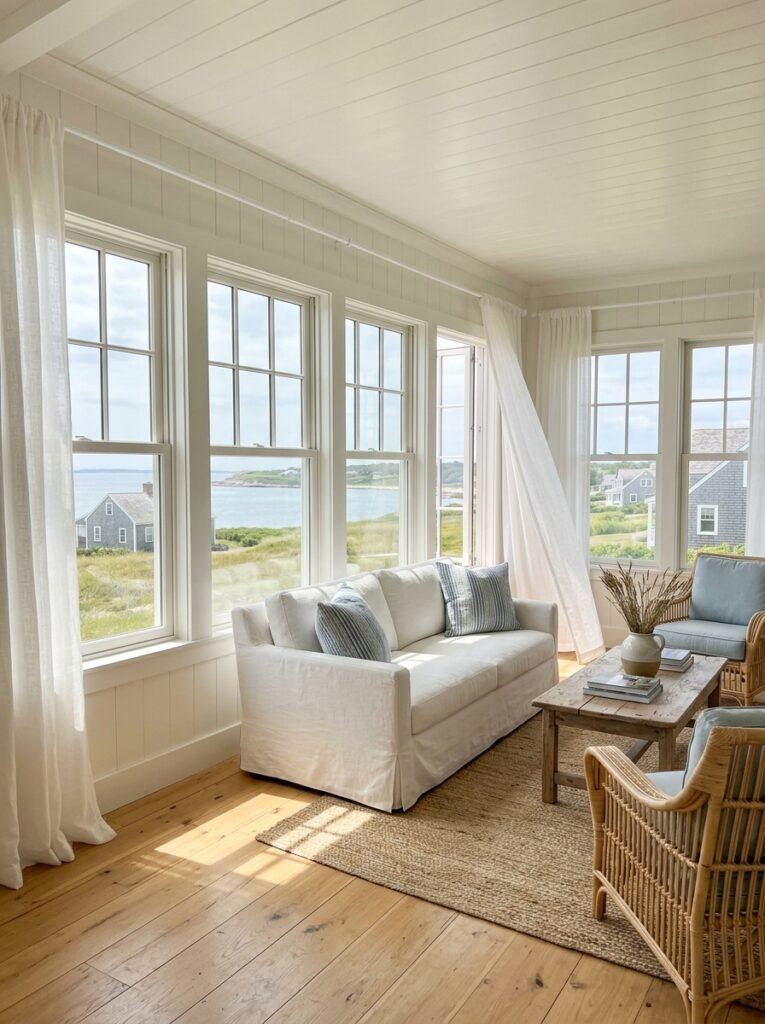
Ask any interior designer who specializes in coastal style and they’ll tell you the same thing: the windows are everything. In a Cape Cod interior, natural light isn’t a feature — it’s the foundation. The entire color palette, the white walls, the pale linen drapes — all of it exists to maximize and celebrate the quality of light that floods through those windows throughout the day.
Traditional Cape Cod homes feature double-hung windows, often with divided lights — small panes separated by slim wooden muntins — that give each window a grid-like, classic look. In interior design terms, these windows become as decorative as they are functional. They frame the outside world like a painting, and in a well-designed Cape Cod room, you’ll notice that furniture is often arranged to honor the view rather than compete with it.
“In a Cape Cod room, the window isn’t just a source of light — it’s the most important artwork on the wall.”
Window treatments in this style lean toward simple and airy: white linen curtains that skim the floor, roman shades in natural cotton, or even bare windows left untouched to let the light pour in uninterrupted. Heavy drapes and ornate valances have no place here. The goal is to blur the boundary between inside and outside, to make the room feel like a natural extension of the landscape beyond the glass.
6. The Kitchen That Makes You Want to Cook More
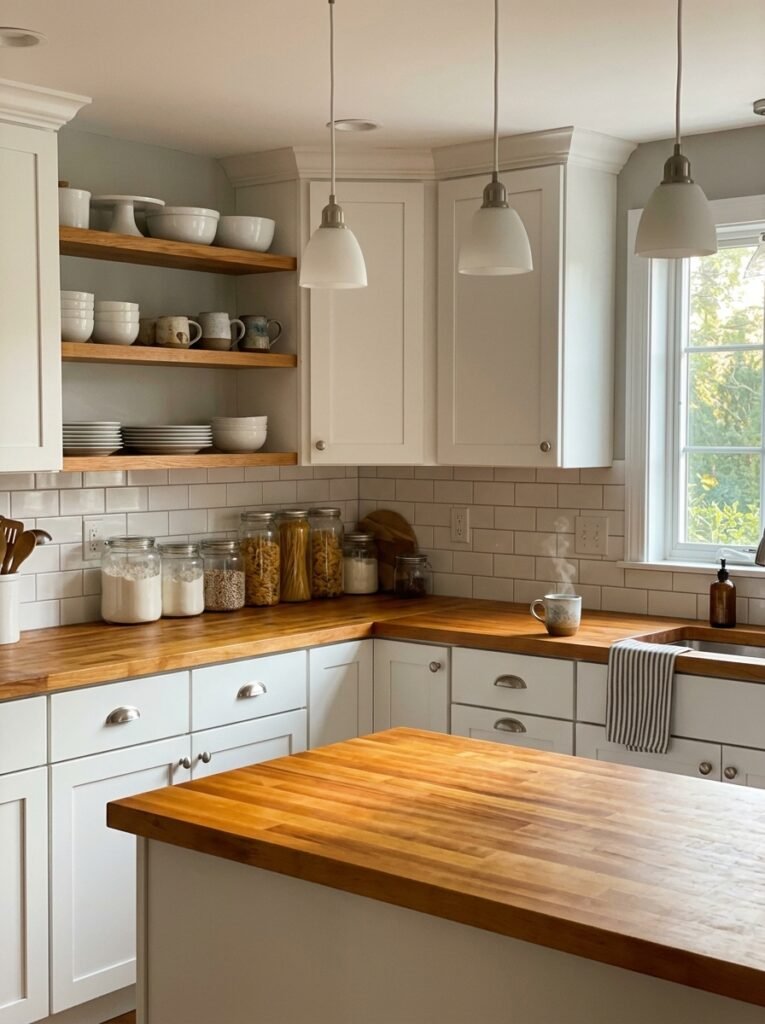
Cape Cod kitchens have a particular power. They make you want to be in them — not just to cook, but to stay. To lean against the counter with a mug of tea and watch the light change. There’s a warmth and a practicality to these kitchens that modern minimalist designs sometimes lack, a sense that real life happens here and that’s precisely the point.
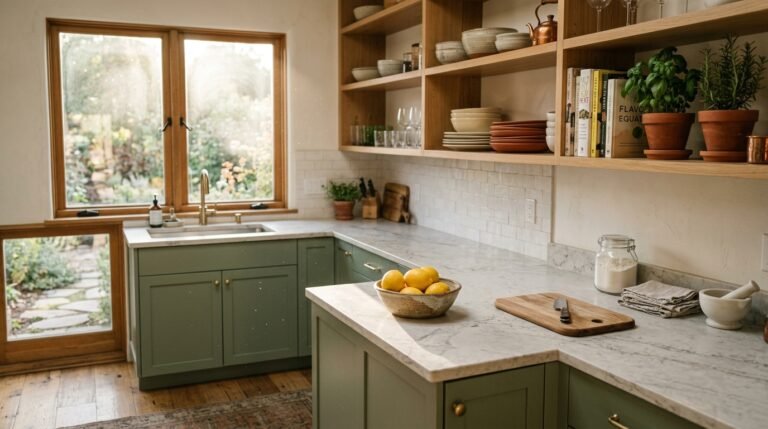
White or off-white shaker cabinets are the quintessential Cape Cod kitchen choice, and for good reason. Shaker style — with its simple, flat-center panel and clean lines — is honest and unfussy in a way that feels genuinely coastal. Pair them with brushed nickel or matte black hardware, and you have a combination that’s timeless rather than trend-dependent.
Countertops lean toward natural materials: butcher block adds warmth and texture, while marble or quartz in white with subtle veining brings a quiet elegance. Open shelving on at least one wall is a Cape Cod kitchen staple — displaying everyday dishes, glass jars of pantry staples, and a few meaningful objects makes the kitchen feel lived-in and generous. The backsplash is typically simple: white subway tile, perhaps with a soft grey grout, that lays the groundwork without stealing the show.
7. Bedrooms That Feel Like a Deep Exhale
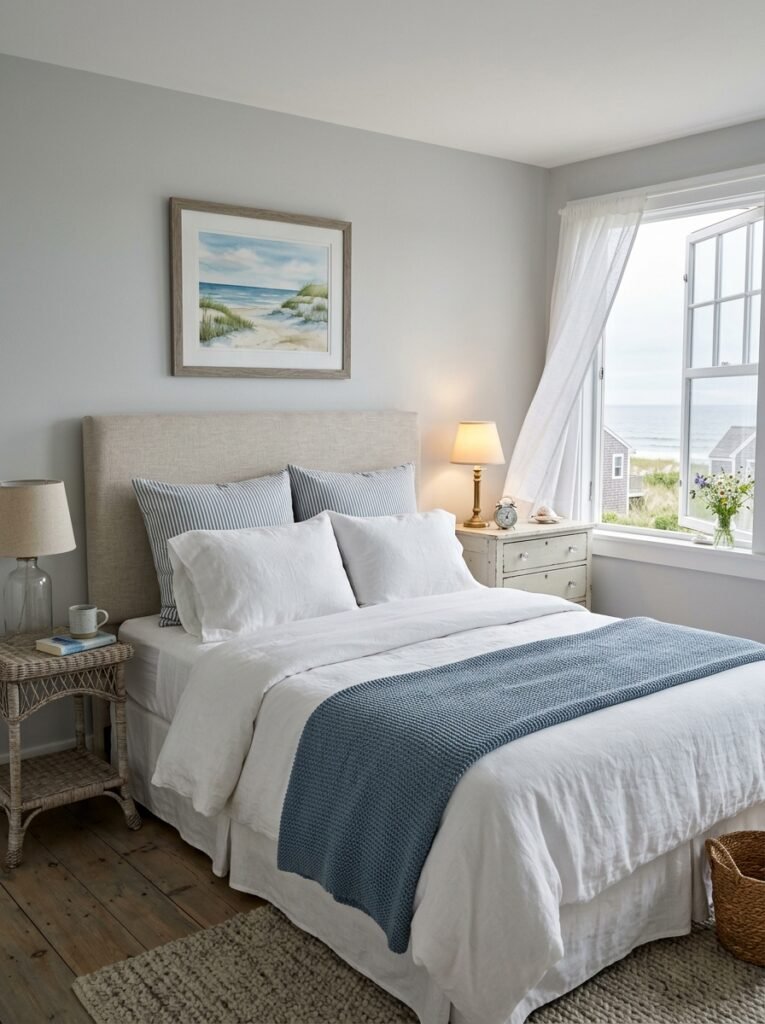
If you’ve ever slept in a bedroom by the sea — windows open, curtains lifting slightly in the breeze, the sound of water in the distance — you understand what a Cape Cod bedroom is trying to capture. It’s that quality of rest that feels almost physical, a heaviness in the best possible sense.
White or light grey walls set the tone. The bed — always the room’s anchor — is dressed in white linen or cotton with layers of textured throws and pillows in soft blue, muted stripe, or natural ticking fabric. The headboard is often upholstered in a neutral linen or painted wood in white or soft grey. Bedside tables might be mismatched — a small painted chest of drawers on one side, a simple wicker table on the other — which gives the room a collected rather than purchased look.
Artwork in Cape Cod bedrooms is meaningful and quiet: a single framed watercolor of the coast, a small collection of botanical prints, a vintage map. Nothing overpowering. The room is designed to rest your eyes as effectively as it rests your body.
8. Bathrooms That Belong in a Seaside Inn
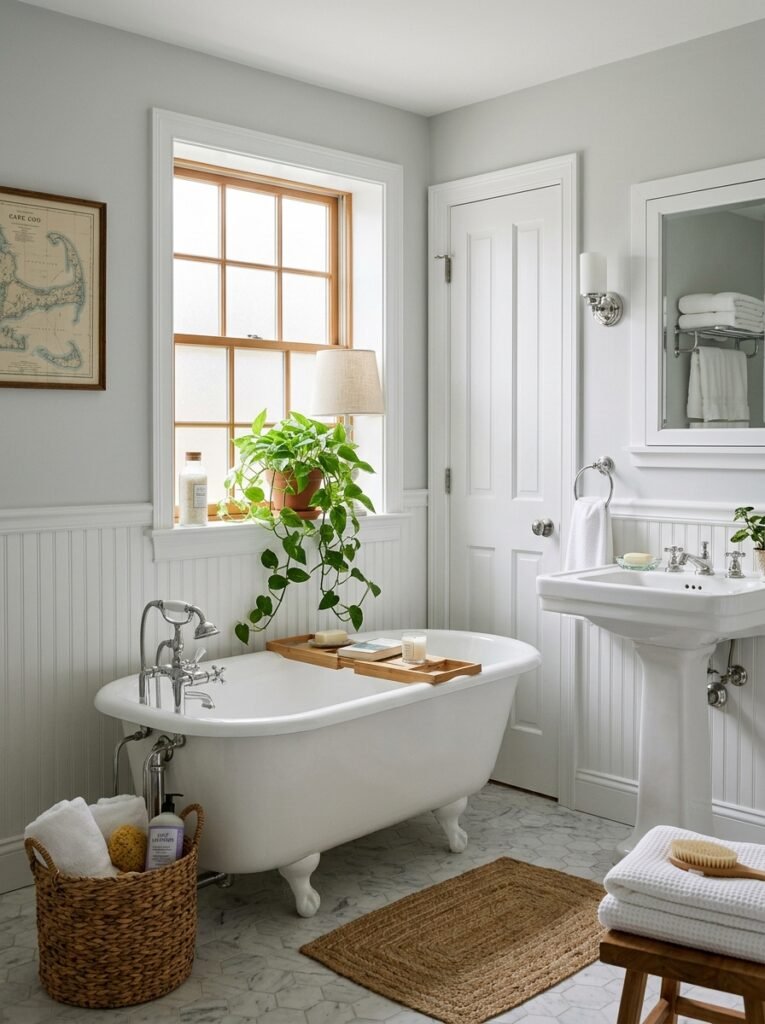
The Cape Cod bathroom is one of the most coveted looks in interior design right now, and it’s easy to understand why. It manages to feel both spa-like and homey — a combination that’s genuinely difficult to achieve. The secret lies in the materials and the restraint.
White beadboard paneling on the lower half of the wall is a signature move. Above it, a soft grey or pale blue paint or simple white subway tile carries the classic coastal feeling upward. Fixtures lean traditional: a pedestal sink or a console sink with exposed legs, a clawfoot tub if space allows, chrome or brushed nickel fixtures that have the look of something that’s been there for generations.
Soft, natural textiles make a significant difference here. Waffle-weave towels in white or sand, a simple bath mat in natural cotton, a wicker basket holding rolled hand towels. A small potted plant — something lush and green, like a fern or a trailing pothos — adds the one note of living color that a Cape Cod bathroom needs to feel complete.
9. Layering Texture — The Secret Ingredient Nobody Talks About Enough
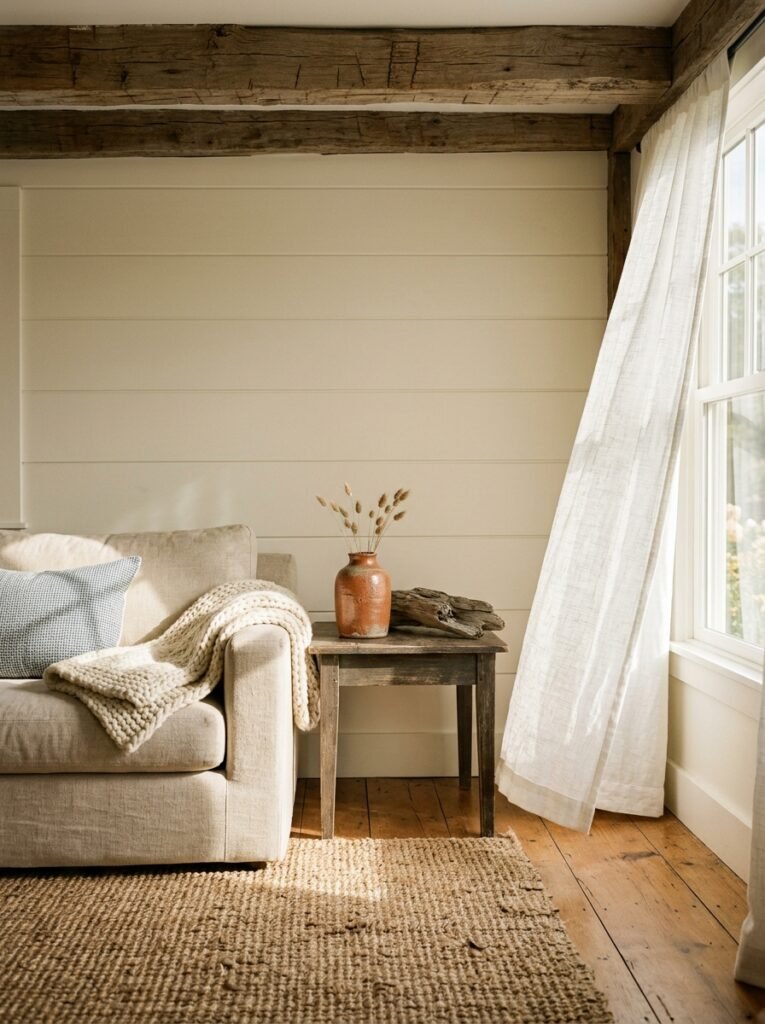
Color gets all the attention in Cape Cod design conversations, but texture is the real genius behind why these interiors feel so inviting. Walk into a room where everything is smooth and flat, even if the colors are beautiful, and you’ll feel something missing. The eye — and the body — craves tactile variation. It’s a sensory need that Cape Cod style satisfies instinctively.
Consider how many different textures exist in a well-executed Cape Cod living room: rough-hewn wooden beams overhead, smooth painted shiplap on the walls, the soft nap of a linen sofa, the scratchy weave of a jute rug underfoot, the cool smoothness of a ceramic vase, the slight roughness of a driftwood decorative piece, the airy lightness of a linen curtain moving in the breeze. Each one is distinct. Each one is doing emotional work.
“In a Cape Cod interior, texture isn’t decoration — it’s the language the room uses to say ‘you can relax here.'”
Layering textures doesn’t require a large budget. A woven throw from a thrift store, a terracotta pot from a garden center, a piece of driftwood collected on a walk — these things cost almost nothing and add more authenticity than any expensive décor item. The rule is simple: if it comes from nature or was made by hand, it probably belongs in a Cape Cod home.
10. Bringing the Outside In — Coastal Accents That Never Feel Kitschy
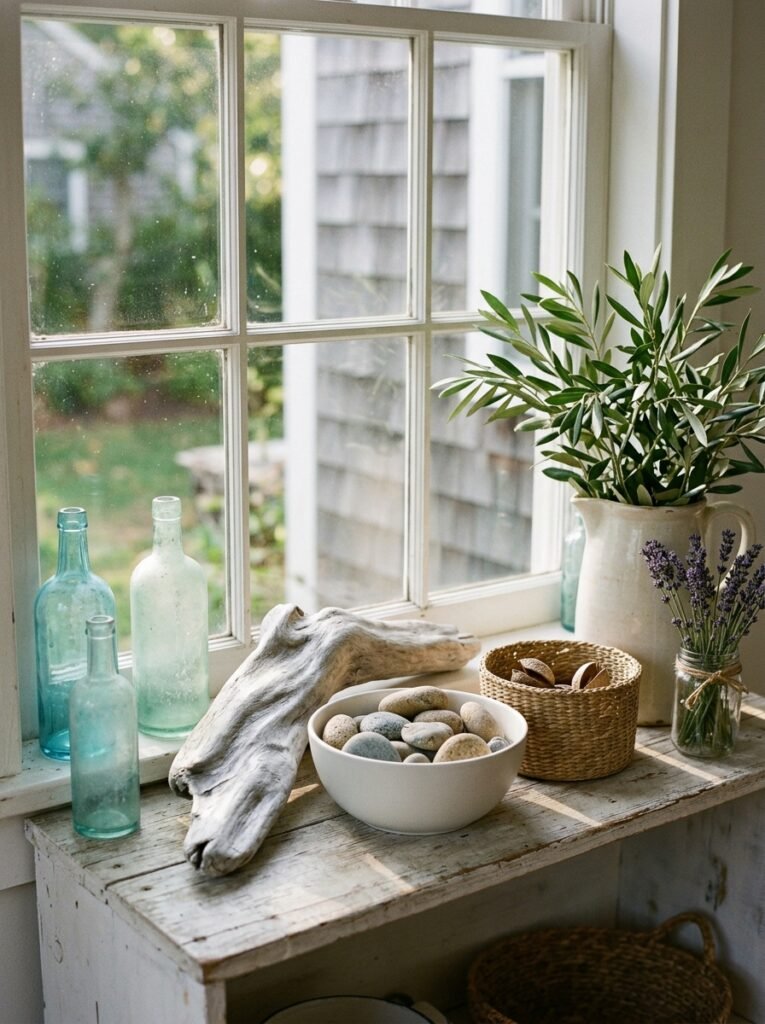
There’s a fine line between Cape Cod coastal accents and the kind of beachy kitsch that involves ceramic seagulls and neon buoys. The difference comes down to restraint and authenticity. Cape Cod accents are subtle, natural, and meaningful rather than literal and over-stated.
Think driftwood as a decorative object on a shelf, worn smooth by years of waves. Glass bottles in sea-glass colors — aqua, pale green, clear — catching light on a windowsill. A basket woven from seagrass holding blankets in the living room. A collection of smooth stones gathered on a beach, placed in a simple white bowl on the coffee table. These are the coastal accents that work because they have genuine substance — they look like they were found, not bought.
Botanical elements also play beautifully in Cape Cod interiors: a large olive branch in a tall white ceramic vase, fresh lavender in a glass jar on the kitchen counter, a trailing fiddle-leaf fig bringing height and life to a corner. Nature, brought inside in its most generous and unforced form.
11. Lighting That Changes the Entire Mood of the Room
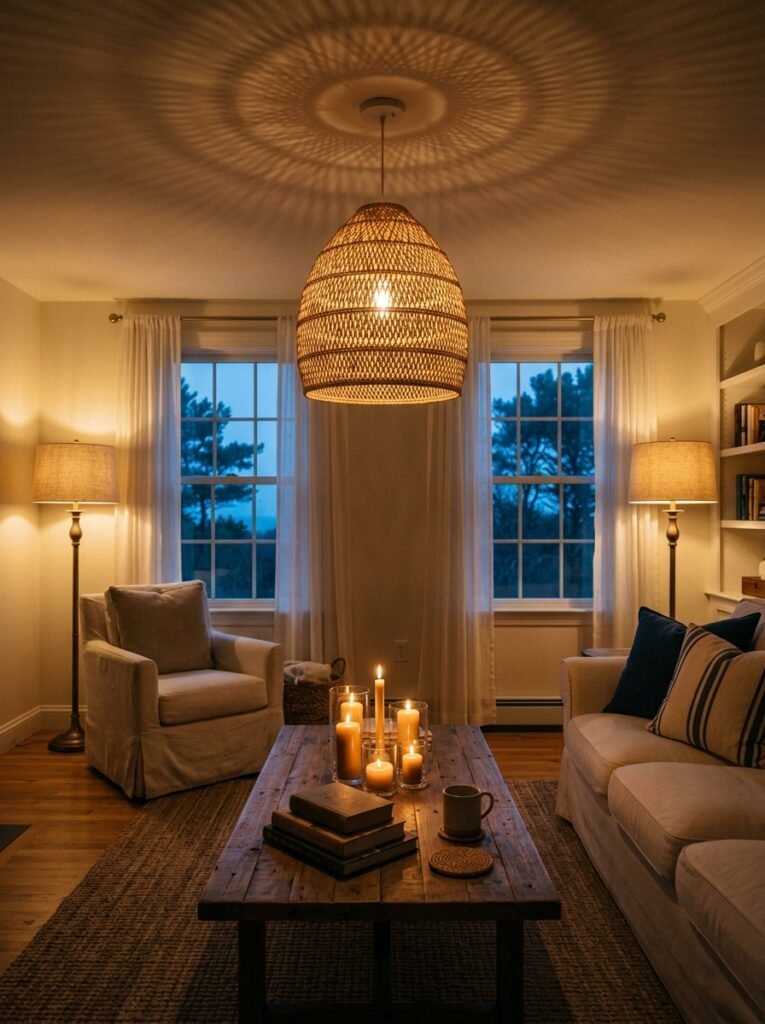
Lighting in a Cape Cod interior is one of the most powerful tools in your design arsenal, and it’s frequently underestimated. The wrong light can flatten a room, make it feel cold or institutional. The right light — warm, layered, and thoughtfully placed — can make the same room feel like the most welcoming place on earth.
Rattan and wicker pendant lights are a Cape Cod staple for good reason: they cast a beautiful, dappled warm light and add organic texture overhead. In the kitchen, a set of simple white or brushed nickel pendants over the island provides focused task lighting that still feels relaxed. In the bedroom, a pair of linen drum shade bedside lamps at the perfect reading height creates that essential sense of intimacy.
The key to Cape Cod lighting is layering: overhead ambient light, task lighting where you need it, and warm table or floor lamps that create pools of golden light in the evening. Dimmer switches are your best friend here. Being able to shift the light level from bright and practical to soft and atmospheric gives a room genuine emotional range.
12. How to Bring Cape Cod Style Into Any Home, Any Budget
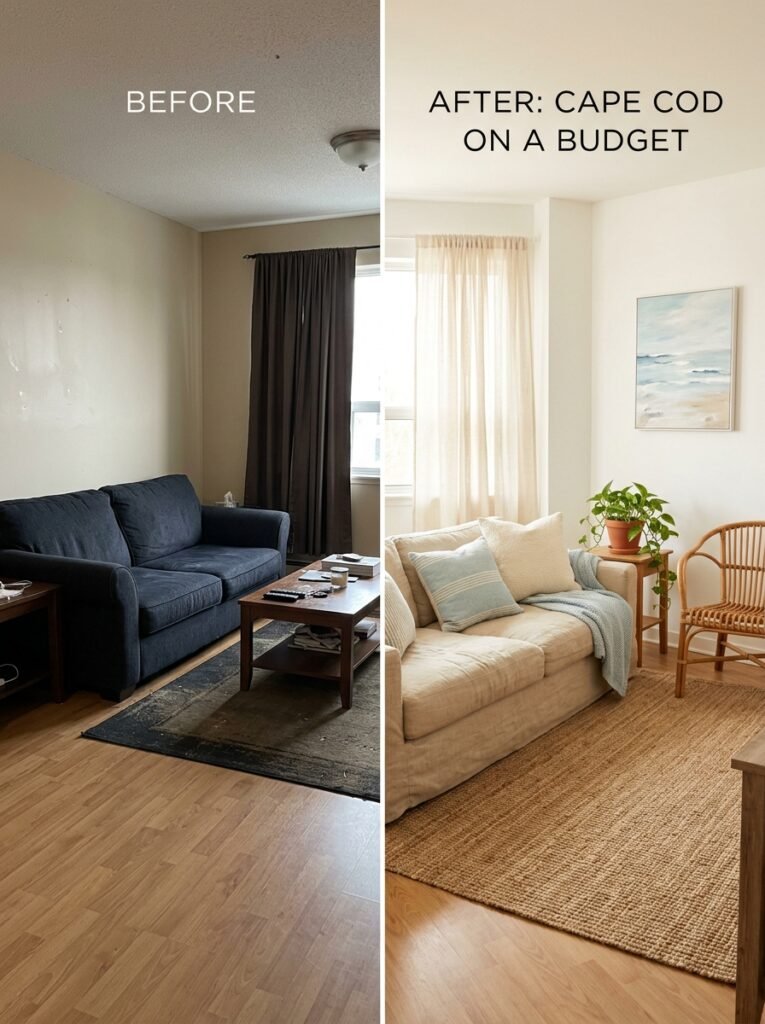
The most liberating thing about Cape Cod interior design is that it is genuinely achievable — regardless of where you live, what your home looks like, or what your budget is. You don’t need an actual Cape Cod cottage on the New England coast. You need intention, patience, and an understanding of the principles that make the style work.
Start with paint. A warm white on the walls costs very little and does more for a Cape Cod atmosphere than almost any other single change. Then layer in texture: a natural rug, a linen throw, some wicker or rattan. Shop secondhand for furniture — you’re looking for pieces with history, not pieces from a showroom floor. Edit ruthlessly. Remove anything that doesn’t feel calm, natural, or meaningful.
The style rewards a slow approach. Add things one at a time, live with them, see how they make you feel. Cape Cod design was never built in a day — it accumulated over generations, and your own version of it can accumulate in the same unhurried way.
—
🌿 How to Take Care of Your Cape Cod Interior
Maintaining a Cape Cod interior is less about strict rules and more about returning to the principles that make the style work in the first place.
Keep white surfaces clean but don’t be afraid of them. White walls can be touched up easily with leftover paint, and a small investment in a quality white touch-up pen handles minor scuffs beautifully. Clean your linen and cotton textiles regularly — they wash beautifully and come back softer each time, which only adds to their charm.
Rotate your natural accents seasonally. Switch out a summer arrangement of shells and sea glass for a winter grouping of pine cones and warm-toned textiles. The style shifts warmly with the seasons without ever losing its identity.
Edit your space at least once a year. Cape Cod interiors breathe because they’re not overcrowded. Walk through each room with fresh eyes and ask honestly whether each object is earning its place. Give away what isn’t. You’ll feel the difference immediately.
Let light be your constant guide. Keep windows clean, keep drapes light enough to let natural light do its work, and resist the temptation to block views with heavy furniture or dark window coverings.
Finally, invest in quality textiles over decorative objects. A beautiful set of linen curtains, a well-made cotton quilt, a generously-sized jute rug — these things make a room feel genuinely luxurious in the quiet, understated way that Cape Cod style does best.
—
❓ FAQ
Q: Can I achieve a Cape Cod interior style in an apartment or urban home? A: Absolutely. Cape Cod style is defined by its principles — light, natural texture, a restrained coastal palette, simple furniture — not by its geography. Shiplap panels, linen curtains, and a warm white paint job can transform an urban apartment into something that genuinely feels like a weekend escape. Focus on the elements you can control and the rest follows.
Q: What’s the difference between Cape Cod style and Hamptons style? A: Both are coastal styles rooted in the New England aesthetic, but Hamptons style tends to be more polished, symmetrical, and formal — with an emphasis on luxury materials and a slightly more curated, magazine-ready look. Cape Cod style is warmer, more relaxed, and has a slightly rougher, more collected feel — mismatched chairs, imperfect patinas, and genuinely worn textures are celebrated rather than avoided.
Q: How do I keep a Cape Cod interior from looking too cold or sterile? A: The key is layering warmth through texture and tone. If your white walls are feeling cold, bring in more natural wood tones, warm-hued textiles like terracotta or faded gold, and extra layers of soft furnishings. Adding more plants and switching to warm-temperature light bulbs (around 2700K) also makes an enormous difference to the overall feel of a room.
—
💭 Final Thought
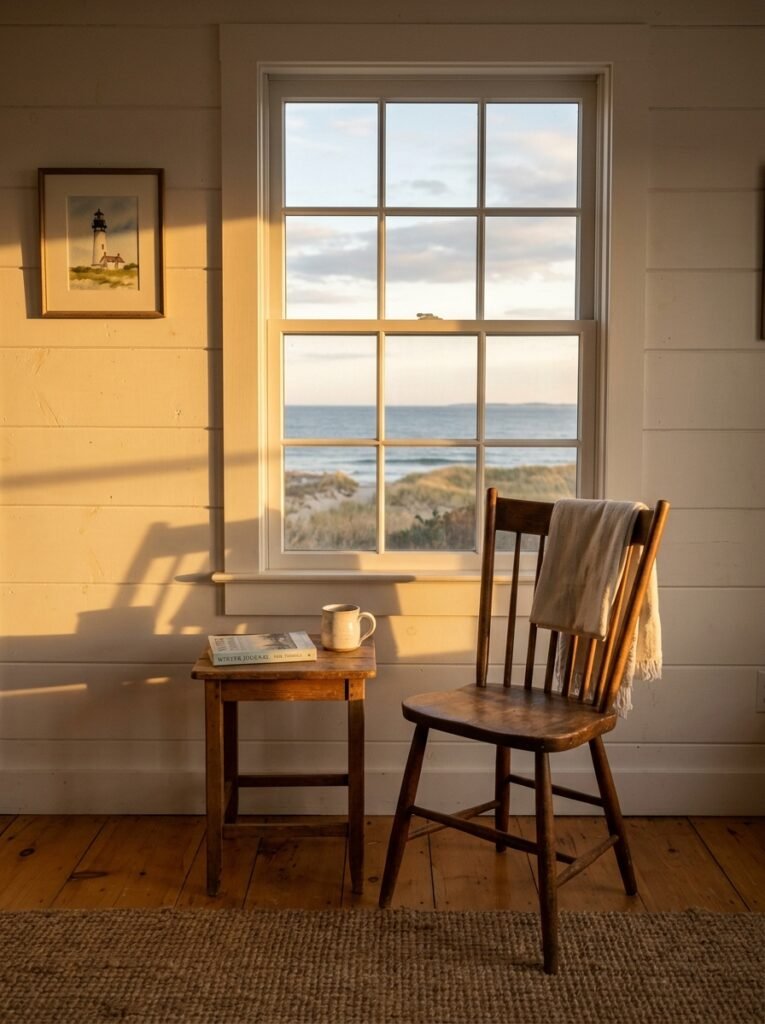
A Cape Cod interior isn’t just a design choice — it’s a daily decision to surround yourself with things that are calm, honest, and quietly beautiful. It’s a reminder, built into the very walls of your home, that simplicity isn’t a sacrifice. It’s a form of abundance.
There’s a reason people return to the Cape Cod aesthetic again and again, decade after decade — because it never stops feeling like home, no matter where in the world you actually are.
So here’s something worth sitting with: if your home is a reflection of how you want to feel every single day, what is yours saying to you right now?