The Quiet Magic of Swedish Cottage Interiors: Why This Nordic Style Feels Like Coming Home
There’s a moment — maybe you’ve felt it — when you step into a room and your shoulders drop, your breath slows, and something inside you says yes, this is it. Swedish cottage interiors have a rare gift for creating exactly that feeling, and it’s worth understanding why.
—
1. The Philosophy Hidden Inside Every Swedish Home

Swedish interior design isn’t just an aesthetic. It’s a worldview. Rooted in centuries of long, dark winters and short, luminous summers, Swedes developed an almost instinctive understanding of how a home should feel — not just how it should look. The concept of lagom, meaning “just the right amount,” sits at the heart of it all. Not too much, not too little. A room that breathes. Furniture that serves a purpose. Light that is welcomed like a guest.
This philosophy emerged from practicality — when winters stretch for months and the sun barely clears the treeline, every design choice either lifts your spirit or drains it. Swedes chose, generation after generation, to lift it.
“A Swedish cottage doesn’t ask you to admire it. It asks you to rest inside it.”
2. Wood: The Soul of the Swedish Cottage
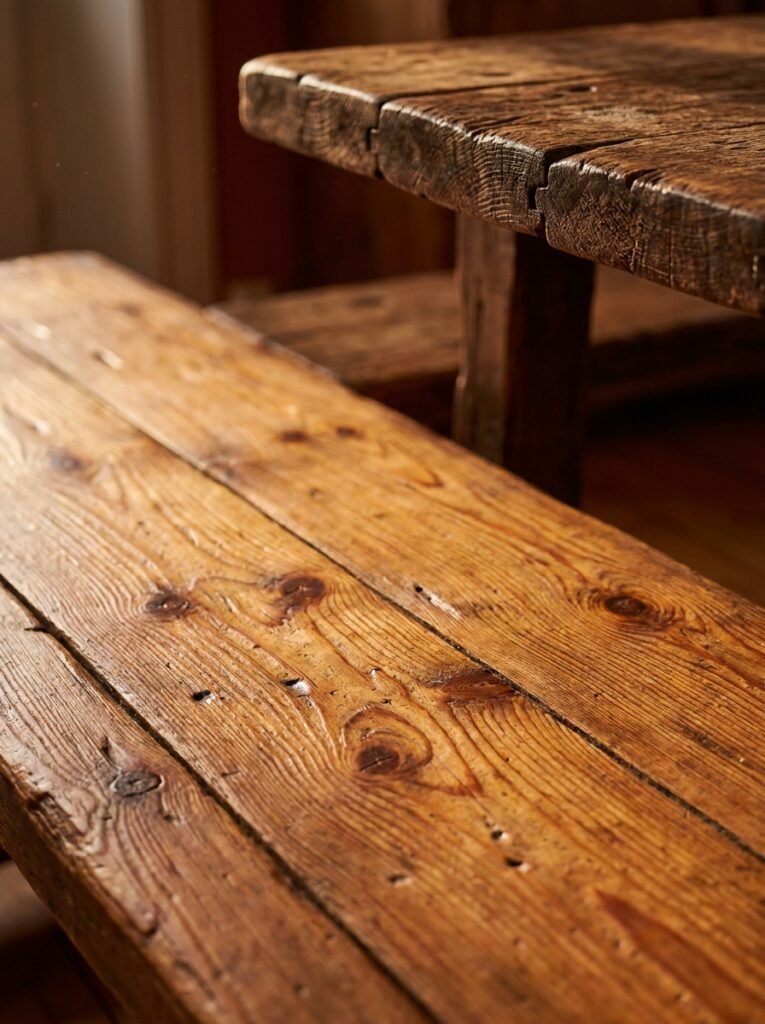
Walk into a traditional Swedish stuga — the Swedish word for cottage — and the first thing you notice is wood. It’s everywhere, and yet it never feels heavy. Pine floorboards worn smooth by decades of stockinged feet. Exposed ceiling beams the color of warm honey. A knotted wooden table at the center of the kitchen, marked by a hundred family dinners.
Swedish carpenters have always worked with nature rather than against it. They didn’t hide the grain or the knots — they celebrated them. Each imperfection tells a story. A dark knot in a floorboard becomes a landmark, something the children learn to step over. This relationship with natural wood gives Swedish cottages a warmth that no synthetic material has ever managed to replicate.
3. The Color Palette That Feels Like a Deep Breath

Close your eyes and picture the Swedish landscape: snow-covered forests, silver birch trees, a pewter-gray sky reflected in a still lake. Now open your eyes inside a Swedish cottage, and you’ll find those same colors translated into interior life. Whites that range from bone to cream. Grays that shift with the light, from dove to slate. Soft blues reminiscent of a winter sky at three in the afternoon.
What makes this palette remarkable is its relationship with light. These are colors that don’t compete with natural light — they collaborate with it. A white-painted wooden wall in a Swedish cottage glows differently at eight in the morning than it does at dusk. The room changes throughout the day, and that quiet transformation keeps the space feeling alive.
4. Windows That Worship the Light

If there is one design element that defines the Swedish cottage more than any other, it might be the window. In a culture where winter darkness is a lived reality — where some regions see as few as four hours of daylight in December — windows are not decoration. They are survival.
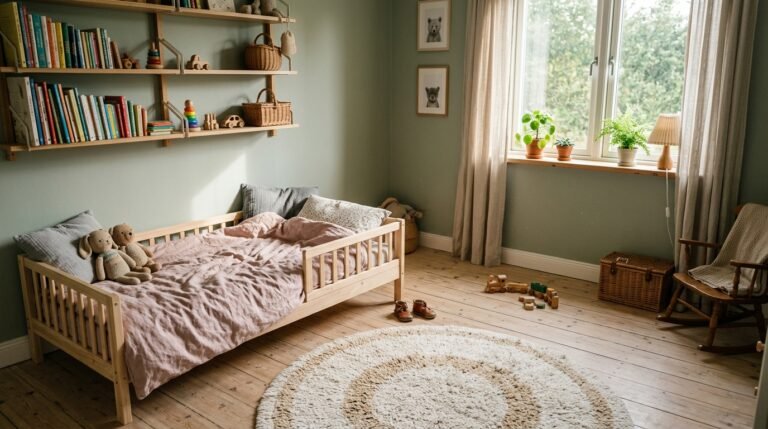
Swedish cottage windows tend to be generously sized, often uncurtained or dressed only with the lightest linen panels. The goal is simple: let every available photon of light pour in. On windowsills, you’ll often find a single candle, a small potted herb, or a simple ceramic object — offerings to the light, in a way. This reverence for natural light is one of the most transferable lessons from Swedish design, no matter where in the world you happen to live.
5. Furniture That Has a Story (and a Second Life)
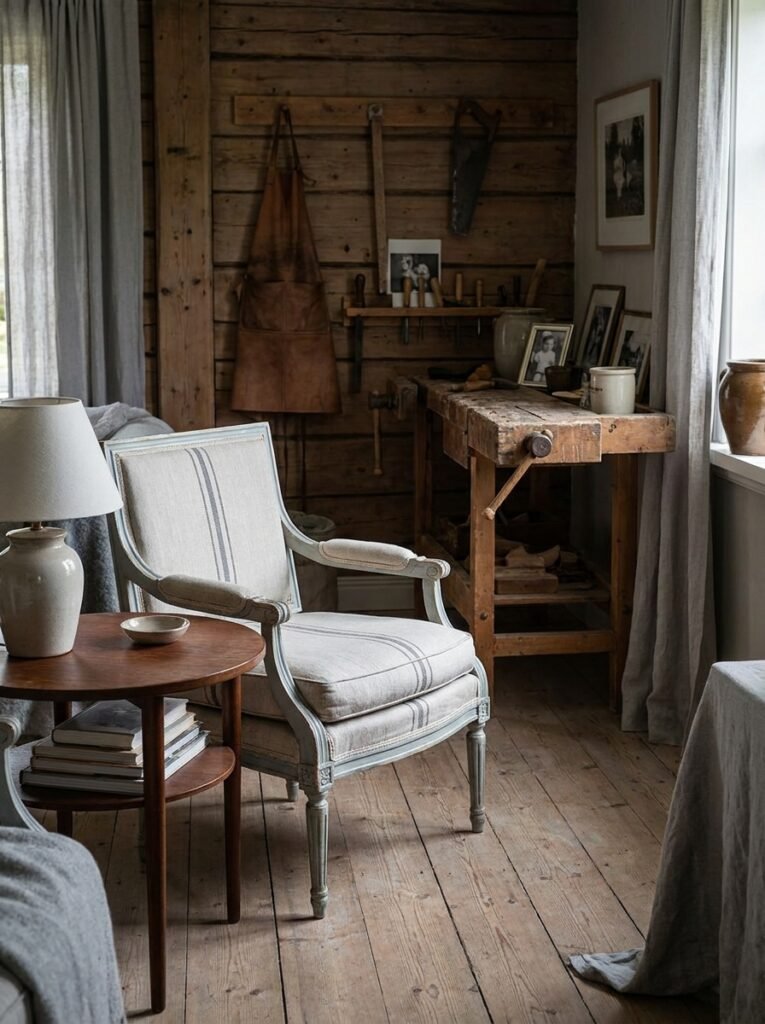
Swedish cottage furniture is almost never bought new. Or rather, it wasn’t meant to be used only once and discarded. A painted Gustavian chair from the 18th century might sit beside a mid-century modern side table and a handmade bench from a local carpenter — and somehow it all works. The Swedes have always understood that a home should accumulate meaning over time, not follow a catalogue.
The Gustavian style — Sweden’s own interpretation of French neoclassicism, simplified and stripped back to its essentials — is particularly beloved in cottage interiors. Think slender-legged chairs painted in soft grays or muted blues, upholstered in ticking stripe or linen. Elegant, but never precious. Made to be used, not preserved under glass.
“Swedish furniture was never meant to be admired from across the room. It was meant to be sat in, leaned on, and loved.”
6. Textiles That Make You Want to Reach Out and Touch
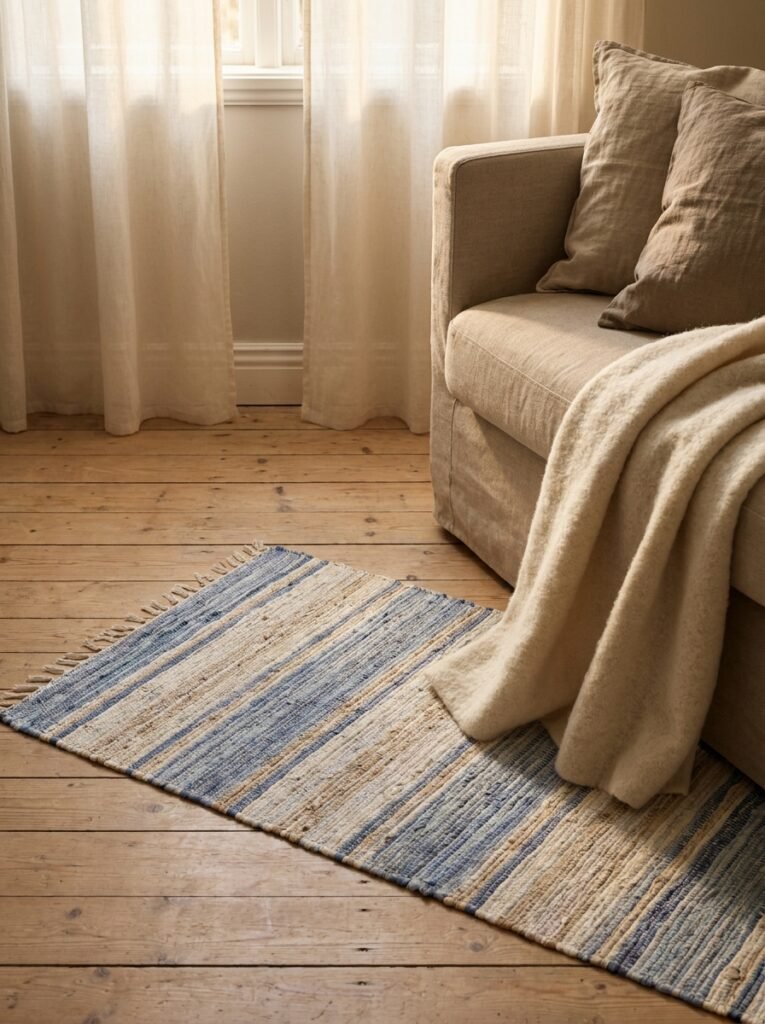
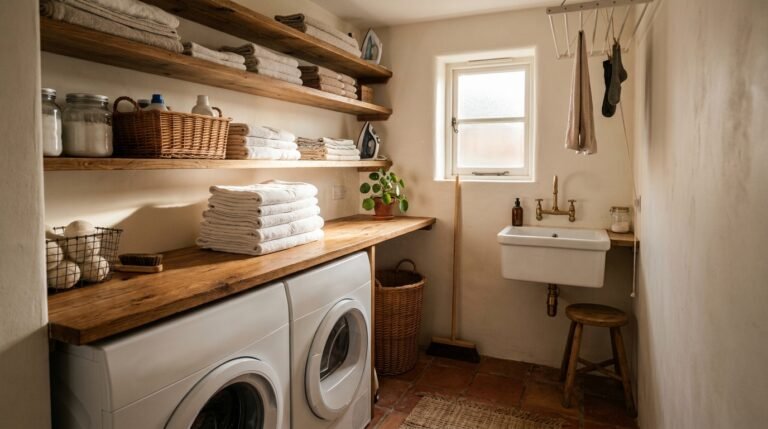
Run your hand along a Swedish cottage interior and you’ll encounter texture everywhere. Linen cushion covers, slightly rumpled and softened by washing. A heavy wool blanket folded over the arm of a sofa, ready for a cold evening. Curtains in undyed cotton that catch the afternoon light and glow faintly. Rag rugs — trasmatta — handwoven from strips of old clothing, layered on bare wooden floors.
These textiles are not decorative accessories. They are the warmth-layers of a home designed for a cold climate, translated into something beautiful. The Swedish approach to textile is tactile and democratic — a handmade rag rug made from worn-out shirts carries the same dignity as a fine linen tablecloth.
7. The Art of the Perfectly Simple Shelf

In a Swedish cottage, the shelf is a stage for a small, curated story. You might find a row of blue-and-white Delft-style pottery. A collection of birch bark boxes, graduated in size. Three candlesticks of different heights. A sprig of dried wildflowers in a simple glass jar. What you won’t find is clutter — or at least, what looks like clutter.
This curation is intentional, and it requires a kind of visual editing that most of us find genuinely difficult. The Swedish approach asks you to hold up each object and ask: does this earn its place? Does it bring beauty, memory, or function? If the answer is no, it quietly disappears. What remains is a shelf that tells you something true about the people who live there.
8. The Fireplace: Center of the Universe

A Swedish cottage without a fireplace — or its more compact relative, the kakelugn, the traditional tiled stove — would be almost unthinkable. These are not amenity features. They are the emotional heart of the home. In a country where the cold is not abstract but deeply physical, the hearth became the gathering point around which family life organized itself.
The kakelugn is an engineering marvel wrapped in beauty — a ceramic-tiled stove designed to burn wood efficiently and radiate gentle heat for hours after the fire has died down. They come in cream, in cobalt blue, in forest green. They stand in corners like quiet sentinels. And they transform any room they occupy into a place where people want to stay.
9. Nature as a Co-Designer

Swedish cottage interiors never really end at the walls. They extend outside — into the garden, the birch forest, the meadow — and they bring the outside back in. A ceramic bowl filled with pine cones gathered on a walk. A branch of pussy willow in a tall vase. A linen tablecloth printed with a wildflower pattern that echoes the meadow visible through the window.
This is not trend-chasing. This is a deeply rooted cultural practice of remaining connected to the natural world, regardless of the season. In winter, evergreen branches and candlelight. In summer, armfuls of meadow flowers in mismatched jugs. The home breathes with the seasons, and it never feels static.
“A Swedish cottage holds the forest inside it, even in the middle of winter.”
10. Candlelight: Sweden’s Secret Ingredient
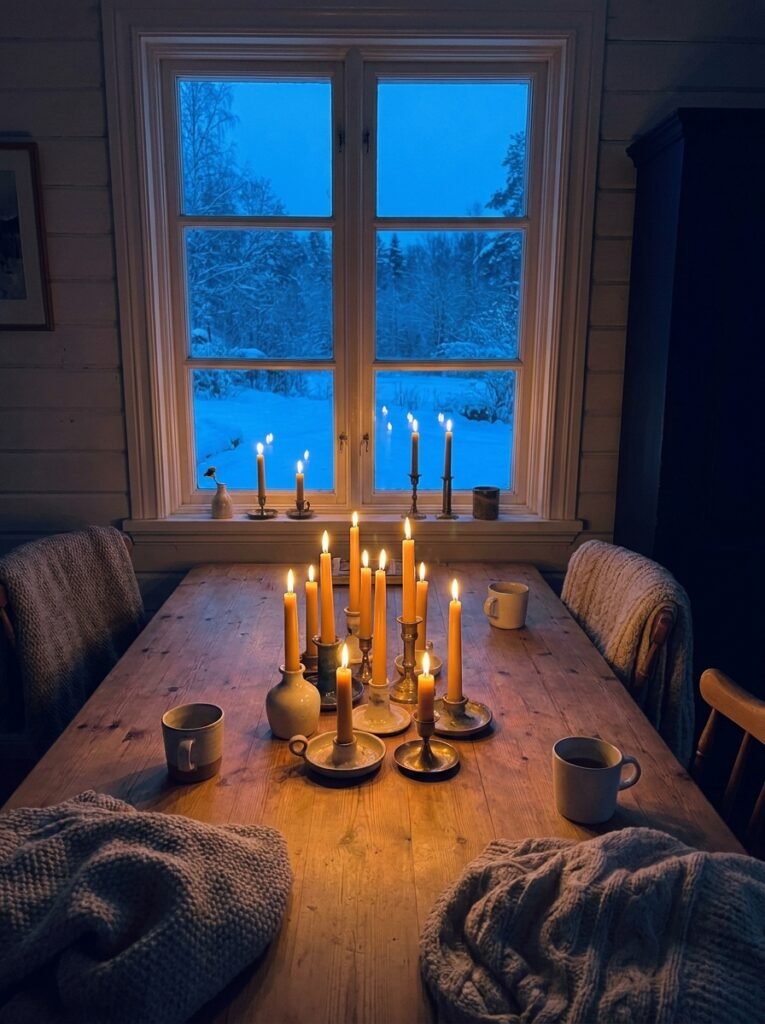
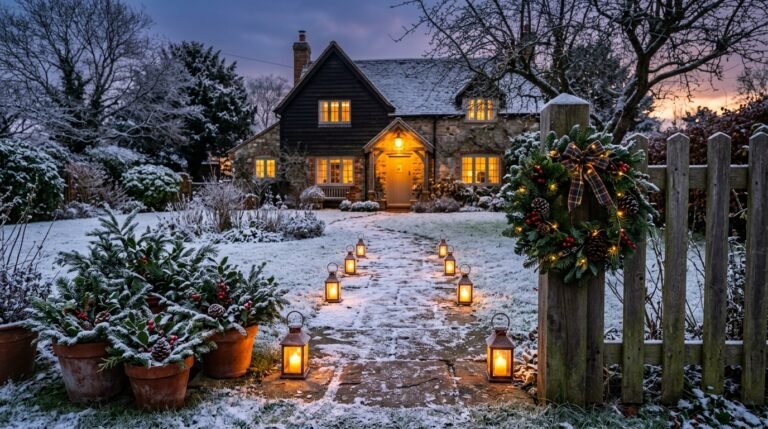
No discussion of Swedish interiors is complete without candles. Swedes burn more candles per capita than almost any other nation on earth, and inside a Swedish cottage, you understand immediately why. Candles are not romantic gestures or dinner party props here — they are daily necessities. They line windowsills in multiples. They cluster on dining tables. They glow from lanterns on the porch.
The effect is transformative. Candlelight softens every edge in a room. It makes white walls warm. It turns a simple wooden table into a gathering place. It creates what the Danes call hygge and the Swedes call mysigt — a state of coziness and contentment that is almost impossible to achieve with overhead fluorescents.
11. The Beauty of Functional Objects

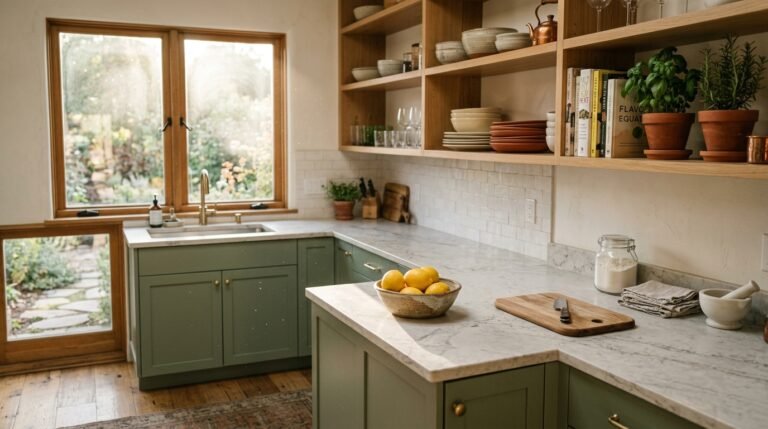
Sweden has a long tradition of craftsmanship that blurs the line between art and utility. In a Swedish cottage, the objects that serve practical purposes are also objects worth looking at. A hand-thrown ceramic mixing bowl. A carved wooden spoon. A copper pot hanging from a ceiling hook. A hand-stitched linen apron on a peg by the kitchen door.
This tradition — rooted partly in necessity and partly in a deep respect for skilled making — means that Swedish cottage kitchens and workrooms have an aesthetic integrity that design-obsessed rooms often lack. Nothing is purely decorative. Everything is beautiful because it works.
12. The Feeling That Lingers After You Leave

Here is what makes Swedish cottage interiors extraordinary: they are felt more than they are seen. You can photograph a Swedish cottage — and thousands of people do, filling inspiration boards with images of pine floors and linen curtains and tiled stoves — but the photograph never quite captures it. It can’t capture the smell of beeswax and woodsmoke. It can’t capture the way the light moves across a white wall over the course of an afternoon. It can’t capture the specific silence of a room that has been designed to let you rest.
The Swedish cottage is a complete sensory experience, built from centuries of accumulated wisdom about how human beings need to live. And that is why, when you step inside one — or a room designed in this spirit — something in you quietly recognizes it as right.
—
🌿 How to Bring Swedish Cottage Style Into Your Own Home
You don’t need to relocate to Dalarna to live inside this feeling. A few thoughtful choices go a long way.
Start with light. Remove heavy curtains and let natural light lead the way. If your windows are small, place a mirror opposite them to double the brightness in the room. Add candles — real ones, preferably unscented beeswax — and use them every evening, not just on special occasions.
Choose natural materials deliberately. Linen, wool, pine, birch, ceramic, and cotton are your palette. Introduce them gradually — a linen cushion cover here, a wooden cutting board displayed rather than hidden there. Let them age naturally and don’t panic when they show wear. That wear is the point.
Edit, then edit again. Swedish cottage interiors are not minimal in a cold, austere way. They are curated in a warm, personal way. Go through each surface in your home and remove anything that doesn’t earn its place. What remains should feel like you.
Let nature in, seasonally. Buy a bunch of wildflowers from a market. Collect a few pine cones on a walk. Put a branch of something seasonal in a tall vase in a corner. These small gestures reconnect your home to the living world outside its walls.
Invest in one handmade thing. A hand-thrown mug, a woven rug, a carved wooden bowl. Objects made by human hands carry a warmth that mass production cannot replicate, and a single handmade piece can shift the feeling of an entire room.
—
❓ FAQ
Q: What is the difference between Swedish cottage style and Scandinavian minimalism? A: Swedish cottage style is warmer, more personal, and more rooted in tradition than the clean-lined minimalism often associated with broader Scandinavian design. It embraces patina, handmade objects, vintage furniture, and layered textiles, whereas contemporary Scandinavian minimalism tends to favor sleek surfaces and restraint. Think of Swedish cottage style as minimalism with a beating heart.
Q: What colors work best for a Swedish cottage-inspired interior? A: The most authentic palette draws from the Swedish landscape — warm whites, soft grays, muted blues, sage greens, and the natural tones of unfinished wood. Gustavian interiors sometimes feature soft gray-blue painted furniture. Avoid bright, saturated colors; the goal is a palette that collaborates with natural light rather than competing with it.
Q: Can Swedish cottage style work in a small apartment? A: Absolutely — in fact, the Swedish approach to space is ideally suited to smaller homes. The emphasis on light, careful editing, natural materials, and meaningful objects means you’re not trying to fill space but to create a feeling. A single white-painted bookshelf, a rag rug on a wooden floor, and a row of candles on a windowsill can transform even a compact studio into somewhere that breathes.
—
💭 Final Thought
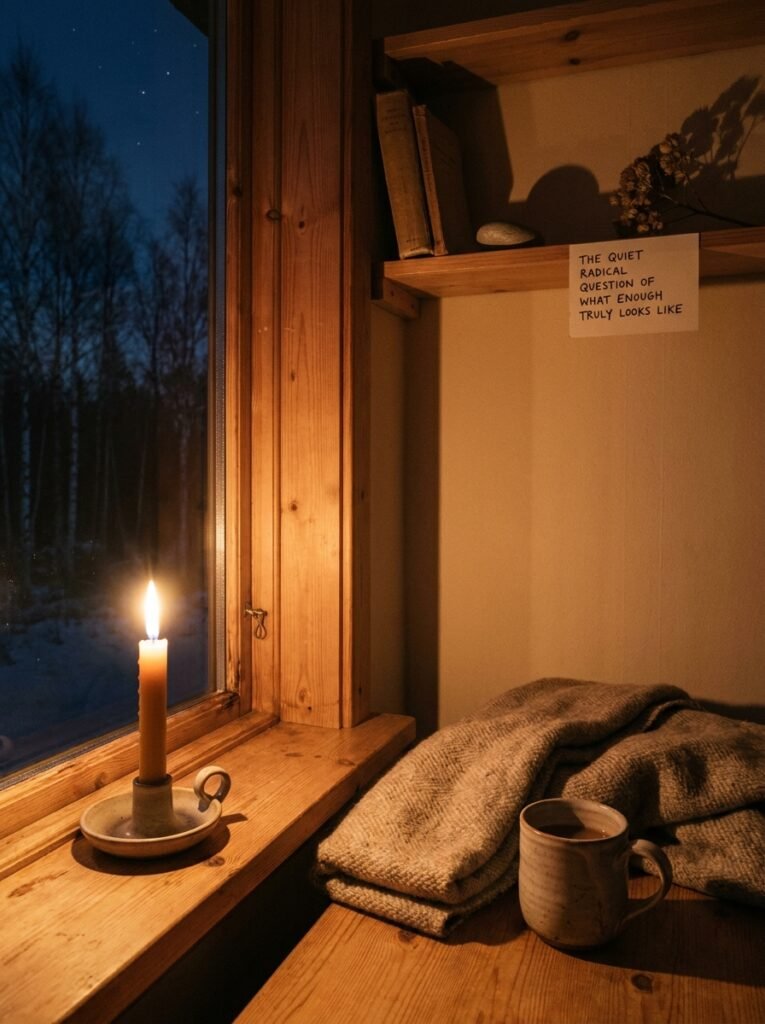
There is something quietly radical about a design tradition that asks, first and foremost, how does this room feel? Not how does it photograph, not what does it cost, not does it follow this season’s trends — but simply: will the people inside it feel rested, warm, and at home? Swedish cottage interiors have been answering that question with grace for centuries. And in a world that moves faster every year, that grace feels more necessary than ever.
So perhaps the real question is this: what would it mean to design one corner of your own life around the idea of enough — just the right amount of beauty, just the right amount of warmth, just the right amount of light?