The Small Living Room That Feels Like a Five-Star Hotel (Without the Price Tag)
You walk in and something just feels right. The room is small — you know it’s small — but it doesn’t apologize for that. It has weight, warmth, intention. That feeling? It’s completely achievable, and it has nothing to do with square footage.
—
1. Why “Small” and “Luxurious” Are Not Actually Fighting Each Other
Here’s the thing most interior design advice gets wrong: it treats small rooms as a problem to be solved rather than a character to be leaned into. Every tip becomes about tricking the eye, faking space, creating illusions. And the result? Rooms that feel neither spacious nor cozy. Just vague.
The apartments and flats that genuinely stop you mid-scroll on Pinterest — the ones that look like they belong in a boutique hotel in Florence or a beautifully restored Georgian townhouse in Edinburgh — they are almost never enormous. What they have is deliberateness. Every single object earns its place. Every corner has been thought about.
Simple luxury in a small living room isn’t about spending more money. It’s about spending more attention. When you stop trying to hide your room’s dimensions and start working with them, something shifts. The low ceiling becomes intimate. The narrow footprint becomes curated. The limited wall space becomes a gallery.
Stop fighting your room. Start listening to it.
“A small room that knows what it is will always beat a large room that doesn’t.”
—
2. The One Furniture Mistake That Makes Every Small Room Feel Cheaper
Tiny furniture in a tiny room. This seems logical. It is not.
Filling a small living room with small-scale, lightweight furniture — a little loveseat, a spindly side table, a rug that barely fits under the coffee table — creates a room that looks like a waiting area. Everything floats. Nothing anchors. The room feels uncertain.
What actually works is one or two pieces of genuine visual weight. A substantial sofa in a rich fabric — a deep charcoal boucle, a warm caramel leather, an inky velvet — becomes the room’s backbone. Everything else can be lighter, lower, more minimal. But that one anchor piece says: this room means business.
In a British terraced house living room, this might mean a two-seater with deeper seats and a proper high arm. In a New York studio or a Chicago apartment, it could be a low-profile sectional that claims a corner and defines the space. Either way, you’re choosing one hero and letting it hold the room together.
The rug matters just as much. Too small and the room looks like it couldn’t afford the right size. Go bigger than feels comfortable. The front legs of every seating piece should sit on it. That single decision pulls the whole room into one cohesive, expensive-looking whole.
—
3. The Color That Keeps Showing Up in Every Beautiful Small Living Room Right Now
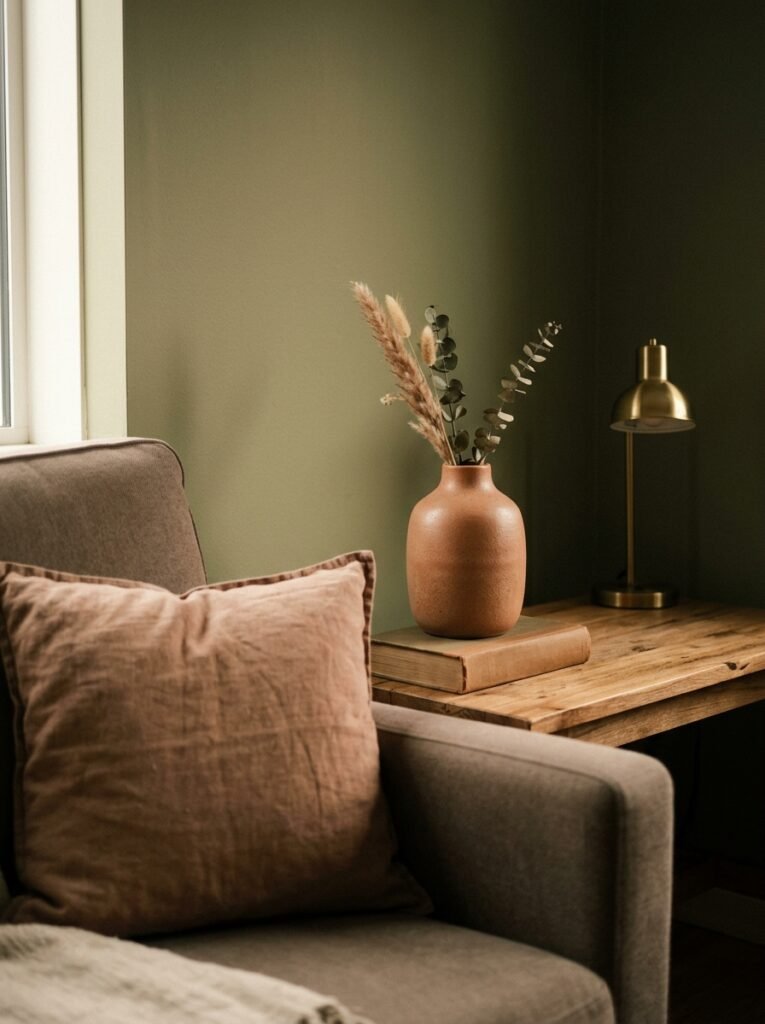
Not white. Not grey. Not the safe, neutral, “opens up the space” choice that everyone defaults to.
It’s deep, moody, committed color. Teal. Warm terracotta. Dusty sage that tips toward olive. That particular shade of navy that looks almost black in the evening but warms to a rich blue-green in morning light.
The reason? Dark colors on walls in a small room do something counterintuitive and completely wonderful — they make the walls recede. The boundaries of the room become soft. The furniture pops forward. And everything glows in the evening light in a way that simply never happens in a white room.
In the UK, farrow & ball’s Down Pipe, Hague Blue, and Mole’s Breath have been transforming small Victorian and Edwardian living rooms for years. In the US, Benjamin Moore’s Newburyport Blue or Sherwin-Williams’ Urbane Bronze do the same work. These aren’t trends. They’re just colors that understand how light and space actually behave.
Paint one wall. Paint all four. Either works. What doesn’t work is painting three and leaving one white “to keep it light.” Commit. The room will reward you.
—
4. Lighting Is the Thing You’re Probably Getting Wrong
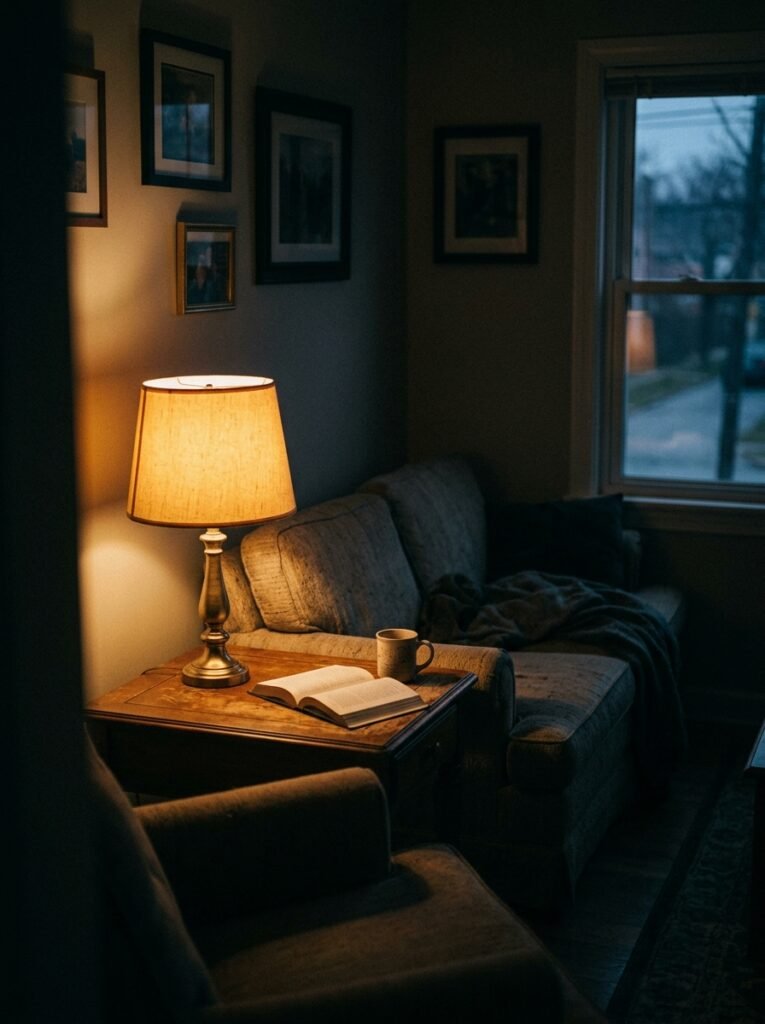
Most small apartments and flats rely on one overhead light and maybe a floor lamp. The result is a room that looks like a rental — flat, uniform, forgettable.
Real luxury is layered light. The amber glow of an Edison bulb at 7pm, warm and low. A reading lamp at precisely the right height next to the sofa. A small table lamp on a shelf casting a pool of light in a corner that was previously dead space. Candles, plural, grouped in odd numbers.
The key is to eliminate overhead lighting as your primary source almost entirely in the evenings. Use it during the day, absolutely. But once the sun goes down, switch to lamps only. This single habit will make your living room feel like an entirely different — and significantly more expensive — space.
In a room without much floor space, wall-mounted sconces are extraordinary. They create light at exactly the right level, they don’t take up a square inch of floor, and they look architectural in the best possible way. A pair of simple brass or matte black sconces flanking a mirror or a piece of art transforms an otherwise ordinary wall into something deliberate.
Dimmable bulbs. Always. Non-negotiable.
“The most expensive thing in a beautiful room is usually the light — and it costs almost nothing to get right.”
—
5. What a Mirror Is Actually For (Hint: Not Just Making the Room Look Bigger)
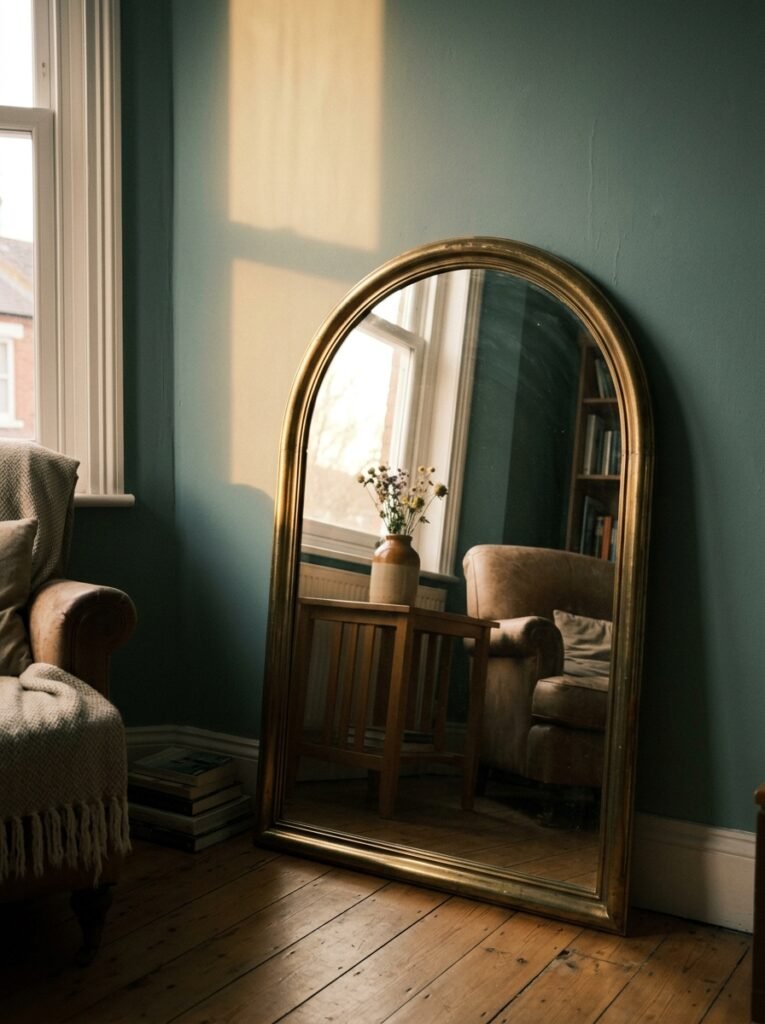
Yes, mirrors reflect light and create a sense of depth. You’ve heard that. But the real power of a well-placed mirror in a small living room is that it makes the room feel considered.
A large, leaned mirror — not hung perfectly straight, but leaned casually against a wall — communicates confidence. It says someone made a choice here. A round mirror above a fireplace or a console table creates a focal point that stops the eye without adding visual clutter.
The key word is large. A small mirror on a small wall in a small room is just a small mirror. A genuinely oversized mirror — something that feels almost too big — becomes architecture. It’s a design element, not just a reflective surface.
In British interiors right now, there’s a particular love for ornate vintage mirrors — gilded frames, slightly foxed glass, something that looks like it came from a French flea market. In American apartments, the lean toward clean, minimal round or arch-top mirrors is everywhere. Both work brilliantly. What matters is scale and intention.
One good mirror, placed well, does more work than ten pieces of small decorative filler.
—
6. The Shelf Styling Secret That Interior Designers Actually Use
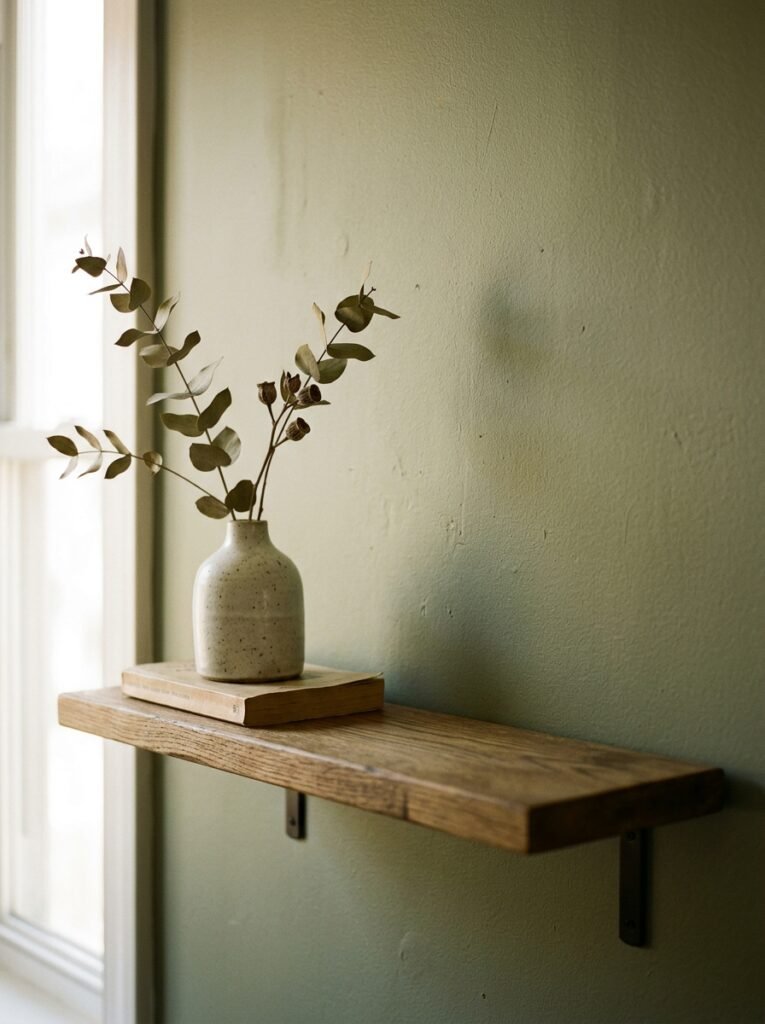
Open shelving in a small living room can look expensive and curated, or it can look like a junk drawer with ambitions. The difference comes down to one principle: the ratio of objects to empty space.
Most people overfill shelves. They treat available shelf space as a problem to be solved rather than a canvas to be composed. The result is visual noise that makes even a well-decorated room feel cluttered and small.
The rule that works: for every three objects, leave one full shelf section empty. Let things breathe. Group items in odd numbers — threes and fives. Vary the height and texture constantly: a tall sculptural vase next to a short stack of books next to one single interesting object at eye level. Repeat a material across multiple shelves — brass, ceramic, natural wood — to create cohesion without uniformity.
Plants count as objects, and they do a specific kind of work that nothing else does. A trailing pothos or a sculptural fiddle leaf in the right corner adds life, softness, and a quality of care that makes a room feel genuinely lived-in rather than staged.
—
7. The One Rule That Makes Any Tiny Room Feel Intentional
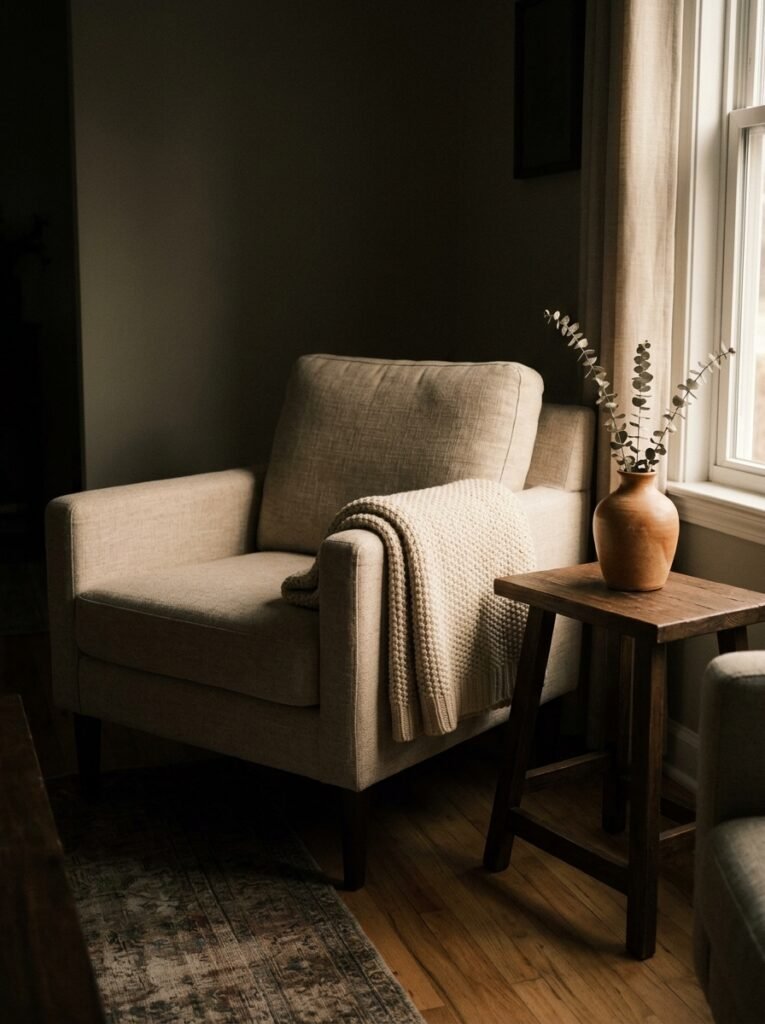
Edit. Then edit again.
This is the most unglamorous piece of advice and it is also the most important. Small luxury living rooms are not decorated — they are curated. The difference is removal.
Walk through your living room and look at every single object. Ask one question: does this earn its place? Not “is it sentimental” or “could it be useful” or “do I like it” — those are different questions. Does it earn its visual place in this specific room?
The things that don’t earn their place don’t have to go in the bin. They go somewhere else. In a box. In another room. On the shelf in the hallway. You’re not throwing away your life, you’re simply choosing what the room gets to say about you.
The rooms that look extraordinary in photos — the ones that get pinned thousands of times — are almost always rooms with fewer things than you’d expect. The eye lands somewhere and rests. There’s no visual competition. Every object is chosen and placed, not accumulated and tolerated.
Removing things is decorating. This is the part that costs nothing and changes everything.
“Clutter isn’t cozy. Clutter is just postponed decisions.”
—
8. Textiles: The Fast, Reversible Way to Make Everything Feel More Expensive
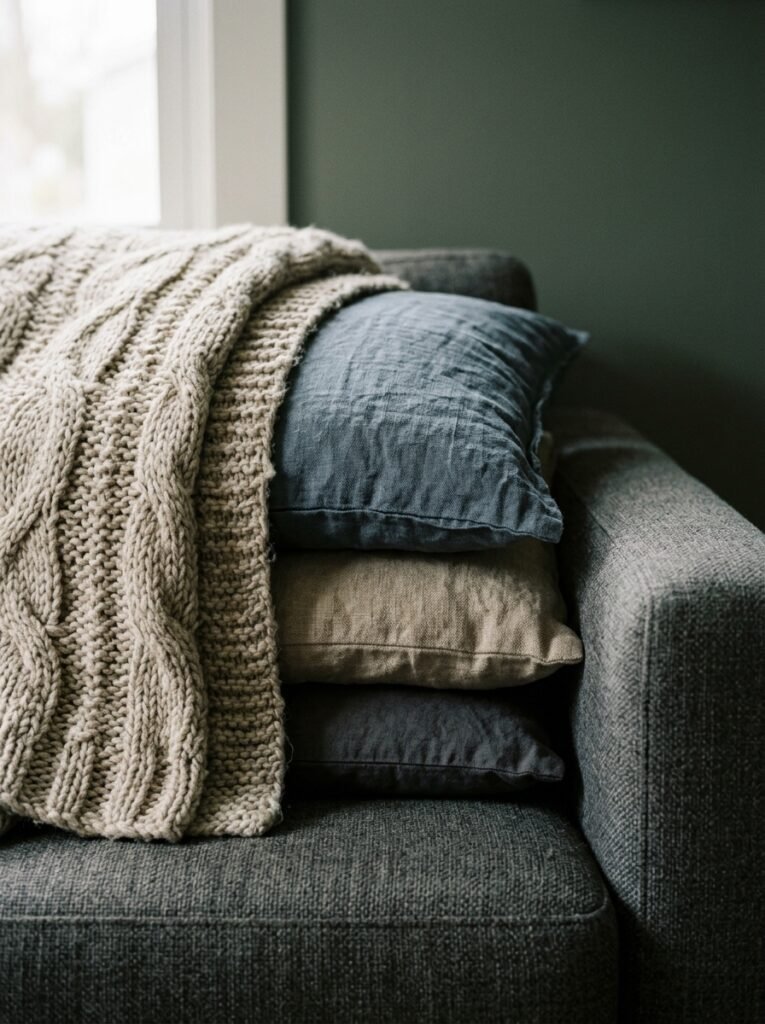
Cushions, throws, rugs, curtains. These are the things that make a room feel lived-in, warm, and genuinely soft in a way that furniture alone never can.
In a small room, the temptation is to keep textiles neutral and minimal. And neutrals are fine — warm putty, soft oatmeal, aged linen — but the texture has to be extraordinary to carry the room. Chunky boucle, waffle-weave cotton, a throw that genuinely feels good in your hand, curtains that are lined and pooled slightly on the floor.
The curtains point deserves emphasis. Hang your curtains high — at ceiling height, or close to it — and let them reach the floor. In a small British front room or a compact American apartment, this single change makes ceilings feel taller and windows feel more architectural. Budget curtains hung at ceiling height look better than expensive curtains hung at the window frame.
Velvet cushions in a deep jewel tone against a neutral sofa are currently doing a lot of heavy lifting in small living rooms across Instagram and Pinterest. Emerald, plum, rust. They’re warm, they’re rich, and they photograph beautifully — but more importantly, they feel genuinely luxurious when you sit down at the end of the day.
—
9. The Console Table and Why It Fixes Everything
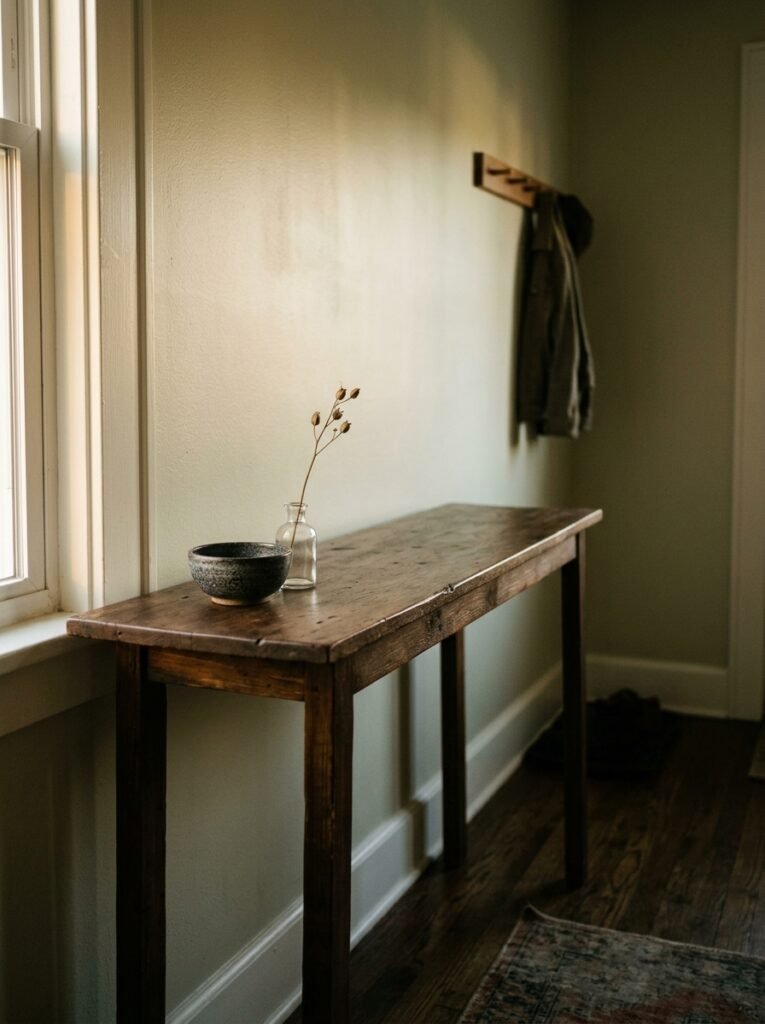
A narrow console table is one of the most underused pieces in small living room styling. It gives you a surface without stealing floor space. It creates a visual layer. It solves the awkward-wall problem better than almost anything else.
Behind a sofa, a console table creates a meaningful zone between seating and the rest of the room. On it: a lamp, a plant, a stack of books, one beautiful object. It grounds the room and makes it feel considered in a way that a sofa floating in the middle of the space never does.
Against a wall in a narrow British terrace hallway-to-living-room flow? Same principle. It fills the gap between functional and beautiful.
In a really small space, choose a console with some openness below it — hairpin legs, a thin frame, a glass lower shelf — so it doesn’t block the visual flow at floor level. You get the surface and the style without adding visual weight.
—
10. What Every Expensive-Looking Small Room Has Exactly One Of
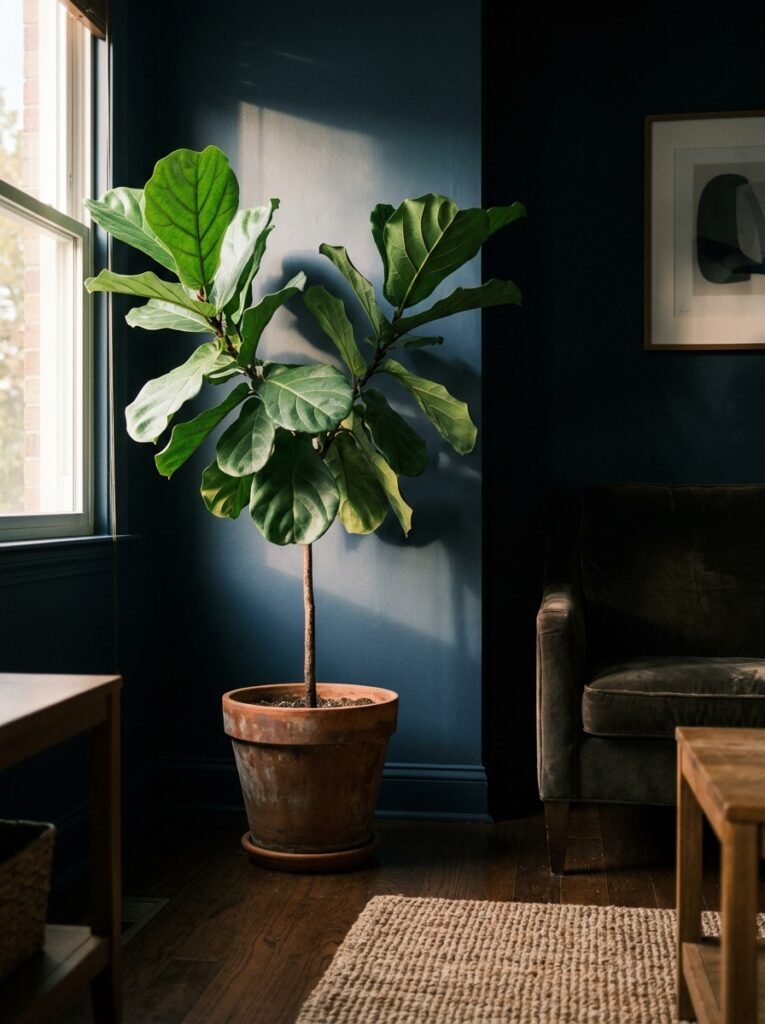
A focal point.
Not five focal points competing. One.
It might be a fireplace, real or decorative. It might be a single large piece of art hung low and close to eye-level, with everything in the room quietly nodding toward it. It might be a wall painted in a deep color while the rest stays neutral. It might be a beautifully styled bookcase that covers an entire wall.
One thing that the room is about. One place the eye arrives and rests.
In small rooms, this matters more than in large ones precisely because there’s less space to spread the story. The room needs one clear thing to say. When you give it that clarity, the room instantly feels more cohesive, more designed, and — yes — more luxurious.
Find your focal point. Then arrange everything else in service of it.
—
11. The Decorating Move That’s All Over British and American Pinterest Right Now
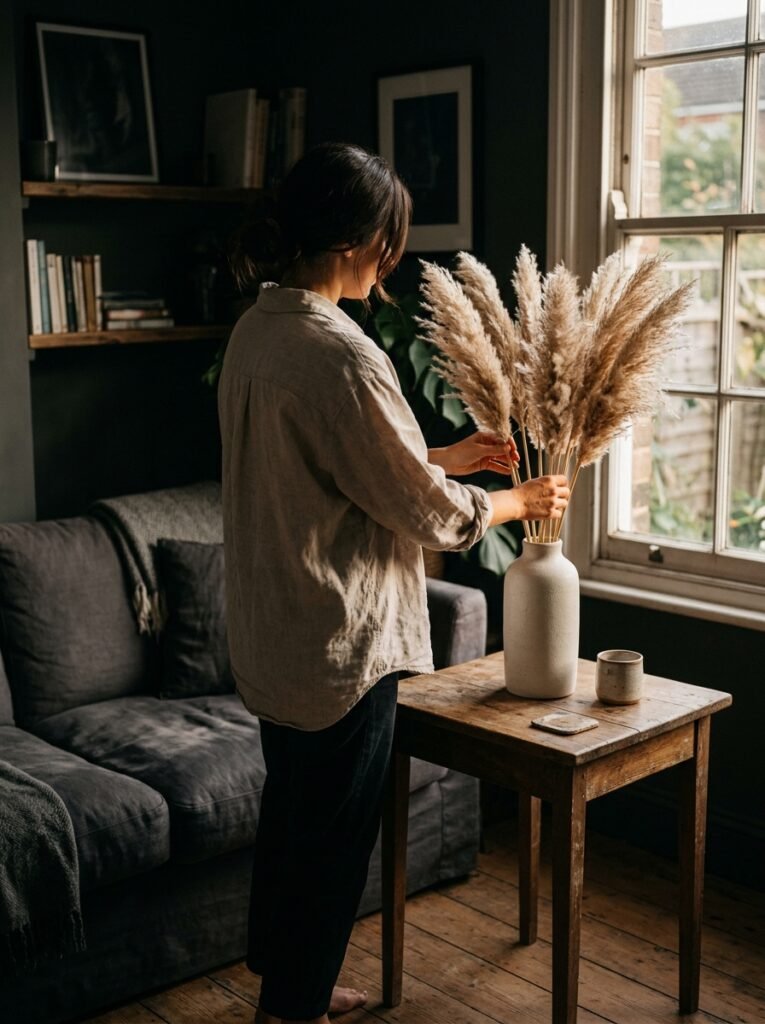
Leaning things. Not hanging them — leaning them.
A large piece of art leaned against the wall. A mirror propped on a console. A framed print resting on a windowsill or a floating shelf rather than hung. This aesthetic choice is everywhere right now and for very good reason: it looks effortlessly intentional. It says the room evolved rather than being assembled.
For small living rooms specifically, the lean has a practical advantage too. You’re not committing holes in rented walls. You’re not locked into one arrangement. And there’s something genuinely less precious about a leaned piece that makes the whole room feel more relaxed and liveable.
Layer a large leaned print or canvas against a wall, and in front of it prop a smaller framed photograph or art card. Suddenly you have depth and dimension that a single hung piece never creates.
—
12. The Detail That Guests Always Notice First (And It Costs Almost Nothing)
Scent.
Not a plug-in air freshener. Not a scented candle burning in the kitchen. A diffuser or a quality candle — something with genuine depth rather than synthetic sweetness — in the living room itself.
The rooms that feel like boutique hotels, that feel like someone lives beautifully — they almost always have a scent. Warm and woody, like sandalwood or cedar. Green and slightly herbal, like eucalyptus or fig. Something that registers before you’ve even looked at the decor.
This is a sensory layer that costs five or ten pounds or dollars and works around the clock. It changes the feeling of entering a room on a cold evening. It makes everything around it feel more considered.
Pair it with one beautiful candle for evenings and the olfactory design of your small living room is complete. Your guests won’t know why it feels expensive. They’ll just know that it does.
—
🌿 Quick Tips
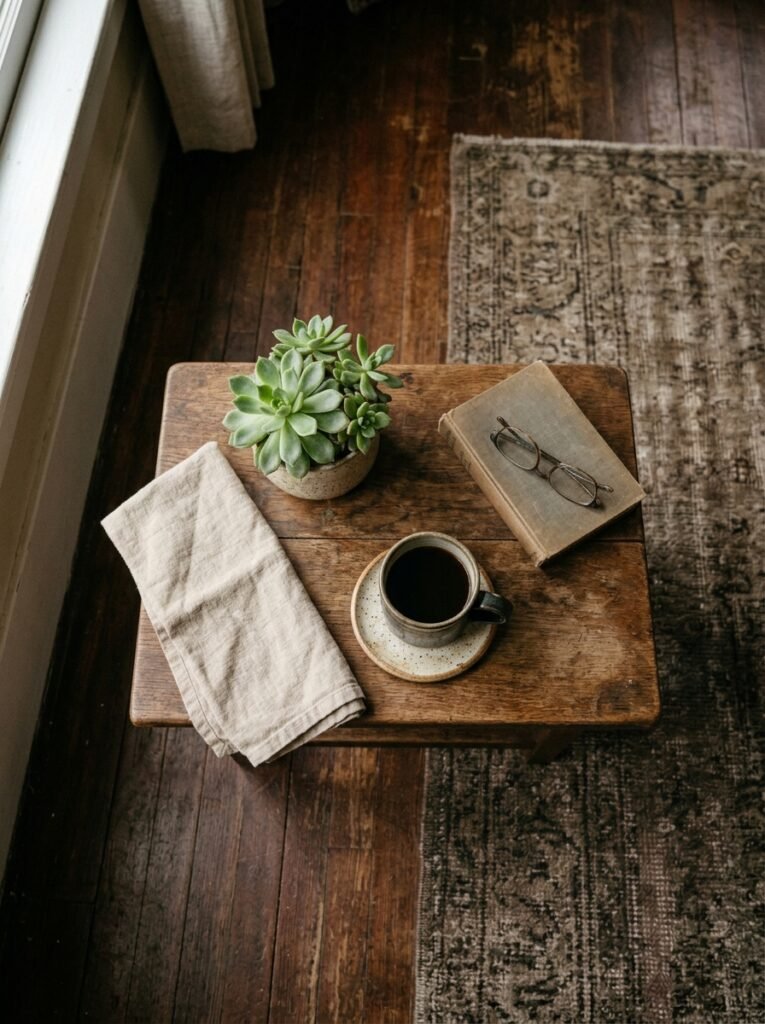
Start with the rug — size up from what feels comfortable and watch the whole room pull together. Swap overhead lighting for lamps after 5pm and keep a dimmer switch on everything. Choose one great throw and one great cushion cover in a rich fabric rather than five cheap ones. If you can’t change the wall color, change the art — one large piece does more than a gallery wall in a small room. Finally, tidy the surfaces down to three objects each, leave a little empty space, and feel the room breathe.
—
❓ FAQ
Q: How do I make a small living room look expensive on a really tight budget? A: Start with lighting and editing. Move every lamp you own into the living room and remove one piece of furniture or decor. These two actions — layering light and subtracting clutter — cost nothing and create more impact than almost any purchase you could make. Then, if you have a small amount to spend, put it into one genuinely good throw or a larger rug.
Q: What colors should I avoid in a small British or American living room? A: Cold, stark whites without any warmth tend to read as clinical rather than spacious in rooms with average light — particularly in UK homes where the light is softer. Avoid very cool greys for the same reason. If you want pale, lean toward warm off-whites and creams. And honestly, don’t be afraid of deep color — it often makes small rooms feel more intentional than pale neutrals ever do.
Q: I’m renting — can I still make my small living room look luxurious without damaging anything? A: Yes, and arguably renting focuses your attention in a useful way. Lean large art rather than hanging it. Use adhesive strips for smaller frames. Invest in a great rug, beautiful textiles, and layered lighting — all removable, all impactful. Paint is often the biggest game-changer for renters who can get permission, but even without it, a deeply styled room with extraordinary textiles and lighting can feel genuinely luxurious.
—
💭 Final Thought
Small living rooms don’t need more space. They need more intention. The rooms that stop us mid-scroll on Pinterest aren’t stopping us because they’re enormous — they’re stopping us because something in them has been genuinely thought about, and that care is visible in every corner.
Your room can feel that way too. Not eventually, with a renovation. Now.
What’s the one thing in your living room that’s been there for years but never quite earned its place?